

In China, the household registration system has restricted the integration of China's hundreds of millions of internal migrants by excluding people who are not locally registered from accessing all of a locality's public services, such as health care, subsidized housing, pension schemes, and education. The registration system has led to the institutional exclusion of migrants in China's cities, and has left many migrants with a kind of second-class citizenship (Solinger Reference Solinger1999; Wu and Webster Reference Wu and Webster2010, 1). Yet today migrants often have a choice of whether or not to transfer their household registration to their migration destination, even if this choice entails costs which vary across cities. That many migrants have not chosen to transfer their registration when given the option has prompted debate about the importance of the registration system serving as an impediment to migrant integration.
In order to better understand migrant integration in reform-era China, this article examines the importance of rural institutions to the process of migrant integration, including both attitudes towards registration transfer and social integration. While some previous studies have posited a connection between rural factors and migrant integration, in this article we develop a simple model for understanding migrants' decision-making, bring together several data sources which can be used to examine these questions, use this data to conduct new empirical tests of hypotheses both from the literature and derived from the model, and make an original argument about the effect of rural factors on migrants' social integration in Chinese cities. Namely, we argue that the variable value of rural registrationFootnote 1 influences migrants' decision-making with regard to registration transfer, resulting in migrants with land and migrants from rural areas with relatively higher levels of economic development being measurably less interested in registration transfer to this city. Furthermore, since the household registration is connected to social integration in the process of shiminhua– transforming into urban citizens—the institutional integration signified by local urban registration is linked to other types of integration. Thus, we posit that the effect of these rural factors extends beyond migrants' decisions about adoption of local urban registration to influence migrants' levels of social integration in the cities as well.
Migrant integration, both institutional and social, is important not only to the welfare of China's hundreds of millions of migrants but also to China's economic plans which are premised on building internal consumption through urbanization. Based on our analysis of survey data, data from official sources, and interviews with the stakeholders, we find that migrant integration in China's cities is connected to factors in the migrants' sending areas. Specifically, we build on the findings of Cai and Wang (Reference Cai and Wang2007) to find that not only is landholding negatively correlated with the desire for registration transfer, but that greater level of economic development in the migrants' sending areas are also negatively correlated with migrants' desire for registration transfer to the destination city. Additionally, we estimate the effects of landholding and rural land rights on two measures of migrant social integration, living in an area with many people from the same area of origin and the number of New Year's greetings delivered to others in the city. We find that both landholding and the strength of rural land rights are correlated with measures of migrants' social integration in their destination areas; landholding is inversely correlated with social integration while stronger land rights is positively correlated with social integration.
THE REGISTRATION SYSTEM, RURAL INSTITUTIONS, AND MIGRATION IN CHINA
China's household registration (hukou) system can prevent migrants from taking advantage of local public services in the cities where they work. The system creates a legal barrier between the local and migrant populations of China's cities and preserves China's migrants as a legally distinct population. Because registration transfer to the city is often onerous, the household registration system is unquestionably the greatest obstacle to migrants' integration into the cities, and it is doubtful that it will be fully abolished in the near future, despite perennial calls for its abolishment and the current leadership's stated desire for substantive reform and increased urbanization. Moreover, there is a misconception among some that all migrants desire urban registration. For example, Chan (Reference Chan2012) argued that “Given the disparities between the two major hukou [registration] types, people with agricultural [rural] hukou will always wish to convert to the non-agricultural [urban] category.” As we will see below, this assumption has been contradicted by surveys reporting that migrants often do not desire registration transfer and by the observation that relaxation of the system in some cities has failed to effect waves of transfers.
As local reforms have proceeded, migrants' attitudes towards registration transfer and their welfare outcomes do not seem to have been significantly affected. This has led some scholars to question the importance of the household registration system to migrants' integration. Fan (Reference Fan2008) sought to locate the source of migrants' continued lack of integration in migrants' preferences, noting that “circulation from and to the village home and among places of migrant work, and return migration, have in fact enabled peasants to straddle the city and countryside and benefit from both” (Fan Reference Fan2008, 11). Leaning on the “New Economics of Migration” literature (e.g. Stark and Lucas Reference Stark and Lucas1988) and basing her argument on the fact that many migrants say they do not desire local registration,Footnote 2 Fan argues that approaches “that emphasizes the hukou [household registration] system alone risks privileging top-down, structural and institutional explanations over bottom-up, household and individual level perspectives.” Instead of these “structural” perspectives, Fan argues that circulatory migration is a strategy that “increases household income and diversifies risk” among the members of a family, some of whom stay in the sending area while migrants circulate back and forth between rural and urban areas (Fan Reference Fan2008, 11). Likewise, economist Zhang Zheng of Peking University argues that “many of those who have moved to urban areas in recent years are wrongly seen as permanent migrants,” when in reality “they will go back to the countryside” when they get older (The Economist 2011).
As further evidence that institutional factors are less important than analysts have claimed, Fan notes that “obtaining urban hukou [household registration] alone does not seem to have jump-started peasants' social and economic mobility” (Fan Reference Fan2008, 171). As the primary thesis to her book, she argues “that temporary migration enables peasant households to advance economically,” implying that it is migrants' preferences which drive the circular migration pattern, not institutions (Fan Reference Fan2008, 13).
China's Rural Land System
Yet arguing that institutions matter does not remove agency from the migrants; it merely allows the analyst to see all of the costs and benefits migrants consider. Analysts who have argued that migrants would always prefer urban registration to rural registration or that migrants desire to maintain rural registration because they do not wish to settle in the city have often neglected the connections between institutions which have interacted to shape migrants' preferences and stymie attempts to reform the registration system. Speaking of the difficulty of reforming the household registration system, Yu and Li (Reference Yu and Li2012) argue that “it's not the household registration system itself, but a whole set of public finance, social management systems, and legal rights systems which make reform of the system slow and difficult.” One of these connected systems is the rural land system, which governs migrants' rights to the main benefit of rural registration, land.
In reviewing Fan's book, Chloé Froissart (Reference Froissart2008) argues that circular migration occurs “because [migrants] have a piece of land in the countryside that they … cannot sell. Leaving for good hence means for migrants a sheer loss” (Froissart Reference Froissart2008, 937). In fact, there is substantial variation in the value of rural land rights, and where registration transfer affords access to the urban public goods regime, forgoing land rights is by no means certain to be a “sheer loss.” Also, land is not the only potential benefit of rural registration. Rurally registered people often own shares in local enterprises and development schemes that a migrant's registration transfer to the city would threaten. These rural property institutions interact with the registration system and other systems to influence migrants' decision-making and identities.
A SIMPLE MODEL OF MIGRANTS' ATTITUDES TOWARDS REGISTRATION TRANSFER
We argue that the value of rural registration has been a neglected factor in discussions of how the registration system affects migrants. While other studies of migrant integration have argued that urban registration is almost impossible for rural-to-urban migrants to attain (e.g. Chan Reference Chan2012) or that the importance of institutions is exaggerated and the reason migrants refuse registration is that they simply prefer circular migration (e.g. Fan Reference Fan2008), we argue that the rural registration itself has value which has been overlooked. This value may include land rights and rights to shares in local development schemes and it thus represents a relevant cost to migrants under a system where rights to such benefits may be forgone if a migrant transfers.Footnote 3 The value of the rural registration can represent a continued “pull” on migrants back to the sending area, even long after they have migrated. While migrants are being pulled to the cities for economic reasons, rural factors may be pulling back on them in a way that makes them less likely to become integrated into the city.Footnote 4 This pull is a function of both differential rural institutions, such as land tenure security, and other rural factors such as the level of economic development.
This article links the literature on land tenure security with the literature on migrant integration by constructing a simple model of migrant integration. Since rural land tenure security remains incompleteFootnote 5 and land rights themselves are not the only benefit to rural registrationFootnote 6 (Deininger and Jin Reference Deininger and Songqing2009; Ye and Xu Reference Ye and Qing2007; Mertha Reference Mertha2009; Mullan, Grosjean, and Kontoleon Reference Mullan, Grosjean and Kontoleon2011; Giles and Mu Reference Giles and Ren2012; De La Rupelle et al. Reference De La Rupelle, Quheng, Shi and Vendryes2008), we argue that the substantial variation in unregistered migrants' attitudes toward urban people, the extent to which they were adapted to city life, and their preferences toward becoming “members of the city” (chengshi de fenzi) are connected to these rural policies.Footnote 7
We examine two forms of integration: local registration and social integration. While these two kinds of integration can be disaggregated and measured separately, they are related.Footnote 8 An important way of describing integration of rural migrant workers into urban China is to use the term “shiminhua,” which means “transforming into urban citizens.” To achieve this transformation, though, both social and institutional integration are necessary, and it can be seen that these two elements of integration, while distinct, are linked.Footnote 9 Moreover, local registration signifies membership in the local area or a kind of local citizenship. While city policies certainly play a role in migrants' marginalization, migrants may choose to remain “peripheral” if they have incentives to maintain ties to the sending places.
We argue that migrant integration occurs as a function of individual factors such as age, income, years in the destination area, and distance from home, factors in the receiving area such as the inclusiveness of the city and the city's economic climate, and factors in the sending area. While sending area factors have been argued to affect migration decisions, as discussed above, no known study has tested hypotheses that sending area factors affect migrant integration in the Chinese context. We focus on three factors, all of which are related to the value of rural registration. First, we examine the effect of landholding. Since landholding could be endogenous to the integration process, we later also examine the effect of the value of registration in the sending area, using the level of economic development in the sending area as a proxy for the value of rural registration. Finally, we examine the impact of land reallocation on migrants' levels of social integration in the cities.
A simplified model of migrant decision-making predicts that a rural-to-urban migrant will transfer her rural registration to the city when:
 $${\rm q}_{\rm j}\,{\ast}\,{\rm d}_{\rm j} \gt {\rm} {\rm v}_{{\rm i}} \;{\rm +}\; {\rm t}_{{\rm ij}}$$
Where q is the value of the public services in city j, d is the restrictiveness of the public services in city j, defined as the proportion of the public services from which the unregistered migrant is excluded, v is the value of migrant i’s rural registration which would be forgone, and t is the transaction costs for migrant i to transfer her registration to city j. Of course some public services are available to migrants who have not transferred, and if a migrant has full access to the public services of a city, it is clear she will not transfer to that city unless her rural registration has negative value which exceeds the positive value of the transaction costs, which are presumed to be greater than zero. We expect that v and t are typically positive, meaning that only when a migrant is excluded from some of a city's services will the migrant seek to transfer. (v could potentially have negative value if local policies mandate the rural registration holder to perform duties that are not economically viable, such as those that may be required for the country's food security.) In short, the left side of the inequality represents the marginal urban goods that could come to the migrant through registration transfer to the city, v represents the opportunity cost of the migrant's rural registration, and t represents the transaction costs of transfer.
Datasets Used

1 This number of observations represents the greatest number of observations for the variables in each dataset we examine in this paper. Unused observations are not included.
Testable Hypotheses
A question that is relatively simple to evaluate relates to the relationship between land and attitudes of migrants towards registration transfer. Land is considered to be a key component of v, the value of rural registration. Although some rural people have rights connected to their rural registrations which are related to shares in a local enterprise which have been gained in exchange for some or all land rights, one of the main benefits to the rural registration is land rights.
In their study of permanent migration in China, Cai and Wang (Reference Cai and Wang2007) noticed that landholding indeed correlated with reduced desire for transfer to local registration. Although this was not a hypothesis of their paper, it is an important finding. As is discussed below, such a correlation could be a result of migrants not wishing to transfer registration in a way that endangers their land rights; or it could result from a situation in which migrants who desire local registration are likely either never to have had land at all, or to have already given it up. Yet this correlation points to a connection between land institutions and attitudes towards registration transfer. Although we confirm Cai and Wang's finding below, we do not formalize this hypothesis since it is not new to this project.
We hypothesize that attitudes towards registration transfer are driven by the relative value of the rural registration. As discussed above, rural registration can include local non-transferrable rights beyond simply land rights. In order to best capture all of the potential values of local rural registration, we use the average level of economic development in place of registration as a proxy for the value of the rural registration. (We also control for the income of the migrant, along with other individual observable factors, to better isolate the effect of the sending area factors as opposed to differences in migrant class, motivation, etc.) This hypothesis is formalized as:
H1: In a comparison of non-locally registered migrant workers, migrants from richer areas are less likely to desire registration transfer to the destination area.
Having land or other non-transferrable assets in the sending area might make a migrant more likely to travel back to the sending area or less likely to invest in the destination areas and thus the effects of these rural factors may extend to migrants' social integration. This is formalized as:
H2: In a comparison of non-locally registered migrant workers, migrants with land are less socially integrated than those without land.
Building on the findings of De La Rupelle et al., who found that land re-allocation led to rural migrants spending more days per year in the sending areas, presumably to protect their land rights, the effect of variation in the strength of property rights on migrant integration should also be considered. Reported land re-allocation, which has been used as a measure of land tenure security, may thus be correlated with lower levels of social integration in the migrant's destination area. This is formalized as:
H3: In a comparison of non-locally registered migrant workers who have land in the sending area, stronger property rights are correlated with greater levels of integration into the city.
On the other hand, if having land deters integration into the city, weaker property rights may discount the value of the land and facilitate greater social integration into the destination area. This observation motivates
H3A: In a comparison of non-locally registered migrant workers who have land in the sending area, stronger property rights are correlated with lower levels of integration into the city.
Data
To evaluate these hypotheses, this project brings together a unique set of data sources including survey data from cities across China, data from official statistical yearbooks, and qualitative data from informal interviews with rural residents, urban residents, and migrants, during field research conducted from 2011 to 2013. The sources of the survey data we use in this article are summarized in Table 1. In order to generate hypotheses and understand the subjective experiences of the stakeholders in the processes we were studying, the interview data were collected in urban areas of Guangzhou, Qingdao, Hangzhou, Shaoxing, and Shanghai and in rural areas of Anhui and Sichuan.
Summary Statistics
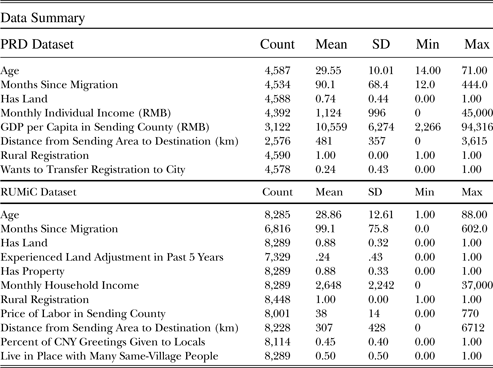
Note: Data on economic development in the sending areas comes from official statistical yearbooks, and data for distance between sending and receiving areas was calculated using Google Maps (maps.google.com).
The survey data come from two surveys of migrant workers collected from 2007 to 2009 in cities across China. The Pearl River Delta (PRD) dataset contains survey data on questions about land, income, origin, attitude towards registration transfer and many other variables for rurally registered migrants in nine cities in the Pearl River Delta.Footnote 10 The Rural to Urban Migration in China (RUMiC) data contains survey data on questions on many variables including land reallocation and migrant integration for rurally registered migrants in fifteen cities across China.Footnote 11
In addition to this data, we have added official yearbook data for economic variables, where possible, on the migrants' “sending” places, and we have used online mapping applications to generate distance data between sending and destination areas. Distance data is included as a control variable because migrants to places that are farther from their sending areas may be less likely to hold land and more likely to break ties with their sending areas, a correlation which could be a source of potential omitted variable bias in our models if not controlled for. Both surveys contain data naming the province, municipality, and county of the migrants, but the county is missing for seventeen percent of the PRD dataset. We use distance data from the municipality level where the county-level sending location was unknown, but all the sending area economic data is from the more precise county level. Due to some missingness in the PRD data, the final regressions include only 2,010 observations, but the differences between the observations included in the final regressions and the dropped observations are small.Footnote 12
Value of Rural Registration
The independent variables of interest are all proxies for the value of rural registration. We take landholding to be a primary value of rural registration, but acknowledge that rural registration may have other value, as described above. This leads to three independent variables of interest. First, the surveys used to compile the PRD and RUMiC datasets directly ask if the migrant has land in the sending area. Second, we look at the RUMiC survey question about whether or not the migrant has recently experienced land re-allocation. Following De la Rupelle et al., we take recent land reallocation to indicate weaker property rights. Finally, we take the economic development in the migrants' sending areas to be a proxy for the value of the sending area registration. We use publicly available gross domestic product (GDP) per capita data from Chinese statistical yearbooks to operationalize this concept.Footnote 13 Note that we include the income of the migrant as a control variable in part because the level of economic development is likely to correlate with income and we wish to isolate the value of the rural registration,
Dependent Variables
We operationalize both the institutional integration of the registration system and migrant social integration. First, the PRD dataset includes a survey question of whether migrants desire transfer to the city where they currently live. We take the answer “yes” to indicate a desire to be institutionally integrated into the city.
The second integration concept we operationalize is social integration, a concept that has many dimensions and which scholars have used a number of different types of survey questions in attempting to measure. To measure social integration, we construct two dependent variables related to Chinese New Year greetings and to living arrangements in the much larger RUMiC dataset.Footnote 14 The RUMiC survey asks migrants about the total number of people to whom the migrant gives Chinese New Year greetings by phone, email, or in-person visit. It also asks how many local people (meaning people living in that city, regardless of registration status) are given such greetings. Chinese New Year is the most important holiday in China, and migrants often return to their hometowns to celebrate the holiday. Whether or not they spend the holiday in their hometown or visit their ancestral village, Chinese people normally contact their close friends and family at Chinese New Year. We discussed the significance of Chinese New Year greetings with migrants in Shanghai and Shaoxing, and we feel confident that such greetings are a useful measure of interaction with and affection towards their recipients. Accordingly, we take the number of Chinese New Year Greetings given to locals as a valid measure of the level of integration of a given migrant.Footnote 15
The second variable used as a measure of migrant integration relates to a survey question about the migrant's living situation. The RUMiC survey asks if a migrant lives “close to many people from the same origin.” While the use of the word “many” injects a measure of subjectivity into the question, it is a question which, for many migrant workers, has a clear answer. We take this to be a measure of the inverse of social integration. Other studies of migrant integration, such as Qian and Zhang (Reference Qian and Zhang2006) and Adida (Reference Adida2011), asked respondents about their friends and local associations, and used such associations as measures of integration. Since living with many people from the same sending area indicates relatively fewer local connections and associations, we take this survey question as a measure of social integration.
ATTITUDES TOWARDS REGISTRATION TRANSFER: EMPIRICAL FINDINGS
It can be seen in Table 3 that there is a strong negative correlation between having land and desiring local registration, as Cai and Wang reported.Footnote 16 Migrants with land are 8.8 percent less likely to desire local registration. Table 3, Column 4 shows the fully specified model with the full set of controls, and it can be seen that the negative correlation between landholding and desire for local registration is significant at the 99.9% level. (Substantive effects reported here are drawn from this fully specified model.) This points to a strong connection between rural factors and attitudes towards transferring to local registration, and the most likely confounding variables, time as a migrant and income, are present in this model.
Rural to Urban Migrants’ Attitudes towards Registration Transfer and Rural Factors, PRD dataset, Logistic Regression Results

Standard errors in parentheses * p < 0.05 ** p < 0.01 *** p < 0.001.
Yet the possibility of endogeneity, reverse causality, or omitted variable bias cannot be excluded as explanations for this correlation. In speaking with landless migrants, the vast majority fell into one of three categories. First, some landless migrants, such as the worker from Hainan described in note 3, had transferred their land to the government as part of a land development scheme. This means that despite lacking agricultural land, the migrant still benefits from rural registration, and the presence of many of this type of migrant in the group of survey respondents would tend to bias against finding a negative effect of land possession on attitude towards local registration. Second, rural people who are born in violation of China's population control regulations are sometimes denied the benefits of registration, including land. Thus, for such migrants, land possession is fully exogenous to the process being considered. The final group, rurally registered people who turn over their land rights for a payment or have their land expropriated by the local government in their absence, may present a threat to the internal validity of this analysis. If such migrants represent a large proportion of the landless migrants in the PRD sample, it is possible that the migrants' attitudes towards the city and towards local registration are influencing their land holding and thus driving the observed correlation.
To address this threat, we turn to another measure of the value of rural registration, which does not originate from the survey. Since most migrants surveyed identified their counties of origin, we merge economic data from the migrants' sending areas with the survey responses, using the economic data to predict migrant attitudes towards registration transfer. As discussed above, using the level of economic development in the sending area as a proxy for the value of the rural registration allows us to capture other potential benefits of rural registration, such as a stake in a local development scheme which, like land, may be forgone if the migrant transfers her registration to the destination area. Table 3 (Columns 2, 3, and 4) shows that economic development in the sending area also negatively correlates with desire to transfer registration to the city according to the PRD data. Moving from one standard deviation below the mean to one standard deviation above the mean results in an average decrease in the predicted probability of desire for local registration of 7.3 percent, other things equal, and this finding is statistically significant at the 99 percent level. This bivariate relationship is depicted in Figure 1. Unlike owning land, which could be a function of the desire to integrate into the destination area or some confounding factor, the level of economic development of the sending area is exogenous to the individual migrant's preferences, giving strong evidence consistent with the hypothesis that there is an effect of sending area factors on migrants' attitudes towards registration transfer.
The Effect of Sending Area Economic Development on Desire for Registration Transfer

This effect holds whether or not the migrant has land, which confirms that the value of rural registration is likely a function of a more complicated set of rights associated with rural registration, not only land. This conforms with the opinions of interviewees who discussed the value to rurally registered people of rural land which had been developed or might be developed in the future.
SOCIAL INTEGRATION: EMPIRICAL FINDINGS
As described above, we test H2 and H3 using two operationalizations for social integration, Chinese New Year greetings to locals and living with many people from the same sending area. This results in four tests. As shown in Table 4 and Table 5, these four tests return statistically significant findings which fail to nullify H2 and H3, providing evidence of the connection between rural land institutions and migrants' levels of social integration in the city. This analysis shows that landholding is positively correlated with living in an area with many people from the same sending area, which we take to mean that landholding is negatively correlated with social integration. Landholding is also negatively correlated with the number of Chinese New Year greetings given to locals. Having land in the sending area correlates with 1.6 fewer greetings to local people, according to the model.
Landholding and Social Integration, RUMiC Dataset, Logistic and Negative Binomial Regression Results

Standard errors in parentheses * p < 0.05 **p < 0.01 ***p < 0.001.
Land Adjustment and Social Integration, RUMiC Dataset, Logistic and Negative Binomial Regression Results

Standard errors in parentheses * p < 0.05 **p < 0.01 ***p < 0.001.
To estimate the effects of land reallocation, we restrict the sample to landholding migrants. Our models also show effects of same village land reallocation, which we take to represent weaker land rights, on both living in an area with many people from the same sending area and the number of Chinese New Year greetings given to locals. The predicted probability of a migrant living in an area with other people from his same sending area is 4.9 percent higher for those whose sending villages experienced land reallocation. Migrants experiencing land reallocation in their home village also give 1.1 fewer Chinese New Year greetings to people living in the same city. While statistically significant at beyond the 95 percent level or above, the substantive results of these successful tests are not large. These results suggest that while the effects may be at the margins, China's land institutions are likely influencing migrants' lives in the city, their levels of social integration, and their decisions about whether and how to participate in urban life.
CONCLUSION
Using newly constructed data to build on the findings of Cai and Wang (Reference Cai and Wang2007), we find that migrants without land and migrants from places with lower levels of economic development are more likely to desire local registration transfer in the city where they live. Using new measures of migrants' social integration, we also find that landholding and recent land reallocation are statistically significant predictors of social integration. While migrants with land are less socially integrated, landholding migrants with stronger land rights are more socially integrated. Stronger land rights may allow migrants to merge their lives with their adopted home without worrying about losing their rural benefits.
The connection between rural factors and migrants' levels of integration into the cities demonstrated by these findings should prompt new thinking about the value of rural registration. Under present conditions many migrants do not desire urban registration, but this does not imply that the household registration system does not play an important role in institutionally excluding migrants from urban society, as some have suggested. On the contrary, it shows that the value of rural registration can represent a continued “pull” on migrants back to the sending areas. More broadly, it represents additional evidence that the registration system, in concert with other institutions, continues to shape not only the migration decisions of migrants and potential migrants, but the lives of migrants who have already migrated.
To ensure the equality of China's citizens, rural and urban, and facilitate integration of migrants into their destination cities, piecemeal reforms of the household registration system alone are likely to be insufficient because other systems are deeply intertwined with the household registration system itself. Comprehensive reform means that not only the registration system should be reformed, but also the related institutions of land, insurance, welfare, public services, and employment must be reformed together. Still, piecemeal reforms can change the aforementioned rural-urban institutional arrangements and their relationship with the registration system can be disaggregated. Eventually, the registration system can again become simply a system for registering residences, but until this is accomplished, the registration system will continue to inhibit both urbanization and migrant integration. Accomplishing fuller reform will allow the free movement of migrants and allow the market to coordinate labor more efficiently, facilitating continued urbanization.
Some media reports have shown that migrants have been enticed, and sometimes forced, into leaving their land for “urban” settings where conditions are poor, jobs are scarce, and the migrants are saddled with debt from the purchase of their urban housing (Johnson Reference Johnson2013; The Economist 2014; “Anhui Ban” 2013). Forcing rural people off the land and into the city is not a promotion of urbanization, but instead harms the free choices of rural people, infringes on their land rights, and leads to inefficient allocation of resources. State-led promotion of urbanization constitutes an important part of China's recent development model, but in this process the rights of rural people have largely been ignored. This manifests itself not only in the widening urban–rural gap, but also worsening relationship between rural people and local governments. Considering China's relatively large disparity between rural and urban incomes and increasing rural–urban inequality, maximizing the benefits to rural people should be a top priority.
Changing property rights and the rights associated with the household registration system have always been important yet difficult aspects of China's processes of migration and urbanization, but there are signs that the new leadership is aware of the importance of protecting the free choices of rural people and even increasing the protection of rural land rights. For example, the “Communiqué of the Third Plenum of the Central Committee” (2013), stated that farmers should be given “increased property rights”. The “Plan for a New National Urbanization Model,” released in 2014, also acknowledges the importance of rural factors, stating that China needs to “give farmers guarantees for land possession, use, profit, transfer, and the right to mortgage contracting rights” (State Council 2014). Scholars discussing China's urbanization model have argued likewise (Xu 2013; Yu Reference Yu2013). Greater protections could also allow them to monetize their rights so that they can invest in a new business in the city or in human capital. This will enable urbanization while simultaneously increasing rural efficiency. The extent to which government policies arguing for increased rural rights will be implemented in a climate in which local governments benefit from the weakness of these rights remains to be seen.
Of course the greatest obstacle to migrant integration continues to be the urban restrictions on registration transfer for migrants and the inferior public services afforded to unregistered migrants. Only when migrants can easily obtain stable housing and social insurance in the cities can the dependence on land to migrants be weakened and can the migrants rest at ease that they can release their land and settle in the city. Only when cities fully open their doors to migrants can the rural areas promote real reforms of the land and household registration systems. Recent policy statements have indicated mainly that the state desires greater rationalization of the system, not relaxation of the urban registration regime.Footnote 17 In the process of population movements and labor flows, only if reform on both the urban and rural sides acts a catalyst can urbanization be promoted and the interests of China's rural and urban citizens be fully ensured.



