1. Introduction
Consider this stylized account of the Keynesian Revolution, as it is accepted and taught by many economists today.Footnote 1 There seems to be a consensus that in the decades before the Keynesian Revolution, there was little progress in English-language economics. The dominant school was neoclassical economics, with Alfred Marshall as its figurehead. Neoclassical economics, in Marshall’s own eyes, was simply an extension and elaboration of classical economics. Cornerstones were supply-and-demand diagrams that were used to study partial equilibria, that is, equilibria in individual industries of the economy. These models, however, assumed that markets always clear, so that they could not explain the sustained unemployment of the 1930s. What was needed, it seems, was somebody to try a radically new approach. That someone turned out to be John Maynard Keynes, with his Reference Keynes1936 General Theory of Employment, Interest and Money. But the book was initially received with skepticism, and it lacked formal models and concrete policy advice. The contributions of young economists such as John Hicks, Paul Samuelson, and Alvin Hansen were needed to make the Keynesian Revolution the success that it was. So we might say that two things were crucial for progress in 1930s economics: an adventurous economist with novel ideas, as well as followers, who were willing to extract all the important results that can be established when those novel ideas are employed.
The motivation for the model I am going to present in this article is the observation that, as in this story of the Keynesian Revolution, both explorer-type and extractor-type scientists have played important roles in the history of science, when we think of both discipline-wide shifts in research programs and different roles within research teams. It is tempting to think that herein lies a division of labor that benefits the epistemic community at large: explorer-type scientists point the way to fruitful new areas of research, and extractor-type scientists extract all the important results. And then scientific progress is faster than it would have been under different research regimes.
Weisberg and Muldoon (Reference Weisberg and Muldoon2009) set out to demonstrate that there are such epistemic benefits to this type of division of labor with an agent-based ‘epistemic landscape’ model. However, a closer reading of their article shows that their model fell short of this task. While the model suggests that the presence of explorer-type scientists makes extractor-type scientists more productive, it also seems to show that it would be better still if everybody was an explorer type. I present an alternative agent-based epistemic landscape model that succeeds at showing the alleged epistemic rewards from division of labor under many circumstances. Moreover, the model I present is not an ad hoc modification of Weisberg and Muldoon’s model: I argue that their failure to demonstrate the benefits of division of labor is due to implausible modeling choices, which my model aims to improve on. In addition, my model allows us to further study the conditions under which division of labor is beneficial. In particular, it suggests that division of labor is only beneficial when scientists are not too inflexible in their choice of a new research topic and not too ignorant of work that is different from their own. In fact, the more flexible and informed scientists are, the more beneficial is division of labor.
The article proceeds as follows. Section 2 introduces epistemic landscape models, in particular Weisberg and Muldoon’s. It presents their results and conjectures as to why they failed to produce the result they aimed for. Section 3 explains my alternative and, as I will argue, more credible model. Section 4 presents and discusses the results from a number of simulations I ran on it, and section 5 concludes.
2. Past Models of the Epistemic Division of Labor
It has been acknowledged for some time that division of labor between scientists may be important for the epistemic progress of a community. Division of labor always involves some kind of diversity in the type of work individual agents do, which helps a group to better achieve a task. In the case of science, this task is an epistemic one. Economists have long been interested in how dividing labor can help a group become more productive. And so philosophers have naturally looked to economic models and applied them to science in order to study the benefits of division of labor and the ways of sustaining it. It is important to note that there are different kinds of division of labor that may play a role in science. What earlier models focused on was diversity in the type of research that is conducted. Kitcher (Reference Kitcher1990), as well as Strevens (Reference Strevens2003), produced rational choice models in which scientists choose between two competing research programs. For the community it is best if there are scientists working on both, but scientists need to be swayed by non-epistemic rewards in order to not all choose the more promising project.Footnote 2 Zollman (Reference Zollman2010) offered a Bayesian model of consensus formation concerning the efficacy of a treatment, where diversity in treatment method for some time is needed to ensure that consensus eventually forms on the right treatment. Hong and Page (Reference Hong and Page2004) use an agent-based model to show that a population of scientists that uses a diversity of problem-solving strategies is better at exploring some search space.
The type of division of labor that Weisberg and Muldoon, as well as my model, focus on is different: it concerns not diversity in research approach but diversity in the way scientists go about choosing their research approach. Scientists differ not only in the type of research they do but also in how adventurous they are when choosing what kind of research to do. And this, too, could amount to an epistemically beneficial division of labor.Footnote 3 To highlight that this is a different kind of division of labor, I will use the phrase ‘diversity of research strategy’ for this second type of division of labor throughout. Agent-based epistemic landscape models, as Weisberg and Muldoon introduce them, lend themselves very well to modeling diversity of research strategy. By offering a spatial representation of similarity of research approach, they allow us to represent explorer-type and extractor-type behavior as different ways of moving on an epistemic landscape. Epistemic landscape models also provide a tractable representation of a fine-grained research field, in which scientists can choose between a large number of research approaches. Given such a research field, the agent-based approach allows us to study the dynamics of the different strategies concerning choice of research project over time.Footnote 4
2.1. Epistemic Landscape Models
The basic idea behind epistemic landscape models is the following: an epistemic landscape represents a research field. Scientist-agents are modeled as making discoveries within that research field by moving around on the epistemic landscape. Different points in the epistemic landscape represent scientific approaches with an associated epistemic significance. An approach is characterized by a methodology (regarding data collection, as well as data analysis), a research question, and a set of background beliefs. Epistemic landscapes represent similarity of research approach as spatial proximity. Weisberg and Muldoon’s epistemic landscape is two-dimensional and discrete, so that different research approaches are represented as discrete patches on a plane, arranged on a grid of 101 × 101 patches (Reference Weisberg and Muldoon2009, 234). Even though research approaches are assumed to be discrete, we can interpret them to be very fine grained: for instance, using the same methodology and background assumptions as somebody else in order to treat a slightly different research question could count as a different, but nearby, approach.
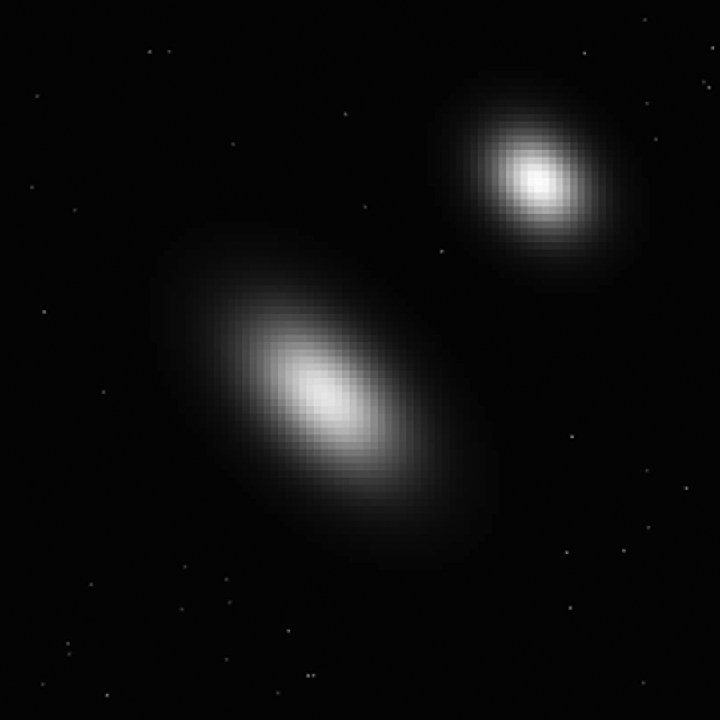
The epistemic significance associated with each approach is a numerical value that represents, roughly, the number of scientifically or socially important results that can be obtained using a particular approach.Footnote 5 It represents what the epistemic community cares about. Weisberg and Muldoon’s model assumes that epistemic significance is not distributed randomly on the landscape, but in two Gaussian-shaped hills with single peaks, where one of the peaks is higher than the other (Reference Weisberg and Muldoon2009, 234). This makes sense if we assume that approaches that are similar to significant approaches are also likely to be similarly significant, and that there are several areas of epistemic significance within one research field. Large parts of the epistemic landscape are assumed to be entirely insignificant. Figure 1 shows an epistemic landscape with patches colored according to significance.
Epistemic landscape.

Scientific progress is now modeled as occurring when scientist-agents, who are initially randomly distributed on the insignificant areas of the landscape, move around the landscape making discoveries. When scientists ‘visit’ a patch, they use the approach of that patch to find out its significance. Weisberg and Muldoon assume that all agents successfully determine the significance of an approach when they use it (Reference Weisberg and Muldoon2009, 233). Scientists can move around the landscape according to rules. By specifying different rules, we can study how well different types of scientists do at exploring the epistemic landscape, as well as how they interact, in the hope of thereby learning something about scientific progress in the real world.
2.2. Followers and Mavericks
Weisberg and Muldoon implement three rules for scientists: a control rule, a follower rule, and a maverick rule. Each type of scientist-agent responds to information about their own past discoveries and can only ever move forward one patch at a time. For instance, controls move straight ahead unless their current approach is less significant than their last, in which case they go back and change direction (Weisberg and Muldoon Reference Weisberg and Muldoon2009, 231–32). They thus behave like ‘hill-climbers’. But mavericks and followers also respond to information about what discoveries have been made by others in their vicinity. These two rules aim to capture the explorer-type and extractor-type behavior we described earlier. Mavericks are explorative in that they avoid approaches that have been used previously. Unless they start going ‘downhill’, in which case they go back and change direction, they move to a random unvisited patch in their neighborhood (243). Followers, on the other hand, like to move to approaches that have proven fruitful in the past. They move to the previously visited patch with the highest significance in their neighborhood. If there are none, they move to a random neighboring patch (239–40).
Weisberg and Muldoon run a number of computer simulations to study how well differently composed populations of scientist-agents do at finding the significant areas of the landscape. They use three measures of success: First, they look at how long it takes the different populations to find both peaks of the landscape (Reference Weisberg and Muldoon2009, 234). Second, they record what proportion of approaches with positive significance has been found by different populations after different time periods. They call this “epistemic progress” (237). Third, they look at what proportion of the total number of approaches has been discovered by the different populations after different time periods. They call this “total progress” (248).
2.3. Weisberg and Muldoon’s Results
One major result from the simulations Weisberg and Muldoon ran is that homogenous populations of mavericks do better than homogenous populations of controls (Reference Weisberg and Muldoon2009, 244–45). So agents do better when they take into account in some way information about what work others have previously done. This already shows the benefits of division of labor in one sense of the word. However, we would also like evidence that diversity of research strategy is epistemically beneficial. And to get such evidence, it seems that we need to show that mixed populations of followers and mavericks do better by the various criteria of success than homogenous groups. This is also what Weisberg and Muldoon seem to suggest they show in their article. In the abstract, they write, “we show that in mixed populations, mavericks stimulate followers to greater levels of epistemic production, making polymorphic populations of mavericks and followers ideal in many research domains.”
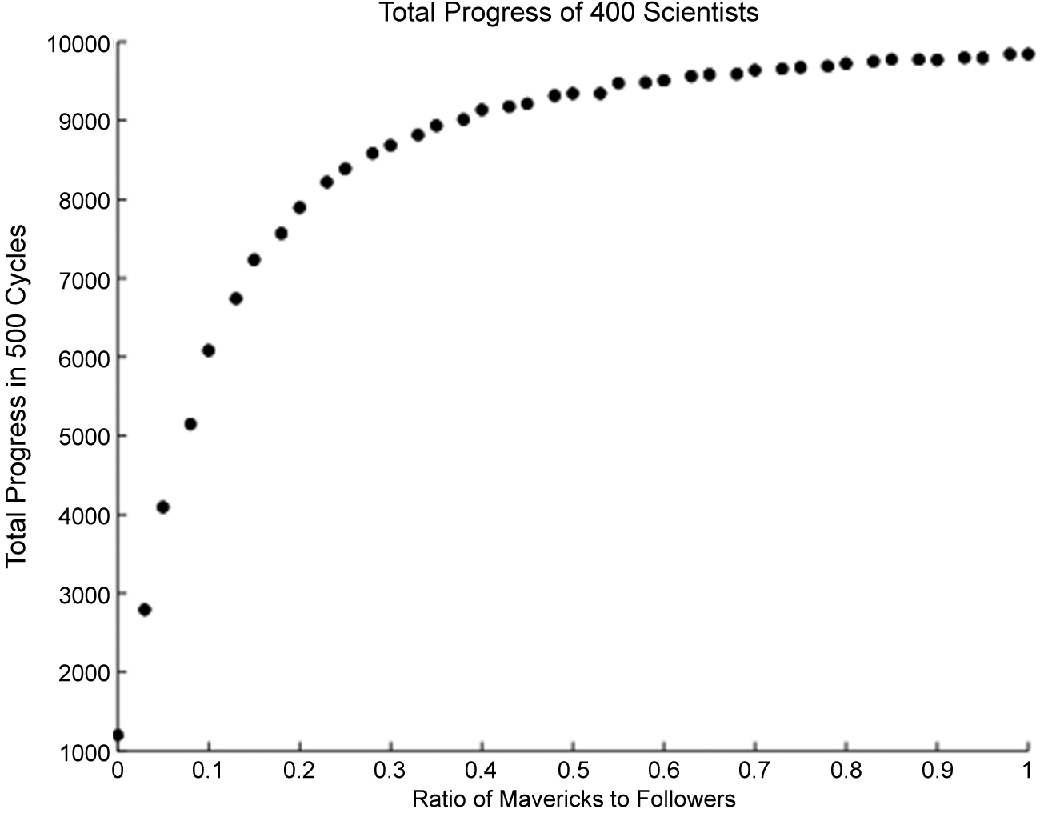
However, if polymorphic populations are indeed ideal, their simulations do not show this. In fact, according to their own measures of success, homogenous populations of mavericks outperform all mixed populations. Figure 2 shows the total progress made by differently composed populations of 400 scientist-agents after 500 periods. What the data seem to show is that the more mavericks there are in a population, the better.Footnote 6
Total progress of different populations of 400 scientists after 500 rounds.

Weisberg and Muldoon point out that the maverick strategy is likely to be more costly than the follower strategy. Taking into account those costs, they claim, a mix of followers and mavericks will turn out to be optimal (Reference Weisberg and Muldoon2009, 250–51). However, they do not present a formal model that incorporates these costs. And looking at the difference in productivity between followers and mavericks, doubts should arise about their claims. All homogenous groups of mavericks eventually find virtually all significant approaches in the landscape. For instance, within 200 periods, 400 mavericks find more than 90% of the significant approaches (245). In contrast, homogenous groups of followers all eventually stagnate at a low value—17% in the case of 400 followers (240–41). Note that in figure 2, homogenous populations of followers discover only slightly more than 1,000 approaches, which means that each scientist on average only discovers around three new approaches within 500 periods, suggesting that they either hardly move or spend the majority of their time on patches that have previously been explored. Even if it is granted that followers become more productive when they are stimulated by mavericks, it is simply not obvious that it would pay off for an epistemic community to include followers in the scientific community, even if their research strategy is significantly cheaper.
2.4. Problems with Weisberg and Muldoon’s Model
We just saw that Weisberg and Muldoon’s model does not clearly demonstrate the benefits of diversity of research strategy, suggesting rather that it would be best for all scientist-agents to be mavericks. This also raises a question at the microlevel: assuming that scientists are motivated in large part by the desire to make significant discoveries, if mavericks are so much better at making significant discoveries, why would anybody want to be a follower? The follower strategy turns out to be extremely unattractive in this model. But that does not match what we observe in scientific practice: a large proportion of scientists do seem to be engaged in what we described above as extractor-type research, that is, research that is somehow based on or similar to work that has previously proven fruitful. This raises doubts whether Weisberg and Muldoon’s model accurately captures extractor-type and explorer-type behavior in actual scientific practice.
Weisberg and Muldoon’s specification of the follower rule in particular seems to me to be implausible given the other modeling assumptions they make. On their follower rule, scientists end up duplicating the work of others much of the time: they are characterized by a tendency to move to the most successful previously explored approaches in their neighborhood. But mere duplication has no added benefit in the setup of the model. As we have seen, Weisberg and Muldoon’s measures of success only count the first time an approach is used.Footnote 7 Given this modeling assumption, any strategy that has scientists merely duplicate others’ work much of the time seems implausible as a representation of actual scientific practice, for two main reasons: First, research results are mostly freely available to other scientists, so we can assume that researchers already have access at least to the research results from approaches that are similar enough to their own for them to understand and easily find them. Second, if this is so, it is hard to see why anybody could be motivated to simply duplicate the work of others: there is no epistemic benefit from doing so. After Hicks read General Theory, he followed Keynes’s lead, but he did not write the General Theory once over again.
There is another aspect of Weisberg and Muldoon’s specification of the follower and maverick strategies that seems implausible, namely, that all agents only move locally. Agents only respond to previous discoveries in their immediate neighborhood, and they can only ever move one patch ahead. One way to justify this assumption would be by claiming that movement at a larger range is costly, and that information about approaches different from one’s own is hard to come by. It is surely the case that, even though much information is now freely accessible, acquiring detailed knowledge of areas of research very different from one’s own is hard. And it is also hard to acquire the new research tools needed to work on a very different approach. As Muldoon and Weisberg (Reference Muldoon and Weisberg2011) highlight, one of the advantages of using an agent-based epistemic landscape model is that we can represent agents as being restricted to a specific research area in this way. But for strict local movement to be a plausible description of actual scientific progress, it would need to be the case that agents are restricted to the approaches that are immediately adjacent to their own. And on the most plausible interpretation of the model, this would amount to an extreme level of shortsightedness and inflexibility among scientists.
Whether local movement is plausible depends to some extent on how fine grained we interpret research approaches to be. If they are coarse grained, it is more plausible than if the distinctions between neighboring approaches are very small. But given the way the model is implemented, we need, in fact, to think of the epistemic landscape as very fine grained. We said that a single scientific agent can discover the entire significance of one approach in one round. If approaches were coarsely grained, this would be unrealistic: it would then have been better to allow for a patch to be visited multiple times, or for single agents to stay on a patch for longer. Of course, we could think of each round as lasting a long time. But what Weisberg and Muldoon presumably aimed to capture is a more detailed look at the dynamics of research groups, which tracks smaller changes in research approach. Imagine we interpret each round as lasting about 2 months. In that case, the 200 rounds that 400 mavericks need in order to discover 90% of the significant approaches would come to about 33 years of research, which seems like a plausible lifetime for a specialized field of research. Given that interpretation, local movement would imply that scientists are not aware of research that they would be able to conduct themselves within 4 months of research. For instance, in our earlier example, this would mean that somebody like Hicks could become aware of an early paper of Keynes’s on a topic that he himself happens to be working on and remain unaware that Keynes has already written General Theory. Similarly, scientists could not now learn the research tools for using an approach that they will be able to use after just 2 months of research on something else. All in all, I think that given the fine-grained interpretation of research approaches that is implicit in the model, it is more plausible to give scientist-agents a larger range of movement, while still acknowledging some limitations to awareness and research flexibility.
3. An Alternative Epistemic Landscape Model
We just identified two potential flaws in Weisberg and Muldoon’s model that may be responsible for their failure to demonstrate the epistemic benefits of diversity of research strategy. First, their specification of the follower strategy is implausible because it has followers duplicate the work of others much of the time. Second, the assumption of local movement seems too restrictive. I hence constructed an alternative epistemic landscape model that differs from Weisberg and Muldoon’s in two major ways: First, it allows for a variable range of movement of the scientist-agents, where the range of movement can be understood as the degree to which scientists are flexible in their choice of a new research approach and informed about work that is different from their own. Second, it uses strategies according to which all scientists avoid mere duplication of previous work. Given these changes, I indeed found diversity of research strategy to be beneficial, with one restriction. Diversity of research strategy is only beneficial when the range of movement is not too small, that is, when scientists are not too inflexible in their choice of a new research topic and not too ignorant of work that is different from their own. In fact, my model suggests that the more flexible and informed scientists are, the more beneficial is diversity of research strategy.
We can still meaningfully distinguish between extractor-type and explorer-type scientists even when all avoid duplication, in the following way. My model describes explorer-types as scientists who like to follow approaches that are very different from those of others, while extractor-types like to do work that is very similar to but not the same as that done by others. Epistemic landscape models lend themselves well to programming these kinds of strategies, owing to their implicit similarity measure. I call the two respective strategies in the model the explorer and the extractor strategies. Given these two types of strategies, I investigated under what conditions mixed populations of extractors and explorers are better at making scientific discoveries than homogenous populations of extractors and explorers, respectively. Keeping Weisberg and Muldoon’s assumptions fixed unless otherwise stated, I used the programming software NetLogo (Wilensky Reference Wilensky1999) to implement the model and run simulations on it.
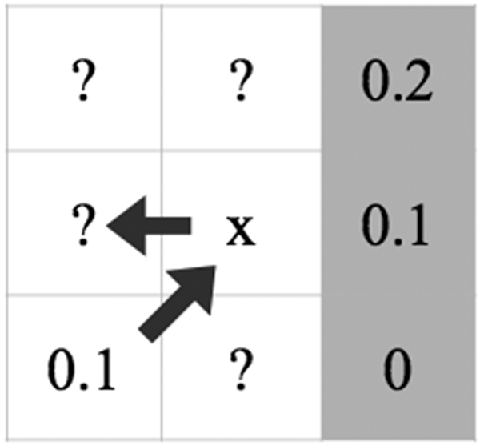
The following is a more detailed description of the explorer rule when movement is local. First, suppose that explorers are in unchartered territory, so that no approaches in their neighborhood have previously been explored. In that case, explorers behave like hill climbers: they go straight ahead unless they start going downhill, in which case they go back and change direction. Now suppose that some of the approaches in their neighborhood have previously been explored. In this case, they go to the unvisited patch at the greatest minimum distance to the patches that have previously been visited by others (as illustrated in fig. 3). If there are no unvisited patches, they go to a random neighboring patch.Footnote 8
Movement of an explorer (x). The gray fields have been previously visited by other scientists.

The explorer strategy describes the behavior of a scientist who does care about making significant discoveries—after all, explorers behave like hill climbers when they are in unchartered territory. But the scientists whom the rule describes also like to move away from research that other scientists are doing. This is captured by the explorers’ behavior when they are in the vicinity of previously discovered patches, as well as by their tendency to go straight ahead once they have set their direction away from those patches.
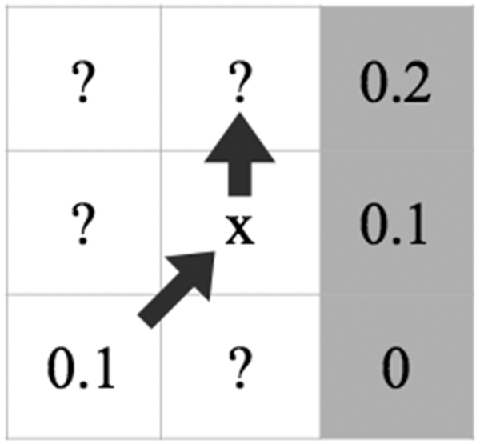
The extractor rule, on the other hand, describes the behavior of a scientist who likes to do work that is similar but not identical to work that was successful in the past. Suppose again that the agent is in unchartered territory. The extractor then moves to a random unvisited patch in the neighborhood (if she has visited them all herself, she goes to a random neighbor). Now suppose that approaches in her neighborhood have been visited by others. As figure 4 illustrates, the extractor then moves to the unvisited patch closest to the best patch discovered by another scientist (like the explorer, if all patches have been visited, she goes to a random neighbor). Since more significant approaches are likely to be in the vicinity of other significant approaches, this also expresses a desire to make significant discoveries.
Movement of an extractor (x). The gray fields have been previously visited by other scientists.

Both strategies can easily be extended to nonlocal movement by exchanging any reference to the neighborhood in the above descriptions for a specified radius. So explorers move to the unvisited patch within radius r that is at the greatest minimum distance to the patches others previously visited within radius r, and extractors move to the patch within radius r that is closest to somebody else’s best previous discovery within radius r. Note that this alters not only the agents’ range of movement but also their range of ‘perception’, that is, the range within which they are aware of other scientists’ research.Footnote 9
4. Results
Using the strategies just described, I ran a number of simulations recording two sets of data. First, I recorded what proportion of the total significance contained in the research field each population discovered after various periods of time. This is the measure of success we assume the epistemic community cares about. Note that this is different from Weisberg and Muldoon’s criteria of success. However, it nicely integrates two concerns, since it is sensitive to both the number of significant patches discovered and the relative significance of the approaches that are discovered. Second, I recorded data on how much significance each type of scientist discovers, on average, each period. This allows us to determine the relative productivity of each type of scientist, which matters for how attractive the strategies are for scientists. Simulations were run for various group sizes, group compositions, and ranges of movement, with 50 repetitions each.
4.1. Local Movement
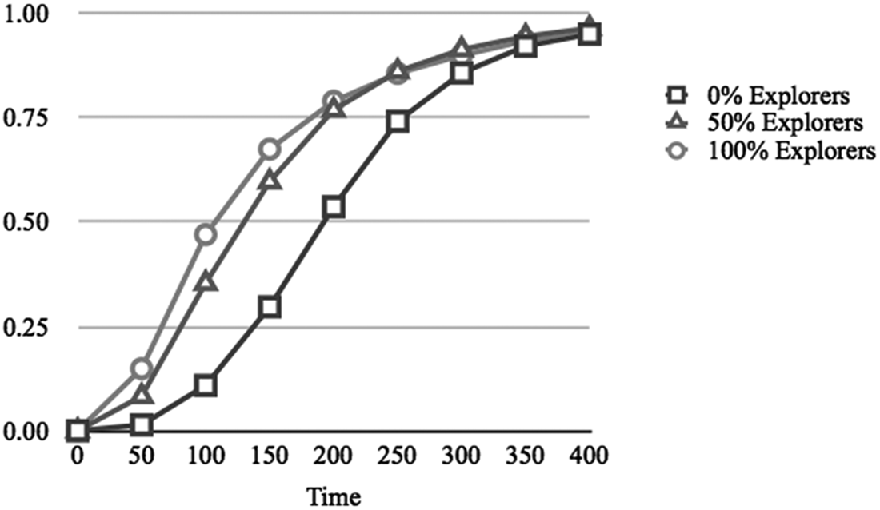
The results for the case of local movement were as follows: all groups of size 40 and larger found approximately the entire epistemic significance of the research field within 500 rounds or less. This is reassuring, since it means that all strategies are reasonably efficient, in contrast to Weisberg and Muldoon’s follower strategy. Still, epistemic communities care not only about eventually finding the entire significance, which all groups will at some point, but also about making progress fast. And different groups of scientists differ greatly in that respect. For instance, unsurprisingly, larger groups do better than smaller ones. Furthermore, homogenous groups of explorers do better than homogenous groups of extractors, especially early on in the simulations. Lastly, at least until late in the research cycle, homogenous groups of explorers also do better than mixed groups. Figure 5 illustrates this in more detail, in the case of a group with a 50/50 mix of explorers and extractors.
Proportion of significance discovered by groups of 40 scientists.

The mixed group does better by a very small margin after 300 rounds. But at this point, 90% of the total significance has already been discovered. Homogenous groups of explorers have a large advantage earlier on in the research cycle. For instance, after 50 rounds, the homogenous groups of explorers have discovered 15% of the total significance, while the mixed groups have only discovered 8%. This seems to outweigh the small advantages mixed groups have later on, especially if we assume that the epistemic community cares in a special way about making early discoveries fast. Looking at the average significance of moves by explorers and extractors, it turns out that explorers also outperform extractors within the mixed groups.
4.2. Medium-Range Movement
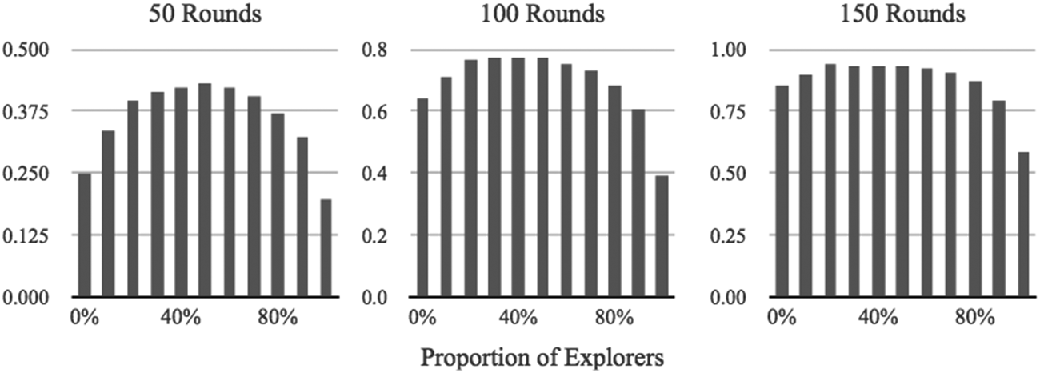
The upshot from what I just presented seems to be that when movement is local, diversity of research strategy is not beneficial. But I have also argued above that local movement is unrealistic because of the extreme shortsightedness and ignorance it implies. The more realistic case is one where agents can move at a larger range. And in fact, things change when we allow for a larger range of movement. From a range of movement of 3 upward, mixed groups start to do best, followed by homogenous groups of extractors, with homogenous groups of explorers doing worst. In fact, while the range of movement is still restricted,Footnote 10 the larger the range of movement, the faster the overall progress and the more beneficial diversity of research strategy. Figure 6 presents the results for a range of movement of 10 in more detail. Clearly, mixed populations of explorers and extractors perform better than homogenous populations at various time points.Footnote 11 This suggests that division of labor between explorers and extractors is indeed beneficial when movement is no longer local.
Proportion of significance discovered by populations of different composition after 50, 100, and 150 rounds.

While the advantage of mixed groups over homogenous groups of extractors is not as large as their advantage over explorers in terms of the average proportion of significance discovered after various time points, part of the advantage of adding explorers to groups of extractors is that the standard deviation is greatly reduced. For instance, after 150 time steps, the standard deviation for homogenous groups of extractors is 12.5 percentage points, while that for mixed groups with 40% explorers is only 3.1 percentage points. This reduced variability should also make mixed groups more attractive, since there is less risk involved for the epistemic community.
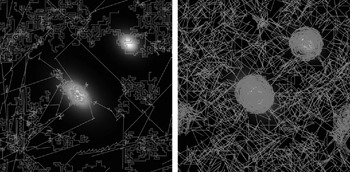
What could explain the difference between the case of local movement and the case of medium-range movement? Figure 7 depicts the paths taken by explorers and extractors in a typical simulation when the range of movement is 1 (left panel) and 10 (right panel).
Local movement (left) vs. medium-range (range 10) movement (right). The paths of extractors are shown in blue.

In the case of local movement, it appears that extractors mostly do not manage to follow the paths of the most successful explorers, while they do so in the case of medium-range movement. There are two suggested explanations for this: First, since their range of ‘perception’ is limited, they cannot ‘see’ which paths will lead to the most significant areas. Second, their choice of who to follow is very restricted—they have to be very lucky for a successful explorer to pass through a patch right beside them. This not only makes sense of what happens in the model but also sounds like a plausible story about why diversity of research strategy might not be beneficial when real-world scientists are too uninformed and shortsighted: visionary explorer-types are no good for guiding the way when extractor-types do not become aware of their work or do not recognize it as visionary.Footnote 12
4.3. Global Movement
Agents who move at a range of 10 are still restricted in how informed they are about others’ research and in their flexibility in adopting new research approaches. We may be interested in what happens when agents can move globally, that is, in the entire research field. To study global movement, I had to slightly adapt the explorer rule for computational reasons: after trying for a while to find an approach that is far away from previously discovered approaches, they move to a random unvisited approach somewhere in the research field. Some pilot simulations with the original rule suggested that there is no significant difference between this rule and the original one. What happens in the global movement case is that diversity of research strategy is still beneficial, but overall progress is again slower compared to the medium-range movement case. The explanation for this seems to be that the lower of the two hills gets neglected by extractors as soon as the higher one is found.Footnote 13
These results suggest that, if the epistemic community cares about exploring all areas of significance, there may be an advantage to scientists being slightly inflexible and/or uninformed and so moving at a medium range. Medium-range movement also seems to be the more credible representation of actual scientific practice. Owing to the costs of changing one’s research approach, scientists are not usually flexible enough to adopt just any new approach within their research field. To take again the example of the Keynesian Revolution, Keynes’s followers did not move away completely from neoclassical economics, and they certainly employed some of the neoclassical tools they were used to. They were later responsible for what is now called the ‘neoclassical synthesis’. Similarly, it would be very demanding to stay on top of all research that happens within one’s field of research, especially when that field is large. Hence, a medium range of movement seems most realistic.
4.4. Average Performance of Explorers and Extractors
Looking at the data on the relative performance of explorers and extractors within the mixed groups, we can see that, apart from a very short period in the beginning, extractors do better than explorers—and this advantage is bigger the larger the range of movement. At range 10, extractors are more than 4 times as productive as explorers. This raises a question similar to one that we raised for Weisberg and Muldoon. In their model, it was unclear why anybody would choose to be a follower, given their lack of productivity. In our case, the question is why anybody would choose to be an explorer. While, as we have seen, it is certainly beneficial from an epistemic community’s point of view to include explorer-type scientists in the scientific community, the strategy is not very attractive: it is riskier and has a much lower average pay-off in terms of epistemic significance.
In order to give a full response to this challenge, we would have to include the scientists’ choice of strategy explicitly in the model, which we have not done. My model simply assumed that a fixed number of agents follow a particular research strategy. This simplification seems appropriate given our main goal of showing that it is conducive to scientific progress to have a mix of explorer-type and extractor-type scientists. Still, if one strategy turns out to look so unattractive that it seems unlikely that any scientist would ever choose it, this is a problem for the model. We want to say that the model gives evidence that division of labor between extractor-type and explorer-type scientists in actual scientific practice is beneficial. And some scientists do choose to be explorers, apparently for good reasons. If the model seems incompatible with this, it may not be a good representation of scientific practice after all. So we should at least have some response to this charge, even if the choice of strategy is not part of our model.
I think that, in contrast to Weisberg and Muldoon’s case, a plausible response can be given to the challenge, namely, that there are a number of social incentives that make the explorer strategy more attractive from the individual point of view. We mentioned at the outset that Kitcher (Reference Kitcher1990) and Strevens (Reference Strevens2003) constructed models that suggested that non-epistemic rewards are needed to maintain an epistemically beneficial diversity of research approach. Perhaps something similar holds here, too. Given that the average epistemic significance discovered by explorers is so much lower, the strategy will only be attractive to somebody who cares about something other than epistemic significance. And so individual scientists, if they should choose to become an explorer-type, cannot only care about what the epistemic community at large cares about.
In fact, many scientists are also interested in monetary and social rewards, like prestige.Footnote 14 And, arguably, these kinds of rewards are given disproportionately to scientists who do the kind of work that explorers do. For instance, the novelty of the proposed research is an important desideratum for most grant-giving agencies. In the European Union, the European Research Council has even made it its main mission to support high-risk ‘frontier-research’ (note again the geographical analogy). Furthermore, fame is often associated with having come up with something very new.
My model is consistent with the claim that these social and financial rewards could have an important function: they could help to maintain an epistemically beneficial diversity of research strategy by making sure that the explorer strategy is attractive enough for some scientists to choose it. This is not to suggest that all revolutionaries, such as Keynes, were motivated by fame and money. Even in the absence of social and financial rewards, there may just be something inherently more attractive about the explorer strategy compared to the extractor strategy, which can draw some scientists to it. There is certainly a thrill in doing something new.
5. Conclusion
The agent-based epistemic landscape model I have presented here appears to show the following: Division of labor between explorer-type and extractor-type scientists is beneficial whenever scientists are not too inflexible and uninformed about other scientists’ research. When scientists are too inflexible and uninformed, extractor-types may not manage to follow explorer-types to more fruitful areas of research. On the other hand, when scientists are perfectly informed and flexible, there is a danger that some potentially fruitful areas of research are ignored.
The model I have presented not only supports an intuitive result that Weisberg and Muldoon’s could not; it is also more credible than Weisberg and Muldoon’s in two major ways: First, it is not restricted to local movement, which I have argued is implausible as a representation of scientific practice. Second, the explorer and extractor strategies are better descriptions of the behavior of scientists than the maverick and follower strategies, since both explorers and extractors avoid the mere duplication of work others have done. What further speaks in favor of the model is that a number of its implications map ccredibly onto features of actual scientific practice, as evidenced in the course of the article. For instance, on my model it turns out to be explorer-type behavior that needs special incentives, which seems plausible.
However, the model is, of course, still highly idealized and could be extended in a number of ways. The results I presented here remain the same when the topology is changed to one with three or four hills, keeping the total amount of significance in the landscape fixed. Still, many other topologies are possible, in particular, ones with more than two dimensions. It would also be interesting to look at models that allow for individual differences in flexibility or talent. Lastly, both research costs and non-epistemic rewards could be modeled explicitly in future studies.