INTRODUCTION
Both sociolinguists, with their commitment to descriptivism, and linguistic anthropologists, with their commitment to cultural relativism, are keenly aware of the perils of imposing linguistic standards from above, of the ease with which linguistic judgments become social, political, or moral ones, and of the reality of variation in contrast to narrowly imposed judgements. Those of us who teach such subjects, being aware of the role that prescription plays in our students' lives, struggle against the prevailing view that language consists of a prescriptive grammar plus a prescriptive dictionary. Nevertheless, prescriptivism serves important symbolic and sociopolitical purposes relating to identity and social status. Human language without metalanguage is virtually inconceivable, and metalanguage in turn forms the basis of the narrower tendency for language to be the subject of prescriptive discourse (Bourdieu Reference Bourdieu1991; Milroy & Milroy Reference Milroy and Milroy1991; Cameron Reference Cameron1995; Milroy Reference Milroy2001). As Cameron (Reference Cameron1995) rightly points out, once we recognize the inevitability of ‘verbal hygiene’, we can think critically about what sorts of prescriptive metalanguage we might value socially.
Despite our awareness of their inevitability, linguists and anthropologists tend to regard prescriptive language standards with a jaundiced eye as we recognize the role of educational systems and elite institutions in choosing and enforcing arbitrary standards. There are entirely sensible reasons why people would choose to value these standards, but this does not require us to legitimize them. Exclusion is not the only source of prescriptivism, however, nor does it tell us how, at a micro scale, standards are transmitted, evaluated, and adopted in local contexts. As the anthropological literature on standardization begins to amass, there is increased awareness of the range of domains in which linguistic standards are imposed or enforced (Lampland & Star Reference Lampland and Leigh Star2009). The investigation of local and domain-specific sources of linguistic standards is in its infancy.
The present study is the result of a three-year ethnographic investigation of the Math Corps enrichment mathematical community in Detroit, Michigan. Situated at Wayne State University and operating continuously since 1992, Math Corps aims to ameliorate some of the challenges facing Detroit public and charter school students (a majority of whom are African-American), to prepare them for college mathematics, and, above all, to build their confidence and self-esteem through self-expression and participation in a close-knit social group. Because program participants regularly return for multiple years and because Math Corps places a strong emphasis on building a social identity, it is important not only because of the specific features of its curriculum, but also because of its focus on community and its linguistic practices.
Math Corps is a community of practice (Lave & Wenger Reference Lave and Wenger1991; Wenger Reference Wenger1998) among whose many unusual features (compared to other mathematics programs) is an enduring and culturally salient commitment to prescriptive mathematical language as a means not only of improving mathematical practice, but also of building community identity among its members. Math Corps staff and teachers promote a distinct, homegrown lexicon and use it contrastively with school practices to build and reinforce in-group boundaries as part of a set of social, mathematical, and moral ideas known as the ‘Math Corps way’. In doing so, they also engage in a discourse in which Math Corps language is linked to Math Corps algorithms and ultimately to an effort to standardize and rationalize mathematical cognition and practice. The importance of these prescriptions within a small and geographically localized community provides an ideal opportunity to examine the various ways in which individuals encounter and interact with prescriptive language standards. Even for students who may have encountered prejudicial prescriptivism elsewhere in their lives, the domain-specific and community-specific prescriptivism at Math Corps can be a powerful source of social solidarity.
My ethnographic fieldwork and interviews were conducted with the students and staff of Math Corps between 2009 and 2011, particularly focusing on the summer camps that form the high point in the program's annual cycle. Over this period, a graduate research assistant and I undertook several hundred hours of observation, and conducted 136 interviews with fifty-six individuals (thirty-four students, eight teaching assistants, and fourteen senior staff members). Most consultants were interviewed once or twice, although thirteen consultants were interviewed four or more times during the course of the research. Because the Math Corps program is open only to students who attend(ed) Detroit public and charter schools, and because the teaching assistants are largely drawn from the body of former students, most of these consultants are African-American, while the senior staff is considerably more diverse.
In this article, I identify and discuss mathematical prescriptivism as a distinct, domain-specific form of metalinguistic reflection found among users and teachers of mathematics in many contexts, including but not limited to Math Corps. While it shares with other language ideologies a concern with language form and standards, it is particularly characterized by a discourse of rationality that seeks to justify prescriptions by appeals to logic, consistency, standardization, conciseness, and/or reason. ‘Verbal hygiene’ is seen by Math Corps staff, at least in part, as a tool for creating ‘cognitive hygiene’—in other words, a sort of pseudo-Whorfian argument is constructed by which good mathematical talk will create good mathematical thought and practice.
Second, I demonstrate how mathematical prescriptivism permeates classroom discourse at Math Corps, becoming a normative topic of discourse among program members. Instructors and teaching assistants monitor students' linguistic productions carefully, and socialize students into an environment where the link between language and mathematical cognition is naturalized. But mathematical prescriptivism at Math Corps is not simply verbal hygiene for its own sake. Instead, Math Corps instructors use language to draw attention to aspects of mathematical practice that, it is argued, will improve mathematical cognition if properly followed. Through the integration of verbal hygiene and mathematical practice, an ideology of standardization becomes a discourse of rationality through which the amelioration of mathematical language is seen as a tool for the improvement of students' mathematical outcomes.
Third, I identify a particularly common discursive event, the prescriptive melodrama, by which prescriptions are given exaggerated emotional and social force within Math Corps. These are playful classroom dramaturgical episodes that highlight the importance of mathematical prescriptivism to the program, while framing violations in a nonconfrontational manner that targets words, rather than students themselves, as the targets of disdain. Like other examples in the literature on displays of verbal art (Goffman Reference Goffman1974; Bauman Reference Bauman1975; Basso Reference Basso1979; Sherzer Reference Sherzer1987), these displays play a vital purpose within the community. The frequency of these episodes, their striking emotive content, and their distinctive participatory structure mark these as distinct from ordinary classroom discourse (prescriptive or otherwise) and highlight contexts where prescriptive discourse is normative.
Finally, I show that mathematical prescriptivism at Math Corps serves as a linguistic and social tool for community formation and boundary maintenance. Prescriptivism in ordinary school settings (including the stigmatization of African American Vernacular English, the native variety of most of my consultants) tends to postulate a universal English standard to which all should aim. In contrast, prescriptivism at Math Corps helps build and enregister a local linguistic and social identity, and links that identity to students' mathematical and linguistic skills. At Math Corps, the enregisterment of a specific mathematical lexicon as part of the ‘Math Corps way’ is similar in many ways to recent accounts focused on issues of class (Agha Reference Agha2003) or ethnic/regional identity (Johnstone, Andrus, & Danielson Reference Johnstone, Andrus and Danielson2006; Remlinger Reference Remlinger2009). Because the targets of mathematical prescriptivism are vulnerable students, Math Corps staff must avoid prescriptions that assault a student's self-esteem, personal identities, or cognitive capacities. Instead, the program uses a targeted, domain-specific prescriptivism as an index of community identity, while also rationalizing and describing a successful set of mathematical practices. This dual purpose—giving students tools for success in school mathematics, while simultaneously emphasizing the superiority of Math Corps practices over those taught in schools—is seemingly paradoxical, but works within the community to reinforce that students are learning something both locally and universally valuable.
MATH CORPS AS A COMMUNITY OF PRACTICE
Math Corps was founded in 1992 by Prof. Steven Kahn at Wayne State University in Detroit, Michigan, and has operated continuously since that time. It is currently operated by the Department of Mathematics and the Center for Excellence and Equity in Mathematics at Wayne State. Its main components include a six-week summer day camp for middle and high school students from the Detroit public school system, as well as Saturday classes through the school year. At present, the summer camp consists of two sites on Wayne State's campus, each with 120 middle school students, around eighty high school students, and around thirty senior staff (i.e. around 500 individuals participate in Math Corps each year). Students are divided into teams of ten students and five teaching assistants with one college instructor, and they participate four or five days a week throughout the camp, engaging in intellectual as well as social activities.
New participants are selected via application essays rather than using grades—in fact, the program explicitly selects incoming students from a wide range of previous mathematical achievement. Unfortunately, given the financial and systemic challenges facing the Detroit public school system, most students come into the program working well below grade level. It is not unusual to find entering students who have difficulty with basic arithmetic. Yet throughout the program, students move rapidly through subjects including topology, imaginary and complex numbers, graph theory, and pre-calculus. Upwards of 80% of students who attend Math Corps for three years or more will go to college, a success rate that is the envy of many other programs across the country.
There are multiple factors behind the success of Math Corps, and it is impossible to disentangle their relative contribution or to control for the factors underlying student outcomes (Edwards, Kahn, & Brenton Reference Edwards, Kahn and Brenton2001). The most significant of these, however, is the close mentoring that middle-school students receive from their high-school TAs and their college-student instructors (CIs), most of whom are program veterans who ‘grew up’ in the Math Corps family for between seven and fifteen years. This continuity is conducive to transmission of ideas, speech patterns, and practices; although there is a hierarchical organizational structure to the program, most daily authority is vested in the TAs and CIs, which differentiates Math Corps from other, similar programs to which it might outwardly appear similar. Additionally, elsewhere it has been demonstrated that student confidence and personal success are bolstered using a set of conceptual and metaphorical relations surrounding the concept of greatness, used as part of a moral and social discourse of self-improvement (Chrisomalis Reference Chrisomalis2013).
In many respects, Math Corps is set up in opposition to the public and charter school systems. Even as it is recognized that Math Corps students are part of the Detroit public school system and will, at the end of camp, return to it for their education, senior staff and program veterans conceptualize the program's activities as the ‘Math Corps way’, which stands in opposition to school mathematics and the social norms of the school system. There is a Math Corps way of dividing fractions, a Math Corps way of mindful social interaction with others, and a Math Corps way of speaking. Students are socialized to talk and think about Math Corps not just as a program, but as a family of which they have become part, and in which membership carries social obligations.
Because it is a decentralized community focusing on the transmission of a locally developed set of skills, characterized by mutual engagement (a set of close social relationships), a joint enterprise (mathematics), and a shared repertoire (the Math Corps way), Math Corps clearly fits Wenger's (Reference Wenger1998:72–73) definition of a community of practice. Because of its unusually strong register of mathematical discourse, discussed below, it is also a distinct speech community. As Bucholtz (Reference Bucholtz1999) points out, although these two concepts were developed independently, they share many key ideas and work productively together. More significantly, practice theory can be productively used to theorize variation within speech communities and thus alleviate the tendency to assume homogeneity in communities of practice. A key element of the mathematical prescriptivism in play at Math Corps is the transmission of linguistic values and practices from more senior members to more junior ones as part of the more general processes of developing mathematical skills and forging social solidarity around a common identity.
MATHEMATICAL PRESCRIPTIVISM AT MATH CORPS
The unmarked case of prescriptivism is the sort of grammatical and lexical metalanguage characterized by style guides, ‘grammar grouches’, and language mavens (Strunk & White Reference Strunk and Brooks White1959; Safire Reference Safire1980; Ottenhoff Reference Ottenhoff1996; Truss Reference Truss2003). It is nonspecific in linguistic scope—any aspect of a language, whether lexical, morphological, or syntactic can be monitored and corrected—and oriented towards a single, absolute, slowly-changing Standard English based on the written register. As Milroy & Milroy (Reference Milroy and Milroy1991) and Cameron (Reference Cameron1995) aptly note, this sort of prescriptivism is used to index social status and moral propriety through appeals to tradition and authority within a national or even international linguistic context.
In contrast to this totalizing prescriptivism, however, various domains of activity are subject to local or contextual prescriptivisms that regulate language only within a single domain of activity. The formulation of and debate about specific-purpose prescribed English codes such as Aviation English (Tajima Reference Tajima2004), used internationally to ensure clarity of communication, or the bafflingly complex debates over the nomenclature of scientific elements (Rothstein Reference Rothstein1995; Rayner-Canham & Zheng Reference Rayner-Canham and Zheng2008) are excellent examples of domain-specific prescriptivism. Within their specific domains, linguistic debate can be no less heated, and they are certainly no less important than the vexed and seemingly perpetual lexical question of whether hopefully means, or ought to mean, ‘it is to be hoped’.
Mathematics is, similarly, a domain where prescriptivism, restricted to terminology for processes and objects, can be quite salient. Pace (Reference Pace1978:155) discusses the nomenclature for fractions where the numerator is greater than the denominator as follows:
One solution is to call such a case an ‘improper’ fraction, but this carries an unfortunate connotation, while also begging the question. We should not attempt to evade the issue by saying a certain ‘part of a whole’ is an improper part.
He follows this with a discussion of reducing fractions to the lowest possible terms: ‘When we “reduce” a fraction, somehow it is still equal to its previous self. In what sense can a thing be changed and still equal its former self?’.
We see, in such formulations, not only a prescription but an attempt to rationalize it—in other words, to create a discourse of rationality in which linguistic rules are governed by a normative logic that is natural and pervasive, and whose violations are in need of remediation. Because mathematics is frequently perceived in the West as a language of nature, or indeed a pure language of logic, it is unsurprising that mathematical terminology should be subject to strong prescriptions on this basis (Davis Reference Davis and Harris2002). Mathematical prescriptivism is not the only form of prescriptivism to have such characteristics, but given the cultural association between mathematics and rationality, it is perhaps the most common. Not all linguistic focus on mathematics need be prescriptive—for instance, Adams (Reference Adams2003), whose research focuses on teaching mathematics to at-risk African-American students, descriptively emphasizes the importance of teaching students to recognize and appreciate variability in mathematical language as a means of enhancing understanding. But, when mathematical language is prescriptive, it tends to rely not on unmotivated formulations, but on a clear link between mathematical language and logic or cognition. In other words, it is no longer about standardization per se, but becomes a discourse of rationality in which mathematics, the language of science, is subject to constant scrutiny for ambiguity and illogicality. It becomes a special case of the invocation of linguistic relativity, in which logical language will create logical thought.
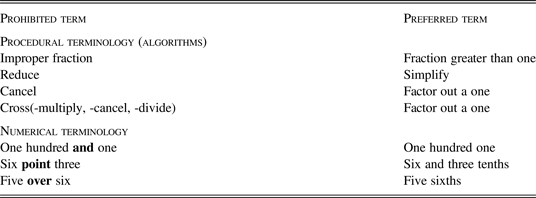
Mathematical prescriptivism at Math Corps is broad, in that it is not based on a single prescription or a strictly delineated set of prohibited and preferred words, but rather, a general principle that mathematical language is to be controlled, which can then be applied by specific instructors as needed. Table 1 lists some of the more common prescriptions I have encountered at Math Corps. They fall generally into two classes: first, procedural terms that refer to algorithms or mathematical processes undertaken in school mathematics, and second, terms used in the reading of numerals orally in English.
Commonly prohibited and preferred terminology.

The implicit metalinguistic values of the ‘Math Corps way’ are specifically linked to an almost invisible discourse of rationality. Students are not generally told why specific prescriptions will improve their mathematical reasoning—or even, in many cases, that they will do so. But being exposed to their TAs (most of whom were former students) and instructors using and discussing such prescriptions with great frequency, students come to value the speech variety used by their mathematically proficient elders. Given that Math Corps has a long history of sending its graduates to top colleges, familiarity with the lexicon becomes part of the toolkit that will lead to this success. Thus, the use of the Math Corps lexicon indexes speakers first as members of the Math Corps family, distinguishing in-group from out-group, and also indexes them as mathematically proficient, as speakers of a local linguistic variety that will lead to mathematical competence both within and outside the group.
For at least some senior staff, the link between ordinary English prescriptivism and mathematical prescriptivism is explicit. In an early interview I had with Dr. Kahn, the founder of the program, the emergent link between linguistic standards and mathematical standards is crystal clear.
(1)
Dr. Kahn: To go back to the Math Corps, we've been thinking about what makes it work, and we've come to this really simple explanation, and it actually, it goes back to English. So the idea is this. Look at English, and let's recognize that it's a stinkin' mess. If you had assigned a group of people to develop a language— we're gonna build a society, we're not cave people anymore, now we need a written language—okay, Joe Schmoe and Mary whatever, and you guys were making a committee, come up with a language for us. Spoken and written language. The people who would come back to you and say, here it is, and present you with English, we would've given an F as a grade, and that would have been kind. We'd be like, are you guys idiots? Are you complete morons?
Every single sentence in the English language, just about, has an atrocity … So in the Math Corps, that's essentially what we did. We looked at math and recognized, this is a stinkin' mess, just like English. It's a mess. It's being taught in ridiculous ways. The procedures, the techniques, the definitions, are all cockamamie stuff, maybe for the same reasons that the English language is a bunch of garbage.
Dr. Kahn proceeded to give several examples of illogical noncorrespondences between spelling and pronunciation; the Math Corps way for him is thus a local analogy for orthographic reform efforts of the sort that are common in various language communities (Johnson Reference Johnson2002; Venezky Reference Venezky2004). Orthographic reform, like mathematical prescriptivism, is a form of verbal hygiene that has a clear and specific rationale: to normalize spelling with pronunciation. At Math Corps, the mathematical lexicon of the Detroit school system to which students are exposed is regarded as part of the problem. Remedying this linguistic deficiency with a new, domain-specific lexicon is thus seen as one way to remedy students' educational deficiencies.
Math Corps' mathematical lexicon consists of a set of well-known prescribed substitutions for mathematical processes. Some of these, like fraction greater than one for improper fraction, or simplify for reduce, are found occasionally (though not systematically) in American school mathematics, as described above. Others, like a very strong prohibition against the terms cancel or cross-multiply (or any cross- formation), do not exist in any other English-language environment that I am aware of. It is not so much that any individual prescription is unique, but that Math Corps is an environment where mathematical prescriptions of all sorts are welcomed and encouraged and are normatively regarded as part of the ‘Math Corps way’. They are thus not only constitutive of a set of speech practices, but they enregister the Math Corps speech variety within the community.
The contrastive domain-specific mathematical lexicon of Math Corps bears a resemblance to the concept of anti-language as described by Halliday (Reference Halliday and Kirkwood1976). An anti-language, such as prisoners' argot, has a lexically elaborated vocabulary that displays structural inversions from the language that serves as its model, and emerges specifically in environments where an anti-society is formed or forming in opposition to the norms of the mainstream. The oppositional identity of a group to the norms and values of the world outside the group is paralleled by the opposition of language to anti-language. Rather than viewing anti-languages as slang, or as means of encoding secret information in a subgroup, Halliday regards acquiring control of the anti-language as part of the socialization process through which a member of the anti-society must go. Math Corps has many of the characteristics of an anti-society, most notably its pervasive insistence on a set of norms and behaviors contrasted with those in the ‘outside world’. Because the program frames itself as a bounded world of its own, in which values such as compassion, kindness, integrity, and courage are demonstrated regularly and expected, it sets itself up oppositionally to the norms of the Detroit public school system and, indeed, Detroit as a whole. The explicit and frequent contrast made between Math Corps and other mathematics programs (for instance, in the former's paucity of explicit rules of conduct), and between Math Corps and American society as a whole (for instance, in the former's rejection of violence) is reinforced through linguistic means. Math Corps senior staff are keenly aware of the linguistic aspects of their moral language and its difference from forms of discourse typical in other educational settings.
Math Corps strongly prefers readings of numerals in a form called simply ‘in English’. Given that there are numerous valid and common readings of numerals even within hegemonically standard Englishes, this phrase deserves some attention. At Math Corps, what is meant by ‘in English’ is that readings that draw attention to the notation of a number written as a fraction or a decimal should be avoided, in favor of readings that draw attention to the specific place values being employed. So, for instance, 400.027 should not be read as four hundred point zero two seven (digitally with the decimal point read specifically) but as four hundred and twenty-seven thousandths. Similarly, 400 27/1000 is also read as four hundred and twenty-seven thousandths rather than four hundred and twenty-seven over one thousand. But readings ‘in English’ create further ambiguity, because four hundred and twenty-seven thousandths (400 27/1000) would be indistinguishable from four hundred and twenty-seven thousandths (427/1000). The solution is further prescription—in this case, the deletion of and from the latter numeral phrase and others where and would occur between hundred or thousand and the tens and ones. Thus, the prescription against and in phrases like four hundred (and) twenty-seven is ultimately motivated by reading ‘in English’ even though in English prior to the nineteenth century, and was normal in any numeral over 100 that also had values in the tens or ones place (von Mengden Reference von Mengden2010). Also, of course, in many more contemporary instances (one hundred and one Dalmatians; one thousand and one Arabian nights), and is still expected if not required.
In making such prescriptions, Math Corps staff stress to students that regardless of the notation of a number, its value does not change—in other words, 400 27/1000 and 400.027 are simply two notations for the same number, and reading them identically emphasizes that point. Readings of fractions using over for the fraction bar (vinculum) draw attention to the fractional notation, and readings of decimals using point or decimal similarly draw attention to the decimal notation, whereas the ‘in English’ reading is notationally neutral.
At Math Corps, students very rapidly learn through socialization in the classroom to prefer the notationally neutral ‘English’ readings of numerals. The following instance in (2) of repair from a fractional reading to a notationally neutral one occurred in an interview with Malik,Footnote 1 a seventh-grade student, on just his fifth day in the program.
(2)
SC: Okay, so I know that fractions are numbers and I know that that's in your notes. But then what if somebody is still like, “Okay, that's fine but not every number is a fraction”. They might be like, what kind of a number is a fraction?
Malik: Like a half, like half, like a hundredths, like thirty-one over—no, thirty-one hundredths, or they just, half of a number, or like half of what you eat. Like if I had half of a sandwich. (2011/07/11)
Just four days earlier, Malik had been part of the following classroom discussion, given in (3), in which his classmate Bashira was steered towards a notationally neutral reading by her teacher.
(3)
Mr. Jamieson: Percent means hundredths, so … if I have thirty-seven percent, what is that equal to as a fraction? What would that be equal to as a fraction? Yes, Bashira?
Bashira: Thirty-seven over a hundred.
Mr. Jamieson: Thirty-seven over a hundred. How can we say this number like a mathematician? You're close. Oh, when I had this number, how would you say this, Malik?
Malik: One fifth.
Mr. Jamieson: One fifth. How do you think you're gonna say … and when we had this? We had, we said seven twentieths. So what do you think this would be?
Bashira: [inaudible]
Mr. Jamieson: Say what?
Bashira: Thirty-seven hundredths.
Mr. Jamieson: Yes, thirty-seven hundredths.
Malik was, at the time of the interview, among the weaker students in the class mathematically, and was very new to the program, but the disciplining of the reading of numbers was well within his grasp, and Bashira being enjoined to read numbers “like a mathematician” clearly had an effect on him. Access to a privileged form of mathematical communication, for such students, despite their overall weakness in mathematics, is a source of confidence that, through access to this code, they have access to knowledge not available to students outside the community.
Because there is such an intense focus on the language of mathematics at Math Corps, instructors develop a pool of potential prescriptions to be presented to Math Corps students based on their previous exposure to prescriptions. None of the prescriptions in Table 1 are individually unique to Math Corps. But because they are socially shared in classrooms and among ‘generations’ of instructors and students, they not only become part of the education of students in the use of mathematical terminology, but also help to inculcate the value that any aspect of mathematical terminology should be rationalized and disciplined within the community. The prescriptions are thus not merely a set of vague rules to be learned, but part of the practices transferred from teacher (and teaching assistant) to student as part of apprenticeship and socialization into the Math Corps program.
PRESCRIPTIVISM AND MATHEMATICAL PROCESS
If Math Corps' attention to prescriptive language in mathematics were purely linguistic, it might be possible to dismiss it as a naïve form of pseudo-relativistic reasoning by which proper language leads automatically to proper thought. The situation is more complex, however; it is not that instructors believe that using preferred terms changes cognition directly, but rather, that they draw attention to processes that are regarded as more effective than those of school mathematics as presently taught. This complex link between language, notation, algorithm, and cognition, not simply a blind adherence to a set of norms, guides much of the mathematical prescriptivism at Math Corps.
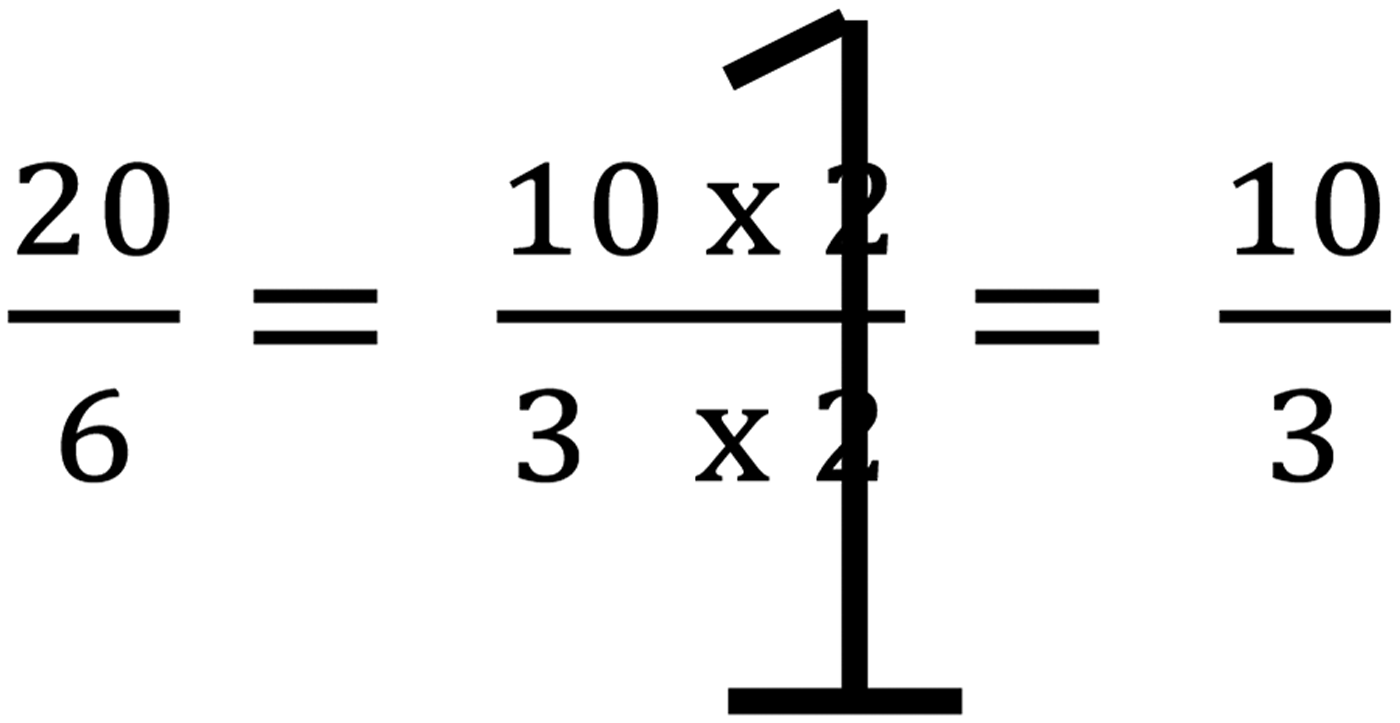
For instance, the prohibition against cancelling is not a random quirk, but rather, emerges out of a desire to inculcate in students the notion that, when simplifying fractions, one is not merely crossing out numbers, but rather, factoring out a form of 1. This is reflected in the notation that Math Corps instructors use to represent this fact. Figure 1 shows the ‘Math Corps way’ of simplifying the fraction 20/6.
Simplifying by factoring out a 1.
The use of a large 1 through 2/2, with a forestroke at the top and a serif at the bottom to distinguish it from a mere vertical line, illustrates to students that, because any fraction x/x equals 1, and anything times 1 equals itself, a form of 1 can be factored out of a numerical representation. It is a use of notation that illustrates that mathematics makes sense, and that rather than cancelling out terms haphazardly, the equivalence of 20/6 and 10/3 makes sense mathematically in terms of factoring out a form of 1. Much of this is left underspecified in actual classroom discourse; instead, it is couched in terms of a prescription against cancel or ‘the C word’.
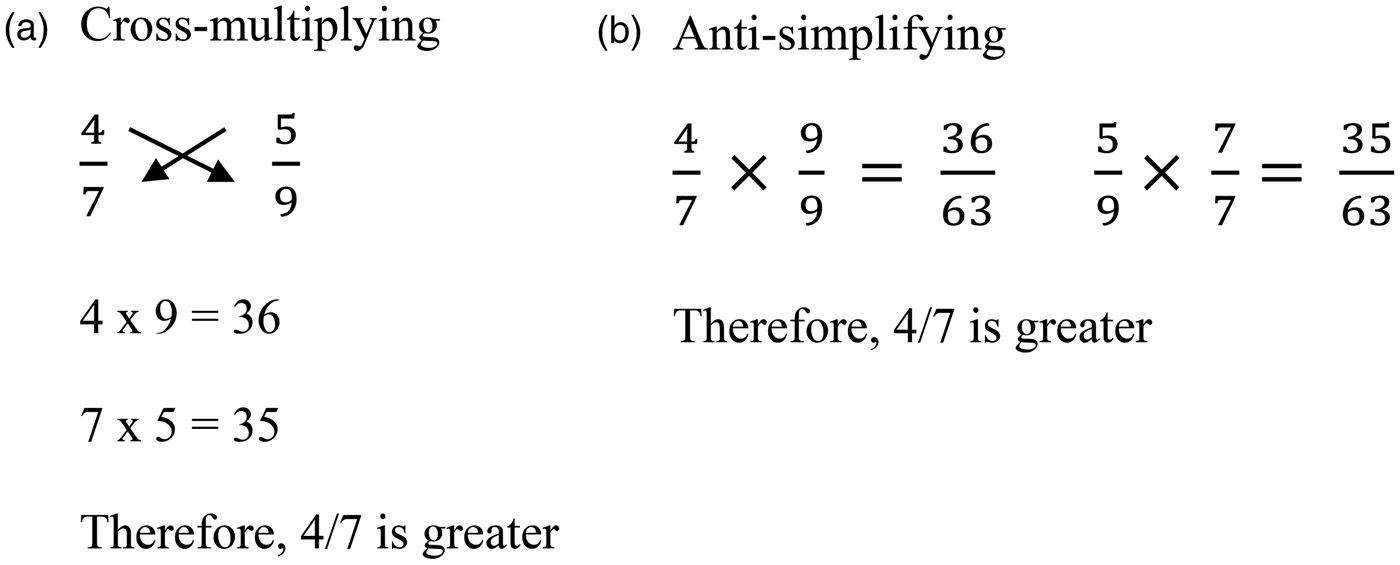
Similarly, the prohibition against the term cross-multiply goes beyond prescriptivism in that it is meant to highlight the risks of certain algorithms and to get students instead to use an approved technique. Cross-multiplying is used in algebra to determine the value of a variable by multiplying the denominator of one side of an equation by the numerator of the other side, and vice versa, or, in comparing fractions, to evaluate which of two fractions is greater (which is implicitly algebraic though not explicitly so). So, for instance, Figure 2 illustrates the contrast between the dispreferred means of comparing two fractions and the Math Corps way.
Cross-multiplying versus anti-simplifying.
In the former method, using cross-multiplying, it is opaque how the answer is obtained, the method of comparison must be learned by rote (the smaller fraction is the one whose numerator, when multiplied by the other denominator, produces the smaller product), and it is easy and frequent for a student to become confused. The arithmetic underlying the second technique is identical, but the process is much clearer: each fraction is multiplied by a form of 1 to produce two fractions with a common denominator. This process is known at Math Corps as anti-simplifying, quite sensibly, in that it is the opposite of simplifying (reducing) a fraction.Footnote 2
Doing so produces two fractions with the common denominator but different numerators, at which point the comparison is obvious. Because Math Corps instructors (rightly) perceive that the latter method is less likely to lead to error, and because it makes the algorithm more explicit, they caution students to avoid the term cross-multiply (and, indeed, various other combinations such as cross-reduce and cross-divide). Drawing attention to language allows the instructor to draw attention to issues of notation and process, so even if the linguistic prescriptions themselves are not directly rationalized in the way that reduce vs. simplify is, they form part of a broader rationalizing effort.
Math Corps students rapidly learn the prescriptions associated with the local register; this is not to say, of course, that all of them use it exclusively, and in fact some actively resist it. In the following interview in (4) with Charlene, a ninth-grade student and one of my principal consultants, she gleefully violates the ‘Math Corps way’, which she sees as generally cumbersome, pedantic, inefficient, and requiring excessive showing of intermediate steps.
(4)
SC: So, now I'd like you to multiply two fractions together, to multiply two fractions together in your, in your head. What is nine elevenths times eleven twelfths?
Charlene: (0:04) Three fourths.
SC: Alright, you got that answer pretty fast. That's correct. How did you do that?
Charlene: [smiling] I cancelled out the elevenths.
SC: Ah.
Charlene: [laughing] And then I was left with nine over twelve, then I reduced it.
SC: So, why, why are you laughing?
Charlene: ‘Cause that's not the Math Corps way.
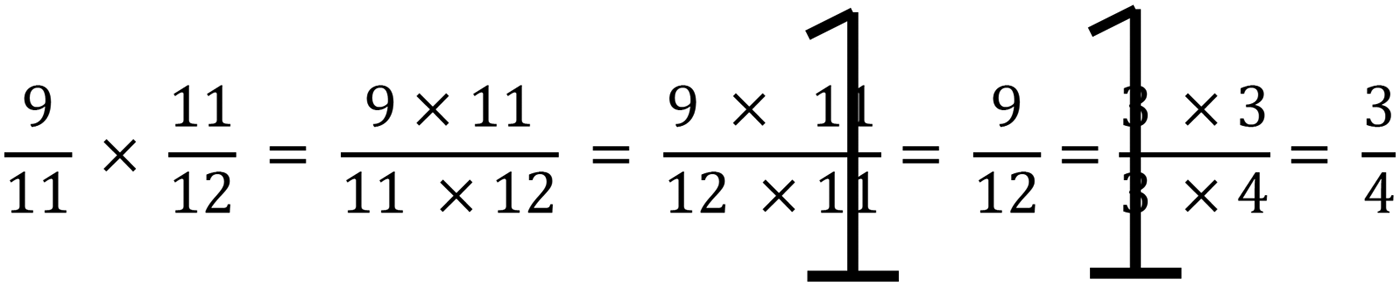
The Math Corps way, in this case, would be as shown in Figure 3.
Operating on fractions: the ‘Math Corps way’.
This is what would be required of her in a written problem to get full points, using commutativity at the third step to create 11/11 and then simplifying at the fifth step by factoring out 3/3, and using a large numeral 1 rather than just crossing out the fractions equivalent to one. For Charlene, though, her linguistic violations parallel her algorithmic ones—she simply crosses out (cancels) the two 11s in the initial problem to produce 9/12, and then divides both numerator and denominator by 3 (reduces) to get the final answer. The fact that she did this mentally, correctly, in four seconds, is a testament to her mental math skills. Her mathematical giftedness is also the source of much of her resistance against Math Corps algorithms and its accompanying prescriptive language. She (correctly) perceives that the Math Corps way slows her down, and because she understands why her algorithm works (i.e. that it is a shorthand), she sees no advantage in drawing out the process. Her sly laughter and her stress of the terms reduce and cancel are a not-so-subtle noncompliance at what she feels are intrusive prescriptions, in an environment (a private interview) where she knows she can get away with it.
In all these cases, prescriptive language is clearly linked to a set of desirable algorithms that students are intended to employ in lieu of ‘school mathematics’. But unlike other communities of practice with a mathematical focus (Lave Reference Lave1988; Nunes, Schliemann, & Carraher Reference Nunes, Dias Schliemann; and William Carraher1993), Math Corps mathematics is not ‘street mathematics’; rather, it is almost a hypercorrect variety of ‘school mathematics’, grounded in the presumption that there is a problem with school mathematics that can be solved through greater emphasis on rationality.
At this level, mathematical prescriptivism is seen as a means of disciplining language, and thus indirectly disciplining mathematical cognition. This can clearly be seen in examples such as the preference for simplify over reduce; the explicit assumption is that students who use reduce will inadequately perceive that 24/6 is equal to 12/3. It is a folk-cognitive variety of linguistic relativity, not so different from nonmathematical metalanguage such as that double negatives are illogical (Cheshire Reference Cheshire, Bauer and Trudgill1998). The use of the prescribed mathematical lexicon and the avoidance of taboo terms are seen to have the potential to improve mathematical cognition, and thus, in conjunction with appropriate practices, to lead to improved outcomes.
In other cases, taboos against language are conflated with the prohibition of particular mathematical techniques. The prohibition against cross- words stems primarily from concern against cross-multiplication as a means of comparing fractions. Because of the potential for error that exists within the notational and graphic practice, a lexical taboo is born, and then is extended to all forms of cross- in mathematical contexts (cross-reduce, cross-divide, cross-cancel, etc.), some of which have generally understood meanings, others of which do not. What begins as a sort of pseudo-Whorfian effort to rationalize mathematical language becomes generalized and socially prominent.
Not all instances of mathematical prescriptivism at Math Corps can be so clearly linked to specific algorithms, however. The taboo against terms such as improper fraction, almost certainly the strongest lexical prescription at Math Corps and the subject of frequent and extended discourse, cannot be explained either by recourse to mathematical cognition in the abstract, or to particular notational frameworks. Students who use the term improper fraction are almost universally aware that these are fractions that are greater than one; the preferred term fraction greater than one does not prevent error either of notation or cognition, and no one has ever tried to justify it to me in this way. Discourse regarding this term simply focuses on the fact that these are still perfectly good fractions even though the numerator is greater than the denominator. However, I have never heard a student suppose that they were not. To fully explore mathematical prescriptivism at Math Corps, then, we must move beyond well-justified links to mathematical process.
THE PRESCRIPTIVE MELODRAMA
The most symbolically charged response to a violation of one of the above taboos is a form that I call a prescriptive melodrama: an extended and playful classroom discussion, full of melodramatic expression concerning a particular mathematical term. A prescriptive melodrama sits as a frame outside ordinary classroom discourse about mathematical practice; it is humorous, emotionally charged, and linguistically marked, allowing teachers to prescribe in a nonthreatening manner. Unlike the discussions above, however, it does not seek to link prescription to specific mathematical practices or algorithms. Prescriptive melodramas at Math Corps exist as a general discursive practice because of the generational focus of the program, allowing teaching assistants to participate in the monitoring of the language of middle-school students just as they were once monitored. They thus serve as a means of creating and maintaining social boundaries more than improving mathematical outcomes.
During my time at Math Corps, I observed fifteen prescriptive melodramas involving four different primary instructors and dozens of TAs and CIs familiar with the practice. Their frequency and duration (given that there are only twenty-two classes in the core curriculum per summer, of half an hour duration each) strongly suggests that they are not ephemeral but form part of the socio-moral core of the program. In other words, not only are the objects of mathematical prescriptivism shared among the community, but the responses to its violation are shared. Yet the prescriptive melodrama is not taught to TAs in their training; rather, it emerges (through legitimate peripheral participation in the community of practice) from the fact that the majority of college instructors were once TAs, and the majority of TAs were themselves once students.
Example (5) is a typical (if brief) instance of the form, involving a teacher (Mrs. Davis), a seventh-grade student (Rahim), and several of the teaching assistants (TAs).
(5)
Mrs. Davis: Why does this make sense, Rahim?
Rahim: Because you have to break it … cause you have to make the eight into an improper fraction.
TAs: Huh? What's that?
TA-1: What? What? What? What the heck is that?
Mrs. Davis: Ohhh … Improper fraction? What's so improper about fractions?
Rahim: Well, a fraction greater than one.
TA-1: All right.
TA-2: Thought they was behaving badly!
TA-3: That sounds kind of familiar.
A prescriptive melodrama most often begins when a student says one of several prohibited terms as part of ordinary classroom discourse, while in a few instances, the instructor him/herself broaches the subject gently, initiating the students into the particular prescription and its taboo status. Either way, this serves as a keying for a playful discursive frame, outside the ordinary context of classroom discourse, in which a new set of rules and expectations apply (Goffman Reference Goffman1959, Reference Goffman1974).
It is common (eleven out of fifteen events) for some or all of the teaching assistants in the classroom (normally there will be ten TAs in a class of twenty students) to react negatively and emotionally to the initial violation, either immediately after the student's utterance or after the instructor responds. For instance, a TA might gasp loudly, moan, shake her head, or interject loudly. Note, above, that while the instructor is involved in the melodrama, the TAs vigorously ensure that it continues to some resolution. When this happens, even if the instructor had not noticed (or had chosen not to notice), at this point it is necessary for the class to pay attention to the violation of protocol.
Overdramatic and playful expressions of disgust, disease, or anger from the instructor are nearly universal in a prescriptive melodrama (fourteen out of fifteen events), highlighting the violation. A middle-aged male teacher might feign a heart attack, stagger, and begin to moan playfully that “it's the big one”, as if the word itself causes injury, until the appropriate term is substituted. Another teacher might feign wiping away tears at the deep sorrow of some concept being called by its wrong name. Still another asserts that “it corrupts your mind, and it just leads to chaos in the future”. Notably, the student is never criticized directly for the violation; rather, it is the utterance, the word itself, that is a pollutant, and that causes physical or emotional pain. By personifying the forbidden aspects of the lexicon, and then criticizing the words, the instructor can deflect attention away from the fact that a particular student has violated the taboo, which avoids the undesirable circumstance where a student feels personally attacked by her instructor.
At some point, the instructor or a TA may make an allusion or playful reference to the polysemy of the prohibited term. For instance, improper fractions “don't go around farting”. Cross-multiplying is dangerous because it leads us to “cross people out of our lives”, so “Stay away from cross anything, or I'll get cross with you!”. The emotive content of the prescriptive melodrama can even provide an instructor an opportunity to turn the discourse, within that frame, to moral and ethical questions in a way that would not normally be possible in ordinary classroom discussion. The ability to inject moral discourse into classroom practice is consonant with Math Corps' focus on the entire student, not just mathematical performance.
Occasionally, the prescriptive melodrama may include an explicit discourse of rationality. For instance, it may include a claim that reduce is prohibited because the process does not actually decrease the number, but rather provides an equivalent fraction by factoring out a form of one. In fact, however, rationalizations in terms of mathematical cognition during a prescriptive melodrama are uncommon and indirect. In interviews, some instructors and TAs asserted that students make this error (a form of the etymological fallacy), but in the prescriptive melodrama, the link to mathematical cognition is usually left unstated. Instead, specific allusion is frequently made to the danger and taboo nature of the word, sometimes turning it explicitly into profanity through initials (for instance, the ‘R word’ = reduce, and the ‘C word’ = cancel), or requiring the students to whisper it.
Finally, at the end of the prescriptive melodrama, order is restored, which can occur (as above) by the original ‘offender’ saying the correct term, by having a different student offer the correct term, or by having the entire class repeat the correct term to reinforce it. The frame ends, and ordinary classroom discourse can resume.
The prescriptive melodrama is certainly not the only playfully emotive ritualized activity at Math Corps. In morning assemblies, various sorts of hyperbolic expressions of negative emotion are normal; for instance, one senior staff member might express playful horror or disgust at another staff member's mode of dress, or two staff members might stage a mock quarrel (within the discursive frame) over which of them would have the privilege of leading the assembly. We can thus understand the prescriptive melodrama within a context at Math Corps in which playful performance, in general, is frequent and viewed positively.
The prescriptive melodrama, however, is noteworthy, because it is only ever found in classroom settings (never in assemblies), because it is the only form of dramatic play in the classroom (the other forms just mentioned do not occur in class), because of its relative frequency, and because of the regular participation of students and teaching assistants in the act. The importance of TAs as immediate role models within the Math Corps family illustrates to students the roles they will be expected to play in future years. The prescriptive melodrama is the only dramatic form at Math Corps that is explicitly pedagogical; it is an act of cultural transmission that invokes and involves mathematics. It thus binds the community normatively and bounds it in opposition to school mathematics.
As a discursive event, the prescriptive melodrama shares much in common with the ‘Whiteman’ jokes described by Keith Basso (Reference Basso1979) among the Western Apache. Like the exaggerated portrayals of ‘Whiteman’, which reinforce Western Apache linguistic norms in opposition to Anglo-American ones, while simultaneously reinforcing social ties among community members, prescriptive melodrama is used in Math Corps classrooms to highlight violations of linguistic and social norms in a relatively safe way. In the classroom, this entails a playful and nonconfrontational spirit—it would be extremely problematic indeed were the prescriptive melodrama to turn nasty, to target a student's language in a cruel way. The danger here is not, as with the Apache case, that the student will be angry, but rather that the student will be humiliated and become an object of ridicule. I have never seen a prescriptive melodrama go this far.
Like Western Apache linguistic play, the prescriptive melodrama is also a way of establishing and reinforcing social ties within the in-group by emphasizing its distinctiveness from the out-group. The widespread presence of wordplay and verbal ambiguity in the prescriptive melodrama allows the instructor to link mathematical practices to social norms. Explicit reference is frequently made to school learning in contrast to the Math Corps way, to the point where instructors will sometimes warn (only half facetiously) their students not to tell their teachers the negative things Math Corps instructors said about them. The prescriptive melodrama thus marks prohibited words as standing outside the community, while simultaneously socializing students within the community.
Yet it is also clear that prescriptive melodrama can go awry, just as Basso's portrayals of ‘Whiteman’ can go too far. At Math Corps, this is particularly a risk when a student does not understand the frame of the discourse. In one instance, a student, Jamarcus, was taken aback when the TAs and other students around him began to engage in a prescriptive melodrama regarding the word reduce. This was an eighth-grade classroom (i.e. most of the students were in the second year of the program), but while Jamarcus was, like his peers, an eighth-grade student, he was new to the program that year—in other words, he lacked any prior exposure to this form of discursive event, and to the specific prescription it concerned. He simply did not understand why everyone was making such a fuss over the use of the word reduce, and the instructor's explanation did not satisfy him that there was anything to be concerned about.
Further evidence of the core importance of the prescriptive melodrama is that it is attested in electronic form outside the confines of the six-week camp. The following series of tweets (Twitter messages) took place between Philip, a male senior staff member, and Erika and Janine, two female college instructors, in early September 2011, several weeks after camp had ended.
(6)
@Erika: Lol shut up please... you can't be “bad” and a hoodrat! The hoodrat cancels out everything!
@Philip: We don't say “cancel”
@Janine: lol yes we can just not in math
@Erika: lol I knew someone from MC was going to say something!
@Philip: lol no canceling ever! And I am independent!
@Janine: no you're not! Lol
@Erika: CANCEL CANCEL CANCEL CANCEL CANCEL!!!!!!!!!! lol
@Erika: I wonder did @Philip see my cancel tweet lol
@Philip: “Canceling” a certain someone's employment with a certain place ...
@Erika: I remember when I didn't talk to my kids for a whole day because they kept saying “cross cancel” ... I was so mad lol
Here we see several of the core elements of the prescriptive melodrama; repeated emphasis of lol indicating the playful nature of the prescription; expressions of anger (capitalization; multiple exclamation points; I was so mad); playing with the semantic ambiguities of the term cancel; and the intervention of the second instructor. Though not intended to do anything remotely connected with building students' mathematical proficiency, this Twitter conversation serves, outside the confines of the normal program both temporally and spatially, to reaffirm the bond between these three individuals and their common identity as shared, in part, through the use of a common register.
The prescriptive melodrama at Math Corps is one solution to the problem of prescribing without criticizing. By re-framing the discourse as a criticism not of the student, but of the words themselves, by imputing moral failings to the language, by attributing failings to the school system, and above all, by putting prescriptions in a playful (but emotionally charged) frame, it is possible to prescribe without there being a stain on a student's intellect or moral character. To do so would ultimately be self-defeating in a program whose goal is to improve mathematical outcomes through promoting self-esteem.
PRESCRIPTIVISM, RACE, AND AAVE
Whereas laypeople may be perfectly happy to accept an imperious tone from prescriptive grammarians such as Strunk & White (Reference Strunk and Brooks White1959), prescriptive discourse at Math Corps is bound by a competing and significantly more important principle: respect for students as human beings. Since most students at Math Corps are African American and speak African American Vernacular English (AAVE) natively, all are aware that the language they speak on a daily basis is evaluated as nonstandard by a middle-class and largely white majority, and most have heard explicit criticisms of their native language variety.
Fordham (Reference Fordham1999) and others emphasize the importance of language and language standards in understanding students' behavior in classroom settings and beyond. Fordham, following her work with John Ogbu (Fordham & Ogbu Reference Fordham and Ogbu1986), argues persuasively that in the Baltimore high school in which she studied, African American students, no matter how high achieving, could never fully own the Standard American English taught in school settings, but could only ‘lease the standard’ during school hours, outside of which they were expected to conform to the linguistic practices of their community, that is, to use AAVE as their normative dialect. In an environment where nonstandard Englishes are frequently challenged or stigmatized by instructors, it is understandable that students might be resistant to this form of prescriptivism.
At Math Corps, in contrast, despite the fact that a vast majority of students and teaching assistants and a majority of college instructors are African American, prescriptive language ideologies play a very different role. Despite the role of mathematical prescriptivism in the program, there is no denigration of AAVE in any of the characteristics in which it is nonstandard. Take, for instance, the following fragment of classroom discourse between a teacher, Mr. Jamieson, and a student, Peter, both fluent users of AAVE.
(7)
Peter: Oh, I mean, three million one hunnit.Footnote 3
Mr. J: Three million one hunnit. I love it. You must be from the East Side? You from the East Side? That's what I'm talking about.
All: [laughter]
Mr. J: Three million one hunnit. Three million one hundred. Very good, Peter.
Very good comeback. Very good. Three million one hundred. All right, we're moving along, moving along. Add, we love addition, cause we wanna add beautiful and good things to this world, we don't wanna take away so in this case I want you to add three hundred twenty-one plus ninety-two, three hundred twenty-one plus ninety-two.
Peter's (correct) answer is praised at several points (“I love it”, “Very good”, “Very good comeback”), and then followed up with a positive message using add metaphorically. His use of hunnit indexes him as being from Detroit's historic African American east side, and the students are all completely aware of the reference to linguistic forms rarely encountered in the school system. While the teacher does shift to a Standard English pronunciation thereafter, there is no effort to discipline language at this point, or at similar points, in the classroom. At Math Corps, no one cares if you answer three hunnit fitty to the question, “What is seventy times five?”. Some instructors do care very much, however, whether you answer three hunnit AND fitty. Criticizing students' use of AAVE, a common occurrence in many American school settings, is hardly the basis for socializing students into a positive identity within the Math Corps community of practice, and I have never seen it occur. The mathematical prescriptivism of Math Corps works specifically because it builds an oppositional identity not on the basis of racial identity, but on the basis of membership in the Math Corps family.
None of this is to say that Math Corps is deracialized or that African American students leave aside their racial or ethnic commitments when they join. Yet the set of linguistic forms specific to the program are so strongly foregrounded in classroom settings that other aspects of language are muted, and there is no linguistic concern surrounding AAVE. And—although there can be many explanations for this fact—I have never seen any sign of the sorts of oppositional identity based on race documented by Ogbu (Reference Ogbu1978, Reference Ogbu2003) among other African Americans. The fact that instructors and teaching assistants, regardless of race, use and reinforce the mathematical language of Math Corps, serves to reinforce the idea that one does not need to abandon one's other identities in order to take on this new one. Given the importance at Math Corps for students to be themselves, it would be highly unusual for it to be otherwise.
CONCLUSION
It is not possible, in any sort of controlled way, to demonstrate that a particular mathematical prescription has a particular cognitive effect on students, or leads to a particular outcome. The ‘Math Corps way’ is more than just a set of randomly selected prohibitions and preferences, however; it is a framework where mathematical notation and language are seen as tools guiding students to better mathematical algorithms and cognition. This discourse of rationality works in part because prescriptive language standards are linked to the specific algorithms used in the community of practice, and in part because this disciplining of mathematical language is linked to talking ‘like a mathematician’, giving students confidence that they are learning practices that make them mathematically proficient.
Beyond the individual level, however, the set of Math Corps prescriptions, enregistered as the ‘Math Corps way’, and embodied in the prescriptive melodrama, serve to socialize participants into the community of practice and to build social solidarity within the ‘Math Corps family’. One is learning a lexicon and set of algorithms through participating in the program, and the personal confidence to apply them successfully to mathematical problems. Yet, even if these were to have no direct cognitive effects whatsoever, daily habitual work using the ‘Math Corps way’ promotes and reinforces a common identity as Math Corps program members. In an environment where one's instructors are successful high school and college students who have been through the program themselves, this crucial link between prescriptive language and success is developed.
More broadly, this study builds on Deborah Cameron's insights regarding verbal hygiene, showing that even if it were possible to eliminate prescriptive standards, doing so might not be desirable and could be counterproductive. The perniciousness of the ‘grammar grouch’, standard-dictionary variety of prescriptivism in the school system lies in its tendency to make students fear error and to feel linguistic insecurity about their own, nonstandard language varieties (Macaulay Reference Macaulay1975). But at Math Corps, students are invited to ‘own’ the local standard (Fordham Reference Fordham1999), and so we see none of these effects, but rather, increasing confidence in their own abilities as mathematicians, and in their identities as members of a highly successful mathematics program. We have only begun to investigate the potential of prescriptive language as a positive tool for linguistic socialization within a sociolinguistic and anthropological framework.