Introduction
Persistent olfactory dysfunction represents a frequent symptom of long coronavirus disease 2019 (Covid-19), affecting 5–30 per cent of the individuals one year after severe acute respiratory syndrome coronavirus-2 (SARS-CoV-2) infection.Reference Vaira, Salzano, Le Bon, Maglio, Petrocelli and Steffens1–Reference Boscolo-Rizzo, Hummel, Invitto, Spinato, Tomasoni and Emanuelli5 Given this high prevalence and the devastating effects on patients’ quality of life,Reference Vaira, Gessa, Deiana, Salzano, Maglitto and Lechien6,Reference Saniasiaya and Prepageran7 persistent olfactory dysfunction has become a healthcare challenge.Reference Boscolo-Rizzo, Polesel and Vaira8
Fortunately, it appears that the prevalence of olfactory dysfunction as a result of infection has decreased over time, from over 50 per cent in the early pandemic wavesReference Saniasiaya, Islam and Abdullah9,Reference Vaira, Lechien, Khalife, Petrocelli, Hans and Distinguin10 to 1–30 per cent in those with Covid-19 caused by the omicron variant.Reference Boscolo-Rizzo, Tirelli, Meloni, Hopkins, Madeddu and De Vito11–Reference Cardoso, Rossi, Galliez, Faffe, Tanuri and Castiñeiras13 However, to date no studies have assessed whether this lower prevalence corresponds to a lower frequency of persistent olfactory dysfunction.
This study aimed to evaluate by psychophysical tests the recovery of olfactory function at six months in individuals infected with the omicron variant.
Materials and methods
This prospective case–control study was conducted at the University Hospital of Sassari from February to October 2022. The study protocol was approved by the ethics committee of the University Hospital of Cagliari (ethical approval code: PG 2021/7118) and written informed consent was obtained from each participant.
The study included patients with a confirmed diagnosis of SARS-CoV-2 infection in February and March 2022. During this period, the omicron variant had a prevalence of over 98 per cent in the Sardinia region for more than two weeks.14 In order to reduce the risk of inclusion bias, patients were enrolled consecutively using the lists of individuals with positive infection results as provided by the Department of Prevention of the University Hospital of Sassari. Furthermore, a group of healthy individuals who had never been diagnosed with SARS-CoV-2 infection were included as controls. All these individuals were part of the hospital staff and therefore subjected to frequent checks with swabs and serological tests, with consistently negative results.
The exclusion criteria for both groups were: (1) previous Covid-19; (2) history of olfactory dysfunction; (3) previous surgery, radiotherapy or trauma to the nasal cavity; (4) chronic rhinosinusitis with and without nasal polyps; (5) neurological or psychiatric co-morbidities; and (6) age less than 18 years. Some of the patients and control participants were included in a previous study on the prevalence of olfactory dysfunction during omicron variant infection.Reference Vaira, Lechien, Deiana, Salzano, Maglitto and Piombino12
Data collection
Some general data were collected for all enrolled individuals, including age, gender and vaccination status. Self-reported olfactory loss was investigated using the specific entry of the Covid-19 symptom index, which classifies olfactory function as normal, reduced or completely abolished.Reference Lechien, Chiesa-Estomba, Hans, Calvo-Henriquez, Mayo-Yanez and Tucciarone15 Evaluation of olfactory function was performed through the extended version of the Sniffin’ Sticks test according to the administration protocol previously described.Reference Hummel, Kobal, Gudziol and Mackay-Sim16,Reference Hummel, Sekinger, Wolf, Pauli and Kobal17 The Sniffin’ Sticks test evaluates three domains of olfactory function: threshold, discrimination and identification. Each of these functions is assigned a variable score of 1–16 for threshold and 0–16 for discrimination and identification. The sum of these scores leads to an overall threshold, discrimination and identification score that categorises olfactory function as normosmia (threshold, discrimination and identification score of ≥ 31), hyposmia (threshold, discrimination and identification score of 17–30.75) or anosmia (threshold, discrimination and identification score of < 17). The evaluation took place within 10 days of the diagnosis of infection in the case group.
All the cases were re-evaluated in the same way at least six months after the first evaluation. Patients were excluded from re-evaluation if they contracted the infection during the follow-up period.
Statistical analysis
Statistical analyses were performed using jamovi version 2.3.18.0, a freeware and open statistical software for desktop computers and ‘the cloud’ servers.18 Categorical variables are reported in numerals and percentages of the total. Descriptive statistics for quantitative variables are given as the median (interquartile range). For the purposes of the statistical analysis, patients were classified into three categories of olfactory function according to the psychophysical scores obtained: normal, hyposmic and anosmic. A chi-square test was performed to evaluate the differences between cases and controls in terms of proportions of normal, hyposmic and anosmic individuals. Analysis of the differences between the Sniffin’ Sticks test results at baseline and at six months was performed by the Wilcoxon signed rank test. Differences in the Sniffin’ Sticks test results between groups was assessed with the Mann–Whitney U test. The level of statistical significance was set at p < 0.05, with a 95 per cent confidence interval. Sample size was calculated using the ‘jpower’ module of the jamovi software. Considering a minimally interesting effect size of 0.5, a power of 80 per cent and a 5 per cent margin of error, the calculated minimum sample size for each group was 64 individuals.
Results
In all, 102 patients and 120 controls who met the inclusion and exclusion criteria were enrolled in the study. The case group consisted of 49 women and 53 men with a median age of 45 years (interquartile age range, 11 years) and a vaccination rate of 99 per cent. The control group consisted of 61 women and 51 men with a median age of 44 years (interquartile age range, 8 years) and a vaccination rate of 100 per cent. The two groups were homogeneous for gender (p = 0.678), age (p = 0.229) and vaccination rate (p = 1).
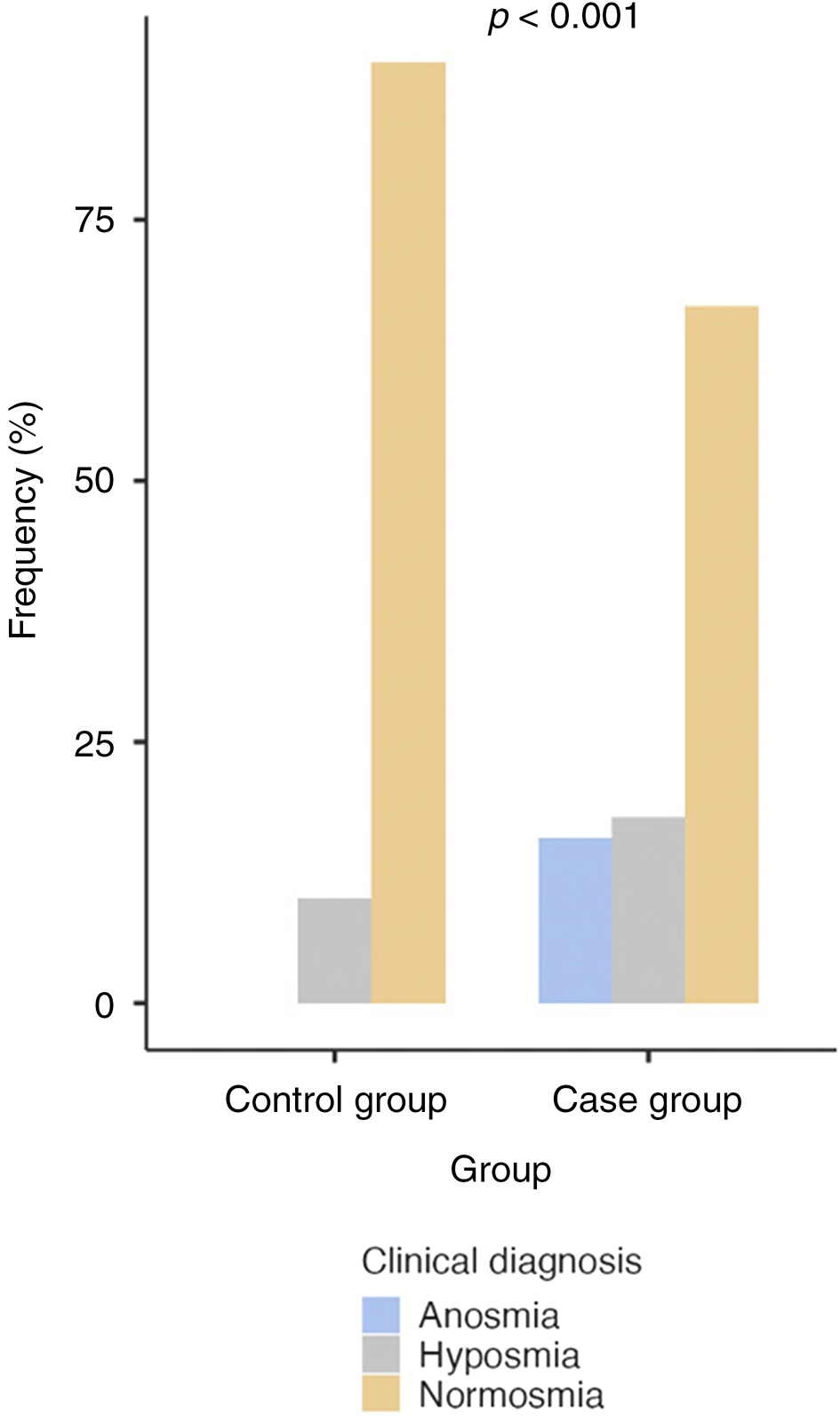
At baseline in the case group, 10 (9.8 per cent) and 16 (15.7 per cent) patients reported a complete or partial loss of smell, respectively. For the psychophysical tests, the median threshold, discrimination and identification score was 33.6 (interquartile range, 12.5) for the cases and 36.5 (interquartile range, 4.38) for the controls, with a statistically significant difference between the two groups (p < 0.001) (Figure 1). Based on the threshold, discrimination and identification scores, 12 of the 120 (10 per cent) controls had hyposmia; in contrast, 34 of the 102 (33.3 per cent) patients in the case group reported an olfactory dysfunction, including 16 cases (15.7 per cent) of anosmia and 18 cases (17.6 per cent) of hyposmia (Figure 2). The differences between the two groups were statistically significant (p < 0.001).
Comparison of baseline threshold, discrimination and identification (TDI) scores between the case group and control group. Circles indicate individual data points. The boxes span 25th–75th percentiles, with the horizontal lines representing the median, the whiskers indicating the 95 per cent confidence interval, and the curved lines reflecting the distribution of the data points.

Comparison of clinical diagnosis of olfactory function between the case group and control group at baseline.

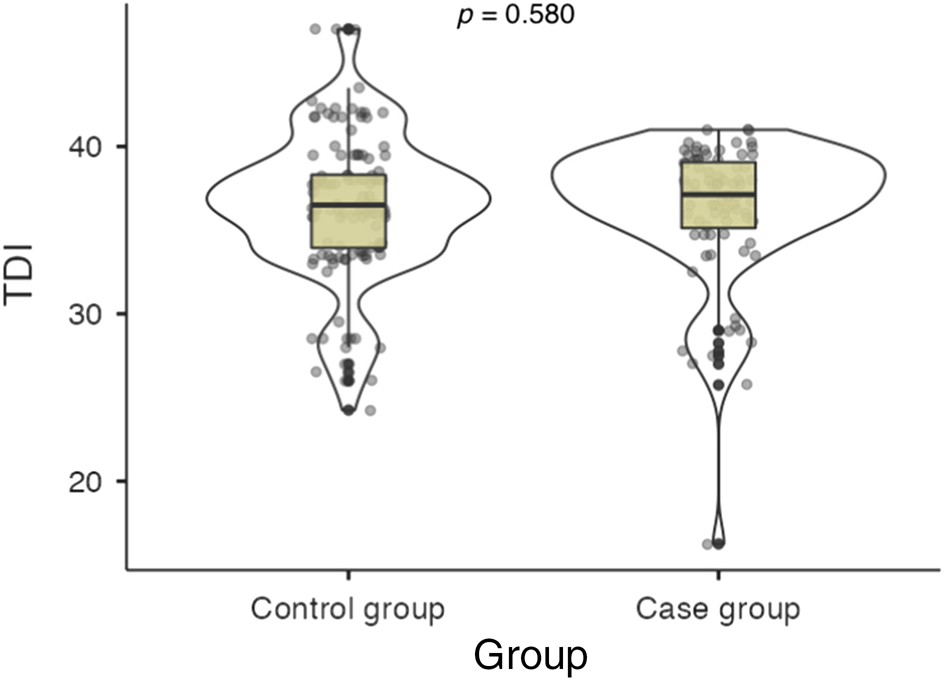
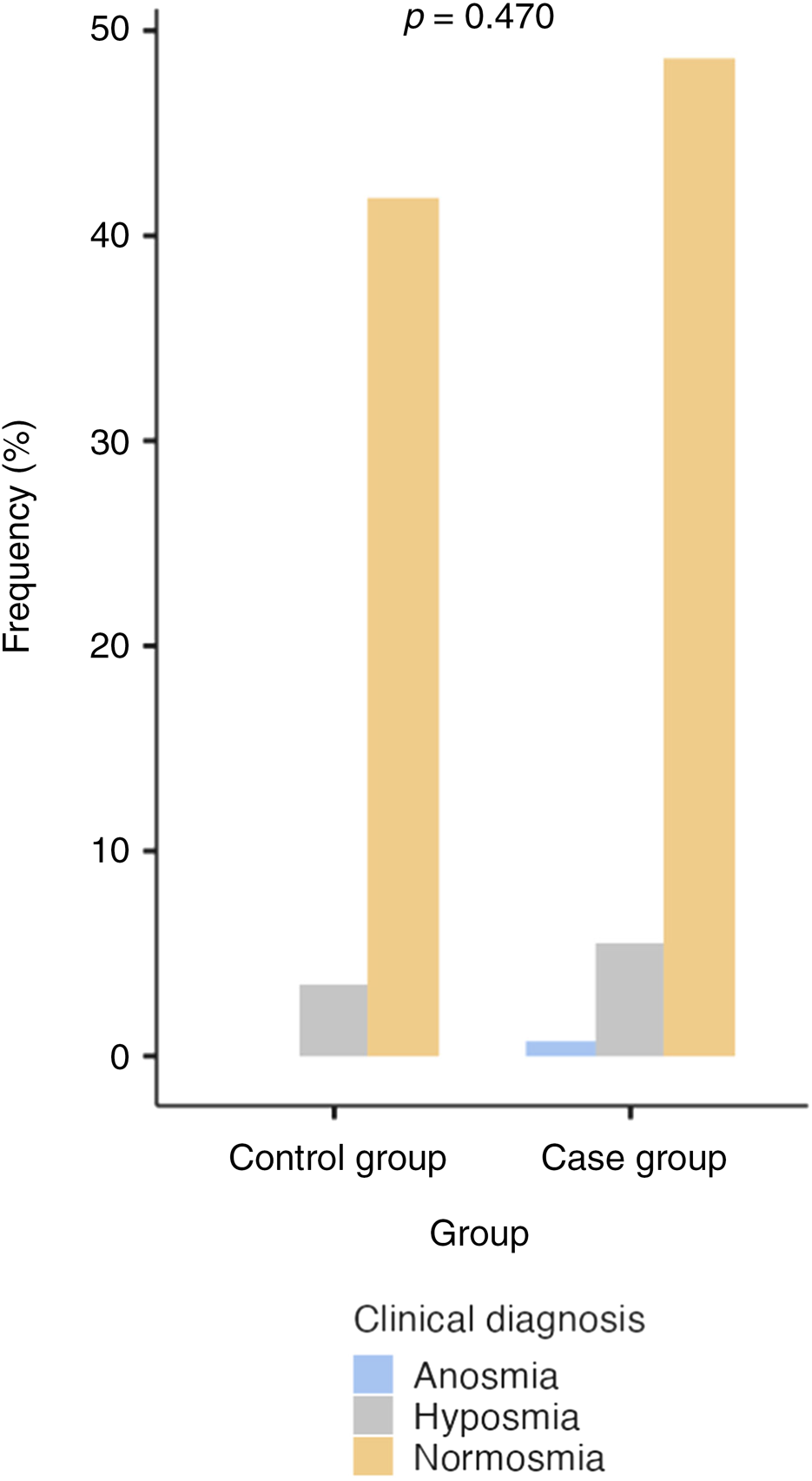
Re-evaluation was carried out at least six months later (range, 180–212 days) on 80 patients from the case group (78 per cent); 9 patients were excluded, including 8 who developed a second infection and 1 who suffered a nasal fracture during the follow-up period, and 13 patients did not attend for re-evaluation. The two groups were still homogeneous for gender (p = 0.908), age (p = 0.803) and vaccination rate (p = 1). In the case group, four patients (5 per cent) self-reported persistent hyposmia, associated in two cases with mild parosmia. With psychophysical testing, the median threshold, discrimination and identification score was 37.1 (interquartile range, 4.75) for cases, with no statistically significant differences between the two groups (37.1 vs 36.5; p = 0.580) (Figure 3). Changes in the threshold, discrimination and identification score of the case group over time were statistically significant (p < 0.001). Based on the threshold, discrimination and identification scores, nine patients (11.3 per cent) had olfactory dysfunction, including eight cases (10 per cent) of hyposmia and one case (1.3 per cent) of anosmia (Figure 4). The difference between the two groups was not statistically significant (p = 0.470).
Comparison of six-month threshold, discrimination and identification (TDI) scores between the case group and control group. Circles indicate individual data points. The boxes span 25th–75th percentiles, with the horizontal lines representing the median, the whiskers indicating the 95 per cent confidence interval, and the curved lines reflecting the distribution of the data points.

Comparison of clinical diagnosis of olfactory function between the case group and control group at the six-month follow up.

Discussion
Since the beginning of the pandemic, SARS-CoV-2 has undergone numerous mutations that have led to a succession of variants of concern. The omicron variant made its appearance in South Africa in October 2021.19 As a result of its high contagiousness, the omicron variant spread rapidly around the world becoming the predominant variant of concern at the end of January 2022.Reference Boscolo-Rizzo, Hummel, Hopkins, D'Alessandro, Menini and Dibattista20 Similarly, the characteristics of the general population have changed over time due to immunisation obtained with vaccination or with previous infection. It is therefore unsurprising that the clinical picture of Covid-19 has changed over time.Reference Maisa, Spaccaferri, Fournier, Schaeffer, Deniau and Rolland21
During the pandemic, there was a gradual reduction in the prevalence of olfactory dysfunction,Reference Klimek, Hagemann, Hummel, Altundag, Hintschich and Stielow22,Reference Hintschich, Vielsmeier, Bohr, Hagemann and Klimek23 with a significant difference comparing the omicron variant with the first pandemic waves.Reference Boscolo-Rizzo, Tirelli, Meloni, Hopkins, Madeddu and De Vito11–Reference Cardoso, Rossi, Galliez, Faffe, Tanuri and Castiñeiras13 In this study, 25.5 per cent of patients self-reported a loss of smell during infection, and 33.3 per cent had threshold, discrimination and identification scores indicative of olfactory dysfunction. This prevalence is significantly lower than that recorded in the Sardinia region itself during the first pandemic waves, which exceeded 70 per cent.Reference Vaira, De Vito, Deiana, Pes, Giovanditto and Fiore24–Reference Vaira, Deiana, Fois, Pirina, Madeddu and De Vito26 However, impairment of olfactory function still affects more than one-third of patients and therefore remains an important symptom to be considered in order to suspect SARS-CoV-2 infection.
The reasons behind the reduced ability of the omicron variant to induce olfactory dysfunction are not yet fully understood. In fact, the omicron variant presents the D614 G mutation of the spike protein, which has been associated in the past with a higher incidence of olfactory dysfunction.Reference von Bartheld, Mathew and Butowt27 It is therefore possible that the lower olfactory dysfunction rate is due to the fact that the omicron variant diffuses less easily in the nasal mucusReference Butowt, Bilinska and von Bartheld28 and that it uses transmembrane serine protease 2 less effectively as an access route into the olfactory epithelium cells.Reference Butowt, Bilinska and von Bartheld28,Reference Meng, Abdullahi, Ferreira, Goonawardane, Saito and Kimura29 On the other hand, it is possible that the more effective response in immunised subjects leads to a more rapid viral wash out before this can induce sufficient damage to cause clinically evident olfactory dysfunction.Reference Vaira, Lechien, Salzano, Maglitto, Saussez and De Riu30,Reference Sheikh-Mohamed, Isho, Chao, Zuo, Cohen and Lustig31 However, it is likely that both of these factors are implicated, because olfactory dysfunction has been found to be frequent with previous variants of concern, even in already immunised subjects.Reference Lechien, Chiesa-Estomba, Radulesco, Michel, Caira and Le Bon32,Reference Vaira, De Vito, Lechien, Chiesa-Estomba, Mayo-Yàñez and Calvo-Henrìquez33
The very high number of patients with Covid-19 who self-reported persistent olfactory dysfunction represents a major challenge. A recent meta-analysisReference Tan, Han, Zhao, Tan, Quah and Tan3 estimated that 5.6 per cent of patients self-reported a persistent olfactory disorder six months after Covid-19, with the prevalence rising to over 30 per cent when evaluated with psychophysical tests.Reference Boscolo-Rizzo, Hummel, Hopkins, Dibattista, Menini and Spinago34 Persistent olfactory dysfunction has a devastating effect on the quality of life of patients, who may isolate themselves socially, reduce their work productivity and withdraw from normal daily activities.Reference Vaira, Gessa, Deiana, Salzano, Maglitto and Lechien6,Reference Saniasiaya and Prepageran7,Reference Boesveldt and Parma35 For these reasons, persistent olfactory dysfunction represents an unprecedented health challenge.Reference Boscolo-Rizzo, Polesel and Vaira8,Reference Vaira, De Riu, Salzano, Maglitto, Boscolo-Rizzo and Lechien36–Reference Lechner, Liu, Counsell, Gillespie, Chandrasekharan and Ta38
To the best of our knowledge, the recovery rate of olfactory function after omicron variant infection has not yet been investigated. The assessment of olfactory recovery should include psychophysical tests because patients often tend to overestimate recovery, especially if they present with complete anosmia at baseline,Reference Vaira, Salzano, Le Bon, Maglio, Petrocelli and Steffens1,Reference Boscolo-Rizzo, Hummel, Hopkins, Dibattista, Menini and Spinago34 and the follow up should be long enough to detect delayed recoveries that are significantly frequent in the first three months after infection.Reference Petrocelli, Cutrupi, Salzano, Maglitto, Salzano and Lechien39 In this study, the prevalence of persistent olfactory dysfunction was 11.3 per cent, with only one case of anosmia. The differences between the cases and the controls were not significant either for the threshold, discrimination and identification score or for the clinical classifications of olfactory function. In the pandemic waves caused by previous variants of concern, several authors found a six-month rate of complete anosmia of around 10 per cent, exceeding 25 per cent if we consider the hyposmic subjects.Reference Petrocelli, Cutrupi, Salzano, Maglitto, Salzano and Lechien39–Reference Boscolo-Rizzo, Menegaldo, Fabbris, Spinato, Borsetto and Vaira43
• Olfactory dysfunction prevalence from infection decreased from over 50 per cent in early pandemic waves to 1–30 per cent during coronavirus disease 2019 caused by the omicron variant
• No studies have assessed whether this lower prevalence corresponds to a lower frequency of persistent olfactory dysfunction
• In this study, omicron variant infection was associated with a significantly lower persistent olfactory dysfunction rate than previous variants
• At six months, the prevalence of olfactory dysfunction in infected patients did not differ significantly from the general population
The pathogenetic mechanism and risk factors underlying the persistence of olfactory dysfunction in some individuals have not been established with certainty.Reference Paderno, Schreiber, Grammatica, Raffetti, Tomasoni and Gualtieri44–Reference Amadu, Vaira, Lechien, Scaglione, Saba and Lampus46 It has been hypothesised that the damage to the olfactory epithelium during infection is so severe and extensive in some individuals that it causes the loss of basal cells, which are necessary for the epithelium to regenerate.Reference Dias de Melo, Lazarini, Levallois, Hautefort, Michel and Larrous47–Reference Vaira, Hopkins, Sandison, Manca, Machouchas and Turilli49 In this sense, the omicron variant has been shown not to cause such severe damage to the olfactory epithelium as previous variants of concernReference Armando, Beythien, Kaiser, Allnoch, Heydemann and Rosiak50 and it does not appear to have neuroinvasive capabilities.Reference Armando, Beythien, Kaiser, Allnoch, Heydemann and Rosiak50,Reference Bauer, Rissmann, Benavides, Leijten, van Run and Begeman51 Moreover, a high concentration of nasal immunoglobulins was detected as a protective factor for the development of persistent olfactory dysfunction.Reference Saussez, Sharma, Thiriard, Olislagers, Vu Duc and Le Bon52,Reference Vaira, De Riu, Mayo-Yàñez, Gengler and Lechien53 Vaccinated subjects have been shown to have higher levels of nasal and salivary secretory immunoglobulins compared to post-infection immunised individuals, especially after the second dose.Reference Sheikh-Mohamed, Isho, Chao, Zuo, Cohen and Lustig31,Reference Guerrieri, Francavilla, Fiorelli, Nuccetelli, Passali and Coppeta54
Finally, another reason for this improved long-term outcome may be related to the fact that all patients included in this study were initiated early on a therapeutic protocol of olfactory training associated with palmitoylethanolamide and luteolin supplementation.Reference Di Stadio, D'Ascanio, Vaira, Cantone, De Luca and Cingolani55 Several authors have demonstrated the effectiveness of olfactory training in promoting and speeding up the recovery of olfactory function after SARS-CoV-2 infection.Reference Altundag, Ylmaz and Kesimli56–Reference Asvapoositkul, Samuthopongtorn, Aeumjaturapat, Snidvongs, Chusakul and Seresirikachorn59 However, in our opinion, it is important to closely monitor patients with olfactory dysfunction during infection, starting them with olfactory training early for at least two reasons. Firstly, in this study, 5 per cent of patients still self-reported incomplete recovery at six months. Secondly, the 60-day re-evaluation of controls who developed infection in the follow-up period found that although threshold, discrimination and identification scores returned to levels that classified individuals as normosmic, median T values were significantly lower than before infection.Reference Vaira, Lechien, Salzano, Maglitto, Boscolo-Rizzo and Hopkins60 This olfactory alteration, although unconscious and therefore not affecting quality of life, can expose patients to environmental dangers.
This study has some limitations that need to be acknowledged. Firstly, although patient enrolment occurred when omicron variant circulation was greater than 98 per cent for more than two weeks, variant of concern determination was not performed and contamination may have occurred. Secondly, to reduce the risk of selection bias, patients were enrolled consecutively from lists provided by the Department of Prevention of the University Hospital of Sassari, and it was not initially disclosed that the test would involve smell. It is possible that patients with more severe symptoms were more likely to agree to evaluation, as well as individuals with self-perceived olfactory dysfunction at baseline agreeing to undergo re-evaluation at six months. Thirdly, the controls were not tested for SARS-CoV-2 infection at the time of olfactory evaluation. However, the individuals included in the control group were part of the hospital staff and then subjected to regular antigenic swabs and immunoglobulin assays, which were consistently negative. Fourthly, the six-month follow up is not long enough to rule out late recoveries that can occur spontaneously, even two years after infection.Reference Lee, Lee, Wee and Kim61
Conclusion
Based on the results of the present study, patients infected with the Covid-19 omicron variant appear to exhibit a significantly lower persistent olfactory dysfunction rate than with previous Covid-19 variants. At six months, the prevalence of olfactory dysfunction in patients who had been infected did not differ significantly from the general population.
Competing interests
None declared.