




No CrossRef data available.
Resources and resilience in the transition to adulthood: Continuity and change
Published online by Cambridge University Press: 01 December 2004
Abstract
Patterns of continuity and change in competence and resilience over the transition to adulthood were examined in relation to adversity and psychosocial resources, with a focus on adaptive resources that may be particularly important for this transition. Variable-focused and person-focused analyses drew on data from the Project Competence longitudinal study of a school cohort followed over 20 years from childhood through emerging adulthood (EA) into the young adulthood (YA) years with excellent retention (90%). Success in age-salient and emerging developmental tasks from EA to YA was examined in a sample of 173 of the original participants with complete data on adversity, competence, and key resources. Regressions and extreme-group analyses indicated striking continuity in competence and resilience, yet also predictable change. Success in developmental tasks in EA and YA was related to core resources originating in childhood (IQ, parenting quality, socioeconomic status) and also to a set of EA adaptive resources that included planfulness/future motivation, autonomy, adult support, and coping skills. EA adaptive resources had unique predictive significance for successful transitions to adulthood, both overall and for the small group of individuals whose pattern of adaptation changed dramatically from maladaptive to resilient over the transition. Results are discussed in relation to the possibility that the transition to adulthood is a window of opportunity for changing the life course.This article is based on data collected as part of the Project Competence longitudinal study, which was initiated under the leadership of Norman Garmezy, and was supported through grants to Ann Masten, Auke Tellegen, and Norman Garmezy from the William T. Grant Foundation, the National Science Foundation (SBR-9729111), the National Institute of Mental Health (MH33222), and the University of Minnesota. Preliminary results of this study were presented at the biennial meeting of the Society for Research on Adolescence in Baltimore (March 2004). The authors gratefully acknowledge the contributions to this study by the participants, who shared their lives over time to benefit others, and by the many research team members, students, and faculty, who added ideas and data to this endeavor over the years. The authors particularly want to acknowledge the role of Doug Coatsworth in designing the emerging adulthood assessments pertinent to this article and the current members of the Project Competence research team who improved this article through their thoughtful critiques and comments as the analyses and writing progressed.
Information
- Type
- Research Article
- Information
- Copyright
- © 2004 Cambridge University Press
Many children grow up with the challenges of severe ongoing adversity in the family or community, and these experiences can pose great risk to healthy development in many domains (Garmezy & Masten, 1994; Luthar, 2003; Masten & Coatsworth, 1998). Nonetheless, it has become clear that many of these children “make it” and become reasonably competent adolescents and adults (Masten, 2001). Yet we know little about the processes that account for such patterns of resilience over time, including when and how they work, and how we might apply such knowledge strategically to boost the likelihood of resilience in young people who are heading down a maladaptive path (Cicchetti & Garmezy, 1993; Curtis & Cicchetti, 2003; Egeland, Carlson, & Sroufe, 1993; Luthar & Cicchetti, 2000; Luthar, Cicchetti, & Becker, 2000; Masten, 2001; Masten & Powell, 2003; Rutter, 2000; Yates & Masten, 2004; Wright & Masten, 2004). Studies of continuity and change in patterns of adaptive and maladaptive behavior are vital to elucidating the processes by which successful development is achieved, sustained, undermined, lost, and recovered.
Developmental transitions engendered by normative changes in the individual, context, and their interactions hold keen interest for the study of continuity and change in adaptive functioning for several reasons. First, such transitions appear to reflect change in opportunities as multiple systems that sustain continuity in the organism and its transactions with the environment enter a period of flux, where reorganization may become easier (Ford & Lerner, 1992; Sameroff, 2000; Thelen & Smith, 1998). Second, there is evidence that both resilience and psychopathology may emerge in conjunction with normative as well as nonnormative transitions (Dahl & Spear, 2004; Luthar, Burack, Cicchetti, & Weisz, 1997; Masten, Obradović, & Burt, in press; Phelps, Furstenberg, & Colby, 2002; Rutter, 1996; Steinberg, Dahl, Keating, Kupfer, & Masten, in press). Third, cultures and the adults charged with socializing young people to take their place in society have devised contexts and strategies to scaffold these transitions in such a way as to positively influence the direction of development, affording intervention opportunities ranging from rites of passage and community organizations to higher education, apprenticeships, and various forms of national service.
Research and theory focused on adaptation in development strongly suggest that the period of transition to adulthood, encompassing the period recently characterized by Arnett (2000) as “emerging adulthood” (EA) in modern societies, as well as the more general period during which adolescents achieve adult status in a wide variety of societies, may afford special risks and opportunities as young people acquire greater executive functioning capacity and autonomy, reach legal age for many privileges and responsibilities, leave home, enter the workforce or higher education, and fall in love (Arnett & Tanner, in press; Bachman, O'Malley, Schulenberg, Johnston, Bryant, & Merline, 2002; Dahl & Spear, 2004; Masten et al., in press; Phelps et al., 2002; Schulenberg, O'Mally, Bachman, & Johnston, in press). The purpose of this study was to examine patterns of continuity and change in adaptive behavior over the transition to adulthood. It extends by 10 years the examination of competence, adversity, and resilience in a 20-year longitudinal study, from the EA years around age 20 (see Masten, Hubbard, Gest, Tellegen, Garmezy, & Ramirez, 1999), into the young adulthood (YA) years around age 30.
Longitudinal Studies of Successful Transitions to Adulthood
Classic as well as more recent studies of adaptation that span the transition to adulthood provide strong evidence of both continuity and change in adaptive functioning. In particular, continuity from childhood or adolescence to adulthood has been observed for antisocial behavior, even as marked desistance has been noted during the same period (e.g., Moffitt, Caspi, Harrington, & Milne, 2002; Robins, 1966; Sampson & Laub, 1993; Thornberry & Krohn, 2003). “Turning points” have been observed in this literature, often occurring during the transition years between adolescence and adulthood (Masten & Powell, 2003; Rutter, 1990, 1996, 2000; Sampson & Laub, 1993). Military service has been described as such a turning point opportunity for the transition to adulthood (e.g., Elder, 1986; Sampson & Laub, 1996), although, again, continuity of antisocial behavior also has been observed from adolescence into military service (Robins, 1966; Sampson & Laub, 1993).
Longitudinal studies over the transition to adulthood for adolescents assumed to carry considerable risk for adaptive difficulties, such as unwed teenage parents, have revealed surprisingly positive adaptation. In their follow-ups of disadvantaged teenage mothers in Baltimore, for example, Furstenberg and colleagues found reasonably good outcomes for many of the young women on such indicators as welfare independence, work, and parenting success (Furstenberg, 2002; Furstenberg, Brooks–Gunn, & Morgan, 1987).
Although few in number, studies specifically focused on resilience (positive adaptation in the context of risk or adversity) provide hints about continuity and change pertinent to the transition years to adulthood. The classic longitudinal study of the Kauai birth cohort (Werner & Smith, 1982, 1992, 2001) has examined a subgroup of children with multiple risk factors over time to identify what makes a difference for children who succeed in life at different ages. Results show striking stability in resilience over time among members of the risk group who are doing well; with respect to the resilient group at age 18, most were doing well at the follow-ups one and two decades later. Additionally, many of the high-risk youth who were maladaptive at 18 appeared to be doing better by YA. Predictors of positive transitions to adulthood among the high-risk subgroup included what they term “second-chance opportunities,” including military service and good marriages, religious conversion, work and school opportunities, as well as the inclination to take advantage of such opportunities and adult support for doing so. During their senior year in high school, those individuals who would fare better in adulthood “evaluated their school experience more positively and had higher expectations for future educational accomplishments” (Werner & Smith, 1992, p. 176).
Planfulness and good romantic relationships or marriages have been implicated in a number of resilience studies. Quinton and Rutter concluded from work in several of their studies that planfulness and supportive relationships could have positive, turning-point influences during the transition to adulthood (Quinton, Pickles, Maughan, & Rutter, 1993; Rutter, 1996; Rutter & Quinton, 1984).
Vaillant and colleagues (see Long & Vaillant, 1984; Vaillant, 2002) studied the control group of the classic study by Glueck and Glueck (1950; see Laub & Sampson, 2002) on delinquency and observed that many of the most disadvantaged of these Boston adolescents (ages 12–16) were indistinguishable from more advantaged adolescents in midlife. Competence measured in adolescence (a global measure of adaptive capacity, reflecting IQ, social adjustment, ego strength, and coping measures, among others) predicted better outcomes. Long and Vaillant (1984) noted in a case presentation that one of the adolescent boys who became a successful adult seemed to have a “knack for finding a niche” (p. 221), an observation that points again to the importance of agency or adaptive qualities in the individual, as well as opportunities in the environment, for positive transitions and turning points.
Investigators have taken advantage of other extraordinary longitudinal data sets to examine risk and protective factors for adjustment over the life course. Elder and colleagues (Elder, 1974; Elder, Liker, & Cross, 1984) and Clausen (1991, 1993) have analyzed data from the classic studies of Berkeley and Oakland children that were underway when the Great Depression occurred. Elder and colleagues observed in their studies that good marriages, military service (with the right timing), and higher education had positive influences on the life course in the transition to adulthood. Elder (2002) has described how the long-term director of the Berkeley study (MacFarlane) surmised that the contextual changes of late adolescence and early adulthood may provide a developmental opportunity for positive maturation to alter the life course.
Clausen (1991) focused on the construct of “planful competence” in relevant analyses of the Berkeley cohort. Planful competence was a composite score from multiple measures available in the data set in adolescence and later ages that encompassed a variety of adaptive attributes, such as realistic goal setting, intellectual investment and capacity, dependability, productivity, self-confidence, and self-control. Clausen (1991) suggested that this quality made it possible for these young people to direct the life course in positive ways, presumably through better choices in education, work, and love and their appeal to others. Planful competence itself was correlated with IQ and related to antecedent socioeconomic status (SES; at birth), and the presence of high quality parenting characterized by structure, attention, and high expectations. Adolescents from working class families in the study were less likely to score high on planful competence; but if they did, Clausen (1991) noted that they moved upward in social class as adults. Clausen (1991) also noted that most of the individuals who scored low on the variable tended to improve their scores in the adult years: “as would be expected, when they took on the roles of worker, spouse, and parent” (p. 831).
To summarize, the slim but compelling literature on transitions to adulthood, particularly for children and adolescents who grew up within the context of disadvantage or adversity, suggests that there are individual and contextual differences in adolescence and EA (and also earlier) that predict success over the transition and, in some cases, forecast positive change. Considerable stability has been found across the transition for various measures of adaptive functioning, yet there are hints that this is a window where positive change occurs for some individuals, particularly less adaptive, disadvantaged individuals who make use of opportunities to change context or course. In addition, adults often appear to guide the way or facilitate access to opportunities.
The role of opportunities is widely observed in reports from large studies as well as individual case reports. The role of agency on the part of the individual, in the form of achievement motivation, future orientation, and planfulness, as well as coping abilities, also emerges thematically. Early predictors of the conditions that set the stage for successful transitions appear to include the core resources of childhood often implicated as assets and protective factors for competence and resilience (e.g., good intellectual skills, good parenting, and socioeconomic advantages).
Overview of the Present Study
This study addressed two major questions about adaptation and resilience over the transition to adulthood, one focused on continuity and the other on change:
- Does resilience that has manifested by the time the transition is underway endure to adulthood? Resilience was expected to endure the transition to adulthood because success in age-salient developmental tasks shows strong continuity from one age period to the next and because those already manifesting resilience clearly have adaptive capacity for negotiating challenges in their lives. We hypothesized that success in the EA core domains of academic achievement, appropriate conduct, and social competence with peers would forecast success in YA regardless of high chronic adversity in childhood and adolescence, and therefore, that people classified as resilient in EA because they were doing OK in all three of these domains would generally show a pattern of good adaptation in YA, with most of them continuing to be classified as resilient based on the age-salient developmental tasks of YA.
- Does resilience emerge in adulthood despite maladaptation in EA and is such change predictable? A small number of individuals who grew up with chronic adversity were expected to show dramatic improvements in competence over the transition to adulthood, because the literature suggests that this period of development affords new opportunities and adaptive capacities for redirecting the life course. We hypothesized that individual differences in a set of adaptive resources pertinent to this transition (planfulness/future motivation, autonomy, coping, and adult resources) would predict changes in manifested competence in age-salient domains, resulting both in predictable changes within domains of competence over the transition (predictable variable-focused change) and also in reclassification of individuals in the maladaptive group in EA into the resilient group in YA (predictable person-focused change).
Both variable-focused and person-focused approaches to resilience were included in the present study, in keeping with analyses undertaken at earlier points in this longitudinal study (see Masten et al., 1999). Variable-focused approaches to resilience benefit from utilizing more of the full statistical power of data, can focus attention on more specific or fine-grained dimensions of human behavior and adversity, allow for statistical controls to sort out covariance, and provide in most cases a more sensitive strategy for detecting specific and differential linkages among predictors and outcome, and thus better clues about possible causal processes (Masten, 2001). Yet this approach may miss striking patterns observed in nature. Person-focused approaches focus attention on the whole person and the configural nature of resilience, recognizing that adversity exposure happens to a whole person, and that resilience typically means doing OK in multiple ways at the same time.
Earlier reports from this longitudinal study of a school cohort have examined the structure and continuity of competence (Masten, Coatsworth, Neemann, Gest, Tellegen, & Garmezy, 1995) and adversity (Gest et al., 1999), and the role of three core adaptive resources reflecting fundamental human and social capital for child development and socialization (Masten et al., 1999). These core resources, general intellectual functioning (IQ), SES, and parenting quality, have been widely implicated in the developmental literature as markers of positive or negative adaptive capacity (Luthar, 2003; Masten, 2001; Masten & Coatsworth, 1998). When the cohort in this study reached EA, variable-focused findings indicated that competence in these transition years was generally related to greater human and social capital, as reflected in higher IQ, SES, and parenting quality scores both concurrently, and 10 years earlier, as well as to lower adversity (Masten et al., 1999). Apparently, when these core resources were in place, chronic adversity during childhood and adolescence had little bearing on success in age-salient developmental tasks at the doorstep of adulthood, around age 20. Person-focused findings compared people who had a pattern of competence and adversity suggesting resilience (they were doing fine in three key domains of adaptive functioning in EA, despite high chronic adversity) to competent peers with low adversity backgrounds and to maladaptive peers with the same level of chronic adversity exposure. Findings suggested that individuals with competent and resilient life patterns had much in common in terms of personal and family resources, despite their striking differences in stressful life experiences. Both groups had significantly more resources than their maladaptive peers.
The longitudinal data over the first 10 years of this study provided not only strong evidence of continuity but also evidence of change (see Masten et al., 1995, 1999). Variable-focused analyses indicated that success in specific major competence domains shows considerable rank-order continuity over a 10-year interval from childhood to EA, with the quality of conduct (following vs. breaking the rules at school and at home) manifesting particularly strong stability. Nonetheless, outcomes in EA in multiple competence domains were also variously predicted by other domains of competence, adversity, IQ, SES, parenting quality, and interactions of these predictors, suggesting lawful change or coherence. For example, the quality of conduct already evident at the outset of the study was a strong predictor of academic attainment 10 years later, over and above the variance predictable from academic achievement and IQ measured at the outset of the study.
Our first examination of competence from EA to YA, in a variable-focused study of the transition to adulthood, provided solid evidence of global and specific continuity in competence defined in terms of age-salient developmental tasks (see Roisman, Masten, Coatsworth, & Tellegen, 2004). Based on a refinement of developmental task theory, we predicted and found that success in three major domains of behavior in EA (reflecting academic achievement, social competence with peers, and appropriate conduct) predicted success in the same domains 10 years later, as well as success in the newly salient tasks of YA, in the domains of work and romantic relationships. In contrast, we expected and found that success in the domains of work and romantic relationships, considered “emerging” tasks domains during the transition to adulthood, had little predictive significance. In other words, results were congruent with the expectation that change is the norm for emerging developmental task domains; across the transition to adulthood, work, and romantic relationships are expected to be in transformation, and therefore, likely to show change.
The present study extended our examination of transitions to adulthood by considering adversity and resources in variable-focused analyses and by examining continuity and change in classification as Competent, Resilient, or Maladaptive in relation to resources in a series of person-focused analyses. In particular, we examined the role of new composite scores assessing adaptive resources specifically pertinent to EA as correlates and predictors of competence and resilience. In the variable-focused analyses, we expected that these “EA adaptive resources” would be associated with competence/maladaptation as assessed concurrently and 10 years in the future, even after controlling for long-standing individual differences on IQ, parenting quality, and socioeconomic advantages. In the person-focused analyses, we expected competent and resilient groups defined in EA or 10 years later in YA to exhibit more planfulness/future motivation, more autonomy, better coping skills, and more adult support than the maladaptive group in EA or YA. In addition, we expected that these EA adaptive resources would predict change in classification from maladaptive in EA to resilient in YA. Nonetheless, because the late-emerging resilience group by definition was not yet showing resilience patterns by EA, we expected them to have fewer resources than those who were already competent by EA.
Methods
Sample and procedures
Participants for this study were drawn from a sample of 205 children (91 boys and 114 girls) whose families have participated in a longitudinal study of competence and resilience (Garmezy, Masten, & Tellegen, 1984; Masten et al., 1995, 1999; Masten, Garmezy, Tellegen, Pellegrini, Larkin, & Larsen, 1988; Masten & Powell, 2003). Families were recruited in the late 1970s, when the children were in the third to sixth grades (ages 8–12), attending two elementary schools in Minneapolis that were located in the same diverse, urban neighborhood, and they were subsequently followed up after 7, 10, and 20 years, with high retention rates (90% of the original cohort participated in the 20-year follow-up). This study is focused on the subsample of 173 of the 177 individuals who participated both in EA during the 10-year follow-up and then again 10 years later in YA during the 20-year follow-up (see Roisman et al., 2004). These 173 (73 males, 100 females; 27% minority) had complete data for the present study (basic competence, resource, and adversity scores for all relevant points in time); this subgroup did not differ from those lost to attrition or key missing data on childhood competence (academic, conduct, social) or EA competence (conduct, academic, social), nor on minority status, SES, IQ, parenting, or chronic adversity scores during childhood and adolescence.
The schools participating in this study were identified on the suggestion of the Minneapolis School Superintendent, because they were located in the same large catchment area and attended by a diverse group of students that well represented the range of socioeconomic and ethnic diversity of the urban public schools at the time in this midsize city. The original cohort included 29% minority children (18% African American, 7% American Indian, 3% Hispanic, 1% Asian), which was similar to the diversity of the school district at that time, with 27% minority children enrolled. It was wide ranging in socioeconomic level as indexed by the Duncan Socioeconomic Index, with scores from 7 to 92.3 on this 100-point scale, and a sample mean of 43 (which reflects a head of household with skilled labor or clerical positions). This school-based cohort also appears to be quite normative on standardized measures of cognitive ability and achievement. For example, the sum of the Vocabulary and Block Design subscale scores on the Wechsler Intelligence Scales for Children—Revised (WISC-R) averaged 20.65 (SD = 5.22) compared to an expected mean of 20 (SD = 6) and scores on the Peabody Individual Achievement Test scores (standardized to mean = 100, SD = 15) averaged 98.0 (SD = 12.25).
Extensive multimethod, multiinformant data were collected on the cohort at the outset of this study, and the assessments were focused particularly on the quality of competence in multiple domains; lifetime adversity, disadvantage, or stressful life events; and differences in the children or their families that might account for good versus poor adaptation. During the initial and comprehensive assessment, informants included parents, teachers, peers, and the children, and methods included interviews of primary caregivers and children, as well as numerous questionnaires, tests, and school records. The cohort was followed up after 7 years, when 88% participated as teenagers (ages 14–19). Parents and adolescents were sent parallel packets of questionnaires that assessed many aspects of how life was going (e.g., with respect to life events, school, work, friends, romantic partners, health, well-being, activities, etc.), and school records were obtained whenever feasible. The EA 10-year follow-up (when the cohort was ages 17–23) was designed to be extensive once again, including interviews of participating youth, their parents, many questionnaires and tests, and assessments completed by peers for many of the cohort. Follow-up data were obtained for 98% of the cohort (see Masten et al., 1995, 1999).
After 20 years, when the cohort was approximately 30, they were again contacted by mail to complete an assessment and 90% of the now young adults eventually participated (183 of the 203 original 203 participants presumed to be still living), along with 86% of their parents. Most members of the cohort were 28 to 33 at the time data were gathered, although four of them were 35 or 36 by the time they participated (median age = 31). Two of the cohort had died (one in a car accident and one of a chronic illness). Additional questionnaires were completed by a friend, romantic partner, and employer for large subsets of the participants (to further clarify the validity of self- and parent reports of competence and other attributes).
For each of the assessments of this study, an effort was made to assess all the major domains of competence, reflecting effectiveness in current and emerging age-salient developmental tasks, with multiple methods and at least two informants. Some developmental tasks were salient by elementary school, and continued to be relevant through the 20-year follow-up, although the exact nature of the items used to tap the competence domains changed (academic attainment, conduct, social competence with peers). Other domains of competence were assessed as they began to emerge in adolescence, such as work competence and romantic relationships, and continued to be assessed as they became age-salient developmental tasks in adulthood (see Roisman et al., 2004, for further discussion of developmental tasks). An effort was also made to retain consistency of questions and measures to the degree developmentally possible and appropriate. Measures were also adapted in some cases to capture age-relevant changes in activities or new domains of emerging interest in the field. For example, the assessments during the 7, 10, and 20 year follow-ups each included Life Events Questionnaires (Masten, Neemann, & Andenas, 1994); Competence Rating Scales modeled with permission on Harter's perceived competence rating scales (Harter, 1986; Neemann & Harter, 1986); and Status Questionnaire measures, with many structured questions about the competence, physical and mental health, and activities of the participants. As a result, there are many identical or highly similar items over the transition from adolescence to adulthood, although there are also new items and scales. For example, the Status Questionnaire in YA includes items from the National Survey of Midlife Development (Brim, Ryff, & Kessler, 2004) on life satisfaction and happiness that were not included (or yet developed) in the earlier assessments.
Measures of competence in developmental tasks
Competence in this longitudinal study was defined with respect to a track record of effective functioning in age-salient developmental tasks (Masten et al., 1995). All assessments in childhood, adolescence and early adulthood (EA and YA) included assessments of academic achievement, social competence with peers (e.g., acceptance, friendship), and conduct (rule abiding vs. rule breaking, disruptive/aggressive, or unlawful behavior). Beginning in adolescence, work and romantic relationships were assessed as emerging domains that became age-salient developmental tasks in adulthood (see Roisman et al., 2004, for further discussion). Effectiveness as a parent was assessed after participants became parents, which occurred quite early in some cases, so that this domain of functioning could be evaluated in relation to the developmental tasks that applied to all participants.
Childhood (ages 8–12 as the study began)
Three composite scores from multiple informants and methods are included in the present study, assessing academic achievement, social competence, and conduct. Construct validity was established by measurement models via structural equation modeling (see Masten et al., 1995). Academic achievement is an average of scores derived from the Peabody Individual Achievement Test, grade point average in school, a teacher rating of comprehension drawn from the Devereux Elementary School Behavior Rating Scale, and a parent interview composite of how the child was doing academically in school (α = .88), as described in more detail elsewhere (Masten et al., 1995, 1999). Social competence was a composite averaging three other composite scores: two derived from the Revised Class Play peer reputation instrument (negative peer nominations, α = .80; positive peer nominations, α = .93) and one composite of nine ratings completed by child interviewers (α = .95). The conduct domain was assessed by averaging four composite scores (α = .77) that were based on two scores from a parent interview (home compliance, α = .66; school compliance, α = .78), eight teacher ratings from the Devereux focused on breaking classroom rules and disruptive behavior (α = .93), and six ratings from the child interview concerning antisocial versus rule-abiding behavior (α = .89).
EA (ages 17–23, 10-year follow-up)
For EA, five composite scores from multiple informants and methods are included (see Masten et al., 1995, 1999; Roisman et al., 2004). Academic attainment is a composite of four variables (α = .90) derived from interviews of participant and parent and items from the Status Questionnaires completed independently by participants and parents. Social competence composite scores are based on eight variables pertinent to social acceptance and friendship (α = .86) from the participant and parent interviews, the Status Questionnaires and the Competence Ratings Scales (Harter-type scales) completed by participants and parents (see Masten et al., 1995, 1999). Conduct composite scores are based on five variables concerning seriousness of trouble with the law, getting into fights, etc. (α = .79; scored so that higher scores reflected law-abiding conduct) derived from the parent and adolescent interview, Competence Rating Scales completed by parents, and the Status Questionnaires completed by participants and parents. Competence in the emerging domain of romantic relationships composited four variables concerning the capacity to form a close and positive reciprocal relationship with a romantic partner (α = .77) derived from the adolescent interview and the Competence Rating Scales completed by participants and parents. Similarly, the emerging domain of work competence was a composite (α = .74) of five variables concerned with how well the participants were doing with work (success and reliability), stemming from interviews of participant and parent, independent clinical ratings based on the participant and parent Status Questionnaires, and participants' self-ratings on the Competence Rating Scales (see Roisman et al., 2004).
YA (ages 28–36, 20-year follow-up)
All five of the domains assessed as developmental tasks in EA were assessed again in YA, although romantic and work success were now viewed as age-salient developmental tasks, rather than emerging tasks. Additionally, parenting involvement and quality was assessed for the participants who were parents. The effectiveness of each of the domains was assessed by combining reports from three sources: the participants, their parents, and clinical judges who made global ratings (paralleling similar ratings during EA) of the Status Questionnaires completed by participants (intraclass correlations ranged from .73 to .94, with a median of .88 for items included in the following composites). Methods included Status Questionnaires about the participants completed independently by self and parent, and parallel versions of the Competence Rating Scales (a Harter-type instrument development originally for the 7-year follow-up in consultation with Susan Harter, and adapted for the 10- and 20-year follow-ups). Academic attainment (α = .92) included an average of two clinical rating of academic success, as well as participant and parent items on level of education and overall academic success. Social competence (friend relationships; α = .71) was based on three variables concerning quality of friendships: a composite of two independent clinical ratings of friendship quality; a participant composite of two scores based on (a) five Status Questionnaire items tapping friendship quality and (b) two Competence Rating Scale items about close friendships; and a parent composite of one Status Questionnaire item on close friendships and two parent-reported Competence Rating Scale items about close friendships. Conduct (α = .87) comprised three variables: an average of two clinical ratings of trouble with the law and rule-abiding conduct; a participants composite combining (a) one global self-rating of law-abiding behavior from the participants Status Questionnaire with a composite of seven behavioral/life events items (e.g., time in prison, arrests) from the Status Questionnaire and (b) two Competence Ratings Scale items about picking on others and getting into fights; and a parallel parent composite (all scored so that high scores reflected positive conduct). Work competence combined three composite variables (α =.72): an average of two clinical ratings of work success; a composite of (a) two items from the participant's Status Questionnaire self-rating job responsibilities and doing well at work and (b) one competence Ratings Scale item regarding performance at work; and a composite of parallel parent items. Romantic competence (α = .85) was an average of z scores from three composites: an average of two clinical ratings of romantic involvement and relationship quality; participant composite of (a) three Status Questionnaire items about closeness and getting along with romantic partner and (b) three similar items from the Competence Ratings Scales; and a comparable parent composite. Parenting competence (α = .81) scores were created for each participant who was a parent by averaging across three composite scores: the average of two clinical ratings of involvement in parenting and global ratings of how well participants were doing as parents; a participant composite of two Status Questionnaire items on how well they are carrying out the job of child care and how well they are doing as a parent overall; and a comparable parent composite.
Measures of chronic adversity
Multiple measures and informants provided extensive information on life events and adversities experienced by the participants in this study, including structured contextual life events interviews and Life Event Questionnaires (Gest, Reed, & Masten, 1999; Masten et al., 1994). After the 10-year follow-up, a computerized database was developed to organize these events and to make it possible to generate “life charts” including only certain types of events during a given window of time (e.g., between competence assessments). Chronic adversity scores were created through a life chart and rating scale approach, described in detail by Gest et al. (1999). Cumulative negative life experiences arising in the family or community that were independent of an individual's behavior were printed onto life charts that were then rated by independent judges who had no other knowledge of the participants' resources or competence. Adversity ratings were made on a 7-point scale, corresponding closely to the Severity of Psychosocial Stressor Scale used at the time for Axis IV of the diagnostic system of the American Psychiatric Association (1987). Two of these scores, reflecting adversity prior to the first competence assessment (birth to Time 1) and from then to the second competence assessment, 7 years later, were used to classify participants as high or low on adversity in person-focused analyses of resilience (Masten et al., 1999). Intraclass correlation coefficients for these two ratings were excellent (.82 and .85, respectively). The scores (r = .62) were averaged to form a chronic childhood/adolescence adversity score reflecting the level of adversity over the course of childhood and adolescence.
Measures of core and adaptive resources
Core resources in childhood and EA
General intellectual functioning (IQ) was estimated on the basis of the two subtests that have the highest correlation with the full-scale IQ: Vocabulary and Block Design. In childhood, these two subjects of the WISC-R were administered; in EA, the comparable subtests of the Wechsler Adult Intelligence Scale—Revised were administered. Standardized subscale scores on each subtest were averaged. Parenting quality composite scores were based on variables derived from independent interviews of parent and child, with many questions about their closeness and other aspects of parenting (see Masten et al., 1988, 1999). Two global parenting quality composites from the parent interview (12 ratings, α = .94) and child interview (10 ratings, α = .89) were standardized and averaged as an index of parenting quality at the beginning of the study. Childhood parenting quality indexed by these items combined closeness, warmth, and structure. The quality of parenting in EA focused on closeness, because structure and discipline were no longer age-appropriate indicators of parenting quality. Four variables were standardized and averaged to index parenting quality in EA (α = .74): (a) a composite of eight clinical ratings of the relationship quality based on the parent interview (α = .95), (b) a global rating of closeness based on the adolescent interview (intraclass correlation based on two independent raters = .87), and two composite variables based on (c) the adolescent or (d) parent Status Questionnaires. In each case, two correlated items rating the quality of the relationship by the informant were averaged together, as were two correlated ratings by judges of the relationship; these scores were in turn highly correlated (.72 for adolescent, .75 for parent), so they were converted to z scores and averaged together (see Masten et al., 1999). The SES was indexed by the Duncan Socioeconomic Index, calculated for the occupation of head of household (whichever stable parenting adult in the household had a higher index), both at the outset of the study and at the time of the 10-year assessment.
Adaptive resources in EA
Data derived from interviewer ratings of participant and parent interviews, participant and parent Status Questionnaires, clinical ratings based on participant and parent Status Questionnaires, and Competence Rating Scales completed by participants and parents were combined to create four composite variables representing various adaptive resources in EA. These multiinformant, multimethod composites were labeled as follows: planfulness/future motivation, autonomy, adult support, and coping.
Planfulness/future motivation (α = .92, eight items) included parallel independent interviewer ratings of achievement motivation (e.g., for high scorers “strives to achieve a high standard of success,” “takes pride in accomplishments”) and future orientation (e.g., for high scorers “concerned with who or what they will become … have put some thought into their future and there is high degree of planfulness”) based on participant or parent interviews, clinical ratings based on participant and parent Status Questionnaires of predicted adaptation 5–10 years from the EA assessment, and also clinical ratings of aspiration level (e.g., high scorer has plans and goals regarding training, school or career that “involves significant training/motivation and time commitment”).
Autonomy (α = .79, four items) included participant and parent interviewer ratings of behavioral autonomy (e.g., for high scorers “self-reliant and self-governing,” “makes decisions and follows through on them”) and emotional autonomy (e.g., for high scorers “absence of childish dependencies and a freedom from excessive need for approval”).
Adult support (α = .67, four items) included participant and parent interviewer ratings of adult connectedness (e.g., for high scorers “a close, warm relationship with an adult other than mother or father”), the Adult Support scale score from the participant's Competence Rating Scales (sample item for high scorers: “Some people really do have adults they can turn to when they're in trouble”), and a parent interview rating paralleling the Harter Adult Support scale.
Coping (α = .68, four items) included the Coping with Stress score from participant and parent Competence Rating Scales (sample item for high scorers: “Some people can do well even when they are under a lot of stress”) and clinical ratings by participant and parent interviewers on a scale designed to parallel the Coping with Stress subscale of the Competence Rating Scales.
Results
Results are presented in two sections: variable focused and person focused. Correlations within and over time and a set of regression analyses address questions of continuity and change from a variable-centered perspective. For the person-focused analyses, classification criteria were utilized to form Competent, Resilient, and Maladaptive groups that were then compared on competence and resources within and over time, utilizing the same strategy as earlier reports from this study (Masten et al., 1999).
Variable-focused analyses
Correlations
Intercorrelations of all the competence, adversity, and resource variables within and across time are presented in Table 1. Generally, indicators of success in YA, predicting competence in academic, social, conduct, work, and romantic domains, were related to earlier competence in age-salient developmental tasks, as well as core resources and EA adaptive resources. A history of chronic adversity during childhood and adolescence had very modest relations with YA success, and only in two domains (academic and conduct).
Correlations over time among competence, adversity (Adv.), and core and adaptive resources

Regressions
Each of the five outcome indicators of competence in YA was regressed (in turn) on a set of predictors, utilizing a specified, hierarchical order of entry. These analyses were designed to examine residualized change: thus, the first step was to enter scores for the same domain assessed 10 years earlier in EA. Next the control variables of gender and age were entered. Then core resources were entered, first the set from childhood and then the set from EA, so that any predictions from EA would reflect the variance in these resources not attributable to earlier scores on the same resources. Finally, the EA adaptive resources were entered as a set to test whether these variables could account for change over time from EA to YA for each developmental task. Adversity was entered last, to see if there were any delayed effects from childhood adversity that were unrelated to any effects that had already occurred by EA (via influences on resources or competence by EA). Additional steps explored potential moderating effects of gender and adversity (explained below). Results are shown in Table 2 for each outcome criterion, indicating the increment in R2 for each step and the significance of the F test for that step, as well as the beta weight at entry and the final beta (with all variables through Step 6 entered). As a further test of the unique role of EA resources in predicting change, a second set of analyses were completed in which all of the other competence scores from EA were entered as an added Step 2 for each YA domain.
Hierarchical regression results predicting YA competence from earlier competence, resources, and adversity

For academic attainment by YA around age 30, all six steps produced a total R2 of .59 (F = 16.39, p < .001). Academic accomplishments that were already evident 10 years earlier accounted for a large portion of this variance (EA academic achievement produced an increment of .46 in R2 when entered at Step 1). Childhood resources did not contribute to the predictions of adult success over and above the contributions already carried forward in the form of academic competence attained by EA. However, the EA core resources added significantly to the prediction of academic attainment, with IQ scores making the most distinctive contribution, an effect retained in the final equation (as indicated by the final beta weight). Once all core resources were accounted for, the set of EA adaptive resources produced a considerable increment of .07 in predicted variance (F = 7.09, p < .001). The most unique predictor from the set (making a significant contribution to the criterion over and above all other predictors) was the planfulness/future motivation score, which also had the largest β weight among all predictors once it was entered. When all EA competence variables were controlled, this set of predictors remained highly significant and virtually unchanged in effect.
Success in the friendship domain of social competence with peers in adulthood was less predictable from competence in EA, although again, competence in the same domain accounted for a large proportion of the predicted variance. Only gender made any additional contribution to predictions of this outcome domain, with girls showing better quality friendships in YA. Controlling for all the EA competence indicators had little effect on these results for friendship. Similarly, for the conduct domain, YA outcome was best predicted by conduct in EA and when all other EA competence indicators were included, the same pattern of results was observed.
In contrast, for the newly salient developmental tasks of YA, success in work and romantic relationships, neither outcome was predicted by success in the same domain in EA, as reported earlier by Roisman et al. (2004). For work, core childhood resources predicted outcome (R2 = .12, change F [ΔF] = 7.49, p < .001), and both IQ and parenting quality had unique effects. Additionally, the EA adaptive resources added .11 to predicted variance at Step 5 (F = 6.16, p < .001). However, once competence in other domains was considered, it was clear that the effects of childhood variables were largely mediated by competence during EA. Entered as Step 2, the set comprised EA competence in academic, social, conduct, and romantic domains produced an increment of .20 (F = 8.45, p < .001), consistent with results reported by Roisman et al. (2004), and the contribution of the core childhood resources dropped from .12 to .02, which was no longer significant. The role of EA adaptive resources also was attenuated, falling from an increment of .11 to .04 (p = .077), suggesting that the predictive power of these resource variables partly overlapped with concurrent EA competence variables as predictors. Even before concurrent competence variables were all controlled, none of the EA adaptive resources had unique predictive power; rather, it was their shared variance that predicted work competence.
For romantic relationships as an adult competence outcome, EA adaptive resources appeared to have more unique predictive significance. Neither set of core resources (IQ, parenting, and SES) had an overall effect (a significant IQ effect disappeared when other competence indicators were controlled). In contrast, there was a substantial effect for the EA adaptive resources variable set (R2 = .13, ΔF = 6.42, p < .001), and this set remained significant even when other competence domains were controlled (R2 = .05, ΔF = 2.74, p < .05). Autonomy was the EA adaptive resource variable making a unique contribution to romantic relationship outcome, both before and after success in all competence variables was controlled. This variable carried the largest beta weight when all predictors through Step 6 were entered simultaneously.
Effects observed in the regression analyses were further probed by checking for gender interactions and also for adversity by resource interactions. No significant interactions were found for gender or adversity with EA adaptive resources.
Person-focused analyses
Individuals were classified into groups according to overall patterns of adaptive functioning in age-salient developmental tasks and chronic adversity in childhood and adolescence, following the procedures of Masten et al. (1999). The cohort had already been classified into competence and adversity groups based on competence in EA for the analyses reported by Masten et al. (1999), and these groups were retained for consistency. Additionally, individuals that remained in the study for the 20-year follow-up were reclassified as Competent, Resilient, or Maladaptive based on the same adversity categories but new competence outcomes in YA. Finally, a change classification was created by grouping individuals according to their status over time, whether they remained in the same group (e.g., resilient–resilient) or changed from one class to another (e.g., maladaptive–resilient). Chronic adversity (across childhood and adolescence) was a fixed variable in this classification, so that change in status could only occur across levels of competence. Key groups could then be compared to test hypothesized differences.
Comparison of EA Competent, Resilient, and Maladaptive Groups
Three competence groups were formed based on patterns of success in age-salient developmental tasks at the time: low, mixed, and OK groups were formed according to z scores for the whole cohort on the composites of competence in the three salient domains of academic, conduct, and social competence. To be considered OK on adaptation in age-salient developmental tasks at this time, an individual had to have three scores at or above z = −.5, reflecting scores in the average or above-average range within the normative cohort. The low group had two or more scores below this level. The mixed group did not meet criteria as either “low” or “OK.” Adversity levels in childhood and adolescence were classified as low, middle, or high. To be classified as high adversity, an individual had to have consecutive scores of 5 (severe) or higher across the two time periods of childhood (birth to the first competence assessment around age 8–12 when the study began) and adolescence (over the next 7 years), on a scale from 1 to 7, where 5 to 7 indexes severe to catastrophic adversity (see Gest et al., 1999, for more detail about these scales). Low adversity was defined as falling below this level (little or no to moderate levels of adversity) in both time periods. Those who did not meet the criteria for consistently high or low adversity fell into the middle/mixed category. This 3 (Competence) × 3 (Adversity) classification resulted in nine categories (see Figure 1).

The conceptual model for classifying people as Competent, Resilient, Maladaptive, or Highly Vulnerable according to scores on adversity and competence in age-salient domains. The blank categories reflect mixed or intermediate scores on adversity, competence, or both.
Three extreme groups held the greatest interest for testing hypotheses about resilience: the resilient group (OK adaptation, high adversity), the competent group (OK adaptation, low adversity), and the maladaptive group (poor adaptation, high adversity). The fourth “corner,” which was the vulnerable group (poor adaptation, low adversity), was too small for statistical analysis (see Masten et al., 1999, for discussion of this empty-cell phenomenon). When diagnosis was based on outcome in EA, group comparisons revealed many similarities between the competent and resilient groups around age 20, and many differences between the two “OK” groups and the maladaptive group, particularly in core resources (Masten et al., 1999).
In the present study, the same three groups were compared in a series of multivariate analyses of variance, with planned contrasts of the Competent and Resilient versus Maladaptive groups on competence (past and future) and resources (past and present). Results are presented in Table 3 for the participants who fall into these groups. Means for each group plus the contrast results are presented. The omnibus test for group differences are shown for each type of variable at each time point.1
For a small set of dependent variables that failed Levene's test of equality of error variances across the three groups, nonparametric (Kruskal–Wallis) tests were conducted. In all but one case, group differences remained significant at the .05 α level. For SES in EA, the nonparametric test was marginal (p = .077).
Group means for competent, resilient, and maladaptive youth defined by EA competence

Comparison of Competent, Resilient, and Maladaptive Groups in YA
Comparable groups were then formed on the basis of competence in the age-salient developmental tasks of YA. For this age period, however, a somewhat different strategy was required due to the differentiation of competence and life choices and tradeoffs that become important. At any given time, we wanted to recognize the possibility that a young parent might step back from the workforce or an individual might focus on work rather than romantic relationships for a time. If an individual was a parent, then this was a crucial category for evaluating competence in adulthood, but irrelevant if one was not a parent. Thus, the following criteria were established to allow for variations in engagement in these developmental task domains: young adults were considered OK on competence if they were average or better (the same criterion of z = −.5 or higher z score, based on the whole available sample for that variable) on four competence domains (including parenting for parents) and low if they fell below average on three or more domains. For parents, diagnosis as “doing OK” also required adequate parenting, regardless of other successes. The middle group did not meet either set of criteria for competence. Adversity categories remained the same.
Results comparing the Competent, Resilient, and Maladaptive groups based on competence in YA are shown in Table 4. The pattern of results is strikingly similar to the results found for groups defined by competence during EA. Resilient young adults who grew up with chronic adversity but show a pattern of competence in age-salient developmental tasks of YA, very much like their low adversity Competent peers, have a history of resource advantages, along with a history of competence in age-salient developmental tasks. They do not differ on the emerging tasks domains of work and romantic relationships in EA.
Group means for competent, resilient, and maladaptive youth defined by YA competence

Continuity and change group comparisons
Last, we formed continuity and change groups according to status in the nine possible categories in EA and YA, to compare those who remained stable in status as Competent, Resilient, and Maladaptive with those who showed dramatic turnarounds, with particular interest in the formerly Maladaptive who became Resilient and the formerly Resilient who might have become Maladaptive. Individuals moving among bordering categories were excluded from the following analyses, which were designed to provide heuristic clues to change. There were only two individuals who changed category from Resilient to Maladaptive, which was too small for statistical analysis. A small group of seven individuals changed category from Maladaptive to Resilient as they made the transition to adulthood. Results for four key groups (three stable and one change group) are shown in Table 5.
Group means and planned contrasts for stability/change groups on core and adaptive resources

Two sets of planned contrasts were undertaken. One set of contrasts compared the small group changing over time to become Resilient with their peers who remained Maladaptive (MR vs. MM), to try to gain some insight into what may have made a difference for these individuals who show emerging resilience over the transition. The other set of contrasts compared the stable Competent and Resilient groups (CC or RR) to the group changing from Maladaptive to Resilient (MR) in an effort to understand why the latter were not already resilient by EA; in other words, how they differed from those who achieved competence by EA and sustained it over time.
Results comparing these groups on resources are summarized in Table 5. The omnibus test for each set of contrasts is shown, along with the results for each contrast. The MR group was similar to their maladaptive peers on the core resources of childhood and EA but disadvantaged compared to their peers who were already competent in EA or before. However, the MR group showed a pattern of better EA adaptive resources in EA than their maladaptive peers who would remain maladaptive over the transition to adulthood, although overall they still had fewer resources than their already competent peers.
Discussion
This study examined continuity and change in the successful achievement of age-salient developmental tasks over the transition to adulthood, with a focus on the role of adaptive resources and chronic adversity. Results suggest that the harbingers of successful transitions are a track record of success in age-salient developmental tasks and the availability of adaptive resources in EA pertinent to the challenges of the transition to adulthood. Striking continuity was observed in the patterns of competence over time, along with intriguing clues about the nature of resources available in EA for positive change over the transition to adulthood, particularly among young people from backgrounds of chronic adversity. Our discussion is organized according to the two overarching questions of the present study.
Does resilience endure the transition to adulthood?
Both variable-focused and person-focused analyses corroborate the expected persistence of competence among those individuals with histories of chronic adversity who were showing good adaptation already in EA. Similarly, if one looks backward in time from the vantage point of YA, both resilient (high adversity) and competent (low adversity) young adults had a history of competence in the developmental tasks of EA.
Success in developmental tasks over time in this study was strongly associated with not only a history of success in earlier tasks but also a set of resources in childhood and EA (intellectual functioning, parenting quality, and socioeconomic advantages) that probably reflect fundamental resources for human adaptation and development (Masten, 2001). These resources were related to YA competence in developmental tasks, but these effects were largely mediated, as one would expect, by competence along the way, in this case competence evident in EA.
Success in EA also was strongly associated with a set of adaptive resources that may be particularly important as young people take on the challenges of the transition to adulthood. These adaptive resources included individual differences in planfulness and related motivation to succeed in the future, behavioral and emotional autonomy, the capacity to handle stressful situations, and having adults that one can count on for help, all of which have been implicated as predictors of future adaptation in developmental theory and longitudinal studies spanning adolescence and adulthood. Competence in the age-salient developmental tasks of EA and also YA 10 years later consistently was related to these attributes. Moreover, this set of attributes had unique predictive validity for certain aspects of adult competence, as discussed further below.
Does resilience emerge in adulthood despite maladaptation in EA and is such change predictable?
Some change did occur over the transition to adulthood, despite considerable continuity in competence over time. Competence itself was one of the predictors of change over time, consistent with the findings reported in an earlier paper focused on developmental tasks (Roisman et al., 2004). Competence in age-salient domains of adaptation in EA predicted successful outcomes over the transition to adulthood, within each of the same domains (academic, social, conduct) and also across domain for the newly emerging tasks (work, romantic) that become salient in YA. Radical change was not the norm, although there was a small number of individuals whose lives appeared to change course rather dramatically over the transition to adulthood, suggesting emergent resilience.
EA adaptive resources predicted change over the transition to adulthood even after core resources were accounted for, and appeared to play a more unique role as well. For academic, work, and romantic competence, EA adaptive resources added substantially to the prediction of adult outcome. Not surprisingly, the broad index of adaptive capacity reflecting planfulness, achievement motivation, and future orientation was uniquely related to gains in academic attainment. Remarkably, even when competence in all the salient and emerging domains in EA was taken into account, these findings held. Similarly, success in the adult developmental task of romantic relationships was uniquely predicted by autonomy (a global index of self-reliance, self-directedness, emotional independence, and independent decision making), even when competence in all the EA domains was controlled, as well as all the core resources and adversity. In the case of work success in adulthood, none of the EA adaptive resources had unique significance; rather, it appeared to be the shared variance among these attributes that accounted for the predictive effect. Further, this variance also was shared with the concurrent competence predictors. In other words, no predictor was unique with regard to work success, perhaps because work success is built on a complex set of skills that have an intertwined history.
Change in terms of the patterning of overall success in developmental tasks in relation to chronic adversity was examined by comparing extreme groups with distinctive patterns of stability or change over time. The small group of seven individuals who made a dramatic change from maladaptive to resilient status over the transition to adulthood was compared to their peers, who showed stable patterns of competence or maladaptation. This group differed in interesting ways from their peers who were already competent by EA and also from their peers who remained maladaptive, and offer tantalizing hints that different resources may play a role in the timing or opportunities for resilience. Planfulness/future motivation, autonomy, and adult support outside the family appeared to be the indicators that predict the emergence of resilience over the transition to adulthood among these young people who were maladaptive at the outset of the transition. At the same time, their difficulties in EA may reflect their relative disadvantage on resources in childhood and EA relative to their peers, who were already manifesting strong patterns of competence in the age-salient developmental tasks of EA. This group had significantly worse parenting quality in childhood than the stable competent and resilient groups and relative disadvantages in EA on IQ and SES. They did not differ significantly from other maladaptive young people in terms of disadvantages on these core resources. Also in keeping with how things were going at the time, this late resilience group showed worse coping skills than their competent/resilient peers, more comparable to their maladaptive peers. Finally, it is interesting to note that six of the seven in the adult-emerging resilience group were women, which is consistent with Werner and Smith's (1992) observation that maladaptive teenage girls in the Kauai study were more likely to show recovery in adulthood than their male counterparts.
These results align with the small but congruent literature on resilience over the transition to adulthood suggesting that there may be a window of opportunity for change when developing adaptive capacity within the individual and their relationships make it possible for those who are heading down a maladaptive path to redirect the life course or respond to new opportunities and conditions for positive change. The sample was too small in this longitudinal study to examine systematically how adaptive resources may have interacted with opportunities for moving into specific transformational contexts in the workplace, higher education, new family contexts by marriage, religious organizations, and the like. Yet individual cases in the study suggest that this may have happened in a variety of ways as individuals moved to good jobs, married into much healthier families, experienced religious conversion, and pursued higher education.
The transition to adulthood may provide opportunities to leave behind some of the burdens of childhood lingering in families, and may offer substantially more latitude by law and by choice about one's life, activities, and relationships. There is good reason to believe that new capacity for executive functioning, planning, self-direction, and related decision making becomes available toward the end of the second decade of human development (see Masten et al., in press; Steinberg et al., in press), around the same time that modern societies provide opportunities for changes in context, and expect greater autonomy. The conjunction of these conditions may present new chances for maladaptive teenagers to change direction by choosing to move into new and healthier contexts, both by seeking or responding to the boost that adult mentors can provide, and by organizing their actions more effectively toward reaching their goals.
Limitations
This longitudinal study of a small sample was one of the earliest studies to focus on the assessment of developmental tasks and adversity in order to study competence and resilience, initiated by one of the pioneers in the study of resilience, Norman Garmezy. It strengths include the breadth of assessments at the outset of the study, not only of multiple competence and symptom domains, but also of the individual and family differences that might account for variations in competence over time, as well as the normative nature of the cohort, good retention, and repeated measures. However, it has a number of limitations, some of which reflect the sample or design and others the state of the science at the time. Despite the excellent retention, the overall sample is small by today's standards, which limits the power and kinds of potential analyses. The sample represented the Minneapolis school students at the time quite well; however, the student body continues to change in urban districts such as Minneapolis, with higher rates of minority students now than then. The assessments also occur in some cases after long intervals (e.g., 10 years), not optimal for detecting turning points and their predictors, and span eras of development that present awkward assessment dilemmas, when even the same measure must be adapted to be age-appropriate. As a result, findings related to small groups and to change clearly require replication. Nonetheless, it is reassuring that the results are consistent with expectations based on the theoretical and empirical literature.
Conclusions
Results of this study are compelling in their implications for the study of continuity and change over the transition to adulthood, despite its limitations. Even with limited power, continuity and change can be readily observed, suggesting large effects. It is also encouraging to find strong and even unique predictive power in assessments focused on the kind of adaptive tools that may depend on the newly integrative cognitive/affective capabilities of older adolescents and their relationships beyond the family (Dahl & Spear, 2004; Steinberg et al., in press). There is clearly much work ahead to examine far more closely and in more depth the nature and development of the processes that support positive transitions and serve as catalysts of change. The findings from this study suggest some optimism that such work is feasible and promising.
Many young people who grow up in chronic adversity manage to make their way through treacherous terrain successfully as they grow up, equipped with adult guidance and a variety of cognitive skills and other adaptive tools shaped by many interactions of individual and context. Some get on adaptive paths and never wander; others stray far off the positive paths of development. Nonetheless, study after study provides hints or corroboration of late recovery possibilities or what might be termed “late-emerging resilience.” The transition to adulthood appears to be one of the normative windows of opportunity for such positive changes, where neurobehavioral and ecological changes converge to create new possibilities for consolidating positive development or shifting development in new directions through the actions of self and others. Intervening to foster the conditions for positive change during the transition to adulthood requires a more solid base of knowledge than presently exists and poses an exciting challenge and research agenda for the coming decade.
References
REFERENCES
American Psychiatric Association.
(1987).
Diagnostic and statistical manual of mental disorders
(3rd ed.).
Washington, DC:
Author.
Arnett, J. J.
(2000).
Emerging adulthood: A theory of development from the late teens
through the twenties.
American Psychologist
55,
469–480.Google Scholar
Arnett, J. J., &
Tanner, J.
(in press).
Growing into adulthood: The lives and contexts of emerging adults.
Washington, DC:
American Psychological Association Press.
Bachman, J. G.,
O'Malley, P. M.,
Schulenberg, J. E.,
Johnston, L. D.,
Bryant, A. L., &
Merline, A. C.
(2002).
The decline of substance use in young adulthood: Changes in social
activities, roles, and beliefs.
Mahwah, NJ:
Erlbaum.
Brim, O. G.,
Ryff, C. D., &
Kessler, R. C.
(2004).
How healthy are we? A national study of well-being at midlife.
Chicago:
University of Chicago Press.
Cicchetti, D., &
Garmezy, N. (Eds.).
(1993).
Special Issue: Milestones in the development of resilience.
Development and Psychopathology
5.Google Scholar
Clausen, J. S.
(1991).
Adolescent competence and the shaping of the life course.
American Journal of Sociology
96,
805–842.Google Scholar
Clausen, J. S.
(1993).
American lives: Looking back at the children of the Great
Depression.
New York:
Free Press.
Curtis, W. J., &
Cicchetti, D.
(2003).
Moving research on resilience into the 21st century: Theoretical
and methodological considerations in examining the biological
contributors to resilience.
Development and Psychopathology
15,
773–810.Google Scholar
Dahl, R. E., &
Spear, L. P. (Eds.).
(2004).
Adolescent brain development: Vulnerabilities and opportunities.
Annals of the New York Academy of Sciences
1021.Google Scholar
Egeland, B.,
Carlson, E., &
Sroufe, L. A.
(1993).
Resilience as process.
Development and Psychopathology
5,
517–528.Google Scholar
Elder, G. H.
(2002).
Historical times and lives: A journey through time and
space. In
E. Phelps,
F. F. Furstenberg, &
A. Colby (Eds.),
Looking at lives: American longitudinal studies of the twentieth
century (pp.
194–218).
New York:
Russell Sage Foundation.
Elder, G. H., Jr.
(1974).
Children of the Great Depression.
Chicago:
University of Chicago Press.
Elder, G. H., Jr.
(1986).
Military times and turning points in men's lives.
Developmental Psychology
22,
233–245.Google Scholar
Elder, G. H., Jr.,
Liker, J. K., &
Cross, C. E.
(1984).
Parent–child behavior in the Great Depression: Life course
and intergenerational influences. In
P. B. Baltes, &
O. G. Brim, Jr. (Eds.),
Life-span development and behavior (pp.
109–158).
New York:
Academic Press.
Ford, D. H., &
Lerner, R. M.
(1992).
Developmental systems theory: An integrative approach.
Newbury Park, CA:
Sage.
Furstenberg, F. F.
(2002).
How it takes thirty years to do a study. In
E. Phelps,
F. F. Furstenberg, &
A. Colby (Eds.),
Looking at lives: American longitudinal studies of the twentieth
century (pp.
37–57).
New York:
Russell Sage Foundation.
Furstenberg, F. F.,
Brooks–Gunn, J., &
Morgan, S. P.
(1987).
Adolescent mothers in later life.
New York:
Cambridge University Press.
Garmezy, N., &
Masten, A. S.
(1994).
Chronic adversities. In
M. Rutter,
L. Herzov, &
E. Taylor (Eds.),
Child and adolescent psychiatry (pp.
191–208).
Oxford:
Blackwell Scientific Publications.
Garmezy, N.,
Masten, A. S., &
Tellegen, A.
(1984).
The study of stress and competence in children: A building block
for developmental psychopathology.
Child Development
55,
97–111.Google Scholar
Gest, S. D.,
Reed, M.-G. J., &
Masten, A. S.
(1999).
Measuring developmental changes in exposure to adversity: A life
chart and rating scale approach.
Development and Psychopathology
11,
171–192.Google Scholar
Glueck, S., &
Glueck, E.
(1950).
Unraveling juvenile delinquency.
New York:
Commonwealth Fund.
Harter, S.
(1986).
Manual: Self-perception profile for adolescents.
Unpublished manuscript,
University of Denver.
Laub, J. H., &
Sampson, R. J.
(2002).
Sheldon and Eleanor Glueck's Unraveling Juvenile Delinquency
Study: The lives of 1,000 Boston men in the twentieth century. In
E. Phelps,
F. F. Furstenberg, &
A. Colby (Eds.),
Looking at lives: American longitudinal studies of the twentieth
century (pp.
87–115).
New York:
Russell Sage Foundation.
Long, J. V. F., &
Vaillant, G. E.
(1984).
Natural history of male psychological health, XI: Escape from the
underclass.
American Journal of Psychiatry
141,
341–346.Google Scholar
Luthar, S. (Ed.).
(2003).
Resilience and vulnerability: Adaptation in the context of
childhood adversities.
New York:
Cambridge University Press.
Luthar, S. S.,
Burack, J. A.,
Cicchetti, D., &
Weisz, J. R. (Eds.).
(1997).
Developmental psychopathology: Perspectives on adjustment, risk,
and disorder.
New York:
Cambridge University Press.
Luthar, S. S., &
Cicchetti, D.
(2000).
The construct of resilience: Implications for interventions and
social policies.
Development and Psychopathology
12,
857–885.Google Scholar
Luthar, S. S.,
Cicchetti, D., &
Becker, B.
(2000).
The construct of resilience: A critical evaluation and guidelines
for future work.
Child Development
71,
543–562.Google Scholar
Masten, A. S.
(2001).
Ordinary magic: Resilience processes in development.
American Psychologist
56,
227–238.Google Scholar
Masten, A. S., &
Coatsworth, J. D.
(1998).
The development of competence in favorable and unfavorable
environments: Lessons from successful children.
American Psychologist
53,
205–220.Google Scholar
Masten, A. S.,
Coatsworth, J. D.,
Neemann, J.,
Gest, S. D.,
Tellegen, A., &
Garmezy, N.
(1995).
The structure and coherence of competence from childhood through
adolescence.
Child Development
66,
1635–1659.Google Scholar
Masten, A. S.,
Garmezy, N.,
Tellegen, A.,
Pellegrini, D. S.,
Larkin, K., &
Larsen, A.
(1988).
Competence and stress in school children: The moderating effects of
individual and family qualities.
Journal of Child Psychology and Psychiatry
29,
745–764.Google Scholar
Masten, A. S.,
Hubbard, J. J.,
Gest, S. D.,
Tellegen, A.,
Garmezy, N., &
Ramirez, M.
(1999).
Competence in the context of adversity: Pathways to resilience and
maladaptation from childhood to late adolescence.
Development and Psychopathology
11,
143–169.Google Scholar
Masten, A. S.,
Neemann, J., &
Andenas, S.
(1994).
Life events and adjustments in adolescents: The significance of
event independence, desirability, and chronicity.
Journal of Research on Adolescence
4,
71–97.Google Scholar
Masten, A. S.,
Obradović, J., &
Burt, K. B.
(in press).
Resilience in Emerging Adulthood. In
J. J. Arnett &
J. Tanner (Ed.),
Growing into adulthood: The lives and contexts of emerging adults.
Washington, DC:
American Psychological Association Press.
Masten, A. S., &
Powell, J. L.
(2003).
A resilience framework for research, policy, and practice. In
S. S. Luthar (Ed.),
Resilience and vulnerability: Adaptation in the context of
childhood adversities (pp.
1–25).
New York:
Cambridge University Press.
Moffitt, T. E.,
Caspi, A.,
Harrington, H., &
Milne, B. J.
(2002).
Males on the life-course-persistent and adolescence-limited
antisocial pathways: Follow-up at age 26 years.
Development and Psychopathology
14,
179–207.Google Scholar
Neemann, J., &
Harter, S.
(1986).
Manual for the self-perception profile for college students.
Unpublished manuscript,
University of Denver.
Phelps, E.,
Furstenberg, F. F., &
Colby, A.
(2002).
Looking at lives: American longitudinal studies of the twentieth
century.
New York:
Russell Sage Foundation.
Quinton, D.,
Pickles, A.,
Maughan, B., &
Rutter, M.
(1993).
Partners, peers, and pathways: Assortative pairing and continuities
in conduct disorder.
Development and Psychopathology
5,
763–783.Google Scholar
Robins, L. N.
(1966).
Deviant children grown up: A sociological and psychiatric study of
sociopathic personality.
Baltimore, MD:
Williams & Wilkins.
Roisman, G. I.,
Masten, A. S.,
Coatsworth, J. D., &
Tellegen, A.
(2004).
Salient and emerging developmental tasks in the transition to
adulthood.
Child Development
75,
123–133.Google Scholar
Rutter, M.
(1990).
Psychosocial resilience and protective mechanisms. In
J. Rolf,
A. S. Masten,
D. Cicchetti,
K. H. Nuechterlein, &
S. Weintraub (Eds.),
Risk and protective factors in the development of psychopathology
(pp.
181–214).
New York:
Cambridge University Press.
Rutter, M.
(1996).
Transitions and turning points in developmental psychopathology: As
applied to the age span between childhood and mid-adulthood.
International Journal of Behavioral Development
19,
603–626.Google Scholar
Rutter, M.
(2000).
Resilience reconsidered: Conceptual considerations, empirical
findings, and policy implications. In
J. P. Shonkoff &
S. J. Meisels (Eds.),
Handbook of early intervention
(2nd ed., pp.
651–681).
New York:
Cambridge University Press.
Rutter, M., &
Quinton, D.
(1984).
Long-term follow-up of women institutionalized in childhood:
Factors promoting good functioning in adult life.
British Journal of Developmental Psychology
2,
191–204.Google Scholar
Sameroff, A. J.
(2000).
Developmental systems and psychopathology.
Development and Psychopathology
12,
297–312.Google Scholar
Sampson, R. J., &
Laub, J. H.
(1993).
Crime in the making: Pathways and turning points through life.
Cambridge, MA:
Harvard University Press.
Sampson, R. J., &
Laub, J. H.
(1996).
Socioeconomic achievement in the life course of disadvantaged men:
Military service as a turning point.
American Sociological Review
61,
347–367.Google Scholar
Schulenberg, J. E.,
O'Malley, P. M.,
Bachman, J. G., &
Johnston, L. D.
(in press).
Early adult transitions and their relation to well-being and
substance use. In
F. Furstenberg,
R. Rumbaut, &
R. Settersten (Eds.),
On the frontier of adulthood.
Chicago:
University of Chicago Press.
Steinberg, L.,
Dahl, R.,
Keating, D.,
Kupfer, D. J., &
Masten, A. S.
(in press).
The study of developmental psychopathology in adolescence:
Integrating affective neuroscience with the study of context. In
D. Cicchetti &
D. Cohen (Eds.),
Handbook of developmental psychopathology
(2nd ed.).
New York:
Wiley.
Thelen, E., &
Smith, L. B.
(1998).
Dynamic systems theories. In
W. Damon (Series Ed.) &
R. M. Lerner (Vol. Ed.),
Handbook of child psychology: Vol. 1. Theoretical models of human
development (pp.
563–634).
New York:
Wiley.
Thornberry, T. P., &
Krohn, M. D. (Eds.).
(2003).
Taking stock of delinquency: An overview of findings from
contemporary longitudinal studies.
New York:
Kluwer Academic/Plenum Press.
Vaillant, G. E.
(2002).
The study of adult development. In
E. Phelps,
F. F. Furstenberg, &
A. Colby (Eds.),
Looking at lives: American longitudinal studies of the twentieth
century (pp.
116–132).
New York:
Russell Sage Foundation.
Werner, E. E., &
Smith, R. S.
(1982).
Vulnerable but invincible: A study of resilient children.
New York:
McGraw–Hill.
Werner, E. E., &
Smith, R. S.
(1992).
Overcoming the odds: High risk children from birth to adulthood.
Ithaca, NY:
Cornell University Press.
Werner, E. E., &
Smith, R. S.
(2001).
Journeys from childhood to midlife: Risk, resilence and recovery.
Ithaca, NY:
Cornell University Press.
Wright, M. O'D., &
Masten, A. S.
(2004).
Resilience processes in development: Fostering positive adaptation
in the context of adversity. In
S. Goldstein &
R. Brooks (Eds.),
Handbook of resilience in children (pp.
17–37).
New York:
Kluwer Academic/Plenum Press.
Yates, T. M., &
Masten, A. S.
(2004).
Fostering the future: Resilience theory and the practice of
positive psychology. In
P. A. Linley &
S. Joseph (Eds.),
Positive psychology in practice (pp.
521–539).
Hoboken, NJ:
Wiley.
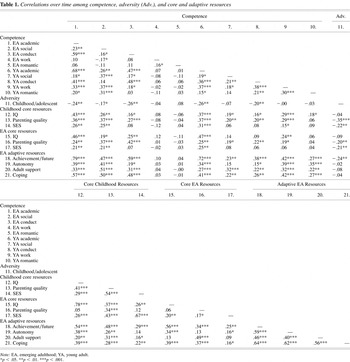
Correlations over time among competence, adversity (Adv.), and core and adaptive resources
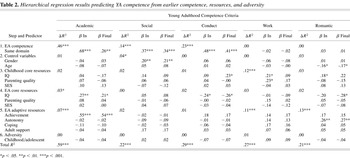
Hierarchical regression results predicting YA competence from earlier competence, resources, and adversity
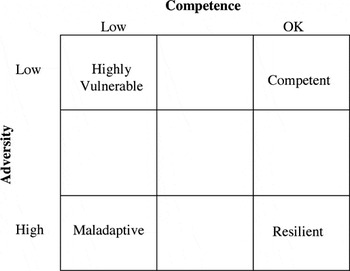
The conceptual model for classifying people as Competent, Resilient, Maladaptive, or Highly Vulnerable according to scores on adversity and competence in age-salient domains. The blank categories reflect mixed or intermediate scores on adversity, competence, or both.
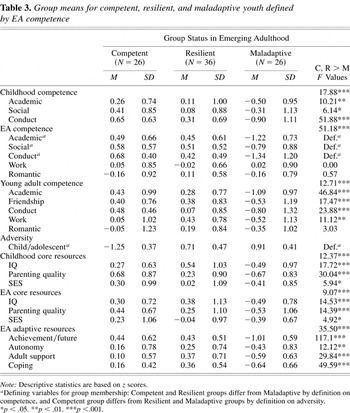
Group means for competent, resilient, and maladaptive youth defined by EA competence
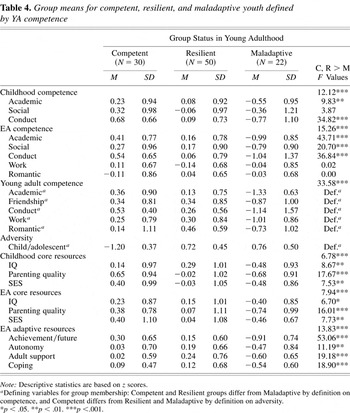
Group means for competent, resilient, and maladaptive youth defined by YA competence
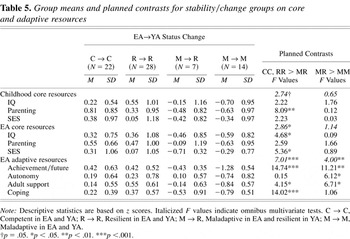
Group means and planned contrasts for stability/change groups on core and adaptive resources
 You have
Access
- 336
- Cited by