The Victorian novel is dominated by heroines, its narrative driven by their impulses and their irrepressible physicality. These women possess a strong visual presence that is intrinsically bound with the way in which they choose to dress themselves, with authorial attention consistently focusing on the elements of their clothing. The body was a highly visible, and more significantly, a readable cultural symbol in the Victorian period, with its signifying ability vitally linked to the clothes that adorned it. Clothes have often been employed in literary metaphors – words as the clothing of thought, clothes as a masking of the real, and so on. In his long poem In Memoriam, A.H.H., Tennyson succinctly deploys the quiet grief contained in the idea of widow's weeds, bringing together the expressivity of both clothes and words, when he writes: “In words, like weeds, I'll wrap me o'er, / Like coarsest clothes against the cold” (stanza 5, ll. 9–10). But in the realist Victorian novel, clothes become even more pertinent, offering a useful descriptive device that is pivotal to the creation of a believable, legible character. The awareness of clothing as something that has potential for both restriction of identity as well as expression of it permeates much of Victorian writing, with numerous novels rendering visible the construction of a coherent selfhood through clothing.
The symbolic function of dress in communicating ideas about the social role of the wearer was not a new notion, but it had gained an extraordinary degree of importance in the age. In her 1878 book, Dress, Mrs. Margaret Oliphant writes, “[O]ur girls are aware that it is their duty to dress well, and encouraged to bestow a great deal of thought and personal care upon the matter” (81). Encouraged to look upon appropriate appearance as an essential part of their feminine role, by mid-century “dress” itself was becoming a principal function in life for an increasingly large number of women, with an astonishing amount of time, effort, and money spent on it. Not only did this emphasis on dress respond to the desire to read social meaning into sartorial choices, it also demanded that every shade and every flounce be read as direct insight into private interiority. Connected with the idea of decipherable signs that had specific meanings, dress was not just a frivolous pursuit but had been transformed into a serious occupation, for the wrong shade of colour or texture of fabric could end in a social mishap.
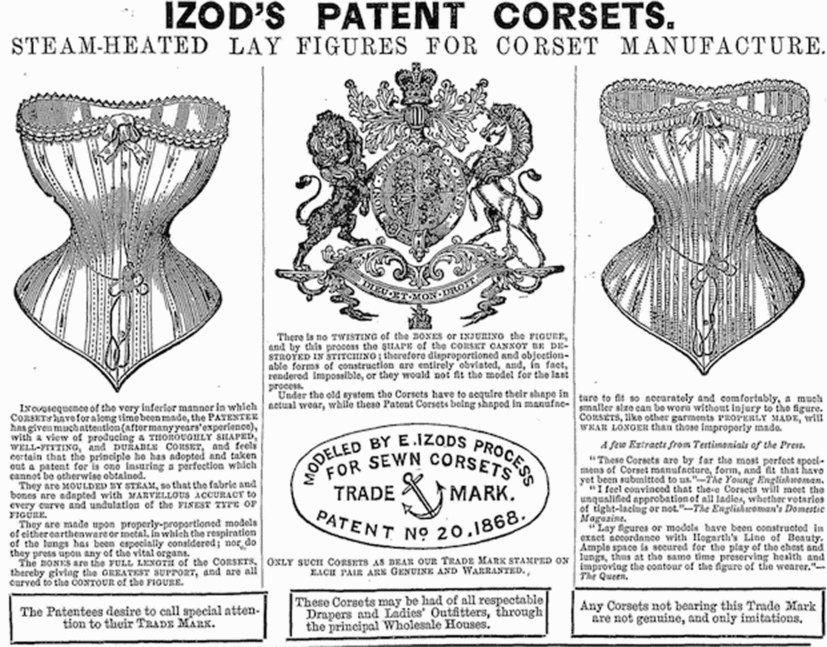
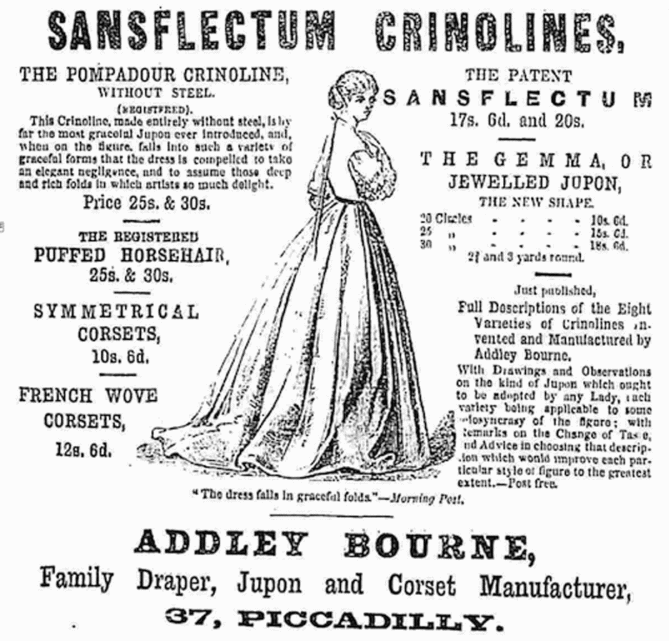
Though the Victorian decades saw the rise and fall of numerous fashions, almost every one of them made unimpeded movement impossible. Be it the innumerable petticoats, the provocative corset, the bustle, the cage-like crinoline, the high-heeled, tiny shoes, or the tight tapering sleeves, women found themselves transfixed into a model of acquiescent domesticity.Footnote 1 One of the constants of Victorian fashion was a tight fit around the midriff, with the waist encased in boned stays, reshaped into a more pleasing diminutive circle, and the legs swathed in voluminous skirts. This juxtaposition of undulating, flowing fabric that converged into a minuscule, stiffened waist that then gave way to an exposed chest and shoulders contributed to a highly sexualised display of a body that was supposed to have sublimated its physicality. Nineteenth-century women's magazines published advertisements for a vast array of women's underwear: corsets, crinolines, and bustles (Figures 6 and 7). All of these complicated garments needed to be hooked, buttoned, laced, tightened, fastened, and knotted, making the role of the lady's maid who would assist in this elaborate procedure of dressing and undressing a essential one for the middle class woman. The easy merging of feminine duty and dress that social commentators like Oliphant overtly proclaimed and that literary representations often more subtly replicated make the dressing room a significant site for the creation of female identity, as well as a certain kind of feminine intimacy. This preoccupation with outward appearance then posited the maid who made up the middle class woman as an aide, advisor and confidante. The implication by which the body and its clothes become intriguingly conflated, where the clothes themselves come to stand in for the body, makes the role of the maid even more critical in the creation of the readable appearance of her mistress.
Advertisement for “Izod's Patent Corsets,” Englishwoman's Domestic Magazine (March 1875), 1.

Advertisement for “Sansflectum Crinolines,” Englishwoman's Domestic Magazine (July 1866), 115.
Given the important functions of the lady's maid, it is not surprising that the dressing room and the relationships it makes possible become increasingly significant in Victorian narratives of selfhood. I will present my own critical narrative by following the women at the centre of four texts and two pictures: George Eliot's Felix Holt, the Radical (1866), Elizabeth Gaskell's North and South (1855) and “The Grey Woman” (1861), Charlotte Brontë's Shirley (1849), Augustus Egg's painting A Young Lady at her Dressing Table (1850s), and John Leech's set of caricatures, “Pin Money” and “Needle Money” (1849).
In a society where female intimacy was difficult to sustain in the face of continual surveillance, the private boudoir or dressing room was one of the few spaces privileged as uniquely female. The conceptualisation of the home as the locus of all that was stable, reliable, and safe, was intrinsically linked with the feminisation of its physical spaces. Writing about gender as an organising principle in architecture, Lynne Walker states that “[a]lthough the Victorian home was feminised and endlessly depicted as ‘woman's place,’ it was nevertheless heavily patriarchal in terms of territory, control and meaning” (826).Footnote 2 In spatial terms, the cultural privileging of the male head of the house translated into the largest proportion of space being allocated to him, and so the public rooms were both the biggest and the most conveniently placed in the house. The women's rooms, on the other hand, were usually placed at the back of the house, or on the side of the garden, away from the street and the potentially intrusive gaze of strangers. The lady of the house would normally have a separate morning room, a drawing room or a parlour, and a boudoir. While the parlour was the room where the woman of the household displayed herself, as well as her varied accomplishments, and conducted the work of paying and receiving social calls and nurturing the family,Footnote 3 the dressing room was an entirely private space where she could create the self that was to be displayed.Footnote 4 Separated and placed at the rear margins of the house, the dressing room then afforded a temporal and spatial privacy. Though sometimes the dressing room – the mirror, the toilette table, and all its various accoutrements – was incorporated into the bedroom, it continued to function in the same ambit of femininity.
It is the space of the dressing room and the intimacies it engendered that I will address in this essay. I want to explore this space and the experience of secluded intimacy, homospectatorial display,Footnote 5 and genuine friendship it provides. Janet Horowitz Murray, in her comprehensive documentary of the experiences of Victorian women, asserts that the “ethic of female comradeship” broke down in relations between women of different classes, and opposing interests of class often proved to be insurmountable obstacles between servants and mistresses (12). However, literary representations suggest otherwise, often showing the relationships between maids and their mistress as those of closeness and loyalty. I am suggesting that the time devoted to a lady's toilette between the lady and her maid would then potentially have been one of familiarity and confidences. I will be focusing on these in Eliot's Felix Holt along with Gaskell's North and South and “The Grey Woman,” pointing out how these representations are very different from the more stereotypical depictions of the dressing rooms found in Egg's painting and Leech's sketches, which are in keeping with the antagonistic relations revealed in Murray's analysis. The second half of my argument draws on the exploration of this relationship and looks at the way in which both the dynamics as well as the terminology of the maid-mistress relationship are replicated in filial relations and between close friends in Brontë's Shirley, with the act of dressing the other becoming the juncture where intimacy arises. What I am then proposing is that preoccupation with dress in the structured exchange between the waiting woman and her mistress can transform an occupational relationship into one of genuine, gendered exchange. In turn, this available structure itself becomes adopted by a number of fictional women – mothers and daughters, sisters, friends – as a mode of creating intimate moments.
I. Maids and Mistresses
George Eliot's Felix Holt, a story about the politically radical eponymous hero and a community on the brink of social and political change, also includes a personal narrative of an eager, yearning mother and her disillusionment. The story of Mrs. Transome's life is told through her relationship with her waiting woman Denner, her only confidante and an indispensable part of her daily life in spite of her straitened circumstances. There is a complexity and moral ambiguity present in Mrs. Transome's character: not only is she ingrained with a defiant pride and a recklessness brought about by an absolute belief in her luck and her own capabilities, she also adheres to a morality that is based entirely on convenience. But Mrs. Transome's youthful mistakes cannot be remedied, and they are revealed to us through unvoiced anxieties and memories. The novel then presents a sensitive and subtle chronicle of an aging woman wracked by disappointment and the fear of disclosure, trying to negotiate between her dignity and her need to be loved. I will look at how these internal maneuverings are often expressed in the dressing room, in the secluded privacy between the mistress and her waiting woman as the former is lovingly dressed, her public face slowly made up for display.
Mrs. Transome's appearance defines the dynamic of the relationship between her and her maid as Eliot wryly naturalises their class disparity into a difference of beauty, where the inferior of the two is to pay homage to the other. Influenced by the contrast between her mistress’ regal beauty and her own round-featured physiognomy, Denner's feelings were “of that worshipful sort paid to a goddess in ages when it was not thought necessary or likely that a goddess should be very moral” (102). Even as Eliot frankly admits this inequality between the employer and the employee, she plays with its terms making it into a quasi-mystical subordination of one woman to another, at the cost of rendering invisible the real physical labour that Denner would have daily undertaken. Though the characteristic image of working-class womanhood in nineteenth-century England was the sempstress or the mill worker, from the mid-century on it was domestic servants who made up the largest occupational group of working women, and their experience was usually more brutal and humiliating than is suggested here. In the feminised Victorian household, it was women who formed the majority of the indoor residential servants, and domestic service largely tended to be a relationship between women. In Felix Holt, we are led to believe that Denner is one of the highest in the domestic hierarchy, but in the reduced circumstances of the family she plays a double role – under her maiden name, she is Denner the lady's maid, while also being Mrs. Hickes, the butler's wife who acts as housekeeper and superintendent of the kitchen.
Denner's obeisance when she recognises how not to say something that would seem like “a familiarity from a servant who knew too much” (102), is part of the excessive deference that Leonore Davidoff argues was demanded of servants in the period (410). She emphasises that this was elaborated through ritual which could easily become an end in itself (412). Though Eliot avoids representing the actual work involved in Denner's position, she does recognise this ritual aspect and how easily it can slip into a kind of ceremonial pantomime, taking on the elements of a dramatic performance that elides the differences between the genuine and the performative, the private and the public. In these dressing room scenes between Denner and Mrs. Transome, not only are intimate secrets artlessly revealed or intuitively divined, but also the performance of domesticity and motherhood bared.
It is to Denner that Mrs. Transome reveals her apprehensions about her newly returned, “best-loved boy” (89) who has come back not only a stranger but also unexpectedly callous. It is only in front of Denner that she can let down the armour of an assumed nonchalant strength. The narrative, attentive to her outward appearance, introduces Mrs. Transome as a stately woman of between fifty and sixty years:
She was a tall, proud-looking woman, with abundant grey hair, dark eyes and eyebrows, and a somewhat eagle-like yet not unfeminine face. Her tight-fitting black dress was much worn; the fine lace of her cuffs and collar, and of the small veil which fell backwards over her high comb, was visibly mended; but rare jewels flashed on her hands, which lay on her folded black-clad arms like finely cut onyx cameos. (86)
The mended clothes juxtaposed with the grace of manner and the bejewelled hands add to her aura. Her hands are not just the bearers of rings that denote inherited wealth but are themselves compared to “finely cut onyx cameos.” The cameo was an important part of Victorian fashion iconography and like any other piece of jewellery, it had the ability to function as a visual language while also being an article that portends wealth. But most significantly, usually being a portrait in profile that was carved in relief, it represented images of women within everyday life. Jean Arnold explains that “[t]he iconic images on cameos circulated through Victorian culture as a spectacle of everyday fashion, their chiselled heads adorning bracelets, brooches, pendants, necklaces, and earrings” (269–70). These then had aesthetic as well as economic implications, and even as the reference to the cameo places Mrs. Transome within a particular context, it detaches her from it, making her into the work of art, the focus of the reader's appreciative gaze. This jewellery bestows a sense of power and agency to its wearer; yet in comparing the wearer herself to the sculpted profiles that are circumscribed within the precious stones, Eliot is suggesting something more profound. These sculpted images of femininity reflect the ordinary lives of actual women, as narrowly prescribed by representational codes and as unprotestingly melancholy. Though Mrs. Transome has the wealth to afford these miniature portraits, she herself becomes like one of the women sculpted within such a piece, restrained by norms that demand a resigned passivity.
But this overwhelming sense of powerlessness and distress is habitual to Mrs. Transome, something that the narrator, through the consciousness of the more pithy worded Denner, attributes to her regal bearing: “Her mistress's rhetoric and temper belonged to her superior rank, her grand person, and her piercing black eyes” (488). She cannily guesses Mrs. Transome's fear about keeping the existence of her bygone affaire de cœur concealed, aroused by her son Harold's striking resemblance to Mr Jermyn, the long-time manager of their estate, and offers advice in her own demotic idiom: “Well, madam, put a good face on it, and don't seem to be on the look-out for crows, else you'll set the other people watching. . . . [T]here's a good deal of pleasure in life for you yet” (103). And even though it is mostly Mrs. Transome who reveals her thoughts to Denner, she does ask her maid about these pleasures:
“What are your pleasures, Denner – besides being a slave to me?”
“Oh, there's pleasure in knowing one's not a fool, like half the people one sees about. And managing one's husband is some pleasure; and doing all one's business well.” (103)
The two women repeatedly return to the question of happiness and how it is constituted for a woman. Mrs. Transome with her throbbing, portentous sorrow and Denner with her axiomatic sayings manage to form a dialogue about the problem of a woman's lot, a recurring subject of Eliot's fiction. Mrs. Transome's final words to herself borrow from the waiting woman's idiomatic vocabulary: “It is a lucky eel that escapes skinning. The best happiness I shall ever know, will be to escape the worst misery” (107). And so she goes on, as Eliot's women do, keeping her secrets to herself, “save in a bitter little speech, or in a deep sigh heard by no one besides Denner” (199). The unlikely companionship that the two women share manifests itself in this instance in a merging of their thoughts, a converging of their language.
A focus on one of the novel's most crucial junctures, when Harold confronts his mother with the secret of his true paternity, reveals another moment of intense vulnerability when Denner provides comfort and strength to her mistress. This is a moment of painful emotional breakdown, as well as an extraordinary connection between the two women. Having come to dress Mrs. Transome, “a labour of love” (485), Denner walks into the dressing room to find a bizarre scene. Draped in a dressing gown that fell in thick folds about her, Mrs. Transome was seated before her mirror in a room made bright with candles and firelight. She had “unfastened her abundant grey hair, which rolled backward in a pale sunless stream over her dark dress” (485), her jewelled hands clasped on her knee, her eyes staring at something beyond the reflection, lost in reverie: “[H]er clear-cut features keeping distinct record of past beauty, she looked like an image faded, dried, and bleached by uncounted suns” (485–86). The funereal stillness of the room, the aridity of Mrs. Transome's figure and her glassy abstraction emphasise the hopelessness she feels. She is no longer even a living, breathing person, but is changed into a muted, lusterless likeness of herself, in the manner of the female vignettes evoked in cameos. The strange motionlessness and the stony apparition startle Denner in spite of her “ingrained and systematic reserve” (486), the reflection of her slight cry and sudden start breaking the trance.
This scene sees the unfolding of one of the most touching moments in the book where the mistress is transformed from “the dishevelled Hecuba-like woman” to “the majestic lady in costume” by the “faithful hand” of the maid (489–90). As Mrs. Transome is dressed, the talk between the two women turns to Esther Lyon, who becomes a sort of double through whom Mrs. Transome comments upon herself and, generally speaking, upon independent women who know their mind:
“A woman's love is always freezing into fear. She wants everything, she is secure of nothing. This girl has a fine spirit – plenty of fire and pride and wit. Men like such captives, as they like horses that champ the bit and paw the ground: they feel more triumph in their mastery. What is the use of a woman's will? – if she tries, she doesn't get it, and she ceases to be loved. God was cruel when he made women.”
“It mayn't be good-luck to be a woman,” [Denner] said. “But one begins with it from a baby: one gets used to it. And I shouldn't like to be a man – to cough so loud, and stand straddling about on a wet day, and be so wasteful with meat and drink. They're a coarse lot, I think.” (488)
Eliot displays a quaint tenderness and candour in this bond that is unmatched by any other relationship in the novel. Though theirs is an unequal employer-employee relationship, it is the only one in which Mrs. Transome lays herself bare. In the refuge provided by the ambit of the toilette table, the mistress is able to strip the mask of impassivity, uncovering her thoughts as she undresses her body, only to be lovingly made up by her devoted maid yet again. Their economic bond perhaps curtails the equality of the friendship, making it lopsided, with the servant providing solace to her mistress without being able to articulate her own concerns. But Denner does feel bound to Mrs. Transome, even though she does not reveal herself in the same way. Showing her own deep affection, she ardently says: “I should want to live for your sake, for fear you should have nobody to do for you as I would” (490). The same woman who never initiates speech so as not to be too familiar, takes her mistress’ hand as she hands her her gold vinaigrette. The intensity of the scene concludes with Mrs. Transome clasping hard Denner's hand as she agonisingly gives words to the most difficult confidence – her anguished wish that her son, who had long been her only source of hope, had never been born.
These feverishly emotional moments played out between the two women are saturated with significance. The dressing room allows a woman the space to prepare her body to be seen in public while also displaying her in a state of privacy. The presence of the lady's maid is crucial to the intensity of this intimacy, for she is witness to the transformation from the “Hecuba-like woman” to the “majestic lady,” as well as the agent of that change. Embedded in this story then is a debate about the authenticity of public femininity, as well as “the degree of spectacularity suitable to the life of a proper domestic woman,” as Lauren Chattman puts it in a different context (75). Chattman's exploration of the fictional link between theatricality and the domestic ideal shows how the depiction of professional actresses in Victorian theatre novels is a useful lens for looking at canonical nineteenth-century domestic novels, for both kinds of writing are interested in the staging of femininity and the ways in which this notion of performance undermines the seemingly stable categories of gender. Eliot is then already suggesting in a manner more subtle than the sensation novelists who will return to this theme with obsessive consistency, that gender itself is a performance and in that sense, Mrs. Transome's concealing of her anxieties in public as well as her display of her aristocratically dignified, ageing body are inseparable from a theatrical self-display of the kind that clashes with the ideal of readable appearances. But at the same time, this highly visual encounter between Denner and Mrs. Transome becomes leached of its visuality, becoming instead intensely, exclusively emotive. Even as we are given a haunting verbal description of Mrs. Transome, it is absorbed into an emotionally charged psychological drama played out between the two women, their dialogue giving voice to past secrets, current griefs, and prophesied fears. It is as if in the dressing room she can finally function as a desiring, feeling subject.
Gaskell's North and South situates a similar relationship between mistress and maid, in the characters of Mrs. Hale and Dixon. It is Dixon who is privy to Mrs. Hale's secrets and jealous of her attention, ruling the drawing room and kitchen alike. She seems to be more of a companion to Mrs. Hale and a general minder of the family than actually providing conventional domestic service. She considers herself superior to the other domestic servants, as well as to Mr. Hale, marriage to whom had been her lady's “affliction and downfall” (21). Despite Dixon's grumbling ways, her habit of giving herself airs and being offended by every trifle, Margaret recognises her loyalty, and her mother's utter inability to do without her maid when she resists her father's suggestion of letting her go due to their reduced circumstances.
It is Dixon who tries to console Mrs. Hale and help her with the packing required for the impending move to Milton. Again, it is the dressing room that becomes the space where the two women, mistress and maid, come together in their shared sorrow and common remembrances:
Mrs. Hale's dressing-room was left untouched to the last; and there she and Dixon were packing up clothes, and interrupting each other every now and then to exclaim at, and turn over with fond regard, some forgotten treasure, in the shape of some relic of the children while they were yet little. They did not make much progress with their work. (52–53)
This scene possesses a very different valence from the one between Mrs. Transome and Denner. There is a greater measure of equality between Mrs. Hale and Dixon, and their relationship shows itself as one of close companionship. The narrator describes their work as that of shared labour, and their joy at discovering a long-forgotten artefact belonging to the children equally sincere, almost as if the children belonged to both of them. The dressing room with its collection of things and memories is a potent space for both the maid and mistress in this case.
Julie Nash argues that “[n]ineteenth-century British servants, with their intimate knowledge of household affairs, their influence over children, and their own limited personal freedom, became for . . . Gaskell essential characters for examining the tensions produced by social transformation and conflicting values” (2). The idea of separated spheres of the public and private, and the distance between employers and employees were abiding cultural myths but often ignored in reality; it is these actual ambiguities that Gaskell sets out to examine.
One of the moments when this undercurrent of tension makes its way to the surface is when Margaret longs to become closer to her mother after their move to Milton. Margaret and her mother's relationship is a conflicted one; Margaret grew up in her aunt's house, and after her return, her longing for maternal comfort and filial intimacy is sadly unfulfilled, for not only is her mother temperamentally very different, but also because her chosen confidante is the maid who has been her long-time companion, rather than her newly arrived daughter. In fact, it is Dixon who holds the secret to her mistress's rapidly declining health and is party to the mysterious consultations in her bedroom, from which she emerges crying and cross. Again, it is she who is preferred over Margaret to attend to Mrs. Hale during the doctor's examination, a preference that leaves Margaret resentful and disheartened. Margaret has to contend against the maid for the attention and affection of Mrs. Hale, but she finally “[triumphs] over all the obstacles that Dixon threw in her way; assuming her rightful position as daughter of the house” (125) by forcing the doctor, by dint of her determination, to reveal the truth. She pleads with her mother to let her take the waiting woman's place: “I will try and be humble, and learn her ways, if only you will let me do all I can for you. Let me be in the first place, mother – I am greedy of that” (128). After this entreaty, Mrs. Hale does begin to depend upon Margaret, both for comfort and diversion, but this is a dependence that cannot lead to a steadily strengthening mother-daughter relationship, for its foreseeable end is Mrs. Hale's death. In addressing the relationship between Mrs. Hale and Dixon, and Margaret's insistent need to insert herself into it, replacing the maid as her mother's confidante and slipping a measure of reserve into the almost claustrophobic familiarity, Gaskell collapses the false dichotomy of public and private realms, bringing to the fore the echoes of conflict between the mistress and the servant. The habitual intimacy that made Mrs. Hale and Dixon so close is what Margaret shrinks from, but in doing so, she dissipates the tension between herself and the maid that had arisen from the competition over Mrs. Hale's attention. In asserting this distance and challenging Dixon's over-familiarity, Margaret inspires her respect and her love.
Felix Holt and North and South are interesting contrasts in this respect. The emotional bond between mistress and servant seems closer than that between mother and child. Margaret and Harold both return to live at home in their youth, and are estranged from their mothers. But while Margaret does make efforts to claim her mother's affection and regard, Harold is completely indifferent to his. The lack of filial intimacy is inevitably recompensed by an intimacy between the two mothers and their maids, who provide loyalty without criticism, unlike their own children, implicitly understanding their needs and emotions. Margaret is her father's daughter, and affinity with her mother is achieved with difficulty. Esther Lyon on the other hand, finds it easier to form an attachment to Mrs. Transome than her own father. But again, it is interesting that many Victorian heroines choose to borrow the visible signs of servitude when approaching their friends, sisters or mothers, insisting and yearning to be their waiting women so as to be able to fully express their affection. It is this impersonation that is part of Esther's emotional maturation in Felix Holt, where she takes on the duties of Denner as Margaret had jealously appropriated those of Dixon. After the confrontation with Harold, at the edge of a nervous breakdown, it is Esther who soothes Mrs. Transome with her gentle manner. She entreats the older woman: “Do let me go to your room with you, and let me undress you, and let me tend upon you. . . . [I]t will be a very great thing to me. I shall seem to have a mother again” (598). This suggestion of the daughter as maid finds an unusual articulation in Esther's relationship with her father, to whom she shows her love by undertaking to “correct his toilette,” a trifling act that is one of the most audible signs of her transformation, given that in the past “she had not liked even to touch his cloth garments” (290).
Choice of clothing has long been an activity over which women bond with each other, whether they be mistresses and waiting women, mothers and daughters, sisters, or friends, and in North and South, Margaret's clothing becomes the focus of her mother's attention, in fact the only activity that can divert her mind from her illness and the only real point of connection between them. Intimacy around clothes then compensates for or veils what is otherwise a disturbing lack of closeness. It is no coincidence that all the women close to Margaret – Aunt Shaw, cousin Edith, and even Bessy – wish to see her dressed well, fabricating a closeness, authentic or otherwise, that arises in moments spent in acts of dressing and undressing, moments that lead to the attachment between Mrs. Hale and Dixon that Margaret yearns to recreate. Gaskell's project in the novel then is not only to show the porousness between the public and the private, but also to show the domestic as a permeable setting where maids and mistress are not just bound by the employee-employer configuration but also share a more significant intimacy.
The dressing room and the role of the waiting woman are crucial to this formulation, revealing that feminised space as an enclosed enclave where secrets can be shared, but one that can also give rise to a familiarity that threatens to bring disorder. The Hale household is very different from the Shaw home where the servants really are invisible, existing on the margins of family life, in the way that volumes of household manuals and directives advised. Margaret, returning to live with her aunt after the deaths of her parents, notices: “the very servants lived in an underground world of their own, of which she knew neither the hopes nor the fears; they only seem to start into existence when some want or whim of their master and mistress needed them” (458). But this is not that state of affairs that Gaskell herself seems to advise. As Nash observes, “[i]n one of the work's most important subplots, Gaskell shows the Hale family coming to terms with the role of a maid within the family, and the difficulties of maintaining distinctions between family members and other dependents, a difficulty that she says will be faced by industrial workers as well, but that will result in improved class relations and economic success” (8).
In North and South, Margaret not only becomes her mother's confidante, but also comes to replace her in Dixon's affections after her death. She has to learn to assert her opinion as well as her position in order to make the distinction between family members with legitimate claims and dependents with more ambiguous entitlements. While in the industrial plot of the novel the relationship between men and masters is difficult because there is not enough intimacy, the relationship between Dixon and Margaret is problematic because it is too intimate. Though it is characterised by mutual dependence and a recognition of loyalty, it is also marked by a reciprocal distrust, apprehension, and resentment, issues that are neatly skirted in Felix Holt.Footnote 6
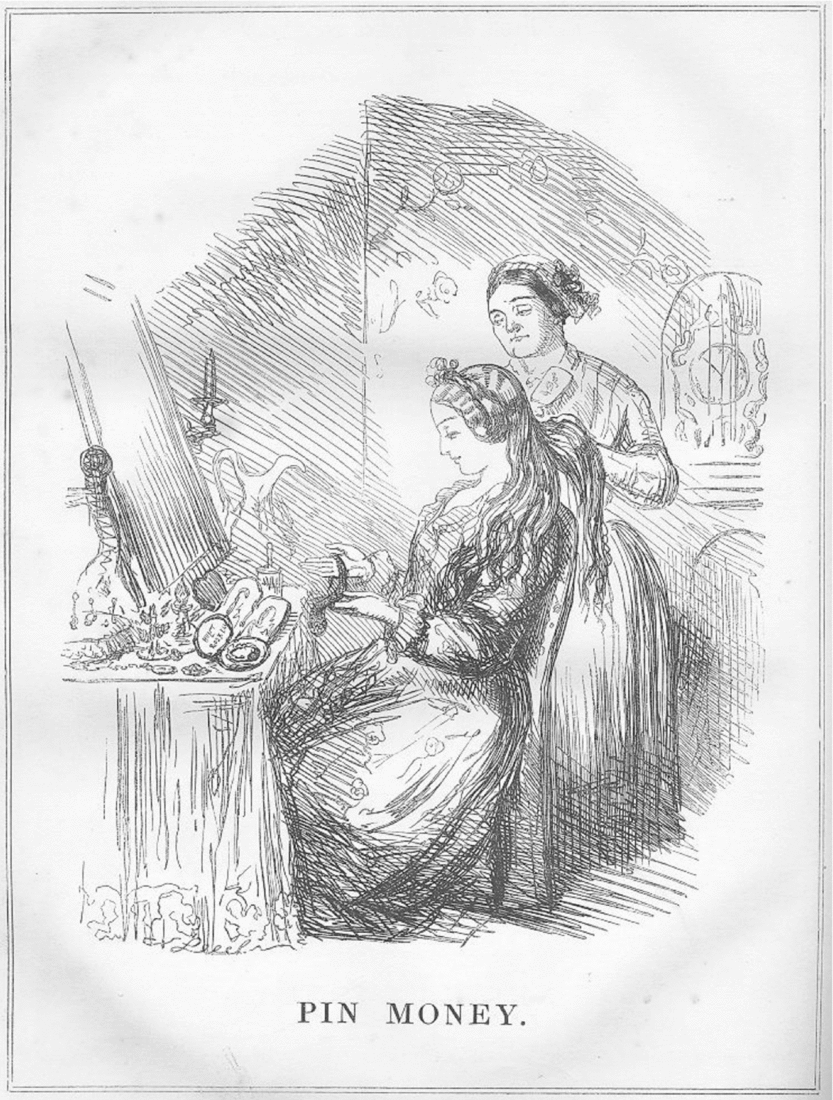
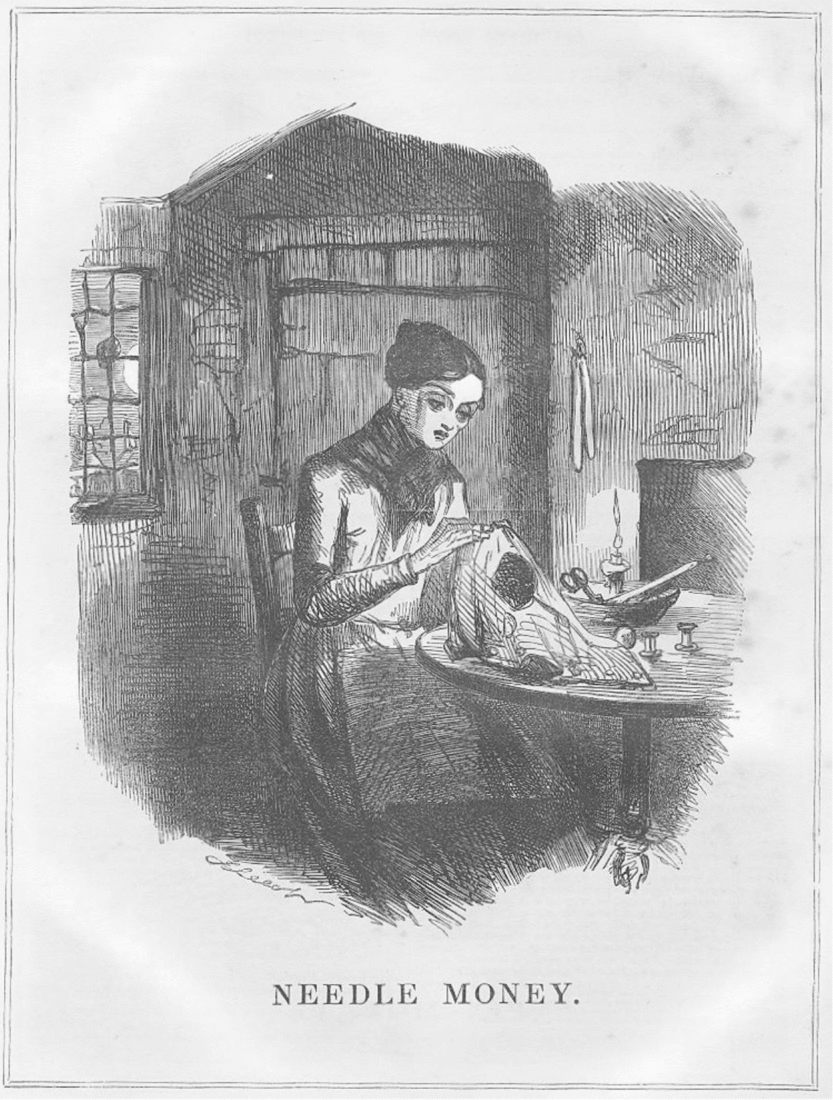
Even as George Eliot and Elizabeth Gaskell undertook a serious and layered representation of the dressing room and its attendant alliances, representations of the same in popular journals like Punch continued to be rather one-dimensional and often patently misogynistic. Both writers portray the dressing room as a flexible space, like the relationships it produced, that allowed for women's autonomous expressivity and a shared companionship, while also being the place where prescribed femininity and the tensions inherent in cross-class interaction were played out. This is the paradox that is fundamental to the dressing room. It is precisely this that made it so suspicious a space to the writers of Punch who consistently bring it up in the same manner as the satires of the previous century did – a room where women cosmetically created false fronts that duped men. The 1849 caricature by John Leech shows a leisured lady before her dressing table in comparison to the poor sempstress bent over her sewing. The two visions are juxtaposed in financial terms with the titles “Pin Money” and “Needle Money” (Figures 8 and 9). Pin money was the allowance a woman would receive from her husband for spending on her clothing and other personal items, and its very name suggested money spent on useless decorative trinkets and other inessentials. In keeping with this idea, the tableau in Figure 8 presents a dressing table laden with a large mirror and hairbrushes, before which sits a young woman having her hair done by her maid. In contrast is the demure milliner in Figure 9, busy at her stitching in a room that seems devoid of much comfort. The images thus present two different kinds of womanhood, one wasteful and vain, for such are the qualities endorsed by the dressing room, and the other poor and hardworking. It is obvious which set of feminine qualities is being championed here.
John Leech, “Pin Money,” Punch (July – December 1849), 240. Courtesy of Special Collections, Templeman Library, University of Kent.
John Leech, “Needle Money,” Punch (July – December 1849), 241. Courtesy of Special Collections, Templeman Library, University of Kent.
The dressing room as a space for female vanity and deceit is present also in a very different kind of picture, Augustus Egg's 1850s painting A Young Lady at her Dressing Table (Figure 10). The painting shows a young woman in the foreground, prominent in her glowing white gown against the shadowy surroundings that seem to swallow up the body of the maid dressed in black. Staring reverently into the mirror, which is festooned in lacy white drapery and an excess of cloth that replicates her own frothy dress, she is holding a white rose to her face, entranced by her own image. On the table before her are the two candles that light up the glass, open jewellery boxes and scattered ornaments, and what seems to be a cascading wave of false hair. This tableau with the candles that illuminate the icon reflected in the mirror is presented as an altar, the whole picture one of false worship because it is self-worship. Behind the rapt mistress stands her maid, positioned in a margin of the painting, waiting in attendance, her pale face hauntingly prominent against the gloom of the room and the dark austerity of her own dress. The two women are presented as obviously recognisable opposites, one frivolous in her gleaming white dress with its swelling skirt that leaves her white shoulders appealingly bare, with slender wrists encircled by gold bangles, and an abundance of golden ringlets; the other with her simply combed black hair and a drawn face, wearing a buttoned-up black gown with a demure white collar. But the maid's gaze is also directed at the reflection, much like the maid in Leech's caricature, suggesting that it is the creation of that image that is crucial to both women. The heap of clothing in the foreground of the painting, topped with the discarded wreath of flowers, is juxtaposed with the hands of the girl at the back who seems to be busy folding away some item of clothing. It is a vignette that draws on the dressing room as a space that objectifies women: a space where women are presented as the centre of the spectator's gaze as well as a space where they objectify themselves. It is not the space that Eliot and Gaskell visualised, a room where women have the independence and the comradeship to become their authentic selves, but a dangerous domain that encourages them to be frivolous and wasteful. Its potential as a space for engendering friendship is subsumed in the misogynistic idea that it might be a space where women can develop a frightening independence, manufacturing an attractive face with which to entrap suitors. Though the form of the maid emerges from the shady periphery of the room that focuses on the illuminated mistress, it does so only to show her role in the creation of her mistress’ public face and the labour that goes into the maintenance of what Esther Lyon calls a “real fine-lady” (153).
Augustus Egg, A Young Lady at her Dressing Table, nd (1850s). Oil on canvas. Private Collection. Photo © Christie's Images / The Bridgeman Art Library.
While on the one hand the conventional representational strategies used by Punch and Egg show the dressing room to be associated with the ostensibly age-old feminine failings of vanity, sensuous self-obsession, and frivolousness, Gaskell shows a different version in “The Grey Woman.” Both Augustus Egg and the Punch caricaturist present their waiting women as detached employees, whereas Gaskell takes the friendship between the maid and the mistress to a contrary extreme, where the two conspire to escape the cruelty of the master and husband in the disguise of husband and wife themselves. In “The Grey Woman,” the waiting woman is neither the impoverished, socially marginalised woman of Leech's parody nor the exploited servant of Egg's painting, but rather the closest companion of her mistress.
In this story, Gaskell turns away from the idea that safety for a woman lies in being married and brought into the affluent household of her husband. The moment of Anna Scherer's establishment as the mistress of the strange, sinister house belonging to M. de la Tourelle is also the moment that signifies her imprisonment. Not only is she confined to the apartment that her husband allocates to her, she feels that all the domestic servants were set as spies on her and that she was “trammelled in a web of observation and unspoken limitation extending overall [her] actions” (212). The exception is Amante, her French waiting woman, who was directed by M. de la Tourelle to always sit in her lady's boudoir, to be always within call.
But soon Anna begins to be reproached by her husband for having become “sadly too familiar with [her] Norman waiting-maid” (205). The relationship between the two women proves to be so close, especially after the news of Anna's pregnancy (as yet unknown to M. de la Tourelle) that it arouses the jealousy of the possessive husband. Reminiscent of Margaret's seething jealousy of Dixon, the boudoir then provides for a complex of relations that exceed the terms of the maid-mistress relationship. Amante, the name itself carrying the meaning “lover,” becomes Anna's companion, nurse, confidante, and finally saviour. Discovering the secret of her husband's identity as the leader of a gang of robbers and murderers, when she clandestinely searches for a letter from her father in his forbidden chamber, Anna is led to safety by the resourceful Amante.
What is most striking in this relationship is how it allows for the inversion of the aesthetics of the dressing room, while also disturbing the husband and wife hierarchy. In helping her mistress escape, Amante reenacts a more nurturing relationship with her in their guise as a married couple, creating an unconventional narrative. However, in order to remain true to themselves, the two women have to disguise themselves: Amante cuts her own hair short, clips her eyebrows, and alters her voice and the shape of her face by “cutting up old corks into pieces such as would go into her cheeks” (229), and she thickens Anna's figure with old clothes, stains her face, blackens her teeth, and dyes her hair. With increasing insecurity, Anna has to learn to intensify her disguise, and, as Eve Lynch points out, the irretrievable fall of the mistress is suggested in a remarkable moment when she deliberately and permanently disfigures her features by breaking a front tooth (101), and later when her hair turns prematurely grey. The underlying principle of the mistress and maid relationship is inverted in these scenes of painful defacement. Amante becomes her mistress’ companion not by dressing her in finery but by disintegrating every signifier of her beauty. Survival is only possible either through socially approved self-effacement or through this impersonation that transgresses class and gender norms, both finally bracketed together as inverse sides of the same idea of female theatricality.
II. Imitating Intimacy: “It is my turn to attend to her. . . . I am her waiting-woman.”
The obsessive detailing of the boundaries of the domestic structure that insisted on the demarcation of the maid and the mistress again reveal that these roles and identifications were really quite fragile. Women like Amante, Denner, and Dixon splinter these attenuated distinctions, revealing the vulnerability of class (even gender) lines, while articulating as well as responding to the Victorian anxiety about the correct “place” of the servant. It is striking then how these terms of servitude are adopted in more equal relations between women.
In Charlotte Brontë's Shirley, Caroline Helstone is the shy, considerate heroine through whom the sartorial theme of the novel is developed. The pair of equally significant female protagonists, Caroline and Shirley, do not merely act as a foil for each other; rather, their friendship becomes a medium through which Brontë conveys the peculiarly feminine meanings associated with the ritual of dress and undress. In the course of the novel, Caroline repeatedly takes on the role of the lady's maid in her various relationships with other women; Hortense Moore, Shirley Keeldar, and Mrs. Pryor all undergo Caroline's keen ministrations.
In Shirley, all the women characters enter the novel through a sartorial description, and Cousin Hortense is no exception. Her peculiar dressing habits, her refusal to adopt English fashions and her adherence to Belgian mores, are part of her stubborn, humorous foreignness. She is the older woman whom Caroline visits for companionship as well as sewing and French lessons, but their moment of closeness arises out of the efforts made by Caroline to dress Hortense rather than their teacher-pupil relationship. This sartorial relationship is an early hint that alerts the reader to the way in which Caroline displays her affection to other women. She has to coax her governess-cousin upstairs to dress, a manoeuvre that required careful management, and the change of clothing takes place in a comical pantomime. While listening to Hortense's solemn homily against the frivolities of fashion, “Caroline denuded her of her camisole, invested her with a decent gown, arranged her collar, hair, etc, and made her quite presentable” (106). However, after all these efforts at presentability, Hortense insists on putting the final touches herself, which consisted in donning a large “servant-like black apron” that spoiled the effect of Caroline's work. But this voluminous apron is crucial to Hortense's self-construction as a good housewife, properly aware of her domestic duties. Indeed, it is one of the items of clothing that she sews for and presents her younger cousin to wear as a legible symbol of her domesticity, a gift that Caroline refuses to profit by, resulting in their only serious quarrel. Though starting off as a relationship that holds potential for intimacy, the familiarity between the women quickly reveals itself to be one that is severely damaging to Caroline's selfhood, tugged and prodded by Hortense's overbearing moralisations on proper feminine occupation and appearance.
Shirley is an exploration of women's selfhood as it negotiates the pressures of social expectations. One of the ways in which these negotiations are opened up in the novel is through the significance placed on female friendship. The friendship that does not come to fruition with Hortense is transplanted to Shirley. It is through the relationship between Shirley and Caroline that Brontë evokes the fulfilment a woman can find in a close relationship with another woman, and how this bond might offer “the solution to the problem of how to survive emotionally as an unmarried woman in Victorian society” (Hunt 55). Shirley is the apparent opposite of Caroline in appearance and in feeling. The myriad descriptions of Caroline as the young, delicate girl in pale, diaphanous muslin gowns, her brown hair falling in an abundance of curls over her dainty shoulders is in striking variance to Shirley's self-professed “masculine manners,” enveloped in the ample and shining folds of her silk dress – “an attire simply fashioned, but almost splendid from the shifting brightness of its dye” (252). Difference then becomes minutely but manifestly written into the folds of a dress, the line of a figure and the changeable colour of cloth. But Shirley's bright garment “of tints deep and changing as the hue on a pheasant's neck” (252) is not more eloquent than Caroline's demure brown merino gown or her pure white muslin dress, colourless except for the pale azure sash. The rich, flamboyant elegance suited to Shirley's dark, extravagant beauty is equally upheld alongside Caroline's conventional, non-threatening, and prettily inconspicuous choice of dress. Their opposing descriptions as “a graceful pencil-sketch compared with a vivid painting” (252) are equally alluring, though in completely different ways. Yet it is this initial difference that signals the ambiguities that will later arise in their relationship. It is also this contrast played out between the self-effacing Caroline and the striking Shirley that enables us to turn a curious, unhurried gaze at the body of a woman who spends much of the novel trying to whittle it down into a shadow; in this way Brontë presents in Caroline a heroine who is both repressed and desirable.
An unusually muted heroine, Caroline chooses to adopt the role of the lady's maid to express some measure of her fondness. As Caroline and Shirley's friendship grows, so does their sartorial intimacy – they choose each others’ clothing, dress together (and on one occasion undress), and occasionally dress each other. The pattern exhibited in Caroline's association with Hortense repeats itself in her relationship with both Shirley, her closest friend, and Mrs. Pryor, her newly found mother. On the morning of the Whitsuntide festivities, with unexpected vivacity, having been dressed in a simple gown by the dexterous hands of her own maid Fanny, Caroline makes her way across sequestered fields and hidden lanes to Fieldhead. In the nature imagery that is reminiscent of Shirley and Caroline's walk through Nunnely Common, the narrative follows the hurrying, tripping steps of Caroline:
She glided quickly under the green hedges and across the greener leas. There was no dust – no moisture – to soil the hem of her stainless garment, or to damp her slender sandal: after the late rains all was clean, and under the present glowing sun all was dry: she walked fearlessly, then, on daisy and turf, and through thick plantations; she reached Fieldhead, and penetrated to Miss Keeldar's dressing-room. (292)
With a self-possession not usual to her, Caroline “penetrate[s]” her way into Shirley's dressing room.Footnote 7 Intent on having Shirley attend the Whitsuntide festivities with her, Caroline wastes no words in trying to persuade her but taking away the book she was engrossed in, “with her own hands, commenced the business of disrobing and re-robing her” (292). Unwilling to “talk, laugh and linger,” Caroline “persevered in dressing her as fast as fingers could fasten strings or insert pins [and] as she united a final row of hooks and eyes, she found leisure to chide her, saying, she was very naughty to be so unpunctual” (292). This pretty tableau of friendship ends in a spectacular reiteration of their difference and their unity as they run out hand in hand, laughing as they went, “looking very much like a snow-white dove and gem-tinted bird-of-paradise joined in social flight” (293).
Another dressing room scene takes place a few chapters later on the morning after the disturbance at the mill. Having spent the night at the Rectory, they wake up together, dressing themselves before the same mirror. Caroline “dressed herself, as usual, carefully, trying so to arrange her hair and attire that nothing of the forlornness she felt at heart should be visible externally” (342). As they get ready, they talk of the impression men have of women, a conversation punctuated by a pause as Shirley looks into the glass, “training her naturally waved hair into curls, by twining it round her fingers” (343), and Caroline fastens her dress and clasps her girdle. In between these calm lulls where the two are busy in arranging their appearance, Shirley soliloquises upon how men misapprehend women and their motives. She observes that “their good woman is a queer thing, half doll, half angel” (343); their heroines are as artificial as the roses in her best bonnet. This oft-quoted phrase is at the heart of the novel, and expresses with a pithy linguistic economy one of its dominant concerns. However, it needs to be inserted back into the scene in which it occurs in order to read its full significance. This remark is made on “the morning after,” when Shirley awakens after a night of intimacy and then has to face the world. It arises in the course of a typically feminine occupation during which Shirley and Caroline give words to half-formed thoughts that are surprisingly perceptive, but could never be aired in public. It seems as if in this fleeting instant of intimacy and relaxation, when they are no longer functioning as cultural signifiers of femininity but as subjects in their own right, they can finally voice their unmediated thoughts, or their anxieties as Mrs. Transome does. Even as Caroline interrupts Shirley, “‘Shirley, you chatter so, I can't fasten you: be still,’” she continues, “‘authors’ heroines are almost as good as authoress's heroes’” (343). But Shirley is adamant that “women read men more truly than men read women” (343) and finally the girlish chatter, wound around the ordinary details of the toilette, dies down as they descend for breakfast.
Unsurprisingly, these are frequently the moments where confessions are made, confidences shared, matters of the heart discussed, and thereby friendships cemented. Indeed, it is during another act of undressing that Shirley tells Caroline of Robert Moore's proposal, as Caroline later informs Robert. He teasingly asks her what they discussed when they “curled [their] hair together,” and she retorts that they talked the whole night through “about things we never thoroughly discussed before, intimate friends as we have been: but you hardly expect I should tell you?” (558–59). Caroline, the shy, reticent one becomes less so in the privacy and the autonomy that these shared dressing room moments provide. Even though their fantasy excursion to Nunnwood or the imagined sea-voyage do not materialise, the space provided by the ambit of the dressing table becomes their locus amoenus.Footnote 8
In a final mark of their friendship, Caroline superintends the “millinery preparations” at Shirley's wedding, and chooses the bride's veil and dress “without much reference to the bride's opinion” (591). This is a significant redefinition of their relationship. There seems to have been an equalisation, a final remodelling that makes them both better fitted to marriage – an equalisation that involves the neutralisation of Shirley and a strengthening of Caroline. Caroline, in spite of her sartorial initiative, is a painfully self-conscious and retiring heroine, but the end of the novel shows her confidently taking charge. On the other hand, Shirley, having withstood all societal disapproval of the unconventional way in which she chooses to manage her life and property, and familial opposition to her stubborn wish to secure a husband of her own choice, becomes almost inert in her inability to take even the slightest decisions regarding her forthcoming marriage. However, this passivity itself may be seen as a form of resistance to her prospective role as a wife, an idea substantiated by the fact that she continually tries to defer the date of the wedding. Her future as a married woman leaves her “vanquished and restricted,” and it is Louis alone who can “make amends for the lost privilege of liberty” (592). Contradictorily, we are told that a year from this date Shirley reveals that she had only partly yielded to her own inclination: “Louis . . . would never have learned to rule, if she had not ceased to govern: the incapacity of the sovereign had developed the powers of the premier” (592).
Kimberly Reynolds and Nicola Humble read this eventual surrender of all obvious signs of masculinity and independence as part of a pattern that emerges in the literary treatment of women during the sexually potent period between puberty and the realisation of full womanhood as wives and mothers. Before becoming the conventional wives of conventional men, they are often allowed a “period of misrule and inversion” (23). Female friendships then, were not an end in themselves, but helped the Victorian girl through a difficult transition into adulthood, providing a healthy focus for a girl's excessive energy and passion that might otherwise turn into a depressive decline. They were also “a useful means of displaying a susceptible and responsive nature to potential suitors, without the danger of compromising restrictive feminine codes of behaviour” (Oulton 9). Even writers like Dinah Mulock Craik and Sarah Stickney Ellis see friendship as important in fostering what Deborah Gorham calls “the feminine qualities of empathy and expressiveness” and “develop[ing] the capacity for sustained intimacy” (113). Ellis calls upon woman to learn how to be a considerate friend for intimate friendships “may teach her some useful lesson, or raise her estimate of her fellow-creatures” (94), while Craik has an entire chapter devoted to “Female Friendships.” Unexpected however is Craik's analysis of friendship as a love relationship:
Probably there are few women who have not had some friendship, as delicious and as passionate as first love. It may not last – it seldom does; but at the time it is one of the purest, most self-forgetful and self-denying attachments that the human heart can experience: with many the nearest approximation to that feeling called love. . . . This girlish friendship, however fleeting in its character, and romantic, even silly, in its manifestations, let us take heed how we make light of, lest we be mocking at things more sacred than we are aware. (136)
Craik imagines a romantic friendship that does not exclude physical intimacy. Indeed, her affirmation of the love and sustenance such a relationship could provide brings up the possibility of a deep female companionship that could be a substitute for marriage. As Craik's words show, it was not just women writers like Brontë who were probing the potency of a close female friend as an alternative to male suitors. Though Oulton reads Shirley as ultimately conservative, for all competition between friendship and family ties is neatly resolved by having the friends marry the two brothers, creating a “seamless transition from platonic to familial relations” (75), Brontë does pose a serious challenge to the relevance of marriage to women. Shirley alternates between these two meanings of female friendship, exploring it as a preparation for marriage as well as an alternative to husbands. Though it is discourse of the kind that Reynolds and Humble analyse that forms a discernible thread running through Caroline and Shirley's friendship, there are other moments that question this stable text. The “seamless transition” that Oulton notices is not so neat, for it is almost derailed by Robert's mercenary proposal to Shirley, by Caroline's near fatal decline, and by Shirley's constant postponement of her wedding date. The fact that the novel is curiously uneven in the focus that it places upon the two women protagonists, and the marriage plot is pulled into the story again only towards the very end, and, as the chapter title suggests, is only the “winding up” (587), is suggestive. These are not just the “trials of love” that are usual to most romances but pose threats of a more serious nature that could destabilise the idea of female friendship as an essential phase in the move towards maturity and marriage, and the desirability of that marriage itself. The men in the novel are provokingly unsatisfactory in their relationships with the two women, and these odd moments of genuine feminine union fundamentally challenge the necessity of such unfulfilling coupling.Footnote 9
Caroline's play at lady's maid, that pulled her attachment to Shirley into a more intimate orbit, extends into her relationship with her mother as well. She herself happily tells Robert, “it is my turn to attend to her; and I do attend to her: I am her waiting-woman, as well as her child: I like . . . making dresses and sewing for her” (557). Caroline's illness is as much a symptom of her “mother-ache” as of unrequited love; it is, after all, not the appearance of the hero but the sudden revelation of her mother that marks the turning point towards recovery.Footnote 10 Once she has been reunited with her much longed for mother, she can finally become healthy again and also begin to find pleasure in that highly recommended feminine occupation of sewing. Throughout the novel, Caroline is shown to be sewing, at first presided over by Hortense and much against her desire, and later in moments of deep despondency in an attempt to make herself properly useful, and resign herself to the dreaded fate of becoming an old maid. However, this useless toil becomes a source of joy for Caroline once she transfers her attentions to her mother, wanting to sew her dresses.Footnote 11
III. Conclusion
The compulsive attention to sartorial detail in literature on feminine propriety, in women's magazines as well as in the lives of Victorian middle-class women inevitably translates into fictional relationships where clothing becomes a key issue of concern. This essay explored how dress was a medium by which women not only judged each other in public but also bonded with each other in private, the dressing room becoming the space where thoughts not permissible elsewhere could be articulated to chosen confidantes – the waiting woman, the cousin, the friend. The concern with clothing thus becomes, in many instances, a manner of displaying affection and strengthening relationships that needs to be taken into account while looking at the restrictions and limitations placed by prevalent sartorial codes. Sometimes those codes were resisted, but more often than not, women worked within them, widening the gap between the expected and the lived, finding interstices of privacy that gave them the ability to form intimacies and discover a less inhibited selfhood.
But the idea of intimacy and friendship as something that the preserve of the dressing room made available can also be transformed into an extreme claustrophobia. The boudoir and the role of the lady's maid are inevitable sites of exaggerated, conflicting meanings. I began this essay by looking at the way in which maids and mistresses could transcend their class differences by forming an attachment based on their shared femininity, something that gets adopted by women in more equal relations when they choose to enact the role of the waiting woman. I want to end by suggesting that just as the sisterly relationship may contain within it seeds of rivalry and competition, antagonism and sexual hostility, the waiting woman too can morph from attendant to antagonist. Just as the boundaries between the maid and the mistress in the feminised domain of the Victorian home were more brittle than was advocated, so too in that newly female realm, “the mistress daily faced her double in the governess, the nurse, the housekeeper, and the chambermaid” (Lynch 96), and most prominently in her own private maid. It is this anxiety that is brought to the surface in the excessive idiom of the sensation novel, most vividly perhaps in Mary Elizabeth Braddon's Lady Audley's Secret (1862), in which the lady of the title not only constantly, consummately multiplies and reproduces new identities, but her maid too becomes part of the same generative economy. In a series of interlinked speculations made in the novel, the body of Lady Audley is troublingly conflated with that of her maid, and the dressing room itself becomes a space that creates as well as reveals her treachery.Footnote 12 The anxieties that North and South associated with the dangerously heightened familiarity that the dressing room could provide are crystallised in Braddon's narrative.
The flexibility of this space as one that allowed for the formation of an autonomous interiority and personalised attachments, as well as the creation of a duplicitous public face and conspiratorial connections is what makes it so interesting to Victorian writers. Related to, and yet distinct from, the associated ideas of duplication of identity, female vanity, narcissistic self-obsession and auto-eroticism, the dressing table becomes a fraught space where contemporary unease about women can be transposed, explored, and resolved.