Introduction
In recent years, virtual reality (VR) devices have improved dramatically due, in part, to the rapid advancement of technology. Although originally VR was mainly used as entertainment (e.g. gaming), this technology is now employed in other fields such as medicine and psychology. For instance, VR is increasingly used during exposure sessions, a major component of CBT for anxiety. The current paper aims to explore the following question: in virtuo exposure (i.e. exposure using VR) could be employed to improve the efficacy of CBT in the treatment of late-life anxiety? In order to fully explore this question, an overview of late-life anxiety and CBT efficacy studies is first required. Second, after exposing the limits of traditional exposure techniques (i.e. in vivo and imaginal), the rationale behind the use of VR to optimize exposure sessions with anxious older people will be presented and discussed. The paper will conclude with recommendations for further studies such as the need to ensure that in virtuo exposure is suitable for older adults suffering from anxiety. In this section, we will present preliminary results from an ongoing study examining the feasibility of VR with older adults as well as a new pilot study specifically designed to answer this important issue with older adults reporting health anxiety.
The prevalence and consequences of late-life anxiety
Anxiety disorders are common in community-dwelling older adults with prevalence estimates hovering between 0.1%–15% depending on the time period considered (Beekman et al., Reference Beekman1998; Ritchie et al., Reference Ritchie2004; Kessler et al., Reference Kessler, Berglund, Demler, Jin, Merikangas and Walters2005; Riedel-Heller et al., Reference Riedel-Heller, Busse and Angermeyer2006; Gum et al., Reference Gum, King-Kallimanis and Kohn2009; Grenier et al., Reference Grenier2011a; Schuurmans and van Balkom, Reference Schuurmans and van Balkom2011). Symptoms of anxiety not reaching the threshold for a specific disorder are even more prevalent (Heun et al., Reference Heun, Papassotiropoulos and Ptok2000; Rivas-Vazquez et al., Reference Rivas-Vazquez, Saffa-Biller, Ruiz, Blais and Rivas-Vazquez2004; Bryant et al., Reference Bryant, Jackson and Ames2008). Indeed, a recent population study found that nearly 21% of the older adults reported different types of anxious symptoms not related to a physical disease (e.g. anticipations, sweating, palpitations) (Grenier et al., Reference Grenier2011a). The presence of late-life anxiety, even at a subthreshold level, causes significant distress (Wetherell et al., Reference Wetherell, Roux and Gatz2003; Ayers et al., Reference Ayers, Sorrell, Thorp and Wetherell2007), impacts everyday functioning, and quality of life (Preisig et al., Reference Preisig, Merikangas and Angst2001; Wetherell et al., Reference Wetherell, Roux and Gatz2003; van Zelst et al., Reference van Zelst, de Beurs, Beekman, van Dyck and Deeg2006; Grenier et al., Reference Grenier2011a), and increases the likelihood to suffer from a depression (Beekman et al., Reference Beekman, de Beurs, van Balkom, Deeg, van Dyck and van Tilburg2000; Preisig et al., Reference Preisig, Merikangas and Angst2001; Van der Weele et al., Reference Van der Weele, Gussekloo, De Waal, De Craen and Van der Mast2009; Potvin et al., Reference Potvin2013).
The efficacy of traditional cognitive-behavioral therapy (CBT) to treat late-life anxiety
Despite the benefits of CBT for anxiety disorders in the general population, the number of clinical trials in older adults is relatively small compared to the number of trials in younger adults. Indeed, less than 20 randomized controlled trials (RCTs) have been conducted to test its efficacy in people aged 65 years or older. This is about twice less than the number of RCTs conducted among younger adults suffering from anxiety. In particular, a total of three meta-analyses focusing on the efficacy of CBT in the treatment of late-life anxiety have been published in recent years.
A first meta-analysis (Hendriks et al., Reference Hendriks, Oude Voshaar, Keijsers, Hoogduin and Van Balkom2008) including nine RCTs conducted between 1977 and 2006 [N = 297 participants with a mean age of at least 60 years suffering from generalized anxiety disorder (GAD), panic disorder (PD), social phobia or agoraphobia] showed that the traditional CBT was more efficient to reduce anxious symptoms than passive (e.g. waiting list) or active (e.g. usual treatment) control conditions. This meta-analysis also suggested that CBT was effective to reduce depressive symptoms associated with late-life anxiety.
Thorp et al. (Reference Thorp, Ayers, Nuevo, Stoddard, Sorrell and Wetherell2009) conducted a second meta-analysis in which they compared the efficacy of relaxation training, CBT, and other types of psychosocial treatments (e.g. counseling, supportive therapy, etc.) in order to relieve anxiety in older adults. By comparing the results of 19 studies published before 2007 (N = 522 participants with a mean age of at least 65 years suffering from GAD, PD, social/specific phobias or agoraphobia), the authors concluded that both CBT and relaxation training were more effective to reduce anxiety than other psychosocial treatments.
A third meta-analysis (Gould et al., Reference Gould, Coulson and Howard2012) including 12 studies [N = 648 people aged 55 years and over having a diagnosis of PD, GAD, agoraphobia, social phobia, posttraumatic stress disorder (PTSD), obsessive-compulsive disorder (OCD), or anxiety not otherwise specified (ADNOS)] published before 2010 suggested that the CBT was more efficient to reduce anxious symptoms (as well as depressive symptoms) immediately after the intervention in comparison to a usual treatment or a waiting list. However, all effect sizes were small and the efficacy of the CBT was not significantly superior to other active control conditions (e.g. supportive therapy or discussion group). The authors conclude that CBT for anxiety seems to be less effective for older adults than for working-age people [two meta-analyses have shown that CBT with exposure sessions is effective to treat anxiety in younger adults with moderate to large effect sizes reported in favor of CBT over control conditions (Hofmann and Smits, Reference Hofmann and Smits2008; Stewart and Chambless, Reference Stewart and Chambless2009)] and that further research is needed to investigate other treatment approaches that may augment CBT and increase its effectiveness. Since, traditional exposure techniques (i.e. in vivo and imaginal) were used as a major component in almost all CBT protocols regardless of the type of anxiety being treated [imaginal or in vivo exposure techniques have been used in 11 of the 12 studies listed in the most recent meta-analysis conducted by Gould et al. (Reference Gould, Coulson and Howard2012). In all these studies, therapists were instructed to choose between imaginal or in vivo exposure or to use both techniques depending on the type of anxiety. In one study (Ladouceur et al. Reference Ladouceur, Leger, Dugas and Freeston2004, listed in the meta-analysis of Thorp et al. Reference Thorp, Ayers, Nuevo, Stoddard, Sorrell and Wetherell2009), only imaginal exposure techniques were employed to treat late-life GAD], we can assume that they are less effective to treat anxiety among older adults than younger ones. However, this conclusion is based on indirect comparisons and should therefore be interpreted with caution. The results of two recent studies that directly compared the effectiveness of CBT for insomnia (Karlin et al., Reference Karlin, Trockel, Spira, Taylor and Manberin press) or PD (Hendriks et al., Reference Hendriks, Kampman, Keijsers, Hoogduin and Voshaar2014) between younger and older adults suggest that CBT is equally effective in both groups. However, no conclusion can be drawn about the effectiveness of imaginal exposure, since this strategy was not included in both CBT protocols (Hendriks et al., Reference Hendriks, Kampman, Keijsers, Hoogduin and Voshaar2014; Karlin et al., Reference Karlin, Trockel, Spira, Taylor and Manberin press). Indeed, only in vivo exposure was employed to treat participants with PD (Karlin et al., Reference Karlin, Trockel, Spira, Taylor and Manberin press) and insomniacs were not treated by exposure (Hendriks et al., Reference Hendriks, Kampman, Keijsers, Hoogduin and Voshaar2014). In light of all these results, we conclude that the efficacy of CBT in the treatment of late-life anxiety seems to depend on the inclusion or not of exposure techniques as well as on the type of exposure used (in vivo vs. imaginal).
Another factor that may explain the efficacy of CBT is the age of older participants taking part in studies. This is particularly true when the CBT included imaginal exposure that requires the use of cognitive/imagery functions that are affected by normal aging. As the person gets older, one solution to improve the efficacy of exposure sessions is to use VR, a technique that does not require the creation of mental images. In order to clearly demonstrate how VR could increase the efficacy of CBT with exposure sessions, we first identify the main limits often associated with traditional exposure techniques.
The limits of traditional exposure techniques with older adults
Traditional exposure techniques can be divided into two main categories: in vivo or imaginal exposure. In in vivo exposure, older adults learn to face their fears in real-life situations (e.g. if the person is afraid of dogs, she will be exposed gradually to a real dog). Unfortunately, this type of exposure is more difficult to achieve when the phobic object is inaccessible (e.g. fear of flying) or less tangible/controllable (e.g. fear of illness). In order to overcome these limitations, imaginal exposure can be used by asking older adults to expose themselves to a scary scenario. Although this exposure strategy offers the advantage of exposing the person to inaccessible or intangible fears, its effectiveness largely depends on the patient's ability to create realistic mental images that trigger anxiety. The use of imaginal exposure may become less effective or more limited as the person gets older, since normal aging is characterized by a natural deterioration of several cognitive functions, including speed of processing, working (short-term) memory, and long-term memory (Salthouse, Reference Salthouse1994; Reference Salthouse1996; Grady and Craik, Reference Grady and Craik2000; Satre et al., Reference Satre, Knight and David2006) involved in the generation of vivid/detailed mental images (Baddeley and Andrade, Reference Baddeley and Andrade2000; Scailquin, Reference Scailquin2000). These images are necessary to the proper functioning of imaginal exposure. Indeed, compared to blurred/unclear images, vivid/detailed images have the advantage to easily trigger emotions (Holmes and Mathews, Reference Holmes and Mathews2010), which allows people to better process or “digest” their fears. This mechanism refers to the emotional processing theory developed by Foa and Kozak (Reference Foa and Kozak1986). In other words, as people get older, it becomes harder to create mental images that are realistic enough to trigger anxiety (Craik and Dirkx, Reference Craik and Dirkx1992; Dror and Kosslyn, Reference Dror and Kosslyn1994; Briggs et al., Reference Briggs, Raz and Marks1999; Raz et al., Reference Raz, Briggs, Marks and Acker1999). In brief, both traditional exposure techniques are not optimal to treat late-life anxiety that is trigger by inaccessible or intangible fears. This can become an issue because, compared to younger adults, older people report more excessive concerns about their future (e.g. fear of having a severe illness, fear of losing independence, etc.), which by definition are inaccessible and intangible (Powers et al., Reference Powers, Wisocki and Whitbourne1992; Diefenbach et al., Reference Diefenbach, Stanley and Beck2001; Hunt et al., Reference Hunt, Wisocki and Yanko2003). There is thus a need to find an alternative way to help older people to expose themselves to this type of fears.
The potential benefits to use virtual environment (in virtuo exposure) in the treatment of late-life anxiety
One way to optimize exposure to inaccessible, intangible or uncontrollable fears is to use virtual environments that mimic real-life situations triggering those fears (e.g. a waiting room in a hospital that triggers health anxiety). Indeed, by using virtual environment, the therapist can better control exposure steps by choosing the intensity of each stimulus to be presented to the anxious patient (Bouchard et al., Reference Bouchard, St-Jacques, Côté, Robillard and Renaud2003; Krijn et al., Reference Krijn, Emmelkamp, Olafsson and Biemond2004; Pull, Reference Pull2005; Gorini and Riva, Reference Gorini and Riva2008; Powers and Emmelkamp, Reference Powers and Emmelkamp2008; Pallavicini et al., Reference Pallavicini2013). It is thus easier for the therapist to grade the level of difficulty of each exposure session (vs. in vivo exposure) and thereby prevent dropouts due to intolerable anxiety (Bouchard et al., Reference Bouchard, St-Jacques, Côté, Robillard and Renaud2003; Wallach et al., Reference Wallach, Safir and Bar-Zvi2009). In addition, unlike imaginal exposure, the patient does not need to mentally reproduce the phobic object because it is projected in front of his eyes. Since the phobic object seems tangible and real, he feels more invested in the virtual environment which has the effect to trigger easier and more quickly different symptoms of anxiety; a condition that is essential to the proper functioning of exposure processes (Krijn et al., Reference Krijn, Emmelkamp, Olafsson and Biemond2004; Gorini and Riva, Reference Gorini and Riva2008; Lambrey et al., Reference Lambrey, Jouvent, Allilaire and Pélissolo2010). Finally, since in virtuo exposure takes place entirely in the therapist's office, the patient feels more secure and safe from prying eyes (as opposed to in vivo exposure where confidentiality is not guaranteed) (Bouchard et al., Reference Bouchard, St-Jacques, Côté, Robillard and Renaud2003; Pull, Reference Pull2005). It brief, in virtuo exposure seems to have the potential to significantly increase the efficacy of traditional CBT with older anxious patients, but further studies should be undertaken to confirm this statement as we will demonstrate in the next section.
The efficacy of in virtuo exposure to treat late-life anxiety
Although in virtuo exposure seems efficient to treat phobias (e.g. fear of height or spider as well as social phobia), panic disorder with agoraphobia (PDA), GAD, and PTSD [it should be noted that PTSD is no longer classified as an anxiety disorder in the DSM-5. It is now classified in a category named “Trauma-and Stressor-Related Disorders”. Since anxiety or fear-based symptoms are frequent in people suffering from PTSD, studies focusing on this disorder are included in the current paper] in working-age people (Krijn et al., Reference Krijn, Emmelkamp, Olafsson and Biemond2004; Parsons and Rizzo, Reference Parsons and Rizzo2008; Powers and Emmelkamp, Reference Powers and Emmelkamp2008; Gorini et al., Reference Gorini, Pallavicini, Algeri, Repetto, Gaggioli and Riva2010; Gonçalves et al., Reference Gonçalves, Pedrozo, Coutinho, Figueira and Ventura2012; Opris et al., Reference Opris, Pintea, Garcia-Palacios, Botella, Szamoskozi and David2012), a review of the literature indicated that no study has tested the efficacy of this technique to relieve anxiety in older adults (≥65 years) [to conduct this review of the literature, we entered in five databases (PubMed, Medline, PsycINFO, Scopus, and Web of Knowledge/Science) different combinations of these terms (in English and French): Virtual Reality (VR), Virtual Reality Exposure Therapy (VRET), in virtuo exposure, age ≥65 years, older adults/people, anxiety, generalized anxiety disorder (GAD), phobia, panic disorder (PD), agoraphobia, obsessive-compulsive disorder (OCD), and posttraumatic stress disorder (PTSD)]. The oldest participants (mean age ranging from 50 to 64 years) submitted to in virtuo exposure sessions were veterans suffering from PTSD (See Rothbaum et al., Reference Rothbaum, Rizzo and Difede2010; Rothbaum et al., Reference Rothbaum, Garcia-Palacios and Rothbaum2012). In one of the first studies on the topic, Rothbaum et al. (Reference Rothbaum, Hodges, Ready, Graap and Alarcon2001) demonstrated that the use of in virtuo exposure was effective to treat PTSD in ten male Vietnam veterans (mean age of 51 years) (Rothbaum et al., Reference Rothbaum, Hodges, Ready, Graap and Alarcon2001). In this study, participants were exposed to different virtual environments (i.e. a clearing surrounded by jungle and a military helicopter) in which the therapist controlled all visual and auditory effects (e.g. explosions, men yelling, etc.). After an average of 13 exposure therapy sessions over 5–7 weeks, treatment completers showed a significant reduction of PTSD and related symptoms. Results of another study conducted with 21 Vietnam veterans (mean age of participants not specified) suggested that exposure to virtual computer-generated environments replicating war traumatic events significantly reduced their PTSD symptoms (patients received two 90-minute individual therapy sessions by week for 8–20 weeks) (Ready et al., Reference Ready, Pollack, Rothbaum and Alarcon2006). It should be noted that therapeutic gains were maintained over a six-month period. In virtuo exposure has also been shown effective in Portuguese veterans (Gamito et al., Reference Gamito2010). Indeed, in this study ten patients (mean age of 63.5 years) were randomly assigned to three conditions: in virtuo exposure, traditional imaginal exposure for PTSD, and a waiting list. Results indicated that in comparison to the other conditions, in virtuo exposure seems more efficient to reduce PTSD-related disorders like depression and anxiety after 12 weeks of treatment. The authors conclude by saying that war veterans with chronic PTSD can benefit from in virtuo exposure (Gamito et al., Reference Gamito2010).
Briefly, these results suggest that in virtuo exposure is efficient to treat different types of trauma in “youngˮ veterans (mean age < 65 years). However, to date no study has been designed to examine if this exposure technique can be used to effectively treat PTSD in older age groups (e.g. 65 years+ or 75 years+). In addition, no research has been carried out to confirm the effectiveness of in virtuo exposure in treating older people with specific phobias or GAD. Nevertheless, it would be important to focus on these disorders since they are more common than PTSD in elderly person (Beekman et al., Reference Beekman1998; Kessler et al., Reference Kessler, Berglund, Demler, Jin, Merikangas and Walters2005; Gonçalves et al., Reference Gonçalves, Pachana and Byrne2011; Grenier et al., Reference Grenier2011b).
Preliminary recommendations for future research with older adults suffering from anxiety
Before performing clinical trials, the first step is to ensure that in virtuo exposure is suitable for older adults suffering from anxiety. Compared to younger adults, older people can actually react or respond differently to equipment [e.g. wearing head-mounted display (HMD), manipulating a joystick, etc.] and virtual environments used for exposure (e.g. a room full of spiders for arachnophobia or a waiting room in a hospital for health anxiety). Three factors should be considered when assessing older paticipant's experience while immersed in VR: (a) illusion of non-mediation, (b) telepresence, and (c) unwanted side effects (Wiederhold and Bouchard, Reference Wiederhold and Bouchard2014). The first two factors describe different components of the subjective feeling of being present in the virtual environment instead of the office of the mental health professional. When users are immersed in a virtual environment, they forget that they are subjected to artificial 3D stimuli and process information, behave and have emotions as if the situation was real. Simply put, through the integration of synchronous multisensory information, the user has the illusion that the experience is not created by synthetic stimuli (i.e. the illusion of non-mediation) and that he or she is transported to the virtual location (i.e. telepresence). The illusion of non-mediation refers to older users ignoring the medium provided the stimuli and outside distractions and process the stimuli as if they were real. For example, when seeing a virtual spider on a kitchen counter, a spider phobic will react with fear and disgust and try to avoid the situation (Bouchard et al., Reference Bouchard, Wiederhold, Bossé, Wiederhold and Bouchard2014). Telepresence refers to the older user actually believing they really are in the virtual kitchen, which is often accompanied by the “wow” reaction of being in a different place than where they were before starting the immersion (Riva et al., Reference Riva, Mantovani, Bouchard, Wiederhold and Bouchard2014). The negative unwanted side effects induced by immersions in VR, often called cybersickness, represent unpleasant symptoms that may be experienced during immersion such as dizziness or nausea (Krijn et al., Reference Krijn, Emmelkamp, Olafsson and Biemond2004; Bouchard et al., Reference Bouchard, Robillard, Larouche, Loranger and Eichenberg2012). It should be noted that these side effects are usually transient (mostly at the beginning of immersion) and negligible for most people (McCauley and Sharkey, Reference McCauley and Sharkey1992; Bouchard et al., Reference Bouchard, St-Jacques, Côté, Robillard and Renaud2003; Bouchard et al., Reference Bouchard, St-Jacques, Renaud and Wiederhold2009; Bouchard et al., Reference Bouchard, Robillard, Larouche, Loranger and Eichenberg2012). In fact, only 5% of young and middle-age people feel severe symptoms that could lead to the cessation of exposure (Lawson et al., Reference Lawson, Graeber, Mead and Stanney2002). Severe unwanted side effects seem to be more common in older people.
Indeed, preliminary results in Forget's laboratory indicate that 20% of the older participants (60 years+ without anxiety or cognitive impairment) were not able to complete a virtual multitasking test (designed to generate cognitive overload through multiple tasks, to measure organization, time management, cognitive flexibility, and prospective memory) due to severe side effects. Moreover, results from this ongoing study show that non-anxious older participants (mean age of 66 years; SD = 7.43) have significantly more side effects than younger ones (mean age of 24 years; SD = 4.17) [t(23) = 3.90; p < .001]. Since a lot of unwanted side effects are similar to anxious symptoms, we believe that older adults suffering from anxiety should be more susceptible to severe cybersickness than older adults without anxiety, but further studies with anxious elders (65 years and over) are needed to confirm this hypothesis. Furthermore, considering that late-life anxiety is often associated with chronic physical diseases (El-Gabalawy et al., Reference El-Gabalawy, Mackenzie, Shooshtari and Sareen2011; Grenier et al., Reference Grenier2012), we do not know yet how this comorbidity can affect the experience of immersion. This is particularly relevant for older adults suffering from anxiety accompanied by vestibular or visual/hearing impairments. Further studies are thus needed to verify how side effects (i.e. cybersickness) differ in terms of number, severity, and intensity across ages. Regarding the two other factors (i.e. illusion of non-mediation and telepresence), pilot data collected in Forget's laboratory suggest that older participants (the same as described above) have more difficulties to disconnect from outside world during immersion (i.e. they have difficulty in maintaining the illusion of non-mediation during the virtual multitasking test) in comparison to younger ones [t(20) = −2.19; p < .05]. However, both groups show no significant difference on the level of telepresence [t(19) = −0.53, p = .59]. It would be interesting to see whether these results generalize to older people with anxiety. In particular, other studies should be undertaken to test the feasibility (by assessing the three factors described above) and the efficacy of CBT with in virtuo exposure sessions in the treatment of late life-anxiety, especially GAD.
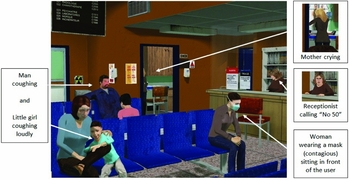
In order to answer these questions, we are now conducting a pilot study to test the feasibility and the efficacy of an innovative CBT (including cognitive restructuring and in virtuo exposure sessions) in treating older adults suffering from health anxiety, a clinical manifestation of GAD that affects up to 10% of elders (Snyder and Stanley, Reference Snyder, Stanley, Asmundson, Taylor and Cox2001; El-Gabalawy et al., Reference El-Gabalawy, Mackenzie, Thibodeau, Asmundson and Sareen2013). Health anxiety is characterized by excessive fear to suffer from a serious illness triggered by internal (e.g. stomach making strange gurgling sounds, increased heart rate, etc.) or external stimuli (e.g. be in contact with a sick person, witnessing injury, etc.) (Salkovskis and Warwick, Reference Salkovskis, Warwick, Asmundson, Taylor and Cox2001; Barsky and Ahern, Reference Barsky and Ahern2004). In the first part of this study, participants aged between 18 years and 35 years will be compared to older adults (aged 65 years and over) on their reactions (i.e. illusion of non-mediation, telepresence, and unwanted side effects) to a virtual environment replicating a hospital waiting room (see Figure 1). In particular, participants [four groups divided by age (18–35 years vs. 65 years+) and the presence of health anxiety (yes vs. no)] will be sitting in a virtual waiting room where they will be confronted to several uncertain situations associated with illness (e.g. a man who coughs louder, a lady who wears a surgical mask, a mother who cries, etc.). In the second part of our study, we will test the efficacy of a new eight-week CBT using the same virtual environment to treat health anxiety in older adults. This CBT will include two main components: cognitive restructuring (i.e. participants will learn to identify and dispute irrational thoughts) and in virtuo exposure (i.e. participants will be confronted to a virtual hospital waiting room and will learn to tolerate the bodily changes/anxiety triggered by stimuli associated with health). All participants will be exposed progressively to the hospital waiting room until habituation is reached. Results from the first part of the study will be used to better tailor the in virtuo exposure sessions to aging. These pilot data will shed new light on how in virtuo exposure can be used to improve the efficacy of a traditional CBT in the treatment of late-life health anxiety.
The virtual environment replicating a hospital waiting room.

In conclusion, recent evidences suggest that in virtuo exposure is efficient to treat “youngˮ veterans with PTSD. However, further investigations are required to generalize these findings to older veterans or civilians with PTSD as well as to other late-life anxiety disorders (e.g. specific phobias and GAD). It will be interesting to compare the efficacy and the cost-effectiveness of in virtuo exposure with traditional exposure techniques (i.e. in vivo and imaginal). With the advancement of technology, virtual environments will become more accessible and less costly for health professionals in the near future. Therefore, it is significant to assess whether this technology can improve traditional CBTs available for older people suffering from anxiety, especially those with inaccessible, intangible or uncontrollable fears.
Conflict of interest
None.
Description of authors’ roles
Sébastien Grenier conducted the review of the literature and wrote the manuscript. Hélène Forget, Stéphane Bouchard, Sébastien Isere, Sylvie Belleville, and Olivier Potvin revised the manuscript and contributed to its content. Marie-Ève Rioux and Mélissa Talbot helped the first author to conduct the review of the literature.
Acknowledgments
This study was supported by a grant from the Réseau québécois de recherche sur le vieillissement (RQRV). The authors would like to thank Fethia Benyebdri, PhD, and a research professional in Dr. Grenier's laboratory, who made the last revision of the manuscript.