Ennyn Durin Aran Moria. Pedo Mellon a Minno. Im Narvi hain echant. Celebrimbor o Eregion teithant i thiw hin.
The inscription upon the archivolt of the Doors of Durin, from The Fellowship of the Ring (1954)
‘You're saying it wrong,’ Harry heard Hermione snap. ‘It's Wing-gar-dium Levi-o-sa, make the “gar” nice and long.’
Hermione corrects Harry Potter's spell,
from Harry Potter and the Sorcerer's Stone (1998)
‘METATRON, MELEKH, BEROTH, NOTH, VENIBBETH, MACH, and all ye, I conjure thee, O Figure of wax, by the Living God, that by the virtue of these Characters and words, thou render me invisible, wherever I may bear thee with me. Amen.’
Invocation of invisibility, from The Key of Solomon (14th or 15th Century)
99% of students see improved writing grades.
Advertisement for Grammarly Premium (2019)
Introduction
A student hovers over red-underlined text, clicks a button, and watches her errant writing replaced. The red line disappears. She continues typing, pausing to address the flagged words and phrases. When she stops typing, what appears before her is spotless – its errors coded out of existence by a modern grammar checker. Her teacher may never become aware of the artificial intelligence that has augmented her writing production. She submits her paper.
Students’ technological abilities to produce mechanically sound Standard English have been drastically improved in the last decade due to improvements in artificial intelligence neural networks. Programs offering grammar editing, such as Grammarly (2019), tout their usefulness for students, indicating that they are likely to receive higher grades when using the program. This application of technology is often uncritically assumed as good – better grammar, higher grades, and increased access to educational capital. Indeed, it would be a stretch to argue that any of these is negative in its own right.
Yet there is also a dark side to AI grammar checkers. Underscored by red, the scarlet-fringed letters connote wrongdoing, error, and transgression. Machines appear to be mathematical, objective; they seem value-neutral to a fault. But this is an oversimplification. Obscured are the creators – the individuals who had codified certain linguistic norms into the algorithm, who determined which linguistic practices would be blemished by scarlet and which would not.
Artificial intelligence grammar-checking algorithms are ‘taught’ by a large corpus of data through a process known as Machine Learning. Individuals teaching these algorithms make decisions about what language practices are coded as ‘right’ or ‘wrong,’ what is included in the training data and what is not. One writer has described this new self-coding as a shift from manually programming computers to training them, ‘like parents or dog trainers’ (Tanz, Reference Tanz2016, para. 11). Having learned grammar structures and other mechanics, the AI algorithm deploys what it has learned on user-generated text (ibid.). That is, it flags – with red – language practices that appear to not match correct use.
One of the most popular grammar checking algorithms today, Grammarly, corrects for three English varieties: American English, British English, and Australian English. The inclusion of these varieties indicates the exclusion of others (over one hundred other English varieties such as South African English, New Zealand English, etc.). Enticed by the promise of better grades and therefore access to the social mobility promised by success in higher education, individuals use automated grammar checkers to conform to one of just three Standard English varieties. And those language varieties not taught to the machine appear as errors to be fixed.
This article seeks to provide new ways to think about Standard English, its scholastic automation through AI, and how it is a proxy for institutional power. To pursue these grounding concerns, this paper will explore a perhaps unexpected avenue: magic. To better ascertain the relevance of magic, consider Johann Wolfgang von Goethe's The Sorcerer's Apprentice (1797).Footnote 1 In the poem, the titular sorcerer's apprentice casts an incantation upon a broom, animating it into a servant. But as the magic grows too powerful, the sorcerer's apprentice tries to stop the runaway broom. He has, however, forgotten the words. He curses to himself: ‘I forgot the charm; what pity! / Now my words are empty’ (Goethe, Reference Goethe1797). Without the right incantation, the sorcerer's apprentice is rendered powerless. When the elder sorcerer returns, it is he who speaks and stops the rampaging broom: Words are the key to power.
Like Goethe's recalcitrant broom, artificial intelligence grammar checkers are a potent medley of control, automation, and language. They normalize Standard English by proffering another means whereby an outsider not proficient in Standard English can get access. A person can, with the help of artificial intelligence, deploy the right words to acquire the spoils of higher education, which are hidden within ‘magically’ sealed chambers.
It is no surprise that individuals seeking desirable careers need to master certain linguistic practices, receive particular degrees or certifications, and demonstrate proficiency on any number of metrics that measure their ability to communicate in Standard English. One need only point to an elementary spelling or grammar test for proof of its importance, for even in childhood is Standard English used to judge and sort students in schools. What may be missed, however, is an understanding of why spelling and grammar have remained such critical gatekeepers to higher education.
In short – and what this paper will further develop – standardized spelling and grammar are magic. No metaphor, no analogy. Standardized spelling and grammar are the culminating embodiment of magic language, the unseen metaphysic that imbues certain words and phrases (in highly specific orders) with a power beyond human explanation. For there is no reason that Standard English is the gatekeeper to higher learning, save the magic that society continues to imbue into its words and grammar.
A brief review of spelling
From the Latin word grammatica came the derivative English words of ‘grammar’ (i.e., language rules), ‘grimoire’ (i.e., a book of magic spells), and ‘glamour’ (i.e., enchantment, magic) (Crystal, Reference Crystal2017). The etymology is revealing. Since early English history, the word ‘grammar’ has covered more than syntax and mechanics; it once represented the fundamental corpus of learning and knowledge (Clark, Reference Clark2010; Reid, Reference Reid1949). A vestige of that linguistic usage remains in the term ‘grammar schools’ today. With their weighty tomes, scholarly monks were mysterious to illiterate commoners.Footnote 2 Their grammar books, filled with inscrutable alphabets and foreign tongues (e.g., Latin), appeared to commoners’ eyes as spellbooks of esoteric and occult magic. In fact, people who wanted to pose as wizards would often stock their chambers with similar-looking books to appear magically powerful (Davies, Reference Davies2010) Consequently, Latin grammatica became ‘grammar’ to the learned and ‘grimoire’ or ‘glamour’ to the common folk. As for magic ‘spells,’ one needs to look no further than ‘spelling,’ both etymologically derived from the same Germanic stem (OED Online, 2020).
Suffice to say there is a complex relationship between language and magic, nor is it limited to English. One of the earliest recorded instances of language-magic entanglement is in Middle Age Hebrew incantations used to summon golems (Covino, Reference Covino1996). A golem (a clay figure brought to life by magic) could reputedly be animated into existence by a Rabbi – from a peripheral Jewish community – rigidly following a religious ritual revealed to him ostensibly by God. To conduct the ritual, the Rabbi would recite thousands of precise letter combinations, some taking upwards of 35 hours (Kaplan, Reference Kaplan1996). Once finished, he would affix a written word – emet (‘truth’) – upon the golem's forehead, which would keep the anthropoid alive (Covino, Reference Covino1996). The ritual derived its reputed power from the precise use of language. Indeed, one small mispronunciation was thought to not only result in a failed golem but also in the horrible transfiguration of the Rabbi who attempted to summon it (Scholem, Reference Scholem and Manheim1961). Consequently, the Rabbi's continued life and social status ostensibly depended upon his mastery of the grammatical order of the incantation (cf. Covino, Reference Covino1996).
Golems, like Goethe's enchanted broom, were summoned by words believed to access magical power. The use of spells and incantations suggests a belief in a power source (or deity) that can be harnessed or summoned through language. Magic words seem to be fundamentally connected to man's relationship with the natural world; they are thought to be linked to an otherworldly power accessible only when magic language is uttered in the right order, in the right place, and at the right time (Malinowski, Reference Malinowski1935/2001). Emerging from these many threads are themes of social power (i.e., the Rabbi as magic practitioner), logocentric ontology (i.e., specific words offer access to a greater power), and thus linguistic prescriptivism (i.e., if words have power, then those words should be preserved).
In Ancient Greece, magic practitioners would write specific, formulaic ‘binding spells’ onto ostraca (potsherds on which people would write) or gold (both parchment and jewelry) as advised by arcane documents such as the Greek magical papyri (Cartwright, Reference Cartwright2016; Collins, Reference Collins2008; Jarus, Reference Jarus2015). Serbian archaeologists recently found 2,000-year-old skeletal remains buried with lead amulets. The amulets encased binding spells engraved onto rolls of gold and silver parchment (Reuters, 2016). These examples suggest a linguistic core to magic: certain words in particular arrangements are believed to invoke supernatural power.
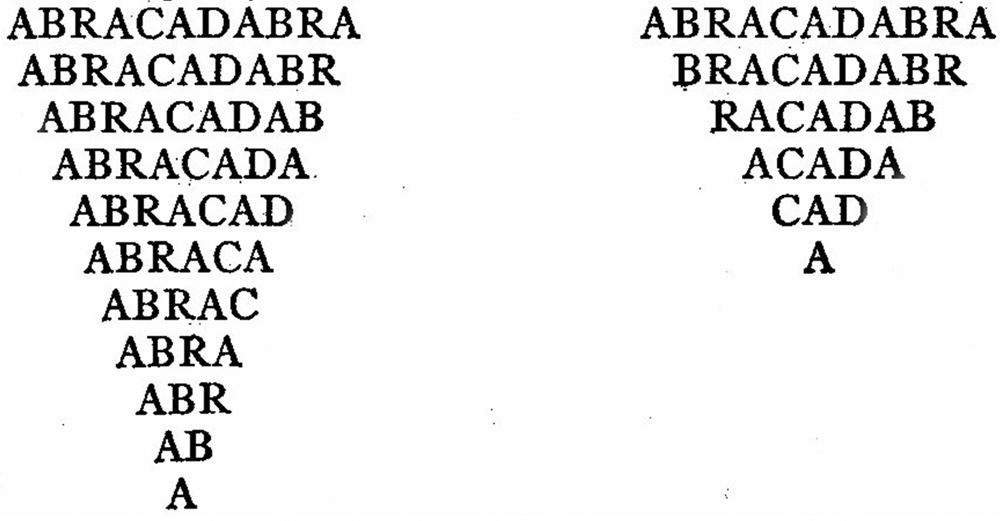
The history of ancient magic is far more expansive than suggested above but suffice to say that language's relationship with magic is by no means a recent phenomenon. Moving into the Common Era, one charm – recorded in the third-century Liber Medicinalis by Quintus Serenus Sammonicus (physician to Roman emperor Caracalla) – was emblazoned with the word ‘ABRACADABRA’ in a triangular design (see Figure 1). The charm was believed to magically ward off diseases such as malaria (Shah, Reference Shah2010). Writing about the bubonic plague, novelist Daniel Defoe (Reference Defoe1722) explained that, just 300 years ago, Londoners placed this triangular amulet upon their doorways to ward off sickness.
Design for an Abracadabra charm (public domain, courtesy of the Encylopedia Brittanica)

Magical words were not just engraved onto ornamental charms, but they were also chanted orally. By the seventh century, some Anglo–Saxon spoken charms explicitly invoked the two (i.e., magic and language) together. For example, a part of one charm reads, ‘I chant a charm of victory, I bear a rod of victory. Word-victory, work-victory’ (Gordon, Reference Gordon1957: 91). That is, chanting the word ‘victory’ was thought to magically manifest ‘victory’ in the real world.
Dating from the 14th or 15th century, the magical enchiridion The Key of Solomon provides an example of traditional Renaissance magic. In a spell to invoke invisibility, practitioners were told to make a small wax figure and then recite a specific incantation. Magicians, addressing the ‘Living God,’ commanded the wax to ‘render [them] invisible.’ The origin of this magic was considered to be outside of the casters themselves. Magic was believed to be a borrowed power, one harnessed with linguistic commands, and granted only to those with the specific knowledge of rite and ritual necessary to invoke the magic.
More recently, researchers have classified magic language as its own category of communication (Thon, Reference Thon2012). Expanding the work of Malinowski (1935/Reference Malinowski2001), Duncan (1962/Reference Duncan2017) wrote that the formulaic nature of magic makes it distinct from, for example, a conversation that might occur around a hearth. The spells of a magician are often performative – they have a distinct tenor, pitch, and singsong nature, suggesting a formulaic structure and style. This all said, and while there are numerous groups that still practice magic today, formal educational institutions like schools and universities dismiss magic as superstition. Certainly, we in academia do not expect students to perform language (like shaman casting magic spells) in a precise, ritualistic, and performative way – indeed not in Times New Roman, font size 12, and with one-inch margins.
Magic words: Shibboleths to power
Max Weber declared modern society ‘disenchanted’ in Reference Weber and Livingstone1917. Using the German word Entzauberung (literally ‘de-magic-ation’), Weber wrote that people were becoming less mystical and more rational (Szelényi, Reference Szelényi2014). For many academics, the supernatural had been disproved empirically, and science was primed to explain all the mysteries of the world (Jenkins, Reference Jenkins2000). In the 20th century, a belief in magic came to signify ignorance to many of the educated elite. Magic and miracle have been all but erased from state-run academic institutions.
In the West, the institutionalized form of magic/miracle is stage magic, such as that performed by the likes of Harry Houdini and David Copperfield. On the stage, magic retains its performativity, as magicians toy with notions of cause-and-effect. A magician drops a ball into a hat, says a magic word, and then pulls out a live rabbit to the delight of the crowd. Perhaps the most familiar magic word was derived from Serenus's magical triangular amulet: abracadabra. Words like abracadabra, presto change-o, and hocus pocus all share the same function. These words signal that the magician has performed his magic; they are the means by which he tells the audience that the trick is his doing.
By uttering magic words during an illusion, the stage magician and audience share a common understanding of what these words imply. That is, the magic words indicate to the viewer that the magician is the one responsible for the dissociation between cause and effect that occurs in a magic trick. If a man were to approach passersby on the street and pull a rabbit from his hat, they might think his behavior bizarre; if the same man were to utter abracadabra as he did so, however, then he might be assumed to be a magician. The magician performs a trick with a magic word to signify his power and his role.
The language of stage magic is functionally similar to magic words engraved upon amulets and recorded in grimoires. In both cases, magic words have a social function. Drawing from the work of O'Keefe (Reference O'Keefe1983) and Covino (Reference Covino1994), magic is a social process in which both spellcaster and ordinary person share cultural assumptions about language and power. That is, language is the means by which a magician both ‘accesses’ power and signals to the onlooker that such power is being harnessed. When the shaman chants his invocation to exorcise spirits, his client tacitly accepts a social contract in which the shaman's language has the ability to effect change in the natural world; in a similar vein, the pendants engraved with ABRACADABRA and draped over doorways signify a social understanding in which a nonmagical object is thought to be imbued with magical properties by virtue of a linguistic inscription.
Magic words function, therefore, to give this assumed power. Historically, magic words were often the purview of only a few scholars who could read esoteric grimoires. Many spells were not written in the vernacular but rather in foreign tongues like Hebrew or Latin. Practitioners had to be highly educated and trained. Consequently, magic language was intricately linked to social class. To me, limited access to magic/miraculous language (or, indeed, any type of guarded, reputedly powerful language) allows class striations to be further reified.
The word ‘shibboleth’ is often used to denote linguistic phrases or pronunciation that certifies an individual as a member of a certain group (and excludes others). I argue that magic language, too, is a shibboleth. Specifically, it is the shibboleth limiting access to power. It is the ability to deploy language in a way that (despite a word's arbitrary nature) signals power and prestige through a sociocultural process in which particular linguistic practices are privileged over others. Grammar is the magic language of power, the mechanics of control, the syntax of the social shibboleth. It is ubiquitous, and society at large is complicit in its enchantment. Magic is not the stuff that dreams are made of; it is the language that gradates social class.
Scholars like Deleuze and Guattari (Reference Deleuze and Guattari1988) have considered how magic and social class are linked. The authors argued that sorcerers were countercultural operatives. A matriarchal society would find its sorcerers in men, for instance. However, dominant cultural groups have just as often had their own individuals using words of power: religious figures whose rites, rituals, and prayers used language to perform miracles. In short, magic language has been employed by various cultural groups, not favoring either the establishment or the insurgent. Magic has been the enactment of power through language that reified the shibboleth to access the power of upper social class.
Perhaps one of the biggest changes resulting from the scientific revolution was the diminution of magical praxis. Yet in this disenchanted society that has reputedly disabused its institutions of magic, magic remains forcefully alive, especially in popular culture. From J. R. R. Tolkien's The Lord of the Rings series (1954–1955) to J. K. Rowling's Harry Potter series (Reference Rowling1997–2007), magic appears with surprising frequency across various media. Magic is an integral feature of the tabletop game Dungeons and Dragons, for instance, and it is a primary mechanic of video games such as the Final Fantasy series (1987–2019). It pervades television in shows like American Horror Story: Coven (Reference Gomez–Rejon, Rymer, Uppendahl, Podeswa, Bueker and Deutch2013) and The Magicians (Reference Clark2015–2020). Magic continues to captivate a modern audience – long after the praxis of magic was debunked by scientific empiricism.
As aforementioned, magic language is primarily about access: the power to access. In Tolkien's The Fellowship of the Ring (Reference Tolkien1954), for example, the adventuring protagonists attempt to enter the subterranean Mines of Moria but are stopped by magically sealed doors inscribed with ancient words:
‘The words are in the elven-tongue of the West of Middle-earth in the Elder Days,’ answered Gandalf. ‘But they do not say anything of importance to us. They say only: The Doors of Durin, Lord of Moria. Speak, friend, and enter . . . ’
‘What does it mean by speak, friend, and enter?’ asked Merry.
‘That is plain enough,’ said Gimli. ‘If you are a friend, speak the password, and the doors will open, and you can enter.’ (Tolkien, Reference Tolkien1945: 336)
Much like language in arcane grimoires, the language that magically unseals Tolkien's doorway is unfamiliar to the group, and even Gandalf – the erudite wizard – is unable to open it despite repeated attempts to incant the correct magical words. Magical power, however, is intricately linked with grammar. The key to the door's seal proves to be Gandalf's faulty grammatical translation of the inscription: the difference between ‘speak, friend’ (i.e., an invitation to say a password) and ‘speak ‘friend’’ (i.e., literally speak the word ‘friend’ in the elven-tongue). Magic language is indeed pedantically precise.
So, too, is academic grammar. Like Gandalf, many students have been frustrated by comma placement. Grammatical pedants share cautionary (i.e., humorous) examples of what havoc errant grammar might wreak. In one pithy grammar joke, the prescriptivist grammarian distinguishes between ‘Let's eat, Grandma’ as a convivial invitation for a meal and ‘Let's eat Grandma’ as the advent of cannibalistic tendencies (see, for example, Adams, Reference Adams2017; Bowal, Reference Bowal2014). Another grammar joke involves a panda that pulls out and fires a handgun after dining at a restaurant, culminating in the punchline of a waiter reading in a wildlife manual that the bear ‘eats, shoots and leaves’ (Truss, Reference Truss2004). The jests are innocuous, but they represent a broad essentialism in academic grammar that accords with similar rules and particularities of word magic. Indeed, colleges and universities often require prospective students to demonstrate grammatical mastery in English sections on exams such as the SAT and ACT – arguably analogous to requiring high school students to prove their proficiency in magical incantations before entering college.
Language, whether spellcasting or scholastic pedantry, is largely about power and control – it is not solely, as the oft-spouted claim contends, just so people can better understand one another. Linguistic prescriptivism is a means by which a dominant group's particular language practices are normalized. Consider, for example, the first European vernacular grammar book, which was created purely for political purposes (Sanders & Illich, Reference Sanders and Illich1988). In 1492, just two weeks after Columbus had set sail on his voyage to what Europeans would call the new world, Spaniard Elio Antonio de Nebrija published the Gramática Castellana. In the book, Nebrija petitioned Queen Isabella to formalize the written Spanish of the state by adopting his prescribed set of rules. One of his arguments for standardization was to stymie the unbridled reading of vernacular texts. In other words, Nebrija exhorted the queen to standardize language so that books in the vulgar patois could be better controlled. Sanders and Illich (Reference Sanders and Illich1988) contended, ‘By this monopoly over an official and taught language, he proposes to suppress wild, untaught vernacular reading’ (p. 77). The Crown could thus exercise greater control over its constituents by codifying grammar.
Similar prescriptivist tracts exist today. In the United Kingdom, for instance, the Lord Chancellor and Secretary of State for Justice Michael Gove insisted in a 2015 memo that clerks abide by his grammatical rules such as never starting a sentence with ‘However’ (Leftly, Reference Leftly2015). Then, in 2019, the UK's Leader of the House of Commons, Jacob Rees–Mogg, issued his own grammar and style guidelines for his staff (Hughes, Reference Hughes2019). Among peccadilloes such as using two spaces after a period, Rees–Mogg required that his office use imperial units for measurement and that the suffix Esq be attached to any non-titled male. These linguistic imperatives from political leaders echo Nebrija's Gramática Castellana's prescriptivism, grammar rules seemingly deployed to standardize particular linguistic choices. In response to Gove's 2015 memorandum, UK linguist David Crystal (Reference Crystal2017) wrote of his concerns for school children ‘who – influenced by the style of their favourite authors – will one day start a sentence with However and find themselves at the mercy of a cadre of examiners who would automatically mark it wrong in a national test’ (p. 235). Certainly, obeisance to this grammatical prescriptivism to use precisely the right words in the correct way, enforced by a disinterested third party, appears broadly in the schooling of the modern student – and, for that matter, at Hogwarts.
Schools of magic
Contemporary media depictions of occult magical education often occur in specialized schools of magic of which Hogwarts (from the Harry Potter series) is perhaps the most well known. But Hogwarts is just one of a much larger collective of magic schools: Unseen University (from Discworld, book series), the Magic School (from Charmed, television series), Luna Nova Magical Academy (from Little Witch Academia, anime), Miss Robichaux's Academy for Exceptional Young Ladies (from American Horror Story: Coven, television series), the College of Winterhold (from The Elder Scrolls: Skyrim, video game), Brakebills College (from The Magicians, book [Grossman, Reference Grossman2009] and television series), among many others. Underscoring the proliferation of magic schools is the belief that magic language can be institutionalized. In these worlds, magic is a curricular subject packaged and taught to students.
These fictional schools of magic emerge from a tradition of institutionalized education that was itself largely a product of print literacy and actively antagonistic to magic (although legends do make a note of certain small schools of magic predating the printing pressFootnote 3). When print literacy expanded, grimoires lost their esoteric mysticism. As magic/miracle fell out of the hands of elite practitioners (e.g., some priests) and was instead picked up by commoners, a third party began to educate the masses about the illusion of magic: schools. For example, an 1895 elementary textbook warned schoolchildren to not believe in witches or amulets (Weber, Reference Weber1976). Schools and schoolbooks actively sought to disprove magic to students. This was not an isolated occurrence, but rather seemed to be a coordinated effort by church and school to dispel superstition. Weber (Reference Weber1976) wrote, ‘The scorn that teachers showed for rustic superstitions was often shared by priests, who were increasingly reluctant to take part in magic rites decried by the official culture’ (p. 379). The assault on magic by pedagogy is perhaps most pronounced in eFreire's (Reference Freire1970) criticism of ‘magical consciousness’ (a mindset that accepts, without question, traditional knowledge). In favor of empirical science, the practice of occult magic/miracle has been dropped in formal, academic institutions. However, linguistic magic (as a grammar) continues to appear in Western education.
Consider Foucault's (Reference Foucault1975) examination of the historical development of the modern penal system in France. He argued that discipline – once acted upon the body as torture or execution in public – had become gradually institutionalized. Rather than through torture enacted on the body, discipline was newly enacted by means of ‘an explicit, coded and formally egalitarian juridical framework’ (p. 222) that allowed the bourgeoisie to maintain its dominant social standing. Like the prison system, modern schooling has institutional methods for perpetuating social status. This was in part accomplished through the normatization of linguistic magic within academic discourse. The process of indoctrination, however, begins even before formal schooling when children are taught the alphabet.
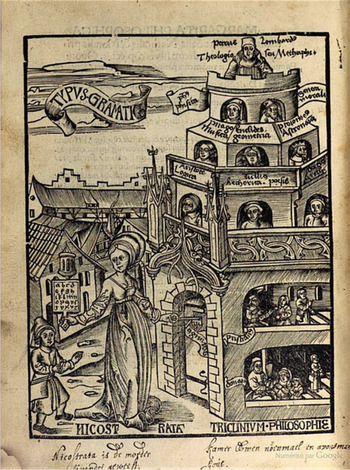
The Latin alphabet is a series of 26 phonemic letters that are combined with one another to create sounds and meaning. An alphabet is a means whereby experience can be codified and shared. From their earliest years, children are surrounded by the alphabet – even before entering into formal education. Positioning a mastery of the alphabet as an entry requirement to learning is a long-standing tradition (cf. Crain, Reference Crain2000). A 1504 encyclopedia for young students depicts Nicostrata – the Roman goddess said to have invented the alphabet – holding up a hornbook imprinted with the alphabet in one hand and a key in the other at the doorway to a temple of scholarship and learning (see Figure 2).
Nicostrata (Carmenta) holds a hornbook inscribed with the alphabet in one hand and a key in her other, showing the way for youth to enter the tower of knowledge (Reisch, Reference Reisch1504)

The premise of the illustration is familiar: If a student intends to learn academically, then the student needs to be able to communicate through the written word. Notice, however, that although on one hand Nicostrata seems to show the young scholar the way into the tower of knowledge, on the other hand she also blocks access for those who have not mastered the prerequisite alphabet. Notably, the Greek Nicostrata was renamed ‘Carmenta’ upon her arrival to Italy, the new name derived from carmen, the Latin word meaning ‘magic spell,’ which serves as the root for the English magical ‘charm.’
This paper earlier discussed how occult magic was to be recited (or inscribed) in a precise way as directed by tradition or grimoire (see also Covino, Reference Covino1994). Spells were performances conducted in particular ways, requiring the spellcaster to not only say the words but also to do so in a ritualistic manner (see, for example, Malinowski, 1935/Reference Malinowski2001). The precursor to formal education – alphabetization – similarly follows an arbitrary but immutable structure. The alphabet is arranged, of course, in A, B, C order; to memorize the alphabet is to memorize its arbitrary sequence, despite the fact that the order of letters in the alphabet is altogether inconsequential. Just as magic spells would be recited in a certain way, so too must the alphabet be recited in a particular order.
Indeed, the alphabet is, in one regard, a magical incantation. In children's learning material, letters can seem to have otherworldly power. They are frequently anthropomorphic (e.g., the depiction of lowercase letters as children and uppercase letters as adults in the book Chicka Chicka Boom Boom [Martin & Achambault, Reference Martin and Archambault1989]) and can assume the characteristics or shape of various other objects (for a detailed discussion on the alphabet and its depictions in various children's primers, see Crain, Reference Crain2000). But letters are inherently abstract and meaningless on their own. The alphabet, often illustrated in human and object forms, is nevertheless regarded as if it is a real ‘thing.’ And, like magic, the alphabet can indeed conjure anything.
The means by which many young children learn to recite the alphabet is also highly analogous to some practices in spellcasting. The alphabet song (Bradlee, Reference Bradlee1835) is seemingly ubiquitous in children's alphabetization in the United States. Young children, with guidance from a learned adult, perform the song in its precise cadence and rhythm, acquiescing to the demands of order and enunciation inherent to the song. In fact, those who deviate from the original song or change its melody are harshly castigated as pariahs. In a 2019 video, a singer – who in interviews elected to only go by Matt for his personal safety – performed the alphabet song in a way that intentionally slowed down the enunciation of the letters L M N O P (Garcia–Navarro, Reference Garcia–Navarro2019). His inbox was flooded with hate mail, including messages that called his slower rendition ‘sacrilege.’ Matt explained that the video had been meant to help students with special needs or English language learners learn the alphabet. Those who had mastered the ABC incantation, however, defiantly protected its traditional form, regardless of its own arbitrary nature. This anecdote is reminiscent of the accounts of the exactitude required also at fictional schools of magic, particularly in the world of Harry Potter. In Harry Potter and the Sorcerer's Stone, for instance, Hermione pedantically chides Harry about his pronunciation: ‘“You're saying it wrong,’ Harry heard Hermione snap. “It's Wing-gar-dium Levi-o-sa, make the ‘gar’ nice and long”’ (Rowling, Reference Rowling1997: 127). Learning the alphabet song is, in essence, the practice of mastering a spell: the precise, invariable recitation of a series of particular utterances, much like that of a Rabbi painstakingly summoning a golem – thankfully, for parents, the alphabet song does not take 35 hours to recite nor result in bodily transmogrification if misspoken.
With alphabetization (which itself behaves magically) as its cornerstone, institutional schooling is an ideal medium for the magic language of Standard English. From the rudimentary alphabet, schooling issues further linguistic prescriptive imperatives – certain language practices are rewarded in schools (with grades) while others are punished (Heath, Reference Heath1983). Performance of the right words on assignments serves as an indication of arbitrary – yet required – linguistic mastery. When the power of occult magic (and religious miracle) waned during the growth of literacy, the form of magic may have changed lexically, but the existence of linguistic magic seems to be fundamental to human sociality itself.
For all the dismissive, pejorative discourse surrounding magic, I believe there are few other social acts as ubiquitous across all known cultures – throughout time – as the practice of language-based magic in one form or another. Yet the modern zeitgeist of ‘disenchantment’ (Weber, Reference Weber and Livingstone1917) is so determined to distance itself from a primitive ‘magical consciousness’ (Freire, Reference Freire1970) that it has derogated a foundational social practice: language that functions as if it had magic power as a fundamental component of perhaps all human cultures. So blinded, we have established academic institutions that reify linguistic magic in the guises of ‘proper grammar,’ ‘usage and mechanics,’ and ‘style.’ Heidegger (Reference Heidegger1971) once wrote: ‘Man acts as though he were the shaper and master of language, while in fact language remains the master of man’ (p. 215). Linguistic magic has not been dispelled by modernity, only concealed by it. It continues to work as the means whereby access to power is sealed behind magic words.
In comparison, modern human societies also tend to dismiss the relevance of mythology. But as Campbell (Reference Campbell1988) argued, if it were not for the enduring power of myth in society, then legal magistrates would not continue to don the black robes of their judicial positions. Obfuscated by the logic and reason of law, the mythic and magical aspects that undergird our social practices are often overlooked. Linguistic magic (as a grammatical component of institutionally preferred language) has likewise been disregarded. In our modern arrogance, many have haughtily disavowed the magic spell as primitive and then institutionalized it in the classroom instead.
The code of the magician
In the story of Ali Baba and the Forty Thieves (Galland, Reference Galland1717), the titular character Ali Baba overhears thieves discussing where they have hidden their treasure, deep in a cave sealed by the magical passphrase ‘open sesame.’ Ali Baba's envious brother Cassim soon learns the passcode from Ali Baba and descends into the cave himself to steal the treasure. The 40 thieves learn of Cassim's intentions and chase him through the cave. Then, having evaded the murderous thieves thus far, Cassim approaches the exit at the mouth of the cave. But Cassim, like Goethe's sorcerer's apprentice, has forgotten the magic words. He is unable to unseal the cave and is killed by the irate thieves.
Ali Baba and the Forty Thieves is a stark tale depicting the special access given by magic language, like Gandalf experienced at the Mines of Moria. The children's television show Sesame Street (1969–2020), which derived its name from the magical passphrase ‘open sesame,’ may seem to be an altogether different case, but it shares in common an intrinsic belief in linguistic magic. The show features a cast of puppets, human actors, and animated characters who aim to teach young viewers about letters, numbers, and other social skills (Berson, Reference Berson1970). In one recurring segment, children are taught a letter of the alphabet. But in the first episode of Sesame Street (Children's Television Workshop, 1969), the series did not start with the letter A. Instead, forgoing alphabetical order, Sesame Street's Episode 001 began with the letter W – W for Wanda the Witch. Paired with the embedded allusion to Ali Baba and the Forty Thieves in the ‘Sesame’ Street title, the intentionality behind piloting the show with one of the least common letters in the alphabet becomes clear: the showrunners made linguistic magic abundantly apparent. Sesame Street, which to this day remains one of the most influential educational programs on television, fused elements of occult word magic (i.e., ‘open sesame’ and witchcraft) with early childhood language learning – it refined occult magic into the magical language of modern schooling.
This belief in linguistic magic (i.e., that certain words and phrases are ‘right’ or better than other alternatives) is what underscores many of the arbitrary language rules that artificial intelligence grammar checkers assist students with. Computer scientists training the newest Natural Language Processing (NLP) artificial intelligence frameworks have aptly named their programs. Google's training model was dubbed BERT, and Baidu's class-leading NLP framework was separately called ERNIE – both characters from Sesame Street. The programs that will emerge from new NLP models with linguistic magic as their core, such as grammar checkers, have the ability to further reify language practices as ‘right’ or ‘wrong,’ ‘good’ or ‘bad.’
Without a deeper understanding of the continuing presence of linguistic magic in education, students may continue to be mesmerized by the glamour of standardized languages. Magic may be treated by academic institutions today as superstition, but its homologous form remains in the grammatical way that specific language use expresses the exclusivity of social power at a certain time and place. This linguistic magic is reified in schools, which grade students according to their mastery of this arbitrary grammar. And with the advent of automated grammar checking attuned only to specific linguistic varieties, perhaps it is fitting that society may soon come full circle to a linguistic obeisance to a higher power – in this case, the unquestionable machine. For if ‘any sufficiently advanced technology is indistinguishable from magic’ (Clarke, Reference Clarke1973/2013), then what else have we done but summon our own linguistic golems, programmed as it were by line after line of precise grammatical conventions arbitrarily dubbed as correct?
Considering the homology between magic spells and Standard English use in schools, educational institutions should look anew at the magical privilege some students may already have even before entering the ivory tower. Standard English is not the only way – or, for that matter, even the ‘best’ way – to express academic thought. One method for academic institutions to challenge the magic of Standard English may be to remove, as admissions requirements, exams that test prospective students’ standardized usage and mechanics. However, suggestions such as this are likely to raise questions about what standards might then be used to admit new students. This requires additional research and study beyond the scope of this article, but I suggest that many alternatives are better than magic.
 JASON TONCIC is a Ph.D. Candidate at Montclair State University researching new literacies, the application of artificial intelligence to writing, and critical interpretations of Standard English in schools. Email: jasonctoncic@gmail.com