In my experience, the topics people study tend to be those that touch some deep personal value of the individual. That is true for me regarding accountability. And the dynamics of accountability—the topic to which I have devoted much of my attention over the years—encompass both theoretical richness and practical challenges. I love talking about accountability and responsiveness because these are the values in which I believe. Why? Because accountability is based on fairness, integrity, doing what is right, and regard for others. Because it is fundamental to how people and organizations operate.
I thank the John Gaus Award Committee and the APSA for this honor. Recognition by my peers is the highest honor and a judgment that I value. My excitement for receiving this award also comes from the unique opportunity that crafting this talk has granted me to take a step back and consider the recent past, current events, and prospects of the future of accountability.
I am sure that if I asked you, we could hear some amazing stories of how each of us became academics; how we arrived upon our research; how we discovered our intellectual passions. What I have always liked about public administration was the emphasis on the link between theory and practice. It is the aspect of public administration that intrigues and stimulates me most.
Government is an essential institution. And I am driven by a desire to always want to know more and more about how it works today and how it can work better tomorrow. Call me a realistic optimist. I can see the flaws, but I think it is essential to see the good government does every day. So here I am, a believer in government as an institution—committed to good government that plays a positive role in society. This makes me both a “throwback” to earlier days, and someone who sees through the dysfunction of government today. I recognize this puts me at odds with the followers of Ayn Rand, but I am not a Pollyanna. I am aware of the limits of government. And I am aware of our ability to design institutions that can make the most of human nature and our academic insights.
ACCOUNTABILITY
What first interested me in accountability was a puzzling example of the cross pressures of public service that I observed while a junior scholar at the University of Kansas. I remember learning of a city administrator who received an award from the regional ASPA chapter at one of their luncheons. That evening at the city commission meeting, the same manager was fired. My initial question was: “What on earth is going on?” How could someone so quickly fall from grace? Of course, the answer is that he had multiple stakeholders and could not please them all. This exemplifies the great tangled web of accountability.
I welcome the opportunity this award has given me to share with you my passion about the subject of accountability. There are three dimensions to understand the past, present, and future of accountability: (1) Hot Rhetoric—the use of accountability as a rhetorical weapon; (2) Cool Theory—a dispassionate look at accountability; and (3) Uneven Practice—the challenges of getting theory into practice, and getting it right.
Hot Rhetoric
Over the years, the word “accountability” has become a rhetorical touchstone for anyone seeking to score political points. The media are saturated with calls for increased accountability. We see, hear, and read inflamed rhetoric often calling for poorly reasoned knee-jerk reactions and short-sighted solutions. It evokes the image of the Red Queen in Alice and Wonderland. Our ”Hot Rhetoric” is comparable to the Queen’s hair-trigger response: a cry of, “Off with their heads!” In short, political rhetoric these days often invokes accountability as a bludgeon— a tool to attack someone, or some organization, that is not meeting the critics’ expectations.
In the arena of public rhetoric, we often narrow the focus to failures of accountability, reflected in calls for answerability or outcries regarding a scandal or crisis. When was the last time you heard accountability in the media used in a positive way? Accountability has come to be a multipurpose phrase that is “unimpeachable” motivation as a basis for criticizing someone else. “I’m just seeking accountability,” is a phrase used in a rhetorical sense as a rationale for any criticism. Let us review a couple of recent examples that illustrate this passionate criticism. Take the recent Veterans Administration scandal: From veteran to villain. Retired four-star General Eric Shinseki went from being a decorated American combat hero to a villain for his role as secretary of the Veterans Administration. He was cursed for denying veterans the services they deserved. Directly echoing our Alice in Wonderland example, calls for Shinseki’s head quickly resonated through the media. Representative Doug Lamborn (R-CO) had this to say:
Heads must roll over this scandal. Secretary Shinseki should use the powers we gave him in the VA Accountability Act to fire hospital directors and others responsible for these failures. Additionally, he should recall bonuses paid out to anyone responsible for secret waiting list hospitals. If the Secretary knew about any of these atrocities, he should resign (emphasis added) (O'Keefe and Lowery Reference O'Keefe and Lowery.2014).
As you can see in the italics, the key words, “Heads must roll,” and “He should resign.” demonstrate this inflamed rhetoric.
Accountability has come to be a multipurpose phrase that is “unimpeachable” motivation as a basis for criticizing someone else. “I’m just seeking accountability,” is a phrase used in a rhetorical sense as a rationale for any criticism.
A few years earlier, recall the outcry after the 2012 Benghazi attack. We heard cries from both the public and Congress asking for firings in response to Hillary Clinton “…not picking up the phone.” During Senate hearings at the start of 2013, then former Secretary of State Hillary Clinton faced tough questions from Senator Rand Paul about her involvement in the response to the attack on the embassy:
I’m glad that you’re accepting responsibility. I think that ultimately with your leaving, you accept the culpability for the worst tragedy since 9/11, and I really mean that. Had I been president at the time and I found that you did not read the cables from Benghazi, you did not read the cables from Ambassador Stevens, I would have relieved you of your post (emphasis added) (Wemple Reference Wemple2013).
In all likelihood, these questions of accountability will persist if and when Clinton runs for president in 2016. And as we will discuss later in the “Cool Theory,” section, political scientists will be eager to see if and how the electorate holds Clinton accountable for her role. As you can see with these “Hot Rhetoric” examples, cries for accountability often take an inflamed, passionate stance, and stretch beyond rationality and logic to score political points.
Cool Theory
For this review, “Cool Theory” encompasses a dispassionate look at accountability as a concept and a dynamic. The literature is too vast to give a thorough review in the space available, but I am delighted to see so much work being done on a subject I consider so fundamental to good government. I know not everyone is as fascinated with accountability as I am. So instead I will offer a brief overview.
First, accountability is a concept relevant to all systems of governance, not just democracies. Second, accountability is a concept that is widely used. Third, accountability means many things to many people.
Several social science fields study accountability, but for this discussion, let us look at the traditions of political science and public administration. With many scholars studying accountability, come many perspectives and permutations of the concept of accountability. But on closer inspection common threads emerge among different scholars. In its simplest sense, accountability is answerability for performance, which, if it is working properly, should result in a reward or a sanction.
Merit reviews, bonuses, awards, campaign donations, and winning elections are examples of the reward cycle of “positive accountability,” yet we do not tend to hear much about positive accountability. Instead, the focus is mostly on negative accountability, for example, sanctions or punishment. The occasional award ceremonies and acclaim always have much shorter news cycles than calls for punishment. We tend to hear more from the “off with your head” crowd.
Political Science Theories and Accountability
Let us examine how political science theories have addressed accountability. Elections are the fundamental accountability relationship in a democracy. And to do accountability you need performance information; accountability without performance information is a hollow concept. But average citizens receive very little information with which to judge the performance of their elected officials. The reality is that most citizen information about elected officials comes from investigative or “attack” journalists. Research has found elections to be fairly blunt mechanisms for elected official accountability (Healy and Malhotra Reference Healy and Malhotra2009). Voters hold members of Congress accountable for positions they take, but not the policy outcomes their actions make possible (Jones Reference Jones2011). Experimental research shows that voters prefer to look at voting behavior as a backward-focused sanction rather than about future-oriented selections (Woon Reference Woon2012). This, again, reflects the negative connotation of accountability.
This is a distressing scenario. What is even more disconcerting is that voters adjust their views of who is responsible for outcomes based on the voters’ partisanship. Success is attributed to the favored party, and voters absolve their favored party of responsibility if performance is poor (Tilley and Hobolt Reference Tilley and Hobolt2011). We see this selective attribution reflected on MSNBC and Fox networks every day. Political science research tells us the accountability of elected officials is problematic (Svolik Reference Svolik2013). Here is the bottom line: Our political system has not done a good job creating effective accountability mechanisms for elected officials.
Public Administration Theories and Accountability
Now, let us turn to the work in public administration on accountability of public officials who are employees. I start with an encapsulated view of my approach to accountability based on decades of my work on different aspects of these dynamics.
First, let us review a few fundamental characteristics. Accountability is answerability to some “authority.” Beyond that, it is a complicated picture. So to understand this dynamic, we ask a few standard questions: Who is accountable to whom? For what are they accountable? How are they held to answer? The answers to these questions reveal a complex dynamic.
(1) We see multiple sources of authority to whom officials must answer. The list is long, including supervisors, elected officials, courts, and citizens, to name a few (Dubnick and Romzek Reference Dubnick and Romzek1993).
(2) Officials typically work under performance expectations that are multiple, diverse, often conflicting, and subject to change. So individuals and organizations are expected to answer to multiple stakeholders for a variety of different performance standards. And the relative priority among various performance expectations can shift. (Romzek and Dubnick Reference Romzek and Dubnick1987, Reference Romzek, Dubnick, Ingraham and Romzek1994)
(3) Regarding the “how?” question, we find many different ways to hold people (or organizations) answerable for their performance. Formal and informal types of accountability can be based on both vertical and horizontal relationships. Formal accountability reflects established reporting mechanisms. Informal accountability dynamics are based on interpersonal relationships.
Formal accountability relationships are those most often subjected to study. Here we see multiple stakeholders, in multiple and overlapping accountability relationships with the answerable party. Individuals face multiple, and often conflicting expectations for performance. In many instances both authority and the accountable party face challenges identifying appropriate performance measures. And, even when reliable performance information is available, implementation of consequences is often uneven.
Informal accountability is based on shared goals and repeated interpersonal interactions (social structures). Interpersonal dynamics give rise to implicit shared norms, discretionary behaviors, unofficial monitoring, and informal rewards and sanctions (Romzek et al. Reference Romzek, LeRoux, Johnston, Kempf and Piatak2014). These informal dynamics occur in nearly all social settings. An example of informal negative accountability is the experience whistleblowers have when they find themselves shunned by their colleagues.
Our political system has not done a good job creating effective accountability mechanisms for elected officials.
Most public officials and all public employees work within a web of several formal and informal accountability relationships. Answering for performance under these accountability arrangements is often time-intensive, costly, and frequently requires trade-offs among disparate reporting relationships (think: city manager).
Accountability is not a puzzle or a formula to be solved. In both the political and governance arenas accountability is a complex dynamic to be managed at best. Note that accountability is a two-way street. As a dynamic relationship between an authority and an accountable party, it is subject to influence by both sides of the relationship. As a two-way street, expectations can be imposed, but these expectations also can be managed or influenced by the answerable party.
A high-profile historical example of managing expectations was General Norman Schwarzkopf when he led the US troops into Iraq (during the first Iraq war). In the lead up, General Schwarzkopf worked hard to make sure the American public understood we should expect a large number of casualties because the Iraqi Republican Guard was so capable. Then, when American troops rolled over Iraqi troops in a matter of days, Schwarzkopf was perceived to be a master tactician.
This very broad-brush characterization of accountability barely scratches the surface. A scan of recent literature reveals at least a dozen different ways scholars have characterized the complicated accountability terrain.
Accountability Schemata
Research offers a multitude of broad conceptual schemata, including accountability:
• deficits (e.g., Acar, Chao, and Yang Reference Acar, Guo and Yang2008; Bovens, Schillemans, and Hart Reference Bovens, Schillemans and Hart2008)
• shadows (Schillemans Reference Schillemans2008)
• pathologies (Koppell Reference Koppell2005)
• dilemmas (Behn Reference Behn2001) and
• promises (Dubnick and Frederickson Reference Dubnick and Frederickson2010)
We see scholars examine an accountability:
• overload (Bovens, Schillemans, and Hart Reference Bovens, Schillemans and Hart2008)
• trap (VanTheil and Leeuw Reference Van Thiel and Leeuw2002)
• crisis (Dowdle Reference Dowdle and W Dowdle2006) and
• paradox (Dubnick Reference Dubnick2005)
The list goes on, with accountability characterized as:
• virtue (Bovens Reference Bovens2010)
• mechanisms (Bovens Reference Bovens2010, Romzek and Dubnick Reference Romzek and Dubnick1987)
• a tangled web (Romzek Reference Romzek, Dubnick and Frederickson2011) and
• a battleground (Reichersdorfer, Christensen, and Vranbaek Reference Reichersdorfer, Christensen and Vrangbæk2013).
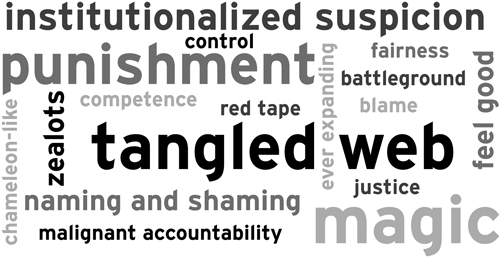
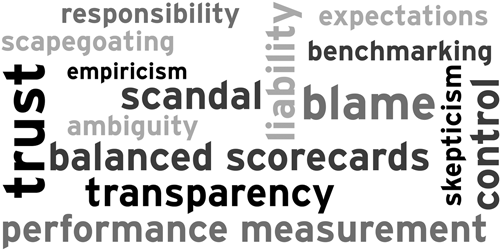
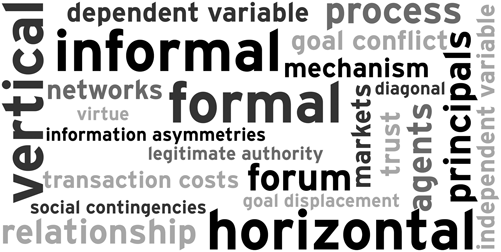
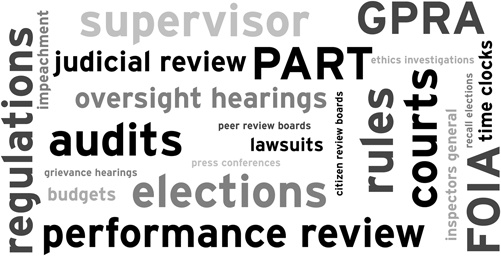
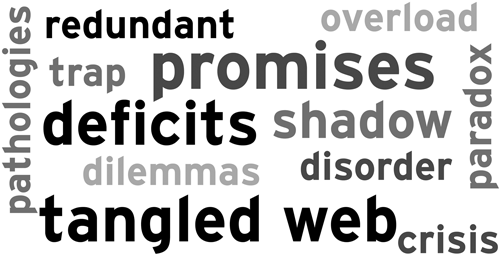
And this is just a short list of some of the research in accountability. Space limitations preclude a comprehensive literature review. Knowing that a picture paints a thousand words, I offer some word clouds that capture graphically the key concepts and connotations of accountability. I am sure these will be recognizable to some scholars.
Figures 1–5 depict five aspects of the accountability concept as reflected in theory and practice. We see lots of words in these clouds, which I believe says something about how much research and literature are now available.
Emotional Connotations

Buzzwords
Theory
Accountability
Metaphors
Emotional Connotations.The range of concepts in this cloud (figure 1) shows the emotional baggage that accompanies accountability. For some it is a “magic” (Pollitt and Hupe Reference Pollitt and Hupe2011) or “feel good” (Bovens, Schillemans, and Hart. Reference Bovens, Schillemans and Hart2008) concept, encompassing whatever the viewer (or researcher) wants it to mean.
Another connotation is that the concept is hard to pin down: it is “ever expanding,” or “chameleon-like” (Mulgan Reference Mulgan2000). In these instances, the lack of agreement regarding meaning is problematic for researchers. And of course, then we have “battleground” (Reichersdorfer, Christensen and Vrangbaek Reference Reichersdorfer, Christensen and Vrangbæk2013), “punishment” (Behn Reference Behn2001), and “institutionalized suspicion” (Behn Reference Behn1998). Obviously these words reflect the negative views of accountability. The bottom line is that accountability carries a lot of emotional baggage.
Buzzwords.Next, consider some of the buzzwords associated with accountability. In figure 2 , we see two categories of buzzwords. Those that evoke a “business like” approach: “performance measurement” (Dubnick and Frederickson Reference Dubnick and Frederickson2010; Van de Walle and Cornelissen Reference Van de Walle, Cornelissen, Bovens, Goodin and Schillemans2014) “empiricism,” “expectations” (Dubnick and Romzek Reference Dubnick and Romzek1993; Lerner and Tetlock Reference Lerner and Tetlock1999), “benchmarking,” and “balanced scorecards” (Moynihan and Ingraham Reference Moynihan and Ingraham2003) as well as the often invoked “transparency,” “control,” “responsibility,” “responsiveness.” Others buzzwords are negative: “blame,” “scapegoating,” “ambiguity,” “scandal,” and “liability.”
Cool/Dispassionate Theory.The third word cloud (figure 3) reflects the cool/dispassionate theory. The words in this cloud indicate that there is a great deal going on that truly reflects the diversity of scholarship in the field. The accountability concept is characterized as “virtue,” “relationship,” “mechanism,” “structure,” and “process” (Bovens Reference Bovens2010; Romzek and Dubnick Reference Romzek and Dubnick1987; Reference Romzek, Dubnick, Ingraham and Romzek1994). We have “principals” and “agents” (Willems and Van Dooren Reference Willems and Van Dooren2012; Schillemans and Busuioc Reference Schillemans and Busuioc2014), “networks” (e.g., Holmen Reference Holmen2011; Koliba, Mills, and Zia Reference Koliba, Mills and Zia2011), and “transaction costs” (Johnston and Romzek Reference Johnston, Romzek and Durant2010). And then, of course, we recognize that some scholars study accountability as a dependent variable while others research it as an independent variable (Stokes Reference Stokes2005).
Accountability Tactics, Mechanisms and Structures.Our fourth word cloud (figure 4) presents a range of accountability tactics, mechanisms, and structures that are used to hold individuals answerable for their performance. This range reflects the belief, deeply entrenched in our political culture that, because some accountability is good, then more is even better.
Conceptual Schemata of Accountability.The fifth word cloud (figure 5) captures the big picture mentioned earlier. This word cloud shows how very complicated the theoretical terrain is for accountability. It reflects the wide range of metaphors researchers have used to capture its complexity. Most metaphors reflect the notion of multiple accountabilities: “overload” (Bovens, Schillemans, and Hart Reference Bovens, Schillemans and Hart2008), “disorder” (Koppell Reference Koppell2005), and “redundant” (Schillemans Reference Schillemans2010). Other scholars point to poorly designed aspects, such as “pathology” (Flinders Reference Flinders2011), “paradox” (Dubnick Reference Dubnick2005), “trap” (Van Theil and Leeuw Reference Van Thiel and Leeuw2002), “crisis” (Dowdle Reference Dowdle and W Dowdle2006), “dilemmas” (Behn Reference Behn2001), “tangled webs” (Romzek Reference Romzek, Dubnick and Frederickson2011), and “deficits” (e.g. Acar, Chao, and Yang Reference Acar, Guo and Yang2008; Bovens, Schillemans, and Hart Reference Bovens, Schillemans and Hart2008).
As you see, a tremendous amount of research exists on this fundamental expectation of the American political system: accountability of public officials. We find a great deal of emotional baggage, a large number of buzzwords, and wide range of formal and informal arrangements to elicit answerability, and an extensive body of research that sheds light on these important dynamics.
The variety of approaches and findings are a sign of the importance of the concept and the interest in and complexity of the dynamics characteristic of accountability. We as scholars find ourselves in a situation similar to that of the parable of the Blind Men and the Elephant. We can feel the certain parts of the animal that we touch, but our limited vision leads us to capture only part of the essence of accountability. We are not the first group to suffer this problem; nor will we be the last.
“Uneven practice” is about the failures to use the existing accountability arrangements to hold individuals and organizations answerable. Sometimes we impose accountability effectively. Often, we do not do it well.
Uneven Practice
Our passionate rhetoric suggests accountability is one of the cornerstones of the American political system. But after we get beyond rhetoric and theory, we have to ask ourselves about the practice of accountability. Despite our hot rhetoric and cool theories, we have uneven practice. This outcome is important for two reasons. First, theory without practice is not of much use. Second, a commitment to link theory and practice is what makes public administration as a field so valuable and relevant.
“Uneven practice” is about the failures to use the existing accountability arrangements to hold individuals and organizations answerable. Sometimes we impose accountability effectively. Often, we do not do it well. Breakdowns of practice on several levels allow these accountability systems to fail. Sometimes these instances of uneven practice of accountability are a result of good people, yet lack good design or proper implementation. Other times uneven practice is just the result of incompetence, poor management, or the lack of political will to impose a penalty. Sometimes accountability failures occur because we do not know we are getting poor performance. Sometimes we know we are getting poor performance (for example, with a contract) but we do not impose any penalties.
For the most part, at the individual level, supervisors know who the good performers are. In your own work groups, you know who is the “go-to” person. Anyone who has ever needed to evaluate someone knows that performance reviews are uncomfortable. No one wants to deliver bad news in the form of a poor performance review. As the hopeful title of an article published by my colleague John Nalbandian (Reference Nalbandian1981) stated, “Performance Appraisals: If Only People Were Not Involved.”
So, even with the most well-designed accountability arrangements, we find examples of failures of implementation or execution. The list is long. Most recently, we have the concept of uneven practice at work with the US Patent and Trade Office (USPTO). The USPTO, once acclaimed for its telework program, has recently come under fire for failures in the same program. Recent investigations revealed that some of the roughly 4,000 USPTO employees who work remotely repeatedly lied about the number of hours they had worked. As a result, many of these employees received bonuses for work they did not do (Rein Reference Rein2014).
While these false reports of hours worked are concerning enough, these failures were compounded when supervisors, who had discovered evidence of fraud and asked to have employee records reviewed, were rebuffed by top officials. This reaction ensured that few cheaters were actually disciplined for their behavior. My point is that even when we have a well-designed system and good documentation, we still find uneven practice when it comes to accountability. Even in seemingly straightforward systems, we know that people act in their own right, and often face conflicting or at least competing motivations.
It may be unrealistic to build a “perfect system” for accountability—to turn accountability “sinners” into “saints.” I expect that within a few months of new IRS regulations, accountants will find loopholes to slip past new standards of accountability. Similarly, we recently saw the example of Veterans Administration staff’s ability to game their own appointment system—and thus dodge the top management-mandated two-week deadlines for appointments. Establishing new standards or new systems for accountability often seem only to lead to new workarounds or other examples of uneven practice.
ACCOUNTABILITY IN ACADEMIA
As I have noted, uneven practice is not new. Breakdowns of accountability are not new. Government scandals are part of American history. We note the widespread use of “hot rhetoric,” the wide range of “cool theory” produced by accomplished scholars, and the reality of “uneven practice.”
Now, consider the question we so often pose to our students: “So what?” What does this turbulent confluence of rhetoric, theory, and practice mean for political science and public administration? For our role as academics? How do hot rhetoric, cool theory, and uneven practice apply to our work? For scholars, most reviews of academic work typically wrap up with a call for more research, better methods, and more conclusive data. I want to suggest something unorthodox and more ambitious: more translation, more engagement .
We as scholars are very good at doing the research. We have not been nearly as good at accepting the responsibility as scholars to share the results of our research with the world beyond academia. We need to take our world-class scholarship and contribute to public engagement and civic discourse. As academics, we have an obligation to apply our knowledge—to help translate the knowledge we possess in a usable format to the benefit of our communities. We need to reach beyond our academic communities to the general public, and do so in a manner that helps improve the world in which we live.
We as scholars are very good at doing the research. We have not been nearly as good at accepting the responsibility as scholars to share the results of our research with the world beyond academia.
We have seen hot rhetoric applied to accountability for academia. It is no secret that the academy has had its critics of late. We have heard hot rhetoric reflecting calls for accountability for academics, some more thoughtful than others. There are critics who challenge the legitimacy and expense of higher education, wondering what relevance and “value added” we have for the real world. We have seen challenges to our scholarly legitimacy from elected officials, evident in recent efforts to defund political science research at the National Science Foundation (NSF). This NSF action is an example of an external demand for greater accountability. And boy, have they used hot rhetoric.
This challenge to relevance has also been articulated within the academy as was nicely summarized by Matthew Flinders and Peter John (Reference Flinders and John2013). They argue that academics have a social responsibility to share their expertise with the public. And that the risk of partisan misuse is not a sufficient reason to avoid engagement. Put simply, this would mean academics “getting off the dime” in terms of scientific neutrality and bringing their expertise to bear on pressing governance problems of the day.
Cool theory can be helpful here. We know we have a political system that is dysfunctional, subject to gridlock, and lacking in thoughtful deliberation and compromise. And I am not only referring to Congress. It is no secret that we have a disengaged and uninformed electorate. For the public who does choose to watch the evening news, they receive a diluted message of current events. They get sound bites and quick clips that emphasize the negative without providing real informed discussions about policy or dysfunction. I find it frustrating to watch the news because it is so discouraging, and it reveals such a dysfunctional system.
Today, with the use of social media, many people hear only the opinions and thoughts of their own community—in a self-reinforcing format that provides a dearth of actual information. The takeaways from all of this? “We can’t hope for anything better than gridlock.”
But we know the challenges to our democracy are much more complicated than that. We possess the information to inform our electorate. We are accomplished scholars. We know how the political system works. We need to accept the responsibility to do more. We frequently talk about how elected officials need to be held accountable and how dysfunctional our system has become. Now it is our turn to look at how accountable we are as academics.
We need to accept accountability for translating theory into practice. We still need value-neutral analysis, but we need to find ways to translate our findings into knowledge that is accessible and useful to the broader public, and especially the electorate. Too often, we stop our education at the doors of our classrooms or the pages of academic journals.
Translational research for the social sciences is not new. Funding agencies are already aware of this. Grant proposals already require principal investigators to include plans to disseminate research beyond traditional venues.
Public administration and political science scholars need to contribute to political discourse in ways that better inform the public about public affairs. I do not mean that we need to head to the streets and become the academic equivalent of the “Occupy Wall Street” movement. I am not proposing an “Occupy DC” movement. Rather, we need to model our actions on those of translational medicine. We need to apply our knowledge in ways to contribute to a healthier political system. We are all facing our own challenge of accountability. As academics, we are not only accountable to our provosts, deans, and department chairs. We are not only accountable to our academic peers, the students we teach, and the universities we lead. And so I ask, what can we do to further the impact and relevance of our academic research on our political system? What can we as academics do to be accountable to the public and for the public good?
We still need value-neutral analysis, but we need to find ways to translate our findings into knowledge that is accessible and useful to the broader public, and especially the electorate. Too often, we stop our education at the doors of our classrooms or the pages of academic journals.
To draw a commonplace parallel situation: Today, in matters of the environment, great emphasis is placed on each individual doing what she or he can to leave the globe in a state that is livable for the next generation. So we are asked to recycle, use energy and water resources more responsibly, and so on. We all have heard the mantra “reduce. reuse. recycle.” for the environmental sustainability movement. As academics in public administration and political science, what should our slogan be? One option could be: “Translate. Engage. Make a Difference.” I leave it up to wordsmiths to create our catchphrase. The point is, the public needs to understand the causes, consequences, and strategies to improve our dysfunctional political system. We can make it happen.
As academics who study politics and government, we have a parallel challenge. We need to hold ourselves accountable for educating the public. We have the capacity to reach new audiences and explain why politics and public administration matter. We can and should help inform the debate. And we know that the public is not reading American Political Science Review or the Journal of Public Administration Research and Theory. So we need to find additional outlets to communicate our findings.
We need to hold ourselves accountable for educating the public. We have the capacity to reach new audiences and explain why politics and public administration matter. We can and should help inform the debate. And we know that the public is not reading American Political Science Review or the Journal of Public Administration Research and Theory. So we need to find additional outlets to communicate our findings.
We have a responsibility as citizens, and as especially well-informed experts, to share our knowledge and expertise. We need to share what we know about the causes and implications of our current and increasingly fractured political institutions, and our dangerously disengaged polity. We have a responsibility to the communities within which we live. And within which we hope the next generation can thrive. We need to leave the world a better place.
Extending our expertise into the realm of practice is a responsibility we should embrace. This is, after all, the distinctive marker of public administration as a field. I invite you to be more accountable to ourselves as academics, to our community, and to our world. Let’s say “yes.”
ACKNOWLEDGMENTS
I want to recognize some of those accountable for my receipt of this award, and the many who have supported me along the way. Particular thanks are due to my husband, Dave Greenamyre, and my children; this award would not be possible without their decades of support. Thank you to my friends and colleagues, especially those with whom I have collaborated over the years. Thanks to all in the profession who have provided intellectual stimulation and challenge—whether up close or at a distance. My sincere thanks also to faculty and staff of the School of Public Affairs at American University for all their support, especially Chris Birdsall, doctoral student, for his assistance with research for this lecture.