


Introduction
Given the multiplicity of legal interpretations and opinions, the question of the place of legal debate within early rabbinic literature of late antiquity—both as textual practice and as hermeneutical and legal theory—has occupied a particularly busy space within recent scholarship.Footnote 1 This question centers on several issues of broad significance for the history of rabbinic Judaism and its literature: Does this phenomenon (if we can speak of it in the singular) represent a defining characteristic of rabbinic culture overall, or rather an aspect better attributed to specific times, places, and rabbinic “schools”? Did it emerge and develop internally within rabbinic Judaism, or is it, on the one hand, the continuation of antecedents in the pre-rabbinic, late Second Temple period, or, on the other hand, the result of external influences or pressures (e.g., Greco-Roman or early Christian) of a later time? Does such legal multivocality reflect the actual nature of either/both rabbinic jurisprudence or/and pedagogy, or the editorial choices of the later anonymous redactors of the composite and anthological texts that have come down to us (or, as I shall demonstrate, both)? Finally, what are its hermeneutical and theological underpinnings (as well as sociopolitical ramifications)? While these four questions will frame what follows, it is the latter two that will particularly demand our attention. They will be addressed, whether explicitly or implicitly, in several comparative textual analyses that will constitute the body of this article.
T. Sotah 7.11–12
We shall look at two passages, one early (Tannaitic; second–third centuries c.e.) and one late (Amoraic; third–sixth centuries c.e.) that are clearly linked to one another, although we should be careful not to presume that their linkage is direct in any genetic sense.Footnote 2 The earlier of the two is from the Tosefta (Sotah 7.11–12).Footnote 3 This passage appears as the third of three homiletical interpretations of different scriptural verses that are narratively framed as having been delivered on a single occasion at Yavneh by Rabbi Eleazar ben Azariah.Footnote 4 It takes the form of an atomizing interpretation of Eccl 12:11. That verse reads as follows (rendered in English as it will be rabbinically understood):

(“The words of the wise/sages are like goads, like nails firmly planted; [taught by] masters of assemblies, they were given by one shepherd”).Footnote 5 Central to the rabbinic interpretation of this verse is the linking of its double plural beginning (“words of the wise/sages”) and its singular ending (“one shepherd”). The homilist subtly equates the scriptural phrase “words of the wise/sages” with the generic rabbinic phrase “words of Torah,” and proceeds to unpack the series of metaphoric terms used in the verse to describe those “words of Torah” (and their rabbinic teachers):Footnote 6

“Like goads . . .” Just as the goad directs the cow so as to bring life to the world, so too words of Torah are only life for the world, as it is said, “It is a tree of life . . .” [Prov 3:18]. Or, just as the goad is movable, might it be so for words of Torah? Scripture says, “And like nails firmly planted.” [Or, might (words of Torah like nails) neither diminish nor increase? Scripture says, “firmly planted.”] Just as a plant flourishes and grows, so too words of Torah flourish and grow.
The first part of the verse (as punctuated above) is understood to characterize “words of Torah” through three metaphors: goads, nails, planting. As if to answer the question “why does Scripture employ three different metaphors?” the first two are said to have positive connotations, but also negative connotations, which are eliminated by unpacking the next metaphor in the series.Footnote 7 The homily continues with the latter part of the verse as follows:
[1] “Masters of assemblies”: [This refers to] thoseFootnote 9 who enter and sit in multiple assemblies, declaring what is impure [to be] impure, and what is pure [to be] pure;Footnote 10 what is impure [to be] in its place, and what is pure [to be] in its place.Footnote 11
[2] Should a person [’adam]Footnote 12 think to himself, “Since the House of Shammai declares impure and the House of Hillel declares pure, so-and-so prohibits and so-and-so permits, why should I henceforth learn Torah?”
[3] Scripture teaches, “Words,” “the words,” “these are the words” [Exod 19:6].Footnote 13
[4] All of the[se] words “were given by one shepherd” [Eccl 12:11]. One God created them, one benefactor [Moses] gave them, the master of all deeds, blessed be he, spoke it.Footnote 14
[5] Therefore you should make of your heartFootnote 15 chambers of chambers,Footnote 16 and bring into it the words of the House of Shammai and the words of the House of Hillel, the words of those who declare impure and the words of those who declare pure.
The text appears to be a composite, with some jagged seams and rough transitions between its component parts. To begin with, sections 1 and 2 present seemingly different images of the nature of study among the “masters of assemblies”: consensus and dissensus.Footnote 17 The opening comment stresses the plural aspect of “assemblies,” by rendering it as “assemblies, assemblies,” meaning “many assemblies,” perhaps referring to multiple disciple circles. What is pronounced in those multiple assemblies appears to be by multiple voices declaring the ritual purity and impurity of various objects. We cannot tell from this comment whether there was unanimity all along, or whether disagreement and debate preceded the unitary judgments once consensus was reached. In any case, the scriptural phrase “masters of assemblies” is midrashically unpacked so as to signify multiple assemblies that produce multiple voices in univocal judgments.
This idealized scenario of univocality is very similar to that of t. Hag. 2.9 (ed. Lieberman, 383), according to which a unitary halakhah is issued forth from the high court in Jerusalem (following a majority vote), also with respect to univocal judgments of purity and impurity, prior to the fall from consensus to dissensus with the proliferation of the ill-serving disciples of Shammai and Hillel:
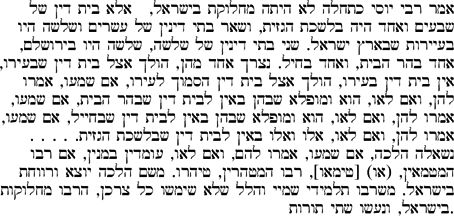
Said Rabbi Yose [ben Halafta, ca. 150 c.e.]:Footnote 19 Originally there was no contention [mahloqet] in Israel. Rather, the court of seventy-one [members] was in the Chamber of Hewn Stone, and the other courts of twenty-three [members] were located in the towns of the Land of Israel. Two courts of three [members] were in Jerusalem, one on the Temple Mount, one on the Rampart. When a person is in need [of a ruling], he goes to the court in his town. If there is no court in his town, he goes to the town nearest to his. If they have heard [the proper ruling], they tell them, but if not, he and the most distinguished among them come to the court which is located on the Temple Mount. If they have heard [the proper ruling], they tell them, but if not, he and the most distinguished among them comes to the court located on the Rampart. If they have heard [the proper ruling], they tell them, but if not, these and those come to the court that is in the Chamber of the Hewn Stone.▒.▒.▒.▒The legal question is asked. If they have heard [the correct ruling], they tell them, but if not, they take a vote. If those who declare [the object] to be impure are in the majority, they declare [it] impure; [if] those who declare [it] to be pure are in the majority, they declare [it] pure. From there the law [halakhah] goes forth and is disseminated in Israel. When the disciples of Shammai and Hillel, who did not serve [their masters] as needed, became many, contentions increased in Israel, and they became two Torahs.Footnote 20
Once again, the conflicting representations of halakhic multivocality play out at both the levels of (historical) thematization and (editorial) juxtaposition. The edited text, as literary artifact, models the very frustrations posed by multivocality as a fall from an imagined past of consensus.
It is this very legal contentiousness that threatens the social/pedagogical scene in section 2 of t. Sotah 7.11–12. There it is precisely the contrary judgments of the Houses of Shammai and Hillel with respect to ritual purity, and those of other authorities with respect to what is forbidden and permitted, that leads a person (’adam) to question why (lamah) he should bother studying in such an environment of dissensus.Footnote 21 Perhaps the discordance between sections 1 and 2 reflects two different views (or hearings) of the same scene, the first from the “outside,” representing the halakhic product of consensus, the other from the “inside,” representing the halakhic process of dissensus.Footnote 22 Thus, while section 1 is reminiscent of t. Hag. 2.9 (consensus pre-disciples of Shammai and Hillel), section 2 may be compared to Sifre Deut. 48, which similarly expresses frustration with respect to irresolvable contradictory judgments regarding purity and permissibility (what is one to do?):
Behold, it says, “They shall wander about seeking the word of the Lord, but they shall not find it” [Amos 8:12]. Our sages permitted [hittiru]Footnote 23 going from city to city and from province to province to determine whether an insect that comes into contact with a loaf of bread renders it impure in the first or second degree. Rabbi Simeon ben Yohai [ca. 140 c.e.] says: Does this [verse] come to say that the Torah will be forgotten in Israel? But has it not been said, “It will not be forgotten from the mouth of their offspring” [Deut 31:21]? Rather, so-and-so prohibits, so-and-so permits, so-and-so declares impure, so-and-so declares pure, and one cannot find a clear rule [davar barur].Footnote 24
Returning to section 2 of t. Sotah 7.11–12, we might imagine that our person (’adam) similarly desires a clear rule (davar barur), but instead encounters opposing declarations of purity and impurity, prohibition and permission. Although part of the frustration experienced by such a person (or “reader”) might be the practical difficulties of memorizing and accessing such a large mass of contradictory teachings, the Sifre passage is explicit in denying that forgetting is the main obstacle to finding a davar barur. According to the Tosefta passage, it is not so much a question of how (he’akh, as in the parallel in b. Hag. 3b), but why (lamah), that is, “Why should I bother to learn Torah henceforth if it involves learning (presumably, by memorizing) so many contradictory judgments?”Footnote 25 Our anonymous person's frustration is not just with respect to method, but also with respect to the meaning and ends of Torah study, that is, the lack of closure to the dissensus that envelops him. In other words, he is on the verge of giving up, not just because of the difficulty of mastering such a quantity of contradictory teachings, but because of his frustration at not seeing the purpose of undertaking such a difficult (and seemingly endless) project that appears to elude halakhic certitude.
Is this his problem alone? Hardly. For what is at stake (potentially at least) is the whole rabbinic enterprise, if not for hermeneutical/theological/jurisprudential reasons, then at least for the ability to attract (and keep) disciples. While we might think of him as a prospective disciple of the sages, we might just as well think of him as an outsider to rabbinic culture, upon whom have been transferred inner-rabbinic uncertainties.Footnote 26
Here I would add that the seeming discordance between sections 1 and 2 is rhetorically (if not perfectly structurally) in keeping with the preceding sequential interpretations of “goads,” “nails,” and “planting” (Eccl 12:11) as metaphors for “words of Torah,” wherein each of the first two are first given positive connotations, followed by negative connotations, with the negative ones resolved by the next scriptural metaphor in the sequence.Footnote 27 Similarly, “masters of assemblies” produces two images in turn: one positive, of multiple assemblies with multiple voices that render unanimous judgments, and one, at first rather negative, of multiple sages and groups of sages who render contradictory judgments, the latter to the consternation (or despondence) of a newcomer/outsider to this scene. As with the previous metaphors, the midrashic homily looks for resolution to the next metaphor in the sequence (“they were given by one shepherd”). Thus far, however, this section of the Tosefta has not posed the problem in expressly theological or hermeneutical (inseparable as they are) terms. But that will now change.
Section 3, as I understand it in this context, is a transition between the problem (section 2) and its solution (section 4), and is therefore key to understanding the larger passage's theological hermeneutic. As is so often the midrashic case, the exegetical dead end in interpreting the base verse (Eccl 12:11)—the seemingly irresolvable multivocality of the pronouncements of the “masters of assemblies”— is averted through the citation and explication of a verse (or phrase) from elsewhere in Scripture, which itself denotes a multiplicity of utterances: “these are the [divinely revealed] words” (Exod 19:6).Footnote 28 This language itself then loops back to “the words of the wise/sages” with which Eccl 12:11 and the midrash began. In typical midrashic fashion, the phrase is parsed into its component units and reassembled so as to emphasize the multitudinous nature of the “words” of both Torah and sages: “words, the words, these are the words.”Footnote 29 For a similar midrashic maneuver in a Tannaitic midrash, note how Sifre Deut. 48 (ed. Finkelstein, 113) parses the phrase “all the commandment” of Deut 11:22 as “commandment,” “the commandment,” “all the commandment,” so as to signify thereby the inclusive plurality of forms of rabbinic instruction: midrash, halakhot, and ’aggadot. Exegetically closer to (but chronologically further from) our midrash is the midrashic explication of the scriptural phrase “these are the words” of Exod 35:1, unpacked as “words,” “the words,” “these are the words,” so as to signify the thirty-nine classes of prohibited labor on the Sabbath in b. Shabb. 70a and 97b. Finally, note how, in yet other Palestinian rabbinic sources,Footnote 30 the scriptural phrase “like all the words” (Deut 9:10) is unpacked and reassembled as “words,” “the words,” “all the words,” “like all the words,” so as to include Scripture, Mishnah, Talmud, and aggadah, and “even that which an advanced student will one day teach before his master” in what was “spoken to Moses at Sinai.” As in our passage, the plural construction of “words” (and their seemingly redundant scriptural accompaniments) is inclusively construed so as to encompass the multivocality (in form and content) of rabbinic “words of Torah.” However, in our passage, the unitary revelatory source of these multitudinous words/teachings, already implicit in the scriptural context of “these are the words” (Exod 19:6),Footnote 31 still needs to be made intertextually explicit with respect to Eccl 12:11.
This is achieved in section 4 by returning to Eccl 12:11, “they were given by one shepherd,” the next and final sequential phrase in the scriptural verse being atomistically commented upon. This will provide the answer to the implied question “why should (or, how can) one study this multitudinous Torah, especially in light of its preservation of discordant halakhic judgments?” which was generated by the preceding phrase, “masters of assemblies” (section 2). Since the scriptural subject of “they were given by one shepherd” (“the words of the wise/sages”) may by now have itself been forgotten, especially after such a long series of explications, that phrase is now glossed: “All of the words of sages [ = (rabbinic) words of Torah] were given by one shepherd.”Footnote 32 With the scriptural phrase “words of the wise/sages” having been metonymically equated with “words of Torah,” the concluding phrase of Eccl 12:11 is now interpreted to mean that the multitudinous “words of sages/Torah” all derive from a single shepherd, understood to signify both God (the source) and Moses (the transmitter), and hence all such “words” are worthy (and demanding) of reception and transmission.Footnote 33 Note in particular the two-fold enunciation of “one [’ehad] shepherd” as denoting both “one God” and “one benefactor,” as well as the single “master of all deeds.” Compare, in another Tannaitic text (Sifre Deut. 306), the midrashic argument that although rabbinic (oral) Torah assumes numerous discursive (pedagogic) forms, “words of Torah are all one,” by virtue of their common divine source.Footnote 34 In sum, the multivocality of the “words of sages/Torah” is originary and not belated with respect to divine revelation. The theological import of this interpretation in its extant textual form in the Tosefta is clear:Footnote 35all of the words of the sages, whether in consensus or dissensus, were ultimately created/spoken/given by a single God and human intermediary. The many “words” (or “voices”) heard among the “assemblies” of sages are, as it were, no different, whether ontologically or epistemologically, from the many words uttered by the one God to the one Moses, or by the one Moses to the many in assembly at Mount Sinai.Footnote 36 If our passage earlier progressed (or regressed) from legal consensus (section 1) to dissensus (section 2), it has now (sections 3 and 4) traced the very multivocality of rabbinic rulings to its single prophetic and single divine origin. While this might not be a neat Hegelian progression of thesis, antithesis, and synthesis, it does produce a strong argument for the hermeneutical and theological unity that underlies and suffuses, without effacing, rabbinic (and revelatory) multivocality. The discursive cacophony of the “house of study” is simultaneously divinely and scripturally grounded, while providing a portal to both.
Having established this hermeneutical and theological understanding of rabbinic dissensus, that is, having answered the person (’adam) who asks, in effect, “Why should I bother to study such a mass of contradictory teachings?” it remains (in section 5) to instruct him how it is practically possible to do so (the he’akh of b. Hag. 3b). Here Shlomo Naeh is certainly correct that the Tosefta's image of a multi-chambered “heart” (that is, mind) is that of a “memory palace,” in which the many discordant teachings of the Houses of Hillel and Shammai can be sorted and arranged according to their forms and contents, thereby satisfying the critical need of rabbinic disciples to acquire and hone the mental tools required to both store and access the many contradictory teachings of the sages who preceded them.Footnote 37 The single, multi-chambered “heart” that can thus absorb and arrange such a mass of dissimilar teachings is a fitting vehicle for the transmission of a multivocal revelation that originates with a single divine creator and a single human law-giver. In a sense, the single person (’adam) of section 2 stands, potentially at least, opposite the single benefactor, Moses.Footnote 38 Not incidentally, he is now directly addressed by our text in the second-person singular (’attah). Or, is it the rabbinic reader/auditor of our text who is being directly addressed—or are the two now one and the same?
There is no warrant for denying either the practical/pedagogical or the theological/hermeneutical thrust of this composite exegesis of Eccl 12:11, that is, the response to the frustrated student/reader or its interpretive grounding in divinely revealed Scripture, nor to force the isolation of one from the other. It is precisely in their dialectical juxtaposition, editorially achieved by the combining of what I presume to have been antecedent sources, that several motifs, elsewhere witnessed in other Tannaitic texts, are powerfully thematized and performatively dramatized as multitudinous rabbinic “words of Torah” that issue from a single divine source and can only be absorbed and arranged within a unitary human “heart of many chambers.” The multivocal “words of the sages,” while pronounced and studied in many places of rabbinic deliberation (we have encountered this in a place of assembly / presumed “house of study,” on the Temple Mount, and in rabbinic peripateticism), derive, ultimately, from a single law–giving shepherd—actually two shepherds, one divine and one human. The task of the bewildered student of this multitudinous teaching/revelation is to be attentive to all, not just as passive recipient, but as active intellectual sorter and arranger. Notwithstanding the challenges and enormity of this endeavor, our singular “person” is no longer alone (as at first), but now in excellent company extending both outward to the many assemblies of sages and backward to the singular revealer and transmitter.
B. Hag. 3b
As already noted, this remarkable passage from the Tosefta (or at least its underlying tradition) became more widely known through its adoption and adaptation by the Babylonian Talmud (b. Hag. 3a–b), to which we now turn for comparison, with particular attention to those textual elements that are new or changed:
[1]Footnote 40 “Masters of assemblies”: These are the disciples of the wise who sit in multiple assemblies and occupy themselves with [the study of] the Torah, some pronouncing impure and others pronouncing pure, some prohibiting and others permitting, some declaring unfit and others declaring fit.
[2] Should a person say, “Since some declare impure and others declare pure, some prohibit and some permit, some declare unfit and others declare fit—how then shall I henceforth learn Torah?”
[3] Scripture teaches: [All of them]Footnote 41 “were given by one shepherd” [Eccl 12:11].
[4] One God gave them, one leader [Moses] proclaimed them from the mouth of the Lord of all creation, blessed be He, as it is written, “And God spoke all these words” [Exod. 20:1; emphasis added].Footnote 42
[5] Therefore you should make your ear like the hopperFootnote 43 and acquire a [perceptive]Footnote 44 heart to understand the words of those who declare impure and the words of those who declare pure, the words of those who prohibit and the words of those who permit, the words of those who declare unfit and the words of those who declare fit.Footnote 45
While we cannot presume that the talmudic version is directly dependent on (and hence a reworking of) the toseftan version, there possibly having been other versions which have not been preserved, a comparison of the two is instructive, especially as it is safe to presume that the talmudic version overall is later than that of the Tosefta. While some have drawn a sharp contrast between these two versions of what is clearly a shared cluster of traditions,Footnote 46 I wish to argue that the talmudic version represents an editorial smoothing and thereby a sharpening of the message of the toseftan version, but with a consequent effacing of the toseftan dialectical fall from consensus to dissensus. However, with respect to their hermeneutical and theological groundings of legal multivocality, they are compatible with one another, with some significant differencesFootnote 47—of which the following are the most salient:Footnote 48
1) This section, like that of the Tosefta, interprets “masters of assemblies” to refer to multiple study groups that pronounce on matters of ritual purity, permitted and forbidden activity, and fit and unfit status. While the toseftan version conveys a sense of consensus, the talmudic version conveys a sense of dissensus. The talmudic version explicitly identifies the participants as “disciples of the wise,” that is, as rabbinic sages and their students, which we may presume to be implicit in the toseftan version.Footnote 49
2) In both versions, an unidentified person (prospective student/non-rabbinic outsider?) asks why (Tosefta)/how (Bavli) he should learn Torah (that is, rabbinic Torah) under these circumstances of conflicting pronouncements. I am uncertain how much significance to attribute to this seemingly small difference in wording. Is the former more existential and the latter more practical?
3–4) Both versions respond to the person's question/protest/consternation with a scriptural proof text. In the toseftan version its identity is uncertain (although I have argued for Exod 19:6),Footnote 50 but in any case it denotes the multitudinously nested quality of the revealed words (“words,” “the words,” “these are the words”). By linking this verse in section 3 with the concluding words of Eccl 12:11 (“were given by one shepherd”) in section 4, the multitudinous words of Torah (= rabbinic discourse) are said in the Tosefta to originate with a single divine source (God) and a single human intermediary (Moses).Footnote 51 The talmudic version achieves much the same result, but by beginning in section 3 with Eccl 12:11, thereby suggesting that the plenitude of contradictory rabbinic pronouncements of sections 1 and 2 were all “given by one shepherd.” The talmudic version then offers a second proof text, Exod 20:1 (“And God spoke all these words”), which introduces the Decalogue, whose plural inclusive (“all”) language is here understood to encompass the broad and contradictory variety of rabbinic pronouncements, but now no longer attributed specifically to the Houses of Shammai and Hillel as in the Tosefta.
5) Finally, both versions conclude by addressing the reader/auditor/student of our text directly, and for the first time, with the second-person singular you (’attah). As previously suggested, perhaps it is the confounded person (’adam) of section 2 who is so being addressed. Or, have we and he been merged? In either case, the addressee is instructed either to transform his heart into one of many “chambers” (Tosefta), or his ear into something like a funnel-shaped “grain hopper” (Bavli), in both cases so as to better receive and internalize the multitude of contradictory legal pronouncements. While the toseftan metaphor emphasizes more the mental sorting of all such pronouncements for purposes of better storage (memorization), and, presumably, retrieval, the talmudic metaphor stresses the hopper-like ear, which is widest at its upper (or outer) opening so as to maximize its intake. It is only then the role of the “heart” (intellect) to “hear” (understand) them all, regardless of their diversity of form, content, and attribution.Footnote 52 These are two distinct expressions, with different emphases, of the shared insistence on absorbing all of the contradictory rabbinic pronouncements into the singular “heart” and “ear”Footnote 53 just as they originated from the singular divine source via his singular human transmitter.
Conclusion
We have critically scrutinized the differences, both significant and subtle, between the two versions of the midrash to Eccl 12:11 found in the Tosefta and the Babylonian Talmud (and the affinities that they have with midrashic passages of both Tannaitic and Amoraic provenance). Despite our inability to know whether the later talmudic version is a direct descendent of the earlier toseftan one,Footnote 54 the comparisons between the two have set the textual details of both in greater relief than if we had only had one with which to work. Conversely, we have also witnessed the endurance with which their shared valorization (and problematization) of legal multivocality has crossed several centuries (and two geographic locations) remarkably intact. The shared pedagogical solution (a wide-open “ear” and a discerning “heart”) to the challenge of scholastic legal dissensus is notably consistent, mutatis mutandis, and similarly funded by a theology and hermeneutic of scriptural revelation. Given the orally dynamic and textually fluid culture of both Tannaitic and Amoraic, Palestinian and Babylonian, rabbinic sages, especially at the level of textual redaction, the endurance of this idea (and its textual praxis), manifest as it is with variants, is all the more profound for its consistently coherent core.













