

1. Introduction
The literature on German relative clauses is very extensive and a large amount of scientific work has been written on the historical development of these constructions in particular (not only in German but also in other Germanic languages).Footnote 1
In this paper, we want to focus on some of the properties of the relative clauses observed in Old High German (OHG).Footnote 2 Even though we do not discuss all the different types of relative constructions attested during this period, we provide a brief overview of the most important types below.Footnote 3 Based on Schrodt Reference Schrodt2004:172ff., OHG relative clauses can be classified according to their introducing elements. First, asyndetic relative clauses—a rare type of relative clause—are introduced neither by a particle nor by a relative pronoun:Footnote 4
-
(1)
Footnote 5
Second, there are relative clauses introduced by a relative particle (the, de, thi, etc.):
-
(2)
Footnote 6
The particle can also be used as “reinforcement” of a relative pronoun (in the example below, ther + de/the):Footnote 7
-
(3)
Third, there are relative clauses introduced by a relative pronoun. This is the only type which is still attested in standard Present-Day German (PDG). These relative clauses are introduced by a relative pronoun:
-
(4)
As this short typological inventory shows, not all types of relative clauses are attested up to the present day. Notice further that, in canonical subordinate clauses, the finite verb typically occupies the final (or a late) position in the clause, and, in fact, all the examples provided above are cases of verb-final relative clauses.Footnote 8 However, this is not the only pattern one finds in OHG. Particular constructions that are often analyzed as relative clauses are those displaying a noncanonical verb position, namely, V1 and V2 relative clauses. These constructions are characterized by peculiar semantic and syntactic properties (see Axel-Tober Reference Axel-Tober2012 for a detailed discussion):
-
(5)
Footnote 5
A further problematic aspect, which is orthogonal to all types of constructions considered so far, is the position of the verb (V) with respect to the object(s) (O) or to other arguments the verb selects. While in V1 and V2 relative clauses the movement of the verb results in a VO pattern, one would expect non-V1/V2 clauses to systematically display an OV order. However, this is not always the case, since OHG relative clauses also allow for a VO pattern even if the verb has not been fronted to the second position (verb-late order).Footnote 10
-
(6)
In the literature, each of the two possible word orders has been associated with different semantic and syntactic properties of relative clauses: information-structural properties of the object, presence of a relative particle, definiteness of the antecedent, specificity of the referent, and the type of relative clause (restrictive versus nonrestrictive). Since these associations have typically only been demonstrated by isolated examples, we decided to test their strength with a corpus investigation. A number of theoretical investigations explore relative constructions in order to explain their origin and development. However, testing their hypotheses was difficult, since no annotated corpus was available until recently. By now, a number of historical texts have been digitized and annotated morphosyntactically. In particular, a reference corpus for the OHG epoch is now available (see next section). Thus, quantitative analyses can now be conducted to test hypotheses in the literature and/or to formulate new ones. Ultimately, corpus-based investigations should allow one to better understand specific syntactic phenomena.
In this paper, we present the results of a pilot study in which we tested traditional and modern hypotheses regarding OHG relative clauses. Whilst conceding that the results presented below are based on a small set of data and that a larger corpus investigation is called for, we are fully convinced that the findings are valid for the phenomena discussed. Specifically, the following research questions were addressed:
-
(i) Since the first written attestations, the typical order of subordinate clauses is OV. Do relative clauses follow this general tendency? How often do they deviate from this pattern (sections 3.1 and 3.2)?
-
(ii) Can one observe variation when taking into account the type of text, and its time and place of origin (section 3.3)?
-
(iii) Do information-structural properties of the object (such as weight or focus) influence its position with respect to the verb, as maintained in recent syntactic literature on the topic (section 4)?
-
(iv) How frequent are relative clauses introduced by a relative particle compared to the clauses introduced by a relative pronoun? More importantly, is there a relationship between VO/OV orders and the presence of a particle (section 5)?
-
(v) Do the definiteness of the antecedent and the specificity of the referent have any influence on VO/OV orders (section 6)?
-
(vi) Is there a relationship between VO/OV orders and the type of relative clause (restrictive, free, and appositive)? Further, is there a relationship between subject-verb/verb-subject (SV/VS) orders and the type of relative clause (section 7)?
Anticipating the discussion below, our main finding is that the only significant factors determining the VO/OV order are the type of relative clause and the information-structural properties of the object. The other factors—that is, language-external characteristics of the text, presence of a particle, definiteness of the antecedent, and specificity of the referent—have no statistically significant influence on the distribution of the two patterns.
2. Empirical Approach.Footnote 11
Since our goal was to conduct a pilot study on the properties of relative clauses in OHG, we needed a small corpus of mostly heterogeneous texts, which were representative of the whole epoch and of different dialect regions. This is clearly not an easy task, if not an impossible one, given the fragmentary manuscript tradition. Furthermore, many of the major OHG texts are often unsuitable for syntactic investigation due to various reasons, such as dependency on metrical schemes, the influence of a Latin source, or because they represent only one period or one dialect region. For this reason our decision was made in favor of the collection of so-called “minor OHG texts” (Steinmeyer Reference Steinmeyer1971). These texts are digitized in TITUS and linguistically annotated in the Old German Reference Corpus (OGRC), which provides a digital, parsed, and searchable database of the entire text corpus of written OHG, as well as Old Saxon.Footnote 12
Our corpus captures a subgroup of more than 80 texts included in Steinmeyer's edition. We selected 49 OHG texts from the beginning of the written tradition in the late 9th century until the period of transition to MHG in the 12th century.Footnote 13 The texts cover all OHG dialect areas, although texts from the southern language area predominate because, in general, there are more extant OHG texts from that region. We excluded some of the texts in Steinmeyer's edition for being clearly one-to-one translated texts and thus strongly dependent on a Latin source.
With our research questions in mind, we created a dataset by searching for clauses annotated as relative clauses.Footnote 14 We also considered those relative clauses (namely, free relatives) that function as argument clauses (subject or object clauses) in certain contexts.Footnote 15 Finally, some of the clauses annotated as main clauses introduced by a demonstrative were included as well. In all stages of the German language, demonstrative and relative pronouns are homophonous (unless relative pronouns are interpreted as demonstratives, a frequent claim in the literature). Therefore, a distinction between V2 relative clauses and main clauses is often unclear. Consider, for example, the case in 7. The second conjunct may be interpreted either as a main clause or as a relative clause, depending on the reading assigned to the pronoun, namely, a demonstrative or a relative pronoun reading.
-
(7)
We decided to add these potential cases to our corpus.Footnote 16 Our queries produced more than 700 clauses, which, in all likelihood, comprise all the relative clauses present in the selected subset of OGRC. As part of this first step, we then selected the 144 clauses (distributed across 25 texts) that we considered to be relative clauses.
A second step consisted in enriching the remaining 144 relative clauses with additional syntactic, semantic, and information-structural data regarding each relative clause (and its antecedent). The corpus also included metadata for each text regarding its type (that is, prose, alliterative verse, or rhyming verse), dialectal region, and the time of origin. The characteristics annotated in the dataset (and relevant for the current study) are discussed below.
The following sections contain a statistical analysis of the data collected and annotated for the current study, together with a thorough discussion of the different factors that could possibly influence word order.Footnote 17 As mentioned above, we discuss the following aspects:
-
(i) VO/OV and SV/VS order (sections 3.1 and 3.2);
-
(ii) synchronic and diachronic variation across type, time, and place of origin of the texts (section 3.3);
-
(iii) information-structural properties of the object of the relative clause (section 4);
-
(iv) presence of a relative particle (section 5);
-
(v) definiteness and specificity of the antecedent (section 6);
-
(vi) type of the relative clause, that is, restrictive versus nonrestrictive (section 7).
Examples are given of the different properties, and the empirical results are discussed in detail.
3. Verb Position: VO/OV Order, SV/VS Order, and Variation
The first issue we would like to address is the more general problem of the position of the finite verb in relative clauses. According to widely accepted assumptions, the typical order in subordinate clauses is the “basic” OV order. In recent syntactic investigations (for example, Hinterhölzl Reference Hinterhölzl2009, Petrova & Hinterhölzl Reference Petrova, Roland, Gisella and Rosemarie2010, Schlachter Reference Schlachter, Karin and Robert2004, Reference Schlachter2012), it has been argued that the positioning of objects with respect to the verb is information-structurally determined. In particular, the VO order is assumed to be associated with (a particular type of) focus on the object (see section 4 on the influence of information structure on the position of the verb in our corpus). Citing the following example from Tatian, Hinterhölzl (Reference Hinterhölzl2009) analyzes the object as constituting the new information focus in the context:Footnote 18
-
(8)
From an information-structural point of view, this seems to be a well-established fact by now. However, we pointed out above that, on the syntactic level, different interpretations for such VO orders in embedded contexts have been proposed. For example, Axel (Reference Axel2007:80ff.) interprets the VO order in subordinate clauses not as the result of verb movement, but rather as the result of “extraposition” of the object. Also, according to Hinterhölzl (Reference Hinterhölzl2009), no verb movement has taken place in such cases; instead, he assumes that the object is base-generated after the verb (following Kayne's Reference Kayne1994 Universal Base Hypothesis). In contrast, other authors, such as Schlachter (Reference Schlachter, Karin and Robert2004, Reference Schlachter2012:55ff.), argue that in subordinate clauses, the verb may move to a higher syntactic position, namely, to a medial I-position, thus yielding a surface VO order.
In this paper, we first analyze the syntactic position of the different elements relative to their linear occurrence on the surface. After that we discuss the implications of various theoretical assumptions made in the literature. In section 4, we provide a statistical analysis of the data pertaining to the information-structural properties of the object. Notice that the OHG verb is typically realized as a unique, finite verb form, with complex predicates being comparatively less frequent. Thus, the question about VO versus OV orders often coincides with the question of the position of the object with respect to the finite verb.
VO/OV Order
Let us start with the question of how often the finite verb comes before or after the object(s) in our corpus.Footnote 19 First, we restricted the dataset to clauses that can answer this question. These clauses do not contain an object relative pronoun (because, in that case, it would automatically precede the verb for independent syntactic reasons).Footnote 20 Then, we counted the number of clauses in which the object precedes the verb, as in 9a, or follows it, as in 9b.
-
(9)
Although, strictly speaking, predicatives are not objects, they behave like arguments of a copula. Therefore, recent information-structural research on the ordering of the verb with respect to its objects (or other arguments) often treats predicatives on a par with objects. That is why we, too, decided to treat them as objects for the purposes of our calculations. Examples 10a and 10b below illustrate the predicative-verb and the verb-predicative order, respectively.
-
(10)
Thus, all types of objects (including prepositional ones) as well as predicatives were considered under the more general notion of “objects”. This yielded the results in Table 1.
Frequency distribution of VO/OV order.

The data in Table 1 show a clear preference for the OV pattern (76%). Interestingly, this pattern is very similar to the distribution of relative clauses in Isidor described in Schlachter Reference Schlachter2012:62ff., following Robinson Reference Robinson1997. Her data show that relative clauses belong to the type of subordinate clauses with the lowest rate of verbfrüherstellungen (literally, ‘verb-earlier-positions’), that is, cases in which the verb does not occur in the last position (27%). Relative clauses are shown to behave similarly to modal clauses (25%), with only conditional clauses displaying a significantly lower rate of Verbfrüherstellungen (17%).Footnote 21
A possible explanation for the relatively low number of VO cases could lie in the limited information-structural potential of relative clauses, at least of restrictive ones (see, for example, Holler Reference Holler2005:58ff.). While the OV pattern is always available in subordinate clauses (and thus also in relative clauses), the VO order is possibly restricted just to those cases in which the object is focused (see section 4 on this point). This information-structural strategy—that is, marking focus by the VO order—seems to be only available in contexts with higher illocutionary potential. In fact, we expect for it to be mainly possible in nonrestrictive contexts.Footnote 22 Other types of subordinate clauses (for instance, argument clauses and causal clauses) generally display a higher illocutionary and information-structural potential (see Schlachter Reference Schlachter2012:66ff.). As Schlachter (Reference Schlachter2012:62ff.) and Robinson (Reference Robinson1997) show, these pattern differently from relative clauses in allowing a higher number of Verbfrüherstellungen.
3.2. SV/VS Order
Consider now subjects. At least in main clauses, subjects appear to be possible in postverbal positions too. This order is a well-established Indo-European pattern (see Matras & Sasse Reference Matras and Hans-Jürgen1995). For our corpus, we decided to annotate the syntactic behavior of subjects as well. The largely prevailing pattern is the one in which the subject precedes the finite verb, as in example 10a. Again, we restricted the database to relative clauses in which the subject function is not fulfilled by the relative pronoun (since, in such cases, the subject precedes the finite verb for independent reasons), as in example 10b.
The alternative VS pattern is attested in only three cases, similar to the one in 11. However, to analyze this example in generative terms, one should treat the adverb umbe as the nonfinite part of the verb, that is, a verb particle, in modern terms. One should further assume that the finite part of the verb moved to the position preceding the subject.
-
(11)
Such VS patterns can thus be explained not as a result of a true extraposition or base-generation of the subject in the postverbal position (together with the adverbial element), but rather as a result of a movement of the verb to a position preceding the subject, which in turn triggers a V2 pattern in this case.
The examples in our corpus are probably not representative of the phenomenon, but subject extraposition is claimed to be possible in OHG even in subordinate clauses. Some clear cases have been discussed in the literature, such as example 12 cited in Axel Reference Axel2007:91.
-
(12)
Even if one considers examples such as 11 as VS cases (with extraposed subjects), the distribution of the subjects in our corpus shows a clear dominance of the SV order (94%), as shown in Table 2.Footnote 23
Frequency distribution of SV/VS order.

Compared to the distribution pattern in Table 1, the stronger effect in this case may be explained by the syntactic properties of subjects, which is realized in a syntactically higher position than objects (see, for example, Frey & Pittner Reference Frey and Karin1998). Objects—being syntactically lower—may be easily found in postverbal position when focused (via extraposition or movement). In contrast, subjects tend to be realized in preverbal position (maybe a high syntactic position) even when focused. Thus, the syntactic constraints on subjects seem to be rigid enough to guarantee that they are not extraposed even when information-structure—for example, new information focus (see section 4)—would require it.Footnote 24
Beyond information-structural and syntactic factors, the distributions in Table 1 and Table 2 may be related to different influencing factors. In the following sections of this paper, we intend to investigate other potential influencing factors that are sometimes discussed in the literature: the presence of a relative particle, the definiteness of the antecedent, and the specificity of the referent. We show that none of these factors has any influence on the VO/OV pattern. To anticipate the discussion below, we argue that some of the information-structural properties of the object and the type of relative clause (restrictive versus nonrestrictive)—which can ultimately be traced back to information structure as well—influence word order.
3.3. Type, Time, and Place of Origin of the Texts
Before starting the investigation of the factors mentioned above, a preliminary quantitative assessment was necessary in order to establish whether the type, the time of origin, and the place of origin of the texts had some influence on the other properties of relative clauses. Contrary to expectations, no clear results emerged from this preliminary investigation of the three extra-linguistic factors. Let us briefly summarize this preliminary study. First, word order barely changes across text types, as illustrated in Table 3.Footnote 25
Comparison of VO/OV order in text types.
Fisher Exact p>0.05.
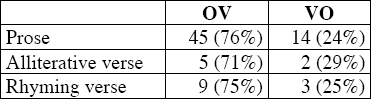
The distribution of the VO/OV order is quite similar in the three text types.
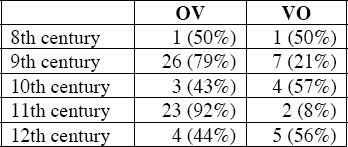
Second, at least with respect to diachronic variation, one could expect a high degree of variation. In fact, looking at the centuries in Table 4 below, significant differences may be observed. However, the change does not seem to proceed in a certain direction. For example, one could expect (at least, from the perspective of PDG) that the number of OV cases would increase progressively to the detriment of VO cases. However, our corpus shows no real trend, although this ultimately might have to do with the small amount of data available: Note, for instance, that there are only two examples with a clear word order from the 8th century. Thus, quantitatively speaking, these examples are not very relevant. Only the changes between the 10th and 11th century and between the 11th and 12th century are statistically significant. Notice, however, that we only have a very small amount of data from the 10th and 12th century. Therefore, we prefer not to attribute too much importance to the low p value in this case.
Comparison of VO/OV order throughout centuries.
Finally, we considered the place of origin of the texts (see Table 5). Here again, we observed little variation across the dialects. Notice that the Central German dialects in our corpus (Central Franconian and Rhine Franconian) show no examples of the VO order, but this could be explained by the small amount of data considered.
Comparison of VO/OV order across dialects.
Fisher Exact p>0.05.

Thus, this preliminary investigation of these three variables (text types, time, and place of origin of a text) does not reveal any interesting quantitative results. Even the two statistically significant changes between the 10th and 11th and between the 11th and 12th centuries are debatable due to their low absolute values. Therefore, we can start considering primarily linguistic variables that could affect word order in relative clauses.
4. Information-Structural Properties of the Object
Given that theoretical and empirical investigations seem to suggest that the properties of the object could play a crucial role in word order, we also annotated the information-structural properties of the object.Footnote 26 In recent papers on the topic (see Hinterhölzl Reference Hinterhölzl2009, Petrova & Hinterhölzl Reference Petrova, Roland, Gisella and Rosemarie2010, Schlachter Reference Schlachter, Karin and Robert2004, Reference Schlachter2012), it is argued that the position of the object with respect to the verb is determined by its information-structural properties. For instance, based on Behaghel's (Reference Baldauf1932) Gesetz der wachsenden Glieder, Hinterhölzl (Reference Hinterhölzl, Eric and Carola2004, Reference Hinterhölzl2009:51) claims that, in OHG, light elements precede heavy elements. Furthermore, he argues that, being prosodically heavy, focused constituents tend to be realized postverbally. We therefore expect the weight of an object to correlate with its position with respect to the verb: Heavier objects should follow the verb much more frequently than lighter objects. Another important observation in Hinterhölzl Reference Hinterhölzl, Eric and Carola2004, Reference Hinterhölzl2009 is that this generalization only applies to presentational, or new information focus, since contrastive focus is typically realized in preverbal position in OHG. Moreover, it was shown for Yiddish (see, for example, Diesing Reference Diesing1997) that definiteness plays a crucial role in object movement.
Below we present each of the following potential variables separately:
-
(i) weight of the object
-
(ii) definiteness of the object
-
(iii) new information and contrastive focus
We discuss the influence of each variable on the position of the object with respect to the verb in our corpus.
4.1 Weight of the Object
Let us start our discussion with the factor weight (or length). For the investigation of the impact of weight on the position of the object with respect to the verb, we decided to annotate the number of words for each pre- and postverbal object (as well as each predicative object). For instance, the object in the relative clause in 13 was annotated as having a weight of 2, since it consists of two elements.
-
(13)
Table 6 shows the distribution of objects with different weight relative to the verb.
Weight (or length) and VO/OV order.
t-test p:0.13, Cohen's d:0.33.

We used a t-test to check whether the mean value of one group—that is, the mean number of words—is significantly different from the mean value of another group. In this case, the mean weight of the OV group is 1.796, and the mean weight of the VO group is 2.211. The t-test reports a p-value of 0.13, which is not below the typical alpha level of 0.05, and is thus not significant. Cohen's d for this correlation is 0.33, which is typically considered to be only a small association. Despite limited evidence, however, we argue that the data clearly indicate that the weight of the object, operationalized by means of the number of words, has an influence on where the object is positioned. More precisely, the heavier the object, the more likely it is to follow the verb.
4.2. Definiteness of the Object
As mentioned above, in Yiddish, the definiteness of the object has been shown to correlate with a different position with respect to the verb. Hence, we decided to annotate examples according to the (in)definiteness of the object, as shown in 14a and 14b for definiteness and indefiniteness, respectively. However, the definite object in 14a and the indefinite object in 14b both precede the verb.
-
(14)
(In)definiteness of object and VO/OV order.
Fisher Exact p:1, Cramer's V:0.03.

Table 7 shows that there is no correlation between the (in)definiteness of the object and its position relative to the verb. A Fisher Exact p-value of 1 and a meager Cramer's V of 0.034 indicates no association between the variables. However, since many cases had to be excluded here, these results are inconclusive.
4.3. Focus
To test current theories on pre- and postverbal positioning of focused objects (see Hinterhölzl Reference Hinterhölzl, Eric and Carola2004, Reference Hinterhölzl2009), we distinguished the annotation of new information, or presentational focus on the one hand and contrastive focus on the other. Let us discuss new information focus first. Since focus is a projecting property, it may involve the object alone (narrow focus) or the object as part of a larger focused constituent (broad focus). This is illustrated in 15a and 15b, respectively.
-
(15)
In the appositive relative in 15a, only the predicative mannelihches chenist is in focus. In contrast, 15b shows the case of broader focus involving at least the predicate with its object (if not the whole relative clause with its antecedent, given the restrictive character of the relative clause). For our annotation, we decided to annotate narrow and broad focus distinctly, since we expected narrowly focused objects to show different syntactic behavior from broadly focused objects.
With respect to contrastive focus, Hinterhölzl (Reference Hinterhölzl, Eric and Carola2004, Hinterhölzl Reference Hinterhölzl2009) shows convincingly that it occupies a preverbal position in OHG, unlike new information focus. For that reason we decided to annotate special cases in which a clear contrastive interpretation was available. The following example is an interesting case because here a contrastively focused object fails to appear preverbally:
-
(16)
For the statistical part, we considered whether focus type (as a factor) had an influence on the VO/OV order. Then we conducted a post-hoc analysis to see which type of focus contributed most to the observation that the VO order is significantly correlated to object focus. Consider the following contingency matrix:
Object focus and VO/OV order.
Fisher Exact p<0.001, Cramer's V:0.53.
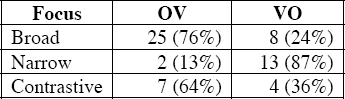
The results of a Fisher Exact test in Table 8 show strong significance, with a p-value well below 0.001 (=0.0001624). These results indicate that the focus type most definitely influences the position of the object relative to the verb. As expected, the effect size, as measured by Cramer's V, is at 0.531, which is considered a strong association between the variables. A post-hoc analysis of the percentage values immediately shows that the narrow focus deviates from the distribution that can be observed for broad and contrastive focus: Narrow focus prefers a VO order, whereas broad and contrastive focus tend to result in an OV order, as predicted by the theoretical work on this topic (see Hinterhölzl Reference Hinterhölzl, Eric and Carola2004, Hinterhölzl Reference Hinterhölzl2009, for example).
5. Relative Particles
Another factor that might influence the VO/OV pattern is the presence of a relative particle. As shown in examples 2 and 3 above, relative particles (such as the, de, thi, etc.) are sometimes used to introduce relative clauses, either alone or along with relative pronouns. The traditional assumption is the one espoused in Schrodt Reference Schrodt2004:174 (see also Tomanetz Reference Tomanetz1879:84ff., among others):
Während von einem Relativpronomen eingeleitete Relativsätze Späterstellung des finiten Verbs haben, weisen die von einer Relativpartikel eingeleiteten Sätze Verbzweitstellung auf (…). Die Relativpartikel war somit nicht subordinierend.
While relative clauses that are introduced by a relative pronoun have late placement of the finite verb, relative clauses that are introduced by a relative particle display V2 order. […] Thus, the particle was not subordinating.
According to this view, the relative particle is just an element introducing the relative clause, not a syntactic subordinator. A different approach is the one proposed by Axel-Tober (Reference Axel-Tober2012:195ff.). She interprets the particle as a subordinating element that blocks the movement of the verb, which thus remains in situ. The expected word order is thus the OV order. She explains the deviating VO pattern by assuming that the object has been extraposed in such cases (Axel-Tober Reference Axel-Tober2012:213).
The diverging opinions in the literature led us to test this factor as well. For our calculation, we not only counted those relative clauses that display what is considered to be a relative particle in traditional terms (such as the, de, thi, etc.), but we also considered adverbial elements that behave like particles, such as dir, der, ther, dâ, dâr.Footnote 27 Hence, we do not distinguish between relative particles and relative adverbs, and refer to both categories as relative particles for short (see Diels Reference Diels1906:180ff.). Notice further that, for the sake of comparability across factors, we discuss the test results for the VO/OV order, whereas the results for the V2 versus non-V2 order are provided in note 29.
There was also a methodological reason for doing so: The notion of V2 is theory-dependent, and the V2 versus non-V2 order cannot be easily tested without assuming a particular syntactic theory, which we intended to avoid when collecting and annotating the data. For example, the order in 17a does not allow one to conclude that one is dealing with a V2 pattern, since this order could be interpreted as a case of extraposition, as in 17b (as proposed in Axel-Tober Reference Axel-Tober2012:213).
-
(17)
More generally, the OV order in subordinate clauses is a non-V2 order, but the VO order is not automatically a V2 order. Nonetheless, if the data show robustly that the VO order mostly occurs under certain conditions, then one can conclude that these conditions either correlate with V2 or with the extraposition of the object.
According to our annotation schemes, four combinations were possible: relative particle with OV order, as in 18a; relative particle with VO order, as in 18b; no relative particle with OV order, as in 18c; no relative particle with VO order, as in 18d.
-
(18)
In some cases, these relative elements are homophonous with the locative adverb meaning ‘there’ (see note 27). For that reason it was not always possible to determine whether we were dealing with a particle or with the adverb meaning ‘there’.Footnote 28
To investigate the relationship between the VO/OV order and the presence of a relative particle, we calculated a contingency table with absolute frequencies and percentages of the VO/OV order. We only considered those cases where we were certain about the status of the particle. The results are presented in Table 9.Footnote 29
VO/OV order and presence of relative particle.
Fisher Exact p:1, Cramer's V:0.01.

The Fisher Exact test yields a p-value of exactly 1. These results show that there is no reason to doubt the null hypothesis, that is, that there is no relationship between the VO/OV order and the presence of the particle. This is not surprising, since the observed percentages are almost identical. In addition, Cramer's V for this contingency table is 0.01, which indicates a weak to nonexisting relationship between the VO/OV order and particle occurrence in relative clauses.
With respect to relative particles as possible factors influencing the position of the verb in relative clauses, we can conclude from Table 9 that the presence of a particle does not affect the VO/OV order. It is true that the data are quite limited, and one should be careful in interpreting them. Yet the tendency in our corpus does not support Schrodt's (Reference Schrodt2004:174) conclusion that relative clauses introduced by a particle prefer V2 word order.Footnote 30 We cannot observe any significant difference between the two types of relative clauses, namely, those with a particle and those without a particle. Recall also that for our calculation, we considered all VO cases, not only V2 cases (see note 29). That means that, according to Schrodt's hypothesis, we would have expected an even higher number of VO examples.
6. Definiteness of Antecedents and Specificity of Referents
As sometimes hypothesized in the literature, the VO/OV order may also be influenced by the definiteness of the antecedent and the specificity of the referent. Below, we first consider each factor separately, and then the interaction between them.
6.1 Definiteness of the Antecedent
Axel-Tober (Reference Axel-Tober2012:213) hints at a possible correlation between the definiteness of the antecedent and verb position in MHG prose texts. In particular, she argues that, on the one hand, the definiteness of the antecedent correlates with a verb-final pattern (and the presence of a relative particle). On the other hand, indefiniteness is associated with a V2 order (and with the absence of the particle). She links (in)definiteness to verb position and to the absence/presence of the particle. It would be difficult for us to test both factors simultaneously, given the small amount of data that would fit the calculation. However, if we ignore the particle factor (which was shown to play no important role), the factor definiteness per se could have some influence on the VO/OV patterns in our OHG corpus as well.
We identified all types of antecedents in our corpus, and we annotated them as definite or indefinite, as in 19a and 19b, respectively.Footnote 31
-
(19)
The results of this search are summarized in Table 10.
VO/OV order and (in)definiteness of antecedent.
Fisher Exact p:1, Cramer's V:0.02.

The contingency table above clearly shows no substantial difference between relative clauses with a definite antecedent and those with an indefinite one. In fact, the Fisher Exact and Cramer's V confirm this result. In our corpus, there is probably no correlation between (in)definiteness of the antecedent and verb position.
6.2 Specificity of the Referent
When we talk about specificity, we refer to whether or not a referent can be identified in a certain context. The following example can illustrate the point:
-
(20)
In this simple sentence, a woman is ambiguous between two possible readings. The first reading is the specific one: The speaker is looking for a certain woman—for example, Mary—whom they met before. The second reading is the nonspecific one: For example, the speaker is telling a friend that they would like to have a girlfriend or a wife.
When considering an expression modified by a relative clause, its specificity is determined not only by the antecedent, but also by the content of the relative clause. This is shown in the following examples, where the relative clause disambiguates between the specific and the nonspecific reading:
-
(21)
Thus, the specificity of the referent cannot be only determined based on the semantics of the antecedent. It also depends on the content of the relative clause.
Specificity, in combination with definiteness, seems to play an important role in certain relative clauses in German, namely, in those displaying a V2 order. For PDG, Gärtner (Reference Frey and Karin1998, Gärtner Reference Gärtner2001) shows that V2 relative clauses can only modify an indefinite antecedent with a specific reading, as illustrated by the following examples taken from Gärtner Reference Gärtner2001:119:
-
(22)
Footnote 32
Example 22a contains an indefinite antecedent, which has a nonspecific reading due to the semantics of the following relative clause. The modifying relative clause displays a verb-final pattern. The example in 22b shows the ungrammaticality of 22a if the verb is placed in the second position of the relative clause. However, if the indefinite antecedent is modified by a relative clause that renders the referent specific, then a relative clause with a V2 pattern is acceptable, as in 22c.
Similar observations on earlier stages of the language were made by Axel-Tober (Reference Axel-Tober2012:207ff). Among others, she illustrates this phenomenon by means of example 5b, repeated here as 23.
-
(23)
Nonetheless, we should point out that for earlier stages of the language, the position of the verb with respect to the object was influenced by other factors, as already noted. For instance, in a generative framework, one cannot exclude the possibility that in 23, it is the object—and not the verb—that moved. All these considerations led us to annotate specificity, too, and to assess its role in determining the position of the verb. Below, we show how specificity affects word order. In the next section, we discuss the effect of the interaction of definiteness and specificity.
With respect to specificity, in our corpus we have examples both of specific and nonspecific referents, as shown in 24a and 24b, respectively.Footnote 33
-
(24)
Footnote 24
The following contingency table illustrates the distribution of VO/OV order in relation to the (non)specificity of the referent:
VO/OV order and (non)specificity.
Fisher Exact p:0.19, Cramer's V:0.19.

Even though the data show a preference for the OV pattern in both cases, the VO order is much more frequent in specific cases than in nonspecific ones. Notice, however, that the Fisher Exact test yields a p-value that is statistically not significant (given the typical α-level of 0.05). Thus, we cannot conclude that specificity alone is to be considered as a factor triggering the VO order.
6.3 Interaction of Definiteness and Specificity
We have shown that at least in PDG, the interaction of definiteness and specificity appears to influence the position of the verb in a relative clause. The following table shows the frequency distribution of the relative clauses across the three variables simultaneously.Footnote 35
VO/OV order and definiteness and specificity.
Fisher Exact p:0.39, Cramer's V:0.25.
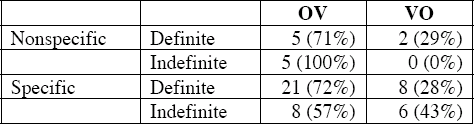
We should point out that the small amount of data in each cell calls for caution in their statistical interpretation. Even though the Fisher Exact test shows no statistical significance, Cramer's V indicates a moderately strong association between the variables. A tendency is clear if one compares Table 11 with Table 12. While definiteness seems to remain untouched by the specificity versus nonspecificity of the referent, the same cannot be said for indefiniteness, which shows an absolute preference for the OV order in the case of nonspecific referents. While in our corpus, no case for nonspecific indefinites with VO order is provided, nearly half of the cases of specific indefinites display that order. This fact seems to be in line with the observations in Gärtner Reference Gärtner1998, Reference Gärtner2001 and Axel-Tober Reference Axel-Tober2012:207ff. on V2 relative clauses in PDG and in earlier stages of the language.
The relationship between these parameters can be visualized in a mosaic plot:
VO/OV order and (in)definiteness and (non)specificity.

Despite the small set of data, Figure 1 shows a very interesting pattern with respect to the influence of the definiteness of the antecedent and the specificity of the referent on word order. In particular, the following observations can be made:
-
(i) The VO/OV order is by no means affected by definiteness. The VO to OV ratio is the same regardless of whether the antecedent is definite or indefinite.
-
(ii) Specificity seems to play a fundamental role in OV order, but it has an even stronger influence on VO order. In VO cases, nonspecific indefinite referents are absent in our corpus. VO cases correlate more strongly with specificity of the referent than OV cases. Not only definite specific referents trigger VO order, but also indefinite specific ones.
Still investigating the semantic properties of antecedent and relative clauses in combination, the next section focuses on the restrictiveness of the relative clause.
7. Restrictiveness
Several studies indicate that the types of relative clauses influence their phono-syntax, semantics, illocution, and information structure (compare Holler Reference Holler2005:25ff.). For the purposes of our investigation, we distinguish between appositive and restrictive relative clauses, as in 25a and 25b, respectively. However, we also annotated a third type—free relative clauses, as in 25c—separately.Footnote 36
-
(25)
Footnote 37
With respect to information structure, Holler (Reference Holler2005:68) among others points out that in contrast to restrictive relative clauses, appositive relative clauses are not integrated in the focus-background-structure of the hosting clause, and that they thus form an information unit of their own (see section 4).
If this also holds for OHG, one would expect restrictive clauses to display a much more limited information-structural potential compared to appositive clauses. Our predictions are twofold:
-
(i) If the VO order is often associated with (narrow) new information focus on the object (section 4), then appositive relative clauses should allow this order more liberally than restrictive clauses.
-
(ii) If a higher illocutionary and information-structural potential typically finds realization in V2 structures, then one would expect for appositive relative clauses to display VO order more frequently than restrictive ones.
Both points lead us to hypothesize that appositive relative clauses would show a higher frequency of VO. This hypothesis is borne out in our data. The underlying question was: Is there a specific word order for each type of relative clause, or is the variation in the VO/OV order not influenced by the type? In order to test this, we compared the types of relative clauses with the VO/OV order (by excluding uncertain cases) and obtained the following contingency table:
VO/OV order and type of restrictive clause.
Fisher Exact p<0.001, Cramer's V:0.46.

The Fisher Exact test finds a p-value of 0.0006, which is much smaller than the usual α-level of 0.05.Footnote 38 This strongly significant (p<0.001) correlation indicates that VO/OV order is very unlikely to be randomly related to the type of relative clause. Cramer's V is 0.46, which is generally considered to be indicative of a very strong association between VO/OV order and the type of relative clause.Footnote 39
As to whether or not the VO/OV pattern is influenced by the type of the relative clause, Table 13 clearly shows that the answer is positive. The postverbal position of the object is clearly much more frequent in appositive clauses, which in fact seems to correlate with their peculiar illocutionary force and information structure. As discussed above (see also Holler Reference Holler2005:58ff.), appositive relative clauses are characterized by an independent illocutionary force and information structure. They differ from restrictive relative clauses, which typically depend on the matrix clauses both for their illocutionary force and information structure. This explains the different realization of (narrowly) focused postverbal objects in the two types, namely, appositives and restrictives.
Notice that free relative clauses show a distribution that is almost identical to that of restrictive relative clauses. This is not surprising if one assumes that free relative clauses are just a special type of restrictive relative clauses that lack an overt antecedent in the matrix clause. In addition, we considered the position of the subject with respect to the verb in relation to the type of relative clause, which is represented in Table 14.Footnote 40
SV/VS order and type of relative clause.
Fisher Exact p:0.13, Cramer's V:0.32.

The absolute values in this contingency table are very low, yielding unreliable percentages, and absolute caution should be applied when interpreting them. Nonetheless, it is, first of all, obvious that the VS order is rare, which was already apparent from Table 2 (and related discussion). The Fisher Exact test returns a p-value of 0.13 indicating a 13% chance that this frequency distribution would have been observed if the type of relative clause were unrelated to the order of subject and verb. The related Cramer's V of 0.32 indicates a relatively strong association between the type of relative clause and the SV/VS order.
Table 14 shows that postverbal subjects are in general disfavored if compared to postverbal objects in Table 14. This probably has to do with grammatical factors colliding with information-structural ones. Although it is still possible to extrapose subjects in OHG main clauses, they tend to be excluded from this position not for information-structural reasons, but rather for syntactic ones.Footnote 41
8. Conclusion
In this study, we analyzed the properties of OHG relative clauses, based on a corpus of minor texts. We discussed a number of aspects often described in the literature on OHG relative structures. In order to do this, we carried out statistical research based on a modern corpus investi-gation, which is a desideratum in the field of historical linguistics. Our aim was to examine the position of the finite verb with respect to its arguments, in particular to the object. Since the first written attestations, the typical order of subordinate clauses has been OV. Thus, our first question was: Do relative clauses follow this general tendency? How often do they deviate from this pattern? Then, we tested the factors that are reported or could be assumed to determine VO versus OV patterns. Let us summarize the major findings of this investigation:
-
(i) Our corpus revealed that the type of texts (prose, alliterative verse, or rhyming verse) cannot be considered to be a factor determining the reciprocal position of verbs and objects in relative clauses. Contrary to expectations, time and place of origin of the texts did not show quantitative influence either.
-
(ii) Some of the information-structural properties of the object were shown to play a fundamental role, in particular:
-
a. With respect to the factor weight (or length), it was shown that heavier constituents tend to be realized more often in postverbal position than lighter constituents, but our calculations did not reveal any statistically significant results.
-
b. The definiteness of the object did not show any statistically significant association with the position of the verb either, in contrast to what was pointed out for Yiddish, for instance.
-
c. In contrast, focus reveals a strong correlation with the position of the object with respect to the verb. In particular, narrow focus on the object is responsible for its postverbal position, whilst contrastive focus is associated with a preverbal position (as in the case of broad focus). This is in line with what has been proposed in the literature on the topic (mainly based on major OHG texts).
-
-
(iii) The presence of particles, which were not particularly frequent in our corpus, was shown not to correlate with the distribution of VO/OV patterns.
-
(iv) No statistically significant results—albeit with an indication of association—ensued from the investigation of the interaction of word order either with the definiteness of the antecedent or with the specificity of the referent (or with both properties simultaneously).
-
(v) Our research showed that the type of relative clause (restrictive versus nonrestrictive) plays a role in determining word order: Our analysis yielded statistically significant results. This was ultimately explained in terms of information structure.
To sum up, our corpus-based investigation revealed that the postverbal position of the object within a relative clause is strongly associated with the information-structural properties of the object and, more generally, with the information-structural properties of the relative clause. The preverbal position of the object is the unmarked position, which is typical for subordinate clauses. This pattern is thus also observed in the case of broad focus or contrastive focus on the object. Conversely, the postverbal position seems to be restricted to the cases in which the object is narrowly focused or, more generally, in which the relative clause exhibits a higher illocutionary potential (for example, in appositive contexts).
Primary Texts
- AB
-
Altbairische Beichte. Elias von Steinmeyer (Reference Steinmeyer1916:309)
- BB
-
Bruchstück einer Beichte. Elias von Steinmeyer (Reference Steinmeyer1916:326–327)
- BR1
-
Basler Rezepte 1. Elias von Steinmeyer (Reference Steinmeyer1916:39–42)
- Ch
-
Christus und die Samariterin. Elias von Steinmeyer (Reference Steinmeyer1916:89–91)
- DD
-
De definitione. Elias von Steinmeyer (Reference Steinmeyer1916:118–120)
- H
-
Hildebrandslied. Elias von Steinmeyer (Reference Steinmeyer1916:1–15)
- HiH
-
Himmel und Hölle. Elias von Steinmeyer (Reference Steinmeyer1916:153–155)
- L
-
Ludwigslied. Elias von Steinmeyer (Reference Steinmeyer1916:85–88)
- M
-
Muspilli. Elias von Steinmeyer (Reference Steinmeyer1916:66–81)
- MF
-
Monseer Fragmente. Hench, George A. (ed.) 1890. The Monsee Fragments. Newly collated text with introduction, notes, grammatical treatise and exhaustive glossary and a photo-lithographic fac-simile. Straßburg.
- MB
-
Mainzer Beichte. Elias von Steinmeyer (Reference Steinmeyer1916:329–331)
- T
-
Tatian. Masser, Achim (ed.) 1994. Die lateinisch-althochdeutsche Tatianbilingue Stiftsbibliothek St. Gallen Cod. 56. Göttingen.
- TV
-
Trierer Verse. Elias von Steinmeyer (Reference Steinmeyer1916:399–400)
- WK
-
Weissenburger Katechismus. Elias von Steinmeyer (Reference Steinmeyer1916:29–18)
Links
Selected texts
Alemannischer Glauben und Beichte; Altbairische Beichte; (Münchner) Augensegen; Bamberger Blutsegen; Basler Rezepte 1; Basler Rezepte 2; Benediktbeurer Glaube und Beichte III; Binger Inschrift (Rheinfränkische Grabinschrift); Bruchstück einer Beichte (Vorauer Beichte); (Deutsche) Buchunterschrift (Weingartner Buchunterschrift); Christus und die Samariterin; Contra Malum Malannum; De Definitione (Bruchstück einer Logik); De Heinrico; (Fuldaer) Federprobe; Gebetbruchstück; Geistliche Ratschläge; Georgslied; Hammelburger; Markbeschreibung; (Zürcher) Hausbesegnung (Sangaller Haussegen); Hildebrandslied; Himmel und Hölle; Hirsch und Hinde; Jüngere Bairische Beichte; (Althochdeutsche) Lex Salica; Lorscher Bienensegen; Ludwigslied; Mainzer Beichte; Memento Mori; Merseburger Zaubersprüche; Muspilli; Pariser Blutsegen; Petruslied; Pfälzer Beichte; Priester Eid; Reimspruch; Sigiharts Gebet; St. Galler Glaube und Beichte I; St. Galler Glauben und Beichte III; St. Galler Schreibervers; St. Galler Spottvers 1; St. Galler Spottvers 2; St. Galler Sprichwörter; Strassburger Blutsegen; Straßburger Eide; Trierer Verse (Wider den Teufel); Weissenburger Katechismus; Wessobrunner Gebet; Wiener Hundesegen
Information on Annotation and Tags
This study benefited from the data set provided by the project Old German Reference Corpus. OGRC includes annotated versions of all OHG and Old Low German texts. The annotation encompasses, amongst others, lemmatization, word classes, and morphological annotation. There are no syntactic comments using treebank annotation. Nevertheless, some specific syntactic information is recorded using a simple linear schema, which allows searches for certain clause types, such as relative clauses.
Since treebanks are excluded from annotation, no syntactic dependencies can be shown except using tags for object clause, subject clause, adverbial clause, etc. For some special cases, different annotation tiers were combined in order to give an easy and pragmatic way to find these constructions in the database. Thus, free relatives that function as object or subject arguments in the main clause are tagged as subject clauses and object clauses, respectively, and the clause introducing element is marked as a relative pronoun, as expected. On the one hand, this leads to the strange fact that these relatives are annotated as argument clauses introduced by a relative pronoun. On the other hand, however, the advantage is that one is able to find these—and only these—free relatives in a very simple way.
Our study is based on a dataset created on the basis of the following queries in the OGRC database:
-
a. Relative clauses
clause=/CF.*_[IU]_Rel/
-
b. Free relatives that function as arguments
clause=/CF_I_(O|S)/ & pos=/DDSREL/ & #1_1_#2
-
c. Main clauses introduced by a substituting demonstrative
clause=/CF_U_M / & pos=/DDS/ & #2_1_#1
See http://korpling.german.hu-berlin.de/annis3/ddd/ for details on Annis Query Language (AQL). Annotation tags used in the queries: CF = clause finite; DDS = determiner, demonstrative, substituting; DDSREL = determiner, demonstrative, substituting, relative; I = introduced; M = main; O = object; Rel = relative; S = subject; U = unintroduced
R Code Used
The following R code was used in this paper for the quantitative analysis, the inferential statistics, and the visualization.



