Introduction
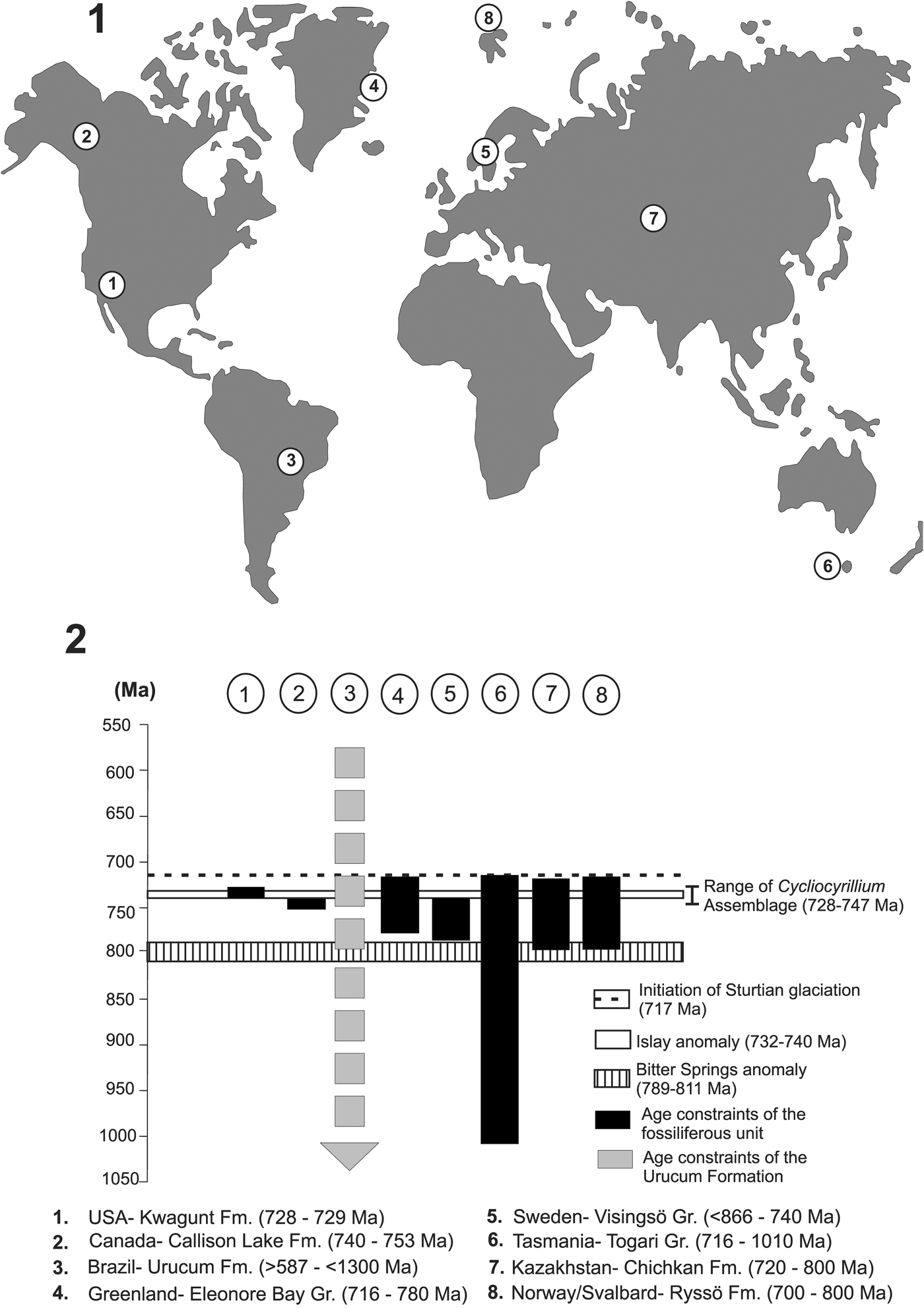
Vase-shaped microfossils (VSMs) are tests of an abundant, relatively diverse, and geographically widespread group of protists that thrived for a limited interval of mid-Neoproterozoic time (Fig. 1). Morphologically, VSMs are hollow structures, approximately 100 microns in maximum dimension, with a single aperture; they may be discoidal, spheroidal to ovoid, or vase- to flask-shaped, with organic or diagenetically (and possibly biogenically) mineralized walls, some possibly covered originally by scales and some with a collar or neck-like oral extension (Bloeser et al., Reference Bloeser, Schopf, Horodyski and Breed1977; Knoll and Vidal, Reference Knoll and Vidal1980; Knoll and Calder, Reference Knoll and Calder1983; Green et al., Reference Green, Knoll and Swett1988; Turner et al., Reference Turner, Black and Kamperman1998; Martí Mus and Moczydłowska, Reference Martí Mus and Moczydłowska2000; Porter and Knoll, Reference Porter and Knoll2000; Sergeev and Schopf, Reference Sergeev and Schopf2010; Strauss et al., Reference Strauss, Rooney, Macdonald, Brandon and Knoll2014; Cohen et al., Reference Cohen, Irvine and Strauss2017; Moczydłowska et al., Reference Moczydłowska, Pease, Willman, Wickström and Agić2017; Morais et al., Reference Morais, Fairchild, Lahr, Rudnitzki, Schopf, Garcia, Kudryavtsev and Romero2017; Riedman et al., Reference Riedman, Porter and Calver2017). Most are preserved as casts and molds (Bloeser et al., Reference Bloeser, Schopf, Horodyski and Breed1977; Knoll and Vidal, Reference Knoll and Vidal1980; Knoll and Calder, Reference Knoll and Calder1983; Bloeser, Reference Bloeser1985; Porter and Knoll, Reference Porter and Knoll2000; Sergeev and Schopf, Reference Sergeev and Schopf2010; Riedman et al., Reference Riedman, Porter and Calver2017), although carbonaceous remains of originally organic test walls have been reported as rare occurrences in some assemblages (Knoll and Calder, Reference Knoll and Calder1983; Bloeser, Reference Bloeser1985; Knoll et al., Reference Knoll, Swett and Mark1991; Cohen et al., Reference Cohen, Irvine and Strauss2017; Riedman et al., Reference Riedman, Porter and Calver2017) but predominate in the Urucum Formation (Morais et al., Reference Morais, Fairchild, Lahr, Rudnitzki, Schopf, Garcia, Kudryavtsev and Romero2017). It is widely accepted (although not necessarily correct) that the 18 described species of VSMs form a polyphyletic grouping, possibly related to extant testate amoebae found within the Rhizaria and Amoebozoa (Schopf, Reference Schopf, Schopf and Klein1992; Porter and Knoll, Reference Porter and Knoll2000; Porter et al., Reference Porter, Meisterfeld and Knoll2003).
(1) Geographic distribution and (2) age constraints of principal Neoproterozoic stratigraphic units in which vase-shaped microfossils (VSMs) occur. References: 1. Chuar Group, Arizona, USA (Porter et al., Reference Porter, Meisterfeld and Knoll2003; Rooney et al., Reference Rooney, Austermann, Smith, Li, Selby, Dehler, Schmitz, Karlstrom and Macdonald2017); 2. Callison Lake Formation, Canada (Strauss et al., Reference Strauss, Rooney, Macdonald, Brandon and Knoll2014; Cohen et al., Reference Cohen, Irvine and Strauss2017); 3. Urucum Formation, Brazil (Morais et al., Reference Morais, Fairchild, Lahr, Rudnitzki, Schopf, Garcia, Kudryavtsev and Romero2017); 4. Upper Eleonore Bay Group, Greenland (Vidal, Reference Vidal1979; Green et al., Reference Green, Knoll and Swett1988; Riedman et al., Reference Riedman, Porter and Calver2017); 5. Visingsö Formation, Sweden (Knoll and Vidal, Reference Knoll and Vidal1980; Moczydłowska et al., Reference Moczydłowska, Pease, Willman, Wickström and Agić2017); 6. Togari Group, Tasmania (Saito et al., Reference Saito, Tiba and Matsubara1988; Turner et al., Reference Turner, Black and Kamperman1998; Riedman et al. Reference Riedman, Porter and Calver2017); 7. Chichkan Formation, Kazakhstan (Sergeev and Schopf, Reference Sergeev and Schopf2010); 8. Backlundtoppen Formation, Svalbard, Norway (Knoll and Calder, Reference Knoll and Calder1983).

Similarities between morphotypes in different assemblages led earlier authors to suggest their potential use for Neoproterozoic biostratigraphy (Knoll and Vidal, Reference Knoll and Vidal1980; Porter and Knoll, Reference Porter and Knoll2000; Dehler et al., Reference Dehler, Elrick, Karlstrom, Smith, Crossey and Timmons2001). This idea has recently gained substantial support on two fronts: first, from new finds in the Callison Lake Formation of northwest Canada (Strauss et al., Reference Strauss, Rooney, Macdonald, Brandon and Knoll2014; Cohen et al., Reference Cohen, Irvine and Strauss2017), Visingsö Group of Sweden (Moczydłowska et al., Reference Moczydłowska, Pease, Willman, Wickström and Agić2017), and Togari Group of Tasmania (Riedman et al., Reference Riedman, Porter and Calver2017) and, second, from improved stratigraphic correlation (Cohen and Macdonald, Reference Cohen and Macdonald2015). Although possible exceptions exist (e.g., Anderson et al., Reference Anderson, Fairchild, Tosca and Knoll2013), well-documented and unambiguous VSMs described to date predate the onset of Cryogenian glaciation at about 717 Ma (Ewetz, Reference Ewetz1933; Macdonald et al., Reference Macdonald, Halverson, Strauss, Smith, Cox, Sperling and Roots2010) and postdate the Bitter Springs carbon isotope anomaly (ca. 811 Ma), as discussed by Riedman et al. (Reference Riedman, Porter and Calver2017).
Recent identification of three new and two previously described species of VSMs in the Urucum Formation, lower Jacadigo Group, Brazil (Fairchild et al., Reference Fairchild, Barbour and Haralyi1978; Morais et al., Reference Morais, Fairchild, Lahr, Rudnitzki, Schopf, Garcia, Kudryavtsev and Romero2017), prompted us to ask whether the newly described Brazilian species might be recognized in other published assemblages, specifically those housed in collections at the University of California at Santa Barbara and Harvard University. We thus reexamined petrographic thin sections from the Kwagunt Formation (Chuar Group, USA; Bloeser, Reference Bloeser1985; Porter and Knoll, Reference Porter and Knoll2000; Porter et al., Reference Porter, Meisterfeld and Knoll2003) and Callison Lake Formation (Canada; Strauss et al., Reference Strauss, Rooney, Macdonald, Brandon and Knoll2014; Cohen et al., Reference Cohen, Irvine and Strauss2017), the two richest and most diverse of known VSM assemblages, as well as material from the Visingsö Group in Sweden (Knoll and Vidal, Reference Knoll and Vidal1980; Martí Mus and Moczydłowska, Reference Martí Mus and Moczydłowska2000; Moczydłowska et al., Reference Moczydłowska, Pease, Willman, Wickström and Agić2017), upper Eleonore Bay Group, Greenland (Vidal, Reference Vidal1979; Green et al., Reference Green, Knoll and Swett1988), and Ryssö Formation, Svalbard (Knoll and Calder, Reference Knoll and Calder1983).
Taxonomic differentiation of VSMs began with Bloeser's (Reference Bloeser1985) description of three species of Melanocyrillium in the Kwagunt Formation. Working with new assemblages found higher in the unit, Porter et al. (Reference Porter, Meisterfeld and Knoll2003) revised Bloeser's taxonomy of the Chuar VSMs, identifying 12 species distributed among nine genera. Eight of these taxa were subsequently recognized by Strauss et al. (Reference Strauss, Rooney, Macdonald, Brandon and Knoll2014) in the coeval Callison Lake Formation; six of the eight were formally described later by Cohen et al. (Reference Cohen, Irvine and Strauss2017) along with two new species. At about the same time, Morais et al. (Reference Morais, Fairchild, Lahr, Rudnitzki, Schopf, Garcia, Kudryavtsev and Romero2017) described three new genera and species (plus two species also shared with the Kwagunt and Callison Lake assemblages) from dolostone clasts within the Urucum Formation of Brazil, while Riedman et al. (Reference Riedman, Porter and Calver2017) identified eight species of VSMs (including one new genus and species) in the Togari Group of Tasmania. With this, the number of valid VSM species currently stands at 18, distributed among 13 genera. This does not count five species of Caraburina Kraskov, Reference Kraskov1985, known only from the Chatkaragai Suite of Kyrgyzstan (Kraskov, Reference Kraskov1985; Kraskov and Yankaouskas, Reference Kraskov, Yankaouskas and Yankaouskas1989), whose reexamination by Riedman et al. (Reference Riedman, Porter and Calver2017) revealed that the distinguishing characteristics of the genus are taphonomic rather than biological.
Riedman et al. (Reference Riedman, Porter and Calver2017) recently published the results of a survey similar to that undertaken here in which they extended the known occurrences of VSM species among diverse stratigraphic units of Tasmania, Svalbard, Greenland, Sweden, and the Yukon. Their paper also confirmed that these fossils are no older than the Bitter Springs carbon isotope anomaly as well as that they extend into the Islay anomaly but disappear prior to the Sturtian glaciation. They thus identify a set of five species, dubbed the ‘Cycliocyrillium simplex assemblage’—Cycliocyrillium simplex Porter, Meisterfeld, and Knoll, Reference Porter, Meisterfeld and Knoll2003, Cycliocyrillium torquata Porter et al., Reference Porter, Meisterfeld and Knoll2003, Melanocyrillium hexodiadema Porter, Meisterfeld, and Knoll, Reference Porter, Meisterfeld and Knoll2003, Bonniea dacruchares Porter, Meisterfeld, and Knoll, Reference Porter, Meisterfeld and Knoll2003, and B. pytinaia Porter, Meisterfeld, and Knoll, Reference Porter, Meisterfeld and Knoll2003—that have only been reported from the uppermost Tonian, specifically from the interval between 789 Ma and 729 Ma, and therefore are biostratigraphically significant. Here we build on this analysis by focusing on taxa originally described from Brazilian localities not surveyed by Riedman et al. (Reference Riedman, Porter and Calver2017). To our surprise, our investigation also revealed two additional previously described VSM species in the Urucum assemblage. These findings both suggest that additional VSM taxa may be biostratigraphically useful and provide a potential age for the host rock that furnished VSM-bearing clasts to the Urucum Formation.
Geologic setting of the Urucum, Kwagunt, and Callison Lake formations
Urucum Formation
Morais et al. (Reference Morais, Fairchild, Lahr, Rudnitzki, Schopf, Garcia, Kudryavtsev and Romero2017) recently reviewed the geological context of this formation, which we briefly summarize here. The Brazilian VSMs occur in dolostone clasts within coarse-grained deposits near the base of the 400 m thick Urucum Formation, Jacadigo Group, in the Urucum District at Corumbá, Mato Grosso do Sul (MS) (Almeida, Reference Almeida1964; Boggiani and Alvarenga, Reference Boggiani, Alvarenga, Mantesso-Neto, Bartorelli, Carneiro and Brito-Neves2004; Freitas et al., Reference Freitas, Warren, Boggiani, De Almeida and Piacentini2011). This unit is overlain by a succession more than 300 m thick mostly of iron formation named the Santa Cruz Formation by Almeida (Reference Almeida1945) and Banda Alta Formation by Dorr (Reference Dorr1945) (see Morais et al., Reference Morais, Fairchild, Lahr, Rudnitzki, Schopf, Garcia, Kudryavtsev and Romero2017, p. 395). Current thinking is that deposition of the iron formation occurred under the influence of late Neoproterozoic glacial conditions (Barbosa, Reference Barbosa1949; Dorr, Reference Dorr1973; Urban et al., Reference Urban, Stribrny and Lippolt1992; Angerer et al., Reference Angerer, Hagemann, Walde, Halverson and Boyce2016; Frei et al., Reference Frei, Dossing, Gaucher, Boggiani, Frei, Árting, Crowe and Freitas2017).
The VSMs are at least as old as the basal deposits of the Jacadigo Group, whose minimum depositional age of 587 ± 7 Ma derives from the burial-heating age of cryptomelane in manganese formation near the base of the Santa Cruz Formation (40Ar/39Ar, Piacentini et al., Reference Piacentini, Vasconcelos and Farley2013). Geochronological evidence bearing upon the maximum age of the group includes a U-Pb sensitive high-resolution ion microprobe (SHRIMP) zircon age of 1,861 ± 5 Ma (Redes et al., Reference Redes, Sousa, Ruiz and Lafon2015) for the crystalline basement, an age of 1,300 Ma (Ar/Ar) for the last regional heating of the Rio Apa block, on which the Jacadigo Group lies (Cordani et al., Reference Cordani, Teixeira, Tassinari, Coutinho and Ruiz2010), and a K-Ar age of 889 ± 44 Ma by Hasui and Almeida (Reference Hasui and Almeida1970) for a basement granite feldspar. O'Connor and Walde (Reference O'Connor and Walde1986), however, alleged a much younger maximum depositional age of 623 ± 15 Ma for the Jacadigo Group based on K-Ar dating of acid volcanics of the Pimienta Formation, supposedly at the base of the Jacadigo equivalent (Boqui Group) in Bolivia, but unknown in Brazil; hence, the relevance of this date for Jacadigo sedimentation is conjectural (Angerer et al., Reference Angerer, Hagemann, Walde, Halverson and Boyce2016). The youngest detrital zircon in the Santa Cruz Formation suggests a maximum depositional age of 695 ± 17 Ma (U-Pb, Frei et al., Reference Frei, Dossing, Gaucher, Boggiani, Frei, Árting, Crowe and Freitas2017) for the upper part of the group. Consistent with this is a broadly permissive five-point Nd-Sm isochron age of 566 ± 110 Ma obtained by Viehmann et al. (Reference Viehmann, Bau, Bühn, Dantas, Andrade and Walde2016) for deposition of the iron formation. These data thus set a minimum age for the VSM-bearing clasts at about 587 Ma but do not precisely constrain their maximum age. The stratigraphic relationship between the rudites containing the VSM-bearing clasts in the Urucum Formation and the iron formation in the overlying Santa Cruz Formation means that the carbonate that furnished the clasts must have been deposited and reworked no later than the glacial episode that influenced ferruginous sedimentation (Angerer et al., Reference Angerer, Hagemann, Walde, Halverson and Boyce2016; Frei et al., Reference Frei, Dossing, Gaucher, Boggiani, Frei, Árting, Crowe and Freitas2017). In light of the 587 Ma burial heating age of the Santa Cruz Formation (Piacentini et al., Reference Piacentini, Vasconcelos and Farley2013), that episode was more likely related to the Cryogenian Sturtian or Marinoan events than to the 580-million-year-old Gaskiers glaciation.
The provenance of the VSM-bearing clasts is currently unknown, but all clasts present identical taphonomic and diagenetic signatures, different from those of intraformational Urucum carbonate beds investigated to date. This suggests a single source, possibly a pre-Jacadigo carbonate platform that has since been completely eroded. However, a source within the Urucum Formation cannot be ruled out and may yet be identified in poorly studied areas around Corumbá and along the Brazil–Bolivia border to the north and northwest.
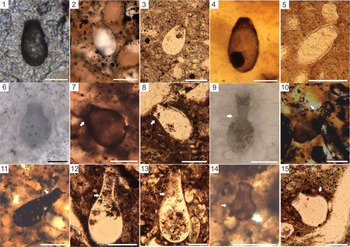
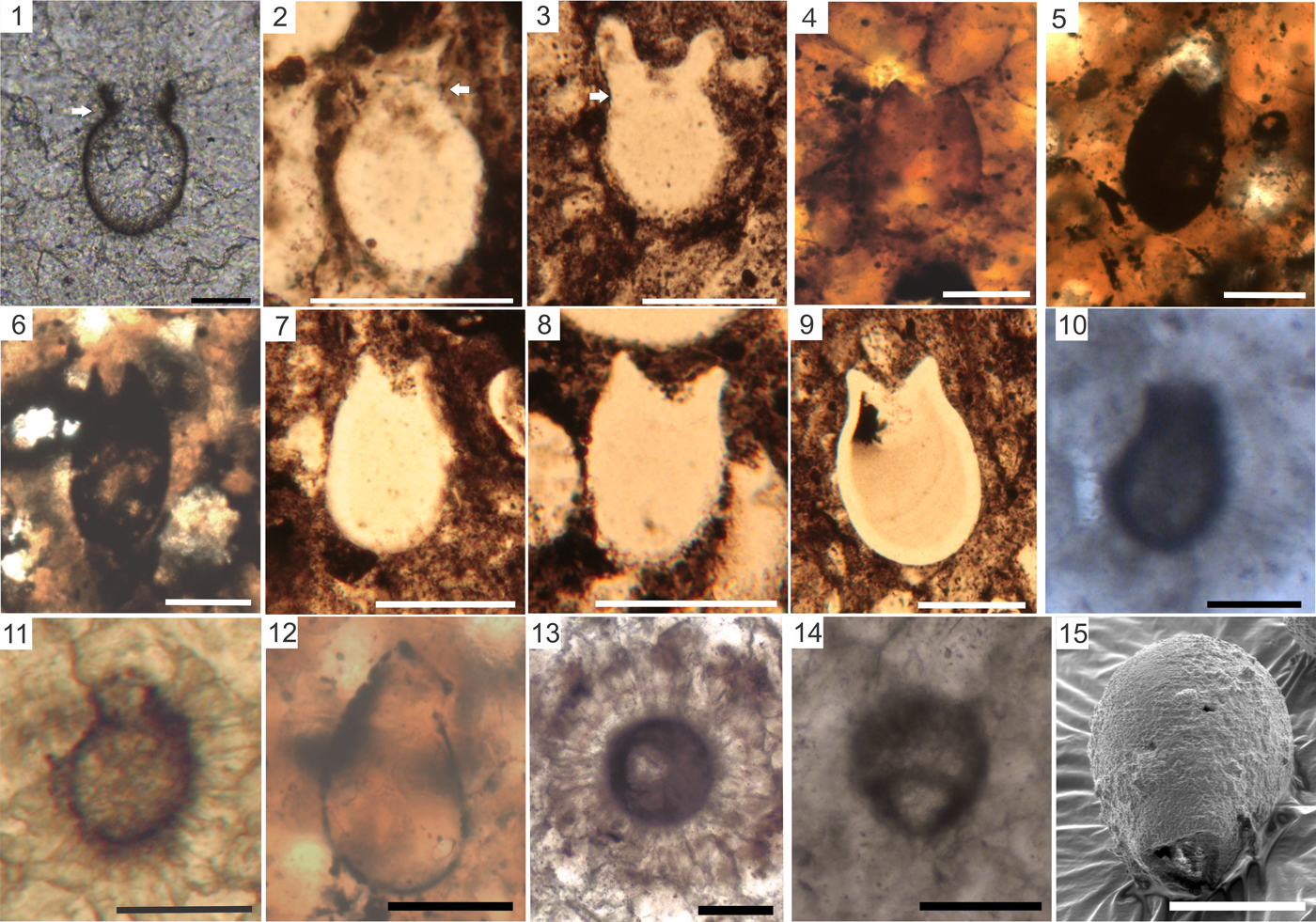
Despite preservation of the carbonaceous test walls of the VSMs in these clasts, other primary sedimentary structures in general were adversely affected by diagenesis (especially dolomitization and recrystallization). Nevertheless, ghost-like textural features permit useful paleoenvironmental and diagenetic inferences. For example, the isopachous, fibrous to bladed habit of the carbonate encasing most of the VSMs (and less commonly coating inner test walls) (Figs. 2.1, 3.1, 3.13) is evidently a palimpsest of an originally calcitic and/or aragonitic cement suggestive of deposition and early diagenesis in a coastal marine setting (Tucker and Wright, Reference Tucker and Wright1990; Morais et al., Reference Morais, Fairchild, Lahr, Rudnitzki, Schopf, Garcia, Kudryavtsev and Romero2017). In one of the VSM-bearing clasts examined here, a finely laminated domed microbialite, lamination is clear to the unaided eye.
Photomicrographs of selected VSM species observed in petrographic thin sections of the stratigraphic units investigated here. Arrows point to base of collar or neck where present. EFS = England Finder Slide coordinates. Scale bars = 50 μm. (1–5) Cycliocyrillium simplex Porter et al., Reference Porter, Meisterfeld and Knoll2003. (1) Carbonaceous test enclosed by fibrous cement in dolostone clasts, Urucum Formation (GP/5T-2536E); (2) siliceous mold, Kwagunt Formation (AK-1053-13A); (3) siliceous mold in dolostone, Callison Lake Formation (F930-15-5); (4) organic test in siliceous ooid, Eleonore Bay Group (GR2880-8); (5) Siliceous mold in phosphatic nodule, Visingsö Group (V72-G14/Harvard University Herbaria Paleobotanical Collection 63100). (6–8) Cycliocyrillium torquata Porter et al., Reference Porter, Meisterfeld and Knoll2003. (6) Siliceous test enclosed by fibrous cement in dolostone clast, Urucum Formation (GP/5T-25532 G); (7) siliceous mold, Kwagunt Formation (AK-1053-13F); (8) siliceous mold in dolostone, Callison Lake Formation (F930-15.5). (9–13) Limeta lageniformis. (9) Carbonaceous test in dolostone clasts, Urucum Formation (GP/5T-2546/EFS = O23-1), photographed using white card technique (see text); (10) pyritized test, Kwagunt Formation (AK-1053-13F1/EFS = R19-3); (11) pyritized test, Kwagunt Formation (AK-1053-13F3/EFS = K28); (12) siliceous mold in dolostone, Callison Lake Formation (J1204-18.1/EFS = E60-3); (13) siliceous mold, in dolostone, Callison Lake Formation (J1204-18.1/EFS = F65-4). (14, 15) Obelix rootsii (Cohen et al., Reference Cohen, Irvine and Strauss2017) new combination. (14) Siliceous mold, Kwagunt Formation (AK-1053-13F1/EFS = J9-2); (15) siliceous mold in dolostone, Callison Lake Formation (F930-15.5).

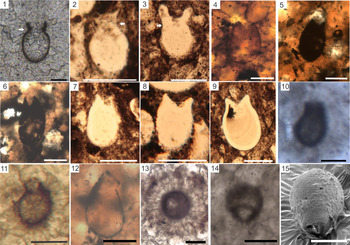
Photomicrographs of selected VSM species observed in petrographic thin sections of the stratigraphic units investigated here. Arrows point to base of collar or neck where present. EFS = England Finder Slide coordinates. Scale bars = 50 μm. (1, 2) Palaeoamphora urucumense Morais et al., Reference Morais, Fairchild, Lahr, Rudnitzki, Schopf, Garcia, Kudryavtsev and Romero2017. (1) Carbonaceous test in dolostone clast, Urucum Formation (GP/5T-2536B); (2) siliceous mold in dolostone, Callison Lake Formation (J1204-16.8/EFS = Y46-1). (3) Palaeoamphora sp.? Siliceous mold in dolostone, Callison Lake Formation. (4–9) Pakupaku kabin Riedman et al., Reference Riedman, Porter and Calver2017. (4) Siliceous mold, Kwagunt Formation (AK-1053-13FB); (5, 6) pyritized tests, Kwagunt Formation (8, AK-1053-13FC/EFS = J21-3; 9, AK-1053-13FB); (7–9) siliceous molds in dolostone, Callison Lake Formation (J1204-18.2). (10–12) Bonniea dacruchares Porter et al., Reference Porter, Meisterfeld and Knoll2003. (10) Lateral view, carbonaceous test in dolostone clast, Urucum Formation (GP/5T-2548 / EFS = V-25); (11) oblique-front view, carbonaceous test in dolostone clast, Urucum Formation (GP/5T-2547/ EFS = E36-2); (12) lateral view, siliceous mold, Kwagunt Formation (AK1053-13F). (13–15) Trigonocyrillium horodyskii (Bloeser, Reference Bloeser1985). (13, 14) Oral views, carbonaceous tests in dolostone clasts, Urucum Formation (13, GP/5T-2548/ EFS = U32-1; 14, GP/5T-2548/ EFS = G30-3); (15) SEM micrograph, siliceous mold extracted from Kwagunt Formation (courtesy S.M. Porter).
Other VSM-bearing deposits
The Chuar Group, exposed in the Grand Canyon, Arizona, consists mostly of variegated mudstones and interbedded meter-scale dolostones, including stromatolites, deposited in a shallow marine embayment within an intracratonic rift basin inboard of the rifted western margin of the Laurentia supercontinent (Karlstrom et al., Reference Karlstrom, Bowring, Dehler, Knoll and Porter2000; Dehler et al., Reference Dehler, Elrick, Karlstrom, Smith, Crossey and Timmons2001; Dehler et al., Reference Dehler, Gehrels, Porter, Heizler, Karlstrom, Cox, Crossey and Timmons2017). The initial 1,000 m corresponds to the Galeros Formation, made up of alternating shales, carbonates, and sandstones; this is followed by 590 m of stromatolites and shales of the Kwagunt Formation (Karlstrom et al., Reference Karlstrom, Bowring, Dehler, Knoll and Porter2000; Porter and Knoll, Reference Porter and Knoll2000, p. 362, fig. 1; Dehler et al., Reference Dehler, Elrick, Karlstrom, Smith, Crossey and Timmons2001). The VSMs occur as siliceous casts and molds in coastal shales of the Awatubi Member and in silicified microbialites within the overlying Walcott Member (Bloeser, Reference Bloeser1985; Horodyski, Reference Horodyski1993) but are most abundant in dolomitic nodules within carbonaceous shales at the top of the Walcott Member, where they occur as siliceous casts and molds, often coated by pyrite or iron oxides (Porter and Knoll, Reference Porter and Knoll2000; Porter et al., Reference Porter, Meisterfeld and Knoll2003). Organically preserved VSMs were reported by Bloeser (Reference Bloeser1985), but this has not been confirmed (Porter and Knoll, Reference Porter and Knoll2000).
The minimum age of the Chuar VSMs is now constrained by a chemical abrasion-thermal ionization mass spectrometry (CA-IDTIMS) U–Pb age of 729.0 ± 0.9 Ma for a tuff ~15 m above the level of VSM-bearing dolomite nodules near the top of the group; a 751 ± 7.6 Ma Re-Os date on early diagenetic sulfides underlies the oldest Grand Canyon VSMs, in the Awatubi Member (Rooney et al., Reference Rooney, Austermann, Smith, Li, Selby, Dehler, Schmitz, Karlstrom and Macdonald2017).
In northwestern Canada, the Callison Lake Formation (Mount Harper Group) was deposited in marginal marine embayments close to the western margin of the Laurentia supercontinent (Strauss et al., Reference Strauss, Macdonald, Halverson, Tosca, Schrag and Knoll2015), much like the Kwagunt Formation, so that the two formations are considered closely correlative. The 530 m thick Callison Lake Formation consists of mixed siliciclastics, carbonates, and evaporites, subdivided into four members, with VSMs present in both the lowest (Heterolithic) and highest (Transitional) members (Strauss et al., Reference Strauss, Rooney, Macdonald, Brandon and Knoll2014, Reference Strauss, Macdonald, Halverson, Tosca, Schrag and Knoll2015; Cohen et al., Reference Cohen, Irvine and Strauss2017). VSMs are crudely preserved in stromatolitic dolostone in the former member but are silicified and thus better preserved in the organic-rich silty shale of the latter (Strauss et al., Reference Strauss, Rooney, Macdonald, Brandon and Knoll2014, p. 659, fig. 1; Cohen et al., Reference Cohen, Irvine and Strauss2017). In both members, VSMs are most abundant within organic-rich intervals. Re-Os geochronology of the fossiliferous strata indicates that the VSMs were deposited between 752.7 ± 5.5 Ma (Strauss et al., Reference Strauss, Rooney, Macdonald, Brandon and Knoll2014) and 739.9 ± 6.1 Ma (Rooney et al., Reference Rooney, Strauss, Brandon and Macdonald2015; Strauss et al., Reference Strauss, Macdonald, Halverson, Tosca, Schrag and Knoll2015).
Comparative taphonomy
Preservational pathways and quality vary among known VSM assemblages. All assemblages described to date were deposited in marine environments, ranging from peritidal to basinal, and in all cases, tests are preserved three-dimensionally. Porter and Knoll (Reference Porter and Knoll2000) and Porter et al. (Reference Porter, Meisterfeld and Knoll2003) provided detailed descriptions of preservational modes for Kwagunt VSMs. While fossils occur in a range of environmental settings, the best-preserved assemblage was found in early diagenetic dolostone nodules within basinal carbonaceous shales near the top of the Walcott Member, deposited near maximum flooding (Porter and Knoll, Reference Porter and Knoll2000; Porter et al., Reference Porter, Meisterfeld and Knoll2003). VSMs are preserved as silica-filled casts of test interiors and, sometimes, test walls; penecontemporaneous coatings of pyrite (now commonly iron oxides) that formed during decay by sulfate-reducing bacteria replicate test walls, but preservation of organic walls is, at best, rare (Bloeser, Reference Bloeser1985). Strauss et al. (Reference Strauss, Rooney, Macdonald, Brandon and Knoll2014) and Cohen et al. (Reference Cohen, Irvine and Strauss2017) also found that the predominant preservational mode in Callison Lake VSMs was infilling of test interiors by silica, although Cohen et al. (Reference Cohen, Irvine and Strauss2017) also observed organic, argillaceous, and carbonate (siderite or diagenetic dolomite) infillings. Only rarely were cell walls preserved. The abundant VSMs in shales and nodular cherts of the Togari Formation, Tasmania, are preserved much like those in the Kwagunt and Callison Lake formations (Riedman et al., Reference Riedman, Porter and Calver2017).
Set against this, the taphonomy of Urucum VSM populations is different, reflecting the distinct depositional and diagenetic setting (Morais et al., Reference Morais, Fairchild, Lahr, Rudnitzki, Schopf, Garcia, Kudryavtsev and Romero2017). Despite dolomitization and partial recrystallization of the original carbonate of the dolostone clasts, exceptional preservation of original test shapes and, importantly, the organic (now kerogenous) walls of Urucum VSMs was imparted by a thin isopachous rim of drusy cements formed penecontemporaneously with burial (Morais et al., Reference Morais, Fairchild, Lahr, Rudnitzki, Schopf, Garcia, Kudryavtsev and Romero2017, figs. 4.1, 4.2, 6.2). Preservation by isopachous cements is known for Neoproterozoic cyanobacteria (Knoll et al., Reference Knoll, Fairchild and Swett1993), but to the best of our knowledge has not previously been implicated in Precambrian protistan preservation. The empty interior of most tests was eventually filled by (now) sparry mosaic dolomite. In several tests, silica has clearly replaced the wall, but most test walls are kerogenous. Confocal laser scanning microscopy has revealed silica clearly associated with carbon in the wall of a specimen of Cyclocyrillium simplex Porter et al., Reference Porter, Meisterfeld and Knoll2003. Indeed, Morais et al. (Reference Morais, Fairchild, Lahr, Rudnitzki, Schopf, Garcia, Kudryavtsev and Romero2017) have argued, judging from the thickness and unique shape of the wall and characteristics of the encasing cement, that the test wall silica in the holotype of Taruma rata Morais et al., Reference Morais, Fairchild, Lahr, Rudnitzki, Schopf, Garcia, Kudryavtsev and Romero2017 may reflect biomineralization rather than diagenesis.
Materials and methods
VSM collections, including type material, housed at the University of California at Santa Barbara, Harvard University, and the Institute of Geoscience at Universidade de São Paulo were reexamined from October 2016 to January 2017. Forty-four petrographic thin sections representing six stratigraphic units were completely scanned using a Zeiss Axioskop 40 transmitted-light petrographic microscope at both North American institutions. Original descriptions and interpretations of type material were reviewed, and additional morphological, taxonomic, and taphonomic observations were made regarding preservational quality and biological affinity of the VSMs. The material was documented and measured in digital micrographs, using QCapture Suite Plus and Canon Utilities EOS software. Some images were made employing a variation of the ‘white-card’ technique of Folk (Reference Folk1987), in which a piece of white paper placed beneath the thin section diffused the incoming light beam thereby largely eliminating crystal boundaries and providing a clearer view of original rock components, such as ooids, early cement, amorphous and dispersed carbonaceous matter, and microfossils.
The great majority of VSMs in petrographic sections appear in nondiagnostic transverse and oblique sections; hence, measurements were restricted to a relatively small number of VSMs exposed in ideal longitudinal sections. Despite the general abundance of VSMs in all six studied units, the number of ideally oriented specimens varied greatly. Thin sections of the Ryssö Formation, for example, contained few interpretable specimens.
Morphological characteristics of VSMs identified by Porter and Knoll (Reference Porter and Knoll2000) and Porter et al. (Reference Porter, Meisterfeld and Knoll2003) used here include total test length (L), width (W), and aperture diameter (AD). For tests with terminal oral extensions, neck length (NL) and collar neck (CL) were measured; body length (BL) was found by subtracting neck length from length (L – NL) (Morais et al., Reference Morais, Fairchild, Lahr, Rudnitzki, Schopf, Garcia, Kudryavtsev and Romero2017). Aspect ratio was calculated as L/W for all specimens, and for long-necked specimens, aspect ratio of the test body was calculated as BL/W. For Bonniea dacruchares Porter, Meisterfeld, and Knoll, Reference Porter, Meisterfeld and Knoll2003, characterized by a curved neck and apertural plane oblique to the aboral axis, concavity is defined per Porter et al. (Reference Porter, Meisterfeld and Knoll2003, fig. 7) as the acute angle formed by the intersection of planes tangential to the neck and lower wall of the test, and curvature is defined as the acute angle between the oral and aboral axes. In the taxonomic descriptions that follow, mathematical averages are indicated by x̅ and standard deviation by σ.
Repositories and institutional abbreviations
Materials examined in this study include 19 petrographic thin sections from the Kwagunt Formation, southwest USA, previously studied by Porter et al. (Reference Porter, Meisterfeld and Knoll2003) and part of Porter's collections at the University of Santa Barbara (UCSB) with the following slide numbers: AK10-53-13A, B, F, F(A), F(B), F(C), F1, F1(9UQ018), F1(9UQ019), F1(9UQ020), F1(9UQ021), 6b(9UQ023), F3, AK10-60-19(9UQ026), AK10-60-31(9UQ027), shale-3I, and, from Bloeser et al. (Reference Bloeser, Schopf, Horodyski and Breed1977), WAL-13, -31, and -74. Six other sample sets are housed at Harvard University Herbaria, as follows: GR2880-8 (Bed 18, Upper Eleonore Bay Group, Greenland); J1204-16.8, J1204-18.1, F930-15.5 (Callison Lake Formation, northwest Canada); K2082-2A (Ryssö Formation, Svalbard); and V72-G14/Harvard University Herbaria Paleobotanical Collection 63100 (Visingsö Group, Sweden). Twenty thin sections of clasts from the Urucum Formation, southwest Brazil, are in the Micropaleontology Collection of the Laboratório de Paleontologia Sistemática, at the Instituto de Geociências, University of São Paulo (LPS, IGC-USP), under accession numbers GP/5T-2529 through 2548. In our reexamination of thin sections from the Ryssö Formation, we were able to recognize only poorly preserved specimens of Cycliocyrillium simplex Porter et al., Reference Porter, Meisterfeld and Knoll2003.
Systematic paleontology
This study revealed morphological variety additional to that registered by Porter et al. (Reference Porter, Meisterfeld and Knoll2003), Cohen et al. (Reference Cohen, Irvine and Strauss2017), and Morais et al. (Reference Morais, Fairchild, Lahr, Rudnitzki, Schopf, Garcia, Kudryavtsev and Romero2017), raising several taxonomic issues that are addressed in the following. Morphometric data are presented here for the eight species of VSMs whose paleogeographic distribution is here extended; data for six of these species are summarized in Tables 1 to 6 in supplementary material.
Vase-shaped Microfossils
Genus Cycliocyrillium Porter, Meisterfeld, and Knoll, Reference Porter, Meisterfeld and Knoll2003
Type species
Cycliocyrillium simplex Porter et al., Reference Porter, Meisterfeld and Knoll2003
Other species
Cycliocyrillium torquata Porter et al., Reference Porter, Meisterfeld and Knoll2003
Diagnosis
Bulbous to pyriform VSMs having a circular aperture either flush with the test or associated with an uncurved terminal oral extension (collar or short neck); angle between apertural plane and oral axis 90°.
Remarks
We here modify the generic and specific diagnoses for Cycliocyrillium and Cycliocyrillium torquata by using ‘terminal oral extension’ as a general term to include the ‘collars’ and ‘necks’ used in previous descriptions of VSMs. In Morais et al. (Reference Morais, Fairchild, Lahr, Rudnitzki, Schopf, Garcia, Kudryavtsev and Romero2017), for the genus Cycliocyrillium, we formalized an upper limit of 10% total test length for such extensions, but subsequent published systematic descriptions and empirical observations during this petrographic survey have shown that this is not a practical limit to differentiate between C. torquata and Limeta lageniformis Morais, Fairchild, and Lahr in Morais et al., Reference Morais, Fairchild, Lahr, Rudnitzki, Schopf, Garcia, Kudryavtsev and Romero2017, as explained in the following. By the same token, we have transferred Cycliocyrillium rootsii (Cohen et al., Reference Cohen, Irvine and Strauss2017) to a new genus of long-necked VSMs, Obelix (discussion follows).
Cycliocyrillium simplex Porter, Meisterfeld, and Knoll, Reference Porter, Meisterfeld and Knoll2003
Figure 2.1–2.5; Table 1 (supplementary material)
- Reference Ewetz1933
Fossil II Ewetz, p. 509, fig. 6.
- Reference Vidal1979
“Enigmatic, ‘bag-shaped’, ‘chitinozoan-like’ microfossils” Vidal, p. 24, plate 6, figs. A, B.
- Reference Knoll and Vidal1980
“Vase-shaped microfossils” Knoll and Vidal, fig. 1D–G.
- Reference Binda and Bokhari1980
“Flask-shaped forms” Binda and Bokhari, fig. 1D, E.
- Reference Knoll and Calder1983
“Vase-shaped microfossils” Knoll and Calder, plate 61, figs. 2, 3, 7, 8.
- Reference Knoll, Swett and Burkhardt1989
Melanocyrillium Knoll, Swett, and Burkhardt, fig. 7.9.
- Reference Knoll, Swett and Mark1991
“Vase-shaped microfossils” Knoll, Swett, and Mark, fig. 7.1–7.3.
- Reference Martí Mus and Moczydłowska2000
“Vase-shaped microfossil” Martí Mus and Moczydłowska, p. 216, fig. 2E.
- Reference Porter, Meisterfeld and Knoll2003
Cycliocyrillium simplex Porter, Meisterfeld, and Knoll, p. 415, fig. 6.1–6.9.
- Reference Sergeev and Schopf2010
Melanocyrillium cf. Melanocyrillium hexodiadema; Sergeev and Schopf, fig. 14.3.
- Reference Dehler2014
“Vase-shaped microfossil” Dehler, fig. 2.
- Reference Morais, Fairchild, Lahr, Rudnitzki, Schopf, Garcia, Kudryavtsev and Romero2017
Cycliocyrillium simplex; Morais et al., p. 398, figs. 5.1, 5.6, ?6.1.
- Reference Cohen, Irvine and Strauss2017
Cycliocyrillium simplex; Cohen, Irvine, and Strauss, p. 15, figs. 4A–C, 7B, C.
- Reference Riedman, Porter and Calver2017
Cycliocyrillium simplex; Riedman, Porter, and Calver, p. 9, figs. 3.7, 3.11, 4.12, 4.23, 5.7–5.9, 5.11, 5.13.
Holotype
HUPC# 64455, upper Tonian Kwagunt Formation, Chuar Group, Arizona, USA (Porter et al., Reference Porter, Meisterfeld and Knoll2003).
Diagnosis
Cycliocyrillium with a smooth apertural margin, flush with the rest of the test.
Occurrence
See Figure 4.
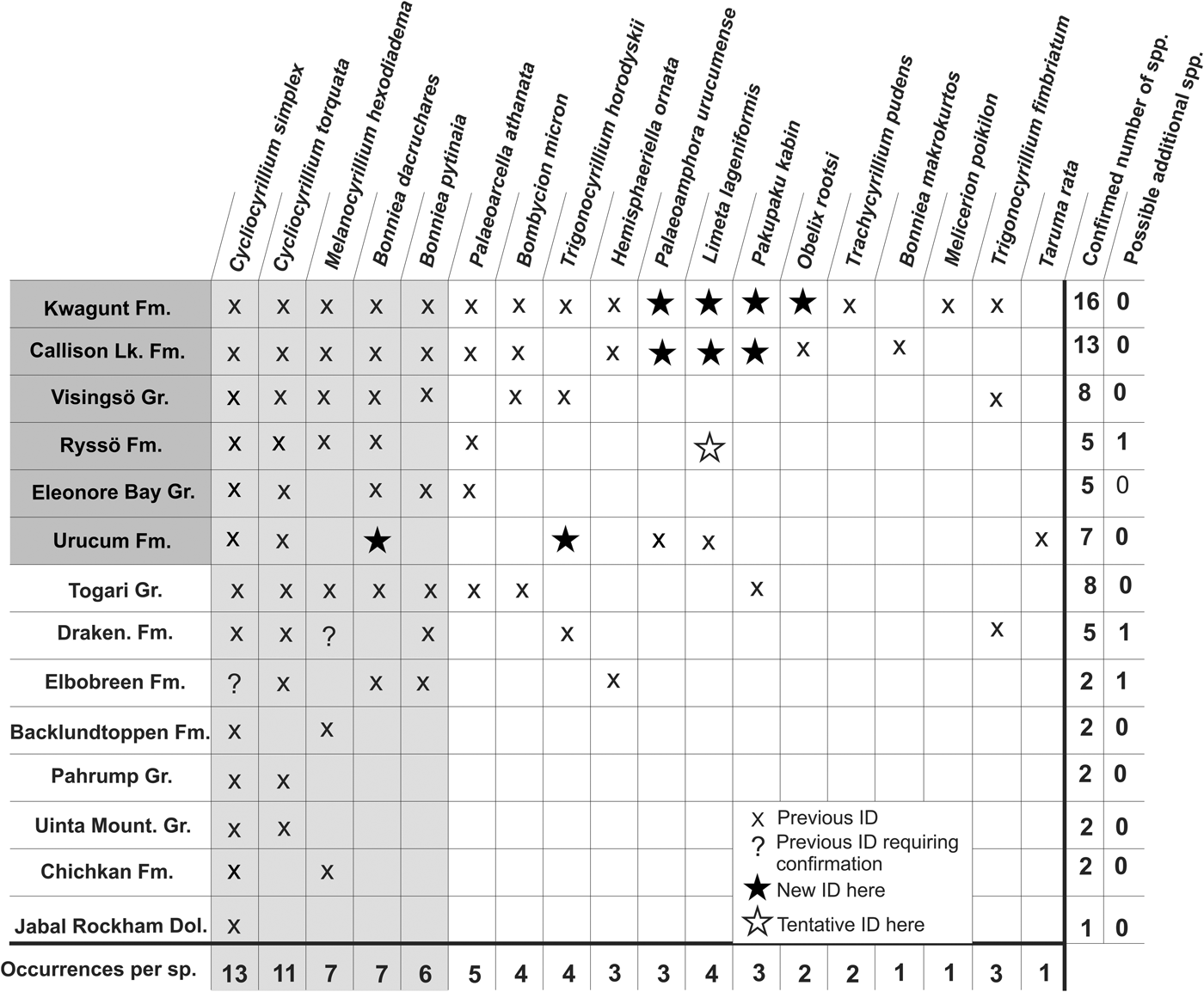
Species of vase-shaped microfossils (VSMs) and their occurrence in 14 stratigraphic units, six of which (shaded at left) were investigated in this study. Stars highlight principal discoveries of this survey. Light shading shows the distribution of the biostratigraphically significant ‘Cycliocyrillium simplex assemblage’ of Riedman et al. (Reference Riedman, Porter and Calver2017). References per unit: Kwagunt Formation, USA (Porter et al., Reference Porter, Meisterfeld and Knoll2003; Morais et al., Reference Morais, Fairchild, Lahr, Rudnitzki, Schopf, Garcia, Kudryavtsev and Romero2017); Callison Lake Formation, Canada (Strauss et al., Reference Strauss, Rooney, Macdonald, Brandon and Knoll2014; Cohen et al., Reference Cohen, Irvine and Strauss2017; Morais et al., Reference Morais, Fairchild, Lahr, Rudnitzki, Schopf, Garcia, Kudryavtsev and Romero2017; Riedman et al., Reference Riedman, Porter and Calver2017); Visingsö Group, Sweden (Knoll and Vidal, Reference Knoll and Vidal1980; Martí Mus and Moczydłowska, Reference Martí Mus and Moczydłowska2000; Porter et al., Reference Porter, Meisterfeld and Knoll2003; Moczydłowska et al., Reference Moczydłowska, Pease, Willman, Wickström and Agić2017; Riedman et al., Reference Riedman, Porter and Calver2017); Ryssö Formation, Svalbard (Knoll and Calder, Reference Knoll and Calder1983; Porter et al., Reference Porter, Meisterfeld and Knoll2003; Riedman et al., Reference Riedman, Porter and Calver2017); Eleonore Bay Group, Greenland (Vidal, Reference Vidal1979; Green et al., Reference Green, Knoll and Swett1988; Riedman et al., Reference Riedman, Porter and Calver2017); Urucum Formation, Brazil (Fairchild et al., Reference Fairchild, Barbour and Haralyi1978; Morais et al., Reference Morais, Fairchild, Lahr, Rudnitzki, Schopf, Garcia, Kudryavtsev and Romero2017); Togari Group, Tasmania (Porter et al., Reference Porter, Meisterfeld and Knoll2003; Riedman et al., Reference Riedman, Porter and Calver2017); Draken Formation, Svalbard (Knoll et al., Reference Knoll, Swett and Mark1991; Porter et al., Reference Porter, Meisterfeld and Knoll2003; Riedman et al., Reference Riedman, Porter and Calver2017); Elbobreen Formation, Svalbard (Porter et al., Reference Porter, Meisterfeld and Knoll2003; Martí Mus, Reference Martí Mus2001); Backlundtoppen Formation, Svalbard (Knoll et al., Reference Knoll, Swett and Burkhardt1989; Porter et al., Reference Porter, Meisterfeld and Knoll2003; Riedman et al., Reference Riedman, Porter and Calver2017); Pahrump Group, USA (Horodyski, Reference Horodyski1993; Porter et al., Reference Porter, Meisterfeld and Knoll2003; Dehler, Reference Dehler2014); Uinta Mountain Group, Utah (Porter et al., Reference Porter, Meisterfeld and Knoll2003); Chichkan Formation, Kazakhstan (Sergeev and Schopf, Reference Sergeev and Schopf2010); Jabal Rockham Dolostone, Saudi Arabia (Binda and Bokhari, Reference Binda and Bokhari1980; Porter et al., Reference Porter, Meisterfeld and Knoll2003).

Description
Morphometric data for C. simplex in the Kwagunt Formation, Urucum Formation, Callison Lake Formation, Upper Eleonore Bay Group, Visingsö Group, and Ryssö Formation gathered from the literature and obtained in the present study petrographic survey are summarized in Table 1 (supplementary material). These data allow the following morphometric characterization of this species: length (L): 34–203 μm, x̅ = 97 μm, N = 188; width (W): 18–102 μm, x̅ = 59 μm, N = 188; aperture diameter (AD): 7–48 μm, x̅ = 22 μm, N = 178; aspect ratio (L/W): 1.0–3.2, x̅ = 1.7, N = 170.
Compared to previous studies (Porter et al., Reference Porter, Meisterfeld and Knoll2003; Cohen et al., Reference Cohen, Irvine and Strauss2017; Morais et al., Reference Morais, Fairchild, Lahr, Rudnitzki, Schopf, Garcia, Kudryavtsev and Romero2017), the new data extend the ranges for these features, as can be seen in Table 1 (supplementary data). This is not surprising, given that more specimens (N = 188) were considered here than in Porter and colleagues’ (Reference Porter, Meisterfeld and Knoll2003) original description (N = 10). C. simplex in the Upper Eleonore Bay Group tends to be slightly more elongate (L/W up to 2.3) than at other localities, as is also true for specimens in the Visingsö Group (L/W up to 2.7), which exhibit, moreover, the narrowest widths for this species (W = 18–34 μm).
Materials
Petrographic thin sections: Kwagunt Formation: AK10-53-13A, AK10-53-13B, AK10-53-13F, AK10-53-13F(A), AK10-53-13F(B), AK10-53-13F(C), AK10-53-13F1, AK10-53-13F1(9UQ018), AK10-53-13F1(9UQ019), AK10-53-13F1(9UQ020), AK10-53-13F1(9UQ021), AK10-53-136b(9UQ023), AK10-53-13F3, AK10-60-19(9UQ026), AK10-60-31(9UQ027), shale-3I, WAL-13, WAL-31, and WAL-74. Callison Lake Formation: J1204-16.8, J1204-18, F930-15.5. Urucum Formation: GP/5T-2537 A, C, and D. Eleonore Bay Group: GR2880-1–9, EQ-18-11A. Visingsö Group: V72-G14/Harvard University Herbaria Paleobotanical Collection 63100. Ryssö Formation: K2082-2A.
Remarks
Nearly all specimens of this species consist of siliceous or, more rarely, phosphatic molds and casts (Visingsö Group). Specimens in the Urucum Formation are an important exception, for they possess carbonaceous walls, possibly reinforced by silica (Morais et al., Reference Morais, Fairchild, Lahr, Rudnitzki, Schopf, Garcia, Kudryavtsev and Romero2017). C. simplex is the most common, though not necessarily the most abundant, VSM taxon in the six stratigraphic units investigated. It is present in 13 of the 15 units listed in Figure 4 and is suspected to be present in the other two.
Cycliocyrillium torquata Porter, Meisterfeld, and Knoll, Reference Porter, Meisterfeld and Knoll2003
Figure 2.6–2.8; Table 2 (supplementary material)
- Reference Horodyski1993
Melanocyrillium Horodyski, fig. 10C.
- Reference Martí Mus and Moczydłowska2000
“Vase-shaped microfossil” Martí Mus and Moczydłowska, fig. 3A.
- Reference Porter, Meisterfeld and Knoll2003
Cycliocyrillium torquata Porter, Meisterfeld, and Knoll, p. 415, figs. 6.11–6.23, 18.1
- Reference Porter, Meisterfeld and Knoll2003
“Vase-shaped microfossils” Porter, Meisterfeld, and Knoll, fig. 2.1.
- Reference Strauss, Rooney, Macdonald, Brandon and Knoll2014
Cycliocyrillium torquata; Strauss et al., fig. 2F.
- Reference Morais, Fairchild, Lahr, Rudnitzki, Schopf, Garcia, Kudryavtsev and Romero2017
Cycliocyrillium torquata; Morais et al., p. 399, fig. 6.2, 6.3.
- Reference Cohen, Irvine and Strauss2017
?Cycliocyrillium torquata; Cohen, Irvine, and Strauss, p. 15, fig. 4D–F.
- Reference Moczydłowska, Pease, Willman, Wickström and Agić2017
Cycliocyrillium torquata; Moczydłowska et al., fig. 2B.
- Reference Riedman, Porter and Calver2017
Cycliocyrillium torquata; Riedman et al., p. 10, fig. 3.13.
Holotype
HUPC# 64453, upper Tonian Kwagunt Formation, Chuar Group, Arizona, USA (Porter et al., Reference Porter, Meisterfeld and Knoll2003).
Emended diagnosis
Cycliocyrillium with a short terminal oral extension, sometimes thickened relative to test wall, that begins at a slight to moderate inflection in the test wall and then proceeds in a parallel fashion (or tapers slightly) for a short distance not exceeding 20% total test length before terminating at the apertural edge.
Occurrence
See Figure 4.
Description
Data from both previously published systematic descriptions and new data obtained in the present study (see Table 2, supplementary material) allow the following morphometric characterization of this species: length (L): 45–145 μm, x̅ = 77 μm, N = 111; width (W): 35–91 μm, x̅ = 59 μm, N = 111; aperture diameter (AD): 12–53 μm, x̅ = 30 μm, N = 111; collar length (CL): 3–19 μm, x̅ = 11 μm, N = 99; body length (BL): 50–123 μm, x̅ = 84 μm, N = 28; ratio of collar length to total length (CL/L), as a percentage: 4%–19%, x̅ = 10%, N = 28; aspect ratio (L/W): 1.15–2.3, x̅ = 1.5, N = 40; aspect ratio for test body excluding collar (BL/W): 1.1–1.9, x̅ = 1.4, N = 28.
Materials
Petrographic thin sections: Kwagunt Formation: AK-10-53-13F-A and B; AK-10-53-13-F1 -9UQ018; 9UQ019; 9UQ021; AK-1053-13-F3; AK-1060-31-9UQ027; 18.11/16/73/8E-3JA. Callison Lake Formation: J1204-16.8; F930-15.5. Urucum Formation: GP/5T-2532 G.
Remarks
In their original description, Porter et al. (Reference Porter, Meisterfeld and Knoll2003) included the presence of a collar or short neck as a diagnostic feature of C. torquata. Consistent with a comment by Porter et al. (Reference Porter, Meisterfeld and Knoll2003, p. 415), Morais et al. (Reference Morais, Fairchild, Lahr, Rudnitzki, Schopf, Garcia, Kudryavtsev and Romero2017) limited relative neck length in C. torquata and in the generic description of Cycliocyrillium itself to 10% or less of total test length as a diagnostic character to differentiate this species (and genus) from the long-necked VSM Limeta lageniformis. However, in the present study, we found collar lengths in C. torquata of up to 13% total test length in thin sections of the Kwagunt Formation (N = 14) and 4% to 19% in the Urucum Formation (N = 10) (Morais et al., Reference Morais, Fairchild, Lahr, Rudnitzki, Schopf, Garcia, Kudryavtsev and Romero2017). Furthermore, all data points in Cohen and colleagues’ (Reference Cohen, Irvine and Strauss2017, fig. 16) scatter plot for 71 specimens of C. torquata in the Callison Lake Formation indicate relative collar lengths from about 10% to 20% total test length. Our results for an additional four specimens from this formation—8% to 17%—are consistent with this observation. For these reasons, we have redefined the limit for relative neck length in C. torquata as 20% total test length. Specimens with relative neck lengths greater than 20% should be classified as Limeta lageniformis or Obelix rootsii (Cohen, Irvine, and Strauss, Reference Cohen, Irvine and Strauss2017) new combination, as discussed in the following.
Genus Limeta Morais, Fairchild, and Lahr in Morais et al., Reference Morais, Fairchild, Lahr, Rudnitzki, Schopf, Garcia, Kudryavtsev and Romero2017
Type species
Limeta lageniformis Morais, Fairchild, and Lahr in Morais et al., Reference Morais, Fairchild, Lahr, Rudnitzki, Schopf, Garcia, Kudryavtsev and Romero2017.
Diagnosis
Test body subglobose to pyriform with a simple aperture at the terminus of a long tapering to cylindrical neck 20% or more total length of test.
Remarks
Neck length comprises 20% or more of the total test length in Limeta. The arbitrary upper limit of 50% for this value proposed in the original diagnosis is meaningless and thus abandoned (Morais et al., Reference Morais, Fairchild, Lahr, Rudnitzki, Schopf, Garcia, Kudryavtsev and Romero2017).
Limeta lageniformis Morais, Fairchild, and Lahr in Morais et al., Reference Morais, Fairchild, Lahr, Rudnitzki, Schopf, Garcia, Kudryavtsev and Romero2017
Figure 2.9–2.13; Table 3 (supplementary material)
- Reference Knoll and Calder1983
VSM test Knoll and Calder, p. 491, pl. 61.13.
- Reference Morais, Fairchild, Lahr, Rudnitzki, Schopf, Garcia, Kudryavtsev and Romero2017
Limeta lageniformis Morais, Fairchild, and Lahr in Morais et al., p. 400, figs. 4.4, 6.7–6.9, 7.5, 7.6.
Holotype
GP/5T:2529 F, Neoproterozoic Urucum Formation, Jacadigo Group, Corumbá, Mato Grosso do Sul, southwest Brazil.
Diagnosis
As for genus.
Occurrence
See Figure 4.
Description
The data in Table 3 (supplementary material) allow the following morphometric characterization of this species (N = 25, unless indicated otherwise); length (L): 67–198 μm, x̅ = 111 μm; width (W): 29–85 μm, x̅ = 53 μm; aperture diameter (AD): 9–32 μm, x̅ = 18 μm; neck length (NL): 17–81 μm, x̅ = 35 μm; body length (BL): 28–136 μm, x̅ = 76 μm; ratio of neck length to total length (NL/L), as a percentage: 20%–48%, x̅ = 31%, N = 15; aspect ratio (L/W): 1.4–3.4, x̅ = 2.1; aspect ratio for test body, excluding the neck (BL/W): 0.9–2.5, x̅ = 1.5.
Materials
Petrographic thin sections: Kwagunt Formation: AK-1053-13F-3(K-28), AK-1053-13F1/9UQ018 (R19-3/ W25-2), AK-1053-13F1-9UQ019 (G40-1/ J35), AK-1053-13F-9UQ021 (K-28/ K37-3/ J36-4). Callison Lake Formation: F930-15-5 (K56), J1204-16.8 (S46-2), J1204-18.1 (E60-3/F49-2/F65-4/R50-3/S54-2). Urucum Formation: GP/5T-2529 F, GP/5T-2530 A, GP/5T-2536 C.
Remarks
Specimens of Limeta lageniformis identified here in the Kwagunt Formation (N = 8) and Callison Lake Formation (N = 7) are similar to one another in shape, with average aspect ratios (L/W) of 2.3 and 2.4, respectively, and average body length-to-width ratios (BL/W) of 1.7. Compared to the type material from the Urucum Formation (Morais et al., Reference Morais, Fairchild, Lahr, Rudnitzki, Schopf, Garcia, Kudryavtsev and Romero2017), in which L/W = 1.8 and BL/W = 1.2 (see Table 3, supplementary material), they display slightly more elongate test-body shapes and more obtuse flexural angles (Morais et al., Reference Morais, Fairchild, Lahr, Rudnitzki, Schopf, Garcia, Kudryavtsev and Romero2017).
Other Proterozoic microfossils exhibiting long oral extensions include single specimens in the upper Tonian Ryssö Formation of Sweden illustrated by Knoll and Calder (Reference Knoll and Calder1983, p. 491, pl. 61.13) and in the early Tonian Jiayuan Formation of China illustrated by Xiao et al. (Reference Xiao, Shen, Tang, Kaufman, Yuan, Li and Qian2014, p. 216, fig. 5B). More work is needed to demonstrate the affinity of these fossils with VSMs.
Genus Obelix new genus
Type species
Cycliocyrillium rootsi Cohen, Irvine, and Strauss, Reference Cohen, Irvine and Strauss2017 (p. 16, figs. 4G–J).
Diagnosis
Bipartite subglobose test, consisting of an approximately hemispheroidal aboral portion and a long, broad-based neck with concave to straight walls tapering markedly for much of the fossil before reaching the aperture.
Etymology
In reference to the ovoid body shape of the character ‘Obélix’ in the French comic strip Astérix, the Gaul, created by Albert Uderzo and René Goscinny.
Remarks
Cohen et al. (Reference Cohen, Irvine and Strauss2017) erected the species Cycliocyrillium rootsi for a set of VSMs with a rounded basal portion and a long, tapering neck comprising 40% to 50% total test length. This bipartite organization is incompatible with its inclusion not only in Cycliocyrillium Porter et al., Reference Porter, Meisterfeld and Knoll2003 but in Limeta as well, as diagnosed here. Hence, we created the new genus Obelix to accommodate this species.
Obelix rootsii (Cohen, Irvine, and Strauss, Reference Cohen, Irvine and Strauss2017) Morais, Fairchild, and Lahr, new combination
Figure 2.14, 2.15; Table 4 (supplementary material)
- Reference Cohen, Irvine and Strauss2017
Cycliocyrillium rootsi Cohen, Irvine, and Strauss, p. 16, figs. 4G–I, 15, 16.
Holotype
Sample YG644.1 (slide J1204-17.9 [4]), England Finder coordinates L19-0 (Cohen et al., Reference Cohen, Irvine and Strauss2017, fig. 4G).
Occurrence
See Figure 4.
Description
Table 4 (supplementary material) presents morphometric data for the type material of Obelix rootsii n. comb. in the Callison Lake Formation and for three specimens identified as such in the present survey. Two of these are new examples from the same formation and differ from the four specimens illustrated in the original study (Cohen et al., Reference Cohen, Irvine and Strauss2017, figure 4G–J); the other is from the Walcott Member of the upper Kwagunt Formation. The data in Table 4 (supplementary material) allow the following morphometric characterization of this species: length (L): 45–85 μm, x̅ = 62 μm, N = 9; width (W): 31–75 μm, x̅ = 53 μm, N = 9; aperture diameter (AD): 12–29 μm, x̅ = 21 μm, N = 9; neck length (NL): 24–50 μm, x̅ = 31 μm, N = 9; body length (BL): range not provided in original paper, but 19–35 μm for specimens CLK 1, CLK 2, and KWG 1 in Table 4 (supplementary material); average of 32 μm obtained by subtracting average NL from average L of type material. Range of relative neck lengths given by Cohen et al. (Reference Cohen, Irvine and Strauss2017) as 40%–50% is here extended to 58%: average for four illustrated specimens in Cohen et al. (Reference Cohen, Irvine and Strauss2017, figure 4G–J) plus new specimens is 51% (N = 7). Aspect ratios (L/W) indicated in Cohen et al. (Reference Cohen, Irvine and Strauss2017, fig. 16) range from 1.0 to 1.25, but new material extends this range to 1.4, with an average of 1.2 (N = 7). Similarly, aspect ratios for test body (BL/W) of illustrated material plus new specimens range from 0.47 to 0.65, averaging 0.60 (N = 7).
Materials
Petrographic thin sections: Kwagunt Formation: AK-10-53F-1 (J9-2). Callison Lake Formation: J1204-16.8; F930-15.5.
Remarks
We here corrected the suffix for the specific epithet to rootsii in conformance with the International Code of Nomenclature (ICN) 60.8b. The ratios of neck to total length greater than 40% reported by Cohen et al. (Reference Cohen, Irvine and Strauss2017) for this species do not fit the diagnosis for the genus Cycliocyrillium Porter et al., Reference Porter, Meisterfeld and Knoll2003, as emended by Morais et al. (Reference Morais, Fairchild, Lahr, Rudnitzki, Schopf, Garcia, Kudryavtsev and Romero2017). Although the genus Limeta is available for VSMs having relative neck lengths 20% or greater total test length, the bipartite subglobose shape of the test (L/W = 1.2) and the long, tapering, broad-based neck in C. rootsi clearly differentiate it from L. lageniformis and justify the erection of the new genus Obelix to accommodate this species.
Obelix rootsii n. comb. differs distinctly in shape from L. lageniformis, as expressed by average values of both L/W (1.2 and 2.1, respectively) and BL/W (0.6 and 1.5, respectively). Necks in both initiate at flexures or inflections in the test walls, but in O. rootsii this occurs near maximum test width, whereas in L. lageniformis it occurs closer to the oral terminus of the body.
Obelix rootsii can be distinguished from longitudinal sections passing through the indented portions at the oral end of Melanocyrillium hexodiadema by the marked inflection at the base of the neck and absence of the invagination and/or longitudinal ridges in the apertural region typical of M. hexodiadema.
Genus Palaeoamphora Morais, Fairchild, and Lahr in Morais et al., Reference Morais, Fairchild, Lahr, Rudnitzki, Schopf, Garcia, Kudryavtsev and Romero2017
Type species
Palaeoamphora urucumense Morais, Fairchild, and Lahr in Morais et al., Reference Morais, Fairchild, Lahr, Rudnitzki, Schopf, Garcia, Kudryavtsev and Romero2017.
Diagnosis
VSMs having a pyriform test with a funnel-like collar or neck and simple aperture.
Remarks
Two siliceous molds of VSMs with flaring terminal oral extensions were discovered in thin sections of the Callison Lake Formation during the present survey, qualifying them for inclusion in Palaeoamphora. In one (Fig. 3.2), the relative length of the funnel-like neck falls within the range of previously described specimens from the Urucum and Kwagunt formations (less than one-sixth total test length), while in the other (Fig. 3.3), it is much larger (42%). For this reason, we have chosen to remove any limit to relative length of the oral extension from the generic diagnosis.
Palaeoamphora urucumense Morais, Fairchild, and Lahr in Morais et al., Reference Morais, Fairchild, Lahr, Rudnitzki, Schopf, Garcia, Kudryavtsev and Romero2017
Figure 3.1, 3.2; Table 5 (supplementary material)
- Reference Porter, Meisterfeld and Knoll2003
Unnamed form, Porter, Meisterfeld, and Knoll, p. 423, fig. 17.1–17.3.
- Reference Morais, Fairchild, Lahr, Rudnitzki, Schopf, Garcia, Kudryavtsev and Romero2017
Palaeoamphora urucumense Morais, Fairchild, and Lahr in Morais et al., p. 400, figs. 5.3–5.5, 6.4–6.6.
Holotype
GP/5T-2534 F, Neoproterozoic Urucum Formation, Jacadigo Group, Corumbá, Mato Grosso do Sul, southwest Brazil.
Diagnosis
As for genus.
Occurrence
See Figure 4.
Description
Published data on the Urucum and Kwagunt formations plus new data on specimen CLK 3 from the Callison Lake Formation (see Table 5, supplementary material) allow the following morphometric characterization of this species: length (L): 57–135 μm, x̅ = 111 μm, N = 10; width (W): 37–109 μm, x̅ = 48 μm, N = 10; aperture diameter (AD): 24–66 μm, x̅ = 48 μm, N = 7; neck length (NL): 5–19 μm, x̅ = 14 μm, N = 10; body length (BL): 48–124 μm, x̅ = 92 μm, N = 7; ratio of neck length to length (NL/L), as a percentage: 8%–17%, x̅ = 13%, N = 7; aspect ratio (L/W): 1.2–2.2, x̅ = 1.,; N = 10; aspect ratio for test body in VSMs with necks (BL/W): 1.1–1.4, x̅ = 1.2, N = 7.
New specimens CLK 3 (Fig. 3.2) and CLK 4 (Fig. 3.3) from the Callison Lake Formation are smaller than previously studied specimens in the Urucum and Kwagunt formations (see Table 6, supplementary material). CLK 3 (Fig. 3.2) furnishes the lower size limits for L, W, AD, and BL in this species. The divergent collar walls of its oral extension allow it to be confidently included in P. urucumense. It, like other known specimens, is also relatively thin walled. The clearly divergent walls in CLK 4 (Fig. 3.3) are characteristic of Palaeoamphora, but its long neck and thick walls differentiate it from all currently known specimens of P. urucumense, as discussed in the following.
Materials
Petrographic thin sections: Callison Lake Formation: J1204-16.8 (Y46-1). Urucum Formation: GP/5T-2536 A and B; GP/5T-2537 B.
Remarks
Although Porter et al. (Reference Porter, Meisterfeld and Knoll2003, fig. 17.1–17.3) have previously distinguished specimens in the Kwagunt Formation that fit in the Palaeoamphora urucumense diagnosis, no specimen was identified in thin section on this survey.
Palaeoamphora sp.?
Figure 3.3; Table 5 (supplementary material)
Occurrence
Callison Lake Formation, Northwest Canada (see Fig. 1.2).
Description
Morphometric data for the specimen in Figure 3.3 are as follows (N = 1): length (L): 67.1 μm; width (W): 50.3 μm; aperture diameter (AD): 21.8 μm; neck length (NL): 28.1 μm; body length (BL): 39.0 μm; ratio of neck length to length (NL/L), as a percentage: 42%; aspect ratio (L/W): 1.3; aspect ratio for test body (BL/W): 0.8; wall thickness (?) up to 14 μm in the oral extension.
Material
Petrographic thin section J1204-18.1 (G56).
Remarks
Specimen in Figure 3.3 differs from specimens of P. urucumense in its greater relative neck length (42% of total test length) and, consequently, in its lower body aspect ratio of 0.8 (as compared to the average of 1.2 for P. urucumense). The great apparent wall thickness in the oral extension requires corroboration. Specimen CLK 4 is placed in open nomenclature as Palaeoamphora sp.?, pending discovery of additional examples.
Genus Pakupaku Riedman, Porter, and Calver, Reference Riedman, Porter and Calver2017
Type species
Pakupaku kabin Riedman, Porter, and Calver, Reference Riedman, Porter and Calver2017.
Pakupaku kabin Riedman, Porter, and Calver, Reference Riedman, Porter and Calver2017
Figure 3.4–3.9; Table 6 (supplementary material)
- Reference Riedman, Porter and Calver2017
Pakupaku kabin Riedman, Porter, and Calver, fig. 6.1–6.6.
- Reference Riedman, Porter and Calver2017
VSM test Riedman et al., fig. 9.2.
Holotype
CPC43685, slide Tas 10-41(par), England Finder coordinates F69-0, from Bertha Road locality, lower Black River Dolomite, Togari Group, Tasmania (Riedman et al., Reference Riedman, Porter and Calver2017, fig. 6.1, 6.2).
Diagnosis
Vase-shaped microfossil having a globose to pyriform test with biconvex (lanceolate) or elliptical aperture, when viewed along the oral-aboral axis. In longitudinal section, aperture appears as a wedge-shaped gap.
Occurrence
See Figure 4.
Description
The data in Table 6 (supplementary material) allow the following morphometric characterization of this species: length (L): 70.2–143.4 μm, x̅ = 98.4 μm, N = 11; width (W): 42.5–83.6 μm, x̅ = 63.3, μm N = 11; aperture diameter (AD): 16.4–32.9 μm, x̅ = 24.2 μm, N = 10; aspect ratio (L/W): 1.1–1.9, x̅ = 1.6, N = 11.
Materials
Petrographic thin sections: Kwagunt Formation: AK-10-53-13FC. Callison Lake Formation: J1204-18.1.
Remarks
Pakupaku kabin was first described from the Togari Group by Riedman, Porter, and Calver (Reference Riedman, Porter and Calver2017). Its principal diagnostic feature is its wedge-shaped aperture, reminiscent of the mouth of the video game character ‘Pac-Man’ or the open gap common in pistachio nuts (Riedman et al., Reference Riedman, Porter and Calver2017, fig. 6.1–6.6). In the present survey, specimens of Pakupaku kabin were observed in dolomite nodules from the Kwagunt Formation (N = 4) and in silicified shales from the Callison Lake Formation (N = 3). In both cases, however, the VSMs are globose; hence, we have emended the original diagnosis to include this term and reworded the diagnosis for greater clarity as well.
Genus Bonniea Porter, Meisterfeld, and Knoll, Reference Porter, Meisterfeld and Knoll2003
Type species
Bonniea dacruchares Porter, Meisterfeld, and Knoll, Reference Porter, Meisterfeld and Knoll2003.
Other species
Bonniea pytinaia Porter, Meisterfeld, and Knoll, Reference Porter, Meisterfeld and Knoll2003; Bonniea makrocurtos Cohen, Irvine, and Straus, Reference Cohen, Irvine and Strauss2017.
Diagnosis
VSMs with a curved ‘neck’ and circular aperture.
Bonniea dacruchares Porter, Meisterfeld, and Knoll, Reference Porter, Meisterfeld and Knoll2003
Figure 3.10–3.12
- Reference Martí Mus2001
“Vase-shaped microfossil” Martí Mus, fig. 3I.
- Reference Knoll2003
“Vase-shaped microfossil” Knoll, pl. 3, fig. 12.
- Reference Porter, Meisterfeld and Knoll2003
Bonniea dacruchares Porter, Meisterfeld, and Knoll, p. 417, fig. 9.1–9.23.
- Reference Strauss, Rooney, Macdonald, Brandon and Knoll2014
Bonniea dacruchares; Strauss et al., fig. 2E.
- Reference Cohen, Irvine and Strauss2017
Bonniea dacruchares; Cohen et al., p. 13, fig. 3A, B.
- Reference Riedman, Porter and Calver2017
Bonniea dacruchares; Riedman, Porter, and Calver, figs. 3.12, 4.3, 4.5, 4.9.
Holotype
HUPC# 64409, upper Tonian Kwagunt Formation, Chuar Group, Arizona, USA (Porter et al., Reference Porter, Meisterfeld and Knoll2003).
Diagnosis
Specimens of the genus Bonniea with tests having length-to-width ratios less than 2 and concavity of the neck greater than 30°. Aperture wall may be slightly thickened.
Occurrence
See Figure 4.
Description
The two specimens of B. dacruchares identified in the Urucum Formation measure 65 and 88 μm in length and 46 and 65 μm in width with aspect ratios (L/W) of 1.4 and 1.3 and aperture diameters of 15 and 23 μm. The specimen in Figure 3.10 exhibits a concavity of 66° and a curvature of 20°. Test walls are carbonaceous.
Materials
Petrographic thin sections: Kwagunt Formation: AK10-53-13A, AK10-53-13B, AK10-53-13F, AK10-53-13F(A), AK10-53-13F(B), AK10-53-13F(C), AK10-53-13F1, AK10-53-13F1(9UQ018), AK10-53-13F1(9UQ019), AK10-53-13F1(9UQ020), AK10-53-13F1(9UQ021), AK10-53-136b(9UQ023), AK10-53-13F3; AK10-60-19(9UQ026), AK10-60-31(9UQ027); shale-3I; WAL-13, WAL-31, and WAL-74. Urucum Formation: GP/5T-2547 and -2548.
Remarks
The length, width, aperture diameter, and concavity of the Urucum specimens lie within the intervals given by Porter et al. (Reference Porter, Meisterfeld and Knoll2003) for the type material. These morphometric parameters are consistent as well with ranges observed in the Callison Lake Formation (Cohen et al., Reference Cohen, Irvine and Strauss2017) and Togari Group (Riedman et al., Reference Riedman, Porter and Calver2017). Forms identified as B. dacruchares in the Ryssö Formation by Porter et al. (Reference Porter, Meisterfeld and Knoll2003) have not been formally described. Several other examples of B. dacruchares have been identified in the Urucum Formation, but as they present less than ideal orientations in thin sections, they could not be properly measured. The specimen in lateral view in Figure 3.10 and that in oblique frontal view in Figure 3.11 clearly exhibit divergent oral and aboral axes (i.e., curvature; Porter et al., Reference Porter, Meisterfeld and Knoll2003, fig. 7) that distinguish them from all other Urucum VSMs.
Genus Trigonocyrillium Porter, Meisterfeld, and Knoll, Reference Porter, Meisterfeld and Knoll2003
Type species
Trigonocyrillium horodyskii (Bloeser, Reference Bloeser1985) Porter, Meisterfeld, and Knoll Reference Porter, Meisterfeld and Knoll2003.
Other species
Trigonocyrillium fimbriatum (Bloeser, Reference Bloeser1985) Porter, Meisterfeld, and Knoll Reference Porter, Meisterfeld and Knoll2003.
Diagnosis
Pyriform to bulbous VSMs with an equilateral triangular aperture (Bloeser, Reference Bloeser1985).
Trigonocyrillium horodyskii (Bloeser, Reference Bloeser1985)
Figure 3.13–3.15
- Reference Bloeser1979
Melamocyrillium [sic] horodyskii Bloeser et al., p. 421 (nomen nudum).
- Reference Bloeser1980
Melanocyrillium horodyskii; Bloeser, p. 73, pl. 4, fig. 1a (nom. nud.); Bloeser, Reference Bloeser1985, fig. 11.1, 11.2.
- Reference Porter, Meisterfeld and Knoll2003
Trigonocyrillium horodyskii (Bloeser, Reference Bloeser1985), Porter, Meisterfeld, and Knoll, p. 414, fig. 5.1–5.19.
- Reference Riedman, Porter and Calver2017
“Vase-shaped microfossil” Riedman et al., fig. 4.5.
Holotype
SEM plug CS-30; log 197, UCLA Catalogue Number 58975, upper Tonian Kwagunt Formation, Chuar Group, Arizona, USA (Bloeser, Reference Bloeser1985).
Diagnosis
Specimens of the genus Trigonocyrillium with unadorned apertural margins.
Occurrence
See Figure 4.
Description
The three tests of Trigonocyrillium horodyskii identified in the Urucum Formation range from 72 to 84 μm in length (x̅ = 79 μm; σ = 6.2 μm; N = 3) and 68 to 80 μm in width (x̅ = 72 μm; σ = 6.9 μm; N = 3), values consistent with the ranges given for the type material by Porter et al. (Reference Porter, Meisterfeld and Knoll2003): L = 75 to 125 μm (x̅ = 96 μm; σ = 19 μm; N = 22); W = 45 to 90 μm (x̅ = 65 μm; σ = 15 μm; N = 22). All three are bulbous, with aspect ratios (L/W) between 1.0 to 1.2, as compared to values of 1.2 to 1.8 for the type material. The triangular apertures present rounded vertices and approximately equal sides, whose averages fall between 19 and 30 μm in the three Urucum specimens. Similar values of 22 to 49 μm were measured for four appropriately oriented specimens of the type material of Porter et al. (Reference Porter, Meisterfeld and Knoll2003, fig. 5.2, 5.8, 5.18, 5.19). The walls of the Urucum specimens are carbonaceous.
Materials
Petrographic thin sections: Kwagunt Formation: AK10-53-13A, AK10-53-13B, AK10-53-13F, AK10-53-13F(A), AK10-53-13F(B), AK10-53-13F(C), AK10-53-13F1, AK10-53-13F1(9UQ018), AK10-53-13F1(9UQ019), AK10-53-13F1(9UQ020), AK10-53-13F1(9UQ021), AK10-53-136b(9UQ023), AK10-53-13F3; AK10-60-19(9UQ026), AK10-60-31(9UQ027); shale-3I; WAL-13, WAL-31 and WAL-74. Urucum Formation: GP/5T-2548.
Remarks
The unadorned triangular aperture allows identification of these VSMs as T. horodyskii; their size and globose shape are also consistent with the type material. In contrast to the molds and casts of this species in the Kwagunt, Visingsö, and Draken assemblages (Knoll and Vidal, Reference Knoll and Vidal1980; Knoll and Calder, Reference Knoll and Calder1983; Porter et al., Reference Porter, Meisterfeld and Knoll2003), the Urucum specimens have carbonaceous walls as recognized by Raman spectroscopy (Morais et al., Reference Morais, Fairchild, Lahr, Rudnitzki, Schopf, Garcia, Kudryavtsev and Romero2017).
VSM diversity and distribution revisited
Sparked by recent discoveries in the Urucum Formation, Brazil (Morais et al., Reference Morais, Fairchild, Lahr, Rudnitzki, Schopf, Garcia, Kudryavtsev and Romero2017), our search for new occurrences of VSM species among known assemblages (Fig. 4) exceeded initial expectations. Not only did it lead to the recognition of Urucum species in the Kwagunt and Callison Lake formations, but it also resulted in addition of other species to both these assemblages as well as to the Urucum assemblage itself. Hence, the main contribution of this paper, as shown in Figure 4, is the demonstration that VSM diversity and species distribution are greater than previously indicated, thereby reinforcing the potential use of these microfossils in Neoproterozoic biostratigraphy (Strauss et al., Reference Strauss, Rooney, Macdonald, Brandon and Knoll2014; Cohen et al., Reference Cohen, Irvine and Strauss2017; Moczydłowska et al., Reference Moczydłowska, Pease, Willman, Wickström and Agić2017; Riedman et al., Reference Riedman, Porter and Calver2017).
The most diverse assemblage is found in the Kwagunt Formation, which contains 16 of the 18 formally described VSM species recognized here. Twelve of these species were erected by Bloeser (Reference Bloeser1985) and Porter et al. (Reference Porter, Meisterfeld and Knoll2003). Of the remaining four taxa, one was originally designated an ‘unnamed form’ by Porter et al. (Reference Porter, Meisterfeld and Knoll2003) but later assigned to Palaeoamphora urucumense Morais et al., Reference Morais, Fairchild, Lahr, Rudnitzki, Schopf, Garcia, Kudryavtsev and Romero2017 when similar forms were described from the Urucum Formation (Morais et al., Reference Morais, Fairchild, Lahr, Rudnitzki, Schopf, Garcia, Kudryavtsev and Romero2017). The remaining three species are recorded here for the first time in the Kwagunt Formation: Limeta lageniformis (Fig. 2.9–2.13), Obelix rootsii n. comb. (Fig. 2.14), and Pakupaku kabin (Fig. 3.4–3.9). Thus, of currently known VSM species, only the singleton species Taruma rata from the Urucum Formation and Bonniea makrokurtos Cohen et al., Reference Cohen, Irvine and Strauss2017 from the Callison Lake Formation have not yet been recognized in the Kwagunt assemblage. On the other hand, the discovery here of Trigonocyrillium horodyskii and Bonniea dacruchares in the Urucum Formation increases its similarity to the Kwagunt assemblage.
The Callison Lake Formation contains the second-most diverse assemblage, totaling 13 species. After Strauss et al. (Reference Strauss, Rooney, Macdonald, Brandon and Knoll2014) called initial attention to the similarity of the VSMs in this unit to those in the Kwagunt Formation, Cohen et al. (Reference Cohen, Irvine and Strauss2017) described eight species of VSMs and pointed out that all but two—Bonniea makrokurtos and Cycliocyrillium rootsi (now Obelix rootsii n. comb.)—were also found in the Kwagunt assemblage. From our survey, we now know that Obelix rootsii n. comb. is also present in the Kwagunt Formation and furthermore that Limeta lageniformis and Palaeoamphora urucumense from the Urucum Formation (Morais et al., Reference Morais, Fairchild, Lahr, Rudnitzki, Schopf, Garcia, Kudryavtsev and Romero2017) and Pakupaku kabin from the Togari Group occur in both the Kwagunt and Callison Lake assemblages (Figs. 2.12, 2.13, 3.2, 3.3, 2.7–2.9, respectively). This means that 12 of the 13 VSM species in the Callison Lake Formation are shared with the Kwagunt Formation. This remarkable similarity further strengthens previous geotectonic, geologic, and biostratigraphic arguments regarding the correlation of these two units (Karlstrom et al., Reference Karlstrom, Bowring, Dehler, Knoll and Porter2000; Dehler et al., Reference Dehler, Elrick, Karlstrom, Smith, Crossey and Timmons2001; Strauss et al., Reference Strauss, Rooney, Macdonald, Brandon and Knoll2014, Reference Strauss, Macdonald, Halverson, Tosca, Schrag and Knoll2015; Cohen et al., Reference Cohen, Irvine and Strauss2017) and establishes the Kwagunt and Callison Lake assemblages as the standard of comparison for all other VSM-bearing stratigraphic units.
The other three stratigraphic units examined in our survey—the Ryssö Formation, Upper Eleonore Bay Group, and Urucum Formation—all contain at least five species (see Riedman et al., Reference Riedman, Porter and Calver2017). In the Ryssö Formation, a long-necked, possibly sixth VSM species illustrated by Knoll and Calder (Reference Knoll and Calder1983, p. 491, pl. 61.13) is tentatively classified here as Limeta lageniformis, even though the thin section containing this specimen was not available for our study. Also found in the Kwagunt assemblage are all species identified in the Ryssö Formation and Upper Eleonore Bay Group, as well as six of the seven species in the Urucum Formation, Taruma rata being the exception.
The VSMs in other stratigraphic units listed in Figure 4 but not examined by us are also found in the Kwagunt Formation. The three most diverse are the Togari Group (Riedman et al., Reference Riedman, Porter and Calver2017), the Visingsö Group (Martí Mus and Moczydłowska, Reference Martí Mus and Moczydłowska2000; Moczydłowska et al., Reference Moczydłowska, Pease, Willman, Wickström and Agić2017), and the Draken Formation (Knoll et al., Reference Knoll, Swett and Mark1991). The first two units have eight species of VSMs, including six in common: all five species of the ‘Cycliocyrillium simplex’ assemblage of Riedman et al. (Reference Riedman, Porter and Calver2017) plus Bombycion micron Porter et al., Reference Porter, Meisterfeld and Knoll2003. The remaining species in the Togari Group (Pakupaku kabin and Palaeoarcella athanata Porter et al., Reference Porter, Meisterfeld and Knoll2003) and the Visingsö Group (Riedman et al., Reference Riedman, Porter and Calver2017) (Trigonocyrillium horodyskii and T. fimbriatum Porter et al., Reference Porter, Meisterfeld and Knoll2003) are also present in the Kwagunt Formation. The five confirmed and one tentatively identified species in the Draken Formation likewise occur in both the Visingsö Group and Kwagunt Formation (Riedman et al., Reference Riedman, Porter and Calver2017).
Five of the six remaining units listed in Fig. 4 have two or possibly three species, all of which are components of the Cycliocyrillium simplex assemblage of Riedman et al. (Reference Riedman, Porter and Calver2017), except for Hemisphaeriella ornata Porter et al., Reference Porter, Meisterfeld and Knoll2003 in the Elbobreen Formation. In the Jabal Rockham Dolostone, only Cycliocyrillium simplex Porter et al., Reference Porter, Meisterfeld and Knoll2003 has been identified (Binda and Bokhari, Reference Binda and Bokhari1980; Porter et al., Reference Porter, Meisterfeld and Knoll2003).
Grouping the assemblages from Svalbard (Ryssö, Draken, Elbobreen, and Backlundtoppen formations; Fig. 4) further exemplifies the global distribution of VSMs. The result is a robust composite Svalbard assemblage of nine (tentatively 10) species, including the six most common species. Significantly, it contains all species recorded from the stratigraphically equivalent Upper Eleonore Bay Group of Greenland (see Knoll, Reference Knoll1982).
Species are listed in Figure 4 from left to right in decreasing order of number of occurrences among the VSM-bearing stratigraphic units. As might be expected, the most easily identifiable VSMs, Cycliocyrillium simplex and C. torquata, are known or suspected in all 15 and in 11 of these units, respectively. These are followed by the iconic VSM Melanocyrillium hexodiadema with seven (possibly eight) occurrences and Bonniea dacruchares and B. pytinaia, registered in seven and six units, respectively. Together, these species compose the biostratigraphically significant Cycliocyrillium simplex assemblage of Riedman et al. (Reference Riedman, Porter and Calver2017), evidently restricted to a narrow interval of the terminal Tonian Period between the end of the Bitter Springs carbon isotope anomaly and 12 Myr prior to initiation of Sturtian glaciation. Apart from Palaeoarcella athanata (six occurrences) and Bombycion micron (four occurrences), the remaining species in Figure 4 are known in only three (possibly four, in the case of Limeta lageniformis) or fewer stratigraphic units. The experience acquired in the present study, however, suggests that closer scrutiny of these VSM-bearing units will certainly reveal additional known taxa as well as new taxa.
Paleobiologic and biostratigraphic implications of Urucum VSMs
Urucum VSMs add substantially to rapidly expanding knowledge of Neoproterozoic vase-shaped microfossils. First, unlike the VSMs reported elsewhere, almost all exhibit kerogenous tests, expanding the potential search space for these fossils. Second, they both increase the known diversity of VSMs and confirm that a number of species co-occur over a wide geographic range. Third, it was the formal description of three new VSM species in the Urucum assemblage that motivated the present survey (Morais et al., Reference Morais, Fairchild, Lahr, Rudnitzki, Schopf, Garcia, Kudryavtsev and Romero2017).
We have shown that of the seven VSM species within Urucum dolostone clasts, six also occur in the Kwagunt Formation and five in the Callison Lake Formation. Figure 4 shows further that of the five species attributed to the biostratigraphically significant Cycliocyrillium simplex assemblage, three are now known in the Urucum Formation, bringing to eight the number of stratigraphic units exhibiting three or more species of this assemblage. As globally distributed assemblages share multiple taxa at the species level, and as all well-constrained VSM assemblages date from the late Tonian between the Bitter Springs carbon isotope anomaly and the onset of Sturtian glaciation, we conclude that the dolostone clasts in Urucum conglomerates and diamictites also record a similarly aged carbonate platform that has since vanished. This is consistent with the glaciogenic nature of overlying beds of the Jacadigo Group.
That VSMs have little or no post-Sturtian record yet appear to be related to an extant clade presents an interesting conundrum with two components. Modern testate amoebae are most diverse in terrestrial settings with abundant vegetation, suggesting that much of their current biodiversity postdates the Paleozoic radiation of land plants (Lahr et al., Reference Lahr, Bosak, Lara and Mitchell2015).
That VSMs disappear about the time of global ice ages is at least consistent with the idea that the group experienced an evolutionary bottleneck and did not rebound in postglacial oceans, either because of a long-term environmental state change or because other heterotrophic protists, including foraminiferans and radiolarians and eventually animals, expanded, challenging VSMs via competition and predation (Porter et al., Reference Porter, Meisterfeld and Knoll2003; Bosak et al., Reference Bosak, Lahr, Pruss, Macdonald, Dalton and Matys2011; Cohen and Riedman, Reference Cohen and Reidman2018).
Conclusions
Comparison of vase-shaped microfossil species from the Urucum Formation, southwest Brazil, with previously described VSMs via detailed reexamination of petrographic thin sections from six previously studied stratigraphic units shows that the morphological variety and similarity of VSMs among the already diverse Kwagunt, Callison Lake, Togari, Urucum, and Ryssö assemblages is even greater than originally thought. The recognition in the Kwagunt and Callison Lake formations of additional taxa in common—Limeta lageniformis Morais et al. Reference Morais, Fairchild, Lahr, Rudnitzki, Schopf, Garcia, Kudryavtsev and Romero2017, Palaeoamphora urucumense Morais et al., Reference Morais, Fairchild, Lahr, Rudnitzki, Schopf, Garcia, Kudryavtsev and Romero2017, Obelix rootsii (Cohen et al., Reference Cohen, Irvine and Strauss2017) n. comb., and Pakupaku kabin Riedman et al., Reference Riedman, Porter and Calver2017—corroborates the correlation of the Kwagunt and Callison Lake formations and the temporal and paleoecological equivalence of their VSM assemblages. The presence of elements of the Cycliocyrillium simplex assemblage of Riedman et al. (Reference Riedman, Porter and Calver2017) in all stratigraphic units investigated here and recent dating of key VSM-bearing successions supports its use in late Tonian biostratigraphy. Finally, the recognition of Trigonocyrillium horodyskii (Bloeser, Reference Bloeser1985) and Bonniea dacruchares Porter et al. Reference Porter, Meisterfeld and Knoll2003 in the Urucum assemblage reinforces its similarity to the iconic Kwagunt assemblage—six of seven species in common, including three of the five species of the biostratigraphically significant Cycliocyrillium simplex assemblage, thereby supporting interpretation of the VSM-bearing dolostone clasts in the Urucum Formation as remnants of an upper Tonian carbonate platform, otherwise removed by post-Tonian erosion.
Acknowledgments
The authors thank FAPESP (Fundação de Apoio à Pesquisa do Estado de São Paulo) (Proc. 2013/12852-1; 2016/05937-9; 2017/22099-0) for the doctoral and postdoctoral scholarship provided to L.M., the Instituto de Geociências at Universidade de São Paulo, as well as UCSB and Harvard, for the use of the facilities in the Laboratory of Paleobiology. We also thank T.C. Samara for help with the figures, L.A. Riedman for all the scientific discussions, and J.V. Strauss for collecting the Callison Lake material. AHK thanks the NASA Astrobiology Institute.
Accessibility of supplemental data
Data available from the Dryad Digital Repository: https://doi.org/10.5061/dryad.kg8tf1s.