Infection prevention and control (IPC) and obstetrics have a longstanding entwined history, beginning in the 19th century when hand hygiene as a preventative measure was discovered in a maternity ward. Through the implementation of hand hygiene, the cornerstone of IPC, Dr. Ignaz Semmelweis significantly reduced puerperal infection for pregnant patients delivering in a hospital. Reference Davis1 This demonstrates that simple, targeted interventions can considerably affect the health outcomes of pregnant patients. Despite gains in the scientific basis of IPC, severe maternal morbidity and mortality rates in the United States have increased, with pregnancy-related deaths rising from 7.2 to 17.6 per 100,000 live births since the 1980s. Reference Callaghan, Creanga and Kuklina2,3 Infection and sepsis are the second leading cause of maternal mortality during the peripartum period in the United States, accounting for 14.3% of pregnancy-related deaths, and infectious morbidity appears to be rising. 3,Reference Kendle, Salemi, Tanner and Louis4 However, maternal morbidity and mortality may be responsive to intervention; ∼80% of pregnancy-related deaths were found to be preventable, but infection-specific mortality data are limited. Reference Trost, Beauregard and Njie5
Preventing healthcare-associated infections (HAIs) among patients receiving obstetric care during the peripartum period can play a key role in reducing maternal morbidity and mortality due to infection. The consistent implementation of evidence-based IPC practices can prevent the spread of HAIs, both between patients and between patients and healthcare personnel (HCP) during obstetric care. Obstetric HCP are routinely exposed to the bodily fluids of laboring patients, placing them at a higher risk of becoming infected with bloodborne and other pathogens, which in turn increases risk of infection for the subsequent patients for whom they care. Reference Helfgott, Taylor-Burton, Garcini, Eriksen and Grimes6 Although previous outbreaks such as Ebola and Zika raised concerns and emphasized the importance of IPC in the specific care and context of laboring patients, Reference Kamali, Jamieson and Kpaduwa7,Reference Olson, Iwamoto and Perkins8 the global and widespread COVID-19 pandemic more widely highlighted gaps in IPC in the obstetric setting and the urgent need to examine IPC practices across all labor and delivery units. Critical to informing IPC guidance to help prevent the transmission of SARS-CoV-2 and other pathogens is understanding and considering the unique dynamics, procedures, and patient populations served in labor and delivery settings.
Understanding barriers to performing appropriate IPC practices in the labor and delivery setting is essential to improving adherence to best practice and potentially reducing pregnancy-related infections. The Centers for Disease Control and Prevention (CDC) Division of Healthcare Quality Promotion (DHQP) conducted exploratory focus groups at the 2022 Infectious Diseases Society for Obstetrics and Gynecology (IDSOG) Annual meeting to learn about the experiences of HCP to inform the development of IPC resources and tools for this HCP population. The aims of these focus groups were to understand perceptions of IPC practices while providing care during labor and delivery, to assess HCP needs, and to identify barriers to the implementation of IPC practices.
Materials and methods
Recruitment
IDSOG is an international professional society focused on the advancement of standard-of-care practices for treating infectious diseases related to reproductive and maternal health. It largely comprises those in academic obstetric practice and infectious disease research (idsog.org). Focus-group recruitment was performed in collaboration with the IDSOG annual conference team. Recruitment materials were shared on Facebook, Twitter, and via email to IDSOG members five weeks prior to the conference. Conference attendees registered to participate through a SurveyMonkey link and were asked a series of demographic and screening questions, including their practice setting, years of experience, and clinical role. No incentives were provided. Registrants were excluded if their clinical activities did not involve providing obstetric care during labor and delivery, with the exception of infectious disease physicians.
Focus groups
A trained moderator conducted 2 focus groups. A standardized pool of 9 questions was utilized, and the questions that were asked varied by focus group depending on the natural flow of the discussion. Additional notes and observations were taken by an assistant moderator and the discussions were recorded.
Analysis
Recordings of the focus groups were manually transcribed and analyzed using NVivo (released in March 2020). Personal identifiers were not associated with responses. Responses were qualitatively coded by question and then across all questions using an immersion-crystallization technique for systematic analysis. Reference Krueger and Casey9 This was performed by a team of 3 trained coders to ensure intercoder reliability. Of the 9 questions, 3 were chosen for further analysis due to having the highest response rate between the 2 focus groups. All responses were provided voluntarily, and not every participant provided a response to every question. For coding by question, participants may be coded to multiple themes and subthemes but are only counted once within each. All responses were reviewed and coded within the context of the question, so every response given may not be coded. For coding across all questions, the most common themes were ordered from greatest number of constructs reported to the least. Participants’ own words have been utilized to operationalize each theme.
Results
Participant demographics
In total, 18 attendees participated in the focus groups; 29 conference attendees registered to participate, of whom 8 were absent at the time of the focus groups, and 3 were excluded. Focus group A had 11 participants and focus group B had 7 participants. Also, 67% of the participants were OB/GYN physicians; 58% of whom were subspecialists and 42% of whom were generalists. The remaining one-third of participants were infectious disease physicians (17%), medical students (11%), and an obstetric anesthesiologist (6%). Furthermore, 83% of participants reported that their clinical activities included providing obstetric care in labor and delivery. Participants represented 12 states and 1 Canadian province with an average of 12 years in practice (range, 0–30 years). All 18 participants reported having practiced in teaching hospitals, 9 (50%) in public institutions, 4 (22%) in private, and 1 (6%) in a federal setting.
Themes by question
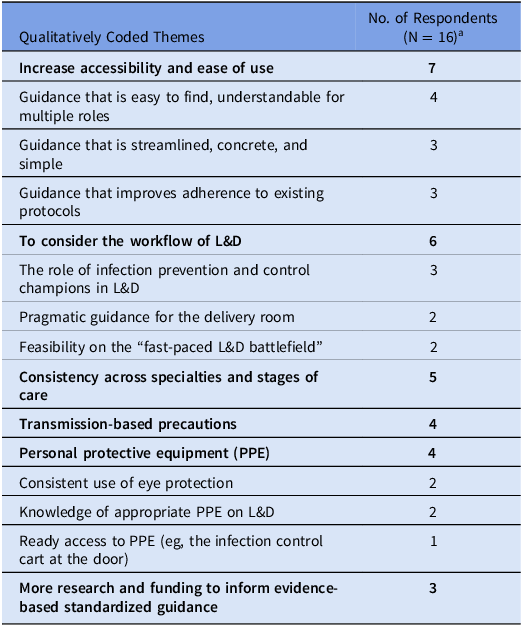
The most common theme that emerged when participants described the greatest need for IPC guidance in labor and delivery was for it to be easily accessible, clear, and simple to understand (44%) (Table 1). HCP commented that labor and delivery guidance should account for their unit’s unique workflow and that future recommendations be pragmatic to implement when practiced “out on the battlefield.” Also, 5 participants (31%) called for guidance to be consistent across hospitals, stages of care (eg, labor and delivery, postpartum), and across the professionals involved in delivery (eg, nurses, trainees, midwives, OB/GYNs).
What is the Greatest Need for Standardized Guidance During Labor and Delivery (L&D)?

a All responses were provided voluntarily and not every participant provided a response to every question. Participants may have been coded to multiple themes and subthemes but were only counted once within each. Themes and subthemes were ordered by the number of respondents from high to low. All responses were reviewed and coded within the context of the question, so every response given may not have been coded.
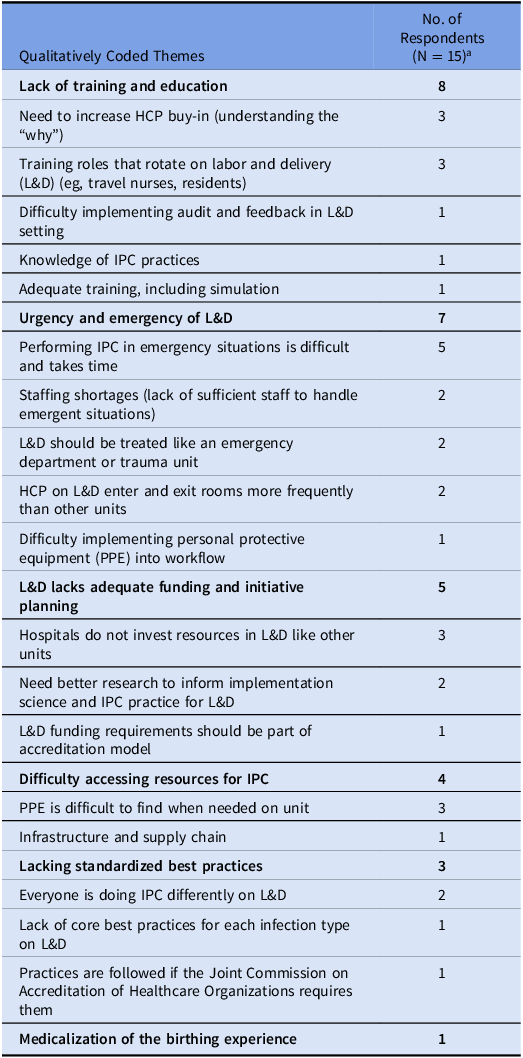
When asked about barriers that impede their ability to follow IPC practices while providing care, issues around training and education were most frequently reported (53%) (Table 2). Furthermore, 7 participants (47%) spoke of how performing IPC protocols within labor and delivery’s workflow is affected by a “lack of time” when responding to emergencies, and further impeded by “having true staffing shortages.” HCP described labor and delivery as being inadequately funded and not consistently included in hospital initiatives. Some HCP felt there was an insufficient allocation of monetary resources for labor and delivery when compared to other units such as “cardiac surgery or neurosurgery.”
Do You Feel That There Are Barriers to Healthcare Personnel (HCP) Ability to Follow Infection Prevention and Control (IPC) Practices When Caring for Laboring Patients?

a All responses were provided voluntarily and not every participant provided a response to every question. Participants may be coded to multiple themes and subthemes but are only counted once within each. Themes and subthemes are ordered by the number of respondents from high to low. All responses were reviewed and coded within the context of the question, so every response given may not be coded.
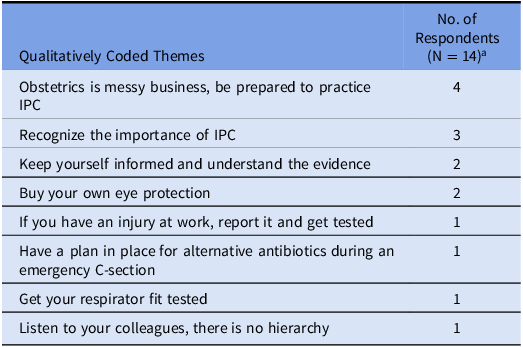
Participants were then asked to give one piece of advice to a new HCP on labor and delivery with respect to IPC (Table 3). Notably, 4 participants (29%) spoke of the unpredictability of labor and delivery, their frequent interactions with bodily fluids (eg, amniotic fluid, blood, placental tissue), and the importance of being prepared for anything. Several discussed the significant impact of performing IPC and the value of understanding the evidence behind it.
What One Piece of Advice Would You Give New Healthcare Personnel Regarding Infection Prevention and Control (IPC) in Labor and Delivery?

a All responses were provided voluntarily and not every participant provided a response to every question. Participants may be coded to multiple themes and subthemes but are only counted once within each. Themes and subthemes are ordered by the number of respondents from high to low. All responses were reviewed and coded within the context of the question, so every response given may not be coded.
Themes across all questions
Across the discussion, the most reported barrier was that the urgent nature of labor and delivery impacts the ability of HCP to consistently implement IPC protocols into their unique workflow (Table 4). Participants described how “labor and delivery is a different beast” when it comes to IPC, and how it is very “technically difficult to implement” personal protective equipment (PPE) donning and doffing protocols as they go from “room to room to room” or to the operating room in emergencies. One HCP commented that they “intercept a lot [of infections] in labor and delivery” as it is a “mixture of people with different healthcare conditions that come to us in pregnancy.”
Themes Across All Questions

The second most frequently reported barrier was a lack of training and education (Table 4). Several participants described that IPC training and education was usually an annual training that did not have any specificity to their setting. One HCP stated, “The only infection prevention training I get that’s formalized is my annual training through my hospital system, which is delivered on a PowerPoint. I’ve memorized it, so I just jump and take the quiz at the end.” In addition, disseminating a hospital’s IPC protocols to residents, travel nurses, and private physicians often proves difficult because “there are so many people working,” and once “they finally figure it out… a new team comes on.” When one medical student began clinical rotations, they had a “talk on PPE donning and doffing … a self-train module on OSHA and bloodborne pathogens, [but] beyond that … not much.”
A lack of access to PPE was the third most frequently cited barrier to performing IPC (Table 4). When PPE is not made easily accessible during emergencies, HCP described providing clinical care without it. Two participants shared the sentiment, “It is what it is. I’ve got to do what’s best for my patient, and you take that sacrifice.” Repeatedly, HCP spoke of the importance of having a fully stocked PPE cart outside of every room.
The fourth most described theme that emerged was a sense that women’s healthcare is “chronically underfunded, understaffed, and under involved” and that “women’s health services and L&D is not treated like a serious place” (Table 4). During the COVID-19 pandemic, one HCP recounted how “OB was completely left out of all the planning” until they began “fighting with people” to get infection control support on labor and delivery and that the “leadership of the hospital was like, ‘We just never even thought this would be an issue for you.’” Participants perceived that their leadership did not understand how labor and delivery functions in the hospital (eg, “an entry point into the hospital”), and what their needs are within the unit (eg, PPE volume on infection control carts, maternal sepsis watch).
Other common themes included the lack of standardization of labor and delivery IPC protocols across institutions and specialties within the hospital. One HCP described practicing during the COVID-19 pandemic as “living in [a] world of decentralization,” with “policies being different wherever you went and a lack of central leadership.” Participants echoed this point, calling for “centralized guidance” that is “all the information you need, in one place.” HCP wanted a user-friendly “website that is very easy to search and find information quickly” and for that information to be “very clear” and not “unnecessarily tedious for people who are very busy.” One participant highlighted the value of guidelines being “streamlined, concrete, and very simple to follow because we are trained to react to a situation and go really fast.” This perceived lack of clarity was exemplified by participants’ reported confusion about when to implement different transmission-based precautions (TBP) and how to recognize the appropriate signage outside of a patient room. Additional common themes are operationalized in Table 4.
Comment
Principal findings
This qualitative study identified the most common themes across participants regarding barriers to implementing IPC protocols in the labor and delivery setting, and specific opportunities to inform the development of tools and resources to guide practices. The labor and delivery setting is unique to the rest of the hospital, both in the type of care provided and the fast-paced nature of the workflow. Participants felt that their hospitals did not understand the fundamental needs of the unit, and this had negative impacts on resource allocation and pandemic preparation. There was a shared sense that the labor and delivery unit and women’s healthcare at large is not prioritized as compared to other specialties, especially as it relates to a lack of obstetric-specific research for evidence-based practice. HCP expressed that training and education materials are not adapted to their setting. They also had concerns regarding an environment where high staff turnover lead to gaps in knowledge and required the need to constantly train new staff. Participants cited a lack of standardization of labor and delivery best practices and IPC protocols, leading them to be implemented differently by each institution. Hospital policies were disparate and difficult to locate, and participants wanted IPC policies and protocols to be on a user-friendly, centralized-resource webpage. Some participants speculated that the rationale behind IPC protocols and best practices were poorly understood across all HCP, leading to low or discordant adherence between team members within different clinical disciplines. Participants also described difficulties with implementing and differentiating TBP, highlighting the importance of obstetric-specific education and clear, consistent protocols.
Results in the context of what is known
Few studies have examined HCP perceived barriers to implementing IPC practices in the labor and delivery setting. The recent COVID-19 pandemic, however, has increased attention to IPC in all healthcare settings. Hanley et al Reference Hanley, Jones and Oberman10 sought to examine facilitators and barriers to the implementation of England’s IPC guidance in maternity units during the COVID-19 pandemic. Consistent with our findings, participants described that “digestible maternity-specific guidance being filtered down to staff” was a facilitator to implementing IPC successfully, and voiced the need for streamlined guidance that could be implemented consistently across hospitals, professional specialties involved in delivery, and across the obstetric care continuum. Reference Hanley, Jones and Oberman10 Like the Hanley study, our participants identified the lack of specificity to the labor and delivery setting as a barrier, and that general IPC guidance fails to address the “unique aspects of care at birth.”
Participating HCP repeatedly described labor and delivery as an unrecognized entry point into the hospital, and that it should be treated similarly to the emergency department. The significance of considering labor and delivery as an entry point was further highlighted in research conducted early in the COVID-19 pandemic. Sutton et al Reference Sutton, Fuchs, D’Alton and Goffman11 found that the majority of pregnant patients testing positive for SARS-CoV-2 were asymptomatic. A survey measuring safety practices in obstetric units conducted by the Society of Maternal-Fetal Medicine (SMFM) in April 2020 revealed that only 20% of respondents’ hospitals performed universal testing for women admitted to labor and delivery. Reference Werner, Louis, Hughes, Han, Norton and Srinivas12,Reference Johnson, Melvin and Srinivas13 A second survey administered by SMFM in May 2020 demonstrated a substantial increase in the use of universal testing in obstetric units but still found disparities in the utilization of screening practices across hospital types. Reference Johnson, Melvin and Srinivas13 These findings underscore the importance of labor and delivery being recognized as an entry point, and appropriate quantities of testing supplies, PPE, and other IPC resources should be allocated to the unit to effectively protect against emerging infectious threats.
Research implications
This cohort only captured the experiences of physicians. Although informative, it does not provide a complete picture of the IPC needs of all HCP in labor and delivery. As such, additional research on this topic should be explored to include the experiences and perceptions of other HCP, especially nurses, midwives, and nursing assistants. Partnering with infection preventionists, medical epidemiologists, and environmental services staff may also provide helpful insight into important IPC practices beyond clinical care and direct patient interaction. Such research should aim to translate HCP perceptions into practical implementation guidance to improve adherence to IPC practices in this specialized setting.
A strength of this study was the qualitative nature of inquiry, in which HCP were able to share their thoughts and experiences openly in a small group setting of their peers. This study also had several limitations, including limited generalizability due to the small sample size and the use of a convenience sample. However, by nature of attending the IDSOG conference, these HCP may have a greater interest in IPC than other groups in this specialty, and as such were able to provide valuable insight into this topic. Furthermore, all responses collected were self-reported.
In conclusion, participating HCP identified barriers to performing IPC on labor and delivery that spanned across intrapersonal, institutional, and public policy levels. IPC may be challenging to implement in the obstetric setting due to the specialized nature of clinical care provided and the barriers identified by the study participants. Targeted interventions should be established to ensure HCP are able to access the tools they need to perform their duties efficiently without compromising patient care. Another way to improve implementation and adherence of IPC practices is to distill infection control guidance to simple steps that can be applied realistically within the fast-paced workflow of obstetric care. Furthermore, the development of future resources should aim to increase hospital leadership’s understanding and awareness of labor and delivery’s unique needs to improve resource allocation to support implementation of IPC practices. This includes personnel resources and strong partnerships with infection preventionists, medical epidemiologists, and infectious disease physicians. Overall, labor and delivery will likely benefit from specialized attention to their corner of the hospital through the provision of obstetric-specific infection control support, creating a safer environment for both patients and HCP. Using the results and lessons learned from these focus groups, we hope to create obstetric-tailored resources that HCP and hospitals can utilize to decrease patient risk of HAIs and protect HCP during the process of labor and delivery.
Acknowledgments
We want to thank the Infectious Diseases Society for Obstetrics and Gynecology for their collaboration to hold these focus groups, and the HCP who graciously shared their experiences and opinions on this important topic. The findings and conclusions in this report are those of the authors and do not necessarily represent the official position of the Centers for Disease Control and Prevention.
Financial support
No financial support was provided relevant to this article.
Competing interests
All authors report no conflicts of interest relevant to this article.