Introduction
More than 500 000 new cases of head and neck squamous cell carcinoma are identified yearly, with approximately 40 per cent of patients having locally advanced disease at presentation.Reference Ferlay, Bray, Pisani and Parkin1 Radiotherapy plays an important role in their management. However, despite advances in treatment options, the prognosis is poor, with three-year cure rates rarely exceeding 50–60 per cent.Reference Bernier and Bentzen2 The main focus of surgeons and oncologists involved in patient management is locoregional control, which also represents the dominant form of treatment failure.
In many new cases of head and neck squamous cell carcinoma, the fundamental treatment decision lies between treatment based upon primary radiotherapy and that based upon primary surgery. This is more relevant now than ever before. Advances in conservation surgery, for example using transoral laser excision as well as modern reconstructive techniques, have made surgery an option for early to intermediate stage disease, rather than radiotherapy. Equally, advances in radiotherapy (for example, concurrent chemoradiotherapy alone or following induction chemotherapy) have made this an organ-preserving option for advanced disease, instead of primary surgery with post-operative radiotherapy.Reference Lefebvre, Chevalier, Luboinski, Kirkpatrick, Collette and Sahmoud3, Reference Pignon, Bourhis, Domenge and Designe4
The most basic form of treatment individualisation using biological markers would therefore ideally include markers that predict response to radiotherapy. The importance of identifying patients who would not respond to radiotherapy (i.e. who would be radiotherapy failures) is significant, as the functional and oncological outcomes of surgical salvage are poorer than those of primary surgery.Reference Clark, de Almeida, Gilbert, Irish, Nelligan and Gullane5 Conversely, the use of surgery on a tumour that may have been cured with radiotherapy exposes the patient unnecessarily to the potential risks of surgery and organ sacrifice.
With the increasing availability of antibodies to a wide variety of molecular markers, much work has focussed on examining protein expression in tumours using immunohistochemistry – a technique suitable for routine clinical use. It is increasingly recognised that the response of a tumour to radiotherapy is unlikely to be dependent on a single biological parameter in isolation (such as hypoxia, proliferation or intrinsic radiosensitivity) but rather on a myriad of biological factors all interlinked together. The molecular complexity of tumours, combined with the availability of a large number of antibodies and new statistical approaches for cluster analysis, provide the rationale for investigation of molecular marker profiles.
The potential of this approach has been highlighted in recent papers which defined profiles associated with response to radiotherapy in patients with head and neck squamous cell carcinoma.Reference Buffa, Bentzen, Daley, Dische, Saunders, Richman and Wilson6, Reference Eriksen, Buffa, Alsner, Steiniche, Bentzen and Overgaard7 Buffa et al. assessed the expression of proteins p53, Ki67, Bcl-2 (B cell leukaemia-2), cyclin D1 and CD31 (cluster of differentiation 31) glycoprotein, and used cluster analysis to identify marker profiles associated with a good response to conventional radiotherapy or to continuous hyperfractionated accelerated radiotherapy.Reference Buffa, Bentzen, Daley, Dische, Saunders, Richman and Wilson6 One profile was associated with approximately 69 per cent locoregional control following hyperfractionated accelerated radiotherapy but only approximately 33 per cent control following conventional radiotherapy. Similarly, Eriksen et al. assessed a cohort of patients from the Danish head and neck cancer group trials, and defined a profile which identified patients who did not benefit from a reduction in the overall treatment time.Reference Eriksen, Buffa, Alsner, Steiniche, Bentzen and Overgaard7 This profile was characterised by wild-type p53, low expression of E-cadherin and B cell leukaemia-2, and moderate expression of Ki67 and EGFR (epidermal growth factor receptor).
With this in mind, we examined the expression of nine biological markers. The aim of the study was to define a biological marker profile associated with the response to radiotherapy of oropharyngeal carcinomas. Marker proteins were selected to reflect a range of biologically diverse yet relevant pathways, as follows: for hypoxia, hypoxia inducible factor-1 α (HIF-1α), carbonic anhydrase 9 (CA9) and glucose transporter 1 (Glut-1); for proliferation Ki67 and EGFR; for radiosensitivity, radiation response and chemoresistance, posphorylated v-akt murine thymoma viral oncogene homolog 1 (pAkt) and major vault protein (MVP) and Bcl-2; and for metastasis and invasion, fragile histidine triad gene (Fhit).
The hypoxia-related markers HIF-1α, CA9 and Glut-1 have all been shown to be important in response to radiotherapy. CA9 and HIF-1α may also be dependent on other oncogenic pathways independent of hypoxia, whilst glucose transporter 1 expression and its prognostic effect may be closely related to glucose availability, which is fundamental to cell survival and apoptosis.Reference Sly and Hu8, Reference Hammerman and Fox9 Tumour proliferation is recognised as an important biological factor determining the outcome of fractionated radiotherapy.Reference Fowler10 Immunohistochemical investigation of Ki67 in biopsy specimens is widely used to assess tumour cell proliferation. Epidermal growth factor receptor signalling is frequently increased in cancer, particularly in head and neck tumours.Reference Grandis and Tweardy11 Over-expression of epidermal growth factor receptor is associated with increased tumour cell proliferation, angiogenesis, loss of differentiation and reduced apoptosis.Reference Shin, Ro, Hong and Hittelman12, Reference Christensen13 Phosphorylated Akt has been linked with radioresistance in many cancers and may be involved in cell survival regulation; it may also play a role in the early stages of malignant transformation.Reference Panigrahi, Pinder, Chan, Paish, Robertson and Ellis14 The role of major vault protein in chemoresistance has been demonstrated, and is thought to be secondary to its role in intracellular transport.Reference Kickhoefer, Siva, Kedersha, Inman, Ruland and Streuli15, Reference Schroeijers, Scheffer, Flens, Meijer, Izquierdo and van der Valk16 B cell leukaemia-2 is an anti-apoptotic protein involved in cell cycle regulation.Reference Wilson, Saunders, Dische, Richman, Daley and Bentzen17 The fragile histidine triad tumour suppressor gene has been shown to be downregulated early in carcinogenesis.Reference Sozzi, Pastorino, Moiraghi, Tagliabue, Pezzella and Ghirelli18
Methods
Between 1996 and 2001, a consecutive series of 60 patients were identified as having received primary radiotherapy at the Christie Hospital, Manchester, for a histologically proven squamous cell carcinoma of the oropharynx (i.e. tonsil and posterior third of the tongue). The medical records of all these patients were reviewed.
Primary tumour sites were irradiated, and patients with positive neck nodes underwent a prior neck dissection. Megavoltage radiation was delivered by means of a 4 MV linear accelerator, in daily fractions, five times a week for three weeks. The radiation dose prescribed at the time followed strict guidelines, with posterior tongue tumours receiving lateral parallel pair radiation (50 Gy in 16 fractions), while tonsillar tumours received ipsilateral therapy of 52.50 Gy in 16 fractions. This represented the standard curative treatment used by our centre at the time, i.e. a hypofractionated accelerated regimen. This fractionation approach is biologically equivalent to 71 Gy in eight weeks for local control in patients with tonsil cancer.Reference Withers, Peters, Taylor, Owen, Morrison and Schultheiss19 The regimen provides excellent tumour control in other head and neck sites such as the larynx and oral cavity.Reference Gowda, Henk, Mais, Sykes, Swindell and Slevin20, Reference Turner, Slevin, Gupta and Swindell21
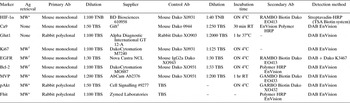
Tumour blocks were obtained from referring hospital biopsies. From each tissue block, haematoxylin and eosin slides were used to confirm the presence of sufficient amounts of tumour. Following deparaffinisation of the sections, the antigen-binding sites (epitopes) were unmasked, using various epitope retrieval steps which involved heat, chemicals or enzymes. To avoid non-specific binding of the primary antibody, blocking proteins were added. In addition, endogenous peroxidase activity within the tissue was quenched using hydrogen peroxide. After binding of the primary antibody to the antigen under investigation, a secondary biotinylated antibody was added. The secondary antibody was species-specific and directed against immunoglobulins from whatever species the primary antibody was derived (e.g. rabbit or goat). After removal by washing of unbound secondary antibody, horseradish peroxidase streptavidin complex was added, which bound to the biotin on the secondary antibody. The horseradish peroxidase acted on the chromagen substrate diaminobenzidine, which was subsequently added. This causes a brown precipitate to be deposited where there was bound horseradish peroxidase (and therefore also the antigen under investigation). Finally, the tissue sections were counterstained to visualise the cells and tissue architecture. All of the steps described were based on established laboratory protocols, but were optimised according to the antigen under investigation (Table I).
Summary of immunohistochemical methods used

MW* = microwaved in citrate buffer for 25 min; MW† = microwaved in ethylene diamine triacetic acid (EDTA) (0.05Tris–HCL/1 mM EDTA) for 25 min. ‡A gift from Profs. S. Pastorekova and J. Pastorek, Slovak Academy of Sciences, Bratislava, Slovak Republic; microwaved in 10 mM Tris with 1 mM ethylene diamine triacetic acid (EDTA) and 0.05% TWEEN 20 for 25 min. Ag = antigen; Ab = antibody; HIF-1α = hypoxia-inducible factor-1; Ca9 = carbonic anhydrase 9; Glut1 = glucose transporter 1; Ki67 = Ki67; EGFR = epidermal growth factor receptor; Bcl-2 = B cell leukaemia-2; MVP = major vault protein; pAkt = phosphorylated Akt; Fhit = fragile histidine triad gene; TNB = 0.1 M Tris-hydrocholoric acid; TBS = tris buffered saline; – = not included in the analysis; ON = overnight; RT = room temperature; min = minutes; hr = hours; RAMBO = rabbit antimouse biotinylated antibody; HRP = horse radish peroxidase; GAMBO = goat antimouse biotinylated antibody; GARBO = goat antirabbit biotinylated antibody; TSA = tyramide signal amplification; DAB = diaminobenzidine
All the markers studied in our patient series, except for glucose transporter 1, were scored using the following, semiquantitative system: 0 = no staining; 1 = <10 per cent staining; 2 = 10–29 per cent staining; and 3 = >30 per cent staining. Glucose transporter 1 was scored as either present or absent. Scoring was performed by two independent, experienced oral pathologists; conflicts in scoring were resolved by discussion and consensus. Scorers were blinded to outcome. The markers were studied individually and within a multivariate analysis. Multivariate analysis was performed using the Cox regression model for locoregional control and cancer-specific survival. The analysis included the clinical factors of site (tonsil or tongue), stage (I/II, III or IV) and haemoglobin level (<13.2 g/dL or ≥13.2 g/dL). The approach adopted for selection of marker terms was based on the guidelines published by Collett.Reference Collette22
Results
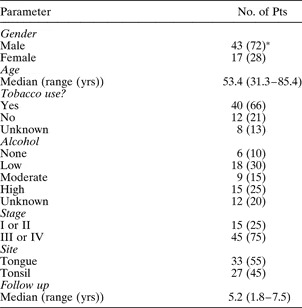
The characteristics of the 60 patients are summarised in Table II. The median duration of follow up for the surviving patients was 5.2 years (range 1.8–7.5). There were 33 patients with locoregional failure. Distant metastases were recorded in seven patients. The five-year locoregional control, cancer-specific survival and overall survival rates for the 60 patients were 38.2, 45.7 and 21.3 per cent, respectively. Univariate Cox regression analysis identified the following clinicopathological factors to be associated with poor locoregional control: low pre-treatment haemoglobin level (p = 0.05), and advancing tumour (p = 0.006), node (p = 0.04) and disease (p = 0.005) stage.
Patient characteristics

*percentage unless indicated otherwise? Pts = patients; yrs = years
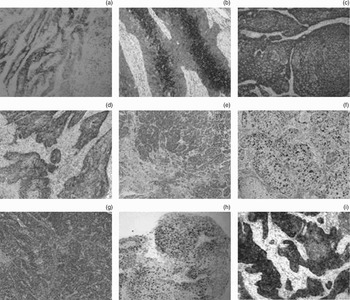
Examples of immunostaining are shown in Figure 1. The expression of carbonic anhydrase 9 was mainly on the plasma membrane, with no significant variation in intensity between tumours. Glucose transporter 1 protein was expressed diffusely throughout the tumour, with either intense or near-absent staining. Although occasional cytoplasmic staining of the tumour cells was observed for epidermal growth factor receptor, only staining of the tumour cell membranes was considered to be specific. B cell leukaemia-2 staining was observed in both the membrane and cytoplasm. Phosphorylated Akt immunohistochemical analysis demonstrated homogeneous staining of the cytoplasm and nucleus. Immunohistochemical analysis for Ki67 revealed a typical nuclear staining pattern. Major vault protein staining was predominantly cytoplasmic. HIF-1α staining was predominantly nuclear, with variable cytoplasmic expression. Immunohistochemical staining for fragile histidine triad gene revealed strong cytoplasmic and moderate nuclear staining.
Photomicrographs showing examples of high levels of tumour expression of (a) carbonic anhydrase 9, (b) glucose transporter 1, (c) epidermal growth factor receptor, (d) B cell leukaemia-2, (e) phosphorylated Akt, (f) ki67, (f) fragile histidine triad gene, (h) HIF-1α, and (i) major vault protein. (×100)

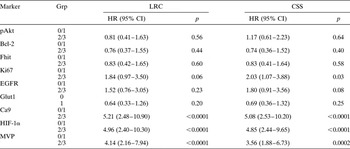
The overall results for immunohistochemical and univariate analyses are shown in Table III. Expressions of carbonic anhydrase 9, HIF-1α and major vault protein were highly significant prognostic factors for both locoregional control and cancer-specific survival. In addition, low Ki67 expression was associated with improved cancer-specific survival.
Univariate outcome analyses for nine biological markers studied

Grp = stratifying group; LRC = locoregional control; CSS = cancer-specific survival; HR = hazard ratio; CI = confidence interval; pAkt = phosphorylated Akt; Bcl-2 = B cell leukaemia-2; Fhit = fragile histidine triad gene; Ki67 = Ki67; EGFR = epidermal growth factor receptor; Glut1 = glucose transporter 1; Ca9 = carbonic anhydrase 9; HIF-1α = hypoxia-inducible factor-1; MVP = major vault protein
Multivariate analysis
After examining the various markers individually, multivariate analysis of all the markers was conducted. Complete data for the nine markers were available for all 60 patients. Analysis of outcome relationships showed that the markers appeared to cluster into two groups (i.e. 0/1 versus 2/3); consequently, for the multivariate analyses, patients were stratified into two similarly sized groups. Multivariate analysis was performed using the Cox regression model for locoregional control and cancer-specific survival. The analysis included the clinical factors of site (tonsil or tongue), stage (I or II, or III or IV) and haemoglobin level (<13.2 g/dL or ≥13.2 g/dL). The approach adopted for selection of marker terms was based on guidelines published by Collette.Reference Collette22 A stepwise model was used to derive a panel of biological markers (Table IV).
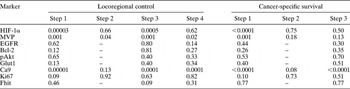
Collett stepwise model used to derive biological marker panel

Data represent p-values. HIF-1α = hypoxia-inducible factor-1; MVP = major vault protein; EGFR = epidermal growth factor receptor; Bcl-2 = B cell leukaemia-2; pAkt = phosphorylated Akt; Glut1 = glucose transporter 1; Ca9 = carbonic anhydrase 9; Ki67 = Ki67; Fhit = fragile histidine triad gene; – = not included in the analysis
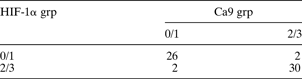
Step one showed that HIF-1α, carbonic anhydrase 9 and major vault protein were statistically significant prognostic factors for locoregional control, in a univariate analysis. Step two used all the terms significant from step one, and the clinical parameters of site, stage and haemoglobin level, in a multivariate analysis. This was then assessed by dropping each of the constituent terms from the model. The only remaining term which retained independent significance was major vault protein. In step three, each of the terms was added, one at a time, to the model. This resulted in both carbonic anhydrase 9 and HIF-1α regaining significance. This behaviour was explained by the fact that both carbonic anhydrase 9 and HIF-1α were important on their own but not together, as the two variables carried virtually the same information. This was demonstrated by cross-tabulation of the cases (Table V).
Cross-tabulation of HIF-1α and Ca9 cases

HIF-1α = hypoxia-inducible factor-1; Ca9 = carbonic anhydrase 9; grp = outcome group
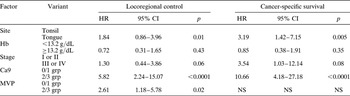
The difference between the prognostic significance of carbonic anhydrase 9 and HIF-1α was small. However, carbonic anhydrase 9 was slightly more significant (p = 0.00001), and was therefore chosen over HIF-1α (p = 0.00003). This resulted in a model with only two markers that retained independent significance, namely major vault protein and carbonic anhydrase 9. A test for interaction between these two variables failed to reveal any significant relationship (p = 0.69). Table VI outlines the hazard ratios from the multivariate analysis.
Multivariate analyses

HR = hazard ratio; CI = confidence interval; Hb = haemoglobin; Ca9 = carbonic anhydrase 9; MVP = major vault protein; grp = outcome group; NS = not significant
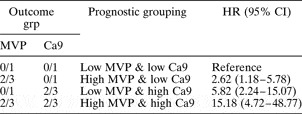
From the fitted model, it is clear that, after adjustment for site, stage and haemoglobin level, raised major vault protein and carbonic anhydrase 9 expressions were adverse prognostic features for locoregional control, with carbonic anhydrase 9 having the larger effect. Table VII illustrates the ordering of the prognostic groups for locoregional control.
Prognostic groups for locoregional control

Grp = stratifying group; HR = hazard ratio; CI = confidence interval; MVP = major vault protein; Ca9 = carbonic anhydrase 9
Applying this model to our dataset illustrated the prognostic categories.
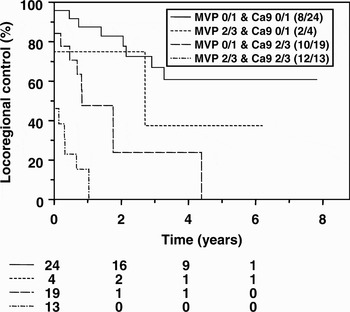
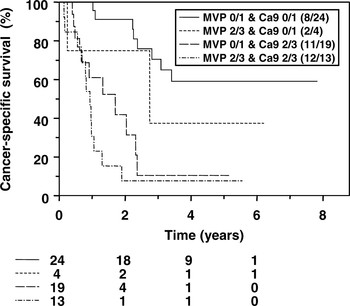
It could be seen that the groups divided into four distinct survival patterns, whereby those patients with a combination of high major vault protein expression and high carbonic anhydrase 9 expression had the poorest probability of locoregional control (Figure 2). In terms of cancer-specific survival, major vault protein was not formally significant (p = 0.13) after adjustment for all the factors; however, the Kaplan–Meier curve (Figure 3) illustrated a trend for poorer outcome when both markers were combined.
Kaplan–Meier curve demonstrating locoregional control according to tumour expression of major vault protein (MVP) and carbonic anhydrase 9 (Ca9) (p<0.0001).

Kaplan–Meier curve demonstrating cancer-specific survival according to tumour expression of major vault protein (MVP) and carbonic anhydrase 9 (Ca9) (p = 0.13).

Discussion
The use of individual biological markers in the investigation of head and neck squamous cell carcinoma often fails to address the complex biology of these tumours. We chose a total of nine markers, in order to reflect a range of different biological pathways, as follows: Ki67, epidermal growth factor receptor, carbonic anhydrase 9, glucose transporter 1, fragile histidine triad gene, B cell leukaemia-2, phosphorylated Akt, HIF-1α and major vault protein. Our approach of using pre-treatment biopsy material and standard immunohistochemistry techniques provided an inexpensive, clinically applicable test that could be easily employed in routine practice. We studied a relatively homogeneous patient and tumour group, with one site and one principal treatment modality. The study group was consecutive, eliminating any selection bias.
Three markers were found to be prognostic for locoregional control and cancer-specific survival: carbonic anhydrase 9, HIF-1α and major vault protein. In a multivariate analysis, the results of the individual markers were used to derive a profile of two markers (carbonic anhydrase 9 and major vault protein), the high co-expression of which conferred a significantly poorer probability of locoregional control within the oropharynx. The prognostic effect of these markers in combination was greater than their effects individually.
The role of carbonic anhydrase 9 in the transcriptional response to hypoxia is well recognised. Our study showed increased tumour carbonic anhydrase 9 expression to be highly predictive of locoregional control and cancer-specific survival. In the current literature, the prognostic role of this protein is unclear. Two studies, both by the same group, found increased tumour carbonic anhydrase 9 expression to be significantly associated with poor locoregional control.Reference Koukourakis, Giatromanolaki, Sivridis, Simopoulos, Pastorek and Wykoff23, Reference Koukourakis, Bentzen, Giatromanolaki, Wilson, Daley and Saunders24 Of six other studies, two revealed a non-significant relationship with poor local control, one found the reverse, and the remainder found no association.Reference Beasley, Wykoff, Watson, Leek, Turley and Gatter25–Reference Bache, Reddemann, Said, Holzhausen, Taubert and Becker31
It is known that carbonic anhydrases participate in a variety of biological processes, including pH regulation, respiration and calcification, and it is known that factors other than hypoxia may influence the expression of carbonic anhydrase 9.Reference Sly and Hu8 These differences may be a reflection of this, or indeed the heterogeneity of the subsites, with only one study concentrating on a single subsite.Reference Hui, Chan, Pezzella, Turley, To and Poon27 Interestingly, in cervical carcinomas, high carbonic anhydrase 9 expression was not found to be associated with poor locoregional control, but with a low probability of metastasis-free survival, suggesting it may not measure hypoxic radioresistance.Reference Loncaster, Harris, Davidson, Logue, Hunter and Wycoff32 Expression of carbonic anhydrase 9 in these tumours may reflect the activity of other oncogenic pathways independent of hypoxia.
HIF-1α has been studied extensively as a potential indirect assessor of tumour hypoxia, and most studies have found high expression to be an adverse prognostic factor in patients undergoing radiotherapy.Reference Koukourakis, Bentzen, Giatromanolaki, Wilson, Daley and Saunders24, Reference Hui, Chan, Pezzella, Turley, To and Poon27, Reference Aebersold, Burri, Beer, Laissue, Djonov and Greiner33, Reference Koukourakis, Giatromanolaki, Liberis and Sivridis34 We found both carbonic anhydrase 9 and HIF-1α to be significant for locoregional control on multivariate analysis. Their relationship with each other shows that they are measures of the same entity (i.e. tumour response to hypoxia), and it was only for statistical reasons that HIF-1α lost its significance in favour of carbonic anhydrase 9.
Our previous study of major vault protein expression revealed it to be strongly prognostic of treatment outcome following primary radiotherapy.Reference Silva, West, Slevin, Valentine, Ryder and Hampson35 Various theories have been postulated to explain this protein's role in mediating drug resistance, including its subcellular localisation serving to bind drugs and transport them to locations remote from their cellular drug target; however, its role in radioresistance remains to be elucidated.Reference Chugani, Rome and Kedersha36
It is evident that tumour biology cannot wholly be described using one single marker. This may explain the heterogeneity in results across various studies. The use of a panel of biological markers to identify a profile associated with outcome has been described in two previous studies.Reference Buffa, Bentzen, Daley, Dische, Saunders, Richman and Wilson6, Reference Eriksen, Buffa, Alsner, Steiniche, Bentzen and Overgaard7 Both these studies used cluster analyses to identify groups of patients who would benefit from accelerated (as opposed to conventional) schedules. Grouping our patients undergoing radiotherapy according to their tumours' carbonic anhydrase 9 and major vault protein expression appeared to have a powerful predictive value; for example, the hazard ratio in patients with high tumour major vault protein and carbonic anhydrase 9 expression was over 15 for locoregional control. This knowledge could be used to produce predictive classifiers enabling stratification of patients to specific, individualised therapies.
Such strategies might include synchronous chemoradiotherapy with or without induction chemotherapy, hypoxia modification strategies, the use of accelerated regimens (such as continuous hyperfractionated accelerated radiotherapy) or the use of bioreductive drugs such as tirapazamine.Reference Gandara, Lara, Goldberg, Le, Mack and Lau37, Reference Henk, Bishop and Shepherd38 Another alternative would be the selection of primary surgery for patients with poorer predicted response to radiotherapy. Clearly, the response from these various regimens is heterogeneous, and therefore the aim would be to identify those patients who would benefit most from such treatments.
Now that chemoradiotherapy (i.e. synchronous chemotherapy, induction chemotherapy or both) is standard for this patient group, it may be possible to identify which patients may be candidates for less toxic treatment, for example without cytotoxic chemotherapy. These patients would have a biomarker-predicted good response to radiotherapy, and hence a good prognosis.
Our approach of using pre-treatment biopsy material and standard immunohistochemistry techniques offers an inexpensive, clinically applicable test which could be easily incorporated into routine practice. The training required to attain good clinical laboratory practice is minimal, and is financially less constraining than other techniques such as microarrays or cytogenetics.
Clearly, further study is required to reproduce these findings, and to determine whether tumour expression of both major vault protein and carbonic anhydrase 9 can act as a marker of tumour aggression or indeed of radioresistance. Additionally, the underlying genetic pathways that define these markers needs to be further elucidated, facilitating the application of this knowledge to enable treatment modification and improved radiotherapy response.
In conclusion, biomarker profiles can be established which highlight large differences in locoregional control in patients with head and neck squamous cell carcinoma undergoing radiotherapy.
• Head and neck squamous cell carcinomas involve diverse subsites, treatments and underlying tumour biology
• Management decisions are largely based on clinical parameters independent of tumour biology
• Single biological marker studies fail to acknowledge the complexity and heterogeneity of this disease
• This study identified a panel of biological markers the combined prognostic effect of which was greater than their individual effects alone
• This biological marker panel may be useful to select appropriate patients for more aggressive therapy
Acknowledgements
This work was supported by Cancer Research UK and the National Translational Cancer Research Network of the UK.