Introduction
In February 1821 Fabian von Bellingshausen of the Imperial Russian Navy was just completing his famous circumnavigation of the Antarctic continent. By the time he and his crews were approaching the South Shetland Islands; they had accomplished much in the way of discovery of new lands. It must therefore have come as some surprise to find, as the fog lifted one morning, a tiny American sealing vessel of no more than 45 tons. This was commanded by the youthful Nathaniel Palmer of Stonington, Connecticut. The meeting itself has been the subject of much debate since the stories relating to it differ considerably in detail. What is not in question, however, is the fact that the encounter took place. Bellingshausen found not just Palmer, but a whole fleet of American and British sealers engaged in a highly profitable commercial venture far into the previously unknown and unexplored world.
Nearly 90 years later, in December 1908, Jean-Baptiste Charcot, the French polar explorer, was also approaching the same islands. By this time the seals had been commercially exterminated by the American and British fleets, but a new commercial venture had drawn similar men who had set out to seek a living in the unknown. Charcot, already an Antarctic veteran wrote:
[T]he meeting with vessels quietly carrying on their work in this region had something impressive and almost uncanny about it. This sensation affected us still more strongly when we found ourselves in Deception Island basin, in the midst of a veritable flotilla of boats, all at work as though in some busy Norwegian port. Our pilot brings us up very close to the smooth, precipitous face of the high black cliff on the west side of the passage, and after a sharp turn the whaling-station appears before our eyes, marvelously sheltered in a fairly big bay notched out of the great crater-basin of this weird and picturesque island. We find two three-masters and two steam-vessels surrounded by several little steam-whalers, this fleet belonging to three different companies. Pieces of whale float about on all sides, and bodies in the process of being cut up or waiting their turn lie alongside the various boats. The smell is unbearable (Charcot Reference Charcot1978: 32).
Although nearly a century had passed between the two meetings, little had changed in substance. Explorers were still gingerly approaching the frozen southern continent, and they were still being met there by hardy seafaring men making their livelihood on the same inhospitable shores.
Deception Island in the South Shetlands is not only geographically unique as a drowned caldera in a polar sea, it is also a singular location from an economic standpoint. The shelter offered by the interior harbour has made it the centre of commerce in Antarctica. Its commercial history has spanned virtually the entire human history of the continent. This paper will present that span from the earliest discoveries and their economic impact through the whaling period to the present and the advent of ecotourism in present Antarctica.
Sealers
William Smith in the British brig Williams is generally credited with the discovery of the South Shetland Islands in early 1819. By the next austral summer (1819–1820) several British and American sealers had arrived and with them the beginning of the commercial history of the area. By the season of 1820–1821 more than fifty American and British sealers had begun the short lived but thorough slaughter of the local fur seal population.
William Smith may have discovered the South Shetlands, but credit for the discovery of Deception Island is not clear. It could have been any one of a number of British or American sealers. In fact it was probably Edward Bransfield with Smith as pilot on the same ship Williams in January 1820. It does, however, appear that it was Palmer, sailing the tiny sloop Hero who first explored the interior harbour on Wednesday, 15 November 1820 while on an exploring voyage for Captain Pendleton's sealing fleet. His orders were to find colonies of fur seals and to find safe anchorages for the fleet. Palmer sailed Hero in through what was then called the ‘Serpent's mouth’, now known as Neptune's Bellows, to find the water quite shallow. After riding out a snow storm, he continued the next morning to explore the interior shoreline found to be ‘an Excellent Harbor secure from all winds’ (Bertrand Reference Bertrand1971: 67). He stayed for two days collecting penguin eggs and exploring the island. Palmer's discovery of the opening into the hidden harbour was also to provide the root of the island's name, Deception.
Life for the crews who were left on shore to kill and skin the fur seals (and later to render the oil from southern elephant seals) was harsh. There are no known structures left on Deception from this era, but certainly some rudimentary shelters were constructed. The men probably lived on shore in tents and in stone walled, canvas roofed, lean to shelters similar to those found on Livingston and other nearby islands. Fires were kept with blubber, and food was often supplemented with eggs of penguins and of the abundant seabirds that inhabit the South Shetlands during the southern summer. As crude as the living must have been on the otherwise uninhabited islands, one needs to keep in perspective what the life of a sailor was like in the 1820s. Certainly the prospect of fresh food, fresh water and solid land (or even ice) underfoot plus the prospect of a share in the voyage's profits must have made the risks and hardships seem worthwhile. Although records are sparse it does not appear that Deception itself was a great source of fur seals. Most were on the precipitous outer coast with its difficult beaches. The interior harbour never appears to have had a large fur seal population, maybe because of the volcanic nature and a lack of food. Deception's only real importance was as a central rendezvous for the various sealing fleets. Indeed, among the early names for the central lagoon was ‘Yankee Harbor’ (a name not unique to Deception) because of its use by the New England ships.
Deception, as Palmer's description implies, is put into the Antarctic setting, unique. It is a still active drowned caldera that is breached on one side to form the entrance into its nearly circular, land locked harbour. The island lies 16 km (10 miles) south of Livingston Island in the South Shetland chain. It is roughly 13 km (8 miles) in diameter and has a mean elevation of 300 m (985 ft) with two conspicuous peaks of 539 m (1768 ft) and 452 m (1483 ft). The interior of the caldera is constantly changing because of volcanic activity. Warm springs abound and both snow fields and shallow wells provide fresh water in abundance.
The discoveries of Smith, Palmer and others also nearly eradicated the fur seal in the region. Some estimates have nearly one hundred ships working in the South Shetlands in the 1821–1822 season. Inevitably, Deception with its central and sheltered location was in the middle of this frenzy of exploitation. Within four years of the discovery of the islands, approximately 500,000 fur seals had been taken and the industry and therefore the first chapter of Deception's commercial history was as dead as its prey (Busch Reference Busch1985; Basberg and Headland Reference Basberg and Headland2008; Jones Reference Jones1992).
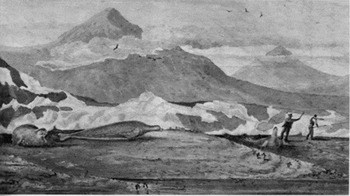
By the mid 1820s the fur seals had been essentially eradicated from the South Shetlands and only the occasional ship ventured into the area. More often than not the prey was elephant seals and the oil that could be extracted from their blubber (Fig. 1). One such expedition sailed under William H. Smyley on the Ohio of Newport, Rhode Island. Smyley was the first to report significant eruptive activity. He said that the southern shore of Deception Island was ‘. . . in flames . . .’ and that he saw ‘. . . no less than thirteen eruptions . . .’ (Charcot Reference Charcot1978: 40). Ohio's departure from Deception in February 1842 marked the end of significant commercial activity there (although there were sporadic visits later in the 19th century) until the second wave of visitors arrived nearly 60 years later (Jones Reference Jones1992).
‘Sea leopards at the island of Deception, South Shetland’. This watercolour painting was done by Lieut. E.N. Kendall of HMS Chanticleer in 1829. It may be the earliest image of Deception (UK Hydrographic Office Archive).

Whalers
Whaling in the southern ocean began as the stocks of whales were being exhausted in the north. The pattern was nearly identical to the destruction of the fur seals that brought the first wave of exploration and exploitation to the South Shetlands. Norway had instituted a ban on whaling in Finnmark in February 1904 and the traditional whaling families were looking for places to expand the trade. Several expeditions had been sent to the Antarctic, but none had so far found sufficient whales to warrant full scale commercialisation in the south.
It was not until Carl Anton Larsen's rescue during the Nordenskjöld expedition in 1903 (Headland Reference Headland1989: 231) that public attention was brought to the numbers of whales present in the south. Larsen convinced a group of Norwegian expatriates living in Argentina to capitalise the first major whaling venture in southern waters. His base was at Grytviken on South Georgia, which was to remain the most successful of the southern whaling stations and both the first and the last to operate as a land station between 1904 and 1965.
It is important to understand the state of whaling at the turn of the twentieth century. Whaling had been revolutionised in the 1870s by Svend Foyn's invention of the harpoon gun. This allowed the use of fast steam powered catcher vessels and was responsible in large part for the decimation of the whale populations in the north. The harvests became so large that true factories were needed to render the oil and other products.
To do this the Norwegians developed ever more efficient machinery. In the north this was usually placed in land stations near the whaling grounds and the kill was towed by the catcher ships to the factory. In the south there were fewer known harbours and there was frequent bad weather. In all but a few spots the south had to be abandoned during the long southern winter. This meant that outside South Georgia, the factories had to be mounted on ships to be anchored in protected anchorages for the short season.
In 1905 Admiralen owned by Christensen's A/S Ørnen was the first of these floating factories and was for the time a technological marvel. It was an ex British merchant ship that had been converted to be a complete whale processing factory. It was primitive in some ways as it relied mainly on open boiling tanks to render oil from the blubber. Open tanks were the only way at that time to render the best grades of oil. It did have one pressure cooker to render bone, tongue and meat. It was completely self contained, except of course for fresh water and fuel. In many ways it mimicked the old American sperm whalers that roamed the oceans of the world but it was far larger and technologically more advanced. It did, however, need a sheltered anchorage, particularly because of its open rendering tanks and the need to strip the blubber from the whale carcass overboard. It was the first into the South Shetlands and spent most of its time in Admiralty Bay, but it was the precursor of what was to come. Gradually this type of ship would become more and more sophisticated as the conditions under which they had to operate were better understood, but Admiralen was the first in the south (Adie and Basberg Reference Adie and Basberg2009; Hart Reference Hart2006).
These types of seagoing factory ships were not capable of producing enough steam for both their engines and their rendering plants at the same time. They were also dependent on the shore for the vast quantities of fresh water that was needed for the rendering process. And lastly, the slipway which allows the entire whale to be taken onboard for processing was still 20 years in the future. Many of the floating factories were old cargo ships and ocean liners, but were now venturing into the south to begin a second less glorious, but nevertheless profitable career. These old rebuilt ships became the ‘old folks’, the mother hens to their little fleets of whale catchers that Charcot found operating in the harbour at Deception and to the north at Admiralty Bay; and thus the derivation of the name given to these places by the Norwegian whalers, ‘gamlehjemmet’, or the ‘old folks home’ (a name applied later after the onset of pelagic or open sea whaling). These were the primary anchorages for the factory ships that could not operate at sea. The Chilean financed, but mainly Norwegian manned Sociedad Ballenera de Magallanes, was the first whaling company to anchor at Deception Island. It occupied Whalers Bay during the 1907–1908 season with the floating factory Gobernador Bories under the command of Adolf Amandus Andresen (a Norwegian living in Punta Arenas) and was accompanied by two catcher ships (Tønnessen Reference Tønnessen1980).
Early whaling at Deception Island
Charcot, in 1908, provided a fine description of the early whale factory ships at Deception Island.
There are on Deception Island three whaling companies, one Chilean and two Norwegian; but apart from some Chilean firemen, the 200 inhabitants of the island are Norwegian. One of the Norwegian companies has as a factory-hulk, a steamer of about 2,000 tons, . . . the other has the two three-masters . . . towed by their little steam launches, while the Magellan Whaling Company, the best equipped, uses as factory-hulk the 3,000-ton-steam [Gobernador Bories] . . . All these floating factories are excellent vessels in spite of their insignificant dimensions, and apparently make light of the terrible seas in these latitudes.
Another company has its headquarters . . . at Admiralty Bay . . . The catches are so abundant that all these vessels are insufficient, and in the stress of the competition they only make use of the most valuable part of the whales’ bodies, letting at least 40 per cent go to waste.
For three years the whale-hunting has lasted here from the end of November to the end of February, . . . The anchorage chosen by the whalers has the advantage of being quite close to the entrance of the bay, while providing an excellent shelter from the sea . . . The Gobernador Bories, which was probably the first to arrive, is anchored by the stern, quite close to a wide low beach . . . so that she is able by means of a hose to bring straight on board all the fresh water necessary. On the beach is a little granite monument recently erected in memory of [one of the captain's] predecessors, who was washed overboard last year during a whale hunt (Charcot Reference Charcot1978: 46–47).
The monument described was set up during a ceremony on 9 February 1908. Norkard Davidsen was in charge of Sobraon, but was washed overboard from the whale catcher Lynx on 22 January 1908. The next year 250 men attended the unveiling of the 7 m (22 ft) high column. This was probably the first ceremony of its kind in Antarctica and was the beginning of the cemetery at Deception, by a considerable margin, the largest in the continent. The graveyard grew with the deaths of factory hands from accidents as well as memorials that were placed to commemorate entire crews of ships that were sunk or disappeared. It was protected and cared for until the lahar from a volcanic eruption washed away or obliterated most of it in 1969. Today it is protected as a historic place under the terms of the Antarctic Treaty (Tønnessen Reference Tønnessen1980).
Charcot described one of the most critical needs of the early non-pelagic factory ships, namely water.
A serious question at Deception Island is that of fresh water. The whalers have need of very large quantities for their work, and to procure it they bring with them a whole outfit of canvas hose, metal pipes, and planks for making gutters, and pierced hogsheads. With great ingenuity they catch the water coming from the little cascades formed by the melting of the snow covering the beach. Sometimes they go very far afield, as far as the fossil glacier extending between Whalers and Pendulum Coves. To bring back this water they have astern boats towed by motor-canoes . . . In spite of the competition between the different companies, the directors, captains and crews make no attempt to injure one another and give mutual help in all things, especially the matter of water. One and all work for the common service (Charcot Reference Charcot1978: 262–263).
The search for water led eventually to the digging of wells along the shore of Whalers Bay. Many of these wells survived for many years and were used by ships and scientists years after the last whalers left. The wells were covered by small buildings or were marked by signposts that also marked the mooring of each factory ship. A few have survived even the volcanism of the late 1960's and remain today. Indeed volcanism at this most unusual of islands was to play a key part in the development and operation of whaling activity during the period 1912–1931.
A paragraph in the colonial report for the Falkland Islands in 1930 best sums up the volcanic activity during the whaling years.
Within recent years instances of volcanic activity . . . have been frequent. The first earthquake of which there is any definite record occurred in 1923, though it is stated by some of the whaling community that shocks were felt in 1912. In February 1924, a strong tremor was experienced, when a large rock forming the crest of a natural arch at the approach to Port Foster was disturbed, and in 1925, during the absence of the [Hektor's] whaling factory [ship] Ronald one of the giant columns in the entrance to the harbour disappeared. Again, in the season of 1928–29 several earthquake shocks were felt, the most pronounced being in March 1929, when a large quantity of rock fell, . . . Frequently the water in the harbour became agitated by the subterranean heat, the shores at places being completely obscured by the dense vapour emitted (Falkland Islands 1930).
During a visit aboard Discovery in March 1927, Sir Alister Hardy wrote as follows.
Digging into this black cinder ‘sand’ we came at about 8 inches down to water that was as hot as we could bear to put our hands in . . . On the other side of the lagoon is a place, they tell us, where smoke and hot sulphurous fumes emerge through cracks in the ground. Three years ago . . . there was an earthquake and an underwater eruption which must have been most alarming while it lasted. One of the whaling captains gave us a graphic account . . . It began, he said, by their seeing the whole beach in a state of turmoil as if hundreds of men were violently digging it; then a great piece of the crater collapsed in a deafening roar, falling into the sea . . . and leaving a gap. All the great factory ships were tied up for the season with their fires out so that they could not have got steam up for many hours if they had wanted to; a rapid escape from the crater in an emergency was impossible. It was therefore a most unpleasant experience for them to just sit there and realize that the water of the harbour, of the whole lagoon, was getting hotter and hotter till it finally boiled. There they were, powerless to move, anchored in a cauldron of boiling water . . . Little damage was done, except that all the paint came off the ships (Hardy Reference Hardy1967: 389–390).
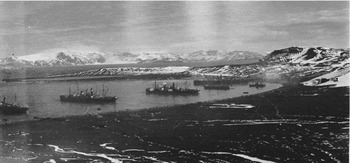
During some years there were as many as 13 factory ships tied up in a row along the beach at Whalers Bay with the attendant activity, piles of supplies, and of course the water collecting equipment. The concentration of whaling activity at Deception was so dense that the anchorage also gained the nickname of ‘New Sandefjord’. Each ship had a different means of supplying the water it needed for the rendering process. Some had the wells that have already been discussed, but others had aqueducts of wooden sluices and canvas pipelines that ran up onto the slopes behind the bay to collect snow melt. The water boats used by some have already been described. Added to the factory ships were all of the attendant catchers, small corvettes to tow the catch to the harbour, and supply ships (Fig. 2).
The line of whale factory ships around the sheltered anchorage of Whalers Bay with the larger lagoon of Port Foster in the background. The photo dates from 1927 and was taken during the Discovery expedition. In the foreground near the shore is a cache of wooden whale oil barrels that still exists. RRS Discovery is just above the barrels in the photo (Institute of Oceanographic Sciences).

In a well known drawing by William Moyes in the 1911–1912 season the factory ships included; Sobraon, Gobernador Bories, Solsteif, Ørn, Bombay, Ronald, Sven Foyn, Hvalen and Neko. At various times the flotilla included sailing ships such as Vesterlide, Nor and Pisagua which were known as skrott-factories or ships intended to use the blubber stripped and otherwise wasted carcasses. Photographs of the scene show an amazing density of ships and activity that was never rivaled anywhere else in Antarctica. Some of the factory ships used Deception early in the season and then moved on as ice conditions improved to the south (Hart Reference Hart2006, Tønnessen Reference Tønnessen1980).
Falkland Islands Dependencies government
With the projection of whaling interests into the South Shetlands (and Antarctica in general), Governor Allardyce of the Falkland Islands felt that the British crown should consolidate its interests there. This resulted in letters patent in 1908 that placed formal British control over the territory (the first territorial claim in Antarctica). To help the Falklands, Allardyce promoted the whaling industry to provide a source for tax revenues. To assert geopolitical control he established an official mail service and licensed and encouraged the use of radio. He had a radio station operating two years before Shackleton's Endurance expedition (1914–1916) and in 1913 was able to report the sinking of a factory ship.
To establish the British presence in the South Shetlands, the governor named a magistrate to go to Deception Island each whaling season. The first into the field was Edward Beveridge Binnie, a Falklander who traveled south and lived aboard a factory ship. His official title was ‘Magistrate and Coroner of The South Shetland Islands and Graham Land’. Later magistrates were to have ‘Receiver of Wrecks’, ‘Customs Officer’, ‘Postmaster’, ‘Registrar of Shipping’, and ‘Whaling Officer’ among others added to their titles as the need arose. The first official mails left Deception on 6 March 1913, and this continued until the 1931 season.
One of the magistrate's jobs was to make sure that Falkland regulations concerning whaling were adhered to. Some of these concerned the prohibition against taking calves and later females. There was a clear disdain on the part of the producers for attempts at control over their hunting. The Norwegians were also clever at introducing extra catcher boats (limited in number as a conservation measure) under all sorts of pretexts. The magistrate had to see through these and limit their use or levy fines.
On 6 May 1912, Port Foster was declared an official port of entry for the duration of the whaling season. This meant that each ship entering or leaving the anchorage had to receive clearance from the local crown representative. It appears that Deception was the only port ever so declared in the Antarctic. This was more symbolic than practical, but it did have the effect of conserving whale stocks as long as the factory ships were confined to the sheltered harbours, of which Deception was the biggest.
In 1914 the island had taken on sufficient significance that the Falkland Islands government had the Hektor Company build a magistrate's residence on shore. The ‘Guvenør Hus’ was preassembled in Norway and consisted of an office, bedroom, and parlour or sitting room. It was bought for 300 pounds. In old photos this tiny house can be distinguished by the flagstaff, that at times flew the union flag or on some occasions the Norwegian flag. The residence was only used as such for a short time since one of the early magistrates used the parlour to dissect and preserve local wildlife. It appears that the use as a dissection laboratory left the building uninhabitable due to the smell (H. Bennett, personal communication, 27 September 1983). After that the magistrates took up residence on the Hektor factory ship, which had individual staterooms for officers and easy access to the shore.
Hvalfangerselskapet Hektor A/S
The Hektor Whaling Company, Ltd (Hvalfangerselskapet Hektor A/S) was established by consul Finn Bugge on the 25 October 1910, with a paid up share capital of 450,000 Norwegian kroner and was registered in Tønsberg, Norway. The company's founder was an electrical engineer, but he had taken over his father's whaling company operating in Iceland and in Norwegian coastal waters. When the Icelandic portion of the company, known as Victor, was shut down, the capital was reinvested in Antarctic whaling through the formation of Hektor A/S.
By 1910 the use of floating factory ships had become so wasteful (since they could not lift the carcasses out of the water and therefore used only the blubber) that on 1 April, 1911, Krogh Hansen the manager for Hektor submitted a successful request for a lease to build a land based whaling station to utilise the hitherto wasted whale carcasses. The concession on Deception (one of only two ever issued in the Antarctic) was given for 21 years from 1 October 1911, with a yearly licence fee of 250 pounds sterling. Aktieselskabet Hektor, of Tønsberg, established a shore station on Deception Island in December 1912. The governor approved the licence for a factory ship plus the land station to process the carcasses from not only the Hektor ship and two catcher boats, but also, importantly, all those from other ships in the anchorage as he considered them to be crown property. This was an attempt on the part of Allardyce to reduce waste, as well as to increase the colony's income.
Hektor's high profitability before World War I was followed by serious financial difficulties in the 1920s. The Hektor land station was closed during the war because its factory and support ships were used as tankers in the north Atlantic and were sunk. Gradually it was taken over by British interests through a complicated process. This was all helped along by close family connections between the Bugge family and important British financial circles.
In 1928, Hector (as the company had come under British control the spelling was anglicised) Whaling Ltd was formed in London sponsored by Hambros Bank, which had Sir Karl Knudsen on its board. The driving force behind the new company was Rupert Trouton who had married into the Bugge family. At first the new company was basically a subsidiary of the Norwegian mother company. But after the financial crisis of 1930–1931 the assets of the Norwegian company were completely absorbed by the British firm. These assets were in turn taken over by United Whalers but only after the land station at Deception had closed and the company had ceased to have any active connection with Deception other than on paper. (United Whalers renewed the lease on the land station in the years after World War II but never used the facilities). Hector's assets eventually ended up in the hands of British and Commonwealth Shipping Limited, which bought it for other properties and never did anything with the remains of the Antarctic assets (Nordvik Reference Nordvik1982; Hart Reference Hart2006).
Deception Island land station
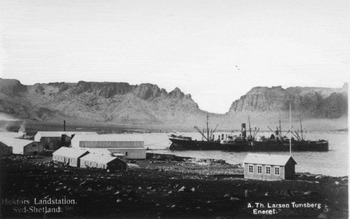
The Hektor land station was built in 1912 on a 500 acre lease on the north side of Whalers Bay. It was adjacent to Kroner Lake (sometimes referred to as Two Kroner Lake) and had a beach with a gentle slope into water that was deep enough for the catchers to approach with the whale carcasses. The lease included a floating factory and it is important to remember that the shore facility was not designed to operate independently. The floating factories of 1912 could not bring the whales aboard for flensing the blubber. The carcass was almost totally wasted and left to float away. This led to enormous waste on a scale that upset even the not overly ecologically sensitive whalers of the time. Of course it was more a question of economics since it was estimated that more than 40% of the available oil was not being recovered. One of the early British magistrates estimated that before the land station was brought in production there were 3,000 rotting whale carcasses strewn around the shores of Whalers Bay and Port Foster (Fig. 3).
The Hektor land station as it looked circa 1912. Offshore are the factory ships Hektoria (I) and Ronald (I) which were part of the station lease. The magistrate's hut is in the foreground. Neptunes Window is a well known feature in the background. (Norwegian Polar Institute)

The job of the shore station was to allow, with its slipway and flensing plan, full use of the whales caught, not only by the Hektor catchers, but also the remains left by the other floating factories anchored in the bay. In this way it was hoped that greater use would be made of each whale killed. An early description of the factory is notable for its inclusion of 18 pressure cookers (18 more were to be added) and a guano mill (Anon. 1913). The use of pressure cookers and guano mill are most significant in that they were designed to process the body of the whale that the ships could not handle. Although the pressure cookers of the land station rendered a lesser grade of oil, the meat and bone contain a large percentage of the oil and in the end the processed bones and other solids were ground up and dried in the guano mill to be sold as fertilizer. It is of interest to note that at the time the best grades of oil were still produced in open cookers and would be processed on the factory ship or ships that were part of the lease. There were never any open cookers used by the shore station.
Two of the Hektor floating factories were the Ronald(I) and the Hektoria(I). In 1912, the first ship to use the name Hektoria(I) at 5,002 gross tons was the largest factory conversion yet employed. It was also the first to have radio communication with the outside world. A more significant ship was the second factory named Ronald(II). When built in Scotland in 1920 it was not only the first specially constructed whale factory ship but at 6,322 gross tons, at that time the largest afloat. It had 12 large open cookers as well as 6 pressure cookers. It was also large enough to supply coal to both the land station and the catchers and to transport whale oil back to Europe in bulk (Hart Reference Hart2006).
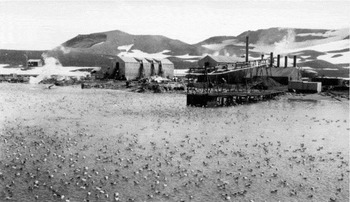
The Hektor Company's floating factory ships were moored to the east of the shore facility. A floating walkway allowed access to the shore. On shore were stores for the factory ship and catchers as well as a repair facility complete with a small floating dry dock, which allowed repairs to the catcher's propellers and rudders. The machine shop and blacksmith also had the function of straightening the harpoons removed from the whale carcasses. There was also a powder storage shed for reloading the harpoon warheads (Figs. 4, 5).
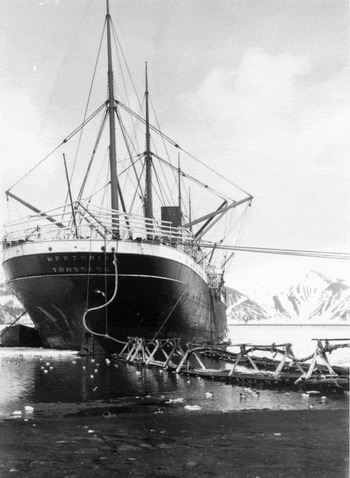
A 1928 photograph of the Deception Island land station. On the left is the magistrate's hut. Sea birds attracted by the waste are in the foreground with the coal transfer framework and guano pier. This was just before the station converted to oil. (Ohio State University Archives, Sir Hubert Wilkins Papers, RG 56.6, #33_5_32).

Hektoria (II) as a supply ship in 1928. Note the floating pipeline and walkway. (Ohio State University Archives, Sir Hubert Wilkins Papers, RG 56.6 #33_5_105).

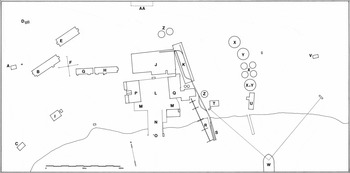
The land factory was a complete operation needing very little in outside support other than resupply of fuels. It was in many ways a complete community with dormitories, a small hospital, a house for the British magistrate, a radio room and antennas (later), and even a pigsty! The factory had its own storage sheds and coal stores (and by 1929 fuel oil) as well as a fueling dock for the catchers. The factory even included a small railway to deliver the bone meal and guano to the storage sheds or supply ships. A prominent later feature was a tank farm first for the storage of the whale oil produced and later, for fuel oil for the station and ships. All of the tanks were connected by a maze of pipelines. Although they are tilted and rusted, these tanks are the most prominent feature remaining today (Hart Reference Hart2006) (Fig. 6).
‘SITUASJONSPLAN, A/S Hector's Landstatsjon, Deception, Syd Shetland’ circa 1929–1930.
Key: A. Magistrate's residence; B. Crew barrack, kitchen, mess hall; C. Pigsty; D. Kitchen water storage; E. Crew barrack, 2nd floor: sample test room; F. Radio mast; G. Crew barrack, radio; H. Crew barrack, hospital, 2nd floor: laboratory; I. ‘Cambio’, use unknown; J. Guano dryer, grinder, blacksmith and machine shop; K. Guano storage; L. Flensing plan; M. Bone cutting plan; N. Slipway; O. Concrete moorings; P. Pressure cookers, cooper's shop and carpenter's shop; Q. Pressure cookers, wash room and steam plant, 2nd floor: separators; R. Coal overhead transfer frame; S. Loading pier; T. Line shop; U. Line shop and pump house; V. Fresh water well; W. Factory ship; X. Whale oil tanks; Y. Bunker oil tanks; Z. Water tanks; AA. Cemetery.

The density of shipping at Deception also meant that organisers of expeditions had potential transport facilities available. Several expeditions used the Hektor ships for transport, among them Hubert Wilkins’ and J.L. Cope's spectacularly under financed expedition (1920–1922). The most famous, however, was Wilkins’ later expedition to Deception in 1928. Wilkins came to Antarctica with two Lockheed Vega aircraft and a large amount of aviation gasoline onboard Hektoria(II). He hired labour from the whaling station to help level an 800 m landing strip running from the station toward Kroner Lake. On 16 November 1928, he made the first airplane flight in Antarctica. A number of exploratory flights were undertaken from the little airport. Without the help of the whaling ships for transport and the station crew for labour, Wilkins’ first flights might not have been the success that they were. Many years later the same field was to be further improved by the Falkland Islands Dependencies Survey, and used for a time as their centre of flight operations (Bagshawe Reference Bagshawe1939; Wilkins Reference Wilkins1929).
Other expeditions made Deception a regular stop because of the resident fleet, station, and British magistrate. Among them were the Discovery, expeditions and later Lincoln Ellsworth, and the British Graham Land Expedition. The latter particularly benefited from the then derelict land station since expedition members took a considerable amount of building materials from the old station to build their own station in the second season when construction supplies ran low.
Whalers' life
Most of the men at Deception lived not at the land station but on the ships, either the ‘old folks’, the factory ships moored along the shore of Whalers Bay, or on the catchers that supplied both the floating factories and the land station. Life for many of them was not much different from life at sea, with the obvious exception of the occasional walk on shore. On the factory ships the crews were in 40 to 60 man cabins, while the officers had private staterooms. The land station dormitories housed not only the land station crew but also half of the crew of the Hektor floating factory, which was considered part of the land station. There the men lived in 10 to 15 man rooms. The work force was almost entirely Norwegian, as were the whaling crews at the time.
The food was similar on both the factory ships and at the shore station. It consisted of salted beef and pork and canned goods. It was supplemented by breads, canned butter and jams and on special occasions, such as Christmas, with fresh pork since there was a pigsty at the factory. Whenever a supply ship arrived there would be a limited supply of fresh vegetables for a short time.
Whale meat cakes were a fresh addition to the diet, as were combinations of whale and pork. Fresh fish was also a popular addition. Penguin eggs were not supposed to be used, but many were collected. There was a period when the magistrate issued a license to collect eggs provided no penguins were killed. The men's views were mixed on the palatability of the eggs since the ‘whites’ stayed transparent. There was no question about eating most seabirds that existed by the thousands off the waste from the butchering of the whales. They were rejected as scavengers and carrion eaters. Curiously, snowy sheathbills that ate the waste of other birds were called ‘rype (grouse)’ and were well received.
Food on the whale catchers was very different since the craft had small crews, usually no cook, and were nearly constantly underway. While floating factory crews and the land station crews have fond memories of the food, the catcher crews do not. It was almost entirely canned food, and even that was quickly warmed and eaten between chases. After all, the catcher crews were paid bonuses for each whale caught, so food was considered a bothersome necessity by the captain and gunner.
Alcohol was forbidden except as a ration on special occasions such as Christmas and New Year when akvavit and beer were distributed. As with any other population of men, however, the Norwegian whalers were not as ‘dry’ as their employers would have liked. They brewed a potent drink called ‘yeast soup’ made of sugar, water, raisins, and yeast.
Clothing generally consisted of dungaree work clothes and oilskins. The men had to supply their own and if they needed new ones they could be purchased at the ‘slappen’, or ‘slop chest’. This was the ships’ (or stations’) store where an account was taken from wages.
Recreation was not as well organised as it later became on the more populous South Georgia. There was an occasional soccer match, but mainly the men took short walks to look at the penguins (and collect eggs), played poker or read books from the libraries on the ships and at the Hektor station. Hunting was not allowed except that it became a real ‘sport’ to hunt the thousands of rats that infested the ships and station. Skuas, called ‘South Shetland crows’, were considered fair game because of their combative personality (Heyburn 1973–1976; Hart Reference Hart2006).
The lives of the whalers were rigorous but healthy in that disease was rare, but injury and infection were quite common. Charcot reported that in 1908 there was no doctor among the three factory ships or their catchers. By 1909 the three companies had hired one contract doctor between them. This doctor also acted for the ships operating at Admiralty Bay. In later years the Hektor Company built and maintained (probably cooperatively with other companies) a small hospital that had both an operating room and ward. It was kept open and staffed with a doctor until the Hektor whaling station closed in 1931 (Falkland Islands 1931).
The end of whaling
The introduction in 1925 of the slipway to allow an entire whale to be winched aboard a factory ship was eventually to cause an end to shore based whaling at Deception Island and, ultimately, to the whaling industry itself. Pelagic whaling had several profound effects. First, it freed the whaling companies from the need to pay licensing fees to the British governor in the Falklands. Secondly, it freed the companies from the quotas set up for the numbers of licensees, opening the southern ocean to large (and uncontrolled) numbers of factory ships and catchers. This had the effect of killing far too many whales, and producing a glut on the whale oil market.
After only five seasons of competing with the wide ranging pelagic fleet plus a plunge in whale oil prices, the (by now British controlled) Hector Whaling Ltd factory on Deception Island ceased operations at the end of the 1930–1931 season. It had operated since 1912–1913 and had been the major single producer in the South Shetland Islands. The Hektor/Hector land station at Deception Island was then and still is the only successful land based industry ever to exist in Antarctica.
As a footnote; only one other attempt was made to build and operate a land based whaling station in the Antarctic. In 1920 the Tønsberg Hvalfangeri applied for a licence to operate a shore station in Borge Bay, South Orkneys. The eight pressure cookers built were damaged so badly by the winter weather that they were rendered useless (L.H. Matthews, personal communication, 24 September 1983; Headland Reference Headland1989: 267; Tønnessen Reference Tønnessen1980).
World War II – FIDS – FIDASE
With the outbreak of World War II, the British Admiralty became aware of the potential value to the axis powers of the abandoned, but serviceable, facilities at Deception, including the large, bulk oil tanks installed toward the end of the active use of the factory. The result of this threat was the dispatch of the armed merchant cruiser Queen of Bermuda to the area in early 1941. The visit lasted only a few hours. The stocks of coal were set on fire, the piping for the oil tanks was blown up and according to reports each oil tank was punctured. What was not disturbed were the buildings of the factory or the adjacent dormitories and administrative buildings. These facilities were to play an important part in the subsequent scientific and political history of the island (Jones Reference Jones1974). In 1944 the British naval Operation Tabarin occupied one of the abandoned buildings in Whalers Bay. They and their successors the Falkland Islands Dependencies Survey (FIDS) and the British Antarctic Survey (BAS) were to stay there until volcanic eruptions forced their abandonment.
By the mid 1950s the British government decided to accelerate its mapping programme on the Antarctic Peninsula. The Falkland Islands Dependencies Aerial Survey Expedition (FIDASE) was carried out by Hunting Aero Surveys Ltd., a commercial British aerial photography and mapping company. On its arrival in 1955 Hunting constructed a large base hut that was built on the raised foundation of an oil tank that Hektor had planned but never erected. FIDASE was a good example of a successful governmental programme carried out by a commercial contractor in a very harsh environment. Hunting's prosecution of its mapping programme from Deception under such conditions was much akin to the work of the hardy sealers and whalers who had preceded them (Mott Reference Mott1986).
Tourism
Antarctic tourism has flourished since the last part of the twentieth century. Deception Island is on the itinerary of virtually every ship visiting the Peninsula area. The still visible wreckage of the whaling industry provides a unique cultural/economic history dimension to the Antarctic experience. Also, because of the volcanism, one of the chief draws to the island is the abundance of thermally heated water. This is the place where Antarctic tourists can swim! Pendulum Cove is a popular spot because of the hot thermal water flowing into the bay. There are also thermal springs in other areas including Whalers Bay. On the outer coast is also a major chinstrap penguin colony at Baily Head, which is also a popular landing when surf conditions permit.
Statistics from the International Association of Antarctica Tour Operators (IAATO 2008) show that Deception Island is one of the most visited sights in Antarctica. Visitor numbers have steadily climbed from the earliest tourist cruises in 1958 on the Argentine naval transport Les Eclaireurs which carried 194 passengers in two cruises. Lars-Eric Lindblad's pioneering tours, first with Lapataia in 1967 and later on Lindblad Explorer started the large scale tourist cruise industry as it exists today. More than 30 ships have cruised Antarctic waters in the latest seasons. IAATO's figures show that some 25,000 passengers visited Deception alone during the 2007–2008 season. Only Port Lockroy exceeds Deception in visitor numbers.
The first tourist over flights of Antarctica were from Chile in 1956 and Deception was reportedly on the inaugural route. Although current flight activity at Deception is limited to local helicopter operations, at least one proposal was put forward to build a 5,000 m runway to support Deception as a tourist centre. It was to be situated on Kendall Terrace on the north side of the island away from any current volcanic activity and on already relatively level terrain. The proposed runway would have supported most types of aircraft and the plan included lodges to house tourists. The plan never reached fruition but serves to emphasise the importance of Deception as a tourist destination.
Since 2005 Deception Island visits have come under the control of the Deception Island management package administered by Antarctic Treaty parties: Argentina, Chile, Norway, Spain, the United Kingdom and the United States with institutional advice. The whole island is designated Antarctic Specially Managed Area No. 4. Among the provisions of the programme are visitor conduct codes, conservation strategies, and provision for scientific, historic and monument sites (Deception Island Management Group 2005).
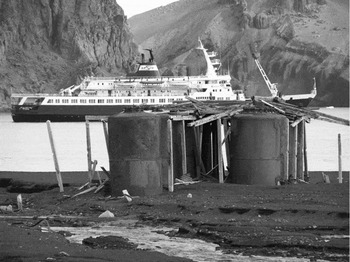
Since the volcanic eruptions of the late 1960s and early 1970s many of the whaling relics are in disarray, but a walk along the beach can show the visitor much of what existed there from the very early 1900s until the shore factory closed in 1931 (Fig. 7).
A modern tourist ship with the wreckage of the Hektor Land Station cookers in the foreground (photograph by author).

On the north end of the beach is Kroner Lake, which is now breached by the salt water of Port Foster. That area is scientifically protected. Between Kroner Lake and the large 1960's vintage FIDS aircraft hanger is the runway used by Sir Hubert Wilkins in 1928 for the first airplane flight in Antarctica. Near the hangar is a roller Wilkins used to compact the runway. The runway (later expanded and used by the FIDS) is not easy to see because of volcanic ash and ejecta.
Beyond the hanger near the beach is the foundation of the whaling station's pigsty. Just uphill is the ‘Guvenør Hus’ or British magistrate's hut. Its flagpole has fallen and the roof has blown off but it has a stone foundation and some of the only decorative or ornamental woodwork to be found in whaling Antarctica. A line of decorative ‘gingerbread’ still survives across the front wall.
The FIDS Biscoe House was one of the last whaler barracks built (probably in the late 1920s) and although the lahar from the eruptions has badly damaged it, it does at least afford the opportunity to see that the structure is in fact an early twentieth century prefabricated Norwegian building with interlocking siding, interior walls and precut beams. It also has a pair of skylights that let sunlight down two stories from the attic to the ground floor through the stairwells. Attached to the building is a FIDS era generator building.
Walking up one of the streams that run through the station one finds the remains of a series of dams used to control and supply glacial melt water for the whaling station's insatiable need for fresh water. Some of the piping and several collapsed water tanks are also present.
Much of the factory itself is still visible although in a ruined state. There are two double rows of large cylindrical pressure cookers which were originally in corrugated sheet metal covered wood frame buildings. One double row of cookers was on each side of the now buried flensing plan. Some of the cookers have been moved by the volcanic lahar flows and virtually all of the buildings which housed them are gone. On one side are four dome shaped boilers that were the steam production plant that supplied the pressure cookers, steam winches and later bone saws. Wreckage of the boiler chimneys, piping building frame timbers, and corrugated iron litter the area.
Uphill from the boilers and cookers are two brick ovens for the rotary guano cookers that took the de-oiled bone and meat and dried it to be sacked for use as cattle feed or fertilizer. Grave markers and a casket visible beyond the guano cookers are relics that floated away during the eruptions and were later found along the shore of Port Foster and returned. The real graveyard is itself buried under several meters of ash and ejecta.
Most of the oil tanks have survived on their stone foundations. The larger ones that held bunker oil for the ships fuel (versus the four smaller ones that held whale oil) have a labyrinth of steam pipes across their floors to heat the oil sufficiently for it to flow. The FIDASE hut sits behind the oil tanks on a raised oil tank foundation. Its elevated location accounts for its well preserved condition.
Nearby at the waters edge is a small U shaped floating dry dock that was shipped from Norway in parts and assembled at Deception. It was only large enough to lift the stern of a whale catcher in order to repair rudders or propellers damaged by ice or fouled lines.
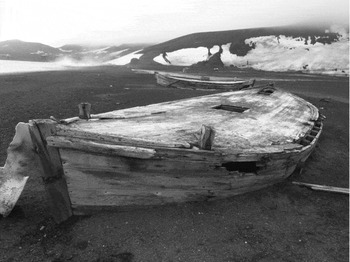
Toward Neptune's Window is a partially collapsed building that housed, among other things explosives for the harpoon guns and harpoon heads. Further along are several largely intact water boats (Fig. 8). These are the boats that Charcot described bringing fresh water from glaciers around the interior of the harbour to feed the boilers of the non-pelagic factory ships once arrayed around the bay. Behind them are fields of wooden oil barrels from the earliest era of Deception whaling when casks were still used to store whale oil. Beyond these, all around the bay are the small huts that covered wells dug for the factory ships and their mooring posts.
Two weathered but well preserved water boats on the beach. These were an integral part of any whale processing operation in the non-pelagic era (photograph by author).

Many of the passengers on the ships that visit get only a brief glance at the relics of the whaling history of Deception Island. They swim in the thermal waters, stroll through the whaling ruins and walk to the views afforded by Neptune's Window. But as tourists they represent but the latest chapter in the history of the spot most thoroughly identified with commerce in the whole of Antarctica (Hacquebord Reference Hacquebord1992; J. Splettstoesser, personal communication, October 2008; Rossnes Reference Rossnes1997; Riffenburgh Reference Riffenburgh2007: 1004–1007; Killingbeck Reference Killingbeck1977).
Conclusion
Deception Island has played a unique part in Antarctic history. Its unusually well protected anchorage has put it at the centre of commercial activity in a way paralleled by no other place in Antarctica. The first wave of Antarctic commerce in the form of the fur sealers used Deception as a central safe haven to explore for their prey around the South Shetlands and the Antarctic Peninsula.
By the turn of the twentieth century pioneering whale rendering factory ships found the anchorage even more important and congregated there in numbers never seen elsewhere. The enormous waste of whale carcasses by the pre-stern slipway equipped ships encouraged the construction of a shore based factory to utilise the entire whale. The Hektor land station operated from 1912 to 1916 and after WWI from 1920 until 1931. A/S Hektor's land station was the only successful shore based industry ever to exist in Antarctica.
The late twentieth century ushered in a new form of commerce, namely tourism. Deception Island has two major attractions; volcanically heated water in which tourists can bathe, and the cultural curiosity of the wreckage of the Norwegian whaling station. The two attractions plus the reliably calm anchorage make Deception one of the most frequently visited destinations in the Antarctic cruise industry.
Acknowledgements
This article could not have been written without the contributions of several people. Alasdair Wilson found valuable information and local contacts in the Falkland Islands and South Georgia. Henry Heyburn collected an enormous amount of information about the whalers who lived and worked at Deception and he made much of it available to me. John Killingbeck was the station commander at Deception in 1960 and later wrote a thesis on Deception, part of which he allowed me to use. The late Helge Nordvik of the University of Bergen was kind enough to provide me with the business history of the Hektor Company. John Splettstoesser kindly edited and reviewed the manuscript. Bjørn Basberg of the Norwegian School of Economics and Business Administration generously reviewed the manuscript and made valuable recommendations.