NEW SPEAKERS IN TRANSNATIONAL FAMILIES
The term new speaker has recently come to the fore as an attempt by sociolinguists and particularly applied linguistics scholars to understand the different types of speaker profiles to be found in contemporary societies. Research on new speakers has so far been discussed within the context of minority languages (O'Rourke, Pujolar, & Ramallo Reference O'Rourke, Pujolar and Ramallo2015), where ‘nontraditional’ speakers of these languages learn, acquire, and use them for different purposes in their daily lives (at work, at school, at home, etc.). From a scholarly point of view, the new speaker label is not necessarily ‘new’. Indeed, as O'Rourke and colleagues (Reference O'Rourke, Pujolar and Ramallo2015:1) point out, this category has been discussed in previous applied linguistics research under the terms nonnative, second language, L2 speaker, and so on. The new speaker concept, however, moves in the direction of current critical sociolinguistic research, which tries to conceptualize languages as resources and repertoires (Blommaert Reference Blommaert2010; Blommaert & Backus Reference Blommaert and Backus2011). Along these lines, other authors have proposed similar labels: emergent bilinguals (García & Kleifgen Reference García and Anne Kleifgen2010), multilingual subjects (Kramsch Reference Kramsch2012), metrolingualism (Pennycook Reference Pennycook2010), translanguaging (Creese & Blackledge Reference Creese and Blackledge2010), and translingual practice (Canagarajah Reference Canagarajah2013) (see O'Rourke et al. Reference O'Rourke, Pujolar and Ramallo2015:1–2). The core idea within this current research strand in sociolinguistics is to question fundamental categories of linguistic research, with a particular focus on those concerned with multilingualism, including ‘language’ and ‘nativeness’.
Despite its connection to all of these other constructs, however, the new speaker concept does not constitute yet another category to be added to this analytical repertoire; rather, it attempts to bring in a shifted focus of analysis, putting the emphasis on people and the sociological implications of using multiple languages for different purposes on a daily basis. New speaker is not intended to simply classify speakers into different categories (i.e. it is not about an imagined opposition between ‘new’ versus ‘old’ speakers). The modifier ‘new’ is added as an attempt to replace the prefix ‘non’ in such constructs as ‘nonnative’ to allow for a changed perspective in the exploration of the experiences of people in multilingual contexts (O'Rourke & Pujolar Reference O'Rourke and Pujolar2015). In short, one of the main tenets behind work on new speakers is to try to find out what happens when people cross linguistic and social borders, what resources they draw on in order to do that, and what impact this has for them socially and in terms of constructing their multiple identities. This linguistic and cultural border crossing happens increasingly in today's globalized societies, and it does so quite intensely in multilingual families, which are growing in numbers. As Li Wei (Reference Wei2012:1) indicates, referring to an OECD report (Organisation for Economic Co-operation and Development 2010), in large urban concentrations today (including London, New York, Delhi, and Hong Kong), one in three families is transnational and multilingual. Such families provide interesting settings for the investigation of how languages are managed, learned, and negotiated (King, Fogle, & Logan-Terry Reference King, Fogle and Logan-Terry2008).
If we think about multilingual transnational families, then, can one talk of new speakers (or rather spaces of ‘new speakerness’) in that context? Families of this type are typically mobile, with at least one of the family members living outside of the home country. In many cases, the couple may have met in a country different than their own and established their relationship in a third language, for example, English (as with the families in this study). In such complex multilingual environments, speakers may find themselves acquiring and using their partner's languages and engaging in new speaker practices. Nevertheless, many studies on transnational multilingual families frame their research in connection to bilingual acquisition and minority language maintenance, since they resonate with Fishman's (Reference Fishman1991) well-known typology of language-shift reversal, in the sense that language transmission within the family is identified as a key aspect of minority-language survival (Spolsky Reference Spolsky2012).
Research on the decisions regarding the most appropriate language management decisions at home has been the driver of most of the work so far investigating family language policy (FLP) (e.g. King & Fogle Reference King and Fogle2008; Schüpbach Reference Schüpbach2009; Schwartz Reference Schwartz2010; Schwartz & Verschik Reference Schwartz and Verschik2013). King and colleagues (Reference King, Fogle and Logan-Terry2008:907) define FLP as the ‘explicit and overt planning in relation to language use within the home among family members’, but they naturally include also the ‘implicitly and covertly’ adopted initiatives (Curdt-Christiansen Reference Curdt-Christiansen2009:352) to promote language learning and literacy at home. Against the background of a growing number of families with parents of different linguistic and cultural origins, the number of books dedicated to the topic of the raising of bilingual/multilingual children in this type of families is also constantly increasing (e.g. Döpke Reference Döpke1992; Barron-Hauwaert Reference Barron-Hauwaert2004; Xiao-lei Wang Reference Wang2008; De Houwer Reference De Houwer2009a, Reference De Houwer2009b; Cunningham Reference Cunningham2011; Baker Reference Baker2014; Braun & Cline Reference Braun and Cline2014). Research on the linguistic ideological dimension of the multilingual repertoires of families, however, has received less attention. Linguistic ideologies, understood here as ‘socially, politically, and morally loaded cultural assumptions about the way that language works in social life and about the role of particular linguistic forms in a given society’ (Woolard Reference Woolard2016:7; see also Woolard Reference Woolard, Schieffelin, Woolard and Kroskrity1998), are important to the extent that they inform us about the implicit assumptions of the indexical meanings behind linguistic patterns at home, with the collateral effects this may have on the linguistic practices in the family context.
Indeed, it seems to be the case that parents’ ideologies and beliefs about languages and about how languages should be transmitted to their children play an important role in the management strategies that they employ within the family context (Schwartz, Moin, & Klayle Reference Schwartz, Moin and Klayle2013). Such ideas and management strategies also shape, to a great extent, the actual language practices at home, although they do not always coincide. In other words, unsurprisingly, the typical discrepancy between what speakers do, what speakers say, and what speakers say they do is very much present within multilingual transnational families (e.g. De Houwer Reference De Houwer, Extra and Verhoeven1999; King Reference King2000; Curdt-Christiansen Reference Curdt-Christiansen2016). Schwartz (Reference Schwartz2008), for example, found that even though most of the Hebrew-Russian families who participated in her study had positive attitudes towards the preservation of Russian, only 27% reported doing reading instruction at home. In other words, parents’ attitudes and beliefs do not always coincide with their everyday language practices. This is something that we found in our own data as well, which we discuss in greater detail in the discussion section.
One topic that seems to generate bigger discrepancies between speakers’ linguistic ideologies and actual behaviour are translingual practices. Certainly, in the highly complex sociolinguistic context of these families, translanguaging seems to be clearly present in their everyday lives. However, this practice might be negatively valued and reported as being avoided (cf. Schwartz & Verschik Reference Schwartz and Verschik2013), something that can have important consequences for the type of linguistic practices at home that are regarded as legitimate or inappropriate. We start from the definition of translanguaging as the ‘multiple discursive practices in which bilinguals engage in order to make sense of their bilingual worlds’ (García Reference García and Baetens Beardsmore2009:45). So far, literature on translanguaging has mostly centred on schools, mostly primary and secondary education (e.g. Creese & Blackledge Reference Creese and Blackledge2010; Canagarajah Reference Canagarajah2011; Hornberger & Link Reference Hornberger and Link2012; García & Li Wei Reference García, Anne Kleifgen and Wei2014), with the aim of critically assessing normative views of language and literacy. It is rightly argued that schools need to actively seek opportunities to positively value the whole range of linguistic repertoires and resources that multilingual students bring with them. We see the family space in a similar way and thus contribute to the literature on translanguaging by incorporating this lesser researched context, focusing not so much on the actual translingual practices but on the discourses associated with them and the consequences they may have for speakers in such environments (Li Wei Reference Wei2011).
So, shifting the centre of attention from education to the family context, the focus of our analysis is on Spanish-Estonian speaking couples with young children living in Tallinn, the capital of Estonia, a linguistically heterogeneous context in a de jure monolingual country (Zabrodskaja Reference Zabrodskaja2014). In this article, we report on qualitative research conducted in spring 2014 in the form of in-depth interviews with members of three families with children of different ages, where the father is of Latin-American origin (a Spanish speaker), and the mother is from Estonia (an Estonian speaker). In an attempt to identify and describe the communication patterns in the family setting, the research questions we aim to tackle in the article are: What are the reported linguistic practices of the three families at home? What practices do they report in terms of their couple dynamics, as well as in reference to their offspring? And finally, what linguistic ideologies can be derived from these reported practices? The specific purpose of our article is to analyse our case study of Spanish-Estonian speaking mixed families as an instance of family language policy by bringing into the discussion the new speaker framework, with a focus on the parents’ language ideologies and reported practices at home. We argue that the new speaker concept can be usefully incorporated in the discussion of family language policies by placing emphasis on speakers’ lived linguistic experiences (Busch Reference Busch2017) in the home context, their capacity to cross linguistic and cultural borders, and the impact of this border crossing in constructing their family identities.
SETTING, SAMPLE AND METHODOLOGY
Braun & Cline (Reference Braun and Cline2014:4–5) suggest a possible classification of multilingual families. They propose three categories: (a) monolingual parents who live in a country where a different language dominates, (b) families with at least one bilingual parent and with many possible variations (e.g. the two parents share one common language, but one of them speaks a different first language, which may coincide with the language of the place where they live), and (c) trilingual parents, born and raised mono- or bilingually and who have acquired a third language due to their marriage. In this third category, an important degree of variation and heterogeneity can be found.
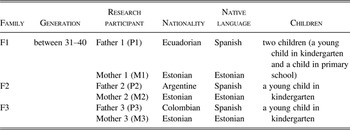
The multilingual families in our study represent very unique cases in the Estonian context, where mixed marriages between Estonians and Russian speakers are more common. In our case, the fathers are Spanish speakers of Latin American origin, while the mothers speak Estonian, a much smaller language than Spanish globally, but the majority and only official language in Estonia. Such couples are products of the current globalised world of transnational mobility; in the case of two couples, the partners met in a third country, that is, outside Estonia and Latin America, while in the third case, they met in Colombia.
According to Braun & Cline's (Reference Braun and Cline2014:4–5) classification, these families fall under the second category: the language of the community is the woman's L1 in all three families. The uniting features for choosing the participants was the fact that they all met outside Estonia, their relationships started in a third language, English, and they have kept this language as the main family language, the one that they speak with each other most of the time. The languages they use in their workplace vary, but for the mothers it is mostly their native Estonian (and some English), and for the fathers it is mostly English (except for Father 1, whose work involves mostly Estonian). The informants in our study were gathered through a ‘criterion sampling’ strategy (Dörnyei Reference Dörnyei2007:128), with the criterion in our case being that the families had the same type of configuration: a Spanish-speaking father of Latin American origin and an Estonian-speaking mother, with young children (of school or preschool age). In Table 1 we provide some general details of the families’ background information.Footnote 1
Basic characteristics of the sample.

Our study is based on a series of sociolinguistic interviews (Hoffman Reference Hoffman, Holmes and Hazen2013) with a sample of three multilingual families in Tallinn, as mentioned. Before Spolsky (Reference Spolsky, Stavans and Kupferberg2006) coined the term family language policy to refer to the most basic setting of his conceptual framework of language policy, some studies noted the importance of language issues among bilingual couples in a globalizing world (Piller Reference Piller2001). Such families provide interesting opportunities to investigate how languages are managed, learned, and negotiated (King et al. Reference King, Fogle and Logan-Terry2008). Both linguistic anthropologists and linguistic ethnographers are interested in how people use language and what they use it for. The field of family language policy offers them a rich basis to study and illustrate these social workings of language. As a basic unit of sociolinguistic inquiry, the family context has traditionally played a key role in transmitting a particular language from generation to generation (Fishman Reference Fishman1991). In our study we are concerned with both linguistic and social structures—not only documenting different patterns of language use, but also connecting these findings with the social world.
The interviews took place in each family's home when both parents were present, but each parent was interviewed separately. All six interviews were conducted in English because this was the common main language for all three couples. All interviews were recorded and transcribed, including pauses, laughter, and participants’ code-switching when they were talking to children. The questionnaire used for each individual interviewFootnote 2 served as a guiding framework and consisted of three parts: (i) the socialization of each individual, (ii) the socialization of the couple, and (iii) the socialization of the children. In analysing the transcripts, we followed a line-by-line reading strategy that allowed us to inductively derive the categories and the most salient themes on which we built our analysis (McCarty Reference McCarty, Hult and Johnson2015:89). In our article, we take a phenomenological approach when introducing the results regarding what and how interviewees reported on their family language policy, and we follow the same pattern on which the questionnaire was organized.
Ours is not a full-fledged ethnographic study, as our data consist of transcripts of interviews, so we were unable to capture the three families’ entire ‘way of looking’ that Wolcott (Reference Wolcott2008, in McCarty Reference McCarty, Hult and Johnson2015) talks about. We believe, however, in line with Blommaert & Jie (Reference Blommaert and Jie2010:5), that ethnography ‘involves a perspective on language and communication, including ontology and epistemology’. It is from that perspective, from the realisation that ‘language and social life are mutually shaping’ (Rampton, Tusting, Maybin, Barwell, Creese, & Lytra Reference Rampton, Tusting, Maybin, Barwell, Creese and Lytra2004, in Creese Reference Creese, King and Hornberger2008:229), that we approach our object of study, incorporating the paradigmatic assumptions of ethnography within the confines of an interview, and seeing language as a socially situated set of resources (Blommaert & Jie Reference Blommaert and Jie2010:7–10). We thus wish to incorporate the tenets of recent work in linguistic anthropology and linguistic ethnography (e.g. Copland & Creese Reference Copland and Creese2015), adopting here an ‘ethnographic perspective’ in the sense that Green & Bloom (Reference Green, Bloom, Flood, Heath and Lapp1997:183) propose: ‘central to an ethnographic perspective is the use of theories of culture and inquiry practices derived from anthropology or sociology to guide the research’. While we wish to be cautious in claiming that interviews allow access to the particular aspects of individuals’ everyday lives, we do wish to incorporate into our study the theoretical orientation of an ethnographic perspective. Indeed, interviews allow ‘the researcher… to reach areas of reality that would otherwise remain inaccessible such as people's subjective experiences and attitudes’ (Peräkylä Reference Peräkylä, Denzin and Lincoln2005:869). So, despite their limitations, we see our interviews as a way to support our efforts in gaining an emic perspective on our participants’ sociolinguistic realities (Copland & Creese Reference Copland and Creese2015:29), the ‘enquiring’ element of doing ethnography of Wolcott's (Reference Wolcott2008) tripartite ‘way of looking’: experiencing, enquiring, and examining (in McCarty Reference McCarty, Hult and Johnson2015:85). With this in mind, we turn to the main themes emerging from the analysis of the interviews in the next section.
LANGUAGE IDEOLOGIES IN THREE sPANISH-eSTONIAN FAMILIES
In this section, we present a summary of the most relevant themes that emerged from the in-depth interviews with the three families. We start with an overview of language-management strategies and ideologies used by the couple, moving on to an analysis of the reported language practices with their children and the ‘one parent–one language’ (OPOL) strategy.
Language management strategies and ideologies in the family context: The couple dynamics
As already mentioned, in all three families, the couples met in a country other than Estonia, in fact outside Europe, as a result of their transnational mobility. Only in one case did they meet in the country of origin of the father. As a consequence, all three families started their relationship in English, since none of the members had sufficient knowledge of their partner's first language (certainly not the fathers). M3 explains it in (1) below.
-
(1) M3: We started in English, otherwise it wouldn't have been possible because then I didn't know any Spanish.
At the moment of meeting, they may have already shown an interest in the other's language, a desire to express solidarity and proximity. This was the case with P2, given in (2).
-
(2) P2: Well I think I learned a couple of words in Estonian. Just when we were in [the country], just because, just because. They were some interesting phrases, like the first phrase, yeah the first phrase was terviseks [Estonian ‘cheers’], of course.
At the present time, however, they have all managed to learn each other's language, at least to the extent that they can understand and interact in their partner's language. The process of learning the language tends to be described as rather informal (although in some cases, formal language courses were taken), and as an on-going process, something that they cannot declare as ‘completed’. Thus, new speaker spaces are gradually created.
-
(3) P1: Well, it's hard to say because I'm still learning, you know. It's not that at one moment you say ‘OK, I have studied enough of this’; it's all this process… but I will say I started feeling that I would be able to manage with the language in two years maybe.
In terms of the couple dynamics, they said that English was the language that they mostly used to talk to each other, given the fact that this was the language that they had started the relationship with. Their self-reported language behaviour, however, contradicted this general assumption. In the case of P1, the interview in (4) shows that although he stated that he spoke mostly English to his wife, he also admits using Estonian as well.
-
(4) Int: OK, yeah, code switching—do you use a couple of languages in the same sentence sometimes?
P1: Yeah, mostly it's when we have guests or… or we want people that are around to understand something, we switch to Estonian. But mostly we speak English.
P1 therefore admits speaking mostly English with his wife, but he also declares switching to Estonian, depending on the context. Mixing languages was also discussed by M2 in the following terms, given in (5) below.
-
(5) Int: Umm, which languages do you usually use to communicate in everyday life?
M2: With ee… with my husband? Good question. The honest answer would be Estanglish [laughing]. If that doesn't count, then… I guess English.
Int: But you use a lot of like code switching, like from Spanish to..?
M2: Yeah.
“Estanglish” is the label she used when trying to define the type of translanguaging (García Reference García and Baetens Beardsmore2009; Creese & Blackledge Reference Creese and Blackledge2010) that took place in their home environment between the two of them, a mixture of Estonian, Spanish, and English. This passage is interesting because it shows that it is the very fact that this type of mixture is ‘nameless’ that makes it difficult to even talk about it or define it. In the end, she needed to resort to some kind of named language, for the sake of reassurance and to provide a sense of answering the question, and she concluded they spoke in English. Following up from that conversation, the interviewer asked in what situations this mixing happened more often; unsurprisingly, it happened more frequently in mundane, everyday situations.
-
(6) Int: When you alternate languages, in which situation is that? And give me an example. Because I also speak Spanish.
M2: Umm, let's say…umm…‚ ‘Would you please give me roheline [Estonian ‘green’] chupeta [Spanish ‘pacifier’]?’.
[laughter]
Int: OK.
M2: Umm… Just the word that first pops into my mind. Or umm there are certain things for which it is easiest to use… some, some term in one language. I don't know, chupete or lutt as well is… which means the same. But I don't know, some everyday things it is easier to use either Estonian or Spanish, whichever kind of clicks in your head more than the English word, which neither of us is perhaps so used to in those very common daily things.
Similarly, M3 also expressed the same idea—that mixing happens quite commonly in everyday situations.
-
(7) Int: In which situations does it happen, if you can think of an example?
M3: Mm usually everyday situations, just using a term in another language; it is quite common.
A lengthier explanation of why such mixing happened was proposed by P2, but here it is interesting to note what he offered as a conclusion to this kind of mixing.
-
(8) P2: Umm… so it it really varies; if I have been watching TV, the news on
TV, then I have to ask [my wife] something, maybe a term in English that I have heard in Estonian, I understand what it means but when I try to say it in English, it doesn't come that quickly, and it is easier to say it in Estonian—and vice versa. Right. And because we both understand all the languages, it doesn't make a difference.
So since both know the two or three languages involved, in the end “it doesn't make a difference”. Right afterwards, however, he offered a negative evaluation of this linguistic practice, especially in relation to the language learning process of their daughter.
-
(9) P2: Of course it is, it is really bad for [my daughter] because then she might
get more confused. It's best if we can each stick to our own language but we just picked this mixture of stuff.
There are many reasons for this type of mixing, but two main ones seem to emerge from the interviews: the improvement of the knowledge in each other's language and the presence of children. These two factors combined create the possibility for all three languages to be more actively present in their everyday lives. M1 expressed the first of these reasons in (10) below.
-
(10) Int: Do you think you mix language more than you did when you first met?
Why?
M1: I think so, because in the past I did not speak Spanish and my husband did not speak Estonian. So there was not much use just saying things; we just explained some things, for example kohuke [Estonian ‘curd snack’]. Now we do not translate any more; we just say kohuke and then we say it is a dessert made from curds.
M2, by contrast, explained that with their first child the presence of Spanish at home had become more frequent.
-
(11) M2: The alternation of languages has happened more, I think, or it's more intense since the… since we had our first child because with the child we had the policy that I would speak only Estonian to her and my husband would only speak Spanish. But because we hear the phrases that he uses and that I use, then some, some terms become easier to use in Spanish for me or in Estonian for him.
These last themes lead us to the next part of the presentation of the results, the socialization of the children and the type of language management strategies, reported practices, and ideologies that we detected in the interviews.
Maintaining linguistic borders: The OPOL strategy with their children
The single, most recurrent reported language management strategy in all three families was ‘one parent–one language’ (OPOL). In all three families, both parents claimed that they tried to apply such a policy as strictly as they could, and so the Spanish-speaking parent would only speak Spanish to the child and the Estonian-speaking only Estonian. However, given the context of pervasive translanguaging that we saw that they admitted, it is interesting to analyse the ideological constructions by which they justified and argued in favour of OPOL. In that regard, the reasons that they gave are not so different from the ones that previous research has already presented: (i) As speakers, they represented the best models for their children in their mother tongues, they spoke them most correctly and they were their true selves in their own language, as opposed to their partner's language, in which they had not become expert. This is associated with the idea of ‘good parenting’, which King & Fogle (Reference King and Fogle2006) describe. (ii) With OPOL, the children can learn both languages at the same time and can be integrated into both family lines, the mother's and the father's (Döpke Reference Döpke1992). And (iii) this type of strategy was what they had heard about from friends or read in books or other sources. The three strands were of course interrelated; sometimes they were expressed separately, but sometimes they appeared at the same time. P1, for example, said:
-
(12) P1: If I spoke Estonian to them, then it would be bad Estonian. But if I speak Spanish, my mother tongue, I have the best… the best Spanish to offer them.
And later on in the interview he said:
-
(13) P1: Well, umm like I said, if we speak our mother tongue to them, they will have the best of that, the language. If we started speaking the foreign language that we don't know, then they would make many mistakes or we would not be able to express ourselves.
Notice that he referred to Estonian as a “foreign language”, something that seems a bit surprising considering the presence of the language on all levels of his daily life. Merging strands (i) and (iii), M3 explained that:
-
(14) M3: I think that it is important that I speak with her in my mother tongue. That she learn from me the language that I know the best. And before, when I was carrying her, I actually read about, about the theory of how to teach different languages and I've also read that it is possible for children to learn different languages simultaneously, but it is better if the child is spoken to with correct grammar so that she avoids the wrong grammar from the very beginning.
Sometimes, a couple admitted not having read thoroughly about the topic, but they would still stick to the OPOL strategy quite firmly.
-
(15) M2: I haven't really done my part of the research, but I have kind of heard or read in books that this is the way to do it if you want her [your child] to grow up bilingual. That you keep it clear that… one parent–only one language, one person–one language basically. Not only one parent–one language but one person–one language.
And indeed, this is thought to be a strategy that has helped their children become full members of each family's cultural strand.
-
(16) P3: But also I would like her to communicate with my sister's son, with my parents, with my cousins. So, I mean, it wouldn't make any sense just to keep her isolated from my cultural background; instead, I should get her involved in it.
Int: And your wife?
P3: She speaks in Estonian to her. Which is just logical, of course.
The OPOL strategy, however, clashes with what they report doing in actual practice: language mixing. In that sense, quite inevitably, the parents produced complicated explanations in order to account for both their declared ‘official’ policy and their actual practice, as in the case of M1.
-
(17) M1: I think in the long run it is something that pays off because you might think that it is easier maybe just to speak one language and then you try to do your best and you start maybe speaking in English but the children are very very smart. So they can pick up as many languages as they hear around them. So I think the advice I would give is really: speak all the languages, speak your mother tongue and stick to it and then children will learn it. And even though they may start speaking later, at maybe three or four years old, at the same time they start speaking maybe two or three languages.
It is unclear what she meant when she said “speak all the languages”, which indeed might imply the idea of language mixing. Of course, she then added “speak your mother tongue and stick to it”, which seemingly relates to OPOL more directly. In addition, paradoxically, it also seems to be the case that it is the OPOL strategy that actually enables language mixing to take place. At least this is what emerged in the following statement in (18) by M2.
-
(18) M2: The alternation of languages has happened more I think, or more intensely since the… since we had our first child because with the child we had the policy that I would speak only Estonian to her and my husband would only speak Spanish. But because we hear the phrases that he uses and that I use, some terms became easier to use in Spanish for me or in Estonian for him.
At any rate, the OPOL strategy did represent a clash between their reported language practices and their attitudes and ideologies about how best to manage their language reality at home. Still, in relation to OPOL, it is worth noting that some of the interviewees did actually perform such a strategy during the interviews. In that sense, we noted a significant amount of ‘backstage work’ (Goffman Reference Goffman1959) being conducted during the interviews. Interestingly, it was the three fathers who seemed to be more eager to demonstrate that kind of practice. In the case of P1, three times during the interview he addressed one of his sons in Spanish.
-
(19) P1: If they don't speak the language, if everybody is foreign, then try to get the kids maybe in a school where they speak a local language so the kids start learning the local language.
[to his son]: Vas a regar el jugo, (son). Mira, pon el vaso en la mesa [‘you are going to drop the juice (son). Look, leave the glass on the table’].
In the case of P2, the whole staging of the interview seemed to be prepared so as to give the impression that theirs was a Spanish-friendly environment. During the interview, there was a song playing in the background, which apparently was one of their daughter's favourite songs.
-
(20) Int: Do you read her fairy tales?
P2: Yes, yes, we have a set of Spanish language books. And what you are hearing… [songs in Spanish playing] are not exactly fairy tales but kind of. So…
P2 also performed OPOL himself during the interview several times.
-
(21) P2: Basically, I spend time with [my daughter] but… [speaks Spanish to his daughter]. Umm… yeah. We spend time together, we spend time with the family. … I like history, so I read history. [speaks Spanish to his daughter]
Sometimes, applying the OPOL strategy was something that they tried to be very conscious of and reinforce. This seemed to be the case with M3 in (22).
-
(22) Int: In what language does she address you? Always Estonian?
M3: She has tried Spanish as well but I have reminded her that with me she should speak in Estonian.
This leads to the role of children in shaping and influencing the family's language practices. Indeed, parents seem to be very much concerned with applying OPOL as thoroughly as possible, but children also have their own wishes and desires, and their own linguistic preferences. This was particularly the case with the first family, and it is not surprising given that their children were older than those in the other families. In that family, the situation of the youngest son seemed very remarkable. Apparently, he had an acute linguistic awareness, and he would determine the language to be used in particular games, as well as with bedtime stories. M1 explains in (23) below.
-
(23) M1: he [the youngest son] knows exactly which language he should speak to whom—to his dad, to his mother—and which language we [parents] should speak to each other. So, for example, when I made a fake phone call, because the children like to play with the phones, and said I was calling dad and then I started speaking Estonian, he said “no no no, you do not speak this language. You need to speak the other language”. So he is a linguist. He distinguishes between languages very well and he has learned a little bit faster.
M1 explains about fairy tales and bedtime stories below in (24).
-
(24) M1: But with the younger one… he has his favourite stories; sometimes I have had to read to him in Spanish and my husband has had to read in Estonian. So it has not been so separate. But I think the reason might also be that he sees that I speak Spanish and my husband speaks Estonian. Okay, you speak all the languages anyway, so it does not matter what language you read in.
This linguistic heterogeneity in relation to bedtime story reading also occurred in another family, in this case reported by M3.
-
(25) M3: I read in Estonian and [my husband] reads in Spanish. Actually, sometimes I do have to read in Spanish as well.
It is interesting to note that P3 also sang songs to his daughter in Italian, a language that he speaks, and there was a particular song that he loved (note here too that this is a language not closely related to the family's background).
-
(26) Int: Did you sing to her?
P3: Of course.
Int: Which language?
P3: Spanish.
Int: Also in Spanish.
P3: Or Italian.
Int: Italian? Why Italian?
P3: Why Italian? Because I love Italian and I speak Italian. And there is a very beautiful song in Italian that I used to sing to her even when she was in her mama's belly.
To summarize, the participants in our study were mobile transnational polyglots, with a significant level of multilingual language use on a daily basis. With their partners, that is, in terms of couple dynamics, they admitted mixing languages quite extensively, some more openly than others, although they all regarded this as something to be avoided. This was particularly the case in terms of their language practice with their children. In that sense, they insisted on OPOL as the management strategy that they tried hard to stick to, in order to keep a degree of coherence and language order in the family context. The very fact that all three languages were present and available to all agents, however, made language mixing all the more common. The children's agency (their wishes and preferences) also seemed to weigh quite heavily when it came to determining which language was to be used in specific settings where they had more room to influence their parents’ choices. In the next section we discuss these and other related themes in greater detail in light of the theoretical framework outlined above.
DISCUSSION AND CONCLUSIONS
The main goal of our study was to find out about the reported language practices and the ideologies associated with these practices in the three participating families in this study. Transnational multilingual families present themselves as relevant settings where one can explore the tension and ambiguities provoked by the coexistence of a range of linguistic resources and several ideas of how language practices should be managed within a micro-level context. Raising children involves complex decisions in any setting but, in transnational multilingual families, the language-related matters gain extra relevance and are intertwined with all other aspects of childrearing (Okita Reference Okita2002), and with decisions that can have an impact on all family members (Piller Reference Piller2002). In other words, transnational multilingual families often illuminate the perennial interplay between overt and covert ideas about language, between explicitly formulated policies and implicit actual practices (Spolsky Reference Spolsky2004; Shohamy Reference Shohamy2006).
In the article, we have focused on language in relation to both couple dynamics and with reference to their children. As our data show, the most important finding is that the parents believed in an idealized one parent–one language strategy with their children, but they reported significant mixing of languages (see also Lanza Reference Lanza1997, Reference Lanza2004). Language mixing happened particularly within the couple dynamics (Pietikäinen Reference Pietikäinen2014), especially since both partners had managed to learn each other's language to a degree beyond the conversational level, after having initiated their relationship in a third language, English. Language mixing was also exacerbated because of having children, who inevitably complicated family dynamics, including linguistically. Interestingly, it was the idealized OPOL policy that, to a certain extent, enabled all linguistic resources to be present within the family context, or at least Spanish and Estonian, thus making it possible to actually use all resources at the same time.
Although we have resisted categorizing the participants of our study as new speakers, we see that all members in the families were engaged in creating new speaker spaces, where their linguistic resources were shared and mobilized at different moments and for different purposes on a daily basis. The language repertoires of all of the speakers in these settings were brought together into a large pool of resources, which varied according to each family. In a way, all speakers in these settings can be considered new speakers: the Spanish-speaking fathers were new speakers of Estonian, and the Estonian-speaking mothers of Spanish. The children, raised bilingually, were acquiring the two languages in an organic way. It can be argued that their dominant language will be the societal language, in this case Estonian, and that if relocated to a Spanish-speaking environment, they might need to go through processes of linguistic legitimization as speakers in other new speaker backgrounds do, for example, in minority language contexts (McLeod & O'Rourke Reference McLeod and O'Rourke2015; Walsh & Ní Dhúda Reference Walsh and Ní Dhúda2015).
The new speaker concept allows us to shift our attention from the linguistic practices to the people immersed in a given multilingual background, enabling us to pay closer attention to the impact and consequences of crossing linguistic and cultural boundaries. In our case, we see that in the three families that participated in our study, language matters did not seem to be problematic. On the contrary, the three families seemed to be able to engage in very complex interactions, making use of a large variety of linguistic repertoires. What seemed to be problematic about this for the parents, as seen from the interview extracts above, was the rationalizing of these complex practices, of talking about them in a way that made sense, which is where the OPOL ideology comes in.
According to Tannenbaum (Reference Tannenbaum2012), as a family language strategy OPOL can be considered a ‘coping mechanism’, a way for families in highly complex multilingual environments to reduce the stress associated with using multiple languages at the same time. The reason why OPOL makes sense is because it resonates with the discourses about language and multilingualism more readily available in Western societies at large. It goes back to the idea that one person can only ‘have’ one language, their ‘native’ or ‘mother tongue’. Indeed, as we have seen, parents, in this context, see themselves as having linguistic authority and legitimacy only in their L1, the language that they speak most ‘correctly’ and the language through which they can be their true selves; in that sense, they have an essentializing notion of language. So, one may argue that the one parent–one language strategy is the micro-level extension of the one nation–one language ideology.
The OPOL discrepancy has been found, unsurprisingly, in previous studies of family language policy (e.g. Lanza Reference Lanza2004). Doyle (Reference Doyle2013), for instance, interviewed eleven mixed families in Tallinn and found that they overwhelmingly adhered to the OPOL strategy; however, it was their more relaxed attitude towards language practices at home that allowed these families to successfully raise bilingual children. There is nothing intrinsically wrong with the OPOL strategy, as Baker (Reference Baker2014:13) has pointed out; however, the fact that the mixing and blending of languages in the home environment is seen in a negative light can potentially have negative consequences for the speakers in this context. This is where turning to the notion of translanguaging can prove beneficial in order to overcome potential problems in multilingual families. Indeed, just as most of the available literature on translanguaging calls for a reconceptualization of language repertoires as positive resources that schools should draw on in dealing with multilingual students (e.g. Creese & Blackledge Reference Creese and Blackledge2010; Hornberger & Link Reference Hornberger and Link2012; García & Li Wei Reference García, Anne Kleifgen and Wei2014), so too multilingual families might gain from viewing their home translingual practices in a decidedly positive way. Otherwise, instead of a coping mechanism, OPOL can become a source of tension and generator of stress. To some extent, the children's preferences regarding their bedtime stories, disregarding their parent's OPOL strategy, illustrate this potential source of conflict. And although it was not reported as a problem in the interviews (rather we can view it as an instance of successful translanguaging at home), other studies have shown that a conflict between parents’ strategies and children's preferences may lead to feelings of disappointment and frustration (e.g. Piller Reference Piller2002). So, instead of being encouraged to pursue such strict linguistic boundaries, multilingual families need reassurance of the creative, transformative, and agentive power of their various linguistic repertoires, just as multilingual students need such reassurance in multicultural schools (García Reference García and Baetens Beardsmore2009).
Multilingual couples are a particular kind of communities of practice (Lanza Reference Lanza, Auer and Wei2007), whose linguistic ideologies deserve to be analysed. The spaces they create through the sharing and blending of their linguistic resources represent new spaces of new speaker profiles; they are translingual spaces, spaces where translanguaging can occur and spaces that are created by translanguaging (Li Wei Reference Wei2011:1234). Translingual spaces create ‘a social world in which the actor plays a number of roles and occupies a number of positions’ (Li Wei Reference Wei2011:1234). In creating such roles and occupying such positions, their language resources, including their linguistic ideologies, are mobilized to produce different effects. The families we investigated are daily engaged in doing sociolinguistic work of this kind, navigating between commonly assumed and available ideologies about parenting, about languages, and about multilingualism, and their actual translingual practices at home. We recommend that examining the intricacies of these two poles (the ideological and the practical) be done through ethnographically informed studies; more studies of this type are needed to continually examine successful ways of managing multilingualism in the home environment. Adding a translanguaging perspective, it seems, might offer positive avenues toward that aim.