Introduction
The genus Spiochaetopterus (family Chaetopteridae) consists of sessile polychaete worms that develop from long-lived planktonic trochophore larvae (∼2 months; Bhaud, Reference Bhaud, Sigvaldadóttir, Mackie and Helgason2003; SQ et al., Reference Irvine, Chaga and Martindale1999) and inhabit sandy to muddy benthic environments, ranging from beaches to deep oceans. These worms secrete chitinous substances around their bodies to form translucent tubes or casings (parchment-like), which remain fixed in sandy/muddy substrates for protection (Barnes, Reference Barnes1964; Jumars et al., Reference Jumars, Dorgan and Lindsay2015). Spiochaetopterus sp. is considered as an indicator of organic pollution, as it thrives in organic matter-rich areas. Its feeding behaviour varies with water movement: under strong waves or currents, it acts as a suspension feeder, consuming detritus, phytoplankton, protozoans, and smaller zooplankton. In low-flow conditions, it shifts to deposit feeding, primarily consuming detritus (Barnes, Reference Barnes1964; Fauchald and Jumars, Reference Fauchald and Jumars1979; Jumars et al., Reference Jumars, Dorgan and Lindsay2015; Turner and Miller, Reference Turner and Miller1991). These polychaetes serve an important ecological role in the marine food web, as they are preyed upon by fishes, molluscs, crustaceans, and wading birds (Gray and Elliott, Reference Gray, Elliott, Gray and Elliott2009).
Along the Indian coast, the population of Spiochaetopterus sp. and their associated ecological interactions can be strongly influenced by seasonal events such as the southwest monsoon (SWM). The SWM begins in June with strong south-westerly winds and ends in September. During the SWM, high-energy waves (∼3 m height) (George et al., Reference George, Kumar, Gowthaman and Singh2020; Muraleedharan et al., Reference Muraleedharan, Dinesh Kumar, Prasanna Kumar, John, Srijith, Anil Kumar, Naveen Kumar, Gautham and Samiksha2018; Shenoi and Kumar, Reference Shenoi and Kumar1982) approach the western shores of the Indian coast, exerting high stress on the beaches and churning the intertidal and subtidal sediment strata (Filho et al., Reference Filho, Almeida and Aviz2009; Ratheesh et al., Reference Ratheesh, Remya, Agrawal, Venkiteswarlu, Gireesh, Amarendra, Nair and Rajawat2022). Due to steep waves and coastal currents, beach sediment is eroded along the west coast of India (Noujas and Thomas, Reference Noujas and Thomas2015). This erosion severely affects the coastal benthic ecosystem, particularly sessile fauna, which are displaced by storm and cyclone waves (Filho et al., Reference Filho, Almeida and Aviz2009; Ong and Krishnan, Reference Ong and Krishnan1995; Sahu et al., Reference Sahu, Lakra and Thiruchitrambalam2022; Sugumaran et al., Reference Sugumaran, Padmasai and Altaff2019; Sukumaran et al., Reference Sukumaran, Vijapure, Kubal, Mulik, Rokade, Salvi, Thomas and Naidu2016).
The species Spiochaetopterus costarum has been reported from the present study area (Goa coast, central west coast of India) by Rengaiyan and Ingole (Reference Rengaiyan and Ingole2018), who provided phylogenetic information along with detailed microscopic images for species identification. In the present study, we focused on the deposition of massive chitin tubes of those polychaete tube worms, which have been rarely reported (Barnes, Reference Barnes1964; Viswambharan, Reference Viswambharan2020), and for which no quantitative studies are available along the Indian coasts or elsewhere in the world (Giles, Reference Giles1980). Sivaleela and Venkataraman (Reference Sivaleela and Venkataraman2012) reported the presence of live Spiochaetopterus sp. tube worms along the Parangipettai coast of Tamil Nadu, and a recent study conducted along the entire west coast of India by Rengaiyan et al., (Reference Rengaiyan, De and Ingole2017) found live worms only in the southern region (Trivandrum coast). The chitin tubes of the worms are strong enough to protect them from natural pressures and predators (Shah et al., Reference Shah, Vollrath, Porter, Stires and Deheyn2014). However, during rough sea conditions, coastal erosion occurs, displacing the tubes along with worms from their substrates. This study provides first-hand information, quantitative data, and reports on the displacement of Spiochaetopterus sp. chitin tubes during the SWM. Previous studies have examined the impacts of cyclonic storms on Indian waters (Sahu et al., Reference Sahu, Lakra and Thiruchitrambalam2022; Sugumaran et al., Reference Sugumaran, Padmasai and Altaff2019; Sukumaran et al., Reference Sukumaran, Vijapure, Kubal, Mulik, Rokade, Salvi, Thomas and Naidu2016), but none have reported the effects on the aforementioned fauna. Except for Viswambharan (Reference Viswambharan2020), there are no records of such displaced tubes along the Indian coasts. Therefore, the objectives of this study are to (a) understand the role of the SWM waves in the displacement of polychaete tubes along the west coast of India, (b) quantitatively assess the deposition of chitin tubes along the shoreline, and (c) examine the spatial variation in tube displacement between sea and estuarine shores.
Materials and methods
Study area and sampling period
Monthly sample collection and fortnightly field observations were conducted from May to July 2022 at beaches along the central west coast of India (Goa; ∼30-km stretch). The sampling area covered a total of ten beaches, including north Goa (Anjuna and Candolim), south Goa (Mormugao-Hole, Baina, and Arossim), the Mandovi Estuary (Aguada, Miramar, and Caranzalem), and the Zuari Estuary (Dias and Siridao) (Figure 1). Additionally, a one-time observation was conducted along the beach stretches of Kochi (Vypin and Njarackal) and Mumbai (Versova) in mid-June 2022 (Figure 1 inset).
Study area and sampling locations marked on the map. The box marked in the inset map represents the area of satellite data retrieval.

Wind and wave data analysis
The ASCAT daily zonal and meridional wind components, along with wind speed data (0.25° spatial resolution), were retrieved from NOAA’s web portal (https://oceanwatch.pifsc.noaa.gov/) for the sampling year (2022) and a recent 10-year period (January 2013–December 2022) to calculate climatology for the central west coast of India (Figure 1 inset). The daily mean for the selected area over the entire duration was calculated using the PyFerret software tool (v7.63), and graphs were generated in Grapher (v7.2.168; Golden Software, USA). The daily climatology of wind parameters was derived from the 10-year dataset using PyFerret and CDO (version 1.9.9rc1; code: ydaymean). Additionally, a daily mean graph for 2022 was created to analyse noticeable variations in wind parameters during the in-situ sampling period.
Similarly, ECMWF Reanalysis v5 hourly data on the significant height of combined wind waves and swells were retrieved from the Copernicus web server (https://cds.climate.copernicus.eu). The hourly data were averaged to obtain daily means using CDO (code: timselmean), and the daily mean for the selected area was calculated in PyFerret. Graphs were then generated in Grapher. The daily climatology and daily mean graphs (2022) of wave height were prepared following the same methodology. A single-factor ANOVA was conducted in R-Studio to assess interannual variations in wind and wave parameters.
Collection and quantification of chitin tubes
A 10 cm2 quadrat frame was made using cardboard for the standardized collection of chitin tubes at selected beaches. The quadrat frame was placed at three locations at each sampling site, with ∼10 m intervals between placements to collect triplicate samples. Photographs were taken, and the collected tubes were stored in labelled polyethene zip-lock bags. In the laboratory, the tube samples were washed with freshwater and examined under a stereo zoom microscope for identification, following the descriptions, drawings, and images provided in the literature (Barnes, Reference Barnes1964; Bhaud, Reference Bhaud1998; Bhaud et al., Reference Bhaud, Martín and Gil2003). Due to the lack of diagnostic morphological characters from the tubes, the specimens could only be identified up to the genus level. Subsequently, the samples were spread over blotting paper at room temperature for 2 days to remove residual moisture. The dry weight of each sample was measured using a weighing balance, and a portion of the subsample (by weight) was imaged using a high-resolution photo scanner (Epson Perfection V600). The tube samples were spread on the scanner without overlapping, and a transparent measurement scale was placed alongside each sample while imaging at a fixed resolution of 720 dpi. Each image was analysed using an image processing software tool (ImageJ, version IJ 1.46r) to measure tube length and abundance. Additionally, the tubes were manually counted with extra care to avoid damaging them. The numerical abundance and dry mass of the tubes are expressed in numbers and grams per square meter.
Results
Wind parameters
The climatological mean wind speed over the study area (central west coast of India) ranged from 3.4 to 9.5 m/s (Figure 2). The daily mean climatology indicated stronger winds from late May to early September (avg. 7.4 ± 1.1 m/s) and relatively weaker winds during the rest of the year (avg. 5.1 ± 0.7 m/s). In 2022, wind speed was lower from January to May (avg. 4.8 ± 1.5 m/s) and increased significantly during the SWM (avg. 7.6 ± 1.9 m/s; ANOVA: p < 0.001, df = 89). Two high-wind events were observed in early May and early June (>7 m/s), followed by another increase in mid-June (avg. 9 ± 1.4 m/s; Figure 2d).
Wind parameters along Goa coast, in left side panels, (a) 10-year (2013–2022) daily-climatological mean wind speed (black line) along with standard deviation (grey shade) and monthly means (red dotted line), (b) similarly the daily climatology of zonal and (c) daily climatology of meridional components, and in right side panels, (d) daily wind speed during the in-situ sampling in 2022 (black line) overlaid with weekly running average (red line) and the in-situ observation dates (yellow stars), (e) similarly the zonal and (f) meridional components.

The zonal and meridional wind components followed a similar trend as wind speed, but their directions varied significantly across seasons (ANOVA (analysis of variance): p < 0.0001, df = 363; Figure 2b,c,e,f). Positive values indicate eastward (zonal) and northward (meridional) wind flow, while negative values indicate westward and southward wind flow, respectively. The zonal wind was predominantly positive (eastward) and onshore-directed for most of the year (January-October), with a strong peak during the SWM (June-August; 6 m/s; Figure 2b,e). Only during the northeast monsoon (November–December), the zonal wind turns negative (offshore-directed) along the central west coast of India. During in-situ observations in 2022, westerly wind speed increased from May. The meridional wind was predominantly negative (southward) throughout the year, except during the SWM (lasting ∼70 days from June to October), when it was northward (Figure 2c,f). Until May 2022, southward winds were dominant, but in June, they shifted to northward.
Significant wave height
Wave height exhibited a distinct seasonal pattern, with significantly higher values observed from June to September (Figure 3). The daily climatology of wave height (2013–2022) ranged from 0.7 to 3 m, with greater heights during the SWM (Figure 3a). Wave height was lower from January to late May (avg. 0.9 ± 0.12 m), increased significantly during the SWM (late May to late September; avg. 2.18 ± 0.5 m), and declined again in the post-monsoon period (avg. 0.9 ± 0.17 m). The monthly mean wave height remained below 1 m from November to April and exceeded 2 m from June to August. In 2022, wave height remained below 1.5 m until early May and below 2 m until early June, before peaking beyond 3 m in July (Figure 3b). During in-situ sample collections, varying sea conditions were observed. In early May, the sea was calm, with relatively low wave height (avg. 1.3 ± 0.1 m). In early June, conditions became rougher, with increased wave height (avg. 1.7 ± 0.3 m). By early July, the sea was extremely rough, characterized by exceptionally high waves (avg. 3.2 ± 0.5 m).
Significant wave height along Goa coast, (a) 10-year (2013–2022) daily-climatological mean (black line) along with standard deviation (green shade) and monthly mean (red dotted line), and (b) wave height during the in-situ sampling in 2022 (black line) overlaid with weekly running average (green shade) and the in-situ observation dates (blue stars).

Quality and quantity of deposited chitin tubes
Presence and transparency of tubes
The chitinous tubes were observed along the beaches of the central west coast of India, particularly in north Goa (Figure 4a,b), south Goa (Figure 4c,d), and estuarine beaches (Mandovi & Zuari; Figure 4e) from early June to early July. The tubes were primarily found along the wrack zones of the beaches. Along the seashores, they appeared translucent and clear (Figure 4a–d), whereas along estuarine shores, they were opaque and filled with black matter, particularly during July observations (Figure 4e). Figure 4e displays both opaque and translucent tubes found along estuarine beaches.
The displaced tubes were deposited on the shore. A large amount of translucent tubes were found (a–d) along with other debris, and (e) the magnified image shows translucent as well as opaque tubes filled with black coloured content.

Count, weight and length of chitin tubes
The quantity and length of deposited chitin tubes varied among the three groups of sampling locations (Figures 5 and 6). No tubes were observed at any sampling sites in May 2022. North Goa beaches recorded a high number of dislodged tubes onshore during the onset of the SWM in June (avg. 2114 ± 1680 tubes/m2), but the numbers decreased significantly in July (avg. 34 ± 33 tubes/m2; Figure 5a). The estuarine beaches (locations 3, 4, and 6) had relatively fewer tubes during June–July (avg. 10 ± 7 tubes/m2), whereas Caranzalem beach (location 5) showed a consistent number of tubes across all observations (avg. 136 ± 4 tubes/m2). At Siridao beach (location 7), the number of tubes increased drastically, showing a nine-fold rise in July compared to June (Figure 5b). South Goa beaches recorded the highest number of tubes throughout the sampling period (avg. 7305 ± 3948 tubes/m2), with a slight decrease in July (Figure 5c).
The count and dry weight of displaced tubes per square meter at (a, b) northern coastal locations, (c, d) estuarine locations and (e, f) southern coastal locations during the onset (June) and peak (July) southwest monsoon in 2022.

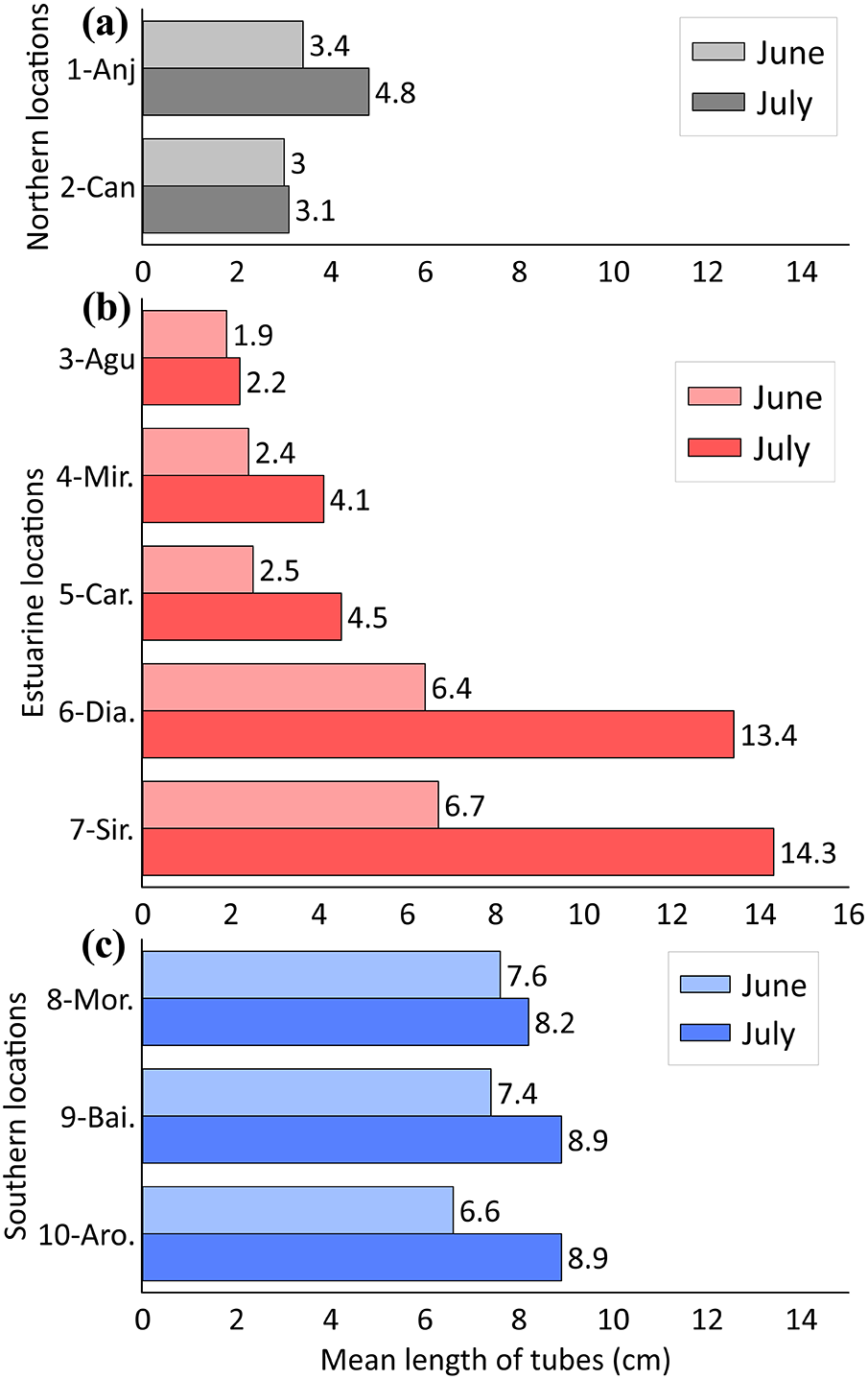
The average length of the displaced tubes (cm) at (a) northern coastal locations, (b) estuarine locations, and (c) southern coastal locations during the onset (June) and peak (July) of the southwest monsoon in 2022.

The dry weight of chitin tubes was also highest along south Goa beaches during the onset of SWM (avg. 335 ± 200 g/m2) and remained high during its peak (avg. 263 ± 146 g/m2), followed by north Goa and estuarine beaches (Figure 6). A noticeable decline was observed along north Goa beaches, while an increase was recorded at two estuarine beaches (Caranzalem and Siridao) during the peak SWM (Figure 6a,b). Tube length varied significantly across locations and sampling periods (Figure 7), with overall longer tubes observed throughout the study area during the peak SWM compared to the onset in June. The difference in tube length between June and July was not significant at locations 1–5 (p > 0.05) but it was highly significant at locations 6–7 (p < 0.005), where the longest tubes were recorded (avg. 13.9 ± 0.7 cm). A moderate variation was observed among south Goa beaches (p < 0.05). No displaced tubes were found along the beaches of Kochi (southwest coast) and Mumbai (northwest coast).
Schematic diagrams depicting (a) the actual presence of tube worms (Spiochaetopterus sp.) In subtidal regions during pre-monsoon and (b) are displaced due to strong wave action during southwest monsoon.

Discussion
Impacts of the SWM on the tube worms
Past studies have shown that when entire benthic faunal communities are suddenly removed from cyclone-affected shores, opportunistic species initially occupy the vacant niche, followed by the gradual recolonization of other communities within a short period (Sukumaran et al., Reference Sukumaran, Vijapure, Kubal, Mulik, Rokade, Salvi, Thomas and Naidu2016). Unlike cyclone waves, monsoonal waves along the west coast of India persist for an extended duration (over 2 months), continuously disturbing (erosion/accretion) intertidal and subtidal zones (Chandramohan et al., Reference Chandramohan, Sanil Kumar, Nayak and Pathak1993; George et al., Reference George, Kumar, Gowthaman and Singh2020). The present study also confirms that no chitin tubes were observed on the beach before the onset of the SWM in May 2022 due to weaker waves (Figure 7). However, simultaneous beach erosion (Chandramohan et al., Reference Chandramohan, Sanil Kumar, Nayak and Pathak1993) and the accumulation of chitin tubes occurred between June and July. Early June collections revealed a large number of fresh chitin tubes, which had been deposited along the high-water line, indicating recent dislodgment from coastal beds. In later collections, substantial quantities of tubes accumulated on the shoreline. This suggests that worms may have either escaped from the tubes upon dislodgment or possibly perished within them, although the exact outcome remains uncertain. The exact timeframe between dislodgment and deposition remains uncertain, as observations were conducted at fortnightly intervals. The quantity of deposited tubes appeared to be influenced by wave height, which disturbs and erodes inter- and subtidal beds. Although the peak wave height was recorded in July (avg. 2.71 ± 0.57 m), the highest beach erosion occurred in June (Chandramohan et al., Reference Chandramohan, Sanil Kumar, Nayak and Pathak1993; George et al., Reference George, Kumar, Gowthaman and Singh2020; Kumar et al., Reference Kumar, Shanas, Dora, Glejin and Philip2017; Noujas et al., Reference Noujas, Kankara and Rasheed2018). Similarly, the largest quantity of deposited tubes was observed in June rather than July, as the high waves in June (>2.2 m) likely initiated extensive disturbance/erosion of the beach sediment, whereas the slight increase in wave height (∼0.5 m) in July had a lesser impact. Unlike other reported cases, this prolonged physical disturbance likely prevents the recolonization of benthic communities along the west coast of India during the SWM (June–August) (Sukumaran et al., Reference Sukumaran, Vijapure, Kubal, Mulik, Rokade, Salvi, Thomas and Naidu2016).
Role of environmental settings on the characteristics of chitin tubes
The translucent chitin tubes found along seashore locations and the opaque tubes found in estuarine locations were probably due to the lower and higher organic matter availability in the respective sampling regions (Cowie et al., Reference Cowie, Mowbray, Kurian, Sarkar, White, Anderson, Vergnaud, Johnstone, Brear, Woulds and Naqvi2014; Gonsalves et al., Reference Gonsalves, Ceg, SO, Kirchman and Bharathi2011; Hedges et al., Reference Hedges, Keil and Benner1997). Estuaries receive a high amount of terrigenous organic matter through rivers, as the flow rate decreases there compared to narrow river channels and decreases further with increasing salinity (Mannino and Harvey, Reference Mannino and Harvey2004; Osburn et al., Reference Osburn, Boyd, Montgomery, Bianchi, Coffin and Paerl2016). The opaque tubes found in estuarine stations during the peak SWM could be attributed to the higher organic matter present in the estuarine sediments, which is disturbed by stronger wave actions (George et al., Reference George, Kumar, Gowthaman and Singh2020; Noujas et al., Reference Noujas, Kankara and Rasheed2018). The sandy coastal locations, with lower organic matter content, contained transparent tubes, whereas silty/muddy sediments in the estuarine shores contained tubes with higher organic matter (Mayer, Reference Mayer1994). Along the north Goa beaches, a large number of tubes were dislodged in early June due to an increase in wave height by more than 1 meter compared to May. The tube quantity significantly decreased in July (by 62-fold) as the increased wave height was insufficient to erode further deeper sediment strata (George et al., Reference George, Kumar, Gowthaman and Singh2020). Very few tubes were observed in specific estuarine beaches such as Aguada (loc. 3), Miramar (4), and Dias (6).
The possible reasons include the presence of rocky shores in Aguada, which do not support tube worms, as wave energy is directly dissipated on them (Lam et al., Reference Lam, Huang and Chan2009). Additionally, the seawall has made it a narrow beach, leading to the washout of tubes and a lack of deposition along its shore (SM 1a-b). Similarly, at Dias Beach, the seawall causes seawater to reach the wall directly, reducing the possibility of tube deposition (SM 2a-b). The cause of the reduced tube deposition at Miramar Beach remains unclear, though it may be influenced by hydrodynamic conditions associated with the Mandovi River and anthropogenic disturbances from tourism.
Caranzalem beach is wider and has a bay-like topography, which could explain the higher and relatively stable quantity of chitin tubes from the onset to the peak of the monsoon. Siridao beach is located inside the Zuari estuary, approximately 8 km from the estuarine bar-mouth area (Figure 1; location 7). High waves during the onset of the SWM likely had a lesser impact, resulting in lower tube deposition, while the peak SWM waves could have caused significant sediment churn-up and accumulation of a high number of tubes (Nordstrom, Reference Nordstrom1989; Sukumaran et al., Reference Sukumaran, Vijapure, Kubal, Mulik, Rokade, Salvi, Thomas and Naidu2016). The chitin tubes from the estuary could have been washed out and transported southward along the coastline by alongshore currents during the SWM, leading to their deposition along the south Goa beaches (George et al., Reference George, Sanil Kumar, Victor and Gowthaman2019). Tube worms are vertically fixed in the sandy/muddy substrate of subtidal regions (Barnes, Reference Barnes1964; Jumars et al., Reference Jumars, Dorgan and Lindsay2015). When wave action intensifies during the SWM, the sediment substrate becomes disturbed, releasing the chitin tubes into the water. During the early stages of high wave activity, shorter tubes with shallow roots were found along the shoreline, whereas longer tubes appeared later, during the peak SWM in July, when extreme wave heights disturbed even the deeply rooted tubes.
Tube worms and beach erosion during SWM
The class Polychaeta includes several families that can either secrete a mucous compound to create their own tubes or use nearby available resources such as sand grains, shells, echinoid fragments, quartz grains, and algal remains to construct tubes (Myers Reference Myers1972; Trowbridge et al., Reference Trowbridge, Little, Stirling, Pilling and Dlouhy-Massengale2013; Vinn Reference Vinn2021; Zatoń and Bond, Reference Zatoń and Bond2016). The tubes of the family Chaetopteridae (Spiochaetopterus sp.), which is the focus of the present study, are built by secreting chitin-like substances (Moore et al., Reference Moore, Nishi and Rouse2017). The solid tube structures of these worms, which are vertically fixed in subtidal sediments, help stabilize the substrate and reduce small-scale erosion (Bailey-Brock, Reference Bailey-Brock1984; Fager, Reference Fager1964; Indarjo, Reference Indarjo2008; Ong and Krishnan, Reference Ong and Krishnan1995). These sedentary burrowing animals support other infauna by supplying oxygen to deeper sediment layers and also serve as refuges for other organisms (Bailey-Brock, Reference Bailey-Brock1984; Thomsen and McGlathery, Reference Thomsen and McGlathery2005). In contrast, bioturbation is the process of sediment disturbance caused by benthic fauna such as annelids, molluscs, gastropods, echinoderms, and crustaceans (e.g., clams, crabs). These organisms burrow and move irregularly within the sediment column, creating cavities, weakening the substrate, and making it more prone to erosion during rough sea conditions (De, Reference De1998; Sanford, Reference Sanford2008). The present study examines an annually occurring harsh wave condition, during the SWM, which can erode coastal and estuarine beaches, removing sediments from subtidal regions and dislodging deeply anchored tube worms from their substrates (Figure 7).
Quantification challenges and future sampling strategies
The exact number of dislodged tube worms could not be quantified in this study, as such an assessment would require periodic collection of live worms from the sediment to enable species identification and quantification (Rengaiyan et al., Reference Rengaiyan, De and Ingole2017). During the SWM, accessing the subtidal zone and operating the sampler is nearly impossible due to exceptionally rough seas and high waves (George et al., Reference George, Kumar, Gowthaman and Singh2020). For future studies, we recommend collecting in-situ samples from estuaries, which are relatively calm and less disturbed (Balthis et al., Reference Balthis, Hyland and Bearden2006; Degraer et al., Reference Degraer, Volckaert and Vincx2003), to evaluate the impact of SWM waves and erosion on live tube worms. Additionally, pre- and post-SWM sampling can be conducted along the seashore when wave activity is lower (George et al., Reference George, Kumar, Gowthaman and Singh2020). Although Spiochaetopterus sp. is known indicators of organic pollution (Gesteira and Dauvin, Reference Gesteira and Dauvin2000), we observed more tubes in the south Goa coastal zones than in the estuary, where organic matter is more abundant (Gonsalves et al., Reference Gonsalves, Ceg, SO, Kirchman and Bharathi2011). This pattern can be attributed to stronger wave action in the coastal zone, which re-suspend sediments and dislodges a greater number of tubes than in estuaries (SM 3a-b).
Present limitations and importance of further studies
The Spiochaetopterus sp. tube worms are expected to play a significant role in both the pelagic and benthic food webs. Their long-lived larval stages contribute to the pelagic food web, while their benthic adult stages influence sediment ecosystems (Bhaud, Reference Bhaud, Sigvaldadóttir, Mackie and Helgason2003; SQ et al., Reference Irvine, Chaga and Martindale1999). However, their distribution across the coastal and estuarine regions of the entire Indian coast is not known. Although the fate of the dislodged tube worms remains uncertain, it is possible that (a) the worms escape from their tubes and enter the water column, or (b) they die within the tubes after being deposited on the shore. If released into the water, these worms could serve as a potential food source for larger zooplankton and fish larvae. Given that the SWM lasts for over two months, the likelihood of these worms re-settling and re-establishing their assemblages in subtidal zones is low. Following such physical disturbances, opportunistic fauna tend to occupy the vacant niche (Lu and Wu, Reference Lu and Wu2000; Sukumaran et al., Reference Sukumaran, Vijapure, Kubal, Mulik, Rokade, Salvi, Thomas and Naidu2016). Similarly, other benthic fauna affected by beach erosion require further study. However, the time required for Spiochaetopterus sp. tube worms to reassemble remains unknown. Currently, no studies exist on chitin tube deposition along the Indian coastline (Viswambharan, Reference Viswambharan2020), and the reasons for the deposition of these tubes along the central west coast of India remain unclear. There are numerous reports documenting similar tube depositions along Oregon beaches, USA (Giles, Reference Giles1980, Reference Giles2016). Once deposited, these tubes may be degraded by chitinolytic bacteria and fungi (Brzezinska et al., Reference Brzezinska, Jankiewicz, Burkowska and Walczak2014; Gooday, Reference Gooday1994); however, in this study, tubes were observed to persist on the shore for several months after deposition. The biochemical properties and potential economic significance of these tubes remain largely unexplored and warrant further investigation. Future studies should incorporate in-situ time series observations to examine the post-dislodgement dynamics of Spiochaetopterus sp. tubes and evaluate their biochemical composition and potential applications within the framework of the blue economy.
Conclusion
The present study showed a negative impact of the SWM waves on the polychaete tube worms, which live in the sub-tidal sediments along the central–eastern Arabian Sea (west coast of India). The SWM onsets between late May and early June with stronger south-westerly winds, which induce strong waves. Our observations revealed that the stronger waves churned up the sub-tidal sediment layer and dislodged the tube worms. Due to lower density, a large amount of chitinous tubes were deposited on the coastal and estuarine shores. The wave height, with an average of 2.2 ± 0.48 m observed during the onset of SWM, disturbed the subtidal regions significantly and dislodged and deposited up to 500 grams of tubes per square meter. The natural (rocky shore) and artificial (seawall) structures in a few of the estuarine beaches did not show the deposition of tubes. The estuary has a gentle slope in its bathymetry, and is far away from the bar-mouth, which may have aided in dissipating the wave energy, causing less and delayed deposition of tubes along estuarine beaches. The south (Kochi coast) and north (Mumbai coast) west coasts of India were not found with such tube deposition. The biochemical and economic potential of these tubes is largely unknown, highlighting the need for in-situ studies on their species distribution, ecological role in the food web, post-dislodgement fate, tube composition, and relevance to the blue economy.
Supplementary material
The supplementary material for this article can be found at https://doi.org.10.1017/S002531542510091X.
Acknowledgements
The authors thank the Director of CSIR – National Institute of Oceanography, India, for the facilities and inspiration. The funds for local travel were utilized from the project EEQ/2021000301, Science and Engineering Research Board (ANRF-SERB), Govt. of India. We thank Mr. Udayakrishnan PB., CSIR-NIO, Regional Centre, Mumbai and Mr. Manoj Kumar TM., National Centre for Aquatic Animal Health (NCAAH), Cochin University of Science and Technology, Kochi, for conducting field observations at the shorelines of Mumbai and Kochi, respectively. Thanks to Dr. Shanas, Physical Oceanography Division, CSIR-NIO, for his support in satellite data retrieval, Our sincere thanks Dr. Darwin D.R., Biological Oceanography Division, CSIR-NIO, for the critical review and valuable suggestions on the first version of this manuscript. The grammar check was done using an AI tool. This is a CSIR-NIO contribution, no. 7531.
Author contributions
Karnan C.: Concept, methods, investigation, visualization, writing original draft, review and editing. Mayuri W.R.: Methodology, investigation and visualization. Sambath K. R: Methodology, investigation and visualization.
Funding
Funds for local travel during field visits were provided by project EEQ/2021000301, Science and Engineering Research Board (ANRF-SERB), Government of India.
Competing interests
We wish to confirm that there are no known conflicts of interest associated with this publication, and there has been no significant financial support for this work that could have influenced its outcome.
Ethical approval
Not applicable.
Consent to participate
Agreed by authors.
Consent to publish
The authors have no objections to publishing the contents of the manuscript.
Availability of data and materials
The satellite data sets used in this study are available in online databases as mentioned in the methods section. The field-measured data that support the findings of this study are available from the corresponding author upon reasonable request.
AI tool
An AI-assisted tool (ChatGPT) was used only to improve language, grammar, and readability. All scientific content, data analysis, and interpretations were conducted entirely by the authors.