Social innovations in the delivery of social services: an introduction
Several national governments, as well as the European Commission, have recently stressed the concept of social innovation (SI) as a means to tackle social problems that can no longer be addressed by either the state or the market. Policy initiatives that foster and support SI are of high relevance for the European policy agenda (European Commission, 2010: 2).
Social Innovations are innovations that are social in both their ends and their means. Specifically, we define social innovations as new ideas (products, services and models) that simultaneously meet social needs (more effectively than alternatives) and create new social relationships or collaborations. They are innovations that are not only good for society but also enhance society's capacity to act. (BEPA, 2010: 9; see also Borzaga and Bodini, Reference Borzaga and Bodini2012: 5)
As concepts of SI are not homogenous and are rather broad, we refer to the Review Article of this themed section (Sinclair and Baglioni, forthcoming) to clarify our own understanding of what characterises SI and which characteristics are relevant for our analysis. We follow Phillips et al.’s view that ‘social innovation can be a product, production process, or technology’ (Reference Phillips, Deiglmeier and Miller2008: 37) and we focus on the following features of SI: the social orientation towards an unmet need, the integration of the target group (empowerment) and the potential to diffuse. Our main interest lies in the question of the institutional environment that structures the origins and what form SI takes. Based on the insights of actor-centered institutionalism (Scharpf, Reference Scharpf1997), we understand institutions as simultaneously enabling and constraining different groups of actors in their actions. Discussion of SI has often focused on private entrepreneurs, so-called social entrepreneurs, while innovations from established/public organisations have been neglected (Schmitz and Scheuerle, Reference Schmitz and Scheuerle2012: 13ff). We argue that this focus is due to the Anglo-Saxon origin of the discourse, and is biased by the (rather liberal) economic orders in those countries, that is the distinctive institutional framework in which their innovations have evolved. In contrast to Anglo-Saxon countries, the German landscape is characterised by highly institutionalised, corporatist structures. Social services are traditionally delivered either by the state or by intermediate, civil society organisations: the so-called Wohlfahrtsverbände (welfare associations) (Bode and Evers, Reference Bode, Evers, Evers and Laville2004). The question arises how a rather closed-shop-like environment such as the German welfare landscape structures constraints and opportunities for actors trying to implement social innovations, either from the outside or within an existing social service infrastructure.
Our background hypothesis is that activities of new actors are rather difficult to accomplish in the strongly institutionalised landscape of the German state and welfare associations. However, the porosity of corporatist structures has increased over recent years. The agency structures of the social service sector have significantly altered due to a changing institutional framework. Internal restructuring and a new balance between various and sometimes new types of social service agencies can be distinguished. We hypothesise that, due to the German institutional landscape, social innovations emerge from new actors (social entrepreneurship), but, more importantly, from established structures (social intrapreneurship) (Mair and Martí, Reference Mair and Martí2006).
Nevertheless, these trends do not apply alike to all social service sectors. For our study we have chosen the child and youth care sector as well as elderly care, and assume that these sectors provide opportunities for new actors to a different extent, as their institutional framework differs in small but significant ways. We furthermore scrutinise how social intrapreneurs and entrepreneurs rely on cooperation. Finally, we conduct an analysis of the influence of local politics, educational authorities and social agencies on the implementation of social innovations, as they might function as important gatekeepers for those involved in social innovations. Based on these hypotheses, we conducted two quantitative surveys in both sectors, and completed and deepened their results with two interview-based case studies for each sector. In order to contain the complexity of the two sectors, we focused on the promotion of children from a migratory backgroundFootnote 2 and on the delivery of culturally sensitive care for older people.Footnote 3
After this short explication of our understanding of social innovation, this article provides an overview of the institutional framework of the mature German welfare state, then discusses our methodology and data, before presenting our results regarding our four main hypotheses. We will conclude with some remarks on the implications of the analysis for social innovation.
Opportunities and constraints for social innovation in the German sectors of youth and elderly care: an institutionalist perspective
New challenges for German welfare corporatism
Since the days of Bismarck's creation of the social insurance system in the 1880s, the German welfare state has been marked by a division of two substantially different logics: the provision of social services is the responsibility of local governments on the one hand, with national social insurance bodies dealing with ‘standard life risks’ on the other. Long before the establishment of the centrally directed welfare state, a corporatist mode of governance emerged at the local level, with a division of labour between local governments and non-profit organisations which were organised in so called Wohlfahrtsverbände (welfare associations).
These long-established arrangements now face severe fiscal constraints. The German social budget encompasses the sum of €750 billion (BMAS, 2010). A considerable volume of social services is additionally financed by the municipalities. The sum spent by municipalities for social purposes has risen continuously in recent decades, and reached €40 billion in 2009 (Anton and Diemert, Reference Anton and Diemert2010: 11). In sum, rising demands face decreasing capacities for conventional provision (Schneiders, Reference Schneiders2010: 137–9).
One way of dealing with these pressures was the implementation of managerial reforms. These instruments were modelled according to the international paradigm of new public management (Pollitt and Bouckaert, Reference Pollitt and Bouckaert2004; Kuhlmann et al., Reference Kuhlmann, Bogumil and Grohs2008) and were often subsumed under the headings of ‘managerialism’ or ‘marketisation’ (Evers and Heinze, Reference Evers and Heinze2008). In this context, the activation of competition played an important role – including private actors and ‘social entrepreneurs’ as competitors. These developments induced the introduction of managerial instruments and rationalities by traditional providers of social service organisations, which were traditionally out of the grasp of market mechanisms. For non-profit organisations, a ‘social management’ movement embraced similar modernisation ideas.
The effects of these reforms remain limited so far: the main parts of social service in Germany are still provided by the so-called ‘freigemeinnütizgen’ non-profit organisations, the welfare associations, against these tendencies towards privatisation and marketisation. For decades, the services and provisions belonging to the five big welfare organisations (the catholic Caritas, the protestant Diakonisches Werk, the German Red Cross, the social-democratic Arbeiterwohlfahrt and the bottom-up organised and secular Paritätische) were providing the predominant share of social services in Germany. For the health sector, old age services, child care, youth welfare or the care of people with disabilities, these associations under the umbrella of the BAGFW (Bundesarbeitsgemeinschaft der Freien Wohlfahrtspflege) dominated the ‘market’. Currently, over 1.5 million employees work in over 100,000 establishments for the organised charities. In these establishments, about 4 million people receive care, cure, activation or consultancy (BAGFW, 2009). Organised charities have developed into one of Germany's biggest employers since the 1970s, comparable in size to multinational corporations. In addition to the internal modernisation in the voluntary sector and a partial expansion of commercial suppliers in distinct areas, there is a further development observable: the blending of social engagement with entrepreneurial action, which is following a global trend known as ‘social entrepreneurship’ (for example, Nicholls, Reference Nicholls2006). However, the involvement of different rationalities in one organisation is no new phenomenon. Indeed, the concept of the ‘third sector’ encompassed exactly these organisations which were not easy to categorise within market, state or community sectors (cf. Anheier and Seibel Reference Anheier and Seibel2001; Salamon and Anheier, Reference Salamon and Anheier1996; Evers and Ewert, Reference Evers, Ewert and Klatetzki2010).
Social innovation in two German social service sectors
We hypothesise that the activities of new actors are rather difficult to accomplish in the strongly institutionalised landscape of the German state and welfare organisations. However, the porosity of corporatist welfare structures has increased in recent years. The agency structures of the social service sector have significantly altered due to a changing institutional framework. Internal restructuring and a new balance between various and sometimes new types of social service agencies can be distinguished. We suggest that these challenges enable the development of social innovations within established structures. We accordingly derive the hypothesis that, due to the German institutional landscape, social innovations emerge from new actors (social entrepreneurship), but more importantly from established structures (social intrapreneurship) (Mair and Martí, Reference Mair and Martí2006).
Nevertheless, these trends do not apply to all social service sectors equally. For our study, we selected two sectors that differ in this regard. While the sector of child and youth care is characterised by high persistence of established structures (Grohs, Reference Grohs2010), the elderly care sector has been subject to considerable liberalisation (Schneiders, Reference Schneiders2010). We therefore conclude (hypothesis 2), that the elderly care sector provides more opportunities for social entrepreneurship, while innovations in the child and youth care sector are more often classified as social intrapreneurship. We furthermore propose that social entrepreneurs have to rely more strongly on cooperation in order to enter the corporatist actor networks, which should hold especially true for child and youth care, where schools exert an important gatekeeper function to the target group (hypothesis 3). Finally, we hypothesise that the influence of local gatekeepers of politics, educational authorities and social agencies should be more inhibitive for social entrepreneurs than intrapreneurs and more powerful in the sector of child care than in the sector of elderly care (hypothesis 4).
Methodology and data
Based on these hypotheses, we conducted two quantitative surveys in both sectors and completed and deepened the results with two interview-based case studies for each sector. In order to reduce the complexity of the two sectors, we focused on the services for children from a migration background and on the delivery of culturally sensitive elderly care.
The central challenge faced in designing the empirical approach was identifying innovative social projects. Both sectors offer a multitude of actors, organisational structures and supporting programmes. Schools are the central gatekeeper for services for children with a migration background. For this reason, we contacted the headmasters of (nearly) all German primary and special-needs schools. It was even more difficult to secure access to culturally sensitive elderly care services. We first contacted facilities and projects using address data from a German association on culture-sensitive elderly care, and supplemented this with sources identified on the internet and scientific journals. Following this, we applied cumulative snow-ball sampling by asking participants of the online survey for further addresses of facilities and projects in this field. We are aware of the potential sample bias in our data towards established actors, and we can only generalise from our results with care.
In the sector of child care, we contacted over 15,000 primary and special-needs schools. We identified 821 projects for the special promotion of children with a migratory background (mostly focusing on language skills) from 1,605 questionnaire responses. We contacted 1,100 organisations in the elderly care sector. From 155 completed questionnaires, we identified fifty-five projects in the field of culturally sensitive elderly care, mainly focusing on advice and recreation.
The questionnaire included open questions enabling participants to describe the innovative project, and semi-open questions to gather more information about the organisation, the actors and structure of both the projects and the facilities and schools.
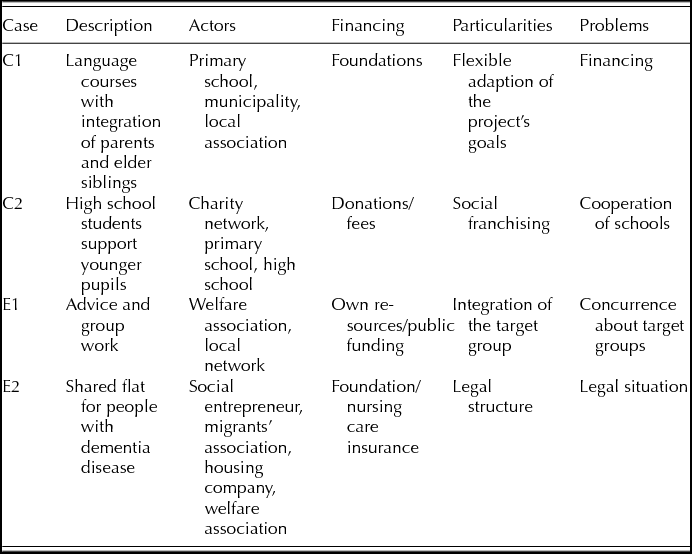
Regarding the case studies, we interviewed key actors from four innovative projects from both sectors (two case studies for each sector) (see Table 1).
Presentation of case studies

Empirical results
Here we present some initial results regarding social innovation by social entrepreneurs as well as intrapreneurs in two German social service sectors. This quantitative data is further supported using evidence from our four case studies.
The initiation of social innovations: the importance of intrapreneurship
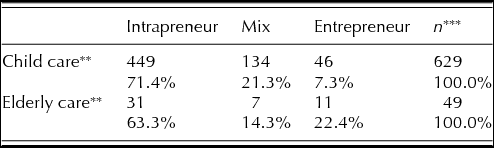
Our first hypothesis concerned the initiation of social innovations in child and elderly care. In accordance with our assumptions, we found that there is a considerable amount of innovative activity in established structures (see Table 2), where committed personalities engage in the development of new services for people in need. This is the case both for services for children from a migratory background and for culturally sensitive elderly care. Our second hypothesis posited that the elderly care sector would provide more opportunities for entrepreneurship than the rather strictly regulated sector of child care and education. And, indeed, there was significant variation between the child and elderly care sectors: the latter showing far more social entrepreneurs in the strict sense (22.4 per cent) than in the child care sector (7.3 per cent). While more than two-thirds of the projects are initiated by intrapreneurs in the elderly care sector, entrepreneurs can enter the sector of child care more easily if the project is initiated together with established actors, as shown in a fifth of the observed cases. Thus, the statistical data show the relative important and significant role of established actors and facilities in initiating innovative projects in both sectors.
Number of projects depending on the initiator*
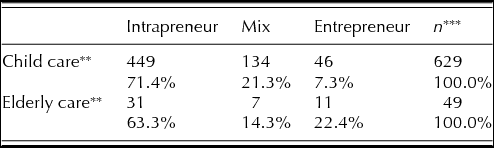
* Mann–Whitney-U test: significant differences between child care and elderly care (p<0,01)
** Chi-Square test: significant results (p<0,001).
*** Missing values: 192 cases (child care), 6 cases (elderly care).
In general, and also underlined in the case studies, social intrapreneurs have a comparative advantage, particularly regarding the financing of their project, as they can rely on the organisation's resources (both material and immaterial) to try out new services (for new target groups) or new organisational forms of service delivery.
A complementary result became evident in the case studies. Although the elderly care sector seems to provide more opportunities for entrepreneurship, both fields share the crucial issue of addressing their target groups. While in the field of child care, the schools and especially their principals exercise an important gatekeeper function, in the sector of elderly care, the traditional ways of addressing the target groups do not work. Cultural sensitivity seems to be dependent not only on culturally sensitive services, but moreover on a culturally sensitive approach, and this problem arose for entrepreneurs and intrapreneurs alike. An interviewee from case E1 stated that the approach had to be based on direct relationships and individual contacts, while German target groups could more easily be contacted using bill-boards or newspaper advertising. In the case of E2, it was found during project development that the original target group (Turkish immigrants) could not be convinced of the proposed model of a shared flat for older people with dementia, as care is still mainly provided within the family. Thus the target group was changed, and the second largest community of Russian immigrants was successfully contacted through a migrants’ association. Case C1 found that the parents, and in particular mothers, of the target group could only be engaged in the project if they felt that supervision for younger siblings was assured. The project devised an innovative solution to entrust elder pupils with this task, which created unexpected additional social value. Finally, case C2 focused on instructing high-school pupils in culturally sensitive behaviour towards the pupils and families they were working with, for example, appropriate clothing.
Social innovations in cooperation: “It's the network, stupid?”
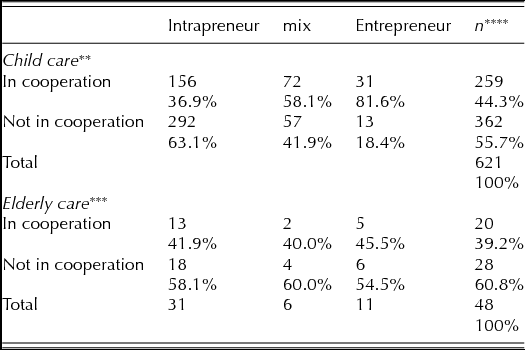
Our third hypothesis underlined the importance of cooperation, especially to enable entrepreneurs to access ‘closed shop’ institutional structures in Germany. We found that cooperation is quite important for all types of innovative projects, in both the child or elderly care sectors, and for innovations which come from within or from outside established structures (see Table 3). Cooperation seemed to be especially important for social entrepreneurs in the child care sector: 81.6 per cent of the projects involved cooperation. This fits not only our hypothesis regarding cooperation in general, but moreover our analysis of the differences between the two sectors, as the child care sector is characterised by more prominent barriers for new actors than is the case for care for older people.
Share of projects in cooperation*
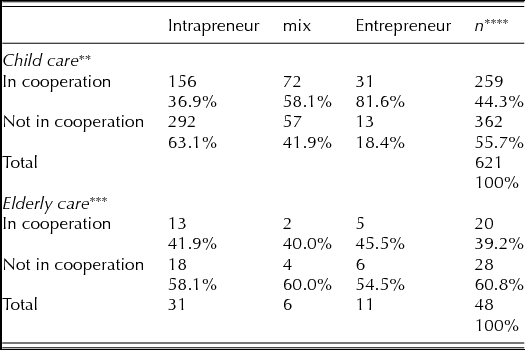
Notes* Mann–Whitney-U test: no significant differences between the cooperation of the observed groups.
** Kruskal–Wallis test: significant differences between the cooperation of the observed groups (p<0,001).
*** Kruskal–Wallis test: no significant differences between the cooperation of the observed groups.
**** Missing values: 200 cases (child care), 7 cases (elderly care).
Projects in this sector mainly involve cooperation, as it is very important to integrate the schools’ principals, and this was confirmed in the case studies. In both our case studies from the child care sector (C1 + C2), all interviewees stressed the importance of the cooperation of the schools for the success of the project, be it in order to address pupils in need, or for the provision of rooms. Case C2, which could use the support of the nationwide network of the initiating charity association, faced significant problems in convincing principals to participate in the project. In the sector of elderly care, such cooperation was not so important, even though one of our case studies (E2) was characterised by a considerable degree of cooperation. In that case, the high level of cooperation was due to the complexity of the project and the necessity to circumvent municipal obstacles. Significantly, this unique coincidence of committed actors in the participating organisations, combined with legal and financial particularities, makes it extremely difficult to transfer this innovative project to other municipalities. As the other case in the field of elderly care (E1) was conducted by the local office of the nationwide welfare association, it was somewhat surprising that, even though the project gained considerable attention from their federal office, the project did not seem to spread to other local offices within the association. We attribute this to the specific local environment that provided an opportunity for communication between relevant local actors, even though the project itself was not conducted in cooperation.
Social innovation in the local context: local drivers and barriers
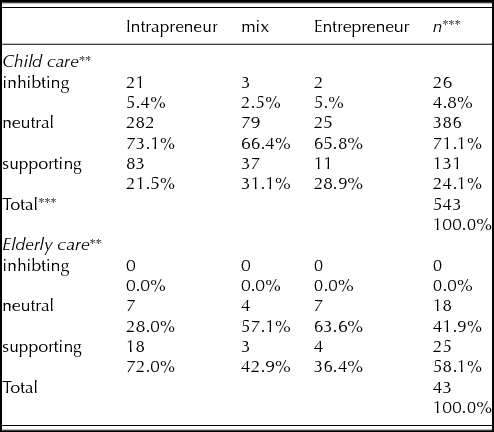
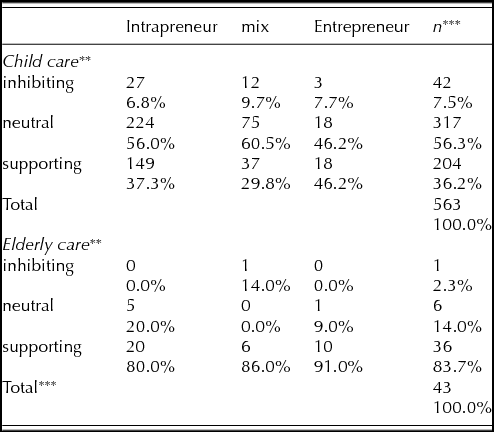
Our fourth hypothesis concerned the influence of local administration and policy makers, educational authorities and social agencies in the initiation and implementation of projects. We proposed that local politics, educational authorities and social agencies will inhibit the initiation and implementation process of innovative projects because of their institutional and administrative structures. In our understanding, this effect should be more important for social entrepreneurs and more prominent in the sector of care for children. However, the results of the survey did not confirm this hypothesis (see Tables 4 and 5). On the contrary, the influence of local politics appears supportive rather than inhibiting in both sectors (Table 4). Comparing the two sectors, there is a more positive assessment in the elderly care sector (58.1 per cent). In particular, intrapreneurs felt supported by local politics in initiating and implementing their projects in three out of four of the observed cases.
Influence of local politics*
Notes: * Mann–Whitney-U test: significant differences between child care and elderly care (p<0,001).
** Kruskal–Wallis test significant differences between the cooperation of the observed groups (p<0,1).
*** Missing values: 278 cases (child care), 12 cases (elderly care).
Influence of educational authorities and social agencies*
Notes: * Mann–Whitney-U test shows significant differences between child care and elderly care (p<0,001).
** Kruskal–Wallis test: significant differences between the cooperation of the observed groups (p<0,1).
*** Missing values: 258 cases (child care), 12 cases (elderly care).
Table 5 shows similar results for the influence of educational authorities and social agencies on the initiation and implementation of projects. Respondents in both sectors agreed that the influence of authorities and agencies was either neutral or supportive. As with the evaluation of the influence of local administration and policy makers, the influence of authorities and agencies was seen as more positive in the elderly care (83.7 per cent) than in the child care sector (36.2 per cent), which confirms our assumptions about the differences between the two policy sectors. Comparing the evaluation of intrapreneurs and entrepreneurs, it appears that the latter have a more positive opinion of the influence of authorities and agencies.
We observed the influence of local politics as well as educational authorities and social agencies in our four case studies. In case C1, the local administration proved to be rather inhibitive towards the innovative project. The employees of this local institution themselves established an association to initiate new and innovative projects independent of their employer. Furthermore, the municipality assisted the financing of the project, so that later there was even the supportive influence of local politics. In case C2, neither local politics nor educational authorities were important influences. Nevertheless the international welfare organisation which initiated and implemented the project played an important role in disseminating the idea of the project through their wide network. In case E1, the welfare association was a member of a local roundtable which brings together several local stakeholders, and the project benefited from this cooperation. Nevertheless, concurrence regarding the target groups occurred among the different actors as the good idea of the welfare association was copied by the other actors, including the municipality itself. Case E2 eventually encountered considerable resistance, both from local politics and social agencies, but due to the high degree of cooperation and quite a lot of attention from the media, this resistance could be circumvented.
Conclusions
Both the survey and case study data show the ambivalent influence of the local context upon social innovation. While the quantitative data showed a mostly supportive effect, the case studies provide a more differentiated picture. Personalities and network structures seem to be important influences that would be extremely difficult to replicate in other contexts. This finding applies to innovations initiated both from within and outside established sectors. Nevertheless, we find confirmation of our hypotheses that actors inside service agencies possess advantages in conducting social innovations, and that the elderly care sector provides more opportunities for innovations in general than services for children. This is due to institutional structures that privilege established intrapreneurs over new social entrepreneurs; however, there is variation in relation to the specific opportunities available to external actors. The initiation of SI is thus structured by the institutional landscape in general, and by specific organisations in different policy fields. Nevertheless, as structuration theory suggests (Giddens, Reference Giddens1984), individuals can override or even alter the structures in which they act. Any theory of SI would thus have to carefully distinguish the effects of agents and structure.
Institutionalised network structures (such as roundtables) might be a driving factor to foster social innovations in the fragmented and highly institutionalised social service sector in Germany. Those networks foster cooperation, which is important for social entrepreneurs and intrapreneurs alike, and might provide information exchange, not least for sources of funding. Other analyses (Heinze et al., Reference Heinze, Schönauer, Schneiders, Grohs, Ruddat, Jansen, Heinze and Beckmann2013) have shown that earned income still plays a rather marginal role for the financing of social innovations in Germany, therefore access to public funding sources will be crucial to facilitate scaling and foster the persistence of social innovations. More flexible public funding structures could facilitate SI from new actors as well as enabling new combinations of the existing pillars of welfare production. This would be an institutional change that finally catches up with social reality, new social problems and the existing solutions to tackle them.