Introduction
The tomato leafminer, Tuta absoluta Meyrick (Lepidoptera: Gelechiidae), is a widespread invasive species originated from South America and damaging economically important tomato crops (Solanum lycopersicum Linnaeus; Solanaceae) (Desneux et al. Reference Desneux, Wajnberg, Wyckhuys, Burgio, Arpaia and Narvaez-Vasquez2010). Larvae feed on the mesophyll of all aerial parts of the plants, as well as on the fruits, resulting in significant yield losses, cosmetic damages, and rot diseases to fresh market tomatoes. Current control strategies involving insecticides have been weakened by the larval endophytic feeding behaviour (Cocco et al. Reference Cocco, Deliperi and Delrio2013) and emergence of resistant insects (Lietti et al. Reference Lietti, Botto and Alzogaray2005; Haddi et al. Reference Haddi, Berger, Bielza, Cifuentes, Field and Gorman2012; Reyes et al. Reference Reyes, Rocha, Alarcón, Siegwart and Sauphanor2012). Sex pheromones have also been used for mass trapping and mating disruption (Vacas et al. Reference Vacas, Alfaro, Primo and Navarro-Llopis2011; Caparros Megido et al. Reference Caparros Megido, Haubruge and Verheggen2013b; Cocco et al. Reference Cocco, Deliperi and Delrio2013) but failed to reduce damages in part due to female parthenogenesis (Caparros Megido et al. Reference Caparros Megido, Haubruge and Verheggen2012). Alternative management strategies including the use of natural enemies (Urbaneja et al. Reference Urbaneja, Gonzalez-Cabrera, Arno and Gabarra2012; Zappalà et al. Reference Zappalà, Biondi, Alma, Al-Jboory, Arnò and Bayram2013; De Backer et al. Reference De Backer, Caparros-Megido, Fauconnier, Brostaux, Francis and Verheggen2014) are still evaluated. During the last decade, the pest has spread worldwide, and is now a serious threat to commercial tomato production in South and Central America as well as Europe, Africa, and the Middle East (Desneux et al. Reference Desneux, Wajnberg, Wyckhuys, Burgio, Arpaia and Narvaez-Vasquez2010, Reference Desneux, Luna, Guillemaud and Urbaneja2011; Tropea Garzia et al. Reference Tropea Garzia, Siscaro, Biondi and Zappalà2012; Zappalà et al. Reference Zappalà, Biondi, Alma, Al-Jboory, Arnò and Bayram2013; Brévault et al. Reference Brévault, Sylla, Diatte, Bernadas and Diarra2014). Since its introduction in Europe in 2006, the moth is reported on the European and Mediterranean Plant Protection Organization A2 list of species recommended for regulation as quarantine pests (European and Mediterranean Plant Protection Organization 2014).
The emergence of an alien invasive phytophagous insect within a geographical range is determined by its ability to localise and successfully develop on new host plants. Host range is constrained by the behavioural and physiological traits of the insect (Suckling et al. Reference Suckling, Charles, Kay, Kean, Burnip and Chhagan2014). Although causing large injuries on tomatoes, T. absoluta is also considered to develop on other cultivated and non-cultivated Solanaceae, such as potato (Solanum tuberosum Linnaeus), tobacco (Nicotiana tabacum Linnaeus), and black nightshade (Solanum nigrum Linnaeus) (Desneux et al. Reference Desneux, Wajnberg, Wyckhuys, Burgio, Arpaia and Narvaez-Vasquez2010, Reference Desneux, Luna, Guillemaud and Urbaneja2011; Mohamed et al. Reference Mohamed, Mahmoud, Elhaj, Mohamed and Ekesi2015). Non-solanaceous host plants have also been reported, including Chenopodium album Linnaeus (Amaranthaceae) (Portakaldali et al. Reference Portakaldali, Öztemiz and Kütük2013), Convolvulus arvensis Linnaeus (Convolvulaceae) (Portakaldali et al. Reference Portakaldali, Öztemiz and Kütük2013), Vicia faba Linnaeus (Fabaceae) (Abdul-Ridha et al. Reference Abdul-Ridha, Alwan, Helal and Aziz2012), and Malva Linnaeus (Malvaceae) species (Caponero Reference Caponero2009). Many of the cited non-cultivated plants may be found in various environments such as croplands, wastelands, logged areas, and urban areas (Lambinon et al. Reference Lambinon, Delvosalle and Duvigneaud2004). In this context, host plant species in the wild could provide reservoirs or refuges for T. absoluta.
Host range prediction is a key step for risk assessment that determines whether an alien invasive species should be eradicated, managed, or tolerated (Suckling et al. Reference Suckling, Charles, Kay, Kean, Burnip and Chhagan2014). However, little is known about the effective developmental and reproductive capacity of T. absoluta on most of the agricultural and non-cultivated plants that are reported as potential hosts in the literature. The characterisation of these parameters could help to understand and prevent the dispersion behaviour of the insect in the environment for more efficient integrated management strategies.
In the present study, we evaluate the ability of T. absoluta to develop, from egg to adult, on cultivated and non-cultivated plants reported as potential hosts in the literature, including Solanaceae, Chenopodiaceae, Convolvulaceae, Fabaceae, and Malvaceae.
Materials and methods
Plant and insect material
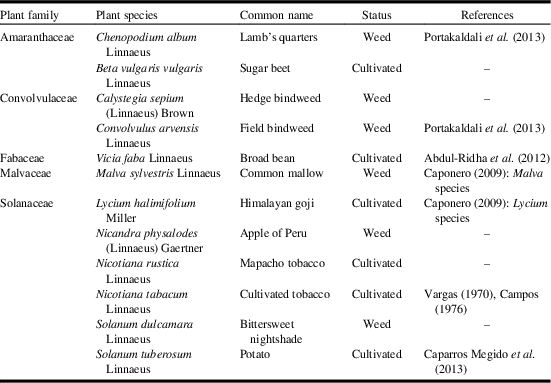
All plants were cultivated in a greenhouse (Gembloux, Belgium, April-September, 25±5 °C controlled temperature) in plastic pots (20 cm diameter×20 cm height) filled with loam (VP113BIO; Peltracom, Belgium) and grown with a 16 light:8 dark hours photoperiod. The plants were watered once every two days. Tomato (S. lycopersicum cultivar Moneymaker) was used for insect rearing. The six Solanaceae tested in this experiment were Lycium halimifolium Miller, Nicandra physalodes (Linnaeus) Gaertner, Nicotiana rustica Linnaeus, Nicotiana tabacum, Solanum dulcamara Linnaeus, and Solanum tuberosum cultivar Charlotte. Six non-solanaceous plant species were also tested including Beta vulgaris vulgaris Linnaeus cultivar Biscay; Chenopodium album (Chenopodiaceae); Convolvulus arvensis and Convolvulus sepium Linnaeus (Convolvulaceae); Vicia faba (Fabaceae); and Malva sylvestris Linnaeus (Malvaceae). Seeds were purchased in the Botanical Garden from Gembloux Agro-Bio Tech (University of Liège), except Beta vulgaris vulgaris cultivar Biscay, which was kindly provided by SESVanderHave (Belgium). The plant species used in the following experiments are summarised in Table 1.
List of plant species used in the laboratory experiments and their specific reference as Tuta absoluta potential host plant in the literature.

In July 2011, 200 third instars of the tomato leafminer, T. absoluta, were collected from a commercial tomato plantation located in Saint-Andiol (France) and subsequently kept under laboratory conditions (24±1 °C, 60–70% relative humidity, 16 light:8 dark hours photoperiod). Tuta absoluta colony was maintained on tomato in net cages (46.5×46.5×46.5 cm). Caterpillars were provided with fresh plants three times a week until pupation.
Evaluation of Tuta absoluta fitness
For each plant species, 20 newly emerged (<24 hours) T. absoluta adults (10 males and 10 females) were placed in a net cage (46.5×46.5×46.5 cm) in presence of a single non-flowering host plant (four weeks old) until the death of the females. When oviposition occurred, eggs were individually placed in a Petri dish (5 cm diameter) lined with a moistened filter paper and containing a single piece of leaf (2×3 cm) taken from the youngest fully open leaves of the host plant species on which they were laid. Leaf pieces were changed every day in order to feed the emerging larvae. The old piece of leaf was cut around the larva using a scalpel blade and the new one was inserted in the Petri dish. Water was also added to humidify the filter paper until pupation. Individuals that pupated were sexed according to the methods of Coelho and França (Reference Coelho and França1987), and male and female pupae were grouped in couples. Each couple of pupae was placed in an individual Petri dish containing a moistened filter paper and a single corresponding host-plant leaf piece (similar as described above) until adult emergence. Following adult emergence, males and females were left together in the Petri dishes for their entire lives. After visual observation of the first mating, the number of eggs laid on a single piece of leaf was daily evaluated until the female died. Water was supplied on the filter paper covering each Petri dish, every two days, to optimise adult survival.
During the development of the insects, egg-laying date, hatching date, pupation date, adult emergence date, and sex were daily recorded for each individual. Pupal mass was not recorded, since the ratio between fecundity and pupal mass is often masked by other factors and should thus be treated with caution when attempting to understand oviposition (Leather Reference Leather1988).
Oviposition test was replicated with a maximum of five times with new fresh plants until 50 eggs were collected. Each Petri dish was considered to be a replicate (i.e., n=50 for each tested plant species). In the case where no eggs were laid on a plant, 30 first instars were extracted from tomato leaves and individually isolated on a new host-plant leave piece in Petri dish. The development of these individuals was then followed according to the protocol described above.
Experiments were carried out under laboratory conditions (24±1 °C, 60–70% relative humidity, and 16 light:8 dark hours photoperiod) and were monitored using an automatic datalogger (HOBO RH/TEMP 8K; Onset Computer Corporation, Bourne, Massachusetts, United States of America).
Statistical analyses
Chi-square tests of independence were applied to compare survival percentages at each life stage and sex ratios on each plant species studied. Only individuals that reached the adult stage were taken into account to assess mean development times of T. absoluta. One-way analyses of variance (ANOVAs) were applied to compare the mean development times of each life stage and the female fecundity rates on the various host plant species. When assumptions of the one-way ANOVA (normality of populations and homoscedasticity) were not met, Kruskall–Wallis tests were applied followed by Mann–Whitney comparisons of specific samples pairs. All tests were performed using Minitab® v.16 software (www.minitab.com/fr-FR/default.aspx).
Results
Egg lay has occurred in most of the tested solanaceous plant species including L. halimifolium, N. rustica, N. tabacum, S. dulcamara, and S. tuberosum; but also in the case of M. sylvestris and V. faba, which are non-solanaceous plant species. No egg was observed on B. vulgaris vulgaris, C. album, C. arvensis, C. sepium, and N. physalodes. Some larvae were extracted from tomato leaves and submitted to those plants, but no larva entered the leaves or fed on these plants.
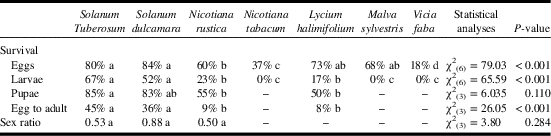
Egg viability differed according to the host plant species (χ2 (6)=79.03; P<0.001; Table 2), being statistically higher on S. dulcamara (84%) and S. tuberosum (80%) followed by L. halimifolium (73%), M. sylvestris (68%), N. rustica (60%), N. tabacum (37%), and V. faba (18%). However, mean development times (±SE) of T. absoluta eggs were not statistically different according to the host plants on which they were laid (H(3)=3.23; P=0.357; Table 3).
Survival rates and sex ratio (male/female) of Tuta absoluta on different potential host plant species.

Note: Values that do not share a common letter are significantly different.
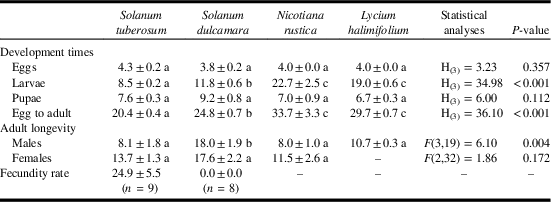
Mean development times (days), adult longevity and fecundity rates (eggs laid per female) of Tuta absoluta (±SE) on different potential host plant species.

Note: Values that do not share a common letter are significantly different. “n” refers to the number of couples, made from individuals that reached the adult stage, that mated.
Survival of the larvae fed on S. tuberosum (67%) and S. dulcamara (52%) were statistically higher than N. rustica (23%) and L. halimifolium (17%), while all larvae died in the case of N. tabacum, M. sylvestris, and V. faba (χ2 (6)=65.59; P<0.001; Table 2). It should be noted that no larva entered the leaves or fed on these one in the case of M. sylvestris and V. faba. Larval development times also differed according to the host plant (H(3)=34.98; P<0.001; Table 3): larvae fed on S. tuberosum developed faster (8.5±0.2 days) than those fed on S. dulcamara (11.8±0.6 days), L. halimifolium (19.0±0.6 days), and N. rustica (22.7±2.5 days).
Pupal development times (H(3)=6.00; P=0.112; Table 3) and survival percentages (χ2 (3)=6.04; P=0.110; Table 2) were not statistically different according to the host plants on which pupae were reared. However, association tests performed on sample pairs indicated a significant difference in insect survival between S. tuberosum (85%), N. rustica (55%), and L. halimifolium (50%).
Development times from egg to adult emergence were significantly lower for insects reared on S. tuberosum (20.4±0.7 days) than those reared on S. dulcamara (24.8±0.7 days), L. halimifolium (29.7±0.7 days), and N. rustica (33.7±3.3 days) (H(3)=36.10; P<0.001; Table 3). Corresponding survival rates from egg to adult emergence were lower with insects reared on L. halimifolium (8%) and N. rustica (9%) than those fed on S. dulcamara (36%) and S. tuberosum (45%) (χ2 (3)=26.05; P<0.001; Table 2).
Longevity of the adult males was significantly different between the host plants, being higher in the case of S. dulcamara (18.0±1.9 days) than the others (F(3,19)=6.10; P=0.004; Table 3). Although higher on S. dulcamara (17.6±2.2 days), longevity of the adult females did not statistically differed between the tested plant species (F(2,32)=1.86; P=0.172; Table 3). Female fecundity was hardly assessable, due to the very low number of alive adults: 24.9±5.5 eggs per female were laid on S. tuberosum (nine couples) while no egg was observed on S. dulcamara (eight couples) and N. rustica (two couples). Only adult males have emerged from pupae reared on L. halimifolium. The sex ratio (male/female) did not differ between the host plants (χ2 (3)=3.80; P=0.284; Table 2).
Discussion
Oviposition on a suitable host in response to plant cues, which is the beginning of a new generation cycle, is of major importance for an insect to maximise its fitness. In the present study, oviposition did not occur on all tested plant species when individually submitted to adult insects before fitness assays. Moreover, when oviposition occurred, a significant variability in egg survival was observed among the tested plant species. This discordance in survival may be due either to plant morphological characteristics or defense mechanisms in response to oviposition, impacting embryonic development. For example, low humidity on the leaf surface due to stomatal closure or hypersensitive response (i.e., formation of necrotic tissue at the site of egg deposition) may lead to their desiccation (Woods Reference Woods2010; Hilker and Meiners Reference Hilker and Meiners2011). Brassica nigra (Linnaeus) Koch (Brassicaceae) was found to produce such leaf necrotic zone at the base of Pieris rapae (Linnaeus) and P. napi (Linnaeus) (Lepidoptera: Pieridae) eggs, thereby desiccating them (Shapiro and DeVay Reference Shapiro and DeVay1987). Volatile and contact chemicals from plant tissues could also alter the embryonic development (Hilker and Meiners Reference Hilker and Meiners2011). Another hypothesis could be that females allocated fewer resources to embryos in response to a poor quality host plant, which has an evident impact on the performances of the resulting offspring (Boggs Reference Boggs1992). For example, Lymantria dispar (Linnaeus) (Lepidoptera: Erebidae) was reported to lay eggs on Quercus rubra Linnaeus, Q. prinus Linnaeus, and Pinus rigida Miller (referred as lower quality host plant species) that contained fewer amounts of vitellogin compared with Populus tremuloides Michaux (Salicaceae) (referred to as a good-quality host plant) (Rossiter et al. Reference Rossiter, Cox-Foster and Briggs1993).
High survival rates, short development times, and high fecundity rates (number of eggs per female) of herbivorous insects are all related to a suitable food quality (Awmack and Leather Reference Awmack and Leather2002; Greenberg et al. Reference Greenberg, Sappington, Sétamou and Liu2002; Pereyra and Sánchez Reference Pereyra and Sánchez2006). According to our results, non-solanaceous plant species are unlikely hosts for T. absoluta because few of those tested elicited oviposition and none were able to support larval growth. Surprisingly, insect survival also greatly differed between the tested solanaceous plant species (being greater on Solanum species) and female oviposition did not necessarily match with their fitness interest. T. absoluta females use plant volatile organic compounds to assess the plant quality (Proffit et al. Reference Proffit, Birgersson, Bengtsson, Reis, Witzgall and Lima2011), which could have misled them during host selection. Moreover, development time of T. absoluta from egg to adult emergence was significantly affected by larval host plant as individuals reared on S. tuberosum grew faster than the others. In absence of abiotic and biotic stress, insect development is mainly influenced by the larval instar (feeding stage), suggesting differences in nutritive quality and/or production of plant metabolites that have impaired larval development. For example, Nicotiana Linnaeus species are reported to produce alkaloids such as nicotine that can alter the growth of herbivorous insects (Steppuhn et al. Reference Steppuhn, Gase, Krock, Halitschke and Baldwin2004; Pomilio et al. Reference Pomilio, Falzoni and Vitale2008). A final aspect is that high adult longevity is classically related to a high fecundity (Leather Reference Leather1988). In this study, oviposition resulting from the bioassays only occurred on S. tuberosum although female longevities were statistically similar among Solanum species. Also, a previous study using an identical protocol to assess T. absoluta fitness when reared on its primary host plant S. lycopersicum (Caparros Megido et al. Reference Caparros Megido, Brostaux, Haubruge and Verheggen2013a) reported longer development times (28 days) and similar survival rates (47%) than observed here with S. tuberosum. However, adult fecundity rate reported on S. lycopersicum (50 eggs per female) was two-fold higher than on S. tuberosum, making tomato more beneficial in terms of fitness. It can be thus hypothesised that alternative host plants such as S. dulcamara, and S. tuberosum in a lesser extent, may be of lower quality than tomato to supply nutrients to the insects, having an impact on the reproductive potential of the resulting adults. Further experiments are needed to confirm this assumption involving a largest number of couples per plant species and taking into account the polyandrous behaviour of T. absoluta females that is known to increase their reproductive output (Lee et al. Reference Lee, Albajes and Eizaguirre2014). Considering the biological parameters described above, it can be assumed that Solanum species are the most suitable hosts for the insect development among the tested plants. Other solanaceous plant species could be opportunistically exploited as food source with fewer incidences.
Using excised leaves from healthy plants may not be representative of the real field situation. Insect infestation is known to trigger systemic production of plant secondary metabolites aiming to plant defense by antifeedant activity or toxicity (Bennett and Wallsgrove Reference Bennett and Wallsgrove1994). For example, levels of specific secondary metabolites like camphor, limonene, and β-caryophyllene significantly increased in Ocimum kilimandscharicum Baker ex Gürke (Lamiaceae) leaves upon Helicoverpa armigera Hübner (Lepidoptera: Noctuidae) attack, delaying larval growth and increasing mortality (Singh et al. Reference Singh, Jayaramaiah, Sarate, Thulasiram, Kulkarni and Giri2014). Such compounds may deter insect performances and the effective host range may be more restricted in the field than observed during this experiment. Another concern is that insect performances were assessed during a single generation, starting with egg-laying adults taken from their primary host plant. However, resources supplied by females to their offspring are known to influence the offspring biological traits (Rossiter et al. Reference Rossiter, Cox-Foster and Briggs1993). Therefore, the potential effect of food reserves allocated to the eggs (from females reared on tomato) on the biological traits of the immature and mature instars reported in this study should be taken into account. We might expect that generation time, survival, and female fecundity will be affected after several generations on an alternative host plant. Compared to previous results (Caparros Megido et al. Reference Caparros Megido, Brostaux, Haubruge and Verheggen2013a), egg to adult development time on S. tuberosum cultivar Charlotte increases from 20 to 24 days after five generations, being less beneficial in terms of fitness. Additional experiments are needed to assess the impact on insect performances of a long-term infestation on alternative solanaceous host plants as reservoirs.
It should be noted that predicting insect host range from laboratory experiments may be problematic, especially with marginal host plants, because such results did not include field constraints. Climatic and temporal variations (Agosta Reference Agosta2006) and thereby phenological and physiological state of the plants (Ayabe et al. Reference Ayabe, Minoura and Hijii2015) may have an influence on host selection patterns for the insects. Genetic variability in plants and insects, as well as local selective pressures on plant traits (Castillo et al. Reference Castillo, Cruz, Tapia-Lopez, Olmedo-Vicente, Carmona and Anaya-Lang2014), may also have an impact respectively on cues displayed or perceived (Harrewijn et al. Reference Harrewijn, Minks and Mollema1995), and insecticidal compounds secretion or plant defense avoidance (Moore et al. Reference Moore, Andrew, Külheim and Foley2014). Larval host plant experience (Caparros Megido et al. Reference Caparros Megido, De Backer, Ettaïb, Brostaux, Fauconnier and Delaplace2014) and conspecific infestation level (Bawin et al. Reference Bawin, De Backer, Dujeu, Legrand, Caparros Megido and Francis2014; De Backer et al. Reference De Backer, Caparros Megido, Haubruge and Verheggen2015) were also found to influence oviposition site selection by T. absoluta females. However, it can be assumed from our results that T. absoluta host range includes agricultural and non-agricultural secondary host plants that would contribute to population development. Because insect survival failed on ubiquitous non-solanaceous weeds including Chenopodium, Convolvulus, and Malva species, the continuous presence of the insect pest by the use of alternative hosts in absence of tomato crops would be strongly related to solanaceous plants, which would predominantly support self-sustaining field populations to different degrees. Depending on climatic conditions, which are major barriers to the insect spread (Van Damme et al. Reference Van Damme, Berkvens, Moerkens, Berckmoes, Wittemans and De Vis2015), and plant availability, it is possible that T. absoluta spreads from an infested tomato production area to neighbouring favourable environments, not only focussing on agro-ecosystems. Investigations in open-field environments are still needed to confirm such assumptions. In this context, a prevention programme as reported in recommendations from phytosanitary organisations (e.g., European and Mediterranean Plant Protection Organization 2005) is of primary importance to prevent either pest expansion and population build-up from infested crops to new sites, or crop infestation from existing refuges. Our results are in total agreement with cultural practices such as crop rotation with special focus on non-solanaceous plants and cultivation-free period between two successive crops. Because non-solanaceous plants are likely to be non-hosts for the pest, intercropping has also to be investigated to prevent crop infestation. For example, intercropping tomato with coriander (Coriadrum sativum Linnaeus, Apiaceae) and gallant soldier (Galinsoga parviflora Cavanilles; Asteraceae) was found to reduce T. absoluta density and enhance natural enemies (Medeiros et al. Reference Medeiros, Sujii and Morais2009). It should be however underlined that such measures will be ineffective as long as potential refuges or reservoirs for the pest remain around the immediate field vicinity. Weeds have still to be removed as some of them could act as potential host plants. Eradication using mass trapping, insecticidal treatment, and removal and destruction of infested crop plants will be necessary when prevention programme does not succeed. A pest monitoring not only focussing on the crops but broadened to the surrounding non-agricultural areas will be required to identify any unexpected infested site and avoid further reservoirs.
Acknowledgements
This research was funded by the Service Public de Wallonie (SPW–DGO3, D31-1298). The authors thank Alain Benko (Biologie végétale, Université de Liège, Belgium) for plant choice and identification, and Valérie Gillis (SESVanderHave) for providing sugar beet seeds. Emilie Joie and Maud Fagan (Entomologie fonctionnelle et évolutive, Université de Liège) are acknowledged for their technical support in plant culture and insect rearing.