For some five decades, a number of researchers have claimed that aptitude is a key factor within adult SLA (e.g., Carroll, Reference Carroll and Diller1981; Carroll & Sapon, Reference Carroll and Sapon1959; de Graaff, Reference de Graaff1997; Robinson, Reference Robinson and Schmidt1995, Reference Robinson and Robinson2002; Skehan, Reference Skehan and Robinson2002, Reference Skehan, Gass and Mackey2012). One of the most researched subcomponents of aptitude is grammatical sensitivity, as measured by the Words in Sentences ( WS) section of the Modern Language Aptitude Test (MLAT). Scores on the WS have been shown to correlate strongly with a variety of outcomes and measures—largely paper-and-pencil tests of L2 grammatical knowledge (e.g., Robinson, Reference Robinson and DeKeyser2007; Sawyer & Ranta, Reference Sawyer, Ranta and Robinson2001). Recently, Skehan (Reference Skehan, Gass and Mackey2012) has claimed the following:
The aptitude agenda that Carroll shaped half a century ago is still relevant. . . . Studies researching aptitude now seem to standardly include a measure of inductive language learning. This, and the grammatical sensitivity sub-test, generate the most consistent correlations in such research. These results indicate that aptitude may be central rather than marginal within SLA [emphasis added]. (p. 391)
The present study provides evidence that calls into question the seemingly central role of grammatical sensitivity within adult SLA. Our evidence comes from the acquisition of two basic aspects of L2 Japanese: head directionality and surface case marking. Although we focus on these two structures in L2 Japanese, we use our evidence to challenge the underlying assumption behind most research on the role of aptitude as grammatical sensitivity in adult SLA. Namely, we challenge (a) the popular assumption that language consists primarily of rules and (b) its corollary, that acquisition entails the learning and internalization of such rules. Instead, we argue that language acquisition is the by-product of learner-internal (largely linguistic) mechanisms. As learners (over time) process morphophonological units in the input, this processing feeds these internal mechanisms, and a L2 system is built unconsciously in the mind of the learner. We will illustrate this later in our discussion of yes/no questions in English.
The article is organized in the following way. We first provide a brief review of the nature of grammatical sensitivity as a subcomponent of aptitude, coupled with a discussion of the assumptions about language that underlie aptitude tests, and some recent challenges to these assumptions. We then present a study on the initial stages of learning Japanese as a L2, with a focus on parameter resetting (head directionality) and the underlying morphophonological representation of case marking. We conclude by suggesting that grammatical sensitivity be restricted to discussions of explicit learning of rules.
GRAMMATICAL SENSITIVITY
Language acquisition is complex because language itself is complex, minimally consisting of formal properties (e.g., phonology, syntax, morphology), properties related to meaning and reference (e.g., semantics, pragmatics, discourse), and the interfaces between these properties and the lexicon as well as the interfaces between the different aspects of meaning and reference. Many researchers within adult SLA have investigated the acquisition of the formal properties of language, often referred to simply as “grammar.” Additionally, both language learners and language teachers likely consider the L2 grammar one of the most important areas to focus on. After all, to have a reasonable command of French, learners need to be able to use au and du before masculine nouns but à la and de la before feminine nouns. Similarly, German learners need to know that tensed verbs occur in second position in matrix clauses but come at the end of the subordinate clause. Learners of Japanese need to learn that the verb comes last and subjects may be dropped. These kinds of differences are, indeed, striking to learners and seem to present a formidable acquisition task. Consequently, it is possible that people who are somehow sensitive to grammatical structure in their native languages would have an advantage in learning a new language. Such sensitivity would presumably enable them to perceive, analyze, or otherwise learn the grammar of another language more readily than those who are less sensitive to grammatical structure in their native languages. For a number of years, researchers have measured this kind of grammatical sensitivity (largely) by the MLAT and, specifically, by the WS subsection of this test.Footnote 1 The WS section of the MLAT consists of 45 items. In each item, the participant reads a stimulus sentence with an underlined word. Then the participant reads a second sentence with six underlined words and must identify the word that has the same function as the underlined word in the stimulus sentence. An example follows in (1) (taken from the purchase website for the Language Learning and Testing Foundation, www.lltf.net):
(1) Mary is happy.
From the look on your face, I can tell you must have had a bad day.
A B C D E
Presented with this example, the participant would presumably select C as the answer because “I” matches the (subject) function of “Mary.” Although this test does not require learners to produce metalinguistic explanations for their choices (i.e., the participant does not have to say “Mary is the subject of the sentence and I is the subject of the next sentence . . .”), participants arguably must engage in some kind of thought process about what makes two elements have the same function, and, therefore, some kind of reasoning about language must underlie the test and what it measures. Thus, although participants do not have to explicitly verbalize their reasons for the tester, at some level, participants “reason out” their responses. We posit, then, that this test likely invites some kind of metalinguistic reflection on the part of participants.
Regardless of the thought processes with which someone engages on the WS as a test taker, scores on the WS have been shown to have moderate to strong correlations with language learning outcomes in a number of studies, both in classrooms and in laboratories (e.g., de Graaff, Reference de Graaff1997; Robinson, Reference Robinson and Schmidt1995; and see the review in Dörnyei, Reference Dörnyei2005), and outside of formal environments (DeKeyser, Reference DeKeyser2000). In a review of such research, Sawyer and Ranta (Reference Sawyer, Ranta and Robinson2001) claimed that, regardless of setting (e.g., naturalistic settings, immersion, communicative instruction), better WS scores go hand in hand with better scores on tests of linguistic knowledge. In particular, they claimed that, in controlled laboratory-type studies in which the learning condition is manipulated (i.e., whether or not learners were consciously focused on rules or rule learning), aptitude (including but not limited to grammatical sensitivity) has been shown to be “relevant to L2 learning in both implicit and explicit conditions” (Sawyer & Ranta, Reference Sawyer, Ranta and Robinson2001, p. 339). Robinson (Reference Robinson and Robinson2002) echoed this claim and argued that recent research shows positive correlations between grammatical sensitivity and achievement in communicative classrooms.Footnote 2 As mentioned in the introduction to this article, Skehan (Reference Skehan, Gass and Mackey2012) has claimed that aptitude—especially grammatical sensitivity—is central in adult L2 acquisition.
To be sure, there are other tests of aptitude—such as the Pimsleur Test, the LLAMA, and the Canal-F (the latter two will figure into some of our discussion later), to name the most well-known—each of which contains some kind of test related to something similar to what is tested in the WS section of the MLAT. We have chosen to focus on the MLAT here for issues of comparability: The MLAT has been the most widely used test of aptitude in adult L2 research (well into the 21st century; e.g., Dörnyei, Reference Dörnyei2005, p. 43). What is more, the WS in particular has been singled out and used repeatedly as a measure of some underlying trait related to the acquisition of “grammar” (see also the quote from Skehan in the introduction to this article). As a result, the literature that is most often cited and reports high correlations between aptitude and learning outcomes has used the MLAT or the WS subsection of the MLAT (e.g., de Graaff, Reference de Graaff1997; DeKeyser, Reference DeKeyser2000; Robinson, Reference Robinson and Schmidt1995; Wesche, Reference Wesche and Diller1981; but see Obler, Reference Obler, Gass, Madden, Preston and Selinker1989, for a case study on a superior language learner with, at best, a mediocre WS score).
At this juncture, it is important to consider exactly what the underlying assumption about the nature of language and language acquisition is in the studies finding support of grammatical sensitivity as a major factor in adult L2 acquisition. Regardless of how Carroll conceptualized language and language acquisition in his writing (Carroll, Reference Carroll and Diller1981),Footnote 3 it seems clear to us that researchers since Carroll have conceived of language as a system of static rules, similar to the pedagogical or structural rules that predated generative and other contemporary approaches to the scientific study of language. These researchers furthermore assume that language learning is the internalization of such rules. For instance, Robinson (Reference Robinson and Schmidt1995) and de Graaff (Reference de Graaff1997)—both of whom found significant correlations between scores on the WS and experimental tests of learner knowledge—examined learning “easy” versus “hard” rules. In Robinson’s case, an easy rule was subject-verb inversion with fronted adverbials of movement (e.g., “Into the house John ran/ran John”), and an example of a hard rule was pseudoclefts (e.g., “Where John and Mary live is in Chicago not in New York”). Furthermore, Robinson described these as “pedagogic rules” (p. 314), with their relative complexity and difficulty confirmed by 15 English as a L2 teachers. De Graaff’s easy rules were plural marking on nouns and negation placement in Spanish. His hard rules were verbal inflections for imperatives and clitic object placement in Spanish. Unlike Robinson, de Graaff based relative difficulty on the notion that rules have underlying complexity—that is, how many formal or grammatical features underlie the particular structure.Footnote 4 Robinson and de Graaff are not alone in this conceptualization, and one can find repeated use of the idea of rule learning in many publications, both explicitly and implicitly (e.g., De Jong, Reference De Jong2005; Henshaw, Reference Henshaw, Sanz and Leow2011; Hulstijn, Reference Hulstijn2005; Leow, Johnson, & Zárate-Sández, Reference Leow, Johnson, Zárate-Sández, Sanz and Leow2011; Spada & Tomita, Reference Spada and Tomita2010).
Our claim, then, is that researchers who assume or claim that aptitude as grammatical sensitivity plays a key role in adult L2 acquisition view language and language learning in particular ways. These assumptions may not always be as clearly stated as they are in Robinson’s (e.g., 1995) research, but these researchers’ underlying assumption is that language acquisition entails rule learning in some way. In the case of Robinson’s (Reference Robinson and Schmidt1995) study, for example, unless learners of English had a specific rule that operated on subjects and verbs, they would not be able to form a sentence like “Into the house ran John.” This suggests a particular conception of how grammars are stored in the mind—namely, that the mind has some system analogous to a grammar book, listing the rules of the language. Learning an aspect of the grammar means storing the rule that governs it in the mind for easy access and then automatizing this rule knowledge enough that it can be retrieved and put to use in real time. Additionally, regardless of researchers’ perspectives on the roles of explicit and implicit processes in adult L2 acquisition, these researchers make the underlying assumption that learners internalize rules from input data. For this reason, aptitude research has tended to test learners’ knowledge of L2 rules and to look for correlations between those scores and WS scores.
It may seem obvious that aptitude research should test learners’ knowledge of the rules of the L2 grammar. After all, this is how foreign—and native—language grammars are usually presented to learners. It makes intuitive sense to say, for instance, that English has a rule that requires wh- words to move to the beginning of the sentence to form questions or to say that Spanish places clitic object pronouns in preverbal position if the verb is conjugated. Because this is generally how people conceive of language learning and teaching, challenging this notion may not make sense. To address the question of what language learning is, however, we need to consider the nature of the system being acquired. In other words, if we take a step back and consider that languages are complex combinatorial systems, not sets of rules, and that what we call rules are therefore not what is represented in the mind of the language speaker,Footnote 5 it seems reasonable to question whether rule learning is the basis of language acquisition. This, in turn, raises the following question: If language acquisition does not entail learning the rules of traditional grammars, then what does it entail? In the present study, we take a generative perspective and claim that linguistic knowledge is not the result of rule learning in the classic sense and that what looks like evidence of rule learning is actually epiphenomenal. Within the generative tradition, development of language in the mind or brain results from the interplay between the linguistic data in the input and learner-internal mechanisms.Footnote 6 What researchers and instructors may call “rules” are actually reflexes of underlying features and operations in the linguistic system that bear little resemblance to how they are described by most people. We illustrate this concept with an example from English yes/no (polar) question formation.
In English, unmarked yes/no questions are formed using do, whereas subject-verb inversion with main verbs, which is used in other languages, is prohibited, as in (2) and (3). The reverse is true in a language like Spanish, which has subject-main verb inversion and lacks so-called auxiliary do support, as in (4).
(2) Does John live near the university?
(3) *Lives John near the university?
(4) ¿Vive Juan cerca de la universidad?
Although we can describe the use of do in these questions with a statement like “to form a yes/no question, insert do and invert the order of the subject and do,” in a mental grammar of English, do support is the result of a series of interactions between abstract features of the grammar. Many aspects of a grammar are derived through these interactions; in this case, do is base generated in Infl, the head of the inflectional phrase (IP), to bear the tense features for the sentence. That is, English instantiates the feature of finiteness, requiring verbs to indicate whether or not they are tensed. Comp, which is the head of the complementizer phrase (CP), contains a feature that is able to enter into what is called an AGREE relationship with the features enumerated on auxiliary verbs in English that probe or search for other elements in the sentence that match. This feature-based AGREE relationship forces do to move out of the IP and yields the surface word order seen in (2) while also prohibiting (3). In Spanish, however, the lexical verb (because it carries tense features) can enter into an AGREE relationship with both the IP and the CP, moving up into the CP without the need for something like do. These kinds of syntactic operations occur when relevant lexical units have functional features that must be checked (i.e., must “find matches”) in the course of a syntactic derivation. What we describe as varying syntactic word orders are thus surface reflexes of functional feature checking that result in lexical insertion or movement of a constituent into a phrase to fulfill the AGREE relationship. Thus, our textbook rule that says “insert do and invert the subject and auxiliary verb” is not what actually exists in the grammar or in people’s minds; it is a specific shorthand way to describe a particular consequence of more abstract principles and underlying features of the grammar. The rule is derivative of more abstract properties and operations in the syntax, and we are able to use such properties to account for the surface differences between Spanish and English, for example.
Using insights such as these from generative theory, VanPatten (Reference VanPatten, Sanz and Leow2011) and VanPatten and Rothman (Reference VanPatten, Rothman, Benati, Laval and Arche2013) have argued that acquisition cannot be the internalization of rules. They argue that language consists of elements that cannot be learned (those that are given by Universal Grammar [UG]), those that are derived from UG but may be triggered by input data (parametric variations), and those that are language specific and must be learned from the input (e.g., lexical items and inflectional morphology). VanPatten and Rothman say the following about acquisition:
Learners do not acquire rules from the input. Instead, learners process surface morpho-phonological units (e.g., lexical form, morphological form) and internalize these units along with underlying features or specifications. These units interact with information provided by UG and the language making mechanisms of the human language faculty such that anything that resembles rules (from an outside perspective) evolves over time. (p. 25)
In the case of yes/no questions in English, learners process and acquire various versions of do with their underlying features (e.g., do <+Q>, <+V>, <−N>, <+present>, <−past>; does <+Q>, <+V>, <−N>, <+present>, <−past>, <third person>, <sing>; did <+Q>, <+V>, <−N>, <−present>, <+past>);Footnote 7 each of these forms is stored in the lexicon. The relevant features of CompFootnote 8 then enter into syntactic relationships with each of these lexical items when they are inserted into sentences to satisfy other features (e.g., finiteness/tense). Acquisition, then, does not consist of internalizing rules; rather, the learner’s underlying syntactic system evolves over time as a result of processing input. The regularities of language (i.e., the aspects of the grammar that look like rules) evolve and develop on the basis of what lexical items get processed and what underlying features are associated with them. Given this scenario, we would expect aptitude in the form of grammatical sensitivity as measured by the WS to have little or no role to play in acquisition precisely because the WS relates to rule learning and therefore does not reflect the nature of the system learners need to acquire or how they acquire it.
To be sure, there have been recent attempts to update aptitude as a construct and/or to provide novel measures of aptitude. Such measures still include some kind of internal subcomponent related to grammatical sensitivity. In Meara’s (Reference Meara2005) LLAMA, for example, a section of the test is devoted to “grammatical inferencing.” This subsection of the test asks learners to “work out the rules” of an unknown language (p. 15). Similarly, Grigorenko, Sternberg, and Ehrman (2000) offer Canal-F (Cognitive Ability for Novelty in Acquisition of Language [Foreign]), which includes a section titled “Learning Language Rules.” Like grammatical inferencing in the LLAMA, participants demonstrate their ability to learn the “most evident rules” of a made-up language in the Canal-F (p. 396). We return to these tests again in our discussion of the results of the present study.
These observations lead us to ask the following questions: What if neither language nor language acquisition is centered on the construct of “rules” as traditionally conceived? And what if assessment of language moved away from assessment of knowledge of language rules to something more closely assessing linguistic competence? Would grammatical sensitivity (and possibly aptitude more generally) still be central within SLA? In the next section, we review a recent study that poses a challenge to grammatical sensitivity as a construct in adult SLA.
A CHALLENGE
VanPatten, Borst, Collopy, Qualin, & Price (Reference VanPatten, Borst, Collopy, Qualin and Price2013) examined the role of grammatical sensitivity across four experiments in four different languages. The researchers used processing instruction (PI) as the treatment for the study, focusing on the first-noun principle and its intersection with the following language-specific phenomena: how learners process word order and clitic object pronouns in Spanish, how learners process case markings on articles in German, how learners process Russian nominal case markings, and how learners process the underlying subjects of causative sentences with faire “do, make” in French.
Because PI was the intervention used, the focus was not on rule learning but on correct processing of sentences (e.g., understanding who did what or who did what to whom). The authors did not use a test of knowledge to measure acquisition; instead, they used trials-to-criterion as their measure. Trials-to-criterion refers to how soon learners begin to process (interpret) sentences correctly. For example, in the case of Spanish, learners are known to misinterpret object-verb-subject (OVS) sequences such as Lo ve María “Mary sees him” as “He sees Mary.” Likewise, in German, learners are known to misinterpret OVS sequences such as Den Hund hört die Katze “The cat hears the dog” as “The dog hears the cat.” VanPatten et al. (Reference VanPatten, Borst, Collopy, Qualin and Price2013) used the number of items (trials) it took for learners to begin processing correctly as their assessment measure. Clearly, the lower the participant’s score on the trials-to-criterion measure, the sooner the participant began processing correctly.
Participants were enrolled in second-year university-level language courses (N = 181). The researchers examined two factors. The first factor was the role of explicit information. All language groups were divided into two groups: +explicit information and −explicit information (+/−EI). The +EI group received a short, jargon-free explanation of both the structure and the processing problem prior to working with the 50-item set of sentences. The −EI groups received no such information and simply began working through the items. The second factor was grammatical sensitivity, as measured by the WS section of the MLAT.
For the factor grammatical sensitivity, there were no significant correlations between scores on the WS and trials-to-criterion, except in one instance: for the German +EI group. No other language groups showed any significant correlations. This study, then, failed to show any significant role for grammatical sensitivity for any language, for the processing of any sentence type, in terms of either trials-to-criterion or a posttest. The lone exception, as noted, was the German +EI group. The researchers argued that, given the results of the other groups, it appears that this particular result was spurious (i.e., it was the only cell out of eight cells in the research design to show a correlation).
The question here is why VanPatten et al. (Reference VanPatten, Borst, Collopy, Qualin and Price2013) did not get the kinds of moderate to strong correlations seen in previous research. In their discussion of the results, VanPatten et al. argue that the reason is because PI does not work on rule learning but instead is a treatment designed to bring about better processing of data in the input. If acquisition (and a pedagogical intervention) is not viewed as the internalization of rules, then grammatical sensitivity to rules and patterns may not show up as a factor in empirical research on instructed SLA.
THE PRESENT STUDY
The present study follows VanPatten et al. (Reference VanPatten, Borst, Collopy, Qualin and Price2013) as well as VanPatten and Rothman (Reference VanPatten, Rothman, Benati, Laval and Arche2013) in that its conceptualization of language and language acquisition is different from that found in standard aptitude research. However, unlike VanPatten et al., the present study is not focused on processing, and it does not use PI as a treatment. Instead, the present study seeks to determine whether aptitude as grammatical sensitivity shows up as a significant factor in (a) parameter resettingFootnote 9 and (b) the acquisition of surface case-marking features when participants complete a simple input/sentence exposure treatment in which they are asked to focus not on grammar but on meaning. The language of study is Japanese, and the participants are learners who have no previous knowledge of Japanese or any other SOV language. These learners received a simple input treatment, during which they received no information about Japanese grammar, nor were they asked to focus on it. The questions we ask are these:
1. Does aptitude in the form of grammatical sensitivity play a significant role in the instantiation of a new parametric setting?
2. Does aptitude in the form of grammatical sensitivity play a significant role in the acquisitionFootnote 10 of nominative and accusative case marking in Japanese?
We chose Japanese because it is a rigidly head-final language and thus instantiates a different parametric setting from that of English. English is rigidly head initial, such that all heads of phrases precede their complements. Thus, the order of elements in the verb phrase (VP) is verb-complement (e.g., “eats apples”), the order in the prepositional phrase (PP) is preposition-complement (e.g., “in the kitchen”), the order in the CP is complementizer-complement (e.g., “that he eats apples”), and so on. In Japanese, all of these orders are reversed such that the order of elements in the VP is complement-verb (e.g., “apples eat”), the order in the PP is complement-postposition (e.g., “kitchen in”), and the order in the CP is complement-complementizer (e.g., “apples eat that”), and so on, throughout the grammar. In VanPatten and Rothman’s (Reference VanPatten, Rothman, Benati, Laval and Arche2013) terms, this aspect of Japanese is derived from a principle of UG. Head-complement word order derives from the principle of UG that language consists of phrases with heads, regardless of whether the head is lexical (e.g., N, V, P) or functional (e.g., T, C, Agr). These heads are free to combine with other phrases to form larger phrases and eventually sentences. Universal Grammar does not, however, require that languages order heads and complements in a particular fashion, and, logically, either order—head-complement or complement-head—is possible. For language acquisition, this means that once learners have established the basic relative ordering of heads and complements in the target language, they will project this ordering to novel structures even before they encounter them in the input. Boeckx (Reference Boeckx, Di Sciullo and Boeckx2011a), for example, calls this “the Superset Bias” in relationship to first language (L1) acquisition and says the following: “For example, if the child learns that V precedes its complement and T precedes its complement, she will be inclined to hypothesize that the next head she encounters will also precede its complement” (p. 217). A recent study (Smith & VanPatten, Reference Smith, VanPatten, Laval, Arche and Benati2013) tested learners’ ability to do just this. Participants were exposed to basic Japanese sentences with object-verb and noun-postposition orders. Participants were given no explicit explanation of Japanese word order and were tested on their intuitions about the relative ordering of elements in novel phrase-structure configurations: yes/no questions (question particles and clause structure) and embedded clauses (complementizers and the clauses they head). Although participants did not know they were being tested on their ability to project beyond what they were exposed to, the results were clear: The participants did indeed project headedness based on the VP to the novel structures of polar questions and embedded clauses. The present study uses the same framework as Smith and VanPatten, and we are testing whether grammatical sensitivity is a factor in naïve L2 Japanese learners’ ability to determine that the language they are learning is head final.
In addition to head-complement order, we decided to look at whether grammatical sensitivity is a factor in learners’ acquisition of case marking. In Japanese, nouns are normally marked for case with postpositions that attach to the noun; -ga indicates that the noun is the subject, and -o indicates that the noun is the object: Taro-ga ringo-o taberu (“John apple eat”). Although case is an underlying syntactic feature of language and is instantiated in UG (i.e., case is a universal feature available to all languages), languages differ as to the extent to which they mark case as well as how they do so; that is, the postpositions used in Japanese are not the means used in Turkish, which in turn are not the means used in Hebrew.Footnote 11 Surface case marking, then, is both a surface reflex of a syntactic feature in UG and also a language-specific feature of the lexicon (i.e., each language marks case differently). Precisely because overt case marking is specific to a given language, it falls into the category of a feature that VanPatten and Rothman would say must be learned from the input. Thus, our study has two distinct features: one derived from UG and subject to the superset bias (word order) and one that is language specific (surface case marking).
METHOD AND PROCEDURE
Participants
Forty-nine people were recruited from fourth-semester Spanish classes at Michigan State University and Florida State University through announcements and flyers posted at both sites. Two participants were eventually eliminated from the study (see the section on scoring) for a final N of 47. All participants were undergraduates, and all were monolingually raised L1 English speakers. No participant had prior knowledge of Japanese or another SOV language.
Materials
There were three parts to the experiment: the WS, which served as a measure of grammatical sensitivity; an input treatment session, which exposed participants to basic word order in Japanese; and an unannounced reading test after the input treatment.
The WS.As briefly described in the background section of this article, in the WS, subjects are asked to read a sentence (called the key sentence) containing an underlined word written in capital letters. The key sentence is followed by another sentence or another set of sentences, each of which has a word or phrase underlined. Participants are asked to choose which word in the second sentence or second set of sentences performs the same function as the underlined word in the key sentence. This section of the MLAT has 45 items, and they get progressively more difficult. We administered the paper-based version of the test, in which participants read sentences from a booklet and then marked a response on a Scantron answer sheet.
The Input Treatment.As noted earlier, Japanese differs from English in two key ways: word order and case marking. Japanese is a head-final language, in that verbs follow their objects, postpositions follow nouns, and complementizers follow the phrase. Example (5) demonstrates these word orders:
(5) a.John-ga ringo-o taberu. OV
John-nom apple-acc eats
“John eats an apple.”
b. John-ga kichin-de ringo-o taberu. N-postposition
John-nom kichin-in apple-acc eats
“John eats an apple in the kitchen.”
c. Mary-wa John-ga ringo-o taberu toh itta. Phrase-complementizer
Mary-top John-nom apple-acc eat comp said
“Mary said that John eats an apple.”
Additionally, each noun is marked with a particle that indicates its role in the sentence. Subjects are marked with -ga and objects are marked with -o; these particles always follow the noun they mark. Similarly, postpositions, like -de in (5b), follow their NP complement. The input treatment section was created to ensure that participants would learn simple vocabulary and also receive exposure to the basic SOV word order and SPPOV word order (PP = postpositional phrase).
In total, the input treatment consisted of 100 items. Participants first read the instruction line given in (6) and then continued to the input treatment.
(6) You will hear a series of sentences about Taro, accompanied by a picture.
Listen to each sentence carefully. You will hear each sentence twice.
The first 50 items of the input treatment consisted of simple SOV sentences with a proper noun as a subject, an inanimate object, and a verb. Sentences were presented in sets of five, so there were 10 sets of SOV sentences. The first five sets of SOV sentences kept the subject and the verb the same, as seen in (7). The next five sets of SOV sentences kept the subject and the object the same, as seen in (8).
(7) a.Taro-ga banana-o taberu.
Taro-nom banana-acc eat
“Taro eats a banana.”
b. Taro-ga ringo-o taberu.
Taro-nom apple-acc eat
“Taro eats an apple.”
c. Taro-ga orenji-o taberu.
Taro-nom orange-acc eat
“Taro eats an orange.”
d. Taro-ga meron-o taberu.
Taro-nom melon-acc eat
“Taro eats melon.”
e. Taro-ga keiki-o taberu.
Taro-nom cake-acc eat
“Taro eats cake.”
(8) a.Mary-ga shinbun-o nageru.
Mary-nom newspaper-acc throw
“Mary throws the newspaper.”
b. Mary-ga shinbun-o miru.
Mary-nom newspaper-acc see
“Mary sees the newspaper.”
c. Mary-ga shinbun-o sawaru.
Mary-nom newspaper-acc touch
“Mary touches the newspaper.”
d. Mary-ga shinbun-o kaku.
Mary-nom newspaper-acc draw
“Mary draws a newspaper.”
e. Mary-ga shinbun-o yomu.
Mary-nom newspaper-acc read
“Mary reads the newspaper.”
Participants heard each sentence twice, accompanied by a picture that illustrated the sentence. Each set of five sentences was followed by a short quiz, in which participants heard a sentence and had to pick the picture that matched the sentence. These “quizzes” served as built-in checks to make sure participants were paying attention to the treatment sentences.
The second 50 sentences consisted of SPPOV word order (i.e., a postpositional phrase indicating location was added to simple SOV sentences). For all of these sentences, the location varied, and the subject, verb, and object were kept the same. Examples follow in (9).
(9) a.Taro-ga toshokan-de hon-o sagasu.
Taro-nom library-loc book-acc look for
“Taro looks for books in the library.”
b. Taro-ga kyoushitsu-de hon-o sagasu.
Taro-nom classroom-loc book-acc look for
“Taro looks for books in the classroom.”
c. Taro-ga kichin-de hon-o sagasu.
Taro-nom kitchen-loc book-acc look for
“Taro looks for books in the kitchen.”
d. Taro-ga heya-de hon-o sagasu.
Taro-nom bedroom-loc book-acc look for
“Taro looks for books in (his) bedroom.”
e. Taro-ga kouen-de hon-o sagasu.
Taro-nom park-loc book-acc look for
“Taro looks for (his) book in the park.”
Again, these sentences were presented in sets of five with a three-item quiz following each set.
The Reading Test.We assessed underlying knowledge of both word order and case marking via a sentence-reading task. Participants were told they were being quizzed to see what they had learned in the treatment section. It is important to note that our assessment was not one that measured rule knowledge; rather, it measured underlying sensitivity to grammatical violations as detected by reading times of whole sentences. That is, rather than asking participants to indicate whether a sentence was a permissible Japanese sentence, participants read sentences and answered comprehension questions about those sentences. It is now well attested that grammaticality judgment tasks invite a different kind of sentence analysis from learners compared to tasks in which participants read for meaning. For example, Leeser, Brandl, and Weissglass (Reference Leeser, Brandl, Weissglass, Trofimovich and McDonough2011) showed that learners seem to engage in introspection and apply more explicit reasoning to sentences when they are asked for a grammaticality judgment than when they are asked comprehension questions. This means that, even in the lone case of a study on parametric variation and aptitude in which grammaticality judgments were used (Ross, Yoshinaga, & Sasaki, Reference Ross, Yoshinaga, Sasaki and Robinson2002), it is not clear whether the significant effect for aptitude in the ability to judge violations of wh-movement and that-trace effects is due to underlying representation or to the ability of learners to reason something out while they are taking the test. For this reason, we used a measurement not used in previous aptitude research.
Our measurement of L2 sensitivity of grammatical violations in Japanese consisted of 42 test sentences total. We tested two different violations of basic declarative sentence structure that the participants were exposed to. The first of these was sensitivity to violations of OV word order, and the second was sensitivity to case-marked arguments. To test participants’ sensitivity to violations of OV word order, we created six test sentences that contained grammatical OV word order and six test sentences that contained ungrammatical VO word order. Examples of these items are shown in (10a–b). Sensitivity to case-marked arguments was tested by holding the word order constant and switching the case markers, so that -o was attached to the first noun and -ga to the second noun. Note that Japanese permits scrambling (i.e., both SOV and OVS are possible), so (10a) and (10c) are grammatical. However, switching the case markers changes the meaning, as (10c) demonstrates.
(10) a.Reiko-ga orenji-o miru. (SOV)
Reiko-NOM orange-ACC sees
“Reiko sees an orange.”
b. *Reiko-ga miru orenji-o. (SVO)
Reiko-NOM sees orange-ACC
“Reiko sees an orange.”
c. #Reiko-o orenji-ga miru. (OVS but anomalous case marking)
Reiko-ACC orange-NOM sees
“The orange sees Reiko.”
Because the test on basic word order contained six items with SOV word order, six items with SVO word order, and six items with anomalous case marking, there were a total of 18 items that tested overall sensitivity to basic word order.
Additionally, we were also interested in participants’ ability to reset the parameter that governs head directionality and project beyond the data they were exposed to. Consequently, we also included items that tested sensitivity to grammatical and ungrammatical versions of polar questions and embedded clauses. Because participants had not received input containing either polar questions or embedded clauses, these sentences were completely new to them and served to test whether participants had projected the headedness beyond the VP to the CP. Japanese polar questions are constructed by adding a clause marker, ka, to the end of the sentence (i.e., the head of the CP), as seen in (11a). Grammatical sentences testing polar questions were created using the vocabulary to which participants had been exposed in the input treatment section to construct new declarative sentences; the particle ka was then added to the end of the sentence. The ungrammatical versions of these items were created by moving ka to the beginning of the sentence. Similarly, embedded clauses are marked with toh,Footnote 12 which follows the embedded clause. Grammatical versions of embedded clauses were constructed using the vocabulary from the input treatment portion to create new sentences and were then placed in a sentence frame of the type “John said that . . . .” Ungrammatical versions were created in the same manner, except that the clause marker was placed before the embedded clause. Sample test items for polar questions and embedded clauses are given in examples (11) and (12), respectively.
(11) a.Taro-ga banana-o taberu ka?
b. *Ka Taro-ga banana-o taberu?
“Is Taro eating a banana?”
(12) a.John-wa Hanako-ga ringo-o taberu toh itta.
b. *John-wa toh Hanako-ga ringo-o taberu itta.
“John said that Hanako eats an apple.”
Each of these sentence types had 12 target items; six were grammatical and six were ungrammatical, for a total of 24 novel sentence types.
The test section was presented in two parts. In the first part, the SOV and SVO sentences were presented together with the ka sentences in a pseudorandomized order. Before they started the first part of the test section, participants read the information given in (13).
(13) You will need new vocabulary for this section. Ka makes the sentence a question.
It is important to note that these instructions were written in such a way that the only information participants had about ka was that it makes the sentence a question. They were given no information about how polar questions are formed in Japanese and no exemplars of sentences containing ka. There were 24 items in this section; after completing the section, participants had the option of taking a brief break. The toh sentences and the anomalous case-marked sentences were presented after the break. Again, these items were pseudorandomized. Before participants began this portion of the test, they read the information given in (14).
(14) You will need new vocabulary for this section. Toh is the equivalent of that in English. The verb itta means said.
Again, participants were given no information about the structure of embedded clauses in Japanese. The only two pieces of information they had pertained to the meaning of the lexical items toh and itta. There were 18 items in this section, for a total of 42 items across the two parts of the posttreatment test. Because participants had only been exposed to sentences with SOV word order in the treatment portion, the novel sentence types served as distractor sentences for the other sentence types. To ensure that participants focused on meaning, each of the items in the test section was followed by a comprehension check. After participants read each test item, they were shown a picture and asked to indicate whether the picture matched the sentence they had just read.
Procedure
Participants were tested individually in the laboratories at their respective schools. Participants first read the consent form and then completed the WS. Participants were told to read the instructions and then work at their own pace until they finished the WS. Most participants finished the WS within 20 min. After they had finished, participants moved to the input treatment portion of the experiment. Apart from the WS, all instructions and materials for this experiment were presented using SuperLab 4.5 (Cedrus Corporation, 2014). Participants worked at their own pace, pressing a button on the response pad to move from input sentence to input sentence and selecting A or B to answer the quiz questions within the treatment portion. Participants took about 30 min to complete the treatment portion.
After participants finished the treatment portion, they completed the assessment portion. For each item, participants read a sentence on the computer screen and then pressed a button for the comprehension check. On the next screen, they saw a picture and were asked whether the picture matched the sentence they had just read. Participants selected A if the picture matched and B if it did not match. Once they indicated their choice, they moved to the next item. The assessment portion took about 10 min. In total, most participants finished the experiment in about an hour. Participants were paid $20 for their participation.
Scoring
There were three aspects of the study that required scoring. The WS was scored first. Participants received one point for each correct answer, for a total of 45 possible points.
To ensure that participants were paying attention to meaning and were learning the vocabulary during the input treatment, the comprehension questions from the treatment section were scored next. Participants had to answer at least 75% of the comprehension questions correctly to be included in the final pool. No participant fell below this standard. Out of 60 possible points, the mean score on these questions was 55.86 (SD = 2.23).
For the reading test portion, reading times on grammatical, anomalous, and ungrammatical sentences served as a measure of grammatical sensitivity. Reading times have been used in other work as an implicit measure of underlying sensitivity to grammatical violations (e.g., Smith & VanPatten, Reference Smith, VanPatten, Laval, Arche and Benati2013; VanPatten, Keating, & Leeser, Reference VanPatten, Keating and Leeser2012). In this type of research, longer reading times on ungrammatical sentences while participants are focused on meaning are taken to be an implicit measure of grammatical sensitivity. We used whole-sentence reading times, which differ slightly from measures taken with the moving-window paradigm. However, because the regions of interest in the items containing polar questions fall at the beginning or end of the sentence, we could not use self-paced reading without running into the possibility of getting spurious results based on sentence wrap-up effects. First, participants’ mean reading times for grammatical and ungrammatical SOV sentences were calculated. Participants who did not have longer reading times for the ungrammatical SVO items were eliminated from further analysis. We did this because, to examine whether learners had projected beyond the basic word order to other parts of the syntax, we had to confirm that they had first “internalized” basic OV word order in Japanese. On this basis, two participants were eliminated, leaving 47 participants in the final participant pool. Next, mean reading times for the anomalous case-marked items, the grammatical sentence-ka items, the ungrammatical ka-sentence items, the grammatical sentence-toh items, and the ungrammatical toh-sentence items were calculated. Outliers were trimmed from the data by replacing reading times for items that were greater than two standard deviations above or below the mean with the participant’s mean for that condition. This resulted in a total of 38 scores out of 1,947—or 1.92% of the data—being replaced.
RESULTS
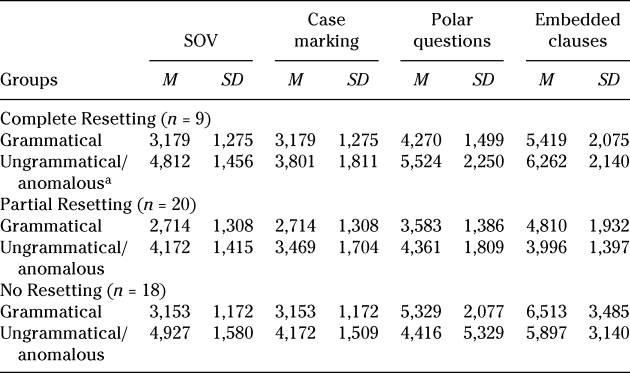
For the purposes of the present study, we looked at the data for how learners performed on both ka and toh sentences as indicators of parameter resetting. In this case, three groups emerged: (a) a group that showed slower reading times for ungrammatical versions of both ka and toh sentences (complete resetting, n = 9), (b) a group that showed slower reading times for ungrammatical ka sentences only (partial resetting, n = 20), and (c) a group that did not show slower reading times for either ungrammatical ka or ungrammatical toh sentences (no resetting, n = 18). The descriptive statistics appear in Table 1.
Mean reading times (in ms) for the posttreatment reading test for ka and toh sentences

a Ungrammatical refers to the SOV sentences, polar questions, and embedded clauses, whereas anomalous refers to the sentences with odd case marking.
To test for these perceived differences between groups, we ran a series of repeated-measures ANOVAs with group as the independent factor and reading time scores as the repeated measure. For the basic sentences (grammatical SOV and ungrammatical SVO) the ANOVA yielded no main effect for group, F(2, 41) = 1.14, p = .329, η2 = .05; a main effect for reading times, F(1, 44) = 155.63, p < .001, η2 = .78; and no interaction, F(2, 44) = 0.68, p = .511, η2 = .03. These results indicate that all three groups had longer reading times for ungrammatical SVO sentences than for grammatical SOV sentences, demonstrating that they had learned that the basic word order of Japanese is SOV and not SVO.
For case marking, the ANOVA yielded the following results. There was no main effect for group, F(2, 44) = 0.83, p = .420, η2 = .04; a main effect for reading times, F(1, 44) = 30.64, p < .001, η2 = .41; and no interaction, F(2, 44) = 0.66, p = .520, η2 = .03. These results indicate that all three groups had longer reading times for anomalous sentences, indicating a sensitivity to the correct use of nominative (-ga) and accusative (-o) case markers.
For the novel polar questions with ka, the ANOVA yielded the following results. There was no main effect for group, F(2, 44) = 1.59, p = .216, η2 = .07; an effect for reading times, F(1, 44) = 9.15, p = .004, η2 = .17; and a significant interaction, F(2, 44) = 30.86, p < .001, η2 = .58. Post hoc paired-sample t tests were conducted to understand the source of the interaction when there were no main effects. What emerged was that the complete resetting group had longer reading times for ungrammatical polar questions, t(8) = −3.37, p =.006, and the partial resetting group also had longer reading times for ungrammatical polar questions, t(19) = −4.71, p < .001, but the no resetting group showed evidence of the reverse direction, taking longer to read grammatical sentences, t(17) = 5.280, p < .001. Thus, the reason that there were no main effects for group and reading times but that there was an interaction was that the complete and partial resetting groups had significantly longer reading times for ungrammatical polar questions, but the no resetting group had longer reading times for grammatical sentences. Thus, the results suggest that the first two groups had reset the parameter and extended head directionality to unknown syntactic phrases (in this case, the position of ka within the CP) but that the third group had not.
Regarding embedded clauses with toh, the ANOVA yielded the following results. There was no main effect for group, although there was a trend toward an effect, F(2, 44) = 2.82, p = .07, η2 = .11; no effect for reading times, F(1, 44) = 0.99, p = .325, η2 = .02; and a significant interaction, F(2, 44) = 5.65, p = .007, η2 = .20. Post hoc paired-samples t tests were conducted to understand the source of the interaction when there were no main effects. What emerged was that the complete resetting group had longer reading times for ungrammatical embedded clauses, t(8) = −4.45, p = .002; that the partial resetting group showed the reverse, with longer reading times for grammatical sentences, t(19) = 5.32, p < .001; and that the no resetting group showed no difference in reading times, t(17) = 1.41, p = .180. Thus, the results suggest that the complete resetting group had reset the parameter and extended head directionality to unknown syntactic phrases (in this case, the position of toh within the CP) but that the other two groups had not.
Given the three distinct groups in terms of parameter resetting, next we examined their scores on the WS (Table 2). If aptitude in the form of grammatical sensitivity plays a role in the development of an underlying system, then we should see higher WS scores for the complete resetting group compared to the partial and no resetting groups, and perhaps a difference between scores for the partial and no resetting groups. The data in Table 2 suggest that this is not the case. We performed a one-way ANOVA on the scores for the WS with the following result: there was no effect for group, F(2, 44) = 0.60, p = .556. Because all groups demonstrated sensitivity to SOV anomalous case marking, there was no separate analysis needed for this aspect of the study. That is, all groups—in fact, almost every single participant—demonstrated longer reading times for anomalous sentences compared to acceptable sentences, suggesting that grammatical sensitivity as measured by the MLAT does not affect the internalization of case marking in Japanese.
Mean scores for the Words in Sentences for the three groups

We subsequently ran a correlation on ungrammatical reading times for the various sentences, just to see if there was any kind of relationship between WS scores and reading time. The results were as follows: SVO ungrammatical: r = −.172, p = .246; SOV anomalous: r = −.193, p = .194; ka ungrammatical: r = −.183, p = .218; toh ungrammatical: r = −.078, p = .603.
As can be seen, no correlations were significant. Regardless of whether participants were exposed to the sentences (i.e., SOV) or not (i.e., ka/toh), reading times did not correlate with grammatical sensitivity scores. We finally looked at the two sets of reading times in which there were clear overall longer reading times for all participants: those for basic word order (SOV vs. SVO) and those for good versus anomalous case marking. For these, we calculated each individual’s difference in reading time between the two “good” versus “bad” sentences (e.g., for a given participant we calculated the reading time differences between SOV and SVO sentences as well as the reading times differences between good and anomalous case-marking sentences). We then ran correlational analyses for these new scores and the WS sores. The results were as follows: SOV versus SOV: r = −.175, p = .238; good versus anomalous case marking: r = −.222, p = .133.
Again, no significant correlations emerged, which we believe is particularly revealing. Basic word order and case marking are precisely what learners were exposed to in the input treatment. If they were inducing any “rules” from the input, as those who believe that aptitude as grammatical sensitivity is a significant factor in SLA would claim, then we should find some kind of correlation between WS scores and reading time differences for just these sentences; we did not.
DISCUSSION AND CONCLUSION
Before we discuss our results, we summarize our main findings. First, when both polar questions and embedded clauses were used to determine parameter resetting, three distinct groups emerged. The first had reset the parameter for head directionality in Japanese, as evidenced by the longer reading times on novel sentences and phrase structures they had not been exposed to during the treatment. The second group showed partial evidence of parameter resetting in that reading times were longer for the ungrammatical ka sentences but not for the ungrammatical toh sentences. The third did not show evidence of resetting the parameter based on reading times for both ka and toh sentences. All groups, however, showed evidence of underlying sensitivity to case marking in that they had longer reading times on anomalous SOV sentences compared to regular SOV sentences. Additionally, there were no differences between the groups on their scores for the WS. Thus, grammatical sensitivity is not a factor in resetting head directionality or in internalizing case marking. Finally, scores for the WS did not correlate significantly with reading times on ungrammatical or anomalous sentences nor on individual reading time differences for the sentence types to which learners were exposed (i.e., basic word order, case marking).
We take these results to suggest that grammatical sensitivity as measured by the MLAT is not associated with the acquisition of those aspects of language derived from UG—in this case, head directionality (with a caveat we will mention later). This is to be expected if, as VanPatten (Reference VanPatten, Sanz and Leow2011) and VanPatten and Rothman (Reference VanPatten, Rothman, Benati, Laval and Arche2013) argue, aspects of language that are either in UG proper or derived from UG (such as parametric variations) are not learned from the input. That is, tests of aptitude should only relate to surface features of language that learners can actually glean from the input. However, in this light, our results for case marking are also strongly suggestive: Grammatical sensitivity does not correlate with the acquisition of the surface morphophonological units used to mark nominative and accusative case in Japanese. (Again, we remind the reader of our restricted use of the term acquisition and refer the reader to note 10). Thus, the third category of items that VanPatten and Rothman refer to, those that are language specific and must be learned from the input, also do not seem to be affected by grammatical sensitivity as measured by the WS portion of the MLAT.
One anonymous reviewer suggested that we mention that “something akin to aptitude might well correlate with rate of acquisition (though perhaps solely of surface phenomena).” Although this remains a possibility, on the basis of the fact that we do not see grammatical sensitivity emerging as a significant factor in the acquisition of surface case marking in our study, we would adopt the strong hypothesis that grammatical sensitivity as a subcomponent of aptitude is also not related to surface phenomena. The basis for this hypothesis is similar to the argument made in VanPatten et al. (Reference VanPatten, Borst, Collopy, Qualin and Price2013): Language acquisition is better seen as a processing problem coupled with learner-internal mechanisms specified for language learning and not as a rule-learning problem. In our treatment, learners were engaged in processing sentences for meaning. Unlike the methodology seen in research such as Robinson (Reference Robinson and Schmidt1995), de Graaff (Reference de Graaff1997), and other similar studies, we did not begin by assuming the existence of rules, and participants were not asked to search for rules, nor were they tested on their knowledge of rules. What is more, rather than a score on a paper-and-pencil type of test, our assessment procedure was quite different from that used in typical aptitude research; that is, we used reading time differences between grammatical and ungrammatical/anomalous sentences. Following VanPatten et al. (Reference VanPatten, Keating and Leeser2012) as well as Smith and VanPatten (Reference Smith, VanPatten, Laval, Arche and Benati2013), we take reading times—in which the focus is on meaning and not grammaticality—as implicit measures of underlying representation. It seems to us that because, by definition, acquisition by processing takes the focus of learning off of rules and rule knowledge, aptitude may not be a significant factor. We add here that our argument is bolstered because the treatment used in the present study is not the same as that used in VanPatten et al. (Reference VanPatten, Borst, Collopy, Qualin and Price2013). Where they used processing instruction as the means to test the centrality of grammatical sensitivity in language acquisition, we did not. Our treatment was simple exposure to sentences followed by occasional comprehension checks to make sure participants were paying attention to meaning. Thus, with two different treatments and quite different foci of investigation ( VanPatten et al.’s was a processing problem, whereas ours in this study is parametric variation as well as surface marking of case), similar results are obtained: Grammatical sensitivity as measured by the WS portion of the MLAT did not emerge as a significant factor.
Even though we argue that acquisition is a processing issue, coupled with internal mechanisms responsible for the organization of language that operate largely outside of awareness, one could argue that perhaps our participants were engaged in explicit rule learning on their own, independently of what the treatment required of them. In other words, it could be the case that learners explicitly came up with some kind of rule about head directionality such as “The verb comes last” as they were exposed to the various SOV sentences in the treatment. Although learners may well have engaged in this kind of reflection and may even have applied it to the SOV/SVO sentences, this kind of generalization is of little use for the novel structures tested, and it does not explain how participants generalized the correct word order to polar questions and embedded clauses. That is, when we consider those participants who completely reset the parameter and those who partially reset the parameter, we cannot think of a rule that would allow them to project head directionality to novel structures across the board. Something like “The verb comes last” does not easily become “Complementizers come last.” Similarly, “The verb comes last” does not become some explicit rule such as “Heads of phrases come last.” However, even if we assume that such explicit analogies were possible on the part of the learner, it is still the case that aptitude as grammatical sensitivity did not emerge as a factor in the study.
As a reviewer pointed out, it is true that there has been a debate among UG-oriented SLA researchers with regard to whether adult L2 learners have access to UG (a position taken in, for example, Schwartz, Reference Schwartz1998, and Schwartz & Sprouse, Reference Schwartz and Sprouse1996), or whether L1 and L2 acquisition are fundamentally different from each other, a position called the fundamental difference hypothesis (Bley-Vroman, Reference Bley-Vroman, Gass and Schacter1989, Reference Bley-Vroman1990, Reference Bley-Vroman2009).Footnote 13 As is probably evident from the background, we believe that the weight of the evidence presented in studies of L2 competence over the past 30 years suggests that interlanguage grammars are constrained by UG and that L2 learners can acquire new parametric settings (see, for example, White, Reference White2003). Indeed, the results of this article add evidence for that claim. At the same time, we point out that access to UG does not mean that the L2 grammar necessarily comes to resemble the L1 grammar (see White, Reference White2003, as well as the special issue of Studies in Second Language Acquisition, 2009, for further discussion).
There are two caveats to our discussion, one having to do with measures of aptitude and the other with generalizability. We discuss measures of aptitude first. We selected the WS section of the MLAT as our test of grammatical sensitivity because it has been, and still is, the most widely used test for research on aptitude and the learning of formal elements of language. It is true that there are more recent measures, notably the LLAMA and Canal-F, both of which we briefly mentioned in the introduction. The LLAMA aptitude test (Meara, Reference Meara2005), for example, contains a section called “Grammatical Inferencing.” Originally, this section asked participants to read sentences in an unknown language along with a translation in the L1. The task of the participants is to “work out the grammatical rules [emphasis added] that operated in the unknown language” (Meara, Reference Meara2005, p. 15). Subsequently, this section was altered to be more of a grammaticality judgment task, and, as the manual for the test claims, “If your main purpose is to identify really good analytical linguists, then this test is a good place to start” (Meara, Reference Meara2005, p. 15). It is clear, then, that, at least in this test, the conceptualization of language and language acquisition is still rooted in traditional notions of rules and rule learning. The same can be said of the Canal-F test. Grigorenko et al. (Reference Grigorenko, Sternberg and Ehrman2000) described Section 5 (called “Learning Language Rules”) in the following way: (1) Participants are given some vocabulary, some grammar, and some examples of how the Ursulu language works; (2) based on the information provided, participants are expected to “have learned the most evident rules [emphasis added] of Ursulu language” (p. 396). Additionally, these authors also discussed language “acquisition” processes as underlying traits, one of which is selective transfer. They stated, “It is particularly helpful to learners in understanding how, based on their previous knowledge, they can carry over to a different context the rules they have learned [emphasis added] in a previous situation” (p. 392). Grigorenko et al.’s research on the Canal-F shows very strong correlations between the WS section of the MLAT and the Learning Language Rules section. This suggests to us that the tests examine the same thing. Although not explicitly stated by either the LLAMA or Canal-F descriptions, it seems that rule learning in these cases is also conscious rule learning. Perhaps for this reason, Skehan (Reference Skehan, Gass and Mackey2012) claims that grammatical sensitivity (however it is measured) continues to generate consistent correlations with inductive rule learning in aptitude research (p. 391). If the focus is taken off of the explicit learning of rules and moved to acquisition as some kind of processing of surface morphophonological units, then we think conclusions such as Skehan’s will have to be reevaluated.
Indeed, some recent work has begun to call this claim into question. One recent study, Granena and Long (Reference Granena and Long2013), used the LLAMA to investigate the role aptitude plays in the ultimate attainment of different domains of language acquisition—namely, phonology, the lexicon, and morphosyntax. Their participants were L1 Chinese speakers with Spanish as a L2. There were three groups of participants: one who had begun learning Spanish before the age of 6, one who had begun learning Spanish between the ages of 7 and 15, and a group who had begun learning Spanish after the age of 15. The authors found no effect for aptitude in any condition or group, except for the last group of participants, and then only in the domains of pronunciation and the lexicon. Crucially for our argument here, unlike previous work, their study found no correlation between aptitude scores and performance on their morphosyntax measure. The authors suggested that this may be because adult naturalistic language learners can still rely on implicit mechanisms to acquire the morphosyntax of the target language. We would likely differ from Granena and Long in their conceptualization of language and the means by which learners acquire the features of the target language. We do note, however, that, despite this difference, the results of their study are compatible with the results of ours—namely, that the “grammatical inferencing” subcomponent of the LLAMA aptitude test has no correlation with performance on a measure of (morpho)syntactic knowledge.
Our second caveat relates to generalizability. In the present study, we focused on head directionality and surface case marking. Head directionality is readily evident in the input, due to VO and OV word orders, and research on child language acquisition as well as our own research here and in Smith and VanPatten (Reference Smith, VanPatten, Laval, Arche and Benati2013) suggests that head directionality is acquired rather early in the course of language acquisition. Our data do show that learners can and do project beyond basic word order to phrases and structures they have not yet encountered in the input, and they may do so almost immediately—at least with regard to head directionality. However, given the relative transparency of VO and OV order, we cannot make claims about other types of parametric variation that are less obvious or perhaps less basic than head directionality. Specifically, the role of grammatical sensitivity in acquiring other aspects of language, such as verb movement or the parametric consequences of null subjects in a language like Spanish, remains an open question. Resetting these parameters requires that learners internalize abstract features from the input, and the consequences of the parametric variation are less evident than those tested here. For example, the null subject parameter in Spanish allows null subjects in basic declarative sentences. It also entails restrictions from the overt pronoun constraint (an aspect of language from UG proper) as well as the obligatory use of null subjects in nonreferential contexts (derived from UG, but not part of UG proper), and finally overt subject-person marking on verbs (which must be learned from the input).Footnote 14 If the results of our study are generalizable, then we should not see aptitude as a factor in any of these areas of language related to null subjects when acquisition is conceptualized as it is here and when the underlying knowledge of syntactic violations is measured by reading times. If our results are not generalizable, we might see something different. In short, we are limiting our claims now to the present study, but we are offering the directional hypothesis that they will hold true for other research that follows our framework.
Before concluding, we wish to make a statement about individual differences more generally. By suggesting that aptitude (specifically, grammatical sensitivity) is not related to the kind of underlying competence building that is the focus of the present study, we do not mean to claim that there are no individual differences involved in adult SLA. Under the same conditions of exposure in our study, three distinct groups emerged: complete resetting, partial resetting, and no resetting. The emergence of these groups hints at some kind of differences in the rate of parametric resetting. Assuming that the two groups that did not reset the parameter eventually would, the group that did reset the parameter was clearly faster. Our only claim in the present study is that the emergence of these groups—that is to say, success in parameter resetting or failure (complete or partial) to do so—does not seem to be due to aptitude related to grammar as measured by the WS.Footnote 15 Future work would need to turn its attention to other possibilities, and, at this juncture, we have no insights as to just what those individual difference factors may be.
We conclude by saying that when we move away from conceptualizing the acquisition of language as the internalization of rules and more toward a conceptualization along the lines of “input + language processing + internal mechanisms (e.g., UG or cognitive architecture),” and when we move away from tests of knowledge to tests of underlying sensitivity in which the primary focus is on meaning, we expect to see the role of aptitude as grammatical sensitivity in adult SLA diminish, if not disappear, as a major factor. This does not preclude research on other individual differences, including other factors traditionally associated with aptitude (e.g., phonetic encoding or vocabulary learning). But if we are correct, then the role of grammatical sensitivity as a component of aptitude may eventually need to be restricted to the (explicit) learning of rules and not to language acquisition conceptualized as the by-product of the processing of morphophonological units in the input combined with the internal mechanisms used to organize and create language. This restriction, then, would stand in contrast to the claims made by Skehan (Reference Skehan, Gass and Mackey2012) and Sawyer and Ranta (Reference Sawyer, Ranta and Robinson2001), who claim that aptitude as grammatical sensitivity is a central factor in all contexts of learning.