1. Introduction
Across languages, there is a widespread tendency for time to be lexicalized in terms of space: moments can be described as locations (at midnight; on Saturday); durations can be conveyed in terms of distances (a long wait; a short movie); and events can be moved through time (the wedding was brought forward; the interview was pushed back). The prevalence of spatial language to describe time has generated substantial interest in both the linguistic expressions themselves and the conceptual metaphors for which they provide evidence.
Analysis of the linguistic expressions has uncovered a number of regularities in the mapping from space to time (Clark, Reference Clark and Moore1973; Kranjec, Reference Kranjec, Forbus, Gentner and Regier2006; Lakoff & Johnson, Reference Lakoff and Johnson1999; Moore, Reference Moore2006, Reference Moore2014; Núñez, Motz, & Teuscher, Reference Núñez, Motz and Teuscher2006; inter alia). Clark (Reference Clark and Moore1973, pp. 38–43) argued that spatial terms vary in the number of dimensions that they presuppose: some terms, such as long/short or in front/behind, presuppose a single dimension; others, such as wide/narrow or beside, presuppose two dimensions; still others, such as tall/short or above/below, presuppose three. However, temporal relations are predicated on a subset of spatial terms: specifically, the spatial terms that are used to talk about time are those that presuppose a single dimension, such as in front/behind or long/short (Clark, Reference Clark and Moore1973; Evans, Reference Evans2004, Reference Evans2013; Lakoff & Johnson, Reference Lakoff and Johnson1999; Tenbrink, Reference Tenbrink2007; Traugott, Reference Traugott, Greenberg, Ferguson and Moravcsik1978).Footnote 1 This limited borrowing of spatial terms to describe time suggests a conceptualization of time as one-dimensional and directed; hence, as a directed axis upon which people and events may be located and along which they may move.
The frequency and regularity of space–time mappings suggest a deeper connection, whereby not only do we describe time in spatial terms, but we may also think about time spatially (Lakoff & Johnson, Reference Lakoff and Johnson1980, Reference Lakoff and Johnson1999). Two dominant metaphors, both making use of motion along a directed axis, have provided fertile ground for testing the psychological reality of the metaphoric connection between space and time: the Moving Ego metaphor casts time as a static landscape along which the conceptualizer moves (e.g., we are approaching the deadline) while the Moving Time metaphor describes events as in motion relative to a static observer (e.g., the deadline is approaching) (Clark, Reference Clark and Moore1973). Across a variety of studies, researchers have found that spatial experience may prime temporal reasoning that is consistent with the experienced spatial situation (e.g., Boroditsky, Reference Boroditsky2000; Boroditsky & Ramscar, Reference Boroditsky and Ramscar2002; Gentner, Imai, & Boroditsky, Reference Gentner, Imai and Boroditsky2002; Matlock, Holmes, Srinivasan, & Ramscar, Reference Matlock, Holmes, Srinivasan and Ramscar2011; Sullivan & Barth, Reference Sullivan and Barth2012; inter alia). For example, Boroditsky and Ramscar (Reference Boroditsky and Ramscar2002) asked participants to imagine either their own linear motion (consistent with the Moving Ego metaphor) or the linear motion of an object towards themselves (consistent with the Moving Time metaphor) before responding to an ambiguous temporal probe, McGlone and Harding’s (Reference McGlone and Harding1998) Next Wednesday’s meeting has been moved forward two days. What day is the meeting now that it has been rescheduled? They found that participants were more likely to adopt the Moving Ego perspective (indicated by a Friday response) after imagining their own motion, but were more likely to adopt the Moving Time perspective (indicated by a Monday response) after imagining the motion of an object towards them. Such findings support the hypothesis that the space–time connections underlying the metaphors are psychologically real.
However, while the evidence for the psychological reality of space–time mappings is compelling, many questions remain. First, the priming studies described above rely on the assumption that the two temporal perspectives are equally prevalent in language (Stickles & Lewis, Reference Stickles and Lewis2018), allowing the temporal probe to be truly ambiguous. Indeed, the two interpretations of the probe are argued to be equally likely in a ‘neutral’ or unprimed context (Boroditsky & Ramscar, Reference Boroditsky and Ramscar2002; McGlone & Harding, Reference McGlone and Harding1998). Further evidence of this assumption is found in the example sentences appearing in papers on space–time metaphor, in which the two perspectives are equally represented.Footnote 2 The equal prevalence of the two metaphors has been used as a basis for researchers attributing interpretation differences across experimental conditions to the spatial prime (i.e., moving self or moving object, as in the Boroditsky & Ramscar, Reference Boroditsky and Ramscar2002, study described above), which is argued to give rise to the perspective that is consistent with it rather than to merely reinforce an existing interpretation bias. However, a number of recent studies have revealed additional factors which influence the perspective adopted, thus calling this assumption into question. First, in their study of natural language uses of the Moving Ego and Moving Time metaphors, McGlone and Pfiester (Reference McGlone and Pfiester2009) found that the valence of the encoded event (positive, negative, or neutral) covaried with the temporal perspective adopted, suggesting that the two perspectives may not be equally prevalent. Specifically, the temporal passage of a positive event was more frequently encoded by the Moving Ego perspective, e.g., There is much optimism that we might be coming to (WordBanks USBooks Corpus, cited in McGlone & Pfiester, Reference McGlone and Pfiester2009), while negative events tended to be encoded by the Moving Time perspective, e.g., when the time comes she can’t do things and she has to be cared for (Switchboard Corpus, cited in McGlone & Pfiester, Reference McGlone and Pfiester2009). In addition, Margolies and Crawford (Reference Margolies and Crawford2008) found that the valence of the event similarly influences interpretation of adapted versions of the Next Wednesday’s meeting question: their participants more frequently adopted the Moving Time perspective when imagining negative events, and the Moving Ego perspective when imagining positive ones. Relatedly, Duffy and Feist (Reference Duffy and Feist2014) found that speakers’ lifestyles and personality influenced the perspective adopted. Specifically, procrastinators, extroverts, and people with high temporal flexibility in their lives tended to adopt the Moving Ego perspective, whereas more conscientious individuals, introverts, and people subject to a set schedule tended to adopt the Moving Time perspective. Finally, in their meta-analysis testing responses to McGlone and Harding’s (Reference McGlone and Harding1998) Next Wednesday’s meeting question amongst control group participants in thirteen studies, Stickles and Lewis (Reference Stickles and Lewis2018) observed an overall preference for the Moving Ego perspective, casting further doubt on the assumption of equal prevalence for the two perspectives. Thus, our first aim in the current study was to test this hypothesis through an examination of naturally occurring uses of the Moving Ego and Moving Time metaphors.
Second, we wish to raise the bar for evidence that people draw upon space not only to talk about time, but also to think about it. Although a variety of spatial expressions can be used to talk about time, the mappings that have received the most attention have drawn upon TEMPORAL MOTION constructions that instantiate the Moving Ego and Moving Time metaphors, with relatively little attention in this context to the semantics of the motion verbs that may be metaphorically employed in these constructions. However, motion verb semantics has attracted substantial attention within linguistics and cognitive science (e.g., Goschler & Stefanowitsch, Reference Goschler and Stefanowitsch2013; Slobin, Reference Slobin, Gumperz and Levinson1996; Strömqvist & Verhoeven, Reference Strömqvist and Verhoeven2004; Talmy, Reference Talmy and Shopen1985, Reference Talmy2000; inter alia), with particular effort focused on examining typological differences in the expression of motion through space (i.e., change of location). Whereas this research has found that languages differ dramatically in their encoding of spatial motion, to our knowledge no work has asked whether the typological variation that has been noted translates to TEMPORAL MOTION (i.e., changes in time described using the language of spatial motion). If in fact humans reuse spatial conceptualizations in their use of space–time metaphors (Boroditsky & Ramscar, Reference Boroditsky and Ramscar2002; Lakoff & Johnson, Reference Lakoff and Johnson1980; inter alia), such typological differences should be expected to likewise surface in the expression of TEMPORAL MOTION. Indeed, Özçalışkan’s (Reference Özçalışkan2004, Reference Özçalışkan2005) study of metaphorical uses of English and Turkish motion language across a variety of domains revealed more frequent encoding of manner information in English than in Turkish, echoing the patterns in literal uses of motion verbs. In a similar fashion, Ibarretxe-Antuñano and Caballero (Reference Ibarretxe-Antuñano and Caballero2014; Caballero & Ibarretxe-Antuñano, Reference Caballero, Ibarretxe-Antuñano, Pirrelli, Marzi and Ferro2015) found typological differences in metaphorical uses of motion verbs in the domains of architecture, wine, and tennis. However, as these studies sampled metaphorical uses of motion verbs across a variety of conceptual metaphors, the results preclude conclusions regarding metaphorical motion in the context of a single metaphorical mapping such as the mapping from motion in space to motion in time. Furthermore, Ibarretxe-Antuñano and Caballero’s work suggests that metaphors may surface in quite different ways in different domains. Thus, to better understand the nature of TEMPORAL MOTION and the metaphorical connections between spatial and temporal motion, it is imperative that we examine its expression across typologically different languages.
2. The linguistic expression of motion events
According to Talmy (Reference Talmy and Shopen1985, Reference Talmy2000), a motion event consists of six basic conceptual elements: FIGURE (the entity that is moving), GROUND (the locative reference object against which the Figure moves), MOTION (the movement itself), PATH (the direction or trajectory of motion), MANNER (the way in which the Figure moves), and CAUSE (the situation that brought about the motion event). Research on the linguistic encoding of motion events has demonstrated that languages differ in the ways in which speakers most typically represent motion events. Of particular interest, languages differ in regard to which conceptual element is typically encoded along with the fact of motion in the main verb (Gennari, Sloman, Malt, & Fitch, Reference Gennari, Sloman, Malt and Fitch2002; Papafragou, Massey, & Gleitman, Reference Papafragou, Massey and Gleitman2002, Reference Papafragou, Massey and Gleitman2006; Slobin, Reference Slobin, Gentner and Goldin-Medow2003; Talmy, Reference Talmy and Shopen1985, Reference Talmy2000). Some languages, including Germanic and Slavic languages, tend to use verbs which conflate MANNER and MOTION, while PATH is expressed by an element other than the verb, called the satellite, e.g., “The man ran (MANNER OF MOTION) across (PATH OF MOTION) the street”. For this reason, these languages are referred to as satellite-framed, or S-languages (Talmy, Reference Talmy2000). By contrast, another group of languages, which includes Romance languages, Greek, and Japanese, tends to encode PATH in the main verb, while MANNER may optionally be expressed as an adjunct, e.g. “El hombre cruzó (PATH OF MOTION) la calle corriendo (MANNER OF MOTION)” ‘The man crossed [PATH OF MOTION] the street running [MANNER OF MOTION]’ (Talmy, Reference Talmy and Shopen1985, Reference Talmy2000; cf. Cardini, Reference Cardini2008); these languages are referred to as verb-framed, or V-languages (Talmy, Reference Talmy2000).Footnote 3
The lexicalization differences noted by Talmy (Reference Talmy and Shopen1985, Reference Talmy2000) have been found to be quite robust in both written texts and orally elicited descriptions and narratives. Across a geographically and genetically varied sample of languages, research findings have consistently shown that, in comparison to V-languages, speakers of S-languages use manner verbs more frequently and with greater lexical diversity when describing motion events, whereas speakers of V-languages demonstrate a preference for path verbs over manner verbs (Gennari et al., Reference Gennari, Sloman, Malt and Fitch2002; Papafragou et al., Reference Papafragou, Massey and Gleitman2002; Slobin, Reference Slobin, Gentner and Goldin-Medow2003, Reference Slobin, Strömqvist and Verhoeven2004; Strömqvist & Verhoeven, Reference Strömqvist and Verhoeven2004).
Despite the extensive research on the linguistic expression of motion events in space and the use of motion verbs in the TEMPORAL MOTION construction, the study of the linguistic expression of motion events in the subdomain of TEMPORAL MOTION appears to have been, thus far, largely overlooked. However, if speakers reuse spatial perspective in their conceptualization of time (Boroditsky, Reference Boroditsky2000; Boroditsky & Ramscar, Reference Boroditsky and Ramscar2002; Gentner et al., Reference Gentner, Imai and Boroditsky2002; inter alia), we might expect that typological tendencies in the framing of motion events would likewise structure the framing of TEMPORAL MOTION, with speakers of S-languages preferring to encode manner in verbs expressing motion through time, while speakers of V-languages prefer to encode path. Indeed, Özçalışkan (Reference Özçalışkan2005, p. 238) argued that “any typological effect that is evident in a literal motion event will unavoidably be observable in the metaphorical extensions of the event”. The second aim of the current study is thus to test this hypothesis.
We report below a corpus study aimed at addressing these open questions regarding the underpinnings of space–time mappings in the subdomain of TEMPORAL MOTION. We seek to flesh out the picture of temporal motion both from the point of view of the time which is represented and of the space by which it is represented, in order to better assess the evidence regarding the psychological reality of connections between space and time. To better understand how time is portrayed, our first aim is to examine patterns in the expression of time via the relative frequency of Moving Ego and Moving Time metaphors in naturally occurring expressions denoting temporal motion. To better understand how space is recruited for the description of time, our second aim is to investigate whether the path/manner asymmetries observed in the domain of MOTION are also evident in temporal metaphorical uses by specifically examining the relative frequency of naturally occurring path and manner verbs in English and in Spanish in the subdomain of TEMPORAL MOTION.
3. Method
The data for the current analysis consisted of a set of naturally occurring uses of motion verbs for the expression of time in one S-language, English, and one V-language, Spanish. The verbs were selected from Cifuentes Férez’s (2008)Footnote 4 taxonomy of motion verbs (360 English verbs; 256 Spanish verbs), which are coded for the semantic component conflated in each verb (e.g., ‘manner’, ‘path’Footnote 5) and for whether the verb expresses translational motion or self-contained motion.Footnote 6 Verbs involving self-contained motion were excluded because, in self-contained motion, an object keeps its same or ‘average’ location, e.g., The butterfly hovered over the flower. By contrast, in translational motion, an object’s basic location shifts from one point to another in space, e.g., John entered the room (Talmy, Reference Talmy2000, p. 35); thus, translational motion aligns more closely to the Moving Ego and Moving Time metaphors, whereby an entity (ego or event) shifts from one point to another in time.
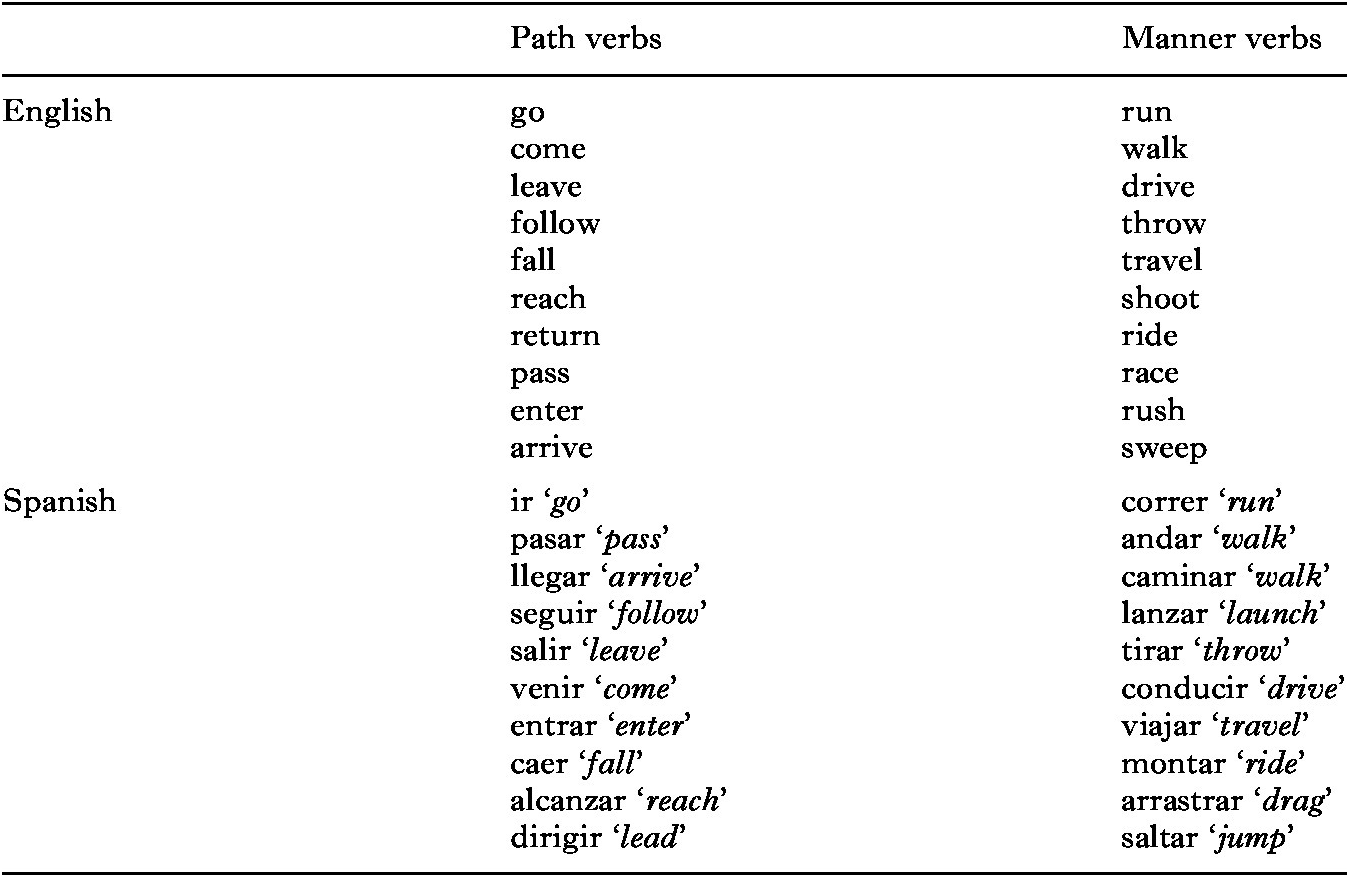
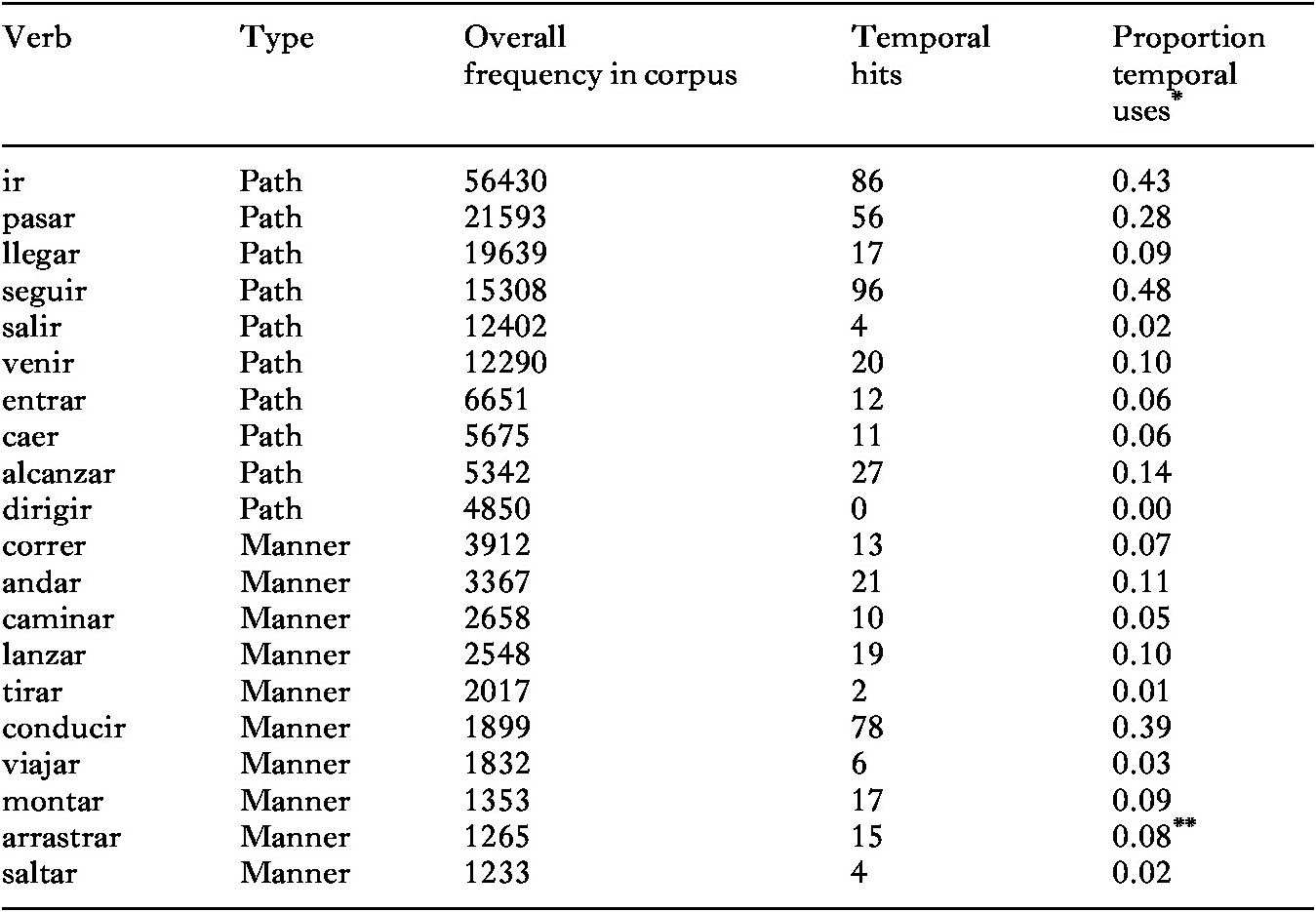
To select the set of verbs to be examined in this study, we used the Brigham Young University–British National Corpus (BYU-BNC; Davies, Reference Davies2004–)Footnote 7 and the Corpus del Español (Davies, Reference Davies2002–)Footnote 8 to calculate the overall frequency of each translational motion verb in natural production, using the lemma of each verb as our search term. Because our aim was to determine whether the typological tendencies in the use of path and manner verbs to describe spatial motion would carry over to descriptions of TEMPORAL MOTION, the ten most frequent path verbs (i.e., verbs conflating only path and the fact of motion) and the ten most frequent manner verbs (i.e., verbs conflating only manner and the fact of motion) in each language were selected for analysis.Footnote 9 The complete set of verbs analyzed in each language is presented in Table 1.
Verbs used in the analysis

The source for our Spanish data was the Corpus del Español (Davies, Reference Davies2002–), a historical corpus spanning a breadth of genres including spoken, fiction, newspaper, and academic. As our interest in this study was modern usage, we limited our search to the 1900s. Since no English corpus exactly matched the characteristics of the Corpus del Español, we attempted to match the breadth of genres and the time span of our Spanish dataset by extracting half of the tokens for each English verb from the BYU–BNC (Davies, Reference Davies2004–), which draws from a similar range of genres but only includes samples from 1980 to 1993, and half from the Corpus of Historical American English (COHA; Davies, Reference Davies2010–),Footnote 10 which includes the time period sampled in Spanish (we again limited our search to the 1900s), but for a more limited range of genres.Footnote 11
We used the lemmas of the forty selected verbs, e.g., [fall].[v], to extract randomFootnote 12 200-token samples for each motion verb from the corpora. This resulted in a total of 4000 English tokens and 4000 Spanish tokens in our dataset. Tokens returning identical hits or homophones of the verbs (e.g., left as opposed to right rather than left the past tense form of leave) were excluded from our dataset,Footnote 13 resulting in a final dataset of 3993 English tokens and 3998 Spanish tokens. We then categorized each token as either TEMPORAL MOTION, i.e., a use for which the medium through which motion takes place is time (e.g., A full minute passed before he could move again), or non-temporal motion, i.e., a use for which the motion takes place through a medium other than time (including both space [e.g., As soon as she passed the gate she could hear the sirens] and non-temporal abstract domains [e.g., Ideas passed rapidly from one institution to another]). Noting that changes in time are part of all motion, we developed and implemented the following criteria for the identification of TEMPORAL MOTION:
If the entity in motion was time or an event (i.e., something that unfolds in time), the use was classified as temporal with a time/event mover, as in the following examples:
a. The climax came after the movie. (COHA)
b. En Alemania y en Austria investigaciones semejantes condujeron al establecimiento de un estilo moderno. (Corpus del Español) ‘In Germany and in Austria similar investigations led (lit., drove) to the establishment of a modern style.’
If the entity in motion was a person or a non-human, non-event (coded as other), we considered the following as evidence that the motion was enacted through the medium of time:
1. The source, goal, or via point was time, an event, a process, or an achieved state:Time as source, goal, or via point
a. Wordsworth, like Locke, has in the end to return to the period before memory can help us. (BYU–BNC)
b. Como ejemplo del estilo rococó en Alemania está la obra del pintor italiano Giovanni Battista Tiepolo, que pasó algún tiempo en Würzburgo. (Corpus del Español) ‘An example of the rococo style in Germany is the work of the Italian painter Giovanni Battista Tiepolo, who passed some time in Würzburg.’
Event or process as source, goal, or via point
a. … as she went on fetching in her other things … (COHA)
b. … sus posteriores excesos de poder le condujeron a su derrocamiento y suicidio … (Corpus del Español) ‘… his previous excesses of power drove him to his overthrow and suicide …’
State as source, goal, or via point
a. Once he reached adolescence. (BYU–BNC)
b. A veces la pasión política conduce a la intolerancia … (Corpus del Español) ‘Sometimes political passion drives to intolerance …’
2. The verb’s function was to indicate temporal order, including uses of motion verbs to point to what comes next:
a. … their reaction has been one of near disbelief, followed by looks of passionate envy. (BYU–BNC)
b. … la concepción de Klopstock de la misión sagrada del poeta influyó en los escritores que le siguieron. (Corpus del Español) ‘… Klopstock’s conception of the poet’s sacred mission influenced the writers that followed him.’
c. … I propose that the court should rule as follows in the Factortame case … (BYU–BNC)
3. The verb was used transitively with an event as object:
a. … closed due to public pressure following the earthquake of 1989. (BYU–BNC)
4. The verb was used transitively with a non-temporal mover and temporal causer of motion:
a. La noche arrastra culpas heredadas y vagos sones ya escuchados. (Corpus del Español) ‘The night drags inherited guilt and vague once-heard sounds.’
5. The mover was an institution whose membership changes over time:
a. … this board’s task has differed from that of all other boards which have preceded it and will follow it … (COHA)
b. … a ningún gobierno ni al actual ni a los pasados ni a los que vienen … (Corpus del Español) ‘… to no government, neither the current one nor the past ones nor those that come …’
6. Time was named as a co-mover:
a. McCormick Place bustled yesterday with workmen racing against time to get the show ready. (COHA)
b. … estamos buscando una formula que nos permita caminar con el proyecto de la alianza … (Corpus del Español) ‘… we are looking for a formula that will allow us to walk with the alliance’s project …’
7. The entity in motion was a state:
a. … la ciudad fue núcleo del malestar politico que siguió a la firma de la Paz de París. (Corpus del Español) ‘… the city was the nucleus of the political unhappiness that followed the signing of the Paris Accord.’
8. The verb encoded persistence of a state:
a. I have to say it again, Dr. Bissett, we can not go on like this. (BYU–BNC)
b. … las consecuencias eventuales de circunstancias casuísticas que, al final no conducen a nada, pero persisten … (Corpus del Español) ‘… the eventual consequences of casuist circumstances that in the end don’t lead (lit., drive) to anything, but persist …’
9. A mover was described as facing toward or away from time:
a. No sigamos caminando de espaldas al futuro. (Corpus del Español) ‘Let’s not continue walking with our backs to the future.’
Finally, instances of the going to construction in English, e.g. … we’re gonna sit down tonight … (BYU–BNC) and the ir a construction in Spanish, e.g. ¿Tú crees que esta situación va a mejorar? (Corpus del Español) ‘You believe that this situation is going to improve?’, which are used to indicate future tense, were classified as temporal (Haspelmath, Reference Haspelmath1997).
We recorded the token frequency of temporal tokens for each motion verb (see Tables 4 and 5). Finally, we examined the temporal perspective implied by each temporal token. Due to the lack of extralinguistic context available with corpus data, consistency with the Moving Ego and Moving Time metaphors must be inferred, rather than being objectively present in the examples. In addition, we observed a high proportion of second and third person predications for which the entity in motion was not time (in contrast with example sentences in the literature),Footnote 14 precluding a reliance on first person perspective as a primary indicator of the Moving Ego metaphor. Noting that all examples in the literature considered to be Moving Ego involved a human mover and all examples considered to be Moving Time involved a time or event mover, we considered tokens in which the moving entity was a person as instantiations of Moving Ego and tokens in which the moving entity was time or an event as instantiations of Moving Time (cf. McGlone & Pfiester, Reference McGlone and Pfiester2009, who coded corpus examples as having either a human agent or an event agent).
One issue with much corpus work is that the results rely on the intuitions of a small number of coders. In line with previous work, our data was coded by the authors (cf. Caballero & Ibarretxe-Antuñano Reference Caballero, Ibarretxe-Antuñano, Pirrelli, Marzi and Ferro2015; Divjak & Gries, Reference Divjak and Gries2006, Reference Divjak and Gries2008; Ibarretxe-Antuñano & Caballero, Reference Ibarretxe-Antuñano and Caballero2014; Koptjevskaja-Tamm, Divjak, & Rakhilina, Reference Koptjevskaja-Tamm, Divjak, Rakhilina, Hasko and Perelmutter2010; Lonergan & Gibbs, Reference Lonergan, Gibbs and Gibbs2016; Özçalışkan Reference Özçalışkan2004, Reference Özçalışkan2005). However, we have introduced two changes in order to move beyond this limitation in work of this type. First, we included detailed criteria for categorizing a usage as temporal in the description of our methods. Second, in order to move this literature more toward the standards for reproducible research in data science (Gentleman & Lang, Reference Gentleman and Lang2007; Mesirov, Reference Mesirov2010; Peng, Reference Peng2011), the full dataset has also been made available and can be retrieved online from the public repository GitHub, thereby allowing interested readers to evaluate the data for themselves.Footnote 15
4. Results
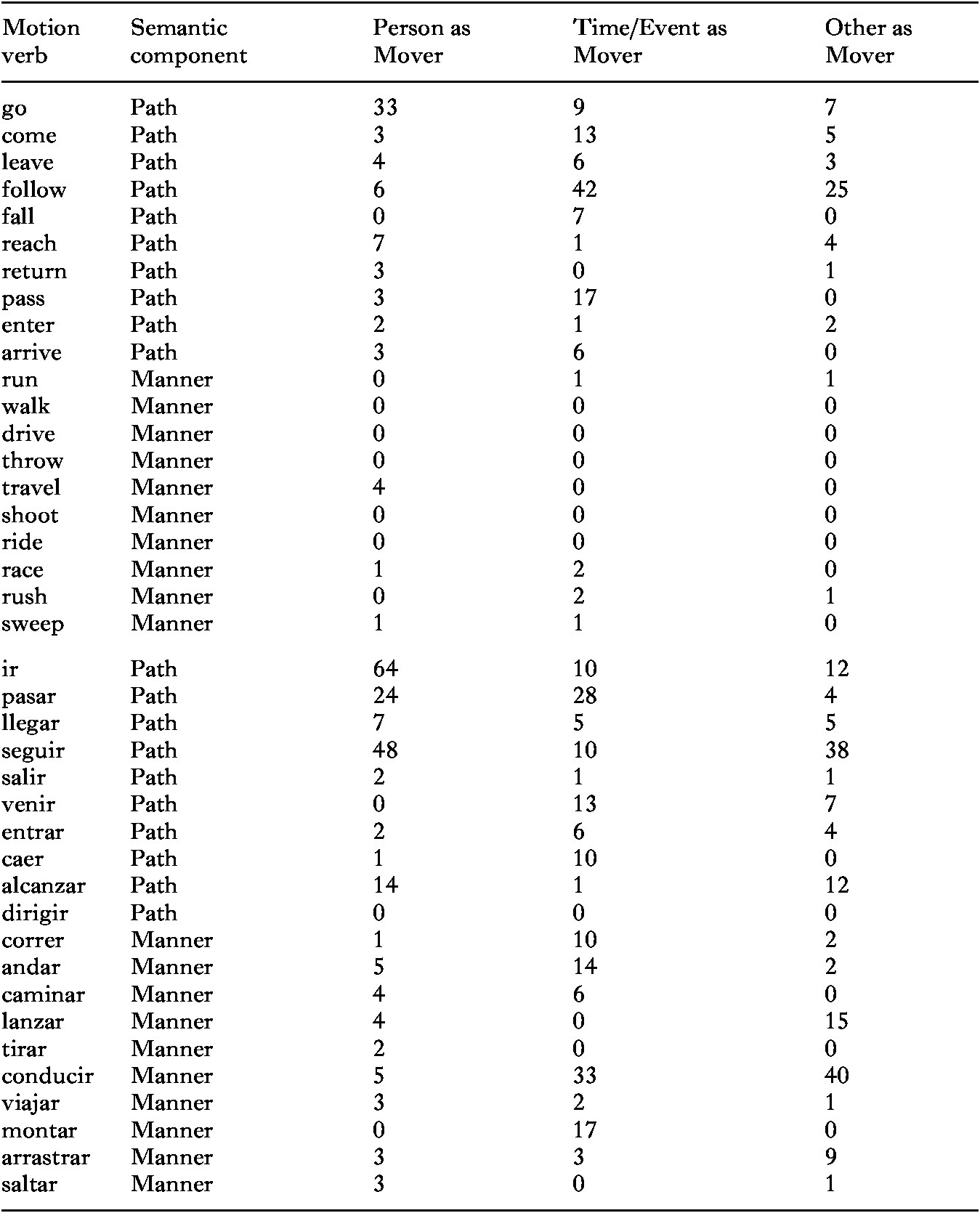
Of the 3993 English tokens, 227 (5.68% of the English dataset) were categorized as temporal expressions. These tokens represented 15 English motion verbs. Of the 3998 Spanish tokens, 514 (12.86% of the Spanish dataset) were categorized as temporal expressions. These tokens represented 19 Spanish motion verbs.
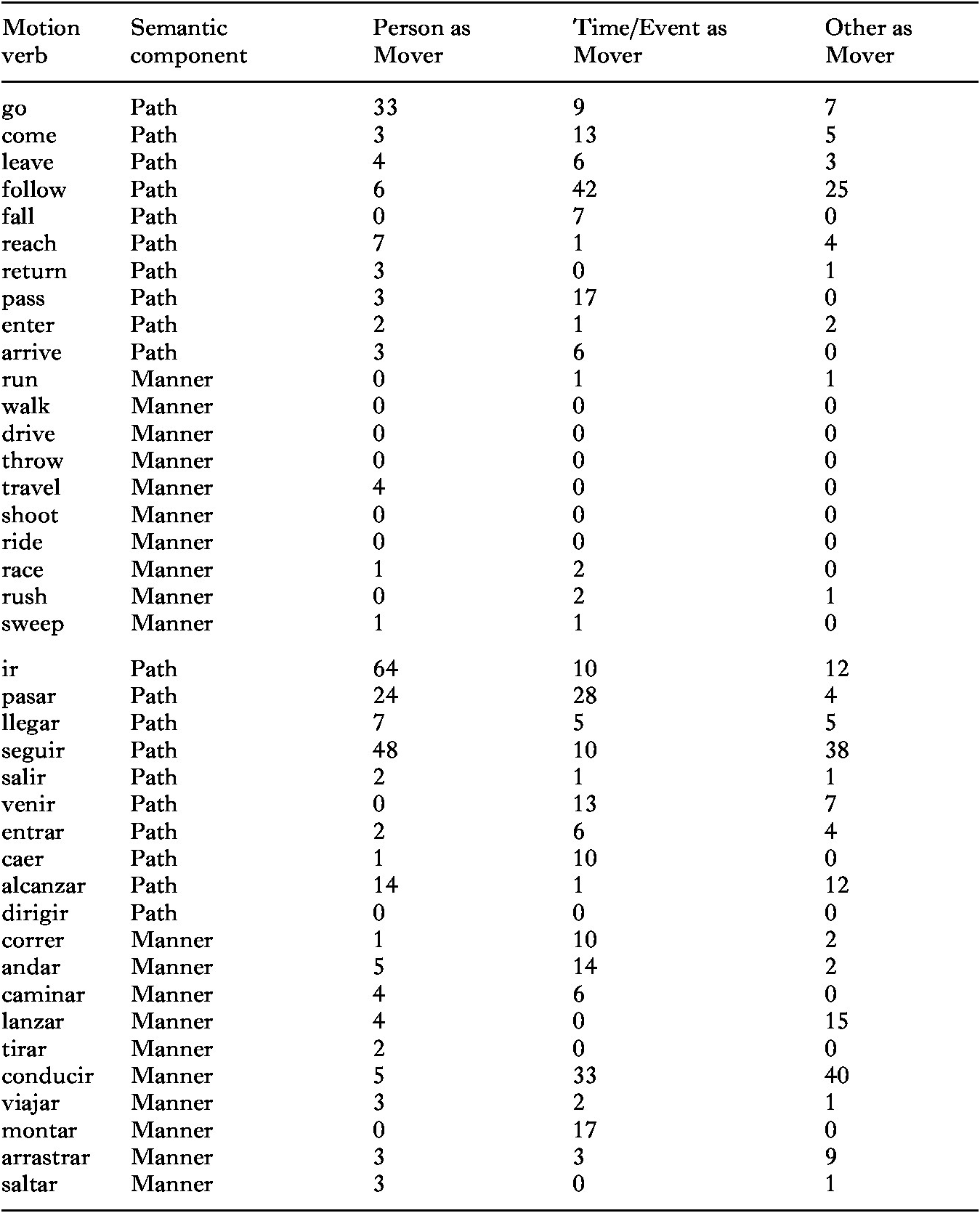
The first aim of the study was to examine the relative frequency of Moving Ego and Moving Time metaphors in natural language use, as evidenced by the frequencies of human and temporal moving entities. An examination of the extracted instances revealed a significantly higher percentage of expressions involving time/event movers (108/227; 48%) than human movers (70/227; 31%) across the set of English motion verbs (X2 (df = 2) = 23.64, p < .0001). In contrast, we found no difference in the frequencies of human and time/event moving entities in Spanish, with 33% (169/514) of the extracted instances predicated of a time or event as mover, and 37% (192/514) of extracted instances predicated of a person as moverFootnote 16 (X2 (df = 2) = 4.49, p > .1) (see Table 2).
Frequency of metaphoric movers
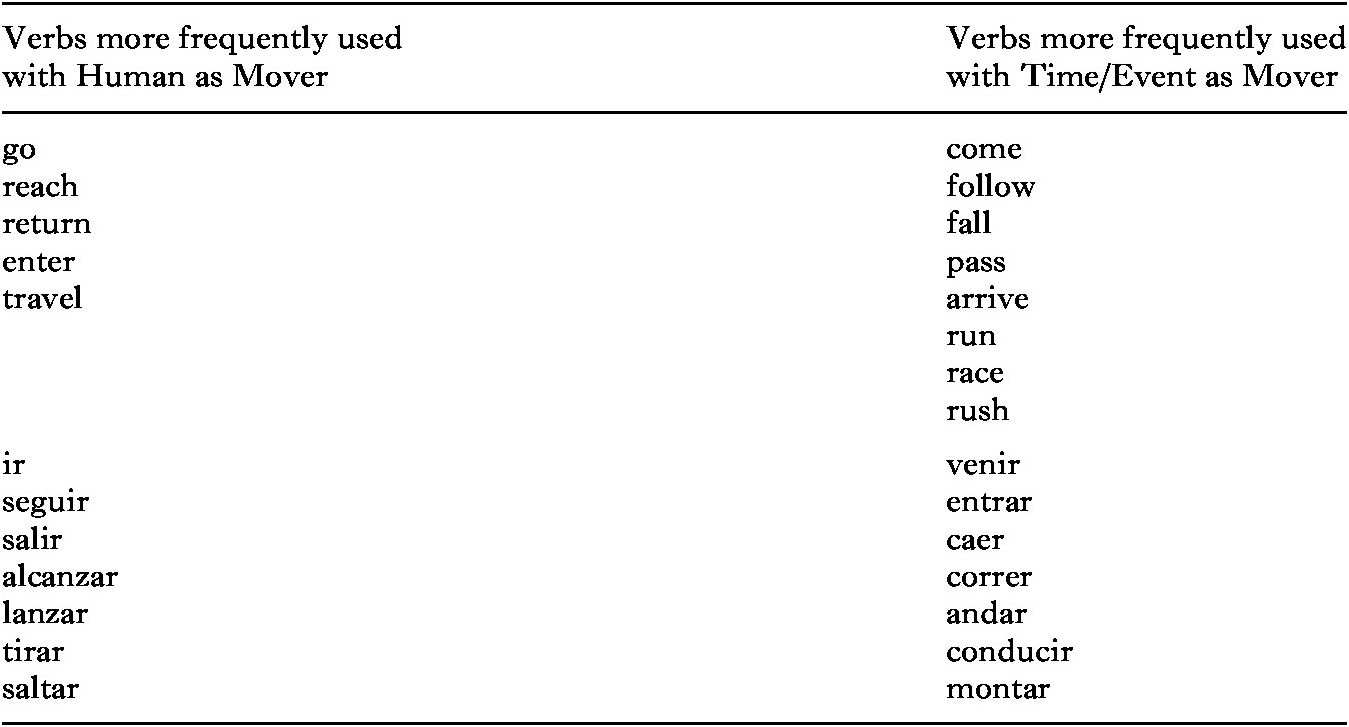
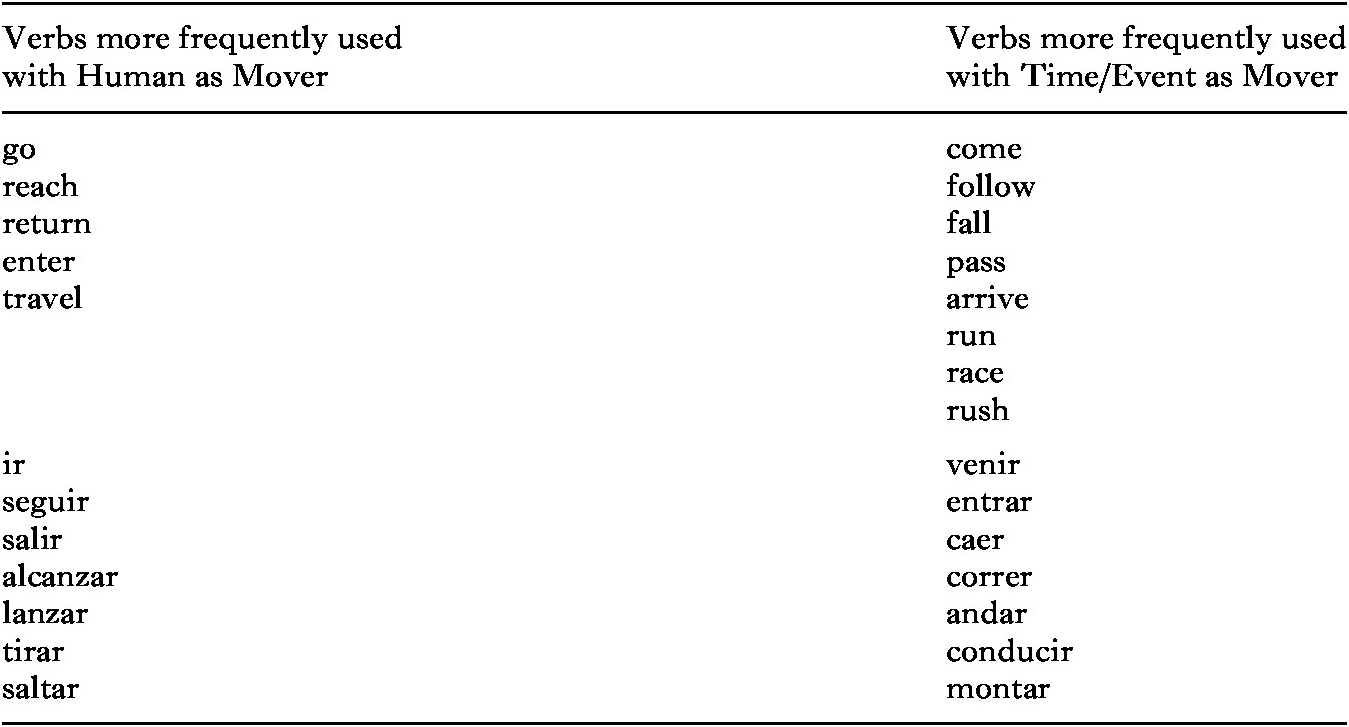
Looking more closely, we note that some verbs occur substantially more frequently with a time/event mover than a human mover, or vice versa (Table 3), suggesting that lexical choice and temporal perspective may be intimately connected (Feist & Duffy, Reference Feist and Duffy2015). In order to examine this more closely, we considered verbs for which one perspective appears at least twice as frequently as the other. By this measure, a total of 12 verbs (5 English, 7 Spanish) were found to occur more often with a human mover than with a time/event mover, while a total of 15 verbs (8 English, 7 Spanish) were found to occur more often with a time/event mover than with a human mover.
Verbs occurring with one type of mover at least twice as frequently as the other
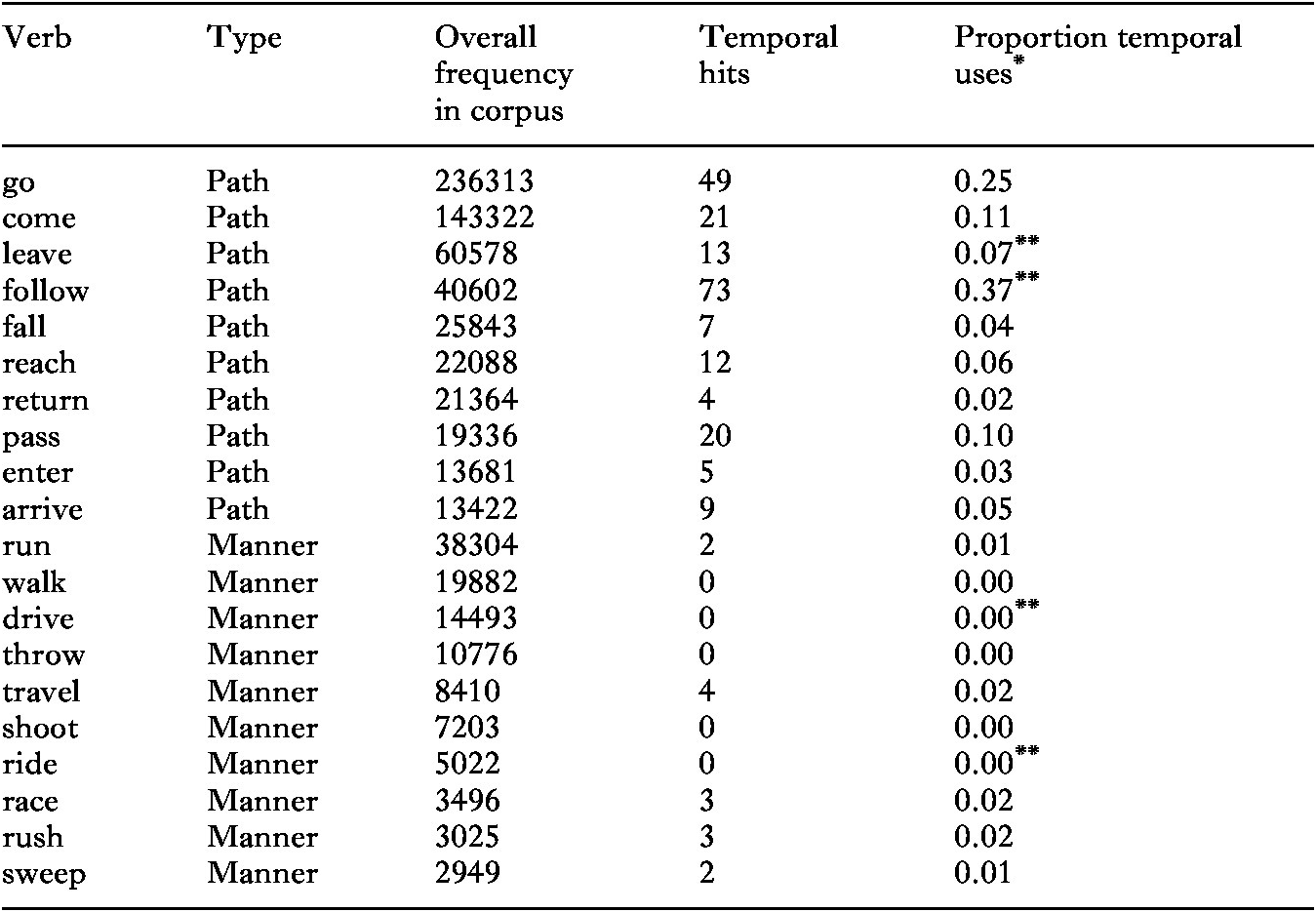
The second aim of the study was to assess whether the path/manner asymmetries observed in physical motion are also evident in the subdomain of TEMPORAL MOTION. An examination of the frequency of use of path and manner verbs to describe time revealed that, in English, path verbs accounted for 94% of the temporal tokens (213/227), whereas manner verbs (14/227) accounted for only 6% (Table 4). This represents a reversal of the pattern noted in descriptions of spatial motion, for which speakers of English more frequently use manner verbs than path verbs (Gennari et al., Reference Gennari, Sloman, Malt and Fitch2002; Papafragou et al., Reference Papafragou, Massey and Gleitman2002; Slobin, Reference Slobin, Gentner and Goldin-Medow2003, Reference Slobin, Strömqvist and Verhoeven2004). In line with the asymmetry by tokens, the extracted temporal expressions also displayed a greater type frequency of path verbs, with all ten path verbs but only five manner verbs (run, travel, race, rush, and sweep) returning temporal uses.
English motion verbs in the subdomain of TEMPORAL MOTION
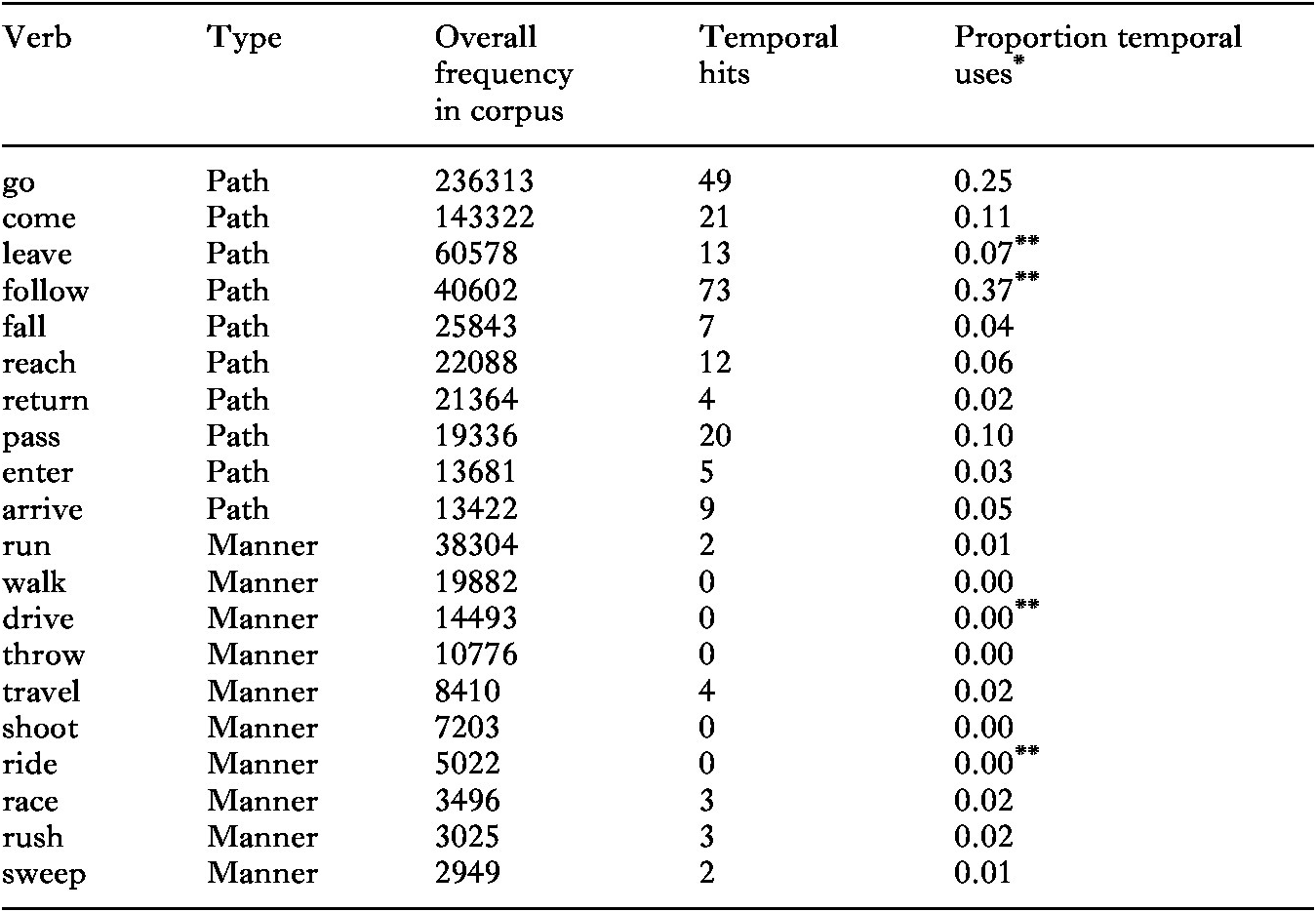
NOTES. * Unless otherwise noted, based on the frequency of temporal instances per 200 hits;
** Based on the frequency of temporal instances per 198 hits (leave, follow, ride) and 199 hits (drive).
In Spanish, path verbs accounted for 64% of the temporal tokens (329/514), whereas manner verbs (185/514) accounted for 36% (Table 5). This pattern is in line with that observed in spatial motion for Spanish (e.g., Gennari et al., Reference Gennari, Sloman, Malt and Fitch2002, p. 65, observed that 80% of the verbs produced by Spanish speakers to describe motion videos were path verbs, and 71% of the descriptions contained manner information), but it is much attenuated from both the balance observed in spatial descriptions (Slobin, Reference Slobin, Gentner and Goldin-Medow2003, reports that only 20% of the motion verbs produced by Spanish speakers in narratives were manner verbs) and the asymmetry we observed in English temporal motion uses. Indeed, the two languages differed significantly in the distribution of path and manner verbs in our dataset, with English displaying a greater asymmetry in uses than did Spanish (X2 (df = 1) = 71.30, p < .00001). Furthermore, and in contrast to English, no type-frequency asymmetry was observed in Spanish, as 9 path verbs and 10 manner verbs included temporal uses.
Spanish motion verbs in the subdomain of TEMPORAL MOTION

NOTES:* Based on the frequency of temporal instances per 200 hits.
** Based on the frequency of temporal instances per 198 hits.
5. Discussion
5.1. OVERVIEW
The connections between space and time have long intrigued researchers in the cognitive sciences, resulting in a growing body of evidence suggesting that experiences in space may influence temporal reasoning. However, much of this work relies upon the use of motion language in the TEMPORAL MOTION construction to structure conceptualization around either the Moving Time or the Moving Ego metaphor. To better understand the experimental findings, we must delve into the linguistic patterns, asking how speakers utilize spatial terms to describe time.
The current study probed the language of time in two ways. First, noting that much of the experimental work investigating connections between space and time has made use of the contrast between the Moving Ego and Moving Time metaphors, we tested the underlying assumption that these two metaphors are equally present in natural language use. Our findings challenged this assumption on two counts. First, our data revealed a cross-linguistic difference, with the assumption of equal prevalence borne out only in Spanish. This suggests that the uses of related metaphors should be assessed on a language-by-language basis. Second, our findings indicated an imbalance in the use of these metaphors in English, whereby tokens instantiating the Moving Time metaphor are more prevalent than tokens instantiating the Moving Ego metaphor. Looking more closely, we observed a parallel type-level imbalance, with 8 English verbs predominantly instantiating the Moving Time metaphor and 5 tending towards the Moving Ego metaphor. The imbalances noted in natural English uses echo the preference for the Moving Time perspective observed in non-student English-speaking populations (Duffy & Feist, Reference Duffy and Feist2014) and suggest that the interpretation of priming effects should be re-evaluated.
In contrast to our findings, McGlone and Pfiester (Reference McGlone and Pfiester2009) observed a much smaller imbalance in the frequencies of the Moving Time (52.8%) and Moving Ego (47.2%) metaphors in English in their corpus data. One possible explanation for this disparity relates to the difference in method employed. McGlone and Pfiester’s key terms included 22 space–time metaphors (involving 15 verbs and 7 prepositions) that they considered to be common and applicable for both Moving Time and Moving Ego expressions. By contrast, the key terms employed in the current study consisted of the 10 most frequent path verbs and 10 most frequent manner verbs in the British National Corpus (BYU–BNC; Davies, Reference Davies2004–), along with the 10 most frequent path verbs and 10 most frequent manner verbs in the Corpus del Español (Davies, Reference Davies2002–). The selection was made independent of their potential for use in the temporal motion construction, thereby allowing generalizations regarding the extensions of motion verbs to the subdomain of TEMPORAL MOTION. Thus, McGlone and Pfiester’s (Reference McGlone and Pfiester2009) study included, by design, the assumption of equal prevalence of the two temporal perspectives that our study was designed to test. As a result, the two studies sampled different lexical items: of the 42 key English terms used across both studies, there were only seven overlaps: six path verbs (arrive; come; enter; go; pass; reach) and one manner verb (run). As seen in our results above, individual verbs may demonstrate a bias for one perspective over the other (cf. Feist & Duffy, Reference Feist and Duffy2015). To wit, of the seven overlapping verbs, four were more likely to appear with a time/event as mover (arrive; come; pass; run) and three with a human as mover (go; reach; enter). Similar evidence for lexical specificity emerged in a recent corpus study of Latin American Spanish (Reali & Lleras, Reference Reali and Lleras2017). Hence, the small overlap in key terms across the two studies may partially account for the disparity in the findings. Finally, whereas McGlone and Pfiester’s (Reference McGlone and Pfiester2009) study included only human and event movers, our study added a third category for non-human, non-event movers (e.g., his slow mind; the government; etc.), allowing for a more complete picture of the range of temporal uses of motion verbs.
Whereas our study was inspired by the dichotomy between the Moving Ego and Moving Time metaphors that gave rise to a rich experimental literature, many scholars have included both deictic and non-deictic spatializations of time in their examinations of space–time metaphor (Casasanto & Jasmin, Reference Casasanto and Jasmin2012; Kranjec & McDonough, Reference Kranjec and McDonough2011; McTaggart, Reference McTaggart1908; Moore, Reference Moore2014; Núñez et al., Reference Núñez, Motz and Teuscher2006; Santiago, Lupiáñez, Pérez, & Funes, Reference Santiago, Lupiáñez, Pérez and Funes2007). One common thread across this body of research is that the linguistic manifestations of the metaphors include either Ego or time (including events) as mover. In contrast, our data include two classes of moving entity absent from prior studies: humans other than Ego (i.e., humans referred to in the second or third person) and entities that are neither human nor an event (21% of the English temporal tokens and 30% of the Spanish temporal tokens). While a full examination of the appearance of different kinds of moving entities in the metaphor types that have been identified is beyond the scope of the current study, their prevalence in the data suggests that a deeper investigation of naturally occurring examples of space–time metaphors will be required to fully understand the mappings connecting spatial and temporal motion.
Our second aim was to bring cross-linguistic evidence to bear on the question of whether speakers reuse spatial conceptualizations when thinking about time. Whereas cross-linguistic variation in the lexicalization of motion events has been well documented (Gennari et al., Reference Gennari, Sloman, Malt and Fitch2002; Papafragou et al., Reference Papafragou, Massey and Gleitman2002, Reference Papafragou, Massey and Gleitman2006; Slobin, Reference Slobin, Gentner and Goldin-Medow2003; Talmy, Reference Talmy and Shopen1985, Reference Talmy2000), little is known about the factors influencing lexical choice in the subdomain of TEMPORAL MOTION. Furthermore, if the linguistic structuring of space does indeed influence the conceptualization of time, we might expect to see patterns in the lexicalization of temporal motion that parallel the patterns observed for spatial motion (Caballero & Ibarretxe-Antuñano, Reference Caballero, Ibarretxe-Antuñano, Pirrelli, Marzi and Ferro2015; Ibarretxe-Antuñano & Caballero, Reference Ibarretxe-Antuñano and Caballero2014; Özçalışkan, Reference Özçalışkan2005).
We addressed this hypothesis by examining the prevalence of path and manner verbs in TEMPORAL MOTION constructions in one S-language, English, and one V-language, Spanish. In contrast to the patterns observed in space, we observed a preference for path verbs in both languages. More surprisingly, the preference for path verbs (both by types and by tokens) was stronger in English than in Spanish, despite the high frequency of manner verbs in literal motion descriptions previously noted in English (Slobin, Reference Slobin, Strömqvist and Verhoeven2004; inter alia). The prevalence of path verbs in the subdomain of TEMPORAL MOTION suggests a measure of independence in the conceptualization of these metaphorically linked domains. Taken together with recent evidence suggesting complexity not only in the domains of space and time, but also in the mapping between them (Duffy & Feist, Reference Duffy and Feist2017; cf. de la Fuente, Santiago, Román, Dumitrache, & Casasanto, Reference de la Fuente, Santiago, Román, Dumitrache and Casasanto2014; Gijssels & Casasanto, Reference Gijssels, Casasanto and Dancygier2017), this finding begins to outline constraints on the aspects of spatial conceptualization that are likely to be reused in the conceptualization of time.
5.2. IMPLICATIONS
Conceptual Metaphor Theory alongside various theoretical permutations proposes that metaphors are used for organizing information within abstract domains. The purpose of the metaphor is to provide relational structure to an abstract domain by importing it through analogical extension from a more concrete domain. According to Gentner and Jeziorski (Reference Gentner, Jeziorski and Ortony1993), analogy may be seen as a type of highly selective similarity. In processing analogy, the natural tendency is to foreground common relational abstractions between domains. Importantly, this relational abstraction selection is a function of both the source and the target domains.
As noted earlier, temporal predications suggest a conceptualization of time as one-dimensional and directed (Clark, Reference Clark and Moore1973; Evans, Reference Evans2004, Reference Evans2013; Lakoff & Johnson, Reference Lakoff and Johnson1999; Tenbrink, Reference Tenbrink2007; Traugott, Reference Traugott, Greenberg, Ferguson and Moravcsik1978), thereby selecting for spatial terms that presuppose a single dimension (i.e., long/short as compared to wide/narrow). In addition, the prevalence of the Moving Time and Moving Ego metaphors suggests that time is further conceptualized as being dynamic, in line with our experience of time as constantly changing, rather than being able to pause at a single moment (i.e., the “consciousness of ‘becoming later and later’” described by Whorf, Reference Whorf and Carroll1941). It is dynamicity which sets time apart from space (cf. Galton’s, Reference Galton2011, discussion of transience), as time is obligatorily dynamic, but space is only optionally so.Footnote 17 Furthermore, because time is in constant flux, a change in spatial location necessitates a change in time, whereas a change in time places no requirements on spatial motion or stasis. This asymmetry places constraints on the possible mappings from space to time, as only those abstractions which maximize similarity between the two domains may be mapped (Gentner & Jeziorski, Reference Gentner, Jeziorski and Ortony1993).
Taken together, these observations suggest that time is conceptualized as a path in languages which include Moving Time and Moving Ego metaphors. Consistent with this conceptualization, our findings showed, first, that path verbs were used more commonly than manner verbs to describe temporal motion in both English and Spanish; and second, that Spanish, a language which habitually backgrounds manner and cause while encoding path in spatial motion verbs (Talmy, Reference Talmy2000), was particularly likely to utilize motion verbs in descriptions of time.Footnote 18 Thus, the more frequent predications were those that foregrounded the path-like nature of time.
The path-like nature of time brings to light an issue with the established mapping from space to time. To wit, while the prototypical (spatial) path is linear, linearity is a typical, but not a necessary, feature of paths. For example, path verbs such as swerve, divert, and circumnavigate demonstrate that many paths are non-linear. Likewise, there exist temporal representations that are path-like but non-linear, including the curvilinear representations noted by Sinha, da Silva Sinha, Zinken, & Sampaio (Reference Sinha, Silva Sinha, Zinken and Sampaio2011) among a population of Amondawa speakers, and the circular temporal paths produced by synesthetes (Brang, Teuscher, Ramachandran, & Coulson, Reference Brang, Teuscher, Ramachandran and Coulson2010). These facts suggest that time, like spatial paths, is prototypically conceived to be linear rather than being constitutively so.
The high rate of use of Spanish manner verbs in temporal motion further refines the notion of path as applied to the domain of time. Despite a dispreference for manner verbs in Spanish descriptions of spatial motion (e.g., Slobin, Reference Slobin, Gumperz and Levinson1996), we observed that Spanish manner verbs were freely used to describe temporal motion, as evidenced by high type- and token-frequencies.Footnote 19 This finding fleshes out the picture of the path of time suggested by the mappings in space–time metaphors: in Spanish, manner verbs are restricted in use when motion will result in the crossing of a boundary (Aske, Reference Aske, Hall, Meacham and Shapiro1989; Naigles, Eisenberg, Kako, Highter, & McGraw, Reference Naigles, Eisenberg, Kako, Highter and McGraw1998; Slobin & Hoiting, Reference Slobin, Hoiting, Moore, Peterson and Wentum1994). The key to understanding their use in temporal motion is the conceptualization of time as unbounded, hence minimizing the boundary-crossing events that impede use of manner verbs in Spanish. The Spanish data suggest that, in addition to being unidimensional and dynamic, the path of time is conceptualized as extending indefinitely into the past and the future, with few boundaries to impede the movement of people and events.
Finally, the foregrounding of path in the conceptualization of time focuses attention on the Ground relatively more than on the Figure, as the presence of a path presupposes a Ground against which the path is elaborated (Feist, Reference Feist2010). This may contribute to the lower use of manner verbs in temporal metaphors, particularly in high-manner-salient English, as manner verbs – which involve factors such as motor patterns, rate of motion, and degree of effort involved in the motion (Özçalışkan, Reference Özçalışkan2004) – describe co-events performed by the Figure. Shinohara (Reference Shinohara and Nehaniv1999, Reference Shinohara, Good and Yu2000) argued that such factors negatively impact the acceptability of manner verbs in the TIME IS A MOVING OBJECT metaphor. The profiling of a mover which can perform a co-event highlights an aspect of spatial conceptualization that is not shared by time. As a result, we would expect such mappings to be less frequent than mappings based on common relational abstractions (Gentner & Jeziorski, Reference Gentner, Jeziorski and Ortony1993) such as path. In keeping with this, we found that manner verbs were used far less frequently in high-manner-salient English than in low-manner-salient Spanish.
6. Conclusions
Studies of the metaphoric connections between space and time have done much to inform our understanding of the human conceptualization of time. For example, the frequency and regularity of use of spatial terms such as long/short or forward/back suggest a conceptualization of time as one-dimensional and directed. However, the striking typological variation in the linguistic encoding of the source domain of space suggests that the mapping and, by extension, the conceptualization of time, may be richer than these observations have suggested. By taking into consideration descriptions of temporal motion across two typologically distinct languages, we were able to flesh out the details of spatial conceptualization that are reused in the conceptualization of time, including the representation of time as an unbounded path and the concomitant de-emphasis of the Figure in temporal motion. These features highlight the combined contributions of time and space to the metaphorical mapping.
The current findings thus point toward an account whereby metaphoric mappings are co-constructed by the two domains in combination with the language in use, rather than involving the unidirectional importation of structure from a concrete domain into an abstract one (cf. Shinohara, Reference Shinohara and Nehaniv1999, Reference Shinohara, Good and Yu2000). The similarity in preference for path over manner verbs across two typologically different languages suggests that there may be salient aspects of the linguistic conceptualization of space that are not amongst the conceptual elements brought through to time, with the target domain bypassing biases in how we conceptualize the source domain as it guides the search for conceptual elements that will best mesh with – and flesh out – the target domain. Alongside this, the more frequent metaphoric use of motion verbs in low-manner-salient Spanish than in high-manner-salient English highlights disparities between time and space whereby typological variation in conceptualization of the source domain will constrain the availability of source domain concepts for application to the target domain.
These findings suggest a way forward in the study of metaphor, as each metaphor will be the product of the source domain in combination with the target domain, tempered by the typology of the particular language in which the metaphor surfaces. Through the comparison of related metaphors across a varied set of languages, we can uncover a wider range of relational abstractions than would be seen in any individual language, yielding a fuller picture of the mappings that help humans to understand the abstract domains about which we think.