Introduction
Despite significant advances in therapeutics, almost half of patients with major depressive disorder (MDD) fail to show a satisfactory response to treatment (Rush et al. Reference Rush, Trivedi, Wisniewski, Nierenberg, Stewart, Warden, Niederehe, Thase, Lavori, Lebowitz, McGrath, Rosenbaum, Sackeim, Kupfer, Luther and Fava2006), and the prediction of treatment outcome remains unsatisfactory. Neurobiological predictors based on functional neuroimaging hold promise, but have not yet produced useful treatment algorithms for individual patients (Mayberg, Reference Mayberg2003; Konarski et al. Reference Konarski, Kennedy, Segal, Lau, Bieling, McIntyre and Mayberg2009; Li et al. Reference Li, Lin, Chou, Chen, Hsieh, Wu, Lin and Su2010). Prediction based on clinical features also remains problematic (Joyce & Paykel, Reference Joyce and Paykel1989). However, literature reviews suggest that a careful account of MDD phenotypes encompassing neuropsychological profiling may hold promise (Porter et al. Reference Porter, Bourke and Gallagher2007; Clark et al. Reference Clark, Chamberlain and Sahakian2009).
In line with this view, the purpose of the current study was to investigate the neuropsychological underpinnings of treatment-resistant/refractory depression. However, the conceptual and operational definitions of pharmacoresistant depression remain divergent to date (Berlim & Turecki, Reference Berlim and Turecki2007). We therefore added the criterion of referral for electroconvulsive therapy (ECT) to the conventional criteria of pharmacoresistance used in the majority of controlled trials (Berlim & Turecki, Reference Berlim and Turecki2007). ECT is an effective treatment of MDD (APA, 2001), leading to a reduction in depression scores of >60% (Lerer et al. Reference Lerer, Shapira, Calev, Tubi, Drexler, Kindler, Lidsky and Schwartz1995; Sackeim et al. Reference Sackeim, Prudic, Devanand, Nobler, Lisanby, Peyser, Fitzsimons, Moody and Clark2000; McCall et al. Reference McCall, Dunn and Rosenquist2004; Falconer et al. Reference Falconer, Cleland, Fielding and Reid2010). Because reservations regarding the side-effects of ECT have restricted its use to pharmacoresistant MDD, it is reasonable to consider ECT referral as a stringent criterion of pharmacoresistance.
A second reason for focusing on MDD patients with ECT referral was precisely the reservations regarding ECT use. These arise from reported adverse effects on cognition (Rami-Gonzajez et al. Reference Rami-Gonzajez, Bernardo, Boget, Gil-Verona, Salamero and Junque2001; UK ECT Review Group, 2003; Robertson & Pryor, Reference Robertson and Pryor2006), although controlled trial evidence on ECT-related, lasting cognitive deficits is very limited (Halliday et al. Reference Halliday, Davidson, Browne and Kreeger1968; Ng et al. Reference Ng, Schweitzer, Alexopoulos, Celi, Wong, Tuckwell, Sergejew and Tiller2000; Sackeim et al. Reference Sackeim, Prudic, Fuller, Keilp, Lavori and Olfson2007). Accordingly, recent reviews have concluded that the degree of cognitive impairment residual to ECT cannot be estimated reliably at present (UK ECT Review Group, 2003; Robertson & Pryor, Reference Robertson and Pryor2006; Falconer et al. Reference Falconer, Cleland, Fielding and Reid2010). The definitive evaluation of cognitive deficits caused by ECT therefore calls for further research, which must take account of two methodological issues.
The first issue is the use of inadequate neuropsychological instruments in previous studies. Global neuropsychological tests such as the Mini-Mental State Examination (MMSE; Folstein et al. Reference Folstein, Folstein and McHugh1975) lack the sensitivity to circumscribe memory deficits. More specialized tests such as the Auditory-Verbal Learning Test (AVLT; Rey, Reference Rey1964) and various forms of paired associates with short retention intervals lack the flexibility to detect the nature and level of ECT-induced cognitive impairments (Goldstein et al. Reference Goldstein, Filskov and Weaver1977; Robertson & Pryor, Reference Robertson and Pryor2006; Falconer et al. Reference Falconer, Cleland, Fielding and Reid2010). It has therefore been recommended that future ECT evaluation should be based on neuropsychological batteries offering the resolution needed for testing patients with a suspected history of brain injury or disease (Robertson & Pryor, Reference Robertson and Pryor2006). A recent study (Falconer et al. Reference Falconer, Cleland, Fielding and Reid2010) contributed to the resolution of this issue by introducing the Cambridge Neuropsychological Test Automated Battery (CANTAB) in the evaluation of ECT. CANTAB is highly appropriate as it detects and differentiates frontal from temporal and amygdalo-hippocampal dysfunction (Sahakian et al. Reference Sahakian, Downes, Eagger, Evenden, Levy, Philpot, Roberts and Robbins1990; Sahgal et al. Reference Sahgal, Sahakian, Robbins, Wray, Lloyd, Cook, McKeith, Disley, Eagger, Boddington and Edwardson1991; Robbins et al. Reference Robbins, James, Owen, Sahakian, McInnes and Rabbitt1994; Lange et al. Reference Lange, Sahakian, Quinn, Marsden and Robbins1995; Owen et al. Reference Owen, Sahakian, Semple, Polkey and Robbins1995, Reference Owen, Morris, Sahakian, Polkey and Robbins1996, Reference Owen, Iddon, Hodges, Summers and Robbins1997; Fowler et al. Reference Fowler, Saling, Conway, Semple and Louis1997; Rahman et al. Reference Rahman, Robbins and Sahakian1999; Clark et al. Reference Clark, Chamberlain and Sahakian2009). It is also sensitive to deficits associated with depression (Elliott et al. Reference Elliott, Sahakian, McKay, Herrod, Robbins and Paykel1996; Porter et al. Reference Porter, Gallagher, Thompson and Young2003; Barnett et al. Reference Barnett, Sahakian, Werners, Hill, Brazil, Gallagher, Bullmore and Jones2005; Clark et al. Reference Clark, Chamberlain and Sahakian2009). Using CANTAB, Falconer et al. (Reference Falconer, Cleland, Fielding and Reid2010) indeed noted a spatial memory impairment 1 month post-ECT. As the study is one of few to detect anterograde memory loss more than 2 weeks post-ECT, the finding suggests that CANTAB is a sensitive instrument for evaluating the cognitive effects of ECT on aspects of memory.
The second methodological issue hindering the assessment of ECT-related cognitive deficits is that those can only be assessed against a ‘baseline’ of depression, which itself produces such deficits (Clark et al. Reference Clark, Chamberlain and Sahakian2009). Some of these deficits reportedly persist after recovery with treatment other than ECT (Reischies & Neu, Reference Reischies and Neu2000; Neu et al. Reference Neu, Kiesslinger, Schlattmann and Reischies2001; Steffens et al. Reference Steffens, Welsh-Bohmer, Burke, Plassman, Beyer, Gersing and Potter2004; Biringer et al. Reference Biringer, Lundervold, Stordal, Mykletun, Egeland, Bottlender and Lund2005; Clark et al. Reference Clark, Sarna and Goodwin2005; Paelecke-Habermann et al. Reference Paelecke-Habermann, Pohl and Leplow2005; Nakano et al. Reference Nakano, Baba, Maeshima, Kitajima, Sakai, Baba, Suzuki, Mimura and Arai2008). Cognitive deficits residual to depression may be subsumed in deficits attributed to ECT, unless proper control procedures are used. Instruments developed to distinguish between depression- and ECT-related deficits, such as the Squire Memory Questionnaire (SMQ; Squire et al. Reference Squire, Wetzel and Slater1979), are of debatable usefulness (Robertson & Pryor, Reference Robertson and Pryor2006). To establish the sensitivity of a neuropsychological procedure such as CANTAB to ECT-related cognitive deficits, care must be taken to ensure that the CANTAB-based, pretreatment profile of ECT candidates does not differ from the corresponding neuropsychological profile of MDD patients of comparable severity who are drug respondent and therefore do not attract ECT referral. The study by Falconer et al. (Reference Falconer, Cleland, Fielding and Reid2010) did not address this issue.
The current study used CANTAB to compare the neuropsychological profile of MDD patients with ECT referral to the profiles of (a) matched MDD patients who did not attract ECT referral and (b) demographically matched non-psychiatric controls. Additionally, given that the cognitive deficits associated with both MDD and ECT are not restricted to memory but also include executive dysfunction, the study used a battery of CANTAB tests addressing visuospatial learning and memory (as Falconer et al. Reference Falconer, Cleland, Fielding and Reid2010) but also cognitive flexibility, spatial working memory and planning. These added tests access frontal function more directly and are particularly relevant given that the spatial memory deficit detected 1 month post-ECT by Falconer et al. (Reference Falconer, Cleland, Fielding and Reid2010) suggests frontal rather than temporal lobe impairment (Owen et al. Reference Owen, Sahakian, Semple, Polkey and Robbins1995).
The study hypothesis was that MDD pharmacoresistant ECT candidates, prior to treatment, may present a CANTAB-based neuropsychological profile different from that of matched, drug-respondent MDD patients and non-psychiatric controls. This may help to access the neuropsychological underpinnings of pharmacoresistant MDD, and possibly bear predictive potential in terms of MDD treatment outcome. If, however, no neuropsychological differences were detected, this would support the claim that CANTAB is an appropriate and sensitive instrument for the definitive evaluation of ECT-related cognitive deficits.
Method
Participants
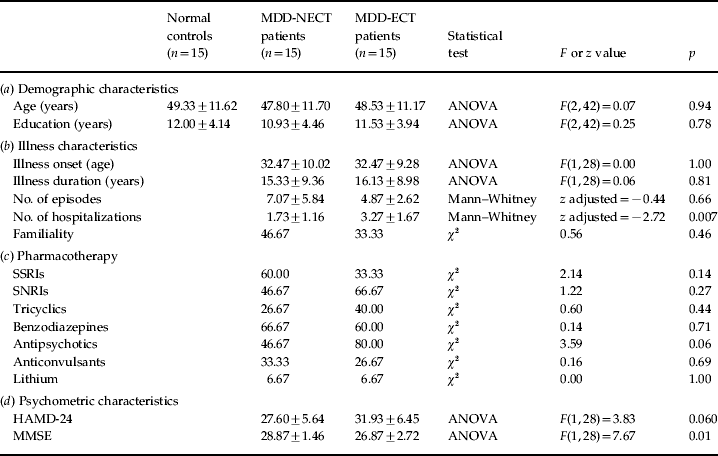
All patients signed informed consent forms. The patients were female, as the study was carried out in the Women's Mental Health Unit of Eginition Hospital. All were diagnosed as having an episode in the context of MDD, according to DSM-IV-TR criteria (APA, 2000). Exclusion criteria were (a) ECT within the past 5 years, (b) co-morbid bipolar disorder, schizophrenia or schizo-affective disorder, (c) central nervous system disorders (dementia, Parkinson's, epilepsy, brain tumours, organic brain syndrome), (d) major medical illness (cerebrovascular disorders, serious endocrine disorders, malignancies), and (e) alcohol or other substance dependence. All patients were on psychotropic medication on admission (Table 1).
Demographic and clinical characteristics of study participants

MDD, Major depressive disorder; ECT, electroconvulsive treatment; MDD-NECT, MDD patients without ECT referral; MDD-ECT, MDD patients with ECT referral; SSRI, selective serotonin reuptake inhibitor; SNRI, serotonin norepinephrine reuptake inhibitor; HAMD-24, 24-item Hamilton Depression Rating Scale; MMSE, Mini-Mental State Examination.
Values are given as mean±standard deviation or percentage.
Controls (n=15)
These were female volunteers matched for age and educational level with ECT candidates. Exclusion criteria were as above, plus a psychiatric history.
ECTs (n=15)
These were MDD patients with more than two episodes, referred for ECT. Three of them presented with mood-congruent psychotic features. As part of the standard pre-ECT evaluation procedure, upon admission, ECT referral was re-examined by two attending psychiatrists not participating in the study. Diagnosis was confirmed by the Standard Clinical Diagnostic Interview (SCID-I/P; First et al. Reference First, Spitzer, Gibbon and Williams2002) and it was documented that ECTs had failed to respond to at least two courses of adequate dosages of antidepressant medications of different classes, for at least 6 weeks (the most frequently used definition of pharmacoresistant depression; Berlim & Turecki, Reference Berlim and Turecki2007). Severity of depression was assessed by the 24-item Hamilton Depression Rating Scale (HAMD-24; Hamilton, Reference Hamilton1960). As part of the procedure, ECT candidates underwent complete blood cell count, serum chemistry analysis, thyroid function tests, plasma cholinesterase measurement, chest radiography, electrocardiography, electro-encephalography (EEG), brain computed tomography, cardiovascular and neurological evaluations.
NECTs (n=15)
These were MDD patients with more than two episodes, assessed with SCID-I/P and HAMD-24. All were being evaluated for admission to the Eginition Women's Mental Health Unit. None had received ECT referral. They were matched with ECT candidates for age, education and age of illness onset.
Instruments
Psychometric scales
Severity of depression of ECTs and NECTs was assessed by the HAMD-24. Global cognitive functioning was assessed by the MMSE.
Neuropsychological tests
A five-test CANTAB battery was used (60–70 min duration). Testing began with a motor screening test (MOT) introducing subjects to the touch screen, while assessing difficulties in vision, movement or comprehension. Two visuospatial memory tasks [Paired Associates Learning (PAL) and Spatial Recognition Memory (SRM)] and two executive function tasks [Intra/Extradimensional (IED) set shifting and Stockings of Cambridge (SOC)] followed, in the same order for all participants. Test summaries are given below (see also Owen et al. Reference Owen, Sahakian, Semple, Polkey and Robbins1995).
PAL assesses the ability to form associations between shapes and their locations on the screen (visual learning–memory). Subjects must indicate the square in which each shape was previously presented, starting with one shape in one of six squares, and ending with eight shapes in eight squares. PAL is sensitive to changes in medial temporal lobe functioning and discriminates between early Alzheimer's disease and depression (Swainson et al. Reference Swainson, Hodges, Galton, Semple, Michael, Dunn, Iddon, Robbins and Sahakian2001).
SRM tests recognition memory as the ability to recognize the correct spatial location of a square presented on five occasions sequentially, followed by a paired series of novel and previously shown squares. SRM is primarily sensitive to frontal lobe dysfunction and relatively insensitive to temporal lobe damage (Owen et al. Reference Owen, Sahakian, Semple, Polkey and Robbins1995).
IED examines attentional flexibility. It includes visual discrimination acquisition and reversal, attentional set formation, maintenance and shifting. Its intra- and extradimensional shift phases are primarily sensitive to changes in frontostriatal function.
SOC tests spatial working memory and planning. It assesses the ability to rearrange a set of balls according to a sample in the minimum number of moves. SOC gives a measure of frontal lobe function.
Procedure
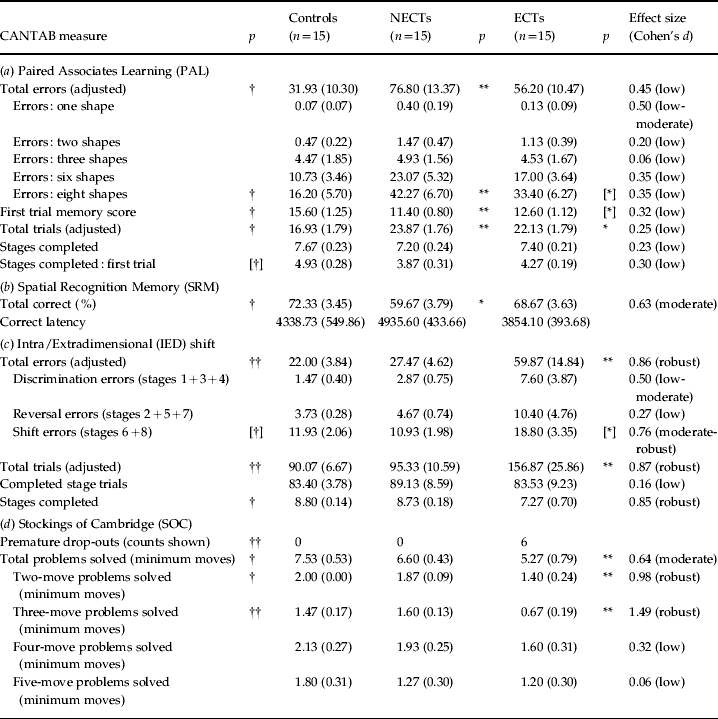
Psychometric and neuropsychological assessments were carried out by trained psychologists, blind as to the MDD patients' future treatment plan. CANTAB tests were administered according to CANTAB manual protocols, on a touch-sensitive screen. The CANTAB measures used are shown in Table 2. Testing took place between 09:00 and 15:00 hours. Controls were only subjected to neuropsychological assessment.
Summary of results from individual CANTAB tests

CANTAB, Cambridge Neuropsychological Test Automated Battery; ECT, electroconvulsive therapy; Controls, non-psychiatric control group; NECTs, depressed patients with no ECT referral; ECTs, depressed patients with ECT referral.
Values are given as mean (standard error).
Significant main effect
† p<0.05; †† p<0.01; significant contrast with Controls
* p<0.05, ** p<0.01; [†], [*]: approaching significance: p<0.06–0.08.
Statistical analysis
The 1999 Statistica for Windows package, version 5.5 (Statsoft Inc., USA), was used.
Demographic and clinical data
Age and years of education were compared for the three groups by one-way analyses of variance (ANOVAs). ECTs and NECTs were further compared with respect to illness history indices through one-way ANOVAs. Familiality and drugs received at intake were compared by χ2 tests. ECTs and NECTs were compared for HAMD-24 and MMSE scores by one-way ANOVAs.
Neuropsychological data
CANTAB datasets were examined for normality (the Kolmogorov–Smirnov test). If the criterion was not met, data were transformed appropriately [log10 for latencies, √(x+0.5) for counts, arcsine (√x) for rates] and retested. Failing the criterion again, the dataset was analysed by Kruskal–Wallis ANOVA. On the other measures ECTs, NECTs and Controls were compared through one-way ANOVAs. Significant group effects were examined by contrast testing. Effect sizes were calculated using Cohen's d (X-ECTs−X-NECTs)/[(SD-ECTs+SD-NECTs)/2].
Results
Sample characteristics
There were no significant group differences in demographics (Table 1 a). NECTs reported (non-significantly) more episodes of illness than ECTs (Table 1 b). ECTs had significantly more hospitalizations than NECTs (1.73±1.16 and 3.27±1.67; Mann–Whitney U test: n=15, z adjusted=2.72, p=0.007). A difference in pharmacotherapy approaching significance was noted for antipsychotics [χ2(df=1)=3.59, p=0.06] (Table 1 c).
Performance in psychometric scales (Table 1d)
ECTs had higher HAMD-24 scores than NECTs, a difference approaching significance [F(1, 28)=3.83, p<0.060]; it is noteworthy that HAMD-24 scores of ECTs were almost identical (31.93±6.45 v. 31.3±6.9) to those reported in one of the largest ECT trials (Sackeim et al. Reference Sackeim, Prudic, Fuller, Keilp, Lavori and Olfson2007). MMSE scores for ECTs were significantly compromised compared to those for NECTs [F(1, 28)=7.67, p<0.01].
Performance in neuropsychological tests
MOT
The three groups did not differ in MOT measures.
PAL (Table 2a)
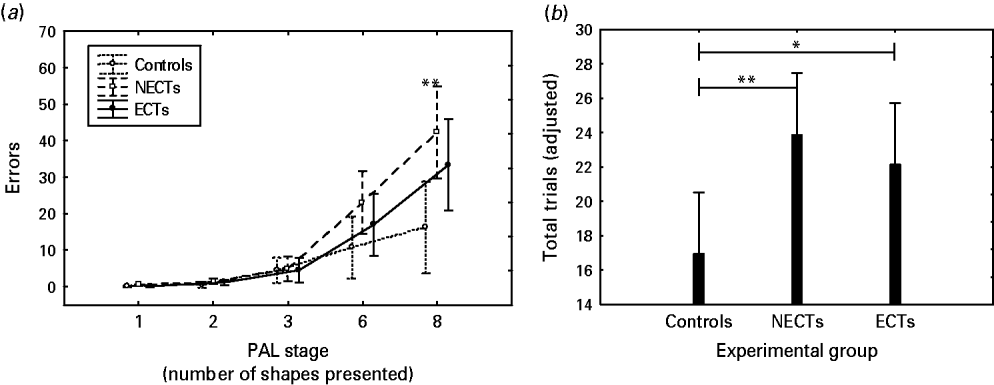
The measure of adjusted total errors produced a significant group effect [F(2, 42)=3.84, p=0.03]. Contrast testing revealed a deficit of NECTs against Controls [Control/NECT: F(1, 42)=7.6, p<0.01]. ECTs did not differ from either group. When stage errors were examined (Fig. 1 a), a significant group effect was noted only at the eight-shape stage [F(2, 42)=4.52, p=0.02], reflecting a NECT deficit [Controls/NECTs: F(1, 42)=7.65, p<0.01]. The first trial memory score also yielded a significant group effect [F(2, 42)=4.06, p=0.03], reflecting a significant NECT deficit [Control/NECTs: F(1, 42)=7.65, p<0.01]. In both cases, ECTs performed intermediately, their difference from Controls verging on significance [Controls/ECTs respectively: F(1, 42)=3.80; F(1, 42)=3.90, p<0.06]. The total trials measure was significant [F(2, 42)=4.11, p=0.02; Fig. 1 b]. ECTs and NECTs were both inferior to Controls [F(1, 42): Controls/NECTs=7.59, p<0.01; Controls/ECTs=4.27, p<0.05].
(a) In Paired Associates Learning (PAL), a significant group effect in total errors [F(2, 42)=3.84, p<0.05] was due to a deficit in depressed patients with no electroconvulsive treatment referral (NECTs) compared to Controls. Analysis of PAL stage errors indicated that this deficit was specific to the most demanding eight-shape PAL stage [F(2, 42)=4.52, p<0.05; Controls v. NECTs: F(1, 42)=8.73, p<0.005]. Depressed patients with ECT referral (ECTs) performed at an intermediate level, differing from neither Controls nor NECTs at any stage. (b) In the measure of adjusted total trials alone [F(2, 42)=4.11, p<0.05], both NECTs and ECTs performed significantly worse than Controls [F(1, 42): Controls v. NECTs=7.59, p<0.001; Controls v. ECTs=4.27, p<0.05]. Data shown are means and 0.95 confidence intervals; * p<0.05, ** p<0.01.

SRM (Table 2b)
The measure of the percentage correct responses yielded a group effect [F(2, 42)=3.32, p<0.05] due to a significant deficit of NECTs versus Controls [Control/NECT: F(1, 42)=6.10, p=0.02]. ECTs performed between Control and NECT levels.
IED (Table 2c)
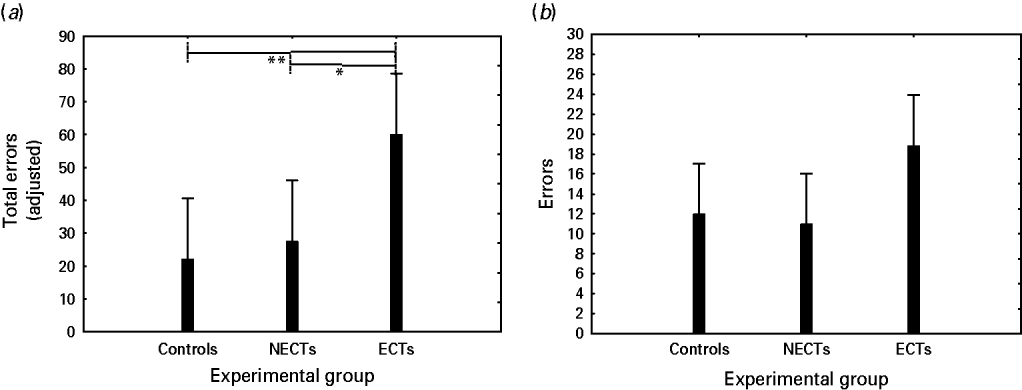
The adjusted measures of total errors (Fig. 2 a) and total trials [respectively, F(2, 42)=4.91, p=0.01; F(2, 42)=5.01, p=0.01] yielded significant group effects. NECTs did not differ significantly from Controls whereas ECTs' performance was significantly compromised on both measures [Controls/ECTs respectively: F(1, 42)=8.40 and 8.11, p<0.01; NECTs/ECTs respectively: F(1, 42)=6.15, p<0.05; F(1, 42)=6.88, p=0.01]. The measure of Stages Completed gave the same pattern [Kruskal–Wallis: H (2, n=45)=8.34, p=0.02]. To determine whether the emerging ECT deficit was specific to discrete IED tasks (discrimination: stages 1+3+4; reversal: stages 2+5+7; set shifting: stages 6+8), separate one-way ANOVAS were carried out. The three groups performed comparably in discrimination and reversal learning. The group effect in the IED shift phases approached significance [F(2, 42)=2.84, p=0.07], again due to increased ECTs' errors (Fig. 2 b).
(a) In the Intra/Extradimensional (IED) shift task, the adjusted measure of total errors yielded a significant group effect [F(2, 42): 4.91, p<0.01]. This was due to the compromised performance of depressive patients with electroconvulsive treatment referral (ECTs) compared to either Controls [Controls v. ECTs: F(1, 42)=8.40, p<0.01] or to depressive patients without ECT referral [NECTs: NECTs v. ECTs, F(1, 42)=6.15, p<0.05]. NECTs did not differ from Controls. (b) Analysis of errors in discrete IED tasks revealed normal performance of both ECTs and NECTs (p>0.15) in the acquisition of a simple discrimination (IED stages 1+3+4) and in discrimination reversal (IED stages 2+5+7). A deficit approaching significance was noted in IED [stages 6+8: F(2, 42)=2.84, p<0.07] due to increased errors in the ECT group. Data shown are means and 0.95 confidence intervals; * p<0.05, ** p<0.01.

SOC (Table 2d)
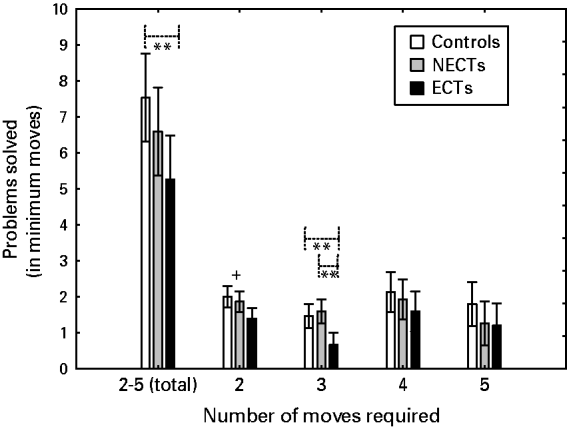
ECTs had a high drop-out rate in the early SOC stages (six drop-outs, four at the two-move, two at the three-move stage: patients refused to continue and SOC was manually interrupted), whereas all Controls and NECTs completed the SOC (Kruskal–Wallis ANOVA: H (2, n=45)=11.00, p=0.004). Given that once a subject dropped out she received a score of zero in subsequent stages, the high ECT drop-out rates affected the data so that subsequent analyses had to be restricted to measures of problems solved in minimum moves, global and stage specific (two-, three-, four- or five-move stages). A significant group effect emerged for total problems solved [F(2, 42)=3.55, p=0.04, Fig. 3]. Contrast testing showed a significant deficit in ECTs [Controls/ECTs: F(1, 42)=7.03, p<0.01]. NECTs performed at an intermediate level, differing from neither group. In the stage analyses (Fig. 3), significant effects were noted at the two-move [Kruskal–Wallis: H (2, n=45)=6.799, p=0.03] and three-move stages [F(2, 42)=9.63, p=0.001], where ECTs performed significantly worse than Controls and NECTs [F(1, 42), Controls/ECTs=16.46, NECTs/ECTs=12.10, p=0.001]. The three groups performed comparably at the more difficult four- and five-move stages, even though early ECT drop-outs were represented in the data by a score of zero.
In Stockings of Cambridge (SOC) depressive patients with electroconvulsive treatment referral (ECTs) solved significantly fewer problems using minimum moves compared to Controls and depressive patients with no ECT referral (NECTs) [F(2, 42)=3.55, p<0.05; Controls v. ECTs: F(1, 42)=7.03, p<0.01]. The ECT deficit was restricted to the easier SOC stages of problems soluble in two [Kruskal–Wallis: H (2, n=45)=6.799, p=0.05] and three moves [F(2, 42)=9.63, p<0.001: Controls v. ECTs, F(1, 42)=16.46; NECTs v. ECTs F(1, 42)=12.10, p<0.001]. NECTS did not differ from Controls. The three groups did not differ in the more difficult stages of problems soluble in four and five moves. The early stages ECT deficit was probably due to significantly more early abandons of the test by ECTs compared to Controls and NECTs [Kruskal–Wallis: H (2, n=45)=11.00, p<0.001). Data shown are means and 0.95 confidence intervals; * p<0.05, ** p<0.01; Kruskal–Wallis: +p<0.05.

Discussion
The primary aim of this study was to investigate whether the factor of ECT referral on grounds of pharmacoresistance would yield quantitative or qualitative neuropsychological differences in MDD patient groups. This could contribute to the neuropsychological phenotyping of MDD, which we suggest holds promise for prediction of treatment outcome. A second aim was to anchor the neuropsychological profile of MDD-ECT candidates to those of matched MDD-NECT patients and of non-psychiatric controls, using CANTAB. Thus, a conceptual baseline would be established, facilitating subsequent assessment of the therapeutic and/or adverse cognitive effects of ECT (Robertson & Pryor, Reference Robertson and Pryor2006).
Comparison of clinical profiles
ECT candidates provided the basis for selection of NECT and Control participants: our three groups were matched for age, education and general health status. The mean age was relatively low (48.56±11.25 years), and therefore effects of depression on neuropsychological functioning would not be expected to be as severe as those encountered in elderly depressives (Christensen et al. Reference Christensen, Griffiths, Mackinnon and Jacomb1997; Porter et al. Reference Porter, Bourke and Gallagher2007), obscuring group differences through floor effects. A shortcoming of our study in terms of generalizability of the results is its small sample size and its limitation to females. We opted for females for reasons of availability, but also to reduce variance, because evidence indicates gender differences in cognitive and affective functioning (Wager et al. Reference Wager, Phan, Liberzon and Taylor2003; Postma et al. Reference Postma, Jager, Kessels, Koppeschaar and van Honk2004). To minimize the impact of the small sample size we have provided effect sizes (Table 2) in addition to conventional statistics.
We were partly successful in matching our clinical groups for illness history (Table 1). Both groups consisted of patients undergoing episodes severe enough to warrant hospitalization. They were comparable in reported illness age of onset and duration, but differed in number of previous episodes and hospitalizations. NECTs reported (non-significantly) more episodes, but the fewer episodes of ECTs had led to significantly more hospitalizations. Hospitalizations, current and past, constitute a factor associated with increased severity of depression and of impairment in CANTAB tests, including IED (Purcell et al. Reference Purcell, Maruff, Kyrios and Pantelis1997), delayed matching to sample, spatial span and response to failure (Elliott et al. Reference Elliott, Sahakian, McKay, Herrod, Robbins and Paykel1996).
All patients were receiving pharmacotherapy at the time of assessment (Table 1). NECTs were more frequently on ‘first-line’ pharmacotherapy with selective serotonin reuptake inhibitors (SSRIs) and benzodiazepines, although several took serotonin norepinephrine reuptake inhibitors (SNRIs) and/or atypical antipsychotics. ECTs were more likely to receive tricyclics or SNRIs, supplemented by atypical antipsychotics. This pattern, though not yielding significant differences in our groups, reflects the pharmacological resistance contributing to ECT referral; it is common to switch patients not showing improvement following an antidepressant course (usually an SSRI) to a different class (e.g. SNRI) with encouraging results (Papakostas et al. Reference Papakostas, Fava and Thase2008).
The possibility that differences in SNRIs or atypical antipsychotics may contribute to the neuropsychological differentiation of our MDD groups must be considered. Antidepressants differentially affect cognition depending on their receptor-binding profiles (Furlan et al. Reference Furlan, Kallan, Ten Have, Pollock, Katz and Lucki2001; Cassano et al. Reference Cassano, Puca, Scapicchio and Trabucchi2002; Riedel et al. Reference Riedel, Eikmans, Heldens and Schmitt2005; Gualtieri & Johnson, Reference Gualtieri and Johnson2007). However, SSRIs and SNRIs seem to have comparable, beneficial effects on mental processing speed and motor performance, with superior SNRI benefit in episodic and working memory (Herrera-Guzmán et al. Reference Herrera-Guzmán, Gudayol-Ferré, Herrera-Guzmán, Guàrdia-Olmos, Hinojosa-Calvo and Herrera-Abarca2009).
With respect to antipsychotics, there is evidence that some atypical ones simulate cognitive deficits in healthy individuals (Mehta et al. Reference Mehta, Sahakian, McKenna and Robbins1999). However, in schizophrenia, data strongly suggest that atypical ones in particular either have no effect or improve executive functioning (Meyer-Lindberg et al. Reference Meyer-Lindberg, Gruppe, Bauer, Lis, Krieger and Galhoffer1997; Burke et al. Reference Burke, Patel, Morris and Reveley1998; Cuesta et al. Reference Cuesta, Peralta and Zarzuela2001; Velligan et al. Reference Velligan, Newcomer, Pultz, Csernansky, Hoff, Mahurin and Miller2002; McGurk et al. Reference McGurk, Lee, Jayathilake and Meltzer2004; Mishara & Goldberg, Reference Mishara and Goldberg2004; Tyson et al. Reference Tyson, Laws, Roberts and Mortimer2004; Woodwart et al. Reference Woodward, Purdon, Meltzer and Zald2005; O'Grada & Dinan, Reference O'Grada and Dinan2007). In depression, data on the cognitive effects of antipsychotics are sparse but in the same direction (Olver et al. Reference Olver, Ignatiadis, Maruff, Burrows and Norman2008; Frasch et al. Reference Frasch, Bullacher, Jäger, Kilian, Rink, Wittek, Becker and Neumann2009).
Thus, the fact that MDD-ECT patients were receiving SNRIs and atypical antipsychotics in greater proportion than their MDD-NECT counterparts and still demonstrated an executive deficit strengthens rather than weakens our finding: the confounding effects of this difference would be expected to lead to an underestimate of executive deficits exhibited by MDD-ECT patients. However, the superior performance of ECTs versus NECTs in visuospatial memory tasks may be attributable to the factor of atypical antipsychotics, to the extent that these also seem to ameliorate performance in these tasks (Keefe et al. Reference Keefe, Young, Rock, Purdon, Gold and Breier2006). It seems unlikely, however, that antipsychotics would concurrently ameliorate visuospatial memory and compromise executive deficits.
In summary, our MDD groups suffered recurrent depressive episodes for the same length of time in comparable life periods, but ECTs had a more serious illness course, including more hospitalizations and a broader range of pharmacological treatments. This suggests more severe, resistant depression in ECTs and was corroborated by higher HAMD-24 scores. Severity of depression influences certain aspects of neuropsychological performance (Porter et al. Reference Porter, Bourke and Gallagher2007). Therefore, a down-the-board CANTAB deficit of ECTs versus NECTs in our study would have been difficult to interpret, all the more so because MMSE global cognitive functioning was significantly compromised in ECTs. We did not, however, observe such uniform deficits.
Comparison of neuropsychological profiles
Given the greater severity of depression, the broader range of psychotropic medication and MMSE deficit in our ECT group, their CANTAB performance would be expected to be inferior to that of Controls and possibly of NECTs. Instead, a double dissociation emerged in the profiles of the two MDD groups. In the two memory tests ECTs showed non-significant deficits against Controls on all but one measure of PAL and SRM. By contrast, NECTs were significantly inferior to Controls in all but one measure of both tests (Table 2, Fig. 1). As ECTs outperformed NECTs in PAL, which is a good detector of early Alzheimer's (Swainson et al. Reference Swainson, Hodges, Galton, Semple, Michael, Dunn, Iddon, Robbins and Sahakian2001), the possibility that the MMSE deficit of ECTs reflects a higher incidence of preclinical dementia can be excluded.
The opposite pattern emerged in the tests examining executive function (Table 2, Figs 2 and 3). NECTs performed like Controls on all global measures of IED, whereas ECTs were significantly inferior to both groups. This deficit was not generalized to all IED components: ECTs were unimpaired in discrimination acquisition and reversal, but showed an increase approaching significance in errors during the IED shift phases (p<0.07; Fig. 2). This suggests an attentional flexibility deficit. The SOC performance of ECTs was also significantly inferior to that of the other two groups. This deficit seemed to be limited to increased rates of early drop-outs, resulting in score reductions in the initial, easiest, SOC stages: the three groups did not differ in subsequent, more difficult, SOC stages. ECT candidates who completed SOC (nine out of 15) in fact sustained their group's performance to levels comparable to Controls, although drop-outs were represented in the analysis with zero scores. Hence, the SOC deficit noted seems attributable not to executive dysfunction per se, but possibly to increased sensitivity to negative feedback in the ECT group (Elliott et al. Reference Elliott, Sahakian, McKay, Herrod, Robbins and Paykel1996; Clark et al. Reference Clark, Chamberlain and Sahakian2009).
As an estimate of the sensitivity of our four CANTAB tests to the factor of ECT referral, we calculated effect sizes on the basis of means and standard deviations of our ECT and NECT groups (Cohen's d: Table 2). PAL measures yielded low effect sizes (0.50 >d>0.06). The percentage correct measure of SRM was a better differentiator, yielding a moderate d value of 0.63. The global IED measures of total errors, total trials and stages completed were good differentiators between ECT and NECT performance, yielding robust d values (0.86, 0.87 and 0.85 respectively). Discrimination and reversal errors yielded low effect sizes (d=0.50 and 0.27). The measure of IED shift errors was as good a differentiator of our clinical groups as IED global measures (d=0.76). This supports our conclusion that the IED deficit in ECTs reflects mainly compromised attentional flexibility. Finally, the only SOC measures to yield robust effect sizes were the easiest categories of problems (two to three moves: d=0.98 and 1.49), while the more difficult categories of four- and five-move problems produced very low effect sizes (d=0.32 and 0.06). This supports our argument that the SOC deficit in ECTs is an artefact of early drop-out rates, probably reflecting increased sensitivity to negative feedback.
Implications for differential neuroanatomical involvement
Inferences on the relationship of the cognitive performance of our patient groups with brain functioning are, of course, subject to confirmation by neuroimaging techniques. However, it is noteworthy that this is not the first instance where the PAL/IED combination has been effective in differentiating cognitive profiles within a clinical population previously considered uniform. Barnett et al. (Reference Barnett, Sahakian, Werners, Hill, Brazil, Gallagher, Bullmore and Jones2005) showed that visuospatial learning and executive function (PAL and IED respectively) were independently impaired in first-episode psychosis, the pattern of deficit reflecting differential clinical response. As neuropsychological tasks in general, PAL and IED are not entirely domain specific (Clark et al. Reference Clark, Chamberlain and Sahakian2009). However, Barnett et al. (Reference Barnett, Sahakian, Werners, Hill, Brazil, Gallagher, Bullmore and Jones2005) argue for a broad dissociation between the cognitive systems engaged by them, with a greater burden on temporo-hippocampal processing in PAL and a greater frontostriatal load in the extradimensional shift stage of IED (Smith & Milner, Reference Smith and Milner1981; Owen et al. Reference Owen, Roberts, Polkey, Sahakian and Robbins1991, Reference Owen, Roberts, Hodges, Summers, Polkey and Robbins1993; Lawrence et al. Reference Lawrence, Sahakian, Hodges, Rosser, Lange and Robbins1996, Reference Lawrence, Hodges, Rosser, Kershaw, Ffrench-Constant, Rubinsztein, Robbins and Sahakian1998; Miyashita et al. Reference Miyashita, Kameyama, Hasegawa and Fukushima1998; Rogers et al. Reference Rogers, Andrews, Grasby, Brooks and Robbins2000; Wood et al. Reference Wood, Proffitt, Mahony, Smith, Buchanan, Brewer, Stuart, Velakoulis, McGorry and Pantelis2002). Therefore, the PAL/IED combination is well suited for examining disorders potentially involving either or both frontostriatal and medial temporal lobe dysfunctions. This is all the more important because different relative loads of the two impairments may signal discrete subtypes of the disorder and, perhaps, differential response to treatment. In that light, it is important to establish whether memory and executive deficits necessarily coexist in MDD, or may present independently. Indeed, in our study the PAL/IED combination highlighted a double dissociation in the cognitive profiles of MDD patients with and without ECT referral.
An additional observation was that our ECTs were more likely than NECTs to abandon SOC early, though unimpaired in the more difficult stages of SOC. MDD patients demonstrate exaggerated responses to negative feedback during neuropsychological testing (Brittlebank et al. Reference Brittlebank, Scott, Williams and Ferrier1993; Murphy et al. Reference Murphy, Sahakian, Rubinsztein, Michael, Rogers, Robbins and Paykel1999; Lembke & Ketter, Reference Lembke and Ketter2002), including an increased probability of failing SOC trials subsequent to incorrect responding (Elliott et al. Reference Elliott, Sahakian, Herrod, Robbins and Paykel1997). It has been suggested (Clark et al. Reference Clark, Chamberlain and Sahakian2009) that depressive states may influence the impact of negative feedback by affecting the connectivity of the amygdala with prefrontal cortical regions (Johnstone et al. Reference Johnstone, van Reekum, Urry, Kalin and Davidson2007; Siegle et al. Reference Siegle, Thompson, Carter, Steinhauer and Thase2007; Chen et al. Reference Chen, Suckling, Ooi, Fu, Williams, Walsh, Mitterschiffthaler, Pich and Bullmore2008) and thus interfering with top-down control of emotional behaviour (Johnstone et al. Reference Johnstone, van Reekum, Urry, Kalin and Davidson2007). Our data suggest that MDD-ECT candidates may have a deficit in this axis.
In summary, our data suggest that MDD patients receiving ECT referral present a cognitive profile different to that of drug-respondent MDD patients. This neuropsychological profile suggests greater frontostriatal and milder temporo-hippocampal involvement in these patients than in the general MDD population. It also suggests that these patients may be characterized by dysfunctional amygdala–prefrontal cortex connectivity. The fact that the ECTs/NECTs differentiation seems qualitative rather than quantitative suggests that it is not attributable simply to the increased illness severity associated with ECT referral. Moreover, the differentiation cannot be attributed to compromised global cognitive functioning in ECT candidates, as reflected by their low MMSE scores in the present study. Follow-up data of these ECT candidates 2 months post-ECT show that remission of depression is accompanied by complete recovery of MMSE scores and improvement of memory scores, while the executive deficit characterizing ECT candidates in the current study persists in magnitude (Kalogerakou et al., unpublished observations).
In conclusion, these findings are salient to research efforts towards the neuropsychological subtyping of MDD, in addition to the evaluation of the therapeutic and adverse cognitive effects of ECT treatment.
Acknowledgements
This work was aided by Grant 70/4/9100 (2008–2009) from the Special Account for Research Grants, National and Kapodistrian University of Athens, to Dr E. Tsaltas.
Declaration of Interest
None.