Introduction
The economy of each country is conditioned by external and internal factors. A number of internal economic development factors, such as population and labour, economic resources and conditions, production funding, savings, investment, education, research and innovation, and technical progress function in an international environment, the significance of which increases with ongoing globalization.
The globalization process not only accentuates the connection and influence of international factors on economic development but it also affects both the population and technology. Macroeconomic indicators of an extremely dynamic type are a characteristic of modern research in countries in transition, first of all, for reasons of easier display and for the sake of not having the possibility to statistically cover the data necessary for making static indicators.
The external macroeconomic sector is increasingly emerging as a factor of economic development and it has the tendency to correlate with the economic growth. The price as the dominant factor in the external economic exchange was given a significant place in determining the real possibilities of absorption of imports in each country. Consequently, the steady growth of Foreign Direct Investment (FDI) and capital in the external macroeconomic sector is dominantly highlighted as an important cause of the macroeconomic development of countries in transition. The inclusion in international exchange flows is achieved by increasing exports within the domain of the external macroeconomic sector.
Market adjustment processes of transition countries and the promotion of economic development have different characteristics, which range from institutional changes to practical issues such as the macroeconomic movement of public debt, foreign exchange rate, foreign direct investment, etc.
In the course of transition, without macroeconomic balances, various programmes have been launched and a number of measures have been adopted to implement macroeconomic transformation policies aimed at promoting economic development that would meet the needs of economic reforms thus set.
Literature Review
Research based on macroeconomic indicators is focused on examining the correlation dependence between these factors and GDP growth. In this context, a study by Amavilah (Reference Amavilah1998) scrutinizes both the impact of FDI from Germany on the economic growth of Namibia and the importance of international trade in both countries. This correlation analysis shows that the FDI from Germany has a large impact on the economic growth of Namibia as well as an impact on employment. On the other hand, it has also been noticed that international trade has an insignificant impact on economic growth.
Kyereme (Reference Kyereme2002) examines factors that affect the trade balance. The author points out that developed industrial countries, whose aim is to reach sustainable economic growth, must be globally competitive in the production of desired goods and services. To this end, they have to increase production with minimal costs, increase savings and investments in capital goods and develop human capital and monetary policy measures, and ensure not only an equilibrium rate but also the optimal level of money supply and fiscal policy measures. Finally, they have to promote savings and investments.
Bergsten (Reference Bergsten2011) explores the share of exports to GDP in the USA and the current account deficit. The author offers assessments of the impact of the relaxed export restrictions and trade agreements on increasing gross exports and reducing the current account deficit.
Bartlett (Reference Bartlett2009) strives to examine the macroeconomic performance of Southeast European countries and cites the payment deficit and a small inflow of foreign capital due to the high risk and poor operating conditions of Southeast European countries. The author highlights the relatively low level of GDP per capita in the countries of the Western Balkans, with the exception of Croatia, and the low share of exports of goods and services in GDP. These countries show a serious decline in industrial production and an increase in unemployment due to restructuring and privatization.
Grupe and Kusić (Reference Grupe and Kušić2005) analyse the importance of regional integration of countries to economic performance and emphasize the impact on market development and attracting FDI. The authors intend to demonstrate under which conditions the resources intended for export can be efficiently used in order to gain comparative advantage.
Angeloni and associates (Reference Angeloni, Flad and Mongelli2007) analyse the economic structures of the EU membership candidate countries. By implementing the required reforms, the authors point out, most countries managed to lower inflation rates, provide a rising real GDP per capita rate, and increase productivity. However, they emphasize that there remain large gaps with the level of development in the Eurozone and it will take time to overcome this.
The countries of central and eastern Europe (CEE), Su and Chang (Reference Su and Chang2011) point out, have undergone major changes. They stated that the economic transformations in the CEE countries have shared a number of common features, ranging from institutional changes to practical issues such as the exchange rate regime or the inflow of foreign direct investment.
According to Peković (Reference Peković2018) changes and goals within the European Union are best reflected in the budget and its structure, which has changed over the course of history. The economic circumstances in which the Union was created, and the diversity of interests and aspirations of all its members, are best indicated by the structure of its revenues and expenditures. As the significance of the budget grew in time, it overcame the European Union’s frameworks and had a significant impact on other European countries that were not members of the Union.
Aničič and Simić (Reference Aničić and Simić2017) state that the public debt for the Eurozone as a whole since 1992 has been above 60%. Since 2001, it has grown steadily, and in 2003 it reached 70.4%. In the period 1997-1998, a race to reduce the deficit started in order to meet the 3% criterion, and this was achieved by higher public ownership sales.
Methods
The subject of our research is an analysis of the macroeconomic performance and the impact of the external macroeconomic sector on economic development with the aim of improving the position of developing countries. This article uses data from ITC, the World Bank and the Statistical Office of the Republic of Serbia for the relevant years. Using the comparative method, we compare the macroeconomic indicators of the selected countries by random sample. In this article, we present macroeconomic indicators in a systematic way and also try to determine the similarities and differences between them and explain their connection.
The aim of the research is to examine the macroeconomic parameters and the external sector impact, i.e. openness to GDP. The dependence of a country’s economy on the external macroeconomic sector is estimated by how much the economy is based on the share of exports and imports in GDP and the commodity structure of exports and imports.
The coefficient of external sector influence on the economy of the country, i.e. the coefficient of the country’s dependence on the external sector is obtained by dividing the value of total exports and imports with the GDP value. Therefore, the relation of exports and imports to a domestic product indicates the dependence of the country on international trade and, in a certain sense, the degree of economic development. The country’s total dependence on exports and imports is represented by the formula:
 $$x + m = {{X + M} \over Y}$$
In addition, the overall dependence of the country on export and import is presented by the expression x + m.
The average and marginal preference of exports and imports is calculated using the following formulas:
 $$PSI = {X \over Y},\,PSU = {M \over Y},\,MSI = {{\Delta X} \over {\Delta Y}},\,MSU = {{\Delta M} \over {\Delta Y}}$$
where M indicates the imports that the country made in the analysed year; X represents the exports realized in the analysed year, and Y shows the gross social product.
Results
Previous macroeconomic policy measures show that the effects of measures and instruments of fiscal, monetary and foreign trade policies have the outcome of maintaining a certain level of production, employment and consumption. The countries with an open macroeconomic economy are highly indebted, and the growth of public expenditure is difficult to control. So far, deficit financing has proven to be an insufficiently effective means of increasing economic growth and modernizing the economy, but it is quite effective in maintaining the overall balance in the economy, especially in those conditions where economic demand shows a sharp decline. The increase in budget deficits in all economies is accompanied by a steady increase in public debt for its coverage.
Macroeconomic stability has positively influenced the level of GDP, dynamic economic growth, volume reduction and the change in public spending. Liberalization of trade and integration into international commodity and financial flows influenced the inflow of foreign capital.
Figure 1 shows GDP per capita in the 20-year period under investigation. In more recent years, all of the analysed countries had achieved GDP growth, although some countries were lagging behind in terms of economic development.
GDP per capita of developing countries 1997–2017.
Source: World Bank.

In the sphere of macroeconomic stability, there is progress in ensuring the stability of prices and the functioning of the public finance sector. However, the high unemployment rate and the low level of product concurrency on the international market continues to be a significant problem.
From the basic macroeconomic indicators it follows that a number of Danube countries have stable operating conditions, a stable price level, low unemployment rate and a current account deficit. In Austria, Germany, Slovakia and Slovenia, the low level of inflation was maintained over the period when the analysis was conducted. Developed transition countries managed to keep the inflation under control, while high inflation rates among the Danube countries ranged from 11.45% in Serbia to 19.38% in Ukraine. In Croatia, Bosnia and Herzegovina (B&H), and Montenegro, the central bank plays an important role in establishing monetary stability, which has had a positive impact on the movement of the inflation rate.
In order to meet the requirements of budget discipline, EU Member States and the Danube region have implemented measures to reduce budget expenditures and increase budget revenues. Although the public debt of the analysed countries has not yet been reduced to the reference value, restrictive budgetary policy should have positive effects on establishing the price stability on the market (Đorđević Reference Đorđević2009).
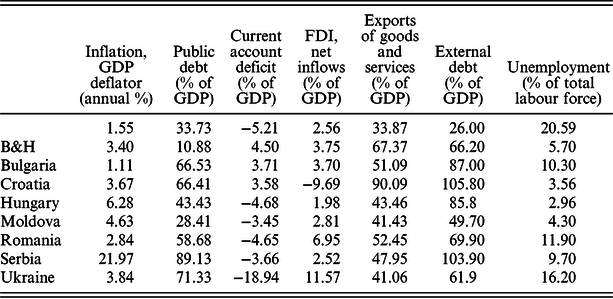
The share of external debt in GDP in 2017 in the case of Bulgaria and Hungary (Table 1) is close to the upper limit of high indebtedness of the country (80%) which is a threat to macroeconomic stability. In the case of Croatia and Serbia, the high share of external debt in GDP can be a threat to economic development and an obstacle to further growth, as it represents the economic burden that is passed on to future generations. On the other hand, the high unemployment rate results in the current budget deficit.
Basic macroeconomic indicators of selected developing countries in 2017.

From the aspect of macroeconomic stability, the current account deficit is a serious problem. In Serbia, in the analysed period, the current budget deficit is 4.65% of GDP and is predominantly financed by public debt as well as the capital funds of Foreign Direct Investments. Macroeconomic trends, in terms of reduced global liquidity and the decline in the credit rating of the countries we are looking at in this paper, complicate capital inflows and additionally aggravate the situation in all observed countries. In the upcoming period, due to the Serbian economy being highly dependent on the import of raw materials and energy, the trend of increasing imports will continue. The increase in imports is the result of an increase in domestic demand for both consumer goods and the needs of industrial production. An increase in exports and a reduction in current account deficits is possible through the increase in exports, in particular services and directing FDI into the export-oriented production.
In addition to the high current account deficits, high unemployment rates also negatively affect the level of competitiveness of the Danube region. The increase in labour productivity has reduced labour demand and caused high unemployment, which ranges from 2.96% (Moldova) to 16.2% (Montenegro) and 20.59% (Bosnia and Herzegovina).
Discussion
International trade is the most important form of international integration. A high share of exports in GDP indicates a country’s dependence on international trade and the high importance of trade to domestic development. We found that for the countries we are looking at in this article the increase in exports and imports is significantly higher than the increase of GDP, which highlights the importance of international trade in correlation with GDP.
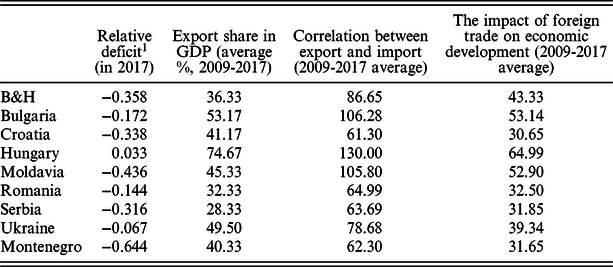
In the analysed period in Hungary, a very high share of exports in GDP was recorded, which indicates a high overall dependence on exports and imports. Among the countries we are looking at here, Serbia has the smallest share of international trade in GDP (only 28.3%) with an impact of around 32% on economic development. The results show that countries with a lower level of foreign trade openness, have significantly higher dependence on imports and a higher share of imports in GDP. However, the situation in Romania and B&H is not favourable.
The influence of foreign trade on the economy of the countries of the Danube region.

Source: World Bank and authors’ calculation.
1
Relative deficit is defined as
 ${{x - m} \over {x + m}}$
, where x is the value of merchandize export, and m the value of merchandize import.
We note that the situation is positive in the case of Hungary and that Bosnia and Herzegovina, Serbia and Montenegro show relatively high deficits.
Conclusion
All countries in the Danube region (Table 2) have made significant efforts in order to establish macroeconomic stability, limit inflation and improve the functioning of public finances. Unemployment and low product competitiveness in the international market are still present. The share of public debt in GDP in the countries of the Danube region has not dropped to the required reference values, and so they are forced to implement measures for restricting budget expenditures. A current account deficit is evident in Bulgaria, Serbia, Bosnia and Herzegovina and Moldova. In all countries, the share of
The share of exports in the GDP of Serbia is not satisfactory. The marginal value of imports is higher compared with the marginal value of exports; consequently, the imports have a major impact on GDP changes. The long-term improvement and continuous increase in exports, and the reduction in dependence on imports, would result in GDP growth. The lack of basic production inputs and the growing needs of the population cause an increase in imports of goods and services. In order to increase GDP, it is necessary to improve competitiveness, according to all indicators (macroeconomic competitiveness, investment environment, business conditions and level of development of public institutions). The results of the research indicate an increase in trade openness (an increase in exports) that dynamically affects economic growth.
On the micro level, it is necessary to ensure sustainable production and product quality growth and to promote the internal economy, increase productivity, efficiency and economy in business. In order to improve product competitiveness, it is necessary to use comparative and natural production conditions, ensure quality raw materials, work on the creation of new products, increase the utilization and modernization of processing capacities and equipment, and develop an assortment of export products.
Reducing the budget deficit and the current account deficit should be overcome by relying on the real sector of production and restrictive budgetary policies along with the improvement of business conditions, the creation of a favourable business environment and better institutional functioning. Favourable loans and tax policy should stimulate investment in restoring available production capacities and building new ones.
About the Authors
Ivan Milojević, PhD of Economics, is a Full Professor at the Military Academy of the University of Defence in Belgrade. He received his PhD degree in finance at the Braća Karić University in Belgrade. Fields of teaching and research include economic policy, financing, accounting systems with balance. He teaches at BA, MA and PhD levels. Some of the projects he participated in are: financial expertise for the needs of the Institute of Agricultural Economics and the Serbian Academy of Sciences and Arts in Belgrade; industry projects – production of ‘Lasta’ airplane and ‘FAP’ trucks; and quantitative modelling and expertise for the audit company ‘HLB DST’. He has published numerous journal articles, both nationally and internationally.
Mihailo Ćurčić, Master of Economics, is a Teaching Assistant at the Military Academy, Department of Finance, University of Defence in Belgrade. He received his BA and MA Degrees from the Military Academy in Belgrade and is a PhD candidate at the University of Business Studies in Banja Luka. His fields of interest are economic theory and politics, and finance. He teaches at BA and MA levels. He has participated in projects at the Centre for Economic and Financial Research in Belgrade in the field of economic sustainability. He has numerous publications in his field of expertise.
Valentina Jovanović, is a Teaching Assistant at the School of Management and Economics in Kragujevac. She obtained a Master of Law from the University of Business Studies in Banja Luka where she currently still pursues a PhD. Her areas of interest are business law and the legal sustainability of companies. She teaches at BA and MA levels. She has participated in projects at the Centre for Economic and Financial Research in Belgrade in the fields of law and the economic sustainability of international business under legal conditions. Several publications have resulted from the projects in which she has participated.