On March 23, 1987, two Scottish school students, Joanne Farrell and Denise Donnelly, from the county of Lanarkshire, to the east of Glasgow, appeared on national television news. The fathers of the young teenagers worked at the tractor plant owned by the US corporation Caterpillar, in Tannochside, adjacent to the town of Uddingston. Both men were involved in a worker occupation that aimed to prevent the factory's closure that had been announced to great shock on January 14. Joanne and Denise had collected signatures from their schoolmates for a letter addressed to Queen Elizabeth II. Denise told a reporter that “everybody was willing to sign it” given fears among Caterpillar workers’ children about what would happen if the plant were to shut down. Joanne explained that she was driven to organize the letter because of the impact that that impending closure would have on her generation: “We just thought that we had to do something. We need that factory there for our future. It's going to be disappearing, so we needed to do something.” The interview culminated on a humorous note after Joanne responded to a further question about her decision to write to the queen rather than the prime minister: “We didn't want to send it to Margaret Thatcher. We knew she wouldn't take any notice of it.”Footnote 1
Almost thirty-two years later, on February 27, 2019, Lanarkshire secondary school students aged between eleven and thirteen revisited the events of 1987. The children presented findings from their engagement with the “Tracks of the Past” (TOTP) project, which had devised a curriculum of lessons based on the occupation. Their contributions to a dissemination event held at the University of the West of Scotland's (UWS) Lanarkshire campus were accompanied by thoughts from academics, former occupiers, and trade union activists who had also been involved in the project. During their presentation, the students emphasized the hardship that workers and their families had endured during the occupation. They went for 103 days without wages in an effort to save 1,200 jobs. The students also referred to the longer-term effects of the loss of industrial employment in discussions on what happened after the factory finally closed late in 1987. Their reflections included inferences that Caterpillar was not an isolated incident within Scotland or globally.Footnote 2
The school students who presented their findings in 2019 were around thirty-five years younger than Joanne Farrell and Denise Donnelly. By the closing year of the second decade of the twenty-first century, Caterpillar's presence in Lanarkshire and the factory's closure was more embedded in the memories of grandparents than it was the recall of school students. But Joanne and Denise's involvement in the occupation confirms that even in the immediacy of closure, deindustrialization is a multigenerational experience. Events at Caterpillar paralleled other campaigns against industrial closures. Children and young people played a formative role in protesting the closure of steelworks in Nova Scotia during the late 1960s. Their letters to employers had a distinctive character in emphasising the threat job losses posed to their cohort's “succession” in industrial employment.Footnote 3 During the 1984–1985 miners’ strike in Britain, school children took on an autonomous role by reprising elements of industrial crowd traditions, including through throwing stones at trucks carrying strike-breaking coal.Footnote 4 These example of young people's distinctive roles in protest and sense of material interest parallel Joanne Farrell and Denise Donnelly's generational consciousness.
Bright's research from the Derbyshire coalfield in the English Midlands has suggested that divisions between strikers and strikebreakers have been passed on intergenerationally. The legacy of the strike is a form of “social haunting” that continues to shape young people's behavior, both more and less consciously.Footnote 5 TOTP developed based on the assumption that the Caterpillar factory would also be familiar through familial connections to the occupation. However, these did not materialize in the context of a reconstructed built environment and the redistribution of a geographically and socially mobile population. Most of the children encountering the occupation through TOTP were doing so for the first time. This is a scenario that will likely become increasingly typical in heritage practice as industrial history recedes from memory and more extensive economic changes affect deindustrialized areas.
In this paper, TOTP is assessed as a moment in the intergenerational transmission of industrial heritage. It contends that where “organic” connections to historical events have been broken, there is still value in “creating stories about the past” through personal and collective memories and artifacts as they relate to familiar landscapes.Footnote 6 Heritage practitioners should avoid assuming a straightforward passage of collective memories across generations. In recent years, the working-class studies scholars Tim Strangleman and Sherry Linkon have theorized the experience of deindustrialization as being dictated by a “half-life” from the premise that the effects of a long transition in economic structure are negotiated in dialogue with the remnants of industrial culture. Strangleman discusses this in terms of a “residual” working-class structure of feeling. The norms and values of industrial workplaces persist long after their disappearance. This embeds shared reference points that affirm the importance of solidarity and collectivism that can positively assist the transition toward a services economy.Footnote 7 Linkon's assessment of the half-life's impact on American literature draws attention to the structural violence of deindustrialization, enforced joblessness, and ruination in the landscape. Her perspective emphasizes the “radioactive” elements associated with elongated periods of unemployment, lost social status, and destructive behaviors such as substance abuse.Footnote 8 Both Strangleman and Linkon's approaches are beneficial in their emphasis on deindustrialization's long-term effects. Yet there is also a linearity to the half-life metaphor, which assumes a point at which it will be diminished to the point of marginality.
Historical consciousness is often highly localized, but the economic reconstruction associated with deindustrialization has led to significant population movements that have eroded the bonds that Strangleman's residual structure of feeling relies upon. These changes in economic structure have also contributed to the injustices Linkon identifies. The industrial past can be a means for community-building through a shared investment in place that extends across generational demarcations. However, these benefits can only be fully realized through approaches that incorporate a pluralistic outlook toward versions of the past and understandings of social justice. This requires a willingness to suspend didactic methods on the part of authoritative educational figures, including university academics and schoolteachers. Instead, a place-based celebration of diffusely distributed knowledges provides a more inclusive method to fully harness the resources that both younger and older generations offer.Footnote 9
TOTP was completed with a first-year secondary school social studies class in the 2018–2019 academic year. Through self-selection based on obtaining pupil and parental permission, thirteen students, just shy of half the class, were followed and analyzed. The thirteen students worked in six groups. Each group produced a “learning journey” montage that combined writing and artwork to portray what they had learned about the occupation. This paper is based on interviews and focus groups with former Caterpillar workers, trade unionists, teachers, and students involved in the project as well as diaries of the school lessons kept by the project researchers. Aside from the interviews with Caterpillar workers, which were recorded for use in public heritage activities, pseudonyms have been used to identify the participants to preserve anonymity. The testimonies and diaries are supplemented by a questionnaire that was filled out by six class parents and the students’ project work. The learning journeys were based on work involving artifacts that recreated objects from the occupation. An electronic database of archival material from the dispute was made available through iPads or Chromebooks. In addition, students interviewed former workers in their classroom. The approach was devised in dialogue with the Scottish curriculum, A Curriculum for Excellence, which emphasizes personalized learning approaches and pupils’ role as responsible local, national, and global citizens.Footnote 10
This paper is divided into four sections. In the next section, TOTP is located within the growing scholarship on deindustrialization and cultural memory before more specifically considering industrial heritage and the value of place-based education approaches in a generational context. The second section outlines the context of the Caterpillar occupation and considers how former workers constructed a politicized legacy that they wished to pass on to the students through TOTP. The third section reviews intergenerational interactions in the project, focused on engagement between former occupiers and students. A discussion in the last section critically reflects on the successes and limitations of the project, especially its findings that most students did not identify trade unionism as important to the history of the Caterpillar plant despite how important union activism was to the occupation. However, the observations on Caterpillar's global resonance and the embedding of the occupation in the Tannochside locality generate more optimistic conclusions. Shared investment in place can be a powerful force for industrial heritage to inchoate new senses of community across generational boundaries regardless of younger residents’ ancestry.
Deindustrialization and heritage
During the opening years of the twenty-first century, scholars of deindustrialization were encouraged to look “beyond the ruins” of industrial societies. A “body count” of lost jobs would not suffice in accounting for a formative economic development with profound long-term cultural consequences.Footnote 11 Global historians compelled researchers to understand deindustrialization as the product of a long series of adaptations within capitalism. This was especially important given deindustrialization's connection to intensified economic globalization and the spatial rearrangement of industrial functions by multinational enterprises.Footnote 12 Subsequent scholarship has not been universal in adhering to global historians’ view of scale, and other perspectives have underlined the importance of the nation to understanding different experiences of deindustrialization.Footnote 13
However, there has been widespread agreement among historians that the construction of meaning and memory is central to understanding deindustrialization. International Labor and Working-Class History has been at the center of this discussion. The editorial of the 2013 special edition on “Crumbling Cultures” underlined that the “passage of time allows us to understand more fully large-scale social and economic trends and to see what was missed” in earlier scholarship, emphasizing art and culture. In the same piece, the authors also highlighted the role of morality in narratives of deindustrialization. Workers rarely accepted judgements based on economic efficiency, instead explaining closure in terms of mismanagement and abandonment. These reflections were geographically embedded: The “lens of place” is powerful in molding attitudes toward changes in the built environment as former industrial sites became residential developments or hosts of service sector employment.Footnote 14 Tannochside is one of a number of examples of former industrial sites whose purpose is contested between competing political and economic forces. Clarke's analysis of the campaign for “a living memory space” on their former factory site by former Moulinex workers in Alencon, Normandy, provides a powerful example of how the aftermath of workplace closures leads to battles over physical landscapes invested with symbolic claims to recognition.Footnote 15 Clark and Gibbs's account of monuments to industry in West-Central Scotland underlines the contingencies that shape memorialization. The memorials are overwhelmingly for the male employing heavy industries of coal, steel, and shipbuilding. There is a distinction between community efforts to memorialize specific events, often with a politicized intent, and more generic local authority tributes to the industrial era.Footnote 16
Caterpillar is differentiated from Scotland's heavy industries in its multinational ownership and relative brevity. The plant's construction began in 1956, after investment was secured through UK regional economic policies that aimed to diversify Scottish industry away from over-dependency on heavy industries. It ultimately closed in November 1987, after the occupiers returned to work in April, following their reluctant acceptance of closure on improved redundancy terms. Caterpillar's presence at Tannochside across three decades can be understood as typical of American firms in postwar Scotland. By comparison, Chrysler assembled cars for fourteen years in Linwood, to the west of Glasgow, during the 1960s and 1970s. Timex manufactured watches and computers in Dundee from the late 1940s to the early 1990s.Footnote 17
The men who led the occupation at Tannochside had begun working at the plant in the mid-1960s. John Gillen served as the deputy-convener of the Amalgamated Engineering Union (AEU) branch at the factory, which represented most of the plant's manual workforce, and held the same role on the Joint Occupation Committee (JOC), which was formed to direct the dispute. He described himself and John Brannan, the dispute's leader, as among a cohort of “daft young boys” who started work at Tannochside in their late teens and climbed the ladder of the plant's union hierarchy over the next two decades.Footnote 18 Karl Mannheim's theory of generations explains that youthful “interior time” experiences are crucial to the formation of generational consciousness.Footnote 19 Rather than a simple outcome of biology, generations should therefore be understood as formed by shared cultural and political contexts. Membership may be confined by social status and geography as well as age.Footnote 20 Recent research demonstrates the value of this approach in relation to coalfield generations, differentiating Scottish miners who experienced major changes in mining technology and industrial relations between the 1940s and 1980s.Footnote 21 The oldest generation involved in TOTP were socialized during the industrial era. This grouping was largely made up of retired former Caterpillar workers and their spouses, but it also included one senior teacher and one parent.
Two younger generations were also engaged in the project. A second cohort incorporated men and women who matured between the 1980s and 2000s. These researchers, teachers, and parents had matured as deindustrialization intensified but were characterized in the TOTP context by their removal from the occupation. Members of this generation were marked by a “sense of temporal juncture” from the older cohort because they did not have memories of the occupation and had fewer long-standing connections to the local area.Footnote 22 The youngest generation consisted of the school students. They were born between 2006 and 2008. This cohort had grown up in the context of the reconstructed socioeconomic and built environment that emerged during Lanarkshire's recovery from its most intense phase of deindustrialization in the closing decades of the twentieth century. These distinctions reveal the historical underpinning of generations. Demarcations between the first and second generation were not solely based on age but were also heavily dependent on connection to place. TOTP did not include younger occupiers who began work during the 1980s, or their relatives such as Joanne Farrell and Denise Donnelly who had memories of the occupation. Generational boundaries were central to the project and authority claims over industrial heritage. Former occupiers radiated authenticity through their recall of direct experience and embodiment of a cohort “whose experience come to epitomize an event of historic and symbolic importance.”Footnote 23 The second generation shared responsibility for facilitating dialogue between the older and younger cohorts. TOTP's intergenerational dimension lay in in the shared obligations it placed on participants to enter dialogue across generational boundaries and the capacity it created for mutual learning and (re)appraisal. At the dissemination event, Gillen explained that the questions asked by the school students and the representations of the occupation in their projects had provided a learning experience for himself and other former occupiers.Footnote 24
John was among the former Caterpillar workers who established the Caterpillar Workers Legacy Group (CWLG), which commemorated the occupation's thirtieth anniversary.Footnote 25 The CWLG was preceded by the unveiling of a public monument to the occupation in 2014.Footnote 26 It is distinguished from most of the other industrial memorials in the surrounding area through its emphasis on commemorating an episode of class struggle. The occupation has been the defining feature of Caterpillar's legacy in Lanarkshire. But, as is discussed below, passing on this memory to future generations remains highly connected to locating the past within much altered economic and physical landscapes. Billy Stewart, a local folk musician, wrote a song titled “Ghosts and Memories” for an album about the occupation produced by the Lanarkshire Songwriters in collaboration with the CWLG. Its chorus reflects on the changes to the former factory site:
Now there's only ghosts and memories of what there used to be Where a factory stood there's houses nowFootnote 27
Stewart's invocation of ghosts in his interpretation of the former factory space's changing social and economic function is redolent of the half-life of deindustrialization. As theorized by Strangleman, the half-life explains deindustrialization as a long process of culturally mediated economic transition that spans several generations. Strangleman draws on Raymond Williams's work to argue that deindustrialization parallels industrialization. Customs that originated in the old order condition consciousness within the new one. This “residual” structure of feeling continues to exercise influence over conceptions of social justice and provides important cultural resources for navigating a much-changed labor market.Footnote 28 As developed by Linkon, the half-life meets the challenge of looking beyond the ruins through obliging scholars to abandon “neat [temporal] breaks and to focus, instead, on process and continuities.” These are not always positive processes, given the “toxic” nature of deindustrialization and its effects in orientating defensive and reactionary attitudes based on gender and race. Linkon's geographical focus is highly localized. She emphasizes affective “daily life” experience of ruinated landscapes, closed pubs, and abandoned factories to assess how the “personal, local perspectives frames contemporary capitalism in terms of memory and loss.” Linkon stresses the intergenerational context of the half-life's transmission, underlining the pivotal role of maturing cohorts in deindustrialized areas and cultural inheritances passed through families.Footnote 29 The half-life metaphor suggests that at some point, the industrial past will lose its power over a course of successive generations. It is useful in suggesting a long and painful economic transition. However, a less deterministic analogy is also required to understand the more selective use of the past by generations no longer “defined” by deindustrialization but who nevertheless connect with the industrial past.Footnote 30 Linkon's emphasis on cultural agency is helpful, but a more explicit emphasis on the mechanisms of the intergenerational transmission of historical consciousness and reassessment is required to advance deindustrialization scholarship.
Industrial heritage education research has revealed both the lingering influence of deindustrialization and more optimistic accounts of communities taking ownership of the past. Bright detailed the “social haunting” of the English coalfields by specters of industrial history. Patterns of territorial affiliations shaped by the politics of the 1984–1985 miners’ strike continued to characterize divisions between villages in the English Midlands, where grandchildren of miners referred to children from rival neighborhoods as “scabs” despite being unfamiliar with the details of the conflict.Footnote 31 In a later article, Bright discusses a less radioactive example of the half-life's transmission. Events to mark the thirtieth anniversary of the miners’ strike had confronted the “unspoken” impact of the conflict and provided a setting for intergenerational learning. Young men and women were able to take ownership of this past. Miners’ children and grandchildren were joined by other interested residents in these activities. These commemorations served as a heritage context that stimulated trade union activism among precarious workers and campaigns against public spending cuts.Footnote 32 The CWLG was also formed to mark the thirtieth anniversary of a 1980s industrial dispute. TOTP similarly involved younger generations, academic researcher and trade unionists, and school students in claiming a connection to the occupation's legacy.
A shared investment in evolving physical, economic, and social landscapes is a central foundation to devising place-based education though learning experiences that connect students to places and people they are familiar with. This approach is premised on understanding knowledges as varied and widely distributed, especially through privileging the value of personal memory and experience.Footnote 33 Accounts of working lives and workplace conflict are especially valuable for introducing critical perspectives in social subjects by personalizing the political.Footnote 34 Rather than simply harnessing existing connections, heritage activities can be sites of community formation by “producing meanings and affects held in common.”Footnote 35 In the Baltimore neighborhood of Hampden, “community archaeology” became a means by which racial and class barriers were renegotiated in a gentrifying deindustrialized community.Footnote 36 Wray's analysis of the restoration of miners’ banners in the Durham coalfields emphasizes the political implications of these interactions. A shared connection to former mining villages enabled white-collar trade unionists to implicate their activism within coalfield heritage.Footnote 37 The intergenerational transmission of politicized lessons that linked the development of global capitalism to their locality loomed large in the minds of former Caterpillar workers. Their heritage activities were highly contextualized by Lanarkshire's deindustrialized environment and the near disappearance of any remnants of Caterpillar's once domineering factory. TOTP was one of the means the CWLG undertook to disseminate their version of the past in a much-altered context, but one in which they felt the occupation remained an important example for younger generations.
Occupation and legacy
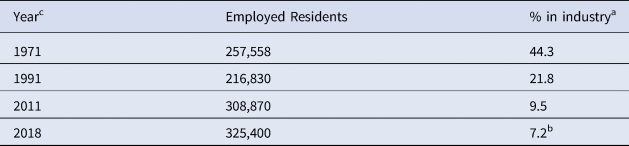
By the late 2010s, industrial employment was a relatively marginal part of Lanarkshire's economy. During the final decades of the twentieth century, the county remained highly dependent on manufacturing. The impact of economic restructuring is clearly demonstrated in Table 1, row 1. Deindustrialization exercised downward pressure on overall employment from the 1970s to the 1990s. Between 1971 and 1991, industrial employment's labor market share was reduced by more than half, falling from 44.3 percent to 21.8 percent, which was concurrent with a sharp overall reduction in employment of over forty thousand jobs. This was equivalent to nearly a fifth of the numbers employed in Lanarkshire in 1991. Lanarkshire therefore conforms to the picture of “enforced joblessness,” which afflicted deindustrializing areas within the United Kingdom and was principally experienced by male manual workers. Older men often withdrew from the labor market, incentivized by redundancy payments and the marginally higher state benefits available for sickness and occupational injuries than for unemployment.Footnote 38
Employment in Lanarkshire

Source: UK Data Service, UK Census 1971 Tables 10 and 28; UK Census 1991 Table 23; UK Census 2011 Age by Industry; UK Census Data; NOMIS Labour Market Profiles, North Lanarkshire and South Lanarkshire.
a Industry refers to mining and manufacturing sectors, except for 2011, when only manufacturing was available.
b Figures for 2018 are a total of industrial jobs in Lanarkshire rather than employment of residents.
c Figures for 1971 are for the County of Lanarkshire, and 2011 and 2018 are combined totals for North and South Lanarkshire council areas; 1991 figures are combined totals from Cumbernauld and Kilsyth, East Kilbride, Clydesdale, Monklands, Motherwell, and Strathkelvin District Councils, which were formed out of Lanarkshire County and later amalgamated into either North or South Lanarkshire.
The occupation took place amid the intensification of deindustrialization during the 1980s. Between 1979 and 1987, around twenty thousand male manufacturing jobs were lost per annum in Scotland. This became widely understood as a threat not just to the individual localities affected but to Scotland's status as an “industrial nation.”Footnote 39 The occupation entered political memory in these terms. Track Record, an account of the occupation authored by the industrial sociologist Charles Woolfson and historian John Foster, was published in 1988. In a foreword, General Secretary of the Scottish Trades Union Congress (STUC) Campbell Christie mourned the plant's closure as “a tragedy” for the workers and communities that depended on the factory. He further felt it was also tragic in “a wider sense for Scotland. Our failure to move the government to prevent Caterpillar's withdrawal gives the signal to every other multinational in Scotland that they can behave as they will without let or hinderance.”Footnote 40 Christie's comments allude to the context of the “retreat” of American multinationals from Scotland and the indifference of Thatcher's government to factory closures, of which Caterpillar was a pertinent example. The UK government's secretary of state for Scotland, Malcolm Rifkind, had prominently announced the factory as a “plant with a future” and pledged state support for a £62 million investment package in September 1986, only four months before the closure was announced.Footnote 41
Yet the long-term effects of these developments are not fully explained by falling industrial employment. Since the early 1990s, deindustrialization has continued apace, but it has not been accompanied by the same extent of labor market withdrawal. Table 1, row 1 shows significant increases in the size of Lanarkshire's workforce, but the county is increasingly characterized by suburbanization and commuting to service jobs in cities beyond its boundaries. In 2015, it was estimated that a combined total of around 120,000 people left the North and South Lanarkshire local authority areas for work every day, primarily to the cities of Glasgow to the west and Edinburgh to the east.Footnote 42 That amounts to over one third of the total workforce, a far higher proportion than that who work in what remains of Lanarkshire's industrial sectors. These changes profoundly shaped the environment in which the school students involved in TOTP have grown up in. One major impact is the remaking of Lanarkshire's landscape and economic geography through the repurposing of its physical space and redeployment of its workforce. The context of industry's marginalization was also a major driver of the CWLG's activities.
The CWLG have portrayed the occupation as a crescendo of the plant's culture of trade unionism as well as a defiant stance against a belligerent corporation and a callous government. During 2017, the thirtieth anniversary year, the CWLG undertook a large range of activities to commemorate the occupation: They made media appearances, took part in a memorial debate at the Scottish Parliament, held local exhibitions at Lanarkshire museums, made and distributed a film, organized showings of a play, and held workforce reunions. In addition, CWLG members took part in an event organized through UWS's partnership with the charity Oxfam, titled “Trade Unionism: Past, Present and Future.”Footnote 43 The TOTP project grew out of these activities, specifically through author one's involvement in recording oral testimonies at reunion events. Generational succession loomed large in the consciousness of CWLG members. Their activities presented an overtly politicized conception of heritage based on a transmission of valuable lessons from past experiences. In 2017, Gillen, who was a founding member of the CWLG, explained that that he understood legacy as differentiated from commemoration:
I think it's the name. The significance is in the title. It's not a remembrance group. It's not a lot of boring old gits sitting about remembering the good old days. The very fact it has legacy in its title says everything, and we're punting this idea that it's no been more crucial. Because the lessons we were learning as young men going into factories with experienced trade unionists are gone by and large. And where are they gonna learn this legacy? This entitlement. This right and confidence to say no. Enough's enough. It can be no to small things. It can be no to the major things. That collectively is where their power is.Footnote 44
The CWLG's reading of generations implicates the key distinction as lying between an older cohort with experience of industrial trade unionism—approximate to the first generation discussed above—and young workers and maturing cohorts, with less focus on the distinction made between the second and third generations identified in this paper. The lessons that the CWLG sought to hand down are an example of an attempt to kindle a conscious and optimistic transmission of the half-life. Past struggles act as an example for future generations. This was apparent at a reception that was organized following the commemorative debate at the Scottish Parliament on January 18, 2017. Brannan was the convener of both the plant's AEU branch and the JOC. Like his deputy, Brannan wished to underline the importance of celebrating a defiant stand: “Our 103 days was a wonderful success. Don't let it be seen as anything but a victory. It was a victory for working-class people who refused to do nothing.” Brannan articulated his view that Caterpillar had contemporary relevance by appealing to “the workers,” specifying service sector workers employed by multinationals, as well as union members in the public sector facing spending cuts.Footnote 45 Intergenerational encounters were built into the CWLG's activities, including through the UWS-Oxfam event. Here, the focus was placed on young workers who were perhaps seen as most distant from traditional union organization. Brannan and Gillen took part in a panel alongside another former shop steward and contributed to a discussion that included current union officials and activists from the “Better Than Zero” campaign, which organizes casualized hospitality workers. Bryan Simpson, a Better than Zero activist, followed the Caterpillar panel. Simpson described the occupiers as “heroes” and went on to state that the occupation represented an inspiring model for “where we need to be” in the present.Footnote 46
These lessons were strongly embedded in a sense of place. The disappearance of the million square foot plant was a source of discomfort to former Caterpillar workers. Mick Ward was a twenty-year-old production worker when the occupation began. He recalled changes to Tannochside's altered landscape in emotional terms. Mick remembered tearfully leaving his last shift and related this to longer-term developments: “Finally resigning yourself to the fact you're beat. You know it's gone. And then driving by and then you see the start of the place slowly getting demolished bit by bit. Things going, and before you know it, it's a shopping centre and a housing scheme. Sad. Sad. Sad. Sad.”Footnote 47 Mick's narrative is strongly redolent of Cowie and Heathcott's observation that large industrial workplaces inspire a powerful “aura of permanence,” which is exposed in the processes of divestment and demolition associated with deindustrialization.Footnote 48 It also demonstrates the affective relationship between history and place, which was central to the TOTP project. For the CWLG, TOTP was one of several initiatives to establish a presence for the occupation as it began to recede from living memory. This included rectifying the factory's absence from the landscape. The memorial mentioned above was one means to achieve this. In a report summarizing the CWLG's activities, Gillen emphasized the nature of the memorial: “It was not to commemorate the factory as such, but to pay homage to the men and women who fought so bravely to save the 1,200 jobs that were under threat of closure.”Footnote 49 The report also detailed that the former Caterpillar union steward and current North Lanarkshire Labour party councillor, Bob Burrows, had worked to have four streets named after the factory on a large new housing scheme, which has been built atop the former factory site. TOTP was listed in a similar vein. The project was a means to have the occupation “included as part of the school curriculum,” preserving its memory and cementing its status as a recognized part of local history.Footnote 50
Unite, the AEU's successor, acted as TOTP's trade union stakeholders in addition to the CWLG. In preparation for lesson planning, authors one and three conducted an interview with Maureen, a full-time union official with responsibilities for Lanarkshire, and Ian, a senior lay activist from the area. Like the researchers, neither Maureen nor Ian shared a direct connection to the occupation, but they had extensive trade union experience in Lanarkshire. Both Maureen and Ian were supporters of the project and enthused by occupation's potential as a means to teach young school students about trade unionism. Maureen pessimistically felt that factory closures had made unions less visible. She said that, “the history, I don't think it's really available. I think you've got to go and research it and have a look, and I would imagine most kids [wouldn't]. Where these places were, it's a new housing estate.”Footnote 51 Reflecting on discussions with her daughter, who was approximately aged with the students that took part in TOTP, Maureen specified that she felt children could articulate a sense of morality which was codified in schools:
If you speak to youngsters about what's morally right and wrong the schools do an awful lot of that with counselling and they have their own charters of bullying and harassment so kids have this understanding of “that's wrong, this is right”. But putting that, adapting that into well, when you get older, what expectations you have of how you should be treated at work.Footnote 52
Maureen paralleled Gillen in underlining that the marginalization of trade unionism could perhaps be countered by the appeal of a collectivist ethos. Ian referenced the Better than Zero campaign as an example of what he felt trade unions were doing to connect with young workers facing precarious conditions. His comments amalgamated Caterpillar as one of a number of lost industrial workplaces that had inculcated trade unionism, including Lanarkshire's coal mines and steelworks, as well as Glasgow's shipyards where his father and grandfather had worked. Ian commented that in Dalmuir and Clydebank to the west of Glasgow, children are still aware of the remaining shipyards, indicating he hoped TOTP could succeed in performing a similar role.Footnote 53 To an extent, these comments “black box” the events of the occupation and its history into utilitarian ends, which are less contingently linked to the specific practices of trade unionism and place emphasized by the CWLG.Footnote 54 This approach of instilling lessons in school students would likely also lend itself to didactic rather than place-responsive modes of education that TOTP applied. More optimistically, Ian also stated that he felt “they're no silly. Young people nowadays will pick up on what's happening.” TOTP could succeed in this view by linking itself the occupation to contemporary circumstances.Footnote 55
Intergenerational learning
Both the project team and the CWLG had imagined some sense of connection with the Caterpillar factory would be found among the students at the Lanarkshire school where the project took place. The extent of existing connections uncovered over the lessons was limited. For the most part, the project involved the formation of new connections based on shared investment in place and a sense of the relevance that the Caterpillar occupation held to contemporary economic experiences. A questionnaire was distributed to the parents of the students in the class that completed the project. Six were returned, meaning around one in five parents completed the questionnaire. The results are not therefore entirely conclusive for the whole class. But they are more representative of the thirteen children that the project followed working across six groups. Five of the six completed questionnaires were from parents of these students. Only one of the parents recalled Caterpillar's presence in the area directly, stating that: “I remember the Caterpillar factory that employed many local people. They always had a summer trip for staff and their families. I also remember the steel factory in the Motherwell area.”Footnote 56 This level of detail is significant in indicating a familiarity with the plant and its social routines, as well as an understanding that Caterpillar was part of a larger local industrial sector. The other five respondents had no direct memories of the Caterpillar factory or the occupation. Two recalled it being reported on Scottish television news.Footnote 57
The sense of removal from Caterpillar was related to the labor market developments recorded in Table 1 and typified the temporal distance from the factory felt by the generation who had matured during intensified deindustrialization. Although there were no direct questions about residency, four out of the six respondents mentioned that they were not originally from Lanarkshire. One stated that they had grown up in Clydebank, to the west of Glasgow, and discussed the town's historic links with the shipbuilding industry.Footnote 58 In addition, two of the questionnaires mentioned coal mining as an industrial heritage they were aware of in Lanarkshire, and three specified that they had visited Summerlee Industrial Museum in North Lanarkshire. Five of the six parents felt schools should be actively involved in industrial heritage, with the most developed answer specifying the importance of community linkages: “If the local industrial past can be built into the curriculum, that's good, but in the spirit of ‘it makes a village’. It's important for the local community to explore its own history.”Footnote 59
The overall picture from the questionnaires is that the assumption behind TOTP, that industrial heritage is inherently localist, was appropriate. However, given the mobility of commuter populations, it is also apparent that this is not necessarily an advantage to developing industrial heritage. Localism acted as a barrier when children attended the school from across traditional settlement boundaries, but more potently because their parents and grandparents had lived elsewhere. Whilst they may have connections with Scotland's industrial history, it did not lie in Tannochside. Moreover, there was potentially an industrial heritage “crowding out” effect. The recognition granted to Victorian heavy industries matches the pattern of industrial commemorations in Lanarkshire and across the United Kingdom.Footnote 60 Summerlee is built on the site of a famous ironworks and hosts a replica coal mine.Footnote 61 Caterpillar's thirty-one year presence in the area was comparatively short when contrasted with activities that had been a major part of Lanarkshire's landscape for most of the nineteenth and twentieth centuries.Footnote 62 Only one teacher, an older senior member of staff with a background in the area, had prior knowledge of the dispute. He had direct recollection of the occupation and was exceptional among the teachers and researchers in having a sense of interior time that was formed within Lanarkshire's industrial era. His perspective paralleled the Unite and CWLG stakeholders: “By educating people, hopefully they'll realize the benefits of being in a trade union.” Several other examples of industrial heritage were raised over the course of a teacher focus group, including Summerlee. Another example was New Lanark, a historic textile mill and UNESCO world heritage site located in South Lanarkshire.Footnote 63
In addition, the senior teacher also emphasized that social studies lessons had also profiled Tunnock's, a large local owned family firm that still manufactures confectionary close to the former Caterpillar factory site. Tunnock's employs over five hundred people in Uddingston and posted record annual profits of over £60 million in 2018–2019.Footnote 64 Tunnock's Caramel Wafer and Teacake have become national symbols alongside the soft drink Irn Bru, which is manufactured by AG Barr in Lanarkshire and outsells Coca Cola in Scotland.Footnote 65 These examples suggest the importance of industrial continuity, especially in Scotland's burgeoning food and drink sector, and provides counterpoints when discussing the heritage of contracting industries such as mechanical engineering. Crowding out was compounded by the fact that just like the students’ families, several of the teachers were not from Lanarkshire and had little familiarity with the occupation. One of the two teachers responsible for the class that completed the TOTP project was asked what they knew about the occupation and responded, “I'll be honest, I'm not from this area so, like, nothing.” They were enthusiastic about the alternative teaching approach of TOTP however, emphasizing both the value of a place-responsive method and a group project that was not reliant on dictated outcomes “I honestly think the whole making it a wee bit real to them [,the students,], making it personal, that'll really help. I think that'll be your hook, because they'll get excited that they're doing something . . . [t]hat's to do with them, that's so local, that possibly had an effect on their family. Or that they're living in a house that's been built in that area.”Footnote 66 Authenticity would be established through shared connections to place and intergenerational interaction with former occupiers who embodied the past.
The students’ work demonstrated investment in other localities and industrial heritages to Caterpillar and the Tannochside site. In preparation for completing the learning journey montages, the students filled out enquiry grids, which asked them to differentiate between people, places, and objects, and to note what they knew about the items they listed and questions they had about them. The grids acted to integrate knowledge gained from an electronic database of archival sources compiled by the research team, physical artifacts, and interviews with CWLG members in the classroom. They were used as the basis to complete a learning journey montage in groups of between two and four that would combine written and artistic representations of the knowledges of the occupation, which the students had learned from TOTP. In line with the participatory ethos of a place-based approach, the journeys’ format was decided by the groups. The only requirement was presentation: Each journey was required to demonstrate progress from “start” to “end.” In practice, not all groups adopted this method.
During the first lesson, students filled out a grid with familiar items from their community, some of which was ultimately completed as homework. Three of the thirteen students mentioned Tunnock's in their inquiry grid.Footnote 67 Debbie's grid included references to the founding of the Tunnock's factory in Uddingston during the nineteenth century and referred to the company's founder, Thomas Tunnock. She also discussed visiting the Tunnock's website and asking family members about the plant.Footnote 68 Calum's grid referred to Caramel wafers biscuit and also mentioned Mr Tunnock—the present owner Boyd Tunnock—indicating he was a well-known figure to at least some of the students, but also that the products of the factory were encountered in everyday settings.Footnote 69 Another of the students, Jenni, discussed the significance of Bothwell Castle, a largely intact medieval fortress near the town of Bothwell in South Lanarkshire, not far from Tannochside.Footnote 70 These findings corresponded with observations from the lessons. For instance, during the second lesson, one of the students was overheard announcing that Mr Tunnock “is still alive because he goes sailing with my dad.” In the same lesson, Jenni removed herself from the context of Caterpillar and Tannochside by stating: “I'm from Bothwell, there's nothing in Bothwell.”Footnote 71
Yet despite this insistence of separation, during a student focus group during the last TOTP lesson, Jenni mentioned that her mother had expressed familiarity with Caterpillar when she discussed it at home with her and that her uncle had worked there. In Jenni's context, it might be that the highly localized distinction between Uddingston and Bothwell assisted her in placing the factory in relation to other landmarks. During the focus group, she displayed knowledge of the length of the occupation and an understanding of the factory's eventual closure. Similarly, another participant in the student focus group, Aria, stated that, “My mum and my dad knew about it when it was happening. They said they knew quite a lot of people that it happened to.”Footnote 72 There was a parallel to the role the thirtieth anniversary of the miners’ strike played in the Yorkshire coalfield in discovering these links.Footnote 73 Formally revisiting the event of the occupation at school encouraged discussion at home and perhaps also legitimated the occupation as a bona fide historical event. This indicates that TOTP stimulated an intergenerational transmission by uncovering existing community knowledge. Aria emphasized the value of conversing with former occupiers who gave TOTP authenticity through its direct connection with an accessible local past. She discussed the benefits of hearing “the people's experiences with that. So, like, actually their feelings and thoughts on what's happening.” Aria singled out the benefit of hearing a woman's viewpoint, recalling that hearing from Brannan's wife, Cathie, was especially insightful: “his wife came in as well, so you got her perspective of it as well.”Footnote 74
Cathie specifically spoke to the girls in the class when she addressed a lesson accompanied by John. In doing so, she overcame an initial lack of confidence. This perhaps denoted levels of certainty over ownership to the Caterpillar story. John was wearing one of the 369 badges that were given to each occupier who stayed until the end and confidently positioned himself at the front of the classroom facing the students.Footnote 75 He introduced trade unionism in terms of a language of rights and wrongs, and also established a rapport with the students by asking if they were familiar with the Viewpark area where himself and Cathie live. But after John had finished talking, Cathie “slightly comes out from behind John. Cathie explains the hardships endured in three months in households without wages. She specifically glances at girls in the class and asks if they have any questions. Cathie also mentions she worked at Tunnock's which seems to get some familiarity and nods in the audience.”Footnote 76 In this instance, Tunnock's acted as a shared reference point that helped to encourage a commonality with the CWLG instead of creating distance from Caterpillar. John and Cathie's body language indicates the affective significance of John's experience as a trade union leader and perhaps reveals Cathie's less confident claim over the occupation's history. However, her effort to overcome nerves and keenness to speak to the girls present demonstrates the significance of “struggles for recognition” in stimulating working-class heritage activism, especially where they coincide with women's history.Footnote 77
Both efforts in self-presentation and a struggle to overcome barriers was apparent in the actions of other participants. Intergenerational dialogue constituted a significant emotional and physical undertaking. In a separate lesson, former union stewards and occupiers Bob Burrows and Jim McRobbie were interviewed by students. Bob wore a suit, which perhaps reflected his standing as a local councillor in the area, but Jim was also smartly dressed. Both men allowed themselves to be directed toward the back of the classroom where they patiently answered the questions to students who queued up, after introducing themselves to the class. A respect for the older men was demonstrated by the children who were careful to make way. This perhaps accorded to learned habits around older relatives and neighbors. Jim suffers from a degenerative illness, but despite occasionally slurring words, he was articulate and made it clear he was looking forward to meeting the students. The interactions between students and former occupiers established a common investment in place that helped to break down the distance between Caterpillar and contemporary Lanarkshire:
I note Bob is doing most of the talking in answer to questions, but Jim also provides comments, including on the experience of the nightshift. A lot of groups ask questions about poverty and survival. A girl in one group tells me about how “local shops, the Coop and a butcher” provided support for the occupation. A sense of familiarity is also apparent in the form of the visitors who link the past with the present and common local affiliations. One boy proudly tells me after speaking to Bob that “he's a Motherwell [Football Club] fan!” Another links Jim's former occupation as an electrician to his dad who's a gas engineer. But unlike Jim, his father “hates his job” which takes him “up north”, away from his wife and children.Footnote 78
Motherwell Football Club have provided a lasting connection between sport and industry. They are affectionately known as “the Steelmen” and the club crest includes a tribute to the giant Ravenscraig steelworks, which was formerly the town's dominant employer.Footnote 79 Ravenscraig's closure coincided with Motherwell's triumph in the 1991 Scottish Cup. A recent BBC Alba documentary linked the two events, demonstrating a symbiosis between the town, the club, and industry in collective memory.Footnote 80 The trend for skilled manual workers to work away from home since major industrial closures, perhaps servicing oil rigs in the North Sea, is an effect of the half-life of deindustrialization, which has resulted in a dispersal of labor across Scotland and further afield. It chimes with the experiences of former Caterpillar workers such as Bill McCabe who was trained for work in the oil industry following the occupation.Footnote 81 Cathie, Bob, and Jim helped to establish familiarity with references to the survival practices that characterized the occupation. In Cathie's case, this was influenced by her role as the manager of a household. In Bob's, it reflected his experience as the chair of the occupation's hardship committee, which tasked him with awarding scarce money to the occupiers who were most in need.Footnote 82 Bob told author three that: “all of the students asked similar questions about how we coped with no money or food. They wanted to know how they sustained themselves, how they survived.”Footnote 83
A human-interest appeal cemented the familiarity of place. Fascination with how workers’ families negotiated the predicament of going without wages stimulated the students’ interest. This encouraged a transmission of Caterpillar's history through intergenerational discussions. Some conversations appeared to indicate interest in trade union activism, especially on the last day of visits by the occupiers, when John Gillen was interviewed: “The questions John are asked seem to be well informed. He discusses the relatively good pay at Caterpillar and the role of shop stewards and the trade union with one group.” In another group, Mark and David demonstrated capacity to link the stories they had been told with the other sources, identifying Gillen and Brannan in a picture of a demonstration from 1987.Footnote 84
The six learning journeys can be grouped around two distinct vantages on Caterpillar. These reflected differing forms of engagement with the sources, but also the formation of contrasting perspectives on the meaning that should be taken from the occupation and the factory's closure. Three of the learning journeys demonstrated a localized or community understanding of Caterpillar in Tannochside. Steph and Andrew's journey reflected on what they had learned from interactions with the former occupiers: “By the end . . . [w]e also found out how hard it was to feed yourself and your family.”Footnote 85 Andrew consolidated this understanding in the focus group when he stated that his main interest in the occupation was understanding how the occupiers survived when “they didnae have any food or nothing.”Footnote 86 Jenni and Calum's work less specifically detailed the occupation, simply noting that there had previously been a Caterpillar factory in Lanarkshire which “made diggers and bulldozers” before “it got shut down.”Footnote 87
Debbie and Thomas produced the most developed learning journey written from a localist vantage. It demonstrated an integration of sources, and more directly reflected on different gendered experiences of the dispute. A paper figure of a woman was included on the learning journey and a piece of card attached reads “Hi I'm Julie and my husband lost his job. I found it hard to stay strong as we were struggling for money and we had three children.” This representation was an amalgamation of Cathie's story with Bob's. Bob was a father of three and the sole earner in the household when Caterpillar closed.Footnote 88 Debbie and Thomas's learning journey also presented an understanding of why employment was valued at the factory, commenting on the “good wages” and “best facilities of its time” that the American owners provided. The occupation itself was discussed through both a union demonstration in London—indicating interaction with the archived sources—and the use of collecting tins, which were one of the artifacts used in the classroom.Footnote 89 During the student focus group, Debbie commented that: “I liked the bit where you got to, like, meet people because, like, they were there and it's kind of like a primary source and it was quite cool to see what their experiences were.”Footnote 90 Her group's learning journey reflected these encounters. It concludes with an appraisal of the occupation's aftermath: “The workers tried everything they could, but they sadly lost. The good thing was that Caterpillar helped them find new jobs.”Footnote 91 This focus on establishing a continuity into the present distinguished this work, but in the process the interpretation perhaps jarred with CWLG members such as Bill McCabe, whose testimony presented retraining as a victory won by the occupiers rather than a benevolent action by Caterpillar.Footnote 92
An alternative perspective was provided by two learning journeys that focused on Caterpillar's multinational presence. David and Mark's journey centered on a world map that was pasted on to the journey. They had written “Location of Caterpillar plants-worldwide” above it, and marked sites in Canada, the United States as well as both Scotland and England.Footnote 93 David and Mark's understanding of Caterpillar's multinational activities was confirmed in interactions during the lessons:
The group discussed with me where various countries in which Caterpillar had factories. They told me that Caterpillar had had two factories in the UK, noting there was another in England, so this was a problem for marking the map. I said that Scotland and England were big enough to mark separately, keen that they showed this knowledge.Footnote 94
Rachel, Claire and Jamie decorated their learning journey with a drawing of a globe that had “Aroun[d] the world” written above it alongside a representation of a Caterpillar bulldozer that was colored the firm's traditional yellow. The journey rationalized closure in terms of global restructuring: “Why did the factory close? Due to the fact the company needed to close one of their factory and the Scot[t]ish factory seemed like the best idea.” This was the only mention of the Tannochside experience. Rachel's group instead focused on Caterpillar's continued international operations, detailing a recent tax controversy:
“Money: Even though Caterpillar is world famous it does not mean that they can't pay their taxes.
“The company got into a lot of trouble when people found out the well known company was not paying taxes due to some complication with Swit[z]erland.”Footnote 95
These conclusions had been drawn based on internet research that was completed on the iPads and Chromebooks, which held the electronic databases that the archival research was based on. In January 2018, Caterpillar had become embroiled in a tax case with the IRS due to the deployment of its Swiss subsidiary for tax avoidance purposes.Footnote 96 The closure at Tannochside was therefore part of a global pattern of economic vandalism.
One of the six learning journeys was exceptional in bridging perspectives in temporal and geographical terms. Aria and Julie's journey combined knowledge generated through interviewing occupiers with research on the archival sources and artifacts. Specific moments from the occupation were referred to, including a fundraising soccer match, the demonstration in London, and a letter that John Brannan sent to Margaret Thatcher. Items related to these events were contained in the archival database. References were also made to the commemorative badges worn by some of the former occupiers and the replicated “I support the Caterpillar workers” stickers that were among the objects provided. As well as providing these details on the occupation, the journey also detailed Caterpillar's continued operation around the world. Alone among the learning journeys, this work also referred to a portion of the old factory site's present-day use as a hypermarket, stating that it was “In Uddingston[,] where Scotmid is now.”Footnote 97 The learning journeys did not represent a sum-total of knowledge created during TOTP. They were decisively limiting by forcing groups to agree on content and to decide priorities. But this was illuminating in demonstrating what the groups collectively concluded was most important, whether localized or global lenses were most appropriate, and how if at all the occupation and factory closure related to contemporary circumstances.
Concluding reflections
The learning journeys demonstrated that a range of conclusions were drawn from distinct vantages in the students’ engagement with TOTP. However, there was a significant omission in the journeys given the aims of the stakeholders. Trade unionism was not overtly mentioned in any of the journeys, but the negative terminology, which has delegitimized British labor protest in recent decades, was also absent. Aria and Julie did reflect on the occupation and detailed its events more extensively than the other groups. Nevertheless, their work did not mention trade unionism itself. Instead, there was a stronger tendency toward making the “broad brushed contrasts” between eras that often typifies industrial heritage.Footnote 98 The three learning journeys that exhibited a community orientation integrated the factory into local history and noted its disappearance along with the relatively well-paid jobs that it sustained. Place was therefore crucial to grounding the occupation experience. These examples indicate an intergenerational transmission of the heritage through a shared investment in Lanarkshire. This was apparent in the ways that shared affiliations to localities enthused interactions between the students and former occupiers. Aria and Julie's explicit connection between the former site of the factory and its current usage as a hypermarket indicated a more developed sense of changes to the built environment and the labor market that are associated with deindustrialization. Nevertheless, they stopped short of a more explicit critique of power imbalances or the long-term effects of the closure after Caterpillar had left in the area. Criticisms can be levelled at the approach of the project itself in the sense that a more explicit focus on the contemporary economic environment could have been incorporated. However, the frequent orientations towards “survival” or “living through tough times” that the students were attracted to regarding the 103 days of occupation and their aftermath also accords readily with fictional and nonfictional accounts of deindustrialized areas in the United States.Footnote 99
One of the lessons began by showing the video clip of Joanne Farrell and Denise Donnelly's television appearance. Author three felt that the video had made an impression on the students after showing it to the class at the beginning of a lesson: “We chat about the video, they seem to find a source like this more accessible than still images.”Footnote 100 Joanne and Denise's absence from the learning journeys is perhaps explained by the fact that none of the visitors had been children during the occupation. As demonstrated in the previous section, the students placed value on hearing directly from participants in the occupation. During the final visit by John Gillen, queues of students had to be organized to allow them to ask questions that were often triggered by the artifacts or archival sources.Footnote 101 Dimensions of synthesizing were also apparent in the learning journeys, especially Aria and Julie's, which explicitly linked references to the archival sources with the memories of occupation participants.Footnote 102 During the student focus group, Debbie indicated that she would have felt there was benefit from speaking to people who were children at the time of the occupation: “Maybe some, like, who were children at the time. Maybe not, like, the oldest people but not the youngest either. Like, people who their mums and dads lost their jobs or things like that would be quite interesting to hear [from].”Footnote 103 Given the intergenerational focus of the project, this was a weakness that precluded greater consideration of the closure's long-term impact and overlooked recent research's emphasis on the effects deindustrialization has upon children.Footnote 104 On the other hand, Cathie's contribution was valuable in illuminating women's experiences, which were present in Debbie and Thomas's learning journey and Aria's focus group contribution.
Jenni's dialogue in the focus group indicated that she had drawn conclusion from the Caterpillar experience that had contemporary resonance regarding employment conditions and class power:
Jenni: Yeah, not so much but, like, I understand that things like that could happen. Like, before I wouldn't think that would happen, I'd just think you lost your job because you didn't like it.
Author three: Ok.
Jenni: But it gave me a wider range of how you could lose your job.
Author three: And that that could still happen today?
Jenni: Yup.
Whilst Jenni's comments did not allude to trade unionism, they certainly indicate an understanding of workplace power imbalances. The learning journeys that considered Caterpillar's contemporary operation developed these themes further. This was especially apparent in the focus on tax avoidance cases in Rachel, Claire, and Jamie's work. Their research demonstrated independent initiative that achieved a connection with contemporary circumstances and questions of social justice. The awareness of capital mobility and Caterpillar's continued international presence shown in David and Mark and Aria and Julie's journeys aligns with the emphasis on international investment and divestment patterns that global historians of deindustrialization have emphasized. With parallels to Cowie's account of RCA's entrance and departure from Bloomington, Indiana, Caterpillar provides an exemplar for patterns of capital accumulation and labor conflict.Footnote 105 In both David and Mark and Rachel, Claire, and Jamie's accounts, Tannochside was merely a springboard to illuminate cross-border economic processes. Contrastingly, Aria and Julie developed a more sensitive account of the occupiers’ activities and centered the site's transformation. Rachel's group indicated some tentative steps toward including information on the housing scheme built atop the former factory site. This was evident from their inquiry grids and the fact they had cut out pictures from a brochure advertising the homes in preparation for making their journey.Footnote 106 Yet their decision to focus on a discussion of Caterpillar's contemporary situation was a significant choice. These conclusions validate the TOTP focus on Caterpillar despite its distance from the daily lives of the students and contemporary identities within Lanarkshire. Unlike Tunnock's, Caterpillar offered a vantage of rupture that exposes the contingency of industrial production and the questions of social (in)justice raised by multinational divestment.
TOTP demonstrated the challenges and opportunities that heritage education offers academic researchers, teachers, and former workers as the industrial past begins to recede from human memory and the built environment. Major final closures of steel mills, factories, mines, and shipyards now often lie three or four decades in the past within former industrial regions of Western Europe and North America. Those areas have often experienced wholesale economic reconstruction and significant population movements that have contributed to the reimagining of place. These changes have disrupted the transmission of collective memories that formerly created a symbiosis between industrial activities and local identities. In the course of TOTP, not one but two generations were discovered that had little to no direct connection to a local factory that closed in the late 1980s. The theorization of the half-life provides scholars with a means to conceptualize deindustrialization as an ongoing cultural as well as economic process. However, the metaphor is perhaps unhelpful in suggesting a naturalized, gradually fading influence. Cultural agency is highly contingent, as demonstrated by the CWLG's activism and the engagement of trade unionists, academics, schoolteachers, and students in TOTP. The conclusions drawn in the learning journeys indicate the power that industrial heritage can hold where deindustrialization is not immediately recognizable in the surrounding landscape.
Where connections to now distant industries proved unable to kindle connections between the oldest and youngest generation, place provided shared reference points. Residency gave all of those school students who were followed a connection to an industrial dispute which happened nearby. The discussion of these events at school also uncovered some latent connections to Caterpillar that were not previously known. This inverts traditional rationales for industrial heritage based on assumed familiarity, but it also suggests additional value to giving working-class history bona fide official recognition. TOTP's consciously intergenerational dimensions were built on a radical recognition of the dispersal of knowledge. As a place-responsive education project, experiential knowledge was privileged. The students regarded the interviews with former occupiers as enlivened moments of contact with authoritative custodians of local history who embodied the human experience of job loss and survival without wages during the occupation. Yet the engagement of three generations in TOTP also represented a handover of authority regarding the occupation's legacy. The CWLG participated as stakeholders with representatives of younger generations of trade union officials, teachers, academic researchers, and school students. It became clear from the learning journeys that the pupils had not drawn identical conclusions to one another or simply absorbed the CWLG's perspective. On the other hand, they also demonstrated that industrial heritage's power lies in its draw as a local past and an exemplar of global patterns. As industrial heritage is passed on to a third generation after deindustrialization, its continuing appeal may rest on its effectiveness to perform these roles.