Visitors to the eastern Canadian regions of Prince Edward Island (P.E.I.) and les Îles-de-la-Madeleine (the Magdalen Islands) often comment on the shared palette that colors these two island communities: rolling green hills, red sandstone cliffs, red and gold beaches, and bright blue-green sea. Discerning listeners might also pick up on a common vocabulary of nautical terms mixed with old French words in the local dialects of French-speaking Acadians, a nod to a way of life that remains at the forefront of the islands’ numerous rural, seaside communities. Visitors to both islands are greeted by the large Acadian flag, the French tricolor with a gold star (Stella Maris), displayed on the exhaust stack of the ferry that shepherds tourists and locals between the islands, a symbolic acknowledgment of a shared past and increasingly prominent connection between P.E.I. and les Îles-de-la-Madeleine. Acadian flags, too, are painted on telephone poles along the main street of Souris, the eastern P.E.I. town where the ferry lands, a curiously explicit symbol of Acadian heritage given that this town is predominantly Anglophone, with but a small Francophone community. The visibility of the flag in this liminal space of ferry terminals and Gulf crossings suggests a common interest in asserting a sense of pride in the town's Acadian heritage and an acknowledgment of a strong connection between P.E.I. and les Îles-de-la-Madeleine.
The Acadian residents of these two island communities are descendents of the first French colonists in eastern Canada and share a socio-political history that is traced to le Grand Dérangement (the Great Upheaval), the deportation of thousands of Acadians from eastern Canada between 1755 and 1763. The geographic location of the islands, their subsequent political affiliations, and divergent cultural retentions have shaped different experiences of what it means to be Acadian. Nevertheless, a renewed interest in shared identity, new economic alliances, and joint cultural activity has emerged in recent years, fostered largely by the young musicians of the Acadian group, Vishtèn.Footnote 1 Vishtèn is a three-member group comprising twin sisters Emmanuelle (whistles, bodhrán, vocals, piano, and dance) and Pastelle LeBlanc (accordion, piano, vocals, and dance) from the village of Mont-Carmel in the Région Évangéline, in western P.E.I., and Pascal Miousse (fiddle, mandolin, guitar, and vocals) from the island of Cap-aux-Meules, in les Îles-de-la-Madeleine.Footnote 2 Since the group's inception in 2000 these musicians have traveled broadly, playing in concert halls and various folk, Celtic, and Francophone music festivals throughout Europe and North America. The group performs and promotes what its members call their brand of “new-traditional” Acadian music and has released three independent recordings, with a fourth recording anticipated to be released in 2012.Footnote 3
Through their strategic musical, narrative, and marketing choices, members of Vishtèn have striven to advance the project of a “pan-Acadian” identity, which has resulted in increased tourism throughout the region and contributed to ongoing processes of Acadian cultural revival. Furthermore, the strategic marketing of the group's music as French, Acadian, and Celtic enables them to identify and be identified with disparate musical communities, thus broadening their audience base and facilitating their participation in a wide range of performance contexts.
Francophone culture on P.E.I. and les Îles-de-la-Madeleine
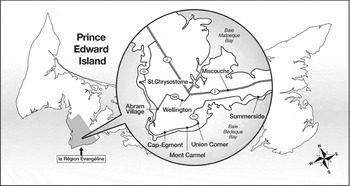
Many people are surprised to hear that French is still spoken by Acadians on Prince Edward Island.Footnote 4 Indeed, Canada's smallest province is better known for Anne of Green Gables and potatoes than its Francophone culture. A process of anglicization began in the late nineteenth century as a result of increased assimilation of the Acadians by the Island's Anglophone population. This process has persisted to the present day. Of the Island's population of 136,000 people, 4 percent—roughly 5,400 people—identify as Francophone Acadians, whereas nearly 23 percent claim French or Acadian ancestry. Of the small Francophone population, approximately 2,500 people reside in numerous small, rural communities in the Région Évangéline (the Evangeline Region) of western P.E.I. (Figure 2),Footnote 5 the only region of P.E.I. where Francophone Acadian culture remains predominant. The effects of increased anglicization over the past century are felt in various forms, including the loss of French language and the anglicization of some family names, a localized French dialect that blends a vernacular French with English, and a prominent Scottish influence in the Acadian instrumental repertoire. P.E.I. Acadians have had to engage in a collective struggle to retain their French language, dialect, and traditions in an increasingly anglicized and modernized environment. By comparison, Acadians of les Îles-de-la-Madeleine comprise the cultural majority and have retained their linguistic and cultural traditions to a greater degree.
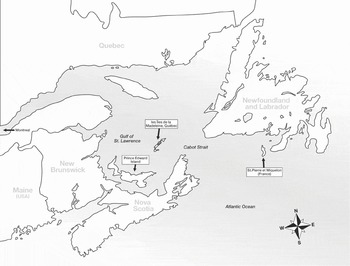
Known affectionately as “les Îles” or “the Maggies,” the archipelago of les Îles-de-la-Madeleine lies 65 miles (105 km) north of P.E.I., in the center of the Gulf of Saint Lawrence (Figure 1).Footnote 6 Although les Îles are under the administrative control of Québec and marginally closer to Nova Scotia than they are to P.E.I., the archipelago is accessible only by ferry from the town of Souris, at the eastern tip of P.E.I., by a multi-day cruise from Montreal, or by airplane. Today the population of les Îles is 13,000 people, 95 percent of whom are Francophone. The majority of the madelinot Footnote 7 Anglophone population, which is largely of Scottish descent, lives in small communities on the islands of La Grosse-Île and l’Île d'Entrée.Footnote 8 As the cultural and linguistic majority of the islands, the Francophone Acadians of les Îles enjoy a situation distinct from other Acadian communities. The relative isolation of les Îles-de-la-Madeleine and linguistic support from Québec have resulted in less encroachment from the dominant Anglophone presence in eastern Canada, and the islanders have experienced, for the most part, an uncontested preservation of their French Acadian dialect and culture.
Fishing is still a mainstay of the madelinot economy although les Îles have experienced challenges similar to elsewhere in Atlantic Canada with regard to a lack of jobs, a declining fishing industry, a consistent exodus of youth, and aging populations in recent years. Mirroring trends in other Maritime communities, particularly P.E.I., residents of the archipelago have confronted these obstacles by promoting cultural tourism and ecotourism, both of which are emerging as major industries in the region.
Musical Encounter, Musical Alliances
In the prologue of his book, Routes: Travel and Translation in the Late Twentieth Century, James Clifford contemplates what he describes as the “predicament of modernity”: a world of people and things in transit, a world “increasingly connected but not homogenous,” a world of encounter.Footnote 9 He writes,
Virtually everywhere one looks, the processes of human movement and encounter are long-established and complex. Cultural centers, discrete regions and territories, do not exist prior to contacts, but are sustained through them, appropriating and disciplining the restless movements of peoples and things.Footnote 10
Map of Atlantic Canada and Maritime Québec. (Map by Wilco van Eikeren)

Detailed map of the Région Évangéline, P.E.I. (Map by Wilco van Eikeren)

Musicians are active participants in the complex world evoked in Clifford's travel metaphor, connecting their music and communities to broader cultural networks. In Maritime Canada, touring musicians from the region's Acadian communities increasingly promote and, to borrow Clifford's term, “translate” their ideas of what it means to be Acadian to an increasingly globalized audience through intricate regional, transnational, and transcultural webs of exchange and cultural alliances.
Recognizing the need to examine the interactions, convergences, and crossing that make up social and musical experiences, ethnomusicologist Beverley Diamond sets out the case for an alliance-centered methodology that offers a particularly useful perspective through which to understand how people create and perform meaning. This approach illuminates the interpersonal connections among people and between communities that inform our sense of selfhood and shape how identities are enacted through cultural markers such as language and music. As she explains,
[Alliances studies] might look at ways that concepts and social relationships of the past are embedded in the present. Alliances studies might track connections to places, or networks of people. Such a focus would shift our attention [from “identity studies” centered on individuals and bounded communities] to such things as genre formations, technological mediations, language and dialect choices, citational practices, and issues of access and ownership.Footnote 11
Following Diamond's characterization, alliances might encompass a wide variety of associations, from direct interpersonal relations to technologically-mediated connections; the latter, in particular, has become increasingly significant for many artists, not least for the so-called “traditional” musicians with whom I work, as the potential audiences for their music are mobilized and maintained via online communities and social media. The increased reliance on such media by folk music groups is exemplified in a recent online fundraising drive launched by the group Vishtèn to help support the production, manufacturing, and promotion of a new album. The group's “crowdfunding” campaign invites the broader community to contribute to the album in exchange for various rewards, including early digital and physical releases of the album, a tune book, Skype music lessons, a bodhrán, recognition in the album credits, handmade mittens, and a house concert. To further entice participation in the campaign and to include contributors in the recording process, the group regularly posts updates, photos of the recording process, and “sneak peeks” of new tracks on their blog and Facebook page.Footnote 12
Vishtèn's group identity centers on an affinity between Acadian communities on P.E.I. and les Îles-de-la-Madeleine. This connection is voiced in their dialogue with audiences and media, as well through their marketing strategy as a “pan-Acadian” group. Writing about the construction of pan-ethnicity at “ethnic festivals” in the United States, cultural geographer Michael Hawkins notes:
In response to the economic lure of tourism and the desire for increased visibility to outsiders, previously marginalized groups may reconstruct their identities, often by merging with other groups under a common “pan-ethnic” identity. Pan-ethnic identities require a common interest, often political or economic, and a system of cultural symbols that are selected or invented to serve as a “cultural umbrella” for the varied groups united under a pan-ethnic label. Pan-ethnicities are sometimes so fluid and tenuous that festivals may become the primary symbol of common identity.Footnote 13
Although the “pan” label highlights the members’ inter-island Acadian connections, the term falls short of the emphasis on the merging of distinct ethnic groups that lies at the center of academic definitions of pan-ethnicity in the context of Vishtèn. At the same time, the group retains the elements of “politico-cultural collectivity,” self-definition, and commonality highlighted by scholars of pan-ethnic movements.Footnote 14
Regardless of their basis of affinity, “pan-” movements involve the creation of new boundaries and a perception of solidarity.Footnote 15 Vishtèn asserts a specifically joint identity by highlighting the shared history of their communities, cultural origins, and contemporary supraethnic symbols (such as dialect, flag, and musical elements). At the same time, the group's articulation of “pan-Acadianness” is highly localized and does not, in fact, link to the broader Acadian community in eastern Canada. Situated in their discourse of sister islands, Vishtèn sonically and discursively promotes an expressly Island Acadian identity distinct from that of mainland Acadians. This notion of a shared musical identity is increasingly celebrated within their communities. As ethnomusicologist Benjamin Brinner suggests in his study of Israeli-Palestinian musical encounters, however, artistic networks are often motivated and operated independently of the particular socio-political circumstances in which the musicians live and perform.Footnote 16 Indeed, whereas the members of Vishtèn accept and participate in furthering their roles as culture-bearers, educators, and advocates for the island communities, particularly the francophone populations, these musicians did not embark upon their musical journeys with that goal in mind, nor do they necessarily consider themselves part of a larger, political, pan-Acadian movement. This point suggests that networks are not necessarily formed in response to or as a result of conflict, but are better understood as arising through individual agency and artistic sensibilities. At least subconsciously, however, contemporary perceptions of the Acadians’ tumultuous history and ill-fated position in the Old World conflicts contribute to the ways in which Vishtèn articulates the island connection and affirms its members’ places in the world. The musicians acknowledge their role as a bridge between the island Acadian communities and understand that their touring and visibility on national and international stages has brought recognition to less well known Acadian communities in eastern Canada.
Narratives of Encounter
Hundreds of years before permanent settlements were established on the islands, both P.E.I. and les Îles were used by indigenous Mi'kmaq, Basque fishermen, and European explorers as stepping stones to the mainland, as hunting and fishing grounds, and as places of refuge from shipwrecks and the harsh Atlantic weather. Beginning in the seventeenth century, P.E.I. and les Îles were linked through land concessions from the French crown to New World entrepreneurs. The first notable contact between the two island regions occurred after le Grand Dérangement when, between 1755 and 1762, small groups of Acadians from mainland Nova Scotia, Cape Breton Island, and P.E.I. sought refuge from exile on les Îles-de-la-Madeleine. The large-scale deportation of mainland Nova Scotia Acadians in 1755 has largely overshadowed these smaller-scale events in scholarly and popular accounts of Acadian history. This widespread awareness of the 1755 exile is due in large part to the popularity of Longfellow's epic poem “Evangeline” (first published in 1847) that captured the imagination of Acadians and non-Acadians around the world.Footnote 17 Historian Earle Lockerby notes that the poem “imparted a romanticized quality” to the 1755 deportation that has endured. The exile, in particular, has become a cornerstone of Acadian identity and an important link for communities throughout the global Acadian diaspora. The continuing importance of Longfellow's fictional heroine to many Acadians is exemplified by myriad scholarly writings, stories, songs, monuments, and historical reenactments.Footnote 18 There is no doubt that the deportation plays into contemporary manifestations of Acadian identity to varying degrees. Nevertheless, it is debatable whether their exile is, or has even been, the defining factor of the Acadian people. Although the deportation has dominated the complex Acadian historical saga, my research suggests that there are other, more tangible events and connections that occupy many contemporary Acadians’ experiences and those of their immediate predecessors; it is these connections that are more commonly expressed among Acadians and in their musical practices.Footnote 19
In 1760, British Colonel Richard Gridley was awarded les Îles-de-la-Madeleine as spoils of war and gave the archipelago its English name, “the Magdalen Islands.” Saddled with the task of establishing a permanent settlement on the islands, between 1762 and 1765 Gridley recruited a small group of Acadians and their families who had successfully avoided deportation from P.E.I. or who had returned to P.E.I. from exile.Footnote 20 Following the deportations and the subsequent re-amalgamation of the Acadians in eastern Canada, P.E.I. and les Îles were united by missionaries, a Catholic diocese (based in Charlottetown, P.E.I.), the exchange of priests and doctors, and a number of inter-island marriages. Often referred to as Canada's Florida Keys, in recent years les Îles-de-la-Madeleine have emerged as a popular holiday destination for many nearby Prince Edward Islanders and mainland Québécois. Given the relative proximity of the islands, it is not surprising that, today, P.E.I. is a center for replenishing supplies, education, work, medical services, and cultural exchange between the islands.Footnote 21
Musical exchange between the two locales is not new. The madelinot group Suroît played regularly on the islands beginning in 1992 and has maintained strong personal and professional/performing relationships with P.E.I.'s francophone Acadian community. Former Suroît fiddler Bertrand Déraspe, arguably les Îles’ best known exponent of traditional music, is invited frequently to perform and give workshops in the Région Évangéline. The group's current fiddler Félix LeBlanc cites P.E.I.'s beloved fiddler Eddy Arsenault's recordings and repertoire as a major influence on his own playing, even before LeBlanc first visited the Island. Moreover, since 1998, several P.E.I. Acadian musicians and groups have performed on les Îles and participated in formal Québec-P.E.I. artistic exchanges.Footnote 22
In spite of this history of exchange, my conversations with young Madelinots suggest that a sense of cultural connectedness with Francophone Acadians on P.E.I. has emerged only within the last decade. One musician who divides his time between his home in les Îles and visiting friends in the Région Évangéline explained that he had been unaware of P.E.I.'s small but vibrant Francophone community and had had no reason to venture to the western Francophone pockets of the Island until a musical connection to Vishtèn brought him to western P.E.I. in 2008. Nonetheless, the apparent lack of awareness of a shared Francophone culture between western P.E.I. and les Îles among younger generations is beginning to dissipate as a renewed interest in developing inter-island partnerships has begun to take form, which many islanders with whom I spoke attribute to being fueled by musical practices. Acadians in the Région Évangéline note a marked increase in madelinot visitors to the region, a development they claim stems from touring P.E.I. artists and music-centered exchange. As I discuss below, Vishtèn's promotion of historical links and shared identity between the island populations has fostered various patterns of exchange that have bubbled over into the economic sector.
Vishtèn's Musical Style
The solo, percussive sound of Emmanuelle's tapping feet fills Crapaud's packed community hall. Fiddler Pascal joins in, playing a rough, rhythmic eighth-note ostinato accompaniment that emphasizes the off-beat. The accordionist, Pastelle, playing a large piano accordion, eases into “La Route 11,” a reel that she composed in honor of the shoreline road (Route/Highway 11) that passes through her home village of Mont-Carmel, in the Région Évangéline, P.E.I. The groove is infectious. We're no more than sixteen beats into their first set and there aren't any still bodies in the audience. After a repeat of the “A” section of the reel, and without missing a beat, Emmanuelle takes over the melody on her penny whistle, Louis-Charles joins in on guitar, and the accordion switches to a rhythmic drone. The whistle's timbre and ornamentation give the tune a distinct Irish flavor, yet I can't seem to put my finger on an accurate descriptor of the overall sound; closing my eyes, I can picture myself simultaneously at a session in Belfast and an Acadian party de cuisine (kitchen party) in the Région Évangéline.
I don't have time to dwell on this thought. As seamlessly as they entered, the accordion, feet, and whistle have dropped out, and Pascal moves into a mesmerizing blues-inspired fiddle improvisation, with the guitar maintaining a heavy “dum-chick” accompaniment. After a minute or two, Pascal transitions effortlessly into a lively madelinot reel on the fiddle. Meanwhile, Emmanuelle has crossed the stage behind Pascal and Louis-Charles and is now chording on the keyboard. The accordion joins the fiddle, at times playing in flawless unison, and at others providing the harmony. There is an abrupt pause and the accordion transposes the tune to a bright, major key. The tune ends with Pascal on fiddle and Pastelle on accordion at center stage, playing off each other's melody and ornamentations. The remainder of the concert highlights the multi-instrumental faculties of each musician as they move effortlessly between instruments, step dancing, Acadian danse assise (seated step dancing), and haunting vocal melodies. Footnote 23
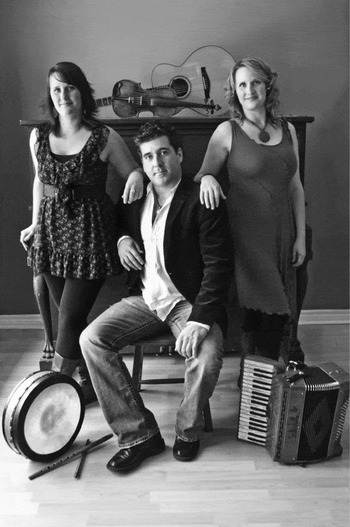
Vishtèn, 2011. (Courtesy of Vishtèn)

The group's musical style defies easy delimitation, with a sound that embodies their musical imagination and sophisticated tastes, and incorporates their various influences and new ideas, all the while retaining what they call the “essential Acadian spirit of their roots.”Footnote 24 As the group's accordionist, Pastelle, explains, their “sound is essentially Celtic, but with a difference.”Footnote 25 The songs are sung in French, either by a band member alone or in three-part harmony. At times seated foot percussion drives the rhythmic playing of the fiddle, but it is restrained in the gentler musical moments that are captured by haunting vocals and whistle melodies. Although fiddle, piano, and guitar are main components of the group's instrumentation, the group's members also highlight a variety of conventionally “Celtic” instruments not generally associated with Francophone Acadian culture, such as the accordion, penny whistle (in the keys of D and G), bodhrán, jaw harp,Footnote 26 and mandolin. Recently, the banjo, slide guitar, and Peruvian cajón (a box-shaped percussion instrument) have joined the mix.
Pastelle links the “difference” in the group's sound to the elements of older Acadian practices from both P.E.I. and les Îles that pervade their music. Podorhythmie, the seated foot tapping, provides the rhythmic background to their performances, either alone or in conjunction with guitar, jaw harp, or bodhrán. On occasion, elaborate variations on a basic eighth-eighth-quarter note foot tapping pattern (“tic-a-tac, tic-a-tac. . .”) combined with modified steps borrowed from step dancing—together known as danse assise (seated step dancing)—are included, adding rhythmic and visual variation.
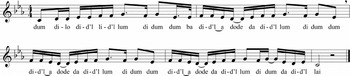
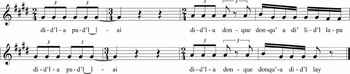
An older practice of turlutter (“mouth music”) also features prominently in Vishtèn's repertoire and is often interspersed within actual song texts. Local lore throughout Acadie and in Québec suggests that the loss, necessary abandonment, or destruction of musical instruments during the exile resulted in the prevalence of a cappella song genres in much of the early Acadian music for most of a generation following the expulsion.Footnote 27 In the Francophone regions of P.E.I., this tradition is called djigger (“to jig”) or touner (“to tune”), words used to describe the practice of singing fiddle melodies with full rhythmic nuance.Footnote 28 The source of the vocable patterns in Vishtèn's music varies from song to song; some patterns are newly composed by the group (Example 1), whereas others are adaptations of traditional, unaccompanied turlutte (songs comprised entirely of vocables) that are learned from archived sources (Example 2). As with traditional instrumental pieces and songs that the group has retrieved from public archives, the older turlutte are often included as a sort of bridge within a song with added instrumental (and podorhythmie) accompaniment. The group's original turlutte frequently employ syllable patterns that are similar to older Acadian turlutte patterns, such as “did'l” and “da”.
Example of turlutte learned from an archived source. Excerpt from “Turlutte (Trad.)” from track “La Femme jalouse” on 11:11 album. (Transcription by author).Footnote 29

Example of original turlutte composed by Vishtèn. Excerpt from “L'esprit du bon vin” track on LIVE album. (Transcription by author).Footnote 30

The syncopated lilt in fiddler Pascal's madelinot style reveals the group's Acadian roots; yet his playing also reveals his forays into various musical styles, including rock, soul, and folk genres. Pascal is widely recognized on P.E.I. and les Îles for his charismatic fiddling and the ease with which he personalizes tunes through the use of double-stops (chords), arpeggiated figures, and percussive bowing techniques. Whether on the concert stage or in the private context of a house party, Pascal often incorporates extensive improvisation in his interpretation of tune melodies, alternating between playing the basic tune and percussive bowed chords (similar to a “chop”Footnote 31); these melodic interpretations are accentuated by techniques that are less commonly heard in the region, such as spiccato (bouncing the bow), pressing the bow lightly on the string to produce an “airy” sound,Footnote 32tremolo, harmonic slides, sul ponticello (playing on the bridge), pizzicato, and sul tasto (playing on the fingerboard). Pascal also uses a reverb and looping machine on occasion to add a variety of other effects.
Moreover, a technique known as the “shuffle” features prominently in Pascal's playing. The “shuffle” is a bowed technique created by dropping or not sounding particular notes, thus producing a syncopated rhythmic feel that gives the impression that the weak beat is accented; this technique is also described by some fiddlers as a “stutter” or “hiccup.” Interestingly, this style of fiddling evokes the rhythmic playing style characteristic of older Acadian fiddlers on P.E.I., although the technique has largely gone out of practice on P.E.I. over the past fifty years.Footnote 33 This regional “shuffle” style is similar to bowing techniques found in southern U.S. and bluegrass fiddling traditions, but there is not a clear connection between these and the Acadian “shuffle” in eastern Canada. Although the origin of the “shuffle” style in eastern Canada is not known, several fiddlers with whom I spoke had their own theories, such as the transmission of tunes via radio broadcast that often resulted in dropped notes or incomplete mastery of tunes due to the difficulty of learning tunes in this manner. For example, one older madelinot fiddler described how, when he was younger, he would listen to weekly broadcasts of Cape Breton fiddler Winston “Scotty” Fitzgerald on the radio (via Cape Breton) at a neighbor's house. As he explained, he would listen to one tune and then immediately run home through the fields to try it on his fiddle, hoping desperately that he remembered the tune (often using turlutte or other mnemonic devices) when he arrived home.Footnote 34 Other local theories I have heard are somewhat more fanciful. Louis-Charles Vigneau recounts a popular belief on les Îles-de-la-Madeleine that the rhythmic pulse of a fishing boat engine can be felt in the lilting cadence of the fiddle:
[The “shuffle” is] typical in the Magdalen Islands. An old fiddler once told me that because of the fish . . . the fish bring people to the Maggies. And the men from the beginning were sailing and working on boats. Little ones to bigger [ones] like today. You know that kind of roll you have on the sea? Sometimes bad weather, sometimes calm. A guy from . . . home told me that in the fiddle style, the rolling too was associated [with] the sea. Because many fiddlers were looking out the window to the sea and playing, just trying to forget about the bad day they had, but they still have the rolling in their heads when they come back from the sea. [He imitates the rhythmic sound of a fishing boat engine.] So, always rolling. And also [the fiddlers] move a lot, like the bounce of the waves.Footnote 35
This connection to the sea expressed in this narrative is not surprising given the centrality of sea-faring life for many Acadians on les Îles and P.E.I. In our interviews, Acadians in rural P.E.I. (such as the Région Évangéline) frequently mentioned the sea as inspiration for their art and, although the fishery holds a largely symbolic meaning for many contemporary islanders in Atlantic Canada, it remains a unifying element of Acadian identity and music.
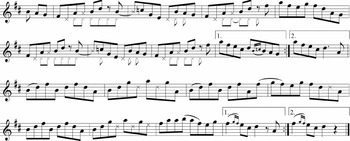
A transcription of the tune “Shédiac Bridge” (Example 3) illustrates Pascal's use of the “shuffle” bowing. Notes played with a suppressed bow stroke are notated with alternate note heads.
“Shédiac Bridge” composed by Pascal Miousse; as played on Vishtèn LIVE (2008).Footnote 36

Drawing on the performance features noted above, Vishtèn reinforces a distinct Island Acadian musical style that has been embraced by fellow islanders. A perceived affinity between the two musical communities is often brought up in conversation and was described to me by one musician as a shared “Acadian feel” that is “true to its Frenchness.”Footnote 37 This notion is extended to perceived connections between their respective histories, dialects, dispositions, and ways of life. Inspired by the charismatic fiddling that is at the forefront of Vishtèn's performances and increased exposure to other madelinot fiddlers in recent years, the “shuffle” style is being picked up by a younger generation of P.E.I. Acadian fiddlers and has re-entered the region's popular consciousness as a shared feature of island Acadian culture, reaffirming this stylistic feature as a part of the Région Évangéline's musical sound.
Vishtèn's repertoire of songs and instrumental tunes is drawn from archival collections housed at the Centre d’études acadiennes in Moncton, New Brunswick, and from a large body of new Acadian tune compositions from P.E.I., to which members of Vishtèn have contributed their own compositions, at once drawing from and helping to create these archives.Footnote 38 The older repertoire is given new life with contemporary arrangements; as Pastelle explains, they aim to interpret the songs in their own style, influenced by older musical forms but not copying them.Footnote 39 Moreover, although older elements like the seated foot tapping, turlutte, and “shuffle,” as well as adaptation of repertoire from Scottish, Irish, and local Acadian traditions are easily recognizable in Vishtèn's performances, they serve primarily as a screen on which to project their own ideas. In a similar vein to other touring groups that are known to stretch the boundaries of “traditional” music (e.g., the Canadian groups La Bottine Souriante, Suroît, Le Vent du Nord, and the McDades) but in contrast to other local Acadian musicians and groups (such as P.E.I.'s BarachoisFootnote 40), the group's confluence of musical styles eludes the bounded definitions of the traditional genres from which the musicians have drawn inspiration and repertoire. Thus, in contrast to what folklorist Dorothy Noyes calls the “old paradigm” of folk music in which people are bearers but not makers of tradition, Vishtèn emerges as both bearers and makers of a localized Island Acadian tradition.Footnote 41 As the group produces new albums featuring a growing number of self-composed tunes, turlutte, and songs, and increases the scope of its tours, it is venturing further from older, “traditional” forms; fiddle improvisations, rhythmic deviations, blues chords (instead of more standard major and minor chord progressions), and new combinations of instruments are increasingly important signifiers of the group's sound.
Vishtèn's choices of genre, instrumentation, style, and language reflect what Diamond terms “strategies of alliance” and serve to position the group within a specific cultural framework.Footnote 42 The view of Vishtèn's music as rooted in the past generation and, to varying extents, representative of older, shared musical forms is increasingly circulated in the two island Acadian communities. Nevertheless, the group's musical choices are not without their critics, some of whom see Vishtèn's instrumentation, Irish influence, improvisational inclinations, and fusion of genres as unrepresentative of local traditional music. These critiques reveal a view of P.E.I. Acadian tradition based on performances of a reconstructed tradition by groups like Barachois in the early 1990s that circulates in popular discourse. Moreover, such critiques reinforce suggestions by Vishtèn's members that their music is, in general, received more positively outside of the Région Évangéline than by their home community.
It is perhaps not surprising that, given the group's sentiments about the reception of their music, Vishtèn's three members relocated from P.E.I. to Montreal, Québec, in late 2011. In a recent conversation, accordionist Pastelle noted that the decision to move was based on their collective desire to experience life in the big city and to be closer to an international airport in order to better facilitate their busy touring schedule.Footnote 43 Montreal's central location will certainly make travel easier and more affordable, and it may enable the group to increase their tours both regionally and internationally. The move to this predominantly francophone cultural milieu—one that is less influenced musically by Scottish traditions than P.E.I. and les Îles—may also have significant implications for the group members’ artistic paths and future marketing choices. Their exposure to artistic influences in the region's francophone Québécois music scene will undoubtedly expand Vishtèn's artistic network and may inspire alternative creative directions. Moreover, as the members of Vishtèn participate more regularly in mainland Québec's arts scene, perhaps they will feel compelled to find new ways of articulating their “Acadianness” as a way of distinguishing themselves from other local, francophone bands. Will their way of articulating that identity on stage change? Will their “pan-Acadianness” morph into a broader pan-Francophone identity to reflect their new surroundings?
Testimony from members of their home communities indicates immense pride in the group's international successes and suggests that Vishtèn's choices continue to resonate as they give voice to a burgeoning interest in connecting these small islands and Francophone communities to broader cultural and musical networks.
Marketing Francophone-Celtic-Acadian Music
Vishtèn's narrative and marketing choices articulate their goals of promoting a shared Island Acadian identity and establishing themselves as an Acadian presence in the global music market—a new voice of French Canada. The group's story, typically unfolded in the course of performances or in media interviews, centers on the three-century-old connection between P.E.I. and les Îles-de-la-Madeleine and positions the group's members as young musicians with an eye to the past and a foot in the future. Historical events and issues of linguistic retention feature prominently in this discourse of “sister islands.” In between sets they describe the number of Francophones on the two islands, on the one hand a majority (les Îles) and on the other the minority (P.E.I.); the optimistic situation of French language schools on P.E.I. as smaller groups of Francophones in predominantly Anglophone communities petition for greater educational and political support; and shared features of the islands’ French dialects and traditions.
Vishtèn's “stage talk” about their communities and their childhood experiences of music making paints a romantic picture of social cohesion and community identity. Non-Acadian and city-dwelling audiences are quick to grab hold of the images of “roaring,” inter-generational “kitchen parties” featuring spontaneous (set and step) dancing, vigorous and communal music making, and boisterous conversation and laughter that last well into the night. The kitchen parties they describe are no longer so common; busier modern lives, the alienation of older generations of musicians in response to a more diverse repertoire, and the larger number of fiddlers in the community have all contributed to the decline of these communal events.Footnote 44 This romanticization of Acadian culture contributes to the aforementioned perception of “difference” Vishtèn seeks to foster in its audiences, festival committees, and concert promoters. Moreover, it highlights all three members’ distinct experiences and their musical histories of growing up in two of the islands’ best-known musical households. By tying into these narratives, the members underscore what they see as a mutual social character and deep musical connection between the Région Évangéline and les Îles-de-la-Madeleine.
Despite their invocation of tradition, members of Vishtèn reject the “kitchen party” label often used by concert promoters to market their shows. They argue that their performances are meticulously choreographed and presented and thus do not reflect the spontaneous nature of such informal events. Instead, they identify easily with the “Celtic” label that is used frequently by promoters to market the group's music. In his essay, “Thoughts on Celtic Music,” Malcolm Chapman argues that “Celtic is a constructed category that enables widespread participation and defies a fixed definition by musical style or genre.”Footnote 45 Summarizing Chapman's argument, Martin Stokes writes that the term Celtic
allows people access to—in their own terms—a domain of “Celtdom” denied to them by the complexities of, for example, a Celtic language, or by the theoretical and practical difficulties of maintaining a coherent political identity. “Celtic Music” is then something which has been created by certain ways of classifying musical experience, and is certainly not a residue of authentic “Celtness” waiting to be discovered in the many and various musical styles and genres played in the Celtic world.Footnote 46
Vishtèn's case fits comfortably within Chapman's notion of Celtic music. Although the group's members emphasize their roots in francophone Acadian culture, they lay strong claim to their Celtic roots and draw significant musical influence from Irish, Scottish, and neighboring Cape Breton traditions. They also acknowledge that their claim to Celtdom and musical exploitation of the term's flexible parameters hold immense marketing value.
The members of Vishtèn recognize the advantages of drawing on a label that speaks to a broad audience. As Emmanuelle explains,
I think they [use the label] “Celtic music” because people don't know what Acadian music is. I think there is a difference, and I think we do bring a lot more Celtic than what's going on in [the Région Évangéline]. You know, we're from there, [Pascal and Louis-Charles] are from the Maggies, but I can't say we're truly playing exactly what's going on there. We'll play tunes from composers and whatever's being played [locally] and what we heard as kids, but it's evolved in a way that I think [the label] “Celtic” music is accurate but I think “Acadian” music is definitely [also accurate] even though we've adapted it to our style.Footnote 47
The Celtic-French-Acadian identity the group has adopted gives them a competitive edge when it comes to securing their place in festival line-ups and other events. By tying into various “imaginaries”—constructed categories such as traditional, Celtic, Francophone, Acadian, and Roots—Vishtèn connotes what folklorist James Leary describes as “long-standing, even mystical relationships between people and places.”Footnote 48 These identifiers set Vishtèn apart from other fiddle- or Celtic-based groups with whom the group competes for placement in festivals and other performance opportunities, all the while appealing to the particular tastes of an international market that seeks sonic familiarity at the same time as it values individuality and distinctiveness. One member of the group explains that the term “Acadian” is relatively unknown in most of their performance contexts, particularly in Europe, although it is better known in the U.S. due to the Acadian-Cajun connection. Vishtèn presents its audiences with an attractive balance of new and familiar elements: they offer listeners the widely recognized instrumentation, sonorities, delivery, “dance-like rhythm,”Footnote 49 and structural forms that define popular conceptions of “Celtness.” These elements are juxtaposed with “exotic,” unfamiliar features of an older, localized Acadian tradition. Vishtèn can thus take strategic advantage of the vague parameters of what is conventionally called “Celtic music” while positioning their music within an identifiable framework; as such, their “Celticity” facilitates an entry point for the group members to talk about their Acadian heritage and the origins of their Scottish and Irish musical influences.
These labels continue to fuel Vishtèn's marketing platform. The addition of Madelinots Pascal Miousse and Louis-Charles Vigneau in 2003 and 2008, respectively, added a further layer to the promotion of their music and the group's dialogue with its audiences. Pastelle explains that, although Vishtèn's music is still “Acadian” and “Celtic,” the madelinot connection now plays a more prominent role in the way they promote the group's identity; they market the group as performers of “pan-Acadian” music from P.E.I. and les Îles-de-la-Madeleine, and emphasize the social and musical similarities and differences between the two traditions.Footnote 50 This approach helps to define Vishtèn in relation to former and emergent P.E.I. Acadian groups and well established Acadian groups from Nova Scotia and New Brunswick.Footnote 51
Vishtèn's position as a francophone link between P.E.I. and les Îles establishes and enacts a linguistic relationship to other French-speaking groups in Canada and abroad that further distinguishes Vishtèn's brand of “Celtic” and “Acadian” from other ethnically- or musically-related groups. Unless the group is performing in Québec, French-speaking countries in Europe, or their home communities, their performances are bilingual (English/French), with an emphasis on French; songs are sung only in French, although if they are performing for a predominantly Anglophone audience (in most of Canada and the U.S., for example) a member of the group will normally provide a short description of the lyrics in English. Writing about the politics and aesthetics of language choice and dialect in popular music, ethnomusicologist Harris Berger points out that, for non-English speakers, the choice of language and, for some, the choice of dialect, is a crucial aspect of performance. Far from a straightforward question of the performer's ease, these choices inform numerous aspects of the musical experience, from syntax and diction to the various levels of interpretation by “critics, music industry gatekeepers, and listeners.”Footnote 52 As Berger explains,
When a singer uses, for example, a high-status foreign language, a despised local dialect, or a formal register in song, he or she may be exploring, performing, or enacting a social identity rather than merely describing it.Footnote 53
Language comprises a key component of the “pan-Acadian” identity that rests at the core of the group's music. Their choice to foreground French gives them access to multiple performance contexts and markets, including yearly tours to France and Belgium and festival performances throughout Québec. Pastelle explains that the group feels obligated to inform the people and audiences they meet on their travels about their Acadian communities and Island Acadian culture:
C'est vraiment une fierté d’être Acadien et de pouvoir emmener sa musique à l'extérieur, parce que c'est une culture qui n'est pas bien connue mais qui est tellement touchante. Quand on voyage à l'extérieur, on voit vraiment comment le monde apprécie notre accent, nos manières . . . Ils n'ont jamais vraiment entendu du monde parler comme ça. En France, ils ne connaissent pas l'Acadie: ils connaissent le Québec. On leur apprend qu'ils ont été chez nous en premier. C'est comme une découverte. On amène ça avec nous autres. Footnote 54
It's really an honor to be Acadian and to be able to bring our music off-Island because the Acadian culture is not well known in other places, but it is very touching. When we travel off-Island, people really experience our accent and our mannerisms . . . they've never heard people speak like we do. In France, they don't know about Acadia, they know about Québec. We tell them that the French were in Acadia first. It's like a discovery. We bring that with us.
To this Emmanuelle adds,
Il faut être fier de parler français. Quand on est une minorité c'est difficile d’être fier de sa langue, mais on a vraiment une culture spéciale . . . ça fait du bien de partir et de revenir aussi. Il y a une richesse dans la musique traditionnelle içi.Footnote 55
You have to be proud to speak French. When you're a minority it's difficult to be proud of your language, but we have a very special culture . . . it is good to leave and also to come back. There is a richness in our traditional music here.
For many Island Acadian musicians, language both creates and subverts cultural boundaries between P.E.I. and other French-speaking communities in France and Québec. Noting that her surname, LeBlanc, comes from the French region of La VendéeFootnote 56, Emmanuelle recalls the enthusiastic reaction of French audiences in that region to the group's music and dialect, explaining that she was told on many occasions by audience members that they feel a connection to Acadie when they heard her accent: “They would say, ‘Oh, my grandmother used to speak that way’ or ‘she used to say that.’”Footnote 57 The group's positive reception by the French music industry prompted them to have their second album produced in France. Despite a perceived historic and cultural connection to some regions, however, Vishtèn has had to negotiate linguistic barriers in order to appeal to the French market.Footnote 58 Emmanuelle explains that even though the group's performances are received warmly in France, and regardless of the fact that all their songs and stage dialogue are in French, they are often addressed by audiences, concert promoters, and other members of the music industry in English, which she believes is based on the assumption that they are Anglophones. Unsurprisingly, as proud Francophones they find this assumption demeaning. Pastelle explains that the producers with whom they worked on their second album were keen to produce a recording that would appeal to listeners’ expectations in the French market; the group's members also characterize the second album as more “produced” as a result of this direction—that is, they feel that it includes more polished and pre-meditated arrangements in comparison with their subsequent 2009 live album recorded on P.E.I—and they recall that the French producers “tweaked” their pronunciation of French song texts.Footnote 59 Vishtèn's connection to broader communities evokes historian Benedict Anderson's conceptualization of nations and identities as imagined communities in which “the members of even the smallest nation will never know most of their fellow members, meet them, or even hear of them, yet in the minds of each lives the image of their communion.”Footnote 60 Members of the global musical communities with which Vishtèn identifies are united by a shared discursive and musical framework that is enabled by mass media technologies and enacted in festival circuits. These communities are maintained and given meaning by the various actors (musicians, audience members, agents, institutions) within established socio-musical frameworks such as Celtic, Francophone, and Acadian, among others. For Vishtèn, then, their desire to advocate on behalf of their home communities and traditions impacts how and with whom the group allies itself and how it seeks to position itself within these frameworks.
Island routes/roots through Acadie
Cultural partnerships between P.E.I. and les Îles-de-la-Madeleine have contributed to expanding markets for Francophone tourism in both locales. The increased flow of people and culture between the islands has fostered the recognition of a distinct musical identity and an emic perception of a unified Francophone Acadian community. One of the most intriguing by-products of this process is what my consultants posit as a new geographic orientation of madelinot travel patterns through the region; no longer just a place through which to transit en route to the mainland, P.E.I. and, specifically, the Région Évangéline in western P.E.I., is becoming a destination for Francophone cultural (predominantly musical) tourism from les Îles and a hub of musical interaction. This interaction is exemplified by the increasing prominence of madelinot fiddlers at concerts and festivals in the Région Évangéline, at which there is almost always representation from the les Îles and a corresponding dialogue of solidarity.
These shifting routes throughout the region have also fostered deeper personal and intercultural relationships. As Louis-Charles explains,
The first time I can say I stopped in P.E.I. was in the Evangeline region, at Philippe [LeBlanc]'s house. And then I discover[ed] [that we share] a lot of knowledge. . . . I [met] new people, new musicians, who were knowing the same or doing the same for the same passion for the music. [Our] roots are the same too . . . [Like me, Pastelle and Emmanuelle LeBlanc] are [playing this music] because . . . their parents [did] too and kitchen parties [happen here, just like in] the Maggies. I think the oral transmission is very present in islands.Footnote 61
He continues,
I realized that not only the music was present but all the French and other things, like cuisine, farm, [and] fish, it was the same as home. I felt at home. For sure . . . because of a lot of fiddlers together, I was really impressed and had never seen that before. Here there is more tunes than songs, opposite at home.Footnote 62
Louis-Charles identifies what he feels are significant cultural resemblances, but he also alludes to important differences in the musical traditions. Whereas Acadian musicians from both locales share an extensive repertoire, in large part due to a shared Scottish influence from neighboring Cape Breton, the traditions differ in their approach to informal music making. It is typical in the Région Évangéline to find an inclusive, group-playing format at informal musical sessions, such as kitchen parties, wherein five or more fiddlers might be playing the same tune, accompanied by several other instrumentalists (keyboard, guitars, and sometimes percussion). In contrast, Pascal explains that it is more common in les Îles to hear a single fiddler accompanied by a guitarist and, at most, two or three fiddlers playing together.Footnote 63
Nonetheless, Louis-Charles notes that the connection and increased flow of madelinot musicians to the region for the summer festivals and invitations to attend large music-centered parties has popularized the group playing format among younger madelinot musicians on les Îles. As he explains,
[Since the] first time [that] Alexandre (à Mario) Déraspe . . . came here four or five years ago and realized what was happening with the kitchen parties, from then to today there's a lot of young fiddlers that play together on the Maggies. [This has probably fostered more] interest in the fiddle style, more interest in keeping the style [and] the tunes. Models are Pascal, Bertrand [and] Félix,Footnote 64 but the interest comes from the P.E.I. connection.Footnote 65
Pascal also notes this shift in madelinot practices toward increased group playing:
On dirait [que] . . . depuis un couple d'années il y a comme une effervessance par rapport a la musique qui est jouer aux Îles . . . le monde veux jouer plus ensemble qu'avant, je pense. Avant ça [on] jouait, mais c’était plus . . . ch’é pas, chacun . . . il n'y avait pas les gros ressemblements tant que ca pareille qu'a ici à l’Île. Comme les premiers fois que j'ai venu à l’Île et on été ici chez Philippe et tu vois quinze, seize joueurs de violon—c'est comme même assez particulier. Aux Îles t'avais pas ça. Tu peux avoir deux ou trois, mais pas quinze.Footnote 66
I'd say that within the last couple of years there has been a change with regard to the music that is played in the “Maggies.” I think people want to play more together than before. Before this, each person played more or less his own style; there weren't a lot of similarities in style between players like you find here in the Evangeline Region. For example, the first few times I came to P.E.I. and we were here at Philippe's house and you saw fifteen or sixteen fiddlers playing together—it's pretty special. In the “Maggies” this wasn't the case. You might find two or three, but not fifteen.
Although the group playing/learning format appears to be growing in popularity on les Îles-de-la-Madeleine, several madelinot fiddlers maintain solo careers and perform regularly in a variety of contexts both at home and abroad; similarly, there are prominent fiddlers on P.E.I. who are identified or who self-identify as “solo” fiddlers, best known for performing with only guitar accompaniment. Nevertheless, some musicians express concern that the increased popularity and formalization of informal instrumental group sessions (such as the weekly Friday Night Acadian Jam that takes place in Wellington, P.E.I.) threaten a “graying-out” of previously distinctive individual and regional styles and impede the nurturing of fiddlers’ creativity in choosing a personalized repertoire. Although such concerns generally turn out to be wrong-headed, they are widespread in fiddle communities as practitioners around the world endeavor to adapt their traditions to the demands of busy modern schedules, media influences, global dissemination of traditional music, and, in some cases, increased demand for formal instruction. Change in tradition is, of course, inevitable. Although the socio-musical shifts in these two Maritime Acadian traditions are in their relative infancy, debate about these changes is becoming part of the local discourse around music making.
Beyond Musical Exchange
The renewed interest in shared identity has inspired burgeoning economic alliances between P.E.I. and les Îles. As one islander told me, trade between the two communities seems like a natural process of exchange, particularly given the emphasis on the production and consumption of local goods throughout the region. This trade link is supported by official campaigns (such as the Taste Our Island Award sponsored by P.E.I.'s Adaptation Development Agricultural Production Technology [ADAPT] Council, as well as “open farm days” sponsored by P.E.I.'s Agricultural Awareness Committee) and community movements to “go local.”
The initiation of inter-island exchange is marked by an ongoing series of multi-day exchanges of small business owners and artists from both islands that have been staged over the past two years. Facilitated by a joint pilot project of the Réseau de développement économique et d'employabilité (R.D.É.E.)Footnote 67 and the Société d'aide au développement des collectivités (S.A.D.C.), the objective of the missions is to form economic partnerships and collaborations between island entrepreneurs, exchange services and expertise, and create new markets for products and services. The initial stages of the program included representatives in the areas of artist development, tourism, cuisine, winemaking, boat construction, and yarn manufacturing. Building on existing relationships among musicians of both islands and the momentum of groups such as Vishtèn, the culture industry emerged as a prominent avenue for cultural and tourism exchange. It remains to be seen what will come of this emergent interest in developing cultural and economic partnerships between P.E.I. and les Îles, although ongoing efforts by community organizations, festival organizers, and individual entrepreneurs and artists show much promise of continued joint ventures for the foreseeable future.
Conclusion
Vishtèn's social agenda and musical choices stem from a broader resurgence in the definition and expression of a localized P.E.I. Acadian identity in the past two decades. At the same time the group draws from this movement, its discursive and musical performances of a connection between P.E.I. and les Îles fuel these processes of cultural definition and linguistic retention in P.E.I.'s Francophone communities. At once connecting their local Acadian communities to broader island, Acadian, linguistic, and cultural networks, Vishtèn draws upon and furthers ongoing processes of identity construction and, consequently, has nurtured pride in local Francophone culture. As such, the group models new frameworks for understanding and giving voice to Acadian identity, which, in Brinner's terms, exemplifies “socio-political as well as cultural possibilities for the future.”Footnote 68
This article has focused on one group of musicians that has been tremendously influential in promoting Acadian culture locally, nationally, and abroad, as well as building musical networks and alliances that have benefited (or have the potential to benefit) the broader P.E.I. Acadian community. One might question to what extent it is possible for individuals or a relatively small group of musicians to exert such influence and bring about cultural change.Footnote 69 And yet, there are numerous examples of similar processes occurring in the Maritime region, including the relatively small number of individuals in Cape Breton who ultimately influenced the so-called “revival” of traditional Scottish fiddling;Footnote 70 prominent Cape Breton fiddlers Natalie MacMaster and Ashley MacIsaac, and groups such as The Rankins and The Barra MacNeils that have exerted significant influence on a global scale;Footnote 71 and the P.E.I. group Barachois that is credited with initiating an ongoing local and national dialogue about Island Acadian music and identity.Footnote 72
Individuals, and even the smallest networks, can be powerful agents for cultural and musical change. Members of Vishtèn have been primary forces in connecting P.E.I. Acadian music, and by extension the community, to other cultural groups and larger musical networks. Their participation in this national and transnational flow of peoples and musics and, especially, the development of tangible relationships with neighboring communities, has contributed to ongoing, local processes of Acadian cultural revitalization. Indeed, how these musicians choose to represent Island Acadian culture and how they articulate these historical and cultural connections musically both reflect and shape how Acadian music and identity are understood and performed locally. Echoing Clifford's suggestion that “discrete regions and territories . . . do not exist prior to contacts, but are sustained through them,” these musical encounters and exchanges foster new ideas about Acadie and individuals’ places within this diasporic imaginary that have broad implications for islanders, their music, and the larger Acadian diaspora.Footnote 73
The musicians of Vishtèn are leading the way in creating alliances that extend beyond the purely musical, demonstrating that music can be a primary tool to “motivate people to action,”Footnote 74 to articulate identity, and to create links between people and places. The sociomusical alliances created by these Acadian musicians provide a strategy by which they are united in their marginality, whether their position stems from a specific historical past, a linguistic connection, or a common musical language.