Introduction
The dissemination of genetic progress in breeds' selection is often taken for granted: as long as a “good” genetic progress is obtained and animals' performances improved, it should be diffused. By dissemination of the genetic progress, we mean here the sales or exchanges of improved breeding animals and their semen from nucleus farms and breeding companies to the whole population. Indeed, breeding activities in most domestic ruminant species in France are based on the separation between the production of genetic gain by breeding companies and nucleus farms, and its dissemination to “commercial” farmers. In the case of dairy sheep for example, this organizational model of diffusion established work division between farmers and technical organizations in order to design and implement an efficient breeding strategy for a whole population, and not for only a few pedigree breeders (Barillet et al., Reference Barillet, Marie, Jacquin, Lagriffoul and Astruc2001). This model was implemented in the 1960s, thanks to the cooperation between French government, farmers and scientists, through the Breeding Law of 1966. In this model, for dairy sheep, “the population was split into two groups: a selection nucleus (selected population), for which the size needed to range between 10 and 20% of the population to be improved” (Elsen and Mocquot, Reference Elsen and Mocquot1974), and the rest of the animal population (i.e. commercial flocks). Breeding tools (pedigree recording, official milk recording, artificial insemination (AI), progeny test, assortative matings, etc.) were exclusively or mainly used within the nucleus farms, first to achieve genetic progress and second to organize its dissemination by AI or natural mating towards the other farms (Barillet, Reference Barillet, Piper and Ruvinsky1997; Barillet et al., Reference Barillet, Marie, Jacquin, Lagriffoul and Astruc2001). The organizational and technical models of dairy cattle are slightly different. The dairy cattle population is not divided between the selected population and the commercial population, as most of the population uses AI, and milk recording, even if not all herds are involved in generation of genetic progress. However, the diffusion of genetic gain and the market of breeding animals and selected semen in terms of farmers' preferences and usages are not very well understood. Since practices and performances of breeding flocks and herds are recorded, the way in which genetic gain is produced is very well known. On the other hand only modelling is used to study how it is spread later to all dairy farms. The main questions usually explored by geneticists are: “what breeding practices in the nucleus flocks could ensure the production of enough genetic gain to improve the genetic level of the whole base population? How could we predict the annual genetic gain of the whole population?” The objective of such modelling efforts is to define an “optimal diffusion plan” and “a good diffusion method” (Elsen, Reference Elsen1993). However, the answers to such questions and the modelling rely on several hypotheses on how the genetic gain produced in the nucleus flocks is used. The main means considered in these models to assess dissemination of genetic gain are mainly sales of AI and breeding animals from breeding centres and breeders towards ordinary farmers (commercial flocks). Indeed, AI is considered as the essential method for reproducing dairy cattle (Wilmot, Reference Wilmot2007). AI is now considered, by research programmes and agricultural extension, as the most efficient and profitable method to diffuse genetic gain, even if it never totally replaced natural mating for sheep breeding. Several questions have to be considered in the “dissemination” aspect of breeding activities: what are the practices of farmers from the commercial flocks according to their uses of the genetic progress produced by breeding schemes? By practices we mean: what are their criteria for a “good” genetic progress supply? How do they choose between AI and other sources of genetic gain? How does the market of breeding sires work? How are the prices of breeding products constructed? What is the importance of disseminating genetic progress for the technical and economical sustainability of breeding programmes and local breeds?
The case of local/indigenous breeds exacerbates the problem of the diffusion of genetic gain. Indeed, genetic research works on local breeds have mainly focused on the production of genetic gain, while its diffusion used to be taken for granted, or considered as obvious as the State was subsidizing official breeding programmes. However, the actual diffusion and sustainability of small local-breeding programmes are threatened by current changes in breeding activities and organizations – diversification of breeding objectives, liberalization of markets for animal genetics, decrease in public support. Local breeds are particularly concerned, for multiple reasons.
-
– Local breeds are threatened by the competition of more productive and widespread breeds. For example, in the case of dairy sheep, the Lacaune breed, one of the most productive dairy sheep breed worldwide, threatens other indigenous and less productive dairy breeds in France.
-
– Local breeding programmes are usually small sized and may have economic difficulties because of lower sales of selected semen, lower return on investment.
-
– AI cannot be the only way for transfer of genetic progress for local breeds, exchanges of breeding animals are often necessary as there is no second possibility of the AI service if the first AI is not successful (at least for sheep, goats and beef cattle).
Thus, local access to breeding animals with a good sanitarian status and corresponding to farmers' criteria is a key factor for maintaining local breeds.
Several studies have addressed the question of maintaining local breeds (see special issue of Ecological Economics, in Drucker and Scarpa (Reference Drucker and Scarpa2003) (45), on animal genetic-resources management), but very few have actually studied the market for animal genetic resources in industrialized countries, while these countries faced a huge decrease, in the past few decades, of their agro-biodiversity. The management of genetic gain diffusion and supply of genetic goods (semen and animals) corresponding to farmers' preferences and uses in breeding activities gets a greater importance, putting forward the need for a better understanding of genetic gain markets and the practices and behaviour of its participants according to genetic improvement strategies of their flocks or herds. In this paper, we study the specific cases of three local dairy sheep breeds to provide basis for a better understanding of the diffusion of genetic gain and the market for breeding animals.
Local breeds in the Western Pyrenees: diffusion of genetic gain at stake
In France, three regions contribute the largest part of the national sheep milk production, where the milk is processed into Protected Designation of Origin (PDO) products and where local breeds are used: the Roquefort region and the Lacaune breed; Western Pyrenees and their three local breeds (Manex Red Face, Manex Black Face and Basco-Béarnaise) producing Ossau-Iraty cheese, and Corsica with the Corsica breed producing Bruccio and other types of cheeses. The Lacaune breed, in the Roquefort region, has been the first local breed to benefit from the implementation of a science-based breeding programme. Geneticists from the INRA (National Institute for Agronomic Research), and local professional leaders and industries, developed a highly efficient breeding programme for this breed, which rapidly became one of the most productive dairy sheep breed worldwide. Lacaune sheep are diffused in other French regions and even worldwide although this breed is still considered as local because the largest part of its population is located in the Roquefort region. In this breeding programme, AI became the major way of dissemination of genetic progress into commercial populations, but this must be considered as an exception. In the two other regions, AI cannot be the main mean of diffusion of genetic gain to commercial flocks.
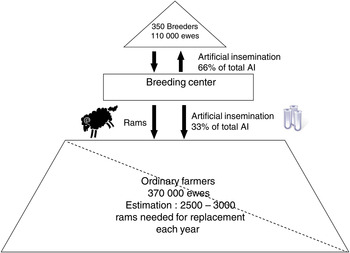
We tried to identify some of the factors explaining these differences in the Western Pyrenees. In this region, a breeding centre and three breeding programmes have been implemented in order to increase the three local breeds' efficiency and farmers' incomes. The following figure (Figure 1) represents the general organization of the breeding programmes in the Western Pyrenees.
Organization of the breeding programs in the Western-Pyrenees.

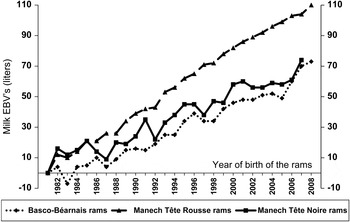
In this region, the genetic improvement of the three local breeds has been successful according to technical criteria of realized response to selection (Barillet et al., Reference Barillet, Astruc, Lagriffoul, Aguerre and Bonaïti2009) (see Figure 2). However, despite this technical efficiency, cooperation between farmers, the breeding centre, extension services and R&D organizations is difficult to maintain (Labatut, Aggeri and Girard, Reference Labatut, Aggeri and Girard2007), threatening the sustainability of these local breeds. Moreover, the Lacaune breed, sometimes replaces local breed in commercial flocks (between 100 and 150 farmers use the Lacaune breed in the Western Pyrenees) thanks to its lead on genetic improvement, the highest level of performance as well as its availability on the market (it is easy to find rams and ewe lambs at a cheap price).
Evolution of estimated breeding values (EBVs) of Manex and Basco-Béarnais rams (average milk breeding value 2008) (Astruc et al., Reference Astruc, Barillet and Lagriffoul2009).

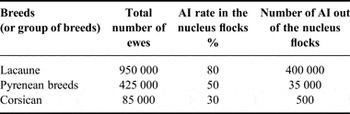
The managers of the three breeding programmes along with scientists involved in the implementation of the breeding programme identified controversies on the breeding objectives for these breeds among farmers, and controversies on the quality of breeding products. They were also worried by an apparently low level of dissemination of genetic progress. In this region, the use of AI outside nucleus flocks is low (Table 1). The diffusion seems to be mainly based on the exchanges of live breeding animals (especially rams), but the number and mechanisms of such exchanges are still unknown, and moreover (i) we do not know the rams used in the flocks and (ii) the pedigree are not known in the flocks out of the nucleus. The parallel market of rams seems to be more important than the breeding centre's one. The nucleus flocks breeders are used to sell rams to the base population. Until now the scope of this parallel market has not been precisely evaluated, but is often considered by managers and scientists as a market that breeders wish to extend because of the net income it can provide. The sanitarian requirements imposed by the French government to prevent from scrapie disease (increasing the proportion of breeding animals that are genetically resistant) (Sidani et al., Reference Sidani, Astruc, Baelden, Barillet, Bibé, Bonnot, Boscher, Bouchel, Bouffartigue, Bouix, Brochard, Dion, François, Jouhet, Jullien, Leymarie, Moreno, Orlianges, Palhière, Perret, Raoul, Raynal, Tiphine and Tribon2010) also encouraged the managers of breeding programmes to better understand the functioning of the market for breeding animals.
Importance of AI per breed.

To better understand the mechanisms of diffusion of genetic gain and the market of breeding animals in this Western Pyrenees sheep industry, traditional genetic tools of analysis need to be complemented. We had to understand how the value of genetic goods (here mainly breeding animals) was built on the different market mechanisms observed. We developed a qualitative analysis on two dimensions involved in the market of animal genetics: the collective tools designed to allow market coordination, and the individual practices and strategies of farmers on this market.
Material and method
We studied two types of market mechanisms: (1) the qualification procedure and official sale of breeding animals, organized by the breeding centre; (2) the parallel “over the counter” market of rams exchanges by mutual agreement between farmers and based on results of animal competition during country fairs. We realized detailed observations of these two market mechanisms: we observed who was making the judgements of animals and how, and which procedure, tools or grading systems were used. We identified who were the participants and the role of these mechanisms in the development of the market for breeding animals, and in the pricing.
In order to identify individual practices on the market for breeding animals, we interviewed 35 farmers, both members and non-members of the collective breeding programme, and presented their “realized strategies” (Mintzberg and Waters, Reference Mintzberg and Waters1985) in a formalized way using an innovative categorization method (Girard et al., Reference Girard, Bellon, Hubert, Lardon, Moulin and Osty2001, Reference Girard, Duru, Hazard and Magda2007; Boisseau, Reference Boisseau2007). We observed that between 25 and 35 interviews are needed to grasp the diversity of strategies and practices that can be found in the reality. The last interviews have not added any new elements to broaden our analysis. This method focuses on the categorization of farming practices instead of evaluating technical and economic variables. It expresses then the qualitative nature of these practices without reducing them to quantitative parameters (Girard et al., Reference Girard, Duru, Hazard and Magda2007). The application of such a qualitative method for studying the diffusion of genetic gain allowed firstly to better understand the motivations of farmers justifying their breeding strategy (AI, breeding animals, scientifically evaluated or not, etc.) and secondly to better understand the market of breeding animals and its dynamics (social networks, price construction of breeding animals, etc.). This method is also linked to local specific practices in order to build a specific typology rather than a generic one, through a deep understanding of husbandry practices (Girard et al., Reference Girard, Duru, Hazard and Magda2007). An important part of the work was to choose objectively 35 farmers to be interviewed. Our aim was not to build a representative sample in statistical terms (which is quite impossible with only 35 interviews), but to interview representative farmers in terms of their diversity. We chose several criteria to favour a wide variety of cases (location, age of farmers, farming system, breed reared, farming practices such as summer grazing or not, pluriactivity, farm cheese production or not, etc.).
We describe the results in two parts. The first one is a general level of analysis focusing on the history and general description of the market for breeding animals for dairy sheep. The second part of the results focuses on the fine-grained mechanisms and practices involved in this market.
Results
The market for breeding animals: compulsory for sheep breeding but uncertain
It is well known that in the field of dairy cattle breeding, the market for AI (semen + AI service) almost totally replaced the market for living breeding animals. The reality of the market in dairy-sheep breeding is different: the market for AI has not fully replaced the market for breeding animals. The presence of breeding rams is always needed on farms as return on AI is not supplied by breeding companies, due to the high number of animals to inseminate, heat synchronization, and the fact that AI is used only on part of the herd.
However, this need for breeding animals and the importance of their quality depends on the breed. In the Roquefort region, where the Lacaune breed was developed, the rate of AI is so high that the quality of individual breeding rams does not have a very high importance: their offspring are not kept for replacement but usually sold for meat consumption. In this case, the “over the counter” market for breeding animals almost disappeared.
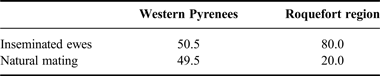
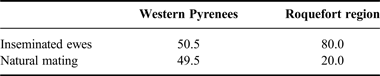
In Western Pyrenees, on the contrary, AI has not been widely used in commercial population, as illustrated by the following chart. Thus, in this region, the market for breeding animals is still of major importance (Table 2).
Proportion (%) of inseminated ewes and natural mating in both regions, for the total ewe population (source: SIEOL, 2010)
The economic model of breeding programme: diversity of situations
The market for living breeding animals is needed, but low sales of AIs can weaken the cooperative basis and sustainability of the collective breeding programme. When a breeder sells individually a ram born from AI on his farm, he not only sells a part of his own breeding work, but also a part of the collective breeding work realized by the breeding programme. Thus this farmer gets individual benefits (sale of the ram) without giving back direct return to the breeding programme. Similarly, when farmers outside of the nucleus flock buy rams from these breeders, they benefit from the genetic gain produced by the collective breeding programme without supporting the costs of its implementation (milk recording, AI, etc.), and without providing any return to the breeding programme. These behaviours are often defined as “free riders” (Olson, Reference Olson1978): without bearing the costs and efforts of collective action, participants benefit from it. However, these behaviours do not always lead to a failure in the collective action. In the case of the sheep breeding market, these behaviours contribute to the dissemination of the genetic progress and provide breeders in the nucleus flocks an opportunity to get a return on investment for their involvement in the collective breeding programme, which is costly on a short-term basis. As it will be described later in the results that this activity (producing rams for sales) is not something that farmers really seek to develop and enhance, and can be as much a constraint than a benefit for them.
In the past because of large financial support to the breeding programmes by the French government, the sales of breeding animals without any return to the collective breeding organization did not threaten the collective action. However, in the current context decrease in public financial support to breeding programmes and liberalization of the market for animal genetics, since the reform of the Breeding Law in 2006, the return on investment that small-scale breeding programmes can get is of the highest importance to ensure their autonomy. In the Roquefort region, as indicated earlier, the diffusion of genetic progress by AI is the predominant means of diffusion, compared with breeding-animals exchange and natural mating. Breeding animals are mainly dedicated to sales outside of the local region, by an organization called “Genelex” which is directly linked to the breeding programme. These sales provide a second source of income and return on investment for breeding programmes. In the case of Roquefort, thanks to the success of the diffusion, the investment of breeders in the breeding programme brings in two types of individual benefits. Nucleus flocks breeders obviously improve faster their flock genetic level. They also get back part of the collective benefits brought each year by the sales of breeding animals and through discounts on the cost of AI. These sales of breeding animals ensure the profitability of the breeding programme, and at the same time favour cooperation and its sustainability because of the decrease in public funding.
In the Western Pyrenees, the situation is different. Here, farmers have difficulties in finding breeding animals to replenish their flock or to start new flocks with the local breeds, especially due to hygiene problems. Several farmers, during their interviews, referred to the shortage of breeding rams: “we lack rams, everybody is looking for rams”. In this region, the occurrence of several sanitarian problems such as scrapie disease (implying to buy only resistant breeding animals) or epididimytis contributed to this shortage of breeding animals. The following quote, from a farmer, illustrates this difficulty and the dilemma between temptation to buy breeding animals from an exogenous breed (in this example the Lacaune) for which breeding animals are easily available, and the willingness of using local breeds:
“When I had the scrapie… I hesitated a lot because I had to renew 80 percent of my flock and I could not find any ewes on the market, the only animals that were offered on the market were female lambs at 90€ each… So I came to enquire about buying Lacaune ewes and they were less expensive, older – 4 or 5 months – and with a higher genetic level, I think… It is true that I hesitated a lot, but I don't know how to work with these ewes, I am used to my Manex”.
In the Western Pyrenees, as well as in Roquefort, the breeding centres sell culled rams (i.e. rams that are not kept for producing semen for AI for several reasons such as morphological defects, or incapacity to give semen). However, one of the paradoxes identified in the Western Pyrenees during our study is that whereas there is a shortage of breeding rams in the region, only part of the rams from the breeding centre are sold, even if their parents have very good estimated breeding values (among the best breeding values of the nucleus flocks). Sometimes, for the Basco-Béarnaise and the Manex Black Face, very few breeding rams are sold for several reasons: standards not corresponding to farmers' criteria, animals considered as unsuitable for mountain grazing, etc.
Failures of collective organizations for the market of breeding animals
The above results confirm that the availability of breeding animals (more specifically young ewes) is an important criterion for the management of local breeds, their conservation and their competitiveness with regard to more productive breeds. The availability of breeding animals is thus an important factor of the capacity of a local breed to face external competition from exogenous breeds for which the production of breeding animals may be better organized. To provide a solution to this problem, in the Western Pyrenees, the breeding centre tried to organize the production of breeding animals in designing, in 1997, a “solidarity stock market”. For example, they encouraged in the nucleus flocks AI of ewe lambs that breeders would have waited one more year to inseminate them, in order to produce ewe lambs for sales. This initiative was directed towards the constitution of a “bank of ewe lambs”. However, producing ewe lambs from inseminated ewe lambs is a constraint in terms of workload and reproduction organization. To encourage breeders to produce these ewe lambs, a bonus of 15€ was paid by the breeding centres to breeders for each ewe lamb delivered. The “solidarity stock market” organized the production and diffusion of not only ewe lambs but also adult ewes, inseminated ewes, rams, etc. Buyers had to sign a contract to ensure that they would buy the ewe lambs produced by the breeders, to encourage them to make the effort of inseminating their young ewes.
This system lasted several years before being abandoned. A breeder who participated in the bank of ewe lambs explained the difficulty to produce a lot of animals that fit into the demands of buyers according to diverse criteria, without keeping animals too long on the farm:
“In this bank of ewe lambs, there was very diverse quality of animals, the breeding centre would collect all the animals, even the undersized ewes, or under weighted, so some of the buyers were critics. I said that I did not want to be criticized, so I said: I will get the ewes ready for October. During three or four years, we inseminated 60 ewe lambs. The first year, I could sell 10 ewes, the second year, 20. But I reared them as if they were for my use! The breeding center said they would collect them at 40 days, I said “no”, they are too young, they need 50 days before weaning. Sometimes, breeders delivered them without even cutting the tails. I did as if they were for my flock, even if one was the daughter of a very good ram, I would not keep it if it was crooked”.
To sum up, this first part of the results revealed several important elements on the general functioning of the breeding stock market:
-
• The market for breeding animals is necessary but highly uncertain on the quality and supply of animals.
-
• It represents a core element to be managed for ensuring the conservation and competitiveness of local breeds.
-
• The financial equilibrium of breeding programmes can partly rely on this market.
-
• Its mechanisms are unknown and its management appears to be difficult.
Thus, the second part of the results focuses on the actual farmers' practices and mechanisms involved in this market for breeding animals.
Six types of individual breeding strategies
To understand the choices made by farmers on the market for breeding animals, we analysed a specific management area among farming practices, the “management of rams”. Three categories of practices defined this management domain in farmers' practices: the strategy of rams' supply over years (location of the supply); the choice of the rams' genetic origin (natural mating or AI); the criteria for choosing rams according to the mode of knowledge available to assess the quality of the ram (scientific evaluation, genealogy, empirical experience, etc.). However, in order to understand farmers' rationalities, the study of other management domains was needed: the management of reproduction (how, when and with what methods farmers would manage the reproduction of the flock), the management of young ewes to renew the flock (would farmers accelerate their growth, keep them longer with dams, wait 1.5 year before mating them, etc.), the use of the territory (do farmers use summer mountain grazing or pastures close to the farm, etc.) and the involvement in collective breeding organization (do farmers participate in the breeding programme, why and how). In all, 13 categories of practices were defined and represented on 13 axes. On each axis, the two extremities represent the extreme practice of this category. For example, for the axis “age of first lambing for young ewes”, one extremity of the axis is “lambing as soon as possible (at one year old)”, the other is “avoid lambing before two years old”. Each practice of each farmer has been positioned on these 13 axes. A software (Repgrid) helped us grouping farmers according to the similarity of their practices among these 13 categories, and thus building a typology of practices.
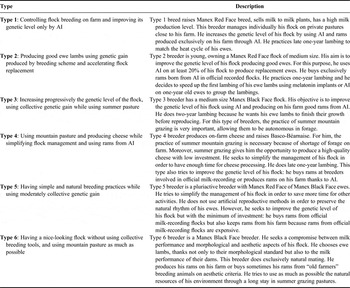
This method helped us to identify six types of individual breeding strategies of farmers at the farm level (see Table 3), ranging from an intensive use of genetic services (type 2 “Producing good ewe lambs using genetic gain produced by breeding scheme and accelerating flock replacement”), a moderate use aiming at improving steadily the genetic level of the flock (type 3 “Increasing progressively the genetic level of the flock, using collective genetic gain while using summer pasture”), to other strategies whose driving forces are not directly genetic improvement but territory use or cheese production (type 4 “Using mountain pasture and producing cheese while simplifying flock management and using rams born from artificial insemination”, as AI is sometimes a constraint when animals are grazing in mountain pasture during their reproductive period, and type 5 “Having simple and natural breeding practices while using moderately collective genetic gain”). Other farmers in their strategy put forward the individual control of breeding for sanitarian and genetic reasons (type 1 “Controlling flock breeding on farm and improving its genetic level only by artificial insemination”) or the animal standard (type 6 “Having a nice-looking flock without using collective breeding tools, and using mountain pasture as much as possible”).
Six types of individual breeding strategies (from Boisseau, Reference Boisseau2007)

Links between types of breeding practices and the collective breeding programme
Beyond these individual strategies lead by the global coherence of farm management, describing individual practices such as “ways of obtaining rams” or “use of collective breeding tools” allowed us to characterize the relationship chosen by each farmer at the collective level, i.e. the breeding programme or local networks of farmers. These data revealed unexpected results on the functioning of the market of breeding rams. Firstly, even though AI is not very much used in the commercial flocks, only the type 6 does not use at all the genetic gain produced by the breeding programme (based on AI rams in the nucleus flocks). The majority of rams' purchases are directly or indirectly linked to the breeding scheme. Thus, despite controversies on breeding objectives, the genetic gain produced by the breeding programme is diffused to a large part of the base population, mainly because of the parallel market of breeding animals. Secondly, we also identified the existence of a second-hand market for rams, which allows a return on investment to farmers who buy expensive rams from breeders in the nucleus flock. This second-hand market was unexpected.
Reasons for choosing a market place
We analysed how farmers choose where to buy their breeding rams (the breeding centre or other farmers). Some farmers chose to buy rams from the breeding centre because they seek and value the maximal guarantee of the ram's genetic potential. Genetic indexes, for these farmers, are the best indicators of the value of a ram, and they know that the best rams according to genetic indexes are at the breeding centre:
“We are very satisfied of the rams bought from the breeding centre. The last one, we bought it in 2003, at the price of 580€, we got it at random draw; it was the best indexed ram. It is expensive but it is worth it, it gives you 100 young ewes in three years, it is really worth it”. For the farmer, buying a good ram is valuable both for its breeding value and for the fact that it gives more ewes than what would have been possible with the same amount of money by using AI.
However, most farmers gave various reasons during interviews to explain why they prefer to buy rams from individual breeders (born in the nucleus flocks) rather than rams sold by the breeding centre (also born in the nucleus flock):
-
– The morphology and standard of rams, which is not suitable enough for some farmers when rams come from the breeding centre. This reason is mainly underlined by farmers using the Manex Black Face breed:
-
○ “Rams at the breeding centre are ugly and really expensive also their horns are cut”.
-
○ Even for farmers who are not really demanding on the aesthetic value of animals, cut horns is an important selection criteria: “The standard is not very important for me, but if the ram has its horns cut, it means that his horns would have gone into his face which is never good… even for ewes afterwards, young ewes will have a tendency of getting horns that grow back into their face. We have ewes with white ears, white muzzle, we are not fussy about the aesthetic. But one of our ewes became blind of one eye because her horn grew back into it so now we are careful about that”.
-
– The capacity of the rams to endure summer grazing: as rams from the breeding centre are reared indoor, with sufficient food, they are sometimes not adapted to the difficult conditions of mountain pasture.
-
○ “When we used to buy rams from the breeding centre, we had to prepare them in terms of feeding, to harden them before going to summer pastures because they were a little frail and they do not resist to summer pastures because of the change in feeding”. Another farmer explained that he did not want anymore to buy rams from the breeding centre because his last two rams, bought 300€ each at the breeding centre, died during the summer grazing period.
-
-
The choice of the breeder from whom they buy breeding rams often depends on their own social network: family, neighbourhood, friends, etc. They are usually faithful to the same provider of rams every year (“I always buy rams from this breeder in the nucleus flock because my father used to buy rams there”) though some of them care about inbreeding rate and change supplier regularly (“In general, every two years, I buy a ram but I always choose different breeders from the nucleus flock to renew the blood lines”).
Another criterion to choose from whom they buy rams is the similarity between their farming practices and the practices of the seller. For example, if buyers do summer grazing, they would sometimes prefer to buy rams from a breeder who has the same practice. One of the farmers we interviewed explained that he buys his rams from breeders from the nucleus flocks, who do not have a really high level of production, but who have “rams that are healthy and who have a reasonable management of their flock, practices that are similar to mine (his) concerning PDO specifications and environmental aspects”.
Another unexpected result was that breeding rams' production and sales are not so much sought-after by breeders in the breeding programme even if it is profitable. For them, producing rams for sales requires a specific organization, and involve risks of mortality before sale and of bad quality of the progeny as rams are not progeny-tested before sale. Sometimes, they prefer not to sell breeding rams instead of taking the risk to disappoint buyers. This result contradicts what is commonly understood about breeding animals markets: farmers in the Western Pyrenees do not deliberately limit the market for AI because they would like to protect their own market for breeding animals. They produce and sell rams because there is a local need, but for most of them it is more a constraint or something they do to help other farmers than something they absolutely seek to develop for their own profit. This is consistent with the fact that there is a shortage of rams in this territory. If producing rams for sales was profitable to farmers, everybody would do it and there would not be any shortage in rams' supply on the market.
Our qualitative analysis also provided useful information on the pricing for breeding animals.
Elements of pricing and links with qualification devices
Several types of breeding animals are sold on the market, based on availability of their breeding-value estimation:
-
• Breeding animals sold by the breeding centre. They are the ones that the breeding centre does not keep for producing semen, either because their genetic indexes are not good enough, or because they cannot give semen, etc.
-
• Breeding animals sold by farmers participating in the breeding programme to farmers who do not participate: they produce rams born from AI. These rams do not have genetic indexes but their parents do, giving some ‘objective’ indication on their potential genetic value.
-
• Breeding animals sold by farmers outside of the breeding programme. These rams do not have any ‘objective’ genetic information.
The general understanding of economic theory for price construction would consider that the more ‘objective’ information on animals genetic value available, the higher the price. According to this principle, the first category of rams would get the higher price on the market. However, the highest prices are observed in the third category, the animals with the lower assurance, according to scientific criteria, of the animals' genetic value. Breeding rams produced outside of the breeding programme, by the farmers from the base population, are sold at a higher price (sometimes twice as much) than the ones from the breeding scheme, while their performance and breeding values are not estimated, as they are not involved in the breeding programme.
The interviews conducted with farmers revealed some of the reasons why the prices of animals with no genetic indexes, could be twice higher than indexed animals. For example, rams from the Manex Black Face breed produced outside of the breeding programme can be sold up to 1 000€ for a high standard ones while the average price for rams in the breeding programme is 250€ (see Table 4). Our analysis of the functioning of the market also gives indications on the pricing of breeding animals. We identified that the diversity of prices on the market cannot be explained according to official and scientific evaluation of animals (including traits corresponding to the collective breeding objectives) and that aesthetic criteria and social networks of farmers are also taken into account.
Prices of rams and lambs on the market for breeding animals.

Farmers appeared to value and price more other aspects of the animal than its estimated genetic value. The first criterion put forward by farmers was the morphology of the animals, their aesthetics value. Some of the farmers considered that the animals from the breeding programme did not match the aesthetic standard of the breed: horns did not have the right shape; animals were not thin or elegant enough, etc. They also argue that their animals should not be considered only as machines to produce milk, but also as living organisms they had to enjoy working with.
The reputation of some farmers to produce animals with high aesthetic standard also contributed in building high prices.
These few examples reveal how the scientific ranking is not the only one to govern the valuation process of animal's genetic value in this industry. Aesthetic order, social relations between buyers and sellers and environment specificities play a key role in this valuation process. How qualification devices are organized for a breed is highly linked to these market mechanisms. Indeed, in most of the breed populations, only one breed's association organizes the qualification of breeding animals for the collective breeding programme and at the same time the promotion of the breed through the organization of animals' competitions. These two devices (qualification for breeding programmes and animals' competitions) take into account aesthetic and genetic value (genetic indexes) criteria. In the Western Pyrenees, such devices are not integrated in activities of the breeds' association (the Organisme de Sélection) but opposed and managed by different groups. The qualification procedure for the breeding programme, organized at the breeding centre, tries to disqualify animals with aesthetic and functional defects. However, there is no collective and shared definition of the “standard” of the breeds, and no scoring system to formalize the judgement. On the other side, local institutions organize animals' competitions, but they do not consider animals with genetic indexes, and thus judge animals only on aesthetic criteria. This contradiction reflects market mechanisms, as qualification devices are coordination tools on markets.
Discussion
Despite the existence of “free-riders”, i.e. individual breeders who sell the collective genetic gain produced in the breeding scheme, the collective action of breeding is efficient: genetic gain is produced and diffused. But the economical equilibrium of the breeding programme is uncertain, as the benefit of private sales of collective genetic gain does not return, even partly, to the collective organization. The only solution considered by breeding programme managers is often to increase sales of AI. Since they are focused only on AI, they have poor knowledge of the market of breeding animals. Several ways of investigation may be proposed.
First, there is a need for quantitative data on the management of breeding animals' exchanges: how many, who are the sellers, who are the buyers, what are the prices, what are the criteria, where the natural mating rams come from, etc. Different local organizations own part of the data concerning rams' exchanges out of the breeding schemes, such as inter-professional and veterinary organizations. However, these data are diverse and not centralized in a unique system. Currently, it is not possible to know sheep movement as it is in cattle movement with obligatory individual traceability (also considering the price and the lifespan difference between cattle and sheep). However, recently in the Western Pyrenees, a database on rams owned by farmers has been implemented.
Secondly, how to provide a return on investment to the collective breeding scheme? Two types of solutions can be imagined: one about collective property rights or the creation of taxes on rams sold by breeders from the nucleus flocks, taxes which would contribute to the funding of the collective breeding scheme. However, both tools are already questioned in terms of social acceptability. There are also organizational solutions. Some have already been implemented:
-
– The collective property of rams, solution chosen by one of the breeding centre of the Lacaune breed in Roquefort: all the breeding rams are the property of the breeding centres.
-
– The creation of an activity of breeding rams production on the breeding centre (breeding rams are not only the leftover of the breeding programme, but rams that have been produced for sale), to meet the specific demands of farmers according to criteria such as morphological quality and hardiness (in Corsica for example).
In the case of the Corsica sheep breed, the local breeding company has developed this second solution. They rapidly understood, at the beginning of the breeding programme that they could not count on a wide diffusion of AI in this mountainous area to ensure the return on investment of the breeding programme. Thus, they developed an activity of managing the production and sales of breeding rams for commercial flocks. However, they encountered a similar problem as in the Western Pyrenees: the breeding rams produced by the breeding programme did not correspond to buyers' criteria, often because of the shape of the horns. Thus, they conducted a study on the shape of horns, to understand whether it could be improved or not (Aragni, Reference Aragni2006). Thanks to this study, through an appropriate management, they succeeded in improving the shape of horns and increased their sales.
In the Western Pyrenees, to solve the problem of the lack of a shared definition for the standard of the Manex Black Face breed, we helped participants to develop different steps to collectively formalize and use a shared standard grid in the breeding programme.
Conclusion
In conclusion, when AI is not widely used within the whole animal population, breeding organizations should give more importance on the market management of breeding animals. This study opens a field of investigation on the market of genetic gain, the organizational and social dimensions of breeding programmes and the practices of farmers. Our results confirm the need to taking into account not only the genetic aspects of breeding programmes (producing genetic gain is not sufficient to insure its diffusion), but also their organizational dimension. For example, organizing a data bank between sellers and buyers on the animals provided by the nucleus flocks towards the commercial flocks and a system of contributions to provide and access to these information could be one of the solutions to investigate. This kind of study differs from the classical approaches of genetic selection, but reveals the interest of interdisciplinary work between genetic science and management science in the analysis of breeding activities.
Acknowledgments
For his careful reading and valuable comments on earlier drafts of this work, the authors are indebted to Francis Barillet (INRA).