Introduction
The negative symptoms of schizophrenia include reduced emotional expression in the face, voice and body, poverty of speech and thought, anhedonia, and reduced motivation and social interest. The most prominent form of blunted emotional expressivity is blunted facial affect (Tremeau et al. Reference Tremeau, Malaspina, Duval, Correa, Hager-Budny, Coin-Bariou, Macher and Gorman2005; Blanchard & Cohen, Reference Blanchard and Cohen2006). It is commonly present early in the course of the disorder, even before the development of frank psychotic symptoms, and typically continues into the chronic phase of the illness after psychotic symptoms are successfully treated with antipsychotic medications (Gur et al. Reference Gur, Kohler, Ragland, Siegel, Lesko, Bilker and Gur2006). Indeed, analysis of childhood home movies of people who later developed schizophrenia and their unaffected siblings reveal subtle abnormalities in facial expressivity many years before the onset of overt illness (Walker et al. Reference Walker, Grimes, Davis and Smith1993). People with schizophrenia have reduced facial expressivity during social interactions and when viewing emotional films (Berenbaum & Oltmanns, Reference Berenbaum and Oltmanns1992), and have difficulty consciously amplifying their facial expressions to emotional stimuli (Kring & Moran, Reference Kring and Moran2008). Furthermore, blunted facial affect has been linked with worse quality of life and functional outcomes in individuals with schizophrenia (Gur et al. Reference Gur, Kohler, Ragland, Siegel, Lesko, Bilker and Gur2006). Despite its clinical relevance, current pharmacological treatments are ineffective at remediating blunted affect in schizophrenia (Green, Reference Green2016).
Deficits in social cognition are also prominent in schizophrenia (Foussias et al. Reference Foussias, Siddiqui, Fervaha, Agid and Remington2015) and are strong predictors of functional outcomes (Green, Reference Green2016). One example of a disrupted social cognitive function that is important for proper social functioning in schizophrenia is the assessment of trustworthiness in faces (Winston et al. Reference Winston, Strange, O'Doherty and Dolan2002). Studies investigating trustworthiness ratings in schizophrenia have produced mixed results with patients rating faces as more (Baas et al. Reference Baas, Van't Wout, Aleman and Kahn2008b ), less (Pinkham et al. Reference Pinkham, Hopfinger, Pelphrey, Piven and Penn2008) or identically trustworthy to control subjects (Couture et al. Reference Couture, Penn, Addington, Woods and Perkins2008). These conflicting findings may be partially explained by the influence that affective information has on trustworthiness judgments. A recent study showed that individuals with schizophrenia rate faces as less trustworthy than healthy controls only after negative affective primes (i.e. negatively valenced evocative photographs shown immediately before the face), but not after neutral or positive primes, and that lower trust ratings were associated with greater severity of feelings of suspiciousness and persecution (Hooker et al. Reference Hooker, Tully, Verosky, Fisher, Holland and Vinogradov2011). Despite the clinical relevance of disruption of social cognition in general, and ratings of facial trustworthiness in particular, there are no currently available pharmacotherapies for these deficits in schizophrenia or in any disorder.
There is growing interest in using the neuropeptide oxytocin to treat both the negative symptoms and social cognitive deficits of schizophrenia. Interestingly, blunted affect has rarely been studied as the focus of treatment in schizophrenia – perhaps due to an underlying assumption that it may not be malleable (Pinkham et al. Reference Pinkham, Hopfinger, Pelphrey, Piven and Penn2008). This is in contrast to negative symptoms and various social cognitive deficits, which have been the focus of a number of studies in schizophrenia, particularly those using oxytocin. For example, several longitudinal clinical trials have found that oxytocin administration can decrease negative symptoms measured by a semi-structured interview like the Positive and Negative Syndrome Scale [PANSS; for a review, see Feifel et al. (Reference Feifel, Shilling and Macdonald2016); but see Horta de Macedo et al. (Reference Horta de Macedo, Zuardi, Machado-De-Sousa, Chagas and Hallak2014); Weiser et al. (Reference Weiser, Saporta, Levi and Feldman2015); Dagani et al. (Reference Dagani, Sisti, Abelli, Di Paolo, Pini, Raimondi, Rocchi, Saviotti, Scocco, Totaro, Balestrieri and de Girolamo2016)]. However, due to the limitations of these measures (e.g. only one of seven questions in the PANSS negative subscale concerns blunted affect and is not limited to facial affect) and the small sample sizes involved, no study has reported on effects of oxytocin specifically on blunted affect. On the other hand, intranasal oxytocin administration has been shown to improve multiple aspects of social cognition, such as theory of mind, in schizophrenia (Pedersen et al. Reference Pedersen, Gibson, Rau, Salimi, Smedley, Casey, Leserman, Jarskog and Penn2011; Woolley et al. Reference Woolley, Chuang, Lam, Lai, O'Donovan, Rankin, Mathalon and Vinogradov2014) (however, see Cacciotti-Saija et al. Reference Cacciotti-Saija, Langdon, Ward, Hickie, Scott, Naismith, Moore, Alvares, Redoblado, ge and Guastella2015) and one small study found a non-significant trend for a single dose of oxytocin to decrease trustworthiness ratings of untrustworthy faces in individuals with schizophrenia (Pedersen et al. Reference Pedersen, Gibson, Rau, Salimi, Smedley, Casey, Leserman, Jarskog and Penn2011) (though a second small study found no effect; Gibson et al. Reference Gibson, Penn, Smedley, Leserman, Elliott and Pedersen2014). In sum, despite the interest in oxytocin as a treatment for schizophrenia, significant uncertainty remains regarding which symptoms and deficits, if any, are affected by oxytocin administration.
Blunted facial affect and social cognitive deficits such as disrupted assessment of facial trustworthiness are thought to be related to different underlying neural circuit dysfunction. In particular, blunted affect has been linked to amygdala hyperactivity and weaker prefrontal cortex (PFC)–amygdala coupling, while deficits in ratings of facial trustworthiness have been linked to hypo-activity of multiple regions including the amygdala, ventrolateral PFC, superior temporal sulcus and fusiform face area (Baas et al. Reference Baas, Aleman, Vink, Ramsey, De Haan and Kahn2008a ; Pinkham et al. Reference Pinkham, Hopfinger, Pelphrey, Piven and Penn2008). Despite the lack of studies focusing on oxytocin effects on blunted affect, emerging evidence suggests that oxytocin may specifically normalize the neural circuitry dysfunction that is believed to underlie blunted facial affect. For example, oxytocin administration decreases amygdala activity during presentation of fearful faces and strengthens amygdala–PFC coupling at rest in healthy individuals and those with schizophrenia (Kirsch et al. Reference Kirsch, Esslinger, Chen, Mier, Lis, Siddhanti, Gruppe, Mattay, Gallhofer and Meyer-Lindenberg2005; Sripada et al. Reference Sripada, Phan, Labuschagne, Welsh, Nathan and Wood2013; Shin et al. Reference Shin, Park, Jung, Park, Yun, Jang, Kim, Han, Kim, Kang and Kwon2015). Thus, in the current study, we simultaneously investigated the effects of a single dose of oxytocin on blunted affect and ratings of facial trustworthiness, two functionally distinct impaired domains in schizophrenia that are due to dysfunction in distinct neural circuits.
We used a well-validated paradigm of facial trustworthiness and objectively quantified ratings of facial expressivity in response to the standardized emotionally evocative stimuli presented in the task. We included matched healthy individuals in our study to determine the specificity of any oxytocin effects to individuals with schizophrenia. Using a double-blind, placebo-controlled, cross-over study design, we video-recorded participants while they rated the trustworthiness of faces that were immediately preceded by emotionally evocative primes. We then quantified the frequency of positive and negative valence facial expressions displayed in these videos in response to the affective primes using an objective manualized coding system validated for use in individuals with schizophrenia (Kring & Sloan, Reference Kring and Sloan2007). By having participants rate facial trustworthiness while being video-recorded, we could simultaneously examine the effects of schizophrenia and oxytocin on facial trustworthiness ratings and facial expressivity while also maximizing consistency between subjects and study sessions. Indeed, the use of standardized stimuli and objective behavioral outcome measures may overcome many of the substantial limitations of more classic semi-structured interview-based symptom scales (Cohen et al. Reference Cohen, Alpert, Nienow, Dinzeo and Docherty2008). We hypothesized that oxytocin administration would increase facial expressivity in response to emotionally evocative photographs irrespective of valence in individuals with schizophrenia and in healthy controls. Additionally, we hypothesized that oxytocin would normalize the accuracy of ratings of facial trustworthiness in individuals with schizophrenia, particularly improving trust ratings after negative affective primes, but not after positive or neutral primes.
Method
Participants
A total of 33 individuals with a schizophrenia spectrum disorder (SZ; 26 schizophrenia; six schizo-affective; one schizophreniform) were recruited from across the San Francisco Bay Area and 35 age-matched healthy controls (HC) were recruited through online advertisements. Healthy participants had no Axis I Diagnostic and Statistical Manual of Mental Disorders, 4th edition (DSM-IV) disorder within the last year or a lifetime history of a psychotic disorder. All participants had no neurological disorders or substance dependence within the last 6 months and had a negative urine toxicology test at each visit. All diagnoses were verified by the Structured Clinical Interview for DSM-IV (First et al. Reference First, Gibbon, Spitzer and Williams2002). Patients were on a stable dose of psychiatric medications for at least 1 month and throughout the study. Written informed consent was obtained from each participant in accordance with the University of California, San Francisco Committee on Human Research.
Procedures
Testing was performed in a randomized, double-blind, cross-over design, with the two testing days separated by at least 1 week. On each test day, oxytocin (40 IU; Novartis, Switzerland) or matched placebo was self-administered via nasal spray by alternating insufflations every 15 s between each nostril over a 5-min time-frame (Feifel et al. Reference Feifel, Macdonald, Nguyen, Cobb, Warlan, Galangue, Minassian, Becker, Cooper, Perry, Lefebvre, Gonzales and Hadley2010). On each testing day, participants completed behavioral testing and were simultaneously video-recorded. Previous work has shown that intranasal oxytocin administration begins to have physiological effects within 30 min and lasts for at least 90 min (Norman et al. Reference Norman, Cacioppo, Morris, Karelina, Malarkey, Devries and Berntson2011). Therefore, in the current study, behavioral testing began 60 min post-administration and continued for no longer than 120 min. For further justification of dosage and timing, see the online Supplementary material.
Social Judgment Task (SJT)
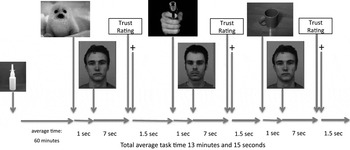
In the SJT, participants rate the trustworthiness of faces after the presentation of an affective ‘prime’ photograph just prior to presentation of the face photograph (for detailed methods, see Fig. 1, online Supplementary material; Adolphs et al. Reference Adolphs, Tranel and Damasio1998; Hooker et al. Reference Hooker, Tully, Verosky, Fisher, Holland and Vinogradov2011). Participants viewed black and white photographs of 49 unfamiliar male and female faces in natural poses, each presented three times paired with three different priming images (negative, neutral, and positive), taken from the International Affective Picture System (IAPS), for a total of 147 trials. Primes were randomly assigned to faces and the face–prime pairs were presented in a fixed, pseudo-random order, such that none of the faces appeared twice in a row. Primes were presented for 1 s, followed by a face for 7 s (or until the subject responded), followed by an inter-trial interval of 1.5 s. Participants rated each face on a seven-point scale according to how trustworthy it appeared: −3 (very untrustworthy) to +3 (very trustworthy). Task instructions emphasized that the prime photographs and faces were not related, and that the participant was to rate only the trustworthiness of the faces. Participants were asked to imagine trusting the person in a very serious situation (e.g. with all their money or with their life). Two versions of the SJT with different faces and priming images were used for each testing day and order was randomized between subjects. Previous work demonstrated that the faces used on each test day did not differ in ratings of trustworthiness (Hooker et al. Reference Hooker, Tully, Verosky, Fisher, Holland and Vinogradov2011). Prior to performing the task, participants were given a set of seven practice trials providing an opportunity to familiarize themselves with the task and raise any questions they might have.
Experimental setup of the Social Judgment Task. Oxytocin was delivered intranasally 60 min before testing. In a randomized order, either a positive, neutral or negative affective prime image was presented for 1 s before a photograph of a face was displayed for 7 s or until the participant made a rating of the trustworthiness of the face. After the rating, a ‘+’ screen was shown for 1.5 s before the next set of photographs was presented for a total of 147 trials. The task was presented on a laptop computer using E-prime professional version 2.0. Photographs of the actual task were in color.

Facial expressivity coding
Facial expressivity was quantified using videos of participants while they completed the SJT (video length depended on how fast each participant completed the task: range: 8–24 min, mean = 13.11, s.d. = 3.13 min). Video-recording during this paradigm minimized experimental heterogeneity as all participants had similar experiences (e.g. seeing the same photographs) without any variability due to an interviewer being present during the task. Furthermore, having a behavioral task that required active input from participants encouraged participants to maintain focus on the computer screen throughout the task and minimized any self-consciousness about being video-recorded. While the SJT has never been used to study facial expressivity before, the IAPS pictures that are part of the SJT have frequently been used to elicit facial expressivity in multiple populations including patients with schizophrenia (e.g. Wolf et al. Reference Wolf, Mass, Kiefer, Eckert, Stritzky, Haasen, Wiedemann and Naber2005; Peterman et al. Reference Peterman, Bekele, Bian, Sarkar and Park2015). Thus, the SJT is an efficient method to simultaneously study facial expressivity in response to emotionally evocative stimuli and judgments about facial trustworthiness.
Videos were coded independently by four raters using the Facial Expression Coding System (FACES; Kring & Sloan, Reference Kring and Sloan2007), a behavioral coding system validated for use in schizophrenia that is based on a two-dimensional model of emotion, where each emotion varies on both valence (positive/negative) and intensity (weak/intense). FACES ratings have been correlated with facial muscle activity, individual-difference measures of expressiveness and personality, skin conductance, heart rate, and reports of experienced emotion (Kring & Sloan, Reference Kring and Sloan2007). FACES has also been used with and validated on participants with schizophrenia (Aghevli et al. Reference Aghevli, Blanchard and Horan2003; Kring & Sloan, Reference Kring and Sloan2007). Coders were blind to diagnostic status, drug condition, and to results of the behavioral task. Inter-rater reliability for FACES is very high (r = 0.70–0.99) when coded by trained experimenters, and FACES ratings converge with ratings using Ekman's Rating System for Facial Expressions (Ekman & Friesen, Reference Ekman and Friesen1976). The intra-class correlation between our two sets of two raters was calculated across participants. There were no significant differences between the ratings between raters, and therefore composite scores are taken from total frequency of expressions (Kring et al. Reference Kring, Smith and Neale1994). Because the variance due to coders is not ignored, the coefficient can be interpreted as an index of agreement rather than consistency (Shrout & Fleiss, Reference Shrout and Fleiss1979). Our inter-rater reliability for FACES was excellent, with an average intraclass correlation coefficient of 0.92 for the schizophrenia group and 0.90 for the controls.
Symptom severity
To assess the positive and negative symptoms of schizophrenia, a subset (n = 23) of patients were rated by trained raters using the PANSS (Kay et al. Reference Kay, Fiszbein and Opler1987). A limited number of patients were administered the PANSS because this measure was not implemented until later in the study.
Medications
In order to better describe our patient population, we calculated benztropine and chlorpromazine equivalents for patients using a standardized conversion table (Andreasen et al. Reference Andreasen, Pressler, Nopoulos, Miller and Ho2010).
Statistical analyses
We plotted variable distributions to examine skewness and kurtosis and tested normality using the Shapiro–Wilk test, and identified potential outliers using stem-and-leaf and box plots. We found no outliers for the normally distributed data. We then examined group differences in demographic variables using independent-samples t tests and χ2 tests.
Our primary outcome of interest was frequency of participants’ facial expressions (total, negative, and positive) during the SJT. Because video lengths varied with speed of completing the task, we calculated the number of expressions (defined by the face changing from neutral to non-neutral expression and then back to neutral) per 5-min interval (i.e. number of expressions divided by number of 5-min intervals, e.g. six expressions over 15 min would yield two expressions per 5-min interval). Our inter-rater reliability for our primary outcome of interest (frequency of facial expressions) was excellent, with an average intra-class correlation coefficient ⩾0.90 (see the online Supplementary material for details). We conducted non-parametric tests to model non-normally distributed data (i.e. lack of any facial expression, particularly for the SZ group, leading to a preponderance of zeroes). Differences in frequency of facial expressions were examined using the Wilcoxon signed-rank test and the Mann–Whitney U test. We calculated oxytocin-induced changes in total facial expressivity (i.e. frequency of facial expressions on the oxytocin day – placebo day), then examined differential effects of oxytocin on facial expressivity by group. We also examined within-subject changes in facial expressivity by drug and emotional valence (positive and negative), within and between groups. We adjusted for multiple comparisons in our analyses using Benjamini and Yekutieli (B-Y) corrections for family-wise error (Narum, Reference Narum2006) (see the online Supplementary material).
In addition to our primary outcome, we also examined average duration per expression and average intensity per expression. For these analyses, we excluded participants who had zero expressions on at least one of the testing days. We used the non-parametric Wilcoxon signed-rank test to examine within-subject differences and the Mann–Whitney U test for between-subject differences.
We also examined effects of oxytocin and affect priming on ratings of trustworthiness during the SJT. We performed a 2 × 3 × 2 mixed factorial analysis of variance (ANOVA) with drug (oxytocin, placebo) and priming (negative, neutral, positive) as within-subjects factors and group (SZ, HC) as the between-subjects factor. We followed up significant interactions with simple -effects ANOVAs to examine the group effect and tests of within-subject factors to examine the priming effect. Because of previous findings that oxytocin had a specific effect on ratings of untrustworthy faces (Pedersen et al. Reference Pedersen, Gibson, Rau, Salimi, Smedley, Casey, Leserman, Jarskog and Penn2011), we also examined the effect of oxytocin on ratings of trustworthiness specifically for facial stimuli, irrespective of the affect priming photographs, that were rated as low, average or high trustworthiness by a separate healthy sample (Adolphs et al. Reference Adolphs, Tranel and Damasio1998). We performed a 2 × 3 × 2 mixed factorial ANOVA with drug (oxytocin, placebo) and normative trustworthiness ratings (low, average, high) as within-subjects factors and group (SZ, HC) as the between-subjects factor.
Results
Demographic data
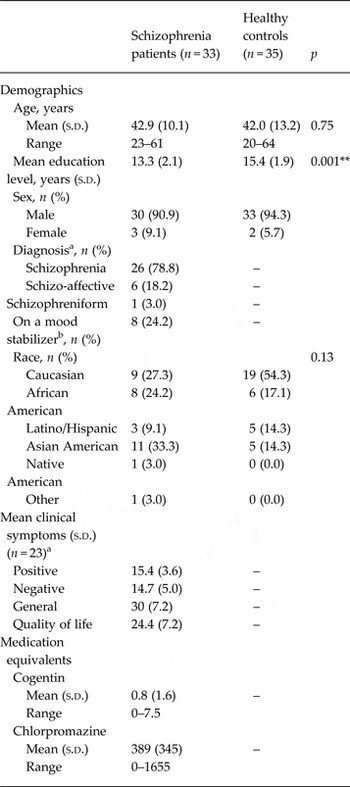
Demographic and descriptive variables are presented in Table 1. Groups were well matched on age. HCs had significantly more years of education than individuals with SZ. There was a higher proportion of non-Hispanic Caucasians in the HC group.
Demographic and clinical information

s.d., Standard deviation; DSM-IV, Diagnostic and Statistical Manual of Mental Disorders, 4th edition.
a Based on the Positive and Negative Symptom Scale for DSM-IV administered by trained clinical interviewers.
b Mood stabilizers include depakote, lithium and lamictal.
** p⩽0.01.
Group differences in facial expressivity during placebo
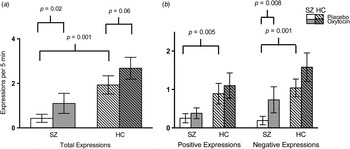
There was no difference in placebo-day expressivity between non-Hispanic Caucasians and the other ethnic groups (p = 0.27) in the HC group, therefore we did not include ethnicity in any subsequent analyses. Consistent with extensive literature on blunted affect in SZ (Kring & Elis, Reference Kring and Elis2013), SZ participants displayed fewer total (both negative and positive valence) facial expressions while viewing emotionally evocative pictures compared with HCs on the placebo day (Fig. 2; p’s < 0.01).
Facial expressivity by group and drug condition. Values are means, with standard errors represented by vertical bars. (a) Oxytocin effects on frequency of total expressions by group. Mean for oxytocin-induced change for schizophrenia patients (SZ) was 0.67 (s.d. = 2.04) and for healthy controls (HC) was 0.75 (s.d. = 2.20). (b) Oxytocin effects on positive and negative valence expressions by group. Mean for oxytocin-induced change for positive expressions for SZ was 0.13 (s.d. = 0.79) and for HC was 0.21 (s.d. = 1.68). Mean for oxytocin-induced change for negative expressions for SZ was 0.54 (s.d. = 1.42) and for HC was 0.54 (s.d. = 1.57).

Effects of oxytocin on facial expressivity
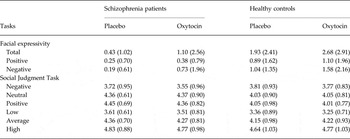
The distributions were non-normal (see Table 2 for descriptions of the means and standard deviations). Based on the B-Y method, for our primary analysis, we had three comparisons and set the new α to 0.027. Compared with placebo, oxytocin administration significantly increased the frequency of total facial expressions in SZ (Z = −2.33, p = 0.02) and non-significantly in HC (Z = −1.87, p = 0.06) participants (Fig. 2 a). There were no differences between groups for oxytocin-induced increases in total facial expressivity (U = 568, Z = −0.11, p = 0.91). Given that video length depended on how fast participants completed the task, we examined relationships between video length and our outcome measures. We found that video length did not have an effect on our outcome measure nor did oxytocin have an effect on video length (p’s > 0.05).
Distribution of facial expressivity and trustworthiness measures

Data are given as mean (standard deviation).
In our secondary analyses, we had seven comparisons and based on the B-Y method set the new α to 0.019. We found that oxytocin significantly increased the frequency of negative valence facial expressions in SZ (Z = −2.67, p < 0.008), but not in HC (Z = −1.18, p = 0.24), and had no significant effect on the frequency of positive expressions in either group (Fig. 2 b). Similarly, we found that oxytocin-induced increases in facial expressivity for negative valence expressions were non-significantly greater than for positive expressions in patients with SZ (Z = −2.05, p = 0.04). The SZ and HC groups did not differ in oxytocin-induced changes in negative (U = 512, Z = −0.83, p = 0.41) or positive (U = 548, Z = −0.37, p = 0.71) valence expressions.
Effects of oxytocin on duration and intensity
Of the participants, 23 of the 33 individuals with SZ (70%) and 12 of the 35 HC (34.3%) had zero expressions on at least one testing day. Only examining the subsample of participants that had at least one expression on both testing days, we found that oxytocin did not have an effect on average duration per expression in SZ [mean: oxytocin: 2.04 (s.e. = 0.51) v. placebo: 2.38 (s.e. = 0.58); p = 0.95] or HC [oxytocin: 1.96 (s.e. = 0.18) v. placebo: 1.95 (s.e. = 0.19); p = 0.73]. Additionally, oxytocin did not have an effect on intensity per expression in SZ [oxytocin: 1.27 (s.e. = 0.13) v. placebo: 1.50 (s.e. = 0.22); p = 0.15] or HC [oxytocin: 1.31 (s.e. = 0.05) v. placebo: 1.35 (s.e. = 0.06); p = 0.56]. SZ did not differ from HC on these measures on the placebo day (p’s > 0.4). For this subset of subjects with intensity and duration data for both days, the frequency of negative expressions was still significantly greater while on oxytocin than placebo for SZ (Z = −2.24; p = 0.03), but the total and positive expressions were not (p’s > 0.07).
Trustworthiness ratings during SJT
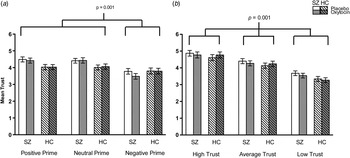
The 2 × 3 × 2 ANOVA revealed a main effect of prime (F 2,57 = 26.49, p = 0.001, η 2 = 0.31) and a prime × group interaction (F 2,55 = 7.97, p = 0.001, η 2 = 0.12, Fig. 3). Pairwise comparisons revealed that in both groups, and across drug conditions, negative primes were associated with significantly lower trust ratings than were neutral or positive primes. Trust ratings between positive and neutral primes, however, did not differ. We then examined the prime × group interaction using simple-effects ANOVAs, comparing trust ratings between the SZ and HC groups averaged across drug administration day, followed up by within-subjects contrasts to examine the prime effect within each group. Looking separately by group, the main effect of prime was significant in both SZ and HC (p’s < 0.001). There were no significant group differences, however, in any of the prime conditions (p’s > 0.38; Fig. 3). Within-subject contrasts revealed that in both groups, negative primes were associated with significantly lower trust ratings than in both the positive and neutral primes (p’s < 0.001), while trust ratings during the positive and neutral primes did not differ (p = 0.67). There was no significant main effect for drug (F 2,58 = 0.40, p = 0.53), nor were there any significant drug × prime (F 2,57 = 1.89, p = 0.16), drug × group (F 2,58 = 0.68, p = 0.42), or drug × prime × group (F 2,57 = 1.04, p = 0.36) interactions. Finally, the 2 × 3 × 2 ANOVA in which faces were separated by their normative ratings revealed no significant effect of drug (F 2,58 = 0.13, p = 0.72) or group (F 2,58 = 1.16, p = 0.29) nor any significant drug × trustworthiness (F 2,57 = 1.72, p = 0.18) or drug × trustworthiness × group (F 2,57 = 0.89, p = 0.42) interactions. Although we used two different forms, there were no version effects between them for either the prime or trustworthiness conditions (p’s > 0.3).
Mean trustworthiness ratings, placebo v. oxytocin. Values are means, with standard errors represented by vertical bars. (a) Oxytocin effects on affective prime trustworthiness by group. Negative prime was associated with significantly lower trustworthiness ratings than positive and neutral primes across drug and group. (b) Oxytocin effects on normative trustworthiness of faces by group. Each trust level had significantly different trustworthiness ratings from each other. SZ, Schizophrenia patients; HC, healthy controls.

Manipulation checks and exploratory analyses
While we found some small significant effects of the order in which oxytocin was administered, these effects did not influence our results for facial expressivity or facial trustworthiness when order was included as a covariate in the model. SZ had significantly greater frequency of positive expressions on the first day (p = 0.04) and HC had significantly higher positive, negative and total expressions on the first day (p’s < 0.02). For facial trustworthiness, there were no significant order effects. Given the small number of females in our sample and the possibility of sex-specific effects of oxytocin, we re-ran all analyses excluding women. Excluding women did not change any of the results. Our blinding procedure was adequate for SZ such that their guesses when they received oxytocin did not differ from chance (SZ: 60.7%, p = 0.26, χ2 = 1.29), but for HC their guesses were significantly worse than chance (HC: 32.3%, p = 0.05, χ2 = 3.90). SZ and HC significantly differed in their percentage of accurate guesses (p = 0.03, χ2 = 4.80). There were no reported side effects from oxytocin for either SZ or HC.
In exploratory analyses, we conducted Spearman correlations between facial expressivity and clinical symptoms and anticholinergic and antipsychotic dosages in the schizophrenia group. We found that oxytocin-induced increases in negative and total expressivity were negatively correlated with positive and general symptoms as well as antipsychotic dosage (for details see the online Supplementary material).
Discussion
We found that a single intranasal dose of oxytocin significantly increased facial expressivity in response to emotionally evocative photographs in individuals with schizophrenia and non-significantly in healthy controls. Although the number of expressions was relatively small, this is consistent with other studies using FACES to code expressions in schizophrenia and healthy controls (Kring & Neale, Reference Kring and Neale1996). This increase in frequency of facial expression was not associated with a change in the duration or intensity of each expression, although this needs to be interpreted with caution given the small number of participants in this analysis. Similarly, we found a non-significant trend for oxytocin to increase negative valence expressions more than positive valence expressions in the schizophrenia group. This is an intriguing and surprising finding that needs to be interpreted with caution given the trend-level significance. Our results suggest that oxytocin may be an effective pharmacological agent to improve blunted facial affect, a core symptom of schizophrenia, that impairs social interactions (Kring & Moran, Reference Kring and Moran2008) and quality of life (Gur et al. Reference Gur, Kohler, Ragland, Siegel, Lesko, Bilker and Gur2006). Given that currently available pharmacotherapies for schizophrenia are generally ineffective for blunted affect and have significant negative side effects (for a review, see Tsapakis et al. Reference Tsapakis, Dimopoulou and Tarazi2015), this is an exciting and important discovery.
In the current study, showing emotionally evocative photographs immediately before presenting a photograph of a face altered ratings of facial trustworthiness, consistent with previous studies, although we did not replicate any group differences in this effect (Hooker et al. Reference Hooker, Tully, Verosky, Fisher, Holland and Vinogradov2011). Oxytocin administration did not significantly alter ratings of facial trustworthiness in individuals with schizophrenia or in healthy controls. Previous studies investigating the effects of oxytocin on facial trustworthiness ratings in healthy individuals have been inconsistent, with some reporting that oxytocin enhances facial trustworthiness (Kosfeld et al. Reference Kosfeld, Heinrichs, Zak, Fischbacher and Fehr2005), but others finding no effect (Lambert et al. Reference Lambert, Declerck and Boone2014). We also failed to replicate the one study that found an effect of oxytocin on facial trustworthiness in schizophrenia (Pedersen et al. Reference Pedersen, Gibson, Rau, Salimi, Smedley, Casey, Leserman, Jarskog and Penn2011) but did replicate the lack of effect found in Gibson et al. (Reference Gibson, Penn, Smedley, Leserman, Elliott and Pedersen2014). Given the lack of group differences on trustworthiness ratings in the current study, we could not determine whether oxytocin normalized trustworthiness ratings in schizophrenia. In our study, we used a higher dosage of oxytocin, presented different stimuli, interspersed faces with affective primes, and had an older subject sample than previous studies, all of which may have contributed to any discrepant results.
The mechanisms by which oxytocin increases facial expressivity are unknown. Oxytocin may increase facial expressivity by increasing PFC–amygdala coupling. In schizophrenia, oxytocin may modulate the aberrant overstimulation of the limbic network that is thought to underlie blunted facial affect. For example, severity of blunted facial affect correlates with amygdala hyperactivity during identification of fearful faces (Gur et al. Reference Gur, Loughead, Kohler, Elliott, Lesko, Ruparel, Wolf, Bilker and Gur2007) and during rating of the emotional valence of facial expressions (Lepage et al. Reference Lepage, Sergerie, Benoit, Czechowska, Dickie and Armony2011). Furthermore, resting-state functional magnetic resonance imaging reveals that weaker amygdala–PFC coupling correlates with higher ratings of flat affect (Anticevic et al. Reference Anticevic, Repovs and Barch2012). Evidence from neuroimaging studies on healthy subjects supports this hypothesis: a single administration of oxytocin decreases amygdala activity and strengthens PFC–amygdala coupling at rest and during the presentation of fearful faces (Kirsch et al. Reference Kirsch, Esslinger, Chen, Mier, Lis, Siddhanti, Gruppe, Mattay, Gallhofer and Meyer-Lindenberg2005; Sripada et al. Reference Sripada, Phan, Labuschagne, Welsh, Nathan and Wood2013). Similarly, a single dose of oxytocin has been found to decrease amygdala hyperactivity in individuals with schizophrenia during viewing of emotional faces (Shin et al. Reference Shin, Park, Jung, Park, Yun, Jang, Kim, Han, Kim, Kang and Kwon2015). Thus, this potential mechanism could explain how oxytocin can increase expressivity in both individuals with schizophrenia and healthy controls.
Another possibility is that oxytocin may amplify individuals’ subjective experience in response to emotional cues, possibly through increasing empathy (Barraza & Zak, Reference Barraza and Zak2009; Cohen & Minor, Reference Cohen and Minor2010), thereby modulating facial expressivity. Because individuals with schizophrenia with and without blunted affect typically have normal or even heightened subjective reports of emotional experience (Berenbaum & Oltmanns, Reference Berenbaum and Oltmanns1992; Sweet et al. Reference Sweet, Primeau, Fichtner and Lutz1998; Kring & Elis, Reference Kring and Elis2013), and individuals with schizophrenia have been found to have dissociations between emotional expression and emotional experience (Sweet et al. Reference Sweet, Primeau, Fichtner and Lutz1998), blunted affect is probably not due to abnormalities in subjective emotional experience. Additionally, few studies have found clear effects of oxytocin on subjective experiences of emotion (Abu-Akel et al. Reference Abu-Akel, Fischer-Shofty, Levkovitz, Decety and Shamay-Tsoory2014; Gibson et al. Reference Gibson, Penn, Smedley, Leserman, Elliott and Pedersen2014), making this hypothesis less likely.
Finally, oxytocin may increase facial expressivity by directly altering parasympathetic regulation of facial musculature, without affecting emotion processing or subjective experience in response to emotional cues. This hypothesis is supported by evidence that oxytocin can affect parasympathetic tone in humans (Gamer & Büchel, Reference Gamer and Büchel2012) and rodents (Michelini et al. Reference Michelini, Marcelo, Amico and Morris2003). In order to disambiguate these hypotheses, future studies should investigate the effects of oxytocin administration on simultaneously measured behavioral, subjective, autonomic and neural responses to emotional stimuli.
Our study has several limitations. First, our study had a relatively small sample size and used a single dose of oxytocin. We also had a very small number of female participants, which prevented us from determining if there were any sex-specific effects of oxytocin in these paradigms. Second, we did not measure subjective emotional responses in the current study, because such subjective reporting can decrease the intensity of induced emotions (Taylor et al. Reference Taylor, Phan, Decker and Liberzon2003). Thus, we do not know if oxytocin only affects facial expressivity or if it also has effects on subjective emotional experience. Third, our study design prevented us from addressing whether individuals with schizophrenia are less accurate in their trustworthiness ratings or whether oxytocin can improve the accuracy of their trustworthiness ratings. Fourth, raters may have been able to identify who were the individuals with schizophrenia in the videos, thereby breaking the blind. However, facial expressivity differences between individuals with schizophrenia and controls were not the focus of the current study, and even if raters could tell the patients from the controls, this would not affect our findings of oxytocin effects on facial expressivity. Fifth, despite being worse than chance, healthy controls may have been able to tell which drug they were on, which could have altered the findings. However, previous studies have found that subjects usually cannot tell which drug they are on (Woolley et al. Reference Woolley, Chuang, Lam, Lai, O'Donovan, Rankin, Mathalon and Vinogradov2014), which suggests that our blinding was adequate and the guessing patterns were spurious. Sixth, the duration of oxytocin's effect after intranasal administration is unknown and was not addressed in the current study. However, this and other studies suggest that oxytocin has effects for at least 2 h. Finally, we did not synchronize the measurement of facial expressivity to the emotional valence of the photographs and there were low frequencies of expression in some individuals. Thus we cannot determine whether any increase in facial expressivity was congruent or incongruent with the valence of the evocative images. Similarly, expressions were scored in terms of frequency and valence, but not with regard to specific emotions. Thus, it remains unclear whether oxytocin increased the ability to facially express specific emotions, or simply increased general expressivity. This distinction is critical because increases in expressivity, in the absence of control or regulation, may not necessarily be adaptive, particularly among individuals that are vulnerable to dysregulated emotion such as those with schizophrenia. Longer treatment trials in larger samples, and with additional autonomic and neural functioning measures, will be necessary to fully elucidate the effects of intranasal oxytocin on emotional expressivity and emotional functioning in people with schizophrenia.
Our approach for eliciting and measuring facial expressivity has several advantages over traditional semi-structured Likert-type symptom rating scales. First, our approach does not require trained clinical interviewers, although it does require trained FACES coders (and coding can be performed at any time after the assessment). Furthermore, with improvements in technology, automated coding of facial expressivity will soon be available (Scherer et al. Reference Scherer, Stratou, Lucas, Mahmoud, Boberg, Gratch and Morency2014). Second, our approach minimizes variability that could be introduced during even a structured interview (e.g. differences between assessors in style, appearance, personality, etc.). Indeed, in our study, all participants saw the same standardized stimuli under the same conditions. Third, from a psychometric perspective, symptom-rating scales are not ideal because they often employ vague rating systems (e.g. ‘mild’, ‘moderate’ and ‘severe’ categories) (Lukoff et al. Reference Lukoff, Liberman and Nuechterlein1986) that may be insensitive to subtle changes in the frequency of facial expressivity especially in response to emotional stimuli (Eckert et al. Reference Eckert, Diamond, Miller, Velligan, Funderburg and True1996). On the other hand, FACES is an objective rating system that is closely tied to individual behaviors, i.e. coding the presence or absence of each facial expression, as opposed to more gestalt ratings in typical symptom-rating scales. Finally, having participants completing an active behavioral task during the presentation of evocative stimuli allows for participant engagement in the task to be verified and measured.
In the current study, we found that oxytocin increases facial expressivity both in individuals with schizophrenia and in healthy controls. This is similar to many commonly used treatments for psychiatric disorders that have similar positive effects when tested in ‘healthy’ individuals. For example, subchronic administration of selective serotonin reuptake inhibitor antidepressants to healthy individuals has been found to increase cooperative tendencies, increase confident behaviors, induce a positivity bias in emotion processing, and decrease negative affect related to negative events (Serretti et al. Reference Serretti, Calati, Goracci, Di Simplicio, Castrogiovanni and De Ronchi2010). Similarly, the acetylcholinesterase inhibitor donepezil commonly used in Alzheimer's disease can improve aspects of memory in healthy individuals (Repantis et al. Reference Repantis, Laisney and Heuser2010). The lack of specificity of oxytocin's effect on facial expressivity may suggest that oxytocin is not remediating a specific deficit in schizophrenia. On the other hand, it is also possible that blunted affect exists on a continuum with healthy facial expressivity and that there is not a distinct neural mechanism underlying blunted affect beyond what would be expected from extreme lack of expressivity. Combined with how well tolerated oxytocin has been in individuals with schizophrenia, even when administered over 4 months (Busnelli et al. Reference Busnelli, Dagani, Girolamo, Balestrieri, Pini, Saviotti, Scocco, Sisti, Rocchi and Chini2016), our results suggest that oxytocin administration may be a way to safely enhance emotional expressivity in anyone, including individuals with blunted affect.
Supplementary material
The supplementary material for this article can be found at https://doi.org/10.1017/S0033291716003433
Acknowledgements
The authors thank the current and former members of the Bonding and Attunement in Neuropsychiatric Disorders Laboratory at the San Francisco Veterans Affairs Medical Center for their dedicated efforts and contributions to achieving the reported results. The authors also thank the patients for participating in the study.
Grant support was provided by the Veterans Health Administration Office of Research and Development Career Development Award (CDA) 1IK2CX000758-01A1 and National Institute of Mental Health Diversity Supplement 3R01MH068725-09S1.
Declaration of Interest
D.H.M. is a consultant to Bristol-Myers Squibb Inc. S.V. is a consultant to the Brain Plasticity Institute. The remaining authors declare that they have no financial relationships with competing interests.