Introduction
The Vesuvius volcano, located ~9 km east of Naples in Campania, Italy is one of the world's most famous geological objects and attracts millions of visitors each year. It is also one of the most studied volcanoes and a world-class mineralogical location. To date, the Somma–Vesuvius volcanic complex is the type locality of 68 mineral species. While most of them have ‘grandfathered’ status, several minerals have been described more recently as a result of new finds or the re-examination of old samples facilitated by progress in X-ray diffraction and other analytical techniques. Among them are d'ansite-(Mn), Na21Mn2+(SO4)10Cl3 (Demartin et al., Reference Demartin, Campostrini, Castellano, Gramaccioli and Russo2012), ghiaraite, CaCl2⋅4H2O (Rossi et al., Reference Rossi, Nestola, Zorzi, Lanza, Peruzzo, Guastoni and Kasatkin2014), parascandolaite, KMgF3 (Demartin et al., Reference Demartin, Campostrini, Castellano and Russo2014), tondiite, Cu3Mg(OH)6Cl2 (Malcherek et al., Reference Malcherek, Bindi, Dini, Ghiara, Molina Donoso, Nestola, Rossi and Schlüter2014), verneite, Na2Ca3Al2F14 (Balić-Žunić et al., Reference Balić-Žunić, Garavelli, Pinto and Mitolo2018), sbacchiite, Ca2AlF7 (Campostrini et al., Reference Campostrini, Demartin and Russo2019), and paradimorphite, As4S3 (Campostrini et al., Reference Campostrini, Castellano, Demartin, Rocchetti, Russo and Vignola2022). Herein, we report another new mineral, napoliite named after the city of Naples (Napoli in Italian).
The new mineral, its name and symbol (Npi) have been approved by the Commission on New Minerals, Nomenclature and Classification of the International Mineralogical Association (IMA2022–073; Kasatkin et al., Reference Kasatkin, Siidra, Nestola, Pekov, Agakhanov, Nazarchuk, Koshlyakova, Chukanov and Rossi2023). The holotype specimen is deposited in the collections of the Fersman Mineralogical Museum of the Russian Academy of Sciences, Moscow, Russia with the registration number 5885/1. A part of the holotype specimen is deposited in the collections of the Sezione di Mineralogia “Alessandro Guastoni” of the Museo della Natura e dell'Uomo, University of Padova, under catalogue number MMP M23222.
Occurrence and mineral association
The Somma–Vesuvius complex (Campania region, Italy) is characterised by complex magmatism and volcanism (Lima et al., Reference Lima, De Vivo, Fedele, Sintoni and Milia2007; Alfano and Parascaldola, Reference Alfano and Parascandola2015; Sbrana et al., Reference Sbrana, Cioni, Marianelli, Sulpizio, Andronico and Pasquini2020; Melluso et al., Reference Melluso, Scarpati, Zanetti, Sparice and de' Gennaro2022); it is a polygenic stratovolcano with strong eruption variability in terms of style, cyclicity and magma composition. During the last 3.5 ka effusive lava flows and scoria eruptions were alternated to highly explosive Plinian eruptions of pumice and ash, with pyroclastic flows and surges. All exposed lavas refer to the recent activity between A.D. 1631 and 1944 (Santacroce et al., Reference Santacroce, Cioni, Marianelli, Sbrana, Sulpizio, Zanchetta, Donahue and Joron2008; Sbrana et al., Reference Sbrana, Cioni, Marianelli, Sulpizio, Andronico and Pasquini2020). Since 1944, Vesuvius has been quiescent, with only moderate seismicity and fumarolic activity.
The last eruption dating back to 1944, began on March 18th and ended on the 29th of the same month, marked the transition from an open conduit to a closed conduit state. The eruption took place during wartime that precluded the collecting of specimens after the eruption and their investigation. Antonio Parascandola was the only person who studied the mineralogy of these fumaroles between 1948 and 1960, when temperatures decreased from a maximum of 800°C in 1950 to ~460°C in 1960s (Parascandola, Reference Parascandola1951, Reference Parascandola1960, Reference Parascandola1961). His studies revealed the presence of about ten mineral species new for Vesuvius.
In recent times, the systematic study of fumarolic minerals formed after the 1944 eruption has been undertaken by a joint team of scientists from the Department of Chemistry of the University of Milan and the Naples section of the National Institute of Geophysics and Volcanology – Vesuvius Observatory (see, e.g. Campostrini and Gramaccioli, Reference Campostrini and Gramaccioli2005; Russo and Campostrini, Reference Russo and Campostrini2011; Russo et al., Reference Russo, Campostrini, Demartin, Cesare, Erba, Carmina, Fascio, Petti and Zuccari2014) that resulted in a discovery of several rare minerals previously unknown at this locality, such as ammineite, artroeite, caledonite, fluornatrocoulsellite, gearksutite, hemimorphite and matlockite, and the description of two new species – parascandolaite, KMgF3 (Demartin et al., Reference Demartin, Campostrini, Castellano and Russo2014) and sbacchiite, Ca2AlF7 (Campostrini et al., Reference Campostrini, Demartin and Russo2019).
Napoliite, therefore, is the third new mineral discovered in the material from fumaroles of the 1944 eruption. The sample of lava scoria where napoliite occurs was collected by one of the authors (MR) in early 2010s from a large fragment located at the eastern rim of the ‘Gran Cono’ crater. Napoliite overgrows volcanic scoria and is associated with anglesite, artroeite, atacamite, calcioaravaipaite, cerussite, challacolloite, cotunnite, hephaistosite, matlockite, susannite and the recently discovered new mineral manuelarossiite PbCaAlF7 (IMA2022–097, Nestola et al., Reference Nestola, Kasatkin, Biagioni, Škoda, Santello and Agakhanov2023). Hephaistosite and susannite are of special interest, as both of them were found on Vesuvius for the first time. Hephaistosite occurs as small grains up to 0.02 mm forming a limited solid-solution series with Tl-bearing challacolloite. The most Tl-rich hephaistosite variety contains (wt.%): K 2.04, Tl 16.06, Pb 57.47, Cl 24.08, total 99.65. Its empirical formula is (Tl0.58K0.38)Σ0.96Pb2.04Cl5.00. Susannite occurs as prismatic colourless crystals up to 1 mm long with adamantine lustre. Its identification is based on semi-quantitative chemical analysis (only Pb, S, C and O detected using energy-dispersive spectroscopy with a Pb to S ratio equal to 4:1) and single-crystal X-ray diffraction data. The parameters of its trigonal unit cell are: a = 9.080(10), c = 11.565(12) Å and V = 826.7(15) Å3.
General appearance and physical properties
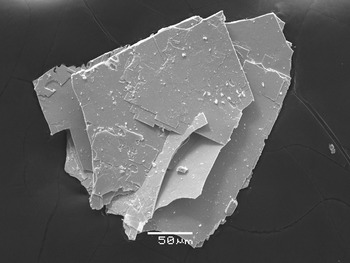
Napoliite occurs as well-shaped lamellar crystals up to 0.25 × 0.25 × 0.01 mm typically forming clusters up to 0.4 × 0.4 mm on the surface of volcanic scoria (Fig. 1). The new mineral is colourless and transparent with white streak and adamantine lustre. It is brittle and has a laminated fracture. No fluorescence is observed under long- or short-wave ultraviolet light. The hardness is ~3 on the Mohs’ scale. Cleavage is perfect on {001}. The density of napoliite could not be determined due to the scarcity of available material. Density calculated using the empirical formula is 7.797 g cm–3.
Cluster of lamellar napoliite crystals. Scanning electron microscopy (back-scattered electron) image. Sample # 5885/1.

Napoliite is optically uniaxial. Its refractive indices (RI) could not be measured because of the absence of immersion liquids that can measure RI values higher than 2.0. The Gladstone–Dale relationship predicts an average RI of 2.10 which is similar to that of other Pb oxychloride minerals [e.g. 2.13 for blixite Pb8O5(OH)2Cl4 (Gabrielson et al., Reference Gabrielson, Parwel and Wickman1958; Krivovichev and Burns, Reference Krivovichev and Burns2006); 2.27 for yeomanite Pb2O(OH)Cl (Turner et al., Reference Turner, Siidra, Rumsey, Polekhovsky, Kretser, Krivovichev, Spratt and Stanley2015); 2.32 for damaraite Pb3O2(OH)Cl (Criddle et al., Reference Criddle, Keller, Stanley and Innes1990)]. Optical properties of napoliite were studied using the methods common for metallic minerals. In reflected light, napoliite is grey with no visible bireflectance and pleochroism. In crossed polars it is very weakly anisotropic. Internal reflections are not observed. The set of reflectance measurements performed in air relative to a SiC standard by means of a Universal Microspectrophotometer UMSP 50 (Opton-Zeiss, Germany) is given in Table 1 and plotted in Fig. 2 in comparison with the published data for rumseyite (Turner et al., Reference Turner, Siidra, Krivovichev, Stanley and Spratt2012).
Reflectance data (R, %) of napoliite.*

* The values required by the Commission on Ore Mineralogy are given in bold.
Reflectivity curves for napoliite compared with the published data for rumseyite (Turner et al., Reference Turner, Siidra, Krivovichev, Stanley and Spratt2012).

Raman spectroscopy
The Raman spectrum of napoliite (Fig. 3) was collected in the range 50–400 cm−1 as no peaks were observed above 350 cm−1. The data were collected using a DXR Thermo Scientific Raman spectrometer, equipped with a diode-pumped solid-state 532 nm laser. The analytical points were performed with a 50× LWD (long working distance) objective, operating at a power of 4 mW, with a spectral resolution in the range of ~3 cm−1 and a spatial resolution of ~1 μm. The acquisition time adopted was 10 s for 10 scans accumulation.
Raman spectrum of napoliite excited by 532 nm laser.

The Raman spectrum of napoliite shows two very intense peaks at 144 and 130 cm−1, whereas lower intensity peaks are positioned in the region between about 315 and 330 cm−1, and even lower intensity peaks at about 180, 112, 83, 60 and 56 cm−1. No Raman signals are detected for those regions above 350 cm−1 including the OH− region above 3000 cm−1.
The Raman spectra of synthetic compounds related structurally to napoliite are unknown. In addition, the Raman spectrum of its polymorph rumseyite is also unreported. However, we can compare the napoliite Raman spectrum with the F-free synthetic compound Pb3O2Cl2 described by Zakir'yanov et al. (Reference Zakir'yanov, Chernyshev and Zakir'yanova2016). On the basis of this work, the peaks in the 130−150 cm−1 region of napoliite could be assigned to the Pb–Cl stretching vibrations and the peaks in the 315–330 cm−1 region to the Pb−O stretching vibrations. However, the strongest peak in the Raman spectrum of litharge, along with another strong peak at 339 cm−1, is observed at 146 cm−1 (Ciomartan et al., Reference Ciomartan, Clark, McDonald and Oldyha1996). Thus, the peak at 144 cm−1 may be a superposition of the bands of Pb–Cl-stretching and O–Pb–O-bending vibrations.
However, an alternative interpretation of the Raman spectrum of napoliite in the range 110–150 cm−1 is possible. The vibrational mode, which corresponds to the most intense band with the wavenumber k w = 144 cm−1, belongs to the ground vibrational state (zeroth vibrational level). At room temperature, the corresponding normal vibrations are partially excited. The fractions of Pb–O bonds located at the first and second vibrational levels (without taking into account anharmonicity) are p 1 = exp[−(hν)/(kT)] and p 2 = exp[−(2hν)/(kT)] of the fraction of the unexcited state, respectively, where h is the Planck constant, ν = ck w is the frequency (c is the speed of light in vacuum), k is the Boltzmann constant and T is temperature. According to the relationship hν = kT eq, the temperature T eq of 298 K is equivalent to the wavenumber kw298 of 207 cm−1, and the values of p 1 and p 2 are equal to 0.5 and 0.25, respectively. Considering that the polarisability (and hence the intensity of Raman scattering) depends on the anharmonicity, it can be assumed that the bands at 139 and 112 cm−1 refer to thermally excited states at the first and second vibrational levels with anharmonic shifts of 14 and 32 cm−1, respectively.
On the basis of data from Zakir'yanov et al. (Reference Zakir'yanov, Chernyshev and Zakir'yanova2016), the peaks at 112 and 180 cm−1 are assigned to the O–Pb−O bending vibrations and the peaks at 56, 60 and 83 cm−1 to Cl–Pb–O, Cl–Pb−F and Cl–Pb−F bending vibrations. Comparison with Raman spectra of oxygen-free lead halides are generally in agreement with the assignment made by Zakir'yanov et al. (Reference Zakir'yanov, Chernyshev and Zakir'yanova2016). No known Raman spectra of lead chlorides and fluorides contain bands of fundamental modes above 240 cm−1, whereas such bands are observed in Raman spectra of the Pb2+ oxides, litharge (at 321 and 339 cm−1: Ciomartan et al., Reference Ciomartan, Clark, McDonald and Oldyha1996; Madsen and Weaver, Reference Madsen and Weaver1998 and massicot (at 289 and 384 cm−1: Ciomartan et al., Reference Ciomartan, Clark, McDonald and Oldyha1996; Madsen and Weaver, Reference Madsen and Weaver1998) and also mendipite, Pb3O2Cl2 (at 330 cm−1: Bouchard and Smith, Reference Bouchard and Smith2003). Thus, the bands at 318 and 332 cm−1 in the Raman spectrum of napoliite should be assigned to stretching vibrations of the longer and the shorter Pb–O bonds, respectively (see Table 6).
Bands with the largest Raman shift of 202 cm−1 are observed in the Raman spectra of lead chlorides cotunnite, PbCl2, and challacolloite, KPb2Cl5. However, these bands correspond to overtones (e.g. the strongest fundamental stretching band of cotunnite is observed at ~100 cm−1: Bouchard and Smith, Reference Bouchard and Smith2003). Raman spectra of fluorocronite, PbF2 (Krishnamurthy and Soots, Reference Krishnamurthy and Soots1970) and matlockite, PbFCl (Bouchard and Smith, Reference Bouchard and Smith2003) contain distinct bands in the range 220–260 cm−1. These bands are absent in the Raman spectrum of napoliite. Consequently, bands below 200 cm−1 in Fig. 3 can be assigned tentatively to mixed soft lattice modes involving both Pb–F and Pb–Cl bonds as well as Cl–Pb–O and F–Pb–O angles.
Bands in the range 590–700 cm−1 and at 447 cm−1 in the infrared spectrum of fiedlerite–1A, Pb3Cl4F(OH)⋅H2O are assigned to the Pb⋅⋅⋅O−H bending and H2O libration vibrations (Zubkova et al., Reference Zubkova, Chukanov, Pekov, Pushcharovsky, Katerinopoulos, Voudouris and Magganas2019). Thus, the absence of bands above 340 cm−1 in the Raman spectrum of napoliite is in agreement with the conclusion on the absence of OH groups and H2O molecules in this mineral.
Chemical composition and chemical properties
Seven electron-microprobe analyses were carried out with a JEOL JXA 8230 Superprobe (wavelength dispersive spectroscopy mode with an accelerating voltage of 20 kV, a beam current on the specimen of 20 nA and a beam diameter of 2 μm). Peak counting times (CT) were 20 s for all elements; CT for each background was one-half of the peak time. The raw intensities were converted into concentrations using X-PHI (Merlet, Reference Merlet1994) matrix-correction software. Both the crystal structure data and Raman spectroscopy confirm the absence of H2O and OH, borate and carbonate groups in the mineral. The contents of other elements with atomic numbers higher than that of carbon are below detection limits. Analytical data and standards used are given in Table 2.
Chemical composition of napoliite (wt.%, mean of seven analyses).

S.D. – standard deviation
The empirical formula calculated on the basis of 3 anions is Pb1.999O0.997F0.996Cl1.007. The ideal formula is Pb2OFCl, which requires PbO 92.07, F 3.92, Cl 7.31, –O ≡ F+Cl –3.30, total 100 wt.%.
Napoliite is slowly soluble in dilute hydrochloric acid without gas evolution.
X-ray diffraction data and crystal structure
The powder X-ray diffraction (XRD) data (Table 3) were collected with a Rigaku R-AXIS Rapid II diffractometer equipped with cylindrical image plate detector using the Debye-Sсherrer geometry (d = 127.4 mm), CoKα radiation (rotating anode with VariMAX microfocus optics), 40 kV, 15 mA, and an exposure time of 15 min. The angular resolution of the detector is 0.045 2θ (pixel size 0.1 mm). The data were integrated using the software package Osc2Tab (Britvin et al., Reference Britvin, Dolivo-Dobrovolsky and Krzhizhanovskaya2017). The unit-cell parameters refined from the powder data using UNITCELL software by Holland and Redfern (Reference Holland and Redfern1997) are as follows: napoliite is tetragonal, space group P42/mcm, a = 5.737(1), c = 12.573(3) Å, V = 413.8(2) Å3 and Z = 4.
Powder X-ray diffraction data (d in Å) of napoliite. The eight strongest lines are given in bold.

* For the calculated pattern, only reflections with intensities ≥0.5 are given.
** For the unit-cell parameters obtained by single-crystal X-ray diffraction.
To obtain the single-crystal XRD data a thin lamellar crystal of napoliite was mounted on a thin glass fibre and examined using Bruker APEX II DUO X-ray diffractometer with a Mo-IμS microfocus X-ray tube (λ = 0.71073 Å) operated at 50 kV and 0.6 mA. More than a hemisphere of three-dimensional XRD data was collected with frame widths of 0.5° in ω, and a 120 s count time for each frame. Then the collected data were integrated and corrected for absorption using a multi scan type model implemented in the Bruker programs APEX and SADABS (Bruker-AXS, 2014). The unit-cell parameters of napoliite [a = 5.7418(11), c = 12.524(4) Å, V = 412.9(2) Å3 and Z = 4 in P42/mcm] were determined and refined by least-squares techniques. The crystal structure was refined using SHELXL (Sheldrick, Reference Sheldrick2015) to R 1 = 0.024 for 222 reflections with F > 4σ(F). Crystallographic data and refinement parameters are reported in Table 4; coordinates and displacement parameters of atoms in Table 5 and selected interatomic distances in Table 6. The crystallographic information file has been deposited with the Principal Editor of Mineralogical Magazine and is available as Supplementary material (see below).
Crystallographic data and refinement parameters for napoliite.

Coordinates and displacement parameters (Å) of atoms in napoliite.

* O0.5F0.5
Selected interatomic distances (Å) in napoliite.

All attempts to refine the structure of napoliite in orthorhombic space groups, as reported earlier for synthetic [Pb2OF]Cl (Aurivillius, Reference Aurivillius1977), resulted in physically unrealistic displacement parameters for Pb, Cl and O atoms and instability of the refinement.
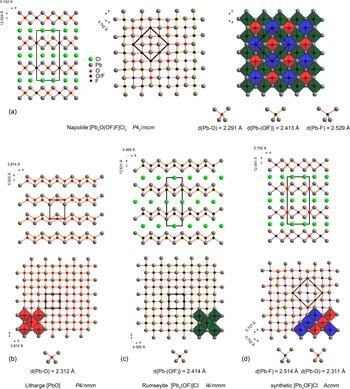
The structure of napoliite (Fig. 4a) contains one symmetrically unique Pb position. The Pb2+ cation is coordinated by one O, one F, two mixed O/F sites and four Cl atoms (Table 6). The coordination geometry of the Pb atom in napoliite can be described as a distorted square antiprism. In agreement with previous results on Pb oxychlorides, the general feature of the Pb2+ coordination in napoliite is the presence of several short Pb–X (X = O and F) bonds [2.2915(6)–2.5286(7) Å] located in one coordination hemisphere of the Pb2+ cation. In the opposite hemisphere, the Pb2+ cation forms four long Pb–Cl bonds [3.251(2)–3.566(2) Å]. This distortion is interpreted as the influence of the stereoactivity of the s 2 lone electron pair on the Pb2+ cation.
The crystal structures in balls-and-sticks and polyhedral representations of (a) napoliite; (b) structurally related litharge (Boher et al., Reference Boher, Garnier, Gavarri and Hewat1985); (c) rumseyite (Turner et al., Reference Turner, Siidra, Krivovichev, Stanley and Spratt2012); and (d) synthetic [Pb2OF]Cl (Aurivillius, Reference Aurivillius1977). In structural formulae, litharge-derived blocks are given in square brackets. Average Pb–X (X = O, F) bond lengths in XPb4 anion-centred tetrahedra are given for each crystal structure. Designations: grey balls = Pb; green balls = Cl; red balls = O sites; blue balls = F sites; dark green = mixed O/F sites; OPb4 tetrahedra = red; (O/F)Pb4 tetrahedra = dark green and FPb4 = blue. Pb–Cl long bonds are omitted for clarity.

The Cl atoms have cubic coordination, whereas all X sites have tetrahedral coordination (Siidra et al., Reference Siidra, Krivovichev and Filatov2008), thus being central for anion-centred OPb4, FPb4 and (O/F)Pb4 tetrahedra (Fig. 4a). XPb4 tetrahedra in napoliite are characterised by typical bond-length values (Table 6 and Fig. 4a). In napoliite, O1 atom forms four O–Pb bonds of 2.2915(6) Å each, which is in a good agreement with the average bond length value of 2.33 Å in ideal OPb4 tetrahedra observed for well refined structures (Krivovichev et al., Reference Krivovichev, Mentré, Siidra, Colmont and Filatov2013). The mixed oxygen/fluorine O/F1 site is tetrahedrally coordinated by four Pb–(O/F) bonds of 2.4129(5) Å, which is almost identical with the average Pb–(O/F) bond length of 2.41 Å in rumseyite (Turner et al., Reference Turner, Siidra, Krivovichev, Stanley and Spratt2012). The presence of a site occupied by F in the crystal structure of napoliite is confirmed by the Pb–F bond length of 2.5286(7) Å. Anion-centred FPb4 tetrahedra are also present in the structure of grandreefite, Pb2(SO4)F2 (Kampf, Reference Kampf1991). The average F–Pb bond length in its structure is 2.55 Å.
Discussion
Napoliite is a new representative (Fig. 4a) of a family of layered lead oxychlorides with lead oxide blocks derived from litharge PbO (Fig. 4b) (Boher et al., Reference Boher, Garnier, Gavarri and Hewat1985; Chukanov et al., Reference Chukanov, Siidra, Polekhovsky, Pekov, Varlamov, Ermolaeva and Virus2019). The structure of napoliite shows that the litharge-derived blocks may have different degrees and arrangements of F substitutions for O.
Napoliite is dimorphous with rumseyite (Turner et al., Reference Turner, Siidra, Krivovichev, Stanley and Spratt2012). Both minerals have not only identical chemical composition but also many similar physical properties. It should be noted that some properties of rumseyite (density, mean refractive index) were calculated erroneously by Turner et al. (Reference Turner, Siidra, Krivovichev, Stanley and Spratt2012); we use this occasion to correct these data (Table 7).
Comparative data for napoliite and rumseyite.

* Calculated by us from the chemical composition and unit cell parameters of rumseyite given by Turner et al. (Reference Turner, Siidra, Krivovichev, Stanley and Spratt2012)
** R min/Rmax for napoliite, R for rumseyite
However, the crystal structures of these minerals, their space groups and powder X-ray diffraction patterns are different (Table 7, Fig. 4). Their origin is also different. Rumseyite is a secondary mineral formed due to the decomposition of galena in manganese oxide pods distributed in Carboniferous Limestone at the Torr Works (Merehead) Quarry in England, whereas napoliite is a fumarolic mineral deposited directly from hot gas as a volcanic sublimate. Both minerals can be considered as extremely rare; they have been found in a single specimen each and neither has a known, reliably characterised synthetic analogue.
From the crystal chemical point of view, a specific feature of rumseyite, [Pb2(OF)]Cl, is that all O2– anions in the [PbO] block are partially substituted by F– (Fig. 4c). In synthetic orthorhombic Pb2OFCl (Aurivillius, Reference Aurivillius1977), F and O atoms are completely ordered over two symmetrically independent anionic sites (Fig. 4d). Thus, napoliite represents a new structure type with a unique order/disorder pattern of fluorine and oxygen atoms. Its structural formula is [Pb1Pb4O1OO/F1(OF)F1F]Cl1Cl2, where the litharge-derived block is in square brackets.
Acknowledgements
We acknowledge Mike Rumsey and three anonymous reviewers, Associate Editor Elena Zhitova and Principal Editor Stuart Mills for valuable comments. Technical support by the SPbSU X-ray Diffraction Resource Centre is gratefully acknowledged. Interpretation of the Raman spectrum was performed in accordance with the state task, state registration No. AАAА-А19-119092390076-7.
Supplementary material
The supplementary material for this article can be found at https://doi.org/10.1180/mgm.2023.43.
Competing interests
The authors declare none.