

I. COMMENTAIRE MATHÉMATIQUE
PréliminairesFootnote *
Nous n'analyserons pas en détail ce qu'est un orbe pour Ibn al-Šāṭir. Qu'il suffise de le concevoir comme un corps à symétrie sphérique. Chaque orbe est doté d'un centre. Le centre de certains orbes est aussi centre du Monde. Enfin, et surtout, Ibn al-Šāṭir utilise chaque orbe comme un référentiel solide en mouvement. Pour qu'un corps solide à symétrie sphérique puisse faire office de référentiel spatial, il faut distinguer un plan attaché à l'orbe et passant par son centre, et une direction dans ce plan. Dans tout ce qui suit, on représentera plus commodément chaque orbe par une sphère, un cercle et un point: à savoir, une sphère dont le centre est le centre de l'orbe, un grand cercle section de cette sphère par son plan, et un point de ce cercle situé dans la direction distinguée par rapport au centre.
Chaque orbe est mobile par rapport à l'orbe qui le porte (c'est-à-dire au sein du référentiel constitué par l'orbe qui le porte). Un seul mouvement est admis pour chaque orbe: un mouvement de rotation uniforme autour d'un axe passant par son centre. Autrement dit, le centre de chaque orbe est immobile au sein de l'orbe qui le porte. Il n'y a aucune restriction quant à l'inclinaison de l'axe par rapport au plan de l'orbe: tel orbe a son axe perpendiculaire à son plan, tel autre a son axe perpendiculaire au plan de l'orbe qui le porte. Mais tous ces mouvements sont relatifs, et chaque orbe hérite aussi “par accident” (au sens aristotélicien du terme) du mouvement de l'orbe qui le porte, qui hérite lui-même du mouvement de l'orbe qui le porte, et ainsi de suite. Le mouvement de chaque orbe est donc composé d'un mouvement propre de rotation uniforme par rapport à l'orbe qui le porte, et du mouvement absolu de l'orbe qui le porte. Seul le neuvième orbe, porté par aucun autre, n'est animé que de son mouvement propre de rotation uniforme.
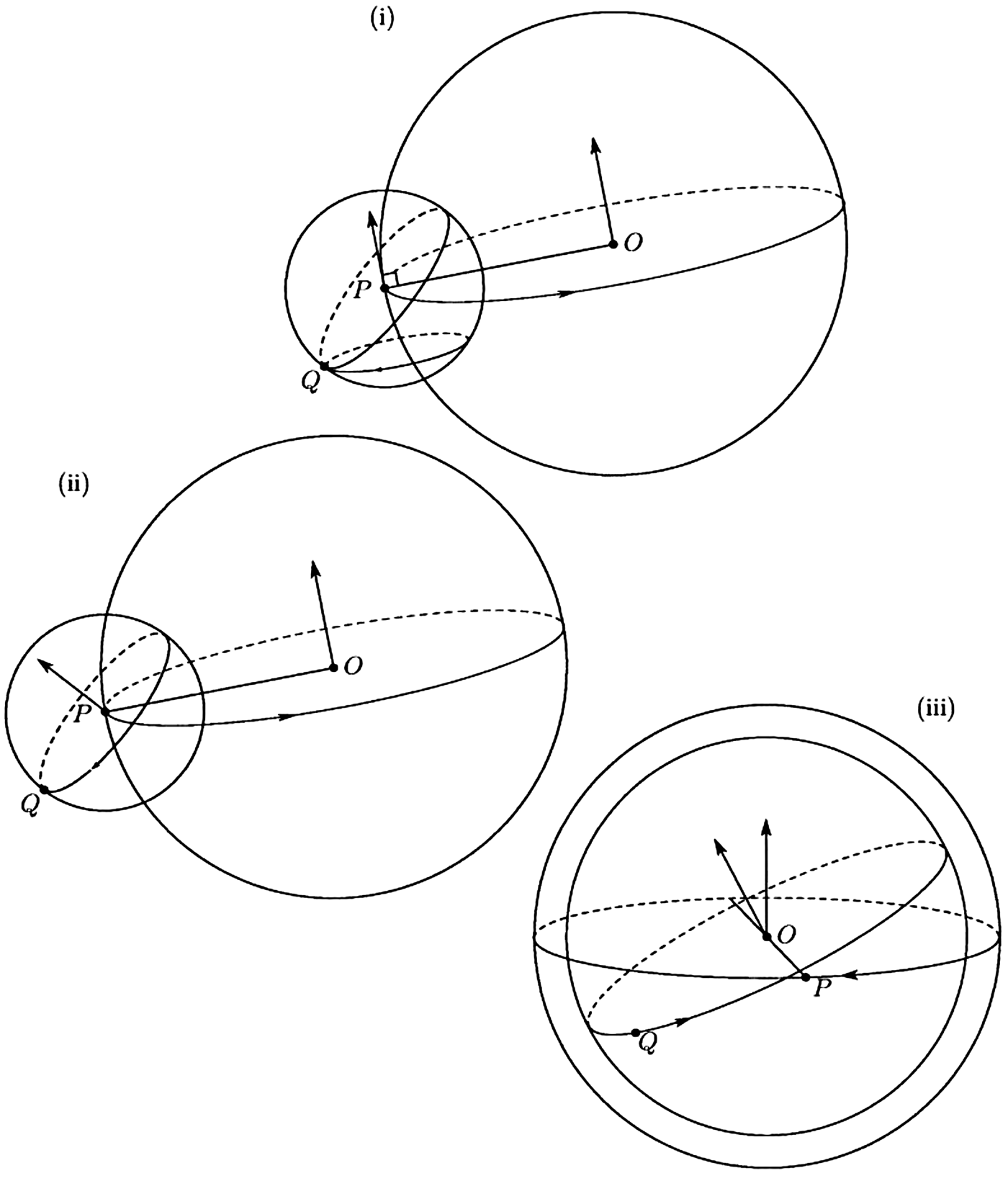
Ce cadre conceptuel donne lieu à trois combinaisons possibles, toutes présentes dans le texte d'Ibn al-Šāṭir. Nous les décrirons au moyen des trois figures (i), (ii) et (iii). Dans chacune de ces trois figures il y a deux orbes représentés chacun par une sphère, un grand cercle de cette sphère et un point sur ce cercle. Le premier orbe dont le point est P porte le second dont le point est Q. Dans les figures (i) et (ii), le point P de l'orbe portant est choisi par commodité au centre de l'orbe porté. Au contraire, dans la figure (iii), les deux orbes ayant même centre O, il a fallu choisir un autre point: le point P est alors un point à l'intersection des plans des deux orbes. Dans tout ce paragraphe, on désignera chaque orbe par son point. L'orbe de P porte donc l'orbe de Q. Ainsi, le lieu occupé par l'orbe de Q est constant au sein du référentiel solide constitué par l'orbe de P. Mais l'orbe de Q est animé d'un mouvement de rotation uniforme sur lui-même, autour d'un axe représenté par un vecteur sur chaque figure. Peu importe ici le sens de cette rotation; seule importe la direction de son axe, perpendiculaire au plan de l'orbe de P dans la figure (i), mais perpendiculaire au plan de l'orbe de Q dans les figures (ii) et (iii). La figure (i) présente cette particularité que la trajectoire du point Q au sein du référentiel constitué par l'orbe de P n'est pas dans le plan de l'orbe de Q: le point Q décrit un petit cercle parallèle au plan de l'orbe de P. Enfin, dans chacune des trois figures, l'orbe de P est lui-même animé d'un mouvement de rotation uniforme autour d'un axe représenté par un vecteur d'origine O. Peu importe que ce vecteur soit perpendiculaire au plan de l'orbe de P – comme il l'est dans ces figures – ou non. Ce dernier mouvement entraîne le point P et aussi l'orbe de Q.
Un orbe est un référentiel solide en mouvement
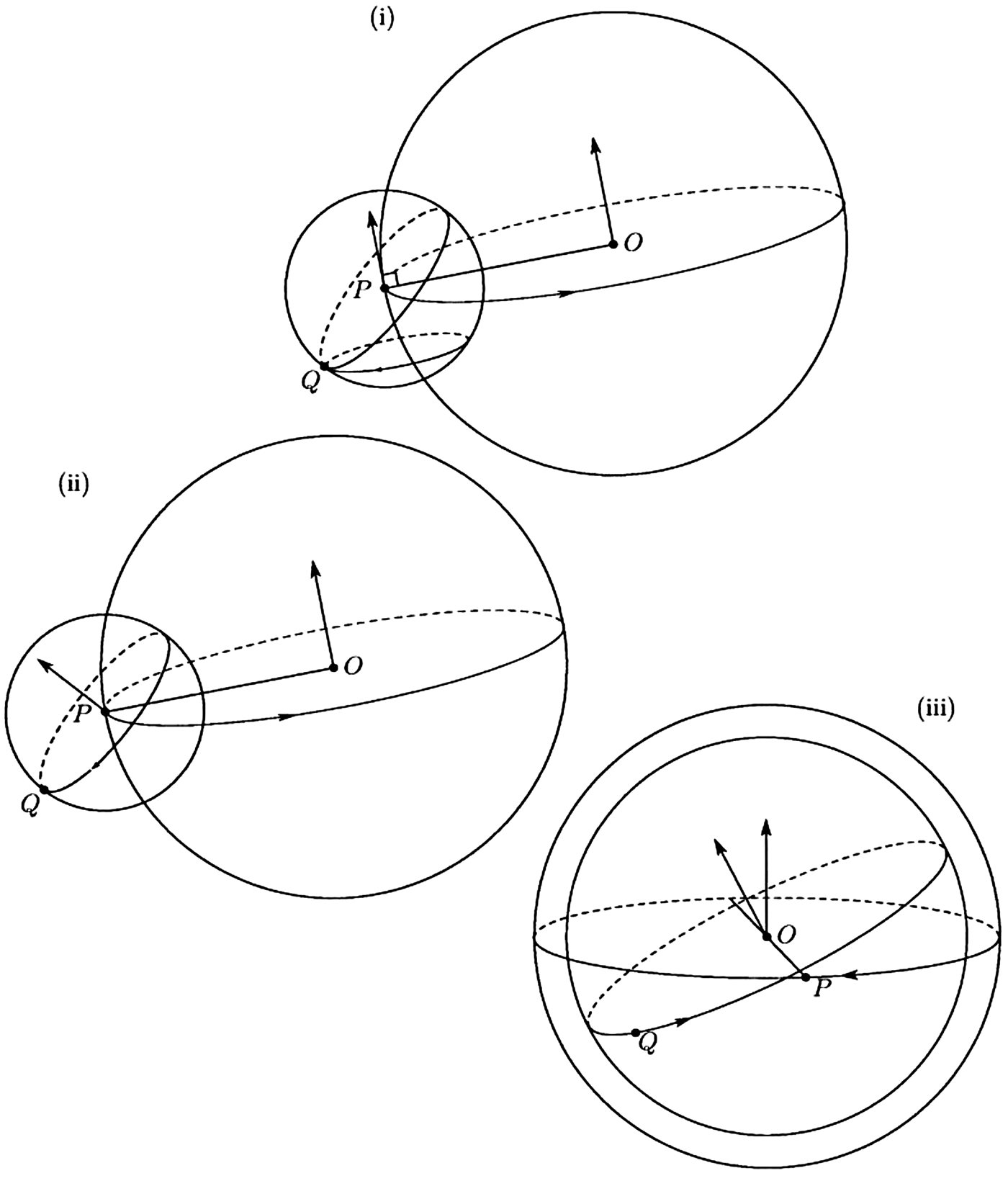
Chacune des planètes supérieures (Mars, Jupiter, Saturne) est portée par un système d'orbes: un “orbe parécliptique”, un “orbe incliné”, un “orbe déférent”, un “orbe rotateur” et un “orbe de l’épicycle”. La figure (i) représente alors la relation entre l'orbe incliné (orbe de P) et l'orbe déférent (orbe de Q), ainsi que la relation entre l'orbe déférent (orbe de P) et l'orbe rotateur (orbe de Q). Pour Vénus, les orbes portent les mêmes noms, mais la figure (ii) représente alors la relation entre l'orbe déférent (orbe de P) et l'orbe rotateur (orbe de Q), ainsi que la relation entre l'orbe rotateur (orbe de P) et l'orbe de l’épicycle (orbe de Q). Mercure compte davantage d'orbes sans toutefois introduire de combinaison nouvelle.
Pour chaque planète, la figure (iii) représente la relation entre l'orbe parécliptique (orbe de P) et l'orbe incliné (orbe de Q): le point P est alors l'un des nœuds. Mais cette figure représente aussi la relation entre le neuvième orbe (orbe de P) et le huitième, dit de l’écliptique (orbe de Q): le point P est alors le point vernal.
Précession des équinoxes
Observons à nouveau la figure (iii). Chez Ptolémée, les étoiles fixes sont attachées au dernier orbe et le mouvement relatif de cet orbe par rapport aux orbes inférieurs rend compte du mouvement de précession des équinoxes. Pour les astronomes arabes, depuis le Traité sur l'année solaire certainement dû aux Banū Mūsā (IXe siècle),Footnote 1 il existe un neuvième orbe au delà des étoiles fixes situées sur le huitième orbe, et c'est le mouvement relatif du huitième orbe par rapport au neuvième qui rend alors compte de la précession. Tous les orbes inférieurs des planètes, du Soleil et de la Lune héritent de ce mouvement comme les étoiles fixes (tandis que chez Ptolémée, le Soleil en était exemptFootnote 2 ).
Chez Ibn al-Šāṭir, l'orbe parécliptique de chaque planète est un orbe dont le centre coïncide avec le centre du Monde, comme l’écliptique. L'orbe parécliptique reproduit, en plus petit, l'orbe de l’écliptique et y est attaché en son centre. Le parécliptique est animé d'un petit mouvement de rotation sur lui-même, par rapport au référentiel constitué par l'orbe de l’écliptique; mais comme l'axe de rotation du parécliptique coïncide avec l'axe de l’écliptique, et que la composée de deux rotations de même axe en est encore une, le parécliptique est aussi en rotation uniforme autour de son axe au sein du référentiel constitué par le neuvième orbe. Le mouvement de l'orbe de l’écliptique par rapport au neuvième est d'un degré toutes les soixante-dix années persanes. Le mouvement de l'orbe parécliptique par rapport au neuvième orbe est un peu plus rapide, comme l'avait vérifié al-Zarqālluh (XIe siècle): il est d'un degré toutes les soixante années persanes, c'est-à-dire 0°1′ par année persane.Footnote 3
Figure initiale
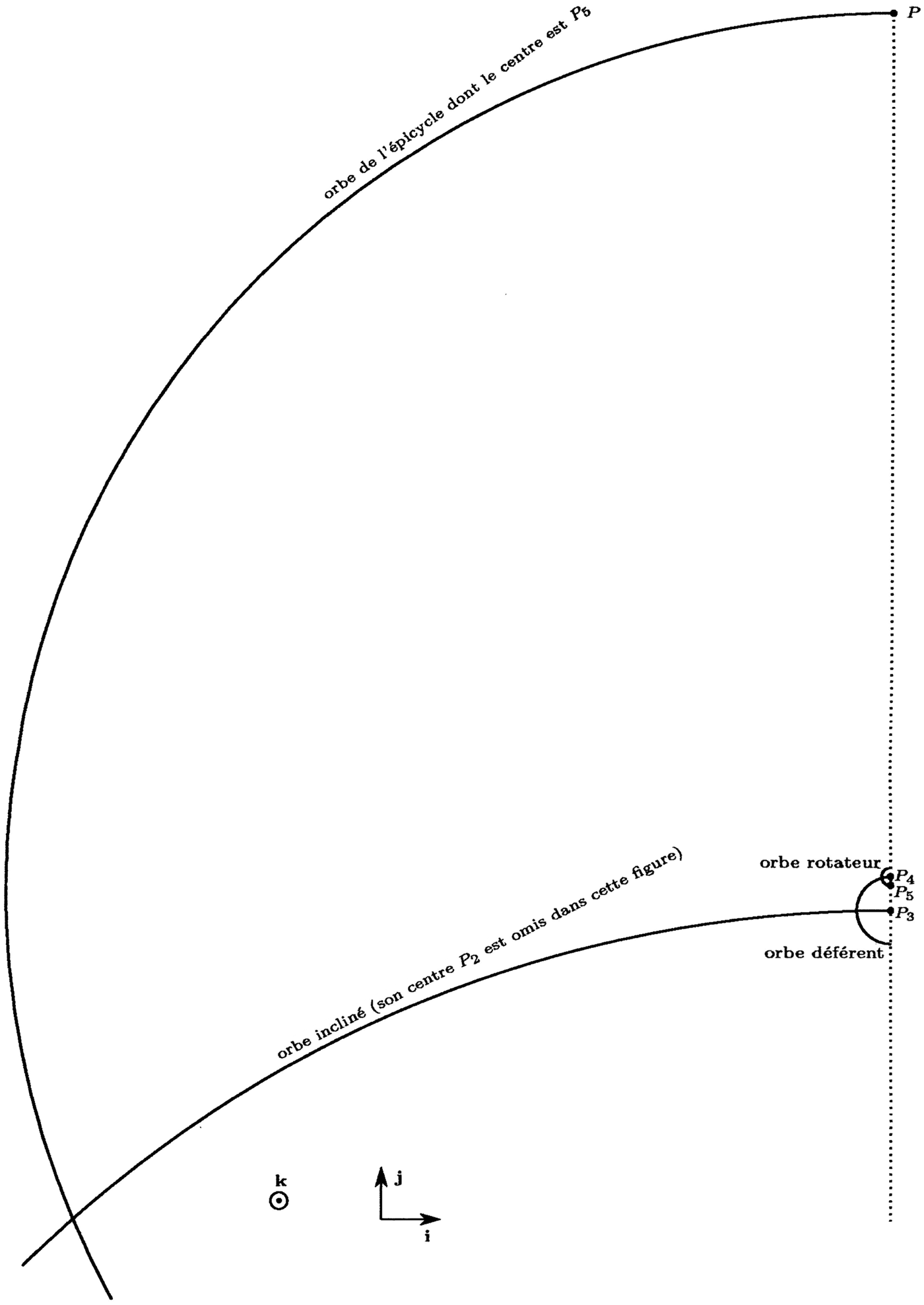
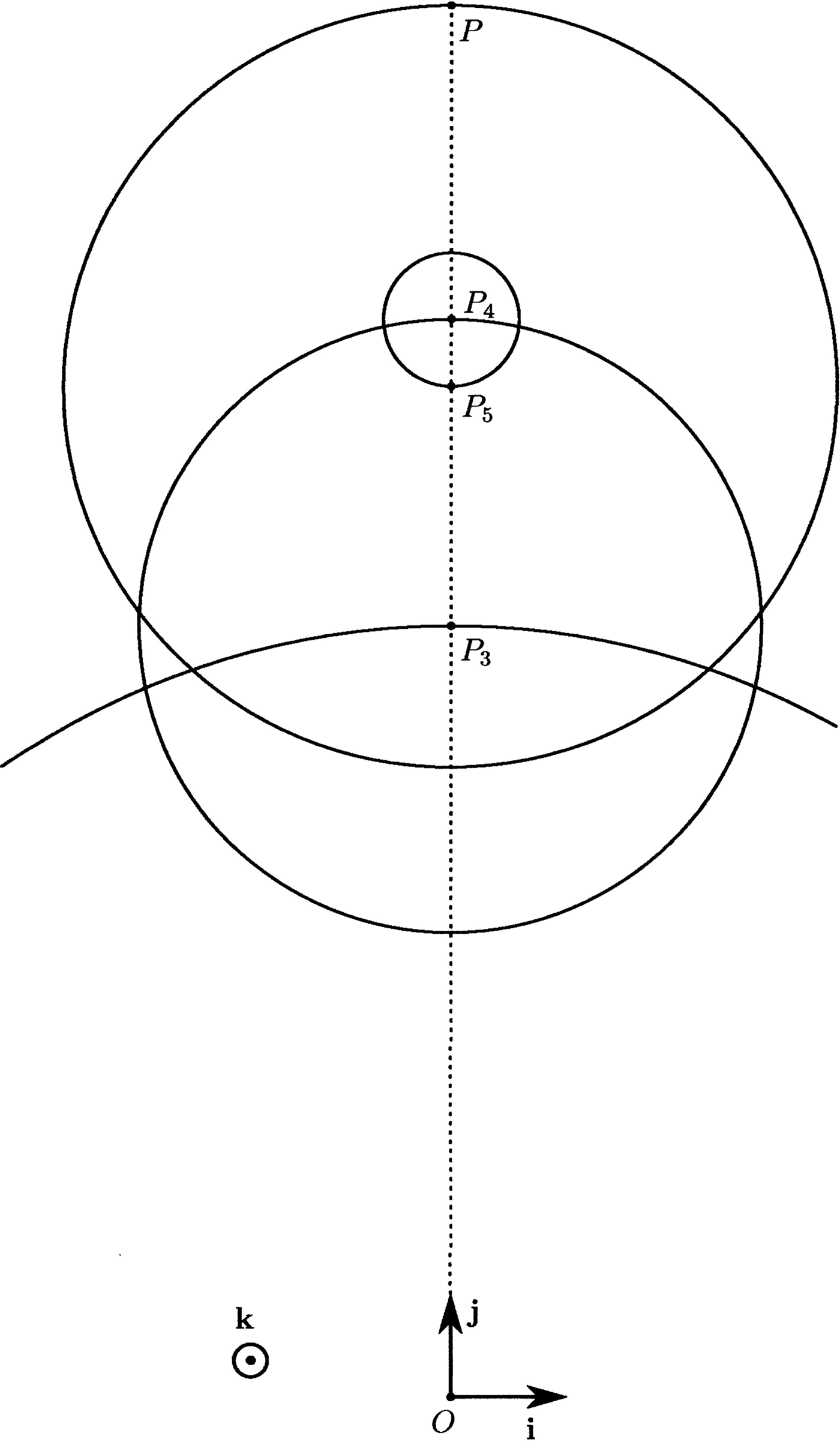
Soit (i, j, k) la base canonique de ℝ3. Dans la figure initiale, les plans des orbes sont tous rabattus dans le plan de l’écliptique (i, j) par des rotations, les centres des orbes sont tous alignés dans la direction du vecteur j elle-même confondue avec la direction du point vernal; enfin, la ligne des nœuds, à l'intersection des plans de l'orbe incliné et du parécliptique, est orientée dans la direction du vecteur i, la tête étant du même côté que i. Le point O est le centre du Monde, P
1 le centre du parécliptique de Vénus, et P
2 le centre de son orbe incliné. Ces trois points sont confondus O = P
1 = P
2. Le point P
3 est le centre de l'orbe déférent, P
4 le centre de l'orbe rotateur, P
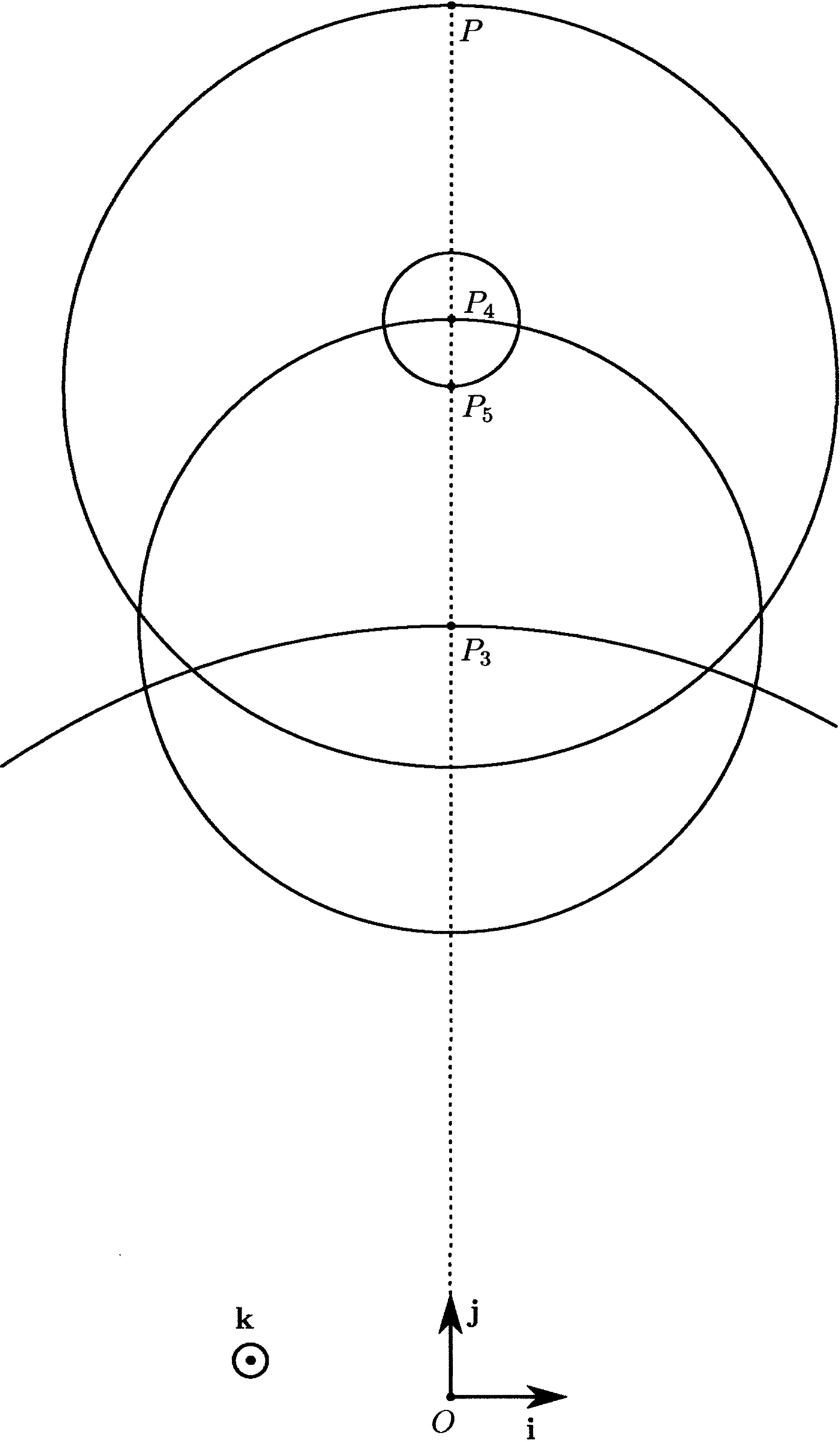
5 le centre de l'orbe de l’épicycle, P est le centre de Vénus, cette planète étant elle-même un corps sphérique. La figure 2 précise la position de ces points: bien qu'ils soient alignés, on remarque que les rayons vecteurs
 $\overrightarrow {{P_n}{P_{n + 1}}} $
ne sont pas tous dans le même sens. Posons
 $\overrightarrow {O{P_3}} = 60\,{\bf j}$
, alors
 $$\overrightarrow {{P_3}{P_4}} = 1; 41\,{\bf j},\;\overrightarrow {{P_4}{P_5}} = - 0; 26\,{\bf j},\;\overrightarrow {{P_5}P} = 43; 33\,{\bf j}$$
où le point-virgule sépare partie entière et partie fractionnaire.Footnote 4 La figure 2 est à l’échelle, mais il a fallu, pour ce faire, omettre le point O. Par souci de lisibilité, on préfèrera utiliser la figure 3, analogue mais pas à l’échelle.
Figure initiale à l’échelle
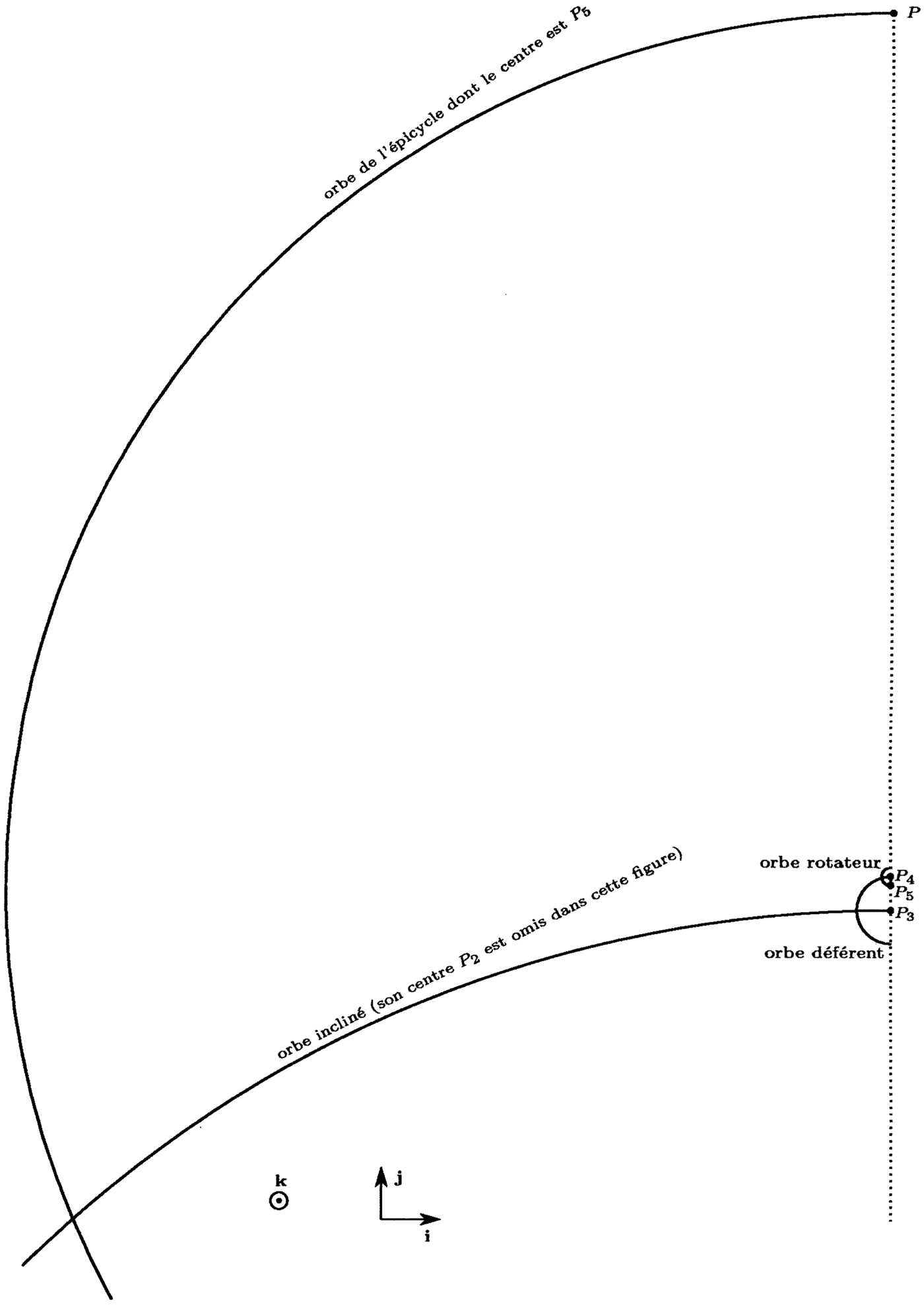
Figure initiale
Remarquons d'emblée que la figure initiale ne représente la position des orbes à aucun instant de l'histoire passée ou future du Monde: il faut appliquer au point P une suite de transformations géométriques pour obtenir la position de Vénus prédite ou observée à un instant donné.
Transformations géométriques
Dans les modèles d'Ibn al-Šāṭir, on chercherait en vain une description mathématique du mouvement en termes de transformations ou de différences entre deux instants. L'objet de la description mathématique est ici l'opération transformant une figure initiale (qui n'a d'existence qu'imaginaire) en une autre figure représentant la configuration des astres à un instant donné. Les transformations appliquées à Vénus P sont des rotations paramétrées par trois angles θ a , θc, θp . Voici la liste de ces transformations:
 $$R({P_5},\,{\bf k},\,{\theta _p}-{\theta _c}),\quad R\left( {{P_5},\,{\bf j},\,0^{circ} 30^{\prime}} \right),\quad R\left( {{P_5},\,{\bf i},\,0^{\circ} 5^{\prime}} \right),$$
 $$R({P_4},\,{\bf k},\,2{\theta _c}),\quad R({P_4},\,{\bf j},\,3^{\circ} ),\quad R({P_4},\,{\bf i},-0^{\circ} 5^{\prime}),$$
 $$R({P_3},\,{\bf k},-{\theta _c}),\quad R\left( {{P_2},\,{\bf k},\,{\theta _c}} \right),\quad R\left( {{P_2},\,{\bf i},\,0^{\circ} 10^{\prime}} \right),\quad R\left( {{P_1},\,{\bf k},\,{\theta _a}} \right).$$
Une rotation dont l'axe est dans la direction du vecteur i ou j a pour effet d'incliner le plan d'un orbe par rapport au plan de l'orbe qui le porte. La description d'Ibn al-Šāṭir ne laisse aucun doute quant à l'ordre dans lequel appliquer toutes ces transformations.
Pour obtenir la configuration des orbes à un instant donné, il faut donc appliquer toutes ces rotations aux points P 3, P 4, P 5, P. L'image du point P 3 entraîné par les mouvements de l'orbe parécliptique et de l'orbe incliné est:
 $$R\left( {{P_1},\,{\bf k},\,{\theta _a}} \right) \,{\circ}\, R\left( {{P_2},\,{\bf i},\,0^{\circ} 10^{\prime}} \right) \,{\circ}\, R({P_2},\,{\bf k},\,{\theta _c}){\rm (}{P_3}).$$
Quant au point P 4, il est aussi entraîné par le mouvement de l'orbe déférent et devient:
 $$R({P_1},\,{\bf k},\,{\theta _a}) \,{\circ}\, R({P_2},\,{\bf i},\,0^{\circ} 10^{\prime}) \,{\circ}\, R({P_2},\,{\bf k},\,{\theta _c}) \,{\circ}\, R({P_3},\,{\bf k}, -{\theta _c}){\rm (}{P_4}).$$
Le point P 5 est aussi entraîné par le mouvement de l'orbe rotateur et devient:
 $$\hskip -.3pc R({P_1},\,{\bf k},\,{\theta _a}) \,{\circ}\, R({P_2},\,{\bf i}, 0^{\circ} 10^{\prime}) \,{\circ}\, R({P_2},\,{\bf k},\,{\theta _c}) \,{\circ}\, R({P_3},\,{\bf k}, -{\theta _c})$$
 $${\circ} R({P_4},\,{\bf i},-0^{\circ} 5^{\prime}) \,{\circ}\, R({P_4},\,{\bf j}, 3^{\circ} ) \,{\circ}\, R({P_4},\,{\bf k},\,2{\theta _c}){\rm (}{P_5}).$$
Enfin le point P, aussi entraîné par l'orbe de l’épicycle, devient:
 $$\hskip -5.8pc R({P_1},\,{\bf k},\,{\theta _a}) \,{\circ}\, R({P_2},\,{\bf i}, 0^{\circ} 10^{\prime}) \,{\circ}\, R({P_2},\,{\bf k},\,{\theta _c})$$
 $$\hskip 3.8pc{\circ} R({P_3},\,{\bf k}, -{\theta _c}) \,{\circ}\, R({P_4},\,{\bf i},-0^{\circ} 5^{\prime}) \,{\circ}\, R({P_4},\,{\bf j}, 3^{\circ} ) \,{\circ}\, R({P_4},\,{\bf k},\,2{\theta _c})$$
 $$\hskip 1.5pc{\circ} R({P_5},\,{\bf i}, 0^{\circ} 5^{\prime}) \,{\circ}\, R({P_5},\,{\bf j}, 0^{\circ} 30^{\prime}) \,{\circ}\, R({P_5},\,{\bf k},\,{\theta _p}-{\theta _c}){\rm (}P).$$
Trajectoire
Dans le cadre théorique que l'on vient de décrire, l'on ne peut guère parler de trajectoire dans l'espace. Il y a bien toutefois une trajectoire dans l'ensemble des valeurs des paramètres:
 $${\theta _a} = {\omega _a}t + {\phi _a}$$
 $${\theta _c} = (\omega _m^ \odot -{\omega _a})t + (\phi _m^ \odot -{\phi _a})$$
 $${\theta _p} = {\omega _p}t + {\phi _p}$$
où l'on a distingué par un exposant les grandeurs
 $\omega _m^ \odot , \,\phi _m^ \odot $
en rapport avec le modèle du Soleil.Footnote
5
On a:
 $$\phi _m^{\odot} = 280; 9, 0,\quad \omega _m^{\odot} = 359; 45, 40 \hbox{par ann\'{e}e persane}$$
 $${\phi _a} = 77;\,52,\,10,\,\quad {\omega _a} = 0;\,1 \hbox{par ann\'{e}e persane}$$
 $${\phi _p} = 320;\,50,\,19,\,\quad {\omega _p} = 225; 1,\,48,\,41 \hbox{par ann\'{e}e persane}$$
Unité de temps
Le temps absolu est mesuré par le mouvement du neuvième orbe, seul orbe dont le mouvement propre est absolu (les mouvements propres des autres orbes sont relatifs à l'orbe qui les porte).
En un lieu donné, la durée entre deux culminations du Soleil (de midi à midi du lendemain) est approximativement constante.
Considérons deux unités possibles pour la mesure du temps:
-
• le jour sidéral: durée d'une rotation complète du ciel visible autour du pôle nord (temps de retour d'une étoile fixe en son lieu par rapport au pôle nord et à l'horizon);
-
• le jour solaire: durée entre deux culminations du Soleil (de midi à midi du lendemain).
Le neuvième orbe étant supposé mû d'un mouvement uniforme, le jour sidéral est de durée constante (sauf à tenir compte du mouvement de précession, le mouvement propre du huitième orbe qui est infime). En revanche, la durée du jour solaire varie au fil des saisons, ce n'est donc pas une bonne unité. En effet, soit midi au Soleil. Un jour sidéral plus tard, le Soleil aura presque effectué une rotation complète d'Est en Ouest à cause du mouvement du neuvième orbe; pas tout à fait cependant, à cause du mouvement du parécliptique du Soleil qui l'aura légèrement entraîné vers l'Est, d'un peu moins qu'un degré. Il ne sera donc pas encore midi au Soleil: le jour sidéral est plus court que le jour solaire. Cet effet se fera sentir d'autant plus que l'angle entre le parécliptique et la trajectoire diurne du Soleil sera faible (ainsi la différence sera plus importante lors des solstices que lors des équinoxes). De toute façon, le mouvement du Soleil le long de son parécliptique n'est pas uniforme.
Tout calendrier civil adoptant pourtant le jour solaire comme unité, il est commode de choisir comme unité astronomique un “jour solaire moyen”: durée entre deux culminations, non plus du Soleil, mais d'un point imaginaire mû d'un mouvement uniforme le long de l’équateur et faisant le tour du ciel exactement en même temps que le Soleil.Footnote 6 C'est l'unité adoptée par Ibn al-Šāṭir: al-yawm bi-laylatihi. Quand une date est donnée en temps civil (c'est-à-dire un certain nombre d'heures à compter de midi au Soleil), il faut la corriger en lui ajoutant une certaine “équation du temps”, ta‘dīl al-ayām, qui s'annule lors de l’équinoxe de printemps quand le Soleil et le point imaginaire coïncident sur l’équateur.Footnote 7 L'heure est un vingt-quatrième de jour solaire moyen.
Soit t 0 la date d'un équinoxe de printemps, et t un instant donné quelconque, dates exprimées en jours solaires moyens. Les mêmes dates exprimées en temps civil (jours solaires, et heures comptées à partir de midi au soleil) seront notées τ 0 et τ, et en jours sidéraux T 0 et T.
Le point imaginaire se déplace le long de l’équateur à la vitesse du Soleil moyen; son ascension droite varie donc comme la longitude λ m du Soleil moyen. À l'instant t, elle vaut λ m (t) – λ m (t 0).
De combien le Soleil s'est-il déplacé vers l'Est depuis le dernier équinoxe de printemps? C'est précisément son ascension droite α(t).
Le jour sidéral est plus court que le jour solaire, d'autant qu'il faut au mouvement diurne pour récupérer le déplacement du Soleil vers l'Est. La vitesse du mouvement diurne est d'environ 15° par heure (elle est de 360° par jour sidéral, mais le jour sidéral compte un peu moins que 24 heures). On a donc:
 $$(T-{T_0})-(\tau -{\tau _0}) \simeq \displaystyle{{\alpha (t)} \over {15^{\circ}}} \,{\rm heures}.$$
Il ne s'agit que d'une approximation, puisque pendant cette durée, le Soleil se déplace légèrement davantage vers l'Est…
De même, le jour sidéral est plus court que le jour solaire moyen, d'autant qu'il faut au mouvement diurne pour récupérer le déplacement du point imaginaire vers l'Est le long de l’équateur:
 $$(T-{T_0})-(t-{t_0}) \simeq \displaystyle{{{\lambda _m}(t) - {\lambda _m}({t_0})} \over {15^{\circ}}} \,{\rm heures}.$$
Ibn al-Šāṭir donne λ m (t 0) = –2°1′7′′. L’équation du temps est doncFootnote 8 :
 $$E = (t-{t_0})-(\tau -{\tau _0}) \simeq \displaystyle{{ - {\lambda _m}(t) - 2^{\circ} 1^{\prime}7^{\prime \prime} + \alpha (t)} \over {15^{\circ}}} \,{\rm heures}.$$
Chez Ibn al-Šāṭir, l'unité de temps est le jour solaire moyen, ou l'année persane de 365 jours solaires moyens. L’“époque” (c'est-à-dire l'instant t = 0) est à midi du 24 décembre 1331. Il s'agit probablement d'une date en temps solaire moyen (les valeurs des paramètres à cette date ayant été obtenus par le calcul à partir d'une observation antérieure,Footnote 9 un jour d’équinoxe de printemps). Le temps GMT (Greenwich Mean Time) est un temps solaire moyen mesurant comme précédemment le déplacement uniforme d'un point imaginaire le long de l’équateur, mais ce point ne coïncide pas avec le Soleil lors de l’équinoxe de printemps: l’équation du temps n'a donc pas la même origine que chez Ibn al-Šāṭir, elle est d'environ 8 min à l’équinoxe de printemps et elle s'annule vers le 15 avril. Il faut aussi tenir compte du décalage horaire à la longitude de Damas, 36°18′23′′. L’époque d'Ibn al-Šāṭir est donc, en temps GMT, le 24 décembre 1331 à 12 h 8 min –(36°18′23′′)/15° ≃ 9 h 43 min.
Si l'on utilise la méthode d'Ibn al-Šāṭir décrite dans cet article pour calculer la longitude de Vénus à cette date, en négligeant l'effet de l'opérateur M (cf. paragraphe suivant) et en appliquant la méthode d'interpolation de Ptolémée (voir plus loin), on trouve 264°23′. L'Institut de Mécanique Céleste et de Calcul des Éphémérides de l'Observatoire de ParisFootnote 10 donne 264°21′.
Transformations planes
Si R et S sont deux rotations dans l'espace, il existe une rotation T telle que R ∘ S = T ∘ R, à savoir, la rotation de même angle que S et dont l'axe est l'image par R de l'axe de S. Appliquons cette relation de commutation à toutes les composées de rotations décrites ci-dessus, de sorte à réécrire à droite toutes les rotations dont l'axe est dans la direction du vecteur k. Par exemple
 $$R({P_1},\,{\bf k},\,{\theta _a}) \,{\circ}\, R({P_2},\,{\bf i}, 0^{\circ} 10^{\prime}) = R({P_2},\,{\bf u}, 0^{\circ} 10^{\prime}) \,{\circ}\, R({P_1},\,{\bf k},\,{\theta _a})$$
où le vecteur u est l'image de i par R(P 1, k, θ a ). On fait de même avec les inclinaisons des plans des petits orbes. Il existe donc une composée de rotations M telle que l'image du point P soit
 $$M \,{\circ}\, R\left( {{P_2},\,{\bf u}, 0^{\circ} 10^{\prime}} \right) \left( {P^{\prime}} \right)$$
où
 $$P^{\prime} = R({P_1},\,{\bf k},\,{\theta _a}) \,{\circ}\, R({P_2},\,{\bf k},\,{\theta _c}) \,{\circ}\, R({P_3},\,{\bf k}, -{\theta _c})$$
 $${\circ} R({P_4},\,{\bf k}, 2{\theta _c}) \,{\circ}\, R({P_5},\,{\bf k},\,{\theta _p}-{\theta _c}){\rm (}P).$$
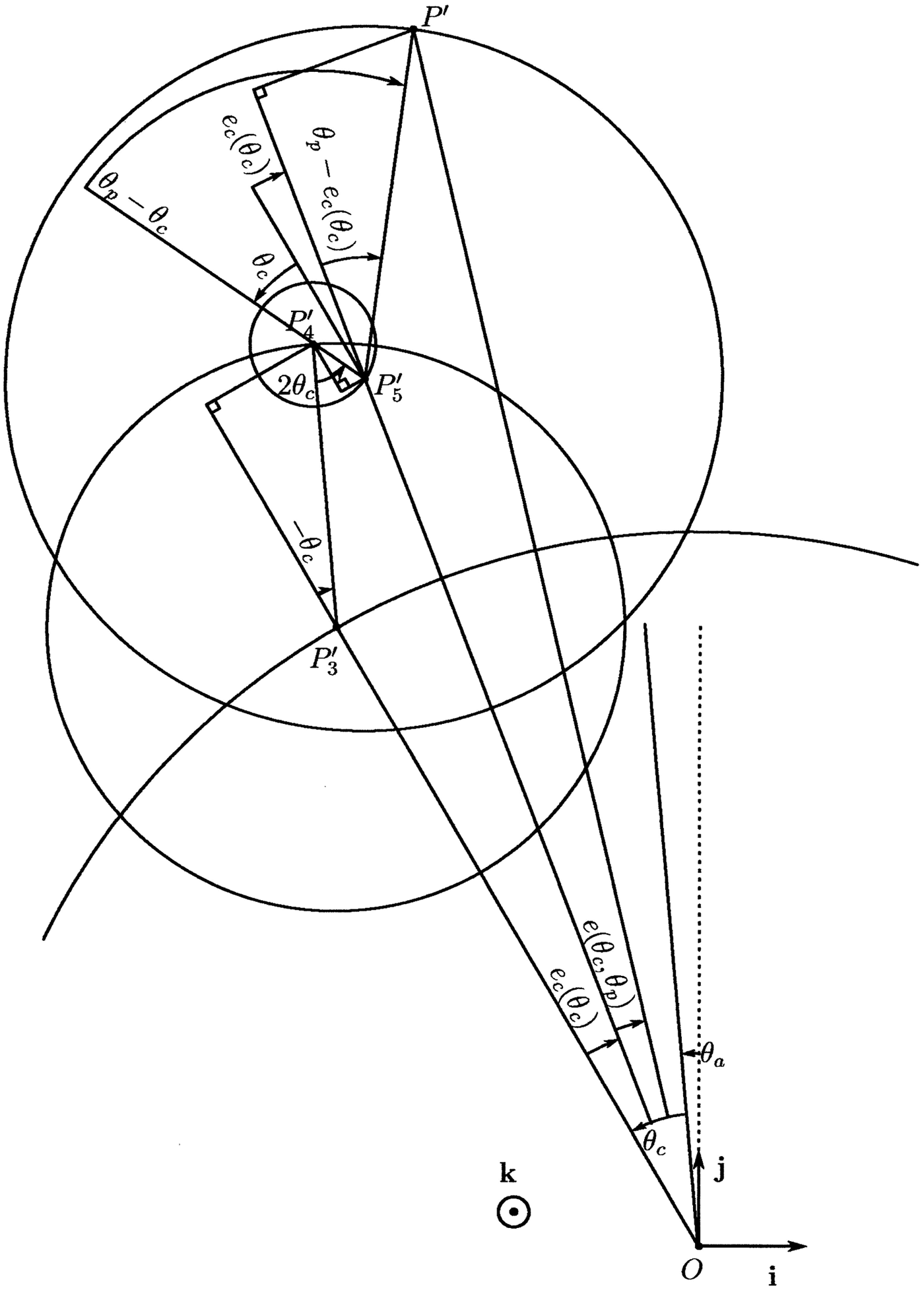
On introduit de même les points P′3, P′4, P′5 suivants (voir Fig. 4):
 $${P^{\prime}_3} = R({P_1},\,{\bf k},\,{\theta _a}) \,{\circ}\, R({P_2},\,{\bf k},\,{\theta _c}){\rm (}{P_3})$$
 $${P^{\prime}_4} = R({P_1},\,{\bf k},\,{\theta _a}) \,{\circ}\, R({P_2},\,{\bf k},\,{\theta _c}) \,{\circ}\, R({P_3},\,{\bf k}, -{\theta _c}){\rm (}{P_4})$$
 $${P^{\prime}_5} = R({P_1},\,{\bf k},\,{\theta _a}) \,{\circ}\, R({P_2},\,{\bf k},\,{\theta _c}) \,{\circ}\, R({P_3},\,{\bf k}, -{\theta _c}) \,{\circ}\, R({P_4},\,{\bf k}, 2{\theta _c}){\rm (}{P_5}).$$
Transformation planes
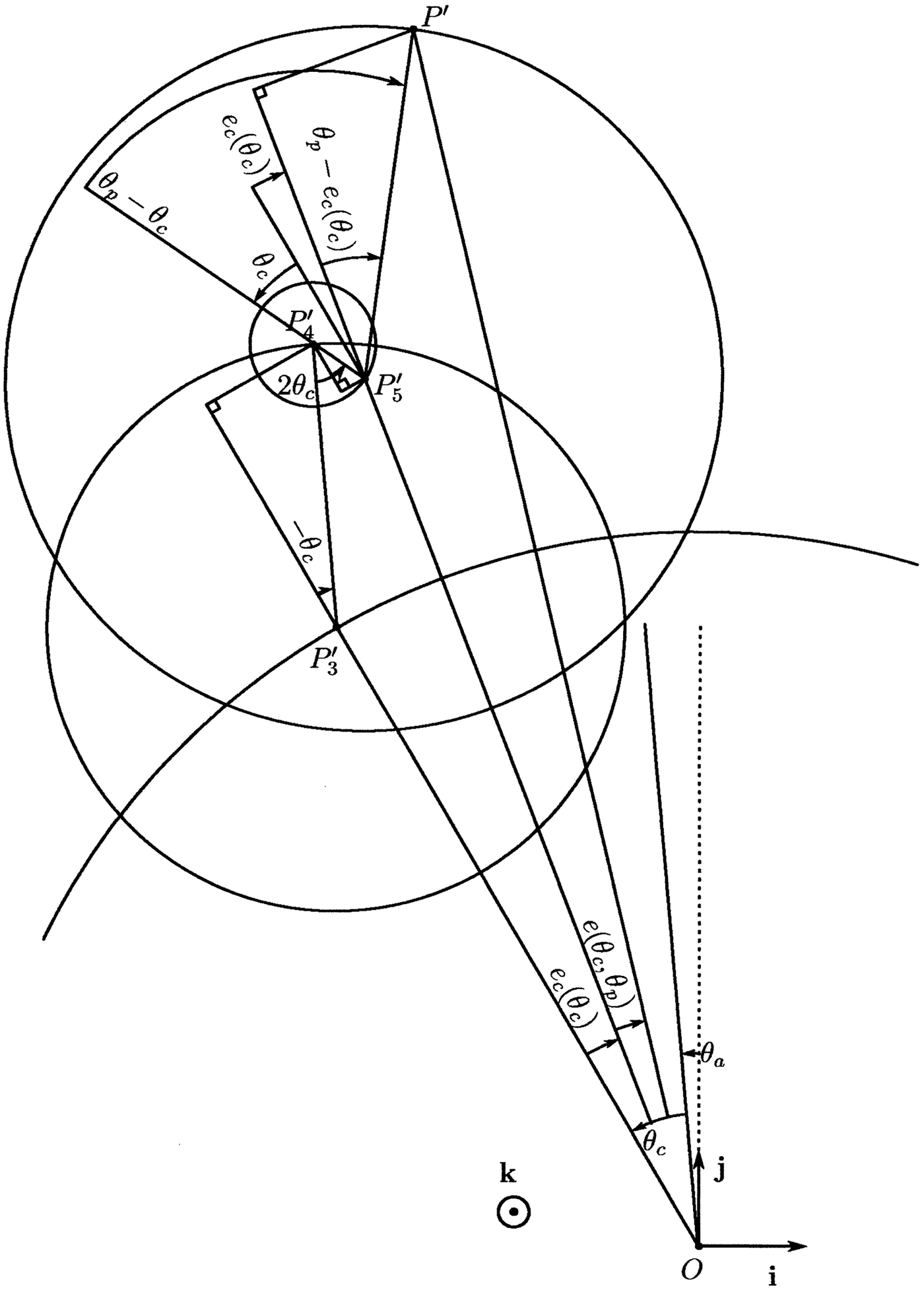
Tous ces points sont dans le plan de la figure initiale: calculer leurs positions relève entièrement de la géométrie plane.
Les équations de Vénus
Le calcul de la position du point P′ revient à résoudre trois triangles rectangles (voir Fig. 4). Ceci est expliqué dans le chapitre 23 de la Nihāyat al-Sūl. On calcule d'abord l'angle e c (θ c ) = (OP′3 ,OP′5) appelé “équation du centre”:
 $${e_c}\left( {{\theta _c}} \right) = - \arcsin \left( {\displaystyle{{{P_3}{P_4}\sin {\theta _c} + {P_4}{P_5}\sin {\theta _c}} \over {O{P_5^{\prime}}}}} \right)$$
où
 $$O{P^{\prime}_5} = \sqrt {{{\left( {{P_3}{P_4}\sin {\theta _c} + {P_4}{P_5}\sin {\theta _c}} \right)}^2} + {{\left( {O{P_3} + {P_3}{P_4}\cos {\theta _c} - {P_4}{P_5}\cos {\theta _c}} \right)}^2}}. $$
On calcule ensuite une autre “équation” e(θ c ,θp ) = (OP′5 ,OP′):
 $$e\left( {{\theta _c},{\theta _p}} \right) = \arcsin \left( {\displaystyle{{{P_5}P\sin \left( {{\theta _p} - {e_c}\left( {{\theta _c}} \right)} \right)} \over {OP^{\prime}}}} \right)$$
où
 $$OP^{\prime} = \sqrt {{{\left( {{P_5}P\sin \left( {{\theta _p} - {e_c}\left( {{\theta _c}} \right)} \right)} \right)}^2} + {{\left( {O{{P^{\prime}}_5} + {P_5}P\cos \left( {{\theta _p} - {e_c}\left( {{\theta _c}} \right)} \right)} \right)}^2}}. $$
La position de P′ est alors donnée par OP′ et par l'angle suivant:
 $$({\bf j},\overrightarrow {OP^{\prime}} ) = {\theta _a} + {\theta _c} + {e_c}({\theta _c}) + e({\theta _c},\,{\theta _p}).$$
On remarque que:
 $${e_c}(360^{\circ} -{\theta _c}) = -{e_c}({\theta _c})$$
 $$e(360^{\circ} -{\theta _c}, 360^{\circ} -{\theta _p}) = -e({\theta _c},\,{\theta _p}).$$
Fonction de deux variables et interpolation
Les valeurs de e c (θ c ) et e(θ c ,θp ) devront être reportées dans des tables; mais e(θ c ,θp ) est fonction de deux variables, et il faudrait donc construire une table pour chaque valeur de θ c . Les astronomes, à partir de PtoléméeFootnote 11 utilisaient dans ce contexte une méthode d'interpolation visant à calculer une valeur approchée de e(θ c , θp ) au moyen d'un produit d'une fonction de θ c par une fonction de θ p . À θ p donné, Ibn al-Šāṭir interpole les valeurs de e entre e(0, θ p ) et e(180°, θ p ) au moyen de la formule suivante (qui n'est pas linéaire en θ c ):
 $$e({\theta _c},\,{\theta _p}) \simeq e(0,\,{\theta _p}) + \chi \,({\theta _c}) (e(180^{\circ}, \,{\theta _p})-e(0,\,{\theta _p})).$$
Le coefficient d'interpolation χ est défini par:
 $$\chi \left( {{\theta _c}} \right) = \displaystyle{{\max \left \vert {e\left( {{\theta _c}, \cdot} \right)} \right \vert - \max \left \vert {e\left( {0, \cdot} \right)} \right \vert} \over {\max \left \vert {e\left( {180^{\circ}, \cdot} \right)} \right \vert - \max \left \vert {e\left( {0, \cdot} \right)} \right \vert}}.$$
Ce coefficient est fonction d'une seule variable, on peut donc le calculer pour une série de valeurs de θ c et en faire une table. Pour ce faire, on remarque que le maximum max |e(θ c ,⋅)| est atteint quand la droite (O,P′) est tangente au cercle de l'orbe de l’épicycle. On a alorsFootnote 12
 $$\max \left \vert {e\left( {{\theta _c}, \cdot} \right)} \right \vert = \arcsin \displaystyle{{{P_5}P} \over {O{{P^{\prime}}_5}}}$$
(pour mieux comprendre l'effet de cette méthode d'interpolation, voir les figures 5 et 6 où l'on a tracé les surfaces représentatives de e(θ c ,θp ) et de l'erreur commise en appliquant la formule approchée ci-dessus – les axes sont gradués en degrés).
Surface représentative de la fonction
 $\left( {{\theta _c},{\theta _p}} \right) \mapsto e\left( {{\theta _c},{\theta _p}} \right)$

 $\left( {{\theta _c},{\theta _p}} \right) \mapsto \left( {e\left( {0,{\theta _p}} \right) + \chi \left( {{\theta _c}} \right)\left( {e\left( {180^{\circ}, {\theta _p}} \right) - e\left( {0,{\theta _p}} \right)} \right)} \right) - e\left( {{\theta _c},{\theta _p}} \right)$
.

Trigonométrie sphérique
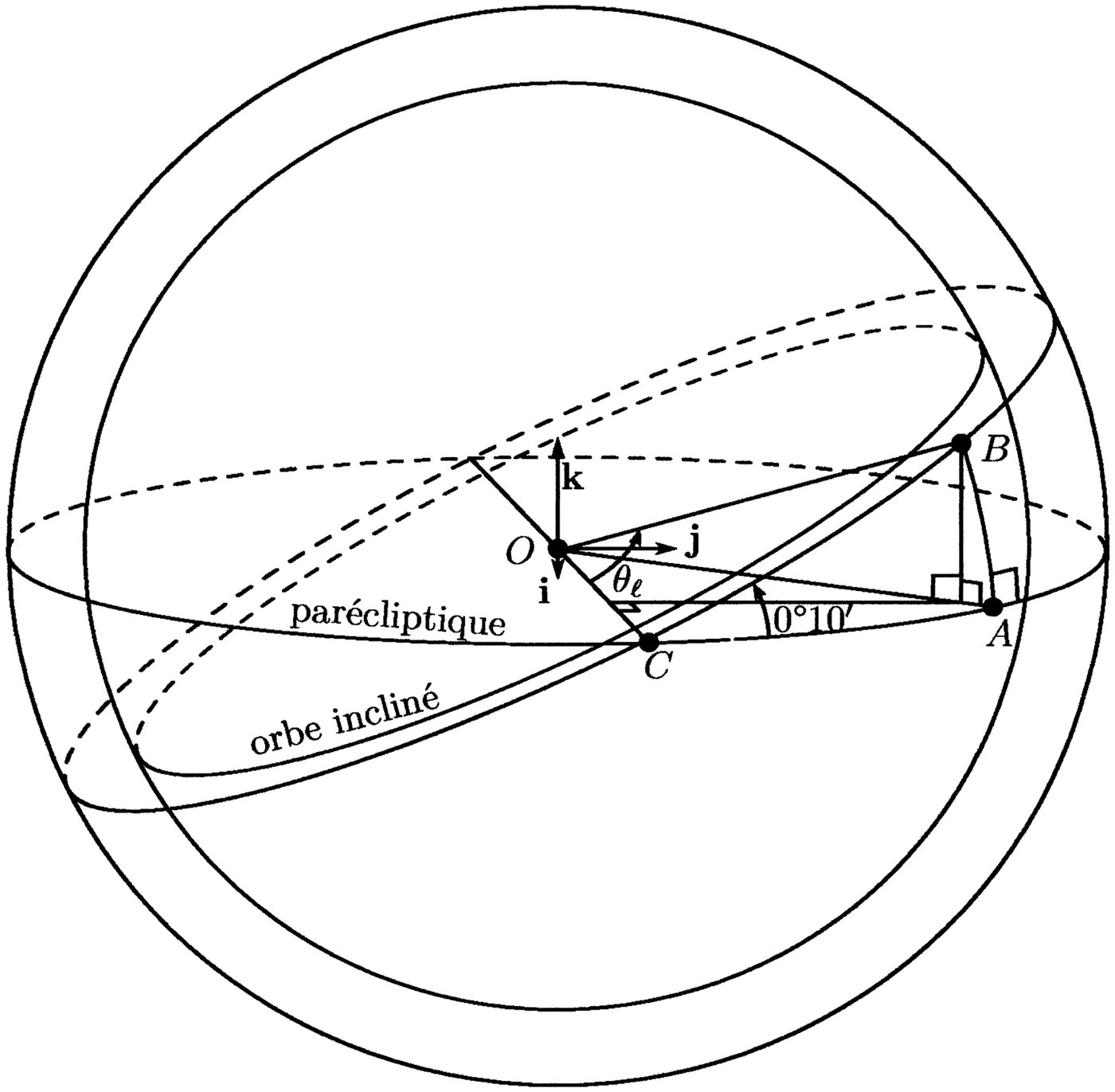
On va à présent calculer les coordonnées sphériques du point R(P 2,u, 0°10′)(P′) par rapport à l’écliptique. L'angle θ ℓ formé entre le vecteur u et la direction du point P′ vaut
 $$\theta_\ell= \theta_c + e_c(\theta_c) + e(\theta_c\comma\, \theta_p)+ 90^{\circ}.$$
L’étude du triangle sphérique ABC (voir Fig. 7) donne:
 $${\rm tan}(\overrightarrow {OC}, \,\overrightarrow {OA} ) = {\rm cos}(0^{\circ} 10^{\prime}) \times {\rm tan}\,{\theta _\ell}. $$
Coordonnées de R(P 2,u, 0°10′)(P′)
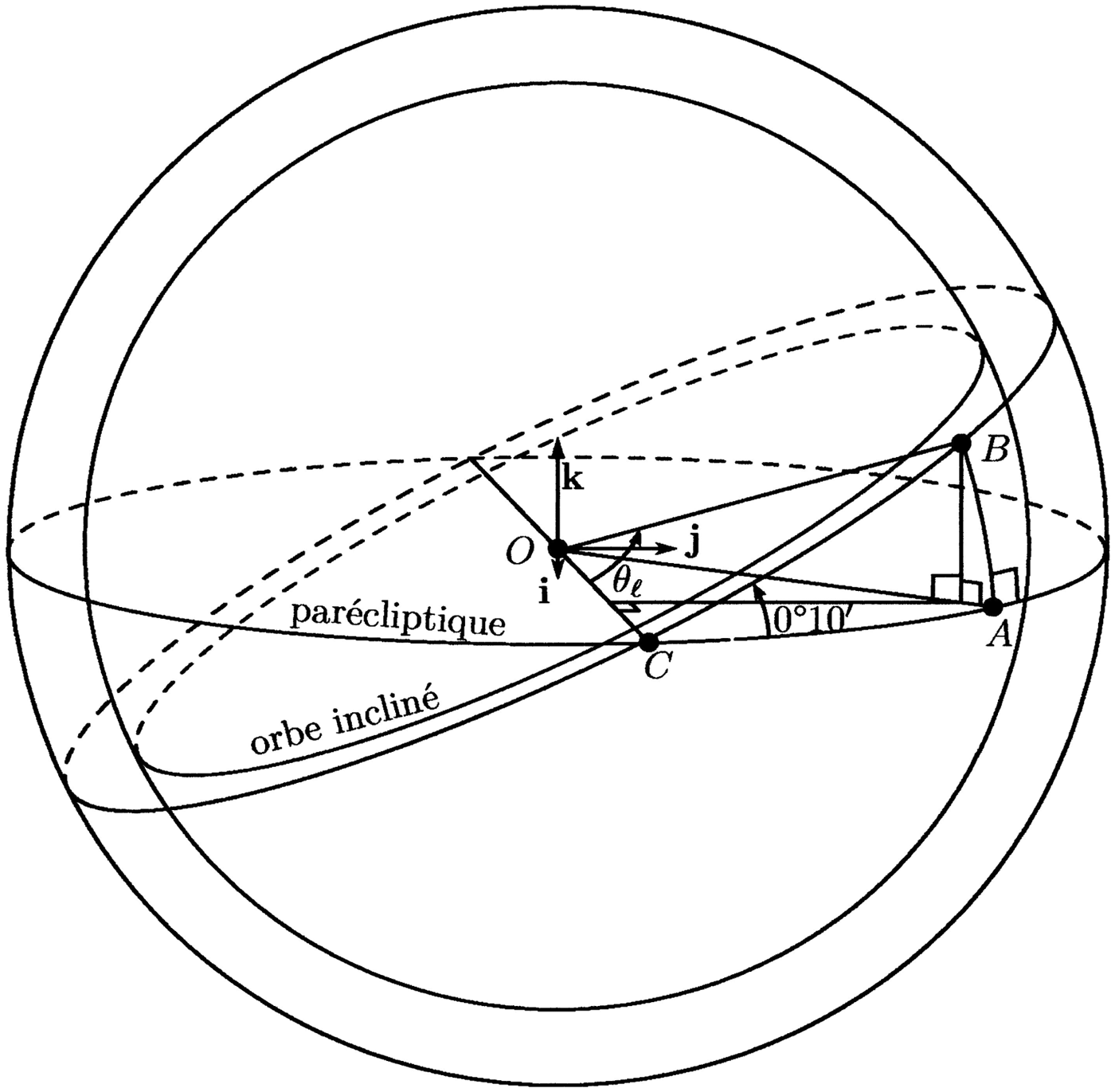
La longitude du point R(P 2,u, 0°10′)(P′) par rapport à l’écliptique, en prenant la direction du point vernal, c'est-à-dire j, comme origine, est donc (au moins quand |θ ℓ | < 90°)
 $${\rm \arctan}\; (\rm cos(0 ^{\circ} 10^\prime) \times \tan {\theta}_\ell)- 90^{\circ} + {\theta_a}$$
et sa latitude est:
 $$\hskip-6pt (\hskip2pt \overrightarrow {\hskip-4pt OA}, \overrightarrow {\hskip-4pt OB} ) = {\rm arcsin}({\rm sin}(0^{\circ} 10^{\prime}) \times {\rm sin}\,{\theta _\ell} ).$$
Les inclinaisons des petits orbes
Les rotations qui composent M ont leurs axes contenus dans le plan de l'orbe incliné OCB et sont d'angles petits (3° au plus). Elles auront peu d'effet sur la longitude de R(P 2,u, 0°10′)(P′). Nous avons tracé la surface représentative de l'erreur Δλ(θ c ,θp ) commise si l'on néglige M (voir Fig. 8).
Erreur en longitude si l'on néglige M

En revanche, l'effet de M et les inclinaisons des plans des petits orbes ont justement été introduits dans ce modèle afin de rendre compte des variations en latitude de Vénus. Hélas, les axes des rotations qui composent M ne passent pas par le point O, et de telles rotations sont difficiles à étudier en coordonnées sphériques.Footnote 13 Ibn al-Šāṭir se contente ici d'une description qualitative de l'effet en latitude de M. Nous donnons, figure 9, la surface représentative de la latitude de Vénus comme fonction des deux variables θ c et θ p .
Latitude de Vénus

Comparaisons
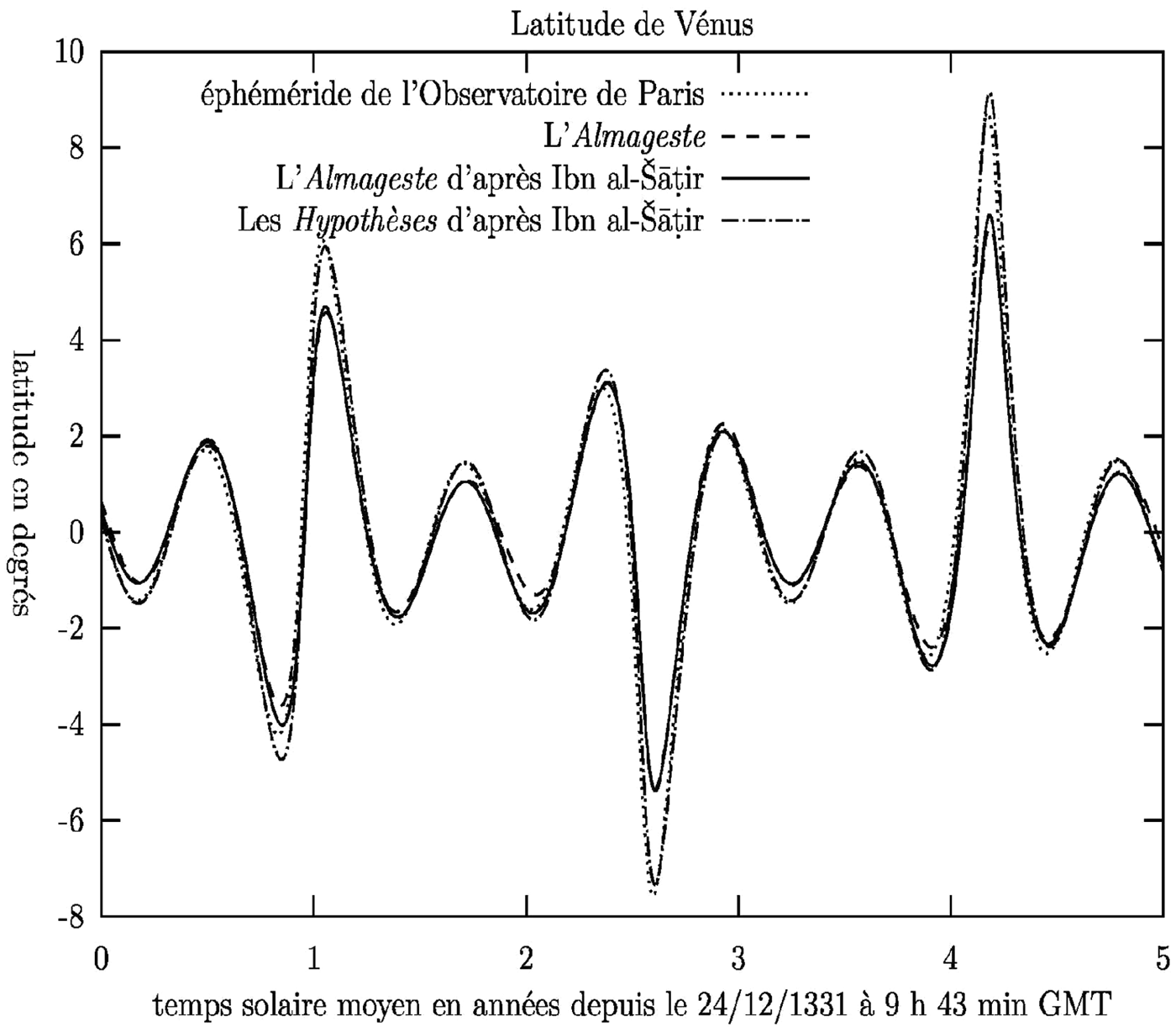
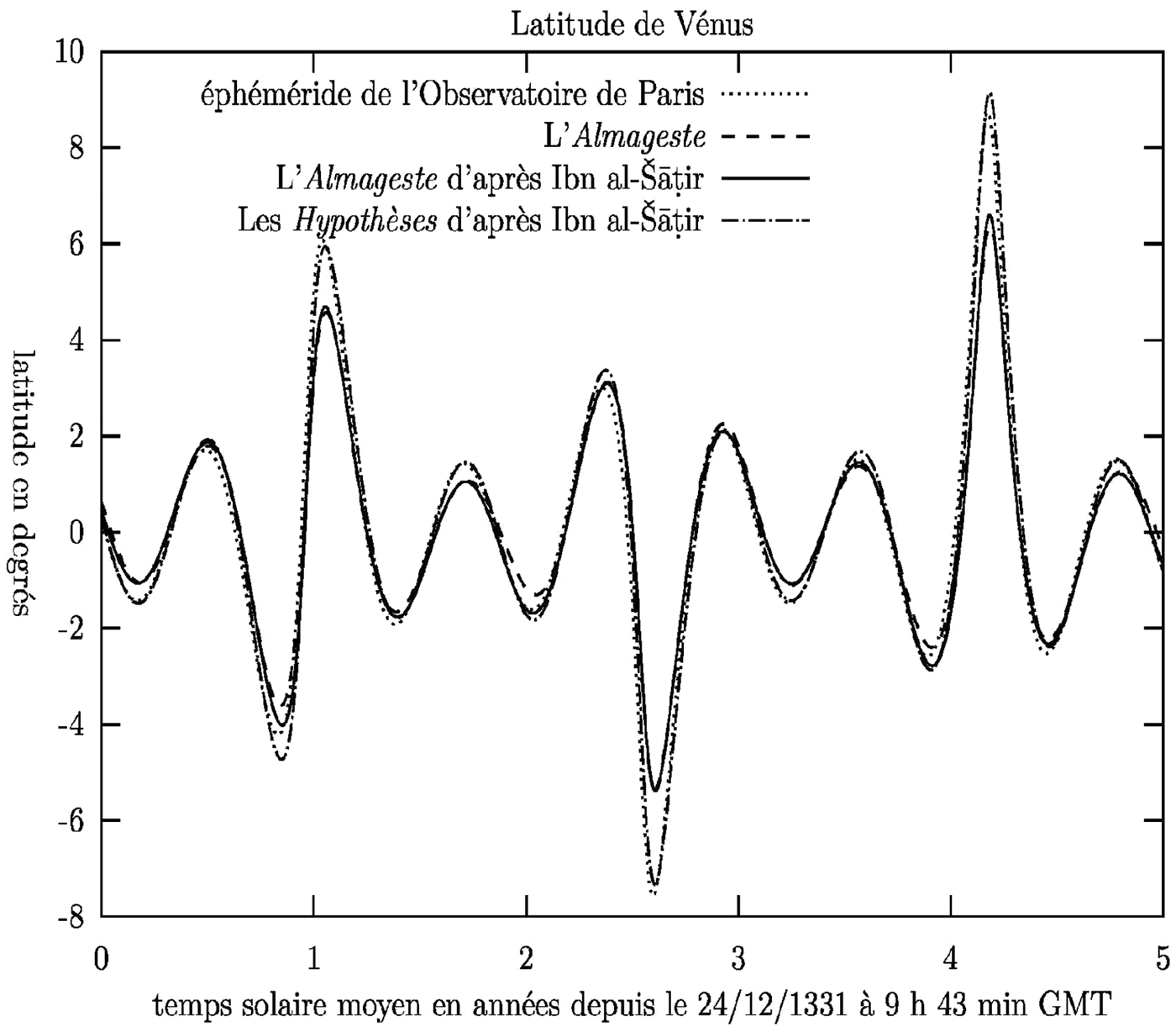
Le modèle que nous avons restitué dans le commentaire mathématique ci-dessus est le premier modèle décrit par Ibn al-Šāṭir dans le chapitre vingt-cinq de la Nihāyat al-Sūl dont nous donnons l’édition critique. On voit que les inclinaisons des plans des orbes sont conçues dans l'idée de reproduire les effets décrits dans l’Almageste. L'inclinaison de l'orbe incliné, variable dans l’Almageste mais constante chez Ibn al-Šāṭir, minime, n'a que peu d'influence sur le résultat final. Ibn al-Šāṭir envisage ensuite une variante plus proche de la théorie des Hypothèses planétaires.Footnote 14 À la figure 10, nous donnons les latitudes de Vénus pendant cinq ans, à partir de l’“époque” choisie par Ibn al-Šāṭir, calculées de quatre manières différentes: (1) par l'IMCCE de l'Observatoire de Paris, (2) en suivant la méthode strictement ptoléméenne de l’Almageste mais avec les paramètres d'Ibn al-Šāṭir à l’époque,Footnote 15 (3) au moyen du premier modèle d'Ibn al-Šāṭir censé reproduire la théorie de l’Almageste, et (4) au moyen du second modèle d'Ibn al-Šāṭir censé reproduire les Hypothèses planétaires.
Comparaisons
II. CHAPITRE VINGT-CINQ DE LA NIHĀYAT AL-SŪL
Des mouvements de Vénus et Mercure en latitude, en deux parties
Première partie: Des latitudes de Vénus. Chez Ptolémée, il y a deux théories à ce sujet.
Première théorie: C'est celle qu'il expose dans l’Almageste quand il dit que l'orbe incliné de Vénus tantôt s'approche tantôt s’éloigne du plan de l’écliptique. Aux nœuds, le centre de l’épicycle de Vénus est dans le plan de l’écliptique, mais hors des nœuds, il est toujours au Nord du plan de l’écliptique (au maximum, à un sixième de degré Nord, inclinaison vers le Nord de l'orbe incliné de Vénus quand elle est à l'ApogéeFootnote 16 ). Quand le centre de son épicycle est aux nœuds (c'est-à-dire aux quadratures de l'Apogée), le diamètre perpendiculaire au diamètre passant par l'Apogée de l’épicycle et par son périgée est dans le plan de l’écliptique; quand il est à la queue, l'Apogée de l’épicycle est incliné vers le Nord et le périgée vers le Sud; quand il est à la tête, l'Apogée de l’épicycle est incliné vers le Sud et son périgée vers le Nord; la grandeur de cette inclinaison est deux degrés et demi dans l’Almageste, et elle s'appelle inclinaison de l’épicycle. Quand le centre de l’épicycle est à l'Apogée, le diamètre passant par l'Apogée de l’épicycle et par son périgée est dans le plan de l'orbe incliné, et le diamètre perpendiculaire est incliné par rapport au plan de l’écliptique, de sorte que la moitié allant de l'Apogée de l’épicycle à son périgée est au Nord de l'orbe incliné, et l'autre moitié, au Sud; la grandeur de cette inclinaison par rapport au plan de l’écliptique est de trois degrés et demi, et elle s'appelle inclinaison de biais. C'est la théorie de Ptolémée dans l’Almageste. Certains parmi les Modernes l'ont amendée par l'observation: ils ont trouvé que l'inclinaison de l’épicycle était égale à l'inclinaison de biais. Les savants ont calculé les tables de latitude de Vénus selon cette théorie.
Seconde théorie. C'est celle qu'il expose dans son livre connu sous le nom des Hypothèses et qui vient après le premier: l'orbe incliné de Vénus serait d'inclinaison constante de part et d'autre. Son inclinaison maximale est un sixième de degré vers le Nord, et de même vers le Sud. L'inclinaison de l’épicycle est, dans les deux cas, trois degrés et demi.
Ni Ptolémée ni aucun autre n'avait encore pu établir les principes du mouvement de l’épicycle et de l'orbe incliné selon la description ci-dessus à cause de la variation d'inclinaison de l’épicycle dans les deux cas, et de la variation des deux diamètres dont l'un est incliné et l'autre est tantôt dans le plan de l’écliptique, tantôt dans le plan de l'orbe incliné. On y est parvenu grâce à Dieu.Footnote 17
À cet effet, on supposera que l'inclinaison maximale de l'orbe incliné vers le Nord est atteinte à l'Apogée de Vénus et que cette inclinaison est un sixième de degré. C'est une inclinaison de grandeur constante vers le Nord, et de même vers le Sud; mais elle se meut, elle se déplace avec l'Apogée, et les nœuds (la tête et la queue) se déplacent aussi de par son mouvement. Supposons le centre de l’épicycle et du rotateur sur la droite passant par l'Apogée. Supposons le déférent dans le plan de l'orbe incliné. Supposons l'apogée moyen du rotateur incliné vers le Sud par rapport au plan de l'orbe incliné, d'un angle de cinq minutes d'arc, et la moitié du rotateur commençant à l'Apogée (c'est la “première” moitié) inclinée vers le Nord par rapport au plan de l'orbe incliné, formant un angle en son centre d'une grandeur de trois degrés. Supposons l'apogée de l’épicycle incliné par rapport à l'apogée du rotateur, vers le Nord, de cinq minutes d'arc. Le diamètre de l’épicycle [passant par] l'Apogée reste donc dans le plan de l'orbe incliné. Supposons la première moitié de l’épicycle (celle qui commence à l'Apogée) inclinée d'un demi-degré vers le Nord par rapport à la moitié du rotateur inclinée vers le Nord.
Ceci étant admis, que les orbes tournent. Que l'orbe incliné tourne d'un quart de cercle, le déférent d'un quart de cercle aussi, et le rotateur d'un demi-cercle dans le même temps; alors l'inclinaison de l’épicycle s'inverse, le diamètre perpendiculaire au diamètre de l'Apogée arrive dans le plan de l’écliptique, et l'autre diamètre est incliné par rapport au plan de l’écliptique d'un angle d'une grandeur de deux parts et demi; ceci, à condition que la variation d'inclinaison de l’épicycle soit comme l'indique l’Almageste.
Quant à l'amendement fait par les Modernes (pour qui l’épicycle est incliné aux nœuds, à l'Apogée et au périgée de trois degrés et demi), et la théorie qu'expose Ptolémée dans les Hypothèses, nous supposerons l'orbe incliné comme on l'a indiqué dans la première théorie. Le déférent est dans le plan de l'orbe incliné. À l'Apogée, l'apogée du rotateur est incliné par rapport à l'orbe incliné, de cinq minutes d'arc vers le Sud; l'apogée de l’épicycle est incliné par rapport à l'apogée du rotateur, de cinq minutes d'arc vers le Nord; la moitié du rotateurFootnote 18 commençant à l'Apogée est inclinée vers le Nord de trois degrés et demi. C'est la voie sur laquelle s'appuie l'amendement fait par les Modernes.
L'inclinaison maximale de l’épicycle est, vers le Sud, 8; 40, et vers le Nord, 1; 3, quand l'inclinaison maximale de biaisFootnote 19 est 2; 30. La dernière latitude Nord est toujours, pour l'orbe incliné, un sixième de degré. La tête de Vénus précède l'Apogée d'un quart de cercle, et sa queue le suit d'un quart de cercle. Les dernières latitudes Nord et Sud, pour l'orbe incliné, sont à l'Apogée et au périgée.
Remarque: Concernant la latitude de Vénus, tout ce qu'ont fait les Anciens et les Modernes en concevant des ceintures qui s'approchent ou une inclinaison variable de l’épicycle est impossible. Qui est bien versé dans cet art ne l'ignore pas.
Deuxième partie: Des latitudes de Mercure. Chez Ptolémée, il y a deux théories, la première dans l’Almageste et la seconde dans les Hypothèses.
Première théorie: Nous supposons un orbe incliné par rapport au parécliptique, d'inclinaison maximale atteinte en l'Apogée, vers le Sud, un demi-degré et un quart, et le parécliptique le coupe aux nœuds. Cette situation à l'Apogée est réciproque de celle au périgée, où l'inclinaison est vers le Nord. De plus, la ceinture de l'orbe incliné tend à se rapprocher de la ceinture de l’écliptique jusqu’à ce qu'elles se confondent, puis elle s'incline à nouveau d'autant dans l'autre sens (et de même pour le lieu situé à l'opposé, [au périgée]). Or ceci est impossible: on ne peut le concevoir dans l'astronomie de Ptolémée, et ni lui ni aucun autre n'a abordé le problème du mobile de ce mouvement.
D'autre part, quand le centre de l’épicycle est au milieu de l'arc entre les nœuds, à l'Apogée, à la dernière latitude Sud, il faut supposer que le diamètre passant par l'Apogée et le périgée de l’épicycle est dans le plan de l'orbe incliné, et que l'autre diamètre est incliné de sorte que la première moitié de l’épicycle soit au Sud, l'autre moitié au Nord, et que l'angle de cette inclinaison (dite de biais) soit sept degrés. Quand le centre de l’épicycle est aux nœuds, le diamètre perpendiculaire à l'Apogée est dans le plan de l’écliptique, et l'autre diamètre est incliné par rapport au plan de l’écliptique, son périgée vers le Nord et son Apogée vers le Sud; l'angle de cette inclinaison est six degrés et un quart, et on l'appelle inclinaison de l’épicycle. Ainsi, le centre de l’épicycle est constamment au Sud du plan de l’écliptique, ou bien dans ce plan (aux nœuds). C'est cette théorie qu'on trouve dans l’Almageste.
Seconde théorie: C'est la théorie des Hypothèses. Là, l'inclinaison de Mercure est constante, vers le Sud à l'Apogée, d'une grandeur de six degrés (et l'autre extrémité, au périgée, est donc inclinée vers le Nord de six degrés). Quand le centre de l’épicycle est entre les deux nœuds, le diamètre passant par l'Apogée coïncide avec l'orbe incliné, et l'autre diamètre est incliné (ainsi que la deuxième moitié de l’épicycle) vers le Nord d'un angle de six degrés et demi; on l'appelle inclinaison de biais. Quand le centre de l’épicycle est [aux] nœuds, le diamètre perpendiculaire au diamètre de l'Apogée est dans le plan de l’écliptique, et le diamètre de l'Apogée est incliné, son périgée vers le Nord et son Apogée vers le Sud, d'un angle égal à l'inclinaison de biais, c'est-à-dire six parts et demi. C'est la seconde théorie; mais ni Ptolémée ni aucun autre n'a pu établir des principes permettant de concevoir ces inclinaisons sans perturber les mouvements en longitude. Nous avons pu concevoir ces deux théories; gloire à Dieu.
Voici la théorie sur laquelle on s'est appuyé. Nous supposons que l'inclinaison maximale de l'orbe incliné est vers le Sud à l'Apogée et vers le Nord au périgée (cette inclinaison maximale est de six degrés dans les Hypothèses). Nous supposons que l'apogée du rotateur est incliné vers le Nord de cinq minutes d'arc, que la seconde moitié du rotateur est inclinée vers le Sud d'un angle de six degrés, un demi-degré et un huitième de degré par rapport au plan de l'orbe incliné, que l'apogée de l’épicycle est incliné par rapport à l'apogée du rotateur vers le Sud de cinq minutes d'arc, et que sa seconde moitié est inclinée de sept degrés vers le Nord par rapport au plan de l'orbe incliné (elle est donc inclinée d'un quart et un huitième de degré par rapport au plan du rotateur). Quand les orbes se meuvent, l'orbe incliné d'un quart de cercle, le déférent aussi, et l’épicycle d'un demi-cercle, alors l'inclinaison du diamètre de l'Apogée devient six degrés et un quart, et le diamètre qui lui est perpendiculaire passe dans le plan de l’écliptique. Or il en est ainsi à l'observation, c'est donc la voie sur laquelle on s'est appuyé; elle ne prend pas en considération que, selon Ptolémée, le centre de l’épicycle serait toujours au Sud, mais il est certes revenu de cette opinion dans les Hypothèses. Sache cela.
La seconde théorie est conçue comme suit. Nous supposons l'orbe incliné comme on l'a décrit ci-dessus, de sorte qu'il coupe le parécliptique aux nœuds et que l'inclinaison maximale soit vers le Sud à l'Apogée et vers le Nord au périgée. Nous supposons que le centre de l’épicycle est à l'Apogée au milieu de l'arc compris entre les nœuds. Nous supposons que l'Apogée du rotateur est incliné de cinq minutes d'arc vers le Nord, et que sa seconde moitié est inclinée vers le Nord, et l'autre moitié vers le Sud, d'un angle de six degrés et demi; on appelle cela inclinaison de biais. Nous supposons l'apogée de l’épicycle incliné par rapport à l'apogée du rotateur de cinq minutes d'arc vers le Sud; alors le diamètre de l'Apogée est dans le plan de l'orbe incliné. Nous supposons que la seconde moitié de l’épicycle est inclinée de six degrés et demi par rapport au plan de l'orbe incliné. Que l'on se représente cela, puis que les orbes se meuvent jusqu’à ce que le centre de l’épicycle soit au nœud. Le diamètre perpendiculaire au diamètre de l'Apogée coïncide avec le plan de l’écliptique, et le diamètre de l'Apogée reste incliné de six degrés et demi par rapport au plan de l’écliptique. La moitié [de l’épicycle] contenant son Apogée est vers le Sud, et l'autre moitié vers le Nord. C'est ainsi qu'il faut concevoir les mouvements des orbes en latitude, de façon à ne pas perturber les mouvements en longitude.
Remarque: Supposer, au besoin, que les orbes sont dans les plans des [orbes qui] les portent ne perturbe pas les mouvements en longitude de manière trop importante. Tu sais que ceci est analogue à l’équation du déplacementFootnote 20 de la Lune corrigée de l'orbe incliné au parécliptique. Puisque la dernière latitude de la Lune est de cinq degrés, et que la variation maximale due au déplacement est de six minutes d'arc et deux tiers, l'omission de l’équation du déplacement des trajectoires selon les latitudes à la ceinture de l’écliptique aura pour effet une perturbation d'une minute d'arc et un tiers, par degré de latitude, au plus: c'est une grandeur négligeable.
Calcule le déplacement si tu le souhaites. En voici la méthode. Prends l’élongation entre l'astre corrigé et la tête de cet astre. Prends l’équation qui correspond à cette élongation dans la table de l’équation du déplacement de la Lune. Multiplie cela par la latitude de cet astre, et divise le produit par la latitude maximale de la Lune (c'est cinq degrés). En sort l’équation qu'il faut ajouter à la correction de l'astre si le nombre entré dans la table était compris entre quatre-vingt-dix et cent quatre-vingt ou entre deux cent soixante-dix et trois cent soixante degrés, et qu'il faut sinon soustraire à la correction de l'astre; reste la vraie correction, rapportée à l’écliptique. Cette équation est maximale dans les octants, et nulle aux nœuds et aux dernières latitudes de part et d'autre. Dieu est le plus grand et le plus savant.
II. ÉDITION CRITIQUEFootnote * الباب الخامس والعشرون في حركات الزهرة وعطارد في العرض وفيه فصلان
الفصل الأوّل في عروض الزهرة وفيه مذهبان لبطلميوس
الأوّل ما ذكره في  حيث قال إنّ مائل الزهرة يقرب ويبعد عن سطح البروج. فلا يزال مركز تدوير الزهرة بين العقدتين في سطح فلك البروج وفي غير العقدتين شماليّ عن سطح البروج بمقدار أكثره سدس جزء ويقابل ميل مائل الزهرة الشماليّ عند أوجها. وإذا كان مركز تدويرها في العقدتين، أعني عند تربيع الأوج، كان القطر القائم على القطر المارّ بأوج التدوير وحضيضه من سطح البروج؛ فإذا كان في عقدة الذنب، كان ميل أوج التدوير إلى الشمال وحضيضه إلى الجنوب؛ وإذا كان في عقدة الرأس، كان ميل أوج التدوير إلى الجنوب وحضيضه إلى الشمال، ومقدار هذا الميل في جزأين ونصف ويعرف بميل التدوير. وإذا كان مركز التدوير في الأوج، كان القطر المارّ بأوج التدوير وحضيضه في سطح المائل والقطر القائم عليه مائل عن سطح البروج بحيث يكون النصف الّذي من الأوج إلى الحضيض من التدوير شماليًّا عن المائل والآخر جنوبيًّا عنه، ومقدار هذا الميل عن سطح البروج ثلاثة أجزاء ونصف جزء ويعرف بميل الوراب؛ هذا مذهبه في المجسطي. وقد صحّح بعض المتأخّرين بالرصد، فوجد ميل التدوير مثل ميل الوراب؛ وعليه حساب جداول عرض الزهرة عند محققي هذا الفنّ.
ومذهبه الثاني ما ذكره في كتابه المعروف بالاقتصاص، وهو بعد الأوّل أنّ مائل الزهرة ثابت الميل في الجهتين، و ية ميله سدس جزءًا في الشمال ومثله في الجنوب، وميل التدوير فيه في الحالتين ثلاثة أجزاء ونصف جزء.
ولم يمكن بطلميوس ولا غيره إلى وقتنا هذا وضع أصول تحرّك التدوير والمائل بالصفة المذكورة لاختلاف ميل التدوير في الحالتين واختلاف القطرين اللذين يكون أحدهما مائلاً والآخر إمّا في سطح البروج أو في سطح المائل. وقد تيسّر بحمد  تعالى.
وهو أن يفرض ية ميل المائل في الشمال عند أوج الزهرة ويته سدس جزء، وهو ميل ثابت المقدار في الشمال ومثله في الجنوب، وهو يتحرّك، فينتقل مع انتقال الأوج وينتقل بانتقاله العقدتين الرأس والذنب. ونفرض مركز التدوير والمدير على الخطّ المارّ بالأوج، ونفرض الحامل في سطح المائل، ونفرض ذروة المدير الوسطى مائلة إلى الجنوب عن سطح المائل زاوية مقدارها خمس دقائق والنصف من المدير الّذي ابتداؤه من الأوج وهو الأوّل شماليّ عن سطح المائل زاوية عن مركزه مقدارها ثلاثة أجزاء. ونفرض ذروة التدوير مائلة عن ذروة المدير إلى الشمال خمس دقائق، فيبقى قطر التدوير الأوج في سطح المائل. ونفرض نصف التدوير الأوّل، وهو الّذي ابتداؤه من الأوج، مائلاً عن نصف المدير المائل إلى الشمال نصف جزء إلى جهة الشمال أيضًا.
وإذا تقرّر ذلك ودارت الأفلاك، فدار المائل ربع دائرة ودار الحامل ربع دائرة أيضًا ودار المدير في ذلك الزمان نصف دائرة، فانقلب ميل التدوير، فصار القطر القائم على الأوجي في سطح البروج والقطر الآخر مائلاً عن سطح البروج زاوية مقدارها جزأين ونصف؛ هذا على أنّ اختلاف ميل التدوير مثل ما ذكر في المجسطي.
وأمّا ما صحّحه المتأخّرون من كون ميل التدوير في العقدتين وفي الأوج والحضيض ثلاثة أجزاء ونصف جزء، وتصوّر مذهبه المذكور في الاقتصاص أن نفرض المائل على ما ذكر في المذهب الأوّل وفي سطحه الحامل في الأوج. وذروة المدير مائلة على المائل إلى الجنوب خمس دقائق وذروة التدوير مائلة عن ذروة المدير خمس دقائق إلى الشمال ونصف التدوير الّذي ابتداؤه من الأوج مائل إلى الشمال ثلاثة أجزاء ونصف.
قلت: وهذا الوجه هو المعتمد عليه وهو ما صحّحه المحققون.
وية ميل التدوير في الجنوب ح م وفي الشمال ا ﺟ وأكثر ميل الوراب ب ل. وية العرض للمائل في الشمال أبدًا سدس جزء. والرأس للزهرة قبل الأوج بربع دور والذنب بعد الأوج بربع دور. وية العرض في الشمال والجنوب للمائل في الأوج والحضيض.
تنبيه: جميع ما تكلّفوه المتقدّمون والمتأخّرون في أمر عرض الزهرة من تقارب المنطقتين واختلاف ميل فلك التدوير محال وليس يخفى على من له اطّلاع على كتب محقّقي هذا الفنّ.
الفصل الثاني في عروض عطارد، وفيها مذهبان لبطلميوس؛ الأوّل الذي ذكره في والثاني الذي ذكره في الاقتصاص.
أمّا مذهبه الأوّل أن نفرض فلكًا مائلاً عن الممثّل نهاية ميله عند الأوج إلى الجنوب نصف وربع جزء، فيقاطع هذا المائل على العقدتين، ويصير نظير الجزء الّذي عند الأوج عند الحضيض مائلاً عنه إلى الشمال بما علمت. وإنّ منطقة المائل تقارب لمنطقة البروج حتّى تنطبق عليها، ثمّ يميل إلى الجهة الأخرى بذلك المقدار وكذلك الجزء المقابل له؛ وهذا محال: لا يمكن أن يتصوّر على هيئة بطلميوس ولم يتعرّض هو ولا غيره لمحرّك هذه الحركة.
ثمّ فرض إذا كان مركز التدوير في منتصف ما بين العقدتين في الأوج عند ية العرض الجنوبي أنّ القطر المارّ بأوج التدوير وحضيضه في سطح المائل والقطر الآخر مائل بحيث يكون النصف الأوّل من التدوير جنوبيًّا والنصف الآخر شماليًّا وزاوية هذا الميل سبعة أجزاء، ويسمّى الوراب. وإذا كان مركز التدوير في العقدتين، كان القطر القائم على الأوج في سطح البروج والقطر الأوجي مائل عن سطح البروج، أمّا حضيضه فإلى جهة الشمال وأوجه إلى جهة الجنوب؛ وزاوية هذا الميل ستّة أجزاء وربع جزء، ويعرف بميل التدوير؛ فلا يزال مركز التدوير إمّا جنوبي عن سطح البروج وإمّا فيه عند العقدتين. هذا مذهبه في.
ومذهبه الثاني الّذي ذكره في الاقتصاص أن مائل عطارد ثابت الميل في الجهة الجنوبية عن الأوج ومقداره سدس جزء والطرف الآخر مائل إلى الشمال عند الحضيض سدس جزء. وإذا كان مركز التدوير فيما بين العقدتين، كان القطر المارّ بالأوج مطابقًا للمائل والقطر الآخر مائل بالنصف الثاني من التدوير إلى الشمال، ومقدار زاوية الميل ستّة أجزاء ونصف جزء، ويعرف بميل الوراب. وإذا كان مركز التدوير بين العقدتين، كان القطر القائم على الأوجي في سطح البروج والقطر الأوجي مائل، حضيضه إلى الشمال وأوجه إلى الجنوب، وزاوية هذا الميل مثل ميل الوراب؛ وذلك ستّة أجزاء ونصف. هذا مذهبه الثاني، ولم يمكن بطلميوس ولا غيره وضع أصول يمكن تصوّر هذه الميول فيها ولا تخلّ بالحركات الطولية. وقد أمكننا نصوّر هذين المذهبين و الحمد.
أمّا المذهب المعتمد عليه وهو أن نفرض ية ميل المائل الجنوبي عند الأوج والشماليّ عند الحضيض، وية هذا الميل في الاقتصاص سدس جزء؛ ونفرض ذروة المدير مائلة إلى الشمال خمس دقائق ونصف المدير الثاني مائل إلى الجنوب وزاوية الميل عن سطح المائل ستّة أجزاء ونصف وثمن وذروة التدوير مائلة عن ذروة المدير إلى الجنوب خمس دقائق ونصفه الثاني مائل إلى الشمال عن سطح المائل سبعة أجزاء، فيكون مائلاً عن سطح المدير ربع وثمن جزء. فإذا تحرّكت الأفلاك أمّا المائل فربع دور وكذلك الحامل وأمّا التدوير فنصف دائرة، فيصير ميل القطر ستّة وربع، فيصير القطر الأوجي مائلاً ستّة وربع والقطر القائم عليه في سطح البروج. وهكذا كان في الرصد، وهذا الوجه هو المعتمد عليه ولا يلتفت إلى ما قاله بطلميوس بأن مركز التدوير يكون جنوبيًا أبدًا، فإنّه رجع عن ذلك في الاقتصاص، فاعرف ذلك.
وأمّا تصوّر المذهب الثاني أن نفرض المائل على الصفة المذكورة المتقدّمة بحيث يقاطع الممثّل على العقدتين ويكون ية الميل الجنوبي عند الأوج والشماليّ عند الحضيض؛ ونفرض مركز التدوير في الأوج في منتصف ما بين العقدتين؛ ونفرض أوج المدير مائلاً إلى الشمال خمس دقائق ونصف المدير الثاني مائلاً إلى الشمال ونصفه الآخر مائلاً إلى الجنوب ومقدار زاوية هذا الميل ستّة أجزاء ونصف جزء، ويعرف بميل الوراب؛ ونفرض ذروة التدوير مائلة عن ذروة المدير إلى الجنوب خمس دقائق، فيكون القطر الأوجي في سطح المائل؛ ونفرض نصف التدوير الثاني مائلاً عن سطح المائل ستّة أجزاء ونصف. وإذا تصوّرت ذلك، ثمّ تحرّكت الأفلاك إلى أن صار مركز التدوير في العقدة، طابق القطر القائم على الأوجي لسطح البروج، وبقي القطر الأوجي مائلاً عن سطح البروج ستّة أجزاء ونصف جزء ويكون النصف الّذي فيه أوجه جنوبيًّا والآخر شماليًّا. هكذا يجب تصوّر حركات الكواكب في العرض بحيث لا تخلّ بالحركات الطولية.
تنبيه مقتضى فرض الأفلاك في سطوح الحوامل في الأصل لا يخلّ بالحركات الطولية بما له كثير قدر وأنت تعلم أنّ ذلك بمثل نقل مقوم القمر من المائل إلى الممثّل. ولما كان نهاية عرض القمر خمسة أجزاء وكان ية الاختلاف للنقل ستّ دقائق وثلثي، كان أكثر ما يخلّ بإهمال النقل من المدار العرضي إلى منطقة البروج أكثره لكلّ درجة من العرض دقيقة وثلث وهذا مقدار يسير.
وإن شئت فانقل، وطريق ذلك أن تأخذ بعد مقوّم الكوكب من رأس ذلك الكوكب، وهو العقدة الشمالية؛ فما حصل فخذ ما يقابله من جدول تعديل نقل القمر من التعديل، فما كان فاضربه في عرض ذلك الكوكب، فما بلغ فاقسمه على نهاية عرض القمر، وهو خمسة أجزاء؛ فما خرج فهو التعديل فزده على تقويم الكوكب، إن كان العدد الّذي دخلت به إلى الجدول أكثر من تسعين جزءًا إلى مائة وثمانين أو أكثر من مائتين وسبعين إلى ثلاثمائة وستّين؛ وإن كان غير ذلك، فنقصه من تقويم الكوكب، يبقى المقوّم المحقّق من فلك البروج وأكثره في أنصاف الأرباع وينعدم في العقدتين وعند نهاية العرض في الجهتين – و تعالى أعلم.