


1. Introduction
This article deals with pronominal gender in Dutch, that is, the use of the personal pronouns hij ‘he’, zij ‘she’, and het ‘it’ to refer back to a noun phrase in the preceding discourse (Haeseryn et al. Reference Haeseryn, Kirsten Romijn, De Rooij and Van den Toorn2019: section 5.2.5). Generally speaking, the pronominal gender system in Standard Dutch is (largely) a lexical (or grammatical) system with anaphoric pronouns that derive their gender specification (i.e., masculine, feminine or neuter) from their antedecent nouns (e.g., Audring Reference Audring2006:86, Kraaikamp Reference Kraaikamp2017). For example, the sentence in (1) can have three different meanings depending on which pronoun is used (with each of them referring to one of the possible antecedent nouns): hij ‘he’ refers to de secretaris ‘the secretary’, zij ‘she’ to de koningin ‘the queen’, and het ‘it’ to het boek ‘the novel’.

Speakers may struggle with their pronoun selection if they are unsure about the lexical gender of the noun. Not only do they have to know the grammar rules, they also have to store the lexical gender of individual nouns in memory (De Paepe & De Vogelaer Reference De Paepe and Vogelaer2008:5; see also Brouwer, Sprenger, & Unsworth Reference Brouwer, Sprenger and Unsworth2017 for a processing study). For most speakers in the Netherlands nouns just have common or neuter gender, and the category of feminine nouns is felt to be artificial. This is due to the fact that there are very few overt indications of the lexical gender of a noun: lexical gender cannot be read off the noun directly, except for nouns with morphologically marked gender (De Vos, De Vogelaer, & De Sutter Reference De Vos, De Vogelaer and De Sutter2021:34). These include nouns ending in a diminutive suffix (which are always of neuter gender, e.g., de koek ‘the cake’ – het koekje ‘the cookie’) or in derivational suffixes that are typical of feminine lexical gender such as -heid, -ie, -te, or -ing (Haeseryn et al. Reference Haeseryn, Kirsten Romijn, De Rooij and Van den Toorn2019: section 3.3.3). In addition, nouns that refer to entities with a biological gender (e.g., de vrouw ‘the woman’ or de koe ‘the cow’) are often more straightforward in terms of lexical gender. In general, knowing the lexical gender of a word is part of an individual speaker’s grammatical competence, although it can also be retrieved from prescriptive reference works, such as dictionaries or grammars. In dictionaries, all nouns are labeled as m (masculine), f (feminine), or n (neuter), or (quite often) as m(f) or m/f. Nouns that are labeled as both masculine and feminine are called “hermaphrodites,” and they reflect the loss of the masculine–feminine distinction in Dutch (De Paepe & De Vogelaer Reference De Paepe and Vogelaer2008:1, Cornips & De Vogelaer Reference Cornips and De Vogelaer2009:8).Footnote 1
In addition to the noun itself, adnominal modification can provide clues about lexical gender. However, in this domain too masculine and feminine gender have coalesced into one category of common gender. This is a development that dates back to Middle Dutch (
 $ \pm $
1500 CE), when the gender distinction between masculine and feminine gradually became less visible in the language due to the attrition and loss of the suffix -en that marked this very distinction (Geerts Reference Geerts1966, De Vogelaer & De Sutter Reference De Vogelaer and De Sutter2011, Kraaikamp Reference Kraaikamp2012, Reference Kraaikamp2017, Bloemhoff & Streekstra Reference Bloemhoff and Streekstra2013:201). Originally, this suffix was a marker for the accusative case of masculine nouns (Bloemhoff & Streekstra Reference Bloemhoff and Streekstra2013:152–153), but during the sixteenth–seventeenth century, when Dutch emerged as a national language, the suffix disappeared (Bloemhoff & Streekstra Reference Bloemhoff and Streekstra2013:203). Interestingly, the southern Netherlandic Dutch dialects, namely, the dialects of North Brabant and Limburg, preserved the suffix as a marker of masculine gender for all grammatical cases. Nowadays, these dialects still mark adnominal modifiers of singular masculine nouns with the suffix -e(n), e.g., de-n hond ‘the-m dog’, instead of de hond (Dutch), and (e)en-en hond ‘a-m dog’ instead of een hond (Dutch), but de/(e)en vrouw ‘the/a-f woman’ (De Bont Reference De Bont1962, Weijnen Reference Weijnen1971, Hoppenbrouwers Reference Hoppenbrouwers1983, Reference Hoppenbrouwers1990, Stroop Reference Stroop1989). Therefore, in general, the north of the Dutch-speaking area is regarded as more innovative when it comes to linguistic change in the gender system, while the south is regarded as more conservative (De Vos & De Vogelaer Reference De Vos and De Vogelaer2011; see also De Troij, Grondelaers, & Speelman Reference De Troij, Grondelaers and Speelman2023 for a more general discussion of this difference). For southern Netherlandic Dutch dialect speakers, who are also fluent speakers of Dutch, the presence of the suffix acts as a linguistic cue to determine the lexical gender of the noun, and sufficient exposure can help speakers learn the gender of masculine as well as non-masculine nouns. However, although this gender feature is one of the main characteristics of the southern Netherlandic Dutch dialects, recent research in the province of North Brabant has shown that the three-gender system is also subject to variation and change (see Doreleijers et al. Reference Doreleijers, Van Koppen and Swanenberg2020, Doreleijers et al. Reference Doreleijers, Piepers, Backus, Swanenberg, Franco, De Pascale, Rosseel and Kristiansen2021). For example, in the current dialect use of younger Brabantish speakers (who are not fully proficient in the dialect) even feminine nouns are being combined with a masculine adnominal suffix, namely, de-n vrouw ‘the-m woman’ or en-e vrouw ‘a-m woman’, leading to a “mismatch” between the determiner and the lexical gender of the noun. However, this increased variation is accompanied by omissions of the masculine gender suffix, resulting in convergence towards the Dutch two-gender system and syncretism (Tamminga Reference Tamminga2013). In addition, with deviations in the adnominal domain one can expect deviations in the pronominal domain to occur as well, because adnominal elements (i.e., determiners and adjectives) are generally more likely to agree with the noun’s lexical gender according to Corbett’s (Reference Corbett1979) Agreement Hierarchy.
Regardless of what the adnominal gender system of an individual speaker looks like, however, all speakers of Dutch have to make a choice between the three genders (masculine, feminine, neuter) when selecting a pronoun, as in (1). The loss of visible gender distinctions affects the learnability of the system (Mills Reference Mills1986:112–115, Cornips & Hulk Reference Cornips and Hulk2008:289, Cornips & De Vogelaer Reference Cornips and De Vogelaer2009:8, De Vos & De Vogelaer Reference De Vos and De Vogelaer2011). Due to the lack of a clear distinction between masculine and feminine and an overall decreased knowledge of lexical gender, speakers may violate lexical agreement. For instance, they sometimes resort to semantic default strategies, such as the use of het ‘it’ whenever the antecedent is not overtly marked as masculine or feminine (De Vogelaer & De Sutter Reference De Vogelaer and De Sutter2011:203). However, as the masculine–feminine distinction has been fading away from the seventeenth century onwards, insecurity about lexical gender must have been around since then. Therefore, contemporary shifts in pronoun use can not only be explained by the collapse of masculine and feminine gender, such as the loss of an adnominal gender suffix (Kraaikamp Reference Kraaikamp2017). This holds a fortiori for additional shifts, for example, from masculine hij ‘he’ to neuter het ‘it’.
Previous research on the pronominal gender system in Dutch points to a change in the selection of pronouns in the spoken language of speakers born in the twentieth century (see, among others, Romijn Reference Romijn1996, Audring Reference Audring2006, Reference Audring2009, De Paepe & De Vogelaer Reference De Paepe and Vogelaer2008, Audring & Booij Reference Audring, Booij, Cornips and De Vogelaer2009, Cornips & De Vogelaer Reference Cornips and De Vogelaer2009, De Vogelaer Reference De Vogelaer, Tsiplakou, Karyolemou and Pavlou2009, De Vos Reference De Vos2009, De Vos & De Vogelaer Reference De Vos and De Vogelaer2011, Kraaikamp Reference Kraaikamp2012, Reference Kraaikamp2017, De Vos, De Vogelaer, & De Sutter Reference De Vos, De Vogelaer and De Sutter2021). These studies have identified a shift from a lexical gender system, that is, a system based on lexical gender as in German, to a semantic gender system as in English.Footnote 2 In a lexical gender system, the choice of the pronoun is determined by the lexical gender of the antecedent noun, whereas in a semantic gender system the form of the pronoun is determined by the semantics of the antecedent noun (De Vos, De Vogelaer, & De Sutter Reference De Vos, De Vogelaer and De Sutter2021:31). If we assume that this (centuries-long) shift is not yet completed but still ongoing, then one might expect to find more evidence of semantic agreement in the language of younger speakers than in the language of older speakers.
In this article, we provide new evidence of an age effect in pronominal gender shift in Netherlandic Dutch based on an experimental study with a large sample of speakers (n=10,119). Age effects are an important aspect of language change, because “in general, change in progress is typically implemented by successive generations of speakers pushing a phenomenon beyond levels observed in previous generations” (De Vos, De Vogelaer, & De Sutter Reference De Vos, De Vogelaer and De Sutter2021:39). The article is organized as follows. Section 2 introduces the expected shift in pronominal gender marking and discusses the state of art on the topic. Section 3 details our methodology, while sections 4 and 5 present and discuss the main results.
2 Changing pronominal gender
Speakers of Dutch who must choose a pronoun and are unsure about the lexical gender of the noun to which the pronoun refers, have roughly two strategies at their disposal (Audring Reference Audring, van der Sijs, Fonteyn and van der Meulen2021). The first is an avoidance strategy, which involves repeating the noun, or replacing it by a synonym or a demonstrative pronoun.Footnote 3 Although this strategy is common, it is not the focus of the present article. The other strategy involves choosing a pronoun based on the meaning of the antecedent noun (Audring Reference Audring2006:91). For example, Audring (Reference Audring2006, Reference Audring2009) has shown that in spoken Dutch the masculine pronoun hij ‘he’ and its variants, ’ie, hem, and ’m, are used more often than would be expected based on the lexical gender of the antecedent noun. Specifically, the masculine pronoun is not only used to refer to masculine animates, but also to bounded objects (regardless of their lexical gender). This tendency is called masculinization (e.g., Geeraerts Reference Geeraerts, Bennis and de Vries1992, De Paepe & De Vogelaer Reference De Paepe and Vogelaer2008:4). In contrast, the feminine pronoun zij ‘she’ and its variants are only used for feminine persons. This too can involve a move away from the lexical gender system, for example, when a neuter noun like meisje ‘girl’ is pronominalized by zij or ze ‘she’ instead of het ‘it’ (Kraaikamp Reference Kraaikamp2017:15, De Vos, De Vogelaer, & De Sutter Reference De Vos, De Vogelaer and De Sutter2021:31). Here, the noun’s lexical gender is in conflict with the biological gender of its referent (cf. Audring Reference Audring2017:63). Another shift concerns the use of the neuter pronoun het ‘it’. On the one hand, it loses part of its function because it is superseded by masculine hij when referring to count nouns. This is the case, for example, when speakers refer to the neuter noun het boek ‘the book’ with a masculine pronoun hij, hem, or ’m ‘he/him’ (Audring Reference Audring2006:95). On the other hand, het also gains additional functionality because it often replaces masculine and feminine pronouns when referring to substances, abstract entities, and events, that is, when the noun is less concrete and less clearly bounded (e.g., Romijn Reference Romijn1996).
The shift from a gender system based on lexical agreement to one based on semantic agreement assumes an underlying cognitive hierarchy on which referents are placed according to the semantic properties that are attributed to them, namely, their degree of individuation (e.g., Van Haeringen Reference Haeringen and Coenraad1951, Audring Reference Audring2009:124). This Individuation Hierarchy, shown in (2), is a variant of the Animacy Hierarchy that emerged from typological research (Silverstein Reference Silverstein and Dixon1976, Sasse Reference Sasse, Joachim Jacobs, Sternefeld and Venneman1993, Siemund Reference Siemund2008).

One of the main assumptions of the Individuation Hierarchy is that there are no binary categories and no inherent properties of referents. Instead, speakers construe a referent as being unique or bounded, or as lacking uniqueness and boundedness (Audring Reference Audring2009, Bouma Reference Bouma2018, De Vos, De Vogelaer, & De Sutter Reference De Vos, De Vogelaer and De Sutter2021:35). Previous research has shown that referents on the left-hand side of the hierarchy (e.g., entities with a biological gender) are more compatible with masculine or feminine pronouns, while referents more to the right on the hierarchy are more compatible with neuter pronouns. Or to put it differently: nouns that are highly individuated, such as boek ‘book’, are preferably referred to with masculine and feminine pronouns (i.e., common gender), whereas nouns that are less clearly individuated, such as honing ‘honey’, are typically referred to by the neuter pronoun (Audring Reference Audring2009, De Vos, De Vogelaer, & De Sutter Reference De Vos, De Vogelaer and De Sutter2021:30, Hinskens et al. Reference Hinskens, Roeland Van Hout and Van Wijngaarden2021:90). This process of changing pronominal gender is called resemanticization (Wurzel Reference Wurzel1986, Audring Reference Audring2009, De Vos Reference De Vos2009). In a semantic gender system, pronoun assignment is independent of the noun’s lexical gender. Differences in the degree of individuation, such as [concrete/abstract] or [count/mass], also play a role in the division of labor between lexical and semantic agreement. A questionnaire study by De Vos & De Vogelaer (Reference De Vos and De Vogelaer2011) finds that concrete count nouns show around 10 percent more lexical agreement than abstract count nouns, concrete mass nouns, or abstract mass nouns. These findings suggest a distinction between simple nouns, that is, tangible objects that have spatial integrity (Josefsson Reference Josefsson2006:1352), and complex nouns that lack such spatial integrity, including heterogeneous collections, semantic networks, and abstract notions (Romijn Reference Romijn1996:40–42). This shows that semantic and lexical agreement are not mutually exclusive but that they co-occur in a language: lexical agreement always co-occurs with semantic agreement (Corbett Reference Corbett1979). De Vos, De Vogelaer, & De Sutter (Reference De Vos, De Vogelaer and De Sutter2021:59) ascribe this alternation to the complexity of the noun: “The alternation between lexical and semantic agreement depends on factors that facilitate or inhibit gender retrieval…. Simple entities have a high degree of so-called concreteness or imagery, making their lexical entry more accessible and the gender information more easily retrievable.”
De Vos, De Vogelaer, & De Sutter (Reference De Vos, De Vogelaer and De Sutter2021) weigh the influence of both structural and social factors on the choice of semantic versus lexical agreement, based on the Belgian Dutch part of the Spoken Dutch Corpus. Their aim is to supplement Audring’s (Reference Audring2009) account of the resemanticization of Dutch pronominal gender, by focusing on a region where the traditional three-gender system is still found. Their multivariate analysis reveals that most of the significant predictors are structural, for example, the semantics of the referent (e.g., the use of neuter het ‘it’ is more likely for nouns with complex semantics), syntactic function, or the syntactic interval between antecedent and pronoun (see De Vos, De Vogelaer, & De Sutter Reference De Vos, De Vogelaer and De Sutter2021:48–56 for a detailed description of all factors). For the present study, however, social factors will be of particular interest. The most important social factor uncovered so far in research on this topic is speech register (De Vos, De Vogelaer, & De Sutter Reference De Vos, De Vogelaer and De Sutter2021:55–56): semantic gender agreement is more often found in spontaneous speech settings, that is, when speakers pay less attention to their speech. This finding also emerges in a Twitter-based study from Bouma (Reference Bouma2018) on semantically agreeing relative pronouns. Interestingly, De Vos, De Vogelaer, & De Sutter (Reference De Vos, De Vogelaer and De Sutter2021:30) argue that the effects they find support a psycholinguistic account “in which resemanticization is seen as a change from below (the level of social consciousness), caused by a hampered lexical access to noun gender.” This suggests that semantically motivated pronouns qualify as indicators rather than markers (Labov Reference Labov1972), implying that speakers are not aware of using them (De Vos, De Vogelaer, & De Sutter Reference De Vos, De Vogelaer and De Sutter2021:41).
Previous studies have also explored possible effects of gender and age. In line with Labov’s (Reference Labov1990) finding that changes tend to be further advanced in women, female speakers use more semantic agreement than male speakers (Bouma Reference Bouma2018:152, De Vos, De Vogelaer, & De Sutter Reference De Vos, De Vogelaer and De Sutter2021:55). Furthermore, Audring (Reference Audring2009:169) reports that the semantic system is “asserting itself more strongly in the speech of younger generations.” In her investigation of the Dutch part of the Spoken Dutch Corpus (for which data were collected between 1998 and 2003), speakers below 20 years of age use semantic agreement in over 70 percent of their utterances, whereas speakers aged 60 and above use it in only about 35 percent of their utterances. However, there is not a linear increase in lexical agreement, since the shift is most clearly present from <20 to 40 years of age. Between 40 and 60 the differences between age groups are less clear-cut. Another study investigating age-related effects in gender shift is the Twitter study of Bouma (Reference Bouma2018:151). He finds that the use of non-agreeing (i.e., semantic) relative pronouns is quite stable for users born before 1980, but steadily increasing for users born between 1980 and 2000, although this difference may be influenced by genre-specific differences, that is, younger people being more accustomed to digital writing than older ones. Compared to Audring’s (Reference Audring2009) findings, Bouma thus only finds an increase in semantic agreement for the youngest speakers, that is, those aged roughly <25 in Audring’s study. For the Belgian Dutch language area, some questionnaire studies (De Vogelaer & De Sutter Reference De Vogelaer and De Sutter2011, De Vos & De Vogelaer Reference De Vos and De Vogelaer2011) reveal significant differences between age groups, but the effect sizes are small.
The current study aims to get a clearer picture of a possible age effect by surveying a large sample of speakers. The lexical agreement system and the semantic agreement system have been contrasted via a questionnaire in which speakers had to make forced choices between different pronouns (relying on either lexical gender knowledge or semantic cues). In addition, we applied a manipulation that increases salience and forces speakers to pay maximum attention to their pronoun choice, since a high level of salience has been found to yield a higher proportion of lexical agreement, namely, conservatism (De Vos, De Vogelaer, & De Sutter Reference De Vos, De Vogelaer and De Sutter2021:59). We thus arrive at the following research question:
RQ: Do we see age-related variation in a highly salient questionnaire setting, and are younger speakers more inclined to use semantic agreement in that setting?
The next section lays out the methodology used in the current study.
3 Methodology
This section is divided into two subsections. First, section 3.1 discusses the data collection method and the sentence completion task we used. Then, section 3.2 explains the way we analyzed the experimental data using Multiple Correspondence Analysis and Hierarchical Clustering.
3.1 Data collection
In order to investigate whether semantic agreement patterns also emerge when speakers are explicitly asked to select a pronoun in a given context, a sentence completion task was designed in collaboration with the Dutch popular scientific magazine Quest. Besides a paper magazine, Quest also operates a website.Footnote 4 On this website, people can read popular-scientific articles about all kinds of topics, including language, and also take quizzes on those topics. The idea of these quizzes (literally ‘tests’) is that people can test their knowledge of a particular subject in a short amount of time (maximally 10 minutes) and in an accessible way. Each test on the website ends with a score, challenging people to do their best, and also allowing them to compare their scores with others. Within this context, we developed a test on lexical gender in pronominal reference.Footnote 5 The test is accompanied by a short popular scientific article to explain the phenomenon of pronominal gender (and the contrast between lexical and semantic agreement), but the participants were only referred to this article after completing the test, so as to not influence their answers.Footnote 6 Each participant could take the test only once. The test is still available online today, but the data collection for the current study took place from October 2019 to April 2020. The test was launched during the DRONGO language festival held on October 25 and 26, 2019 at Radboud University in Nijmegen. Visitors to the festival could join a “live science lab” of the Meertens Institute, a research institute of the Royal Netherlands Academy of Arts and Sciences that studies the linguistic and cultural diversity in the Netherlands. In this lab, visitors could complete the test on the spot and interact with researchers at the institute. After the festival, the test remained available for several months and was advertised via social media platforms of Quest, the Meertens Institute, and the individual researchers, and through the digital magazine for Dutch linguistics and literature Neerlandistiek.nl.
The test consists of twenty sentence pairs in which a pronoun is omitted in the second sentence of every pair (see the Appendix for the full list of test items). Participants were presented with a forced choice design and had to choose one of three referential pronouns – masculine (option A), feminine (option B), or neuter (option C) – such that the two sentences formed a logical and meaningful whole. One of the sentence pairs is illustrated in (3). Participants could only choose one option and were required to make a choice for each item before they could proceed to the next question.Footnote 7

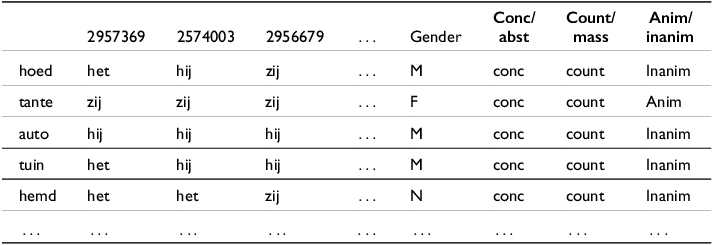
The test contains eight masculine nouns, six feminine nouns, and six neuter nouns. The nouns differ in their degree of individuation (concrete/abstract, count/mass, and animate/inanimate). An overview of all nouns that are included in the test is given in table 1.Footnote 8
Overview of the nouns used in the sentence completion task

In order to achieve a high level of salience, we made speakers aware of the pronoun selection process by explicitly asking them to choose the grammatically correct pronoun and attaching a score to it in the form of an assessment task. Moreover, participants could only choose between full pronouns, not their reduced variants. Audring (Reference Audring2009:154) hypothesizes that full-form pronouns are “more strongly associated with formal discourse,” in other words, speakers tend to overuse full pronouns in formal registers. Therefore they may also tend to be more conservative and show more lexical agreement. However, her data did not support the latter intuition, as full pronouns actually turned out to have a strong tendency towards semantic agreement (Audring Reference Audring2009:161, 216). This is probably due to the high switching ratio (i.e., from lexical to semantic agreement) of pronouns referring to persons. In general, full pronouns are used more often for persons than for inanimate objects. As our test (that could only offer three answer options) did not include clitic or reduced pronouns next to the full pronouns, this might have led to different results, especially regarding the use of the feminine pronoun.Footnote 9
In addition to the linguistic questions, the test includes two background questions on the participant’s age (open-ended question) and gender (multiple-choice question: male, female, other/not specified).Footnote 10 These questions were compulsory for participants who wanted to see their score. In total, participants took about 10 minutes to complete the test. Participants who also wanted to receive their score by email (or sign up for the Quest newsletter) could optionally leave their email address. Quest did not share email addresses with the researchers, so these are not stored for research purposes. All data were anonymous, that is, not traceable to a specific person through personal information or IP address.Footnote 11 In total, 10,353 participants filled out the questionnaire completely. In the next subsection we lay out the statistical analysis of our data.
3.2 Data analysis
We have analyzed the experimental data using a combination of Multiple Correspondence Analysis and Hierarchical Clustering, focusing first on the twenty words in table 1 and how they group together, and then on our pool of participants, to see what strategies they use to assign a pronoun to these twenty antecedent words.Footnote 12 The starting point for the first part of the analysis is a raw data table, a small portion of which is shown in table 2.
The raw data table that served as input for the first part of the analysis (partly)

The data partially represented in table 2 form a 20
 $ \times $
10,357 matrix, with each row representing one of the twenty words listed in table 1. The first 10,353 columns represent our participants. Each participant was randomly assigned a seven-digit identification number, and the cell values are one of the three multiple choice options offered in the questionnaire; see the example in (3): hij ‘he’, zij ‘she’, or het ‘it’. The final four columns represent the information that was also listed in table 1: the lexical gender of the nouns, whether they are concrete or abstract, count or mass, and animate or inanimate. On this table we performed a Multiple Correspondence Analysis (MCA), with the final four columns acting as supplementary variables (for general discussion, see Greenacre Reference Greenacre2007 and Levshina Reference Levshina2015: chap. 19). The output of MCA is a low(er)-dimensional representation of the data set,Footnote 13 which makes it possible to visualize and subsequently interpret how the nouns pattern in terms of pronominal reference and what role the supplementary variables play in determining this patterning. The final step in our analysis involves Hierarchical Clustering (HC), which divides the set of twenty nouns into a number of subsets such that those subsets reflect common behavior in the questionnaire. We perform this clustering on the outcome of the MCA (Husson, Josse, & Pagès Reference Husson, Josse and Pagès2010, Husson, Lê, & Pagès Reference Husson, Lê and Pagès2011). In other words, we use the coordinates of the twenty nouns in the (reduced) MCA-space as the basis for clustering them into groups. All results of both the MCA and the HC are discussed in section 4.
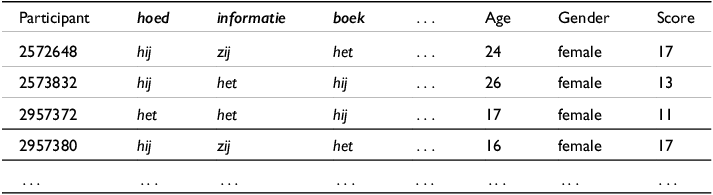
The analyses just described can provide insight into which (types of) nouns cluster together in the experiment, but they do not yet provide any information about which pronouns the participants actually use to refer to these nouns. In order to answer that question, we performed a second MCA and HC analysis on our data set, but this time focused on the participants, using their age, gender, and test score as supplementary variables. This means our initial raw data set looks slightly different. A small portion of it is shown in table 3.
The raw data table that served as input for the second half of the analysis (partly)

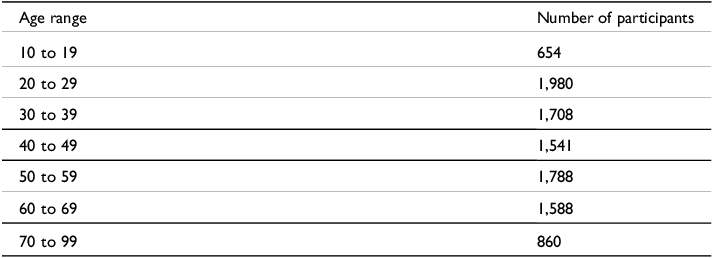
The data table underlying table 3 measures 10,119 rows by 23 columns. Each participant is represented by a separate row.Footnote 14 The first twenty columns are the twenty words of the questionnaire, with cell values identical to the ones in table 2 and the final three columns contain the age of the participant, their gender, and their test score. The age of the participants ranges from 11 to 99, with a mean of 44.56 (median: 44.00) and a standard deviation of 17.58. In order to facilitate the visualization of the data set and the analysis of the results, we split the participants into seven different age groups. The range and size of these groups is given in table 4.
Age ranges of the participants

As far as their gender is concerned, 6,004 of the participants are female (59%) and 4,115 male (41%). Finally, the Score-variable in table 3 is a number that theoretically can range from 0 to 20 and that indicates the degree to which the pronoun choices made by the participant reflect the Standard Dutch lexical gender of the relevant nouns: it is the sum of the prescriptively correct answers over the twenty stimuli. As such, these scores provide us with a measure of the conservatism of the participants’ grammars. In our data set, the lowest score is 4 and the highest 20. The mean is 13.59 (median: 14.00) with a standard deviation of 3.07. As shown in table 5, apart from the very high and very low scores, the participants are distributed fairly evenly over the different scores.
Scores obtained by the participants on the test

In the next section we discuss the results of the analyses described above.
4. Results
4.1 Noun clusters
We first present the results of the MCA performed on the data table partially represented in table 2, that is, the part of the analysis that focuses on discovering commonalities among the twenty nouns of the experiment. The first two MCA-dimensions are visualized in the plot in figure 1. This plot is a two-dimensional representation of the twenty nouns from table 1. The closer two nouns are to one another in the plot, the more the participants referred to them using the same pronoun (regardless of whether that pronoun is hij ‘he’, zij ‘she’, or het ‘it’). Nouns that are far apart are typically not referred to by the same pronoun. The question now is if we can detect natural classes in the groups of nouns that cluster together, and this is where the supplementary variables come in. Recall from (the discussion of) table 2 that we also encoded the lexical gender of the noun. That information is present in the form of color-coding in the plot in figure 1: feminine nouns are marked in black, masculine nouns in red, and neuter nouns in green. Note how this color-coding closely matches the grouping of the nouns in the plot: black nouns are on the right-hand side of the plot, green ones occupy the lower left quadrant, and red ones the upper left quadrant – with two exceptions, which we return to below. This shows that in choosing a pronoun to refer to these nouns, our participants strongly relied on their lexical gender. Using the same line of reasoning, we can now also look at the third dimension of the MCA. Consider in this respect the plot in figure 2.
First two dimensions of the MCA color-coded according to lexical gender.

Second and third dimensions of the MCA.

This plot represents the second and third dimensions of the MCA, and this time we have color-coded the nouns according to whether they are count or mass nouns. Again it is clear that the color-coding tracks the grouping in the plot: all mass nouns (marked in red) are grouped together in the lower left quadrant of the plot. This also explains the unexpected position of the nouns honing ‘honey’ and onzin ‘nonsense’ in figure 1: while masculine, these nouns are also mass, and that is what is driving them downwards on the plot.
A second way to gauge the role played by the supplementary variables is by calculating, for each supplementary variable and each MCA-dimension, the squared correlation ration (
 ${\eta ^2}$
). This is a value between 0 and 1 that represents the proportion of variance explained by that supplementary variable on that MCA-dimension. The
 ${\eta ^2}$
-values for the four supplementary variables and the first three MCA-dimensions are given in table 6.
Squared correlation ratio for the four supplementary variables and the three MCA-dimensions

As is clear from the table, lexical gender plays an important role in accounting for the variation, especially on the first two dimensions, while the count/mass distinction is the most important driver of variation on the third dimension, thus confirming the visual patterns in figures 1 and 2.Footnote 15
A third and final way to superimpose the information provided by the supplementary variables on the plots generated by the MCA is by directly plotting the values of the supplementary variables. Just as each of the twenty words from table 1 can be plotted on the MCA-dimensions, so can the values of the supplementary variables. The result is shown in the plots in figure 3. This way of representing the data reveals a number of additional insights. First, it illustrates an effect from table 6 that we have so far not commented on, namely the role of animacy. While all feminine nouns are to the right of the y-axis in figure 1, there is still a clear division between koe ‘cow’, oma ‘grandmother’, and tante ‘aunt’ all the way on the right, and bibliotheek ‘library’, hitte ‘heat’, and informatie ‘information’, which are situated more in the center of the plot. The first plot in figure 3 shows that this is the effect of animacy: it is not so much feminine nouns in general that cluster together on the first dimension, but animate feminine nouns. A second thing to note in figure 3 is the fact that the values concrete and count occupy a position close to the origin in both plots. This shows that these values are not very distinctive in our data set. In other words, our participants rarely used the same pronoun for all concrete nouns, or all count nouns (as opposed to, say, the mass nouns or the animate feminine nouns).
MCA with the values of the supplementary variables also plotted.

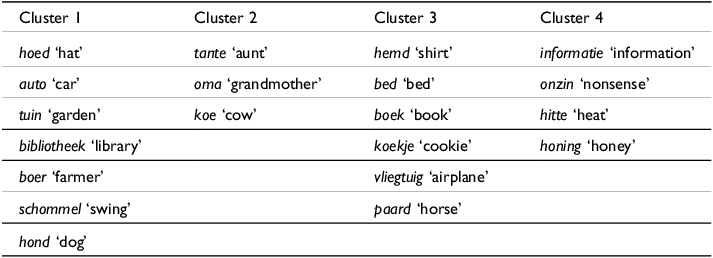
The trends we have just observed are further corroborated if we look at the outcome of the hierarchical clustering analysis. Applying Hierarchical Clustering to the outcome of MCA yields the four clusters shown in table 7.Footnote 16
The four noun clusters that follow from the hierarchical clustering analysis

This clustering further confirms our earlier analysis of the data, in particular the role played by gender, the count/mass-distinction, and animacy. Cluster 2 contains all and only animate feminine nouns, cluster 3 all and only neuter nouns, cluster 4 all and only non-neuter mass nouns, and cluster 1 contains all remaining nouns, namely the masculine nouns (whether animate or not) and the inanimate feminine nouns.
4.2 Gender uniformity per noun
As already hinted at in the previous section, the results we have just discussed paint a clear picture about which (types of) nouns cluster together in our experiment, but they don’t yet provide any information about which pronouns the participants use to refer to these nouns. For instance, the MCA and subsequent cluster analysis have revealed that the four nouns in cluster 4 are typically referred to by the same pronoun, but which pronoun that is, and whether there is variation among the participants in the choice of pronoun is still an open question. This is why we now turn to the second MCA and cluster analysis described in the previous section, namely the one that focuses on the participants, and uses their age, gender, and test score as supplementary variables. As a first visualization of the raw data, consider the bar plots in figure 4. They show, for each of the twenty words, which percentage of our participants chose which pronoun. These plots are already quite informative. For instance, they show that for nouns like tante ‘aunt’ and oma ‘grandma’ there is much greater agreement between the participants than for nouns like vliegtuig ‘plane’ or tuin ‘garden’.
Bar plot representation of the raw data.

In order to make these intuitions about the degree of interspeaker agreement more quantifiable, we adopt and adapt the notion of ‘internal onomasiological uniformity’ (IOU) from Geeraerts, Grondelaers, & Speelman (Reference Geeraerts, Grondelaers and Speelman1999:46).Footnote 17 They define IOU as follows:

In this formula
 ${I_Z}\left( Y \right)$
represents the internal onomasiological uniformity for concept Z in data collection Y, x
 ${_1}$
to x
 ${_n}$
are possible expressions of concept Z in data collection Y, and F
 ${_{Z,Y}}$
(x) is the relative frequency of x in Y to express Z. Geeraerts, Grondelaers, & Speelman (Reference Geeraerts, Grondelaers and Speelman1999) use this concept to measure the degree to which there is uniformity in the terms speakers use to refer to a certain concept: when there is a clearly dominant term the value of
 ${I_Z}\left( Y \right)$
will be high, whereas when several terms are more or less equally popular,
 ${I_Z}\left( Y \right)$
will be much smaller. We can now use this same concept to quantify the degree of uniformity in the bar plots in figure 4: when most speakers converge on the same pronoun (as in the case of tante ‘aunt’ or oma ‘grandma’), the value will be high, whereas in cases like vliegtuig ‘plane’ or tuin ‘garden’ it will be much smaller. The IOU-values are given in table 8.
Overview of the uniformity scores of the twenty nouns

A comparison between these scores and the classes defined by the Individuation Hierarchy in (2) – repeated below as (5) – reveals clear similarities. First, the nouns with the highest uniformity scores are those that are highly individuated. Nouns like tante ‘aunt’, oma ‘grandma’, and boer ‘farmer’ all refer to humans, which occupy the extreme left edge of the hierarchy. In almost all cases, these nouns were referred to with feminine (‘aunt’, ‘grandma’) and masculine (‘farmer’) pronouns.

Moving slightly to the right on the Individuation Hierarchy, the next highly individuated class includes other animates, such as animals. Indeed, the noun hond ‘dog’ is in fourth place in the ranking of uniformity scores in table 8. This noun is referred to by the masculine pronoun in almost all cases. The same applies to the noun koe ‘cow’, which is almost exclusively assigned a feminine pronoun. However, the opposite is true for the neuter noun paard ‘horse’, as this noun has the lowest uniformity score in the ranking. In almost half the cases, paard is assigned a non-neuter pronoun, more often masculine than feminine. This finding goes against the lexical agreement system (i.e., a neuter noun should be referred to with a neuter pronoun), but it is not unexpected from the point of view of the Individuation Hierarchy, which assumes that highly individuated nouns are more compatible with masculine or feminine pronouns.
In the middle of the hierarchy we find the class of bounded objects, such as hoed ‘hat’ or boek ‘book’. This class of count nouns is less individuated than the categories of humans and other animates, but more so than mass nouns. Here, the masculine nouns auto ‘car’ and hoed ‘hat’ have a relatively high uniformity score, as in the vast majority of cases these nouns are assigned a masculine pronoun. However, this does not apply to the masculine noun schommel ‘swing’. Compared to auto and hoed, the noun schommel is increasingly referred to with a feminine or neuter pronoun. Given the tendency of masculinization (see section 2) and the relatively high degree of individuation, this is unexpected. The majority of the pronouns used are still masculine, though.
Within the class of count nouns, the masculine noun tuin ‘garden’ and the feminine noun bibliotheek ‘library’ have the lowest uniformity scores. In about half the cases the noun tuin is referred to with a feminine or neuter pronoun. Particularly the neuter pronoun is unexpected here, as tuin is a count noun. However, at the same time, the noun indicates a place (in contrast to boek ‘book’ or koekje ‘cookie’, for example) and could therefore be regarded as more abstract and less individuated, causing variation in pronoun assignment. The feminine noun bibliotheek ‘library’ also shows low uniformity. In about half the cases it is referred to with a masculine pronoun. Nouns that indicate a place thus seem to be more subject to variation than countable bounded objects (see also Audring Reference Audring2009:69).
The uniformity scores of neuter count nouns like boek ‘book’, koekje ‘cookie’, hemd ‘shirt’, and bed ‘bed’ are clearly lower than those of their non-neuter counterparts. Most of the time a neuter pronoun is used, but the variation increases, particularly the use of masculine pronouns to refer to these nouns. This fits in with the idea that the neuter pronoun loses part of its function due to masculinization, namely the masculine pronoun taking over the position of neuter pronouns when referring to count nouns. This shift seems even further advanced in the neuter noun vliegtuig ‘plane’, with more than a quarter of the pronouns assigned being masculine.
Moving further to the right on the hierarchy, we arrive at the class of specific mass nouns. In our data set, the masculine noun honing ‘honey’ (referring to a specific portion of honey) has one of the lowest uniformity scores. The high percentage of neuter pronouns fits in with the process of resemanticization and the idea that referents on the right-hand side of the hierarchy are lowly individuated and more compatible with a neuter pronoun regardless of their lexical gender.
At the extreme right edge of the hierarchy we find the class of unspecific mass nouns and unbounded abstract nouns. The noun onzin ‘nonsense’ has a relatively high uniformity score. Looking at the pronoun assignment in figure 4, it is striking that in more than three-quarters of the cases this common noun was referred to with the neuter pronoun, thus favoring semantic over lexical agreement. Although the other lowly individuated nouns informatie ‘information’ and hitte ‘heat’ have lower uniformity scores, they also clearly have the neuter pronoun as the most frequently chosen option.
In summary, the uniformity scores in table 8 track the Individuation Hierarchy in (5) quite well. They generally show the highest scores for animates, where semantic gender also matches lexical gender. If the noun’s semantics clashes with its grammatical gender, semantic agreement becomes more likely and uniformity scores decrease. This was the case with animals like paard ‘horse’, places like tuin ‘garden’, specific mass nouns like honing ‘honey’, and unbounded abstract nouns like hitte ‘heat’. In the middle of the hierarchy, semantic agreement occurs less frequently, but there are some indications of an ongoing process of masculinization, with the masculine pronoun sometimes occurring at the expense of neuter or feminine pronouns. Yet another indication of pronominal gender shift is the semantic agreement we find with nouns bearing derivational suffixes that reveal their lexical gender, such as -je in koekje ‘cookie’ or -te in hitte ‘heat’.
4.3 Participant clusters
What neither the plots in figure 4 nor the numbers in table 8 show, however, are the patterns of variation that underlie the data: are there groups of speakers that we can identify based on their pronominalization strategies? This is why we now turn to the results of the second MCA and cluster analysis. The cluster analysis allows us to split the 10,119 participants into three clusters, the sizes of which are shown in table 9.Footnote 18 It is the properties of these three groups that we will examine more closely in what follows.
Size of the three participant clusters

We first examine the interaction between age and cluster membership. This relationship is visualized in figure 5. This plot represents the three clusters on the y-axis in increasingly darker shades of gray. The x-axis represents the seven age ranges, whereby the width of the bars is proportional to the size of the age group (see table 4). The height of the bars shows the percentage of participants from a particular cluster in that age range. What the figure shows is that cluster 1 skews towards the older age ranges, while in clusters 2 and 3 younger participants are overrepresented.
Interaction between age ranges and cluster membership.

This is confirmed by the plot in figure 6. This plot represents the first two dimensions of the MCA, color-coded according to the three clusters revealed by the cluster analysis. Superimposed on this we have plotted the seven age ranges. As can clearly be seen from the plot, the age variable aligns quite well with the first dimension of the MCA, with higher age ranges being represented on the left-hand side of the plot, and lower age ranges on the right-hand side. This same horizontal dimension is also a key factor in distinguishing the three clusters, with cluster 1 exclusively to the left of the y-axis, cluster 3 to the right, and cluster 2 in an intermediate position.Footnote 19
First two dimensions of the MCA color-coded according to cluster and with age ranges superimposed.

Let us now focus on the interaction between gender and cluster membership. The plot in figure 7 parallels the one in figure 5 but it substitutes the seven age cohorts for two genders. As is clear from the plot, gender does not seem to play a role in accounting for the variation in our data set. At most there is a slight preponderance of female speakers in cluster 2. This is also confirmed by the MCA: the
 ${\eta ^2}$
of the supplementary variable GENDER is 0.013 on the first MCA-dimension and 0.008 on the second, showing that the effect is very small indeed.
Interaction between gender and cluster membership.

Finally, we turn to the interaction between test score and cluster membership. The result of this analysis is represented in figure 8. In this graph, the effect of the supplementary variable is much more pronounced than in the previous two figures: high scores are almost exclusively found in cluster 1, with cluster 2 dominating the mid to low range, and cluster 3 containing almost exclusively low scores. The effect of test score can also be seen in the outcome of the MCA. In figure 9 we plot the first two MCA-dimensions color-coded according to test score. The graph clearly shows that red/high scores dominate on the left (where cluster 1 is situated; see figure 6), and low/green scores on the right.Footnote 20
Interaction between test scores and cluster membership.

First two dimensions of the MCA color-coded according to test score.

The results we have just discussed provide the following characterization of our participant pool: there is an older, more conservative group of speakers whose judgments adhere closely to the Standard Dutch norm, and there is a younger, more innovative group of speakers. In between the two extremes we find a continuum, both in terms of age and in terms of degree of conservatism. In order to get a clearer view of the types of innovation that we find among our (younger) participants, we can look at the type of plot shown in figure 4, but this time split up per cluster. This is shown in figure 10.
Bar plot representation of the data per cluster.

Cluster 1 corresponds to the highest test scores and is thus closest to the lexical agreement system. With the exception of the noun onzin ‘nonsense’, which is mostly assigned a neuter pronoun, pronoun selection in this cluster takes place on the basis of the lexical gender of the noun. For example, the other abstract and mass nouns do not show any indications of semantic agreement. In fact, the nouns that are most variable within this cluster, such as honing ‘honey’ and hitte ‘heat’, reveal uncertainty about which of the two common genders should be assigned rather than switches between common and neuter gender.
Clusters 2 and 3 clearly differ from cluster 1, in that abstract and mass nouns such as informatie ‘information’, hitte ‘heat’, and honing ‘honey’ are mostly assigned a neuter pronoun. This is a clear indication of a shift from a lexical to a semantic agreement system in the younger, more innovative speaker groups. In addition, compared to cluster 1, uniformity decreases for the locational nouns tuin ‘garden’ (more references with a neuter pronoun) and bibliotheek ‘library’ (more references with a masculine pronoun). Also, there is a (slightly) higher number of occurrences of a masculine pronoun when referring to neuter concrete count nouns, namely hemd ‘shirt’, bed ‘bed’, boek ‘book’, koekje ‘cookie’, and vliegtuig ‘plane’. This points to an increasing degree of masculinization. The neuter animal noun paard ‘horse’ is also increasingly referred to with a non-neuter pronoun in clusters 2 and 3, which is consistent with its high degree of individuation according to the Individuation Hierarchy. In cluster 3, however, the number of occurrences of a neuter pronoun with non-neuter nouns increases, especially in reference to count nouns, such as hoed ‘hat’, tuin ‘garden’, and schommel ‘swing’. This is surprising, because the neuter pronoun het ‘it’ is normally situated at the right-hand side of the hierarchy where the abstract and mass nouns are located. However, this finding confirms recent assumptions about a shift of het ‘it’ towards the left-hand part of the hierarchy. This is suggested by Audring (Reference Audring, van der Sijs, Fonteyn and van der Meulen2021), who gives some examples in which neuter het ‘it’ is also used to refer to objects, one of which is displayed in (6) (Audring Reference Audring, van der Sijs, Fonteyn and van der Meulen2021:83 (16)). Here, the masculine count noun ring ‘ring’ is referred to with the neuter pronoun het. Building on examples like this one, Audring (Reference Audring, van der Sijs, Fonteyn and van der Meulen2021) assumes that the use of het may increase in the near future.

In sum, clusters 2 and 3 show more semantic agreement and instances of masculinization than cluster 1, thereby accounting for the lower test scores. In addition, cluster 3 can be distinguished from cluster 2 based on the higher proportion of neuter pronouns in reference to non-neuter (inanimate, concrete count) nouns.
5. Discussion
5.1 Summary
The results of the Multiple Correspondence Analyses and Hierarchical Clustering show that studying a large sample of speakers helps consolidate insights about pronominal gender shift in Dutch. Below we come back to the research question we started this article with:
RQ: Do we see age-related variation in a highly salient questionnaire setting, and are younger speakers more inclined to use semantic agreement in that setting?
First of all, the data set makes it possible to detect natural classes in the groups of nouns that cluster together, such as animate feminine nouns and non-neuter mass nouns. Participants not only strongly rely on the lexical gender of the nouns in choosing a referential pronoun (the lexical agreement system), but they also use semantic nominal properties such as animacy, countability, and concreteness in guiding their pronominalization strategies (the semantic agreement system). Whereas the values concrete and countable did not play a clearly identifiable role in pronoun assignment, in that participants rarely use the same pronoun for all concrete nouns or all count nouns, the opposite was true for the values animate, uncountable/mass, and abstract. Furthermore, the data set provides insight into which pronouns participants use to refer to nouns occupying different positions on the Individuation Hierarchy (Audring Reference Audring2009:124). The uniformity scores of the twenty nouns reveal high interspeaker agreement for nouns in which semantic gender matches lexical gender (in this case masculine/feminine animates and masculine concrete count nouns) and less agreement for nouns in which semantic gender clashes with lexical gender, in particular at the right edge of the Hierarchy, where the abstract and mass nouns are located. Overall, increased variation indicates an ongoing shift in pronominalization, but for some nouns this shift is already further advanced: the most frequently chosen pronoun does not match the lexical gender of the noun. This provides evidence that semantic gender is not only found in spontaneous speech settings, but also in formal (written) language settings when speakers are more aware of (i.e., pay more attention to) their linguistic choices, and are even being assessed on them.
The data set also enabled us to identify groups of speakers based on their pronominalization strategies. In total, three different speaker clusters can be distinguished. Previous research has shown that the semantic system is more strongly present in the speech of younger generations and that an increase in lexical agreement is expected in the language of older speakers (e.g., Audring Reference Audring2009, Bouma Reference Bouma2018, De Vos, De Vogelaer, & De Sutter Reference De Vos, De Vogelaer and De Sutter2021). This age-related variation also emerges in our data set, with the number of older participants gradually decreasing from cluster 1 up to cluster 3 and the number of younger participants gradually increasing from cluster 1 up to cluster 3, which points to apparent-time language change.Footnote 21 This gradual difference is also reflected in the test scores, which we used as a measure of conservatism. Cluster 1 contains the higher test scores, thus reflecting participants that adhere more closely to “conservative” lexical agreement. These speakers mostly rely on the lexical gender of a noun when choosing a pronoun. By contrast, clusters 2 and 3 contain the (mid to) low test scores, indicating participants who are more likely to shift to innovative semantic agreement. These speakers increasingly rely on the noun’s semantics when choosing a pronoun, which is reflected in the observed tendencies of masculinization (i.e., referring to non-masculine concrete count nouns with masculine pronouns) and resemanticization (i.e., referring to less individuated nouns with neuter pronouns). Our data set did not reveal convincing gender-related variation patterns (e.g., Bouma Reference Bouma2018, De Vos, De Vogelaer, & De Sutter Reference De Vos, De Vogelaer and De Sutter2021). Regarding the assumption that the pronominal gender shift is further advanced in women, only a limited effect was found, as female speakers were slightly more likely to use semantic agreement than male speakers.
Comparing the three clusters based on their number of speakers, cluster 2 is the largest. This cluster could be considered a transitional one, as it displays a (partial) switch from lexical to semantic gender agreement that is also found in cluster 3. In cluster 3, the variation in pronoun assignment increases further due to the higher proportion of neuter pronouns in reference to non-neuter nouns, especially inanimate concrete countable objects. This shift is unexpected from the point of view of the Individuation Hierarchy and it predicts a renewed role for neuter het ‘it’ in which it will be able to pronominalize a larger part of the hierarchy by shifting to the left (as in English).
5.2 Limitations
Although the current study was able to reveal quite robust noun and age-related speaker patterns because of the very large sample, the methodology and subsequent data set also have some weaknesses that need to be further addressed. First of all, the number of nouns included in the experiment is low. This complicates generalizing across noun classes, despite the clear distinctions that emerge between different categories in the current data set. Second, one could argue that including nouns that refer to feminine persons such as tante ‘aunt’ is insufficiently distinctive due to their lack of variability:Footnote 22 speakers invariably choose the feminine pronoun, especially in a formal register. In a more informal register, however, research into southern Netherlandic Dutch dialects has revealed remarkable deviations in this respect. For example, it is possible for (some) Limburgish speakers to refer to female persons with neuter pronouns, for example het ‘it’ (Piepers, Backus, & Swanenberg Reference Piepers, Backus and Swanenberg2021), and for (some) southern Netherlandic Dutch dialect speakers to refer to female persons with masculine pronouns, for example hij ‘he’ (Piepers, Swanenberg, & Backus Reference Piepers, Swanenberg and Backus2023). Furthermore, we observe adnominal gender shifts in the Brabantish dialects, for example masculine suffixes on determiners preceding feminine nouns (e.g., en-e vrouw as discussed in section 1; Doreleijers et al. Reference Doreleijers, Van Koppen and Swanenberg2020). Based on the significant dialect attrition involving the loss and divergence of the adnominal masculine gender suffix, one would expect the most radical gender changes in the past century to be found in the southern Dutch language area.
This brings us to another limitation of the current data set, namely, the fact that it does not contain geographical information or information about the first language of the participants (see also footnote 10). Since the platform used to disseminate the questionnaire (i.e., Quest) did not allow us to include questions about the regional or linguistic background of the participants (due to privacy concerns), it was not possible to differentiate for geographical area or dialect knowledge in the analysis. This would have been very interesting, though, especially since (as discussed above) the northern part of the language area is generally considered to be more innovative and the southern part more conservative based on the gender systems of the corresponding dialects. Future research on pronominal gender should definitely take this geographical variable into account, especially when focusing on more informal registers.
A final limitation relates to some of the test items, for example the noun onzin ‘nonsense’. The context used to elicit this item is given in (7).

In choosing an appropriate pronoun in this context, participants may have selected one that refers back to the whole first sentence rather than to the noun onzin ‘nonsense’, especially because of the idiomatization of the expression het/dit slaat nergens op ‘it/this makes no sense’. This might also explain why this noun behaves differently from the other abstract nouns in cluster 1. Speakers in this cluster in general adhere to the lexical agreement system, except for this noun, which is assigned a neuter pronoun. In addition, the test sentences with tuin ‘garden’ (masculine) and bibliotheek ‘library’ (feminine) have another issue; see sentences (4) and (8) in the Appendix. Both sentences contain another noun (i.e., het huis ‘the house’ and het dorp ‘the village’, which are both neuter), so the choice of pronouns could have been influenced (with a lower likelihood of choosing the neuter pronoun).
In spite of the above-mentioned limitations, the current study adds a new perspective to the existing body of research on pronoun use in Dutch, especially with respect to the ‘balancing act’ between lexical and semantic agreement. In particular, we have addressed the age factor in pronominal gender shift, showing that younger speakers are more semantically oriented than older speakers, thus reflecting apparent-time language change. Moreover, our study shows that processes of masculinization and resemanticization not only occur in spontaneous speech settings, but that they also emerge in formal assessment contexts that yield a high level of salience and linguistic awareness. The current data set is consistent with the findings of Audring (Reference Audring2009) that full pronouns, even in these more formal settings, also have a tendency towards semantic agreement. By continuing to include new data sets of speakers from different generations in the debate, we are hopefully on track to unravel the many mysteries of pronominal gender shift in Dutch.
Acknowledgments
Many thanks to two anonymous reviewers who provided helpful comments on an earlier version of this article. We would also like to thank the LiME-team of the Meertens Institute for their useful comments (in particular Hans Broekhuis, Stefan Grondelaers, Frans Hinskens, and Ton van der Wouden), and we would like to acknowledge support from the FWO-funded research network Re-examining Dialect Syntax (W002320N). This work was supported by the Dutch Research Council, PGW.19.018.
Appendix