Classical biological control, the deliberate introduction of exotic natural enemies into new habitats in which an exotic pest also causes damage, aims for a long-term reduction of the pest population (van den Bosch, Reference van den Bosch1971). Despite the fact that it is widely considered in pest management, classical biocontrol shows a great frequency of failures (Greathead & Greathead, Reference Greathead and Greathead1992). In many failed cases, populations of the natural enemies could not establish in the new habitats and in others, successful establishment did not lead to persistent low-density populations of the pest (Mills, Reference Mills, Leather, Watt, Mills and Walters1994). Thus, predicting and generalizing the outcome of classical biocontrol remains an elusive goal. While case-by-case detailed ecological studies of pest, crop and natural enemies are, if time-consuming, warranted, the search of broad patterns is still central to much applied ecological research. Classical biological control is considered fundamental to controlling damaging insects in many long-lived crops such as plantation forestry.
Sirex noctilio Fabricius (Hymenoptera: Siricidae) is a major pest of exotic tree plantations worldwide as it is responsible for severe losses to pine tree afforestation. This wood-boring wasp endemic to Eurasia and Northern Africa was accidentally introduced, mainly during the last century, into several countries. The invasion history of S. noctilio suggests two source populations and several pathways of introduction for globally invasive populations. Apparently, multiple independent introductions from Europe and other native areas (Asia and Northern Africa) into the Southern and Northern Hemispheres occurred followed by subsequent spread among the invaded areas (Boissin et al., Reference Boissin, Hurley, Wingfield, Vasaitis, Stenlid, Davis, Stenlid, Davis, de Groot, Ahumada, Carnegie, Goldarazena, Klasmer, Wermelinger and Slippers2012). It has also been suggested that the spread rates of this species can be quite extraordinary, ranging from 11 to 78 km/year, depending on the geographical region (Lantschner et al., Reference Lantschner, Villacide, Garnas, Croft, Carnegie, Liebhold and Corley2014). Although S. noctilio has a wide host range, the Pinus species are strongly preferred (Spradbery & Kirk, Reference Spradbery and Kirk1978; Madden, Reference Madden and Berryman1988). Given that pines are commercially important and so planted extensively worldwide, S. noctilio has become a global problem (see Carnegie et al., Reference Carnegie, Eldridge and Waterson2005 for New Zealand and Australia; Villacide & Corley, Reference Villacide and Corley2012 for South America; Tribe & Cillié, Reference Tribe and Cillié2004 for South Africa and, Hoebeke et al., Reference Hoebeke, Haugen and Haack2005; and de Groot et al., Reference de Groot, Nystrom and Scarr2007 for North America and Canada).
The life cycle of this invasive wasp is well known. Female wasps lay eggs into trees together with a phytotoxic compound and spores of the symbiotic fungus Amylostereum areolatum, which is essential for larval nutrition and development (Madden & Coutts, Reference Madden, Coutts and Batra1979; Madden, Reference Madden1981). The larvae excavate galleries and the combination of the fungus and the toxic mucus results in physiological stress to trees that leads to their death (Coutts, Reference Coutts1969; Ryan & Hurley, Reference Ryan, Hurley, Slippers, de Groot and Wingfield2012). Sirex noctilio when in low populations attacks suppressed and stressed trees (Madden, Reference Madden1968a ; Villacide & Corley, Reference Villacide and Corley2012). Tree susceptibility to attacks can arise from different reasons such as competition in overstocked stands, physical damage because of pruning, unfavourable environmental conditions, or even other insect and disease attacks (Madden, Reference Madden and Berryman1988).
Sirex noctilio population dynamics in its non-native range is critical to damage in pine plantations. The wasp has pulse-like outbreak population behaviour (Madden, Reference Madden and Berryman1988; Villacide & Corley, Reference Corley, Villacide, Slippers, de Groot and Wingfield2012). Pulse-like outbreaks are described by a rapid, unpredictable increase in densities and are usually terminated by natural enemies, resource defences or host depletion (Berryman, Reference Berryman, Barbosa and Schultz1987). During outbreaks, S. noctilio is capable of attacking healthy trees in addition to the stressed ones; thus resulting in high tree mortality (Corley & Villacide, Reference Corley, Villacide, Slippers, de Groot and Wingfield2012).
The need for damage mitigation strategies during S. noctilio outbreaks has led to integrated pest management measures in the invaded regions. Silvicultural practices together with the introduction of biocontrol agents are the procedures of choice. The innundative release of the entomopathogenic nematode Deladenus (Beddingia) siricidicola Bedding is widely used to control woodwasp populations and, is regarded as the primary biological control agent for this pest (Slippers et al., Reference Slippers, Hurley, Mlonyeni, de Groot, Wingfield, Slippers, de Groot and Wingfield2012). In addition, several species of parasitoids have been deliberately introduced from Europe and North America as control agents in most invaded regions (Cameron, Reference Cameron, Slippers, de Groot and Wingfield2012). Among these species, Ibalia leucospoides (Hochenwarth), Megarhyssa nortoni (Cresson) and Rhyssa persuasoria (Linneaus) have become established in most regions (see for Australia: Taylor, Reference Taylor1967; Carnegie et al., Reference Carnegie, Eldridge and Waterson2005; for New Zealand: Zondag, Reference Zondag1959; Nuttall, Reference Nuttall1972; for South America: Klasmer et al., Reference Klasmer, Fritz, Corley and Botto1998; Villacide & Corley, Reference Villacide and Corley2003; Eskiviski et al., Reference Eskiviski, Núñez Cresto, Olmedo and del Rosario de Coll2004; Iede et al., Reference Iede, Penteado and Filho2010; and for South Africa: Tribe & Cillié, Reference Tribe and Cillié2004). Ibalia leucospoides has attracted the most research on biology and behaviour, probably, because of its widespread establishment and distribution.
Ibalia leucospoides is considered as an effective control agent of S. noctilio in a number of regions (e.g., Haugen, Reference Haugen1990; Carnegie et al., Reference Carnegie, Eldridge and Waterson2005; Collett & Elms, Reference Collett and Elms2009); however, only a few studies suggest that under some conditions its role in regulating the pest population may be secondary to that of other parasitoids (Taylor, Reference Taylor1978; Corley & Bruzzone, Reference Corley and Bruzzone2009). Moreover, variability has been reported in per cent parasitism achieved by this parasitoid, among pine stands, and even within the same region. Most studies that focused on this parasitoid have looked into its host-foraging behaviour and life-history traits (Madden, Reference Madden1968b ; Spradbery, Reference Spradbery1974; Fernández-Arhex & Corley, Reference Fernández-Arhex and Corley2005; Martínez et al., Reference Martínez, Fernández-Arhex and Corley2006; Corley et al., Reference Corley, Villacide and Nouhuys2010; Fischbein et al., Reference Fischbein, Corley, Villacide and Bernstein2011, Reference Fischbein, Bettinelli, Bernstein and Corley2012, Reference Fischbein, Bernstein and Corley2013). Yet none has integrated these traits with the introduction process of the natural enemy in order to understand the variable success of this species as a control agent.
Characterizing established pest–natural enemy interactions may be useful to uncover patterns and consequently improve the accuracy of our predictions of success in classical biocontrol. We review here the history of introduction, ecology and behaviour of the parasitoid I. leucospoides (Hymenoptera: Ibaliidae), used to manage S. noctilio populations worldwide. We analyse information retrospectively, choosing an invasion ecology perspective. This is because, the three steps followed in the invasion process by non-native species are, arrival, establishment and spread (Lockwood et al., Reference Lockwood, Hoopes and Marchetti2007) which are analogous to those expected through classical biological control (release, establishment and pest suppression at the regional scale). We also expect, more broadly, to contribute knowledge to the fundamental basis behind classical biological control of S. noctilio and of invasive forest insects in general.
Arrival and establishment of Ibalia leucospoides into new areas
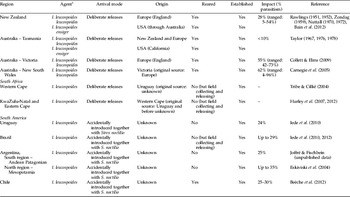
The first step involved in all biological invasions consists of the arrival of individuals of a species to new areas, outside of their native range. Unlike S. noctilio that globally has arrived into non-native regions through accidental introductions (Villacide & Corley, Reference Corley, Villacide, Slippers, de Groot and Wingfield2012) the main pathway by which I. leucospoides has arrived into new regions has been the deliberate release of individuals as biological control agents of woodwasp populations (table 1). Still, different levels of human intervention have occurred among different areas of New Zealand, Australia and South Africa. Conversely, the arrival of I. leucospoides to South America (Uruguay, Argentina, Brazil and Chile) was initially accidental and probably resulted from its transportation as a by-product within wood commodities attacked by S. noctilio. Then, natural dispersal (both active and passive movements) may have facilitated local redistribution. To date the parasitoid has been introduced into the most pine-growing areas of the world, although deliberate releases of these insects as a control agent are currently known to occur in Chile, Brazil and South Africa (table 1).
Ibalia leucospoides introduction and parasitism rates in different regions in the world.

1 Crossbreeding between I. leucospoides leucospoides and I. leucospoides ensiger in different introduced areas prevent the differentiation between these two subspecies (Hurley et al., Reference Hurley, Slippers and Wingfield2007).
The establishment of non-native populations depends mainly on propagule pressure, environmental characteristics of the invaded habitat and several life history traits of the invasive species (Engelkes & Mills, Reference Engelkes and Mills2011).
Propagule pressure is defined as the combination of the propagule number (the frequency of introduction events) and propagule size (the number of individuals per introduction event). In the context of classical biological control, propagule pressure is akin to the deliberate releases of the natural enemies (Grevstad, Reference Grevstad1999a ). Hence, propagule pressure and the temporal and spatial patterns of the introductions are important to the initial establishment of the natural enemies in new environment (Lockwood et al., Reference Lockwood, Cassey and Blackburn2005; Simberloff, Reference Simberloff2009). Increasing propagule pressure may increase the chances of establishment, this is mainly because: (1) large propagule pressure increases the probability to overcome environmental stochasticity, demographic stochasticity and Allee effects (theoretical models: Grevstad, Reference Grevstad1999a ; Hopper & Roush, Reference Hopper and Roush1993; empirical evidences: Grevstad, Reference Grevstad1999b ); and (2) large and continuous propagule pressure, mostly arriving from different sources, will serve to increase genetic diversity of the introduced populations which likely enhance the adaptability to new habitats and probably reduce the expected genetic bottleneck effects for small founder populations (Lockwood et al., Reference Lockwood, Cassey and Blackburn2005; Fauvergue et al., Reference Fauvergue, Vercken, Malausa and Hufbauer2012).
The reports on the introductions of I. leucospoides worldwide suggest that establishment success has occurred in many, although not in all regions or areas. In New Zealand, I. leucospoides ensiger and I. leucospoides leucospoides were imported, reared and released during several years. Despite successful population establishment, the available data suggest a ‘haphazard approach’ to natural enemies releases (Zondag, Reference Zondag1959; Nuttall, Reference Nuttall1970, Reference Nuttall1972). In Australia, releases also occurred through successive years and the establishment of populations was successfully achieved (Taylor, Reference Taylor1967, Reference Taylor1976; Neumann & Minko, Reference Neumann and Minko1981; Haugen, Reference Haugen1990; Carnegie et al., Reference Carnegie, Eldridge and Waterson2005; Collett & Elms, Reference Collett and Elms2009), but again no quantitative recommendations may be drawn from insect releases. In South Africa, establishment has succeeded too. In South America in turn, the scenario is different because I. leucospoides arrived accidentally together with S. noctilio. Despite this, it has established populations. With the exception of Chile, no other country is rearing this species for planned releases (table 1).
It is difficult from the reported experiences to determine an appropriate release strategy that not only takes into account the relative role of the number of individuals released versus number of releases, but also the configuration of releases over time and across the space. The relationship between propagule pressure and the probability of establishment might take on a variety of forms depending on the levels of environmental variability and Allee effects. While the propagule size serves to overcome demographic stochasticity and negative effects of inverse density-dependent forces (Grevstad, Reference Grevstad1999b ; Fauvergue & Hopper, Reference Fauvergue and Hopper2009); propagule number serves to reduce the influence of environmental stochasticity (Grevstad, Reference Grevstad1999a ). The limited information and the lack of systematic, comparable experiences of deliberate releases, of I. leucospoides in this case, obscure the definition of more effective release strategies of this or other parasitoids.
Several environmental characteristics can influence the chance that forest pests and their natural enemies establish successfully in new areas. Site conditions, resource availability, climate, host tree species planted, presence of other tree-killing insects, stand management, age, tree growth rates and the size and configuration of stands in the landscape, among others. For natural enemies, climate and resource availability may be relevant not only to the establishment, but also to the level of suppression they may achieve.
Climatic matching between the native area and the new habitat is, for natural enemies of exotic pests, a search criteria used in classical biological control (Kidd & Jervis, Reference Kidd, Jervis and Jervis2005). The conventional wisdom is that a good climatic match, favours not only natural enemy adaptation to the new habitat (and its establishment), but also contributes to developmental synchrony of the natural enemy with its host. Temperature can directly affect insect development and, lack of synchronicity between pest and parasitoid can affect the stability and persistence of coupled interaction, and of course, suppression levels (theoretical model: Corley et al., Reference Corley, Capurro and Bernstein2004; Corley & Bruzzone, Reference Corley and Bruzzone2009). For many forest insects such as S. noctilio, development can be delayed and emergence spread out for several years. Prolonged diapause in insects may prove adaptive in unpredictable environments (Menu et al., Reference Menu, Roebuck and Viala2000) but is affected by climate and this, in practice, might have an effect on the suppression levels achieved by parasitoids. Corley & Bruzzone (Reference Corley and Bruzzone2009) have shown through modelling, how the proportion of the host population that displays extended diapause, coupled with the host rate of increase (e.g., from endemic to outbreak levels) and the kind of physiological interaction between pest and natural enemies (i.e., koinobiont vs. idiobiont host–parasitoid relationships), can have important consequences on host suppression levels. Specifically, the model predicts that idiobiont parasitoids are more capable of increased host population suppression at a higher proportion of the host population in prolonged diapause than koinobiont ones.
The distribution of S. noctilio in the Southern Hemisphere includes regions with different climatic conditions: temperate Mediterranean climates (e.g., mainland Australia and Southern South Africa) similar to the southern parts of the species native range, colder climates (e.g., Southern Argentina, Chile and Tasmania), and warm semi-tropical areas (e.g., Brazil and some parts of South Africa) (Lantschner et al., Reference Lantschner, Villacide, Garnas, Croft, Carnegie, Liebhold and Corley2014). These climate regimes imply that different fractions of the population will develop at different rates. As such, the koinobiont parasitoid I. leucospoides seems to perform better in warmer and drier regimes where the incidence of prolonged diapause is lower (Taylor, Reference Taylor1978; Corley & Bruzzone, Reference Corley and Bruzzone2009). It is worth mentioning that in their native range I. leucospoides shows a greater percentage of emergence in temperate to warmer climates, whereas R. persuasoria, another idiobiont biocontrol agent used, does so in temperate to cold climates (Spradbery & Kirk, Reference Spradbery and Kirk1978). Thus, the local climatic conditions and how parasitoids deal with their host emergence patterns should be also taken into account when selecting natural enemies for several forest pests.
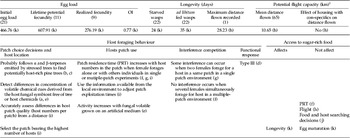
Considering that females of the vast majority of parasitoid wasps consume some kinds of food during their adult lifetime and the potentially positive effects of the dietary nutrients have on life-history traits such as longevity, fecundity or flight activity (Bernstein & Jervis, Reference Bernstein, Jervis, Wajnberg, Bernstein and Van Alphen2008), it is expected that success in establishment of natural enemies will be influenced by the availability of suitable food sources. In this context, recent studies have explored the role of food consumption on different aspects of I. leucospoides behaviour and biological functions, either in laboratory or in natural scale representative experiments (table 2). The results obtained show that providing adults with food in captivity does not affect their dispersal capacity (Fischbein et al., Reference Fischbein, Corley, Villacide and Bernstein2011), neither does host patch exploitation rules (Corley et al., Reference Corley, Villacide and Nouhuys2010) nor the total egg production (Fischbein et al., Reference Fischbein, Bernstein and Corley2013), while it has a small influence on female olfactory response to cues associated with food and host foraging (Pietrantuono et al., Reference Pietrantuono, Fernández-Arhex, Jofré and Corley2012). Sugar-rich foods can have a positive effect on female parasitoid longevity but only when it is provided ad libitum, an unrealistic case (Fischbein et al., Reference Fischbein, Bernstein and Corley2013). It is important to note here that the beneficial effects of feeding in many species have been generally shown through laboratory experiments, and that knowledge of food foraging and its consequences on reproductive success and parasitoid performance in the field is still limited (Lee & Heimpel, Reference Lee and Heimpel2008a ). For I. leucospoides, the influence of food consumption on the metabolism of laboratory females whose feeding regime was known, together with food acquisition by free-foraging wasps in the wild was studied and compared (Fischbein et al., Reference Fischbein, Bernstein and Corley2013). This work showed quantitative changes in carbohydrate levels for females fed in captivity, despite the lack of food effects on traits (see below for a more detailed discussion on this); and although information obtained on the feeding behaviour of free-foraging wasps is partial, it has been suggested that food intake in natural conditions, while possible, may not be frequent in tree pine plantations (Fischbein et al., Reference Fischbein, Bernstein and Corley2013). In summary, none of the fitness-related traits studied demanded to be fuelled after emergence. This knowledge is useful to establish insect holding conditions in the context of mass-rearing and to consider that the lack of food intake may not be a handicap for this parasitoids performance in pine plantations.
Life history traits and behaviours of Ibalia leucospoides female parasitoids.

OI, ovigeny index, estimated as the ratio between the initial egg load and lifetime potential fecundity.
1 flight capacity measured in flight mills under laboratory conditions.
PRT, patch residence time.
Numbers between brackets are the replicates.
(a) Madden (Reference Madden1968b), (b) Spradbery (Reference Spradbery1974), (c) Madden (Reference Madden and Berryman1988), (d) Fernández-Arhex & Corley (Reference Fernández-Arhex and Corley2005), (e) Martínez et al. (Reference Martínez, Fernández-Arhex and Corley2006), (f) Corley et al. (Reference Corley, Villacide and Nouhuys2010), (g) Fernández-Arhex & Corley (Reference Fernández-Arhex and Corley2010), (h) Fischbein et al. (Reference Fischbein, Corley, Villacide and Bernstein2011), (i) Fischbein et al. (Reference Fischbein, Bettinelli, Bernstein and Corley2012), (j) Pietrantuono et al. (Reference Pietrantuono, Fernández-Arhex, Jofré and Corley2012), (k) Fischbein et al. (Reference Fischbein, Bernstein and Corley2013).
Some species have traits that enable them to establish successfully even if they are released in small quantities, whereas others require significant propagule pressure to achieve the same result. Understanding the way that life-history traits and individual behaviours contribute to the establishment and growth of populations, although regarded as a prerequisite for the improvement of biological control, is neither a simple nor a straightforward issue.
The potential reproductive output and the probability of surviving long enough to realize this potential are considered the main components of parasitoids fitness, and hence, have an important role in the establishment of new populations. Females of I. leucospoides emerge with more than 75% of their total egg complement mature and the remaining eggs are matured throughout their adult life (Fischbein et al., Reference Fischbein, Bernstein and Corley2013) (table 2). This high proportion of mature eggs early in life together with the total egg load (≈600 eggs) suggests both that I. leucospoides is not egg-limited and that this may positively influence the success of population establishment. In addition, the significant initial investment in reproduction may represent a reproductive advantage for this parasitoid species that attacks a host with an unpredictable pulse-like outbreak dynamics and an aggregated spatial distribution. That is, female wasps could be able to use all egg-lying opportunities when hosts are available, even early in life. Parasitoid females live an average of 24 days in laboratory conditions without food (Fischbein et al., Reference Fischbein, Bernstein and Corley2013). When food supply is provided ad libitum longevity increases by 42% (Fischbein et al., Reference Fischbein, Bernstein and Corley2013). This augmentation is not negligible but modest compared with that of other parasitoids (e.g., Siekmann et al., Reference Siekmann, Tenhumberg and Keller2001; Desouhant et al., Reference Desouhant, Driessen, Amat and Bernstein2005; Lee & Heimpel, Reference Lee and Heimpel2008b ). Females of this species may emerge with robust energy reserves to support maintenance requirements without adult feeding, besides survival seems not be a constraint to population establishment.
Dispersal capability and host-searching abilities are also important attributes to the lifetime reproductive success of parasitoid and probably contribute to the success of establishment and population growth. In turn, in harsh environmental conditions – where the host density can be very low and host distribution highly heterogeneous, as during S. noctilio endemic population phases – they could act as significant fitness constraints for parasitoids.
Potential dispersal capacity of I. leucospoides does not match that of its host. Sirex noctilio can fly nearly 50 km in a day in flight mills (Bruzzone et al., Reference Bruzzone, Villacide, Bernstein and Corley2009) while I. leucospoides cannot exceed 28 km/day in identical conditions (Fischbein et al., Reference Fischbein, Corley, Villacide and Bernstein2011). Although I. leucospoides may be unable to track its host at a regional scale by individual flight, its flight capacity may not be a barrier to local redistribution (i.e., within a release area). The potential dispersal distance displayed by this hymenopteran species is such that it may prevent the negative impacts of very low or very high dispersal capability on establishment (table 2). Namely, a high probability of inbreeding at release sites associated with low dispersal or the high risk of Allee effects at the leading edge of the introduction front due to too much dispersal (Heimpel & Asplen, Reference Heimpel and Asplen2011).
There is evidence showing that this parasitoid is able to deal with several potential problems involved in host foraging (Corley et al., Reference Corley, Villacide and Nouhuys2010; Fischbein et al., Reference Fischbein, Bettinelli, Bernstein and Corley2012) (table 2). Female wasps are able to accurately assess differences in host patch quality from a distance without the need of following a sampling process (i.e., to make direct contact with host patch). Also, females can adjust patch exploitation times to the richness of the current patch visited and probably to the profitability of the surrounding context. Finally, wasps appear not to be affected by other females foraging in the same patch. Hence, females of I. leucospoides seem to have evolved both a high sensitive ability to detect chemical cues specific to S. noctilio but moderate responsiveness to host availability while a patch is being exploited by others. It is known that I. leucospoides uses volatile chemical cues derived from the host fungal symbiont during the host-searching process, which provides information on the host presence (Madden, Reference Madden1968b ; Spradbery, Reference Spradbery1974) and on the relative densities of hosts on the patches (Martínez et al., Reference Martínez, Fernández-Arhex and Corley2006; Fischbein et al., Reference Fischbein, Bettinelli, Bernstein and Corley2012). Efficiently finding the host can be translated into fitness gains especially considering S. noctilio ecological traits. Whereas pine plantations are generally characterized by a regular spatial arrangement, trees attacked by S. noctilio are typically aggregated, especially during the long lasting, endemic population phases (Corley et al., Reference Corley, Villacide and Bruzzone2007). The distribution of attacks by S. noctilio within these clumps shows different degrees of heterogeneity (i.e., low or high degrees of variance in the number of woodwasp larvae per stem). On the contrary, during outbreak periods, overall infestation levels can be high, affecting many trees (i.e., 80% of a given stand) and rendering spatial distribution less heterogeneous. Accordingly, the abundance and spatial distribution of S. noctilio can vary not only among plantations but also within stands, and in the course of a single flight season as well as in subsequent generations, resulting in varying levels of heterogeneity. In this context, females of I. leucospoides demonstrate abilities to manage changes in habitat profitability.
Aggregated spatial distribution of hosts may induce parasitoid aggregation which may lead to an increase in individual encounters. These congregations on a patch may promote con-specific interference resulting in a reduction of parasitism rates and maybe in a decrease of establishment probability of an initial population. However, recent works on I. leucospoides in which several or a pair of females were watched while foraging on logs of varying host densities suggest that interference competition is minimal and that the time allocated to the patch is more affected by host density than by the presence of other individuals on it (Corley et al., Reference Corley, Villacide and Nouhuys2010; Fernández-Arhex & Corley, Reference Fernández-Arhex and Corley2010). Probably in their natural environment, wasps may not be host limited at the scale of an infested tree.
Geographical spread of Ibalia leucospoides: region-wide pest control
The spread of natural enemies can be seen as the expected outcome of deliberate releases aimed at a region-wide pest control. Spread occurs when species expand their geographic range and, population growth (reproduction) and dispersal (involving short- and long-range movements) are the two key components underlying this process. Environmental factors can also be relevant, because of their direct or indirect effects on reproduction and/or dispersal behaviour. As for invasive species, human aided-transport beyond their natural dispersal range also largely contributes to geographical spread (Liebhold & Tobin, Reference Liebhold and Tobin2008).
There is limited information from which to estimate I. leucospoides’ spread rate. There are only a few historical records of the presence of this species in areas where no deliberate releases were made for Tasmania and New Zealand (Taylor, Reference Taylor1967; Nuttall, Reference Nuttall1972). From this scant information we obtained a very rough estimate of both spread rates and natural dispersal distances (as in Masciocchi & Corley, Reference Masciocchi and Corley2012). The mean spread distance for I. leucospoides in Tasmania was 48.74±7.79 km (mean±SE, n=7), with a minimum and maximum distance covered from the point of introduction of 28.96 and 80.46 km, respectively (Taylor, Reference Taylor1967). The rate of spread for that region was approximately 8 km/year. In New Zealand, the mean distance was 20.19±3.55 km (mean±SE, n=15), while the minimum and maximum distances covered from the nearest point of introduction was 2.81 and 51.49 km, respectively (Nuttall, Reference Nuttall1972). The estimated rate of spread for New Zealand was of approximately 2 km/year.
For the sake of managing invasive woodwasp populations, I. leucospoides is unlikely to track (naturally) the leading edge of the pest populations. Sirex noctilio spread rates, ranged from 11 to 78 km/year depending on the geographical region (Lantschner et al., Reference Lantschner, Villacide, Garnas, Croft, Carnegie, Liebhold and Corley2014). As mentioned before, several factors affect the spread process; climate for instance, influences S. noctilio development, which can affect I. leucospoides population growth rate and thereby its spread. In addition, habitat characteristics such as stand connectivity at the landscape level, coupled with host resource depletion because of a possible exponential growth of the parasitoid population during a post-outbreak period could be factors that may influence spread. Further field studies are needed to actually learn whether dispersal capacity and spread act as constraints to colonize new pest-attacked habitats. Still, if the goal of the parasitoid releases is to achieve a regional control, this limitation can be overcome by human-aided redistribution of the natural enemies, following local establishment rules.
A note on selection criteria in classical biological control
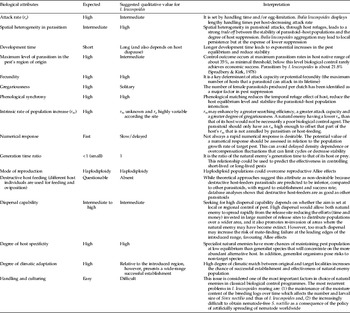
Selection criteria in biological control are, from an empirical standpoint, a controversial issue. The general idea is to favour success in natural enemy introductions prior to their importation, quarantine, mass rearing and release protocols are issued by looking for, in their native habitat, those species that are most important in terms of their potential impact on pest population. Decisions on which biological control agents are potentially better are frequently based on reductionist criteria or else by using a holistic approach. The problem with the former approach is by knowing which attributes make for better natural enemies. The holistic perspective, in turn, implies in-depth understanding of underlying mechanisms of the host–parasitoid interaction (Kidd & Jervis, Reference Kidd, Jervis and Jervis2005). In table 3, we list several attributes that could be considered in the selection process of natural enemies (based on Kidd & Jervis, Reference Kidd, Jervis and Jervis2005).
Biological attributes (i.e., selection criteria) of natural enemies in general (and Ibalia leucospoides in particular) considered as the most desirable for classical biological control (Kidd & Jervis, Reference Kidd, Jervis and Jervis2005).

For I. leucospoides, none of these approaches has been clearly described. Original introductions into New Zealand consisted, as probably determined by the significance of the pest problem, in massive releases of a variety of parasitoids and empirically assaying species establishment. Despite the fact that at first sight I. leucospoides meets in general, sought out attributes of parasitoids for classical biocontrol, several ecological characteristics may, through an a posteriori approach, explain current variability in suppression success.
Significant spatial heterogeneity in parasitism in pine plantations may lead to local persistence of parasitoid–host populations but at the expense of lower suppression. This could be a possible scenario for I. leucospoides in all areas where it is present. Alternative explanations for the low levels of suppression achieved in some sites and regions could be linked to generation time ratio (close to 1, while this parasitoid species may be trapped in host diapause). In addition, long generation times can also decrease the capacity of I. leucospoides to follow variations in host density leading to a slower numerical response. Ibalia leucospoides has a type III functional response as described by Fernández-Arhex & Corley (Reference Fernández-Arhex and Corley2005); this implies acceleration in attacks as the parasitoid becomes increasingly efficient at finding hosts. Still in the wild, attacks probably level off rapidly because of the influence of handling time in host exploitation by this parasitoid (each oviposition takes 5–20 min; D. Fischbein, personal observation).
Discussion and conclusions
Classical biological control likened to what is known for biological invasions, may be described as a process with at least three distinct successive stages; arrival or introduction, establishment and, spread or pest suppression at regional scale, with transitions or barriers in between that must be overcome by the control agents. Each of these stages is governed by different ecological processes, life-history traits and behaviours of the species involved in, either the invaders or natural enemies (Lockwood et al., Reference Lockwood, Hoopes and Marchetti2007; Engelkes & Mills, Reference Engelkes and Mills2011). From this species-specific review, we may draw several conclusions for this and other host–parasitoid systems involving pests of long-lived crops where classical biocontrol is implemented.
Firstly, we note that it is likely that the success in establishment of parasitoid populations may not always be a limiting factor. Planned releases that take into account propagule pressure over time and across the space may reduce the chances for demographic extinction and Allee effects (Grevstad, Reference Grevstad1999a , Reference Grevstad b ). For I. leucospoides, propagule pressure remains unknown, but successful establishment may be explained by good climatic adaptation, high reproductive potential early in life, the lack of a need for feeding in the field, great abilities to find host and a flight capacity that allows local redistribution. An important point here refers to the need for detailed quantitative descriptions of natural enemy releases in classical biological control. Such information may help in improving our understanding of those processes that may have influence on the most important causes of failure reported for biological control.
Secondly, in managing highly invasive pests, the spread capacity displayed by parasitoids is important to achieve long term, widespread suppression of the pest populations. The range potentially occupied by I. leucospoides is smaller than that of S. noctilio. But, given that natural dispersal while improving geographic spread may compromise establishment, moderate natural dispersal may be a positive trait whenever releases can be planned at the regional scale. How much parasitoid natural dispersal is optimal remains an open question of great importance, likely to be solved through modelling, given the increasing pest problems caused to forest ecosystems arising from non-native insects.
Another long-standing issue, particularly so for pests that attack long-lived crops such as forests, is how the adequate levels of pest population suppression may be possible with persistence of the interactions (Beddington et al., Reference Beddington, Free and Lawton1978; Murdoch et al., Reference Murdoch, Chesson and Chesson1985; Kidd & Jervis, Reference Kidd, Jervis and Jervis2005). The ability and the degree by which a parasitoid can stably suppress the host population depend on several factors (Mills, Reference Mills2001). The size of the host refuge from parasitism (the larger the refuge, the more hosts escape from parasitism, regardless of what attributes the biological agent may possess), the host net rate of increase and whether the parasitoid is egg or time limited are some of these factors. Ibalia leucospoides’ attributes and the interaction with its host both suggest that the parasitoid may be a better regulator than suppressor. The spatial and temporal refuges of the host population (i.e., through host aggregated distribution and diapause, respectively) may favour local persistence, but probably reduce the degree to which S. noctilio population is suppressed. In addition, I. leucospoides has a relatively high potential fecundity and reported abilities in finding concealed hosts, although they may be restricted in total attacks probably because of long host-handling times. Finally, this parasitoid species is unable by itself, to stop a pest outbreak. In other words, persistent parasitoid populations may establish at the cost of region-wide suppression levels.
There may be variations in some life history traits among different populations of I. leucospoides as a consequence of environmental effects on phenotype (Ellers & van Alphen, Reference Ellers and Van Alphen1997). Ibalia leucospoides inhabits most pine-cultivated areas throughout the southern and northern hemispheres, where it likely experiences very different environmental conditions, in terms of climate, host abundance and distribution, and potential interspecific competition. Naturally, life-history variation among populations may also be genetically based. All these elements may limit some of the conclusions we draw here. Additional studies on this and other long-standing and widespread host–parasitoid interactions that consider the genetic and phenotypic variations between populations in a biocontrol context will improve our understanding on the effects of the environment on establishment and suppression.
Throughout this review we have analysed the success of the parasitoid I. leucospoides as a model of classical biological control of forests pests in the light of invasion ecology (Fauvergue et al., Reference Fauvergue, Vercken, Malausa and Hufbauer2012). Classical biocontrol is a key component of modern pest management practices and is particularly important to manage non-native pests. We suggest that through a retrospective analysis of well-studied cases, conclusions on those factors critical to success may be brought to light. Critically, further studies providing quantitative predictions of propagule pressure and natural enemy dispersal behaviour are warranted to contribute to overcome establishment failures. In turn, climatic matching, not only as a factor determining species survival (and establishment) but also through its effects on voltinism and interaction synchronicity, needs careful attention because of its consequences on pest suppression and interaction persistence. This may be especially relevant to pest management in crops such as tree plantations that are relatively long lived and occupy vast surface areas in contrasting environmental scenarios that are currently subjected to changing conditions (Corley & Jervis, Reference Corley and Jervis2012; Liebhold, Reference Liebhold2012).
Acknowledgements
This work was partially supported by grants: PICT-1775 (Agencia Nacional de Promoción Científica y Tecnológica) and SaFo-109 (Componente Plantaciones Forestales Sustentables, BIRF LN 7520 AR, Argentina). D.F. and J.C. are Research Fellow of CONICET (Consejo Nacional de Investigaciones Científicas y Técnicas).