




No CrossRef data available.
Monosyllabic word merger in Mandarin
Published online by Cambridge University Press: 16 September 2005
Abstract
Spoken language reduction in spontaneous speech constitutes an important part of the process of language change. Utilizing a Mandarin corpus, this article examines monosyllabic word merger with pronouns in the first syllable position. The shortened form marks a respective vocalic or consonantal element stemming from the source syllables. This article proposes that there exists a target syllable for a pair of monosyllabic words, but it is not unique. Depending on the syllable structure of the source syllables, different lines of developments of target syllables are possible. When the combination of the source syllables allows a development into a well-formed Mandarin syllable, the output is a good candidate for a coalescent compound. Furthermore, when the immediately neighboring vocalic parts constitute a front-back contrast or they are identical, it is likely that word merger is produced. Durational results also show that a monosyllabic word merger is usually longer than a single syllable.The author would like to thank the reviewers of the journal Language Variation and Change and two of my colleagues, Professor Ying-chin Lin and Professor Jackson T.-S. Sun, for their constructive comments. The study presented in this article was financially supported by the National Science Council, grant NSC-92-2411-H-001-075 and by the Ministry of Education, grant 91-E-FA06-4-4.
Information
- Type
- Research Article
- Information
- Copyright
- © 2005 Cambridge University Press
Different pronunciation variations in colloquial speech reflect sociolinguistic and idiolect characterizations (Chao, 1976). With the technology available nowadays, we are able to investigate natural spoken language more systematically than with the traditional field-work methods (Engstrand, 1992). One would expect that reductions found in spontaneous speech may influence diachronic language variation and change in the sound system and the lexicon. Bybee (2002) predicted an effect of word frequency with which words are used in the contexts on the sound change the words undergo, tested on the data from /t, d/ deletion in American English. The phenomenon under analysis in this article is segmental change and reduction of monosyllabic word merger in spontaneous Mandarin. We use the Mandarin Conversational Dialogue Corpus (MCDC), collected at the Institute of Linguistics in Academia Sinica, to analyze the monosyllabic word merger. Though in the laboratory condition, subjects speak quite naturally by approximately ten minutes after the start of the conversation.
When new characters are invented or a new meaning is assigned to an existing character to represent the output of word merger, it is a coalescent compound. Nevertheless, in a number of Chinese dialects, where the writing system is not yet full-fledged, the concept of coalescent compounds also applies to word merger (often with function words), which results in a predictable, phonological presentation in spoken form. Inventing new words (i.e., new characters in the Chinese writing system) for merged syllables has a history in Chinese. He35 Yin55 Ci35, literally translated “composite,” “sound,” “word,” means “coalescent compounds.” The choice of a representative character may be determined by two conditions. The chosen character and the new syllable must be homophones. And originally, the character and the source syllables are used in different syntactic and semantic environments to avoid any possible ambiguity. In Lung (1979), a number of coalescent compounds are mentioned in the discussion of Archaic Chinese phonology. To take

bu51 (not)

ke214 (allowed) as an example, a new character

with the pronunciation po214 was created to signify the meaning of “not allowed.” Feng (2002) also discussed coalescent compounds using written documents of Chinese;

sa55, a coalescent compound, is invented to also have the meaning of “three + classifier”

san55 ge3. However, coalescent compounds in Chinese and Chinese dialects are not always written by fixed characters. Similar to coalescent compounds, di-morphemic contractions of function words are discussed in Cheng (1985). In Southern Min “to scold someone” ka21 lang13 me33 (“to make,” “man,” and “scold”), has the contracted form kang33 me33 in spoken use. Contraction of syllables associated with function words are also found in Hakka (Chung, 1997). The cases mentioned in Cheng (1985) and Chung (1997) are not lexicalized, because Southern Min and Hakka (two major dialects spoken in Taiwan) do not have a full-fledged writing system yet. But because the contracted forms are regularly predictable in spoken language, we also call them coalescent compounds in this article.
To investigate how syllables are merged in spoken language, we need to discuss what kind of phenomenon the merging of syllables is. If syllable merger occurs because of segmental reduction or deletion conditioned by the phonetic features of the adjacent segments, it is a phonetic phenomenon. If syllable merger is regulated by the phonological environment and results in a unique and predictable form, it is a phonological phenomenon. If syllable merger is produced from highly automated articulation and the output is a composite of elements stemming from the source syllables to make the new syllable as understandable as possible for the listener, it is a sociolinguistic phenomenon associated with sound change of the language. If syllable merger leads to an invention of a new character or a new meaning of an existing character (i.e., coalescent compounds), it is a phenomenon associated with the writing system and the lexicon. If we can classify feasible, acoustic forms of the source syllables and of the new syllable, then research on syllable merger is an engineering matter, as well. With a corpus-based study, this article proposes that monosyllabic word merger is more than a phonetic or phonological phenomenon, because, as we will see later, the outputs of word merger are not only determined by phonetic or phonological factors. They are more closely related to the understanding of listeners. Furthermore, coalescent compounds can be derived from monosyllabic word merger, where the phonological environment allows. In this case, spoken language reduction results in a change in the lexical system.
SOUND SYSTEM IN MANDARIN
Taiwan Mandarin is different from Beijing Mandarin with respect to rhyming, phonemics, and lexis. This article only deals with Mandarin spoken in Taiwan, which is a syllable-timed language (Auer & Uhmann, 1988). Lexical tones have four marked realizations in modern Mandarin: high level (the first tone marked by musical points, 55), rising (the second tone, 35), contour (the third tone, 214) and falling (the fourth tone, 51), and the unmarked neutral tone (3). Different Chinese dialects have different numbers of lexical tones associated with different melodic values. In this article, we use Pinyin to transcribe Mandarin words (they are written in italics throughout this article) and for tones we adopt the convention of musical points. When a phonetic transcription is necessary, IPA (International Phonetic Alphabet) symbols are used.
Syllables in modern Mandarin
Mandarin has a very simple syllable structure, either the open syllable CV or the closed syllable CVC, where the ending C must be the dental nasal [n] or the velar nasal

. Other Chinese dialects such as Southern Min and Hakka have stops [p], [t] and [k] and nasals

in the coda position. In addition, a Southern Min syllable can also end with a glottal stop

. However, the syllable structure remains CVC. Some prefer the representation of CGVC/CGVG or CVX to assign glides an explicit position (Chung, 1997; Duanmu, 2000). This article adopts the notion that a syllable is represented by CGVGC, where V designates the main vowel only, and G a pre- or post-nuclear glide, and C a consonant.
1In the Mandarin syllable canon CGVGC, only the main vowel V is obligatory, the other parts are optional.

Traditionally, a Chinese syllable is divided into an initial, consisting of an onset consonant, and a final (equivalent to the definition of rhyme), containing the nucleus and the coda. Front vowels in modern Mandarin are [i], [y], [e], [a]. Back vowels are [u] and [o]. Mid vowels are

(after [s ts tsh]),

(after

),

(after [t th n l x k kh] and in

) and the retroflex

in the diminutive suffixation. Diphthongs are

. Rising diphthongs such as [ia], [ie] and [uo] are considered combinations of a glide and a nucleus (Ho, 1996). Triphthongs are regarded as combinations of a prenuclear glide and a diphthong. Mandarin has two semi-vowels or glides, the labiovelar [w] and the palatal [j] (Duanmu, 2000; Ho, 1996). Consonants are ordered in terms of the place of articulation as follows:
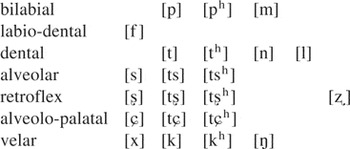
The alveolo-palatal group

can only be followed by [i] or [y] including diphthongs starting with [i] or [y]. The alveolar group [s], [ts], and [tsh], the retroflex group

, and the velar ones [x], [k], and [kh] can be followed by any vowels in Mandarin except [i] and [y]. The coda position can only be occupied by

, where

never occurs in the onset position.
Example of word merger in Chinese dialectology
It is hardly possible to directly prove that word merger in colloquial speech once caused any sound change in the study of Chinese dialectology. This is partly because the materials available to researchers are exclusively restricted to written documents, written in characters not in phonetically encoded alphabets. Characters can at the same time contain phonetic, semantic, and orthographic components. Hence, it is only possible to compare different characters used in different documents written in the periods of different dynasties to obtain implicit cues to changes of sounds and written systems in the development of Mandarin. In Taiwanese Southern-Min, the plural form of personal pronouns is constructed by the singular form and a nasal coda [n], for example,

gua3-

guan3 (I-we),

li3-

lin3 (you-you) and

i1-

in1 (he/she-they).
2We follow the tone marks used in Mei (2002). And the character for the plural form of the third-person pronoun lacks a radical part representing human in the text because of the incomplete font system of the word-processing program.

. In Fuding:

. The characters

appear in Zu-Tang-Ji, a book written in 951, meaning the plural form (Mei, 2002). Comparing Fuding dialect with Taiwanese Southern, we know that the plural suffix [n] comes from the initial of

. This is an example of word merger and coalescent compound obtained by synchronic comparisons of two different Southern-Min dialects and materials of historical documentation.
MERGER OF MONOSYLLABIC WORDS
The phenomenon of concern to this article is merger of monosyllabic words. That is, within a context in conversation the first source syllable s1, representing the first monosyllabic word Wa, is merged with the second syllable s2, representing the second monosyllabic word Wb. And because of the deletion of the Wa–Wb word boundary, the word merger results in a new syllable sr, representing both Wa and Wb. Segmental changes of s1 and s2 like deletion or assimilation and the omission of the word boundary occurs during the process of merger. However, in addition to phonetic and phonological considerations, lexical and syntactic characteristics also play a substantial role in the surface form of sr, because the new syllable sr represents two words Wa and Wb. Coalescent compounds of Chinese usually involve frequent function words (Feng, 2002). In many Chinese dialects, although not conventionalized in the writing system (i.e., sr is not represented by a character), word merger may be a coalescent compound, if regular, phonological rules can be formulated. Coalescent compounds undergo a similar process as syllable contractions do, but they are normally studied from the viewpoint of dialectology and historical linguistics.
This section summarizes a number of different aspects related to the merger of monosyllabic words. Pronunciation reductions in spontaneous speech may lead to changes at both the segmental and the suprasegmental levels. From the phonetic point of view, segmental deletions and assimilations may contribute to reduction at the syllable level, so syllabic boundaries may be merged to different extents. In Mandarin, many syllable boundaries are also word boundaries, because a majority of modern Mandarin words are monosyllabic or disyllabic. Furthermore, recent investigations into syllable contractions often consider the merger of two syllables, a phonological phenomenon in which the merger of the nuclei of the source syllables is the most essential process.
Deletion of segments
Segmental deletion is a substantial part of the process of syllable merger. However, as will be stated later, the process is not linear and the direction is not progressive. Su (1999) reported results of a phonetic study on 15 minutes of Mandarin continuous dialogues, listing the percentage of deleted and assimilated segments of Taiwan Mandarin. None of the labial consonants is deleted in the data ([p], [ph], [f], [m]). But the voiced retroflex

has a very high percentage of deletion. Su explained this result by the weaker stricture degree of voiced consonants compared with voiceless ones. However,

is often preserved in syllable merger, especially in the initial position of the second source syllable (Tseng, 2005). Applying the assumption of the stricture degree and the edge-in theory, the initial

of the second source syllable should apparently disappear. But it is not supported by our data. The initial

from ren35 (man) remains undeleted in syllable merger. Phonetic features may be an important factor in pronunciation reduction generally. But for syllable merger, factors such as the perceptual distinctiveness and the listener's understanding substantially influence the actually produced forms (discussed later). This also illustrates that segmental reductions should be investigated in context, not as an isolated phenomenon.
Syllable contraction
The term “syllable merger” is used in Duanmu (2000:258) when two (or more) syllables are merged into one. Sometimes the merged syllable sounds like a monosyllabic word, sometimes like two syllables, depending on the number of merged syllables and their syllabic structures. In conformity to the traditional Chinese syllable transcription Fan214 Qie55, the process of syllable contraction in Chinese, called the edge-in theory (Chung, 1997), starts with the initial part of the first syllable and ends with the final part of the second syllable. The new target syllable in principle has to satisfy the phonotactics of the language. A sonority model was proposed by Hsu (2003) to modify the edge-in theory in which the sonority hierarchy

determines the priority of vowel association of the new nucleus for Southern Min. For Mandarin, the effect of the sonority hierarchy was not found in Tseng (2005). Instead, the effect of a front–back contrast between the nuclei of two source syllables was preliminarily observed.
According to Cheng's analyses, in Southern Min two syllables are contracted into one syllable only when the first syllable is an open syllable. Furthermore, syllable contractions occur more often when the initial of the second syllable is zero or is a voiced consonant than when the initial is a voiceless consonant. In studies of Archaic Chinese phonology, it has been proposed that historically voiced consonants are more likely to be changed (or dropped) than voiceless consonants (Lung, 1979). Empirical data examined by Tseng (2005) illustrated that in Mandarin, a zero onset of a syllable raises the possibility of being contracted with a preceding syllable and an aspirated voiceless onset prohibits such a contraction. Voiced onset consonants do not show a clear preference for a contraction compared with voiceless onsets. Related to syllable contractions, Hsiao (2002) also discussed the tonal contraction in Mandarin, Southern Min, and Hakka by applying the correspondence approach.3
Using a small body of data in her master's thesis, Cheng (2004) investigated the pitch contour of contracted tones and found that only three contours are associated with tone contraction: slightly falling, slightly rising, and flat.
Coalescent compounds
The number of syllables of a coalescent compound is smaller than that of the corresponding source syllables. Whether the development of coalescent compounds is a linguistic reduction or a creation within a language is unclear. But we prefer the argumentation that coalescent compounds are products of spoken language reduction, that is, word merger. Unlike in modern Mandarin, traditional Chinese is a monosyllabic language, in which a character represents a syllable, a morpheme, and a word. Therefore, merger is only applied to monosyllabic words, especially function words. The conditions triggering word merger may lie in the creativity of a language, the necessity of creating new words, or the derivation of the phonology. Nevertheless, the process of coalescent compounds and syllable merger is quite similar (Cheng, 1985; Chung, 1997; Lien, 1997). When syllable merger results in a new syllable, which is a well-formed Mandarin syllable, the new syllable has more chance to be integrated into the lexicon than a new syllable, which does not obey the Mandarin phonotactics. For example, Tseng (2005) mentioned that the output of syllable merger

zhe51yang51 (in this way/then) is often produced as jiang51. Jiang51 is a well-formed syllable in Taiwan Mandarin. It is now very common to use jiang51 instead of zhe51yang51 in informal writing, such as in e-mail correspondence. Interestingly and importantly, the character chosen for jiang51 is

(sauce), which has a very much different collocation from the original meaning of zhe51yang51. This confirms our proposal that the syntactic and semantic content of the source syllables must be distinctive from that of the new character for the syllable merger to avoid any ambiguity. An example for an unlikely candidate for coalescent compounds is

bu51yi35yang51. The shortened form of syllable merger is

, which is a syllable violating Mandarin phonotactics. Although

is also often used in colloquial Mandarin and in informal writing (but usually spelled in Chinese transliteration alphabet), it is rather unlikely to be integrated into the lexicon.
WORKING HYPOTHESES
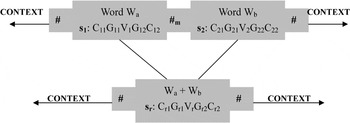
When a monosyllabic word Wa is merged with a subsequent monosyllabic word Wb, the deletion of #m results in a new target syllable sr, representing both Wa and Wb, where Cij signifies consonants, Vn the main vowel, and Gij pre- or post-nuclear glides (i, j, n = 1, 2, and r), as shown in Figure 1. This article proposes that the effects and features mentioned earlier do not reflect the most essential characteristic of monosyllabic word merger in spontaneous conversation. Because word merger occurs in conversation, the most important goal of a speaker's utterances is that the recipient understands the utterance. Therefore, studies done on segmental changes, syllable contractions, and coalescent compounds only partially clarify the process of word merger. Most substantially, the listener should recognize which two words the source syllables are (Wa and Wb) to ensure the communication between the speaker and the listener.

Monosyllabic word merger.
In principle, sr should obey the Mandarin phonotactics (Chung, 1997), but more importantly, we propose that sr should reflect a clear perceptual dissimilarity between s1 and s2 to preserve the lexical and syntactic content of Wa and Wb. When a strict phonotactic restriction occurs (sr is an existing well-formed Mandarin syllable), a coalescent compound is possible. For word merger in spontaneous speech, the reason for producing word merger is to speak fast; but at the same time sr must represent the content of both Wa and Wb. In other words, sr is a reduced form of s1 + s2. But is the possibility for any two monosyllabic words to be merged the same? No, the word frequency plays a role. As shown in Tseng (2005), the more frequently a word is used, the more likely the word is merged with the neighboring syllables. Thus, merger and reduction affect function words first due to highly reduced articulatory gestures, because function words are produced much more frequently than content words.
In addition, we will further examine two phonological conditions that may determine the probability of a merger of Wa and Wb. The first is whether the nuclei of s1 and s2 constitute a front–back contrast. In the case of a vowel contrast, the perceptual bias caused by sr is reduced. The backness contrast is preliminarily observed in a corpus-based study presented in Tseng (2005), so we will look for more evidence, but restricted to monosyllabic word merger. When s1 and s2 have a front–back contrast, this contrast will remain unchanged in sr. This is the most convenient situation to have a good sr. And the second phonological condition we will examine is whether the immediately neighboring vocalic parts of s1 and s2 are identical. We expect this will affect the monosyllabic word merger, especially when no front–back contrast is available. We use the Mandarin Conversational Dialogue Corpus, an annotated spoken Mandarin corpus, to study the merger of monosyllabic words. Because Mandarin personal pronouns (singular forms) are all monosyllabic and they are produced most frequently in conversation, we restrict the analyses to cases in which pronouns are merged with a following monosyllabic word.
DATA
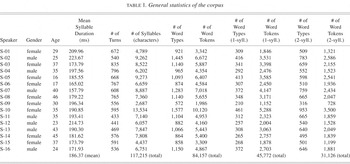
The Mandarin Conversational Dialogue Corpus (MCDC) consists of eight transcribed and annotated conversations spoken by 16 speakers who volunteered to join the project (Tseng & Liu, 2002). General statistics of the corpus are given in Table 1. Note that all discourse particles, discourse markers, and paralinguistic sound sequences, such as coughing and breathing, are excluded in the statistics.
General statistics of the corpus

Table 1 shows that the majority of Mandarin words used in conversation are mono- and disyllabic words. Out of 117,215 syllables, mono- and disyllabic words make up about 91% of the overall tokens produced by all 16 speakers. Average duration of a syllable is 186.37 milliseconds. In our data, syllable merger is identified when the human annotator clearly hears a deletion of syllable boundary or the annotator hears a segmental deletion within two neighboring syllables, and they are unable to identify the respective nucleus of the source syllables. As a result, 39,490 syllables were perceived as merged with the neighboring syllables, approximately 33% of all produced syllables. About half of the merged syllables are found in the first 100 most frequent syllables (Tseng, 2005). This supports the notion that word frequency is a factor determining whether syllable merger is likely. Bybee (2002:269) mentioned that “the tendency for articulatory reduction due to increased automation is always present and shows itself more prominently in highly practiced, frequent words.”
Merger of monosyllabic pronouns
Personal pronouns in Mandarin are ni214 ([ni], 2nd-person, singular), wo214 ([wo], first-person, singular), and ta55 ([tha], 3rd-person, singular). Their plural forms are composed by adding the plural suffix (only for humans) men3 (

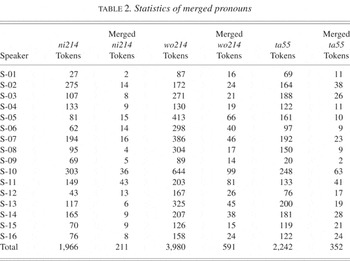
) to the singular base forms. This article investigates occurrences of these three singular personal pronouns merged with a subsequent monosyllabic word. As shown in Table 2, 10.73% (211/1,966) of the totally produced ni214 tokens are merged with the subsequent word, 14.85% (591/3,980) of wo214 tokens, and 15.70% (352/2,242) of ta55 tokens, respectively. On the whole, wo214 and ta55 pairs show a similar distribution in different merger combinations with subsequent monosyllabic words across the speakers. In the following analyses, we focus on the 211 occurrences of merger with ni214, 591 with wo214, and 352 with ta55.
Statistics of merged pronouns

Segmental similarity
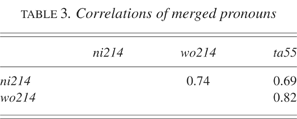
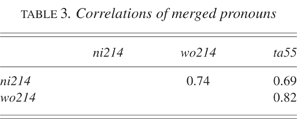
First, comparing the segmental similarities between these three personal pronouns, we find that ni214 and ta55 both have an initial consonant and a front vowel nucleus.4
[a] may have different phonetic realizations. Some have the mid vowel color like da214 [ta] (hit). However, it is apparent that [a] in ta55 is a front vowel.
Correlations of merged pronouns
Tonal similarity
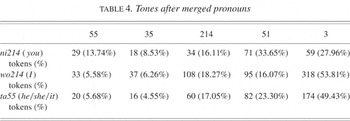
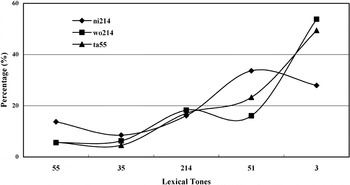
Because the correlation of distribution does not lie in the similarity of the syllable structure, we further examine the tonal patterns within the merged pronouns. Ni214 and wo214 share a common lexical tone, the third contour tone. Thus, the monosyllabic words following the merged pronouns are divided into five tonal groups. Table 4 illustrates the result. Ni214 and wo214 pairs do not show a high correlation (r = 0.57). In fact, it is the least correlated pair. The correlation between wo214 and ta55 is, similar to the results of previous analyses, the highest (r = 0.97). Ni214 and ta55 pairs are lower (r = 0.73). The correlation is also shown in Figure 2 in terms of the percentage of each subsequent tone. Figure 2 clearly demonstrates a similar behavior of wo214 and ta55 distributions.
Tones after merged pronouns


Tone combinations after merged pronouns.
Interim summary
In all three pre-analyses, the general distribution of merged pronouns and the distribution of subsequent segments and tones, ni214 (you) is clearly different from wo214 (I) and ta55 (he/she), although from the segmental point of view, ni214 is similar to ta55 in that they have both an onset and a front vowel without glides. Furthermore, from the prosodic point of view, ni214 and wo214 both have the third tone. Despite the fact that no apparent phonological features are shared between wo214 and ta55, their distribution in all three analyses is the most closely correlated. Viewed from the communication point of view, the result seems plausible. Discourse-related characteristics of the first and the third personal pronouns are clearly distinct from those of the second personal pronoun, because the speaker needs not pay attention to the reaction from him-/herself or from a third person to his/her utterances. But the speaker does have to care about the reaction of the addressee. In addition, syntactic patterns such as interrogatives and imperatives can only be used for the second personal pronouns in conversation. The words used following ni214 are therefore different from those following wo214 and ta55. This implies that the discourse function of spoken utterances may be more important than individual segments or tones. For further analyses, we will focus on the merger of the vocalic parts and the actually produced forms of word merger with pronouns.
VOWEL CONTRAST AND IDENTICAL VOCALIC PART
By setting one percent as the threshold, we obtain a group of ten syllables following all the three personal pronouns (cf., Appendix A). These ten monosyllabic words are ye214 (also),5
Although all ten syllables are monosyllabic words, ye214, yi55, jiu51, and hai35 cannot form a chunk on their own. They must be followed by a predicate. All the other monosyllabic words can form meaningful chunks with the pronouns in modern Mandarin.
Yi55 (a, one) has the canonical tone 55, but when followed by a fourth tone (51) or a neutral tone (3), yi55 regularly takes on a variant tone yi35. In the remaining cases, yi55 will be produced as yi51. Furthermore, yi55 is often a word fragment, such as yi51zhi35 (always), yi51qi214 (together). When a pronoun is followed by yi55, it includes two cases: (1) yi55 is a numeral and (2) yi55 is a word fragment.

Preference for word merger
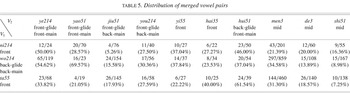
Table 5 summarizes the percentage of the merged pronouns with the respective ten words listed in (1)–(5). Based on the assumption that the percentage of a merged pronoun pair signifies the preference for word merger inferred from linguistic conditions (vowel contrast, identical vocalic part, or discourse-related features), Table 5 illustrates the results of the preference for word merger. For example, the pair ni214-ye214 (you-also) is produced 24 times in the corpus and twelve of them are merged, so the percentage is 50%. Only four out of the 76 occurrences of the pair ni214-jiu51 (you-then) are merged, so the percentage is 5.26%. By restricting the vowel contrast to the immediately vocalic part (this includes the glide), results shown in Table 5 support the notion that the front–back contrast is a central factor influencing the preference for word merger. Where such a contrast is available, the percentage is high: wo214-ye214 (I-also), wo214-yao51 (I-want), wo214-you214 (I-have), wo214-yi55 (I-one), ni214-hui51 (you-will), ta55-hui51 (he-will), and wo214-jiu51 (I-then). Among the occurrences, ta55-jiu51 (he-then) shows a high tendency for word merger, although no front–back contrast is available. One possible reason accounting for this result is that the merged form [tao] for ta55-jiu51 is a legitimate and a very common syllable in Mandarin. For the combinations with mid vowels, no clear preference is identified.
Distribution of merged vowel pairs.

Vowel contrast
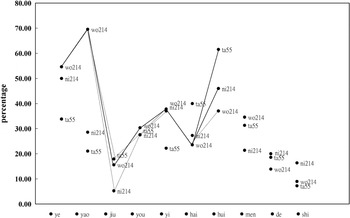
But what if we examine the data from the point of view that the domain of the front–back contrast lies in the main vowel, rather than the immediately vocalic part? So, we have two cases. The first case is that the main vowel plays the essential role of the vowel contrast. The second case is that the contacting vowel part plays the essential role. In the latter case, glides have a more important status. As long as the glide is the nearest vowel part in a direct contact with the merged pronoun, the vowel contrast is defined as the contrast between the vowel part of the pronoun and the glide. What we have previously discussed is the second case. The solid line shown in Figure 3 represents the prediction of the second case and the dotted line represents the first case. As shown in Figure 3, the second case has better prediction power in that the solid line meets more cases on the highest points. This means that for the nucleus of a Mandarin syllable, the role of a glide in the process of vowel merger is at least as essential as that of the main vowel.

Two predictions of vowel contrast in word merger.
Identical vocalic parts
Applying the vowel contrast assumption, cases like ni214-ye214 (you-also), ni214-yao51 (you-want), ni214-yi55 (you-one), and ta55-hai35 (he-still) show a relatively high tendency for word merger. This supports the notion that when the immediately neighboring vocalic parts of the pronoun and the subsequent monosyllabic words are identical, the probability of word merger is raised. In our data, vocalic identity at the nucleus-glide interface (i.e., [i]-[j], ni214-ye214, ni214-yao51, ni214-yi55) as well as across main vowels (i.e., [a], ta55-hai35) is observed.
PRODUCED FORM OF WORD MERGER
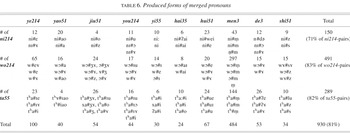
Our proposal is that the target syllable sr should preserve the most perceptually distinctive features of the two monosyllabic words Wa and Wb. This can be a consonant, a glide, a main vowel, or the rhythmic timing. To analyze how sr is formed, we need to examine the actually produced form of all merger occurrences. All variations of produced forms and the numbers of occurrences are listed in Table 6.
Produced forms of merged pronouns

Source syllables leave their trace in the output
Table 6 illustrates that the output contains a part of both source syllables irrespective of vowel or consonant. The word boundary #m is present in most of the word mergers and can be easily identified in the output. The boundary is marked with # in Table 6. In a number of cases, where there is an identical vocalic part or vowel assimilation, # is placed after the pronoun. Ni214 often keeps its complete form and has a part of the second source syllable merged with the full [ni]. For the rest of the cases, the output has either a prolonged [i] (ni214-yi55, [ni:]) or has the structure of a well-formed Mandarin syllable (ni214-yao51, [niao]). The part stemming from the second source syllable is either a neutralized vowel (ni214-de3,

) or a representative consonantal element (ni214-shi51, [niz]).
Similar forms are also found in the case of ta55. Because of the initial stop [th], ta55 often remains unreduced in the process of word merger. In a few cases, [th] will be reduced to the velar fricative [x] or the glottal stop

. This kind of reduction occurs not only in word merger. It is a general reduction in spontaneous Mandarin. The output sometimes has a prolonged nucleus part [a:] (ta55-hai35,

), where the front vowel [a] is available in the second source syllable (identical vocalic part). Like in the case of ni214, there are three patterns of variation in the outputs: (1) a well-formed Mandarin syllable, (2) a combination of ta55 and a vocalic part from the second source syllable, and (3) a combination of ta55 and a consonantal part from the second source syllable. Well-formed Mandarin syllables as the outputs, such as [thiao] (ta55-yao51), [thai] (ta55-ye214, ta55-you214), and [thao] (ta55-jiu51, ta55-hai35) show that the form of the new nucleus varies. This can be deletion of a vowel (the first [a] in ta55-yao51), assimilation of a vowel (ta55-ye214, ta55-jiu51), or assimilation of a consonant (ta55-hai35). When the output inherits a vocalic part from the second source syllable, the new nucleus is usually neutralized or assimilated to the neighboring segment. The back central vowel

(ta55-ye214, ta55-jiu51), the back vowel [u] (ta55-hui51), and the open back vowel

(ta55-you214) are the most frequently observed in the output nucleus representing

. Consonants representing the second source syllables can be

(ta55-jiu51), [s] (ta55-shi51), and [z] (ta55-shi51). This result clearly supports our proposal that the monosyllabic word merger undergoes a process that tends to keep a representative element (vocalic or consonantal) from both source syllables. A well-formed output syllable is not the goal, but a product conditioned by the syllable structure of the source syllables. The analysis of wo214 is similar to that of ni214 and ta55. The only difference is that wo214 is often reduced to the semi-vowel [w] or the combination of semi-vowel and the open back vowel

.
Word merger output has a target syllable, sometimes more than one
Phonological considerations of syllable contractions (the edge-in theory or the sonority model) predict a unique output for a pair of source syllables (Chung, 1997; Hsu, 2003). This does not apply in our data of monosyllabic word merger. For example, in the case of wo214-yao51,

have a nucleus with a back–front and a back–central combination, but [wao] has a nucleus of a front–back combination. These different sonority arrangements of the new nucleus explain that the sonority hierarchy is not the only factor that determines the output of the new nucleus in Mandarin. Clearly shown in the data, word merger reduced or merged to different extents represents different phases sometimes for more than one target syllable. The variations of wo214-jiu51 show two different lines of merger:

. In the first group, the semi-vowel [w] from wo214 is unreduced, whereas in the second group [w] is deleted. Irrespective of the initial [w], the remaining variations of both groups are quite symmetric. The initial alveolo-palatal affricative

in jiu51, possibly with the following [i], changes its form to the voiced post-alveolar

(not available in Mandarin sound system), and the back vowel in jiu51 is reduced to

. For the

series, there are two different directions for further reduction: to reduce the vowel or the consonant. In the case of a consonant, the fricative is deleted, so the output is

. In the case of a vowel,

is deleted and

is reduced to [z], so the output

is derived. Similar patterns of variations are also observed in the case of ta55-jiu51.
Word merger output does not always obey Mandarin phonotactics
Conventionalized coalescent compounds in Mandarin and in Chinese dialects have one feature in common: The syllable structure of the coalescent compound should obey the corresponding phonotactics to stabilize its phonological status. A number of monosyllabic word mergers concerned in our data are good candidates for coalescent compounds, because the target syllables are well-formed Mandarin syllables. As concluded in the previous section, there are different phases of merger and reduction, some of which still have a solid disyllabic structure. But some result in a well-formed Mandarin syllable, which fulfills the necessary condition for a possible development into a coalescent compound. Although it is unlikely that a personal pronoun would form a coalescent compound with any following monosyllabic word, our data show a probable relationship between monosyllabic word merger and coalescent compounds in Mandarin and Chinese dialects.
Table 6 shows a large number of monosyllabic outputs not obeying the Mandarin phonotactics. We list a few important variations:

. The output should represent the lexical content of both source syllables (words), so to ensure that the listener is able to recognize the source syllables, different strategies are employed to make the reduced/merged output sound like the two source syllables as much as possible. Phonotactics is only obeyed when the syllable structure of the source syllables allows such a development, for we also observe that some of the reduction is so extreme that there only remains a syllabic nasal

(wo214-men3).
In addition to the discussed output variations that do not obey Mandarin phonotactics, we observed an interesting phenomenon with the plural marker men3. In Southern Min, plural personal pronouns are formed by adding a nasal coda to the corresponding singular forms, as mentioned earlier. A similar process is observed in the process of word merger with plural personal pronouns in our data:

. Note that the bilabial nasal [m] is a legitimate coda in Southern Min, but not in Mandarin. This clearly violates Mandarin phonotactics. But it occurs extremely often in spoken Mandarin in Taiwan. Why is it so? Indeed, the nasal coda in the word merger with the plural marker illustrates a repeated process of reducing an independent plural marker written in a fixed character to a plural suffix, namely the nasal coda. In the case mentioned earlier, it was a dental nasal from the initial of the plural character

. In this case, it is the bilabial nasal from the initial of the plural character

men3. Most of the sinologists are convinced of the sound change of the plural marker in Southern-Min dialects. To analyze this result from a different point of view, the most dominantly spoken dialect in Taiwan is Taiwanese Southern-Min, also belonging to the Southern-Min dialect family. It is no wonder that the development of plural suffix nasal in Southern-Min is once again observed in Taiwan Mandarin. Taiwan Mandarin is used as an official language in Taiwan and more than 70% of Taiwanese are native speakers of Taiwanese Southern-Min (Huang, 1994). It will be highly interesting to study the word merger of personal pronouns with the plural marker in Beijing Mandarin in mainland China, where the people speak different dialects, to see whether the same process can be observed or not. If not, it is an additional support for the notion that pronunciation reduction in spoken use can influence the sound system and the writing system. And more importantly, it is also conditioned by different sociolinguistic environments and language structures.
Duration and reduction degree
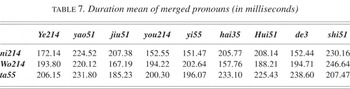
The durational measurements are based on boundaries that are placed at the onset of voicing in the vowels and voiced consonants, and at the onset of the occlusion phase in the stops. Men3 is excluded in the durational analysis because its shortened forms are too different to obtain a plausible duration mean, ranging from two syllabic units (e.g.,

) to a syllabic nasal (e.g.,

, see Table 6). The result is given in Table 7 (see Appendix B).
Duration mean of merged pronouns (in milliseconds)

No statistically significant correlation is found between the ni214, wo214, and ta55 series. As expected, ta55-pairs are in most cases longer than the other two pairs. This is because the initial stop [th] is usually not reduced in the merger process, especially when ta55 is the first source syllable. We also find that the duration is normally short when there is an identical vocalic element in s1 and s2 or when the output constitutes a common Mandarin syllable. But at the same time, we also find that the degree of merger is not directly related to the duration of the output of merger. That is, intuitively, we expect that when word merger is more reduced, it should be shorter. But this is not consistently observed in our data. For example, ni214-hui51 is produced as [nih] for a length of 189.9 milliseconds and as [niwei] for a length of 160.6 milliseconds by the same speaker. On the whole, the mean duration of the monosyllabic word merger is longer than the average duration of a single syllable in the corpus (186.37 milliseconds). This implies that when two monosyllabic words are merged, they do not result in a new monosyllabic word generally (in this case, coalescent compounds are possible). The temporal feature clearly indicates that there are two syllables. Interestingly, no matter to what degree the merger is reduced and how short the duration is, the data show that human listeners perceive two monosyllabic words, not a single syllable.
CONCLUSION
This article presents empirical results of a corpus-based study on monosyllabic word merger in spontaneous Mandarin, focusing on pronouns merging with a subsequent monosyllabic word. Statistical analyses show that the distribution of wo214 (I) and ta55 (he/she) word merger is more similar to each other than to that of ni214 (you), although ni214 shares a segmental similarity with ta55 and a tonal similarity with wo214. Whether this result has to do with the discourse function and syntactic patterns (interrogative and imperative) associated with ni214, as ni214 is used for the immediate addressee, needs further investigation. The most interesting result we find in the data is that the monosyllabic word merger does not follow Mandarin phonotactics strictly. The output of the monosyllabic word merger has inherited a vocalic or consonantal element from both source syllables to ensure that it represents both monosyllabic words. The sonority of the source nuclei is not observed to play a decisive role in forming the new nucleus. Phonotactics is only followed when it is possible for the syllable structure of the source syllables. In this case, the monosyllabic word merger is a good candidate for a coalescent compound and is possibly associated with the development of the lexicon of a language.
In the discussion of whether it is likely for a monosyllabic word pair to be merged or not, we find that a front–back contrast of the immediately vocalic parts of the nuclei and a vocalic identity are the two most important phonological features. Furthermore, we also identify that the immediately vocalic element is the glide, where available, not the main vowel, which appears later. In this aspect, glides have the same phonological status as vowels in the process of monosyllabic word merger. Importantly, the output of word merger is not unique, but may develop into a number of distinct target syllables. Tonal features, though not considered in this article, are worth further investigation. For example, ni214-ye214 has a falling output tone in most cases, but when ni214-ye214 is followed by a word with a falling tone, such as yao51, the output tone is rising. This may be analyzed in the context of intonation.
With a corpus-based study, this article illustrates that variation patterns produced in colloquial speech can reflect important cues, which are observed in the history of Chinese dialectology, as the example with the nasal plural suffix. These variations may affect the sound system and the writing system for Mandarin to different degrees. Ill-formed syllables resulting from word merger are very often used in spontaneous Mandarin. Some of them may adopt a near-syllable to preserve the word merger, like the case of jiang51 instead of zhiang51 for

. Some of them may apply the transliteration method, because the merged syllable does not exist in modern Mandarin. It is disadvantageous for the word merger with no conventionalized character to preserve in the evolution of language. For the well-formed word merger outputs, it is more likely for them to be integrated into the dictionaries as independent lexical items and therefore to be preserved while language changes, once they are represented by fixed characters.
APPENDIX A: OCCURRENCES OF MERGED PRONOUNS
(Pairs making up more than one percent are shaded)

APPENDIX B: DURATION OF MERGED PRONOUNS
(in milliseconds)

References
REFERENCES
Auer, Peter, &
Uhmann, Susanne.
(1988).
Silben- und akzentzählende Sprachen.
Zeitschrift für Sprachwissenschaft
7(2):214–259.Google Scholar
Bybee, Joan.
(2002).
Word frequency and context of use in the lexical diffusion of
phonetically conditioned sound change.
Language Variation and Change
14:261–290.Google Scholar
Chao, Yuen Ren.
(1968).
A grammar of spoken Chinese.
University of California Press.
Chao, Yuen Ren.
(1976).
Aspects of Chinese sociolinguistics.
Stanford University Press.
Cheng, Robert L.
(1985).
Sub-syllabic morphemes in Taiwanese.
Journal of Chinese Linguistics
13(1):12–43.Google Scholar
Cheng, Chi-erh.
(2004).
An acoustic phonetic analysis of tone contraction in Taiwan
Mandarin.
Master's Thesis.
National Chengchi University,
Taipei.
Chung, Raung-Fu.
(1997).
Syllable contraction in Chinese. In
F.-F. Tsao &
S. H. Wang (eds.),
Chinese languages and linguistics III, Morphology and lexicon.
Symposium Series of the Institute of History and
Philology,
Academia Sinica,
Taipei.
199–235.
Duanmu, San.
(2000).
The phonology of standard Chinese.
New York:
Oxford University Press.
Engstrand, Olle.
(1992).
Systematicity of phonetic variation in natural discourse.
Speech Communication
11:337–346.Google Scholar
Feng, Chun-Tian.
(2002).
Contraction of numerals.
Linguistic Research
2:38–44
(in Chinese).Google Scholar
Ho, Dah-an.
(1996).
Some concepts and methodology of phonology.
Da-An Press
(in Chinese).
Hsiao, Yuchau.
(2002).
Tone contraction.
Paper presented at the 8th International Symposium on Chinese
Languages and Linguistics.
Hsu, Hui-chuan.
(2003).
A sonority model of syllable contraction in Taiwanese Southern
Min.
Journal of East Asian Linguistics
12:349–377.Google Scholar
Huang, Shuanfan.
(1994).
Language, society and ethnic consciousness.
Taipei:
Crane.
Lien, Chinfa.
(1997).
Studies on directional complement in Taiwan Southern
Min—Dialect typology and historical study.
In
C.-y. Tseng (ed.),
Chinese languages and linguistics IV, Typological studies of
languages in China (vol. 2).
Taipei:
Academia Sinica.
379–404.
Lung, Yu-Chun.
(1979).
A discussion of the theory that yin-sheng words end with final
consonants.
Bulletin of the Institute of History and Philology
50(4):679–716
(in Chinese).Google Scholar
Mei, Tsu-lin.
(2002).
On some Southern-Min function words: Their appearance in the
literature and in dialects.
In
D.-a. Ho (ed.),
Dialect variation in Chinese.
Taipei:
Academia Sinica.
1–22
(in Chinese).
Shih, Chi-Lin.
(1986).
The prosodic domain of tone sandhi in Chinese.
Doctoral Dissertation,
University of California,
San Diego.
Su, Tzu-ting.
(1999).
Deletion phenomenon of phonemes in spontaneous Taiwanese
Mandarin.
Proceedings of the 14th
International Congress of Phonetic Science, San Francisco.
379–382.
Tseng, Shu-Chuan.
(2005).
Contracted syllables in Mandarin: Evidence from spontaneous
conversations.
Language and Linguistics
6(1):153–180.Google Scholar
Tseng, Shu-Chuan, &
Liu, Yi-Fen
(2002).
Annotation of spontaneous Mandarin.
Technical Report No. 02-01,
Chinese Knowledge Information Processing Group, Academia
Sinica
(in Chinese).
Monosyllabic word merger.
General statistics of the corpus
Statistics of merged pronouns
Correlations of merged pronouns
Tones after merged pronouns
Tone combinations after merged pronouns.
Distribution of merged vowel pairs.
Two predictions of vowel contrast in word merger.
Produced forms of merged pronouns
Duration mean of merged pronouns (in milliseconds)
 You have
Access
- 1
- Cited by