The Centers for Disease Control and Prevention (CDC) recommends that hospitals consider developing infection transmission control practices that include isolation measures for patients who are colonized or infected with organisms with a high propensity for transmission within healthcare systems, who demonstrate antimicrobial resistance, who are difficult to treat, or whose conditions associated with high morbidity and mortality.Reference Siegel, Rhinehart, Jackson and Chiarello 1 Although isolation practices are considered a standard of care, they may have some unintended consequences. Patients may have fewer healthcare team visits to the room, resulting in sparser vital sign records, fewer physician encounters and chart notes, and less extensive nursing narratives in the chart.Reference Evans, Shaffer and Hughes 2 – Reference Lupión-Mendoza, Antúnez-Domínguez, González-Fernández, Romero-Brioso and Rodriguez-Bano 6 Additionally, isolated patients may report higher levels of anxiety and loneliness,Reference Lupión-Mendoza, Antúnez-Domínguez, González-Fernández, Romero-Brioso and Rodriguez-Bano 6 – Reference Gammon 9 possibly because they believe they are being treated differently.Reference MacKellaig 10
Results from studies of the unintended impact of infection control practices on patient experience are mixed. Some studies have shown that patients in isolation have lower satisfaction with physician communication and staff responsiveness while others show no difference in experience scores.Reference Stelfox, Bates and Redelmeier 5 , Reference Gasink, Singer and Fishman 11 – Reference Livorsi, Kundu, Batteiger and Kressel 13 The results of these studies may not be generalizable. Vinski et alReference Vinski, Bertin and Sun 14 described results for a hospital that had limited isolation practice, did not isolate for methicillin-resistant Staphylococcus aureus (MRSA) or vancomycin-resistant Enterococcus (VRE), and had only 203 patients in the isolation arm of the study. Also, these studies did not adjust for confounders like age, gender, race, length of stay, and severity of illness.Reference Vinski, Bertin and Sun 14
We used patient-level data to compare Hospital Consumer Assessment of Healthcare Providers and Systems (HCAHPS) patient experience scores for patients in isolation for a significant portion of their hospital stay with those who were not in isolation, adjusting for potentially confounding variables. We hypothesized that patients in isolation would report worse experiences with physician communication, nurse communication, staff responsiveness, pain control, and overall care.
Methods
In this retrospective analysis, we prospectively collected HCAHPS patient experience data and Press Ganey patient satisfaction survey data from a single academic tertiary-care hospital.
Participants and time period
All patients who returned the Press Ganey HCAHPS surveys sent by the hospital between July 2011 and July 2016 were included in the study.
Exposure
Patients in isolation during their hospital stay were considered for inclusion in the exposure group. The isolation status included contact isolation (ie, glove and gown), droplet isolation (ie, glove, gown and face mask) and airborne isolation (ie, negative pressure room, glove, gown and N95 face mask). Patient isolation status data were obtained from the electronic health record, in which isolation status had been updated daily. For the purpose of this study, we defined the isolation group a priori as patients who were in isolation for at least 50% of their hospital stay. Patients on droplet or airborne isolation for at least 50% of their hospital stay constituted the “droplet” subgroup and the “airborne” subgroup, respectively. Patients discharged from the hospital who were not on any isolation during any part of their stay constituted the control group. Patients on some form of isolation for <50% of their hospitalization were excluded from the primary analysis.
Patient experience survey instruments
Responses to HCAHPS patient experience surveys sent by the hospital via mail to a random 50% sample of the discharged patients were utilized to assess patient experience. The development, testing, and methods for administration and reporting of the HCAHPS survey have been described previously. 15 Additionally, we obtained national hospital-level HCAHPS scores for 2017 reported by Centers for Medicare and Medicaid Services (CMS) on the Hospital Compare website. These national data were used to calculate hospital-level percentile scores for patient experience–related variables to help contextualize our findings and to demonstrate industry standards. 16
Outcome variables
The HCAHPS patient experience survey responses on items related to nursing, physicians, pain control, staff responsiveness, and overall rating were the primary outcome variables. Patient experience with discharge, hospital environment, and selected physician and nursing Press Ganey items (survey items originated by Press Ganey but not part of the HCAHPS instrument) were outcome variables for additional exploratory analysis.
Covariates
Age, sex, race, payer type, length of stay (LOS), all-payer refined diagnosis-related group–severity of illness (APR-DRG SOI) index, and clinical service type (medicine, surgery, oncology, neurological diseases, obstetrics and gynecology) were included as covariates in the analysis.
Statistical analysis
“Percent top box” scores were calculated for each survey item as the percentage of patients who responded “always” or “definitely yes” or “9” or “10” on the HCAHPS survey items. This procedure is consistent with CMS practice and prior studies.Reference Siddiqui, Zuccarelli, Durkin, Wu and Brotman 17
We used χ2 analyses and t tests to detect significant differences between control and exposure groups for the different covariates that were included in the model.
Survey responses were treated as binary outcome variables (“top-box” vs “other”) and adjusted logistic regression was performed to test the effect of isolation exposure on giving a top box score. We used generalized estimating equations (GEE) to address clustering related to repeat responses by the same patient over different admissions. Sensitivity analysis using different thresholds for exposure (eg, isolated for >25% of hospital stay and >75% of hospital stay) yielded similar results, so we only report the primary analysis. Adjusted odds ratios (aORs) were calculated from GEE logistic regression parameter estimates to compare the odds of those exposed giving a top box score to controls giving a top box score.
Logistic regression using GEE was also used when detecting a dose response. We treated our exposure as a continuous measure of percentage of hospital stay spent in isolation and scaled it to measure 25% increments. All patients that spent any time in isolation were included. The dose-response analysis was adjusted for age, race, gender, payer, APR-DRG SOI index, length of stay, and service. All patients who were in isolation at any point in their hospital stay were included in the dose-response analysis. We calculated adjusted odds ratios (aORs) that measured odds of giving a top box score for each unit of increase in exposure where a unit increase was a 25% increase in isolation time.
Each analysis was performed for the overall group of any form of isolation and then within individual subgroups of “droplet” and “airborne” isolation types. Because we conducted multiple comparisons, Bonferroni correction was used to calculate a P-value threshold of .0046 for statistical significance. All analyses and data management were performed using SAS version 9.4 software (SAS Institute, Cary, NC).
Results
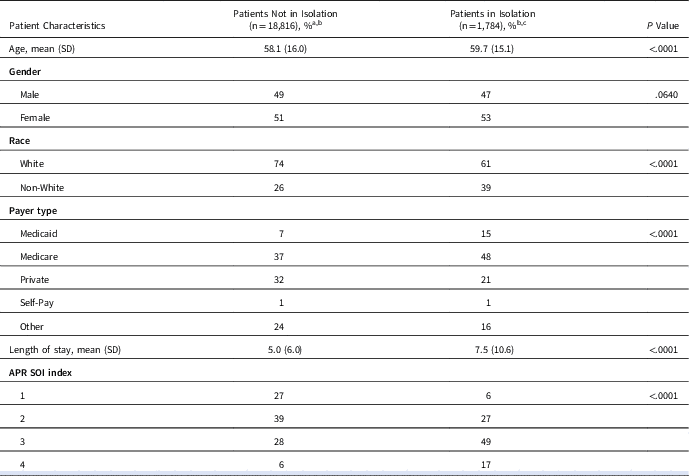
A total of 21,175 patients returned a HCAHPS survey during the study period, for a survey response rate of 35.4%. Among them, 2,359 were in isolation at any point in the hospital stay and 1,784 were in isolation for >50% of the hospital stay. Of those in isolation for >50% of their hospital stay, 402 patients were on droplet isolation precautions and 35 patients were on airborne precautions. Patients in isolation were older (mean age, 59.7 vs 58.1 years; P < .0001), were more frequently nonwhite (39% vs 26%; P < .0001), and had longer length of stay (mean LOS, 7.5 vs 5.0; P < .0001). They also differed in severity of illness and payer type (Table 1).
Patient Demographics

Note. SD, standard deviation; APR SOI, all-patient refined severity score.
a Patient not in isolation at any point during their hospital stay.
b Percentage unless otherwise indicated.
c Patient in isolation for at least 50% of their hospital stay.
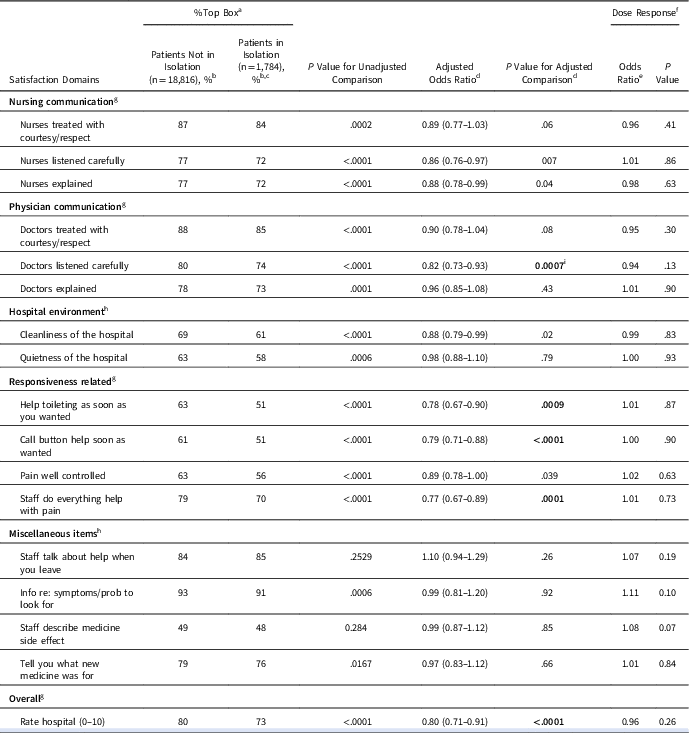
The unadjusted analysis showed a broad dissatisfaction pattern among isolated patients. They reported worse experience with nursing care (eg, nurses listened carefully, 72% vs 77%; P < .0001), physicians (eg, doctors explained, 73% vs 78%; P < .0001), staff responsiveness (eg, help toileting, 51% vs 63%; P < .0001).
However, our adjusted analysis showed that patient isolation was associated with inferior experience on a narrower set of items. Patients reported worse experience with responsiveness to toileting needs (aOR, 0.77; P = .0009), responsiveness to call button (aOR, 0.78; P < .0001), staff doing everything to help with pain (aOR, 0.77, P = .0001), and overall rating (aOR, 0.78; P < .0001). There was no association with nursing communication. Patients in isolation reported worse experience with only 1 of the 3 physician items, doctors listened carefully (74% vs 80%; OR, 0.82; P = .0007). Dose-response analysis was nonsignificant for all items (Table 2). The Press Ganey item on nursing responsiveness was also negatively associated with patient isolation status (52% vs 61%; aOR, 0.81; P = .0003), but there was no association with time the physician spent with the patient (52.5% vs 56.5%; aOR, 0.92; P = .14). A subgroup analysis of the contact-only isolation group had similar results as the combined isolation group. A subgroup analysis of the droplet and airborne isolation groups did not show any significant association with patient experience.
Comparison of Top Box HCAHPS Patient Experience Scores for Patients in Isolation With Those Not in Isolation

a Percentage of patients responses that were “always” or “definitely yes” or “9” or “10” on the HCAHPS survey items.
b Number of responses varied across different items for both group.
c Patients were considered isolated if they spent greater than 50% of their hospital stay on isolation status.
d Adjusted for age, sex, race, payor type, length of stay (LOS), all-payer refined diagnosis-related group–severity of illness (APR-DRG SOI) and clinical service type. P < .0046 was significant (calculated using Bonferoni correction).
e Odds ratio for a Top Box response for each 25% increase in time spent in isolation (no. of days in isolation/length of stay).
f All patients who were in isolation at any point in their hospital stay were include in the dose response analysis.
g Items analyzed for primary analysis.
h Items analyzed for exploratory analysis.
i Bold P value indicates statistical significance (P < .0046).
Discussion
In this retrospective analysis of HCAHPS data from a single, academic, tertiary-care hospital, we found that patient isolation was associated with worse patient experience on items susceptible to timely staff responsiveness and with overall care. Patients did not report adverse experience with nursing communication and, for the most part, with physician communication. The absence of a dose response to an increase in percentage of days spent in isolation could suggest that differences in experiences may be the result of unmeasured cofounders related to illness rather than isolation itself, or that any exposure to isolation status, however brief, still taints patient experience.
Prior negative studies have had relatively small sample sizes.Reference Gasink, Singer and Fishman 11 – Reference Livorsi, Kundu, Batteiger and Kressel 13 Vinski et alReference Vinski, Bertin and Sun 14 conducted one of the larger studies. Our findings are consistent with theirs in showing worse patient experience with staff responsiveness. To contextualize this finding, hospitals reporting composite patient experience scores of 61% on staff responsiveness (similar to our control group) are at 46th percentile and those reporting 51% (similar to our exposure group) are at 5th percentile nationally. We additionally note that patients reported worse experience with overall care. Their study did not adjust for any potential confounders and noted a trend toward worse experience in multiple other domains. Our study had a larger sample size, and we found those trends to be statistically significant in the unadjusted models. However, the association with isolation was markedly attenuated in the adjusted models, suggesting that the associations with inferior experience for most items related to nursing, physician, hospital environment, and discharge can probably explained by patient demographic factors and illness severity.
The dose-response analysis did not show worse experience on any of the items with increasing percentage of hospital stay spent in isolation. This finding raises the possibility that isolation status may be a marker for other factors, such as specific type of illness or illness severity, that dampen patient experience. The postdischarge nature of the survey may also have impeded detection of dose effect because of decreased recall. The absence of dose response could be the result of a threshold effect. Our sensitivity analysis demonstrated that patients in isolation for at least 25% of the hospital stay reported worse experience, similar to our exposure group. Given that the mean length of stay in the isolated patient population is 7.5 days, a lower exposure threshold (eg, 10%) would likely correspond to a single day spent in isolation for most patients. It is possible that a poor experience during this relatively brief period taints patient experience reporting for the entire hospital stay.
Many studies have examined the importance of staff responsiveness to patients.Reference Sofaer, Crofton, Goldstein, Hoy and Crabb 18 – Reference Ahmadi Kashkoli, Zarei, Daneshkohan and Khodakarim 20 Current efforts to improve patient experience with responsiveness are focused on purposeful hourly rounding and providing the nurses’ hospital-issued phone numbers to patients.Reference Meade, Bursell and Ketelsen 21 – Reference Williams 23 It is important that such interventions include patients in isolation so as not to exacerbate any disparity in staff attention that may affect these patients. Additionally, patients with physical disability in isolation may be particularly vulnerable when in isolation.
Patients in isolation reported that doctors listened to them carefully less often. This could be related to less frequent patient visits by the physicians.Reference Saint, Higgins, Nallamothu and Chenoweth 4 However, this finding is difficult to interpret. As noted earlier, only 1 of the 3 physician items showed a statistically significant difference. Additionally, patients in isolation were not significantly less satisfied with the time physicians spent with them. When the overall quality of communication was suboptimal, it is unclear why patients would not also have indicated worse experience with the “doctors explained” item.
Our study has some limitations. First, it was a retrospective study. Our findings may be confounded by variables we are not aware of, and the dose-response analysis suggests this possibility. This study was conducted at a single, tertiary-care, academic center that predominantly serves an inner-city population and high-acuity patients, so our findings may not be generalizable. We are also limited by the low response rate; however our response rate is typical for the HCAHPS survey broadly across the nation.Reference Elliott, Zaslavsky and Goldstein 24 Elderly, male, acutely ill, and nonsurgical patients tend to have lower response rates. We have adjusted for these factors.Reference Elliott, Zaslavsky and Goldstein 24 Despite low response rates nationwide, HCAHPS survey results are relevant for hospital reimbursements and for policy purposes. Additionally, our subgroup analyses may have failed to demonstrate significant associations because of small sample size.
In conclusion, our findings suggest that patient ratings of provider and nursing communication were largely not affected by isolation status. This finding is especially reassuring because these communication items are regarded as some of the most important items for safety and quality of care. However, isolation status was associated with worse experience with responsiveness. Hospitals could increase staff awareness on this aspect of care and emphasize timely response, especially for this population.
Acknowledgments
None.
Financial support
No financial support was provided relevant to this article.
Conflicts of interest
All authors report no conflicts of interest relevant to this article.