




No CrossRef data available.
Article contents
Early parental loss and salivary cortisol in young adulthood: The moderating role of family environment
Published online by Cambridge University Press: 10 February 2006
Abstract
Early family life adversity has been linked with negative physical and psychological health consequences in adulthood, possibly due to alterations in neuroendocrine activity. Young adults from families characterized by parental loss (N = 45) and control participants (N = 43) completed self-report measures of prior abuse and family conflict, and performed a stressful speech task designed to elicit neuroendocrine responses. Higher reported abuse and conflict were associated with increased cortisol for the loss group, but were unrelated to cortisol in the control group. Results indicate alterations in neuroendocrine functioning associated with early parental loss, which are moderated by the quality of the family environment.
This research was supported by Grant 0130024N (to P.I.L.) from the American Heart Association. We are grateful for the research assistance of Jessica Tartaro and Anna Rodriguez.
Information
- Type
- Research Article
- Information
- Copyright
- © 2006 Cambridge University Press
As demonstrated by converging evidence from animal and human studies, adverse childhood experiences can have long-lasting effects on psychological and physical health. Adversity in the early family environment in particular has been identified as having profound effects on neurobiological development that may increase long-term vulnerability to physical and psychological illness (Nemeroff, 2004). Early family adversities such as parental loss, conflict, and abuse have been linked to a wide variety of physical health problems in adulthood (Felitti et al., 1998; Krause, 1998; Maier & Lachman, 2000; Rahkonen, Lahelma, & Huuhka, 1997; Sachs-Ericsson, Blazer, Plant, & Arnow, 2005).
The regulation of physiological stress response systems has been proposed as a mechanism linking early family adversity to long-term health (Boyce & Ellis, in press; Luecken & Lemery, 2004; McEwen, 2003; Repetti, Taylor, & Seeman, 2002; Troxel & Matthews, 2004). A primary component of the stress response system, the hypothalamic–pituitary–adrenal (HPA) axis, regulates the release of cortisol in humans. Short-term HPA responses to novel situations are adaptive, and facilitate behavioral strategies for coping (McEwen, 2003). However, models of the negative long-term effects of stress focus on the consequences of dysregulated stress responses, including those that are exaggerated, prolonged, or of insufficient magnitude to mount an effective response (McEwen & Wingfield, 2003). The allostatic load hypothesis (Korte, Koolhaas, Wingfield, & McEwen, 2004; McEwen, 1998) describes the cumulative wear and tear on the body resulting from prolonged or inefficiently managed HPA hormones and other physiological systems involved in the body's stress response. Chronic elevations in cortisol are indicative of heightened emotional distress (Maes, Bosmans, Suy, Minner, & Raus, 1991), and may increase the risk of cardiovascular disease and other illnesses (McEwen, 1998; Taylor, Repetti, & Seeman, 1997). Thus, both chronic and acute indicators of stress provide important information about an individual's long-term vulnerability to physical and psychological illness.
Animal models provide powerful evidence that parental behavior has direct, enduring effects on the development of neurobiological stress response systems (Meaney, Brake, & Gratton, 2002). Manipulations that disrupt caregiver attention have been associated with increases in corticosterone or cortisol secretion, exaggerated stress responses, and poor lifespan health in a variety of animal species (Gunnar, Gonzalez, Goodlin, & Levine, 1981; Meaney et al., 2002; Rosenblum & Andrews, 1994). Studies with children have also associated poor caregiving with elevated cortisol and dysregulated stress responses (El-Sheikh and Harger, 2001; Gunnar & Donzella, 2002). In a longitudinal study, Essex, Klein, Cho, and Kalin (2002) found elevated salivary cortisol in children exposed to high maternal stress during early developmental periods combined with high concurrent stress. Similarly, Kaufman et al. (1997) found elevated corticotropin-releasing hormone (CRH) in children with a history of abuse and current chronic stress. Essex et al. (2002) suggests that the timing of early exposure to stress is critical, and it can sensitize individuals to later HPA reactivity. Complex alterations in neuroendocrine function, including flattened stress responses, result from inadequate early caregiving (Boyce & Ellis, in press; Gunnar & Vazquez, 2001), making it imperative to look at both overall levels of cortisol and the pattern of responses to stress.
In families characterized by parental death, children may be at particularly high risk for the development of dysregulated stress response systems. Early parental loss has been associated with higher blood pressure in young adults (Luecken, 1998), elevated daily cortisol in middle-aged adults (Nicolson, 2004), and health problems in older adulthood (Krause, 1998; Maier & Lachman, 2000). Luecken (2000a) found that the long-term physiological impact of early loss was moderated by the quality of the parent–child relationship, such that early loss was associated with greater cortisol reactivity to stress only if the relationship with the surviving parent was poor. These findings imply that the regulation of physiological response systems later in life is influenced by the quality of early family experiences.
In children and adolescents, a number of studies have associated physiological dysregulations with high levels of family conflict (Ballard, Cummings, & Larkin, 1993; Granger, Serbin, Schwartzman, LeHoux, & Cooperman, 1998; Katz & Gottman, 1997), suggesting that family conflict may be an important moderator of the long-term physiological impact of parental loss or may exert an independent impact on stress responses. Flinn and England (1995) reported that children from high conflict families showed either chronically elevated cortisol or low basal cortisol with unusually high spikes in response to conflict. Similarly, childhood abuse has been associated with a wide variety of negative long-term health outcomes, including gastrointestinal illnesses (Leserman et al., 1996), fibromyalgia (Walker et al., 1997), and greater incidence of chronic illnesses (Felitti et al., 1998; Sachs-Ericsson et al., 2005). Permanent dysregulations in biological stress response systems resulting from the abuse have been proposed as a mechanism underlying poor health outcomes (DeBellis, 2002; Heim & Nemeroff, 2002).
Neuroendocrine dysregulations associated with abuse are apparent in a number of patterns, including elevated or suppressed daily cortisol (DeBellis et al., 1999; Teicher, Andersen, Polcari, Anderson, & Navalta, 2002), higher allostatic load (Seeman, Singer, Ryff, Love, & Levy-Storms, 2002), and increased or diminished cortisol responses to distressing situations (Hart, Gunnar, & Cicchetti, 1995; Heim & Nemeroff, 2002). Several theories exist to explain the differing effects of abusive treatment. Childhood abuse can be considered a chronic stressor, and it may result in diminished cortisol levels as a compensatory response to persistently elevated central CRH (DeBellis, 2002). In contrast, abusive experiences can be conceptualized as “priming” the HPA axis to hyperrespond to later stress (Chrousos & Gold, 1992; DeBellis, 2002). It may be necessary to consider affective pathology to understand the complicated neurobiological sequelae of abuse (Gunnar & Donzella, 2002). It may also be critical to consider the family context in which the abuse occurs in the prediction of physiological consequences.
Despite accumulating evidence of the long-term impact of early family experiences on physiological stress response systems, a number of areas remain to be addressed. Although a few studies have found dysregulated cortisol patterns associated with early parental loss, it is unclear to what extent other aspects of the family environment moderate the long-term consequences. Previous studies of childhood adversity have been criticized for their focus on a single form of adversity, such as parental loss (Kessler, Davis, & Kendler, 1997). As a result of this singular focus, little is known about additive effects of multiple adverse experiences. A related limitation concerns the inconsistent reports of HPA alterations associated with abuse, calling for researchers to explore how family context may moderate the long-term physiological consequences of abuse.
The current study evaluates cortisol responses to a stressful speech task in young adults from bereaved and maritally intact, control families. Self-reports of abusive treatment and family conflict were evaluated as moderators of the impact of parental loss on cortisol responses. Drawing from previous studies suggesting that parental loss is only associated with dysregulated cortisol in the presence of inadequate parenting, we expected that parental loss in the context of higher reports of abuse or conflict would be associated with elevated cortisol across the task and greater cortisol reactivity to the task relative to those from intact families. We also evaluated if current distress explained the effects of adversity on cortisol. Exploratory analyses evaluated specific subtypes of abuse to further examine aspects of abuse associated with physiological dysregulation.
Methods
Participants
Demographics
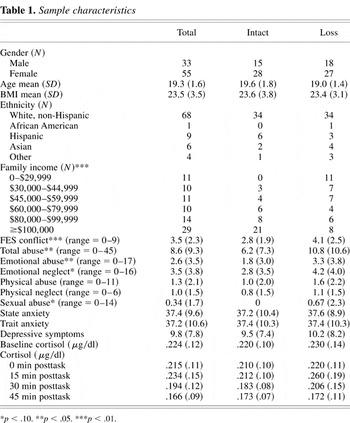
Participants included 88 undergraduate students (ages 18–28 years, mean age = 19.6 years). The sample included 55 females and 33 males, representing a variety of ethnic backgrounds (see Table 1). No monetary compensation was given for participation in this component of the study; however, most participants completed a larger, 2-day study for which they received $75. Current results represent data from the first day of participation only.
Sample characteristics

Family groups
The two family groups were composed of 45 participants from bereaved families, and 43 from intact, married families. Criteria for bereaved families included the death of one biological parent up to the student's age of 16. Participants' ages at the time of the death ranged from 0 to 16 years (M = 8, SD = 4.9). At least 2 years had to have elapsed since the death, and no death or divorce could have occurred after the age of 16 in either of the groups. The age of 16 was chosen to minimize the possibility of an acute grief reaction. In addition, existing literature is inconsistent in reports of age influences on the long-term effects of early parental loss; therefore, sufficient rationale did not exist for specifying a younger age. Criteria for the control group included two living, married, biological parents.
Recruitment and selection criteria
Participants were recruited from introduction to psychology classes. Respondents completed a large screening survey, and those who were eligible were invited to participate. A double-blind protocol was maintained in which participants did not know why they had been selected, and family group was not known to the experimenter until data were collected. Exclusionary criteria included a history of serious illness, acute illness, or use of medications that affect hormonal function (e.g., antidepressants, steroids), although hormonally based contraceptives (N = 20) were allowed. Participants were asked to refrain from use of alcohol the night before participation, cold medication the day of participation, and caffeine, energy drinks, eating, smoking, or exercise for at least 2 hr prior to participation. Compliance was queried prior to participation, and those who did not comply were rescheduled.
Measures
Questionnaires
The Childhood Trauma Questionnaire (CTQ; Bernstein et al., 1994) is a 25-item self-report measure of abusive treatment during childhood. Items are scored on a scale of 0–4 (0 = never true, 4 = very often true). The CTQ assesses five dimensions, including emotional abuse, emotional neglect, physical abuse, physical neglect, and sexual abuse. A total abuse score was calculated by summing scores on the five subscales (Cronbach's α = .90). The CTQ was chosen based on its strong evidence of reliability and validity (Bernstein et al., 2003). The CTQ has been shown to have measurement invariance of its factor structure across clinical and community samples, and criterion-related validity as evaluated through corroboration of self-reports with therapist ratings using information from sources such as clinical records, child welfare investigations, and other informants (Bernstein et al., 2003). The conflict subscale (nine items) from the Moos Family Environment Scale (Moos & Moos, 1994) provided a self-report of the amount of conflict within the family (α = .78). Items are scored as either 0 (false) or 1 (true). Current distress was assessed with the State-Trait Anxiety Inventory (Spielberger et al., 1983; state anxiety α = 87; trait anxiety α = .91), and the Beck Depression Inventory II (Beck, 1996; α = .89).
Cortisol measures
Five saliva samples were collected for determination of cortisol before, during, and after a moderately stressful speech task. Samples were collected at pretask, immediately following the task, and at 15, 30, and 45 min following the task. Samples were obtained with a Salivette device (Sarstedt, Rommelsdorf, Germany), and were immediately stored frozen at 0°F for 1–3 months. They were shipped on dry ice to Salimetrics (State College, PA) for analysis of free cortisol using a highly sensitive enzyme immunoassay. For the assay, salivettes were removed from a −80°C freezer either the afternoon before testing and allowed to thaw in the refrigerator overnight or were removed from the freezer on the morning of testing and allowed to thaw at room temperature. The salivettes were centrifuged at 3500 rpm for 10 min immediately prior to testing. Assays were performed in duplicate, and the coefficient of variance (CV) of duplicate results was calculated. If the CV was greater than 15% and the difference between the two values was greater than 0.030 μg/dl, the test was repeated. If the CV was >15%, but values were <0.030 μg/dl apart, the test was not repeated. The test has a range of sensitivity from .007 to 1.8 μg/dl and average intra- and interassay CVs of 4.13 and 8.89%, respectively.
Speech task
The speech task was modeled after the procedure of Saab, Matthews, Stoney, and McDonald (1989), in which participants were given 4 min to prepare and 4 min to deliver a speech to defend themselves from a false accusation of shoplifting. The speech was videotaped and was given in front of an “audience” consisting of the experimenter and the lab supervisor. Participants were told that speeches would be evaluated for clarity and the strength of their arguments, and would be rated in comparison to speeches given by participants similar in gender and educational level.
Procedure
All participation occurred between 1 and 5 PM Monday–Thursday. Upon arriving at the lab, participants first read and signed informed consent forms. Participants then rinsed their mouths with water. Twenty minutes after their arrival, the first saliva sample (pretask) was collected. Participants then completed the speech task, and saliva samples were taken immediately after the task (0 min post), and at 15, 30, and 45 min posttask.
Data analysis
Preliminary analyses
The two groups were compared for equivalence on demographic characteristics and potential covariates (see Table 1). Chi-square and Students' t tests found no group differences in gender (p = .62), smoking status (p = .34), age (p = .14), hormonal contraceptive use (p = .25), ethnicity (p = .36), caffeine use (p = .52), time of day of participation (p = .22), time of last meal (p = .62), type of last meal (p = .64), or body mass index (BMI; p = .82). Family group differences were found only for income, F (1, 83) = 23.3, p < .001. Pearson correlations found a significant correlation between family conflict and total abuse (r = .61, p < .001).
The sample as a whole showed a significant pattern of cortisol reactivity to the task, F (2, 190) = 25.6, p < .01, in which cortisol increased overall in response to the task and decreased in the final two samples. Of all the potential covariates (listed above), only gender, F (2, 184) = 3.2, p = .04, and BMI, F (1, 83) = 5.8, p = .02, were related to cortisol, in which men exhibited a stronger pattern of reactivity to the task than women, and BMI was negatively related to average cortisol. Income, age at the time of the death, or elapsed time since the death did not exert a main effect on cortisol (income: p = .61; age at death: p = .52; time since the death: p = .08) or cortisol responses to the task (income: p = .60; age at death: p = .42; time since the death: p = .47). One participant from the loss group was identified with cortisol levels greater than 3 SD above the mean but within normal physiological levels. When that participant's data was removed from analyses, the pattern of results was not significantly affected. Therefore, all data were retained in analyses. Cortisol values were log transformed for all statistical analyses to correct for deviations from normality. However, reported means and graphical representations of the data are displayed using nontransformed cortisol values for ease of interpretation only.
Primary analytic strategy
Evaluation of differences between the two groups in the pattern of cortisol responses to the speech task were conducted with repeated-measures general linear models (GLMs; SPSS 11.0), with five repeated measures of cortisol as dependent variables, and family group, abuse, and the group by abuse interaction as independent variables. Gender and BMI served as covariates. Because of the observed gender difference in reactivity to the task, analyses were initially conducted with gender as a moderating factor; however, none of the interactions with gender were significant. Therefore, gender was included in remaining models only as a covariate. Repeated-measures GLM provides estimates of both within-subjects effects (the pattern of changes over time) and between-subjects effects (combined cortisol across all time periods). The impact of family conflict was analyzed in the same manner as abuse. In all analyses, abuse and conflict were included as continuous variables. Analyses were repeated controlling for current distress (anxiety and depressive symptoms).
For within-subjects tests, Greenhouse–Geisser corrections were used to adjust for sphericity. For exploratory analyses, a Bonferroni correction of α = .01 was used to control the error rate. The eta-squared value is reported as a measure of effect size, calculated as the ratio of the sum of squares for each individual factor divided by the total sum of squares for the model. This method was used instead of partial eta squared (supplied by default by SPSS 11.0) because it allows for summing of the individual effect sizes to determine the total percentage of variability explained by the independent variables.
Results
Abuse
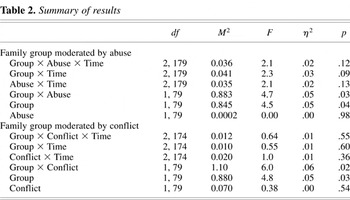
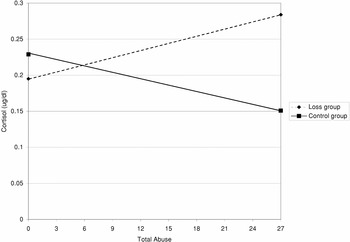
First, the effects of family group moderated by abuse were tested (Table 2). There was a main effect of family group on cortisol across the experimental period, F (1, 79) = 4.5, p = .04, in which the loss group (M = 0.21 μg/dl, SD = 0.10) had higher cortisol overall than the intact group (M = 0.19 μg/dl, SD = 0.11). However, this effect was secondary to a significant between-subjects interaction of family group and reported abuse on cortisol across all time periods, F (1, 79) = 4.7, p = .02 (see Figure 1). The total effect size on cortisol due to family group and abusive treatment was η2 = .10, a medium-sized effect according to Cohen's (1988) guidelines, and which can be interpreted as explaining 10% of the total variance in cortisol. Within-group analyses testing the significance of the slopes for the loss and control groups found that the increasing slope associated with higher abuse was significant for the loss group (p = .05), but the slope was not significant for the control group (p = .10). The Group × Abuse × Time interaction did not reach significance. Similarly, when analyses are repeated controlling for baseline cortisol levels, the Group × Abuse × Time interaction was not significant; therefore, the interaction of family group and abuse did not uniquely predict the pattern of responses to the task.
Summary of results


Family Group × Total Abuse effects on cortisol. The lines represent the regression of total abuse on mean cortisol, controlling for BMI and gender.
Because of the significant correlation between family conflict and abuse, analyses were repeated controlling for family conflict. When conflict was included as a covariate, the family group by abuse interaction (between-subjects effect) became slightly nonsignificant, F (1, 78) = 3.7, p = .06.
Family conflict
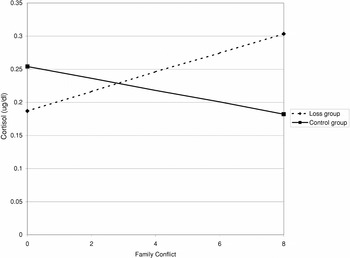
Next, the moderating effect of family conflict on cortisol responses to the task was evaluated. Findings were similar to those for abuse, in which a main effect of family group was found, F (1, 79) = 4.8, p = .03, and the group by conflict interaction was a significant between-subjects predictor of overall cortisol across all time periods, F (1, 79) = 6.0, p = .02 (see Figure 2). The total effect size due to family group and conflict was η2 = .11, a medium- to large-sized effect according to Cohen's (1988) guidelines, explaining 11% of the total variance. Within-group analyses testing the significance of the slopes for the loss and control groups found that the increasing slope associated with higher conflict was significant for the loss group (p = .04), but the slope for the control group was not significant (p = .23). The Group × Conflict × Time interaction was not significant. Similarly, when analyses are repeated controlling for baseline cortisol levels, the Group × Conflict × Time interaction was not significant; therefore, the interaction of family group and abuse did not uniquely predict the pattern of responses to the task.

Family Group × Conflict effects on cortisol. The lines represent the regression of family conflict on mean cortisol, controlling for BMI and gender.
Because of the significant correlation between family conflict and abuse, analyses were repeated controlling for abuse. When abuse was included as a covariate, the family group by conflict interaction (between-subjects effect) remained significant, F (1, 78) = 5.6, p = .02.
Current distress
All effects of the Group × Abuse interaction and the Group × Conflict interaction on average cortisol remained significant after including anxiety symptoms in the model. The Family Group × Abuse interaction became nonsignificant when depressive symptoms were included in the model (p = .10). In contrast, the Family Group × Conflict interaction remained significant after controlling for depressive symptoms (p = .03). Depressive symptoms did not predict average cortisol or cortisol responses over time. Neither state nor trait anxiety was associated with cortisol responses over time or average cortisol.
Subtypes of abuse
Exploratory analyses within the loss group evaluated subtypes of abuse for their impact on cortisol, using a Bonferroni correction for significance of α = .01. Physical and emotional abuse were highly significant predictors of cortisol responses to the task; physical, F (2, 77) = 6.8, p = .002, η2 = .14; emotional, F (2, 78) = 7.2, p = .001, η2 = .15, in which higher reports of abuse were associated with elevated cortisol before and immediately after the task. Physical neglect was a highly significant predictor of average cortisol, F (1, 37) = 11.7, p = 002, η2 = .21, in which higher physical neglect was associated with elevated average cortisol.
Discussion
Results from the current study provide further evidence that the impact of early family adversity extends beyond psychological outcomes, as have traditionally been studied, to neurohormonal outcomes associated with vulnerability to stress-related illness. Overall, parental loss was associated with elevated cortisol in response to a novel stressor relative to participants from intact families. However, this finding must be interpreted within the context of a significant interaction of loss and abusive treatment. As hypothesized, the combination of early parental loss and reports of abusive treatment was associated with elevated cortisol relative to those who experienced parental loss in the absence of abusive treatment, and relative to those from intact early family environments. Contrary to hypotheses, the interaction of family group and reported abusive treatment did not predict the pattern of cortisol responses to the task (i.e., the magnitude of reactivity to the task). We interpret these findings as reflecting elevated cortisol responses to the moderately stressful experience of participation in the study. This interpretation is meaningful in terms of the allostatic load hypothesis, which posits that physiological dysregulation at rest, during reactivity, and during recovery from stress contributes to long-term health status. Our results suggest that interactions between distal environmental forces (abuse, conflict, and parental loss) may be associated with chronically elevated physiological arousal in response to stress. These findings are supportive of research by Essex et al. (2002) in which early stress exposure was only associated with elevated cortisol in those experiencing current stress. In this case, the anticipation of participation in the research may have also contributed to current stress levels and elevated cortisol.
Similarly, reports of high conflict in the family of origin were associated with elevated cortisol in those who experienced parental loss, but were not associated with the magnitude of reactivity to the task. Because reports of conflict and reports of abusive treatment were significantly correlated (r = .61), it is likely that the constructs overlap in their effects on cortisol. The measure of conflict used in this study assesses overall conflict levels within the family (e.g., “family members often criticized each other,” or “family members sometimes hit each other”), while the abuse questionnaire is specific to several types of abuse or neglect perpetrated on the respondent (e.g., “I didn't have enough to eat,” or “someone molested me,” “I got hit or beaten so badly that it was noticed by someone like a teacher, neighbor, or doctor”). The similarity of the neuroendocrine consequences of abuse or conflict suggest a broader underlying risk factor indicating inadequate care or relationship adversity within the family of origin. Interestingly, the impact of conflict remained significant after controlling for abuse, while the impact of abuse became nonsignificant (p = .06) after controlling for conflict. These results suggest that exposure to family conflict may exert a unique influence on neuroendocrine regulation.
Interestingly, there were no main effects of abusive treatment or high family conflict on cortisol, raising the intriguing possibility that there may be specificity of outcomes dependent on the types of adversity and the presence of ameliorative factors. Because this was a healthy undergraduate population not specifically selected for high abuse or conflict, these findings suggest that the clustering of adversity (i.e., parental loss combined with abusive or high conflict experiences) may represent a significant risk factor for later life HPA dysregulation. In this sample, abusive or high conflict experiences in combination with a family environment rendered vulnerable by the loss of a parent was associated with elevated combined cortisol across all time periods of participation in the study. The striking contrast between the impact of reported abusive treatment or high conflict in those from bereaved families compared to intact families suggests that it is important to consider family context when evaluating the neurobiological consequences of early family adversity.
For adult children from maritally intact families, there was a trend toward lower cortisol in those reporting abusive family experiences. Previous research has documented hypoarousal of the HPA axis associated with childhood abuse, particularly in those who develop depression or posttraumatic stress disorder (Kaufman et al., 1997; Yehuda, Halligan, & Grossman, 2001). Chronic hyperactivity of the HPA axis during childhood resulting from exposure to chronic conflict or abuse may lead to enhanced negative feedback and long-term hypoactivity (King, Mandansky, King, Fletcher, & Brewer, 2001). For example, Gunnar and Vazquez (2001) reported flattened cortisol patterns in children living in family environments characterized by chronic neglect and disruption. Granger et al. (1998) conclude that high risk early family experiences may be associated with low basal cortisol along with greater sensitivity of HPA responses to challenge. As Gunnar and Vazquez (2001) notes, alterations in cortisol patterns can vary with changes in the caregiving environment. For those who additionally experience the acute stress of parental loss, the qualitative changes in family environment and in the nature of the chronic stress experienced by an individual may result in sensitization of HPA responses.
The differential impact of abuse or conflict on those from bereaved versus intact family groups may be explained by the availability of alternative caregivers. Animal models find that the availability of alternative social attachments can ameliorate the physiological outcomes associated with maternal separation (Boccia, Laudenslager, & Reite, 1994). Similarly for children, Gunnar and Donzella (2002) reported that a sensitive, responsive babysitter prevents cortisol elevations following maternal separation. A strong bond between a child and a responsive surviving parent can buffer a child from the potential long-term negative psychological sequelae of parental loss (Luecken, 2000b). Bereaved children in abusive families may lack the beneficial influence of a caring, alternative attachment figure. These speculations reinforce the need for research to more closely examine specific mediators and moderators of stress responses in children and adults exposed to family adversity. The current research documents the influence of distal, contextual factors associated with physiological stress response systems in young adults, and future research will need to also take on the important task of identifying and linking key proximal factors.
Luecken and Lemery (2004) articulated a theoretical model of pathways linking early family adversity to physiological dysregulation in adulthood, including genetic, psychosocial, and cognitive–affective processes. A genetic pathway may be important in that expression of genetic predispositions to stress vulnerability is influenced by environmental experiences. Further, genetic characteristics of the child and the parent can each influence the quality of parenting provided. Twin studies will be important for understanding the interaction of environmental and genetic factors in the development of physiological stress response systems. A cognitive–affective pathway suggests that early family experiences influence the development of cognitive and emotional self-regulatory abilities, which can alter responses to stress. An abusive environment may result in hypervigilance toward environmental threat cues (Luecken & Appelhans, 2005), exaggerated threat appraisals, or the selection of maladaptive coping responses. Future studies examining “real-time” cognitive or affective responses will provide critical information required to understand the cognitive processes (presumably modifiable by intervention) by which childhood adversity influences physiological vulnerability to stress.
A psychosocial pathway suggests that family of origin experiences influence the development of psychosocial characteristics (e.g., depression, hostility, anxiety) that can then affect physiological responses. In the current study, we evaluated if psychological distress explained the elevated cortisol associated with parental loss and abusive or high conflict experiences. However, our findings could not easily be explained by current anxiety or depression symptoms among the participants. Notably, anxiety and depressive symptom levels did not differ between the two family groups. Although anxiety symptoms had no effect on cortisol, after controlling for depressive symptoms, the interaction of family group and abusive treatment on cortisol became nonsignificant. This finding partially supports the suggestion by Gunnar and Donzella (2002) that affective state be considered when evaluating the long-term neurobiological consequences of childhood abuse. Depressive symptoms were not independently associated with cortisol, suggesting that depression is not a mediator. However, conflict remained a significant predictor of cortisol responses in the loss group after controlling for current depressive symptoms, suggesting that the effect is independent of current distress.
There were several limitations to the current study. First, caution must be taken in interpreting the findings of elevated cortisol as measured by five samples taken during 45 min of study participation, suggestive of elevated response to a moderately stressful experience. Therefore, the current data cannot provide information about the impact of early family context and adversity on basal cortisol, 24-hr secretion, circadian rhythms, or long-term arousal of the HPA axis. An important direction for future studies will be to evaluate the pattern of HPA activation in naturalistic environments. Second, as was appropriate for the goals of this study, the measures of abuse and family conflict report cumulative exposure only, and do not indicate specific details such as the timing or the perpetrator of the abuse, or the length of exposure to abuse and/or the age at which it ended. It is not possible within this study to evaluate whether the conflict or abuse ended after the death of a parent. This knowledge may be particularly helpful in explaining the differential impact of abusive treatment on participants from bereaved families. However, it is interesting that participants' ages at the time of parental death did not affect cortisol outcomes or the relation of abuse or conflict to cortisol. Neuronal development continues throughout adolescence (Chugani, 1998), and there may be a wide critical period for family adversity to impact neurobiological systems.
This sample consisted of participants pursuing a college education, which may limit generalizability to a wider population. Much of the research on childhood adversity has used student samples, and although reported rates of abuse are comparable to community samples, effect sizes are generally smaller (Brown, 2002). Given that the current data reflects medium-sized effects according to Cohen's (1988) guidelines, this suggests that the impact for the broader population may be considerable. Most previous neurobiological studies selected participants who experienced severe, documented abuse. In the current sample, reports of the severity of abusive experiences within a normal population were lower than would be found in a study of participants with court-documented abuse. It is intriguing that the current findings nevertheless document cortisol alterations associated with reported abusive experiences. However, our findings were only within the context of a family challenged by parental death, which is likely a severely disruptive experience.
In the current sample, the perception of a conflictual or abusive early family environment was associated with cortisol function; however, reports of abuse and conflict were retrospective and cannot be verified. An extensive literature review (Brewin, Andrews, & Gotlib, 1993) concluded that there is little evidence for inherent inaccuracy of retrospective reports, and that recall of emotional childhood experiences may actually be enhanced relative to neutral experiences (Brewin et al., 1993). In any event, perceptions of adversity may be more influential on long-term outcomes than the objective events. Models of the long-term physiological impact of child adversity and stress commonly emphasize the role of cognitive mediators such as appraisal processes and coping skills (Luecken & Lemery, 2004; Repetti et al., 2002).
Taken together, evidence from the current study suggests that adverse family experiences prior to adulthood can impact physiological stress-response systems in young adulthood, particularly those likely to contribute to the risk of stress-related illness. For those who experience early parental loss, our results show that the quality of the family environment must be considered when interpreting neuroendocrine correlates. More broadly, our findings suggest that abusive or high conflict experiences during childhood can lead to lasting neurobiological alterations that depend on the family context in which the adverse treatment occurs. The striking contrast between the impact of reported abuse or conflict on cortisol function in those from bereaved versus intact families shows that it is important to look beyond reports of abuse or conflict to consider specific risk or protective aspects of the family environment.
References
REFERENCES
Ballard, M. E.,
Cummings, E. M., &
Larkin, K.
(1993).
Emotional and cardiovascular responses to adult's angry
behavior and challenging tasks in children of hypertensive and
normotensive parents.
Child Development,
64,
500–515.Google Scholar
Beck, A. T.
(1996).
The Beck Depression Inventory II.
San Antonio, TX:
Harcourt Brace.
Bernstein, D. P.,
Fink, L.,
Handelsman, L.,
Foote, J.,
Lovejoy, M.,
Wenzel, K.,
et al.
(1994).
Initial reliability and validity of a new retrospective measure of
child abuse and neglect.
American Journal of Psychiatry,
151,
1132–1136.Google Scholar
Bernstein, D. P.,
Stein, J. A.,
Newcomb, M. D.,
Walker, E.,
Pogge, D.,
Ahluvalia, T.,
et al.
(2003).
Development and validation of a brief screening version of the
Childhood Trauma Questionnaire.
Child Abuse and Neglect,
27,
169–190.Google Scholar
Boccia, M. L.,
Laudenslager, M. L., &
Reite, M. L.
(1994).
Intrinsic and extrinsic factors affect infant responses to maternal
separation.
Psychiatry,
57,
43–50.Google Scholar
Boyce, W. T., &
Ellis, B. J.
(in press).
Biological sensitivity to context: I. An
evolutionary–developmental theory of the origins and functions of
stress reactivity.
Development and Psychopathology.
Brewin, C. R.,
Andrews, B., &
Gotlib, I. H. L.
(1993).
Psychopathology and early experience: A reappraisal of retrospective
reports.
Psychological Bulletin,
113,
82–98.Google Scholar
Brown, G. W.
(2002).
Measurement and epidemiology of childhood trauma.
Seminars in Clinical Neuropsychiatry,
7,
66–79.Google Scholar
Chugani, H. T.
(1998).
A critical period of brain development: Studies of cerebral glucose
utilization with PET.
Preventive Medicine,
27,
184–188.Google Scholar
Cohen, J.
(1988).
Statistical power analysis for the behavioral sciences
(2nd ed.).
New York:
Academic Press.
Chrousos, G. P., &
Gold, P. W.
(1992).
The concepts of stress and stress system disorders: Overview of
physiological and behavioral homeostasis.
Journal of the American Medical Association,
267,
1244–1252.Google Scholar
DeBellis, M. D.
(2002).
Developmental traumatology: A contributory mechanism for alcohol and
substance use disorders.
Psychoneuroendocrinology,
27,
155–170.Google Scholar
DeBellis, M. D.,
Baum, A. S.,
Birmaher, B.,
Keshavan, M. S.,
Eccard, C. H.,
Boring, A. M.,
et al.
(1999).
Developmental traumatology, Part 1: Biological stress
systems.
Biological Psychiatry,
9,
1259–1270.Google Scholar
El-Sheikh, M., &
Harger, J.
(2001).
Appraisals of marital conflict and children's adjustment,
health, and physiological reactivity.
Developmental Psychology,
37,
875–885.Google Scholar
Essex, M. J.,
Klein, M. H.,
Cho, E., &
Kalin, N. H.
(2002).
Maternal stress beginning in infancy may sensitize children to later
stress exposure: Effects on cortisol and behavior.
Biological Psychiatry,
52,
776–784.Google Scholar
Felitti, V. J.,
Anda, R. F.,
Nordenberg, D.,
Williamson, D. F.,
Spitz, A. M.,
Edwards, V.,
et al.
(1998).
Relationship of childhood abuse and household dysfunction to many of
the leading causes of death in adults: The Adverse Childhood Experiences
(ACE) Study.
American Journal of Preventive Medicine,
14,
245–258.Google Scholar
Flinn, M. V., &
England, B. G.
(1995).
Childhood stress and family environment.
Current Anthropology,
5,
854–866.Google Scholar
Granger, D. A.,
Serbin, L. A.,
Schwartzman, A.,
LeHoux, P., &
Cooperman, J.
(1998).
Children's salivary cortisol, internalising behaviour problems,
and family environment: Results from the Concordia Longitudinal Risk
Project.
International Journal of Behavioral Development,
22,
707–728.Google Scholar
Gunnar, M. R., &
Donzella, B.
(2002).
Social regulation of the cortisol levels in early human
development.
Psychoneuroendocrinology,
27,
199–220.Google Scholar
Gunnar, M. R.,
Gonzalez, C. A.,
Goodlin, B. L., &
Levine, S.
(1981).
Behavioral and pituitary–adrenal responses during a prolonged
separation period in infant rhesus macaques.
Psychoneuroendocrinology,
6,
65–75.Google Scholar
Gunnar, M. R., &
Vazquez, D. M.
(2001).
Low cortisol and a flattening of expected daytime rhythm: Potential
indices of risk in human development.
Development and Psychopathology,
13,
515–538.Google Scholar
Hart, J.,
Gunnar, M. R., &
Cicchetti, D.
(1995).
Salivary cortisol in maltreated children: Evidence of relations
between neuroendocrine activity and social competence.
Development and Psychopathology,
7,
11–26.Google Scholar
Heim, C., &
Nemeroff, C. B.
(2002).
Neurobiology of early life stress.
Seminars in Clinical Neuropsychiatry,
7,
147–159.Google Scholar
Katz, L. F., &
Gottman, J. M.
(1997).
Buffering children from marital conflict and dissolution.
Journal of Clinical Child Psychology,
26,
157–171.Google Scholar
Kaufman, J.,
Birmaher, B.,
Perel, J.,
Dahl, R. E.,
Moreci, P.,
Nelson, B.,
et al.
(1997).
The corticotropin-releasing hormone challenge in depressed abused,
depressed nonabused, and normal children.
Biological Psychiatry,
42,
669–679.Google Scholar
Kessler, R. C.,
Davis, C. G., &
Kendler, K. S.
(1997).
Childhood adversity and adult psychiatric disorder in the US
National Comorbidity Survey.
Psychology and Medicine,
27,
1101–1119.Google Scholar
King, J. A.,
Mandansky, D.,
King, S.,
Fletcher, K., &
Brewer, J.
(2001).
Early sexual abuse and low cortisol.
Psychiatry and Clinical Neuroscience,
55,
71–74.Google Scholar
Korte, S. M.,
Koolhaas, J. M.,
Wingfield, J. C., &
McEwen, B. S.
(2004).
The Darwinian concept of stress: Benefits of allostasis and costs of
allostatic load and the trade-offs in health and disease.
Neuroscience and Biobehavioral Reviews,
29,
3–38.Google Scholar
Krause, N.
(1998).
Early parental loss, recent life events, and changes in health among
older adults.
Journal of Aging and Health,
10,
395–421.Google Scholar
Leserman, J.,
Drossman, D. A.,
Li, Z.,
Toomey, T. C.,
Nachman, G., &
Glogau, L.
(1996).
Sexual and physical abuse history in gastroenterology practice: How
types of abuse impact health status.
Psychosomatic Medicine,
58,
4–15.Google Scholar
Luecken, L. J.
(1998).
Childhood attachment and loss experiences affect adult
cardiovascular and cortisol function.
Psychosomatic Medicine,
60,
765–772.Google Scholar
Luecken, L. J.
(2000a).
Parental caring and loss during childhood and adult cortisol
responses to stress.
Psychology and Health,
15,
841–851.Google Scholar
Luecken, L. J.
(2000b).
Attachment and loss experiences during childhood are associated with
adult hostility, depression, and social support.
Journal of Psychosomatic Research,
49,
85–91.Google Scholar
Luecken, L. J., &
Appelhans, B. M.
(2005).
Information-processing biases in young adults from bereaved and
divorced families.
Journal of Abnormal Psychology,
114,
309–313.Google Scholar
Luecken, L. J., &
Lemery, K.
(2004).
Early caregiving and adult physiological stress responses.
Clinical Psychology Review,
24,
171–191.Google Scholar
Maes, M.,
Bosmans, E.,
Suy, E.,
Minner, B., &
Raus, J.
(1991).
A further exploration of the relationships between immune parameters
and the HPA-axis activity in depressed patients.
Psychology and Medicine,
21,
313–332.Google Scholar
Maier, E. H., &
Lachman, M. E.
(2000).
Consequences of early parental loss and separation for health and
well-being in midlife.
International Journal of Behavioral Development,
24,
183–189.Google Scholar
McEwen, B. S.
(1998).
Stress, adaptation, and disease. Allostasis and allostatic
load.
Annals of the New York Academy of Science,
840,
33–34.Google Scholar
McEwen, B. S.
(2003).
Early life influences on life-long patterns of behavior and
health.
Mental Retardation and Developmental Disabilities,
9,
149–154.Google Scholar
McEwen, B. S., &
Wingfield, J. C.
(2003).
The concept of allostatis in biology and biomedicine.
Hormones and Behavior,
42,
2–15.Google Scholar
Meaney, M. J.,
Brake, W., &
Gratton, A.
(2002).
Environmental regulation of mesolimbic dopamine systems: A
neurobiological mechanism for vulnerability to drug abuse?
Psychoneuroendocrinology,
27,
127–138.Google Scholar
Moos, R. H., &
Moos, B. S.
(1994).
Family Environment Scale Manual.
Palo Alto, CA:
Consulting Psychologists Press.
Nemeroff, C. B.
(2004).
Neurobiological consequences of childhood trauma.
Journal of Clinical Psychiatry,
65,
18–28.Google Scholar
Nicolson, N.
(2004).
Childhood parental loss and adult cortisol levels.
Psychoneuroendocrinology,
29,
1012–1018.Google Scholar
Rahkonen, O.,
Lahelma, E., &
Huuhka, M.
(1997).
Past or present? Childhood living conditions and current
socioeconomic status as determinants of adult health.
Social Science and Medicine,
44,
327–336.Google Scholar
Repetti, R. L.,
Taylor, S. E., &
Seeman, T. E.
(2002).
Risky families: Family social environments and the mental and
physical health of offspring.
Psychological Bulletin,
128,
330–366.Google Scholar
Rosenblum, L. A., &
Andrews, M. W.
(1994).
Influences of environmental demand on maternal behavior and infant
development.
Acta Paediatrica (Suppl.),
397,
57–63.Google Scholar
Saab, P. G.,
Matthews, K. A.,
Stoney, C. M., &
McDonald, R. H.
(1989).
Premenopausal and postmenopausal women differ in their
cardiovascular and neuroendocrine responses to behavioral
stressors.
Psychophysiology,
26,
270–280Google Scholar
Sachs-Ericsson, N.,
Blazer, D.,
Plant, E. A., &
Arnow, B.
(2005).
Childhood sexual and physical abuse and the 1-year prevalence of
medical problems in the National Comorbidity Survey.
Health Psychology,
24,
32–40.Google Scholar
Seeman, T. E.,
Singer, B. H.,
Ryff, C. D.,
Love, G. D., &
Levy-Storms, L.
(2002).
Social relationships, gender, and allostatic load across two age
cohorts.
Psychosomatic Medicine,
64,
395–406.Google Scholar
Spielberger, C. D.,
Gorush, R. L.,
Lushene, R.,
Vagg, P. R., &
Jacobs, G. A.
(1983).
Manual for the State-Trait Anxiety Inventory.
Palo Alto, CA:
Consulting Psychologists Press.
Taylor, S. E.,
Repetti, R. L., &
Seeman, T.
(1997).
Health psychology: What is an unhealthy environment and how does it
get under the skin?
Annual Review of Psychology,
48,
411–447.Google Scholar
Teicher, M. H.,
Andersen, S. L.,
Polcari, A.,
Anderson, C. M., &
Navalta, C. P.
(2002).
Developmental neurobiology of childhood stress and trauma.
The Psychiatric Clinics of North America,
25,
397–426.Google Scholar
Troxel, W. M., &
Matthews, K. A.
(2004).
What are the costs of marital conflict and dissolution to
children's physical health?
Clinical Child and Family Psychology Review,
7,
29–57.Google Scholar
Walker, E. A.,
Keegan, D.,
Gardner, G.,
Sullivan, M.,
Bernstein, D., &
Katon, W. J.
(1997).
Psychosocial factors in fibromyalgia compared with rheumatoid
arthritis: II. Sexual, physical, and emotional abuse and neglect.
Psychosomatic Medicine,
59,
572–577.Google Scholar
Yehuda, R.,
Halligan, S. L., &
Grossman, R.
(2001).
Childhood trauma and risk for PTSD: Relationship to
intergenerational effects of trauma, parental PTSD, and cortisol
excretion.
Development and Psychopathology,
13,
733–753.Google Scholar
Sample characteristics
Summary of results
Family Group × Total Abuse effects on cortisol. The lines represent the regression of total abuse on mean cortisol, controlling for BMI and gender.
Family Group × Conflict effects on cortisol. The lines represent the regression of family conflict on mean cortisol, controlling for BMI and gender.
 You have
Access
- 70
- Cited by