


Background
Cognitive behavioural therapy (CBT) is one of the most effective interventions for treating several psychological disorders. It has proven to be helpful in treating anxiety and depression (e.g. Twomey et al., Reference Twomey, O’Reilly and Byrne2015), substance abuse (Magill and Ray, Reference Magill and Ray2009), post-traumatic stress disorder (Karatzias et al., 2019) and insomnia (Mitchell et al., Reference Mitchell, Gehrman, Perlis and Umscheid2012). However, CBT originated and has been more extensively researched in countries such as the United States (e.g. Beck, Reference Beck1976) and the UK (see Marks, Reference Marks and Dryden2012) – locations with a specific set of cultural and organizational traits (access to resources). Most of the evidence about CBT effectiveness comes from countries culturally similar to the United States and the UK: predominantly White, highly developed, wealthy countries, often referred as the ‘Western world’ (see Hofstede et al., Reference Hofstede, Hofstede and Minkov2010; Minkov, Reference Minkov2013). This cultural specificity has led clinicians and researchers to question the validity of such interventions for individuals from other cultural backgrounds, where values, beliefs and attitudes can differ from those in the ‘Western world’, and where resources are often less (Butler et al., Reference Butler, McCreedy, Schwer, Burgess, Call, Przedworski, Rosser, Larson, Allen, Fu and Kane2016; Hwang, Reference Hwang2005; Organista and Munoz, Reference Organista and Munoz1996; Rathod et al., Reference Rathod, Gega, Degnan, Pikard, Khan, Husain, Munshi and Naeem2018).
To address the possible differences in the applicability of CBT between populations, extensive recommendations have been made by researchers and psychological associations, which promote training and education in ‘culturally sensitive therapy’ (e.g. American Psychological Association, 2003; Bernal and Domenech Rodriguez, Reference Bernal and Domenech Rodríguez2012; Bernal et al., Reference Bernal, Jimenez-Chafey and Domenech Rodriguez2009; Miranda et al., Reference Miranda, Azocar, Organista, Dwyer and Areane2003a; Organista and Munoz, Reference Organista and Munoz1996; Sue et al., Reference Sue, Zane, Hall and Berger2009). Numerous studies have investigated the effectiveness of culturally adapted CBT (e.g. Hwang et al., Reference Hwang, Myers, Chiu, Mak, Butner, Fujimoto, Wood and Miranda2015; Papas et al., Reference Papas, Sidle, Martino, Baliddawa, Songole, Omolo, Gakinya, Mwaniki, Adina, Nafula, Owino-Ong’or, Bryant, Carroll, Goulet, Justice and Maisto2010). Many of these studies were carried out in the United States with patients from diverse ethnic minorities, like African American (e.g. Webb Hooper et al., Reference Webb Hooper, Larry, Okuyemi, Resnicow, Dietz, Robinson and Antoni2013) and Latin American (e.g. Chavira et al., Reference Chavira, Golinelli, Sherbourne, Stein, Sullivan, Bystritsky, Rose, Lang, Campbell-Sills, Welch, Bumgardner, Glenn, Barrios, Roy-Byrne and Craske2014) patients. These approaches have shown positive outcomes in terms of therapy outcomes, patient engagement and retention rates (Miranda et al., Reference Miranda, Duan, Sherbourne, Schoenbaum, Lagomasino, Jackson-Triche and Wells2003b; Windsor et al., Reference Windsor, Jemal and Alessi2015).
Several meta-analyses have investigated the effectiveness of culturally adapted therapies for Latin American patients (e.g. Benish et al., Reference Benish, Quintana and Wampold2011; Griner and Smith, Reference Griner and Smith2006; Hall et al., Reference Hall, Ibaraki, Huang, Marti and Stice2016; Huey and Polo, Reference Huey2008) showing moderate benefits in terms of symptom improvement (effect sizes between d = 0.45 and 0.52). However, it is important to consider whether it is the use of CBT per se or the cultural adaptation that is the key clinical variable here. Research on regular, non-adapted CBT effectiveness in Latin America has also shown positive results (Becerra Galvez et al., Reference Becerra Gálvez, Reynoso Erazo, García Rodríguez and Ramírez Ramírez2016; Botero Garcia, 2005; Villalobos Perez et al., 2005). Therefore, it is unclear whether culturally adapted CBT has additional benefits in comparison with regular CBT for non-European/Caucasian participants.
Some concerns about culturally adapted interventions rest with the fact that a consensus is still to be reached on when and how to adapt the therapies. Chu and Leino (Reference Chu and Leino2017) conducted a systematic review about the type of cultural modifications commonly made to therapies. Their findings showed that all of the studies had peripheral adaptations – modifications regarding treatment delivery and engagement. In contrast, 11.11% of the studies involved adaptations to core elements of therapy. Their study provides a useful framework of common concepts and terms used when adapting psychological interventions [a more detailed breakdown of Chu and Leino’s (Reference Chu and Leino2017) classification of cultural adaptations of therapy is provided in the Method section of this article].
The aim of this systematic review is to evaluate the current evidence on the effectiveness of both regular and culturally adapted CBT, and to assess if adapted therapy results in better outcomes for the patients. Given the existing research, the review will focus on the effectiveness of CBT for Latin American patients (e.g. Argentina, Bolivia, Brazil, Chile, Colombia, Costa Rica, Cuba, Dominican Republic, Ecuador, El Salvador, Guatemala, Honduras, Mexico, Nicaragua, Panama, Paraguay, Peru, Puerto Rico, Uruguay and Venezuela), as conducted in Latin American and non-Latin American countries.
Method
Design
This systematic review examined the effectiveness of CBT for a range of different disorders, comparing four types of quantitative studies evaluating:
Culturally adapted CBT in Latin American countries;
Regular CBT in Latin American countries;
Culturally adapted CBT for Latinos in non-Latin American countries;
Regular CBT for Latinos in non-Latin American countries.
Current literature has focused on comparing the effectiveness of culturally adapted versus non-adapted therapies, or overall effectiveness of culturally adapted therapy in psychopathology reduction (e.g. Benish et al., Reference Benish, Quintana and Wampold2011; Griner and Smith, Reference Griner and Smith2006; Hall et al., Reference Hall, Ibaraki, Huang, Marti and Stice2016). However, studies analysing cultural adaptations of CBT for Latin American patients within Latin America do not exist to date, nor studies comparing the effectiveness of these interventions in different countries. If current literature is to support cultural adaptations of therapy for Latin American patients, then studies assessing the effectiveness of these interventions within Latin America should also be considered. Therefore, this is a novel methodology that can offer new insights about cultural adaptations of CBT for Latin American patients. In order to compare CBT outcomes, a narrative summary and descriptive statistics from individual and accumulated studies were reported.
Summary of search strategy
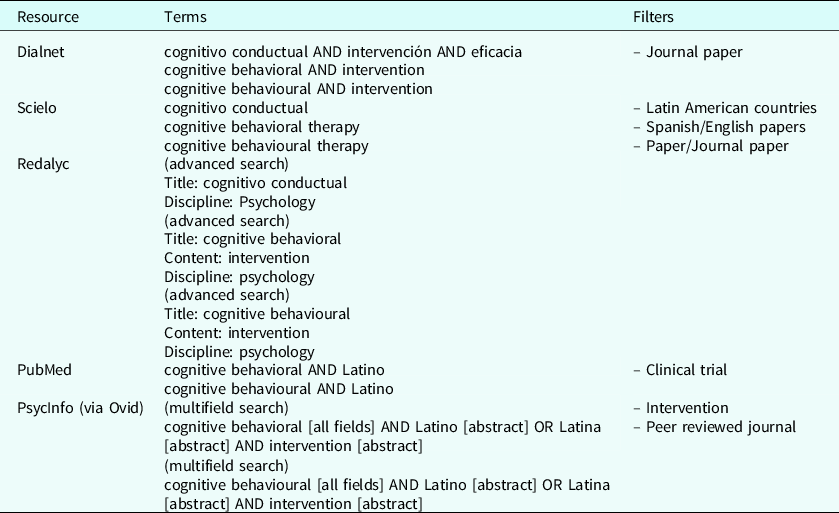
The search of papers was made through the following electronic resources: Dialnet, Scielo, Redalyc, PubMed and PsycInfo. Dialnet, Scielo and Redalyc collect predominantly publications from Hispanic countries published in the Spanish language. Therefore, these search engines were utilized to gather mostly (but not exclusively) papers from Latin American countries. Likewise, PubMed and PsycInfo were used to gather papers published in the English language and carried out in non-Latin American countries (mostly the United States, in this case). A literature search was carried out in March 2019. No restrictions were made regarding the publication date of the papers. The different search strategies that were implemented for each database are shown in Table 1. The included search terms were intentionally broad, in order to gather as many studies as possible. The term ‘Hispanic’ was omitted from the searches to avoid papers from Spain, which are not relevant for the purposes of this study.
Systematic review search terms and filters (both in Spanish and English)

Eligibility
Empirical, quantitative studies regarding the effectiveness of culturally adapted and conventional CBT were included in this review. The focus on quantitative studies was chosen given their concise and delimitated nature, which provides a more straightforward way of analysing the results of the included studies. Every study that specifically identified that it involved any type of cultural adaptation to the therapy was included (regardless of the extent of that adaptation). However, the simple use of translated/validated measures was not considered as a cultural adaptation of the therapy. Participants were Latin American, residing in Latin American countries (Mexico, Puerto Rico, Dominican Republic, Central or South America and Cuba) or in other highly developed countries. The included papers were published in the English or the Spanish language. Brazilian studies were considered if they were in the English or the Spanish language. To obtain a better estimate of the effectiveness of CBT alone, studies that included the simultaneous use of medication were omitted.
Papers found and included/excluded
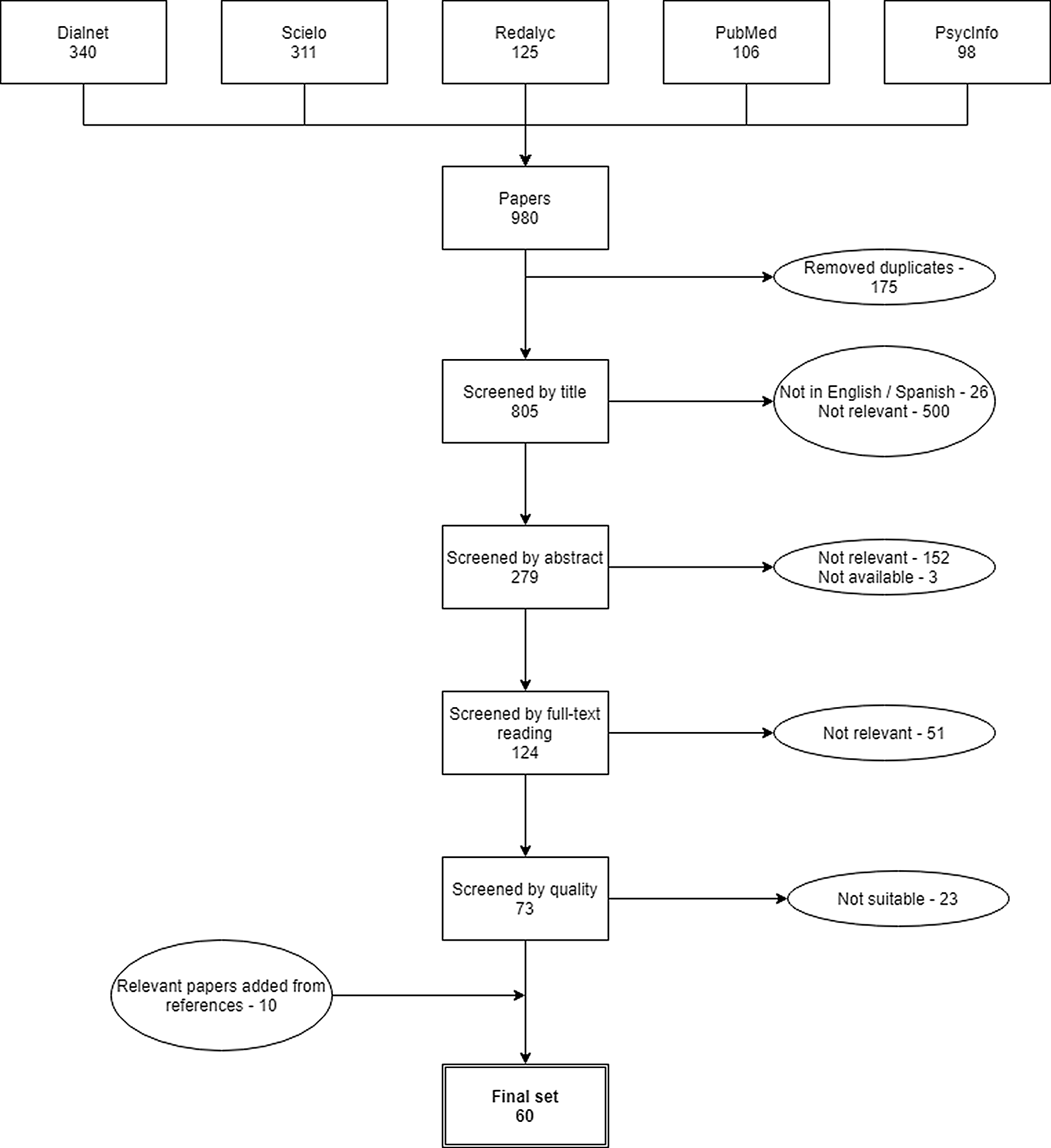
The search in the electronic databases resulted in 980 papers, which after removing the duplicates resulted in 805 papers. After the screening process (see Fig. 1), 60 papers were included in the final review.
PRISMA flow diagram.

Classification of final paper set by type of cultural adaptation
To enable the systematic analysis of the data, the information from the 60 included papers was synthesized and organized utilizing a data extraction tool, which was created by the researcher (Table 2). This data extraction tool classified the most relevant information of the included papers, namely: study aims, intervention, participants, measures, outcome, and type of cultural adaptation. As expected, the studies that evaluated regular and adapted CBT for Latin American patients in non-Latin American countries were all carried out in the United States. Therefore, these four groups (defined by the use of adapted versus non-adapted CBT either inside or outside Latin America) will be used here henceforth.
Raw data extracted from the analysed studies

The typology of cultural adaptation was based on Chu and Leino’s (Reference Chu and Leino2017) classification. This classification sorts cultural adaptations into two main categories: core and peripheral.
Core adaptations could include:
-
An addition of an extra module or element to the original therapy;
-
A modification of a core component;
-
A complete change of the component; or
-
No change at all.
Peripheral adaptations might relate to:
-
Engagement, which includes:
-
The entry/access aspect of the therapy;
-
The retention/completion of the therapy; and
-
Psychoeducation for patients with poor understanding of the psychological process.
-
-
The delivery of the therapy can be subdivided in three areas:
-
Materials and semantics relevant to the specific ethnic minority;
-
Cultural examples and themes; and
-
Therapy framework, which can imply aspects about:
-
➢ Session structure (number and duration of the sessions);
-
➢ The provider–client relationship (interpersonal style); and
-
➢ Person/place (the involvement with other collaborators in the therapeutic process, such as family members, physicians, priests, etc).
-
-
Most of the studies included in this review had peripheral adaptations. Only a handful of papers included core modifications, and some studies only mentioned making a ‘cultural adaptation’, without providing any further details.
Quality of the included papers
After reviewing the full text and ensuring that the studies were relevant for the purposes of the review, the quality of each paper was assessed by the researcher. The data extraction tool utilized to assess the quality of the papers was the Critical Appraisal Skills Programme parameters (CASP, 2017). A score was assigned to each question of the CASP, giving a possible range of 11–37. The scores were divided into tertile groups based on lower (27–29), medium (30–31) or higher (≥32) CASP scores, thus classifying the papers as low, medium or high quality.
The 23 papers excluded at the ‘screened by quality’ stage (see Fig. 1) were removed due to not having a clearly focused aim (first criterion on the CASP quality rating system), or for having a relatively poor quality score (26 points or less on the CASP evaluation). This poor quality might indicate that these studies could be methodologically weak or underpowered to make assumptions about their results. Therefore, these studies were excluded from further consideration, which resulted in the 60 papers included in this review.
In order to determine the validity of the quality ratings, a second quality assessment was conducted by an external reviewer, based on a proportion of the papers. Twelve (20%) of the 60 remaining papers were selected randomly, using a random number list generated in Excel. These papers were then evaluated by the external reviewer, also utilizing the CASP assessment tool (Appendix 1 in Supplementary material). Inter-rater reliability was calculated to determine the agreement on the quality scores provided by both the main researcher and the external examiner. Intraclass correlation resulted in an average coefficient of 0.784, and the percentage of agreement resulted in an agreement of 92%. Both of these scores indicate a strong inter-rater agreement.
Results
Characteristics of the studies included in the review
From the 60 papers included in the review, 68.3% included adult populations, 20% included adolescents, 5% children and 6.7% elderly populations. Twenty-one studies were randomized controlled trials, whereas 49 were uncontrolled effectiveness studies. Twenty-two papers were conducted in the USA, 15 in Mexico, nine in Brazil, four in Chile, four in Colombia, four in Puerto Rico, one in Argentina, and one in Costa Rica. Regarding the methodological quality of the reviewed papers, 43% were considered high quality, 43% as medium quality and 14% low quality.
Narrative summary of findings
A second data extraction tool was created by the researcher (Table 3), to detail and summarize the outcomes of the studies that were included in the review. These outcomes included whether the intervention was statistically significant, the available effect sizes, retention rates, and quality scores. Overall, the nature of adaptations was mainly peripheral (Chu and Leino, Reference Chu and Leino2017).
Summary of main outcomes

* Effect size (d) was not explicitly reported in these studies, therefore it was calculated by the researchers utilizing the provided means and standard deviations.
Adapted CBT in Latin America
Half of the papers of this group involved peripheral cultural adaptations, specifically in the delivery domain. The remainder had unspecified cultural adaptations. Five of the six studies that formed this group had significant positive outcomes, meaning that the interventions had beneficial effects for the patients. Except for one study, the effect sizes were all moderate and medium, which indicates a considerable effect of the therapy. All of the studies retained more than 50% of the patients (three of them retained more than 80%), showing a relatively high level of acceptability. The papers ranged between medium and high quality.
Non-adapted CBT in Latin American countries
Except for one paper, all the 32 studies resulted in significant improvements for the patients. Many studies had effect sizes above d = 1.00, again indicating a large effect of the intervention. Most of the studies retained more of the 75% of the patients. There were a few papers of low and high quality – most were of medium quality.
Adapted CBT for Latinos in the United States
Most of the cultural adaptations were peripheral, implemented in all of the delivery domains. A handful of studies included engagement adaptations, and only three of them had cultural adaptations at a core level. Only one of the papers had an unspecified type of cultural adaptation. All the 19 studies had significant and positive outcomes. The effect sizes (d) varied widely, ranging from 0.13 to 4.18. Most of the studies retained more than 75% of patients. The majority of the studies were rated as being of high quality, a handful of studies were medium quality, and only one study was rated as low quality.
Non-adapted CBT for Latinos in the United States
There were only three such studies. One of the studies did not disclose whether the results of the intervention were statistically significant, and did not provide the effect size or retention rate. The remaining studies reported statistically significant outcomes. However, it should be noted that one of the studies established the level of significance at 0.1. The effect sizes in these papers were medium and large. It was possible to derive the retention rate for only one of the studies, which was 89%. Two studies were rated as being of high quality, and one was rated as being low quality.
Quantitative comparison between groups
Effect sizes, retention and quality scores
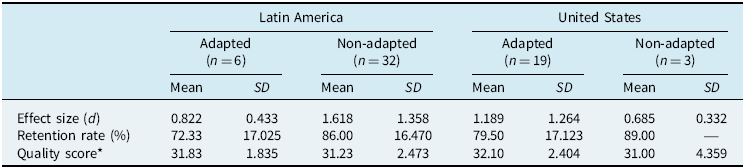
Given the low number of studies regarding non-adapted CBT in non-Latin American countries (n = 3), this group was omitted from subsequent consideration and quantitative analyses. Overall, there were no salient differences between the groups in terms of effect sizes, retention rates or quality scores (Table 4). However, the trend was for non-adapted therapy in Latin America to be superior to the adapted versions in both effect size and retention rate. The overall finding was unexpected – adapted CBT for the Latin American groups did not enhance outcome.
Quantitative comparison between the groups of analysed papers

* Possible scores range from 11 to 37.
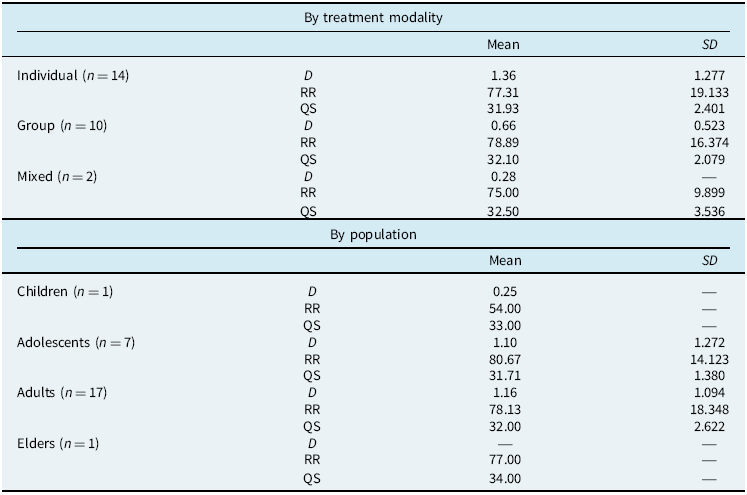
The effect sizes, retention rates and quality scores of culturally adapted interventions (both in Latin America and the US) were analysed by subgroups (Table 5), in order to analyse whether adaptations were helpful in some settings but not in others. When subdivided by treatment modality (individual, group or mixed interventions), results indicated that the effect size of culturally adapted interventions reduces considerably when delivered in group format (d = 0.66), although this effect size is still considered between medium and large. There were only two studies with mixed treatment modality (combining individual and group sessions), therefore no strong conclusions can be drawn from these data. When subdivided by populations treated, results showed that interventions with adolescents and adults are effective in terms of effect sizes, retention rates and methodological quality. There was only one intervention including children, and one intervention including elders, so again, no conclusions can be made for these populations.
Effect sizes, retention rates and quality scores of all culturally adapted interventions by subgroups

d, effect size (Cohen’s d); RR, retention rate; QS, quality score.
To determine whether the number of effective interventions differed among the groups, a chi-squared test was implemented comparing the frequency of significant and non-significant p-values between the categories. There were five studies with significant outcomes and one non-significant in the group of adapted therapy in Latin America; 29 papers from the non-adapted therapy in Latin America resulted in significant outcomes, while only one was non-significant; and finally, all of the 19 studies from the adapted therapy in the USA had significant outcomes. There was no significant difference between the groups in the proportion of significant interventions (χ2 = 4.084, d.f. = 4, p = 0.395).
Association of the quality of the studies with outcome variables
To analyse whether the quality of the studies was related to effect sizes and retention rates (as suggested by Ost, Reference Ost2014), Pearson’s correlations were used. No significant correlation was found between the quality scores and effect sizes (r = 0.246, p = 0.103), or between quality scores and retention rates (r = 0.049, p = 0.753).
Discussion
The main goal of this review was to evaluate the current evidence regarding the effectiveness of both regular and culturally adapted CBT in different locations, in order to determine whether cultural adaptations of CBT result in better outcomes for patients, as is commonly assumed (Organista and Munoz, Reference Organista and Munoz1996; Sue et al., Reference Sue, Zane, Hall and Berger2009). This review explored cultural adaptations of CBT for Latin American patients, both in Latin America and Western clinical settings. The type of cultural adaptation was also assessed. The findings of this study indicate that, contrary to our hypotheses, there were no differences between the different sets of studies in terms of effectiveness, retention rates or methodological quality. This could indicate that CBT is effective by itself, regardless of the adaptations. The majority of the cultural adaptations made to the therapy were peripheral or unspecified, rather than core adaptations (Chu and Leino, Reference Chu and Leino2017).
One of the most commonly cited studies on cultural adaptations of therapy was carried out by Griner and Smith (Reference Griner and Smith2006). Their meta-analysis found an average size effect of d = 0.45 for culturally adapted therapy for Latinos in the United States, in comparison with non-adapted therapy. Similarly, Huey and Polo (Reference Huey2008) reported an average effect size of d = 0.47 for culturally adapted therapy for Latino youths in the United States. While these studies indicate that cultural adaptations can be effective, it is important to note that these reviews included a wide range of therapies, not only CBT. Benish et al. (Reference Benish, Quintana and Wampold2011) carried out a meta-analysis of culturally adapted interventions. The average effect size for the primary outcomes was d = 0.32. Likewise, Hall et al. (Reference Hall, Ibaraki, Huang, Marti and Stice2016) reported a medium effect size (g = 0.52) on their meta-analysis for ‘culturally responsive interventions’ over non-adapted versions. Besides including several types of therapy, these two studies did not report the specific effect sizes for Latino participants. Therefore, the results of these studies reveal that cultural adaptations might be helpful, but our research indicates that this is not the case specifically for CBT with Latin American patients. Similar results have been obtained previously by Benuto and O’Donohue (Reference Benuto and O’Donohue2015), and by Casas et al. (Reference Casas, Benuto and González2020), although with different methodologies. Likewise, Benuto et al. (Reference Benuto, O’Donohue, Bennett and Casas2019) found that ethnicity is not a predictor of therapy success when delivering CBT for Latinos victims of crime. This growing body of evidence points to the same conclusion – cultural adaptations of therapy might not be the decisive factor for CBT to be effective for Latin American patients
Adapting a therapy is commonly based on the premise that the relevant patients have characteristics that prevent them from getting full benefits from that therapy in its original form. However, there is an alternative perspective – that such adaptations of evidence-based therapies represent a form of ‘broken leg exception’ (Meehl, Reference Meehl1954), where therapists assume that their patients are ‘unique’, due to their having a specific characteristic (in this case, being from a different culture). Meyer et al. (Reference Meyer, Farrell, Kemp, Blakey and Deacon2014) acknowledge this possibility in the content of their ‘Broken Leg Exceptions Scale’, suggesting that clinicians might exempt patients from an ethnic minority from undertaking exposure therapy. The resulting issue is that we are not aware of which adaptations are necessary, and which are ‘broken leg exceptions’. Further research is needed to determine the differences between these two.
Clinical implications
Creating adaptations to CBT is time consuming, and requires clinicians to learn multiple versions of the same method. As adaptation results in better outcomes in some settings (e.g. Griner and Smith, Reference Griner and Smith2006), then the necessary research is well-justified in those psychological interventions. However, in our efforts to follow recommendations (American Psychological Association, 2003; Bernal et al., Reference Bernal, Jimenez-Chafey and Domenech Rodriguez2009; Miranda et al., Reference Miranda, Duan, Sherbourne, Schoenbaum, Lagomasino, Jackson-Triche and Wells2003b; Organista and Munoz, Reference Organista and Munoz1996; Sue et al., Reference Sue, Zane, Hall and Berger2009) that we should be inclusive, we might sometimes be investing our time and effort unproductively, at least in the delivery of CBT.
The current literature does not allow us to say that there is no potential benefit of adapting CBT, but peripheral adaptations have not yet been shown to be more effective than regular CBT. Future research needs to consider whether core adaptations have greater impact (Chu and Leino, Reference Chu and Leino2017) or whether adaptations in general are effective for other non-Western populations, before one can recommend adaptations to CBT as being worth the effort invested. It will be important that adaptations should be clearly defined, so that they are replicable and comparable. Of course, therapy protocols need to be used flexibly with individual patients (Wilson, Reference Wilson1996). However, that should be done without assuming that such adaptations should be made on the basis of ethnicity per se.
The fact that cultural adaptations of CBT do not seem to offer additional benefits does not mean that clinicians should not have any cultural awareness. In order to be able to assess the patients’ cultural needs, and to determine whether a particular patient will benefit from a culturally adapted intervention, some cultural competency is needed. Cultural sensitivity can be reached through practices such as undertaking courses in diversity, supervised clinical experience with diverse populations, didactic training, experiential activities, and cultural immersion (Benuto et al., Reference Benuto, Singer, Newlands and Casas2018). However, and as Soto et al. (Reference Soto, Smith, Griner, Domenech Rodríguez and Bernal2018) recommend, it is important that clinicians address their patients’ cultural needs in a sensitive and humble way, as this has the potential to influence the treatment outcome.
Limitations
This review has a number of strengths and limitations. Firstly, it is limited by the small number of papers from non-adapted CBT in Western cultures. Also, the included studies addressed a wide range of disorders, potentially reducing comparability. This heterogeneity of studies, along with the unbalanced amount of papers in the groups, was the reason why the chosen design was a systematic review and not a meta-analysis. The tool chosen to evaluate the quality of the studies included in the review (CASP) might have influenced the findings. The CASP version utilized for this study was the randomized controlled trial one, even when not all the reviewed studies had this design. The researchers chose this tool given its conciseness and clearness, and adapted it to include both effectiveness and efficacy studies. However, future studies should consider other quality assessment tools, such as the Quality Assessment Tool for Quantitative Studies (EPHPP: Effective Public Health Practice Project, 1998), or the Downs and Black Checklist (Reference Downs and Black1998).
The study did not consider ‘grey literature’ (resources published outside academic papers), which could have resulted in a publication bias. However, grey literature often includes less rigorous methodological procedures, meaning that its inclusion in this review could have made the results less reliable. Other aspects to consider rely on the fact that Latin America and the United States might be not so culturally different from each other. The geographical closeness, as well as the influence of immigration and media, might reduce the ‘cultural distance’ between these regions. Therefore, a similar review including papers from other cultures might indicate whether cultural adaptations of therapy are more effective in different locations, and considering other individual therapies. Likewise, a further issue to consider in such studies is the degree to which the individual patient is acculturated to the local norms.
One might question whether the group of studies labelled as ‘regular CBT delivered in Latin America’ should be considered ‘regular’, as the cultural context is already different, the providers are immersed in it, and the materials are translated. This might suggest that some adaptations have been already made to the therapy, even if they are not explicitly stated. However, even if that were the case, such adaptations would only be superficial and based on the therapist’s own judgement. It should be also stressed that ‘translation’ and ‘validation’ are non-equivalent processes. Therefore, it is unlikely that such adaptations modify CBT enough to consider it ‘culturally adapted’.
In terms of strengths, this study included Hispanic databases and included non-English language studies, which are often overlooked. Furthermore, the nature of adaptations was considered, and the quality of the papers was taken into account and assessed. This approach provides a novel and comprehensive approach to the topic, where Latin American studies are often disregarded, and the type of adaptation is mostly ignored.
Supplementary material
To view supplementary material for this article, please visit: https://doi.org/10.1017/S1754470X20000574
Acknowledgements
The authors would like to thank Ligia Orellana and Jose Sepulveda for their support with the quality assessment of the papers included in this review.
Financial support
This work was supported by the National Council of Science and Technology (Mexico – grant number 411170).
Conflicts of interest
None.
Ethical statement
No ethical approval was needed for the elaboration of this research. Authors have abided by the Ethical Principles of Psychologists and Code of Conduct (American Psychological Association, 2017) as set out by the BABCP and BPS.
Key practice points
-
(1) The evidence to date does not support the need for cultural adaptations of CBT for Latin American populations.
-
(2) Creating cultural adaptations to CBT is not without cost, as it is time consuming, and clinicians need to learn multiple versions of the same method.
-
(3) Therapists might be better encouraged to focus their efforts on improving the way they deliver CBT through training and supervision.
-
(4) Cultural needs will still need to be addressed with some patients. Clinicians are encouraged to discuss the best way to do so with their patients, rather than taking this decision unilaterally.






Comments
No Comments have been published for this article.