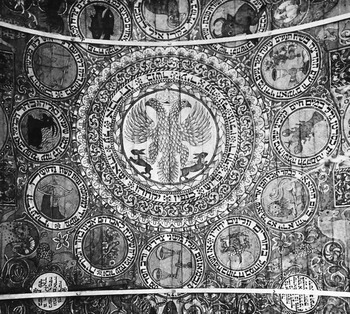
When in 1714 the artist Israel ben Mordecai Liśnicki from Jaryczów painted the interior of the wooden synagogue of Chodorów,Footnote 1 today in the L'viv (Polish, Lwów) region of western Ukraine, he did not know that one of his paintings would be the subject of divergent interpretations by art historians some three hundred years later. The controversy centers around the depiction of an eagle grasping in its talons two hares trying to escape outward. The hares are grasped by the neck (fig. 1). This depiction, located in the center of the ceiling, is surrounded by a decorative medallion inscribed with the verse “Like an eagle who rouses his nestlings, gliding down to his young, so did He spread His wings and take him, bear him along on His talons” (Deuteronomy 32:11). In the background are the twelve signs of the zodiac.Footnote 2
Eagle and hares, detail of ceiling painting, Chodorów synagogue, Ukraine, 1714. Photograph: A. Breier, before 1913. (Tel Aviv Art Museum, Prints and Drawings Department)

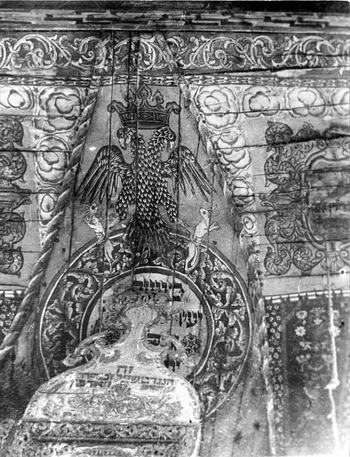
A similar image was painted in 1746 on the ceiling of the wooden synagogue of Smotrycz, also in Ukraine, in the Podolia region.Footnote 3 There the eagle is depicted above the Torah ark, its talons grasping the hares around the center of their bodies (fig. 2). The inscription “Like an eagle…” is inscribed in this case beneath the eagle, within a stylized floral medallion. In both these synagogues the eagle is crowned and two headed, as was common in the European heraldic tradition. Although other similar images may have existed on synagogue ceilings, the available photographic material limits our discussion to these two only.Footnote 4
Eagle and hares, detail of ceiling painting, Smotrycz synagogue, 1746. Photograph: S. A. Taranushchenko, 1920s. (National Library of Ukraine, Kiev, Department of Manuscripts)

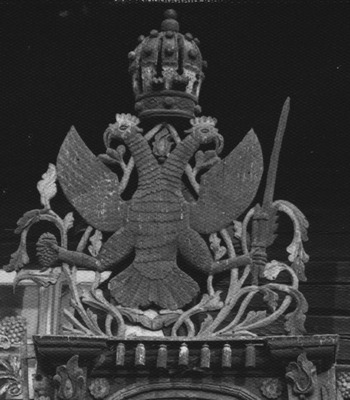
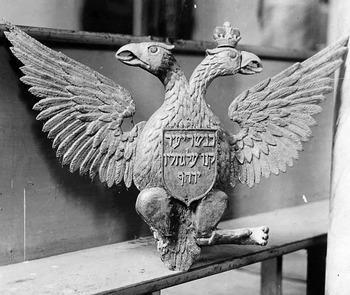
In both cases, the images consist of two components, the eagle and the hares, known in Jewish art. The many depictions of eagles differ in their components, composition, and iconography, but they were all considered metaphoric allusions to God, based on the above-mentioned verse, “Like an eagle….” When single- or double-headed eagles top hanging lamps in synagogues, for example, their meaning is a divine presence disseminating the light of the Torah.Footnote 5 Single-headed eagles appeared frequently during the sixteenth century in title pages of Hebrew printed books, without any connection to the content of the work.Footnote 6 Eagles also allude to God when depicted on tombstones in eastern Europe.Footnote 7 Since the mid-eighteenth century double-headed eagles have appeared frequently on top of wooden Torah arks in eastern Europe in the current territories of Latvia, Lithuania, Poland, and Ukraine, as can be seen on the Torah ark of the synagogue in Vyžuonos, Lithuania, from the second half of the eighteenth century (fig. 3). That eagle is also a metaphor for God, but it also has an eschatological element—a shofar and/or the Four Species. Given the instruction that encircles the eagle and the hares in the two paintings under discussion, this eschatological element is not even questioned.
Eagle, detail of Torah ark, Synagogue of Vyžuonos, Lithuania, second half of the eighteenth century. (Yad Vashem, no. 210B03).

The hare, the focus of this study, is also familiar to us. It is depicted in a few illuminated medieval haggadot and later in printed haggadot. In those illustrations the hares are being chased by a hunter and his dogs, thus suggesting the well-known iconography of the persecuted Jews.Footnote 8 But is this medieval iconography of the hares relevant to the wooden ceilings in eastern Europe in the early eighteenth century?
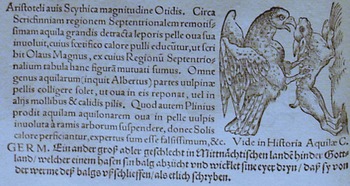
Moreover, do the hares, grasped in the eagle's talons, allude to Jews protected by the metaphoric eagle—God, as suggested by some scholars?Footnote 9 This interpretation seems strange, since the eagle is known for bearing its nestlings on its wings, as in the verse from Deuteronomy and in an additional biblical passage: “I bore you on eagles' wings and brought you to Me” (Exodus 19:4). Moreover, grasping the hares by their necks or around their body is the typical manner in which eagles are depicted taking hold of their prey in nature as well as in contemporary works of biology. A drawing in Icones animalium by Conrad Gesner, published in Zurich in 1560, exemplifies the common concept of the eagle with its typical prey, a hare, as suggested by the drawing and the text in Latin and German (fig. 4). Given these examples, one would seek a different interpretation of the hare and its connection with the eagle in the two synagogue images.
Conrad Gesner, Icones animalium quadrupedum viviparorum et oviparorum, 2nd ed. (Zurich: C. Froschauer, 1560), 4 (detail)

Seeking a biblical reference to the hare, one finds that it is mentioned in a list of creatures that are unfit for eating according to Jewish law: the camel, the daman, the hare, and the pig. The verse referring to the hare reads: “The following, however, of those that either chew the cud or have true hoofs, you shall not eat…. The hare—although it chews the cud, it has no true hoof: it is unclean for you” (Leviticus 11:4, 6). The same instructions are repeated in Deuteronomy 14:7.
This verse was the subject of many literary references, of which the earliest and most frequently cited appears in Vayikra Rabba in a discussion about the four kingdoms that will oppress the people of Israel. Basing themselves on various biblical verses, the sages mention several empires and allude to them in a metaphoric way as four elements, for example, four rivers flowing from the Garden of Eden, four cruel beasts, or four creatures unfit for eating. This midrash identifies the hare with the kingdom of Greece: “The hare alludes to Greece; the name of the mother of Ptolemy was hare.”Footnote 10 Indeed, lagos, the Greek term for “hare,” was according to tractate Megillah the name of the wife of Ptolemy Philadelphus, the second king of the Ptolemaic dynasty, who ruled Egypt in the years 285–246 BCE and commissioned the Septuagint, the translation of the Bible into Greek.
Tractate Megillah tells the following story about Ptolemy:
It happened to Ptolemy the king that he took seventy-two elders from Jerusalem, and placed them in seventy-two separate chambers, and did not inform them to what purpose he had brought them. And afterward he entered to each of them, and said to them: Translate me the Torah of Moses from memory…and they wrote for him [in the portion of the Torah that lists the nonkosher animals]: “את צעירת הרגלים” the young-legged creature.Footnote 11 And they did not write for him “and the hare” because the name of Ptolemy's wife was Hare. So that [Ptolemy] should not say: The Jews mock me and they inserted my wife's name in the Torah.Footnote 12
This interpretation of the hare as an allusion to Greece was repeated many times in homiletic and exegetic literature, from antiquity in the Land of IsraelFootnote 13 and from the Middle Ages onward in Europe.Footnote 14 After the sixteenth century, with the flourishing of Hebrew printing, the homiletic and exegetic literature became more readily available, and thus the allusion of the hare to Greece was more widely known. One of the books that contributed to the spread of this imagery was the work of the Italian rabbi Menaḥem ben Benjamin Recanati (1250–1310). Recanati identified the hare with the kingdom of Greece by a metaphoric reference to its long legs and short front limbs.Footnote 15 His Perush ‘al ha-Torah, a kabbalistic work based on textual interpretation of the Pentateuch, was already known and popular among the Jews of Poland in the sixteenth century.Footnote 16 Concurrently, the connection of the hare to Greece was spread through the newly printed kabbalistic literature, of which just one example was Rabbi Isaiah Horowitz's Shnei luḥot ha-brit, his most important book and the basis of the acronym Shelah by which he was known. In this ethical compilation on the Pentateuch, widely appreciated among the Jewish population in eastern Europe,Footnote 17 Horowitz also refers to Vayikra Rabba 13:5, and repeats its wording:, “ואת הארנבת זו יון” i.e., “The hare [Leviticus 11:6] alludes to Greece.”Footnote 18
In light of the above, one may conclude that the connection of the hare to Greece was known among the European Jews from various literary sources, all of which stemmed from its early appearance in Vayikra Rabba 13:5. We might assume that learned individuals would have been familiar with it directly from the common literature while the unlearned would have heard it from the oral homiletic presentations in the synagogue on various occasions of the yearly cycle. The most suitable occasions were the weekly lessons on the weekly Torah portions that included Leviticus 11:6 or Deuteronomy 14:7. But there were many additional occasions on which the biblical text under discussion was linked to the kingdom of Greece.
An early homiletic source was the Mekhilta de-Rabbi Ishmael, which refers to Genesis 15, in which Abraham foresaw in his vision the four kingdoms that would in the future oppress his descendants.Footnote 19 Referring to this text, the midrash explains the words “a dread, even a great darkness, was falling upon him [Gen. 15:12]. ‘A dread,’ refers to the Babylonian Empire. ‘Darkness,’ refers to the empire of Media. ‘Great,’ refers to the Greek Empire.”Footnote 20 Here, Greece is referred to with a negative connotation. Bereshit Rabba also connects Greece to “darkness”: “And darkness symbolizes [the exile of] Greece, which darkened the eyes of Israel with its decrees ordering Israel; ‘Write on the horn of an ox that ye have no portion in the God of Israel.’ ”Footnote 21
No doubt, in most of the literary sources Greece raised negative connotations due to its reign over the Land of Israel and mainly because of the oppressions of Antiochus Epiphanes in the year 167 BCE, which inspired the Maccabean revolt and the rededication of the Temple in Jerusalem. Through commemoration and celebration of this historical event each year on Hanukkah, every Jew was aware from childhood of the suppression of Israel by Greece. The prayer recited during the days of Hanukkah notes the maliciousness of the kingdom of Greece with the following words: “In the days of the Hasmonean…when the iniquitous power of Greece rose up against thy people Israel to make them forgetful of thy Torah.…”Footnote 22 On other occasions of the yearly cycle they learned and discussed the malicious nature of Greece through other literary sources. One of the most popular was Midrash Tehillim, an early homiletic text on the book of Psalms from the early centuries CE. Praising the Lord for His help, King David lists the calamities brought upon him by his enemies. Among them is “the sufferings of Sheol” (Psalm 18:6). When the midrash refers to this expression, it indicates “Sheol's suffering under the rule of Greece.”Footnote 23 As a response to these distressing texts, the Jews could find comfort in the midrash Tanḥuma-Yelammedenu, which provides a prophecy of the fall of Greece, one of the four evil kingdoms, as happened to Babylon, Media, and Rome.Footnote 24
Since our study deals with the depiction of the hares in eighteenth-century synagogues in eastern Europe, one would wonder what is the connection of the above-mentioned literary sources about ancient Greece to contemporary ceiling paintings, but, when reading contemporary local literature, the link becomes clear and persuasive.
Shir ge'ulah (a song of deliverance), written in Lwów in 1609, is relevant to this discussion with regard to both period and place. The poem was composed after a period of four and a half years in which the Turei Zahav Synagogue in Lwów was confiscated from the Jews at the demand of the local Jesuits. When it was restored, Rabbi Isaac ben Samuel ha-Levi Segal composed this poem, which glorifies the deliverance from the hostile kings of Babylon and Media, the Edomites, and the Ishmaelites, who were at the time considered the descendants of the Greeks.Footnote 25 The use of the ancient motif of the four evil kingdoms and reference to the Jews' modern opponents in terms of the ancient kingdoms comes as no surprise, since this metaphoric mode of expression was common in contemporary Jewish literature.Footnote 26 Moreover, this traditional way of indicating a metaphor enabled the Jews to express themselves in a hidden, more confidential manner. When Shir ge'ulah was read from prayer books in other synagogues of Poland as part of the morning prayer on the Saturday following Purim,Footnote 27 their coreligionists understood quite well who were the Babylonians, Medians, Greeks, and Edomites.
The Jews were more specific, even indicating Greece precisely, in their literature concerning the massacre of 1648–49 by Bogdan Chmielnicki in the eastern part of the Polish kingdom—today Ukraine.Footnote 28 The earliest documentation of the historical events was published in 1650 by Meir ben Samuel in Cracow under the title Ẓok ha-‘itim, “time of distress” (Daniel 9:25).Footnote 29 In his narrative of the events, he had the Polish king speak of the attack by the “Greeks,” when he was really referring to the uprising of the Ukrainians.Footnote 30
Another documentary text by Abraham ben Samuel Ashkenazi mentions a father and son who were cruelly slaughtered by the “Greeks.”Footnote 31 Additional direct references to the cruel Ukrainians as “Greeks” are repeated in lamentations and prayers in memory of the victims.Footnote 32 The reason for the precise identification of their Ukrainian persecutors as Greeks was explained by Nathan Nata Hannover (1620?–1683), an eyewitness to the Chmielnicki massacres of 1648–49, who fled and found refuge in Italy. In his book Yeven Meẓulah (Abyss of Despair), which was printed for the first time in Venice in 1653, Hannover described the disastrous persecutions and analyzed the social and religious reasons for the Ukrainian uprising. In his introduction he explained:
In his [King Sigismund's] days the religion of the Pope gained strength in the Kingdom of Poland. Formerly most of the dukes and the ruling nobility adhered to the Greek faith, thus the followers of both faiths were treated with equal regard. King Sigismund, however, raised the status of the Catholic dukes and princes above those of the Greeks, so that most of the latter abandoned their Greek faith and embraced Catholicism. And the Greek nation became gradually impoverished. They were looked upon as lowly and inferior beings and became the slaves and the handmaids of the Polish people and of the Jews.Footnote 33
The direct identification of the Ukrainians with the Greeks is, thus, based on the fact that the Ukrainians belonged to the Greek Orthodox Church.Footnote 34 Moreover, Hannover associated their deeds with the ancient decrees of Antiochus, who, according to tradition, sought to eradicate the Jewish religion. Thus, like his predecessors Hannover used midrashic terminology and cited the previously mentioned Bereshit Rabba: “Greece, which darkened the eyes of Israel with its decrees, ordering Israel, ‘Write on the horn of an ox that ye have no portion in the God of Israel’” (Bereshit Rabba, par. 2:4).
No doubt, when in the second half of the seventeenth century Jews on Ukrainian territory referred to the “hateful Greeks,” they had in mind the local Greek Orthodox population, against whom they called for revenge. But taking revenge while living within the same hostile population was impossible. Jews could express such desire only in a metaphoric way, its meaning obscure to the gentiles. They did so by using the hare to refer to “Greeks,” their enemies.
Tracing literary expressions of revenge, we come across the seliḥot for the twentieth of Sivan, the special prayers of lamentation for the fast day commemorating the massacre of 1648–49. The call for revenge is expressed among the descriptions of the traumatic events, and God is called upon to revenge the blood that was shed. One of these seliḥot, published in DyhrenfurthFootnote 35 in 1772, includes biblical verses like “The Lord will bare His holy arm in the sight of all the nations” (Isaiah 52:10); “The Lord goes forth like a warrior, like a fighter He whips up His rage” (Isaiah 42:13); “God of retribution” (Psalm 94:1); “Champion my cause and redeem me” (Psalm 119:154); and “He will show no pity on His day of vengeance” (Proverbs 6:34).Footnote 36
But the most surprising text is the popular poem Perek shirah, a short text containing words of praise for the Creator spoken by his creatures. The verses of this poem are arranged in midrashic style and in fact are biblical quotations, mostly from the Psalms.Footnote 37 Among these creatures is the eagle, who calls for revenge by saying: “You, O Lord God of hosts, God of Israel, bestir Yourself to bring all nations to account; have no mercy on any treacherous villain. Sela” (Psalms 59:6).Footnote 38 The meaning of the common metaphor of eagle as the merciful God (“Like an eagle…,” Deuteronomy 32:11), thus, shifted from representing the caring father of Israel to calls for revenge.Footnote 39
The Jewish community of Chodorów suffered severely from the persecutions of 1648. Building the new synagogue, or perhaps restoring one that was destroyed, indicates that the survivors tried to recover and return to normal life. The inscription on the ceiling and the paintings by Israel ben Mordecai Lisnizki were done in 1714, but since the synagogue had undergone several renovations earlier, it is possible that the ceiling painting were created earlier. But even if that is not the case, in 1714 the collective memory of the 1648–1649 pogroms was likely still very much alive, continuing to arouse a desire for vengeance. That desire was expressed on the ceiling of the synagogue by the painting of the hares in the talons of the eagle. Their position, trying but failing to flee within the medallion on the ceiling of the Chodorów synagogue, leaves no chance for the hares to escape the eagle's anger. The fate of the hares in the Smotrycz synagogue is even worse; they are caught around their bellies with no option to move, except to turn their heads toward the eagle.
No doubt, merciless revenge does not correlate with the verse inscribed, referring to the merciful father: “Like an eagle who rouses his nestlings, gliding down to his young, so did He spread His wings and take him, bear him along on His talons” (Deuteronomy 32:11). Was there another verse available for the definition of the eagle as a metaphor of God? The answer to this question is suggested by the image of a similar eagle, painted in 1740 on the upper ceiling in the synagogue of Mohylew on the Dnieper, in Belarus—an eagle without hares.Footnote 40 The location of the eagle on the highest level of the ceiling suggests an iconography of a ruling power, which is indeed confirmed by the inscribed medallion that consists of the two verses with which we are already familiar: “Like an eagle who rouses…. ” (Deuteronomy 32:11); and “I bore you on eagles' wings …” (Exodus 19:4).
These two verses are the only and ultimate literary sources for the metaphoric concept of the eagle as God and of his relation to the people of Israel. Thus Jews felt free to depict the eagle not only as a painted image on the ceiling, but also as a freestanding sculpture on top of the Torah ark, as seen in the synagogue of Vyžuonos (fig. 3). None of the eagles upon the Torah arks, however, were designed to reflect the biblical metaphor of the eagle “rousing over its nestlings,” or bearing them on its wings. Instead, the images adopted a double-headed eagle used by some European powers as symbols of sovereignty crowned double headed Eagle. One example is the eagle atop the Torah ark of 1847 in Bauska, Latvia (fig. 5).Footnote 41 This eagle, too, was not designed as rousing over its nestlings or bearing them on its wings. Still, it is identified as the metaphoric God by the inscribed familiar verse of Deuteronomy 32:11. In the Mohylev synagogue a similarly abstract concept appears. The two relevant verses indicate the identity of the eagle, with no need for a pictorial description. The same can be said about the images of the eagles in Chodorów and Smotrycz. Deuteronomy 32:11 ensures the identity of the eagle as the metaphor of God, and the content of the depiction is determined by the two hares.
Eagle (removed), detail of Torah ark, Great Synagogue of Bauska, Latvia, 1844–47. Photograph: Visvaldis Peņģerots, 1930 (Center for Monuments' Documentation at the State Inspection for Protection of Cultural Monuments of Latvia, CDM 24575).

Through the image of an eagle grasping the hares, the Jews in eastern parts of the Polish-Lithuanian commonwealth, now Ukraine, expressed a hidden message of vengeance. The message, based on a long Jewish literary tradition, connected the hare, a creature unfit for eating according to Jewish law, to the Greek kingdom considered hostile to “the people of Israel.” After the massacres of 1648–49, this link became loaded with contemporary significance, with the hares-Greeks now identified with the Ukrainians. These circumstances also help explain why these images are found in this particular geographic area.Footnote 42