An important topic in psycholinguistic research is the nature of sentence representations during language comprehension. Information from several sources is used to yield an interpretation of a sentence. Syntactic processing is usually considered an essential step, as the comprehender has to build a syntactic structure according to the morphosyntactic rules of a language. Traditional theories assume that language processing is based on complete and detailed representations of the input. In addition to syntactic algorithms, sentence comprehension may be driven by nonsyntactic constraints and simple processing heuristics. The good-enough approach to language comprehension assumes that the comprehender has access to two processing routes: a complete syntactic route and a heuristic route that utilizes word order and plausibility heuristics to produce sufficiently good representations of sentences (F. Ferreira, Reference Ferreira2003; Ferreira, Bailey, & Ferraro, Reference Ferreira, Bailey and Ferraro2002). While the comprehender uses a combination of syntactic algorithms and heuristics, he or she could bypass a full syntactic analysis when faced with complex or temporarily ambiguous structures. Under the good-enough account of processing, the comprehender may settle for an interpretation of a temporarily ambiguous sentence based on heuristics rather than on elaborate syntactic algorithms. The good-enough representation of a sentence may be incomplete and incompatible with the actual input, as supported by the misinterpretation of garden-path and passive sentences.
The syntactic algorithm and the heuristic parser may generate different representations of temporarily ambiguous sentences such as (1).
-
(1) The student praised by the principal received good grades.
The example sentence is temporarily ambiguous between a past-tense main clause and a passive reduced relative clause structure. In neutral contexts, the past-tense main clause structure is typically the preferred interpretation, resulting in increased processing difficulty if the sentence is disambiguated toward the passive reduced relative analysis at the by-phrase (Altmann, Reference Altmann1998; Frazier & Clifton, Reference Frazier, Clifton, Fodor and Ferreira1998; MacDonald, Pearlmutter, & Seidenberg, Reference MacDonald, Pearlmutter and Seidenberg1994; McRae, Spivey-Knowlton, & Tanenhaus, Reference McRae, Spivey-Knowlton and Tanenhaus1998; Trueswell, Reference Trueswell1996; Trueswell, Tanenhaus, & Garnsey, Reference Trueswell, Tanenhaus and Garnsey1994). The main clause/reduced relative clause ambiguity has also been shown to pose parsing difficulties for second language (L2) readers when the initial interpretation must be revised upon disambiguation (Yang & Shih, Reference Yang and Shih2013). According to the good-enough approach, sentence comprehension could be based on heuristics, such as assignment of an agent role to the first noun phrase and plausibility of the initial noun phrase as agent. The comprehender may not construct an elaborate syntactic representation for the difficult sentence, as heuristics offer a faster route. Compared to first language (L1) processing, L2 processing may be even more reliant on lexical or word-order heuristics while computing shallow good-enough syntactic representations (Clahsen & Felser, Reference Clahsen and Felser2006; Felser, Roberts, Gross, & Marinis, Reference Felser, Roberts, Gross and Marinis2003).
To clarify whether the comprehender constructs an abstract syntactic representation for a temporarily ambiguous sentence, the study utilized structural priming as a means to probe syntactic representations during sentence comprehension. Structural priming is the tendency to repeat a structural pattern that has been previously encountered (Bock, Reference Bock1986). The paper used the term structural priming rather than syntactic priming because part of structural priming might result from nonsyntactic sources (e.g., Bock, Loebell, & Morey, Reference Bock, Loebell and Morey1992). Prior exposure to a particular syntactic structure facilitates subsequent processing of the same or a related structure. For example, if people encounter a sentence with passive voice, they are more likely than normal to use passives in subsequent sentences. Structural priming taps into syntactic representation, as at least part of the priming effect depends on the repetition of syntactic structure across sentences and cannot be fully accounted for by the repetition of lexical items (e.g., Bock, Reference Bock1989; Pickering & Branigan, Reference Pickering and Branigan1998) or thematic role order (e.g., Bock & Loebell, Reference Bock and Loebell1990; Pickering, Branigan, & McLean, Reference Pickering, Branigan and McLean2002; Salamoura & Williams, Reference Salamoura and Williams2007). The occurrence of structural priming suggests that a syntactic representation is constructed and shared across primes and targets.
A few studies have used structural priming to investigate sentence comprehension and production in a bilingual context (Bernolet, Hartsuiker, & Pickering, Reference Bernolet, Hartsuiker and Pickering2007; Chen, Jia, Wang, Dunlap, & Shin, Reference Chen, Jia, Wang, Dunlap and Shin2013; Desmet & Declercq, Reference Desmet and Declercq2006; Hartsuiker, Pickering, & Veltkamp, Reference Hartsuiker, Pickering and Veltkamp2004; Kidd, Tennant, & Nitschke, Reference Kidd, Tennant and Nitschke2015; Loebell & Bock, Reference Loebell and Bock2003; Salamoura & Williams, Reference Salamoura and Williams2006, Reference Salamoura and Williams2007; Schoonbaert, Hartsuiker, & Pickering, Reference Schoonbaert, Hartsuiker and Pickering2007; Shin & Christianson, Reference Shin and Christianson2009; Weber & Indefrey, Reference Weber and Indefrey2009). These studies address the question of how bilinguals represent syntax in their two languages. By examining cross-linguistic structural priming, inferences can be drawn about whether bilinguals have two separate syntactic systems or one integrated system with some information shared between the languages. Cross-linguistic priming provides evidence for shared syntactic representations in bilinguals. There are, however, limited studies on cross-linguistic priming in sentence comprehension, and the priming effects are complicated by the influences of word-order and lexical repetition between primes and targets.
Most comprehension studies investigate structural priming using temporarily ambiguous sentences, with the hypothesis that processing of a dispreferred structure would be easier than normal when target sentences are preceded by syntactically related primes. Presumably, priming could enhance the availability of a dispreferred structure and thus reduce comprehension difficulty at disambiguation. Under a lexicalist account of parsing, a primed syntactic representation is accessed via the lexical item that appears in both prime and target sentences. In contrast, a nonlexicalist approach suggests that syntactic information is not bound to specific words and that activation of a structure can be lexically independent. Thus, structural priming can occur in the absence of lexical overlap across sentences. The small body of comprehension research has produced inconclusive evidence regarding the effects of lexical repetition on structural priming. In many cases, comprehension priming appears to be lexically dependent and subject to a lexical boost (Tooley & Traxler, Reference Tooley and Traxler2010). Nevertheless, a few studies did find verb-independent structural priming in comprehension (e.g., Pickering, McLean, & Branigan, Reference Pickering, McLean and Branigan2013; Thothathiri & Snedeker, Reference Thothathiri and Snedeker2008; Traxler, Reference Traxler2008).
Furthermore, while robust structural priming has been observed across languages with structures of the same word order, it remains unclear whether structures of different word order can prime each other. Cross-linguistic differences in word order have raised the important question of how bilinguals represent similar structures that have different word order in their two languages. Two models have been proposed based on different assumptions concerning whether people construct syntactic representations in one stage or two stages during sentence processing. A two-stage account (e.g., Bock & Levelt, Reference Bock, Levelt and Gernsbacher1994; Garrett, Reference Garrett and Butterworth1980; Hartsuiker, Kolk, & Huiskamp, Reference Hartsuiker, Kolk and Huiskamp1999; Hartsuiker & Westenberg, Reference Hartsuiker and Westenberg2000) distinguishes functional and positional level of syntactic construction. Functional-level processing selects lexical items to express conceptual content and then assigns grammatical functions (e.g., subject or object) to constituents carrying thematic roles (e.g., agent or patient). Positional-level processing then imposes word order on the constituent structure through a linearization process. In other words, syntactic representation includes a functional level of unordered constituent structure and a separate positional level of linear ordering. Under this account, bilinguals have shared representations of equivalent structures in their two languages, regardless of word order. In contrast, a one-stage account of syntactic construction (e.g., Pickering et al., Reference Pickering, Branigan and McLean2002) maintains that both hierarchical and linear relations between constituents are computed simultaneously at a single level. The positional information of constituent structures is encoded along with the functional level of syntactic representation. From this viewpoint, structures that differ in word order across languages are represented separately (De Bot, Reference De Bot1992; Ullman, Reference Ullman2001). Bilingual research has yielded inconsistent findings supporting either a one-stage (e.g., Bernolet et al., Reference Bernolet, Hartsuiker and Pickering2007; Kidd et al., Reference Kidd, Tennant and Nitschke2015; Loebell & Bock, Reference Loebell and Bock2003; Pickering et al., Reference Pickering, Branigan and McLean2002) or a two-stage (e.g., Chen et al., Reference Chen, Jia, Wang, Dunlap and Shin2013; Desmet & Declercq, Reference Desmet and Declercq2006; Shin & Christianson, Reference Shin and Christianson2009; Weber & Indefrey, Reference Weber and Indefrey2009) account of syntactic construction.
In an attempt to explain the interaction between lexical and syntactic processes during bilingual processing, Hartsuiker et al. (Reference Hartsuiker, Pickering and Veltkamp2004) proposed an integrated model of representation (i.e., shared lexicon and shared syntax), which is an extension of Pickering and Branigan's (Reference Pickering and Branigan1998) lexicalist model. Before we review the theoretical accounts in detail, it is important to note that Hartsuiker et al.’s model is based on a limited number of studies on structural priming in bilingual production. Hartsuiker and Pickering (Reference Hartsuiker and Pickering2008) emphasized the need for more empirical data to inform the bilingual representation model. The present study adopted Hartsuiker et al.’s integrated model of representation, as it is specifically concerned with the interface between lexical access and structural building in bilingual processing.
Hartsuiker et al. (Reference Hartsuiker, Pickering and Veltkamp2004) proposed that the lexicon and syntax are shared between the two languages of a bilingual. More specifically, bilinguals have a single integrated lemma stratum that contains language-specific lemma nodes. Each lemma node, which represents the base form of a word (e.g., hit in English and golpear in Spanish), is linked to a specific language node (e.g., English or Spanish), as well as to a shared conceptual node (e.g., HIT [X, Y]), category node (e.g., verb), and combinatorial nodes (e.g., active or passive structure). The experience with a passive structure will activate the passive combinatorial node as well as the verb lemma used in the structure. The passive combinatorial node will remain active and thus will facilitate subsequent processing of a passive structure. Structural priming also occurs across languages because the activated combinatorial node is linked to both languages. Bilinguals can be primed to use a passive structure even if it appears in a different language. This suggests that an integrated syntactic representation (as specified in a combinatorial node) is accessed during the processing of the same structure in the two languages. Furthermore, encountering identical or translation-equivalent verbs across sentences will boost structural priming because additional activation will arise from the link between a verb lemma and a combinatorial node. Nevertheless, Hartsuiker et al.’s model does not specify whether grammatical function and word-order information are differentiated for combinatorial nodes, as their model was proposed based on priming between Spanish and English passives with an identical word order. As mentioned above, controversy exists as to whether grammatical encoding occurs in one stage (a single level of syntactic representations with word order as an integral part) or two stages (two separate levels of functional and positional representations).
In the following section, we discuss lexical and word-order effects on cross-linguistic structural priming during sentence comprehension, which could inform a model of bilingual representation. Then, we describe the experiment and draw predictions about cross-linguistic structural priming based on Hartsuiker et al.’s (Reference Hartsuiker, Pickering and Veltkamp2004) model.
LEXICAL EFFECTS ON STRUCTURAL PRIMING DURING COMPREHENSION
Previous studies indicated that structural priming affected online comprehension of ambiguous sentences, such as those involving reduced relative/main clause, double object/prepositional object, or early/late closure ambiguity. These studies also suggested that priming effects were enhanced with identical verbs in prime and target sentences. Eye-tracking and self-paced reading data showed that total reading times on the disambiguating region (i.e., the by-phrase) were reduced when targets and primes shared verbs but not when they contained synonymous or different verbs (Tooley, Traxler, & Swaab, Reference Tooley, Traxler and Swaab2009; Traxler & Tooley, Reference Traxler and Tooley2008; Traxler, Tooley, & Pickering, Reference Traxler, Tooley and Pickering2014). Likewise, Arai, van Gompel, and Scheepers (Reference Arai, van Gompel and Scheepers2007) and Carminati, van Gompel, Scheepers, and Arai (Reference Carminati, van Gompel, Scheepers and Arai2008) claimed that structural priming in dative structure required verb repetition. The eye-movement data revealed that after listening to a double-object prime, participants were anticipating a recipient immediately following the verb as in a double-object dative structure. The priming effect was only present with verb overlap between prime and target. Traxler (Reference Traxler2015) found facilitated processing of an early closure sentence after reading an early closure prime with a repeated verb. In addition, Melinger and Dobel (Reference Melinger and Dobel2005) demonstrated that a single verb presented in isolation was sufficient to prime a particular syntactic frame. Dutch and German native speakers were more likely to reuse the primed dative structure after being exposed to nonalternating ditransitive verbs that were restricted to either prepositional or double-object dative construction, for example, contribute only used in prepositional datives and fine only in double-object datives. The authors concluded that a verb's argument structure is lexically encoded and can be used immediately to resolve syntactic ambiguity during sentence processing.
The findings of verb-specific structural priming effects have led to the proposal that sentence comprehension is guided by lexically dependent syntactic information, which can be accessed during word retrieval (Levelt, Roelofs, & Meyer, Reference Levelt, Roelofs and Meyer1999; Pickering & Branigan, Reference Pickering and Branigan1998; Roelofs, Reference Roelofs1992). On this view, prior exposure to a verb in a particular syntactic context strengthens the connection between the verb and the relevant syntactic structure. Thus, when the same verb is repeated in subsequent sentences, the associated structure would be primed and become more readily available than normal. According to Hartsuiker et al. (Reference Hartsuiker, Pickering and Veltkamp2004), encountering a repeated verb across sentences will activate both the same verb node and the combinational node that encodes the verb's subcategorization frame. If different verbs are used across sentences, only the shared combinational node will be activated, thus resulting in weaker priming effects.
The lexicalist account of comprehension priming is challenged by another line of evidence suggesting that structural priming is not driven by specific verbs. Instead, the tendency to repeat syntactic structure involves the preservation of abstract syntactic configurations that are not associated with lexical items (Bock & Griffin, Reference Bock and Griffin2000). Prior exposure to a particular structure leads to the activation of a specific mapping between syntactic constituents and thematic roles. The processing system then tends to compute the same message-to-syntax mapping subsequently. Unlike Arai et al. (Reference Arai, van Gompel and Scheepers2007), Thothathiri and Snedeker (Reference Thothathiri and Snedeker2008) found comprehension priming in dative structures without verb overlap between primes and targets. In order to boost the priming effect, two primes were presented before a target, and a between-participant design was adopted, in which participants were only exposed to either prepositional dative primes or double-object primes to avoid interference from competing structures. The authors argued that structural priming in comprehension might be relatively weak and needed to be boosted by repeated priming. In addition, Pickering et al. (Reference Pickering, McLean and Branigan2013) and Traxler (Reference Traxler2008) reported verb-independent structural priming during the interpretation of prepositional phrases that involved high/low attachment ambiguity (e.g., The waitress is prodding the clown with the umbrella.) and modifier/goal ambiguity (e.g., The girl dropped the blanket on the floor in the basket earlier today.), respectively. Participants tended to adopt the same structural analysis as that in prime sentences, and the tendency persisted over intervening trials.
The findings in Thothathiri and Snedeker (Reference Thothathiri and Snedeker2008), Pickering et al. (Reference Pickering, McLean and Branigan2013), and Traxler (Reference Traxler2008) implied that the inconsistency of priming effects in comprehension might in part be due to different sentence constructions or priming manipulations. While priming results of some structures (e.g., reduced relatives) suggest that comprehension priming might be determined by lexical repetition, results for other kinds of sentences (e.g., those containing dative or prepositional structures) are mixed. Furthermore, unlike in language production, readers have to integrate a variety of available information incrementally during comprehension. In other words, previous experience with a particular structure is not the only information that would guide syntactic analysis. A comprehension priming effect might be cancelled out by opposing constraints (e.g., frequency and complexity) that favor an alternative structure. The presence of multiple primes could enhance priming, making it a stronger cue in subsequent processing. The current study extended the investigation into cross-linguistic priming using the same experimental manipulation as in Thothathiri and Snedeker (Reference Thothathiri and Snedeker2008). The focus was on priming of an English reduced relative structure, which had been found dependent on verb overlap between primes and targets.
As the source of structural priming in sentence comprehension gives rise to different theoretical explanations regarding language processing and representation, further evaluation of lexical effects on structural persistence is necessary. Little research has been conducted on whether and how a lexical boost influences cross-linguistic structural priming during sentence interpretation. Such research is needed in order to better understand the representation of lexical–syntactic information in bilingual memory.
WORD-ORDER EFFECTS ON CROSS-LINGUISTIC STRUCTURAL PRIMING DURING COMPREHENSION
Experimental evidence for the impact of word order on comprehension priming is scarce. Cross-linguistic priming studies have mostly focused on sentence production. As the first demonstration of abstract cross-linguistic priming in comprehension, Kidd et al. (Reference Kidd, Tennant and Nitschke2015) pointed out that word-order equivalence supported the construction of integrated syntactic representations in bilinguals. English object relative clauses (RCs; e.g., the woman that the man kisses) primed the corresponding interpretation of a German subject/object RC ambiguity (e.g., die Frau, die das Mädchen küsst “the woman[Subj/Obj] that the girl[Subj/Obj] kisses”), but English subject RC primes (e.g., the woman that kisses the man) did not have such an effect. The word order (i.e., noun–noun–verb) is the same between English and German object RCs, but not between subject RCs. The finding is congruent with those from production studies. Using a picture description task, Bernolet et al. (Reference Bernolet, Hartsuiker and Pickering2007) reported no priming between Dutch and English RCs that differed in verb position (e.g., de baby die rood is “the baby that red is”), though priming did occur from Dutch to German that both had verb-final RCs. The authors claimed that structures of different word order were represented separately. Moreover, Loebell and Bock (Reference Loebell and Bock2003) found structural priming between English and German datives that had the same word order. Prepositional datives (e.g., Der Junge schickte einen Brief an seinen Brieffreund. “The boy sent a letter to his pen pal.”) and double-object datives (e.g., Der Junge schickte seinem Brieffreund einen Brief. “The boy sent his pen pal a letter.”) each primed the corresponding structure across languages. In contrast, no priming was observed between English and German passives, where word order differed with the main verb appearing in a sentence-final position in German. However, it is unclear if the absence of priming was due to word-order difference between English and German, as Loebell and Bock's experiment revealed no significant within-German priming effect for passives either.
While the finding of word order dependent priming has been taken as evidence for a one-level account of syntactic representation, some studies have demonstrated that word-order equivalence is not necessary for cross-linguistic structural priming. This suggested that syntactic processing might involve two stages and that there is a common representation across languages regardless of word order. Weber and Indefrey (Reference Weber and Indefrey2009) showed L1 (German) to L2 (English) comprehension priming during word-by-word reading of sentences containing a passive structure. Reading times were shorter for primed targets compared to the unprimed ones even if word order differed in German and English passives. Yet, the cross-linguistic priming in Weber and Indefrey was obtained under the condition where primes and targets had translation-equivalent verbs. Thus, it remains unclear whether the priming effect was lexically driven.
In addition, a few production studies provided evidence for cross-linguistic structural priming without word-order equivalence. Chen et al. (Reference Chen, Jia, Wang, Dunlap and Shin2013) found production-to-production and comprehension-to-production priming between Chinese and English passive sentences that differed in word order. Shin and Christianson (Reference Shin and Christianson2009) demonstrated that Korean postpositional datives (subject–object–verb) elicited more production of English prepositional datives (subject–verb–object; e.g., Mary-ka John-eykey chayk-ul cwu-ess-ta “Mary-NOM John-to book-ACC gave-PAST-DECL”). Desmet and Declercq (Reference Desmet and Declercq2006) showed that RC attachments were primed from Dutch to English despite different word order. Participants were more likely to attach the RC in an ambiguous English sentence (e.g., The farmer fed the calves of the cow that were. . .) to the first noun phrase following a Dutch high-attachment prime than following a low-attachment prime. These findings can be best accounted for by a two-stage model of syntactic processing, where bilinguals have a shared representation for similar syntactic constructions in their two languages, regardless of word order.
The literature review summarizes research on lexical and word-order effects on structural priming. While production studies reported cross-linguistic structural priming without lexical and word-order equivalence, much less has been known about the nature of syntactic representations during sentence comprehension. The present study investigated whether comprehension priming would occur from Chinese to English, two typologically unrelated languages, in the absence of lexical and word-order equivalence and whether the priming effect would be affected by a lexical boost. Cross-linguistic priming in comprehension is potentially informative about the extent to which bilinguals make use of abstract integrated syntactic knowledge to interpret sentences.
THE EXPERIMENT
The present study tested Hartsuiker et al.’s (Reference Hartsuiker, Pickering and Veltkamp2004) shared-syntax account through cross-linguistic structural priming. A self-paced reading paradigm was utilized to investigate the influence of previous reading experience on bilinguals’ comprehension of ambiguous sentences. The main question was whether Chinese (L1) passive RCs could prime the corresponding analysis of subsequent English (L2) sentences that were temporarily ambiguous between a past-tense main clause and a passive reduced RC structure (dispreferred). Word order and lexical equivalence across Chinese primes and English targets were manipulated in this experiment. The manipulation allowed us to determine whether structural priming would occur without word-order and lexical repetition and whether there would be a lexical boost. Cross-linguistic priming without word-order and lexical repetition would provide evidence for shared abstract representations of syntactic structures underlying bilingual comprehension. This also helped to clarify whether the comprehender constructed an abstract syntactic representation for syntactically ambiguous sentences in his or her L2 (cf. Clahsen & Felser, Reference Clahsen and Felser2006a; Felser et al., Reference Felser, Roberts, Gross and Marinis2003; F. Ferreira, Reference Ferreira2003; Ferreira et al., Reference Ferreira, Bailey and Ferraro2002).
Both Chinese primes and English targets contained a passive RC structure that differed in word order. As illustrated in the head-final Chinese NP (bei NP 1 V de NP 2) in (2) below, the head noun phrase (NP 2) xuéshēng “student” is modified by the preceding RC that contains a passive construction bei NP V (bèi xiàozhǎng chēngzàn “PASSIVE principal praise”). The English equivalent (NP 2 Ven by NP 1) has an initial head noun phrase (NP 2) student modified by the following passive reduced RC Ven by NP (praised by the principal). Chinese and English passive RC structures have the same constituents that occur in different orders.
-
(2) nàgè bèi xiàozhǎng chēngzàn de xuéshēng dédào hǎo chéngjì
-
the PASSIVE principal praise RC student receive good grade
-
The student praised by the principal received good grades.
Except for the word-order difference, Chinese and English passive RC structures are identical with respect to functional relations between constituents. They involve the same mapping between grammatical and thematic roles. In both structures, the extracted subject noun xuéshēng “student” receives a role of patient; the internal noun xiàozhǎng “principal” is the object of the preposition bei “by” and bears an agent role.
The experiment included three conditions: prime with verb repetition, prime without verb repetition, and no prime. To examine lexical effects on structural priming, Chinese primes and English targets contained translation-equivalent verbs in the prime with verb repetition condition but not in the prime without verb repetition condition. The question of whether comprehension priming occurs independently of lexical items is relevant to the debate regarding whether syntactic representations are lexically specific. If Chinese passive RCs prime the corresponding analysis of the ambiguous English sentences that contain different verbs, then the priming effect cannot be attributed to lexical activation alone. Instead, the priming should arise from shared syntactic components at the functional level of representation. Furthermore, the comparison of the two prime conditions would reveal whether verb overlap enhances structural priming in comprehension.
According to Hartsuiker et al. (Reference Hartsuiker, Pickering and Veltkamp2004), the magnitude of cross-linguistic priming depends on both a syntactic component and a lexical component of representations. Their model predicts structural priming from Chinese to English with and without translation-equivalent verbs across sentences. When Chinese primes and English targets do not contain translation-equivalent verbs, structural priming arises from residual activation of the combinatorial node (in this case, the passive relative structure). When English targets do contain translation-equivalent verbs as Chinese primes, structural priming results from residual activation of the combinatorial and the lemma node as well as the link between the two nodes. In short, lexical repetition between primes and targets would boost structural priming. It is worth noting that Chinese-to-English priming with translation-equivalent verbs is predicted to be weaker than within-language priming with identical verbs, as translation-equivalent verbs do not share the same lemma nodes. If structural priming occurs from Chinese to English with and without translation-equivalent verbs, processing difficulty of the dispreferred English reduced relative structure should decrease. This would provide evidence for a shared representation across languages, which could be lexically independent.
In addition to lexical effects on structural priming, the experiment examined whether cross-linguistic structural priming occurred between Chinese and English structures that differed in word order. As Hartsuiker et al.’s (Reference Hartsuiker, Pickering and Veltkamp2004) model does not make specific predictions regarding the word-order effect on cross-linguistic structural priming, we turn to a one-stage account (Pickering et al., Reference Pickering, Branigan and McLean2002) versus a two-stage account (Bock & Levelt, Reference Bock, Levelt and Gernsbacher1994; Garrett, Reference Garrett and Butterworth1980; Hartsuiker et al., Reference Hartsuiker, Kolk and Huiskamp1999; Hartsuiker & Westenberg, Reference Hartsuiker and Westenberg2000) of syntactic construction. According to a two-stage account, the shared components of Chinese and English passive relative structures are represented at the functional level, whereas word order is specified at the positional level independently of the functional level. Despite word-order difference, Chinese and English passive RCs share thematic roles (i.e., an agent and a patient) and syntactic constituents. There is a common representation for the passive relative structures at the functional level, which involves mappings from the patient to the extracted subject position and the agent to the internal object position. Functional-level priming (i.e., a tendency to repeat the same mappings) would increase the accessibility of the dispreferred English reduced relative structure in subsequent processing. Thus, the English target sentences should incur less processing difficulty at the disambiguating by-phrase in the prime conditions than in the no-prime condition. In contrast, a one-stage account assumes that Chinese and English passive relative structures have separate representations due to word-order difference. As identical word order is necessary for cross-linguistic priming to occur, the two structures would not prime each other. The absence of priming would argue against the existence of constituent structure representations that are unspecified for word order.
METHOD
Participants
The participants were 54 native speakers of Mandarin Chinese with the age ranging from 19 to 22 years. They had learned English at school as their L2 for at least 8 years starting from around the age of 11. The participants’ Test of English for International Communications reading scores ranged from 265 to 320 out of a possible total score of 450, corresponding to the B1/B2 (Independent User) level in the Common European Framework of Reference for Languages (Tannenbaum & Wylie, Reference Tannenbaum, Wylie and Powers2013). A one-way analysis of variance (ANOVA) on the reading scores (M = 288.06, SD = 13.95 for the prime with verb repetition group, M = 285.28, SD = 14.29 for the prime without verb repetition group, and M = 289.17, SD = 13.75 for the no-prime group) showed no significant difference among the three groups, F = 0.37, p > .05. In other words, the three groups had similar score means in terms of their reading proficiency. The participants were paid a nominal sum to participate in the experiment.
A between-participants design was employed to maximize the possibility of detecting priming effects. As the stimulus list was relatively short and priming tends to persist over several trials (Bock, Dell, Chang, & Onishi, Reference Bock, Dell, Chang and Onishi2007; Bock & Griffin, Reference Bock and Griffin2000), in a within-participants design the effect of primes on one trial might carry over to subsequent trials even if primes are not present. This interference can be reduced in a between-participants design where a given session contains prime sentences of the same type. In other words, a between-participants design could magnify the difference between the prime and the no-prime conditions. Participants were randomly assigned to one of the three experimental conditions, namely, prime with verb repetition, prime without verb repetition, and no prime. That is, one-third of the participants obtained passive relative primes that had identical verbs as targets; another one-third received passive relative primes that did not overlap with targets; and the rest of the participants only saw sentences with an active structure before targets.
Materials
The experiment had a total of 20 sets of critical items. All critical items consisted of four sentences. In the prime with verb repetition and the prime without verb repetition conditions, the first two sentences were Chinese passive relative primes, and the last was an English target. Two primes were utilized because priming effects might be reinforced with a structure occurring across multiple verbs (Pickering & Branigan, Reference Pickering and Branigan1998; Thothathiri & Snedeker, Reference Thothathiri and Snedeker2008). The Chinese passive relative primes had a head-final noun phrase in the subject position, with the head noun modified by a preceding RC. The subordinate verb within the RC was in a passive voice marked by the morpheme bei, as shown in the example sentence in (2).
The English target sentences contained a regularly inflected verb (i.e., verb + –ed) that was temporarily ambiguous between an active past-tense analysis in a main clause context and a passive participle analysis in a reduced RC context. The temporary ambiguity was then syntactically disambiguated toward the dispreferred passive reduced relative interpretation at the following by-phrase. Some target sentences were adapted from Trueswell and Tanenhaus (Reference Trueswell and Tanenhaus1991). The primes and targets were separated by one unrelated filler sentence in order to increase between-verb priming effects (Thothathiri & Snedeker, Reference Thothathiri and Snedeker2008). The fillers were half Chinese and half English. The prime and the target sentences were nine words long plus a period, and the fillers were of various types and lengths.
The only difference between the prime with verb repetition condition and the prime without verb repetition condition was that the Chinese prime and English target sentences contained translation-equivalent verbs in the former and unrelated verbs in the latter. The no-prime condition comprised exactly the same sentences as those in the prime conditions, except that in the former, the first two sentences had an active structure. An example item is provided in Appendix A.
In the three conditions, the 20 critical items were pseudorandomized with 60 filler sentences of various types and lengths with at least 1 filler intervening between every two experimental trials. One third of the fillers contained syntactic violations at different points in the sentences. All the sentences were displayed in one line on the computer screen.
Procedure
The experiment employed the noncumulative self-paced reading paradigm (Just, Carpenter, & Woolley, Reference Just, Carpenter and Woolley1982) via E-Prime experimental software. Sentences appeared on a computer screen one word at a time in a moving window display. Participants were instructed to read at their normal speed by pressing the space bar to receive the next word. All times between presentation of a word on the screen and a response were measured to millisecond accuracy using E-Prime software. Each sentence was followed by a grammaticality judgment task, in which participants had to judge whether the sentence was grammatical or not. A practice session of six trials preceded the experimental session. The entire experiment lasted approximately 25 min.
RESULTS
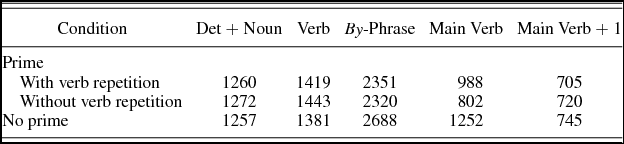
Reading times and grammaticality judgments of the target sentences were analyzed. The target sentences were divided into five analysis regions. The disambiguating region was located at the by-phrase, which resolved the ambiguous sentences to a passive reduced relative interpretation. Table 1 presents reading times for the five analysis regions. Reading times reflect processing difficulty such that the longer the reading time, the more difficult the processing.
Mean reading time (ms) by sentence region

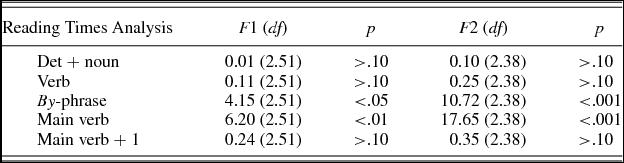
The reading time data for each region were submitted to one-way ANOVAs with priming as the experimental factor, which had three levels: prime with verb repetition, prime without verb repetition, and no prime. Table 2 summarizes the analyses.
Analyses of reading times by sentence region

Statistical analyses revealed no difference in reading times across the conditions at the “det+noun” and the verb region (ps > .10). Priming effects were found at the by-phrase (the disambiguating region) and the main verb region. Post hoc Tukey comparisons confirmed that, relative to the no-prime condition, reading times were significantly shorter at the by-phrase region in the two primed conditions (ps < .05), which did not differ from each other (ps > .10). At the main verb region, reading times were shortest in the prime without verb repetition condition, followed by the prime with verb repetition condition, and then the no-prime condition. The difference between the prime without verb repetition and the no-prime condition was significant both by subject and by item (ps < .01). Other pairwise comparisons were significant by item (ps < .05) but not by subject (ps > .10). In general, the presence of Chinese passive primes facilitated the processing of a passive reduced relative structure in the English target sentences.
The grammaticality judgment data showed the percentage of the target sentences that were judged grammatical. The average percentage of correct responses was 79.17% for the prime with verb repetition condition, 75.56% for the prime without verb repetition condition, and 75.28% for the no-prime condition. A one-way ANOVA yielded no significant difference between the three conditions in the accuracy of judgment (ps > .1). In other words, the presence and the type of primes did not affect the participants’ judgments, though the target sentences were read slower at the by-phrase and the main verb region without primes.
DISCUSSION
Structural priming has been less consistently demonstrated in comprehension than in production, as comprehension priming is subject to the impact of lexical and word-order difference between primes and targets. Using two primes and a between-participant design, the study provided clear evidence for both lexically specific and lexically independent structural priming in bilingual comprehension. Crucially, cross-linguistic priming effects occurred independently of lexical and word-order equivalence. Compared to the no-prime condition, the English targets were read faster at the disambiguating by-phrase in the two prime conditions. That is, structural revision from the preferred past-tense main clause to the passive reduced relative analysis was easier when the English targets followed Chinese passive relative primes than when there was no prime. Cross-linguistic structural priming facilitated subsequent processing of passive reduced relative structure in the English targets. The reading time difference also appeared at the main verb, the next disambiguating region. As the experiment adopted a self-paced reading paradigm, the slowdown at the main verb of the target sentences probably reflected a spillover from processing difficulty at the previous by-phrase region (Mitchell, Reference Mitchell, Carreiras and Clifton2004). The difficulty in the unprimed condition arose because the subject was initially analyzed as the agent of the verb under a main clause interpretation, and the disambiguating by-phrase necessitated syntactic and thematic revisions. The extracted subject noun must ultimately be treated as a patient, and the object of the preposition by was the true agent.
The findings provided evidence that the L2 users had access to an abstract syntactic representation during the comprehension of syntactically ambiguous sentences. They did not seem to rely more on lexical cues than on structural information during L2 syntactic ambiguity resolution, as the sentences with different verbs primed the targets to a similar extent as those with translation-equivalent verbs. The results are consistent with combinatorial processing proposed by Hartsuiker et al. (Reference Hartsuiker, Pickering and Veltkamp2004), in which structural priming occurs as a result of residual activation of combinatorial nodes. More specifically, verb lemmas (e.g., English praise, Chinese chēngzàn) are linked to the combinatorial nodes representing the RC structure and the main clause structure, respectively. Exposure to the Chinese RC structure leads to activation of the verb lemma chēngzàn as well as the relative combinatorial node. When subsequently the reader encounters another RC, the relative structural node would have a higher activation level as compared to that in the unprimed condition. It is crucial that the relative structural node would remain active even if subsequent processing involves different verbs. In other words, comprehension of a syntactic ambiguity could be based on an abstract, lexically independent syntactic representation, though this does not rule out a possible contribution of heuristic processing when relevant cues are available. If a syntactic representation were not constructed for a structurally ambiguous sentence and interpretation was entirely based on nonsyntactic sources such as lexical knowledge and thematic role order, structural priming should not have occurred in the prime without verb repetition condition, where the Chinese primes and the English targets had different verbs and word orders.
The target sentences were read slightly faster at the main verb in the prime without verb repetition condition than in the prime with verb repetition condition, though the difference was not significant at the by-phrase region. This suggested that within-verb and cross-verb priming effects both occurred in bilingual comprehension and were equally strong across an intervening sentence. The findings are not entirely compatible with those of Pickering et al. (Reference Pickering, McLean and Branigan2013). Similar to Pickering et al., the current study showed that both abstract and lexically specific priming effects persisted over time. However, while Pickering et al. reported stronger comprehension priming within verbs than across verbs (see also Tooley et al., Reference Tooley, Traxler and Swaab2009; Traxler, Reference Traxler2015; Traxler et al., Reference Traxler, Tooley and Pickering2014), the present study did not find a lexical boost during bilingual comprehension. The different findings might be due to two reasons. First, this study focused on L1 to L2 priming whereas Pickering et al. involved within-L1 priming. A lexical boost effect was found to be weaker across languages than within languages (Schoonbaert et al., Reference Schoonbaert, Hartsuiker and Pickering2007). This finding could be accounted for by Hartsuiker et al.’s (Reference Hartsuiker, Pickering and Veltkamp2004) integrated model, in which priming for translation-equivalent verbs results from indirect activation between translation-equivalent lemmas that share a conceptual node. The indirect activation should be relatively small as compared to direct activation for identical verbs (the same lemmas). In addition, a lexical boost in cross-linguistic priming disappeared when prime and target sentences were separated by an intervening filler (Salamoura & Williams, Reference Salamoura and Williams2007). It is possible that the lexical boost effect was weak and decayed rapidly in the present study. Second, while Pickering et al. used only one prime before a target, the use of two different primes might enhance verb-independent priming in the current study. As demonstrated in Savage, Lieven, Theakston, and Tomasello (Reference Savage, Lieven, Theakston and Tomasello2006), a variety of passive primes with different verbs were significantly more effective than identical primes in facilitating subsequent use of passive sentences. In the present study, repeated exposure to the syntactic frame bei NP 1 V de NP 2 with varied verbs and arguments might reinforce an abstract representation of the passive reduced relative structure, thereby increasing its availability in subsequent processing.
The finding of comprehension priming without lexical repetition is consistent with Thothathiri and Snedeker (Reference Thothathiri and Snedeker2008) but in contrast to Arai et al. (Reference Arai, van Gompel and Scheepers2007). While the former study showed verb-independent priming within L1 using two primes, the latter yielded no priming effect with only one prime. Structural priming might be relatively weak in comprehension and thus needs to be boosted through repeated exposure to a particular structure. The current study extended Thothathiri and Snedeker by demonstrating cross-verb comprehension priming from L1 (Chinese) to L2 (English), which suggests that bilinguals use abstract syntactic representations during online sentence comprehension. If we consider previous experience with language as a constraint that guides subsequent sentence comprehension, the strength of this particular constraint could in part account for the presence of priming in the current study and Thothathiri and Snedeker. Priming might grow in strength over trials in an implicit learning process and becomes a more effective cue in subsequent processing within or across languages. In other words, readers can adapt their expectations to specific linguistic environments through repeated experiences, leading to decease in processing difficulty associated with garden-path effects.
The experimental results appear to support an abstract structural account of syntactic processes, in which argument structure is built and represented independently of lexical content (e.g., Borer, Reference Borer, Benedicto and Runner1994). While admitting the importance of lexically specific information during sentence processing, the structural account posits that argument structure is not associated with particular lexical items and that syntactic construction does not rely on word retrieval. The reader has access to an abstract structural configuration (in this case, passive relative structure), which can generalize to sentences with new lexical items (i.e., the prime without verb repetition condition). The activation of a construction thus increases its likelihood of being used again, leading to structural priming. The structural representation need not be activated by specific verbs but can be generated online in abstract form. However, the results are incompatible with a strong lexicalist view of syntactic processes, in which structural formation is entirely driven by lexical specifications (e.g., Levin & Rappaport-Hovav, Reference Levin and Rappaport-Hovav1995). Under this account, argument structure is stored in lexical entries and retrieved via lexical access. Upon reading the passive relative structure with a particular verb, the structure is activated and becomes readily available only if the same verb is accessed again. Structural priming should not have been observed without verb repetition in primes and targets. It is worth noting that Hartsuiker et al.’s (Reference Hartsuiker, Pickering and Veltkamp2004) bilingual representation model is not purely lexicalist, as it incorporates the possibility that a combinatorial node can remain active across sentences even without lexical support.
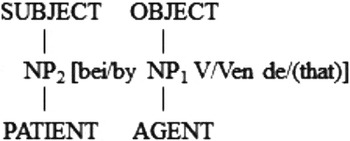
Furthermore, the present study showed comprehension priming from Chinese to English passive RCs that differ in word order. This is the first study demonstrating comprehension priming between genetically and typologically unrelated languages. Crucially, the cross-linguistic priming effect did not depend on specific lexical items, as it existed even when Chinese primes and English targets contained no translation-equivalent verbs. This provided evidence for a shared syntactic representation at the functional level, where an unordered constituent structure is constructed. Figure 1 below illustrates the shared representation of Chinese and English passive relative structures based on a two-stage account of syntactic construction, which assumes separate levels of functional and positional representation (Bock & Levelt, Reference Bock, Levelt and Gernsbacher1994; Garrett, Reference Garrett and Butterworth1980; Hartsuiker et al., Reference Hartsuiker, Kolk and Huiskamp1999; Hartsuiker & Westenberg, Reference Hartsuiker and Westenberg2000). Although Chinese and English differ in word order, both structures contain an extracted subject noun phrase, which receives a patient role, and a modifying RC in passive voice, where the internal object bears an agent role. The cross-linguistic priming arose from the syntactic representation shared between Chinese and English passive relative constructions and did not require identical word order. Thus, the experience with the Chinese passive relative primes facilitated the dispreferred interpretation of the English targets in the primed conditions compared to the unprimed condition. The findings argued against a one-stage account of syntactic construction, which predicts no priming effect between Chinese and English passive relative structures that differ in word order. The structural priming observed in the experiment presumably occurred at the functional level, rather than at the positional level, as Chinese and English passive relative structures share abstract functional relations but differ in word order. Thus, there is a need for a bilingual representation model to differentiate between functional and positional processing.
Illustration of the shared syntactic representation of Chinese and English passive relative clause structure at the functional level.

Structural priming that occurs without lexical and word-order equivalence is likely to reflect an implicit learning mechanism, in which the language comprehension process is tuned by prior exposure. Experiencing a prime sentence causes the reader to link a particular meaning relationship (specifically, between a patient and an agent) to a passive relative constituent structure. The knowledge of the mappings among conceptual and syntactic representations is strengthened during the process of implicit learning, leading to a tendency to repeat the same mappings in subsequent processing. The finding of L1 to L2 priming in the current study suggested that the representation and processing of L2 is, at least to some extent, abstract in nature. During the comprehension of English (L2) target sentences, the bilingual participants used abstract syntactic knowledge, which was not bound to the repetition of a particular lexical item or word order. In other words, explicit memory for specific instances is unnecessary for structural priming to arise. In addition, the robust priming obtained in this study might in part be attributed to an inverse-preference effect (Pickering & Ferreira, Reference Pickering and Ferreira2008), which means that less favored structures are more heavily affected by structural priming. Compared to active main clauses, passive RCs are less frequent in everyday use and more complex to L2 learners and thus should undergo more learning. This explanation is speculative and warrants further research that controls for the degree of preference of prime material.
While structural priming reflects the repetition of abstract representations, the priming process might also involve function word and conceptual activation. The Chinese primes contained a preposition bei that marked passive voice. It is possible that repeated exposure to the marker activated the associated passive structure and thus facilitated the passive participle interpretation of the ambiguous verbs in subsequent English targets. The experience with another function word de, a RC marker, in the Chinese primes might contribute to the activation of the reduced relative structure during the comprehension of the English targets. Function word priming alone, however, cannot account for the priming of the target structure in English. For one thing, the English sentences did not contain translation equivalents of these function words during the ambiguous region (i.e., det noun verb). Thus, the cross-linguistic priming effect observed in the study must rest on the activation of an abstract syntactic representation rather than pure lexical access. For another, structural priming occurs independently of function words, such as prepositions (Bock, Reference Bock1989; Fox Tree & Meijer, Reference Fox Tree and Meijer1999) or complementizers (Desmet & Declercq, Reference Desmet and Declercq2006; V. S. Ferreira, Reference Ferreira2003). In the no-prime condition the sentences preceding the targets also contained de between an attributive adjective and a head noun, but it did not prime the reduced RC interpretation of the English targets. The word de itself does not denote a particular syntactic structure as it can be an attributive marker or a genitive marker depending on the context (Li & Thompson, Reference Li and Thompson1981). Thus, the priming of the reduced relative structure was unlikely to simply result from residual activation of the function word.
Another possible source of the observed cross-linguistic priming effect is the activation of conceptual representations. Chang, Bock, and Goldberg (Reference Chang, Bock and Goldberg2003) and Griffin and Weinstein-Tull (Reference Griffin and Weinstein-Tull2003) suggested that structural priming could be affected by the order of thematic roles or the number of conceptual arguments in sentences. One possibility is that priming is caused by a tendency to repeat the ordering of thematic roles. This factor can be ruled out in the present study, given that active and passive constructions both have two conceptual arguments (one agent and one patient) and that Chinese and English passive RCs involve different orders of thematic roles. In Chinese the agent argument is described before the patient (the extracted argument), whereas the order is reversed in English. Thus, the observed structural priming effect is not attributable to simple repetition of the ordering of thematic roles. In contrast, the conceptual feature of patient prominence could potentially underlie structural priming. The use of passives allows focus to be directed toward the patient argument and thus communicates a slightly different message from the use of actives, which emphasizes the agent of an action. Upon reading Chinese passive relative primes, the comprehender might construe the patient argument as prominent and thus is more likely to interpret the sentence-initial noun phrase of the English targets as a patient modified by a passive reduced RC. It seems inevitable that structural priming involves shared message property between primes and targets.
Nevertheless, research has clearly indicated that conceptual similarity is not necessary for the occurrence of structural priming across sentences, though it does facilitate the use of a similar syntactic structure (e.g., Bock, Reference Bock1989; Bock & Loebell, Reference Bock and Loebell1990; Cleland & Pickering, Reference Cleland and Pickering2003). In other words, conceptual similarity alone cannot account for structural priming. Presumably, the passive reduced relative analysis of the English targets would not be primed by any sort of structure that contains a prominent patient (e.g., an intransitive with only a patient argument; Bock, Reference Bock1986). Moreover, the observed structural persistence was not likely to arise simply from a conceptual level because the English primes and the Chinese targets described unrelated events involving different entities. The languages only shared thematic roles (i.e., an agent and a patient) and syntactic constituents, and the conceptual roles must be mapped onto appropriate syntactic positions (i.e., patient to the extracted subject and agent to the internal object position) in order to generate the passive reduced relative representation. In other words, priming of the target structure must be derived from the activation at both the conceptual and the syntactic level. A switch in structure, in this case from the passive reduced RC to the active main clause analysis, requires a remapping process. In short, structural priming is based on the mapping between conceptual elements and syntactic constituents.
Conclusion
This study is the first to demonstrate that cross-linguistic priming occurs in comprehension without word–order and lexical repetition between primes and targets. Prior exposure to Chinese passive relative primes facilitated the corresponding interpretation of the subsequent English targets containing either translation-equivalent or different verbs. The findings provided evidence for a shared bilingual syntactic representation that was underspecified for word order. In addition, lexically specific and lexically independent priming effects were found to be nearly equally robust across an intervening item. No lexical boost was evident in the bilingual data, suggesting that the L2 learners’ language comprehension relied on generalizations beyond individual lexical items.
While the present study showed structural priming from Chinese (L1) to English (L2), it is yet uncertain whether directional asymmetry exists in cross-linguistic priming. Further research is necessary to understand the influence of L2 on L1 comprehension and the role of lexical knowledge in L2 to L1 structural priming. A question related to priming asymmetry is whether the level of L2 proficiency affects the organization of a bilingual syntactic system. Specifically, are similar structures of two languages represented together from early stages of L2 development or are they initially represented separately and then merged together as the learner becomes more proficient in an L2? These findings are informative about the mechanisms that underlie language use at different stages of bilingual development.
APPENDIX A EXAMPLE ITEM USED IN THE STUDY
Prime with verb repetition condition
Chinese prime 1:
nàgè bèi xiàozhǎng chēngzàn de xuéshēng dédào hǎo chéngjì
the PASSIVE principal praise RC student receive good grade
The student praised by the principal received good grades.
Chinese prime 2:
nàgè bèi lǎopǎn chēngzàn de zhíyuán hěn nǔlì gōngzuò
the PASSIVE boss praise RC employee very hard work
The employee praised by the boss worked very hard.
Chinese/English filler:
nàgè xuǎnshǒu suīrán niánjì qīng dànshì jīngyàn hěn fēngfù
the player though age young but experience very much
Although the player was at a young age, he was very experienced.
English target:
The designer praised by the client was very creative.
Prime without verb repetition condition
Chinese prime 1:
nàgè bèi jǐngchá dǎizhù de xiǎotōu gǎndào hěn xiūkuì
the PASSIVE policeman arrest RC thief feel very ashamed
The thief arrested by the policeman felt ashamed.
Chinese prime 2:
nàgè bèi nǎinǎi chǒnghuài de xiǎohái zuòshì bù fùzé
the PASSIVE grandmother spoil RC child do something not responsibly
The child spoiled by the grandmother did something irresponsibly.
Chinese/English filler:
nàgè xuǎnshǒu suīrán niánjì qīng dànshì jīngyàn hěn fēngfù
the player though age young but experience very much
Although the player was at a young age, he was very experienced.
English target:
The designer praised by the client was very creative.
No-prime condition
Chinese prime 1:
nàgè rènzhēn fùzé de jǐngchá zuótiān dǎibǔ le xiǎotōu
the earnest responsible ATT policeman yesterday arrest ASP thief
The earnest, responsible policeman arrested the thief yesterday.
Chinese prime 2:
nàgè cíxiáng héǎi de nǎinǎi yǐjīng chǒnghuài le háizǐ
the kind amiable ATT grandmother already spoil ASP child
The kind, amiable grandmother already spoiled the child.
Chinese/English filler:
nàgè xuǎnshǒu suīrán niánjì qīng dànshì jīngyàn hěn fēngfù
the player though age young but experience very much
Although the player was at a young age, he was very experienced.
English target:
The designer praised by the client was very creative.
ACKNOWLEDGMENT
Preparation of this manuscript was supported by Grant 103-2410-H-011-035 from the Ministry of Science and Technology of Taiwan.