INTRODUCTION
Venture capital firms (VCs) have been the most important financial institutions in the third and fourth industrial revolutions (Lerner, Reference Lerner1994; Sorenson & Stuart, Reference Sorenson and Stuart2008). Nowadays, significant funding and other resources are managed by VCs, making them some of the most active players in the capital market. They have succeeded against other traditional financial institutions by embracing innovative young firms that use advanced technological applications (Zhelyazkov & Gulati, Reference Zhelyazkov and Gulati2016). Because the VC market is an extremely high-risk private equity market, network relationships have been regarded as important channels through which VCs exchange information, discover innovative young firms, hedge uncertainty, and gain essential resources (Gulati, Reference Gulati1999; Hochberg, Ljungqvist, & Yang, Reference Hochberg, Ljungqvist and Yang2010). The importance of functional networks means that partner selection occupies a large part of VCs’ limited attention (Cox, Katila, & Eisenhardt, Reference Cox, Katila and Eisenhardt2015; Zhang, Gupta, & Hallen, Reference Zhang, Gupta and Hallen2017). What partners should these firms work with? Do they tend to syndicate with homogeneous or heterogeneous partners?
From the social network perspective, trust based on strong ties and structural closure is the key to maintaining a stable micro-environment, and this trust grows with the homophily of the community (Burt, Reference Burt1992; Burt & Burzynska, Reference Burt and Burzynska2017; Podolny, Reference Podolny1994). Homogeneous partners’ shared information and values help reduce conflicts and enhance trust (Du, Reference Du2016; McPherson, Smith-Lovin, & Cook, Reference McPherson, Smith-Lovin and Cook2001). Because VCs need to hedge against startups’ inherent technology and market uncertainties, they have a strong incentive to syndicate with homogeneous partners rather than heterogeneous partners (McPherson et al., Reference McPherson, Smith-Lovin and Cook2001). On the other hand, because VCs are looking for ventures with the potential to grow, they may find it helpful to cooperate with heterogeneous partners that can give them access to novel information from distant markets and unfamiliar industries (Burt, Reference Burt2010; Gulati Reference Gulati1999). Moreover, the startups in which VCs invest often demand resources from a number of parties that have not been brought together before. As their patrons, VCs have to assemble complementary resources from unfamiliar partners (Harrison, Price, Gavin, & Florey, Reference Harrison, Price, Gavin and Florey2002). Thus, VCs’ partner-selection decisions may be influenced by two opposing logics: uncertainty reduction and resource mobilization. Although prior works have noted the importance of uncertainty reduction (Du, Reference Du2016), few studies have discussed the implications of resource mobilization for VC syndication.
The tension between these two partner-selection strategies is exacerbated in emerging economies (Meyer, Reference Meyer2015). In China, for example, because market-based institutions and rules are not well established, all market participants face a high level of institutional uncertainty (Opper & Nee, Reference Opper and Nee2015). VCs in emerging economies must deal with not only technological uncertainties, as their peers in developed economies do, but also a high level of institutional uncertainty. They face intense pressure to minimize institutional uncertainties as they mobilize and assemble complementary resources. For this reason, investigations of VC syndication network formation in emerging markets should pay special attention to the need to reduce institutional uncertainties – a need that highlights the contrast between the two opposing logics. In this study, we empirically explore how VCs in China choose their syndication partners when facing a need to reduce institutional uncertainty while also striving to achieve resource complementarity.
We argue that while trusts between homogeneous partners help form a ‘guanxi’ network and reduce uncertainties, homophily may not work for VCs that prefer to invest in very innovative startups and seek novelty. Resource-mobilization considerations dominate in these VCs’ choices of syndication partners, and VCs interested in exploring new territories and combining complementary resources are particularly willing to collaborate with heterogeneous partners (Ter Wal, Oliver, Jörn, & Sandner, Reference Ter Wal, Oliver, Jörn and Sandner2016). Whether and the extent to which a VC should stick to the homophily principle in choosing syndication partners depends in part on its peculiar investment preference and how much it prioritizes resource complementarity (Hearnshaw & Wilson, Reference Hearnshaw and Wilson2013; Pathak, Day, Nair, Sawaya, & Kristal, Reference Pathak, Day, Nair, Sawaya and Kristal2007; Swidler, Reference Swidler1986).
To test these predictions, we analyze syndication networks formed by Chinese VCs betwen 2006 and 2013. We chose the Chinese VC industry not only because the Chinese VC market was the second-largest VC market during this period, but also because of the large variation in venture capital heterophily, innovation practice, and institutional environment (Batjargal, Reference Batjargal2007) among Chinese VCs. This diversity enables us to examine and compare the impact of institutional variation in a single large emerging market. In this sense, the Chinese VC industry provides an ideal field in which to explore complex patterns of resource accumulation and untangle the paradox of firms’ strategic choices in an emerging market.
Our analysis of VCs’ syndication partner selection process offers new insight into how firms collaborate in an emerging market and how these patterns differ from those scholars have found in mature markets. We find that only less-innovative VCs in an immature market stick to homophily; the freer and more open the market is, the more innovative the VC firms are and the less likely it is that the network is composed of homogeneous partners. As a market system matures, the proportion of heterogeneous syndication keeps growing.
Our work contributes to the existing literature in three main ways. First, we highlight the contingency of the homophily principle in an emerging market. Although the homophily principle influences the network topology in this market, it no longer dominates when VCs are coinvesting in innovative firms in a relatively mature institutional environment. In fact, the homophily principle either does not hold or has only a marginal impact on the majority of VCs in our study. Second, our results show that resource-mobilization considerations may be as important as, or even more important than, institutional factors in VCs’ partnership choices. This finding supports previous research arguing that homophily is mainly moderated by environmental elements (Podolny, Reference Podolny1994). Finally, by employing exponential random graph models (ERGMs or p* models), we are able to separate endogenous structural effects (reciprocity, transitivity, etc.) from exogenous effects (actor attributes effects) to explore how they jointly shape the network (Lusher, Koskinen, & Robins, Reference Lusher, Koskinen and Robins2013; Yang, Keller, & Zheng, Reference Yang, Keller and Zheng2017), thus providing a rigorous examination of VC network dynamics (Lee & Wellman, Reference Lee and Wellman2012; Perera, Reference Perera, Bell and Bliemer2018).
We begin by introducing the homophily principle as a general mechanism in partner selection and providing an overview of the Chinese venture capital industry. We then discuss the benefits of choosing homogeneous and heterogeneous partners. We develop our theory by hypothesizing how venture capital firms adapt their syndication strategy to the institutional uncertainty of their context and their inclination to invest in innovative companies. We then introduce the longitudinal VC syndication network data and the ERGMs used to test our hypotheses. The next section describes our results and offers additional analysis. Finally, we summarize our research findings and briefly discuss their theoretical and practical implications.
THEORETICAL BACKGROUND AND HYPOTHESES DEVELOPMENT
Complex Network Theory
The formation of a VC syndication network is a social selection process. Multiple endogenous and exogenous factors intertwine with one another to shape the network topology. Each node in the network is self-adaptive and influences the other nodes through the ties between them. The closer two nodes are in the network, the more important this influence is. Statistical models’ usual assumption of node independence is not valid in this kind of network. In this regard, complex network theory provides a proper framework for analyzing the dynamics of VC syndication networks.
Complex network theory is an important stream of complexity theory (Barabási, & Albert, 1999; Thurner, Klimek, & Hanel, Reference Thurner, Peter and Hanel2018). Complexity science was founded in the 1960s (Lorenz, Reference Lorenz1963) and has grown rapidly (Gell-Mann, Reference Gell-Mann1995; Powell & Whittington, Reference Powell, Packalen, Whittington, Padgett and Powell2012; Thurner et al., Reference Thurner, Peter and Hanel2018). Lorenz (Reference Lorenz1963) found that one butterfly flapping its wings in Brazil can cause a tornado in the US. This famous butterfly effect shows that a complex system can nonlinearly react to tiny differences. In this theoretical framework, both self-adaption and interdependence can be properly considered (Anderson, Reference Anderson1999). In this study, we regard the syndication network as a complex network and pay particular attention to the interdependence of node attributes. Specifically, we consider two factors that might be related to node attributes: the institutional context of a focal node and its investment preference. Both factors impact a VCs’ performance through network links. Empirically, we use Exponential Random Graph Models (ERGMs) to explore the network formation dynamics and examine how a network typology evolves.
Institutional Uncertainty and Homophily in Emerging Markets
Conventional wisdom suggests that homophily is a general mechanism driving the formation of social relationships. At least in interpersonal relationships, homophily is an essential principle for network formation. In marriage, friendship, work, and other domains, actors with similar characteristics tend to relate to each other (McPherson et al., Reference McPherson, Smith-Lovin and Cook2001). Research shows that homogeneous working groups have lower communication costs (Steen, Reference Steen2010), friendlier atmospheres (Ring & Ven, Reference Ring and van de Ven1994), and greater mutual trust (Dayan & Benedetto, Reference Dayan and Benedetto2010). Workplace networks constructed between actors with similar backgrounds are believed to have the ability to help employees reach their fullest potential.
In an unstable and highly uncertain market, the homophily principle is particularly important. Inter-organization networks in such markets can provide informal protection for social actors through their enhancement of social norms and reputation mechanisms (Opper & Nee, Reference Opper and Nee2015), and homogeneous networks often serve this purpose better because their members share similar values and information (Burt, Reference Burt2005; Granovetter, Reference Granovetter1985; Robson, Katsikeas, & Bello, Reference Robson, Katsikeas and Bello2008; Ter Wal et al., Reference Ter Wal, Oliver, Jörn and Sandner2016). Podolny (Reference Podolny1994) revealed that organizations tend to form more homogeneous ties when the market is more uncertain.
Syndication networks function to buffer external shocks. One of the environmental factors that can influence VCs’ partner-choosing strategy is institutional uncertainty (Beckman, Haunschild, & Phillips, Reference Beckman, Haunschild and Phillips2004; Podolny, Reference Podolny1994). Institutional uncertainty directly affects how much VCs rely on informal social relationships and trust in their collaborations (Bylund & McCaffrey, Reference Bylund and McCaffrey2017), so we focus on how an uncertain institutional environment can influence VCs’ partner-selection decisions.
The institutional environment is the organization's state, societal, and professional context (Wang, Fan, & Yu, Reference Wang, Fan., Zhu, Garnaut and Song2007) and includes regulations, customs, and taken-for-granted norms (Meyer & Rowan, Reference Meyer and Rowan1977). The development of the market, the number of market intermediaries, the degree of government intervention, and the perfection of the legal system are all elements of the institutional environment (Bylund & McCaffrey, Reference Bylund and McCaffrey2017; Wang et al., Reference Wang, Fan and Yu2017). When the institutional environment is unstable, conflict-solving costs are quite high. Under such circumstances, companies can not easily turn to well-defined formal institutions when their interests are under threat (Du, Reference Du2016; McPherson et al., Reference McPherson, Smith-Lovin and Cook2001). In such cases, the social norm is the primary mechanism that companies rely on to avoid potential moral risks and stabilize their mutual trust (Chen, Chen, & Huang, 2013; Cui & Jiang, Reference Cui and Jiang2012; Opper & Nee, Reference Opper and Nee2015). Because homophily is the source of solidarity and social norms (Durkheim, Reference Durkheim and Simpson1933), homophilous communities often enjoy more mature rules and cultures that succesfully limit and discipline organizational behaviors (Ter Wal et al., Reference Ter Wal, Oliver, Jörn and Sandner2016). As a result, homophilous syndication becomes an essential strategy for trust building and self-defense in an uncertain environment.
The norms and institutions of the VC industry are not well established in China. The first VC firm was established in China in 1985, and the first law regulating VC investment was introduced six years later. Since then, there have been several major changes in laws, institutions, and local norms. Many of these norms only apply to specific industries and districts, which makes the situation more complex. For example, lawyers in the eastern metropolitan areas have a long history of collaborating with VC firms and are quite experienced with VC related affairs, but in the middle-western, inland areas disputes between VC firms are often solved by the social network and individual negotiation (Lin, Reference Lin2020; Luo, Rong, Yang, Guo, & Zou, Reference Luo, Rong, Yang, Guo and Zou2019). Such social and cultural differences often lead different VCs to adopt different strategies when choosing partners and making investments.
In summary, as institutional uncertainty increases, trust takes a more important role and firms are likely to be more inclined to form homogeneous syndication networks. Highly homogeneous collaboration brings about solid social norms, strict supervision, and lower communication costs, all of which help collaborators build mutual trust and defend against potential risks from moral hazards and market fluctuations. Based on these statements, we can put forward the following hypothesis:
Hypothesis 1: Compared with those in a stable institutional setting, venture capital firms in an uncertain institutional setting are more likely to syndicate with homogeneous partners.
Resource Mobilization and Heterophily in the Chinese VC Industry
Homophily generally plays an important role in the formation of collaborative inter-organizational relationships, but whether the homophily principle works in the VC industry is under debate. VC firms often work with highly innovative startups and great market uncertainty, which demands intense resource input in the form of both large volume and diversified categories (Petkova, Wadhwa, Yao, & Jain, Reference Petkova, Wadhwa, Yao and Jain2013). According to resource dependence theory, organizations can obtain the resources they are short of and hence reduce dependence on contingencies in the external environment by forming alliances or collaborating with other market participants (Hillman, Withers, & Collins, Reference Hillman, Withers and Collins2009). Collaborating with partners is thus one effective way to access resources that organizations do not own. Many companies seeking investment from venture capital firms have novel business models. Complementary resources, which are necessary for commercial success, often reside in various dispersed organizations and have to be recombined or redeployed. And because information and resources from similar partners are often redundant, heterogeneous syndication may be particularly useful and important (Granovetter, Reference Granovetter1985; Lin, Ensel, & Vaughn, 1981). The era of the digital economy offers ample motivation for innovative firms to combine heterogeneous resources not readily available from familiar partners. For example, the development of e-commerce platforms such as Amazon and JD depends on the availability of e-payment and logistic services, which were not necessary for traditional shopping stores. Ride-sharing firms need such complementary resources as electronic mapping and location-based services, which were not important for conventional taxi services. Because highly innovative companies often require unconventional resources, syndication of heterogeneous VCs will fulfill the ventures’ needs for diverse resources better than homogeneous syndication would, because expertise and resources in a heterogeneous network are complementary and nonredundant.
Research has repeatedly shown that heterophily between partners results in good performance at both the micro-intra-organization (Flynn, Chatman, & Spataro, Reference Flynn, Chatman and Spataro2001; Powell, White, Koput, & Owen-Smith, 2005) and macro-inter-organization (Andrevski, Brass, & Ferrier, Reference Andrevski, Brass and Ferrier2016) levels. The benefits of heterophily are realized through the mechanisms of resource accumulation and complementarity in the following ways.
First, different backgrounds provide social actors with diversified cognitive resources, including knowledge and problem-solving experience (Ely & Thomas, Reference Ely and Thomas2001). The collision between different values and methods fuels reflective cognition on the organizational level, thereby giving birth to innovation. Stark (Reference Stark2009) calls this process ‘creative recombination’ or ‘generative friction’. Different elements from unrelated fields stimulate people to assess problems from a new perspective and to use old resources in a new way (Burt, Reference Burt1992). Popli and Ladkani (Reference Popli and Ladkani2020) have shown that greater group diversification leads to more robust post-acquisition performance for affiliate acquirers.
Second, diversified partners are highly likely to provide each other with a variety of material resources, including complementary assets, that improve marginal utility (Brander, Amit, & Antweiler, Reference Brander, Amit and Antweiler2002). Useful resources include capable personnel, market channels, and technological support, most of which are highly specialized to a specific field and district. Complementary assets are especially important in later financing rounds, when firms have launched mature products but need to increase their market shares and decrease potential interruption from the government (Gulati, Reference Gulati1999). In addition to theoretical work in this area, empirical research has shown that the heterophily of VC firms’ backgrounds is critical for mature-portfolio companies (Zheng, Cao, & Ren, Reference Zheng, Cao and Ren2019).
Finally, compared with partners in similar fields, partners that are active in different fields provide members with more social resources, including the opportunity to enter a new market or establish a closer relationship with the government. A partner active in an unfamiliar network provides VC companies with the chance to not only participate in current transactions but also make new friends and become eligible game players in unfamiliar business circles (Luo et al., Reference Luo, Rong, Yang, Guo and Zou2019).
Since heterogeneous syndication has so many benefits and VCs are profit-seeking organizations, it would be arbitrary to assume that they would follow the homophily principle under all circumstances. This problem becomes even more prominent for VCs that prefer to invest in highly innovative startups.
For portfolio companies, often with assistance from their VCs, innovation often comes from new technological elements or recombining current resources in unexpected ways (Schumpeter, Reference Schumpeter1934; Stark, Reference Stark2009). New technological elements allow companies to take a new market niche and reap great financial rewards, while the recombination of resources gives rise to creative conflict, which gives people a unique perspective. In an industry in which knowledge and technologies are rapidly iterated, innovation often is not the product of accidents but instead is systematically produced by bringing heterogeneous resources together. This conscious arrangement can happen at intra-organizational, inter-organizational, or institutional levels. For example, Stark (Reference Stark2009) introduced a case in which people from different professional backgrounds were encouraged to work together closely to bring about innovative products that would not have a clear shape until a very late stage of development. To take an advantageous position in the market, organizations need to consciously manage their collaborations in a wise – that is, diversified – way.
VC firms can profoundly influence companies’ cognitive, material, and social resources. Highly innovative companies’ demands for resource recombination urge VC firms to form diversified collaborations to satisfy their needs. If a VC firm focuses its own strategy on finding innovative firms, it will consider choosing heterogeneous partners to combine more resources for the development of innovative firms. That is to say, a VC's partner-choosing strategy is influenced by its investing strategy.
Based on this logic, we put forward our second hypothesis:
Hypothesis 2: Compared with those that prefer to invest in conventional companies, venture capital firms that prefer to invest in innovative companies are less willing to syndicate with homogeneous partners.
METHODS
The VC Industry and VC Syndications
VC firms are financial institutions that accept capital from a limited number of partners and invest the money in promising young firms. Financial returns usually come from desirable exits through their portfolio company's initial public offering (IPO) or mergers and acquisitions (M&A) (Hochberg, Ljungqvist, & Yang, 2007; Lerner, Leamon, & Hardymon, Reference Lerner, Leamon and Hardymon2012).
VCs are players in the early-stage private equity market. The two things venture capitalists have to do every day are find innovative young firms and deal with uncertainty. When a VC seeks innovative companies that can make change happen, it has to take on a high level of uncertainty in the VC industry (Zhang et al., Reference Zhang, Gupta and Hallen2017). The success of a young firm is often not easy to predict, and the institutional environment is an additional source of uncertainty (Beckman et al., Reference Beckman, Haunschild and Phillips2004). This institutional uncertainty is generated when conflicts cannot be quickly solved by law and when government intervention can be expected during operation.
In an uncertain environment, one way VCs can find innovative young firms is by using co-investments to build up a syndication network (Beckman et al., Reference Beckman, Haunschild and Phillips2004). Co-investments can help VCs share risk, exchange information, and combine complementary resources (Gulati, Reference Gulati1999). At the same time, if the VCs’ co-investment partners behave passively, then free riding and moral hazards may arise. Thus, VCs are all facing the question of how to choose co-investment partners to help innovative startups and deal with uncertainty. Since VC firms are profit-seeking organizations, they are motivated to syndicate with diversified partners to reduce resource redundancy. However, they also rely on long-term close relationships due to their uncertain institutional environment. The way VC firms choose partners will reveal the mechanism of resource flow and accumulation in the emerging market. In this sense, the VC industry is a good context in which to examine how firms trade off resource complementarity and uncertainty reduction.
Sample
We test our hypotheses using network data from the Chinese VC industry from 2006 to 2013 for three reasons. First, the Chinese VC market is the largest VC market among developing countries (Batjargal, Reference Batjargal2007). Studying the Chinese VC context is a first step toward considering the same question in relation to other developing countries. Second, because China is a large country characterized by significant regional variations in institutional development, it offers a large enough variance in institutional uncertainty to test our theoretical predictions. The institutional environment is different from province to province (Han & Zheng, Reference Han and Zheng2016), but the data are comparable and coherent, which is the advantage of studying a large market. Third, China's digital economy was quite innovative during our observation period (Guo & Jiang, Reference Guo and Jiang2013), and this burst of innovation gives us a chance to capture business model innovation using innovative natural language processing methods.
We use the Simuton database published by Zero2IPO Group of China, supplemented by information from other sources including the internet and government documents. The Simuton database is widely used in Chinese VC-related research. Our consolidated data set includes information about investment events, information about VC firms, and VC exit events (through M&A or IPO) from 1992 to 2014. All investment records with undisclosed VC names have been deleted; for investment records in which the name of the portfolio company is undisclosed, a syndication tie between two VCs is considered to exist when they invest in an anonymous firm in the same industry, at the same location, and approaching the same development stage on the same day. The database contains 21,659 investment events. After deleting all the unqualified investment records with undisclosed VCs or PEs/angels, 12,375 records remain.
To ensure that models are not influenced by sample bias, we chose the 1992–2014 period for descriptive statistics and 2006–2013 for model building (five years for independent variables and three years for dependent variables, in accordance with established practice in former studies; Sorenson & Stuart, Reference Sorenson and Stuart1999, Reference Sorenson and Stuart2008; Zhelyazkov & Gulati, Reference Zhelyazkov and Gulati2016). We only include VCs that have at least one investment record during the 2006–2013 period. In the end, 739 nodes remain in our dataset, which is 62.5% of the original 1,183 nodes.
VC Network Description
To operationalize our network variables, we first construct syndication networks. A tie in the VC syndication network is observed if two firms jointly invest in a portfolio company on the same day (Podolny, Reference Podolny2001). Two or more ties can exist between a pair of actors simultaneously if the VCs often cooperate on different projects.
Figure 1 presents the number of VC institutions that exist in the market, the number of co-investments conducted per year, and the average number of partners that these VC institutions have in a given year (i.e., the average degree of centrality calculated after the co-investments are matrixed into a 0–1 matrix). Since 1985, when the first VC institution was established in China, VCs have undergone long-term growth and development.
Number of VCs, syndication ties, and average partners, 1992–2014

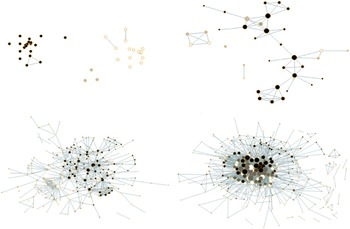
Figure 2 presents the changing topology of VC syndication networks from 1992 to 2014. The VC network changes yearly; we present it at four distinct time points to show its growth path. Networks in 2004, 2008, and 2011 also contain many isolated nodes, which we have dropped out to make the figure clearer.
Syndication network of Chinese VC firms
Note: The syndication network in 1998 (upper left), 2004 (upper right), 2008 (bottom left), and 2011 (bottom right).

An intuitive understanding of the co-investment behavior of VC firms can be obtained by tracing the dynamics of VC networks. In Figure 2, black, white, and grey nodes denote foreign, state-owned, and private institutions, respectively. In all the figures, the size of the nodes denotes the connectivity of firms. As Figure 2 shows, cooperation between teamed-up institutions with the same type of capital emerges across China's network of VC institutions in its preliminary development stage. Foreign institutions occupy a very central position in the 2004 and 2008 networks, and this tendency continues through 2011. At the same time, state-owned institutions often act as bridges between foreign VCs and private VCs in the early networks (e.g., Shenzhen Capital Group), whereas private institutions emerge from the peripheral areas of the network but grow and move to become central actors in later years. One can infer from the network that syndication was originally a Western practice and was introduced to China by foreign VCs, later followed by state-owned and private institutions.
Model Specification
We focus on the effects of VC homophily on network generation, so we estimate the exponential random graph (p*) models (ERGMs) for the VC syndication network from 2011 to 2013. ERGMs are based on matrix representations of network topology (Lusher et al., Reference Lusher, Koskinen and Robins2013; Robins, Pattison, Kalish, & Lusher, Reference Robins, Pattison, Kalish and Lusher2007; Snijders, Pattison, Robins, & Handcock, Reference Snijders, Pattison, Robins and Handcock2010; Snijders et al., Reference Snijders2017). A network can be presented as a matrix X, Xij represents the number of ties between node i and node j, and a network with n nodes can be represented by an n*n matrix. This matrix X can be easily transformed into a matrix Y, where:

The matrix Y is taken as the dependent variable of ERGM.
ERGM for social network analysis (SNA) has the following general form:

In this formula, Pr(Y = y) denotes the probability that Y takes the observed value y, ZA(y) represents the graph statistic and covariate network effects, λA represents the corresponding parameters, and 1/k acts as a normalizing factor, where

to ensure that $0 \le \Pr ( Y = y) \le 1$ for all possible y. The choice of what variables are included in A reflects our theoretical thinking and may vary with different research contexts.
The traditional method of specifying VC collaboration is to assume that each dyadic syndication Yij is independent (Harris, Reference Harris2013). However, this assumption ignores the interdependent nature of relationships in a network. For example, if nodes N and M are syndicated while nodes M and K are syndicated, then one should not assume that the relationship between N and K has nothing to do with M. However, if the N-K tie is related to M, then the traditional models would not be tenable, because the relationships violate the independence hypothesis. ERGMs consider the interdependence of nodes and are more suitable than other methods for analyzing network structure. In this model, A includes network configurations such as isolated nodes distribution and triangles, thereby incorporating network structures. We estimate the models with Monte Carlo Markov-chain maximum likelihood estimation (Snijders et al., Reference Snijders, Pattison, Robins and Handcock2010) by using the ERGM package in R (Hunter, Handcock, Butts, Goodreau, & Morris, Reference Hunter, Handcock, Butts, Goodreau and Morris2008).
Measures
This study's dependent variable is the VCs’ syndication network from 2011 to 2013. To make the network suitable for ERGM analysis, we turn the ties in the network into binary variables with values of 0 and 1.
As for exploratory variables, we construct the indicators of node homophily from the investment history of VC firms. We use three different variables to measure homophily: industry focus, location focus, and capital type of VC firms (Trapido, 2007). Homophily of industry focus and location focus are represented in a matrix format, with Aij denoting the Jaccard homophily index of industries or locations of startups that VC firm i and j have invested. We categorize VCs’ capital types as foreign, domestic, or joint-ventured. We measure homophily in capital type using an asymmetric binary matrix, where 1 denotes that two institutions share the same capital type and 0 denotes that two VCs have different capital types.
China has been transforming from a central-planned economy to a market-based economy for a long time; including reduced government intervention, increasingly used the free market to allocate resources (Murrell, Reference Murrell2005), and relied on professional institutions and the legal system to regulate the market. To measure the level of institutional uncertainty VCs face in their provinces, we use the widely used marketization index (Wang et al., Reference Wang, Fan and Yu2017). Five factors are considered to capture the degree of market development or institutional maturity: the relationship between government and market, ownership structure, goods market development, factor market development, and legal framework. A higher marketization score represents better governance, clearer property rights, mature institutions (Wang et al., Reference Wang, Fan., Zhu, Garnaut and Song2007), and an institutionally more stable environment. To calculate this measurement for a specific VC firm, we first find all the companies it has invested in and then search the marketization index of the provinces where these companies are located. To measure institutional security, we calculate the average of all the marketization scores of the invested companies. The reverse of this security score represents the institutional uncertainty that VC firms confront. The pairwise value of institutional uncertainties is calculated by summing the scores of two VC firms; the higher this number is, the more uncertain the environment is for possible deals. Before adding interactions into the model, we center the terms.
To measure VC firms’ inclination to invest in innovative companies, we use business description data from the Simuton database, which includes extended text descriptions of each invested company, including what it does and what its products are. For each company, we use a word-embedding technique from natural language processing (word2vec algorithms) to convert each word in the text as a vector that represents the company's location in the semantic space of the current business landscape (Kozlowski, Taddy, & Evans, Reference Kozlowski, Taddy and Evans2019). Following previous research in the natural language processing domain, we use the average distance between words as an indicator of innovation, because a longer average distance indicates a greater inclination to recombine previously distant business elements (Shi, Teplitskiy, Duede, & Evans, Reference Shi, Teplitskiy, Duede and Evans2019). After obtaining the word's embedding vector, we use the average distance between all the words in a company's description text as a proxy for innovation inclination. The distribution of this measurement across all companies in our database can be found in Figure 3.
Distribution of the innovation measurement and two examples of invested companies on this scale
Notes: The first company is Shanghai Nanhui metal production factory, a factory established in 1981 that focuses on the fine finishing of metal products. It works on stretching, cold punching, and finishing metal products. The second company is Buding Mobile, a Mobile e-voucher platform in China that focuses on O2O (online to offline) business. Shanghai Nanhui metal production factory has an innovation score of 4.14, while Buding Mobile has an innovation score of 13.19.

In this article, a VC firm's inclination to invest in innovative companies is represented by the average of the innovation scores of all the companies it has invested in at least once. A high score means that the VC firm tends to invest in more innovative companies, and the pairwise value is calculated by summing the scores of two VC firms. We do not use the traditional patent method of measuring innovation, because most companies that VCs invest in rely on novel business models rather than new technologies. The business descriptions in the Simuton database incorporate both business model innovation and new technologies, and for this reason we expect it to be a more accurate measurement of innovation in VC investment settings.
In addition to these endogenous factors, we also consider exogenous factors, including the VC firms’ locations (a categorical variable including eastern/central/western/foreign areas), numbers of funds, investment experiences (number of total historical investments), and inclination to invest in high-tech industries (the proportion of investments in medicine, internet, software, and telecommunications industries according to the 2011 version of Chinese Standard Industry Classification). Homophily in industry focus may emerge as a result of a general tendency to invest in high-tech firms; because sharing this tendency may not necessarily mean that two VCs share the same industrial focuses, we also control for the high-tech inclination term.
To control for the structural effects endogenous in the network configuration, we specify the model with closure and connectivity parameters for non-directed networks (Yang et al., Reference Yang, Keller and Zheng2017). Because former network structures may affect later networks via path dependence, we include the VC network of 2006–2010 as a control variable.
Main characteristics of Chinese venture capital

RESULTS
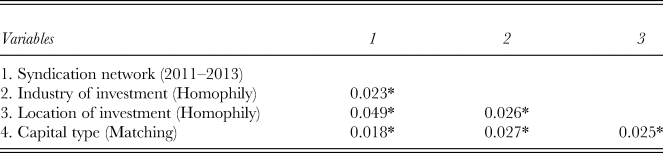
Table 2 shows the correlation table of the main variables. Homophily dimensions between VC institutions are positively related to VC syndication networks. However, we cannot draw conclusions based on these descriptive statistics due to complex interdependencies within the data. For further exploration, we specify ERGMs.
Correlation of syndication network and homophily matrices

Notes: *p < 0.001, QAP test with 2000 repetitions
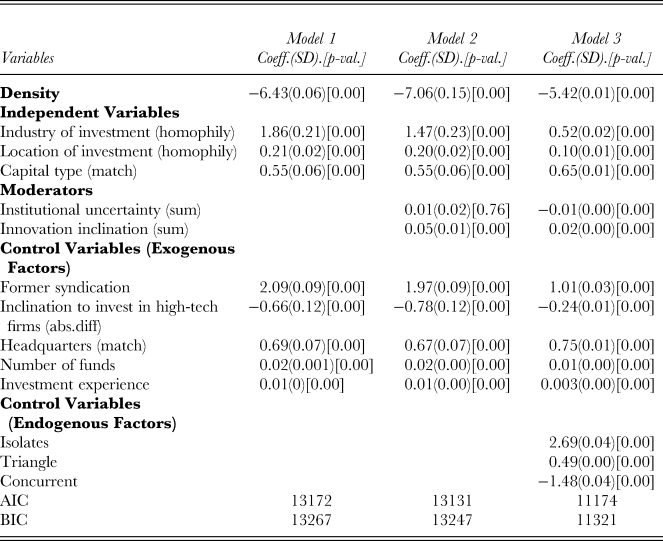
Tables 3 and 4 report estimates with standard errors of ERGM models. The significance levels are noted at the foot of each table.
Results of ERGMs (p* models)

Results of ERGMs (p* models) with moderators

In Table 3, to test our hypotheses, we first examine the effect of homophily (independent variables) on network ties, as estimated in models 1, 2, and 3. The results of model 3 show that the estimated coefficients of the homophily measures are positive and significant. Syndication happens most often between VCs that are in the same industry and have the same location focus and the same type of capital. This finding suggests that the homophily principle applies to the VC industry in general. After controlling for endogenous within-network factors, the homophily effects persist. Specifically, when industry homophily changes from 0 to 1, the odds ratio of tie-forming increases by 68.2% ((e 0.52 − 1)*100%); when location homophily changes from 0 to 1, the odds ratio of tie-forming increases by 10.5% ((e 0.1 − 1)*100%) in model 3. When comparing the different capital types, we find that the odds ratio of tie-forming increases by 91.6% ((e 0.65 − 1)*100%) when the two VCs have the same capital type. The significance of the control variables is as predicted: large, experienced VCs located in open areas tend to syndicate more than their counterparts. Previous syndication, the same location of headquarters, and a similar inclination to embrace high-tech development can enhance future cooperation opportunities.
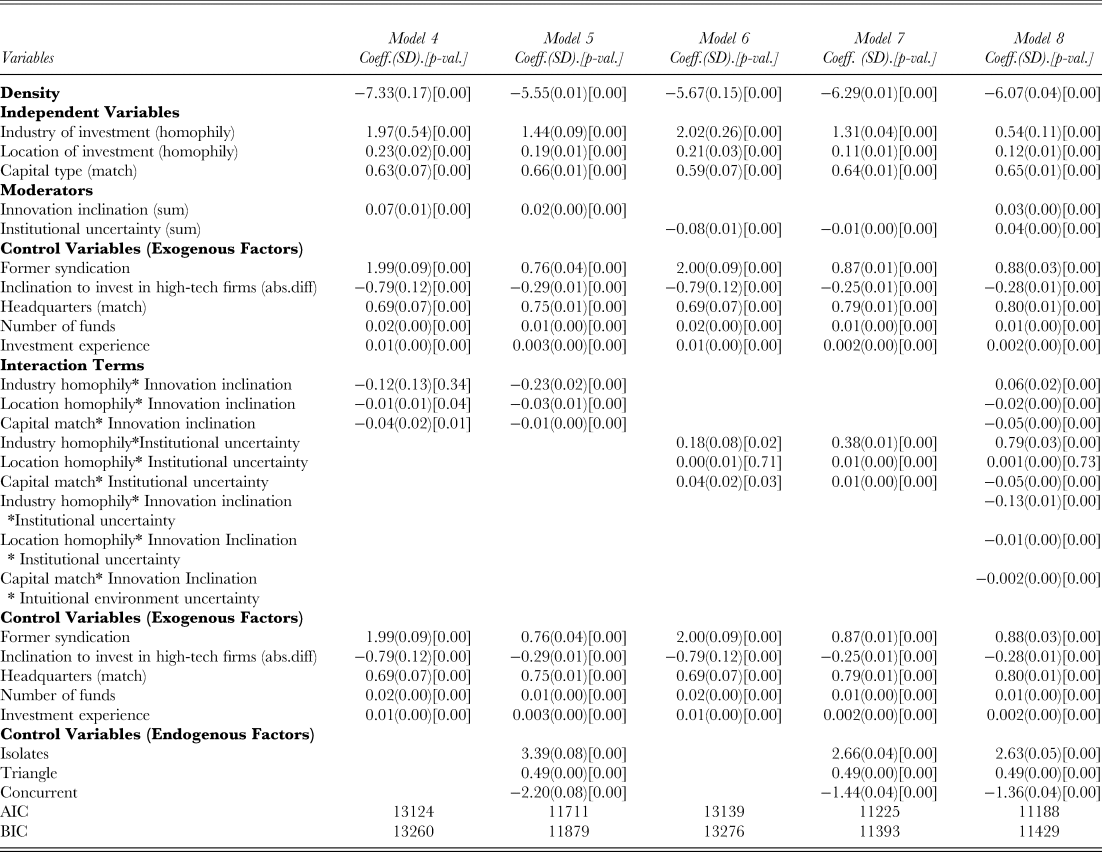
Models 4–7 provide support for moderating effects. When the interaction terms of homophily and innovative inclination are added to the models, they have significant negative coefficients, indicating that VC firms that are more inclined to invest in innovative companies are less likely to form homophilous collaborations. Moreover, in regions with high levels of institutional uncertainty, the likelihood of homogenous syndication increases, indicating an increased tendency to syndicate with homogeneous partners to fend off institutional uncertainty.
The goodness-of-fit graphs of several structural measurements are shown in Figure 4. These graphs show that our model can predict the distribution of the degree and number of triangles, although we tend to overestimate the geodesic distances between the nodes.
Goodness-of-fit diagnostics
Notes: This figure shows the goodness-of-fit graphs of our structural measurements. The solid line is a real syndication network. The dashed line is the network simulated by theory. The closer the two lines are, the better the simulation results are.

Notably, the three-way interaction terms in model 8 have significant, negative coefficients. This suggests that for highly innovative VC firms, the enhancing effect of an institutionally uncertain environment on homogeneous syndication is reduced. This result is consistent with our hypotheses, because we take the technological factor as a competing consideration with the institutional factor for VC firms, and we assume that these factors will balance each other. This means that considering either institutional uncertainty or inclination to invest in innovative companies alone does not provide a complete picture of the partner-selection pattern. In Figure 5, we present the contingent relationship between homophily and syndication based on the results of model 8. When considering the mediating effect of innovativeness, we classify all VCs into the ‘high’ or ‘low’ group by comparing their innovation score with the sample medium and assign the average innovation score of each group to the variable in the model separately. The calculations for the groups characterized by ‘high’ and ‘low’ institutional uncertainty are processed in the same way. A significant inclination for homogeneous syndication only emerges when the environment is highly uncertain and VC firms do not actively pursue innovation. With regard to industry and location measurements, the principle of homophily does not work for VC firms in a highly stable environment (the slope is nearly zero), regardless of whether VC firms are innovative. All the VC firms tend to form syndications with other VCs with the same capital type, and the firms with the lowest inclination to innovate have the largest slope.
The contingent relationship between partner homophily and syndication inclination
Notes: Note that in all the three charts, it is always the less innovative VC firms in a highly unstable environment that are most likely to form homogeneous syndications. Although the environment and innovative motivation both influence the inclination for homogeneous syndication, the environment seems to have a greater impact.

Our findings suggest that, though the homophily principle is still relevant in the Chinese VC industry, its effects are conditional. It does not apply to every company under every circumstance; of all the VC firms in our study, less than one-quarter fall into the low innovation, high uncertainty category. For the other categories, the homophily principle either has only a marginal effect or has no effect at all. These are the situations when homophily does not function.
To sum up, the homophily principle only works for less innovative VC firms in more uncertain environments. Either a more stable environment or a higher preference for innovation will disturb this pattern and attract more diversity into the collaboration. In general, homophily doesn't work for most Chinese VC firms: for more innovative VC firms in a more stable market, the effects of the homophily principle are only marginal or even ignorable.
Additional Analysis
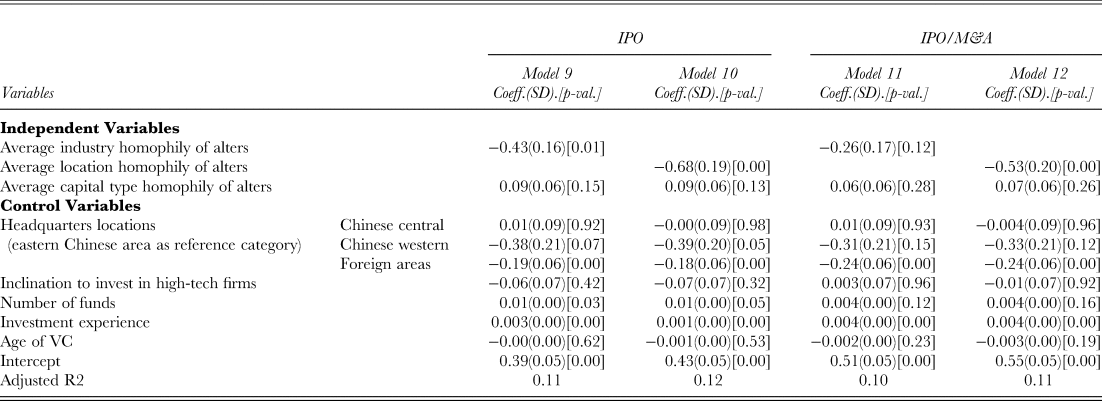
To see why venture capital firms may prefer heterogenous partners, we examine the performance implications of their partner-selection decisions. Previous research has revealed that innovation and a safe environment are both positively related to better performance (Chowdhury, Tarek, & Mohammad, Reference Chowdhury, Tarek and Mohammad2019). Thus, if homogeneous syndications are formed among VC firms that are not inclined to invest in innovation and that operate in conditions of high uncertainty, we can assume that homophily in syndication may be negatively related to performance. In Table 5, we test the relationship between homogenous syndication and VC performance. This analysis is carried out at the VC level. We first build a VC network from 2006–2010 and then calculate the average homophily measures for each focal VC's changes. The resulting measures present each VC's inclination to syndicate with similar partners. Because a focal VC's inclination to syndicate with an industry-similar partner is highly correlated with its inclination to syndicate with a location-similar partner, we include the two variables separately in the model specifications. Those VCs that never syndicated with other VCs during the 2006–2010 period are deleted from our sample, leaving 502 cases in the dataset. The control variables are the same as the controls in the main model in section 4. VC financial indicators are usually absent from a data set, so the number of desired exits (i.e., IPO or a high-priced M&A) is often used to measure performance (Hochberg et al., Reference Hochberg, Ljungqvist and Yang2007). Our dependent variable is a 0–1 indicator. If a VC experiences a desired exit event, then the dependent variable is set to 1; otherwise, the dependent variable is set to 0. On this basis, we conduct a logit regression.
Effects of partner homophily on VC performance

Results from the logistic models clearly show that homophily between a focal VC and its partners does not contribute to better performance at the VC level; on the contrary, it harms the firms’ performance. Industry and location homophily measures have significant, negative coefficients, which means that remaining in a narrow social circle decreases the probability of a desired exit event. Specifically, when the average industry homophily of alters changes from 0 to 1, the odds ratio of a VC firm having an IPO event decreases by 34.9% ((e −0.43 − 1)*100%) in model 9. When the average location homophily of alters changes from 0 to 1, the odds ratio of VC having an IPO event decreases by 49.3% ((e −0.68 − 1)*100%) in model 10. We can conclude that the rewards of diversified syndication are generally higher than the rewards from homogeneous collaboration, regardless of where this syndication takes place. This finding lends additional support to our argument that VCs tend to choose heterogeneous partners in an unstable institutional environment because heterogeneous partners contribute valuable and novel resources, which in turn enhance the focal VC's performance.
DISCUSSION
Our study explores the contingency of the homophily principle in an emerging market. Because companies in China face a high level of institutional uncertainty, firms need to strike a balance between uncertainty reduction and resource mobilization. The general homophily principle, based on assumptions about trust building, may not hold in all situations. Our analysis reveals that the influence of the homophily principle on the network topology of the Chinese VC industry is mainly driven by less innovative firms in an institutionally uncertain environment. Such companies make up only a small proportion of all VCs in our sample. In contrast, VC firms that are inclined to invest in more innovative startups and that operate in a relatively mature market are more willing to syndicate with partners who bring in diverse resources.
According to our quantitative analysis, both uncertainty-reduction and resource-mobilization mechanisms influence the partner-choosing patterns of Chinese VC firms. Contrary to the assumption that homophily is mainly moderated by institutional elements such as the investment grading system (Podolny, Reference Podolny1994), we find that VCs’ inclination to invest in innovative ventures is also a strong moderator that should be considered in future studies. For some VC firms, the homophily principle either does not work or has only a marginal impact. This result urges us to think about the applicability of Western management theories in an emerging market. On one hand, emerging markets are generally characterized by greater uncertainty and more complex mechanisms of resource accumulation, and ‘guanxi’, trust, and strong ties do play a more important role than in mature markets. On the other hand, the need for resource complementarity also has quite important effects, and efficiency matters in emerging markets just as much as in mature markets. Which factor is more important depends on the spatial-temporal distribution of the firms. Once the spatial-temporal ‘location’ of a sample is identified, the specific optimal strategy can be derived. Thus, we believe that the debate between network homophily and network diversity, as well as the debate between ‘Chinese management’ and ‘Western management’, can be solved by taking the complexity of context into consideration. Ignoring or over-emphasizing either side leads to theoretical misunderstanding.
Methodologically, we use ERGMs with moderators to properly capture how VC firms choose partners. Our results describe the complex situation in which environmental factors and company-level factors co-affect the network topology. Traditional network analysis often considers the company-level factors and environmental factors as separate and examines their effects separately. By contrast, our analysis reveals that contexts contain complexities that cannot be reduced to a linear relationship. We find that VC firms form their strategies in local business contexts: They tend to choose homogeneous partners when doing conservative business in an unstable market but replace those relationships with more diversified collaborations to gain innovative opportunities.
Our findings can help VC firms make better business decisions in practice, especially in theirs choices of co-investing partners and portfolio companies. A stable, open market environment often allows for more ambitious, innovative investment and more trial and error. VC firms in these regions can be more courageous and participate in investments with higher risks. In comparison, a more institutionally uncertain environment does not allow for as much diversity of alliance and innovative investment. In such circumstances, a wiser choice is to be more cautious and conservative. Our study also has implications for public policy. Our findings support the assumptions that a free market contributes to innovation and economic growth and that further marketization is necessary for an emerging market to continue to develop. The government should promote the growth of market-oriented institutions because they offer a better environment for innovation.
Nevertheless, this article has some limitations. Due to data unavailability, we do not have exact information about personal relationships between the individuals who run the VC firms, such as their universities, work histories, and life-course data. Interviews with VC partners indicate that VC networks are interrelated with interpersonal networks between general partners and that similarity in personal backgrounds constitutes an important homophily effect. However, because our database lacks this information, we are unable to quantitatively analyze these patterns. Future studies should further examine the development and impact of VC managers’ personal relationships. Different types of personal ties can influence the long-term development of VC cooperation. The complexity of network formation can be extended to multilevel networks. An understanding of how individual-level networks co-evolve with organization-level networks can better reveal the complexity of partner-choice mechanisms.