I. INTRODUCTION
The NASA Genesis mission is the first mission returning solar material to Earth for laboratory analysis after the Apollo program (Burnett et al., Reference Burnett, Barraclough, Bennett, Neugebauer, Oldham, Sasaki, Sevilla, Smith, Stansberry, Sweetnam and Wiens2003). Solar wind (SW) was collected by passively exposing ultrapure materials such as silicon and sapphire (Al2O3), mounted on a small spacecraft, to the charged particles (Jurewicz et al., Reference Jurewicz2003). The collection took place at Lagrange 1 (L1) point, where gravities of Sun and Earth are equal, for a duration of 854 days (Reisenberg et al., Reference Reisenberg, Wiens, Barraclough, Steinberg, DeKoning, Zurbuchen and Burnett2005). The space craft returned to Earth on September 8, 2004 with an unexpected crash landing in the Utah desert. The impact not only fractured the collectors into small irregular pieces but also broke the return capsule open exposing the collectors to the desert environment. As a result samples were contaminated and have to be cleaned individually before any analyses of SW material can be carried out. The ubiquitous contaminants are separated from the atoms of SW by only 5–15 nm, presenting significant challenges for SW analyses as well as the development of cleaning techniques. The contamination varies from sample to sample, but consists primarily of two types: an organic silicone-like film acquired in flight and particulates from the hard landing. Different surface cleaning procedures for removal of both types of contaminations were and are still being developed to enable analysis of minor SW elements prominent also in the contamination (Huang et al., Reference Huang, Humayun, King, Goddard and Burnett2006, Reference Huang, Humayun and Burnett2008; Sestak et al., Reference Sestak, Franchi, Verchosky, Al-Kuzee, Braithwaite and Burnett2006; Allton et al., Reference Allton, Wentworth, Rodriguez and Calaway2007; Calaway et al., Reference Calaway, Burnett, Rodriguez, Sestak, Allton and Stansberry2007, Reference Calaway, Rodriguez, Allton and Stansberry2009; Schmeling et al., Reference Schmeling, Burnett and Jurewicz2011).
Each sample has to be checked after cleaning to decide whether removal of contaminants was successful and to guide what, if any additional cleaning steps are required. Analysis methods employed for post-cleaning control have to be surface sensitive and non-destructive to avoid additional contamination. They also have to be fast and multi-element capable to accommodate the large number of samples. Bench-top total reflection X-ray fluorescence spectrometry (TXRF) offers all these features as it is a non-destructive, surface sensitive analysis method with detection limits in the lower 1011 to 109 atoms cm−2 range (Klockenkämper, Reference Klockenkämper1997; Wobrauschek, Reference Wobrauschek1998, Reference Wobrauschek2007; Streli et al., Reference Streli, Kregsamer, Wobrauschek, Gatterbauer, Görgl, Pianetta, Pahlke, Fabry, Palmetshofer and Schmeling1999; Shaffner, Reference Shaffner2000; Pahlke et al., Reference Pahlke, Fabry, Kotz, Mantler and Ehmann2001; Hellin et al., Reference Hellin, de Gendt, Valckx, Mertens and Vinckier2006; Schmeling, Reference Schmeling2005; Sekowski et al., Reference Sekowski, Steen, Nutsch, Birnbaum, Burenkov and Pichler2008; West et al., Reference West, Ellis, Potts, Streli, Vanhoof, Wegrzynek and Wobrauschek2010; Schmeling et al., Reference Schmeling, Burnett and Jurewicz2011).
To date a total of 18 different Genesis samples consisting of silicon, silicon on sapphire and sapphire were analyzed using bench top TXRF after applying different methods of surface cleaning. Two samples treated by very different surface cleaning methods were selected for this study to demonstrate the capability of bench-top TXRF and also to highlight the challenges faced with this type of sample. The results indicate that each material is unique and requires a specific cleaning approach, which often has to be adapted for Genesis samples.
II. INSTRUMENTATION AND METHODS
Most sample analysis was carried out with a PicoTax® TXRF spectrometer utilizing a fine focus X-ray tube with Mo target (40 kV and 1000 μA operating conditions). Some of the samples were analyzed with the newly acquired S2 Pico Fox® TXRF spectrometer equipped with a micro focus X-ray tube with Mo target (40 kV, 600 μA) and a curved multilayer, focusing the X-ray beam on the sample. Both instruments are equipped with a silicon drift detector and were manufactured by Bruker AXS, Berlin, Germany. The sample spot size for the Pico Tax® instrument is about 2 mm (width) × 5 mm (length) and for the S2 PicoFox® instrument 0.1 mm (width) × 5 mm (length).
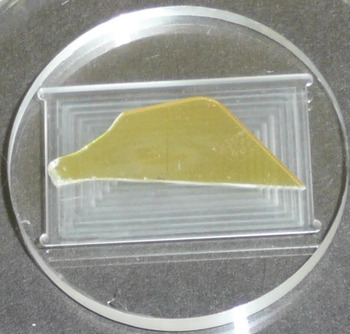
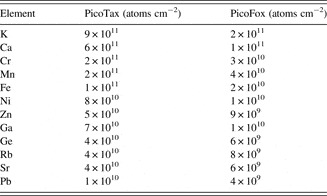
Since both instruments use vertical loading of the sample, they were tilted 90° and supported in a frame structure to allow for horizontal loading of the Genesis samples. Special polycarbonate templates were made having an area large enough for the Genesis sample to be placed into a pocket of appropriate depth milled out of the material to make a flush surface of sample and carrier. Figure 1 shows a template together with a sample. The templates were cleaned by ultrasonication in soapy water, then rinsed with 18-MOhm water and checked for contamination before each analysis. The Genesis sample was then placed carefully into the cleaned template using polytetrafluoroethylene (PTFE) tweezers in a class 100 clean bench and transferred to the TXRF instrument in a closed container to avoid contamination during transport. TXRF analysis of the samples was carried out with counting times of 7200 s for PicoTax® and 2000 s for S2 PicoFox® instrument, respectively. Higher sensitivity permitted for shorter measurement times with S2 PicoFox®. Counting times were adjusted when needed to determine contaminations present. The detection limits (in atoms cm−2) for a counting time of 7200 s for both instruments are shown in Table I.
(Color online) A NASA Genesis SW sample (silicon on sapphire) as placed in a polycarbonate analysis template, specifically made for this purpose.

Detection limits for selected elements measured with PicoTax and PicoTax. Counting time 7200 s.

All samples were analyzed by TXRF after being cleaned with ultrapure water (UPW) and some samples were cleaned with UV Ozone at Johnson Space Center, which removes many of the larger particulates and organic materials, respectively (Allton et al., Reference Allton, Wentworth, Rodriguez and Calaway2007; Calaway et al., Reference Calaway, Burnett, Rodriguez, Sestak, Allton and Stansberry2007, 2009). Two approaches for cleaning were then investigated: (1) Acid cleaning for sample sapphire (Al2O3) 50719 and (2) CO2 snow cleaning for sample silicon 60758. For (1) Sample 50719 was subjected to a 6 M hydrochloric acid cleaning cycle analyzed by TXRF and then underwent a second more rigorous cleaning step involving hydrofluoric (1:5) and hydrochloric acid (6 M). In case (2) sample 60578 was placed in a CO2 snow cleaning apparatus based on the system manufactured by Applied Surface Technologies (New Providence, NJ; high purity unit K4–10, http://www.co2clean.com). This sample was placed in a sealed chamber, which was purged with dry nitrogen for 2 h prior to raster scanning the surface of the sample with a CO2 snow jet for about 30 min. TXRF analysis was carried out before and after CO2 cleaning.
The acid-treated sample was also investigated by scanning electron microscopy (FEI XL 30) to locate and identify remnant particulate contamination.
III. RESULTS
A. Acid cleaning – NASA Genesis SW sample sapphire 50719
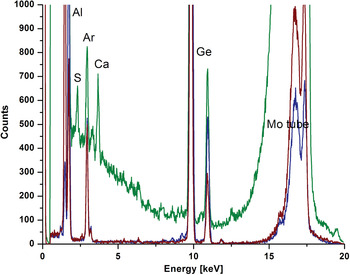
NASA Genesis sample sapphire (Al2O3) 50719 underwent three cleaning steps as described under (1) in the experimental section with subsequent analysis by TXRF. Figure 2 shows TXRF analysis results using the PicoTax® instrument following each cleaning step. The green spectrum shows the results obtained after UPW and UV/O3 treatment, the blue spectrum was recorded after 6 M HCl cleaning and the red spectrum shows the results after additional cleaning with 1:5 HF:H2O and 6 M HCl. Clearly noticeable is the difference in background scattering for the spectra before and after the first acid cleaning, especially pronounced in the lower energy range. The elevated background for the green spectrum (before acid cleaning) most likely indicates the presence of the film-like organic surface contamination acquired in flight, which appears to be removed by 6 M hydrochloric acid treatment. The large peak remaining after 6 M HCl and somewhat reduced after second acid cleaning with HF and HCl corresponds to germanium. Some of the collectors were made of high purity germanium and were pulverized during the crash. As a result most collector fragments show germanium contamination to a certain degree. Inspection using scanning electron microscopy of the same area analyzed by TXRF yields also germanium as contaminant. An estimation of contamination remaining after each analysis step was attempted. For this, the count rate of the element(s) measured on the sample surface was compared to the count rate of a standard containing known concentrations of the element in the same order of magnitude than the sample. The counting time was the same as the sample. Table II shows the rough estimates. It is important to keep in mind that these rough estimates are indicating only the order of magnitude of contamination and not the exact amount.
(Color online) Spectra obtained after different cleaning steps for sample Al2O3 50719. The green (light gray) spectrum was acquired after routine cleaning with UPW and UV/O3 (Allton et al., Reference Allton, Wentworth, Rodriguez and Calaway2007), the blue (dark gray) spectrum was measured after cleaning the sample with 6 M HCl and the red (black) spectrum corresponds to the sample after an additional cleaning step with 1:5 HF:H2O and 6 M HCl.

Estimated concentrations of remaining surface contaminants after each cleaning step.

B. CO2 snow cleaning – NASA Genesis SW sample silicon 60758
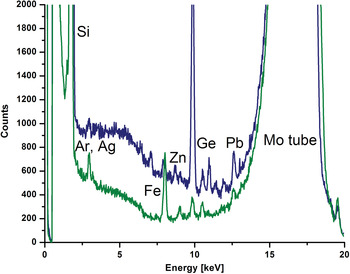
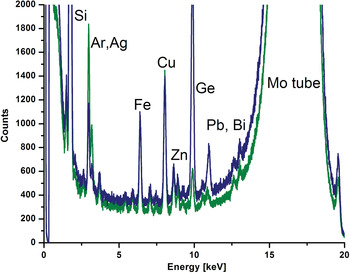
Another Genesis sample, 60758, made of silicon, was subjected to a different cleaning approach using CO2 snow as described in the experimental section. CO2 snow is widely used as a cleaning step in the semiconductor industry. CO2 cleaning is gentle and fast and does not attack the material itself, but only removes particles located at the surface of the substrate. The sample was already mounted on a stub for resonance ion mass spectrometry (RIMS) analysis and special polycarbonate templates were made accountable. The templates had markers to ensure that the sample was loaded in the same position into the TXRF spectrometer each time, before and after cleaning. The sample was analyzed with both the PicoTax® and the S2PicoFox® instruments before and after cleaning with CO2 snow. The older PicoTax® instrument has a larger analysis spot with 5 mm in length and 2 mm in width and thus provides a good overview measurement of the sample. The newer S2 PicoFox® instrument has an analysis spot size of 5 mm in length and 0.1 mm in width, thus making it possible to obtain some crude surface mapping when the sample is moved systematically with respect to the beam. This was achieved by using different templates, which held the sample in different off-set positions from the center of the beam spot. The sample itself was about 5 mm in one direction and about 4 mm in the other direction. As the sample was already fixed on a stub, sometimes several spectra were necessary to ensure that proper total reflection of the X-ray beam on the sample surface was achieved. Figures 3 and 4 show the results obtained with PicoTax® (Figure 3) and S2 PicoFox® (Figure 4) before and after the CO2 cleaning step. The initial contamination of the sample is shown as the blue spectrum in Figures 3 and 4. The green spectra in Figures 3 and 4 show the results after CO2 cleaning of the sample. It is important to note that the sample was mounted with glue containing mostly silver but also other elements. Possibly the peaks of Fe, Cu, Zn, Pb and Bi originate besides the Ag from the glue as the X-ray beam striking the sample is larger in one direction than the sample itself and might also irradiate the glue and aluminium mount surrounding the sample on all sides. Moreover as the sample is progressively moved away from the center of the irradiated area, more and more of the mount together with the glue and less sample is being exposed to the beam accounting for additional peaks. To clarify the source of some of the elements detected, we are in the process of measuring the glue itself and compare it with the spectra obtained for sample 60758. The germanium peak (at ~9.8 keV) very likely originates from the sample and was noticeably reduced after CO2 cleaning as seen in both sets of measurements. So far these results seem to indicate that CO2 snow cleaning might be a good and gentle alternative to acid cleaning when the contaminants, like in this case Ge, are loosely held at the surface.
(Color online) Analysis of sample Si 60758 by PicoTax® TXRF spectrometer with spot size 5 mm length and 2 mm width. The blue (dark gray) spectrum shows the sample before CO2 cleaning, whereas the green (light gray) spectrum shows the sample after CO2 cleaning.

(Color online) Analysis of sample Si 60758 by S2 PicoFox® TXRF spectrometer having a spot size of 5 mm in length and 0.1 mm in width. The blue (dark gray) spectrum shows the sample before CO2 cleaning and the green (light gray) one after CO2 cleaning.

IV. CONCLUSION
Bench top TXRF spectrometry was used successfully to analyze surface contaminations on NASA Genesis SW samples before and after cleaning procedures. Two different cleaning approaches were explored and both appear to be promising. In some cases, additional measurements identifying contamination originating from sample treatment (i.e., sample glue for mounting prior to RIMS analysis) have to be carried out to identify the actual remnant Genesis contaminations.
ACKNOWLEDGEMENTS
This work was supported by NASA/JPL grant 1369203 and NASA grant NNX10AH05G. The work of I.V.V was supported by NASA through grant NNH09AM48I, and by UChicago Argonne, LLC, under contract No. DE-AC02-06CH11357. We thank C. E. Tripa for his help in preparing the CO2 snow cleaned samples.