Implications
Pre-storage incubation has been suggested as a useful tool to reduce the negative effects of prolonged storage times by advancing the developmental stage of the embryo. This study clarified that pre-storage incubation could enhance the livability of the developing embryos via reducing the stress of prolonged egg storage. Pre-storage incubation for 6 or 8 h had a positive effects on hatchability traits, thyroid hormones, antioxidative properties, lipid peroxidation and humoral immunity in the newly hatched chicks in prolonged egg storage which could be applied in broiler parent and grandparent hatcheries.
Introduction
Cool temperature storage of hatching eggs before incubation is a common practice in commercial breeding farms and hatcheries. According to the variable market demand for 1-day-old chicks and the hatchery capacity, the total length of egg storage varies between a few days and several weeks. However, it is well known that prolonged storage periods beyond 7 days leads to an increase in the incubation duration (Tona et al., Reference Tona, Bamelis, De Ketelaere, Bruggeman, Moreas, Buyse, Onagbesan and Decuypere2003; Reijrink et al., Reference Reijrink, Meijerhof, Kemp, Graat and van den Brand2010a) and had negative effects on hatchability (Fasenko et al., Reference Fasenko, Robinson, Whelan, Kremeniuk and Walker2001b; Tona et al., Reference Tona, Onagbesan, De Ketelaere, Decuypere and Bruggeman2004) and chick quality (Tona et al., Reference Tona, Bamelis, De Ketelaere, Bruggeman, Moreas, Buyse, Onagbesan and Decuypere2003 and Reference Tona, Onagbesan, De Ketelaere, Decuypere and Bruggeman2004). In addition, previous studies determined that the negative effects of prolonged egg storage more than a week on embryonic growth rate, viability, hatchability and chick quality vary with the age of breeder flocks (Lapao et al., Reference Lapao, Gama and Chaveiro Soares1999; Tona et al., Reference Tona, Bamelis, De Ketelaere, Bruggeman, Moreas, Buyse, Onagbesan and Decuypere2003). Several studies noted that prolonged egg storage decreased hatchability in the eggs of old breeder hens more than in eggs of young breeder hens (Lapao et al., Reference Lapao, Gama and Chaveiro Soares1999; Tona et al., Reference Tona, Onagbesan, De Ketelaere, Decuypere and Bruggeman2004). It was explained that the negative effects of prolonged egg storage more than a week might be attributed to the deterioration of internal egg quality characteristics, mainly albumen viscosity (Reijrink et al., Reference Reijrink, Berghmans, Meijerhof, Kemp and van den Brand2009). Lapao et al. (Reference Lapao, Gama and Chaveiro Soares1999) observed that albumen pH was increased with egg storage time, and this effect was more pronounced in older than younger breeder hens. Also, albumen height was decreased with increase of the age of the breeder hens and egg storage (Lapao et al., Reference Lapao, Gama and Chaveiro Soares1999) and yolk sac membrane elasticity was decreased with the increasing of the storage time (Jones and Musgrove, Reference Jones and Musgrove2005). Moreover, Nahm (Reference Nahm2001) demonstrated that embryonic mortality during storage was highly related with egg weight loss and increased with storage time.
Warming of hatching eggs before storage (pre-storage incubation) has been a suggested method to reduce the negative effects of long-term storage times by enhancing the developmental stage of the embryo. Some previously published studies indicated that pre-storage incubation was associated with improvements in hatchability of chickens (Fasenko et al., Reference Fasenko, Robinson, Whelan, Kremeniuk and Walker2001b; Silva et al., Reference Silva, Faria, Torres, Faria Filho, Coelho and Savino2008; Gucbilmez et al., Reference Gucbilmez, Ozlu, Shiranjang, Elibol and Brake2013), turkeys (Fasenko et al., Reference Fasenko, Christensen, Wineland and Petitte2001a) and quails (Petek and Dikmen, Reference Petek and Dikmen2004) and these improvements were connected with the stage of embryonic development in the egg at the time the egg is stored. Fasenko et al. (Reference Fasenko, Christensen, Wineland and Petitte2001a and 2001b) and Reijrink et al. (Reference Reijrink, Berghmans, Meijerhof, Kemp and van den Brand2009) confirmed that embryos that have completed hypoblast formation have a survival advantage over embryos that are undergoing, or have just completed, the area pellucida formation which finally translated into higher hatchability rates.
Previous studies have shown that prolonged egg storage may induce embryonic stress in form of blastodermal cell apoptosis and necrosis (Bloom et al., Reference Bloom, Muscarella, Lee and Rachlinski1998; Hamidu et al., Reference Hamidu, Uddin, Li, Fasenko, Guan and Barreda2011; Dymond et al., Reference Dymond, Vinyard, Nicholson, French and Bakst2013) which consequently manifested in increased embryonic mortality, depressed embryonic metabolism and developmental delays (Hamidu et al., Reference Hamidu, Rieger, Fasenko and Barreda2010). Thus, it could be hypothesized that pre-storage incubation could advance the developmental stage of the embryo and might enhance the livability of the developing embryos via reducing the stress of prolonged egg storage. To our knowledge, no previously conducted research has investigated the effects of pre-storage incubation and its interactions with the age of breeder hens and length of storage period on thyroid activity, antioxidative status and immunity of neonate chicks. Therefore, the objective of the present study was to investigate the effects of pre-storage incubation and egg storage on hatchability characteristics, chick quality and serum thyroid hormones, antioxidative properties and immunoglobulin Y (IgY) concentrations of newly hatched chicks at two ages of breeder hens in Egyptian local cross chicken.
Material and methods
The present experiment was carried out in Inshas Research Station, Animal Production Research Institute, Ministry of Agriculture, Egypt. All experiments and animal husbandry were performed in accordance with the institutional guidelines concerning animal use and welfare.
Breeder flock ages, egg collection and experimental design
A total of 8000 fertile eggs were obtained from two different ages of chicken breeder hens (Egyptian local cross, Inshas). Half of the eggs were collected from young breeder hens (28 weeks old) and the other half from older breeder hens (50 weeks old). All eggs were cleared from the nests before egg collection to ensure that eggs laid late on the previous day were not included. In each age of hens, eggs were distributed in a completely randomized experimental design in a 2×4 factorial arrangement, with two storage periods (4 or 14 days) and 4 pre-storage incubation durations (0, 4, 6 or 8 h at 37.5°C). In each age of hens, eggs were randomly distributed into 8 experimental groups of 500 eggs each. Eggs in each treatment were randomly allocated into 10 replicates of 50 eggs each. For the incubation measurements, a group of 50 eggs was used as the experimental unit. Eggs for the 14 days storage group were collected 10 days before the eggs collected for the 4 days storage group so that the eggs from both storage periods could be set in the incubator at the same time. The 4 days storage was chosen, as this emulates the current industry conditions, whereas 14 days was consider the long storage period. Before storage, eggs were numbered and weighed. All eggs were placed small-end down in an egg cooler maintained at an average of 12°C and 75% relative humidity. This storage conditions were chosen to optimize the hatchability in the experimental groups.
Egg weight loss
To calculate egg weight loss, all eggs were numbered and weighed individually at the day of egg collection, at the last day of storage and at day 18 of incubation. Egg weight loss during storage was determined by calculating the difference in egg weight between the day of egg collection and the last day of storage as a percentage of egg weight at collection. Egg weight loss during incubation was determined by calculating the difference in egg weight between the last day of storage and day 18 of incubation as a percentage of egg weight at the last day of storage. Total egg weight loss was the sum of egg weight loss during storage and incubation.
Egg incubation, fertility, hatchability, embryonic mortality and chick quality
At the end of storage time, eggs were transferred from storage room to the egg room and stayed in it for 18 h before setting to allow the eggs to equilibrate to room temperature. Eggs were thereafter set in a single-stage egg incubator (Model 576 setter and a Model 192 hatcher; Petersime®, Zulte, Belgium). The setter air temperature set points were 37.4±0.2°C dry bulb and 28.9±0.2°C wet bulb. The hatcher air temperature set points were 37.2±0.2°C dry bulb and 30±0.2°C wet bulb. Eggs were turned through an angle of 90° hourly and temperature settings within the setter and hatcher were automatically regulated. Eggs from the different treatments were labeled and placed in the standard incubator trays (150 eggs per tray) that were distributed throughout all positions in the setter and hatcher to distribute possible minor machine position effects across treatments, which could be due to small differences in air flow. After day 21 of incubation, live hatched chicks were graded and counted, while, unhatched eggs were broken and examined macroscopically to determine fertility and the stage of embryonic mortality. Because fertility was determined macroscopically, it is possible that an embryo that died during storage was classified as an infertile egg. Stages of embryonic mortality were determined according to Reijrink et al. (Reference Reijrink, Berghmans, Meijerhof, Kemp and van den Brand2009). Embryonic mortality was divided into three categories: embryonic mortality from days 0 to 9 (early), from days 10 to 17 (middle) and from days 18 to 21 (late). Fertility was calculated as a percentage of set eggs. Hatchability was calculated as a percentage of set eggs and as a percentage of fertile eggs. Embryonic mortality was calculated as a percentage of fertile eggs. Chick quality was determined in each experimental treatment. All chicks were graded into first ‘A’ and second ‘B’ grade chicks. A chick was classified as a grade A chick when the chick was clean, dry, free of deformities or lesions and bright eyes as well as navel was completely closed and clean (Tona et al., Reference Tona, Onagbesan, De Ketelaere, Decuypere and Bruggeman2004). The other chicks were classified grade B chicks. The first and the second grade of chicks were calculated as a percentage of total hatched chicks.
Blood collections and chemical analyses
Ten newly hatched chicks from each treatment were anesthetized with carbon dioxide and blood samples (0.5 ml/chick) were collected by cardiac puncture for serum chemical analyses. Serum was separated by centrifugation at 5900×g for 10 min and frozen at −20°C until analysis. Serum triiodothyronine (T3) and thyroxine (T4) concentrations were measured using commercial ELISA kits (BioCheck®, Foster City, USA). Serum levels of IgY were determined using chicken IgY ELISA quantitative kits (GenWay Biotech Inc., San Diego, CA, USA). Lipid peroxidation in blood serum was measured in the form of malondialdehyde (MDA) as described by Richard et al. (Reference Richard, Portal, Meo, Coudray, Hadjian and Favier1992). MDA is a product of the oxidative degradation of polyunsaturated fatty acids, and is thus used as an index of oxidative stress. The activity of the antioxidative enzyme glutathione peroxidase (GSH-Px) and total antioxidant capacity of blood serum were measured according to Paglia and Valentine (Reference Paglia and Valentine1967) and Koracevic et al. (Reference Koracevic, Koracevic, Djordjevic, Andrejevic and Cosic2001), respectively, using kits produced by Bio-Diagnostic, Giza, Egypt. The analyses were carried out according to the manufacturer’s instructions.
Statistical analysis
Data were analyzed separately at each hen age as a 2×4 factorial design with storage time, pre-storage incubation, and their interaction as class variables. All the traits were analyzed by using the following univariate linear model:
 $$Y_{{ijk}} {\,\equals\,}S_{i} {\plus}I_{j} {\plus}S{\times}I_{{ij}} {\plus}e_{{ijk}} $$
where S i is the effect of the egg storage time treatment (two levels, 4 and 14 days of egg storage), I j the effect of the pre-storage incubation (four levels, pre-storage incubation for 0, 4, 6 and 8 h), S×I ij the effect of the interaction (eight levels, egg storage time and pre-storage incubation) and e ijk the residual effect. To test the significant of the used effects in the model, factorial ANOVA was applied using the GLM procedure of SAS 9.2 (SAS Institute Inc., 2008). The different levels of each effect included in the models were compared by using Duncan’s multiple range test where significance levels were detected as first class error at α=0.05.
Results
Egg weight and egg weight loss
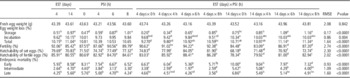
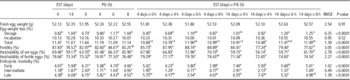
The main effects of pre-storage incubation treatments and egg storage time on fresh egg weight, egg weight loss during storage, incubation and total experimental period in eggs from breeder hens at 28 and 50 weeks of age are presented in Tables 1 and 2, respectively. No significant differences were observed in fresh egg weights at 28 and 50 weeks of age. At both of ages, egg weight loss percentage during storage was increased when storage time was increased significantly. At 28 and 50 weeks of age, pre-storage incubation increased egg weight loss significantly during storage, while, egg weight loss during incubation and total egg weight loss were not significantly affected by pre-storage incubation (Tables 1 and 2). At 28 weeks of age, a significant interaction between length of storage time and pre-storage incubation was observed for egg weight loss percentage during storage, incubation and total experimental period (storage+incubation, Table 1). Similarly, at 50 weeks of age, pre-storage incubation and storage duration interacted significantly in egg weight loss during storage and the whole experimental period, while, this significance was disappeared during the incubation period (Table 2). As egg storage time and length of pre-storage incubation increased, egg weight loss during storage significantly increased and consequently total egg weight loss was increased. Eggs stored for 14 days presented higher weight loss during storage when heated for 6 and 8 h as compared with non-heated eggs (Tables 1 and 2).
Effect of egg storage time (EST) and pre-storage incubation (PSI) on egg weight loss, fertility and hatchability traits in Egyptian local strain chickens (Inshas) at 28 weeks of age

RMSE=root mean squared error.
Values are least-squares means.
a,b,c,d,e,f,gMeans within a row with no common superscript differ significantly (P⩽0.05).
Effect of egg storage time (EST) and pre-storage incubation (PSI) on egg weight loss, fertility and hatchability traits in Egyptian local strain chickens (Inshas) at 50 weeks of age

RMSE=root mean squared error.
Values are least-squares means.
a,b,c,d,e,fMeans within a row with no common superscript differ significantly (P⩽0.05).
Fertility, hatchability and embryonic mortality
The results of apparent fertility, hatchability of set eggs, hatchability of fertile eggs and embryonic mortality are shown in Tables 1 and 2. At 28 weeks of age, when storage time was increased from 4 to 14 days, apparent fertility, hatchability of set eggs and hatchability of fertile eggs were significantly decreased by 6.64%, 8.86% and 5.36%, respectively. Similar trend was observed in eggs produced from old breeder hens (50-week-old). At 28 and 50 weeks of age, pre-storage incubation for 6 or 8 h enhanced significantly the apparent fertility, hatchability of set eggs and hatchability of fertile eggs. At 28 and 50 weeks of age, the significant interaction between pre-storage incubation and storage period influenced the apparent fertility, hatchability of set eggs and hatchability of fertile eggs (Tables 1 and 2). In young breeder flock (28-week-old), eggs stored for 4 days showed higher significant fertility, hatchability of set eggs and hatchability of fertile eggs when heated for 6 h, while, when eggs were stored for 14 days, the highest apparent fertility, hatchability of set eggs and hatchability of fertile eggs were observed in eggs heated for 8 h comparing with non-heated eggs (Table 1). At 50 weeks of age, eggs stored for 4 and 14 days presented higher fertility, hatchability of set eggs and hatchability of fertile eggs when heated for 6 or 8 h as compared with non-heated eggs (Table 2). The results of the present study showed that, in eggs stored for 14 days, the pre-storage incubation for 6 or 8 h had a beneficial effect on hatchability when compared with the non-heated eggs. The improvement in hatchability was attributed to the reduction in embryonic mortality (Tables 1 and 2). The pre-storage incubation obviously decreased early (0 to 9 days), intermediate (10 to 17 days) and late (18 to 21 days) embryonic mortality as compared with non-heated controls at 28 and 50 weeks of age. As shown in Tables 1 and 2, early, intermediate and late embryonic mortality were significantly affected by the interaction between pre-storage incubation and egg storage. When storage time was 14 days, early, intermediate and late embryonic mortality were decreased for the 6 or 8 h pre-storage incubation than for the control eggs (0 h pre-storage incubation) in young and old breeder hens. This indicates that within eggs stored for long period (14 days), pre-storage incubation for 6 or 8 h appears to enhance the survive of the embryos which translated to reducing the embryonic mortality.
Chick quality
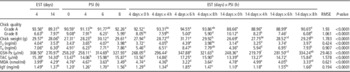
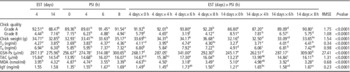
The main effects of pre-storage incubation treatments and egg storage time on chick quality in eggs from breeder hens of 28 and 50 weeks of age are presented in Tables 3 and 4, respectively. At both of ages, percentage of grade A chicks was higher for eggs stored for 4 days than for eggs stored for 14 days and pre-storage incubation for 6 or 8 h elevated significantly the grade A chicks and reduced the grade B chicks in comparison with non-heated controls. There were significant pre-storage incubation×egg storage interactions for the grade A chicks in young (Table 3) and old breeder hens (Table 4). Pre-storage incubation increased chick weight significantly in young and old breeder hens. The interaction of pre-storage incubation and storage time had a significant effect on chick weight (Tables 3 and 4). Heating eggs for 6 and 8 h before storage resulted in higher chick body weight as compared with heating for 0 h when eggs were stored for 14 days at 28 and 50 weeks of age.
Effect of egg storage time (EST) and pre-storage incubation (PSI) on chick quality, serum thyroid hormones, antioxidative properties, lipid peroxidation and immunoglobulin Y (IgY) in newly hatched chicks in Egyptian local strain chickens (Inshas) at 28 weeks of age

RMSE=root mean squared error; T3=triiodothyronine; T4=thyroxine; MDA=malondialdehyde; GSH-Px=glutathione peroxidase; TAC=total antioxidant capacity; IgY=immunoglobulin Y.
Values are least-squares means.
a,b,c,d,e,fMeans within a row with no common superscript differ significantly (P⩽0.05).
Effect of egg storage time (EST) and pre-storage incubation (PSI) on chick quality, serum thyroid hormones, antioxidative properties, lipid peroxidation and immunoglobulin Y (IgY) in newly hatched chicks in Egyptian local strain chickens (Inshas) at 50 weeks of age

RMSE=root mean squared error; T3=triiodothyronine; T4=thyroxine; MDA=malondialdehyde; GSH-Px=glutathione peroxidase; TAC=total antioxidant capacity; IgY=immunoglobulin Y.
Values are least-squares means.
a,b,c,d,e,fMeans within a row with no common superscript differ significantly (P⩽0.05).
Thyroid hormones
Results concerning the effects of pre-storage incubation treatments and egg storage time on serum thyroid hormones (T3 and T4) concentrations in newly hatched chicks at 28 and 50 weeks of breeder hens age are presented in Tables 3 and 4, respectively. Pre-storage incubation for 6 or 8 h elevated significantly serum T3 and T4 concentrations in comparison with non-heated controls. The interaction of pre-storage incubation and egg storage time had significant effects on serum T3 and T4 concentrations. At 28 weeks of age, within eggs stored for 14 days, pre-storage incubation had a significant positive effect on serum T3 and T4 concentrations (Table 3). Similar significant positive effect on serum T3 and T4 concentrations was detected at 50 weeks of age (Table 4).
Antioxidative properties
Respecting to the influence of pre-storage incubation or the interaction between the egg storage time and pre-storage incubation on chick serum antioxidative properties including GSH-Px activity and total antioxidant capacity as well as lipid peroxidation index (Tables 3 and 4), it could be noted that egg storage for 14 v. 4 days significantly depressed both GSH-Px activity and total antioxidant capacity and elevated MDA concentration which used as an index of lipid peroxidation in blood serum in the newly hatched chicks. At 28 and 50 weeks of age, pre-storage incubation for 6 or 8 h improved significantly serum GSH-Px activity and total antioxidant capacity as well as decreased serum MDA in the newly hatched chicks. A significant interaction between the pre-storage incubation and storage duration was detected on antioxidative properties in the newly hatched chicks, showing that eggs stored for 4 and 14 days presented higher serum GSH-Px activity and total antioxidant capacity, while serum MDA was decreased in the newly hatched chicks when heated for 6 or 8 h in comparison with non-heated eggs in young and old breeder hens (Tables 3 and 4).
Humoral immunity
Results of immune response, presented in Tables 3 and 4, show that pre-storage incubation for 6 or 8 h had a positive effect on humoral immunity as measured by serum IgY concentration in the newly hatched chicks. At 28 and 50 weeks of age, there was a significant effect of the interaction between pre-storage incubation and storage duration on serum IgY concentration in the newly hatched chicks. When eggs were stored for 14 days, heating eggs for 6 and 8 h increased significantly serum IgY concentration in the newly hatched chicks as compared with non-heated eggs.
Discussion
Egg weight loss
As shown in Tables 1 and 2, pre-storage incubation increased egg weight loss significantly during storage, however, egg weight loss during incubation and total egg weight loss were not significantly affected by pre-storage incubation in young and old breeder hens. These results are in agreement with several previous studies (Fasenko et al., Reference Fasenko, Robinson, Whelan, Kremeniuk and Walker2001b; Reijrink et al., Reference Reijrink, Berghmans, Meijerhof, Kemp and van den Brand2009 and Reference Reijrink, Meijerhof, Kemp and van den Brand2010b). Reijrink et al. (Reference Reijrink, Berghmans, Meijerhof, Kemp and van den Brand2009) showed that pre-storage incubation increased egg weight loss during storage by 0.18% (P<0.0001). Moreover, Fasenko et al. (Reference Fasenko, Robinson, Whelan, Kremeniuk and Walker2001b) elucidated that exposure to pre-storage incubation and a long time of storage would increase the opportunity for water vapor to escape from the egg. Results of the present study indicated that a significant interaction between length of storage time and pre-storage incubation was observed for egg weight loss percentage during storage, incubation and total experimental period in young breeder hens (Table 1). It could be assume that, in the present study, total egg weight loss increased when storage time increased and length of pre-storage incubation increased. Similarly, Silva et al. (Reference Silva, Faria, Torres, Faria Filho, Coelho and Savino2008) proved that pre-storage heating×storage period interaction significantly (P<0.0001) affected egg weight loss during storage period, incubation period and the whole experimental period (storage+incubation). However, Fasenko et al. (Reference Fasenko, Robinson, Whelan, Kremeniuk and Walker2001b) and Reijrink et al. (Reference Reijrink, Berghmans, Meijerhof, Kemp and van den Brand2009) observed that egg weight loss during incubation and total egg weight loss were not significantly affected by the pre-storage incubation×storage interaction.
Fertility and hatchability
In young and old breeder hens, the significant interaction between pre-storage incubation and storage period influenced the apparent fertility, hatchability of set eggs and hatchability of fertile eggs (Tables 1 and 2). These results are in correspondence with Petek and Dikmen (Reference Petek and Dikmen2006) who elucidated that there were significant pre-storage incubation×egg storage interactions (P<0.001) for the apparent fertility, hatchability of total and fertile eggs. Also, results of the present study revealed that pre-storage incubation for 6 or 8 h had a positive effect on hatchability of set eggs and hatchability of fertile eggs and these results are in agreement with several previous studies (Petek and Dikmen, Reference Petek and Dikmen2004; Silva et al., Reference Silva, Faria, Torres, Faria Filho, Coelho and Savino2008; Gucbilmez et al., Reference Gucbilmez, Ozlu, Shiranjang, Elibol and Brake2013). Fasenko et al. (Reference Fasenko, Robinson, Whelan, Kremeniuk and Walker2001b) showed that the pre-storage incubation treatment of 6 h improved hatchability (81.9%) in comparison with the control treatment (72.2%) when eggs were stored for 14 days. Reijrink et al. (Reference Reijrink, Berghmans, Meijerhof, Kemp and van den Brand2009) elucidated that the effect of pre-storage incubation on hatchability is most beneficial when the majority of the embryos are below hypoblast developmental stage at egg collection. Similarly, Fasenko et al. (Reference Fasenko, Robinson, Whelan, Kremeniuk and Walker2001b) revealed that advancing embryos to complete the hypoblast formation via pre-storage incubation restored hatchability to varying degrees over a 14-day storage period because the optimal stage of embryonic development to resist prolonged egg storage might be when the hypoblast was formed and embryos in this stage of development are interred in a quiescent developmental stage. In addition, the ability of the slightly developmental embryos to resist storage-induced effects is probably due to the increase in the total cell numbers and the maintenance of the pre-gastrulation embryos, which might provide a larger reservoir of available cells to compensate for increased cell death induced by prolonged storage (Bloom et al., Reference Bloom, Muscarella, Lee and Rachlinski1998; Hamidu et al., Reference Hamidu, Uddin, Li, Fasenko, Guan and Barreda2011). Furthermore, Reijrink et al. (Reference Reijrink, Meijerhof, Kemp and van den Brand2010b) explained that an embryo that increased development during storage due to pre-storage incubation may be better able to form an effective barrier between the inside of the embryo (pH ranges from 7.9 to 8.4) and its exterior (albumen pH around 9.0 and yolk pH around 6.5) during early incubation than a less developed embryo.
Embryonic mortality
The improvement in hatchability in current study was mainly attributed to the reduction in embryonic mortality (early, intermediate and late) due to pre-storage incubation and its interaction with storage period (Tables 1 and 2). Similarly, Reijrink et al. (Reference Reijrink, Meijerhof, Kemp and van den Brand2010b) showed that pre-storage incubation decreased embryonic mortality during the first 2 days of incubation by 0.8% (P=0.01) and decreased embryonic mortality on day 20 of incubation by 0.3% (P=0.05). These results are consistent with the findings of Fasenko et al. (Reference Fasenko, Christensen, Wineland and Petitte2001a and 2001b), Reijrink et al. (Reference Reijrink, Berghmans, Meijerhof, Kemp and van den Brand2009) and Gucbilmez et al. (Reference Gucbilmez, Ozlu, Shiranjang, Elibol and Brake2013) who explained that pre-storage incubation enhanced the embryo viability, decreased the embryonic mortality and increased the hatchability. Gucbilmez et al. (Reference Gucbilmez, Ozlu, Shiranjang, Elibol and Brake2013) reported that hatchability of fertile eggs obtained from a 29-week-old flock stored for 11 days was increased by heating at either 1 or 5 days of storage, with an accompanying significant decrease in early dead and numerical decrease in late dead as compared with the control. Therefore, it might be noted that heating of fertilized eggs before storage improved the livability of the developing embryos and resulted in lowering the embryonic mortality (Fasenko et al., Reference Fasenko, Christensen, Wineland and Petitte2001a and Reference Fasenko, Robinson, Whelan, Kremeniuk and Walker2001b; Petek and Dikmen, Reference Petek and Dikmen2004), which finally leading to enhance the hatchability (Fasenko et al., Reference Fasenko, Robinson, Whelan, Kremeniuk and Walker2001b; Silva et al., Reference Silva, Faria, Torres, Faria Filho, Coelho and Savino2008; Reijrink et al., Reference Reijrink, Meijerhof, Kemp and van den Brand2010b) of eggs stored for long periods.
Chick quality
Results of the current study indicated that percentage of grade A chicks was higher for eggs stored for 4 days than for eggs stored for 14 days significantly and pre-storage incubation for 6 or 8 h elevated significantly the grade A chicks percentage and reduced the grade B chicks percentage in comparison with non-heated controls (Tables 3 and 4). It was shown that egg storage longer than 7 days is associated with a decline in chick quality (Tona et al., Reference Tona, Bamelis, De Ketelaere, Bruggeman, Moreas, Buyse, Onagbesan and Decuypere2003 and Reference Tona, Onagbesan, De Ketelaere, Decuypere and Bruggeman2004). Previous studies noted that pre-storage incubation can be positive or negative for chick quality independent of storage time (Reijrink et al., Reference Reijrink, Meijerhof, Kemp and van den Brand2010b). Reijrink et al. (Reference Reijrink, Meijerhof, Kemp and van den Brand2010b) showed that pre-storage incubation did not improve chick quality. While, Reijrink et al. (Reference Reijrink, Berghmans, Meijerhof, Kemp and van den Brand2009) confirmed that pre-storage incubation increased percentage of second grade chicks (P=0.0007). Therefore, it might be mentioned that the declining in chick quality due to long storage period could be relieved by using pre-storage incubation treatments.
Thyroid hormones
It is well known that thyroid hormones (T3 and T4) are involved in numerous physiological processes such as regulating heat production of chick embryos during the incubation (McNabb, Reference McNabb2000), transition from allantoic to lung respiration (McNabb, Reference McNabb2000; Reyns et al., Reference Reyns, Venken, de Escobar, Kuhn and Darras2003) and preparation for pipping and hatching process (De Smit et al., Reference Decuypere, Buyse and Buys2008) as well as they are important for regulating metabolic rate during the post-hatch period (Decuypere et al., Reference De Smit, Bruggeman, Debonne, Tona, Kamers, Everaert, Witters, Onagbesan, Arckens, De Baerdemaeker and Decuypere2000). This time is a critical for the embryo to survive because the embryos need oxygen and energy for hatching and after hatch to face the new life. Lu et al. (Reference Lu, McMurtry and Coon2007) reported that plasma T3 and T4 concentrations were significantly elevated before hatching and their levels increased with age after hatching. This means that thyroid hormones are important for successful hatching and also for stimulating a variety of developmental and metabolic processes after hatching (Reyns et al., Reference Reyns, Venken, de Escobar, Kuhn and Darras2003; Lu et al., Reference Lu, McMurtry and Coon2007). Interestingly, data of the present study (Tables 3 and 4) showed that pre-storage incubation increased serum T3 and T4 concentrations significantly in the newly hatched chicks which might influence the chick postnatal growth.
Antioxidative properties
One of the major results in the present study was the improvement of the antioxidative properties illustrated by the significant increase in serum GSH-Px and total antioxidant capacity and the decrease of lipid peroxidation index (serum MDA) in the neonate chicks due to 6 and 8 h pre-storage incubation (Tables 3 and 4). This better antioxidative status of the newly hatched chicks is very important in the protection against free radicals attack, which in turn, involved in positive effects in the postnatal development, immune response and resistance to various diseases (Surai, Reference Surai2002; Ebeid et al., Reference Ebeid, Zeweil, Basyony, Dosoky and Badry2013). The main role of GSH-Px is to remove hydrogen peroxide and lipid hydroperoxides and thereby protects cells against damage caused by free radicals in vivo (Surai et al., Reference Surai, Fisinin and Karadas2016). GSH-Px protects the neutrophils from oxygen-derived radicals that are produced to kill ingested foreign organisms (Arthur, Reference Arthur2000) and maintenance of redox balance is important for the health (Surai, Reference Surai2002). The improvement in the antioxidative status in the current study is probably attributed to serum T3 and T4 concentrations. In this context, Laurberg et al. (Reference Laurberg, Andersen, Bülow Pedersen and Carlé2005) proved that thyroid hormones play a crucial role in the regulation of antioxidant enzymes activity. In addition, Lin et al. (Reference Lin, Decuypere and Buyse2008) stated that plasma levels of MDA tended to be decreased by circulating T3. Therefore, it could be mentioned that pre-storage incubation may enhance the antioxidative status and reduce lipid peroxidation, leading to reduce the oxidative stress during embryogenesis which probably resulted in improving the immunity in the newly hatched chicks in the present study.
Humoral immunity
To our knowledge, this is the first study indicating an enhanced serum IgY concentration in newly hatched chicks when fertilized eggs were incubated for 6 or 8 h before storage (Tables 3 and 4). Getting such benefits in newborn chicks is a necessity because at hatch the chick’s immune system is not completely mature and the chick depends on maternal antibodies (IgY) received from the egg yolk. These results confirmed the association between immune response and thyroid hormones, as it is well established that the normal levels of T3 and T4 are necessary for proper function of both the humoral and cellular immune response (Klecha et al., Reference Klecha, Genaro, Gorelik, Barreiro Arcos, Silberman, Schuman, Garcia, Pirola and Cremaschi2006). Furthermore, it was postulated that thyroid hormones are involved in the intensity of immune response through activating of the immunological system components (including natural killer cells and macrophages, Botella-Carretero et al., Reference Botella-Carretero, Prados, Manzano, Montero, Escribano, Sancho and Escobar-Morreale2005) and also cytokines secretion (including interleukin-2 and interferon-γ, Klecha et al., Reference Klecha, Genaro, Gorelik, Barreiro Arcos, Silberman, Schuman, Garcia, Pirola and Cremaschi2006). Therefore, it could be assumed that pre-storage incubation would influence the viability and immune function in the newly hatched chicks via its positive effects on T3 and T4 concentrations in the present study. This assumption is in agreement with Akhlaghi et al. (Reference Akhlaghi, Zamiri, Jafari Ahangari, Atashi, Ansari Pirsaraei, Deldar, Eghbalian, Akhlaghi, Navidshad, Yussefi Kelarikolaei and Hashemi2013) who concluded that higher antibody levels during early post-hatch life might be a response to higher thyroid hormones level at internal piping, as thyroid hormones accelerated the speed of yolk sac absorption and consequently the maternal immunoglobulins. Furthermore, by taking into account our results in antioxidative properties and lipid peroxidation, it seems more likely that pre-storage incubation may enhance the immune responsiveness and the protection against diseases in the newly hatched chicks.
Based on the data presented above, it could be concluded that pre-storage incubation enhanced the hatching results, improved the antioxidative properties, reduced lipid peroxidation and elevated the humoral immunity in the newly hatched chicks. Hence, several benefits might be gained by pre-storage incubation when fertilized eggs will be stored for long periods.
Acknowledgments
This work was supported by Animal Production Research Institute, Ministry of Agriculture, Egypt. The authors wish to acknowledge Prof. Mohamed El-Habbak, Department of Poultry Production, Faculty of Agriculture, Kafrelsheikh University, Egypt, for his help and support.