INTRODUCTION
Heterostyly is defined as the occurrence in a species of two (distyly) or three (tristyly) floral morphs that exhibit reciprocal herkogamy, where herkogamy is the spatial separation of pollen presentation and pollen receipt within or between flowers of an individual plant (Barrett Reference BARRETT and Barrett1992, Barrett & Shore Reference BARRETT, SHORE and Franklin-Tong2008, Darwin Reference DARWIN1877). Heterostyly is often associated with other physiological and structural characters, such as self- and intra-morph incompatibility and pollen and stigma polymorphisms (Barrett Reference BARRETT and Barrett1992, Dulberger Reference DULBERGER and Barrett1992). Darwin (Reference DARWIN1877) hypothesized that the structural features promote efficient pollen transfer between floral morphs (disassortative pollination). Several workers have demonstrated that the heterostylous morphology provides for the efficient transfer of pollen between the anthers and stigmas of different morphs (Lau & Bosque Reference LAU and BOSQUE2003, Lloyd & Webb Reference LLOYD, WEBB and Barrett1992). However, this breeding system does not function perfectly because large quantities of self- and intra-morph pollen can be found on stigmas (Barrett Reference BARRETT and Barrett1992, García-Robledo Reference GARCÍA-ROBLEDO2008, Hernández & Ornelas Reference HERNÁNDEZ and ORNELAS2007, Lloyd & Webb Reference LLOYD, WEBB and Barrett1992, Ornelas et al. Reference ORNELAS, JIMÉNEZ, GONZÁLEZ and HERNÁNDEZ2004a). Although morph-specific differences in several features (mainly related to pollen and stigma characteristics) have been described in distylous species, the functional significance of these differences, if any, is mostly not understood (Dulberger Reference DULBERGER and Barrett1992, Ganders Reference GANDERS1979). According to Darwin's hypothesis, pollen from different stamen levels should adhere to various parts of the animal's body corresponding to the position where compatible stigmas would contact the animal. Yet, because cross-pollination is necessary for reproductive success in both morphs, they should not differ in attributes that contribute to attracting and rewarding floral visitors, leading to equal reproductive success. Nevertheless, in several distylous, self-incompatible species an asymmetry in nectar production and availability between morphs generates the ecological conditions for differential visitation disrupting disassortative pollination and, as a consequence, produces morph differences in female reproductive success (Leege & Wolfe Reference LEEGE and WOLFE2002, Ornelas et al. Reference ORNELAS, JIMÉNEZ, GONZÁLEZ and HERNÁNDEZ2004a, Reference ORNELAS, GONZÁLEZ, JIMÉNEZ, LARA and MARTÍNEZ2004b).
Palicourea demissa Standl. is a distylous shrub chiefly pollinated by hummingbirds (Valois-Cuesta & Novoa-Sheppard Reference VALOIS-CUESTA and NOVOA-SHEPPARD2006). Under controlled cross-pollination conditions, Valois-Cuesta et al. (Reference VALOIS-CUESTA, SORIANO and ORNELAS2011) observed that floral morphs do not differ in fruit set. However, short-styled plants produce 20% more fruits than long-styled plants under natural conditions suggesting that short-styled plants have a higher reproductive success through female function. Given that P. demissa is morphologically distylous with morph differences in most ancillary floral polymorphisms and reciprocity of the sexual organ heights, we hypothesized that morph differences in nectar production would translate into differential pollinator visitation and, consequently, entail a reproductive cost. Because short-styled (SS) flowers of P. demissa are larger than long-styled (LS) flowers, SS flowers are expected to produce more nectar and receive more visits than LS flowers. If pollinator visitation rates and legitimate pollination increase with increased nectar production and these relationships differ between floral morphs, we also predicted that disassortative pollination would be disrupted.
METHODS
Study site
Fieldwork was carried out in the cloud forest that surrounds La Mucuy Bird Observatory (8°38′N, 76°02′W; 2300–2400 m asl), in the Sierra Nevada National Park, Mérida, Venezuela. In the study area, the mean annual temperature is 14 °C and the mean annual precipitation ranges between 2800 and 3400 mm, with peaks in April–May and October–November. Moreover, mean annual horizontal precipitation (fog) is about 300 mm (Ataroff & Rada Reference ATAROFF and RADA2000). This cloud forest area characterized by tree-ferns is rich in vascular epiphytes (Ataroff & Sarmiento Reference ATAROFF, SARMIENTO, La Marca and Soriano2004) and bird species; about 14 hummingbird species have been recorded in the area (Rengifo et al. Reference RENGIFO, NAVA and ZAMBRANO2005).
Study species
Palicourea demissa Standl. (Rubiaceae) is a common shrub (3–8 m in height) at La Mucuy. The studied population is morphologically distylous and self- and intra-morph incompatible (Valois-Cuesta et al. Reference VALOIS-CUESTA, SORIANO and ORNELAS2011). Despite the distylous condition, morph differences in most ancillary floral polymorphisms and spatial reciprocity of the sexual organs have been documented (Valois-Cuesta et al. Reference VALOIS-CUESTA, SORIANO and ORNELAS2011). SS flowers display larger corollas, stigmatic lobes and pollen grains than LS flowers. Similarly, the anther-stigma separation (intra-morph herkogamy) is greater in SS than LS flowers. However, the position of anthers of LS flowers and stigmas of SS flowers is highly reciprocal, whereas in the opposite direction the reciprocity is reduced (Valois-Cuesta et al. Reference VALOIS-CUESTA, SORIANO and ORNELAS2011). Although SS flowers produce larger pollen grains than LS flowers, floral morphs do not differ in the number of pollen grains per flower and inflorescence (Valois-Cuesta et al. Reference VALOIS-CUESTA, SORIANO and ORNELAS2011). In the studied population, floral morphs are not spatially aggregated and show a 1:1 morph ratio (Valois-Cuesta & Novoa-Sheppard Reference VALOIS-CUESTA and NOVOA-SHEPPARD2006). Most flowering occurs between May and June; each plant displays 23.4 ± 5.92 inflorescences and each inflorescence opens 2.4 ± 0.1 flowers d−1 (Valois-Cuesta et al. Reference VALOIS-CUESTA, SORIANO and ORNELAS2011). The life span of individual inflorescences from the first open flower until fruit initiation of last open flower is about 47.6 ± 3.0 d−1 (N = 120 observations; H. Valois-Cuesta unpubl. data). Flowers are yellow, pedicellate and gamopetalous, anthesis start between 05h30 and 07h30 h and last c. 14 h (Valois-Cuesta & Novoa-Sheppard Reference VALOIS-CUESTA and NOVOA-SHEPPARD2006). Flowers produce nectar and are visited by hummingbirds and insects (Valois-Cuesta & Novoa-Sheppard Reference VALOIS-CUESTA and NOVOA-SHEPPARD2006).
Natural patterns of nectar production
The amount of nectar secreted by a flower may not be clearly revealed when natural patterns of nectar production are measured, particularly among species that respond positively to nectar extraction by their pollinators (Castellanos et al. Reference CASTELLANOS, WILSON and THOMSON2002, Ornelas et al. Reference ORNELAS, GONZÁLEZ, JIMÉNEZ, LARA and MARTÍNEZ2004b). We quantified nectar production to determine whether plants of each morph reward pollinators equally and when the pollinators sought out such resources (Ornelas et al. Reference ORNELAS, GONZÁLEZ, JIMÉNEZ, LARA and MARTÍNEZ2004b). Inflorescences of 20 plants (10 of each morph) were bagged in May 2008 with tulle before bud opening. Nectar was extracted the following day with graduated micropipettes (20 μL) without removing the flowers from the plant (non-destructive method). Nectar production was measured repeatedly throughout the life of individual flowers at 2-h intervals (at 08h00, 10h00, 12h00, 14h00, 16h00 and 18h00) to minimize the effects of evaporation in the quantification of nectar production. Fifty-nine flowers were examined (29 SS and 30 LS). In the same plants, we measured the nectar for which buds (40 SS and 44 LS) of selected inflorescences were excluded from floral visitors to let nectar accumulate for 24 h. The accumulated nectar was sampled once in each flower at 18h00 on the day after the exclusion. Nectar volume was measured as described.
Nectar standing crop (nectar availability)
Because pollinators are responding to nectar standing crop, we also extracted the nectar available in flowers that had been exposed to floral visitors and measured its volume and nectar concentration. Data were collected from flowers of 30 randomly selected plants of each morph (362 flowers of each morph) in May 2008. Nectar was collected at six different times (2-h intervals, from 06h00 to 18h00) to evaluate eventual variation in sugar through the peak of hummingbird activity. Nectar volume was measured as described and sugar concentration (percentage sucrose) was determined with a pocket refractometer (Bellingham + Standley 45–81, Buffalo, New York, USA; range concentration 0°–50° BRIX scale). The amount of sugar produced was expressed in milligrams after Bolten et al. (Reference BOLTEN, FEINSINGER, BAKER and BAKER1979) and Kearns & Inouye (Reference KEARNS and INOUYE1993).
Floral visitors
We conducted field observations (264 h) on 22 randomly selected plants (10 SS and 12 LS) throughout the blooming peak (May–June 2008) to describe the assemblage composition and foraging modes of floral visitors and to determine daily patterns of floral visitation. We watched each focal plant for 12 h, from 06h00 to 18h00. For each plant, we recorded species, time of visitation, number of probes per visit, and the number of flowers visited per foraging bout of each floral visitor.
Legitimate pollen deposition
To assess legitimate pollination between morphs, we randomly collected 360 flowers (180 flowers from 30 plants of each morph) exposed to their pollinators at six different times (2-h intervals, from 08h00 to 18h00). The stigma of each flower exposed to natural pollination was carefully removed and mounted on a microscope slide (Kearns & Inouye Reference KEARNS and INOUYE1993). Samples were observed under a Leitz Dialux 20 EB microscope. The magnitude of legitimate pollination was assessed by counting the number of pollen grains of the opposite morph on the stigma in both morphs. We assumed that pollen receipt was an indication of pollinator activity, and that pollen grains with a diameter >105 μm arrived from SS flowers and those < 100 μm arrived from LS flowers (Valois-Cuesta et al. Reference VALOIS-CUESTA, SORIANO and ORNELAS2011).
Statistical analyses
We used repeated-measures ANOVAs to analyse differences between morphs in terms of nectar production (volume) and visitation rate. Between-subject variation was assessed with floral morph, plant, type of floral visitor (hummingbird vs. insect species), visitor species (all visitor species), hummingbird species and insect species as the main factors. The model includes the effects of time of day as repeated factor (within-subject variation). The sum of total nectar produced (volume) after repeated removal was compared with that of flowers in which nectar was allowed to accumulate for 24 h using a two-way ANOVA. To describe the effects of floral morph and time of day on nectar standing crop (volume, sugar concentration, mass of sugar) and legitimate pollen deposition, nested two-way ANOVAs were used. Floral morph and time of day were treated as fixed factors. Among-plant variation was assessed with floral morph and plant as the main factors. Along with the main effects, a floral morph × time of day interaction was included in the model. Data were log(x+1)- or square root-transformed to correct normality and homoscedasticity, but untransformed data (mean ± SE) are reported. Morph differences in the number of visits per plant were assessed with a Mann–Whitney test, and the number of probes per visit and visitation rate per plant from each floral visitor were assessed using one-way ANOVAs. To evaluate species richness in the foraging guild of P. demissa, a species-accumulation curve was performed using the software EstimateS 7.5 developed by Robert K. Colwell (available at http://purl.oclc.org/estimates) with flower visitors as a function of our observational sampling effort. Lastly, data on legitimate pollen deposition and visitation rate per plant were also analysed using quadratic regression analyses for nectar production (total volume of secreted nectar per flower) and availability (nectar volume, sugar concentration and amount of sugar of flowers available to floral visitors) from 10 LS and 10 SS plants of P. demissa. Regression models in each relation were evaluated using ANOVAs and the slopes were compared between LS and SS plants using t-test. All statistical analyses were run using SPSS 12.0 (SPSS, Inc. Chicago, IL, USA).
RESULTS
Nectar production and availability
Nectar production (volume) was not significantly different between SS and LS flowers after repeated removals (repeated-measures ANOVA; F1,195 = 3.95, P = 0.075; Figure 1). Also, the among-plant differences were not significant (F18,195 = 0.82, P = 0.66). Nectar production varied significantly over time (F5,195 = 67.1, P < 0.0001) but the floral morph × time-of-day interaction was not significant (F5,195 = 1.45, P = 0.21). Overall, SS flowers accumulated more nectar after six repeated extractions (28.7 ± 2.1 μL, N = 10 plants) than LS flowers (24.6 ± 3.22 μL, N = 10 plants) but these differences were marginally significant (one-way ANOVA; F1,39 = 4.11, P = 0.05). The among-plant variation was not significant (F18,39 = 0.69, P = 0.8). Nectar production rate (μL per flower h−1) was higher in SS flowers (1.48 ± 0.13, N = 10 plants) than in LS flowers (1.16 ± 0.12, N = 10 plants) but these differences were not significant (F1,39 = 3.02, P = 0.09). Also, the plant effect (F18,39 = 0.88, P = 0.59), time-of-day effect (F4,156 = 1.66, P = 0.15), and the floral morph × time-of-day interaction were not significant (F4,156 = 2.14, P = 0.07). Over 24 h of accumulation, undisturbed SS flowers accumulated more nectar (27.0 ± 2.7 μL, N = 10 plants) than undisturbed LS flowers (24.6 ± 2.6 μL, N = 10 plants) but these differences were not significant (F1,64 = 2.51, P = 0.12; among-plant variation, F18,64 = 0.68, P = 0.81). When flowers that experienced repeated removals were compared with those undisturbed flowers that accumulated nectar for 24 h, the total amount of nectar secreted was not significantly different between morphs (two-way ANOVA; F1,39 = 1.03, P = 0.31; among-plant variation, F18,39 = 0.54, P = 0.91). The plant effect (F58,81 = 0. 92, P = 0.62), the nectar-treatment effect (F1,81 = 0.72, P = 0.39) and the floral morph × nectar-treatment interaction (F1,81 = 0.02, P = 0.87) were not significant.
Nectar production in short-styled (SS) and long-styled (LS) flowers of Palicourea demissa at La Mucuy, Mérida, Venezuela. Flowers subjected to repeated nectar removal (a) and flowers in which nectar was allowed to accumulate for 24 h (b). Data indicate mean ± SE.

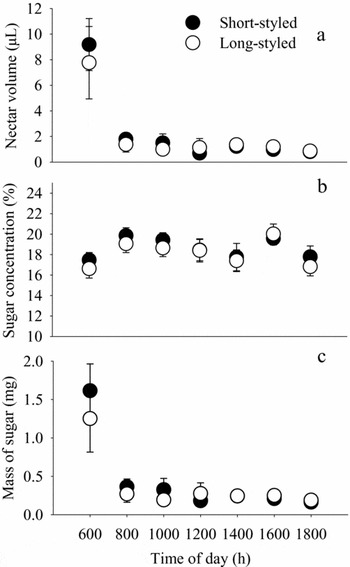
In flowers exposed naturally to floral visitors, nectar standing crop measures (volume, sugar concentration, amount of sugar) were independent of the floral morph (two-way ANOVA; volume, F1,654 = 2.32, P = 0.19; sugar concentration, F1,638 = 3.29, P = 0.07; amount of sugar, F1,580 = 3.06, P = 0.08; Figure 2) but these measures were not independent of the time of day (volume, F6,654 = 59.9, P < 0.0001; sugar concentration, F6,638 = 11.3, P < 0.0001; amount of sugar, F6,580 = 52.3, P < 0.0001; Figure 2). Among-plant variation was not statistically significant (volume, F58,654 = 0.84, P = 0.79; sugar concentration, F58,638 = 1.17, P = 0.19; amount of sugar, F58,580 = 0.81, P = 0.84). The floral morph × time-of-day interaction was significant in volume (F6,654 = 2.56, P = 0.018) and amount of sugar (F6,580 = 2.67, P = 0.014), but the interaction for sugar concentration was not significant (F6,638 = 0.58, P = 0.75). A Tukey test showed that differences throughout the day in nectar volume and amount of sugar were significant at 06h00 (contrast between 06h00 and 08h00–18h00, P < 0.05; contrast 08h00–18h00, P > 0.05) but these differences in nectar standing crop disappeared in the afternoon (Figure 2).
Nectar standing crop in short-styled (SS) and long-styled (LS) flowers of Palicourea demissa at La Mucuy, Mérida, Venezuela. Nectar volume (μL) (a), sugar concentration (%) (b), amount of sugar (mg) (c). Data indicate mean ± SE.

Floral visitors
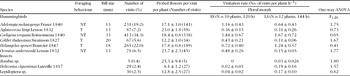
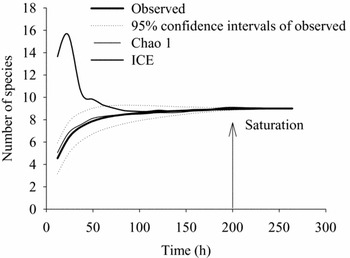
A total of 1205 floral visits by hummingbirds and insects were recorded during our observations, a good sampling effort according to a species-accumulation curve (Table 1, Figure 3). We found no significant differences between morphs in the number of visits that our focal plants received throughout the day (SS = 55.6 ± 9.3 visits per plant, N = 10 plants, 120 h; LS = 53.9 ± 5.5 visits per plant, N = 12 plants, 144 h; Mann–Whitney test, U = 56, P = 0.82) or in the rate at which visits occurred over time (SS = 4.6 ± 0.8 visits per plant h−1, N = 10 plants, 120 h; LS = 4.5 ± 0.5 visits per plant h−1, N = 12 plants, 144 h; one-way ANOVA; F1,20 = 0.01, P = 0.93).
Floral visitors of short-styled (SS) and long-styled (LS) plants of Palicourea demissa at La Mucuy, Mérida, Venezuela. T = Territorial, NT = Non-territorial. Bill size data were taken from Hilty (Reference HILTY2003). Data indicate mean ± SE. Effects of morph evaluated with one-way ANOVAs. In all cases, morph differences were not significant (P > 0.05).

Species-accumulation curve for pollinating and non-pollinating fauna of Palicourea demissa at La Mucuy, Mérida, Venezuela. The species richness estimators (Chao 1 and ICE) were obtained from abundance data of each floral visitor (number of visits per hummingbird and insect species). Note that 200 h of observation were necessary to record the assemblage composition of floral visitors of P. demissa.

The number of flowers probed per visit ranged from 2 to 94, but in most cases (86%), flower visitors probed <20 flowers per plant. Interestingly, the less frequent floral visitors (Bombus sp. and the hummingbirds Aglaicercus kingi and Ocreatus underwoodii) probed on average >20 flowers per plant per visit (Table 1) but morph differences were not statistically significant (SS = 17.7 ± 0.7, N = 347; LS = 18.0 ± 0.6, N = 518; one-way ANOVA; F1,862 = 0.45, P = 0.5).
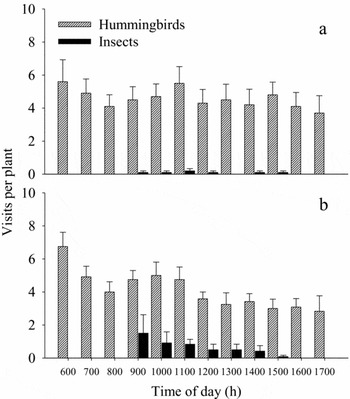
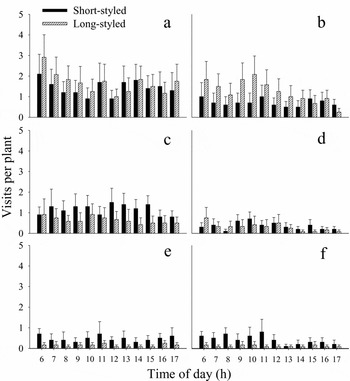
The visitation rate (number of visits per plant h−1) was not significantly different between floral morphs (repeated-measures ANOVA, floral-morph effect; F1,174 = 0.06, P = 0.81; Figure 4) and the among-plant variation was not significant (F20,174 = 0.4, P = 0.98). The visitation rate varied significantly over time (F11,1914 = 1.87, P = 0.04), but the floral morph × time-of-day interaction was not significant (F11,1914 = 0.81, P = 0.62). Hummingbirds were significantly more frequent visitors than insects to plants of both morphs (hummingbirds: SS = 4.58 ± 0.78 visits per plant h−1, N = 10 plants,120 h; LS = 4.11 ± 0.43 visits per plant h−1, N = 12 plants, 144 h; insects: SS = 0.06 ± 0.03 visits per plant h−1, N = 10 plants, 120 h; LS = 0.40 ± 0.22 visits per plant h−1, N = 12 plants, 144 h; type of floral visitor effect, F1,174 = 20.2, P < 0.0001; floral morph × type of floral visitor interaction, F1,174 = 0.93, P = 0.33; Figure 4). The hummingbird visitation rate was independent of the floral morph (F1,100 = 0.75, P = 0.38). However, the insect visitation rate was significantly higher on LS plants (F1,40 = 4.7, P = 0.036; Figure 4). In both cases, the effect of time of day was statistically significant (hummingbirds, F11,1100 = 2.16, P = 0.015; insects, F11,440 = 3.16, P < 0.0001), but the hummingbird species × time-of-day (F55,1100 = 0.97, P = 0.52) and insect species × time-of-day (F22,440 = 1.44, P = 0.09) interactions were not significant.
Visitation rates of hummingbirds and insects on short-styled (SS) (a) and long-styled (LS) plants (b) of Palicourea demissa at La Mucuy, Mérida, Venezuela. Data indicate mean ± SE.

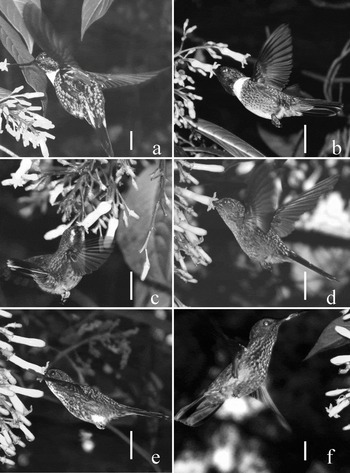
Although the hummingbird assembly was most frequent as floral visitor than insect assembly (hummingbirds = 94.7%, insects = 5.3% of visits recorded; Table 1, Figure 4), hummingbird species varied significantly in their visitation rates compared with variation in the visitation rates of insect species (repeated-measures ANOVA; visitor species effect; F8,160 = 5.3, P < 0.0001; hummingbird species effect; F5,100 = 2.7, P = 0.025; insect species effect; F2,40 = 1.66, P = 0.20). However, visitation rate of individual species was independent of the floral morph (visitor species × floral morph; F8,160 = 0.63, P = 0.75; hummingbird species × floral morph; F5,100 = 0.52, P = 0.76; insect species × floral morph; F2,40 = 0.3, P = 0.74; Table 1; Figure 5). Individual plants were homogeneous for visitation rate by hummingbirds (F20,100 = 0.4, P = 0.1) but heterogeneous for visitation rate by insects (F20,40 = 2.0, P = 0.037). Of the six hummingbird species that visited the flowers, Coeligena torquata (34%, 1.6 ± 0.5), Heliangelus spencei (22%, 1.0 ± 0.3) and Adelomyia melanogenys (19%, 0.9 ± 0.3) were the most frequent floral visitors and had the highest visitation rates, respectively (Table 1, Figure 5). On the other hand, hummingbird species also differed in their foraging behaviour; for example, C. torquata, A. melanogenys and O. underwoodii were not territorial, whereas H. spencei and Colibri thalassinus were very territorial and aggressive. Aglaiocercus kingi defended feeding territories when numerous flowers were displayed on individual plants. In addition, we frequently observed that after probing a few flowers (< 3–6 flowers) H. spencei, A. kingi and A. melanogenys (all short-billed hummingbirds) perched nearby and cleaned off their bills on branches before they flew towards other conspecific plants. Although hummingbird species differ in the size of their bills (Table 1), all probed flowers of both morphs legitimately (Figure 6), and nectar robbing was not observed during our fieldwork.
Visitation rates of most frequent floral visitors of Palicourea demissa at La Mucuy, Mérida, Venezuela. Coeligena torquata (a), Heliangelus spencei (b), Adelomyia melanogenys (c), Aglaiocercus kingi (d), Ocreatus underwoodii (e), Colibri thalassinus (f). Data indicate mean ± SE.

Frequent floral visitors of Palicourea demissa at La Mucuy cloud forest, Mérida, Venezuela. Coeligena torquata (a), Heliangelus spencei (b), Adelomyia melanogenys (c), Aglaiocercus kingi ♀ (d), Ocreatus underwoodii ♀ (e), Colibri thalassinus (f). Scale = 1 cm.

Legitimate pollen deposition
Plants of SS flowers received significantly more legitimate (SS = 88.0 ± 3.56, N = 30 plants; LS = 14.9 ± 0.97, N = 30 plants; nested two-way ANOVA; F1,290 = 400.9, P < 0.0001) and about the same number of illegitimate pollen grains on stigmas (SS = 60.2 ± 5.2, N = 30 plants; LS = 44.7 ± 2.7, N = 30 plants; F1,290 = 3.55, P = 0.06) than those plants of LS flowers. However, stigmas of SS flowers experienced proportionately higher levels of legitimate pollination (F1,290 = 247, P < 0.0001). Among-plant variation was not statistically significant (F58,290 = 0.88, P = 0.71). Although stigmas of SS flowers received proportionately more legitimate pollen over time than did stigmas of LS flowers, this morph difference varied through the day (time-of-day effect, F5,290 = 0.95, P < 0.45; floral morph × time-of-day interaction, F5,290 = 3.18, P = 0.008).
The rate at which legitimate pollen grains were deposited on stigmas was constant over time (nested two-way ANOVA; time-of-day effect; F5,290 = 0.32, P = 0.9), but differed between morphs (SS = 8.33 ± 2.9 grains h−1, N = 180; LS = 1.46 ± 0.79 grains h−1, N = 180; F1,290 = 4.02, P = 0.046). The floral morph × time-of-day interaction was not significant (F5,290 = 0.34, P = 0.88). Again, among-plant variation was not statistically significant (F58,290 = 0.18, P = 1.0).
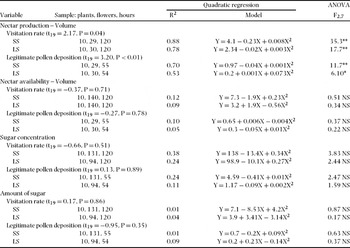
Finally, regression analyses showed that visitation rate of floral visitors and the deposition of legitimate pollen are explained by nectar production (secreted volume per flower per plant) in both floral morphs. However, those relationships were stronger for SS than LS plants. For nectar standing crops, the volume, concentration and amount of sugar showed no significant relationship with legitimate pollination and visitation rate (Table 2).
Non-linear regression analysis of legitimate pollen deposition (proportion of legitimate pollen grains on stigma per plant) and floral visitation rate (number of visits per plant h−1) against nectar production (secreted volume per flower per plant) and availability (volume, sugar concentration and amount of sugar per flower per plant) for short-styled (SS) and long-styled (LS) flowers of Palicourea demissa at La Mucuy, Mérida, Venezuela. The significance of the model is indicated and differences between the slopes for LS and SS morphs are indicated in parentheses after the variable name. * P < 0.05, ** P < 0.001, NS = Not significant.

DISCUSSION
The role of nectar on disassortative pollination
In both floral morphs, total nectar volume secreted by flowers subjected to repeated nectar removal was not different from that of flowers that accumulated nectar until the end of day. Although the effects of different nectar removal intensities on total nectar production was not evaluated here (Ordano & Ornelas Reference ORDANO and ORNELAS2004), our results in P. demissa suggest that the repeated visits by floral visitors did not stimulate replenishment of removed nectar (Musicante & Galetto Reference MUSICANTE and GALETTO2008, Pleasants Reference PLEASANTS1983), and that nectar evaporation was minimal. Nevertheless, the number of visits per plant showed a positive relationship with the nectar production in both floral morphs (Table 2). The significance of this relationship is expected because the amount of nectar produced by individual flowers in both morphs (~25 μL per flower) secreted at a rate of ~1.3 μL per flower h−1 allows a constant nectar reward over time, and plants of each morph could consequently achieve a constant visitation rate over time. Likewise, a nectar offer of a few microlitres per flower over time could increase the probability of disassortative pollination in P. demissa since pollinators are forced to visit more plants throughout their foraging routes to satisfy their energetic requirements. This interpretation is partially consistent with results of several works showing that visitation rates increase with increased nectar availability but pollen transfer among flowers is reduced (Cresswell Reference CRESSWELL1999, de Jong & Klinkhamer Reference DE JONG and KLINKHAMER2005, Engel & Irwin Reference ENGEL and IRWIN2003, Stone & Thomson Reference STONE and THOMSON1994).
A surprising aspect of the nectar measurements relationships with visitation rates and legitimate pollination in P. demissa was the non-significant relationships of nectar availability (volume, sugar concentration and amount of sugar) with legitimate pollination or visitation rate (Table 2). These results suggest that the foraging behaviour of floral visitors and, consequently disassortative pollination in P. demissa, depend more on fluctuations in the amount of nectar secreted rather than changes on its energetic value among plants. Although these results need to be experimentally evaluated, an alternative explanation is that the observed minimal variation in sugar concentration and amount of sugar does not affect pollinator behaviour patterns. Klinkhamer et al. (Reference KLINKHAMER, DE JONG and LINNEBANK2001) found that pollinators approached groups of plants with high nectar production rates more often than groups with low nectar production rates, if the groups were segregated. However, pollinators did not discriminate within groups when plants with high and low nectar production rates were placed next to each other (Wolf & Hainsworth Reference WOLF and HAINSWORTH1990). Because floral morphs of P. demissa produce a similar number of inflorescences per plant, number of flowers per inflorescences, and plants are spatially intermixed regardless of morph condition (< 3 m of distance among plants) within the studied population (H. Valois-Cuesta unpubl. data), it is unlikely that pollinators discriminate among plants on the basis of sugar concentration, and therefore, floral morphs of P. demissa could experience equal rates of floral visitation and legitimate pollen deposition.
In P. demissa, patterns of nectar availability (nectar volume, sugar concentration and amount of sugar) were similar between morphs (Figure 2), suggesting that pollinators are similarly rewarded when visiting flowers of either floral morph. This explains the fact that more frequent floral visitors of P. demissa (hummingbirds) visited plants regardless of their morph condition. Gender specialization based on nectar production has been documented in several dichogamous species (Carlson & Harms Reference CARLSON and HARMS2006), but little explored in heterostylous species. In distylous species a differential nectar production between morphs could generate differential patterns of floral visits, pollen deposition on stigmas, and female reproductive output (Leege & Wolfe Reference LEEGE and WOLFE2002, Manetas & Petropoulou Reference MANETAS and PETROPOULOU2002, Ornelas et al. Reference ORNELAS, JIMÉNEZ, GONZÁLEZ and HERNÁNDEZ2004a, Reference ORNELAS, GONZÁLEZ, JIMÉNEZ, LARA and MARTÍNEZ2004b). Among distylous species for which nectar production data exist, nectar production equals between morphs in most cases (Palicourea petiolaris and P. fendleri, Sobrevila et al. Reference SOBREVILA, RAMIREZ and DE ENRECH1983; Fernandusa speciosa, Castro & Oliveira Reference CASTRO and OLIVEIRA2001; Psychotria poeppigiana, Coelho & Barbosa Reference COELHO and BARBOSA2004, Valois-Cuesta et al. Reference VALOIS-CUESTA, LÓLEZ-PEREA and QUINTO-VALOYES2009; P. barbiflora, Teixeira & Machado Reference TEIXEIRA and MACHADO2004a, Reference TEIXEIRA and MACHADO2004b), except for Palicourea padifolia (Ornelas et al. Reference ORNELAS, GONZÁLEZ, JIMÉNEZ, LARA and MARTÍNEZ2004b) and Fagopyrum esculentum (Cawoy et al. Reference CAWOY, KINET and JACQUEMART2008). In P. demissa, similar patterns in nectar production and nectar availability should promote legitimate pollination in both floral morphs and, ultimately, disassortative pollination.
Hummingbirds as mediators of disassortative pollination
The effectiveness of legitimate pollination from SS to LS and from LS to SS flowers depends on how flowers and pollinators are morphologically adjusted (Lloyd & Webb Reference LLOYD, WEBB and Barrett1992, Ornelas et al. Reference ORNELAS, JIMÉNEZ, GONZÁLEZ and HERNÁNDEZ2004a, Stone & Thomson Reference STONE and THOMSON1994). Flowers of P. demissa are dimorphic (SS flowers display larger corollas, corolla-tube entrance width, and show greater stigma-anther separation than those of LS flowers; Valois-Cuesta et al. Reference VALOIS-CUESTA, SORIANO and ORNELAS2011) and the hummingbird pollinators recorded here differ markedly in bill size (Hilty Reference HILTY2003; Table 2). Our study showed that hummingbirds play a fundamental role as pollen vectors in P. demissa, but hummingbird species may play a different pollinator role if they vary in bill size.
Several workers have evaluated experimentally the effect of the floral morphology on pollination efficiency in distylous species. For example, Stone (Reference STONE1995) evaluated the efficiency of distyly in promoting legitimate pollination in emasculated flowers of Psychotria suerrensis and discovered that distyly is only partially effective in achieving efficient pollen donation. She found that pollen from LS plants was transferred more efficiently to SS stigmas and pollen from SS plants was dispersed in equal amounts to stigmas of both morphs. In Palicourea fendleri, Lau & Bosque (Reference LAU and BOSQUE2003) found that Amazilia tobaci hummingbirds were more efficient depositing legitimate pollen on stigmas of SS flowers than on those of LS flowers. They suggested that the probability of disassortative pollination in distylous species depends on the relative position of sexual organs between floral morphs (Stone Reference STONE1995). Ornelas et al. (Reference ORNELAS, JIMÉNEZ, GONZÁLEZ and HERNÁNDEZ2004a) evaluated this hypothesis in P. padifolia with stuffed hummingbirds and found that long-billed hummingbirds transferred significantly more pollen from LS towards SS flowers than in the opposite direction. Although asymmetrical pollen transfer between floral morphs seemed to favour SS-morph plants of P. padifolia, the observed variation in pollen removal and pollen receipt was not explained by the variation in hummingbird bill morphology, nor did they find evidence that hummingbird bill morphology solely explained the differences in fruit production between LS and SS-morph individuals (Ornelas et al. Reference ORNELAS, GONZÁLEZ, JIMÉNEZ, LARA and MARTÍNEZ2004b). If we consider that the bill size of a hummingbird is the determining factor in the direction of pollen flow between morphs in P. demissa, we then could infer that long-billed hummingbirds play a major role in pollen transfer between reproductive organs at low levels (from anthers of LS flowers towards stigmas of SS flowers), whereas short-billed hummingbirds would be more efficient in the transfer of pollen grains among reproductive organs positioned at higher levels (from anthers of SS flowers towards stigmas of LS flowers). This idea is supported by preliminary work on P. demissa where long-billed hummingbirds (C. torquata) deposited twice as many legitimate pollen grains on emasculated SS flowers (40%, N = 15) than emasculated LS flowers (20%, N = 15). In contrast, short-billed hummingbirds (A. melanogenys and H. spencei) deposited 2.3 times more legitimate pollen on LS (50%, N = 30) than emasculated SS flowers (20%, N = 30; Z. Betancourt, P. J. Soriano, H. Valois-Cuesta & J. F. Ornelas, unpubl. data).
In both morphs of P. demissa, the visitation rate and legitimate pollination were correlated with nectar production (Table 2); how then could we explain the observed asymmetrical pollen flow and the higher female reproductive output of SS plants previously reported (Valois-Cuesta et al. Reference VALOIS-CUESTA, SORIANO and ORNELAS2011)? The reciprocal position of anthers and stigmas in distylous species has been interpreted as a mechanism that facilitates disassortative pollination (Barrett Reference BARRETT2002, Darwin Reference DARWIN1877, Lloyd & Webb Reference LLOYD, WEBB and Barrett1992), in which a closer reciprocity among sexual organs should enhance male (legitimate pollen donation) and female (legitimate pollen receipt) reproductive success. Several authors have shown that legitimate pollen transfer between floral morphs is negatively associated with asymmetries in the position of anthers and stigmas (Hernández & Ornelas Reference HERNÁNDEZ and ORNELAS2007, García-Robledo Reference GARCÍA-ROBLEDO2008, Lau & Bosque Reference LAU and BOSQUE2003, Ornelas et al. Reference ORNELAS, JIMÉNEZ, GONZÁLEZ and HERNÁNDEZ2004a, Stone & Thomson Reference STONE and THOMSON1994), i.e. the low reciprocity among sexual organs diminishes pollen deposition on legitimate stigmas (Barrett Reference BARRETT2002, Lloyd & Webb Reference LLOYD, WEBB and Barrett1992). In P. padifolia, Hernández & Ornelas (Reference HERNÁNDEZ and ORNELAS2007) found that pollen receipt was not affected by characters typically associated with the efficiency of this floral polymorphism in promoting disassortative pollination. They showed that at high levels of stigma-anther separation there was a significant reduction in legitimate cross-pollination compared with that at low levels of separation. However, the negative effects of herkogamy (stigma-anther separation) were only detected for LS plants (significant interaction between floral morph and stigma-anther separation). In contrast, high values of herkogamy had a positive effect on SS plants, which received more legitimate pollen grains with increased spatial separation. Accordingly, the greater anther-stigma separation (herkogamy) observed in SS flowers of P. demissa (Valois-Cuesta et al. Reference VALOIS-CUESTA, SORIANO and ORNELAS2011) might favour female reproductive success in SS flowers and male reproductive success in LS flowers; it would reduce physical interference between anthers and stigma, minimizes spontaneous self-pollen deposition, and at the same time would facilitate accessibility to pollinators in the SS morph. Therefore, the legitimate pollen flow between morphs would be asymmetric, with SS plants being more effective as receptors of legitimate pollen and LS plants as pollen donors. To fully answer this question a key factor of the pollination process between morphs, the visitation frequency and foraging behaviour of pollinators, needs to be further evaluated (Engel & Irwin Reference ENGEL and IRWIN2003, Feinsinger & Busby Reference FEINSINGER and BUSBY1987, Lasso & Naranjo Reference LASSO and NARANJO2003, Ornelas et al. Reference ORNELAS, JIMÉNEZ, GONZÁLEZ and HERNÁNDEZ2004a). In P. demissa, a long-billed, non-territorial hummingbird (C. torquata) was the most frequent floral visitor in both floral morphs. If the hypothesis of herkogamy (stigma-anther separation) is satisfied in P. demissa, it is reasonable to suggest that the observed pollen receipt pattern, in which SS flowers received proportionately more compatible pollen grains than LS flowers, could not be attributed to the higher C. torquata visitation rates but to the morphology of its bill (Z. Betancourt, P. J. Soriano, H. Valois-Cuesta & J. F. Ornelas unpubl. data) or a combination of bill morphology and frequency of visitation. Although floral visitation frequency may explain pollen deposition patterns on stigmas (Engel & Irwin Reference ENGEL and IRWIN2003), the foraging behaviour of pollinators may also play an important role on the pollination success of each morph. In P. demissa, short-billed hummingbirds (H. spencei, A. kingi and A. melanogenys) were territorial and commonly observed cleaning their bills after probing several flowers (Contreras & Ornelas Reference CONTRERAS and ORNELAS1999). This feeding behaviour should increase the chances for geitonogamous crosses (12–23 flowers probed per foraging bout; Table 1), and territoriality should reduce the chances that non-territorial floral visitors transfer pollen towards plants of the opposite morph. Although pollen flow is surely mediated by hummingbirds in the studied population of P. demissa (> 90% of visits), insects with a low-frequency visitation (< 6%) could also play a minor role in pollen transfer from SS to LS flowers because of the anther position and, therefore, accessibility to pollen grains.
In conclusion, our results suggest that hummingbirds are equally rewarded when they visit SS or LS plants, facilitating equal visitation rates and pollination success in both morphs of P. demissa. However, the territoriality and foraging modes of pollinators, and their visitation frequency are ecological conditions that may disrupt disassortative pollination in P. demissa. Further experimental research is needed to evaluate the role of short- and long-billed hummingbirds as promoters of the observed asymmetrical legitimate pollination and reproductive success of hummingbird-pollinated distylous species. If pollinators disrupt the complementarities of pollen transfer in both floral morphs (asymmetrical pollen flow), the expression of a more profitable gender is expected in each morph.
ACKNOWLEDGEMENTS
We thank Z. Betancourt, C. Rengífo, J.H. Castaño, R. Pelayo and J. Murillo for their fieldwork assistance; J. Estrada, C. García, N. Ramírez, M.E. Naranjo, and two anonymous reviewers for their helpful comments on previous versions of the manuscript. This research was supported by the Red Latinoamericana de Botánica (RLB06-M03, RLB08-SP-1) and Consejo de Desarrollo Científico, Humanístico y Tecnológico, Universidad de los Andes, Mérida-Venezuela (C-1557–08–01EM). Staff at La Mucuy Bird Observatory, Sierra Nevada National Park and Laboratorio de Ecología Animal “A”, Universidad de los Andes, Mérida, Venezuela provided logistical support.