Recent years have witnessed a number of instances of threatened or actual interstate violence stemming from one state's support for insurgent groups operating against another. In early 2008, a war scare arose after Colombia attacked a rebel base in Ecuador and charged Venezuela with providing the group with guns and money. A few months later, the U.S.-backed government in Afghanistan threatened cross-border raids into Pakistan over the latter's alleged support for Taliban insurgents. Turkish troops have repeatedly crossed into northern Iraq to attack Kurdish rebels whom they claim receive support from Iraqi Kurdish authorities. After its 2003 invasion of Iraq, the United States charged Iran with aiding extremist groups in that country and hinted at military action in response.
Such cases are by no means a new phenomenon, and current scholarship is increasingly recognizing that support for nonstate actors such as rebels or terrorists is an important source of interstate militarized action.Footnote 1 A significant component of the Vietnam War revolved around U.S. efforts to compel North Vietnam to end its assistance for communist insurgents in South Vietnam, Cambodia, and Laos. White minority governments in Rhodesia and South Africa regularly engaged in cross-border raids against their neighbors to coerce those states into abandoning their support for black nationalist groups. Much of the militarized conflict between Israel and the Arab states fit the same pattern, as Israel sought to compel its neighbors to stop facilitating guerilla attacks from their territories. By one count, Israel conducted 102 reprisal raids against Egypt, Jordan, Syria, and Lebanon in the period 1949–69 as part of this compellent policy.Footnote 2
Given the propensity for these kinds of disputes to become militarized, the threat and use of force for the purposes of ending insurgent support is an important topic, one that bridges the study of international and civil conflict. At the same time, this phenomenon belongs to a broader class of interactions that are common in world politics: interactions in which one state attempts to coerce another to change some policy that is entirely under the latter's control, such as the financial or military support given to nonstate actors. There are many instances in which one state enacts a policy that benefits it but harms others—for example, the pursuit of a weapons program or the mistreatment of an ethnic minority. Although the afflicted state cannot directly alter the offender's policy, it may threaten force to compel policy restraint. Militarized action can arise if the states fail to reach some enforceable bargain that both prefer to costly conflict.
This article examines the strategic problems that arise in this class of interactions and applies its insights to the specific case of interstate conflict over rebel support. The study takes as its starting point a common observation in rationalist theories of war: because of the costs associated with the use of force, there generally exists some compromise that both sides prefer to fighting.Footnote 3 The offending state could forestall attacks by agreeing to “dial back” its policy, perhaps in return for concessions on an issue it cares about. For example, states that have supported insurgent groups have at times agreed to end that support, sometimes in exchange for power-sharing arrangements or territorial concessions. The prevalence of militarized conflict in these cases, however, suggests that such bargains can be difficult to reach. Understanding why, and identifying the conditions under which conflicts over policy can be resolved, is important to the study of international violence.
Although the existing literature identifies several information and commitment problems that might lead to bargaining failures,Footnote 4 I argue that conflicts over policy are susceptible to a strategic problem that has received scant attention in the conflict literature: that of enforcing compliance with policy compromises in the face of temptations to renege.Footnote 5 Because the offending state has unilateral control over its policy, the coercive interaction does not end when a compromise is reached; rather, the bargain must be continuously enforced to ensure that the offender does not violate the agreement. The enforcement problem is particularly acute if the offending state's control over the policy allows it to make adjustments covertly, so that cheating is hard to detect. Recent U.S. efforts to compel disarmament of Iraq, North Korea, and Iran, as well as its efforts to end Iranian support for militant groups in Iraq, have been bedeviled by uncertainty over what the target states were doing. At various times, information about the disputed policies proved to be wrong or incomplete. As I will show, this uncertainty raises an important barrier to conflict resolution: given states' ability to enact policies in a covert manner, any agreement to limit these activities must overcome the problem of monitoring and enforcing compliance. The offending state must have incentives not to exploit its ability to renege covertly, and the afflicted state must have assurances that the deal will be honored. Otherwise, inefficient conflict may arise.
The idea that inefficiencies can arise due to problems of monitoring and enforcement is not new to international relations scholarship. Indeed, this idea was central to neoliberal theories of cooperation.Footnote 6 In this literature, states were assumed to have unilateral control over some policy instrument, such as tariff levels or investments in armaments, and scholars considered the conditions under which states could make reciprocal adjustments in policies despite a strategic environment in which unilateral defection was advantageous. The crisis bargaining literature, by contrast, has not focused on problems of enforcement and has instead privileged the problem of distribution—that is, whether the states can agree to a division of some disputed good that both prefer to war. In static versions of standard models, a deal is assumed to be self-enforcing if both states derive more benefit from it than they expect to be able to get from war. In dynamic versions, certain commitment problems have been considered. As Fearon and Powell have shown, an enforceable deal requires states to make a credible commitment not to exploit a first-strike advantage, a large exogenous shift in power, or a shift in power that derives from possession of the disputed good.Footnote 7 This article demonstrates an additional commitment problem that can cause violent conflict: the inability of states to commit not to renege on policy concessions.Footnote 8 Moreover, it shows empirically how institutional arrangements designed to address this problem can lead to a reduction in interstate conflict that accompanies civil wars.
The theoretical portion of this article develops a formal model showing how the enforcement problem can cause bargaining failures that lead to costly conflict. In the model, one state uses the threat of force to extract and enforce policy concessions from another. If a bargain is reached, enforcement is a repeated process, and the enforcing state can respond to violations by engaging in a costly use of force. A central assumption is that the policy level the offending state enacts is imperfectly observed, so there is some chance that it can cheat without being detected. Even though there always exists a policy compromise that both sides prefer to conflict, there are conditions under which no efficient deal can be enforced in the face of incentives to renege. Moreover, unlike in models based on repeated games like the prisoners' dilemma, the inefficiency identified here does not necessarily go away when the “shadow of the future” becomes sufficiently large.
The empirical section of this article shows that insights from the theory are useful for thinking about the origins and management of interstate conflicts over rebel support. The analysis combines existing data on militarized conflict and external support for rebel groups with an original dataset on agreements designed to limit such support. I highlight two results that are anticipated by the theory. First, episodes of rebel support are strongly associated with an increased risk of militarized interstate disputes, an increase in the lethality of these disputes, and a greater likelihood that force will be used repetitively. Second, agreements to limit rebel support have a poor record at reducing interstate violence unless they are coupled with either third-party monitoring mechanisms that can improve the detection of cheating and/or concessions by the afflicted state that diminish the marginal benefit of reneging.
A Model of Coercing Policy Restraint
This section develops a model in which one state uses the threat of military force to coerce policy restraint from another. The model shares similarities with those in the literature on cooperation, particularly those that entail noisy action or imperfect monitoring.Footnote 9 In each period, one state enacts a policy over which it has unilateral control. If the policy enacted is greater than a previously agreed level, there is some chance that the deviation will be detected. The model departs from others in this literature by assuming that the afflicted state enforces the deal by threatening a military reprisal. The use of force imposes costs on both sides; moreover, there is some chance that an attack can lead to the defeat of the offending state. Hence, the game is not, strictly speaking, infinitely repeated, since there is a way for the interaction to end through an imposed settlement.
Assumptions
Consider a game between two states, A and B. State A is assumed to control some policy from which it derives benefit but which harms state B. Let x t ∈ [0,1] denote the policy enacted in period t, and assume that state A's utility is given by u A(x t) = x t, while B's utility is given by u B(x t) = 1 − x t. Hence, state A's ideal policy is to implement x = 1 in every period, while B's ideal point is x = 0. For now, I leave unstated why the policy is valuable to state A and harmful to state B.Footnote 10 Later, I extend the model to consider situations in which the policy is useful for obtaining some other good, such as influencing internal politics in state B.
The game starts with a bargaining phase and then moves on to an enforcement phase.Footnote 11 In the bargaining phase, the states come to an agreement on some level of policy, which I label π. In the enforcement phase, state A decides in every period what level of the policy to enact. I do not explicitly model the bargaining phase. Instead, I examine the enforcement stage to determine the conditions under which an enforceable agreement exists—that is, whether there exists some π ∈ [0,1) that state B can compel state A to enact in every period. If such an agreement exists, then I assume it can be reached in the bargaining phase. If no such deal exists, then bargaining is irrelevant. A deal might be reached, but both sides know that the terms will not be carried out.
State B has no control over state A's policy, but it can threaten or use military force to enforce restraint. In each period of the enforcement phase, state B chooses whether or not to attack. An attack does two things. First, it imposes costs on both sides. Let c i > 0,i ∈ {A,B} denote the cost incurred by each state in a period in which state B attacks. Second, there is some probability, p, that state B's attack will destroy state A's ability to pursue its policy.Footnote 12 An attack against rebel bases in state A might eliminate the rebel threat, rendering A's assistance useless. A strike on a country's nuclear facilities has some chance of eliminating the program. Alternatively, military force might lead to the removal of the offending regime and its replacement with a friendlier one.Footnote 13 In this event, the enforcement game ends, and A cannot enact nonzero values of x for the remainder of time. Hence, if B “wins” in any period τ, then x t = 0 for all t > τ. Let δ ∈ [0,1) denote the discount factor. Then Δ = 1/1 − δ is the present discounted value of getting one's most preferred policy for the remainder of time. To make the analysis nontrivial, I impose one restriction on these parameters. A necessary condition for conflict is that state B must be willing to attack for at least one period rather than live forever with its least preferred policy. Formally, this requires that pδΔ − c B > 0 or c B < pδΔ. Notice that this condition is certain to be met for any p and c B as long as δ is sufficiently large.
The sequence of moves in each period of the enforcement stage is as follows. In each period, state A chooses a policy level x, and then state B must decide whether or not to attack. The outcome of the attack determines whether or not the game moves on to another period. Between these two decisions, a random draw determines whether or not state B detects evidence of cheating by state A.
State A's ability to enact the policy covertly is central to the strategic dilemma in these cases. I capture this imperfect monitoring by assuming that state B does not observe x in each period; instead, it must rely on an unreliable “alarm” that detects cheating with some probability that depends on how far state A has deviated. This means that state B has only a noisy and incomplete knowledge of its payoff in each period. Formally, let f (x − π) : [−1,1] → [0,1] be a continuous function that maps the magnitude of the deviation, x − π, into a probability of detection.Footnote 14 That is, when state A enacts x given agreement π, a random draw sends a public signal that A has cheated with probability f (x − π).Footnote 15 I keep the exact form of this function general, though several restrictions are appropriate. The main assumption is that f (x − π) < 1 for some x − π > 0, which ensures that noncompliance sometimes goes undetected. Assume further that the probability of detection increases with the size of the deviation, or f′(x − π) ≥ 0, and larger deviations are associated with a higher marginal rate of detection, or f′′(x − π) > 0.
The fact that cheating sometimes goes undetected is crucial to the argument; without such false negatives, a peaceful outcome always exists. Of additional interest is whether the alarm is also subject to false positives: that is, whether the alarm ever goes off in response to compliant behavior. This would be the case if f (x − π) > 0 for some x − π ≤ 0. The possibility of false negatives is certainly realistic, as a state may incorrectly believe that another is in noncompliance. The possibility of false positives is not, however, necessary for conflict to occur. Given this, the analysis begins by assuming that the alarm is not subject to false positives, or f (x − π) = 0 whenever x ≤ π. After showing how conflict can arise under this (relatively benign) condition, I sketch how introducing false positives makes the enforcement problem even harder.
Characterization of Equilibria
Given its potentially infinite time horizon, the enforcement game can have a wide variety of equilibria. Here, I focus on stationary equilibria, in which the states play the same strategy in every period on the equilibrium path. Such equilibria can take three general forms. The first is fully noncooperative: in every period, state A enacts x = 1, and state B attacks regardless of whether or not the alarm sounds. As long as c B < pδΔ, this set of strategies constitutes a Nash equilibrium, which I will call “war.” In each period of a war, state A gets a payoff of 1 − c A. With probability p, state A is forced to accept a payoff of zero in all subsequent periods; with probability 1 − p, the war continues for at least one more period. The present expected value of a war that starts in the current period is therefore:

For state B, every period of war entails a cost, c B, but with probability p, state B wins and enjoys its most preferred outcome forever after. The present value of war is

It is easy to show that the sum of the war payoffs is less than the total benefits that can be divided, or w A + w B < Δ, as long as the sum of the cost terms, c A + c B, is greater than zero. Hence, war is inefficient: there always exists some compromise that both sides prefer to this outcome.Footnote 16
The second kind of equilibrium is fully cooperative: in every period, state A enacts x = π, the alarm never sounds, and state B never attacks. Because force is never used along the path of play, this outcome is efficient. There is no guarantee, however, that such an equilibrium always exists. State A faces a short-term temptation to violate the agreement, hoping that the violation will go undetected. State B may have an incentive to take advantage of state A's restraint and strike unprovoked. The existence of a deal that both sides prefer to war does not ensure the existence of a deal that is enforceable in the face of these incentives.
The third kind of possible equilibrium involves partial cooperation: in every period, state A enacts x = z such that 1 > z > π, the alarms sounds with probability f (z − π), and state B attacks for at least one period with nonzero probability whenever the alarms sounds. In such equilibria, state A complies with the deal only partially, but its cheating is kept in check (that is, z < 1) by the expectation that B will enact some costly punishment whenever the alarm sounds. Since the retaliation may involve a finite number of attacks, the equilibrium path of play can exhibit intermittent uses of force with spells of peace in between. Though less violent than war, partial cooperation is still inefficient, because force is used with nonzero probability on the equilibrium path. Because of this, the analysis focuses on the conditions necessary to sustain a fully cooperative equilibrium before considering the existence and implications of equilibria with partial compliance.
Conditions for the Existence of an Efficient Equilibrium
A fully cooperative equilibrium takes the following form. Given some agreed policy level, π,
1. State A plays x = π in the first period and in every subsequent period as long as state B has played Not Attack in all previous periods.
2. State B plays Not Attack in every period as long as it has never detected cheating by state A.
3. If state B ever detects a deviation from rule (1) in any period t, then it plays Attack in period t. Starting in period t + 1, the states play some strategy pair S A = (σAA,σBA), which constitutes a subgame perfect equilibrium (SPE) to the enforcement game.
4. If state B deviates from rule (2) in any period t, then starting in t + 1, the states play some strategy pair S B = (σAB,σBB) that constitutes an SPE to the enforcement game.
As points (3) and (4) make clear, the cooperative strategies on the equilibrium path are supported by some punishment strategy off the path of play—that is, a strategy that each state enacts in the event of a deviation by the other. To keep the analysis general, the punishment strategies are left unspecified. To determine whether or not an efficient equilibrium exists, I identify the conditions that must hold for π to be enforced by any feasible punishment strategy.
The details of the solution are in the Appendix. The solution hinges on determining the range of bargains that can be enforced given the parameters. For state A, there exists a lower bound, π, such that it would be willing to abide by any deal π ≥ π. For state B, there exists an upper bound, π, such that it would be willing to abide by any deal π ≤ π. For an enforceable deal to exist, the upper bound must be higher than the lower bound, or π > π.
A crucial factor in determining whether this condition can be met is how easy it is to detect cheating. State A's lower bound is decreasing in f′(0), which measures how likely it is for state B to detect infinitesimal deviations from π. As f′(0) goes to zero, small deviations become virtually impossible to detect, and the lower bound, π, goes to its maximum value, 1. Because it can cheat with impunity, state A will never abide by a deal that gives it anything less than its ideal policy. On the other hand, as f′(0) increases, the lower bound falls. In the limit in which f′(0) → ∞, monitoring is trivial, and state A will abide by any deal that it prefers to the punishment regime. Hence, A will only honor a deal if it is adequately compensated for not exploiting its ability to cheat. The easier it is for A to renege without detection, the better the terms it will demand.Footnote 17 For cooperation to occur, state B must be willing to accommodate those demands.
In the Appendix, I show that the difference between the upper and lower bounds is maximized when the states threaten to wage war in the event of a (detected) deviation by the other side. War is the most destructive punishment available, so if no deal can be supported by a threat of war, then there is no enforceable deal for any feasible punishment regime. This insight generates a necessary condition for the existence of a fully cooperative equilibrium. An enforceable deal exists only if

The left-hand side of this expression captures how hard it is to detect infinitesimal violations. The harder such violations are to detect, the higher this value becomes, making condition (3) harder to meet. The right-hand side denotes the total expected costs of a war. The costlier war will be in expectation, the easier it is for this necessary condition to be met.
Rewriting this expression in terms of the discount factor, a fully efficient equilibrium requires

An interesting thing about this condition is that it is possible for the right-hand side to exceed one, which happens whenever

In this case, the necessary condition for a peaceful equilibrium cannot be met even as δ → 1. Hence, even when the states are maximally patient, an enforceable deal may not exist.
The usual “folk theorem” result—that is, an efficient deal can be sustained in some equilibrium as long as the actors are sufficiently patient—does not hold in this case because of the assumption that war can end in a once-and-for-all settlement. In repeated games, efficient outcomes can always be sustained because the net gains from cooperation become infinite as δ → 1. Approaching that limit, the long-term gains eventually overtake the finite benefit from a one-period deviation. Here, the gains from peace—the difference between the total pie and the total value of war—are finite, even in the limit.Footnote 18 Even though the total value of peace goes to infinity (that is, limδ→1 Δ = ∞), so too does state B's value for war, since B will eventually win and enjoy its most preferred policy forever after. There is consequently no guarantee that the long-term gain from cooperating will overcome the short-term benefits of deviating. As Powell notes, patience is not necessarily a virtue when states contemplate the fruits of victory.Footnote 19
The Existence and Implications of Partially Cooperative Equilibria
I have shown that, under certain conditions, there is no deal that will evoke full compliance. When condition (1) is not met, the states will be unable to avoid the inefficient use of force. This condition does not, however, ensure that there will be a war, as defined here, since there may exist equilibria that involve partial compliance.Footnote 20 For example, the game may have equilibria such as the following: Given π, state A enacts in every period a policy z > π. State B attacks in any period in which the alarms goes off, which happens with probability f (z − π), but not otherwise. Hence, state B tolerates a certain amount of cheating by state A, but it keeps the amount of cheating in check by attacking whenever those violations are publicly revealed. Variations on this theme exist—for example, the punishment could involve more than one period of attacks—but all of them require that there be some chance that state B uses force in response to a signal of cheating. Indeed, it is trivial to see that, in any equilibrium in which the alarm goes off with nonzero probability on the path of play, state B must attack with nonzero probability in response.Footnote 21 Given the infinite time horizon, this means that force will eventually be used, and state A will eventually be defeated.
Nonetheless, in the absence of a deal that will evoke full cooperation, the states might settle for partial compliance (if such an equilibrium exists) and avoid all-out war. Indeed, this kind of equilibrium—with its intermittent episodes of violence interspersed with periods of peace—may be a common feature of these interactions in the real world. As the empirical evidence shows, policies of rebel support often lead to recurring, limited uses of force, and not necessarily full-scale war as traditionally defined. Unfortunately, because partial compliance equilibria can involve punishment strategies of varied lengths and because of the abstract nature of the model (for example, how does a single period in the game translate into real time?), it may be hard to distinguish between partially cooperative and fully noncooperative equilibria by observing the incidence of violence.
Moreover, there is no guarantee that even such “second-best” equilibria always exist. In addition to the basic monitoring problem, partial compliance can be hard to sustain because state A is punished with some probability even on the equilibrium path of play. As a result, the marginal cost of a deviation is discounted by the probability that the state would be punished anyway. In the Appendix, I sketch a proof showing that even partial cooperation is impossible if the probability of detection is not sufficiently sensitive to small changes in the policy. Hence, difficulties in monitoring compliance can rule out all but the fully noncooperative equilibrium.
One final point flows from this discussion. As noted earlier, it is often realistic to assume that the alarm is subject to false positives. The foregoing logic suggests that this pathology makes full cooperation even harder by raising the possibility that the alarm will sound on the equilibrium path, requiring a forceful response by state B. Indeed, if the alarm technology is such that f (x − π) > 0 for all x − π—in which case there is some chance the alarm will go off regardless of what state A does—then full cooperation is impossible, and the best that can be achieved is something akin to a partially cooperative equilibrium with its intermittent violence. Even if state A complies in every period, the alarm will sound with nonzero probability, and state B must attack in response with nonzero probability. Under these conditions, inefficient conflict is guaranteed.
Possible Solutions to the Enforcement Problem
This section explores two extensions to this basic model that allow for potential solutions to the enforcement problem. The first adds the possibility that states can pay to improve their ability to monitor compliance. The second considers the possibility that state A's policy is not an end in and of itself but rather a means of achieving a better outcome on the distribution of some other object of value. Both possibilities have the potential to expand the range of enforceable bargains; however, neither is sufficient to ensure that costly conflict can be avoided.
Costly Monitoring
Since imperfect monitoring gives rise to the enforcement problem, it is possible that states could resolve the problem by investing in better monitoring technology. The most natural way to improve detection capabilities would be to bring in third parties, such as observer missions, peacekeepers, or inspectors.Footnote 22 Such third parties could collect information and thereby raise the probability that cheating is detected. Third parties may also help ensure that signals of cheating become public, something that I earlier assumed to be unproblematic, but which in the real world might not be. I assume that such measures come at some cost to either or both states. These costs may reflect actual costs of hosting third parties as well as “sovereignty costs” of letting outsiders snoop around the country.
Assume that, if a bargain is struck, the states pay some cost at the outset of every period of the enforcement game in which the deal is still in effect. In return, they get a more reliable alarm. Let m A and m B denote the amounts paid by state A and state B, respectively, in each period. The probability that state B detects a deviation to x > π is now given by f (x − π; M), where M = m A + m B and ∂f/∂M > 0. I assume that this charge is assessed at the outset of every period as long as state A has never been caught cheating in any previous period. If cheating is ever detected, and the states switch to their punishment strategies, then the cost is not paid in subsequent periods. This assumption, made for the sake of simplicity, implies that states cannot restart monitoring once the deal has been broken.
Introducing costly monitoring has two effects. On the one hand, increasing the probability of detecting deviations diminishes state A's incentives to cheat, lowering its minimally acceptable deal, π. On the other hand, the costs associated with monitoring diminish the value of abiding by the deal. Holding everything else constant, an increase in monitoring costs leads both states to increase their demands, raising π and lowering π. Whether costly monitoring increases or decreases the range of enforceable deals depends on which of these effects is more pronounced. Formally, the necessary condition analogous to (3), which indicates when a fully cooperative equilibrium exists, becomes

An increase in M decreases both sides of this inequality, so there is no guarantee that the necessary condition for peace is easier to meet. Whether or not monitoring aids cooperation depends on how efficiently it increases the probability of detecting infinitesimal deviations.
Thus, it is possible, but not inevitable, that the option of costly monitoring will increase the range of enforceable deals. It is reasonable to expect, however, that states would not choose to pay for monitoring unless it was necessary to achieve a deal that could not obtained for free, and certainly not if a deal could not be enforced even in its presence. In addition, costly monitoring could be particularly valuable if the alarm were subject to false positives, which, as I have shown, can preclude full cooperation altogether. Hence, agreements on policy restraint that include provisions for outside monitoring are more likely to be enforceable.
Reducing the Incentive to Cheat Through Concessions
The basic model treated state A's policy as an end in and of itself without regard to why the policy was valuable to state A and harmful to state B. In reality, policies are often means to some other end. One state supports rebel groups against another in order to influence the other's form of government or to promote the independence of ethnic kin.Footnote 23 A state pursues a nuclear program because doing so will increase its regional influence and permit it to have leverage over other issues. When policies are means rather than ends, an analysis of interstate bargaining must consider the possibility of compromise, not just on the policy level, but also on the underlying issue that the policy is intended to influence. Doing so raises the possibility that policy restraint might be supported, not simply by the threat of military action, but also by concessions by the afflicted state.
To capture this, I modify the basic game. Assume that the underlying issue in dispute is a good controlled by state B. I normalize the value of this good to one and assume that any division of the good, y t ∈ [0,1], leads to payoffs u A(y t) = y t and u B(y t) = 1 − y t. This good represents the object of the international dispute. One could interpret y t as the share of power that the government in state B gives to some rebel group supported by state A, or the level of autonomy given to the region populated by the rebels. State A wants the rebels to receive more power or greater autonomy, while state B would prefer to give less. I assume that state B determines the allocation of the good at the outset of each period, before state A enacts its policy. To keep things simple, state B's choice is perfectly observed.
As before, state A controls a policy instrument that one can now think of as being a means to acquire the underlying good. In each period, state A can enact a policy level, x t ∈ [0,1], with the following effect: given a division of the good y t and a policy level x t, state A receives an expected share of the good equal to y t + (1 − y t)x t. Thus, one can think of state A's policy as determining the probability that it will seize the remainder of the good—the portion not already conceded by state B—for that period.Footnote 24 Hence, the more state B gives up, the less state A gains from increasing the offending policy.
In this model, a deal represents a bargain on two dimensions: a distribution of the good, ω, and a policy level, π. As before, I look for a full compliance equilibrium in which this bargain is enforced by feasible punishment strategies, including war. The details of the solution are in the Appendix. The main result is that adding the possibility of concessions by state B increases the range of enforceable deals. Holding everything else constant, the set of bargains that can be enforced by a given punishment strategy is larger in this game than in the basic model. Because concessions by state B decrease state A's marginal benefit from increasing the policy level, the incentives to cheat are lower. That said, the possibility of concessions does not ensure that a fully efficient bargain can be found. There still exists a condition, analogous to that in equation (3), that is required to ensure that an enforceable deal exists. While this condition becomes easier to meet, there are still sets of parameters for which it is violated.
Hence, while neither can guarantee peace, both costly monitoring and the ability to link policy restraint with concessions on some other dimension can increase the set of conditions under which enforceable bargains exist. Two implications follow. First, disputes over policy are less likely to become militarized when states have access to either or both of these arrangements. Second, bargains that incorporate these kinds of provisions are more robust to shocks to the underlying parameters. That is, if one changed the model to permit p, c A, c B, and/or δ to change stochastically over time, bargains that include monitoring and/or linkage would be expected to last longer.
Interstate Conflict over Support for Rebel Groups: An Empirical Application
The theoretical model suggests that disputes over policies can lead to inefficient conflict due to problems of monitoring and enforcement, in addition to other information and commitment problems identified in the existing literature. It also suggests that policy compromises that are accompanied by costly monitoring and/or concessions on some underlying object of contention are more likely to be stable than those that are not. In this section, I test these implications in the context of one important type of dispute over policies: disputes over state support for rebel groups engaged in civil conflict.
As Gleditsch, Salehyan, and Schultz show, civil wars are an important source of interstate conflict.Footnote 25 Dyads in which at least one state is experiencing a civil war are about twice as likely to experience a militarized interstate dispute as dyads with no civil wars. Most of this increase comes from two processes: intervention—militarized actions by outside states to assist the rebels—and externalization—efforts by the afflicted state to strike at rebels operating from neighboring countries and/or to coerce those countries into stopping support for the rebels. Along the same lines, Salehyan shows that an important determinant of whether civil wars lead to interstate conflict is whether rebel groups operate from bases in other states.Footnote 26
These studies suggest a number of reasons why civil wars create conflicting interests between states. As the rationalist literature on war suggests, however, interest conflicts are not, on their own, sufficient to explain the costly use of force.Footnote 27 States generally have incentives to find bargains that allow them to avoid those costs. In theory, the supporting state could agree to reduce its aid to some mutually acceptable level in order to forestall attacks. Understanding why certain disputes lead to the use of force requires an explanation of the strategic mechanisms that can cause bargaining to fail.Footnote 28
The theory developed here suggests that inefficient conflict can arise due to the problem of enforcing compromises over policies that are under the unilateral control of one state. Whether and how much a state is aiding insurgents is often difficult to observe. Support given in the form of arms or money is hard to detect and even harder to quantify. Moreover, as the model shows, what matters is not just how easy it is to detect the policy, but how easy it is to detect small deviations from an agreed upon level. Even when it is possible to know, broadly speaking, whether a state is helping out an insurgent group, small changes in that support can be quite difficult to detect, meaning that f′(0) is generally small. Given this, the temptation to renege on a deal, in the hopes that violations will not be detected, can prevent fully efficient cooperation. Moreover, this is an issue area in which the paucity of reliable public signals creates the possibility for false positives and incorrect accusations of cheating. As I have shown, this possibility makes the enforcement problem even harder to resolve and increases the potential value of third-party monitoring.
The purpose of this empirical section is not to test the theoretical model per se. The model is quite simple and serves primarily to establish the existence of inefficient outcomes, without fully specifying the conditions that make them more or less likely. A complete model of this phenomenon would certainly need an additional strategic actor—the rebel group—as well other kinds of uncertainty.Footnote 29 Instead, the purpose of what follows is to show that the theoretical insight into the strategic problem facing states in these situations is useful in a first cut at understanding the incidence and management of interstate conflict associated with civil wars.
I develop two sets of results. The first demonstrates the strong association between policies of rebel support and costly interstate violence. Periods of rebel support are associated with an increased risk of interstate militarized action, an increase in the lethality of those actions, and an increase in the risk of repeated violence. All of these patterns are consistent with the idea that interstate disputes that arise in conjunction with rebel support are especially hard to resolve without recourse to costly violence. While these associations are important for substantive purposes, they do not, on their own, tell one whether the specific theoretical mechanisms identified here contribute to this pattern. To that end, I examine the track record of formal agreements designed to limit rebel support. The theory developed here suggests that such agreements are most likely to be robust when they make provisions for monitoring and/or link policy restraint to a compromise on some other issue. As I will show, the empirical evidence is consistent with these expectations.
Empirical Associations Between Rebel Support and Interstate Violence
To demonstrate how rebel support contributes to interstate violence, I rely on two main data sources. The first is the Militarized Interstate Dispute (MID) dataset, specifically the dyadic version created by Maoz.Footnote 30 MIDs are events that involve at least two states in which at least one state threatened, displayed, or used military force against the other.Footnote 31 For each dyad involved in MID, these data provide information on when the dispute started and ended, which state took the first militarized action, how high the dispute escalated, and whether or not it led to fatalities. For the purposes of tests performed here, I restrict attention to politically relevant dyads, in which states are either territorially contiguous or at least one is a major power.Footnote 32
The second main dataset identifies cases in which one state supported a rebel group engaged in a civil conflict against another state. This information comes from a new dataset compiled by Cunningham, Gleditsch, and Salehyan.Footnote 33 These data are based on civil conflicts identified in the Uppsala Armed Conflicts Database (UACD).Footnote 34 The UACD includes all conflicts in the period 1946–2006 that generated at least twenty-five deaths per calendar year.Footnote 35 From these, it is possible to isolate civil conflicts pitting governments against at least one rebel group. For each civil conflict in UACD, Cunningham, Gleditsch, and Salehyan provide information on the rebel groups involved, including whether they received support from foreign states. In cases with external support, the dataset further classifies whether the support entailed the use of troops, military aid in the form of training and/or arms, and nonmilitary aid, such as money. Finding evidence of such support is obviously challenging, as states often deny that they are aiding rebels. In some cases, the dataset notes that the support is alleged rather than explicit. The data also distinguish cases in which the rebels simply had a presence in another state from those in which outside states actively lent support. There are many cases in which rebels exploit porous borders and weakly governed regions to set up bases in foreign states without the latter's consent. For the purposes of this analysis, these cases were not counted as entailing rebel support. These data were used to create a variable, for each dyad year, indicating whether one state was supporting a rebel group in the other.Footnote 36
Assessing the association between rebel support and MIDs requires some care. The main concern is that some actions that constitute rebel support may also be MIDs. When outside states directly intervene on behalf of insurgents, the dependent variable—interstate violence—and the independent variable—rebel support—measure the same thing. The theory presented in this article does not rule out that high levels of support entail direct intervention, but I am particularly interested in showing that states that suffer from the negative effects of others' policies employ militarized action in response. I deal with this issue in three ways. First, I exclude from the analysis cases of rebel support that took the form of direct intervention. Specifically, I leave out dyads in which external support came in the form of troops or which the UACD coded as being involved in an internationalized civil war. I can thereby isolate the effect on interstate violence of support policies that primarily entailed the provision of arms or money—acts that do not, on their own, constitute interstate militarization. Second, I exclude from the analysis the first year of each episode of rebel support. Doing so ensures that the association between rebel support and MIDs is not inflated by MIDs that preceded or signaled the onset of the support policy. Finally, I estimate the effect of rebel support on the initiation of militarized action. If the theory here is correct, being the target of rebel support should be associated with being the initiator of interstate conflict.
The data reveal several interesting patterns. The first is a very strong association between periods of rebel support and the onset of an MID in the dyad. Of the 956 dyad years that involve rebel support, 221 (23.1 percent) experienced an MID onset.Footnote 37 For comparison, the rate of MID onsets in dyad years not experiencing rebel support was 1.9 percent. Put another way, while dyad years with rebel support account for only 1.6 percent of politically relevant dyad years in the period 1946–2001, they account for 16.9 percent of dyad years with MID onsets. The same comparison holds when focusing only on the onset of MIDs that involve the use of force (rather than just a threat or display of force). MIDs involving force start in 18.0 percent of dyad years coinciding with rebel support compared to 1.4 percent of dyad years without. All of these associations are significant at any confidence level, and they are robust to multivariate analyses with standard control variables, such as the balance of military capabilities, regime type, territorial contiguity, and alliance portfolio similarity. In multivariate models, the effect of rebel support is shown to be above and beyond the (positive) effect associated with simply having a civil war in the dyad. These associations also hold when estimated using a conditional logit model with dyadic fixed effects, which means that the relationship is not a product of fixed characteristics of the dyad that might lead to both MIDs and rebel support.Footnote 38 Thus, it is not simply the case that disputatious dyads engage in rebel support; episodes of rebel support coincide temporally with greater militarization even after controlling for the overall level of conflict in the dyad.
What accounts for this increased dispute rate? The argument developed here suggests that states embroiled in civil wars threaten and use force to coerce outsiders into reducing their support for rebels. It is also possible, of course, that states aligned with rebel groups initiate militarized conflicts to complement the other aid they are providing. These two arguments are not mutually exclusive, and indeed, the empirical evidence suggests that both contribute to the observed pattern. Of the MIDs that occurred during periods of rebel support, 49 percent were initiated by the state fighting the rebels, 40 percent by the state supporting the rebels, and 11 percent occurred in dyads in which both states were supporting rebels against the other. The numbers are virtually identical even when cases of direct intervention are included. Thus, around half of the increased MID rate associated with rebel support is due to militarized actions initiated by the afflicted state. Multivariate analysis of MID initiation rates confirms a strong positive association between being the target of rebel support and initiating a militarized dispute against the supporting state.Footnote 39
These associations are only partly informative, however, because a policy of rebel support may simply indicate that there is a high-value dispute in the dyad—that is, something worth fighting over. Additional evidence comes from the severity of MIDs that coincide with rebel support relative to those that do not. Of the MID dyads that coincide with rebel support (again, holding aside cases of direct intervention), 42.1 percent led to fatalities, whereas fatalities occurred in 27.3 percent of other MIDs (p < 0.001, χ2 = 20.6). Some of this increase in lethality is due to the presence of a civil war in the dyad, but rebel support has an effect above and beyond the civil war effect. Only 33 percent of MIDs coinciding with a civil war in the dyad, but without rebel support, led to fatalities. In the baseline case with no civil war, the fatality rate was 24.0 percent. Hence, interstate disputes that arise in conjunction with a policy of rebel support are particularly prone to costly violence.
Finally, episodes of rebel support are susceptible to repeated interstate violence. When force is used in a dyad engaged in rebel support, there is a good chance that the same dyad will experience another use of force in the near future. In particular, an MID involving the use of force during a period of rebel support had a 46.3 percent chance of being followed by another such MID in the same dyad within two years. The comparable figure for dyads not experiencing rebel support is 32.2 percent, or about a third less (p < 0.001, χ2 = 12.9).Footnote 40 The repeated use of violence in these relationships is consistent with the idea that a commitment problem—rather than uncertainty about the willingness to use force—accounts for the persistence of costly interstate conflict.Footnote 41 The 102 Israeli attacks cited earlier, targeting Arab states supporting Palestinian infiltration, provide an extreme but illustrative example. By, for example, the twentieth such raid, it is unlikely that the Arab states remained uncertain about Israel's willingness to attack or that Israel was uncertain about its adversaries' willingness to persevere in this policy.
In sum, the pattern of interstate disputes that coincide with rebel support suggests that these situations are particularly difficult to resolve without recourse to costly, and often repeated, conflict. Although these observations are consistent with the idea that potentially efficient compromises are undermined by incentives to renege, they do not specifically confirm the importance of this mechanism. To do that, I look at the robustness of agreements to end or reduce rebel support.
Agreements and the Management of Interstate Violence
States engaged in conflicts involving rebel support have at times reached agreements to limit or refrain from the offending policy. In some cases, these agreements have been followed by a reduction in rebel support and the accompanying interstate violence. For example, agreements in 1987 and 1989 coincided with a reduction in interstate conflict between Nicaragua and its neighbors, Costa Rica and Honduras, over their support of the Contra rebels. The accords provided for elections in Nicaragua (which the Contras eventually won) and monitoring by the United Nations and Organization of American States (OAS). Other agreements have not been so successful. In April 1990, Uganda and Sudan signed a treaty in which each promised not to allow its territory to be used for committing hostile actions against the other. Nevertheless, accusations of rebel support continued, as did militarized conflict between the two states. A second agreement on nonintervention signed in April 1995 met a similar fate: before the month was out, the two states had severed diplomatic relations, and border clashes took place over the next several years. When the two countries signed yet another agreement on this issue in December 1999, an editorial writer in Kampala greeted the news with understandable skepticism: “Every time a treaty between Uganda and Sudan is signed, hardly is the ink dry than something breaks it.”Footnote 42
Why do some agreements at policy restraint work while others do not? The models presented here do not technically predict that states will reach agreements after some spell of conflict. The assumption of complete information and the absence of exogenous shocks to the parameters mean that a deal is either reached at the outset or never. Nevertheless, the theory does have implications for the kinds of deals that are likely to be robust in the face of temptations to cheat and future shocks to the relationship.
First, if a key challenge to reaching an enforceable deal is the possibility that a state could renege without detection, then a deal is more likely to work if it improves the monitoring technology available to the adversaries. Such improvements can open up the range of enforceable deals and make a deal more robust to shocks to the underlying parameters. This suggests that agreements to curb rebel support are more likely to work if they are accompanied by provisions that facilitate detection of noncompliance. One such provision is the naming of third parties to help monitor the agreement. Fortna shows that monitoring by the United Nations or other peacekeepers can have a beneficial effect on compliance with cease-fire agreements in interstate and civil wars.Footnote 43 Here, I consider whether third-party monitors can have a similar effect on agreements to limit rebel support in civil wars.
A second implication of the theory is that agreements to limit rebel support are more likely to work when they are linked with substantive concessions by the targeted state. All other things equal, a state has less incentive to defect from an agreement to reduce the offending policy if it is offered some concession in return. This suggests that agreements to curb rebel support are more effective at reducing interstate violence if they are coupled with substantive concessions (for example, power sharing, regime change, territory) by the targeted state than if they are not.
Assessing these claims requires data on agreements to curb or end rebel support. Using the list of dyads that experienced rebel support, the author and a team of research assistants identified all interstate agreements on this issue. To be clear, we identified agreements only for dyads in which at least one state was coded as supporting rebels against another. Hence, these data can be used to examine the effect of agreements in managing interstate conflicts once one state has decided to support rebels against another; they cannot be used to look at the role of agreements in preventing rebel support in the first place. This means that the tests presented below estimate the effect of agreements in cases in which a state has already shown a desire to engage in the proscribed behavior. In those cases in which states signed agreements and never supported rebels, it is difficult to know if these agreements prevented rebel support or simply codified the pre-existing desire not to.
The data collection relied on a variety of sources, including news accounts, treaty collections, and secondary sources. The agreements identified varied somewhat in their form. Some are formal agreements, such as treaties, while others are more informal, such as joint communiqués issued after official meetings. I found a few cases in which state leaders verbally promised to rein in rebel activity, but these were not coded as agreements. Given the reliance on public sources, it is possible that there were secret agreements that I was unable to identify. It is also possible that states decided to reduce rebel support without an explicit agreement to that effect. If there are secret or unspoken agreements that were effective at managing conflict in these cases, then their omission would lead one to understate the effects of the public agreements I did identify.
To be included in the dataset, an agreement had to include explicit provisions to limit rebel support. In particular, a state had to agree to terms such as:
• Not to harbor or support groups engaged in hostilities against the other state.
• Not to permit its territory to be used for planning or launching attacks on the other state.
• To prevent and/or not participate in acts of subversion against the other state.
• To engage in joint military operations against groups engaged in subversion.
• Not to interfere in the internal affairs of the other state.
It should be noted that many regional security organizations, such as the Association of Southeast Asian Nations (ASEAN), the OAS, and the African Union have such provisions in their charters. These general commitments are not included in the tests done here.
Given these criteria, I identified fifty-six agreements in dyads that experienced rebel support. There are fewer than fifty-six separate agreements, since some are multilateral and consequently affect more than one dyad. Some dyads had more than one agreement, but, interestingly, most had none: only thirty-nine of the ninety-seven dyads that experienced a spell of rebel support had at least one agreement.
For each treaty, I coded whether or not the provisions on rebel support were coupled with concessions by the state experiencing the civil war. Such concessions generally entailed a domestic power-sharing agreement or a pledge to hold elections, but they might also include other policy or even territorial concessions.Footnote 44 In addition, I recorded whether the treaty provided a role for third parties in monitoring compliance. The most common third party was the United Nations, but in some cases there was a special commission, such as the International Commission for Supervision and Control charged with monitoring the 1962 Geneva accords over Laos. In cases with third-party observers, I recorded the years during which the monitoring was in effect. Of the agreements identified, twenty-three involved a substantive concession, and twenty made provisions for a third-party role. These two attributes were strongly correlated: eighteen of the twenty-three agreements with concessions made provisions for third-party monitoring, while only two of the thirty agreements without concessions did so.
In assessing the effect of agreements on interstate violence, several considerations shape the choice of sample and estimator. Because of how the agreement data were collected, the test sample must be confined to dyads that experienced rebel support. Each such dyad enters the sample in the first year of the rebel support episode.Footnote 45 Dyads were kept in the sample until the civil conflict affected by external support ended or until 2001, if the civil conflict was ongoing in that year. This permits a test of whether agreements reduced the likelihood of interstate conflict while the civil war that was the subject of the dispute was ongoing. Although the results do not change if observations after the end of the civil conflict are included, it makes sense to treat the end of the civil conflict as the termination of the interaction.
For each dyad year in this sample, I coded two dependent variables: one indicating whether or not there was an MID onset in the dyad in that year (mid), the second indicating the onset of an MID that involved the use of force (force). Independent variables were created indicating, for each dyad year, whether there was an agreement in the dyad in any previous year (postagreement) and whether there was a previous agreement that included concessions by the target state (postagreement with concessions).Footnote 46 A third variable indicates, for each dyad year post-agreement, whether or not there were third-party observers or peacekeepers in place with a mandate to monitor the agreement (third-party monitors). These variables permit one to compare the likelihood of MIDs in pre- and post-agreement periods, taking into account the provisions of the agreement and the presence, or not, of outside observers.
To assess the effects of agreements on interstate conflict, I focus on intertemporal variation within each dyad: is the probability of an MID lower after an agreement than before? Given this, it is appropriate to use the conditional logit estimator with dyadic fixed effects.Footnote 47 This “within” estimator conditions on the overall number of MIDs in each dyad, thereby avoiding possible problems created by heterogeneity across dyads—heterogeneity in the stakes of the civil conflict, the extent of rebel support, and the existence of other issues that might also create MIDs. Absent such controls, there is a danger that the estimated effect of agreements would be driven, not by the effect of an agreement within a dyad, but rather by differences in the kinds of dyads that sign agreements. For example, if agreements are signed in relatively peaceful dyads, then estimates that include cross-sectional variation would mistakenly attribute peace in post-agreement periods to the agreements rather than to the underlying level of conflict in the dyad. In practice, the estimated effects obtained from this model are driven entirely by dyads that experienced at least one MID and that had an agreement at some point. This is a desirable feature: after all, dyads that never experienced an MID or never had an agreement reveal little about the effect of the latter on the former.Footnote 48
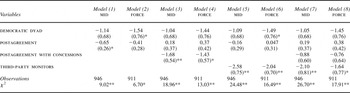
The model was estimated using a variety of specifications with control variables typically included in models of MID onsets. Of these controls, the only one that had even marginally significant effects was a measure of joint democracy, which is included here (democratic dyad).Footnote 49 The estimates are presented in Table 1. For each specification, the dependent variable is indicated at the top of the column.
Effect of agreements on the probability of MIDs

Notes: Estimates were obtained using a conditional logit model with dyadic fixed effects. Standard errors in parentheses.
* significant at 5%;
** significant at 1%.
The estimates in Table 1 show that certain kinds of agreements have a pronounced effect on interstate conflict. Models (1) and (2) show that MIDs and uses of force are both less likely after agreements to limit rebel support than before those agreements. Models (3) to (6) show, however, that the only agreements that significantly reduce conflict are those that include concessions or are being monitored by third parties. The estimated effects on both of these provisions are negative and significant, while the effect of an agreement without them becomes statistically indistinguishable from zero. Conditional logit estimates do not readily lend themselves to interpretation using predicted probabilities, but the estimates in model (4) imply that the odds that force will be used given an agreement with concessions are one-quarter of the odds that force will be used in the absence of an agreement; the estimates in model (6) imply that the odds that force will be used given the presence of monitors are about one-seventh of the odds that force will be used in the absence of monitors.
Models (7) and (8) control for both of these provisions simultaneously. Both have negative effects, though their coefficients have smaller magnitude than before. Given the high correlation between these provisions, not much should be made of the fact that only one of the coefficients is individually significant. Likelihood restriction tests show that these coefficients are jointly significant at the 1 percent level. Hence, while the effects of concessions and monitoring are hard to tease out separately, the estimates are consistent with the theory: agreements that seek policy restraint are more likely to be associated with reduced interstate conflict when coupled with substantive concessions by the target and/or monitoring mechanisms.Footnote 50 Phrased another way, agreements to end rebel support have a poor record of reducing interstate conflict unless they are accompanied by some deal on the underlying issue of contention and/or some way of verifying compliance.
Empirical work on the effects of international agreements necessarily raises concerns about selection effects.Footnote 51 Because states can choose whether or not to sign a treaty, it is hard to know if the observed effects of that treaty are due to its terms or to the conditions that led the states to sign it. Given that the states in our sample were engaged in rebel support prior to making any agreements, it is very likely that there was some change in the situation that made possible an agreement that was not previously attainable. It is therefore plausible that subsequent outcomes are influenced by this change in underlying conditions. For example, the Soviets reduced their support for the Pathet Lao after signing the 1962 Geneva Accords not because they signed an agreement, but because of fears of a confrontation with the United States and increasing concerns over China, factors that helped bring about the treaty.Footnote 52 One could not argue that, had the treaty been exogenously imposed on the Soviets, it would have had the same effect.
Nevertheless, the evidence in this study shows that variation in agreement terms correlates with variation in subsequent behavior. This suggests that the provisions have effects, even if states are selecting them strategically. One could assert that states only permit third-party monitoring when they intend to reduce rebel support anyway, but it is hard to then argue that this monitoring has no effect. The only reason to be selective in agreeing to this provision is if it has consequences that are desirable sometimes but not others. If states accept costly monitoring only when they intend to subsequently comply, and not otherwise, this selectivity attests to the role that monitoring plays. Similarly, the concessions that accompany some agreements represent substantive moves towards the ideal point of the offending state, and it is hard to see how such terms would not influence incentives to abide by the deal. Still, the drop in violence that follows concessions may also reflect some development in the conflict that led the afflicted state to give in. But this result only underscores how difficult the management of these conflicts can be: a stable reduction in the violence surrounding rebel support may not be possible until the afflicted state is ready to make a deal on the underlying issue.
Conclusion
This study has shown that efforts to coerce policy restraint face an enforcement problem similar to that identified in the literature on international cooperation. When monitoring is imperfect, inefficient conflict can occur even though there exists a deal that both sides prefer to fighting. Moreover, the possibility that military force can lead to an imposed settlement means that such inefficiencies do not necessarily go away when the “shadow of the future” is sufficiently long. The insights of this model were then shown to inform the analysis of interstate conflict over the support of rebel groups in civil wars. In addition to showing the usefulness of the theoretical contribution, the results are part of a growing literature demonstrating that international organizations can play a role in reducing interstate violence.Footnote 53
Although disputes over insurgent support constitute a large and important subset of disputes over policy, this analysis has broader implications for understanding international conflict. Many interstate disputes revolve around efforts to coerce policy change. As noted at the outset, efforts to compel states to end weapons programs are plagued by problems of monitoring and enforcement.Footnote 54 The repeated militarized conflicts between the United States and Iraq after the Persian Gulf War, culminating in the 2003 Iraq War, partly reflect Iraq's inability to commit credibly and verifiably to the terms of the cease-fire. Another policy area that has generated conflict throughout history is states' treatment of minority populations. Whether such policies are susceptible to the commitment problem identified here depends on whether the mistreatment of minorities can be done covertly, or at least in a way that violations fly “under the radar screen” of concerned foreigners. For example, after threats from the United States and the North Atlantic Treaty Organization (NATO), Serbia agreed in October 1998 to withdraw its military and paramilitary forces from Kosovo and to end attacks on civilians there. The deal did not hold, however, in part because the Serbs believed that they could continue their mistreatment of the Kosovars at a low enough level that the violations would not sound an alarm in Western countries. This strategy was grimly described by one Serb diplomat as: “A village a day keeps NATO away.”Footnote 55 By contrast, territorial disputes generally do not face this problem, since it is usually hard to unilaterally change the territorial distribution without the other side noticing. Hence, the results of this study suggest that researchers need to pay greater attention to the issues that are at stake in international disputes and to the particular strategic problems that may arise in attempting to craft peaceful bargains over those issues.
Appendix
Basic Model
For any set of punishment strategies S A and S B, a cooperative equilibrium exists if neither state would prefer to deviate from the equilibrium for a single period. Although the punishment strategies are left unspecified, there are bounds on the continuation payoffs associated with them. Let d i denote the continuation payoff to state i associated with the punishment strategy that would be triggered by its defection, S i. Since the maximum possible payoff in any period is 1, it follows that d A,d B ≤ Δ. The minimum possible continuation values are determined by the states' minimax payoffs. State B's lowest payoff comes when state A plays x = 1 in every period, in which case its best response is to attack in every period. For state A, the worst punishment that state B can impose is to attack in every period, in which case state A's best response is to play x = 1. Hence, for both states, the minimax payoff is the war payoff.
Given a deal π and the punishment payoff d A, state A will abide by the deal only if it has no incentive to deviate to some x > π for one period and then return to the equilibrium strategies. A's present discounted value of cooperating in every period is

The expected value of enacting x > π depends on the likelihood of detection. If a deviation is not detected, A receives a payoff of x + δr A. If a deviation is detected, B responds by attacking, and the states play the punishment strategies, S A, thereafter, in which case the expected payoff is x − c A + (1 − p)δd A. So the expected value to A for enacting x is

It follows that a deal π < 1 is only sustainable if δr A > (1 − p)δd A − c A, creating a lower bound for π as a function of d A:

State A can profitably deviate if the optimal policy level is greater than the agreed policy level. The following lemma is useful to determining the conditions under which this will happen.
Lemma Given condition (8), there exists some optimal policy level x* greater than π, if and only if

Proof The “if” portion of this claim follows immediately. The “only if” portion stems from the assumptions that (1) f is continuous at 0, and (2) f′′(x − π) > 0 for all x > π. These assumptions, together with (8), ensure that the function EU A(x) is continuous at x = π and that its second derivative is negative for all x > π. As a result, EU A(x) either increases from x = π to some maximum x* > π, or it decreases forever from x = π, in which case x* = π.
This result means that, for there to exist some optimal policy greater than π, it is both necessary and sufficient for A's expected utility to be increasing as x increases above π. The right-sided derivative of (7) evaluated at x = π is

Setting this greater than zero, a profitable deviation exists if and only if

State A will abide by the deal in equilibrium if and only if π > π. Because f′(0) ≥ 0, this lower bound is higher than the one specified in (8), making (9) the binding constraint.
For state B, the current discounted payoff on the equilibrium path is

A one-period deviation, an unprovoked attack followed by the punishment strategies S B, generates an expected payoff of

State B cannot profitably deviate if

This expression gives an upper bound on the deals by which state B will abide.
The bounds described in (9) and (12) determine whether an enforceable compromise exists. A deal exists if the upper bound exceeds the lower bound, which requires

The right-hand side of equation (13) is maximized when d A and d B are minimized. If a deal is not possible under those conditions, then no deal is possible for any feasible punishment strategies. Substituting the minimax payoffs into (13) yields condition (3) in the text.
Nonexistence of Partially Cooperative Equilibria
Consider a partially cooperative equilibria in which, given some deal, π, state A enacts in every period some z > π. In any period in which the alarm sounds, state B enacts some punishment strategy that involves attacking in that period and possibly for additional periods. Unless a punishment is ongoing, state B does not attack in periods in which no cheating is detected. Here, I sketch a proof showing conditions under which such an equilibrium does not exist.
As before, let d A denote the continuation payoff for state A in the period following a detected violation and an attack. State A's expected payoff on the equilibrium path is given recursively by

If state A were to deviate for one period to some other policy level, x, then

Given z and π, the optimal policy level is the value of x that maximizes this expression. For no profitable deviation to exist, that optimal level must equal z, so the derivative of (14) evaluated at x = z must equal zero in equilibrium. The expression for this derivative is

The quantity within the brackets is finite for all δ.Footnote 56 This means that, for sufficiently small values of f′(z − π), the derivative in (15) cannot be set to zero and will be positive. When that is the case, state A's utility is strictly increasing in x, and no policy z < 1 can be sustained in equilibrium. Hence, if the probability of detection is not very sensitive to infinitesimal changes in the policy level—that is, if f′(v) is sufficiently small for all v—then state A cannot commit to even partial compliance.
Costly Monitoring
In the game with costly monitoring, the payoffs on the equilibrium path become r A = (π − m A)/(1 − δ), and r B = (1 − π − m B)/(1 − δ). Otherwise, the solution proceeds exactly as above.
Concessions
Consider the game in which the bargain consists of a division, ω, enacted by state B in return for state A enacting x = π. The payoffs on the equilibrium path are

The payoffs from war, w A and w B, are unchanged from before.
Given ω, the expected payoff to state A of deviating to some x > π is

Using the same logic as above, state A prefers not to deviate when

State B can deviate from the equilibrium either by enacting some division other than ω or by making an unprovoked attack after A moves. Because B's allocation decision is perfectly observed, it is easier to deter a deviation of the first kind, as A can respond immediately. The most profitable deviation for B is to make an unprovoked attack after A has already set x = π for that period. The expected payoff in this event is

so state B will abide by the deal only if

Because x cannot be set less than zero, this condition implies an upper bound on ω, which I denote by ω.
Given ω, an enforceable deal exists only if π(ω) > π(ω). Subtracting (16) from (17), I find that

This means that the range of enforceable policy levels is increasing in ω and maximized at the upper bound, ω. Thus, a necessary condition for any deal to exist is

Comparing this condition to its equivalent in the basic game, the right-hand side of (18) must be greater than the right-hand side of (13).