In February 1848 the Young Ireland newspaper the United Irishman marked the fiftieth anniversary of the 1798 rebellion with a history of the United Irish society, the instigator of the failed rising from which the paper drew its name. The article began by bemoaning the lack of public monuments to the fallen leaders of the 1798 and 1803 risings, then reflected on the fate of their wives and sweethearts:
Rank clay fattening over a skeleton in Kildare—In Michan's vaults the mummied trunks of brothers—in the earth above them “relics cold and unhonoured” … and these are all that remain to Ireland of the last men who died for her. Their families nay their names have fretted away. Their wives and children are scattered over the world in graves and garrets. Pamela Fitzgerald starving in an alley of the capital where once she ruled a Republican queen—Matilda Tone, a lone widow in Paris, or a childless woman in America—and Sarah Curran, yielding up the “broken heart” far off in Sicily—such has been the fate of all they loved and all who loved them.Footnote 1
Accusations that the memory of the United Irish martyrs had been shamefully neglected were a commonplace of nationalist rhetoric by the 1840s; the bloody excesses and sectarian rancor that marked the rebellion ensured that the legacy of 1798 would be bitterly contested. This charge should not, however, obscure ongoing efforts to reclaim the memory of 1798 for Irish nationalism in the first half of the nineteenth century, an enterprise that included numerous elegies to the fallen leaders by the Irish poet Thomas Moore (from whose poem “Oh Breathe Not His Name” the author of the article drew the reference to relics “cold and unhonoured”) and that would culminate in the publication of Richard Robert Madden's monumental eleven-volume Lives and Times of the United Irishmen between 1842 and 1860. Nonetheless, the United Irishman implied that such commemoration was necessarily clandestine in character: the heroic dead remain unnamed, referenced only obliquely through places and people with which they are linked. Yet merely by alluding to the names of their widows, the Young Ireland press could immediately invoke the triumvirate of nationalist leaders with whom they were associated.
The first of the three so evocatively alluded to was Pamela Fitzgerald, widow of the aristocratic rebel Lord Edward Fitzgerald. Having traveled to Paris in 1792 and renounced his title, “Citizen” Fitzgerald had fallen in love with Pamela, reputedly the illegitimate daughter of the French educator and writer Madame de Genlis and Philippe “Egalité” Duc d'Orléans, cousin of Louis XVI and one of the signatories of the king's death warrant. Forced into hiding shortly before the outbreak of the rebellion in May 1798, Edward Fitzgerald died soon after from wounds sustained during his arrest. Pamela was left virtually penniless. She remarried in 1800 but later separated from her second husband and died in poverty in Paris in 1831.Footnote 2 The next, Matilda Tone, was the widow of the United Irish leader Theobald Wolfe Tone, who had cut his own throat after being captured on board a French expedition to Ireland in 1798. Matilda had met and married Tone when she was only sixteen and dutifully accompanied him into exile in America in 1795. She would never return to Ireland, crossing the Atlantic once more in 1796 to join Tone in France. After she learned of his death in 1798, she lived on in Paris, with a pension from the French government, until 1816, when she left for Edinburgh and then the United States with her second husband, the Scottish doctor Thomas Wilson.Footnote 3 The third was Sarah Curran, fiancée of Robert Emmet, executed leader of the 1803 United Irish rebellion and daughter of John Philpott Curran, the celebrated barrister. Emmet and Sarah Curran had embarked on a doomed love affair in 1802, and Curran would be implicated in Emmet's investigation and trial, much to the embarrassment of her father, who effectively disowned his daughter as a result. Following Emmet's execution, she married an officer in the British army and in 1805 followed him to the British garrison in Sicily. She died there from consumption in 1807, though the preferred explanation was that she had pined away from a broken heart.Footnote 4
Women's history has long been concerned with rescuing from obscurity those figures that have been written out of the male-authored historical canon. Historical research on the “women of 1798” is no exception: one of several articles on this subject prompted by the rebellion's bicentenary is tellingly subtitled “Explaining the Silence.”Footnote 5 Yet what is noteworthy about nationalist commemorations of the United Irishmen from the nineteenth century onward is the relative visibility of women associated with the movement's leaders. Madden devoted several chapters in his collective biography of the United Irishmen to Matilda Tone, Pamela Fitzgerald, and Sarah Curran.Footnote 6 These women also featured consistently in historical and literary accounts of the movement's leaders in the nineteenth century. In the twentieth century, they were to become the subjects of novels and biographies in their own right.Footnote 7 The United Irish widows can be understood as embodying the original dual meaning of the term relict signifying both a widow and a venerated object associated with the deceased.Footnote 8 So closely intertwined are their narratives with those of their husbands and lovers that there has been little attempt to unravel this intimate connection and to consider the mnemonic function that these “republican relicts” performed in Irish nationalist discourse.Footnote 9
Over the past two decades, as a series of major anniversaries in the nation's history have been marked, memory has emerged as one of the dominant preoccupations of Irish historical scholarship.Footnote 10 In 1998, the bicentenary of the 1798 rebellion prompted an outpouring of new research on the commemoration of the rebellion and the United Irish movement. This rich and voluminous scholarship has, among other things, emphasized the persistently politicized character of that commemoration, summarized in Kevin Whelan's oft-quoted observation that “the rebellion never passed into history, because it never passed out of politics.”Footnote 11 There have been stimulating studies of the religious and ideological forces that shaped opposing interpretations of the rebellion,Footnote 12 of the relationship between vernacular and official forms of remembrance,Footnote 13 and of representations of the rebellion across a range of media: balladry, poetry, novels, and monuments.Footnote 14 Yet apart from some valuable work on Matilda Tone's role as republican widow and guardian of her husband's memory, there has been no systematic analysis of the relationship between gender and memory in Irish history.Footnote 15
This neglect is not unique to Irish scholarship. Memory studies have largely ignored gender in their theoretical and methodological reflections, despite the fact that, as Jane Rendall and Karen Hagemann remark, “memory is always gendered and … gender is one of the most important interpretive patterns that structures the process of memory production.”Footnote 16 Responding to this lacuna, the leading memory theorist Aleida Assmann has taken some initial steps toward analyzing the relationship between gender and memory. She discerns a strong underlying pattern in modern Western memory cultures that identifies women as the principal subjects of memory and sets feminized remembrance in opposition to men's forgetting, the latter being understood as a necessary precondition for masculine action. However, as she further contends, this polarity is reversed when it comes to the question of who is remembered. Then it is men who are designated the objects of memory, while women become the objects of historical oblivion.Footnote 17 The gendered dynamic structuring modern memory (and forgetting) that Assmann outlines can potentially add much to our understanding of how the memory of 1798 was constructed and contested. It may, admittedly, seem counterintuitive to propose that remembrance is a “female domain” while men “long to forget”Footnote 18 in the context of a nation long viewed as having an almost pathological obsession with the past. Yet as Guy Beiner has shown, forgetting, and the rhetorical and emotional power that derives from that which is unspoken or concealed, have often been integral to Irish practices of remembrance.Footnote 19 Moreover, as this article suggests, the republicanism that informed the United Irish movement and later generations of Irish revolutionary nationalists contained within it a pronounced ambivalence to forms of memory as mourning typically associated with women.
The commemoration of the United Irishmen in the first half of the nineteenth century, however, may also complicate Assmann's identification of women as subjects of memory but objects of oblivion. Instead, I suggest, it offers a revealing case study of the circumstances in which certain women may be incorporated into cultural memory rather than excluded from it, albeit as adjuncts in the constructions of their husband's heroic reputations. The incorporation of women into this memory culture, I argue, had much to do with the fraught political context in which the 1798 rebellion and its leaders were memorialized. In the first half of the nineteenth century, as Joep Leerssen observes, there were almost no “monuments or lieux de mémoire embodying a ‘national’ Irish, anti-Ascendancy historical consciousness,” and open celebration of the United Irishmen remained legally hazardous.Footnote 20 Building on the distinction between communicative and cultural memory as elaborated by Jan Assmann and Aleida Assmann, where the former connotes memories that are often informal, family oriented, and transmitted orally and the latter encompasses more institutionalized memories preserved and transmitted through printed media, monuments, and public rituals, Sylvia Paletschek and Sylvia Schraut have suggested that “communicative memory can be understood as female, cultural memory as male.”Footnote 21 Counterhegemonic communicative memory arguably offers more space in which women can emerge as agents and objects of remembrance; oral traditions of the French landing in Connaught in 1798, for instance, were often transmitted by women and incorporated more female figures than canonical histories.Footnote 22 Yet we must also be careful not to overstate the dichotomy between communicative and cultural memory. In Ireland the transition from communicative to cultural memory was by no means linear. The memory of 1798 was always complex and multilayered. Oral, familial, and local traditions persisted alongside more canonical histories, and influenced and were informed by them well into the twentieth century.Footnote 23 What we can, however, identify is a preoccupation with the failure to secure a place for the memory of 1798 within the Irish public sphere, as evidenced in Irish nationalists’ obsession with unmarked graves, unwritten epitaphs, and unbuilt monuments. As a result, the remembrance of the rebellion assumed a covert character, at times as much rhetorical as real, that blurred conventionally gendered distinctions between private grief and public remembrance, intimate histories and heroic reputations, family genealogy and public biography, so as to foreground women and the female mourner in particular.
The sources upon which this article draws were for the most part produced between 1798 and 1848, a period bookended by two unsuccessful revolutions: the United Irish rising and the smaller-scale Young Ireland rising fifty years later. The focus is on a range of print media—the press, periodicals, memoirs, biographies, and illustrated prints—associated with the emerging nationalist counter-memory of the rebellion. Though such material circulated within the public sphere of print culture, it maintained a connection with vernacular historiographies and personal recollections of 1798. Broadsheet ballads and literary elegies on the rising drew, as I show below, on the oral tradition of the Gaelic lament. The biographies of the United Irish leaders that were published from the 1820s onward often relied on the private and familial reminiscences of surviving relatives. The comparative prominence accorded to women in commemorations of the rebellion partly derived from the embattled circumstances in which that commemoration took place but also, I suggest, had deeper roots in commemorative traditions that predated the rebellion. Therefore, in what follows, I first outline some of the divergent mnemonic traditions at work within Irish patriot discourse from the late eighteenth century onward: what might loosely be termed the classical republican and lamenting traditions. These traditions were underpinned by different understandings of the relationship between personal grief and public commemoration and, consequently, different conceptions of women's commemorative role. I then proceed to explore how the privileging of women's grief in elegies for Ireland's fallen heroes provided a critical context for the elevation of figures such as Sarah Curran and Pamela Fitzgerald to objects of memory in their own right. The continued proscriptions constraining open celebration of the United Irishmen's republicanism would similarly refocus attention away from the leaders’ politics toward their personal lives and intimate relationships. I conclude with a consideration of Matilda Tone, a figure, who, at various moments, would embody the different roles available to women within Irish memory culture.
Manly Silence and Women's Cries
While the exhortation to remember would become one of the dominant imperatives of Irish nationalism in the nineteenth century, United Irish efforts to transcend class and sectarian differences meant that they largely glossed over the divisive legacy of Irish history. In the words of Wolfe Tone, the society sought to “abolish the memory of all past dissensions, and to substitute the common name of Irishman in place of the denominations of Protestant, Catholic and Dissenter.”Footnote 24 At the same time, the movement also recognized the emotive potential of republican sacrifice. As it developed into a mass-based revolutionary organization and the state responded with draconian repression to the spread of seditious activity, the motif of the patriotic martyr would increasingly feature in United Irish propaganda. William Orr, a young Presbyterian farmer executed in 1797 for administering the United Irish oath, provided the movement with its first martyr; the phrase “Remember Orr” became a rallying cry in the buildup to the 1798 rebellion. In an effort to inscribe the memory of Orr on the public consciousness, William Drennan, a founding member of the United Irishmen, composed the “Wake (of William Orr),” first published in the United Irish paper the Press in 1797. The opening stanza of this solemn elegy reads,
Drennan's injunction to silence reflected the climate of fear that Orr's execution and a violent campaign of state repression in the north of Ireland had created. Accounts of Orr's execution, outside the County Antrim town of Carrickfergus, recorded solemn and silent scenes: townspeople too fearful to speak with each other, their windows darkened to block out the melancholy scenes taking place outside.Footnote 26 The appeal to silence, however, also invoked a specifically gendered model of mourning. While the poem briefly gestures to the affective power of the female mourner—Orr's pregnant wife “with aspect wild”—women's grief is marginalized in favor of a more austere and masculine form of mourning. It is a model of masculine self-control closely associated with the classical republican discourse that informed much of the United Irishmen's rhetoric. Indeed, many of the elegies on Orr drew implicit parallels between the young farmer and the classical Roman hero Cincinnatus, drawn from his plow to defend the republic.Footnote 27 As well as enjoining a model of emotional labor that is divided between manly silence and “women's cries,” the Latin epigraph to the poem also suggests a further gendering of remembrance. Taken from the classical historian Tacitus's account of the funerary customs of the German tribes on the borders of the Roman Empire, it reads “Feminis lugere, honestum est; viris, meminisse” (“It is the honourable thing for women to mourn; men remember”).Footnote 28 This perhaps surprising differentiation between mourning and remembering—activities commonly perceived as closely related—seems to rest upon an implied opposition between the passivity of the female lament and masculine political action. While grief, as Gail Holst Warhaft observes in her study of the political uses of mourning, “because it arouses passion … can always be used for political ends,” the intensity of emotion displayed by mourners, particularly women, has also historically posed a challenge to the sacrificial logic that underpins revolutionary and patriotic rhetoric.Footnote 29 In classical literature, women's grief was often represented as narrowly personal and excessive and, as such, a threat to the collective values and martial purpose of the civitas.Footnote 30 As in revolutionary America and France, late eighteenth-century Irish radicals drew on a classical republican discourse that equated political rights with the right and duty to bear arms, a model of citizenship from which women were explicitly excluded. A mediated relationship to the public sphere was, nonetheless, available to women through the role of republican wife or mother, a role that demanded the subordination of personal feeling and attachments to the public good.Footnote 31 Though Drennan had retreated from active involvement in the United Irishmen by the time the movement entered its insurrectionary phase, in an article published in the Press in 1797 he celebrated the exemplary Roman matron, Cornelia, the widowed mother of the Graachi.Footnote 32 Cornelia had suppressed her maternal affections to sacrifice her sons for the good of the republic and, according to the Roman biographer Plutarch, was widely admired for her ability to speak of her dead sons “without a sigh or tear.”Footnote 33 In the Roman view, female grief represented a disruptive force within the rational, public sphere.
While the elegy for Orr construed women's grief as a threat to the United Irishmen's collective resolve, in the injunction to “wake not him with women's cries,” Drennan also alluded to an alternative culture of mourning: the lamenting tradition associated with Irish mortuary rituals. In Irish Gaelic culture, as in ancient Rome and many other cultures, it was customary for bereaved relatives to hire mna chaointe (keening women) to cry over the body of the dead and compose extempore verses in praise of the deceased. Their lamenting would continue throughout the wake and the funeral procession as the keeners accompanied the coffin to the grave. Mna chaointe were particularly associated with untimely deaths, such as the young mother who died in childbirth, the child who fell ill, or the young man who was executed.Footnote 34 The lamenting tradition represented a demotic Catholic counterpart to the more stoical mode of mourning with which middling and elite Protestants schooled in the classics like Drennan would have been familiar. To eighteenth-century Protestant observers, the keen was an intriguing but disturbing element of Irish popular culture. Drawing on prevailing understandings of the relationship between gender and emotion, such commentators interpreted the proverbial “Irish cry” as evidence of the native Irish susceptibility to “feminine expressions of sorrow.” The contemporary keen, with its female-led chorus of uninhibited, excessive grief was dismissed as a barbaric and degenerated version of the more restrained formal lamentation practiced by the ancient Irish male bards.Footnote 35
Anglophone observers’ aversion to the keen likely stemmed not only from its excessive emotional display but also from its subversive potential. In Jacobite aisling or “vision” poetry, Ireland was personified as a mournful woman lamenting the loss of her Stuart protector and her menfolk driven into political exile on the continent.Footnote 36 Over the course of the eighteenth century, political laments dedicated to figures executed for seditious activity circulated within the underground culture of Catholic Ireland; some were attributed to women.Footnote 37 The most famous example, “Caoineadh Airt Uí Laoghaire,” or “The Lament for Art O'Leary,” was reputedly composed by Daniel O'Connell's aunt, Eileen O'Connell. A tribute to her husband, Art, who was shot and killed in 1773 after a long conflict with a local Protestant magistrate, the composition follows the formal conventions of the lament: Eileen relates Art's distinguished lineage, describes his impressive bearing, and heaps calumny on those who murdered him.Footnote 38 The lament is a powerful expression of personal grief, but it must also be understood as emerging from an intensely political context of sectarian conflict in late eighteenth-century Munster. Footnote 39 In contrast to the republican tradition, it illustrates how women's grief might be harnessed to a political cause, the bereaved woman foregrounded precisely because of her ability to lend a personal, affective charge to a political grievance. As the nineteenth-century antiquarian Thomas Crofton Croker observed during his researches into the keening tradition, “private and political feeling are often strongly infused in these compositions.”Footnote 40
In the repressive aftermath of the 1798 rebellion, the personal grief of bereaved women was again foregrounded. In the Gaelic-speaking areas of Connaught, several laments were produced for the fallen rebels, one of which, the lament for Father Manus Sweeney, was supposedly based on a spontaneous keening by his sister at the gallows.Footnote 41 As men concealed themselves to avoid government persecution, the task of commemorating the dead would largely fall to women, who were often responsible for reclaiming their relatives’ bodies from the battlefield and ensuring that they were properly waked and interred.Footnote 42 Anne Devlin, who would later be sanctified in nationalist hagiography as Robert Emmet's faithful Catholic housekeeper, claimed that in the tense atmosphere that followed the rising, “sympathy for the dead” was “an offence not to be forgotten.”Footnote 43 Early in 1799, according to Devlin's account, she and other young female volunteers exhumed and reinterred two rebels who had been buried separately from their comrades. This act was followed by a carefully choreographed funeral ceremony in which local women led a procession to the graves where they laid garlands. The privileged position accorded to women in Irish funerary and lamenting traditions thus enabled them to assume a public and often political role in community remembrancing, a role that acquired a heightened political charge in the aftermath of the United Irish rising. This intimate association between women and mourning would carry through into nationalist commemorations of the rising in the nineteenth century, though, as I discuss below, women's capacity to act as agents of memory in a public context would be increasingly circumscribed.
“This Heart Must Shroud Thy Fame”: Sarah Curran and Pamela Fitzgerald
In his influential, if subsequently much contested, 1924 study of Gaelic poetry in eighteenth-century Munster, Daniel Corkery described the “Lament for Art O'Leary” as a gateway into the “secret life” of the Gaelic-speaking Catholic gentry.Footnote 44 For Corkery, this was a suppressed but culturally and emotionally rich world, which anglophone observers were unable to access. In a more recent reworking of Corkery's concept of the penal-era Catholic nation as a “Hidden Ireland,” Leerssen suggests that eighteenth-century Catholic Ireland was “hidden” insofar as Gaelic and Catholic culture was largely oral and manuscript in form, while the public sphere and print culture remained predominantly Protestant and anglophone. As Leerssen further notes, the emergence of an increasingly assertive Irish Catholic community in the first decades of the nineteenth century would see the transfer of vernacular Gaelic practices and customs into the anglophone public sphere. This shift explains the curious hybridity of nineteenth-century Irish literature, in which idioms and expressions from Gaelic oral culture fused with English literary forms.Footnote 45 The lament was one such form that would gradually filter into Irish verse in English. But if the culture and idioms of Gaelic, Catholic Ireland were no longer “hidden,” public commemoration of the trauma of the rebellion or celebration of the rebels’ aims remained fraught. In this context, attention was deflected away from the rebellion's male protagonists to the figure of the grief-stricken woman. While the keen had enabled women to assume a public role in community remembrancing, in the first half of the nineteenth century it was largely men who gave literary expression to this female grief. The image of the wailing woman lamenting the death of her loved ones percolated into popular balladry in the form of “The Maniac—Mary Le More.” Several variants of this ballad appeared in the decade following the rebellion, each focusing on the motif of the young woman driven mad by grief following her violation at the hands of British soldiers and the death of her male relatives in the rebellion. Though composed by the English radical writer Edward Rushton, the ballad of Mary Le More fused the emotional “excess” associated with the Irish keen with the image of the young female madwoman, a popular trope in English Romantic poetry.Footnote 46
The figure of Mary Le More exemplifies Tom Bartlett's observation that after 1798 an inability to conceive of women as political agents meant that women's roles in the rebellion were reduced to that of “symbol, model and victim.”Footnote 47 This presentation of women as the innocent victims of British brutality can also be seen as countering loyalist histories of the 1798 rebellion in which rebel women were depicted as shrill, lascivious harridans whose gender transgressions emblematized the rebellion's reversal of the natural political and social order. Richard Musgrave, in his highly influential history of the rebellion first published in 1801, repeatedly depicted the female rebels as more religiously zealous and bloodthirsty than their male counterparts, and conservative histories in the first half of the nineteenth century would continue to reproduce this trope of the savage, masculinized female rebel.Footnote 48 Such gendered representations can be located within a broader European conservative reaction against the more expansive possibilities for women opened up by the revolutionary upheaval of the 1790s.Footnote 49 While the figuration of the woman-nation as a passive, suffering victim reflected early nineteenth-century gender ideologies, the positioning of women as vectors of national grief can also be understood in terms of the political contests over the memory of the United Irishmen and the official “masculine” silences regarding 1798. A later broadside version of “Mary Le More” not only focused on the bereaved woman as an object of pity and a symbolic embodiment of national suffering but also identified women, “the fair daughters of Ireland,” as the primary witnesses to and recorders of the country's woes: “Remember the wars of your long shackl'd nation! / Remember the wrongs of poor Mary Le More!”Footnote 50
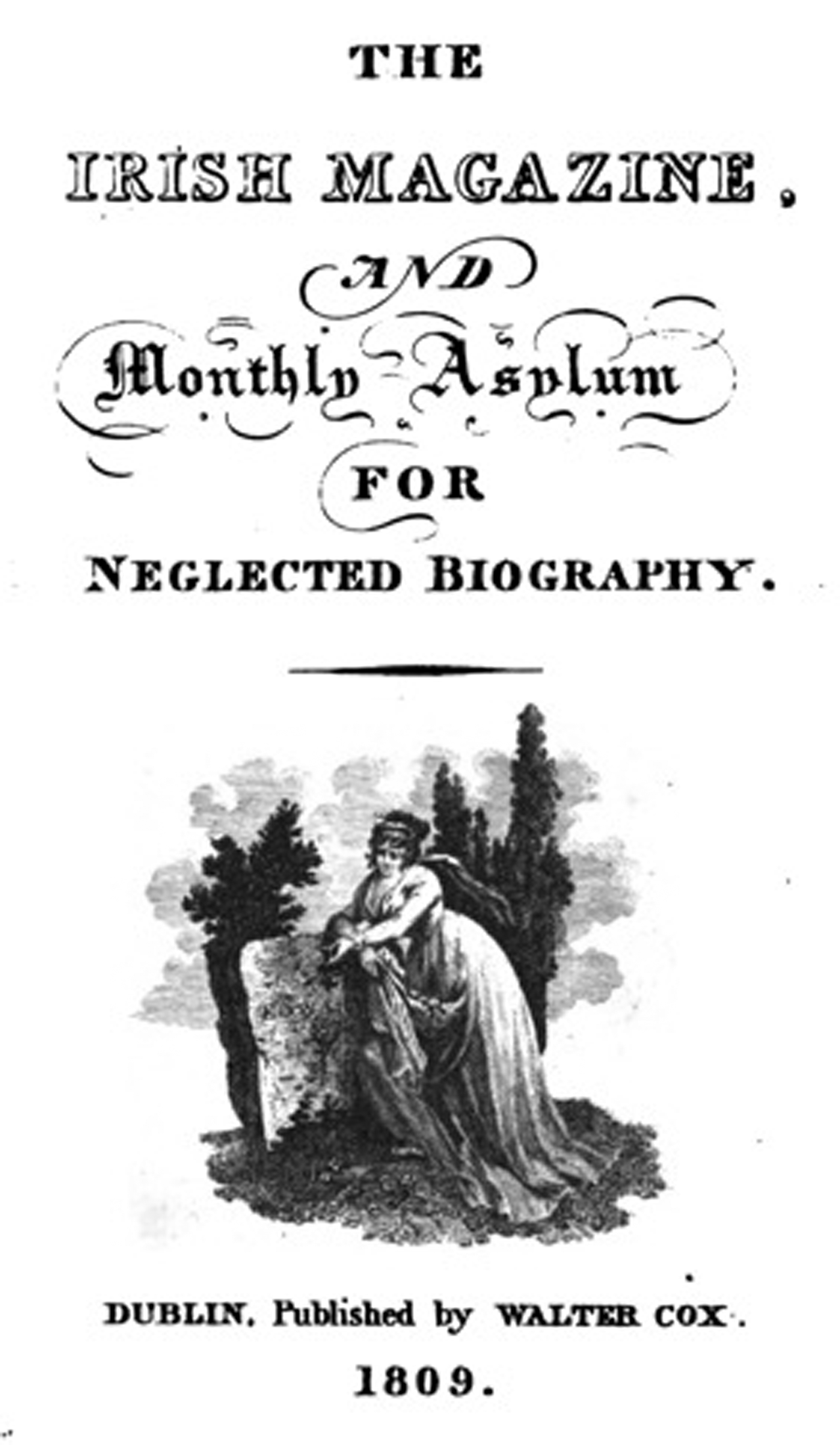
A variant of the ballad, entitled “Mary, a Doggerel Poem,” was published in the Irish Magazine in 1808.Footnote 51 One of the earliest distinctively Catholic Irish periodicals, the Irish Magazine—significantly subtitled the Monthly Asylum for Neglected Biography—devoted numerous pages to histories of the 1798 rebellion and biographies of the United Irish leaders.Footnote 52 Defending his tendency to revive painful memories by dwelling on the bloodshed of ’98, the magazine's editor, Walter Cox, maintained that “the very life-blood of public spirit is nourished by an acquaintance with the history of our sufferings.”Footnote 53 Cox was repeatedly imprisoned during the magazine's run and exiled to America in 1815, underscoring just how hazardous such an enterprise remained.Footnote 54 This insistence that the expression of grief and suffering had a place in the public sphere was also reflected in the Magazine's efforts to rescue the Irish keening tradition from the denigration it had suffered at the hands of English and Anglo-Irish commentators. In February 1815, Cox published a piece entitled “The Ullah or Irish Cry,” an imagined scene set in the distant past in which the Saxon Philander, mourning at the grave of his Irish friend Theodore, hears the “heart-striking tones” of the keen and is deeply moved.Footnote 55 The increasing prominence of the grieving woman in Irish nationalist culture was also evident in the multiple poems the magazine published on the theme of the United Irish martyrs’ graves, many of which featured the figure of a mourning Erin/Hibernia lamenting over the tombs of her fallen heroes.Footnote 56 The intimate connections between women, death, and memory were further signaled in the Irish Magazine's 1809 collected volume of issues, whose frontispiece depicted a female figure draped over a tombstone upon which the name “Edward” is faintly decipherable, a probable reference to Edward Fitzgerald (figure 1).
Frontispiece to Irish Magazine and Monthly Asylum for Neglected Biography (1809).

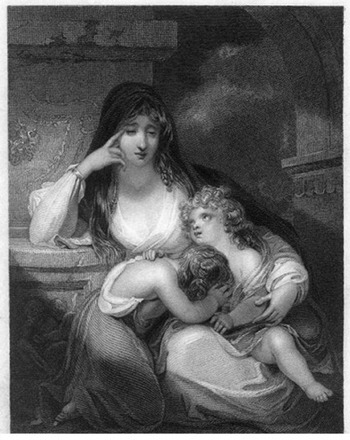
This intensified focus on the female mourner on the part of those seeking to commemorate, however obliquely, the fallen leaders of the 1798 and 1803 rebellions partly explains why their wives and sweethearts came to be so tightly woven into the weft of their heroic narratives. Women's role as active agents in the revolutionary movement of the 1790s, whether on the battlefield or as participants in political debate, was as a consequence largely occluded in nationalist narratives of the rebellion, although a strong vernacular memory of certain figures, such as Betsy Gray, the tragic heroine of the Battle of Ballinahinch, was preserved in certain localities.Footnote 57 In a slippage characteristic of Irish nationalist discourse, the symbolic representation of the feminized grieving nation became readily conflated with the flesh-and-blood person of the bereaved woman.Footnote 58 A contemporary engraving of Pamela Fitzgerald, supposedly after a portrait by George Romney, is notable for its classical allegorical style and shows the recently widowed Pamela wearing a mourning veil and clasping her two children to her breast, an image that blends the dual aspects of the female personification of Ireland as both mother and mournful lover (figure 2). Thousands of copies were reputed to have been sold and circulated amongst the United Irish exiles in continental Europe. Patriotic devotion to the feminized Irish nation was thus channeled and refocused onto the body of the grieving Pamela, a living relic of her martyred husband, whom émigré United Irishmen were said to hold “almost in worship.”Footnote 59 In this way, Pamela Fitzgerald became both the subject and object of mourning, both mourner-in-chief and a living mausoleum to her dead husband.
Stephanie Caroline Anne (“Pamela”) (née Syms) Lady Fitzgerald, by unknown engraver. National Portrait Gallery, London. D. 15319.

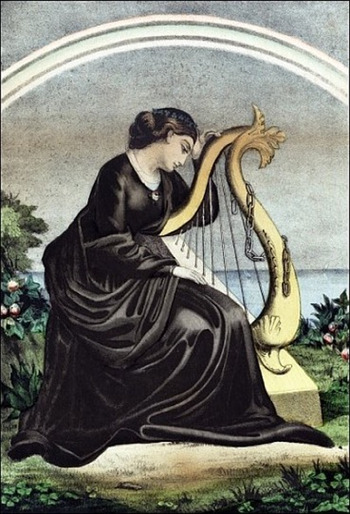
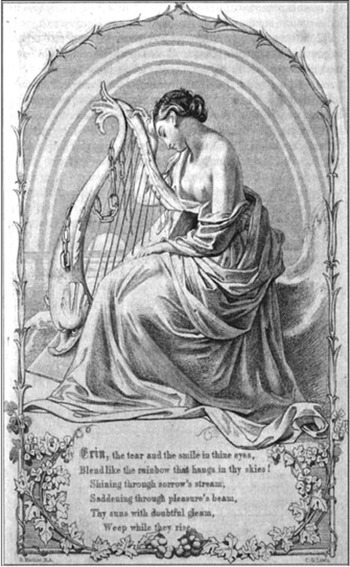
The collapsing of the boundaries between the allegorical and actual woman would be even more evident in accounts of the relationship between Sarah Curran and Robert Emmet. Emmet's biographers have long noted how the affair between Emmet and Curran quickly acquired a sedimentary layer of romance, as poignant scenes involving Curran were added to the already dramatic details of Emmet's death. One told how she had escaped her family's vigilance to attend Emmet's execution, waving a white handkerchief to catch his attention before falling into a faint, another how she had visited Emmet's grave at dusk.Footnote 60 In “My Emmet's No More,” one of the earliest broadsheet ballads dedicated to Emmet, the figure of Mary Le More and the harp-playing Erin coalesce in the form of a wild-eyed and despairing Curran who sings of “Erin's woes and her Emmet's no more.” Footnote 61 Curran's reputation as a gifted singer and harpist further assisted in the close identification of her with the well-established symbol of the winged maiden harp that had been employed by Irish patriots, including the United Irishmen, from the late eighteenth century onward.Footnote 62 An 1805 portrait of Curran by William Beechey depicted her with her harp, gazing forlornly into the distance. By the late nineteenth century, these associations had become so fixed that an American print of Curran entitled “Emmet's Betrothed” reproduced almost entirely Daniel Maclise's image of Erin from the 1846 illustrated edition of Thomas Moore's Irish Melodies (figures 3 and 4). Insofar, as female allegories tend to embody “timeless values” as distinct from “concrete historical actions,” the alignment of Curran with the feminized nation inscribed her into Irish cultural memory while also simultaneously positioning her outside of history.Footnote 63
Emmet's Betrothed,” Currier & Ives, ca. 1884, Museum of the City of New York. 56.300.1083.

Daniel Maclise “Erin,” from Thomas Moore and R. Shelton Mackenzie, Literature, Art and Song: Moore's Melodies and American Poems (New York, 1872), 33.

It was Moore's ballad “She is far from the land,” part of his hugely successful series of Irish Melodies (1808–1834) that was most instrumental in consolidating Curran's place in Emmet's tragic narrative. Ireland's foremost Romantic poet, Moore played a seminal role in translating the literature and culture of Gaelic Ireland into the anglophone print culture of the nineteenth-century nation.Footnote 64 Drawing on the lamenting tradition and the trope of feminized nation, Moore's ballad depicted Curran in mournful exile, “her heart in his grave,” singing a plaintive air to the memory of her dead lover. While readers would have been familiar with the poem's subject matter, neither Curran nor Emmet are directly referenced, and Moore refused to confirm that Emmet was its theme. The allusive quality of Moore's elegy underlines once more the covert character of nationalist commemoration during this period, which relied on oblique modes of signification and emphasized feminine suffering over masculine militarism. In Moore's poem, as Guy Beiner observes, “silent mourning in private is trusted with preserving memory, in defiance of a prohibition on public commemoration.”Footnote 65
Fears that a revival of the memory of 1798 would undermine the campaign for Catholic emancipation were partly overcome once emancipation appeared to have been secured, paving the way for the publication of a series of United Irish memoirs from the late 1820s onward.Footnote 66 Richard Robert Madden also began collecting material for his collective biography of the movement, the first series appearing in 1842. Though Madden's history was intended to provide a more forthright, oppositional account of Irish history, he nonetheless exploited the affective power of the female mourner in his 1846 biography of Emmet. This included a composition by Madden entitled “Miss Curran's Lament on the Grave of Robert Emmet,” inspired by the apocryphal story of Curran's nocturnal visit to her lover's grave:
While the poem's title and its repeated refrain of “Robert A Roon” (“a roon,” or a rún, roughly translating as “my darling” in Irish Gaelic) reveal the influence of the lamenting tradition, these verses also point to the limits of the female lament in Irish nationalist discourse. For Madden, it was the absence of public monuments and the enforced silence with respect to the memory of the United Irishmen that had elevated female grief to such a prominent position (“No stone must bear thy name … / This heart must shroud thy fame”). In place of the public commemoration that was Ireland's heroes due, the personal, private memory of the grieving women must serve as a temporary substitute.
Moving from the commemoration of the United Irish leaders in verse to the fashioning of their heroic reputations in memoir and biography, it is also possible to see how the tense climate in which this memorialization was located worked to foreground the leaders’ relationships with women. Although Young Ireland would gradually reappropriate the legacy of 1798, open identification with the aims and actions of the United Irishmen remained dangerous. This was amply demonstrated during the trial of the eleven “Repeal traversers” for seditious conspiracy in 1844, in which the ballad “The Memory of the Dead” was used as evidence by the prosecution.Footnote 68 The continued controversy surrounding 1798 meant that those sympathetic to the rebellion faced the dilemma of celebrating the United Irishmen without necessarily endorsing their aims or revolutionary methods. One of the strategies developed by those who wished to register sympathy for the movement without being accused of sedition was to “de-republicanize” the rebellion, downplaying the movement's French-inspired radical Jacobinism. Doing so, as Seán Ryder has shown, involved the elaboration of a form of “heroic memory” that “redefined the leaders of the rebellion as embodiments of moral virtue and culturally-specific nationalism.”Footnote 69 The marginalization of the ideological aspects of the United Irishmen involved a much greater emphasis on their personal morality and individual virtue. As Ryder comments, “There is little discussion in The Nation of the political doctrine of Tone's republicanism, but much about his personal character and courage.”Footnote 70
One consequence of this privileging of the personal over the political was a marked tendency in accounts of the United Irishmen to focus on their intimate relationships as sites in which their noble attributes could be displayed. Though Madden and Young Ireland subscribed to Thomas Carlyle's dictum that history consisted of the biographies of “great men,” they did not, like Carlyle, see their heroism as lying entirely in their public actions.Footnote 71 In nineteenth-century Britain, the Carlylean approach to biography produced accounts of national heroes in which the domestic life of the subject was subordinated to, or set in tension with, their public achievements.Footnote 72 By contrast, sympathetic biographies of the United Irish leaders tended to pay much greater attention to their intimate lives and relationships with their wives and sweethearts. In his 1831 biography of Edward Fitzgerald, Thomas Moore dwelt at length on the domestic contentment of the newly married Edward and Pamela as they enjoyed the simple pleasures of their rural retreat, with Edward “the happy husband and father, dividing the day between his child and his flowers.” Portraying Fitzgerald as a reluctant rebel, Moore argued that the government that could drive this family man to insurrection was “convicted by this very result alone.”Footnote 73
The conflation of United Irish leaders’ romantic integrity and their patriotic virtues would also be apparent in early accounts of Robert Emmet. The hugely popular chapbook The Life, Trial and Conversations of Robert Emmet Esq. (1836) imagined Emmet on the eve of his rebellion confiding to a coconspirator his wish “that the tender passion may be always blended with the amor patriae; for he that anticipates the commendation of a beloved mistress can never act dishonourably.”Footnote 74 As the elevation of Emmet to symbolic signifier of the Irish national soul required to a certain extent his depoliticization, a similar process occurred in accounts of Sarah Curran's relationship to militant republicanism. While the letters between Emmet and Curran found when Emmet was arrested had ultimately not been used in his prosecution, the arresting officer Henry Charles Sirr maintained that he had destroyed a substantial correspondence between the couple in order not to embarrass the Curran family. According to a note found among the Sirr papers, Curran had entered entirely into Emmet's plans for rebellion, even gloating at “the prospect of seeing her father hung from a tree in his own orchard.”Footnote 75 These claims may not have been unfounded. A letter from the British home secretary to Lord Castlereagh written at the time referred to the correspondence between Emmet and Curran, commenting, “Mademoiselle seems a true pupil of Mary Woolstonecraft [sic].”Footnote 76 Madden, however, vehemently repudiated these suggestions: “A man of Emmet's character, who loved the name of honour more than he feared death, and in his sentiments with respect to the destiny and the noble qualities of women, was true and loyal in his chivalry, as ever a knight of old … was not likely to fix his attentions lightly or on one unworthy of them.”Footnote 77
In order for Curran to function as a symbolic representation of the Irish nation and as an appropriate recipient of Emmet's devotion, it was necessary she be abstracted from the world of revolutionary politics. If the taint of Wollstonecraft's political and sexual radicalism attached to her, it would call into question not only her personal virtue but also the rectitude of Emmet's attachment to her and by extension the national cause. This insistence on the United Irish leaders’ romantic rectitude and domestic virtue meant that both came under the scrutiny of conservative polemicists. Sympathetic commentators tended to reproduce the image of a “doting husband” that Theobald Wolfe Tone presented in his memoir and journals. By contrast, in his 1845 history of the rebellion, William Hamilton Maxwell drew attention to Tone's abandonment of his wife, Matilda, who had accompanied him into exile in America and “for whom he professed a romantic attachment,” so that he might travel to France to pursue “utopian projects.” Footnote 78 In a similarly skeptical vein, Maxwell seized on Moore's account of Lord Edward Fitzgerald as a “young and melancholy” Romeo succumbing to an ardent first love before finding his Juliet in the form of Pamela, seeing in it evidence of fickleness and inconstancy.Footnote 79 The United Irishmen's private lives consequently became one of the battlegrounds upon which the war of words that followed the 1798 rebellion was fought.
Fitzgerald's marriage to Pamela further complicated Irish nationalist efforts to distance the United Irishmen from their ideological origins in the pan-European revolutions of the 1790s. The union exemplified the close connections between revolutionary France and the United Irish movement.Footnote 80 This made Pamela a target for loyalist vilification, with the Protestant ultra Richard Musgrave observing in his 1801 Memoirs of the Different Rebellions in Ireland that she had nothing to recommend her “but the extravagance and malignity of her republican principles.”Footnote 81 These French republican connections were downplayed in accounts eager to present Pamela as a wholehearted convert to the nationalist cause. According to the Irish Magazine, “this excellent lady imbibed all the attachment for Ireland which predominated in the breast of her husband.”Footnote 82 In his 1828 memoir, the United Irishman Charles Hamilton Teeling, an intimate of the Fitzgeralds, similarly portrayed Pamela as a devoted patriot whose “constant theme” was Ireland.Footnote 83 Rendering her an object of sympathy rather than suspicion, he waxed sentimental on the sight of Pamela immediately following Edward's death: “the lovely mourner wrapt in sable attire; deserted, yet not alone; for the tender pledge of conjugal affection clings to a bosom now insensible to all but sorrow.”Footnote 84
In depicting Pamela as a “lovely mourner,” Teeling reinforced the United Irish widow's role as an emblem of national suffering. Yet as has already been suggested, this focus on a feminized mode of mourning as commemoration did not go uncontested. For the Young Irelanders, the increasingly open celebration of the United Irishmen was identified with a more “manly” approach to the national past that rejected the coy elegies produced by Thomas Moore. Differentiating between the plangent verses of Moore and the more masculine rhetoric of Young Ireland, Charles Gavan Duffy would later claim that the former “were the wail of a lost cause” while the Young Ireland press “vibrated with the virile and passionate hopes of a new generation.”Footnote 85 In an essay on the history of Ireland, Thomas Davis, the principal poet and organizer of the Young Ireland movement, declared his antipathy for the narrative of Irish history as an unrelenting catalogue of woes: “Something had to be done to rescue Ireland from the reproach that she was a wailing and ignorant slave … She has ceased to wail … She begins to study the past—not to acquire a beggar's eloquence in petition, but a hero's wrath in strife.”Footnote 86
Implicit in Davis's rejection of Ireland's depiction as a “wailing slave” is the tension between feminine passivity and masculine action, the “hero's wrath in strife,” echoing William Drennan's dismissal of “women's cries” in favor of more masculine modes of commemoration. Indeed, the Nation would reprint “The Wake of William Orr” in 1843 with a glowing introduction.Footnote 87 Davis's attempt to “remasculinize” nationalist commemoration is indicative of Young Ireland's efforts to reinvigorate the martial element of Irish nationalism, a process that would culminate in the failed rising of 1848. While the Nation continued to publish poetry in the lamenting style, it often distinguished between the doleful laments associated with female figures and the more strident martial laments associated with men.Footnote 88 Drawing on accounts of the female keen that understood it to be a debased version of the traditional male chant, Davis also sought to “remasculinize” the lamenting tradition. In “The Victor's Burial,” he evoked the military funeral of a Celtic chief where assembled warriors chanted the thirroe, which Davis glossed as “a masculine lament, as distinguished from the woman's keen.”Footnote 89 While the “silence” surrounding the memory of 1798 in the opening decades of the nineteenth century had been filled by the weeping of women, by the 1840s Young Ireland was beginning to revise this furtive and feminized form of remembrancing in favor of a more open celebration of the United Irish martyrs.
“A Worthy Relict”: Matilda Tone and Women as Custodians of Memory
As the Young Irelanders moved from rhetorical commemoration of the United Irishmen toward active imitation of their revolutionary separatism, they would increasingly recognize Irishwomen's necessary involvement in the impending national struggle.Footnote 90 In the context of the movement's recharged republicanism, fears that female grief might act as a brake on masculine militancy resurfaced, and the Young Ireland press increasingly featured poems in which women gladly sacrificed their loved ones to the national cause.Footnote 91 This, in turn, shaped representations of the United Irish widows, who were gradually elevated from adjuncts in the construction of their husbands’ heroic identities to exemplary figures in their own right.Footnote 92 In April 1848, only a few months before the Young Ireland rising, the Nation began a series entitled “Illustrious Irishwomen” that opened, significantly, with a biography of Matilda Tone. Continuing over several weeks, the portrait aimed “to place before our countrywomen a mirror, in which they will see their true duties in the struggle for which Ireland is now preparing.”Footnote 93 The account of Matilda Tone's life, largely taken from Wolfe Tone's memoirs, stressed her self-sacrifice and fortitude during various trials and her unwavering support for her husband.Footnote 94 Although the Young Ireland press counted many women among its contributors, the movement tended to imagine the idealized national subject as male and to reproduce the gender norms of contemporary bourgeois ideology.Footnote 95 Just as Theobald Wolfe Tone had become for Young Ireland a heroic embodiment of the spirit of the Irish nation, Matilda Tone was presented to Irishwomen as encapsulating the more passive heroism that the nation demanded from them. She combined habits of “patient endurance, contemplation and self-sacrifice” with a “lofty patriotism and constancy of principle” of which, the author concluded, “we have no more noble example in the whole history of women.”Footnote 96
Of the women considered here, Matilda Tone's life has been most fully scrutinized for what it reveals about the relationship between gender and Irish republican memory. Nonetheless, insofar as she focalizes several of the themes discussed in this article—the competing roles available to women within the commemorative cultures of Irish nationalism, and the foregrounding of personal and familial memory that resulted from the suppression of more public forms of commemoration—she is a figure worth revisiting. Her utility as a role model for Irish nationalist women, derived, as Nancy Curtin has shown, from her status as the exemplary republican wife and widow.Footnote 97 Like the Roman matron Cornelia so lauded by William Drennan, she had, by sacrificing her husband to the national cause, willingly subordinated her private interests to the public good. It was a role that Matilda Tone seemed destined to play, albeit one that was largely scripted by others and which, as I discuss below, she at times contested. In an example of what has been described as prememory, or the shaping of history by preexisting mnemonic structures, Matilda Tone's very name seemed to foreshadow her later fate.Footnote 98 Born Martha Witherington, the name Matilda was bestowed upon her by Theobald Wolfe Tone shortly after they met, in reference to the character of Matilda, Lady Randolph, who in John Home's historical tragedy Douglas (1756) remains steadfast to the memory of her first husband following his death in battle. Home's immensely successful play championed Scotland's antique martial virtue in response to Pitt the Elder's refusal to allow the establishment of a Scottish militia and, as such, fused civic humanist values with a powerful portrait of uxorial fidelity.Footnote 99
In contrast to both Sarah Curran and Pamela Fitzgerald, Matilda Tone continued to mix in republican and United Irish circles in both Paris and New York following her husband's death. Adopting the rhetoric of American republicanism, the Irish immigrant community in the United States was able to openly heroicize the United Irishmen in a manner that was impossible in Ireland.Footnote 100 Matilda's performance of republican widowhood was therefore encouraged by her continued contact with these United Irish exiles, from whom she accepted a medallion inscribed to the “worthy relict of the late Illustrious Patriot Gen. Theobald Wolfe Tone” in 1807. Her sixteen-year-old son was presented with a sword on the same occasion.Footnote 101 Yet as Curtin observes, while conforming in certain respects to this model of widowhood, Matilda Tone also showed signs of resistance.Footnote 102 Though her decision to embark her son on a military career partly fulfilled Irish republicans’ desire to see him follow in his father's footsteps, she came into conflict with United Irish exiles in France when she refused to let William join Napoleon's Irish Legion, believing that his career would be blighted if he joined this ragged group of emigrant soldiers. She would also challenge those who were intent on casting her as the eternal mourner in the mode of Sarah Curran. An account of a visit to the Tones in Paris published in the New Monthly Magazine in 1825 depicted Matilda as still immured in grief, her home a shrine to her dead husband and children. The anonymous author further suggested that she had been reluctant to remarry, thinking it due to “the memory of her husband that she should bear no other name.” Describing a visit to Matilda on the eve of her marriage to Thomas Wilson in 1816, he wrote, “She happened to be alone, was unusually sad, and for the first time that I had seen her, dressed in white. I felt slightly shocked at the instant by the transition, and my eye passed involuntarily to the portrait of Tone, which hung immediately before her. She rose and retired, in silence, and in tears.”Footnote 103
In a statement appended to the 1826 edition of the Life of Theobald Wolfe Tone, Matilda rejected this mawkish portrait, dismissing it as “a hackneyed and commonplace novel scene.” Insisting that she did not own a white dress, had never noticed where the gentleman's eyes had glanced, and had certainly not left the room in tears, she protested vigorously at this attempt to recast the details of her life into a sentimental fiction: “They have been furbished up with alterations, additions, and embellishments, so as to form a sort of dramatic narrative, amusing to read, but where times are confounded, and truth and fable strangely jumbled together. In a historical novel or tragedy, this license is permitted or taken, but the author generally apologizes for it.”Footnote 104
Matilda Tone's refutation of this portrait suggests an astute recognition of the ways in which the blurring of the boundaries between literature, myth, and history in Irish nationalist culture could elide the distinction between symbolic and real womanhood. Though she may have bristled at such depictions, she would nonetheless vigorously assert her status as the principal guardian of Wolfe Tone's memory. Her most significant contribution in this regard was the preservation and coediting, with her son William, of Theobald Wolfe Tone's journals and memoir, first published in 1826. The memoirs were vital in securing Tone's posthumous reputation and exerted a particular influence on Thomas Davis and the Young Irelanders, who were responsible for initiating the cult of Tone in the 1840s.Footnote 105 Central to this cult was the identification and preservation of Tone's grave at Bodenstown, County Kildare, which would become a key site of pilgrimage for successive generations of Irish nationalists. In this, too, Matilda Tone played a key role. Whereas Thomas Davis had, in recognition of the affective power of the fallen hero's unmarked tomb, imagined leaving “winter and winds rave” around Tone's grave until Ireland as a free nation could build for him an appropriate mausoleum, it was at Matilda Tone's behest that he erected a marble slab at the site of the grave in 1844.Footnote 106 Although Davis never completed a planned biography of Tone, he drafted a dedication to Matilda Tone, in which he paid tribute to this “worthy relict,” judging her “the only fit guardian of this memoir of him who lies in Bodenstown.”Footnote 107
Davis's recognition of Matilda Tone's integral work as a custodian of Tone's legacy reflected, as David Brundage has shown, a broader commitment by a number of women associated with the United Irishmen to carve out “a place for themselves as the keepers of historical memory, preserving and passing on a legacy of republican radicalism to future generations.”Footnote 108 As both Brundage and Curtin rightly note, within the restrictive roles afforded by republican gender ideology, memory work allowed women a degree of authority. Yet it is also important to note that this authority was contingent on the continued oppositional and subaltern character of United Irish commemoration. In his Lives and Times of the United Irishmen, Richard Robert Madden repeatedly paid tribute to the women who had fulfilled their role as custodians of their husbands’, brothers’, and fathers’ memories. Margaret Bond was praised for not forgetting her “duty to her husband's memory” by erecting a monument to Oliver Bond in Dublin.Footnote 109 Lady Pamela Campbell similarly received Madden's approbation for demonstrating “her filial love and reverence for her father's memory” by reinterring Lord Edward Fitzgerald's remains in the family vault in Kildare.Footnote 110 As Madden acknowledged, his own history was crucially dependent on the biographical information, papers, and memoirs he collected from the surviving female relatives of the United Irish leaders:
With few exceptions, the materials collected for the memoirs of the leaders of the United Irishmen would in all probability have perished had they not fallen into the hands of women, who clung to the memories of their departed friends … It would seem that in man's adversity, when his fellow-men fall away from his sinking fortunes, or detach their thoughts from his maltreated memory, there is a steadfastness in the nature of woman's love, a fidelity in her friendship, which gives to the misfortunes of her kindred a new claim to her solicitude for everything that concerns their interests or their fame.Footnote 111
Contrasting the “fidelity” of women to the memory of their fallen kin with the willful amnesia of the men of Ireland, Madden underlined how the thwarted transition from personal to public memory had concentrated the task of remembrance in the hands of women.
This gendering of memory reflects broader trends in nineteenth-century European and America, whereby women were increasingly identified as the custodians of family history, assuming responsibility for the preservation of domestic archives, heirlooms, and memories.Footnote 112 Indeed, Matilda Tone's editing and publication of Tone's memoirs paralleled the work of her intimate friend and correspondent, Eliza Fletcher, who also wrote exemplary lives of her late daughter and husband, though they were, compared to Wolfe Tone, relatively obscure subjects.Footnote 113 Consequently, when Madden began his researches into the United Irishmen, he very early identified women as key sources of biographical material on the movement's leaders. His correspondence with Mary Ann McCracken, sister of the executed United Irish leader Henry Joy McCracken, began in 1831 and would last for nearly three decades, during which time McCracken presented Madden with contemporary letters, anecdotes, and other material that shed valuable light on the structure and character of the movement in Ulster.Footnote 114 Similarly, when he requested details of the Catholic United Irishman Dr. William J. Macneven, from his daughter, she was able to prepare a biographical memoir based on conversations with her father that she had dutifully recorded.Footnote 115 Madden's correspondence with the female relatives of the United Irish leaders reveals how invested many were in defending the reputation of their fathers, husbands, and brothers; the daughters of Samuel Neilson, for example, expressed their gratitude to Madden for rescuing their father from the allegation in Thomas Moore's 1831 biography of Edward Fitzgerald that it was he who had been responsible for betraying Fitzgerald.Footnote 116 Studies of women's mnemonic practices have tended to stress the tension between family genealogy and public memory that structured national memory building in the nineteenth century, whereby women's efforts to preserve material associated with the domestic and the particular contrasted with the homogenizing and monumentalizing tendency of national memory.Footnote 117 In nineteenth-century Ireland, however, women were key archivists of a national memory that remained embryonic and oppositional.
Though Madden relied heavily on women in researching his history of the United Irishmen, he perhaps surprisingly failed to consult with Matilda Tone while visiting the United Irish émigré community in the United States.Footnote 118 In a letter to the New York Truth-Teller, published in 1842, Matilda Tone publicly corrected what she felt were inaccuracies in Madden's account of her husband's role in the movement—which, she maintained, might have been avoided, had Madden spoken with her.Footnote 119 In this she proved herself ready, if provoked, to invoke her status as the chief mourner for Tone and to present herself as his “heart-broken” widow. “I am told,” she wrote, “that Doctor Madden was twice to New York in search of documents for his history. I wonder he did not apply to me. I never heard of him till I saw his book advertised—perhaps he was ignorant of my existence, for I live in complete retirement, and to use Carolan's words—‘Lonely and desolate I mourn the dead.’”Footnote 120
While Matilda Tone may have been the exemplary republican widow, it is telling that she could also couch her loss in the more elegiac language of Romantic nationalism, quoting the lament on the death of the Irish harper and bard Turlough O'Carolan by his friend McCabe. Here she may have been referencing an episode included in Madden's memoir of Wolfe Tone that recounted how, at a farewell gathering on the eve of the Tones’ departure to the United States, Edward Bunting had played his setting of the lament, prompting Matilda (described by Madden as one “unused to melting moods”) to burst into tears.Footnote 121 Whereas William Drennan in his elegy on William Orr had distinguished between women's mourning and men's remembrance, Matilda Tone, by simultaneously invoking the power of female grief and her status as custodian of Tone's memory, insisted that they were inseparably connected.
Conclusion
The death in 1849 of Matilda Tone, the last of the triumvirate of “republican relicts,” marks the close of the period under consideration here and also coincides with a shift in Irish nationalist cultures of commemoration. From the 1850s onward, Catholic Ireland began the gradual reclamation of public space from the Protestant Ascendancy, starting with the erection of statues of moderate nationalists such as Daniel O'Connell and climaxing in the “statuemania” that accompanied the centenary of the United Irish rising in 1898.Footnote 122 Though national memory found material expression in such memorials, the United Irish widows continued to form an integral part of their husbands’ narratives. There is also evidence that the mnemonic functions attributed to women in the first half of the nineteenth century formed a recurring element in subsequent nationalist commemorations. The mass funeral processions that followed the execution of the Manchester martyrs in 1867, for instance, featured bands of women loudly weeping.Footnote 123 Nationalist accounts of one of the martyrs who had been engaged to be married drew implicit parallels with the fate of Sarah Curran and Robert Emmet, and their romantic tragedy was echoed in Joseph Mary Plunkett's marriage to Grace Gifford on the eve of his execution following the 1916 rising.Footnote 124 The intimate connection between women, memory, and mourning was also enshrined in the monuments to the 1798 rebellion erected during the centennial year, many of which featured a feminized figure of Ireland dressed in mourning.Footnote 125 Women's role as keepers of memory was further acknowledged during the 1898 commemorations. The Belfast-based Alice Milligan and Ethna Carbery (the pen name of Anna Johnston) were leading figures in the 1898 centenary. Milligan wrote a biography of Wolfe Tone, and the journal Shan Van Vocht, which Johnston and Carbery coedited, dedicated numerous pages to poems, stories, and articles on the 1798 rebellion. In 1897 Milligan presided over the formation of the Irish Women's Centenary Union, which was charged with particular responsibility for the care and decoration of graves and the exhibition of relics associated with the United Irishmen.Footnote 126 Still conscious of the risks involved in publicly celebrating the rebellion and its leaders, Shan Van Vocht justified the formation of a separate women's committee on the grounds that it was less likely to attract the government's attention.Footnote 127 Though the 1898 centenary was primarily concerned with commemorating male involvement in the rebellion, these female organizations were also engaged in remembering the women of 1798: among the first acts of the women's centenary union was a subscription for an epitaph to be laid on Mary Ann McCracken's grave and an excursion to the grave of the heroine of the Battle of Ballinahinch, Betsy Gray.Footnote 128 The United Irish widows were also called upon to sanction female nationalist activity; the Ladies’ Auxiliary committee, established to raise funds for a monument to Wolfe Tone, included branches named after Pamela Fitzgerald, Sarah Curran, and Matilda Tone.Footnote 129 Indeed, Matilda Tone's female descendants succeeded her as custodians of Tone's papers and reputation, and in 1899 her granddaughter and great-granddaughter made a donation to the Wolfe Tone and ’98 Memorial Association.Footnote 130
While the potency of female grief and the importance of women's memory work were recognized in 1898, they can be understood as subordinate and supplementary to the mass parades, demonstrations, and monument building through which nationalist Ireland achieved the open celebration of the United Irishmen that had been impossible half a century earlier.Footnote 131 Between 1798 and 1848, this relationship was in some measure reversed. In the absence of “official” memorials to the United Irish leaders, the bereaved woman variously acted as the object and subject of national mourning, a testament to her lover's romantic rectitude and personal virtue, and a crucial repository of memory. The deeper roots of this commemorative mode can be identified in the underground political culture of eighteenth-century Catholic Ireland, where the tradition of the female lament fused private grief and community remembrance, personal feeling, and political grievance. At the same time, an alternative model of republican memory can be traced from the United Irish commemorations of the 1790s, in which women's mourning was understood as a source of emotional excess that could threaten the more restrained and martial memorial practice of the masculine public sphere.
Anxieties over the female lament resurfaced during the 1840s. For the Young Irelanders, a feminized model of national memory based on the lamentation of past woes represented a potential impediment to political action. In response to these concerns, we see an effort to “remasculinize” nationalist commemoration and a new emphasis on the United Irish widows as exemplary models of female national expression. How these models of national masculinity and femininity, embodied in figures such as Theobald and Matilda Tone, influenced Irish men and women's personal understanding of their gendered national identity is a question that remains to be explored. A speech on the future of Irishwomen delivered by the feminist-nationalist Constance Markievicz in 1915 hints at the frustratingly limited template for female action that nationalist accounts of the United Irish wives and sweethearts provided. Surveying her countrywomen's role in the nation's political past, Markievicz dismissed the “women of 1798” as essentially passive, reserving her particular scorn for “weak Sarah Curran, who drifted to madness of Emmet's death.”Footnote 132 Revealingly, what Markievicz complained of was not that women had been completely erased from the historical record of 1798 but rather the type and character of the women who had been remembered. In response, she researched and presented a series of lectures, later published in the Irish Citizen, on those women who had taken a more active role.Footnote 133 Despite her efforts, the tendency to represent women's experiences of 1798 in terms of bereavement and mourning persisted, a tendency exemplified by Helen Walsh Concannon's 1919 history Women of ’Ninety-Eight, which took as its opening epigraph lines from William Drennan's poem “Lament of the Women after the Battle”: “To men who gave us their blood, / Ah! what can women give but tears!”Footnote 134
To return to Aleida Assman's suggestion that women have historically been subjects of memory but objects of oblivion, the examples considered here provide a perhaps more complex picture of the circumstances in which women might enter cultural memory. The conditions for that entry derived in part from the contested character of Irish remembrance and the circumlocution with which the memory of 1798 was addressed: a sentimental focus on the figure of the grieving widow deflected attention from the violence of the rebellion and the United Irishmen's republican agenda. The price of that entry was, as Markievicz contended, the elision of women as active agents. Yet as custodians of their male relatives’ memory, the women of 1798 also furnished an alternative archive that could later be mined to write more inclusive histories. For example, the letters that Mary Ann McCracken presented to Madden revealed her very active participation in Belfast's radical political culture and her sympathies with the feminist thought of the 1790s, though her status as a pioneer of Irish feminism would not be fully recognized until the 1960s.Footnote 135 The integration of gender into Irish memory studies, then, requires more than an assertion that women have been written out of history—it must also entail an interrogation of who is remembered, and why they are remembered and a recognition that gender too is a significant constituent element of Irish matrices of memory.