

European tax politics during the crisis
With the outbreak of the global financial and economic crisis in 2008, banks were socialised, growth rates declined and unemployment rose. As a consequence, average public debt in the European Union (EU) rocketed from 59 per cent in 2007 to 80 per cent of Gross Domestic Product (GDP) in 2010. Rising fiscal stress and a negative economic outlook, above all, in particularly indebted countries such as Greece and Ireland, placed increased pressure on European governments to adjust their economies. On the one hand, they need to consolidate public finances and avert a further slowing down of the economy. On the other hand, a substantial amount of public tax money was used to bail out financial institutes and thus triggered the demand for redistribution. The aim of the paper is to understand if social-democratic and conservative governments have opted for different policy measures. Have they been able to mitigate the fiscal pressure stemming from the crisis?
The paper is of exploratory nature, aiming to shed light on the tax policy strategies adopted by European governments. An assessment of the entire economic policy responses is too broad to allow for a focused comparison. Moreover, as existing studies primarily address the expenditure side, above all social policy responses (Heise and Lierse, Reference Heise and Lierse2011; Watt, Reference Watt2011; Starke et al., Reference Starke and Kaasch2011), this article concentrates on the revenue side, that is, on the tax adjustments. It explores and compares the tax measures adopted by European governments since the outbreak of the crisis.
In 2009, most EU countries offered tax reliefs to stimulate the economy, reversing this trend in 2010 by raising taxes due to an increased pressure to consolidate. For instance, after the introduction of some tax benefits in 2009, the Greek government increased the VAT rate by 4 points, hiked the top personal income tax rate by 5 points and imposed an extra levy on large profitable corporations (European Tax Trends, 2010). Yet, the amounts of adjustments and the kind of tax responses are diverse in the EU. While Greece imposed a one-off extra levy on companies, Hungary raised the corporate income tax and other governments such as the Netherlands offered tax reliefs to companies through special depreciation or exemption rules.
There are two main sources that can account for the variation in tax policy-making: political and economic factors. With regard to the former, one assumes that leftist parties react differently from right-wing parties as social democrats tend to favour a more interventionist and redistributive role of the government (Garrett and Mitchell, Reference Garrett and Mitchell2001). Accordingly, one would argue that the socialist Greek government opted for extra charges on corporate and high incomes, whereas the conservative government in the Netherlands implemented more investment-driven tax measures. In turn, a functionalist approach would focus on differences in macro-economic performance, such as the interest rate on bonds or the deficits, which requires different kinds of intervention. According to this strand, the Dutch government had room to reduce taxes and to stimulate the economy, whereas the Greek government was forced to address its unsustainable debt levels, thus mainly raising extra charges.
The next part discusses these theories to explain variations in state activity and tax intervention, in particular. The third part addresses methodological aspects and describes the data employed, whereas the fourth part discusses the empirical results, which include quantitative and qualitative evidence. Based on a period of three years from 2008 to 2010, the tax measures of the member states are first analysed from a quantitative perspective. Different from previous research, the dependent variable is not the tax ratio as a percentage of GDP or the tax rate but the focus is on the policies themselves, the amount and the direction of tax adjustments. The advantage of this approach is that it also entails information on base changes and can therefore render more comprehensive insights into governments’ crisis responses. Moreover, I conduct three mini case studies to better shed light upon which social groups carry the main burden of the tax reforms. This is necessary as an increase or a decrease of, for instance, the personal income tax does not by itself show if a government redistributes between high and low incomes or different kinds of incomes such as labour and capital. The overall evidence indicates that high fiscal stress severely restricts governments’ capacities to shape political intervention. In fact, there is little proof that social-democratic governments have adopted a more redistributive and interventionist approach to taxation than conservatives during the crisis.
Explaining variation in state activity
There is a large scholarly literature, which investigates tax variation over time and among countries (Garrett and Mitchell, Reference Garrett and Mitchell2001; Swank and Steinmo, Reference Swank and Steinmo2002; Genschel and Schwarz, Reference Genschel and Schwarz2011). In general, the comparative public policy literature differentiates between two main approaches that explore variations in state intervention in the economy (for an overview, see Starke, Reference Starke2006; Castels and Obinger, Reference Castels and Obinger2007): those that highlight the effect of domestic politics and institutions on policy outcomes; and those that regard functional imperatives as the main drivers of change. Domestic political factors do not only include party politics but also the number of veto players (Tsebelis, Reference Tsebelis2000) and the kind of democratic system, such as majoritarian and consensus democracies (Armingeon, Reference Armingeon2002; Schmidt, Reference Schmidt1996, Reference Schmidt2002; Hays, Reference Hays2009). Yet, as the research interest is on party politics, other issues of domestic institutional factors do not form part of the literature review and are only introduced as controls in the quantitative empirical analysis.
To measure policy change, scholars tend to take the tax revenue or the rate as the main indicator. The revenue is determined by many factors other than policy decisions, such as the business cycle, and therefore appears unsuitable for the objective of this analysis. While the rate is a better indicator, an exclusive focus on tax rates disregards base changes. Base changes, such as new depreciation rules for corporate taxes or tax exemptions and credits for personal incomes, also alter the tax burden. In fact, during the course of the crisis, more than half of the tax measures adopted by the European member states were base changes. It is therefore of utmost importance to involve both base and rate forms of adjustment when investigating tax policy responses.
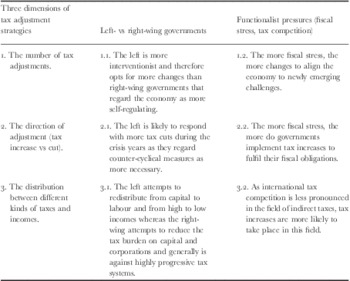
Base and rate changes can be measured in three dimensions: firstly, the number of tax adjustments; secondly, the direction (tax cut vs increase) of change; and thirdly, the distribution between different kinds of taxes (also see Table 1). These three dimensions serve as a point of reference throughout the literature review and the empirical analysis. Both, government composition and functionalist pressures, are likely to have an impact along all three aspects, which I will discuss in the next section.
Possible effects on the tax adjustment strategies

Functionalist theories
Functionalist scholars regard policy changes as a response to particular socio-economic challenges (Genschel, Reference Genschel2004; Garrett and Mitchell, Reference Garrett and Mitchell2001; Swank and Steinmo, Reference Swank and Steinmo2002). They focus on pressure stemming from global economic integration, such as capital liberalisation, and on domestic issues, such as unemployment and fiscal stress. I will show that socio-economic pressures are likely to have an impact on tax policy in terms of all three dimensions of change during the crisis (see Table 1).
Initially, scholars predicted that global economic integration would substantially change the way taxes are levied due to an increased pressure stemming from tax competition (for an overview, see Genschel and Schwarz, Reference Genschel and Schwarz2011). It was thought to lead to lower tax revenues and to bring about a shift in the tax burden from capital and corporate taxes to labour and consumption taxes. The convergence hypothesis captures the notion that tax competition causes a shift in the tax burden (Garrett and Mitchell, Reference Garrett and Mitchell2001; Genschel, Reference Genschel2004; Scharpf, Reference Scharpf1991). More explicitly, the hypothesis postulates that the exit option of capital has changed the power balance between markets and politics leaving little choice for governments but to provide market-friendly policies (Scharpf, Reference Scharpf1991; Garrett and Lange, Reference Garrett and Lange1991). As a result, progressive tax systems are uncompetitive in a global economy and tax policies will converge in neoliberal ideas. In sum, the functional strand suggested that socio-economic pressures will shift the tax burden from capital to labour, which would lead to less progressive instruments of taxation (Rodrik, Reference Rodrik1997).
But to what extent has tax competition caused the convergence of national tax systems (Genschel, Reference Genschel2002; Swank, Reference Swank2006)? Empirical evidence is inconclusive: often the effects are small and dependent on the specification of the model (Starke, Reference Starke2006; Swank, Reference Swank2002, Plümper et al., Reference Plümper, Troeger and Winner2009). There are various reasons that account for why the observable effect is smaller than anticipated. First of all, economic integration also puts downward pressure on labour taxes, as governments need to secure employment (Swank and Steinmo, Reference Swank and Steinmo2002). If labour is comparatively expensive, then (labour-intensive) investments will be shifted to other regions. In fact, international tax competition is least pronounced in the field of indirect taxes, so that a shift of the tax burden from direct to indirect taxes is most likely (Rixen, Reference Rixen2008).
Moreover, governments have budget rigidities with fixed long-term costs and are therefore restricted in lowering taxes. During the course of the recent crisis, European member states have faced particularly strong fiscal pressure. Deficits drastically rose as governments bailed out financial institutions and implemented economic stimulus packages, and public spending rose due to the recession. While a deficit as such does little damage, government bond rates rocketed for some member states with particularly gloomy economic outlooks. For them, loans from the capital market became extremely expensive, placing pressure on the member states to act and to reduce their long-term debt to regain access to cheap international finance. Under such circumstances, governments’ priority switches to reducing the deficit and they increasingly turn to domestic taxpayers to discharge their payment obligations.
Although the crisis represents a general upsurge of fiscal stress, some member states were hit particularly hard. To account for differences in fiscal stress, I focus on the long-term interest rate on government bonds (see also the Data and methodology section below). For example, Greece paid an interest rate of more than 15 per cent in May 2011 and also Lithuania was charged about 14.5 and Latvia 13 per cent throughout most of 2009 for ten-year maturity bonds (Eurostat, 2011). According to the functionalist approach, we can assume that firstly, in terms of the overall number of tax adjustments, governments with high fiscal stress implement more changes, as they face a greater need to adjust their economies to newly emerging challenges. Secondly, they are under more pressure to consolidate and are therefore more likely to adopt tax increases. Yet, they are likely to circumvent increases in the field of direct taxes, above all corporate taxes, as they face international competition. Table 1 summarises the three possible impacts of functional pressure on governments’ tax adjustments strategies during the crisis.
Party politics and taxation
Another strand of scholars has investigated the role of party politics and domestic institutions on public policy-making. They were curious to understand how such national political variations affect taxation. The most popular approach, which highlights the importance of political parties for economic outcomes, is the Power Resource Theory (Esping-Andersen and Korpi, Reference Esping-Andersen and Korpi1984; Stephens, Reference Stephens1979; Huber and Stephens, Reference Huber and Stephens2001; Bradley et al., Reference Bradley, Huber, Moller and Nielsen2003). It is based on the assumption that different forms and intensities of class organisation affect public policy outcomes. Of importance is the left–right composition of governments, as different parties represent the interests of different social groups. Lower income groups and labour are thought to favour a large and active state, which regulates the market. In contrast, capital owners and high-income groups are thought to reject strong economic interventionism and redistribution. The idea is that left- and right-wing parties, once they are in power, implement those policies that serve the interests of the respective electorate (Cusack, Reference Cusack1997).
The original idea was brought forward by Hibbs (Reference Hibbs1977), who showed that particular macro-economic outcomes are linked to left- and right-wing governments. More recent studies also concur with Hibbs’ finding, that domestic politics have an influence on how governments react to market pressures (Garrett, Reference Garrett1998; Garrett and Mitchell, Reference Garrett and Mitchell2001; Timmons, Reference Timmons2010). Garrett (Reference Garrett1998) shows that, even though taxes generally became less progressive in the 1980s, the greatest change occurred in countries with strong right-wing parties. His analysis verifies that government composition affects policy choices and that social-democratic governments opt for more progressive and redistributive tax measures. Bradley et al.'s study (2003) also confirms that leftist governments positively affect income redistribution.
These studies suggest that left-wing governments favour more redistribution through higher proportions of public revenue and through a more progressive set-up of taxes. Quinn and Shapiro (Reference Quinn and Shapiro1991) classify the left-wing approach as consumption-oriented whereas right-wing governments favour an investment-driven approach. Accordingly, social-democratic governments minimise the burden on low and medium incomes, as these tend to have a higher marginal propensity to consume. In turn, conservative and liberal governments seek to reduce the tax burden on capital and governments hoping that high profits are used for future investments. Hence, social-democratic parties are more likely to shift the tax burden from labour to more capital-intensive factors and vice versa for right-wing governments.
Although this literature tends to highlight the kind of taxes that are preferred by different governments, their divergent preferences may also affect the overall number of tax changes and the direction of tax adjustments. Social-democratic governments are often depicted as favouring a more interventionist role of the state. This may translate into a more active policy stance and a higher number of changes to stimulate economic activity through tax reliefs in times of recessions and higher taxes in times of stability and prosperity. By contrast, right-wing governments tend to regard the economy as a more self-regulating entity, which needs less intervention. Hence, we may observe less tax adjustments in countries that are governed by a party classified as right-wing.
These theories apply to times of economic stability, in which governments are under no immense pressure to act. Yet, the focus of the study is on the crisis: governments need to provide economic stimuli to prevent a severe recession, they need to revert monetary and economic confidence and they need to address public revenue problems. However, there may be a substantial amount of uncertainty with respect to which measures to implement. Hence, political leaders are likely to seek economic orientation either by seeking expertise and best practices with international organisations, such as the EU and the OECD, or by reverting to traditional party politics and values. Moreover, if national elections are approaching, governments may look for pragmatic responses to please the median voters and to gain the election. By inserting an election dummy in the quantitative analysis, I control for such behaviour and analyse to what extent tax responses concur with party-specific economic approaches.
Table 1 provides an overview of the potential effects of party politics on tax outcomes during the course of the crisis. In sum, I expect that the composition of government has three potential effects on the tax adjustment strategies. As regards the first dimension, the effect on the overall amount of tax changes, we expect fewer tax adjustments from the right-wing than from the left. As regards the second dimension of Table 1, the direction of adjustment, the effect of partisanship is more arbitrary. On the one hand, left-wing governments are assumed to favour higher proportions of public revenue, which would imply that the left is likely to opt for more tax increases than the right. Yet, during times of economic instability such as the crisis, the left-wing is likely to respond with more tax cuts, as they tend to highlight the necessity of counter-cyclical measures. For the period under investigation, especially the first two years of observation when the European member states had agreed on an economic stimulus package, we therefore expect more tax decreases than increases from the left in contrast to the right. Finally, with regard to the kind of tax adjustment, we expect that left-wing governments are more likely to shift the tax burden from labour to capital-intensive factors and from high to low incomes. In the next section, I describe the data and the methodology used to test the hypotheses summarised in Table 1.
Data and methodology
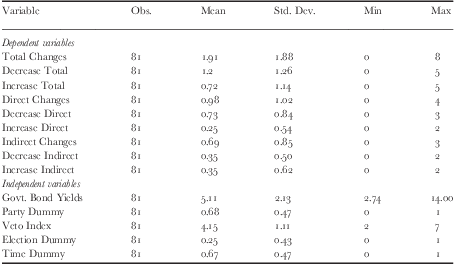
The analysis is based on a unique dataset, which captures the tax reforms implemented by the European member states between 2008 and 2010 (European Tax Trends, 2011; also see Table A.2 in the appendix for data sources and coding decisionsFootnote 1). One may argue that the data for this period does not suffice to assess governments' crisis reaction; after all, the crisis erupted in 2008 and, hence, one needs data from previous years to evaluate whether a policy change occurred. Although it is true that the crisis started in 2008, policy reactions take some time. In fact, in 2008, we only observe two tax changes, whereas the policy adjustments drastically increase to 82 and 71 in the following two years. In other words, 2008 serves as a reference year. Moreover, the crisis did not hit all member states to the same extent, so that between-country variations also serve to validate the argument. In the following, I briefly outline the data used to evaluate the tax adjustment strategies in the EU and to measure the effect of political and economic variables on the outcome of interest. An overview about each variable and the descriptive statistics is provided in the appendix (Table A.1).
The dependent variable
As highlighted above, the dependent variable differs significantly from most analyses, which focus on the tax revenue or the tax rate. The revenue is particularly prone to erratic conclusions about governmental decisions, as changes can be due to multiple reasons such as macro-economic fluctuations, which are not linked to actual policy adjustments. Although tax rates better reflect policy decisions, they discard changes in the tax base and therefore do not provide an all-embracing picture of governments’ responses. This analysis therefore explores the number and the directions of adjustments overall and of different taxes as well as the distribution between different kinds of taxes. The information is taken from the European Tax Trend (2010: 28–29).
Let me start by providing a few examples to better illustrate the advantage of the data employed. A number of member states directly reduced the corporate tax rate such as the Greek, the Slovenian and the Swedish governments. Yet, various others also opted for different forms of tax reliefs through accelerated depreciation and incentives such as the Dutch and the Austrian governments (European Tax Trends, 2010). If I analysed the tax rate, I would not be able to account for such effects, whereas the dataset employed in this paper takes these changes into consideration and therefore provides a more comprehensive account of the policy reactions. Yet, there are also some disadvantages. The main one is that the data does not include information about the budgetary impact of the reforms. A tax change, no matter how high the fiscal effect, counts the same in the following quantitative analyses. In other words, whether a government lowers the corporate tax rate by 1 or 5 per cent is not reflected in the data. To overcome this shortcoming, I compensate the quantitative study with a qualitative case study analysis, which includes this information for a limited selection of countries.
As discussed in the section Explaining variation in state activity above, I differentiate between three dimensions of policy change (see Table 1). To empirically capture these dimensions, I assess, firstly, the amount of reforms governments have implemented and, secondly, whether they opted for tax cuts or increases. In a third step, the analysis takes into consideration which kind of taxes have been adjusted and in which direction. In other words, the interest is not only on whether governments opted for tax cuts or increases, but also which taxes have been subjected to increases and decreases, respectively.
Independent and control variables
To better understand reasons for such policy changes, the theoretical analysis highlighted political and economic factors that are likely to determine tax outcomes. To account for party differences, I constructed a left–right dummy based on the cabinet seats of each government, which takes on a value of one if the right-wing is in power and zero otherwise. The data is taken from the European Election Database (2011, see also Table A.2). If green and social-democratic parties, as defined by the Party Manifesto Group (Volkens et al., Reference Volkens, Lacewell, Regel, Schultze and Werner2011), occupy the majority of cabinet seats, then the government is coded as “left”. By contrast, if liberal, conservative or Christian-democratic parties are in power, it is coded as “right”. The author also tested for a left seat share in parliament, which takes zero if no left-wing parties are represented and one hundred if no right-wing parties are represented. However, as the results do not change, only the dummy variable is listed in the result tables. Moreover, I interacted the party dummy with the economic variable based on bond rates (see below). However, the interaction effect was insignificant and did not change the results, so that I opted for the simpler model without the interaction effect.
To assess the impact of fiscal stress on governments’ reactions, I tested a variety of factors. Often, the deficit and debt rates are applied to test for the effect of fiscal stress (Garrett and Mitchell, Reference Garrett and Mitchell2001). Yet, these variables only capture part of the picture. For instance, Hungary had an average deficit of 4.1 per cent of GDP between 2008 and 2010, France of 5.9 and Poland of 6.3 per cent. Nonetheless, the Hungarian government had to pay the highest price to obtain money from the financial markets with an average interest rate of 8.2 per cent in contrast to Poland and France with 6 and 3.7 per cent, respectively. The bond rates account for other important factors such as the growth rates and expectations about future economic developments.Footnote 2 The data for the long-term government bond yields is taken from Eurostat (2011).
Control variables, which the study accounts for, include the veto index “checks” (Keefer and Stasavage, Reference Keefer and Stasavage2003; see Table A.2) and an election dummy, which is one if an election takes place in that year and is zero otherwise (European Election Database, 2011). The veto index measures the amount of existing domestic checks and balances. It equals one if legislative and executive competitiveness exist and it is further increased by one if, for instance, the opposition controls the legislature or the government relies on a coalition. In our sample, Slovenia has the highest score with seven points and thus accounts for the most veto points in 2009 and 2010. By contrast, Lithuania and the United Kingdom have, among others, the lowest score with three points and thus account for the least amount of veto players.
Methodology
To explore how governments reacted to the fiscal pressures emanating from the crisis and whether left- and right-wing governments opted for different tax policies, the research proceeds in two main steps, which involve a mix of quantitative and qualitative evidence. I first conduct a quantitative analysis by assessing governments’ tax reactions based on the political and economic variables just outlined. The analysis is conducted for the total amount of changes, the direction of change (total increases and decreases) and the kind of changes in terms of direct and indirect taxes. A quantitative analysis for each tax type, such as the corporate income tax, is not appropriate due to a lack of cases.
The dependent variables are count measures with a slight overdispersion, which suggests that a negative binomial model is most suitable. However, the Poisson model emerged as a better model fit for total tax changes when accounting for the time dummy. For robustness, I therefore ran all estimations with a Poisson and a negative binomial model. The results are robust in terms of, firstly, the direction of the effects of the independent variables and, secondly, their significance levels. However, I only include the results of the negative binomial model.
The analysis is based on the tax changes adopted by the 27 European member states over three years. The data structure has its asymptotics in the number of cases (27 countries) and not in the time dimension (3 years), which makes the use of standard time series methods unsuitable. Estimating a times series cross-section model with a fixed effect or including lagged variables is, due to the small-T, not fitting for the dataset. Yet, as I focus on the same countries over three years, the 81 units of the dataset are certainly not independent. Above all, the tax choices taken in previous years may affect choices taken in the future. Hence, I included a dummy variable, which takes on the value of 0 for the year 2008 and 1 otherwise. For robustness I also constructed a time variable, which is 0 for the year 2008 and 2009 and 1 otherwise. Both variables are significant and do not change the results. However, I only include the former in the analysis, as the year 2008 can be regarded as a reference year prior to the crisis, which was followed by drastic tax adjustments (see above).
The quantitative analysis is complemented with qualitative evidence to better understand the reform contents. In particular, the quantitative analysis cannot capture how the reforms affect high and low income earners. For instance, the fact that Denmark cut the personal income tax does not provide any information about who benefited from this change. Did the government offer tax reliefs to lower-income classes or did they reduce the top income tax rate? Hence, I conduct three comparative mini case studies based on the tax reforms implemented by the Spanish, the German and the British governments. Based on a diverse case study selection (Gerring, 2008), the three cases allow capturing of potential qualitative differences.
Tax responses to the crisis: empirical evidence
In the two preceding sections, guiding indicators were identified to explain and compare the tax responses between countries. Both government composition and fiscal stress serve as points of reference for the empirical analysis. The goal is not to systematically test these theories but rather to use them as focal points to scrutinise the empirical data. Such an exploratory approach is particularly suitable, as no systematic study exists about how governments respond in times of economic instability and uncertainty.
Functional pressure during the crisis
To what extent does fiscal stress affect European governments’ decisions to conduct tax changes? The pressures stemming from declining growth rates, rising public debt levels and interest rates on government bonds were intense during the crisis. Some countries, such as Greece and Portugal, have faced particularly strong fiscal stress whereas others, such as Germany, comparatively little. Different degrees of socio-economic pressure were hypothesised to cause different policy responses. In the section Explaining variation in state activity above, I suggested that crisis pressure has an impact on all three change dimensions (Table 1): firstly, the higher the interest rate on government bonds, the more policy changes a government is likely to undertake; secondly, the more tax increases will be implemented; and finally, tax increases are more likely to take place in the field of indirect taxes.
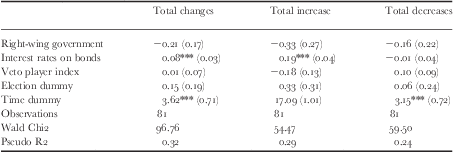
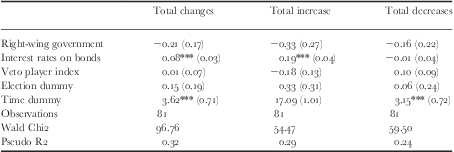
Table 2 summarises the estimation results for the impact of bonds on the first and second change dimension, that is, the number of tax changes and the direction of change. The impact on total changes and on total increases is positive and statistically significant. If I simulate a one percentage point bond increase from its mean using clarify (Tomz et al., Reference Tomz, Wittenberg and King2001), holding all other variables at their mean and the election dummy at zero, we would observe one additional tax change. In a further simulation from the lowest bond rate of 2.74 per cent paid by Germany in 2010 to the highest rate of 14 per cent paid by Lithuania in 2009, we would observe three additional changes. It shows that high bond rates place pressure on governments to readjust the economy.
Negative binomial model for tax changes in the EU-27 from 2008–2010
Note: standard errors in parentheses, ***p < 0.01, **p < 0.05, *p < 0.1, constant not reported.
Moreover, state activity as such does not only enhance with increased bond rates but governments are also more likely to enforce tax increases. As governments no longer have fairly cheap access to international finance, they increasingly turn to domestic taxpayers. Tax increases, even if they imply a loss of public support, become a less costly alternative than the rising cost of future public debt. Simulating from the lowest bond rate of 2.74 per cent to the highest of 14 per cent, we would observe more than three additional tax increases. By contrast, the amount of tax decreases hardly differ between states with high and low bond rates. It demonstrates that states with high fiscal stress are severely constrained in adopting a growth-oriented strategy. Hence, the empirical results are in accordance with the first two functionalist hypotheses.
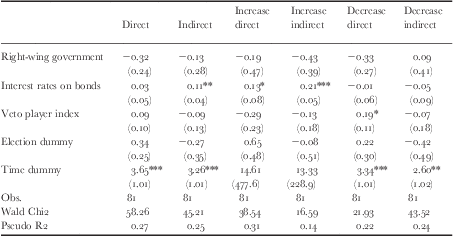
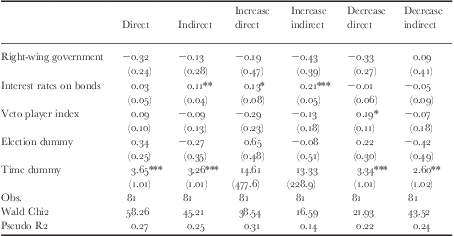
The effect of bond rates on the distribution among different kinds of taxes provides some further interesting results (Table 3). The effect of bond rates is only statistically significant for changes in the field of indirect taxes but not for direct ones. In the preceding literature review I argued that international tax competition is less pronounced in the field of indirect taxes, so tax increases are more likely to take place in this field. Simulating an indirect tax change, holding all independent variables at their mean and the election dummy at zero, I find that a bond increase from the mean (5.11 per cent) to the highest rate of 14 per cent brings about four extra tax changes. In other words, governments that are under fiscal pressure tend to increase the VAT or Excises, but not corporate or personal income taxes.
Negative binomial model for tax changes in the EU-27 from 2008–2010
Note: standard errors in parentheses, ***p < 0.01, **p < 0.05, *p < 0.1, constant not reported.
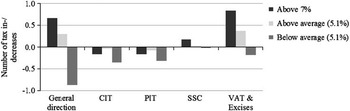
Figure 1 graphically illustrates this finding and further depicts the direction of tax adjustments according to each tax type. It demonstrates that governments with higher bond rates generally change taxes more upwards than those with less fiscal pressure. Although this tendency is representative for each tax category, Figure 1 highlights a crucial difference between direct and indirect taxes. As regards direct taxes, corporate and personal income taxes, all governments rather lowered than increased them. By contrast, social security contributions and consumption taxes were only lowered in countries with fiscal room whereas governments under high pressure increased them. The finding shows that countries with high fiscal pressure struggle not to fall behind in the international competition for investments and businesses, keeping direct taxes low.
Direction of tax changes according to ten-year government bonds. Source: own research based on Eurostat (2011) and European Tax Trends (2010). Notes: “General direction” means increase-decrease. The category above average also accounts for the members of the above 7 per cent group. CIT, corporate income taxes; PIT, personal income taxes; SSC, social security contributions; VAT, value added taxes.

The regression analysis highlights the significant and considerable impact of an increase in the bond rate on state activity and tax adjustment strategies. Moreover, the results support that tax competition is highest in the fields of corporate and personal income taxes as high rates may lead to a capital flight into low-tax regions. Hence, if governments are under fiscal pressure, they rely for the most part on increases in consumption taxes.
The role of party politics and government composition
The aim of this section is to understand if a particular crisis response on the revenue side is linked to the government composition and/or fiscal stress. The hypotheses (see Table 1), which linked party politics firstly to the amount of tax changes and secondly to the kind of tax, are tested and the quantitative evidence is interpreted.
In 2008, very few tax adjustments took place compared to the following two years, as the crisis erupted at the end of 2008 and political responses are time-lagged. Moreover, the years 2009 and 2010 show a considerable increase in economic adjustments. Yet, there are no significant party differences as regards the overall amount of tax adjustments. Table 2 shows the results of the regression analysis for our first proposition, which measures the number of tax adjustments according to cabinet composition. It suggests that the left-wing tends to be more interventionist and may therefore opt for more changes than the right. However, while left-wing governments conducted about 8.2 average changes, conservative cabinets implemented 7.0 changes between 2008 and 2010. The difference is marginal and insignificant.
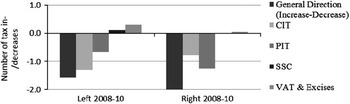
Figure 2, which illustrates the adjustments per tax type, reconfirms these results: the graphic indicates that both left- and right-wing governments reacted with more tax decreases than increases even though social democrats opted for fewer decreases in total. Although one may argue that this shows that leftist parties supported a more interventionist and counter-cyclical approach than rightist parties, the difference seems trivial and is also of no statistical significance (Table 2). The figure rather shows that social-democratic and conservative governments both actively reacted to the crisis: they opted for a mixed strategy between fiscal consolidation and stimulating economic growth.
Direction of tax changes according to government composition. Source: own research based on Eurostat (2011), European Tax Trends (2009, 2010), Volkens et al. (Reference Volkens, Lacewell, Regel, Schultze and Werner2011) and the European Election Database (2011). Notes: “General Direction” is the direction of change calculated by increase-decrease; a negative number indicates an overall tax decrease whereas a positive one indicates an increase. CIT, corporate income taxes; PIT, personal income taxes; SSC, social security contributions; VAT, value added taxes.

Table 3 demonstrates the results for the impact of party politics on the distribution between different kinds of taxes. Due to the limited amount of cases, I do not regress our variables on each tax type but I gather them in terms of a direct and an indirect tax category. However, none of the statistical results is significant for the party dummy. In fact, Figure 2 illustrates that both cabinets shifted the burden from direct to indirect taxes. On average, consumption taxes and social security contributions were increased, while corporate and personal income taxes were adjusted downwards. This pattern is the same irrespective of the cabinet composition. Although I cannot confirm that party politics matters for the kind of tax adjustment that European governments implemented during the initial three years of the crisis, Figure 2 shows two interesting party differences.
Firstly, social-democratic governments adjusted the personal income tax more upwards than the conservative ones. This may suggest that left-wing governments took a more redistributive approach than right-wing governments. While an increase in indirect taxes is regressive, an increase in direct taxes can at least potentially have progressive effects. However, to assess if this is the case, it is necessary to conduct a more qualitative investigation of the measures adopted and to evaluate which social groups are affected mostly by the personal income tax measures. This is done in the Conclusion below.
Secondly, social-democratic governments decreased corporate taxes more than their counterparts. This does not imply that they directly lowered the corporate tax rate, but it could involve measures to stimulate incentives for innovation, research & development and accelerated depreciation, which are predominantly base changes. Nonetheless, the finding that labour parties decreased corporate taxes more than right-wing governments is inconsistent with the hypothesis that labour parties redistribute from labour to capital. The evidence rather shows that the tax strategies adopted by left- and right-wing governments differ, if at all, only marginally.
As regards the two political controls, the veto player index and the election dummy, the statistical analysis does not generate any significant results apart from one. The effect of the veto player variable on direct tax decreases is significant at 10 per cent. It shows that the more veto players are present in a country, the more likely are governments to opt for tax decreases in the field of direct taxes. The finding is puzzling from a theoretical point of view, as one would rather expect that veto power is linked to fewer reforms due to potential opposition and deadlocks. It appears advisable to further scrutinise this aspect in future analyses. Overall, the results, however, suggest that the direct effect of political variables on tax adjustment strategies was of little significance during the first three years of the crisis.
Qualitative evidence: the British, Spanish and German cases compared
The previous two sections provided remarkable evidence of the impact of government bond rates on state activity and tax adjustment strategies. Yet, they did not confirm that social-democratic and conservative governments opted for different tax measures during the course of the crisis. To gain further empirical proof, this section conducts three comparative mini case studies based on the tax reforms implemented by the Spanish, the German and the British governments. The selection occurred in terms of a diverse case study design to represent the full variation of the sample (Gerring, 2008). As the main independent variable of interest is party politics, the cases involve one left-wing government, represented by Spain, one right-wing government, the German case, and one governmental change, the British example.
The main goal of this section is to investigate if the reforms enforced under a social-democratic or a conservative government affected different kinds of taxpayers and income levels. Do left-wing governments opt for more redistribute and progressive measures than right-wing ones? If this is the case, we should observe that the Spanish social-democratic government adopted more progressive tax reforms than the German Christian-democratic-liberal coalition. Moreover, in the UK, I expect to observe a shift from more to less progressive reforms due to the governmental change in May 2010.
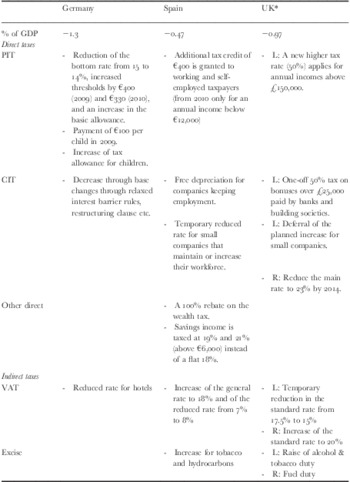
Table 4 provides an overview of the main tax reforms undertaken in the three countries under consideration between 2008 and 2010. In Germany, the conservative-liberal coalition government under Chancellor Angela Merkel implemented reforms with an overall expansionary impact between 2008 and 2010. The reforms offer a tax relief of an estimated 1.3 per cent of GDP including multiple changes in the field of direct taxes. The coalition reduced the bottom personal income tax rate from 15 to 14 per cent, and increased the thresholds and the basic allowance; these are reforms that benefit low- and high-income earners. Moreover, a one-time payment of €100 per child and an increased tax allowance for children were designed to target families.
Overview of tax changes in Germany, Spain and the UK, 2008–2010

Source: European Tax Trends (2010); table only shows major tax reforms.
Notes: L, changes by the Labour government; R, changes by the succeeding government under Cameron; CIT, corporate income taxes; PIT, personal income taxes; SSC, social security contributions; VAT, value added taxes.
It was suggested that right-wing governments tend to reduce the tax burden on capital and corporations and are less likely to favour redistributive tax measures from high- to low-income earners (Table 1). Yet, the tax changes implemented by the German government do not directly fit into this characterisation. In fact, the personal income tax measures benefit low, medium and high incomes and particularly families.Footnote 3 At the same time, they also granted additional benefits to corporations among others, through new restructuring laws, interest barrier rules and incentives to keep short-term employment. The overall net effect of the reforms is neither highly progressive nor does it only target medium- and high-income earners, capital owners and corporations.
The Spanish social-democratic government adopted a less expansionary tax programme than the German coalition. The reforms amounted to approximately 0.47 per cent of GDP, one third of the German package. The fact that the tax reforms provided less economic stimuli is inconsistent with our predictions. It may be linked to economic constraints, as was shown in the previous quantitative analysis; alternatively, the expansionary impact was achieved more on the spending side.
Zapatero's government granted an additional tax credit of €400 to working and self-employed taxpayers to support purchasing power. From 2010, the measure is restricted to annual incomes below €12,000. While this measure mainly benefits low incomes, the left-wing government also abolished the wealth tax in 2008, which was levied on assets and properties starting at a value of approximately half a million euros. In the field of corporate income taxes, the government adopted incentives to maintain or increase employment. For instance, small companies are subject to a reduced income tax rate if they maintain or increase their workforce. Moreover, Zapatero increased VAT rates, raised excise taxes and altered flat tax systems on saving to a more progressive one.
Overall, the tax changes implemented by the Spanish government are expansionary and aimed at maintaining employment or enhancing purchasing power. While such an expansionary approach matches a hypothesised left-wing tax strategy, the measures do not unambiguously conform to the ideal social-democratic approach identified in Explaining variation in state activity above. Above all, the abolishment of the wealth tax does not match the traditional view.
Just like the other two preceding cases, the British government's overall tax changes had an expansionary impact amounting to an estimated 0.97 per cent of GDP. The Labour government, which was in power until spring 2010, introduced a variety of tax changes. Firstly, they increased the tax rate for high incomes and introduced a one-off levy of 50 per cent on bonuses paid by banks and building societies. In other words, direct tax changes exclusively placed an extra burden on people with high incomes. Secondly, they deferred a scheduled tax increase for small companies, temporarily reduced the standard VAT rate and increased excise taxes. The tax increases adopted by the Labour government between 2008 and 2010 predominantly affected high-income earners, while the VAT reduction benefits all consumers. As such, the measures fit into the left-wing approach described above, according to which the left is more prone to redistribute from high to low income levels.
By contrast, the succeeding Conservative government under Cameron increased the VAT rate, adopted a fuel duty and reduced the main corporate income tax rate to 23 per cent. In other words, while the social-democratic approach can be classified as a more progressive approach, the conservative approach provides tax relief to companies but augments the tax burden for consumers. The British case seems to best match the party-specific tax adjustment strategies that the scholarly literature identifies. While a tax increase or decrease is likely to depend on the macro-economic climate, the distribution between different kinds of taxes and incomes seems to be determined by the government in power in the British case.
The qualitative evidence provides a mixed picture. Two cases confirm the result of the quantitative analysis, which showed that the left-wing did not respond, during the crisis, with tax measures that were different from those of the right. Yet, the British case revealed some country-specific variation with regards to how the Labour government and the Liberal-Conservative coalition addressed tax changes. Accordingly, the tax programme advanced by the former was progressive, whereas the one of the latter redistributed from labour to capital incomes.
Conclusion: fiscal stress and the lack of political choice
Have European governments mitigated the fiscal pressures stemming from the global crisis? At the outset of the paper, two main forces were identified that are likely to affect economic outcomes: political parties and functionalist pressures. The power resource theory suggests that labour parties favour a more progressive and consumption-driven tax strategy than right-wing governments, which, by contrast, support a more investment-driven approach (see Functionalist theories above). Previous studies that account for the relationship between government composition and taxation show that party politics significantly affect tax outcomes (Timmons, Reference Timmons2010; Garrett and Mitchell, Reference Garrett and Mitchell2001). However, the findings of this study cannot confirm a direct effect between partisanship and taxation but show that functionalist pressures mainly structured governments’ tax policy measures.
European crisis responses do not directly correspond to party-specific tax adjustment strategies. On the contrary, both left- and right-wing governments actively intervened in the economy: while in 2008 very few tax changes took place, the number of adjustments increased in the following two years, irrespective of the government composition. Initially, they mainly intervened based on tax cuts to stimulate economic activity in 2009 while the focus shifted to a more consolidation-oriented approach in the following year. Likewise, there is very little evidence that socio-democratic parties have opted for a more progressive or redistributive policy stance. Although the comparative case study analysis revealed mixed results, it did not confirm that social-democratic governments in general adopt more redistributive tax reforms. It was only in the British example that I detected party-typical tax reforms. It raises important follow-up questions. In particular, why do we observe party-specific tax approaches in some countries but not in others?
It is crucial to stress that the results do not necessarily contradict previous studies, which found differences in tax outcomes between social-democratic and conservative governments. Instead, the analysis shows that we ought to evaluate how national actors respond to external pressures and under which conditions their room to manoeuvre diminishes or increases respectively. The financial and economic crisis is a situation of particularly high fiscal stress, in which governments lack the capacity to act and, in turn, functionalist pressures for a large part shape tax outcomes.
In summary, the crisis has not reinforced a redistributive tax approach to compensate for the substantial amounts of public money used to bail out financial institutions. Certainly, it is possible that redistributive policies were implemented on the expenditure side by increasing social security benefits or other transfers. However, such transfers are mainly designed to protect people outside of the employment market, whereas taxes can be used to redistribute among different income groups. Overall, the empirical analysis provides little evidence that European governments have reverted to traditional party politics and values to overcome economic uncertainty during the crisis.
Acknowledgements
An earlier version of this article was presented at the Annual Conference of the Society for the Advancement of Socioeconomics in Madrid 2011. Special thanks go to Laura Seelkopf, Philipp Genschel and Henning Schmidtke who contributed with valuable ideas and suggestions as well as to the editorial board of the Journal of Public Policy.
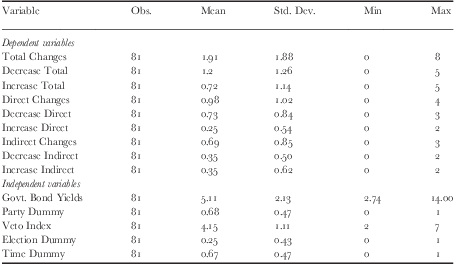
Descriptive statistics
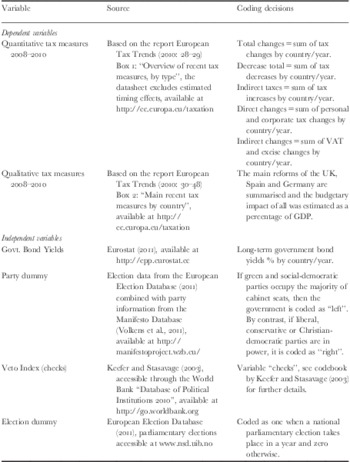
Data sources and coding decisions