Introduction
Parkinson’s disease (PD) is the most common age-related movement disorder, which is characterized by bradykinesia, resting tremor, gait imbalance, muscular rigidity, and postural instability and some nonmotor symptoms, including autonomic and cognitive dysfunctions.Reference Coelho and Ferreira 1 – Reference Noyce, Bestwick and Silveira-Moriyama 3 In PD, α-synuclein accumulates in neuronal perikarya (Lewy bodies) and neuronal processes (Lewy neurites). The disease process is multifocal and involves select central nervous system neurons and peripheral autonomic nervous system neurons.Reference Kalia and Lang 4 The lifetime prevalence of PD is 1% to 5%, and the incidence of PD increases mainly with age from 17.4 to 93.1 per 100 000 person-years at 50–59 and 70–79 years of age, respectively.Reference Coelho and Ferreira 1 – Reference Noyce, Bestwick and Silveira-Moriyama 3 Although evidence for several rare genetic mutations in a small percentage of the PD cases in the younger population provides some clues for the pathogenesis, several twin studies support the stronger involvement of environmental factors than that of genetic factors in disease pathogenesis.Reference Johnson, Hodge and Duvoisin 5 – Reference Ward, Duvoisin, Ince, Nutt, Eldridge and Calne 7 This conception of the diathesis-stress model stems from previous studies, suggesting that environmental factors collaborate with a permissive genetic background and initiate the disease process.Reference Johnson, Hodge and Duvoisin 5 – Reference Ward, Duvoisin, Ince, Nutt, Eldridge and Calne 7
Although the exact etiology of PD is unknown, evidence increasingly supports that pathologic infection may be crucial in the development of neurodegenerative disorders, such as Alzheimer diseaseReference Karim, Mirza and Kamal 8 and PD.Reference De Chiara, Marcocci and Sgarbanti 9 – Reference Wang, Fang, Cheng, Jiang and Lin 13 Increasing literature has demonstrated the preliminary association between PD and certain human herpesviruses family including Herpes simplex virus-1 (HSV-1) and Epstein-Barr virus (EBV).Reference De Chiara, Marcocci and Sgarbanti 9 , Reference Woulfe, Gray, Gray, Munoz and Middeldorp 12 – Reference Vlajinac, Dzoljic, Maksimovic, Marinkovic, Sipetic and Kostic 15 . For example, Bu et al explored the association between infection and PD by analyzing 131 and 140 patients with PD and controls, respectively, and reported a significant association between the immunoglobulin G seropositivity to HSV-1 and the risk of PD.Reference Bu, Wang and Xiang 16 Woulfe et al reported an association between EBV-induced immune pathogenesis and the development of PD.Reference Woulfe, Gray, Gray, Munoz and Middeldorp 12 As a member of human herpesviruses with the characteristic of latency in the nervous system like HSV-1 and the capability of neuronal infection like EBV,Reference Hassani, Corboy, Al-Salam and Khan 17 , Reference Jha, Mehta and Lu 18 Varicella zoster virus (VZV) also could remain in a latent form in the ganglia and may reactivate during poor immune function or on aging.Reference Cohen 19 Herpes zoster is a VZV disease characterized by a painful skin rash with blisters on the affected dermatome.Reference Cohen 19 Several studies demonstrated a potential link between herpes zoster and dementiaReference Almeida and Lautenschlager 20 – Reference Grahn, Nilsson, Nordlund, Linden and Studahl 22 ; however, only handful studies investigated the link between herpes zoster and PD, and showed inconsistent findings with limited power or limited study group (only elderly).Reference Vlajinac, Dzoljic, Maksimovic, Marinkovic, Sipetic and Kostic 15 , Reference Ragozzino, Kurland and Rajput 23 – Reference Lai, Lin, Lin, Lin, Lin and Liao 26
In our study, using a large sample derived from Taiwan’s National Health Insurance Research Database (NHIRD) and a longitudinal follow-up study design, we investigated the temporal association between herpes zoster and the risk of PD. We hypothesized that patients with herpes zoster have an increased risk of PD.
Methods
Data source
Taiwan’s National Health Insurance is a mandatory universal health insurance program that was inaugurated in 1995 and covers up to 99% of the country’s 23 million residents. The NHIRD is administered by the National Health Research Institute and provides comprehensive patient information, such as demographic data, clinical visit dates, and disease diagnoses. All identities are encrypted to ensure patient privacy. The diagnostic codes used are based on the International Classification of Diseases, Ninth Revision, Clinical Modification (ICD-9-CM). The NHIRD has been used extensively in numerous epidemiologic studies in Taiwan.Reference Chen, Su and Chen 27 – Reference Shen, Tsai, Perng, Kuo and Yang 30
Inclusion criteria for patients with herpes zoster and the control group
Patients aged 45 years and older who were diagnosed with herpes zoster (ICD-9-CM code: 053) by dermatologists, internal medicine doctors, family medicine doctors, ophthalmologists, and neurologists between January 1, 1998 and December 31, 2008 and who had no history of PD (ICD-9-CM code: 332.0) before enrollment were included as the herpes zoster cohort. To construct an age- and sex-matched (1:4) control cohort, patients who were not included in the herpes zoster cohort, had not been diagnosed with herpes zoster at any time, and had been not diagnosed with PD before enrollment were randomly selected from the same database. Cases of PD (ICD-9-CM code: 332.0) diagnosed by board-certified neurologists were identified during the follow-up period and followed until December 31, 2011 or the date of death. Medical comorbidities were also assessed as confounding factors; these included depressive disorder, dementia, hypertension, dyslipidemia, diabetes mellitus, renal diseases, ischemic heart diseases, cerebrovascular diseases, chronic respiratory diseases, asthma, allergic rhinitis, and atopic dermatitis. All diagnoses were given at least twice by physicians to achieve diagnostic validity. Furthermore, herpes zoster with and without neurological symptoms (ICD-9-CM codes: 053.0, 053.1 and ICD-9-CM codes: 053 except 053.0, 053.1, respectively) were separately analyzed as possible risk of developing PD. The level of urbanization (level 1 to level 5; level 1: most urbanized; level 5: least urbanized) and health system use (number of medical consultations per year) were assessed in our study.
Statistical analysis
For between-group comparisons, the independent t test was used for continuous variables and Pearson's X 2 test was used for nominal variables, where appropriate. The Cox regression model was used to investigate the hazard ratios (HRs) with 95% confidence intervals (CIs) of developing PD after adjustment for demographic characteristics (age, sex, level of urbanization, and income), medical comorbidities, and health system utilization. Furthermore, we examined the presence or absence of neurological symptoms of herpes zoster with the risk of developing PD. A subgroup analysis stratified by age group (age <65 years and age ≧65 years) was then performed to investigate the risk of developing PD separately. Sensitivity tests were performed to validate the findings after we excluded observations on the first year and the first 2 years. All data processing and statistical analyses were performed using the Statistical Package for Social Science (SPSS) version 17 software (SPSS, Inc.) and Statistical Analysis Software (SAS) version 9.1 (SAS Institute, Cary, NC).
Results
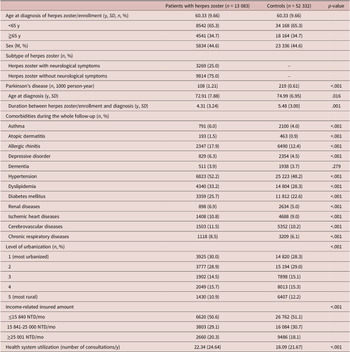
In all, we enrolled 13 083 patients with herpes zoster and 52 332 age-/sex-matched controls, with a mean age of 60.33 ± 9.66 years and a female predominance (55.4% vs. 44.6%). During the follow-up period, patients with herpes zoster had a greater incidence of developing PD (1.21 vs. 0.61 per 1000 person-years, p < .001) and had the earlier onset of PD diagnosis (72.91 ± 7.88 vs. 74.99 ± 6.95 years, p = .016) compared to the controls (Table 1). Among all patients with herpes zoster, 25% of them exhibited neurological symptoms. In addition, a greater prevalence of allergic comorbidities, psychiatric comorbidities, and other medical comorbidities, including asthma (6.0% vs. 4.0%, p < .001), atopic dermatitis (1.5% vs. 0.9%, p < .001), allergic rhinitis (17.9% vs. 12.4%, p < .001), depressive disorder (6.3% vs. 4.5%, p < .001), hypertension (52.2% vs. 48.2%, p < .001), dyslipidemia (33.2% vs. 28.3%, p < .001), diabetes mellitus (25.7% vs. 22.6%, p < .001), renal diseases (6.9% vs. 5.0%, p < .001), ischemic heart diseases (10.8% vs. 9.0%, p < .001), cerebrovascular diseases (11.5% vs. 10.2%, p < .001), and chronic respiratory diseases (8.5% vs. 6.1%, p < .001), was noted in herpes zoster cohort than in control cohort (Table 1). Patients with herpes zoster had more health system utilization (p < .001), resided more in the urbanized region (p < .001), and had a lower income (p < .001; Table 1).
Demographic data and incidence of Parkinson’s disease of patients with herpes zoster and the control group.

Abbreviations: NTD, New Taiwan Dollar; SD, standard deviation.
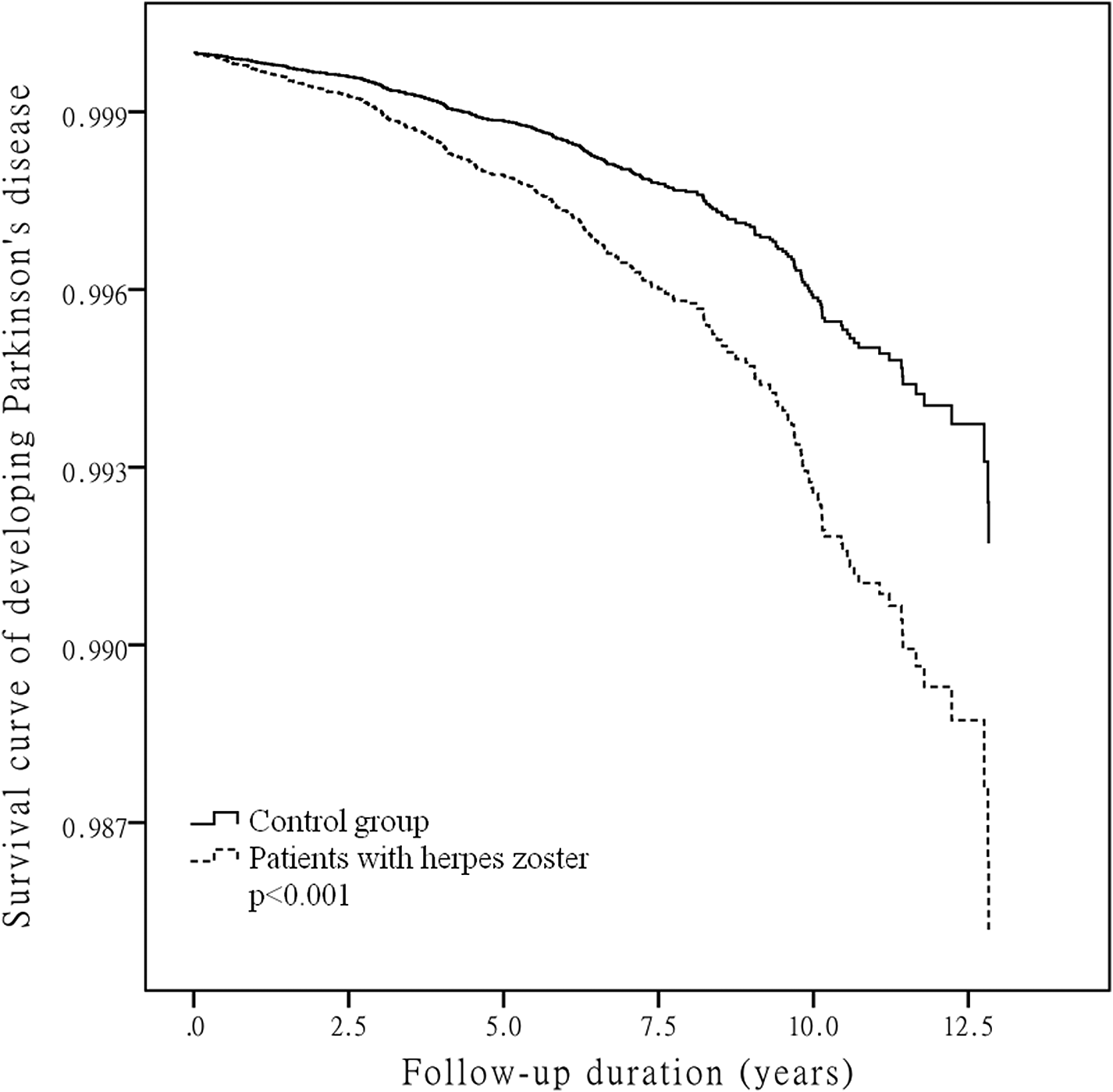
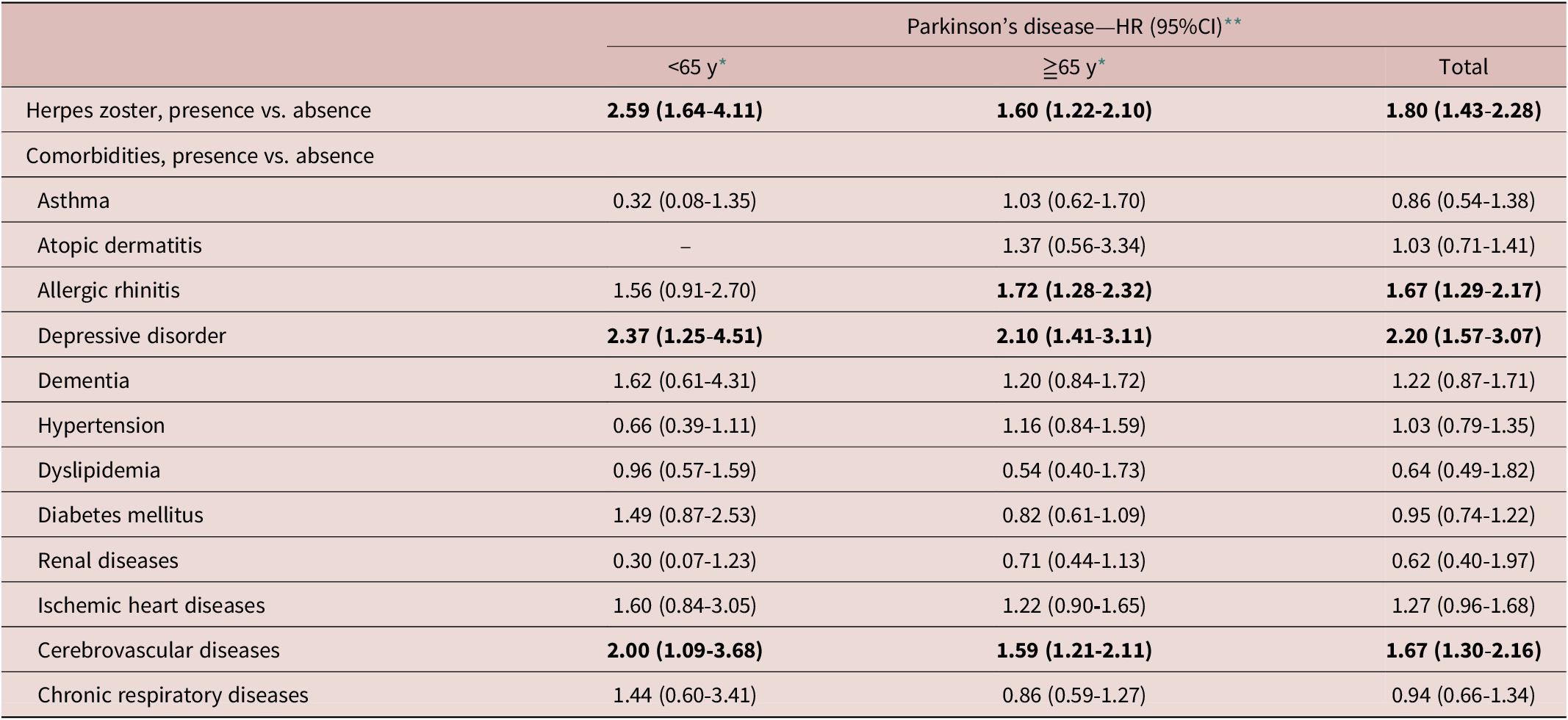
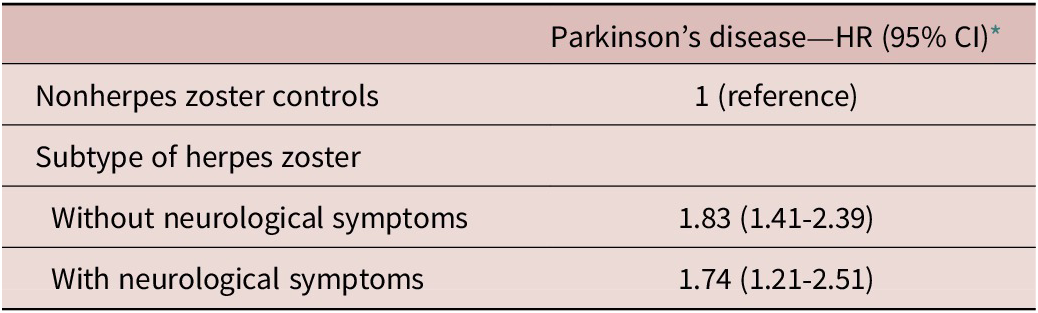
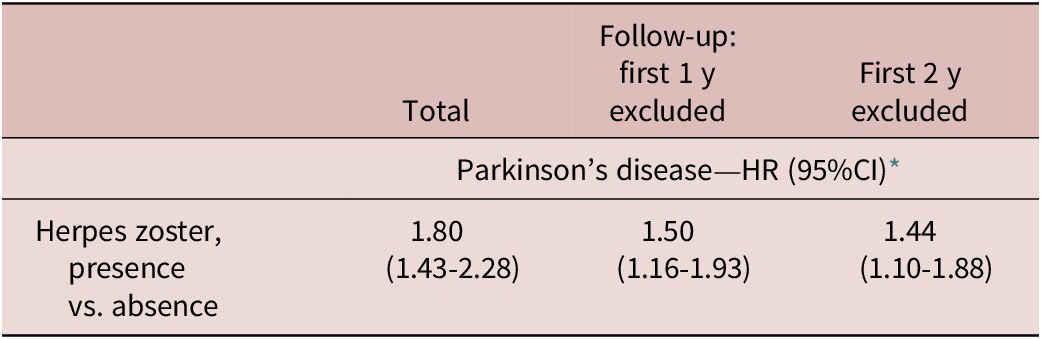
The Kaplan–Meier survival curve with a log-rank test demonstrated that patients with herpes zoster had a significantly higher risk of developing PD than the control group (p < .001; Figure 1). After adjustment for demographic characteristics, comorbidities, and health system utilization, the Cox regression model showed that patients with herpes zoster had a higher risk of developing PD (HR: 1.80, 95% CI: 1.43-2.28) in later life than the control group. Stratified by age group, patients with herpes zoster in midlife (<65 years; HR: 2.59, 95% CI: 1.64-4.11) and in old age (≧65 years; HR: 1.60, 95% CI: 1.22-2.10) were both prone to developing PD in later life (Table 2). Whether patients with herpes zoster had complications of neurological symptoms or not, they all exhibited a higher likelihood of subsequent PD (with neurological symptoms: HR: 1.74, 95% CI: 1.21-2.51; without neurological symptoms: HR: 1.83, 95% CI: 1.41-2.39; Table 3). Sensitivity analyses after excluding the first 1-year (HR: 1.50, 95% CI: 1.16-1.93) and the first 2-year (HR: 1.44, 95% CI: 1.10-1.88) of observation period revealed the consistent results (Table 4). Finally, our results also demonstrated that allergic rhinitis (HR: 1.67, 95% CI: 1.29-2.17), depressive disorder (HR: 2.20, 95% CI: 1.57-3.07), and cerebrovascular diseases (HR: 1.67, 95% CI: 1.30-2.16) were associated with a higher risk of subsequent PD (Table 2).
Survival curve of developing Parkinson’s disease among patients with herpes zoster and control group.

Risk of developing Parkinson’s disease of patients with herpes zoster and the control group.
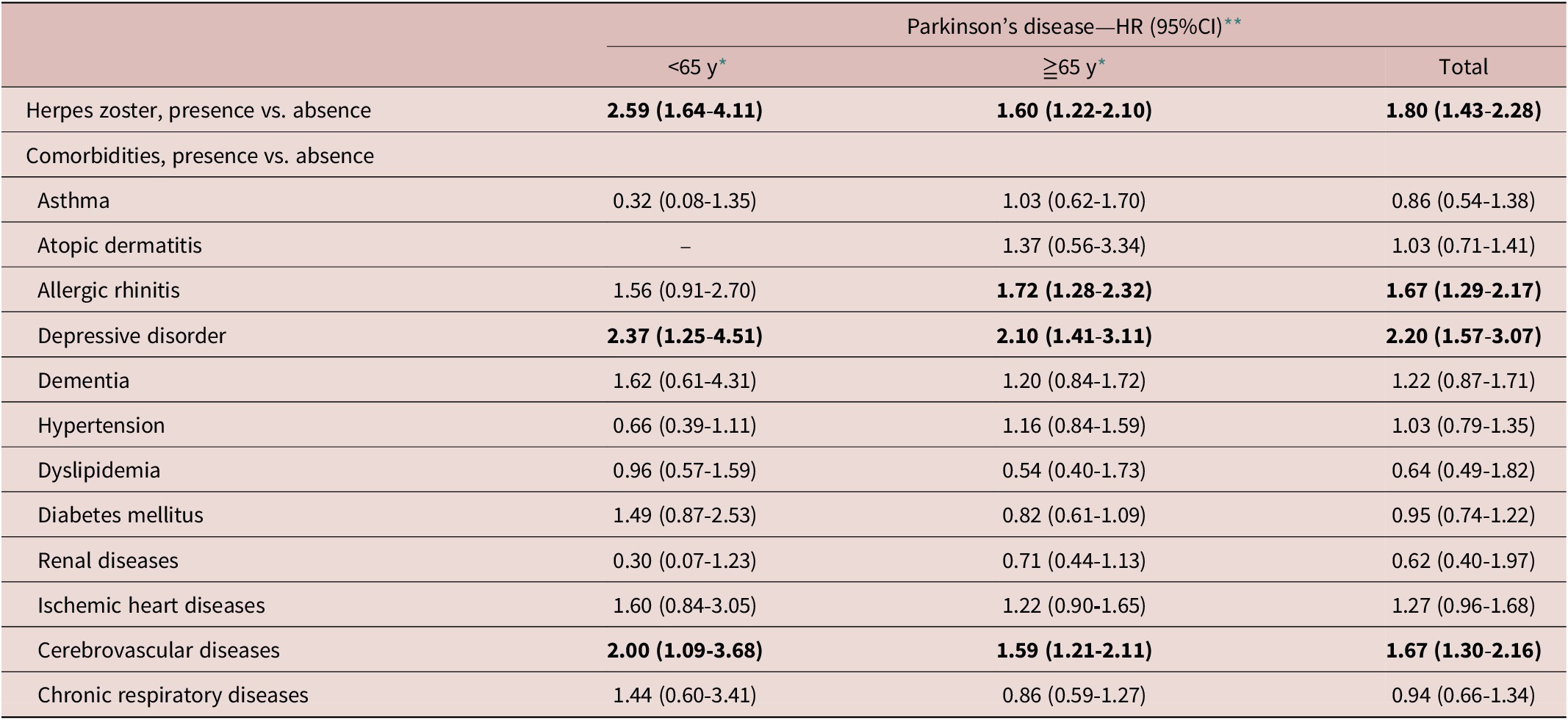
Bold type indicates the statistical significance.
Abbreviations: CI, confidence interval; HR, hazard ratio.
* Age when herpes zoster occurred.
** Adjusted for demographic characteristics, health system utilization, and comorbidities.
Subtype of herpes zoster and risk of developing Parkinson’s disease. *
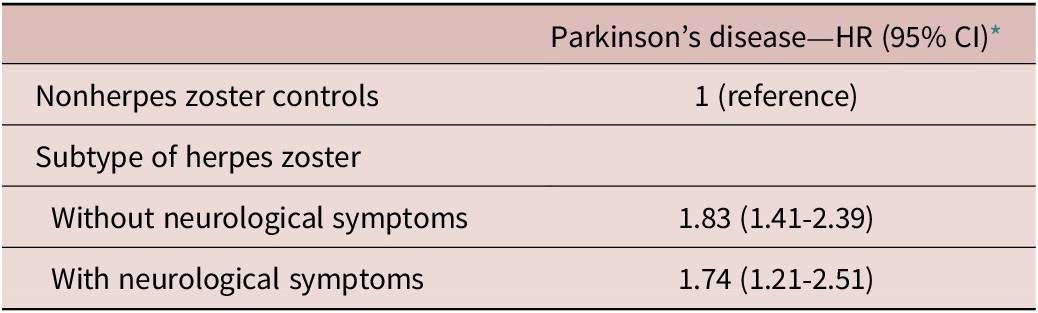
Abbreviations: CI, confidence interval; HR, hazard ratio.
* Adjusted for demographic characteristics, health system utilization, and comorbidities.
Sensitivity test for the risk of developing Parkinson’s disease of patients with herpes zoster and the control group.

Abbreviations: CI, confidence interval; HR, hazard ratio.
* Adjusted for demographic characteristics, health system utilization, and comorbidities.
Discussion
This is the first study to investigate the association between herpes zoster and the risk of PD in midlife and old age involving a large nationwide cohort. After adjustment for demographic characteristics, medical and psychiatric comorbidities, and health system utilization, our results supported the study hypothesis that patients who had herpes zoster in midlife or in old age had an increased risk of subsequent PD. In addition, the patients with herpes zoster had an earlier onset of PD than the controls. The increased risk of PD was present in both herpes zoster patients with and without neurological symptoms.
The earlier studies showed no association between herpes zoster and PD, as listed in Supporting Information Table.Reference Vlajinac, Dzoljic, Maksimovic, Marinkovic, Sipetic and Kostic 15 , Reference Ragozzino, Kurland and Rajput 23 – Reference Harris, Tsui, Marion, Shen and Teschke 25 The small sample sizes and very few PD cases in Ragozzino et al’s and Hemling et al’s studies may limit the results.Reference Ragozzino, Kurland and Rajput 23 , Reference Hemling, Roytta and Rinne 24 The major limitations of Vlajinac et al’s and Harris et al’s studies that confounded the results were the self-report of herpes infection history instead of the diagnosis given by board-certified physicians.Reference Vlajinac, Dzoljic, Maksimovic, Marinkovic, Sipetic and Kostic 15 , Reference Harris, Tsui, Marion, Shen and Teschke 25 On the contrary, our study validated and expended the findings of Lai et al’s study that not only the elderly but also the midlife patients with herpes zoster had an elevated risk of developing PD later in life.Reference Lai, Lin, Lin, Lin, Lin and Liao 26 We further found that patients with herpes zoster with and without neurological symptoms exhibited a similar likelihood of PD, indicating that both herpes zoster-related systemic and local inflammation may play important roles in the PD risk.
VZV causes varicella (chicken pox) as the primary infection and herpes zoster (shingles) upon reactivation of its latent form, which is present in the neurons, for example, the dorsal root ganglia, autonomic ganglia, and cranial nerve ganglia, leading to frequent chronic inflammation throughout the host’s lifetime.Reference Staikov, Neykov, Marinovic, Lipozencic and Tsankov 31 From a clinical perspective, chronic inflammation and infection has been linked with PD pathogenesis. Marttila et al proposed that the increased antibody level against HSV in patients with PD may reflect a more general disturbance in the patients’ immune functions.Reference Marttila, Rinne and Tiilikainen 32 Bu et al measured antibody titers of several common infectious pathogens and determined that infectious burden consisting Cytomegalovirus, HSV-1, Epstein–Barr virus, Borrelia burgdorferi, Chlamydophila pneumonia, and Helicobacter pylori was dose-dependently associated with PD (5-6 seropositivities: odds ratio, 7.77; 95% CI: 2.26-26.68).Reference Bu, Wang and Xiang 16 Based on the hypothesis of chronic inflammation and infection associated with the risk of PD, our study confirmed that herpes zoster, a latent and persistent viral infection lasting for the entire life of the host, may contribute to an elevated risk of subsequent PD after adjusting for demographic characteristics, medical comorbidities, and health system utilization.
Cell-mediated immunity is central to the occurrence of herpes zoster and its complications as a systemic disease.Reference Staikov, Neykov, Marinovic, Lipozencic and Tsankov 31 VZV infection activates human monocytes and monocyte-derived macrophages, followed by the production of proinflammatory cytokines, including interleukin (IL)-6, IL-8, and tumor necrosis factor (TNF)-α.Reference Staikov, Neykov, Marinovic, Lipozencic and Tsankov 31 Numerous studies have demonstrated the potential role and effect of proinflammatory cytokines in PD pathogenesis and have suggested that dysregulation of the inflammatory pathway may affect the central nervous system, resulting in PD. Reale et al reported that patients with PD had a higher serum concentration of IL-1β and TNF-α than did the controls and that the severity of PD was significantly correlated with the cytokine levels.Reference Reale, Iarlori and Thomas 33 Another study found that patients with PD had higher levels of IL-1β, IL-6, and TNF-α in the striatum and the level of TNF-α in the cerebrospinal fluid than did those in the control group.Reference Mogi, Harada and Kondo 34 , Reference Mogi, Harada, Riederer, Narabayashi, Fujita and Nagatsu 35 Studies have revealed that dopaminergic neurons in the substantia nigra were possibly more vulnerable to the damage caused by proinflammatory cytokines than were the other neurons in the brain.Reference Block, Zecca and Hong 36 , Reference Lawson, Perry, Dri and Gordon 37 Combining the aforementioned and the present results, we suggest that the herpes zoster-related inflammation is a potential factor for the risk of PD and that patients with herpes zoster are more likely to develop PD. However, further investigation is required to determine the exact pathophysiological association between herpes zoster and the risk of PD.
Our study has the following limitations. First, the incidence of PD may have been underestimated because we included only patients who sought medical help and consultation. However, in our study, PD was diagnosed by board-certified neurologists; therefore, the diagnostic validity is high. Second, information on the definite time of the primary VZV infection, disease severity of herpes zoster, personal lifestyle, psychosocial and environmental factors, and family history was unavailable in the NHIRD; therefore, we could not investigate the influence of these parameters on the studied association.
In conclusion, our study is the first longitudinal, cohort study to indicate that the patients with herpes zoster in midlife and old age, no matter having the neurological complication or not, had an increased risk of PD. Additional studies are necessary for validating our results and to clarify the underlying pathophysiology of the aforementioned association and whether proper intervention for herpes zoster may attenuate the long-term risk of PD.
Acknowledgments
We thank Mr I.-Fan Hu for his friendship and support.
Funding Source
The study was supported by grant from Taipei Veterans General Hospital (V103E10-001, V104E10-002, V105E10-001-MY2-1, V105A-049, V106B-020, V107B-010, V107C-181) and Ministry of Science and Technology, Taiwan (107-2314-B-075-063-MY3, 108-2314-B-075 -037). The funding source had no role in any process of our study.
Author Contributions
Dr MHC, Prof TLP, and Dr CMC designed the study, wrote the protocol and manuscripts. Dr YHW, Dr SJT, Dr YMB, Dr CFT, and Prof TLP wrote the drafts and assisted with the preparation and proof-reading of the manuscript. Dr MHC and Dr TJC performed the analysis and provided the advices on statistical analysis.
Disclosure
All authors declare no conflict of interest.
Supplementary Materials
To view supplementary material for this article, please visit http://dx.doi.org/10.1017/S1092852919001664.