The life is a germ, and a germ is life.
—Louis Pasteur, quoted in Vallery-Radot, The Life of Pasteur Footnote 1
Fungi are elusive organisms. Mislabeled as plants and confused with animals, revered as vital ecological agents and reviled as pathogenic parasites, prescribed as life-saving medicines and prohibited as illicit drugs, fungal ontology resists taxonomic epistemology.Footnote 2 They resist systems-thinking. Inhabiting literal and figural borderlands, fungi flourish in the gaps between taxonomic orders, in the ruins of environmental collapse, in the intervals between life and death. While indicating fungi's ecological hardihood, this interstitial flourishing also suggests that fungi represent imaginative possibilities for rethinking the relationship between language-making, self-making, and world-making.Footnote 3
In the last decade, awareness of fungal networks has been transforming ideas about communication, mediation, and relationality. In May 2008 the entrepreneurial mycologist Paul Stamets gave a TED talk, “6 Ways Mushrooms Can Save the World,” that describes how mycelium—fungi's underground network of filaments—serve as “extended neurological membranes.”Footnote 4 According to Stamets, this subterranean fungal brain is sentient: it is “the Earth's natural internet.” This natural internet refers to fungi's symbiotic sharing of nutrients and information with plants and trees. Mainstream mass media has seized upon this idea and given it an eco-pop moniker: the “Wood Wide Web.”Footnote 5
As a good Victorianist might guess, the Victorians got there first. By the end of the nineteenth century, the fact that fungi entered into not only parasitic but also symbiotic relationships with other species had been well established. What is more, Victorian scientific popularizers were spreading the idea that fungal networks represented utopian possibilities for reimagining the Darwinian struggle for existence: here was evidence of an ancient system of cooperation.Footnote 6 Here was biological precedence for the Socialist Dream. In short, the “fungus-save-the-world” fantasies that emerged at the end of the Victorian century rhyme with those that emerged at the end of the twentieth.
Taking a long view of mycological history, this essay considers how studies of fungal life have modeled fugitive, cryptic, and queer forms of belonging that open the body and the body politic to modes of collectivity that trouble the equation of ecology with holistic closure. Deploying “queer” in a double sense, I use the term to mark the epistemic power of interspecies relationships to disrupt the normative sociopolitical order (queer as a practice of resistance) and to acknowledge forms of intimacy that do not conform to heterosexual definitions of coupling (queer as lived sexual experience). Queer, in this dual sense, describes the way ideas and experiences of fungal life have disrupted assumptions about the self-enclosure of bodies and systems. In the place of unified coherence, fungi flourish in precisely those places where natural and social orders refuse to coalesce and harmonize, pointing us toward what Deanna Kreisel and Devin Griffiths describe as the “chaotic disaggregation of nature and society” that characterizes “open ecologies.”Footnote 7 As this essay shows, the geographies of desire and belonging created through fungal intimacies make it impossible to speak of either the self-contained individual or ecology in the singular. Open and plural, selves and worlds proliferate, contaminate, and interpenetrate through the secret, infectious touch of fungal relations.
To explore the disjointed multiplicity of ecological entanglements created through fungal intimacies, this essay turns to Arthur Machen's The Hill of Dreams, a fin-de-siècle bildungsroman that contests and subverts the logic of self-formation. Composed in the 1890s but not published until 1907, The Hill of Dreams describes the brief life of Lucian Taylor, who struggles and fails to become a writer, dying in poverty surrounded by his cryptic scribblings. While hinting that opium might be the cause of Lucian's premature death, the novel implies that his life was doomed by his early “contact” (read: sexual coupling) with an animistic earth that exerts an uncanny influence over his development. In this way, Machen's novel turns the plot of boyhood socialization into a plot of transspecies association through the figure of the fungal earth. By this, I refer to the way in which scientific understanding of the earth—teeming with fungal microbes and interlaced with the mycelia's expansive reticulations—dovetailed with Machen's fascination with occult terrain: both represented the earth as secreting unseen subterranean forces.
I begin with an exploration of two interlocking issues—the classification of Machen's novel as “semi” autobiographical and fungi as “quasi” animated—and show how fungi's resistance to taxonomic systematization opens the entwined discourses of life science and life writing to queer narratives of otherwise-being. Drawing out the liminal dimensions of fungal life's otherwise-being, I develop a theory of the “ecological occult”—a strand of environmental thinking interested in the cryptological, subterranean secrets concealed beneath the earth—to elucidate the mysterious, pathological connection between Lucian and the fungal earth. Rethinking Victorian discourses of contamination, I recover the fact that microbes were originally classed as fungi (Schizomycetes). Attending to the microbe's figuration as “wandering” matter, I show how fungal life reveals an exilic, fugitive form of belonging that offers new possibilities for reimagining sociopolitical relations.
As suggested by the recent craze for the Wood Wide Web, fungal relations continue to shape contemporary ideas of sociality and collectivity. Accordingly, this essay traces theories of fungal symbiosis from the end of the nineteenth century to the end of the twentieth, showing how queer, fungal relations continue to figure our enmeshment in and resistance to dominant sociopolitical paradigms. While the history of fungal symbiosis reconfigures the body politic, Lucian's attempt to become a writer indexes his body's porosity and vulnerability, its openness to his fungal attachments. Showing how Lucian's writing exists as a recursive practice of endless rewriting, I consider how this “decompositional dynamic” intersects with the novel's relationship to the bildungsroman and its ideal of endless modification. Drawing out the implications of Lucian's fungal contamination, I contend that Machen's novel reconfigures the bildungsroman's organismic metaphor as pulpy fiction, a transcorporeal decomposition of the self-contained, unified subject.
Fittingly, Lucian's life ends in a merger into the mildew and mold of a moldering home, which may or may not be his home. Troubling the equation of ecology with dwelling, his/the/a moldering home subverts the narrative and ecological function of the house. As Kreisel and Griffiths remind us in their introduction to this special issue, Haeckel's coinage of the term “ecology” (from oikos, meaning home) connects the ideology of domesticated housekeeping to imperial homesteading.Footnote 8 Hence this essay ends with a meditation on the moldering home's uncanny (unheimlich, “unhomely”) estrangement of the narrative logic of homecoming and the ecological implications of housekeeping, suggesting a queer, nongenealogical relationship to the home that occults and opens the oikos to the porous, transcorporeal intimacies of fungal life.
1. Fungal Borderlands
Critics mostly concur that The Hill of Dreams is a “semi-autobiographical novel.”Footnote 9 With the exception of Kostas Boyiopoulos, who calls it an “underexplored experimental masterpiece,” critics agree that The Hill of Dreams reflects Machen's personal experience as a struggling writer in London.Footnote 10 While the novel cleaves to Machen's life story, the designation of “semi” warrants further scrutiny as Machen's autobiography only carries us so far.Footnote 11 Arthur Machen, né Arthur Llewellyn Jones, was born and raised in the Welsh town of Caerleon; Lucian, in the fictional Welsh town of Caermaen. Machen's father was a clergyman; Lucian's father is too. Poverty prevented Machen from attending university; Lucian also cannot afford university. Machen moved to London and began his decadent writing career.Footnote 12 Lucian also moves to London and writes a decadent tale. But, with Lucian's premature death, the similarities stop. Lucian dies in a lonely garret surrounded by his indecipherable writings. Machen survived and published widely, garnering fame for his novels and short stories.
Between Machen's success and Lucian's failure, between Machen's long life and Lucian's premature death, the novel foregrounds the differences between fictionalized constructions and lived experiences of self-formation, a disjunction that interrogates the logic of development undergirding generic, social, and political assumptions about the “normal” unfolding of a person's life. As Alexis Harley demonstrates in Autobiologies, Victorian autobiography and evolutionary biology became deeply entwined discourses precisely through their mutual interest in the interplay between the origins and development of a life and life.Footnote 13 Facilitating the transaction between fictionalized and scientific narratives of development, both discourses organized time through “retrospective or reconstructive” narratives.Footnote 14 Through its backward glance, autobiography converts the contingencies of life's unfolding into a necessary teleological progression toward the self of the writing present: autobiography operates “as if the subject's whole life has yearned towards who-she-has-become.”Footnote 15 However, in The Hill of Dreams, the fictional story of Machen's self-formation is not expressed as a yearning toward “who-he-has-become.” Rather, it is a story of who-he-could-have-been, a story of the self's otherwise-being. Jettisoning the idea of a coherent teleology, the novel undermines the retrospective narrative of autobiography and the “organismic metaphor” of the bildungsroman, offering a queer take on life-writing and developmental biology.
From the outset of the novel, it is clear that Lucian's development will not follow the bildungsroman's traditional course. Following an account of Lucian's time at grammar school, the text reveals its unusual relationship to the plot of boyhood socialization: “it was a queer, funny life that of school, so very unlike anything in Tom Brown.”Footnote 16 In its titular character's growth from sporting boy to sensitive youth, Thomas Hughes's Tom Brown's School Days (1857) set the standard for the Victorian school novel, congealing midcentury conceptions of masculine maturation. While recent critics have argued that Hughes's representation of male-male friendship blurs the boundary between homosocial and homosexual desire, Machen's allusion trades upon Victorian readings of the novel, which praised it for its representation of normative, “natural” boyhood.Footnote 17 In this way, the allusion to Tom Brown reveals Lucian's “queer” relationship to the “natural” rhythms of growth that encode the bildungsroman's heteronormative temporality.Footnote 18 The queerness of Lucian's development is quickly reinforced by another allusion: coming home from school for the holidays, Lucian buys a copy of Thomas de Quincey's Confessions of an English Opium Eater, a text famous for its episodic, impressionistic, and fragmented timeline. With a nod to de Quincey's experimental autobiography and its nonlinear temporality, the novel unfolds a discontinuous, distributed form of development, a maturation repeatedly interrupted by Lucian's queer relationship with the fungal earth.
Early in The Hill of Dreams, Lucian climbs to the Roman ruins that sit atop the titular hill. Unquestionably, Lucian's ascent is sexual: he “desperately mounts” the ruins, with its “swelling battlements,” and finally “thrusts the last bough apart” (23, 24). When Lucian penetrates the ruin, strips off his clothes, and lies down on the pulsating earth, his mind “stray[s] over half-imagined, delicious things, indulging a virgin mind in its wanderings,” while his body becomes increasingly aroused: “quick flames now quivered in the substance of his nerves, hint of mysteries, secrets of life” (26). His erotic reverie reaches its climax when, with a final shudder, “the turf beneath him heaved and sank as with the deep swell of the sea” (26). Lucian's adolescent initiation into adulthood: he copulates with the earth.
The earth, meanwhile, is alive with animistic forces that are at once occult and fungal. Tapping into fungi's unstable place in the Victorian imagination, the “abominable fungus” marks Lucian's sexual initiation as a crossing-over into unstable sexual and biological terrain:
The earth was black and unctuous, and bubbling under the feet, left no track behind. From it, in the darkest places where the shadow was thickest, swelled the growth of an abominable fungus, making the still air sick with its corrupt odour, and he shuddered as he felt the horrible thing pulped beneath his feet. (24)
“Black,” “unctuous,” and “bubbling”: the fungus marks the point where efflorescence becomes deliquescence and, thus, sets up several interconnected boundary-problems: the destabilization of the line between life and nonlife, the consequent disruption of the rhythms of “normal” (i.e., vital) development, and the racialized marking of “black” development as “abominable.” As signaled by its etymology (‘ab-’ away from + ‘homine’ human being), the abominable fungus reflects Alexander Weheliye's concept of the racialized assemblage, which construes race “as a set of sociopolitical processes that discipline humanity into full human, not-quite-humans, and nonhumans.”Footnote 19 While the fungus's blackness speaks to the ways racialization works to police biological hierarchies, the abominable fungus also becomes a figure for the libidinal undoing of hierarchies within Machen's matted thicket: “not a branch was straight, not one was free, all were interlaced and grew about another; and just above ground, where the cankered stem joined the protuberate roots, there were forms that imitated the human shape” (25). Here is Darwin's “entangled bank” run riot.Footnote 20 Luxuriously overgrown, life bursts its own bounds; fecundity ripens into rankness; and trees swell into “not-quite-human” form. Encoded in the racialization of the “abominable” fungus, the categories of the zoological (human boys) and the botanical (not-quite-human trees) pleasurably intertwine and rub up against each other.Footnote 21
No other organism better represented the nebulous boundary between botany and zoology in the Victorian imagination than fungus.Footnote 22 For the first half of the nineteenth century, it was not clear whether fungi should be classed with plants or animals. Unlike plants, fungi did not contain chlorophyll and thus could not produce their own nutrition. Like animals, fungi either fed on living matter (parasitic) or dead matter (saprophytic) and produced animal-like excretion.Footnote 23 While, by the end of the century, the taxonomic confusion was resolved by creating a new third kingdom, fungi were still figured as “quasi-animals,” consuming rather than storing the sun's energy.Footnote 24 Hunger for flesh—as well as a resemblance to flesh as the pileus was often called “fleshy”—continued to animate fungus in the Victorian imagination.Footnote 25 In this way, fungi reflected the “flexible” location of life in the Victorian period, in which life could be latent in both animate and inanimate matter.Footnote 26
In keeping with Mel Chen's argument about animacy's hierarchical logic, the animatedness of the fleshy fungus became an important testing ground for the taxonomic ranking of quasi-animals and quasi-plants in the Victorian period.Footnote 27 Moreover, with the discovery of microscopic fungi, mycology and microbiology increasingly converged in their study of the microbe, a cryptic creature that skimmed along the plant-animal border.Footnote 28 I will discuss the microbe in more detail below. For now, I want to stress how the quasi-animality of microscopic fungi and microbial life resulted in an array of “third kingdoms” designed to capture their elusive place in the natural order: Richard Owen proposed the Protozoa in 1860; also in 1860, John Hogg suggested the Primigenum; John Cassin, the Primalia in 1863; and Ernst Haeckel, the Protista in 1866.Footnote 29 Even Pasteur, the leader in the emerging field of microbiology, employed a notoriously loose vocabulary. His many names for the microbe included “végétaux cryptogames microscopiques,” “animalcules,” “infusoires,” “bactéries,” “vibrioniens,” “monads,” “mucor,” and, tellingly, “champignons” (mushrooms).Footnote 30 As the sheer proliferation of these classifications suggest, the realm of “quasi” animatedness activated an anxious desire to rank and order fungal life.
Hence, even as Victorian mycological research helped police biological hierarchies, fungal life also indexed the difficulty of pinning down life-forms that flourished in the interstices of taxonomic orderings, creating a space where alternative narratives of a life and life could emerge. A queer conjuncture of the autobiographical and the biological intersects in the incomplete, partial categories marked as “semi” and “quasi.” Hence, just as the designation of “semi” frees the genre of autobiography from the dictates of retrospective teleology, opening life-writing to provisional conceptions of identity and personhood, the designation of “quasi” pries apart the taxonomies of biology, opening the hierarchies of botany and zoology to the not-quite-human animacies of fungal life. Signaling Lucian's entrance into ontologically unstable terrain, the “abominable fungus” foreshadows Lucian's transformation into something not-quite-human, even as it produces what Jesse Oak Taylor has termed “abnatural” encounters with life's taxonomies, that is, encounters that reveal nature as “replete with exceptions, always eluding definition.”Footnote 31 In their defiance of taxonomic systems and their otherwise-being, fungi are fecund allies for occult interpretations of language-making, self-making, and world-making.
2. The Ecological Occult
Looking back on his literary career in his 1915 autobiography, Far Off Things, Machen attributes his success to the fact that, upon opening his eyes as a child, the first thing he saw was “the vision of an enchanted land.”Footnote 32 Machen credits his creative abilities to his early impressions of his native country as an ancient burial ground concealing the archaeological ruins of pre-Roman history: “as soon as I saw anything, I saw Twyn Barlwm, that mystic tumulus, the memorial of peoples that dwelt in that region before the Celts left the Land of Summer.”Footnote 33 But his vision of his native Welsh country as a pre-Roman burial ground is not merely archaeological; it is occult. In Celtic mythology, the Land of Summer (Gwâld yr Hâv or Tir na Samhraidh) is an “otherworld,” a place deep within the earth, an ancestral realm that is connected via secret mounds and tunnels to our world.Footnote 34 Machen's occult topography turns the surface of the terraqueous globe—the usual field of action for human life and its fictions—into a network of secret burrows concealing a deep earth.Footnote 35 Not entirely synonymous with geology's deep time or with antiquarianism's deep genealogy, this occult depth disrupts the retrospective practices of (geo)historical recovery as the network of secret burrows turn time into a web of nonlinear access and exit points. Hence, in both his fictional and autobiographical writing, Machen represents the soil as secreting subterranean forces that have the power to overturn the logic of retrospective narration, reshaping the linear processes of self-making.
In this way, Machen's depiction of the earth as a “mystic tumulus” (tumulus, ‘heap of earth’) dovetails with late Victorian science and its understanding of the soil's secret life. In his article “The Living Earth,” the novelist and scientific popularizer Grant Allen describes how the soil burst into riotous life at the end of the century:
But the particular point on which I wish to lay stress here is the modern discovery that the soil itself—the layer of soft mould which clothes the surface of the earth in all cultivatable districts and from which vegetation springs—is actually in great part a living layer, a confused mass of tiny plants and animals … a vast subterranean forest of moulds and mildews.Footnote 36
While Charles Darwin had drawn attention to the ecology of the soil in The Formation of Vegetable Mould (1881), his depiction of the earthworm, vitally churning and plowing the earth, left the soil intact as an inert substrate.Footnote 37 Whereas, in Darwin's view, the soil was composed of the “castings” of the earthworms, Grant Allen envisioned the soil itself as a “living layer” composed of innumerable tiny creatures. By the end of the century, the soil was alive, and it was alive with minute fungi. Reading Machen's vision of the “mystic tumulus” alongside Allen's “subterranean forest,” the figure of the fungal earth represents a form of environmental thought that I will call “ecological occultism,” a form of natural supernaturalism invested in the cryptological, in the secret codes, the stealthy signals, buried in the earth.
If Machen's mystic tumulus not only derives etymologically from “heap of earth” but also “mound” or “hillock,” then it is significant that the most prominent topographical feature of the novel is the titular hill. The hill, or rather what lies beneath the hill, becomes the pivot-point for an overlapping conception of the soil's secret life and, as I am suggesting, for an occult account of development. But such a view of secret environmental influence might strain even the most robust account of ecological entanglement. Even if developmental biology and literary convention concur in granting “the environment” a determining influence on human subjectivity, how can processes that occur at the utmost fringes of the active environment shape human formation? In Fateful Beauty, Douglas Mao recuperates the influence of small, unseen forces on the developing human being—what Mao refers to as the subtle operations of “stealthy environments.” In a statement that sheds light on Machen's ecological occultism, Mao argues that, by the middle of the nineteenth century, “science was pressing very hard the point that daily life itself is permeated by mystery in the form of the countless physiochemical transactions shaping each one of us.”Footnote 38 Machen, likewise, sets up Lucian's development as a series of transactions between his young body and the fungal earth, a stealthy environment that continues to shape his development long after his fateful trip to the Roman ruins.
Erupting in sudden, unexpected bursts, Lucian repeatedly relives his visit to the Roman ruins as a form of eco-occult contagion: “sometimes when he was deep in his books and papers, sometimes on a lonely walk, sometimes amidst the tiresome chatter of Caermaen ‘society,’ he would thrill with a sudden sense of awful hidden things, and there ran that quivering flame through his nerves that brought back the recollection of the matted thicket” (44). Representing the “quivering flame” as an occult and pathological phenomenon, the novel figures Lucian's relation to the fungal earth as a “toxic animacy” that slowly transforms him into something not quite human.Footnote 39 At first, he worries that he has only become “in a measure inhuman” (145). However, as he gradually declines, he becomes convinced that “he could not be human” and speculates that there must be something “in his body that made him foreign and a stranger in the world” (167). Machen's eco-occult universe reimagines ecological entanglement as contamination. While contamination usually implies impurity, corruption, and pollution, Anna Tsing argues for a reappraisal of the ontological and sociological value of contamination. Tsing contends that it represents important world-making possibilities: “as contamination changes world-making projects, mutual worlds—and new directions—may emerge.”Footnote 40 Similarly, Lucian's fungal contamination not only debilitates him but also inspires him: the mystical hills become his literary muse. In this way, Machen's eco-occult representation of the human-fungal encounter provides a useful framework for rethinking the dominant paradigms of contamination in the period.
3. Fugitive Fungi
Of the many discoveries of the fin-de-siècle, the ascent of germ theory most readily tapped into occult interpretations of “the environment.”Footnote 41 It is not difficult to imagine why germ theory's central premise—that infinitesimal, invisible creatures had the power to contaminate and vitiate a human being—could have represented an occult hypothesis to some Victorians. With the rise of germ theory, it became common knowledge that microbes were everywhere—and everywhere unseen. Even with advances in microscopic technology, the furtive microbe resisted capture, its motile bodies dancing on the fringe of human perception.Footnote 42 Due in equal measure to their invisibility and their ubiquity, an aura of mystery clung to the microbe. In Eliza Priestley's striking description, microbes are veritably stealth incarnate:
We must allow our minds to carry us into the region of the invisible, for we have to realize the fact that the air round us is crowded with the germs, in every stage of vitality, of small organisms which are noiseless, intangible, unseen. While sleeping, waking or drinking, they steal so insidiously upon us that we are unconscious of their presence until illness gives the first note of warning.Footnote 43
Silent and undetected, microbes “steal so insidiously upon us” that we do not know they are there until it is too late—until we are contaminated. Unseen and unfelt, the microbe's presence not only requires an imaginative visualization of the invisible but also resensitizes the affective interface of the unconscious body. In this way, the microbial turn transformed Victorian conceptions of the environment, extending its influence beyond the mundane realm of the sensible and visible into the occult realm of the hidden and invisible.
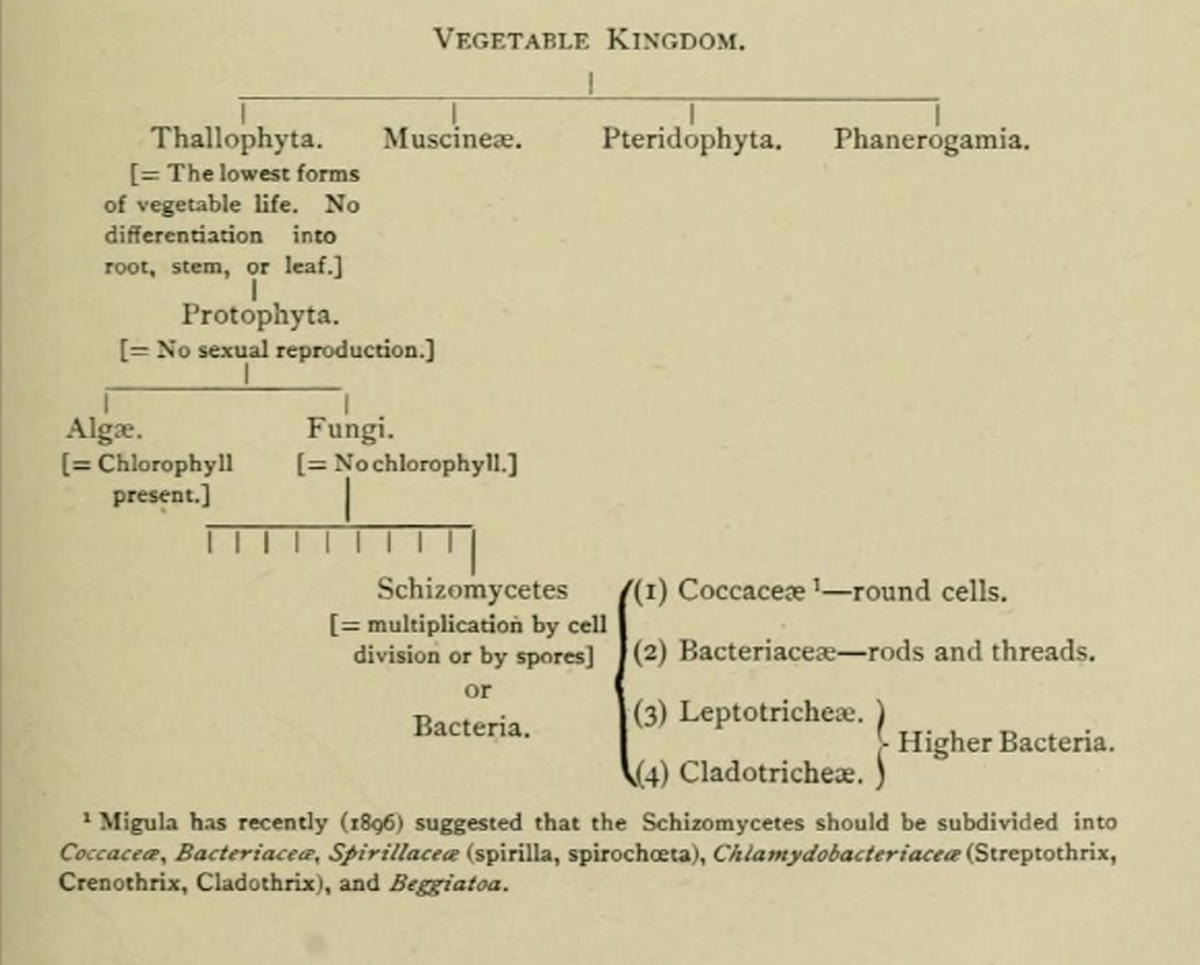
While it is well known that germ theory heightened attention to the microbe's pathology, what is perhaps less well known is that fungi were central to this development. As discussed above, mycologists had long understood that fungi must feed on organic matter. Bacteriologists soon realized that microbes, lacking chlorophyll, also fed on organic matter. Accordingly, in 1857 the German botanist Carl Nageli proposed the name Schizomycetes (fission fungus), a classification that persisted well into the twentieth century despite the problem posed by the blue-green algae.Footnote 44 As their name suggests, blue-green algae possessed chlorophyll and reproduced by fission. In 1875 Ferdinand Cohn, one of the founders of modern bacteriology, proposed a new classification that merged together bacteria and blue-green algae: the Schizophytae (fission plants). However, as the modern biologist Jan Sapp notes, “few botanists followed his lead; bacteria were generally regarded as fungi, and the Schizomycetes and the blue-green algae as organisms apart.”Footnote 45 Hence, even when Ellsworth Dougherty proposed the revolutionary division of “eukaryotic” and “prokaryotic” in 1957, this breakthrough was not immediately accepted. In The Development of Microbiology (1976), Patrick Collard notes that although Dougherty's division “is of great evolutionary significance,” this new knowledge “has not of course led to any internal rearrangement within the class Schizomycetes.”Footnote 46 So, even while bacteria were moved into their own kingdom, the internal arrangement of the class and the name Schizomycetes was retained. More importantly for our purposes, the fungal classification of bacteria was already accepted in Machen's time. Hence, in Bacteria (1899), a popular science textbook, George Newman authoritatively declares: “we know that bacteria are fungi.”Footnote 47
Classification of Bacteria: Schizomycetes (fission fungi). Illustration from George Newman, Bacteria (London: John Murray, 1899), 7.

The fact that Cohn classed bacteria with Schizophytae (fission plants) and that Newman placed fungi within the vegetable kingdom (fig. 1) only reinforces how unstable fungi were in the Victorian imagination: the “quasi” animatedness of fungal life continued to produce “abnatural” encounters with life's taxonomies, especially within the occulted, unseen world of microbial life. So, while I refer below to “bacteria,” it is important to bear in mind that, by the end of the century, “bacteria” were generally considered fungi and thus were subject to the queer implications of their taxonomic liminality. Hence, even as fungal animacies both compelled and undermined taxonomic systems, this unique animacy helped usher in a new approach to classification. As Collard notes, by the end of the century, the desire to reduce the multiplicity of life to a tidy order gave way to a new desire to see the complex interplay of multispecies relationality.Footnote 48 And the key was fungi's unique metabolism. As attention shifted to their metabolic and physiological characteristics, bacteria were not only perceived as contaminating pathogens but also indispensable environmental agents that helped renew the earth's limited supply of elementary matter.
Even Pasteur, renowned for his work in pathology and immunology, was convinced that bacteria played a crucial role in the cercle de vie.Footnote 49 Pasteur's vision of life was premised upon the belief that “it is a law of the universe that all that has lived disappears” (84). For Pasteur, the circle of life was an “absolutely necessary” exchange of “mineral and gaseous substances” (84). Trained as a chemist, Pasteur's cercle de vie remained a relatively straightforward exchange of elementary matter: “putrefaction restores to the atmosphere the water, the carbon dioxide, hydrogen, and ammonia without which life cannot exist.”Footnote 50 While his cercle de vie dictated the return of matter to the soil and the atmosphere, his circle was confined almost entirely to the atmosphere, such that chemical substances were simply “voyageurs” borne on aerial drifts (84). In Pasteur's view, bacteria compose a climatological cache, an aerial realm where life can go to draw again upon “the elements of its indefinite perpetuity” (84).
Extending and developing Pasteur's cercle de vie, Cohn placed bacteria at the center of his “life cycle of organisms.” Trained as a botanist, Cohn realized that the release of chemical elements into the atmosphere could not account for the presence of elementary materials in the soil: there had to be “some mechanism by which the complex molecules synthesized by green plants from elementary materials were returned to the soil.”Footnote 51 In Bacteria: The Smallest of Living Organisms (1872), Cohn proposed that bacteria performed this necessary function:
If the amount of material which can be moulded into living beings is limited on the earth, the same particles of material must ever be converted from dead into living bodies in an eternal circle; if the wandering of the soul be a myth, the wandering of matter is a scientific fact. … Since bacteria cause the dead body to come to the earth in rapid putrefaction, they alone cause the springing forth of new life, and therefore make the continuance of living creatures possible.Footnote 52
At first glance, Pasteur's cercle de vie and Cohn's “eternal circle” are precisely not the kind of open, relational ecologies that this essay and special issue are interested in investigating. Indeed, by representing the earth's biochemical exchanges as a “circle,” Pasteur and Cohn tap into a long history, one that can be traced from Kant's conception of the earth as the “original mother” to Lovelock's theory of the planet as Gaia, that views the earth as a self-repairing, closed system.Footnote 53 Nevertheless, with Pasteur's “voyageurs” and Cohn's “wandering” matter, bacteria roam the soils and the skies as travelers and wayfarers. Ironically, while bacteria alone can restore “the material which can be moulded” to the earth, they are themselves liminal go-betweens, passing through corpses and clouds, traversing the lithosphere and the atmosphere, in a state of fugitivity.
4. Interspecies Intimacies
Exercising a gravitational force pulling him back to the fungal earth, the memory of the Roman ruin haunts Lucian. Always referred to as the incident in the “matted thicket”—a redundant designation that signals both the thick density of his recollections and the intricate entanglement of fungal ecology—it exerts a powerful influence upon Lucian's development, resurfacing at crucial moments in his life. After learning his manuscript has been plagiarized, Lucian takes a shortcut through the woods on his way home, where the memory of the “matted thicket” returns again:
The bramble bushes shot out long prickly vines, amongst which he was entangled, and lower he was held back by wet bubbling earth. … The weird wood noises were the only sounds, strange, unutterable mutterings, dismal, inarticulate. … [He] almost fancied he heard two voices speaking in its murmur … that two unknown beings stood together there in the darkness and tried the balances of his life, and spoke his doom. The hour in the matted thicket rushed over the great bridge of years to his thought. (60–61)
The sexual energy of the matted thicket unleashes a splitting, multiplicative temporality that simultaneously “entangles” him in the present and rushes him across “the great bridge of years.” Distorting the boundaries of temporal organization and the contours of Lucian's body, the matted thicket sends out swift “shoots” that ensnare Lucian, while the “bubbling” earth, echoing the language of the “abominable fungus,” slurps at his “lower” half. This human-fungal encounter is both contaminating and tantalizing, suggesting a “transmaterial” or “transcorporeal” eroticism that mingles the human and the not-quite-human.Footnote 54 However, as Dana Luciano and Mel Chen argue, transmaterial sexuality does not necessarily dissolve the boundaries between human and nonhuman. Rather, its queer denaturalizing of sexual norms urges us to consider “how those categories rub on, and against, each other, generating friction and leakage.”Footnote 55 Here the categories of the human and nonhuman generate the pleasure of sexual intimacy and the threat of judicial punishment, as the occult voices of the woods pronounce Lucian's “doom.” In this way, Machen's matted thicket resonates with multiple theories of ecological relationality: Haraway's humans-as-humus, Deleuze and Guattari's rhizome, and Morton's mesh.Footnote 56 While Machen's matted thicket suggests a form of decentered, interconnected relationality that chimes with the rhizome and the mesh, its coercive force complicates the political implications of horizontal relationality, reminding us that flat ontologies are not necessarily democratic or liberatory.
Mining the tension between eroticism and subjugation, Machen's matted thicket draws upon the deeply ambivalent sociopolitical possibilities produced by fin-de-siècle mycology. In the nineteenth century, it was well known that these nonchlorophyllous creatures were, of necessity, heterotrophs (“other eaters”). It was thought that fungi could only feed either as saprophytes or parasites.Footnote 57 The discovery that fungi entered into symbiotic relationships with algae, thus forming an entirely separate class of plants—lichens—ushered in a new age in the history of biology.Footnote 58 When the Swiss botanist Simon Schwendener proposed his “dual hypothesis” in 1867, his representation of the fungus-alga relationship was, however, far from cooperative: he envisioned it as a master-slave relationship, wherein the dominant fungus captures, imprisons, and lives off the work of the servile alga.Footnote 59 Schwendener's master-slave analogy gradually gave way to visions of mutually beneficial reciprocity. In “Queer Relationships,” an article on symbiosis that ran in the Saturday Review in 1887, the anonymous writer imagines a capitalist revision of Schwendener's master-slave relationship, where the “investing” fungus provides the alga with water, although noticeably this capital expenditure is represented as a minimum payment to prevent “desiccation.”Footnote 60 However, by the end of the century, the fungi-algae liaison came to exemplify the “intimate relations” of cooperative living.Footnote 61
While nineteenth-century mycology reproduced the master-slave relations of settler colonialism, it also unsettled those relations, offering possible sites of resistance through its “queer relationships.” Hence, the discovery of nitrogen-fixing bacteria extended the fungal analogy for mutual aid. Converting nitrogen, an essential plant food, into a consumable form, nitrogen-fixing bacteria required the work of two species of microbes and, thus, led to the idea of fungal “association”—a term ripe for political maneuvering. Scientific popularizers praised nitrogen fixation as “a highly interesting system of cooperation on the part of these minute soil workers.”Footnote 62 No longer the insidious, unseen enemy, fungal microbes came to be seen as laborers: “they are both economic and industrious in the best biological sense of the terms.”Footnote 63 Peter Kropotkin, the anarchist communist, was quick to seize upon the microbe's “precious work” on behalf of species other than its own: “To their activities we are indebted … and until lately man has been chiefly living upon the treasuries accumulated by the invisible workers.”Footnote 64 In a striking reversal, humanity becomes the parasite that feeds upon the nutritive wealth of the microbial nation. In this way, the development of the concept of fungal symbiosis revealed the fault lines of nineteenth-century politics and science, posing a challenge to the Hobbesian and Darwinian struggle for existence. Acting as a wedge against theories of innate competition, symbiosis became a natural ally of trade unions, chartist groups, the “friendly societies” in Britain, and the mutual aid societies in France.Footnote 65
Clenching the politic idiom of mutual cooperation was Albert Bernhard Frank's surprising discovery of the symbiotic relationship between fungal mycelium and the roots of living trees—what he termed mycorrhiza (myco- ‘of fungi’ + rhiza ‘root’).Footnote 66 I say surprising, because the “spawn” of fungi was long considered destructive, even deadly, to trees.Footnote 67 Spawn, or mycelium, is the vegetative portion of the fungus, consisting in a network of fine white filaments. While we tend to picture the fungus as a capped pileus sitting atop a fibrous stem, this terrestrial form is, in fact, just the “fruiting body” of the vast expanse of subterranean vegetative mycelium—a prime example of the ways in which fin-de-siècle science occults the soil's hidden relations. Frank discovered that certain species of trees did not “nourish themselves” but were fed by a “wet nurse”—a “mantle” of fungal mycelium that completely enveloped the root, even to its growing tip.Footnote 68 Like Machen's “wet bubbling earth,” Frank's tree root and fungal mycelium latch onto each other in a “wet” transspecies, transcorporeal embrace. As the fungal “wet nurse” suggestively implies a queer nonbiological, nongenealogical relationship between “mother” and “child,” Frank's mycorrhiza helped denaturalize heteronormative assumptions about kinship and sexuality.
Just as fungal relations proved to be potent sites of political and libidinal imagining at the turn of the twentieth century, fungal relations have again become a testing ground for sociopolitical ideologies at the turn of the twenty-first century. Figured now in the techno-idiom of the “network,” modern biologists now represent mycorrhiza as a subterranean internet, a secret electrical grid concealed beneath the earth. Describing this communications network, modern biologists represent it as a supply-chain management system, allowing fungus to connect with “multiple trading partners” and improve its “bargaining power” with its plant hosts.Footnote 69 Running alongside the neoliberal image of free trade is its counterpart: the surveillance state. Mycorrhizal networks allow plants to transmit defense signals, warning other plants in the network about pathogenic and herbivore attacks.Footnote 70 In other words, like their Victorian predecessors, contemporary scientists and scientific popularizers have seized upon the social and political implications of mycorrhizal networks. In “The Secrets of the Wood Wide Web,” published in the New Yorker in 2016, Robert MacFarlane summarizes the contemporary political stakes of mycorrhizal networks:
A central debate over the Wood Wide Web concerns the language used to describe the transactions it enables, which suggest two competing visions of the network: the socialist forest, in which trees act as caregivers to one another, with the well-off supporting the needy, and the capitalist forest, in which all entities are acting out of self-interest within a competitive system. Sheldrake [an expert in mycorrhizal fungi] was especially exasperated by what he called the “super-neoliberal capitalist” discourse of the biological free market.Footnote 71
In this way, our contemporary fascination with fungal symbionts repeats the late Victorian fungal turn minus, of course, the particular fear and loathing that attaches to the “super-neoliberal capitalist.” Taking a long view of mycological history, we can see how fungal symbiosis continues to confirm and trouble dominant sociopolitical arrangements, duplicating the logic of neoliberal free trade and disrupting it with a socialist redistribution of wealth. Attending to the Victorian fungal turn, we see how fungal symbiosis served as an index to the shifting political significance of social relations between “high” and “low,” men and women, masters and slaves, even as it opened up new discursive terrain that helped naturalize and, thus, legitimize socialist cooperation.
Hence, in “Ancient Experiments in Co-Operation,” H. G. Wells used fungal associations to bolster his vision of a socialist “synthesis” as the natural evolution of human society.Footnote 72 Moving from lichen symbionts to mycorrhizal networks, Wells explains how “the great majority of forest-trees obtain food, not by their roots directly, but through the intermediation of fungus filaments that interweave among their roots.”Footnote 73 Ultimately, the symbiotic fungal-tree becomes the image for the “extensive modification” of humanity. While humankind is already “an aggregate of amoeboid individuals,” Wells predicts that in the future we might “coalesce” into ever greater unified aggregates, “such strange forms as we have hinted at, human trees with individuals as their branches and so forth.”Footnote 74 In this way, Machen's seemingly idiosyncratic representation of Lucian's thrall to the fungal earth taps into the fin-de-siècle fascination with the social, political, and erotic implications of fungal symbiosis. Wells shrinks from the “startling and grotesque” image of the aggregated humanity tree: the loss of clearly demarcated selves troubles him. Nevertheless, it is clear that fungal intimacies radically open the human body to transspecies assemblages that reconfigure the way we imagine political and social futures.
5. Pulpy Fiction
If Lucian's intimate coupling with the fungal earth enmeshes him in transspecies associations that threaten to dissolve the boundaries of his body and mind, then his attempt to become a writer reflects this loss of stable self, this merger into strange agglomerations. Just as the memory of the “matted thicket” continually returns Lucian to his origin story, his writing is stalled forever in the throes of birth—what Mr. Taylor calls his son's penchant for “the questionable process of composition” (94). Toiling endlessly over the cadences of phrases, the selection of individual words, and, worse yet, starting story after story and laying them aside unfinished, Lucian's writing is continually beginning. In this way, Lucian's writing reveals the “decompositional dynamic” implicit in the logic of Bildung, namely, that Bildung demands a ceaseless process of becoming that necessitates a continual unmaking and remaking. And this unfinished state of affairs leaves Lucian's writing open—open to the pleasures and pain of symbiotic composition.
Fittingly and unsurprisingly, Lucian's first attempt at publication is a laborious homage to the earth. Reflecting his symbiotic link to the land, his writing attempts “to translate into English prose the form and mystery of the domed hills” (48–49). But during the manuscript's long composition, Lucian struggles to arrest an endlessly recursive writing process: “he had labored hard to do his very best, writing and rewriting, weighing his cadences, beginning over and over again” (49). Lucian eventually manages to stop the process and sends the manuscript to a publisher, who never responds to his submission. Later, he discovers that his manuscript has been plagiarized or, rather, incompletely plagiarized as the thieving author, Mr. Ritson, only partially purloins Lucian's manuscript. In this way, Lucian's manuscript bears the trace of its decompositional dynamic, since the plagiarized book, The Chorus in Green, splinters Lucian's manuscript: his writing goes forth into the world as a hybrid-decomposed form. What is more, Lucian finds that he (grudgingly) approves of the plagiarizer's decision to use only part of the original:
There were about two hundred pages in the pretty little volume, and of these about ninety were Lucian's, dovetailed into a rather different scheme with skill that was nothing short of exquisite. And Mr. Ritson's own work was often very good; spoilt here and there for some tastes by the “cataloguing” method, a somewhat materialistic way of taking an inventory of the holy country things; but, for that very reason, contrasting to a great advantage with Lucian's hints and dreams and note of haunting. (53)
The crafty Mr. Ritson carves Lucian's manuscript into pieces, splicing bits of Lucian's enigmatic, ethereal prose onto his sturdier, “materialistic” stuff. But Lucian finds the interlocking of Mr. Ritson's style with his own “exquisite.” The dovetailed work, conjoining the styles and labors of two very different individuals, turns a straightforward case of literary parasitism into one of literary symbiosis: Lucian calls Mr. Ritson his “collaborator and corrector” (53).
Accordingly, Lucian is unconcerned about the vulnerability of his self or his labors. Talking the issue over with his irate father, who wants him to “expose the rascals,” Lucian immediately begins to talk about the idea for his next book, while Mr. Taylor silently wonders at his son's “excitement over a book that was not even begun, the mere ghost of a book flitting elusive in the world of unborn masterpieces and failures” (68). Through the critical gaze of Mr. Taylor, the frail logic of Bildung plays out as the “phantom formation” of the not-yet-formed book, where the epigenetic body (the “unborn” book) and the constantly self-forming idea (the book's “ghost”) do not give rise to form but, instead, flit in the land of bibliophilic nonbeing.
I refer here to Marc Redfield's suggestion that the bildungsroman is a “phantom formation,” an empty construct that reveals the self-reflexive operations of aesthetic ideology. In his deconstruction of the genre, Redfield argues that, “the ‘content’ of the Bildungsroman instantly becomes a question of form, precisely because the content is the forming-of-content.”Footnote 75 While Redfield reads Bildung as a ghostly dematerialization of the narrative “contents” of the self, Pheng Cheah argues that Bildung’s spectrality emerges in the organism's relationship to teleological time. According to Cheah, “any process of actualization is inevitably haunted” because the incarnation of Bildung’s ideal within the organism's body requires an “originary opening up of being” to “an inhuman substrate absolutely other to our cognitive faculties.”Footnote 76 Opening the organism's body to sheer alterity, the inhuman other acts as “the aporetic infection and haunting of life that disrupts even as it inaugurates the teleological time that grounds human freedom's actualization.”Footnote 77 Simply put, Bildung is always subject to “a strict law of contamination.”Footnote 78
In a similar vein, a mycological mode of contamination opens the organism's body to inhuman others. However, within the German idealist tradition explored by Cheah, the law of contamination is understood as “constitutive” to the organicist metaphor. In other words, alterity, routed through the operations of teleological time, is absorbed into the organism as its condition of possibility, reaffirming the organic body's capacity for autocausality. But, as I suggested above, Machen's “semi” autobiographical novel does not write toward the telos of the writing present: it is a story of self-formation's otherwise-being. Written in the wake of evolutionary biology's subversion of teleological time (i.e., that natural selection operates without design, direction, or intention), Machen's ecological occultism unfolds a cryptic, concealed mode of multidirectional causality that mines the many unseen vectors of “infection.” Deepening and extending the hauntological effects of the body's “opening,” the novel intensifies the effects of contamination, which are no longer contained and sublimated into the autocausality of the holistic organism.
Moreover, while the integrity of the organic body underwrites Bildung, theories of ecological entanglement (with their interdependent, mutual relations) undermine the organic body's self-enclosure and challenge the plot of individual development. Even as fin-de-siècle mycology and Machen's “matted thicket” only intensify Darwin's “entangled bank,” Lucian's fungal relations open Bildung’s organismic body to transcorporeal attachments that decenter, displace, and decompose the coherence of the developing individual, leaving the porous body open to alternative political and libidinal forms of belonging. Through a body-text analogy, the decompositional dynamic of Lucian's writing process comes to exemplify the porosity and vulnerability of Machen's open-ended Bildung. While, by “normal” standards, Lucian's writing career is a failure, his “questionable” love of composition reveals the pleasures of process itself, the delights of symbiotic compositions.
For example, when working on his book of devotion for Annie, a local girl whom he briefly but fiercely idolizes, the inbuilt delay of the decompositional dynamic becomes a method for ritualistic elongation: “again and again he copied and recopied this madness of a lover; dallying all day over the choice of a phrase, searching for more exquisite phrases” (87). Erotically lingering over his prose, Lucian's repetition of his composition becomes a means to draw out the pleasures of worshipful “dalliance.” But endless de- and recomposition do eventually beget a book: Lucian copies and recopies his prose “nine” times—the epigenetic text gestates for nine intervals—before he writes it out in a fleshy little book with “a skin of creamy vellum” (90).
Although Lucian succeeds in giving birth to his little book, the book is a never-ending repetition of Lucian's connection to the fungal earth, channeled through Annie, his surrogate “earthly” lover. Lucian prolongs the dalliance of composition by illuminating its pages with curious sylvan shapes, “the strange forms of trees, and the poisonous growth of great water plants, and the parasitic twining of honeysuckle and briony” (93). As suggested by those parasitic twinings, his textual pleasure is inseparable from his symbiotic relationship with the fungal earth. Indeed, he takes particular pleasure in distilling his own inks from the earth, finding “in the unctuous juice of a certain fern” an ingredient that makes his black ink “still more glossy” (94). Echoing the fungal language of the matted thicket, Lucian embeds the “unctuous” earth in his book of erotic devotion: the pulpy fungus of youth returns in the form of “pulpy fiction,” the deliquescent, transcorporeal unmaking of the self-contained, coherent subject.
While Lucian's writing process reveals the pleasures of nonreproductive dalliance with language-making and love-making, his fungal assemblages enact forms of literary mutualism that transform the bildungsroman's plot of individual formation into one of transspecies association. Machen's novel is not simply an antibildungsroman; it does not forgo the principle of development. Instead, it dislocates development from a centralized, unified, and harmoniously integrated body, letting it loose across an asymmetrical field of human, not-quite-human, and nonhuman actors that infect and contaminate one another.
6. Fungal (Dis)assemblages
In the novel's last chapter, Lucian's fungal contamination takes its final, dire turn. Turning the textual “decompositional dynamic” into an embodied experience, Lucian's life slowly dissolves through “recollection”—a fungal (dis)assemblage that gathers and disperses his text and his body. Skimming along a discontinuous stream of repeated patterns, sounds, and images, his recollection intermingles memories of the “matted thicket” with a more recent fungal obsession: a “moldering home,” which may or may not be his moldering home. In the slippage between possessive pronoun and (in)definite article, his/a/the moldering home displaces and estranges a set of interlocking ideas centered on the narrative and ecological function of the house: the chrononormative organization of time around the temporality of domestic relations; the promise of narrative closure tied to the hero's homecoming; and the intimate, living relationality of ecology (from the Greek oikos, meaning “house”).Footnote 79 In short, the moldering home not only subverts straight time but also occults and, thus, opens the oikos.
Like the queer kinships of fungal symbiosis, Lucian's fixation upon the moldering home intimates the pull of nongenealogical, retrogressive time, a temporal mode keyed to Lucian's tactile re-collection. Touching the pages of his strewn manuscript, Lucian relives his past in intermittent bursts, as “the feeling of the pages seemed to restore all the papers that had been torn so long ago,” recalling hours of “painful labor and disappointment” as well as moments of “reassurance.” In this haptic scene, the novel represents time as a disjointed stream that resonates with Elizabeth Freeman's queer, tactile temporality: “touches that are both painful and pleasurable break open the past, slicing it into asynchronous, discontinuous pieces of time.”Footnote 80 Like Freeman's pile of cultural detritus, Lucian's life agglomerates into a “scattered heap,” a queer temporal accumulation that “drags” Lucian into his fungal past.Footnote 81 Epitomizing his break with the chrononormative time of domestic life, Lucian's attachment to the “moldering home” displaces his desire for his familial home with an anachronistic “countergenealogical” desire to recollect the remains of the past.
But Lucian's desire to recompose the past's remains necessarily entails a decomposition, as his desire is routed through the moldering home, which is slowly being reclaimed by the fungal earth: “the slate roof was all stained and livid, blotched with the drippings of a great elm … and marks of damp and decay were thick on the uneven walls” (220). In this way, Lucian's countergenealogical attachment to the moldering home figures homecoming as a return to the fungal earth. Through a hauntological odor of “rank soil,” the moldering home turns the narrative momentum of homecoming into a retrogressive return to the fungal earth. At first, Lucian imagines how “the odor of the earth filled the house” (221). Eventually, however, the odor fills and pervades him. In the last moments of his life, Lucian looks up from his heap of papers, and “a vapor of the grave entered his nostrils” (238). As the hauntological dislocation of the house onto his body turns recollection into interment, the transcorporeal experience of the “rank soil” suggests Lucian was always already coterminous with the fungal earth: homecoming simply returns him to its cryptic, subterranean relations.
As indicated by the dislocating smell of the rank soil, the hallucinatory prose leaves the ontological status of the moldering home in doubt. But it is precisely this ontological instability that reveals how fungal contamination rewrites the narrative logic of homecoming. If homecoming typically works to unify self and world, suturing narrative to the sociopolitical norms of belonging, then Lucian's queer attachment to the moldering home pointedly pries apart the totalizing gesture of narrative closure. Soon after Lucian's death, the appearance of his landlady provides a shift in narrative focalization that produces a number of nebulous “revelations” that fail to provide narrative closure. On one hand, it appears that Lucian was, in fact, obsessed with an old derelict home, since we learn that “they had to drag him away from a house in Halden Road” (240). On the other, Lucian's rooms bear an uncanny resemble to the moldering home:
The lamp she carried cast quaking shadows on the mouldering paper, patched with marks of rising damp, and hanging in strips from the wet, dripping wall. The blind had not been drawn, but no light or glimmer of light filtered through the window, for a great straggling box tree that beat the rain upon the panes shut out even the night. (239)
As the moldering home both is and is not his home, it models a form of ecological writing that is not only occult but also uncanny. If the uncanny, or unheimlich, literally means “unhomely,” then the home is arguably the ur-object for the estrangement of the once-familiar. In this way, the moldering home estranges our homey ideas of the oikos and its living relations. On one hand, the home's mildew and mold enter into Lucian's body, revealing a visceral intimacy and a thick kinship. On the other, the home's hauntological presence, slipping between past and present, between dream and reality, between place of belonging and site of exclusion, alienates the exilic, fungal protagonist, suggesting that intimate relations need not unite into a coherent sociopolitical structure. Instead, the moldering home indicates that intimate relations form para-ecologies that run alongside and cryptic-ecologies that run underneath, undermining the home's seemingly stable, self-enclosed structure. In this way, the moldering home becomes a prime site for rethinking open ecologies.
In this issue's introduction, Deanna Kreisel and Devin Griffiths remind us that Haeckel's coinage of “ecology” connected the science of environmental relationality to the domesticating ideology of the household and that, under the sway of settler colonialism, ecology's domestic “housekeeping” was transformed into imperial “homesteading.” As a house overrun by mildew and mold is the very antithesis of good upkeep, the moldering home resists assimilation into the idea of household maintenance. However, it is possible to read the mildew and mold as invading, colonizing, and establishing its dominion over the home and thus emulating the appropriative logic of settler colonialism. But, as we have seen, the moldering home does not work to integrate natural and social systems into a holistic system of organized expansion. Rather, in its uncanny displacement of the once-familiar home, it disarticulates the concept of the home, and thereby ecology, from normative social and political forms of belonging. In place of domestic housekeeping or imperial homesteading, the moldering home would seem to upend the very idea of oikos, replacing the intimate relations of the home with the deracinated, fugitive struggles of homelessness.
As Britt Rusert argues, fugitivity, freed from the idea of criminality, offers a “radical comportment to the world, a subterranean politics and furtive insurgency.”Footnote 82 Following Rusert's call to imagine the connections between fugitivity and science more broadly across the nineteenth century, I want to suggest that the moldering home might productively complicate our understanding of the relationship between ecology and settler colonialism. On one hand, Donna Haraway contends that moving material around the world for capital accumulation and profit—“the rapid displacement and reformation of germ plasm, genomes, cuttings, and all other names and forms of part organisms and of deracinated plants, animals and peoples”—is a defining feature of settler colonialism.Footnote 83 In this vein, the fugitive form of belonging engendered by the moldering home is just another capitalist dream of colonialist displacement, a vision of imperial invasion that obliterates the grammar of belonging and overwrites the distinction between his/the/a home. On the other, the moldering home offers a critique of displacement and deracination, expressing Lucian's melancholic longing to return to his home.
Just as fungal life simultaneously compels the production and subversion of hierarchical taxonomies, the moldering home incites visions of capitalistic mobility and exilic fugitivity—neither thinkable without the other—both bound together by the complexities and intimacies of settler colonialism, which continually displaces and disrupts the longing to come home. In Lucian's case, the toxic animacy of the fungal earth operates as a hauntological presence that alienates him from his immediate surroundings, even as it incites a deep longing for the earth's embrace. In Machen's eco-occult world, Lucian's contaminating, erotic connection to the fungal earth maps the topology of the “mystic tumulus” onto the fugitive science of nineteenth-century mycology, figuring ecological attachment as a dispersed, decentered desire that passes through a cryptological earth, which not only secretes the unseen forces of life, death, and decay but also reconfigures sociopolitical relationships between self and world.