Over the past 50 years, research into the psychological impact of war exposure on combat soldiers has received increased attention (Jorden et al, Reference Jorden, Marmar, Fairbank, Schlenger, Kulka, Hough and Weiss1992; Monson, Taft, & Fredman, Reference Monson, Taft and Fredman2009). In recent times, there has been a growing interest in extending research beyond the returned veteran to include the psychological wellbeing of those to whom the war veteran returns to after their tour of duty has ended. Females in romantic relationships with male veterans are increasingly recognised as a specific at-risk population for relationship dysfunction, physical and emotional abuse, and psychological distress (Campbell & Renshaw, Reference Campbell and Renshaw2012; Galovski & Lyons, Reference Galovski and Lyons2004; O’Toole, Outram, Catts, & Pierse, Reference O’Toole, Outram, Catts and Pierse2010). A direct link has been identified between the combat-related psychopathology of veterans and impaired psychological wellbeing for their female romantic partners (Knobloch & Theiss, Reference Knobloch and Theiss2012; Renshaw & Caska, Reference Renshaw and Caska2012; Solomon et al., Reference Solomon, Waysman, Levy, Mikulincer, Benbenishty, Florian and Bleich1992). However, despite significant evidence that romantic partners of military personnel face damaging challenges during and after combat deployments, research focused specifically on this population is limited within an Australian context. The importance of this research is twofold: first, the smooth transition of military personnel post deployment is an essential part of returning from deployment; and second, the transitioning for the romantic partner when their defence force partner returns from combat is pivotal to the general wellbeing of the couple. Understanding the nuances around the reunion is worthy of research.
Veteran Combat Exposure and Romantic Partner Distress
In a recent Australian study looking at psychiatric diagnoses in female partners of Vietnam veterans, O’Toole et al. (Reference O’Toole, Outram, Catts and Pierse2010) investigated the relationship between Australian military service in Vietnam and subsequent female partner wellbeing. Two hundred and forty veteran-partner couples were assessed for psychiatric disorders using the Composite International Diagnostic Interview, which allowed a direct comparison to Australian population statistics from the Australian Bureau of Statistics. Veterans were measured on symptoms of post-traumatic stress disorder (PTSD) and levels of combat exposure, allowing researchers to define which veteran experiences and symptomologies most greatly contributed to romantic partner distress. O’Toole et al. (Reference O’Toole, Outram, Catts and Pierse2010) found that when compared to the general Australian population, female partners of Vietnam veterans were significantly more likely to suffer from psychiatric disorders; most commonly, depression, generalised anxiety disorder (GAD), persistent pain disorder and PTSD. Interestingly, specific veteran characteristics that were associated with such disorders in the female partners were varied, with the research indicating that the veterans’ own psychiatric diagnosis was not the only important factor contributing to female partner suffering. Factors such as a veteran's combat exposure levels and battle casualty also had independent and direct effects on aspects of veteran-partner psychiatric suffering. For example, O’Toole et al. (Reference O’Toole, Outram, Catts and Pierse2010) found that veteran romantic partner use of anxiolytic medication (used to treat anxiety disorders) and moderate depression was strongly related to levels of veteran combat exposure in Vietnam. Thus, the experience of combat for a veteran, irrespective of a diagnosable psychiatric disorder, can be linked to psychiatric impairment in the female partner.
Problems Encountered at Reintegration
Reintegration into civilian life poses many challenges for soldiers returning from combat deployment. However, it is not commonly recognised that these challenges often form the basis of conflict within romantic relationships and have the potential to result in female partner distress (Cantrell & Dean, Reference Cantrell and Dean2005; Sayers, Reference Sayers2011; Solomon, Dekel, & Zerach, Reference Solomon, Dekel and Zerack2008). Psychological problems, such as flashbacks, anger, feelings of nervousness and/or hyper-vigilance, emotional numbing and withdrawal from interpersonal relationships are frequently promoted as being normal reactions for a veteran post-combat (Grossman, Reference Grossman2009). Yet such combat reactions have the potential to leave a romantic partner feeling uncertain and confused concerning the stability of the relationship, which can then become a source of conflict and distress when relationship difficulties become overwhelming (McCormack, Hagger, & Joseph, Reference McCormack, Hagger and Joseph2010; Sayers, Reference Sayers2011). A recent investigation by Renshaw and Kiddie (Reference Renshaw and Kiddie2012) found that additional to PTSD, veterans who returned home from combat deployment using maladaptive coping strategies such as avoidance to deal with trauma were significantly more likely to express high levels of anger and verbal aggression.
Lessons Learnt From Past Deployment
Research by Killgore et al. (Reference Killgore, Cotting, Thomas, Cox, McGurk, Vo, Castro and Hoge2008) on veterans of Operation Iraqi Freedom (OIF) identified combat exposure as a precursor to significant increases in risk-taking and unsafe behaviours for combat veterans. The study found that higher exposure to violent combat directly increased veteran tendencies to engage in risky behaviours upon returning home from deployment. The combat veterans had acquired the ability to disconnect from emotional situations and become apathetic towards any long-term consequences of excessive alcohol and drug use and aggressive acts of violence (Kelley et al., Reference Kelley, Athy, Cho, Erickson, King and Cruz2012; Knobloch & Theiss, Reference Knobloch and Theiss2012). Such evidence supports the findings of O’Toole et al. (Reference O’Toole, Outram, Catts and Pierse2010), in which romantic partners of Australian Vietnam veterans with high combat exposure suffered higher rates of psychological distress than the civilian Australian population. Recent studies on veterans and their female partners have found that the aforementioned post-war behavioural changes pose significant challenges to a romantic relationship and consequently become a source of relationship conflict and emotional distress in a female partner (Demers, Reference Demers2009; Monson, Taft, & Fredman, Reference Monson, Taft and Fredman2009). It is possible, given the high operational tempo, that Australian veterans who have experienced high levels of combat violence in Afghanistan are at risk of developing problem behaviours. Such problems have the capacity to increase strain on romantic relationships and potentially damage the emotional connection felt between a veteran and their female partner.
Romantic Partner Conflict
Research on combat veterans and their romantic partners has consistently shown that negative relationship conflict following deployment is one of the main factors that lowers relationship satisfaction and causes distress (Galovski & Lyons, Reference Galovski and Lyons2004; Taft, Schumm, Panuzio, & Proctor, Reference Taft, Schumm, Panuzio and Proctor2008; Whitton & Whismon, Reference Whitton and Whisman2010). Although conflict is inevitable in every relationship, the occurrence of persistent, overwhelming demands and continual readjustment challenges faced by military romantic couples produce an environment that generates destructive tension between partners (Regen, Reference Regan2011; Solomon et al., Reference Solomon, Waysman, Levy, Mikulincer, Benbenishty, Florian and Bleich1992).
Bertoni and Bodenmann (Reference Bertoni and Bodenmann2010) suggest that the method of relationship conflict between romantic couples is central with regards to the ongoing impact on each person involved. By comparing satisfied and dissatisfied couples on measures of positive and negative aspects of relationship functioning, Bertoni and Bodenmann (Reference Bertoni and Bodenmann2010) found that higher relationship satisfaction was strongly linked to the use of compromising and cooperative tactics when dealing with conflict. Compromise was found to be a constructive method of conflict resolution, with higher compromising couples reporting more positive communication, fewer negative exchanges and significantly higher relationship satisfaction (Bertoni & Bodenmann, Reference Bertoni and Bodenmann2010). Compromising partners were less likely to use offence and violence towards their partner, with conflict offering a platform for open discussions and acceptance of each partner's vulnerabilities.
Existing literature suggests that negative conflict tactics often pervade romantic relationships of combat veterans when post-war difficulties cause excessive tensions, with such tactics being a major contributing factor to relationship dysfunction and declining psychological wellbeing (Monson et al., Reference Monson, Taft and Fredman2009; Olson & Golish, Reference Olson and Golish2002). Zacchilli, Hendrick, and Hendrick (Reference Zacchilli, Hendrick and Hendrick2009) identified two negative conflict tactics of interactional reactivity and domination as having the potential to harm, erode or destroy a romantic relationship. Interactional reactivity is related to the use of abusive methods of communication, such as verbal aggression and anger, and also to emotional volatility and low levels of trust between romantic partners. Domination in romantic relationships is related to one individual attempting to coerce the other into agreement, and concerns power imbalances or asymmetries between the romantic partners (Kayser & Rao, Reference Kayser, Rao, Fine and Harvey2006). Both of these conflict tactics are negatively related to relationship satisfaction and respect, indicating that the use of destructive conflict tactics is likely to create an unfulfilling and insecure relationship situation (Zacchilli et al., Reference Zacchilli, Hendrick and Hendrick2009). The ongoing use of negative conflict tactics in romantic relationships has also been identified as contributing to the development of chronic psychological problems, such as depression and anxiety (Doyal & Peterson, Reference Doyal and Peterson2005; Goeke-Morey, Cummings, Harold, & Shelton, Reference Goeke-Morey, Cummings, Harold and Shelton2003; Marchand & Hock, Reference Marchand and Hock2000; Papp, Goeke-Morey, & Cummings, Reference Papp, Goeke-Marey and Cummings2007). There is extensive research to support the proposition that increased levels of destructive conflict often transpires when post-combat stressors strain a romantic relationship (Renshaw, Blais, & Caska, Reference Renshaw, Blais, Caska, MacDermid Wadsworth and Riggs2011; Renshaw, Rodebaugh, & Rodrigues, Reference Renshaw, Rodebaugh and Rodrigues2010). Additional to negative readjustment behaviours of a returning veteran, Wadsworth (Reference Wadsworth2010) found that readjustment issues, such as the loss of independence, negotiating the need for personal space and renegotiating household roles pose significant challenges for the female partner. Experiencing such challenges were found to increase a female partner's own emotions of anger, resentment and frustration towards the veteran and romantic relationship, consequently increasing instances of destructive conflict (Wadsworth, Reference Wadsworth2010). Therefore, exploring methods of relationship conflict is a useful method of identifying the rate at which post-deployment suffering may be impacting on the romantic partners of combat veterans returned from deployment to Afghanistan.
The Transactional Model of Stress and Coping
For the majority of people, being involved in a romantic relationship is a valuable part of life (Diamond, Hicks, & Otter-Henderson, Reference Diamond, Hicks and Otter-Henderson2008). Consequently, when overwhelming negative challenges damage the security of the romantic relationship, it is likely that such events will become a source of distress for both individuals (Regan, Reference Regan2011). Lazarus and Folkman's (Reference Lazarus and Folkman1984) Transactional Model of Stress and Coping provides a theoretical framework for understanding how a veteran's combat deployment to Afghanistan and subsequent relationship conflict can produce psychological distress in the female romantic partner. This framework is based on the assumption that the initial experience of stress originates from a negative person-situation interaction, with associated emotions viewed as an active, unfolding process dependent upon subjective appraisal and coping options (Randall & Bodenmann, Reference Randall and Bodenmann2009). If the pressure of the relationship environment exceeds the female partner's perceived ability to cope, it is likely that stress will occur, with continuous experience of such emotions becoming a risk factor for the development of more chronic psychological problems, such as depression and anxiety (Lazarus, Reference Lazarus1999).
The Relationship Between Conflict and Communication
Bowles (Reference Bowles2005) in his research indicates that conflict in any relationship is escalated when there is a combination of frustration to meet the needs of another as well as ineffective communication. Prolonged conflict in an intimate relationship ends in dysfunction when cooperation and a constructive perspective are missing (Christensen & Shenk, Reference Christensen and Shenk1991). Bowles’ research (Reference Bowles2010) extended a theoretical understanding of conflict in relationships with the communication styles. He posits that from his Focus on Communication Questionnaire two groups emerge, which he refers to as the ‘Ontask and Offtask’ groups (Bowles, Reference Bowles2010). This research refers to some people's style of communication in a conflict situation as being more task oriented, as well as having an other-person focus, and the ‘Ontask’ group being higher on a factor called concession (Ontask group). The Offtask group in a conflict situation is more likely to have a communication style that Bowles refers to as ‘Success driven, Withdrawing and Confusion focussed’ (Bowles, Reference Bowles2010, p. 125). This research sheds light on the importance of communication as a factor in reducing both the frequency as well as the intensity of conflict.
When a soldier returns home from a deployment suffering from any form of combat reaction and/or when negative relationship conflict is present, the resulting demands placed on the romantic relationship can be ameliorated when there is a focus on the task in hand and when the soldier is willing to strategically concede at times and focus on ‘the other’. When winning the argument or withdrawing from the conflict and using confusion as a strategy are employed, there is likely to be less satisfaction in the conflict resolution. The personal style of communication and expectations of a female partner contribute to the emotional impact of the situation, highlighting a reciprocal nature of conflict resolution (Wadsworth, Reference Wadsworth2010).
Coping Resources
The evaluation of coping resources that help a person deal with the demands of a difficult relationship environment is an important issue. Unfavourable relationship conditions may lead to dissatisfaction and distress, but the perception of one's ability to cope with or alter the situation at hand will determine the level of perceived control over the situation, thereby determining the long-term impact of the distress (Lazarus & Folkman, Reference Lazarus and Folkman1987). Bowles and Hattie (Reference Bowles and Hattie2013) refer to ‘typologies of change’ (p. 442); some people are resistant to change, others are more adaptive. Bowles and Hattie refer to ‘adapters’ to change as one group who are likely to accept change more easily and therefore resist conflict in change situations.
Resources pertaining to a veteran's female partner coping include personal competence, social support and access to professional treatment or other resources that can assist in the readjustment process following a soldier's deployment to a warzone. Dunkel-Schetter, Folkman, and Lazarus (Reference Dunkel-Schetter, Folkman and Lazarus1987) identified social support as being the central mediating influence on personal coping and appraisal patterns relating to stressful situations. Ultimately, secondary appraisal involves how controllable demands of the relationship are and whether the resulting challenges faced are perceived as changeable or not. It may also identify just how adaptable people are to change (Bowles & Hattie, Reference Bowles and Hattie2013). By interviewing close relations of Iraq and Afghanistan veterans, Demers (Reference Demers2009) identified social support as one of the most significantly desired resources for dealing with negative relationship experiences. Many people closely involved with a veteran, however, reported not having access to valuable support systems or self-silencing to avoid negative reaction or judgment from others (Demers, Reference Demers2009). If a veteran's female partner does not have access to the resources she needs to effectively cope with distressing relationship conditions, then it is likely that she will feel dissatisfied with the romantic relationship and be vulnerable to suffering ongoing stress.
Consequently, the effects of experiencing prolonged stress appraised in a negative and unmanageable manner leaves a person vulnerable to disruptive emotions that can become an ongoing source of psychological distress. The work of Lazarus and Folkman (Reference Lazarus and Folkman1984) offers a beneficial framework for understanding the emotion and coping processes for female partners of a returned combat soldier deployed to Afghanistan. However, the work of Bowles and Hattie (Reference Bowles and Hattie2013) adds insight to personal factors that facilitate adaptive change. The transactional model of stress and coping connects together environmental disturbances, such as soldier readjustment problems and increased destructive conflict, to personal factors relating to the female partner and available coping resources, which when combined can potentially lead to long-term relationship dissatisfaction and reduced psychological wellbeing.
Aim, Design, and Hypothesis
The aim of the current study was to carry out exploratory research to identify whether female romantic partners of Australian combat veterans of the war in Afghanistan were experiencing significant romantic relationship challenges and high levels of psychological distress, consistent with past and international research. The previous past significant conflicts that the Australian Defence force was involved in occurred in a different timeframe, and the importance of the current conflict in Afghanistan and its consequences for personnel and their partners is a significant area needing understanding. This research aims to further elucidate the understanding of the impact on romantic relationships of this particular war. The study was designed as an online survey to anonymously measure two female Australian groups, one being females romantically involved with Australian Afghanistan veterans and the other a sample of females romantically involved with males from the Australian civilian population. These groups were compared on self-reported levels of romantic partner conflict, relationship satisfaction, psychological distress and perceived social support.
Specific Hypotheses
-
1. It is hypothesised that the veteran partners will report experiencing more psychological distress when compared to the civilian partner group.
-
2. It is hypothesised that veteran partners will recount conflict in their romantic relationships as being handled using lower constructive but higher destructive methods, alongside relationship satisfaction and perceived social support being lower for the veteran partner group, when compared to the civilian partner group.
-
3. It is hypothesised that within the veteran partner group, increased depression, anxiety, and stress will be associated with females who perceive that they have low levels of social support.
By evaluating females who match on Australian social membership along with romantic relationship features, potential problem areas can be explored and important issues requiring further investigation can be recognised. Such information can then guide further analysis aimed at separating romantic relationship problems relating to Australian Defence Force (ADF) service from those caused by a soldier's combat exposure to Afghanistan. Results from this study seek to stimulate a greater interest towards building a body of knowledge specific to Australian combat involvement within the context of the current realities of the modern war environment in Afghanistan.
Method
Participants
The veteran partner sample included 97 females (M age = 28.6, SD = 0.93). Females were required to be Australian citizens, aged between 18 and 45 years and be currently romantically involved with an Australian veteran of the war in Afghanistan. Initial recruitment of participants for the female veteran partner sample was through advertising on a Facebook site titled ‘Australian Defence Force Partner Support Group’. From there, the advertisement was circulated by email through a closed network of ADF families. Flyers inviting females to participate in the study were also placed in community centres in and around Holsworthy, New South Wales (NSW), and distributed within the 2nd Commando Regiment, based in Sydney, NSW. The greatest proportion of females were in a romantic relationship that fell in the 6–9 year length range (SD = 0.90). All male ADF members were reported by the females to have been previously deployed to Afghanistan in a combat role, comprising of 89.7% Special Forces, 3.1% Infantry, and 7.2 % from other ADF Force Element Groups. Romantic relationship status varied, with 63.9% married, 20.6% in committed relationships, 10.3% engaged to be married and 5.2% currently separated. Of these relationships, 93.8% of couples were currently living together and 6.2% were not.
The comparison civilian partner sample included 87 females (M age = 26.9, SD = 1.38). Females were required to be Australian citizens, aged between 18 and 45 years and currently romantically involved with an Australian male who was not a serving member of the ADF and who had not been deployed to the war in Afghanistan. Initial recruitment of participants for the female civilian partner sample was through advertising on a Facebook site titled ‘Australian Women Online’. Females were invited to circulate the advertisement by email to their network of Australian women. Flyers inviting females to participate were placed in community centres located in and around Holsworthy, NSW. The greatest proportion of females were in romantic relationships that fell in the 3–5 year length range (SD = 1.04). Romantic relationship status varied, with 49.4% married, 42.5% in committed relationships and 8% engaged to be married. Of these relationships, 85.1% of couples were currently living together and 14.9% were not.
Design
The current study employed a comparative non-experimental research design, carried out via an online survey. Two groups were measured, with each participant assigned to a group based on the participant criteria explained above. In order to correctly reject the null hypothesis that no difference existed between the two groups, power was set at .80, according to the method of Cohen (Reference Cohen1992). Therefore, the sample size required in order to detect a difference between the means of the two independent groups, when a = .05, was estimated to be 65 participants per group (Cohen, Reference Cohen1992). With the attained sample of 97 for the veteran partner, and 87 for the civilian partner sample, the current study had adequate statistical power for testing hypotheses.
Measures
An online survey comprising six sections was used. Research information letters, specific to either the veteran partner or civilian partner research groups, were provided to each participant, along with a demographic questionnaire measuring length, living arrangements and status of the current romantic relationship, participants’ age and whether their romantic partner was employed by the ADF, with additional information for the veteran partner population collected about whether their partner had returned from active combat in Afghanistan, and stating the Force Element Group in which they had been deployed. Four measures assessing romantic partner conflict, relationship satisfaction, psychological distress and perceived social support were administered.
Romantic partner conflict
The Romantic Partner Conflict Scale (RPCS) was used to assess female self-reported conflict in romantic relationships (Zacchilli et al., Reference Zacchilli, Hendrick and Hendrick2009). The RPCS consists of 39 items, measuring six factors of Compromise, Avoidance, Interactional Reactivity, Domination, Submission and Separation. However, Zacchilli et al. (Reference Zacchilli, Hendrick and Hendrick2009) identified in their research that only Compromise (e.g., ‘My partner and I negotiate to resolve our problems’; a = .95) was clearly constructive, and Domination (e.g., ‘I rarely let my partner win an argument’; a = .87) and Interactional Reactivity (e.g., ‘I suffer a lot from conflict with my partner’; a = .82) were clearly destructive conflict methods, with each subscale explained in greater detail below. Therefore, although the complete scale was administered, only these three subscales were utilised for group comparisons in the current study. In order to compare levels at which females reported either themselves or the male partner being more dominant during conflict, Male and Female Domination were separated. Questions for the Domination subscale, which were designed by Zacchilli et al. (Reference Zacchilli, Hendrick and Hendrick2009) to measure female domination, were followed by a rephrased version to assess perceived male domination (e.g., ‘I try to take control when we argue’ was followed by ‘My partner tries to take control when we argue’; a = .70). This added an additional six items to the overall RPCS scale.
Definitions for the three subscales according to Zacchilli et al. (Reference Zacchilli, Hendrick and Hendrick2009) are as follows. Compromise is a constructive conflict strategy that improves a relationship, in which both partners in the romantic relationship search together for a solution that is acceptable. Domination is a destructive conflict strategy that damages the romantic relationship, where there is an attempt by one person to manipulate or control the outcome of the argument or conflict to benefit themselves. Interactional reactivity is also seen as a destructive conflict strategy relating to verbal aggression, emotional instability and lack of trust between the romantic couple. A romantic relationship is operationally defined as a committed relationship between two persons, based on emotional connection, being in love and reciprocal commitment (Fuhrman, Flannagan, & Matamoros, Reference Fuhrman, Flannagan and Matamoros2009).
Relationship satisfaction
The Relationship Assessment Scale (RAS; Hendrick, Reference Hendrick1988) is a seven-item, self-report measure of global relationship satisfaction. Responses to questions (e.g., ‘In general, how satisfied are you with your relationship?’) were given on a 5-point Likert scale. Ratings were averaged across the seven items and scores ranging from 1 to 5 were used for interpretation, with Hendrick (Reference Hendrick1988) advising that higher scores indicate greater relationship satisfaction (a = .86). Relationship satisfaction is operationally defined as a person's subjective valuing of their romantic relationship, and whether pleasing feeling, thoughts, and behaviours are experienced between the romantic couple both at the current moment and over time (Hendrick, Dicke, & Hendrick, Reference Hendrick, Dicke and Hendrick1998).
Psychological distress
The Depression Anxiety Stress Scale 21 (DASS-21; Antony, Bieling, Cox, Enns, & Swinson, Reference Antony, Bieling, Cox, Enns and Swinson1998) was used as a measure of psychological distress. The DASS-21 provides individual scores for the three subscales, explained in greater detail below, each consisting of seven items indicated on a 4-point Likert-scale (did not apply to me at all to applied to me very much, or most of the time). The affective components of depression, anxiety, and stress over the past week were examined by the DASS-21, with higher scores indicating increased severity of symptoms. The current study used the operationally defined concepts of depression, anxiety, and stress from the work of Lovibond and Lovibond (Reference Lovibond and Lovibond1995). The Depression subscale is characterised ‘by a loss of self-esteem and incentive, and is associated with a low perceived probability of attaining life goals of significance for the individual as a person’ (Lovibond and Lovibond, Reference Lovibond and Lovibond1995, p. 342). Anxiety is considered to emphasise somatic and subjective fear-related symptoms as well as situational anxiety, and the Stress subscale is ‘measuring a state of persistent arousal and tension, with a low threshold for becoming upset or frustrated’ (Lovibond & Lovibond, Reference Lovibond and Lovibond1995, p. 342).
Perceived social support
The Medical Outcomes Study (MOS) Social Support Survey (Sherbourne & Stewart, Reference Sherbourne and Stewart1991) is a 19-item self-report survey measuring perceived availability of functional social support. Participants were required to indicate how often each of the proposed types of support was available to them if they needed it (e.g., ‘Someone who shows you love and affection’; ‘Someone to do something enjoyable with’). Ratings were indicated on a 5-point Likert scale (from 1, none of the time, to 5, all of the time). An overall index score measuring social support was calculated by averaging the 19 scores for each participant, with higher scores indicating more frequent availability of functional support, if needed. Functional social support is operationally defined as the degree to which interpersonal relationships can provide assistance to the person in a practical and satisfactory manner, and reflects the existence and quality of interconnectedness with others (Sherbourne & Stewart, Reference Sherbourne and Stewart1991).
Procedure
The online survey was posted on social media to recruit participants. Consent to participate in the research was assumed if participants continued to complete the research after reading the participant information letter. Research information letters specific to either the veteran partner or civilian partner research groups were provided to each participant, along with a demographic questionnaire measuring length, living arrangements and status of the current romantic relationship, participant age and whether their romantic partner was employed by the ADF, with additional information for the veteran partner population collected measuring if their partner had returned from active combat in Afghanistan and the Force Element Group in which they had been deployed. Separate group online surveys were set up on the website Survey Monkey (http://www.surveymonkey.com/). Survey presentation was in the following order: research information and consent, demographic information sheet, the RPCS, the RAS, the DASS-21, and the MOS Social Support Survey. Survey scales were presented in the same order for every participant, with the total survey taking approximately 15 minutes to complete.
Results
Prior to conducting statistical analysis, the data for individual participants’ mean score on the variables Compromise, Interactional Reactivity, Male Domination, Female Domination, Relationship Satisfaction, Depression, Anxiety, Stress, and Social Support were screened to evaluate independent t-test assumptions. No missing data were found and three univariate outliers were identified for the Relationship Satisfaction variable (z score > 3.29; Field, Reference Field2009). The decision was made to transform these scores to one unit above the next highest score as recommended by Tabachnick and Fidell (Reference Tabachnick and Fidell2007). Inspection of the data showed slight departure from normality for all group variables with the exception of Male Domination and Social Support for the veterans’ partner sample. Attempts to transform data to minimise the non-normal distributions did not result in substantial changes, therefore data was left in the original form. Using the advice of Lumley, Diehr, Emerson, and Chen (Reference Lumley, Diehr, Emerson and Chen2002), who stated that t tests are valid for estimating differences in means when data are non-normally distributed if the sample size is large (>65 per group), the decision was made to continue with the independent samples t test. The Levene's test indicated the assumption of equal variance was violated for six of the nine variables, these being Compromise, Interactional Reactivity, Relationship Satisfaction, Depression, Anxiety, and Social Support. Therefore, the ‘equal variance not assumed’ test was used to indicate the significance of means differences for these six variables (Field, Reference Field2009).
With an alpha set at .05, chi-square tests of association were carried out to test the null hypothesis that no association between group membership and romantic relationship demographic variables existed. The null hypothesis for length of current romantic relationship was retained, χ2(4) = 5.05, p = .28, as was the null hypothesis for living arrangement, χ2(1) = 3.80, p = .06. The null hypothesis for type of relationship was rejected, χ2(3) = 13.53, p = .01. Given that length of relationship and living arrangement did not establish the presence of an association between group attributes and those demographic variables, it was considered that the female veteran partner and civilian partner samples had sufficient relationship resemblance in order to carry out statistical comparison analysis.
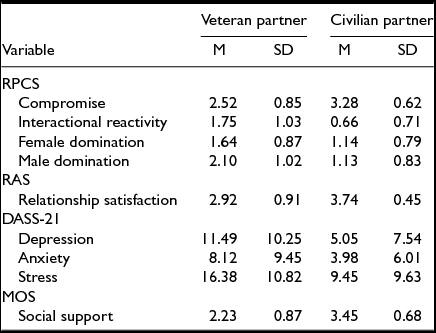
A series of independent samples t tests were performed to evaluate the differences in overall mean scores for the female veteran partner and civilian partner samples. The analysis included the comparison of group means on nine measures of Compromise, Interactional Reactivity, Female Domination, Male Domination, Relationship Satisfaction, Depression, Anxiety, Stress and Social Support. In order to control the familywise error rate, a Bonferroni adjustment was made to reduce the p value from .05 to .006. Table 1 shows the means and standard deviations obtained to determine the extent to which each group reported experiencing survey variables.
Means and Standard Deviations of Survey Scales for Female Veteran Partner and Civilian Partner Samples
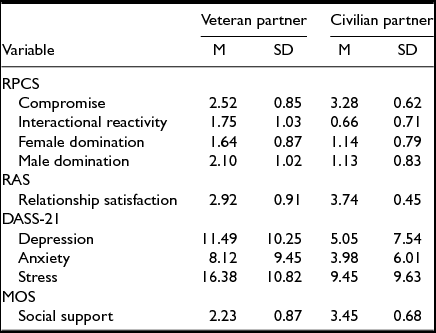
Note: RPCS = Romantic Partner Conflict Scale; RAS = Relationship Assessment Scale; DASS-21 = Depression Anxiety Stress Scale; MOS = The Medical Outcomes Study Social Support Survey.
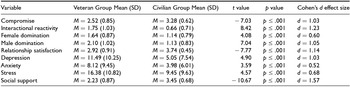
Table 2 summarises the results of the t tests, with significance levels and effect sizes for all nine variables for the two groups, the veteran group and the civilian group. These results show significant differences on all variables for the veteran group compared to the civilian group. On the Compromise scale as well as the Interactional Reactivity scale, Levene's test showed unequal variances (F = 5.44, p = .02), therefore degrees of freedom were adjusted from 182 to 175. Homogeneity of variance was met for the Female and Male Domination scale and the Stress scale from the DASS-21.
Table of t-test results for dependant variables for the Veteran and Civilian Groups

On the Relationship Satisfaction scale, Levene's test showed unequal variances (F = 23.28, p < .001), therefore degrees of freedom were adjusted from 182 to 143. For the Depression scale, Levene's test showed unequal variances (F = 5.44, p = .02), therefore degrees of freedom were adjusted from 182 to 175. There was a large effect size between the two groups (Table 2). For the Anxiety scale on the DASS-21, Levene's test showed unequal variances (F = 12.48, p = .001), therefore degrees of freedom were adjusted from 182 to 165 and results showed a medium effect size between the groups (Table 2).
To test the secondary hypothesis that perceived levels of social support are related to depression, anxiety, and stress for the veteran partner group, a multiple regression analysis was performed. Refer to Table 1 for means and standard deviations. With alpha set at .05, the linear combination of psychological distress measures was significantly related to perceived social support, R = .60, R 2 = .36, adjusted R 2 = .34, F(3, 93) = 17.42, p < .001, which represents a moderate effect size, f 2 = .56. A significant inverse relationship was found for depression, B = −.02, SE = .01, t(96) = −2.89, p = .01, and Anxiety, B = −.03, SE = .01, t(96) = −2.79, p = .01; however, stress did not contribute to variance in perceived social support, B = −.01, SE = .01, t(96) = −0.56, p = .58. This indicates that veteran partners who exhibited high levels of depression and anxiety tended to have lower perceived social support.
Discussion
In the current study, levels at which psychological distress was evident among Australian females romantically involved with Afghanistan War veterans were explored. Conflict and satisfaction in their romantic relationships were examined, along with female perceptions of available social support, which has been identified in the literature as major sources of distress for veteran partners (Galovski & Lyons, Reference Galovski and Lyons2004; O’Toole, Reference O’Toole, Outram, Catts and Pierse2010; Zacchilli et al., Reference Zacchilli, Hendrick and Hendrick2009). Due to existing literature suggesting psychological distress often increases when coping resources are insufficient, a secondary hypothesis aimed to investigate whether this trend was apparent within the veteran partner group (Dunkel-Schetter et al., Reference Dunkel-Schetter, Folkman and Lazarus1987; Dunt, Reference Dunt2009). As expected, results showed support for hypotheses 1 and 2, with significant differences between the two groups emerging in the predicted direction on all nine measures. Overall, females who were romantically involved with an Afghanistan veteran reported experiencing more psychological distress than females in the civilian population (O’Toole et al., Reference O’Toole, Outram, Catts and Pierse2010; Renshaw et al., Reference Renshaw, Blais, Caska, MacDermid Wadsworth and Riggs2011). Destructive conflict tactics were identified as being more common in veteran partner relationships, while constructive tactics when handling conflict were not. Consistent with the findings of Zacchilli et al. (Reference Zacchilli, Hendrick and Hendrick2009), these trends in relationship conflict and psychological wellbeing were accompanied by lower relationship satisfaction for female partners of veterans. Additionally, perceptions of functional social support were lower for this group than for the civilian partner group, with depression and anxiety identified as being significantly related to this reduced coping resource for females romantically involved with Australian veterans of the war in Afghanistan.
Romantic Partner Distress
The prediction that psychological distress would be considerably higher for female partners of veterans of the war in Afghanistan was largely supported by the data. Reflected by the assessment of depression, anxiety and stress levels, psychological distress for the veteran partner group fell within the severe classification, while the civilian partner group reported levels within the normal to mild range (Lovibond & Lovibond, Reference Lovibond and Lovibond1995). These findings are consistent with previous research showing elevated rates of psychological distress in veteran partner populations across multiple theatres of war (Galovski & Lyons, Reference Galovski and Lyons2004; O’Toole et al., Reference O’Toole, Outram, Catts and Pierse2010; Solomon et al., Reference Solomon, Waysman, Levy, Mikulincer, Benbenishty, Florian and Bleich1992). More specifically, results are in line with the research findings of O’Toole et al. (Reference O’Toole, Outram, Catts and Pierse2010), who found that female partners of Australian Vietnam veterans suffered higher rates of psychiatric disorders than the general Australian population. Although their findings were able to directly link female partner suffering to features specific to the veteran, results from the current study indicate a possible distress pattern emerging for some romantic partners of Australian Afghanistan veterans. While various conditions have been cited as contributing to distress and relationship breakdown for veterans and their partners, increases in veteran problematic behaviours and destructive conflict have been pinpointed as significantly related to distress in female partners (Demers, Reference Demers2009; Kelley et al., Reference Kelley, Athy, Cho, Erickson, King and Cruz2012; Killgore et al., Reference Killgore, Cotting, Thomas, Cox, McGurk, Vo, Castro and Hoge2008; Renshaw & Kiddie, Reference Renshaw and Kiddie2012). Communication in conflict situations is a significant factor (Bowles, Reference Bowles2010). One possible explanation is that females experience such events as stressors and, if coping resources are insufficient, over time negative emotions develop into more severe psychological distress (Lazarus, Reference Lazarus1999). Additionally, females who are less focused on winning arguments, withdrawing from conflict and using confusion as a strategy may not have optimum communication skills to manage conflict successfully, as posited by Bowles (Reference Bowles2010). Results of the current study seem to indicate that Australian females who are romantically involved with an Afghanistan War veteran are at an increased risk of psychological problems when compared to civilians in the Australian population.
Experiencing Romantic Partner Conflict
To understand how the romantic relationship might affect distress levels for female partners of veterans, methods of conflict management and relationship satisfaction were assessed. The hypothesis that female partners of Afghanistan veterans recount lower constructive tactics when dealing with conflict in their romantic relationship was largely supported by the current study. As indicated by levels of compromise, it seems that the veteran partner group reported experiencing less cooperation when faced with relationship conflict, with compromise being supported in the literature as closely linked to satisfaction and positive communication in romantic partnerships (Zacchilli et al., Reference Zacchilli, Hendrick and Hendrick2009). Compromise here is viewed as strategic conceding, which Bowles (Reference Bowles2010) indicates may be one of the elements in reducing the frequency and intensity of the intimate partner conflict. This finding supports the literature linking negative post-war behaviour changes in veterans to increases in destructive relationship exchanges (Galovski & Lyons, Reference Galovski and Lyons2004; Killgore et al., Reference Killgore, Cotting, Thomas, Cox, McGurk, Vo, Castro and Hoge2008). Consequently, when the current study assessed the hypothesis that destructive conflict would be greater in the veteran partner group, the data supported this proposition.
Negatively related to relationship functioning and satisfaction, destructive tactics of interactional reactivity and domination were greater for the veteran partner group in comparison to the civilian partner group. With interactional reactivity indicating verbal aggression and emotional volatility when handling conflict, these findings are consistent with finding lower constructive tactics. Results echo those from recent studies that have found that increased negative conflict exchanges often transpire when post-deployment challenges of combat-exposed veterans threaten the stability and security of a romantic relationship (Campbell & Renshaw, Reference Campbell and Renshaw2012; Hoge, Reference Hoge2010; Kelley et al., Reference Kelley, Athy, Cho, Erickson, King and Cruz2012). Furthermore, in comparison to the civilian partner group, the veteran partner group reported greater domination not only from the male veterans but also by the female partners themselves. A possible explanation is that, additional to post-combat behaviour changes for the veteran, challenges for the female partner in readjusting following deployments may create a situation based on a power struggle (Wadsworth, Reference Wadsworth2010). This proposition is supported in the literature, with Wadsworth (Reference Wadsworth2010) finding that female partner challenges (e.g., loss of independence and personal space) following deployment have the potential to result in negative relationship conflict. This possibly suggests that the increase in destructive conflict problems develop from interacting difficulties from either side of the romantic relationship following combat deployment, particularly when coping resources are insufficient (Dunkel-Schetter et al., Reference Dunkel-Schetter, Folkman and Lazarus1987).
Challenges to Relationship Satisfaction
Linked with the aforementioned results was support for the hypothesis that relationship satisfaction would be significantly lower for female partners of veterans in comparison to the civilian partner sample. While the reasons for dissatisfaction will be different for every couple, this finding indicates that, on average, relationships between Afghanistan veterans and their romantic partners are at a higher risk of dysfunction and/or dissolution (Fuhrman, Flannagan, & Matamoros, Reference Fuhrman, Flannagan and Matamoros2009). The results of the current study are supported by findings of Whitton and Whisman (Reference Whitton and Whisman2010), who found that dissatisfaction in romantic relationships increases instability in relationship functioning. Highly fluctuating relationship satisfaction is said to create uncertainty regarding the emotional security provided by a romantic relationship, which can then raise the risk of psychological distress and relationship breakdown (Whitton & Whisman, Reference Whitton and Whisman2010). Additionally, results from the current study are consistent with those of Zacchilli et al. (Reference Zacchilli, Hendrick and Hendrick2009), who reported that dissatisfaction in romantic relationships was significantly related to high levels of destructive conflict tactics of interactional reactivity and domination. Thus, results of the current study suggest difficult romantic conditions for some Australian Afghanistan veteran couples are potentially overwhelming the stability of the relationship quality. In turn, these conditions increase the threat of relationship distress, dysfunction and eventual dissolution.
Perceived Social Support and Coping Resources
Self-perceived social support has been identified in the literature as being a central modifier of personal coping (Dunkel-Schetter et al., Reference Dunkel-Schetter, Folkman and Lazarus1987). This was assessed to explore additional influences on levels of psychological distress. The hypothesis that female romantic partners of veterans would report lower levels of functional social support was confirmed by the current study. On average, lower social support was found to be apparent for the veteran partner group in comparison to the civilian partners, indicating possible deficiencies in coping resources important for females romantically involved with a veteran of the war in Afghanistan. These finding are consistent with the finding of Demers (Reference Demers2009), who established that although those with close relationships to veterans desire support from others when faced with post-deployment relationship challenges, they often had limited connections to effective support networks. The research by Demers (Reference Demers2009) adds to an explanation for low social support for female partners of veterans in two ways. First, due to the relocation of families in order to be located near military bases, often those in close relationships with serving veterans become separated from personal support networks of family and close friends. Second, Demers (Reference Demers2009) found that persons in close relationships with returned servicemen will avoid asking for help from others because of an internalised expectation that they should be able to cope with the pressures of supporting their partner, with self-silencing often occurring in order to prevent social judgment of the self and the veteran. Taken together with findings from the current study, this implies that low social support for female partners of veterans is possibly connected to environmental conditions relating to service with the ADF, both in Australia and as a result of facing negative challenges following combat deployments in Afghanistan.
The third hypothesis that levels of psychological distress would be related to perceptions of social support within the veteran partner sample was partially supported by the data. While levels of stress were not found to be connected, higher levels of depression and anxiety were found to be related to lower reported social support. These findings imply that while veteran partners are found to experience higher stress and destructive relationship conflict along with lower relationship satisfaction when compared to civilian partners, the development of more severe psychological distress may be mediated by effective coping resources. An increase in destructive interactions between romantic partners can produce negative emotions if situational demands are appraised as harmful (Perrewe & Zellars, Reference Perrewe and Zellars1999). However, it is likely that the continual experience of such emotions in the absence of valuable sources of help determines the extent of distress experienced. This is consistent with much of the literature, which has identified deficient social support as limiting female partners of veterans’ capacity to deal effectively with relationship distress, thus increasing psychological suffering (Cantrell & Dean, Reference Cantrell and Dean2005; Demers, Reference Demers2009; Galovski & Lyons, Reference Galovski and Lyons2004; Wadsworth, Reference Wadsworth2010). The findings of the current study offers support for the proposition that females who are romantically involved with Australian veterans of the Afghanistan war are at increased risk of developing their own symptoms of psychological distress. The recognition of such suffering highlights the need for further exploration to be carried out to identify areas of support required in order to minimise the risk of more serious psychological distress developing over time. An understanding of the typologies of communication style, as outlined by Bowles (Reference Bowles2010), and how typologies impact on relationship conflict may provide a more comprehensive means of understanding the factors that need to be addressed in therapeutic intervention. This is likely to have a positive outcome on the relationships of all couples.
Limitations and Future Directions
The findings of the current study should be considered in light of several limitations. First, the decision to compare female partners of Afghanistan War veterans to a civilian partner sample was based on the method employed by O’Toole et al.'s (Reference O’Toole, Outram, Catts and Pierse2010) study. While this proved successful in detecting difference between the two groups, the complexity of separating ADF service effects from increases in distress following combat deployments to Afghanistan requires further investigation. Although all females in the veteran partner group reported that their associated male veteran had been deployed to Afghanistan in an ADF combat role, no further information, such as number and length of deployments, could be collected due to operational security restrictions.
Recommendation
The current study identified many issues requiring further investigation to ensure the long-term health and wellbeing of romantic partners of ADF veterans of the Afghanistan war are supported. Given the findings of literature reviewed herewith, an additional recommendation is for relationship management training and conflict resolution skills to be considered for combat soldiers. Such training could supplement current ADF psychological health programs (see Gottman, Gottman, & Atkins, Reference Gottman, Gottman and Atkins2011). Supplying soldiers with knowledge and coping tools to effectively navigate relationship reintegration would provide support for the psychological health and wellbeing of both persons involved in the romantic relationship. The recommendation for the female partners is that the organisations such as Veterans and Veteran Counselling Services (VVCS) teach conflict management and communication skills, as well as connecting the women to supportive social networks.
Conclusion
In conclusion, the results of the current study indicate the importance of identifying relationship challenges faced by Australian Afghanistan veterans and their romantic partners, given the influence on female partner distress. Currently, this is one of the few studies that has gathered data to empirically explore both relationship and psychological distress in the context of Australian combat deployments to Afghanistan. The findings indicate that female partners of Afghanistan veterans exhibit increased levels of distress and destructive relationship conflict, along with lower relationship satisfaction and social support when compared to Australian females who are not connected with the ADF. If lessons learned following past wars are to be appreciated, such trends in relationship strain and suffering highlight an impending concern for the future health of ADF members and their families. Although future research is required to obtain a more complete understanding regarding situational factors relating to such distress, the current study affords a unique first step towards the recognition of a continuation of such issues within the modern war environment. The need to provide psychological assistance following combat deployment can no longer be considered to be necessary just for the combat soldiers themselves. Instead, a holistic approach to the minimisation of the after effects of combat deployment requires a much broader consideration of the wellbeing and safety of those to whom the soldier returns to, both between deployments and after their war has ended.