Introduction
The role of diet and nutritional factors in brain aging is attracting much research attention. A growing body of evidence links dietary patterns with cognitive abilities in old age. Evidence from observational studies suggests that a “healthy” diet is associated with better cognitive function. Some studies employed an a priori (hypothesis-based) approach to show that degree of adherence to a pre-defined “healthy” diet (using diet quality indices) was related to cognitive function in older individuals (Huijbregts et al., Reference Huijbregts1998; Wengreen et al., Reference Wengreen, Neilson, Munger and Corcoran2009), although these studies used only a brief and limited measure of global cognition, the Mini-Mental State Examination (MMSE). By contrast, one study reported a lack of association (Shatenstein et al., Reference Shatenstein2012). However, the a priori method makes assumptions about which specific food items constitute a healthy diet based on current nutritional research and does not take into account the complexity of the full diet (Allès et al., Reference Allès, Samieri, Féart, Jutand, Laurin and Barberger-Gateau2012). Only three studies, to our knowledge, have investigated the effects of overall dietary patterns, extracted a posteriori (based on correlations among all dietary components), on cognitive outcomes in healthy, old age populations. One study reported better cognitive performance (using the MMSE only) among the “healthy” dietary pattern, characterized by a higher intake of fruit, vegetables, and fish (Samieri et al., Reference Samieri, Jutand, Feart, Capuron, Letenneur and Barberger-Gateau2008). Studies using more comprehensive neuropsychometric tests assessing specific cognitive domains are limited (Akbaraly et al., Reference Akbaraly2011; Kesse-Guyot et al., Reference Kesse-Guyot, Andreeva, Jeandel, Ferry, Hercberg and Galan2012). In one study the “healthy” pattern was associated with better global cognitive function and verbal memory than the “traditional” pattern (Kesse-Guyot et al., Reference Kesse-Guyot, Andreeva, Jeandel, Ferry, Hercberg and Galan2012). In the other study, the observed associations between the “healthy” or “whole food” pattern and decreased odds of cognitive deficit on all cognitive tests (compared with the “processed” food pattern) in a sample of 60-year-old individuals were significantly attenuated by education (Akbaraly et al., Reference Akbaraly2011).
With this attenuation of a potentially important association in mind, and given that individual differences in cognitive abilities from youth strongly predict cognitive ability differences in old age (Gow et al., Reference Gow2011), and the adoption of health behaviors in adulthood (Batty et al., Reference Batty, Deary, Schoon and Gale2007; Anstey et al., Reference Anstey, Lowb, Christensen and Sachdev2009), it is plausible that the link between dietary patterns and cognitive performance is not causal. Rather, this association seen in observational studies could reflect a lifelong trait association between cognitive ability and diet choice. Education is sometimes used as a proxy measure for both prior cognitive ability and social background (Deary and Johnson, Reference Deary, Penke and Johnson2010), but no study to date has been able to control for prior cognition. Without a valid measure of early-life cognitive ability we cannot properly examine the extent to which diet influences cognition in old age, or conclude that adhering to a particular diet contributes to successful cognitive aging.
In the present study we investigate the extent to which prior cognitive ability (measured at the age of 11 years) and adult socioeconomic status (SES; assessed by occupation) account for the association between healthy dietary patterns and better cognitive functions in old age. The present study uses an a posteriori method of extracting dietary patterns.
Methods
Study population
The study sample was drawn from the Lothian Birth Cohort 1936 Study (LBC1936), an ongoing longitudinal study of cognitive aging, which comprises 1,091 men and women living independently in the community. Almost all participants were residing in Edinburgh and the surrounding Lothian region at recruitment. Early-life (mean (M) age 11 years) intelligence test data are available for this sample because most are surviving participants of the Scottish Mental Survey of 1947 (SMS1947; Deary et al., Reference Deary, Whalley and Starr2009). Assessment in later life took place between 2004 and 2007 when participants were aged about 70 years (M = 69.5 ± 0.8). Full recruitment and testing procedures are reported in an open-access protocol paper (Deary et al., Reference Deary2007). In brief, the assessment involved an interview, extensive cognitive testing, a physical examination, and questionnaires. Food frequency questionnaire (FFQ) data were available for 882 participants. Persons scoring <24 on the MMSE (n = 4) were excluded; using this cut-off reduces the risk of having persons with dementia in the sample. After exclusions, 878 persons remained for analyses. Ethics permission for the LBC1936 study protocol was obtained from the Multi-Centre Research Ethics Committee for Scotland (MREC/01/0/56) and from the Lothian Research Ethics Committee for Scotland (LREC/2003/2/29). The research was carried out in compliance with the Helsinki Declaration. All participants gave their written, informed consent.
Dietary assessment
Dietary patterns were assessed using the Scottish Collaborative Group FFQ version 7.0. The FFQ version 7.0 lists 168 foods or drinks and a common unit or portion size for each item is specified. Response to all items was on a 9-point scale, ranging from “rarely or never” to “7+ per day” in the previous two to three months. All participants (n = 1,091) were asked to complete the FFQ at home and return it by post. Of these questionnaires, 98 were not returned, 26 were returned blank, and 39 had >10 missing items and excluded from the analyses. A further 46 questionnaires were excluded due to having extreme energy intakes, defined as <2.5th or >97.5th centile for energy intake.
Identification of dietary patterns
Dietary factors were previously identified for this sample using principal components analysis (PCA) with varimax orthogonal rotation on all the FFQ items. Further details can be found in Mõttus et al. (Reference Mõttus, McNeill, Jia, Craig, Starr and Deary2011). Four main components were extracted, based on the examination of scree plots, which accounted for 11.67% of the total variance. Component scores were calculated using food items with factor loadings exceeding 0.30. The four components were labeled according to the types of foods with the highest factor loadings. The factor loadings of specific food items on each of the four dietary patterns identified are available as supplementary data (see Table S1 published as supplementary material online attached to the electronic version of this paper at http://journals.cambridge.org/ipg). A “Mediterranean-style” diet pattern (22 items) was defined by greater consumption of vegetables (such as leeks or courgettes, broccoli, salad vegetables) and also had positive loadings from fish, poultry, pasta, rice, water, tomato-based sauces, oil and vinegar dressing, and beans. The “health aware” diet pattern (14 items) was defined by eating more fruits (such as apples, bananas, tinned fruit, oranges, and others) and carrots, and had negative loadings from high consumption of meat products (bacon or gammon, pork or lamb, and sausages) eggs, and spirits or liqueurs. Both components essentially identified “healthy” dietary patterns. A “traditional” diet (ten items) was defined as eating more tinned vegetables, peas or beans, carrots, baked beans, bottled sauces, meat or chicken pies, pasties and sausage rolls, mashed potatoes, custard or other sweet sauces, milk-based puddings, and drinking less filter, espresso, or cappuccino coffee. This component identified a traditional Scottish dietary pattern, low in fruit and salad vegetables. The final component, a “sweet foods” diet (17 items), was defined as eating more puddings, cakes, biscuits, and chocolate. Factor scores were calculated by summing the frequency of consumption multiplied by factor loadings across all food items. In this way, each individual gets score values for each of the identified dietary patterns, indicating the degree to which the individual's diet conforms to the dietary pattern.
Cognitive assessment
Moray House Test (age 11 and 70 MHT IQ)
On 4 June 1947, about 95% of schoolchildren born in 1936 and attending Scottish schools (70,805) took a version of the Moray House Test (MHT) No. 12 (Scottish Council for Research in Education (SCRE), 1933; 1949). The MHT is a group-administered test of general intelligence. This test was concurrently validated against the Terman–Merrill revision of the Binet scales (SCRE, 1949). SCRE recorded and archived these scores and made them available to the LBC1936 study. Participants re-sat the MHT at a mean age of 70 years. MHT scores for the LBC1936 study were corrected for age in days at the time of testing and converted into intelligence quotient (IQ)-type scores for the sample (M = 100, SD = 15).
Other cognitive testing
Three cognitive domains are represented in the LBC1936 cognitive battery: general (g) cognitive ability, processing speed, and memory. The derivation of these factors by PCA has been described elsewhere (Luciano et al., Reference Luciano2009; Corley et al., Reference Corley, Gow, Starr and Deary2010a). A general (g) cognitive ability factor was derived from scores on six Wechsler Adult Intelligence Scale-IIIUK (WAIS-III) subtests (Wechsler, Reference Wechsler1998a), namely Letter-Number Sequencing; Matrix Reasoning; Block Design; Digit Symbol; Digit Span Backwards; and Symbol Search. A general (g) cognitive ability factor is well established in the literature (Deary et al., Reference Deary, Penke and Johnson2010). A processing speed factor was derived from scores on a set of mental speed measures, namely Symbol Search (WAIS-III); Digit Symbol (WAIS-III); Simple and Choice Reaction Time mean (Cox et al., Reference Cox, Huppert and Whichelow1993; Deary et al., Reference Deary, Der and Ford2001); and Inspection Time (a computer-based test of elementary visual processing speed; Deary et al., Reference Deary2004a). A memory factor was derived from scores on a set of memory measures from Wechsler Memory Scale-IIIUK (Wechsler, Reference Wechsler1998b), namely Logical Memory I immediate recall and II delayed recall; Spatial Span Forwards and Spatial Span Backwards; Verbal Paired Associates I immediate recall and II delayed recall; and two WAIS-III subtests (Letter-Number Sequencing, and Digit Span Backwards). Verbal ability was assessed using the National Adult Reading Test (NART; Nelson and Willison, Reference Nelson and Willison1991) and the Wechsler Test of Adult Reading (WTAR; Holdnack, Reference Holdnack2001). These tests are widely used to estimate prior cognitive ability and each requires the pronunciation of a list of 50 irregular words. The MMSE is a standardized brief screening measure for cognitive pathology (Folstein et al., Reference Folstein, Folstein and McHugh1975). Scores range from 0–30, with a score of <24 often used to indicate possible dementia.
Covariates
Covariates included age (in days at the time of testing) and sex. Adult SES was derived from participants’ (or their spouses’) highest reported occupation and classified into one of the following six categories: professional; managerial; skilled non-manual; skilled manual; semi-skilled; and unskilled (Office of Population Censuses and Surveys, 1980). For data analysis, classes 4 and 5 (semi-skilled and unskilled) were combined due to the small number of participants (n = 4) in class V. Age 11 IQ was derived from scores on the MHT, which participants sat for the SMS1947, as mentioned above. Raw scores were corrected for age in days at the time of testing and converted into IQ-type scores for the sample (M = 100, SD = 15).
Participants were also asked questions about their alcohol consumption (units per week); smoking (converted to pack years); and physical activity (coded as follows: 1 – “household chores”; 2 – “walking etc. 1–2 times a week”; 3 – “walking etc. several times a week”; 4 – “exercise 1–2 times a week”; 5 – “exercise several times a week”; 6 – “keep-fit/heavy exercise/sport several times a week”). Health measures included history of diabetes, stroke, or cardiovascular disease (CVD) (all coded as dichotomous variables, yes/no).
Statistical analysis
Analyses were performed using SPSS version 19 (IBM, NY, USA). We screened the data for outliers and excluded those individuals whose scores were greater than 3.5 SD from the sample mean for each dietary pattern: “Mediterranean-style” (n = 5); “health aware” (n = 6); “traditional” (n = 7); and “sweet” (n = 7). Classification of dietary patterns into tertiles was used to illustrate any demographic, dietary, and health differences within the patterns. We used one-way analysis of variance (ANOVA) for continuous variables, and Chi-square tests (χ 2) for categorical variables, to examine the relations between dietary patterns and characteristics of the participants. We report the p-value for trend. The main analyses examined the effects of dietary pattern scores, as continuous variables, and cognitive functions at age 70. For these analyses, we used a General Linear Model (GLM) approach in a series of models; each subsequent model was adjusted for a different set of covariates. All models contained age and sex. Model 2 added SES. Model 3 added age 11 IQ. Model 4 added SES and age 11 IQ. We report p-values (p < 0.05 as level of significance was used for all data analyses). We present relevant estimates of effect size, reported here as partial eta-square (ηp 2): ηp 2 is the proportion of the total variance attributable to a given factor. It is defined as the ratio of variance in the outcome accounted for by an effect, and that effect plus its associated error variance, within an ANOVA/GLM design.
Results
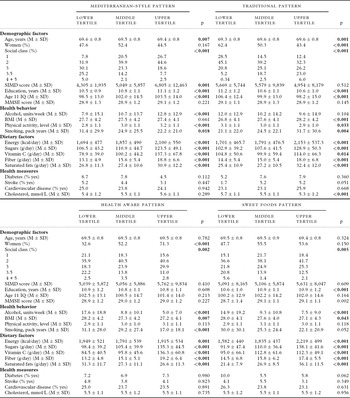
Table 1 shows the characteristics of study participants in relation to dietary patterns. Individuals with higher scores on the “Mediterranean-style” pattern were significantly younger, less deprived, belonged to a more professional social class, had more years of education and a higher age 11 IQ, consumed more alcohol, smoked less (in pack years), and were more physically active. Those with higher scores on the “traditional” pattern were significantly more likely to be males, older, have fewer years of education and a lower age 11 IQ, a higher body mass index (BMI), belong to a less professional social class, smoke more, and report less physical activity. In addition, those with more traditional diets had a lower prevalence of high (total) cholesterol. Those with higher scores on the “health aware” pattern were more likely to be females, belong to a less professional social class, smoke less and drink less alcohol, and have a lower BMI. Individuals with higher scores on the “sweet foods” pattern were more likely to have more years of education, a higher MMSE score, drink less alcohol, and have a lower BMI.
Characteristics of the sample as a function of dietary pattern scores at age 70

Note: Analysis of variance was used to examine continuous variables and χ 2-tests for categorical variables in relation to the differences between dietary pattern tertiles.
p-values in bold indicate statistical significance.
Dietary patterns and early-life cognitive ability
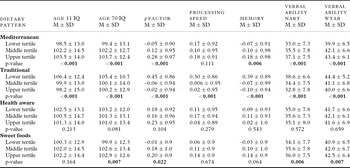
Table 2 shows the associations between dietary patterns and early-life cognitive ability (age 11 IQ). Higher scores on the “Mediterranean-style” pattern were associated with higher childhood IQ scores (p < 0.001). Between the lower and upper tertiles, there was an IQ difference of 5 points. Higher scores on the “traditional” dietary pattern (p < 0.001) were associated with lower childhood IQ scores; there was an IQ difference of 8.2 points between the lower and upper tertiles. There was no significant difference in childhood IQ scores between tertiles of the “health aware” and “sweet foods” dietary patterns.
Associations between dietary patterns, age 11 IQ, and cognitive outcomes at age 70

Notes: Each tertile X cognitive outcome has a reported mean and standard deviation.
Analysis of variance was used to examine the relationship between dietary pattern tertiles and cognitive outcomes at age 70 and we report the p-value for trend.
p-values in bold indicate statistical significance.
Dietary patterns and late-life cognitive ability
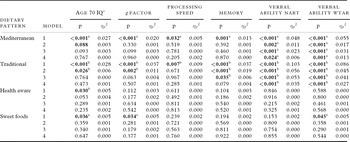
Table 3 presents the associations between dietary pattern scores (as continuous variables) and cognitive abilities at a mean age of 70 years. General linear models controlled for a different set of covariates at each stage (model). In the basic age- and sex-adjusted only model (model 1), the “Mediterranean-style” pattern was associated with significantly higher scores on all cognitive domains at age 70 (ηp 2 range 0.005 to 0.055). The “traditional” pattern was associated with significantly lower scores on all cognitive domains at age 70, most at p < 0.001 (ηp 2 range 0.028 to 0.10), and processing speed (p = 0.007 ηp 2 = 0.009). The magnitude of the relationships was stronger for verbal ability tests. The “health aware” pattern was associated with lower age 70 IQ scores. The “sweet foods” pattern was associated with higher scores on age 70 IQ, general (g) cognitive ability, and one of the verbal ability measures (WTAR). The range of effect sizes for the latter two dietary patterns was significantly smaller.
General linear models showing associations between dietary patterns and cognitive outcomes at age 70

Notes: *Age 70 IQ is already age-adjusted (age not included in the models for this outcome variable).
p-values in bold represent significant associations between dietary component and cognitive outcome.
Model 1: adjusted for sex and exact age at testing in later life; model 2: covariates as model 1 plus occupational social class; model 3: covariates as model 1 plus IQ at age 11 years from Moray House Test; and model 4: all covariates.
apositive associations; bnegative associations.
Generally, controlling for age 11 IQ and occupational social class (models 2, 3, and 4) strongly attenuated most of the associations between the dietary patterns and cognitive scores, and often reduced them to non-significance. These key results illustrate the significant roles that premorbid cognition and adult SES play in shaping the relationship between diet and cognition. For example, with only age and sex in the model it would appear that the “Mediterranean-style” diet accounts for 2.7% of the variation in age 70 IQ score. After adding, separately, occupational social class and age 11 IQ scores as covariates, this reduces to 0.3%, a marked attenuation. In the multivariable model that included age, sex, age 11 IQ, and occupational social class (model 4), only the relation of the “Mediterranean-style” pattern with the verbal ability measures remained statistically significant. However, the effect sizes were reduced by 88% for NART (from ηp 2 = 0.048 in model 1 to ηp 2 = 0.006 in model 4), and 76% for WTAR (from ηp 2 = 0.055 in model 1 to ηp 2 = 0.013 in model 4).
Similarly, the negative associations between the “traditional” dietary pattern and cognitive abilities were diminished after adjustment of covariates, particularly age 11 IQ. For example, in the basic model 1, the “traditional” dietary pattern appears to explain 2.8% of the variance in age 70 IQ, 3.7% in general cognitive ability, and 3.7% in memory performance. However, after adjustment for age 11 IQ, these associations are reduced to 0%, 0.4%, and 0.6%, respectively. In the multivariable model that included age, sex, age 11 IQ, and occupational social class (model 4), the only statistically significant associations to remain were with the verbal ability measures. However, the effect sizes were again markedly attenuated from ηp 2 = 0.103 (model 1) to ηp 2 = 0.035 (model 4) for NART, and ηp 2 = 0.086 (model 1) to ηp 2 = 0.027 (model 4) for WTAR. In model 1, persons with higher scores on the “health aware” foods dietary pattern scored more poorly on a test of age 70 IQ, although the effect size was small (ηp 2 = 0.005). In model 1, persons with higher scores on the “sweet foods” pattern scored better on tests of age 70 IQ, general (g) factor, and WTAR. The effect sizes for these associations were small (ηp 2 = 0.005). After adjustment for age 11 IQ and SES, independently and in combination, there were no longer any significant associations between the “health aware” and “sweet foods” dietary patterns and cognitive domain scores at age 70.
We ran additional analyses using the fully adjusted model 4, which tested for an interaction effect between each dietary pattern and childhood IQ. We found that the associations between one of the dietary patterns, “health aware,” and cognitive outcomes differed depending on level of prior ability (data not shown). This interaction effect was present for the following cognitive outcomes: age 70 IQ (p = 0.009), memory (p = 0.006), and both verbal ability measures (NART p < 0.001, WTAR p < 0.001). Examination of the scatterplots representing these relationships, and the fit lines of the subgroups split at the median (low IQ/high IQ), showed that in those with a lower childhood IQ, there was some evidence of a relative detrimental effect of an increased “health aware” diet on these cognitive outcomes. For those with a higher childhood IQ there were either no or slightly positive effects. Therefore, childhood IQ moderated the effect of a “health aware” diet on cognition, but only on some of the outcomes. However, the differences in effect sizes (ηp 2) between the low- and high-IQ groups were small, e.g., 0.006 for age 70 IQ scores (0.009 and 0.003 respectively). We found no such moderation effects of adult SES and dietary patterns on cognitive outcomes.
Discussion
In this study we examined associations between four empirically derived dietary patterns and important domains of cognitive function in a UK sample of men and women aged about 70 years. Before adjustment for childhood IQ and SES, our results suggested that following a “Mediterranean-style” diet was associated with better cognitive function, and following a “traditional” diet was associated with poorer cognitive function on all cognitive domains tested: IQ, general (g) cognitive ability factor, processing speed, memory, and verbal ability. This is consistent with some previous findings examining effects of diet on cognition in older age. We found, however, that current cognitive function was no longer associated with dietary patterns after adjustment for childhood IQ and adult SES. Only a small positive association persisted between the “Mediterranean-style” diet, and a small negative association between the “traditional” diet, and verbal ability. The relationship between the “health aware” dietary pattern and some of the cognitive measures (age 70 IQ, memory, and verbal ability) was moderated by childhood cognitive ability such that those with a lower childhood IQ consuming an increased “health aware” diet (characterized by a high consumption of fruit and low consumption of meats, eggs, spirits, and liqueurs) were at a relative disadvantage on these cognitive domains. The converse was true for those with a higher childhood IQ. However, the differences in effect sizes were small, and given that the “health aware” dietary pattern had little predictive value in the main analyses, these results may have limited clinical significance. Whereas there is a well-established link between a healthy, whole food diet, and a reduced risk of cognitive deficit, we found no evidence to suggest that this link is causal. Our hypothesis that the relationship between dietary patterns and cognition in old age might be confounded by childhood cognitive ability, and adult SES, was supported. This is, to our knowledge, the first study to examine the relationship between dietary patterns and cognition using a direct measure of cognitive ability obtained in youth to control for premorbid cognition. We used dietary patterns, derived using an a posteriori (data-driven) approach, to examine trends among food components from the overall diet rather than relying on a measure of adherence to a particular dietary pattern.
There has been much research attention focused on the effects of a healthy dietary pattern and reduced risk of chronic disease, particularly coronary heart disease (CHD) (McCullough et al., Reference McCullough2002; Hoffmann et al., Reference Hoffmann, Zyriax, Boeing and Windler2004; Drogan et al., Reference Drogan, Hoffmann, Schulz, Bergmann, Boeing and Weikert2007; Liu et al., Reference Liu, Nettleton, Bertoni, Bluemke, Lima and Szklo2009; Chiuve et al., Reference Chiuve2012) and diabetes (Fung et al., Reference Fung, McCullough, van Dam and Hu2007; DiBello et al., Reference DiBello, Kraft, McGarvey, Goldberg, Campos and Baylin2008) as well as other outcomes such as mortality (Hamer et al., Reference Hamer, McNaughton, Bates and Mishra2010) and Alzheimer's disease (Scarmeas et al., Reference Scarmeas, Stern, Tang, Mayeux and Luchsinger2006a; Reference Scarmeas, Stern, Mayeux and Luchsinger2006b; Reference Scarmeas2009a). Despite methodological differences between studies, dietary patterns characterized by a higher intake of fruit and vegetables, fish, and legumes and lower intake of red meats, processed foods, sweets, and saturated fats seem to be associated with the lowest risk of chronic disease (Gu and Scarmeas, Reference Gu and Scarmeas2011). However, studies investigating possible links between dietary patterns and cognitive changes associated with non-pathological aging are sparse. One line of investigation has focused solely on the health-promoting effects of the Mediterranean diet. It is characteristically rich in plant foods (fruit, vegetables, nuts, legumes, and cereals), wine, fish, and olive oil, and low in red meat and poultry. Adherence to this particular dietary pattern, measured using diet quality indices, has been widely reported to offer the best protection against cognitive aging in epidemiological studies (Féart et al., Reference Féart2009; Reference Féart, Samieri and Barberger-Gateau2010; Scarmeas et al., Reference Scarmeas, Stern, Mayeux, Manly, Schupf and Luchsinger2009b; Tangney et al., Reference Tangney, Kwasny, Li, Wilson, Evans and Morris2011). However, studying this dietary pattern in isolation is questionable, as the diets of certain populations, including the United Kingdom, may not closely resemble those of people living in Mediterranean countries.
In the three previous studies to date, which used a similar exploratory approach to determine distinct dietary patterns, there have been differences in derived dietary factors. Typically, two main factors emerge representing a “whole-food” or “healthy” dietary pattern, associated with better cognitive functioning, and a “processed-food” or “traditional” pattern, associated with poorer cognitive functioning (Akbaraly et al., Reference Akbaraly2011; Kesse-Guyot et al., Reference Kesse-Guyot, Andreeva, Jeandel, Ferry, Hercberg and Galan2012). Another study identified five dietary patterns using cluster analysis rather than PCA. Here the dietary pattern labeled as “healthy” was characterized by higher consumption of fish in men and fruit and vegetables in women, and was related to better cognitive performance (Samieri et al., Reference Samieri, Jutand, Feart, Capuron, Letenneur and Barberger-Gateau2008). The current study found the two ubiquitous dietary patterns, namely “Mediterranean-style” and “traditional.” The “traditional” pattern described in our study loaded highly on foods such as meat, pies, pasties and sausage rolls, mashed potatoes, tinned vegetables, and milk puddings, and represents a traditional (in Scotland) convenience diet. Two additional patterns, “health aware” and “sweet foods,” accounted for a smaller percentage of the variance and were less predictive of cognitive outcomes. However, the four patterns identified in this study are not dissimilar to those found in other UK populations, and the percentage of the variance in the diet explained by these factors is comparable (Hamer et al., Reference Hamer, McNaughton, Bates and Mishra2010).
Of these studies, the cognitive measures used have also varied from the MMSE only (Samieri et al., Reference Samieri, Jutand, Feart, Capuron, Letenneur and Barberger-Gateau2008) to more comprehensive test batteries representing global cognitive function, verbal memory, and executive functioning (Kesse-Guyot et al., Reference Kesse-Guyot, Andreeva, Jeandel, Ferry, Hercberg and Galan2012). Although their outcome was pathological aging, one further study paper (using a data-driven method) identified a dietary pattern similar to the “Mediterranean-style” pattern which was strongly protective of Alzheimer's disease risk (Gu et al., Reference Gu, Nieves, Stern, Luchsinger and Scarmeas2010). Due to methodological differences in terms of the approaches used to quantify dietary patterns and the variations in cognitive endpoints measured, making comparisons between studies is problematic. That said, the present study supports and adds to the finding of Akbaraly et al. (Reference Akbaraly2011) in that confounding plays a significant role in the relationship between dietary patterns and cognitive function to the extent that factors other than diet account for the majority of variance in the observed associations (Akbaraly et al., Reference Akbaraly2011). In addition, in a recent paper by Shatenstein et al. (Reference Shatenstein2012), although based on an a priori diet quality measure, a similar pattern of results emerged. The observed association between higher diet quality scores and better performance on the Modified Mini-Mental State examination disappeared after controlling for a set of potential confounders which included education (measured in years) and family income.
In our analysis, the dietary patterns–cognition relationship in old age could be accounted for, largely, by individual differences in prior ability (childhood IQ) and adult, occupation-based SES. This accords with the findings of some of our other studies where the same observation was made when alcohol consumption, (Corley et al., Reference Corley2011), BMI (Corley et al., Reference Corley2010b), and physical activity (Gow et al., Reference Gow, Corley, Starr and Deary2012a) were the health behaviors/lifestyle factors measured as putative determinants of differential cognitive aging. This is the only study to date to be able to directly control for prior ability in the dietary patterns–cognition relationship, using a well-validated measure taken in youth. Individual differences in cognitive function across the lifespan are highly stable, with correlations between 0.6 and 0.7 between age of 11 and 70–80 years (Deary et al., Reference Deary, Whalley, Lemmon, Crawford and Starr2000; Reference Deary, Whiteman, Starr, Whalley and Fox2004b; Gow et al., Reference Gow2011). Despite this, many studies designed to assess the extent of cognitive impairment in old age do not include data on early-life cognitive function, as it is rarely available. Traditionally, premorbid ability has been estimated via indirect sources such as education and tests of vocabulary and pronunciation. However, these proxy measures are somewhat inadequate as they reflect life circumstances and knowledge; factors hypothesized to contribute to cognitive decline (Johnson et al., Reference Johnson, Corley, Starr and Deary2011).
The current study lends further support to the possibilities of reverse causation or confounding, the former indicating that individuals with a higher childhood cognitive ability are more likely to adopt healthy eating patterns in later life and vice versa. This finding has been documented for several other health behaviors, including smoking (Kubicka et al., Reference Kubicka, Matejcek, Dytrych and Roth2001; Taylor et al., Reference Taylor2003), alcohol consumption, physical activity (Batty and Deary, Reference Batty and Deary2004; Anstey et al., Reference Anstey, Lowb, Christensen and Sachdev2009) and diet (McNeill et al., Reference McNeill2011). In the LBC1936 study, McNeill et al. (Reference McNeill2011) reported some evidence of reverse causation in associations between vitamin C intake and NART, and verbal fluency; childhood IQ was found to cause marked attenuation. Higher lifetime trait IQ was also found to predict vitamin supplement use rather than supplement use predicting IQ in old age. Similarly, in the Danish Glostrup 1914 cohort, Gow et al. (Reference Gow, Mortensen and Avlund2012b) reported that greater physical activity was no longer associated with less cognitive decline, after adjustment for baseline cognitive ability. They suggest that this indicates reverse causation or “preserved differentiation,” that is, more active individuals had a higher lifetime cognitive ability.
Although the current study is based on a healthy, non-pathological aging sample, it is plausible that the same mechanism may underlie the widely reported association between the Mediterranean diet and the risk of dementia or Alzheimer's disease (see Allès et al., Reference Allès, Samieri, Féart, Jutand, Laurin and Barberger-Gateau2012). Although there is a wealth of data to suggest that higher premorbid cognitive ability is protective of decline in later life (e.g., Bourne et al., Reference Bourne, Fox, Deary and Whalley2006; Gow et al., Reference Gow2011), the association with dementia risk is less consistent. Lower childhood intelligence was found to predict late- (but not early-)onset dementia (Whalley et al., Reference Whalley, Starr, Athawes, Hunter, Pattie and Deary2000). However, McGurn et al., (Reference McGurn, Deary and Starr2008) reported that it was a risk factor for vascular dementia but not Alzheimer's disease. Some research suggests that the midlife diet may better predict dementia in late life as it reduces the impact of any recent changes to diet due to health status or cognitive impairment (i.e., reverse causation). Some studies have reported no association between risk of dementia in later life and dietary antioxidant intake at midlife in a male sample (Laurin et al., Reference Laurin, Masaki, Foley, White and Launer2004) and with midlife fruit and vegetable intake in males (Hughes et al., Reference Hughes2010); however, there was a reduction in risk with increasing fruit and vegetable intake in women. A moderate intake of saturated fats in midlife was associated with an increase in risk of dementia and Alzheimer's disease (Laitinen et al., Reference Laitinen2006). Although findings are often inconsistent, prospective studies are important for research on the etiology of cognitive aging; dietary assessment at midlife and/or measures of long-term dietary intake likely reduce the possibility of confounding or reverse causation by factors caused by the disease process in later life. Whether the same pathways linking cognition and diet identified in the current study are relevant to dementia risk, requires further research from longitudinal studies.
There are several ways in which childhood IQ and SES could be related to dietary patterns. First, it could work via knowledge about nutrition (Wardle et al., Reference Wardle, Parmenter and Waller2000). People with lower cognitive ability may be less likely to acquire the concepts and knowledge to ensure a healthy diet and make favorable food choices. The 1970 British Cohort Study (BCS70) found that those with a higher childhood mental ability score reported a significantly higher intake of fruit, vegetables, wholemeal bread, poultry, fish, and foods fried in vegetable oil in adulthood, and a lower intake of chips, non-wholemeal bread, cakes, and biscuits in adulthood (Batty et al., Reference Batty, Deary, Schoon and Gale2007). The second way in which childhood IQ and SES could be linked to dietary patterns is via financial circumstances. Higher cognitive ability scores in childhood predict advantageous social circumstances in adulthood, including job and financial attainment and a higher SES (Deary et al., Reference Deary2005). Diet quality follows a socioeconomic gradient (Hare-Bruun et al., Reference Hare-Bruun, Togo, Andersen and Heitmann2011); lower quality diets (consisting of cheaper foods with a lower nutritional value) are more likely to be consumed by those with lower education/SES and more limited economic means. Third, it might come about via self-management of health. IQ may affect how people interpret and respond to health advice (Taylor et al., Reference Taylor2003). IQ is associated with levels of health literacy, a crucial factor in health management (Murray et al., Reference Murray, Johnson, Wolf and Deary2011). Essentially, cognition may influence the extent to which people manage their own risk for cognitive decline. Anstey et al. (Reference Anstey, Lowb, Christensen and Sachdev2009) proposed an interactive cycle involving cognition, self-management of health (including diet), and ultimate cognitive outcomes. The current study supports this possible mechanism.
Therefore, controlling for childhood cognitive ability is advantageous in order to properly test whether there is any variance in cognitive function in old age explained by diet over and above that explained by an individual's prior ability. Some associations were found between higher “Mediterranean-style” pattern scores and better verbal ability, but only on one of the tests, and higher “traditional” pattern scores and poorer verbal ability, although both were markedly attenuated after adjustment. This may be a true finding. However, it is possible that some associations persist between dietary patterns and verbal ability because verbal ability tests, such as the NART and WTAR, reflect one's peak level of cognitive ability in adulthood. Such tests are purported to reflect one's crystallized intelligence, which is related to education and intellectual, social, and cultural development across the lifespan, not necessarily captured by tests such as the MHT. Compared with the skills measured by traditional IQ-type tests, verbal ability is relatively unaffected by non-pathological (Carroll, Reference Carroll1993; Schaie, Reference Schaie1996) and pathological age-related changes (McGurn et al., Reference McGurn2004). In addition, peak adult cognitive ability is likely to be associated with lifestyle preferences that influence the adoption of health behaviors, including diet, supporting the concept of reverse causation. Furthermore, the proportion of the total variance in verbal ability scores explained by these dietary patterns was between 0.6% and 1.30% for the “Mediterranean-style,” and approximately 3.0% for the “traditional” dietary pattern. These effect sizes are small. However, around 50% of the variance in cognitive abilities in old age is explained by childhood IQ. It is likely that a large number of lifestyle/behavioral predictors will have small effects, so it is inevitable that the effect sizes of other variables will be relatively small. These effect sizes are comparable to those consistently cited behaviors linked with cognitive aging – smoking and physical activity (as well as apolipoprotein E (APOE)) – which account for 1–2% of the variance. It is important to know the effects of lifestyle predictors, such as diet, so that we can discover the combination of factors that might help people age better.
Strengths and limitations
In contrast with the conventional approach, which focuses on a single nutrient or a few nutrients or foods in isolation, identifying dietary patterns takes into account overall eating patterns. The current study has the advantage of using a data-driven approach to determine dietary patterns, independent of previous hypotheses, to explore the factors that account for correlations among reported food components in the overall diet. On the other hand, the a priori method of measuring diet quality makes assumptions about what constitutes a healthy diet based on current theory regarding nutrition (Allès et al., Reference Allès, Samieri, Féart, Jutand, Laurin and Barberger-Gateau2012). Further strengths of this study include the large sample size, narrow age cohort (minimizing age and cohort effects), and data collection using a well-validated questionnaire and comprehensive cognitive (and covariate) measures. Most notably, we have a repeated measure of cognitive abilities at two distinct time-points across the lifespan (age 11 and 70 years). A direct measure of prior cognitive ability is rarely available. An advantage of using a measure of IQ obtained in youth is the lower prevalence of known conditions which might impact on IQ/cognition such as hypertension (Manolio et al., Reference Manolio, Olson and Longstreth2003) and diabetes (Awad et al., Reference Awad, Gagnon and Messier2004).
Inevitably, there were also some limitations. We used a single measure of diet (FFQ) designed to capture dietary habits in the short term, but not necessarily representative of dietary habits over a longer period of time. Although a potential limitation, the FFQ (Masson et al., Reference Masson2003) has good repeatability (dietary intake in later life is reasonably stable in the short term) and good validity for most nutrients in community-dwelling older populations (Jia et al., Reference Jia, Craig, Aucott, Milne and McNeill2008; McNeill et al., Reference McNeill, Winter and Jia2009). The four extracted dietary components explain less than 12% of the variance. Hence, it could be argued that major dietary effects on cognition could occur in the remaining 88% of the shared variance, or that specific food types might be associated with higher cognitive scores. A further potential limitation relates to the influence of age-related cognitive decline on dietary choices, e.g., the adoption of more convenience foods as represented by the “traditional” dietary pattern. Reverse causation of this kind may distort the observed associations. That said, we excluded persons based on the MMSE score, and therefore we were confident that the current samples were free from cognitive impairment. Furthermore, the LBC1936 study is a self-selecting sample. Compared with the general population, it is likely to be healthier and more cognitively able. Of course, given our interests in the lifelong association between dietary patterns and cognitive abilities, it would have been useful to have information on dietary patterns from childhood, and more information on both diet and cognition from points in the life course between the age of 11 and 70 years.
Conclusions
Dietary patterns are a promising strategy for analyzing the associations between food and cognitive performance in epidemiological investigations. However, our findings urge caution in interpreting diet–cognition associations as causal effects in that direction. Our results suggest a pattern of reverse causation (or confounding); a higher childhood cognitive ability (and adult SES) might predict choice of and/or adherence to a “healthy” dietary pattern and better cognitive performance in old age. Our models show no direct link between diet and cognitive performance in older age; instead, they raise the possibility that they are related via the lifelong stable trait of intelligence.
Conflict of interest
None.
Description of authors’ roles
J. Corley was involved in data collection, performed the statistical analyses, and led the writing of the paper. J. M. Starr and I. J. Deary contributed to study design, interpretation of analyses, and drafting of the manuscript. G. McNeill contributed to the interpretation of analyses and drafting of the manuscript.
Acknowledgments
The LBC1936 data were collected using a Research Into Ageing programme grant; this research continues as part of the Age UK-funded Disconnected Mind project. We thank the Scottish Council for Research in Education for allowing access to the SMS1947. We thank the LBC1936 study participants. We thank Dr Leonie Craig at the University of Aberdeen who was responsible for quantifying the dietary pattern data. J. M. Starr and I. J. Deary are members of The University of Edinburgh Centre for Cognitive Ageing and Cognitive Epidemiology, part of the cross council Lifelong Health and Wellbeing Initiative (G0700704/84698). Funding from the Biotechnology and Biological Sciences Research Council (BBSRC), Engineering and Physical Sciences Research Council (EPSRC), Economic and Social Research Council (ESRC) and Medical Research Council (MRC) is gratefully acknowledged.