





Introduction
A high frequency of transmission from one host to another is known to select pathogens for increasing virulence (Alizon et al., Reference Alizon, Hurford, Mideo and Van Baalen2009; Cressler et al., Reference Cressler, McLeod, Rozins, J and Day2016). The present study draws attention to the often-overlooked fact that transmission frequency is not only determined by the occurrence of opportunities to transmit but also by the parasites’ decision whether to take advantage of these opportunities.
All parasites occupy a patchy habitat, where the host individuals constitute more-or-less distant, potentially habitable patches. However, hosts are mortal and, therefore, make short-lived islands. This makes the ability to transmit from host to host a key adaptation for every parasite. Indeed, 1 of the 2 significant causes of parasite mortality is their loss during transmission (the other being loss due to host defences) (Rózsa and Garay, Reference Rózsa and Garay2023). Myriads of parasite transmission strategies can be observed in Nature, often in surprisingly delicate and complex forms. Since body size and structure differ across developmental stages, the costs and benefits of transmission will differ accordingly, leading to age-dependent dispersal strategies. For example, most micro- and macroparasites – and the endoparasites in particular – possess a distinct transmissive stage in their life cycle: propagules released from the host body into the environment, ready to invade new host individuals (Goater et al., Reference Goater, Goater and Esch2014). Contrarily, some ectoparasite species lack a specialized transmission stage in their life cycle; instead, all their mobile stages (nymphs or larvae, and adults, but not the eggs) are capable of transmission.
The present study focused on determining the optimal strategy for age-dependent transmission of an ectoparasite. It examined how parasites optimize the decision to transmit to a new host at different developmental stages. To analyse the evolution of transmission decisions, avian lice (Insecta: Psocodea: Phthiraptera), a group of obligate ectoparasitic insects widely used as model systems in studies of host–parasite interactions, were selected as model organisms from among the many available possibilities.
They constituted an optimal choice due to their straightforward and well-understood life cycle. Avian lice lack a separate transmissive stage in the life cycle; their eggs are firmly attached to the feathers, but the 3 nymphal stages (a.k.a. larvae or instars) and the adults (a.k.a. imagoes) can crawl from one bird to another (Johnson and Clayton, Reference Johnson, Clayton, Price, Hellenthal, Palma, Johnson and Clayton2003; Gustafsson et al., Reference Gustafsson, Zou, Li and Sun2024). This transmission mode is strictly dependent on the body-to-body contact between the host individuals. Not surprisingly, vertical transmission (along the parent-offspring route) is the most frequent way of louse dispersion, given the long period of sharing a nest (Clayton and Tompkins, Reference Clayton and Tompkins1994; Lee and Clayton, Reference Lee and Clayton1995; Brooke, Reference Brooke2010). Horizontal transmission during host copulation also occurs (Hillgarth, Reference Hillgarth1996), and some lice can actively and purposefully use Hippoboscid flies as phoretic hosts (Harbison et al., Reference Harbison, Jacobsen and Clayton2009). For simplicity, the present study was focused exclusively on vertical transmission, from parent birds to nestlings, as their primary transmission route.
Almost all bird species have many direct body-to-body contacts between parents and nestlings (chicks) during the breeding season (with the brood parasitic cuckoos as an evident exception). This creates an opportunity for the lice living in the parents’ plumage to invade a nestling or to stay on the parent bird. How this decision is made is a question that apparently nobody has asked before.
Within avian life cycles, the highest mortality rates occur during the nestling and fledging periods (Ricklefs, Reference Ricklefs2000). On the other hand, if the nestling survives and develops into an adult bird, it is likely to outlive its parents and to produce more nestlings in the future (creating more chances for transmission) than its parents. From the parasites’ point of view, therefore, transmission from a parent bird to a nestling is a high-risk, high-benefit decision, while staying on the parent bird is a low-risk, low-benefit decision.
There is little published information about avian lice transmission along the parent-offspring route. These sources unanimously state that some lice stay on the parent birds, while others transmit to nestlings. Further, different developmental stages are not equally prone to transmission. The few studies comparing the louse developmental stage distribution between parents and nestlings indicate that nymphs are overrepresented among the lice transmitted to chicks of the Blackbird (Turdus merula), Imperial Shag (Leucocarbo atriceps) and the Common Swift (Apus apus) (Lee and Clayton, Reference Lee and Clayton1995; Brooke, Reference Brooke2010; Leonardi et al., Reference Leonardi, Svagelj, Gómez Laich and Quintana2018). The latter authors distinguished 3 age groups among Swift chicks, and the youngest chicks carried by far the highest proportion of nymphal lice. Moreover, newly fledged young birds, such as Auks (Alcidae), often carry disproportionately more nymphal parasites than adult birds (Eveleigh and Threlfall, Reference Eveleigh and Threlfall1976). Unfortunately, none of the above authors has provided transmission data separately for the 3 nymphal stages.
The analysis described below aimed to explain why louse nymphs transmit from parents to nestlings more readily than adults. To address this question, the optimal parasite transmission strategy during the breeding period is determined with the aim of maximizing the number of birds infested by a focal female parasite and her descendants at the end of the breeding season.
Materials and methods
What kind of parasite success does selection maximize?
A key question before developing a model is determining the index that adaptation maximizes through evolution, measuring evolutionary fitness. Does selection maximize the evolutionary success of individuals (varieties), as most subsequent authors interpret Darwin (Reference Darwin1859)? Does it maximize the evolutionary success of ‘selfish’ genes (alleles) (Hamilton, Reference Hamilton1964; Williams, Reference Williams1966)? Or, alternatively, should group selection theory (Leigh, Reference Leigh2010) be adopted to focus on the survival of groups? After all, what is natural selection optimizing?
It is a widely accepted view that selection is a hierarchical process (i.e. multilevel selection; see Okasha, Reference Okasha2006); however, note that its effect on different levels of biological hierarchy can be markedly different. In evolutionary ecology, it is often presumed that selection acts on individuals to maximize the number of offspring that survive into the next generation, which may not hold true for populations with overlapping generations. Garay et al. (Reference Garay, Csiszár and Móri2017) investigated the objective function maximized by natural selection. They discovered that both the ‘selfish strategy’ (which maximizes an individual’s lifetime reproductive success) and the ‘survival strategy’ (which maximizes the probability of non-extinction for descendants) are outcompeted by the so-called ‘Darwinian strategy’. This latter strategy maximizes the long-term growth rate of a lineage (cf. Garay et al., Reference Garay, Varga, Gámez and Cabello2016). In this interpretation, lineages are made up of individuals that are connected by genetic inheritance along parent–offspring relationships.
Accordingly, the parasite strategy that produces the largest number of surviving offspring may not necessarily be the optimal one. Instead, the optimal parasite transmission strategy is the one which results in the highest number of infested birds at the end of the breeding season. Therefore, the present analyses are focused on parasite ‘lineage success’ rather than ‘individual success’. This means, for example, that producing 10 parasite offspring that all infest a single bird constitutes less success than producing 5 + 5 offspring that infest 2 different birds. Thus, in the arguments below, the objective function to be maximized by natural selection acting on parasites’ decisions is the number of infested birds at the end of the breeding season.
Model species
The feral pigeon (rock pigeon, Columba livia domestica) and the slender pigeon louse (Columbicola columbae) constitute the most intensively studied and most meticulously described bird–louse system. Therefore, the present model parameters were chosen to mimic these species’ life cycles and population dynamics parameters as realistically as possible. However, these parameter values are simplified to averages, thus, their natural variability is neglected. Further, it was necessary to include some arbitrary variables when the realistic parameters were unknown.
Host parameters
Feral pigeons typically lay 2 eggs in a clutch and then raise 2 nestlings. About 50% of birds die during their 1st year as nestlings or juveniles (before the first breeding attempt). Another 20% die during the 2nd year, while 10% die during each of the 3rd, 4th and 5th years. These parameters are simplified data obtained from a monograph by Johnston and Janiga (Reference Johnston and Janiga1995).
Slender pigeon lice cannot infest nestlings before a suitable plumage layer emerges on their body. Although there is no information about the exact timing of the first infestations, it is safe to presume that it starts at about the chicks’ 10th day of age, when their independent thermoregulation arises. The nestlings become independent on the 30th day (Johnston and Janiga, Reference Johnston and Janiga1995). Thus, the time window for vertical transmission through body-to-body contact is 20 days.
Parasite parameters
The full life cycle of the slender pigeon louse lasts about 65 days; the egg stage lasts 4 days, the 3 nymphal stages last 7, 7 and 7 days, and the adults live about 40 days. Females lay 1 egg approximately every other day. The eggs are firmly attached to the feathers, but the nymphs and adults are free to move on to another host or remain on the original one. These parameters are simplified data obtained from the monographs by Martin (Reference Martin1934) and Eichler et al. (Reference Eichler, Zlotorzycka, Ludwig and Stenram1972).
The quantity of lice representing different age classes and sexes on a typical feral pigeon is hard to assess due to the high variability of infestation indices. While there are several papers describing slender pigeon louse infestations quantitatively in feral pigeons, unfortunately, only one of them provided median intensities (interpreted as a ‘typical level’ of infestation; Reiczigel et al., Reference Reiczigel, Marozzi, Fábián and Rózsa2019). Thus, following Rana et al. (Reference Rana, Gupta, Bhardwaj and Khan2022), this parameter is fixed at 50. The proportions of lice belonging to different developmental stages are hard to assess because the body size differences cause a considerable sampling bias (Galloway and Lamb, Reference Galloway and Lamb2021). Based on data by Nelson and Murray (Reference Nelson and Murray1971), the proportions of the 3 nymphal and the adult stages are 24%, 23%, 15% and 38%, respectively. The sex ratio (the proportion of males) of the slender pigeon louse is usually close to 50%, more often slightly female-biased (see e.g. Galloway and Palma, Reference Galloway and Palma2008; Galloway and Lamb, Reference Galloway and Lamb2014, Reference Galloway and Lamb2015; Rana et al., Reference Rana, Gupta, Bhardwaj and Khan2022), rarely slightly male-biased (Černý, Reference Černý1970).
Thus, a typically infested feral pigeon harbours a total of 50 slender pigeon louse individuals: 12 1st-stage nymphs, 11 2nd-stage nymphs, 8 3rd-stage nymphs, 9 adult males and 10 adult females.
Parent–offspring transmission in the nest
Most avian lice live deep inside the layer of feathers to avoid bird grooming, preening with the bill and scratching with the legs. (Some, like the slender pigeon louse, also often hide in the spaces between the barbs near the rachis on the underside of the primaries, secondaries and rectrices, Bush et al., Reference Bush, Sohn and Clayton2006.) However, to transmit from one bird to another, lice must come to the outer surface of the plumage (Hillgarth, Reference Hillgarth1996). This risky localization during transmission makes them exposed to grooming (Bush and Clayton, Reference Bush and Clayton2023), desiccation (Moyer et al., Reference Moyer, Drown and Clayton2002) and accidental detachment (Bush et al., Reference Bush, Sohn and Clayton2006). Hence, it is reasonable to presume that transmission from one host to another carries a significant mortality risk for lice. Unfortunately, there are no studies in the literature to quantify this risk.
As mentioned above, empirical studies provide no information about which nymphal stage transmits to nestlings more readily than others. The transmission success is presumably dependent on the size of sensory organs for better orientation and also on the size of limbs for stronger attachment and faster movement. Additionally, the body surface area of larger individuals is relatively smaller (in relation to body mass), which makes desiccation less of a threat to them. Thus, the 3rd-stage nymphs, being the largest of nymphal stages, appear to be better adapted for transmission, even though host grooming may exert a greater threat to them than to the smaller 1st- and 2nd-stage nymphs. Therefore, the following analysis is focused only on the transmission strategies of 3rd-stage nymphs and adults. Losses due to host mortality are also taken into consideration, since lice cannot escape from dying birds (phoresy on Hippoboscid flies is rare and not considered here).
Model parameters
Let  $\omega$ denote the probability that the parasite survives transmission. Let T denote the time window for vertical transmission, 20 days in the present example. Let N denote the number of nestlings (siblings) in a clutch, 2 nestlings in the present example. Let K denote the number of a focal female’s 3rd-stage nymphs emerging during the infestation time window (T).
Considering the annual mortality rates of pigeons (see above), let the age distribution of the host population be 0–1 year: 53.6%, 1–2 years: 25.0%, 2–3 years: 10.7%, 3–4 years: 7.1% and 4–5 years: 3.6%.
Let  ${L_A}$ denote the number of adult female lice on a host individual at any given moment,
 ${L_A}$=10 in the present example. Let
 ${L_3}$ denote the number of 3rd-stage nymphs on a host bird at any given moment,
 ${L_3} = 8$ in the present example.
Model assumptions
Parasites are uninformed
Lice are supposed to have no information about the presence or absence of other lice on the target nestling. Further, they do not know the age (thus, the survival chance) of the parent bird they inhabit, nor the survival chance of the target nestling. This condition allows to apply the urn model known in mathematics.
Based on data shown above, the age distribution of adult (breeding) birds’ frequencies  $\text{}{x_2^\ast} = 0.25$,
 ${x_4^\ast} = 0.071$,
 ${x_5^\ast} = 0.036$ and thus
 $\mathop {\sum}\limits_{i = 2}^5 x_i^\ast = 0.464$.
Let  ${p_j}$ represent the probability that an individual parasite drawn at random is associated with a breeding bird belonging to age group
 $j$ (i.e. a female louse placed on a randomly chosen j-year-old breeding bird, the probability of this is
 ${p_j}$, where
 $j = 2,3,4,5$).
 \begin{equation*}\text{}{p_j} = \frac{{x_j^\ast}}{\sum \limits_{i = 2}^{5}{x_i^\ast}}\text{}.\text{}\end{equation*}
Obviously, the 1st-year-old cohort is not yet part of the breeding group, therefore left out, and hence
 \begin{equation*}\sum \limits_{i = 2}^{5}{p_i} = 1\end{equation*}
i.e. all parasites come from adult hosts.
Thus, the probabilities that a randomly chosen parasite originating from a bird of 2, 3, 4 or 5 years old are  $\frac{{0.25}}{{0.464}}$,
 $\frac{{0.107}}{{0.464}}$,
 $\frac{{0.071}}{{0.464}}$ and
 $\frac{{0.036}}{{0.464}}$, respectively.
There are more infectious louse nymphs than nestlings
The lengths of the stages of the host and parasite life cycles suggest that an average female louse has about  $K = 5$ nymphs which develop into the infectious 3rd-stage within the 20-day period that allows for vertical transmission. Obviously, there are more infectious louse nymphs than there are nestlings,
 $N \lt K$.
The presumed mortality cost of transmission
As explained above, it is assumed that larger ectoparasites are less vulnerable during transmission than smaller ones. Therefore, the most straightforward approach to obtain arbitrary mortality rates inversely proportional to the size of developmental stages was chosen. To create a simple, arbitrary function, the body length (expressed in mm and obtained from Conci, Reference Conci1956) was divided by 3 for each stage. Thus, the body lengths and corresponding probabilities of transmission survival for the 3rd stage are as follows: body length = 1.56 mm,  $\omega$ = 0.52; for the adult female stage, body length = 2.68 mm,
 $\omega$ = 0.89. (Transmission by 1st-stage and 2nd-stage nymphs is neglected here, because their transmission survival chances would be very low [
 $\omega$ = 0.31;
 $\omega$ = 0.36], according to this arbitrary function.)
Only 1 transmission
Since transmission has a mortality risk for parasites, it can be safely assumed that all lice risk only a single transmission during a breeding season. Otherwise, the parasites’ chance of survival would decrease exponentially.
Below, the analyses are focused on the decisions (to transmit or not to transmit) at the 3rd nymphal stage and the adult female stage, i.e. the success or failure of a focal female and her descendants in achieving as high a prevalence as possible at the end of the breeding season. The optimal decisions of 1st- and 2nd-stage nymphs are not discussed.
Results
First scenario: Only the adult female lice transmit to nestlings
Presuming that the parent bird is  $j = 2,\text{}3$ or 4 years old, the lineage (a focal female and her descendants) can be present on 2 birds at the end of the breeding season: eggs and nymphs on the parent bird and the focal female on one of the nestlings, presuming it survived transmission. However, if the 3rd-stage nymphs happen to inhabit a 5-year-old parent bird, then they have no chance of surviving since the host dies and they cannot leave it.
First, consider the case of  $j = 2,\text{}3,\text{}4$ years old parent birds. The expected number of infested birds is
 \begin{equation*}{M_A} = 1+\omega .\end{equation*}
Second, consider the case of 5-year-old birds. The nymphs staying on the parent bird would die, while the adult female transmitted to one of the nestlings survives with the probability  $\omega$; thus, the expected number of infested birds is
 \begin{equation*}{M_A} = \omega .\end{equation*}
By applying the Total Number Theorem, the parasite phenotype, in which only the adult female transmits, will on average infest the following number of birds at the end of the breeding season:
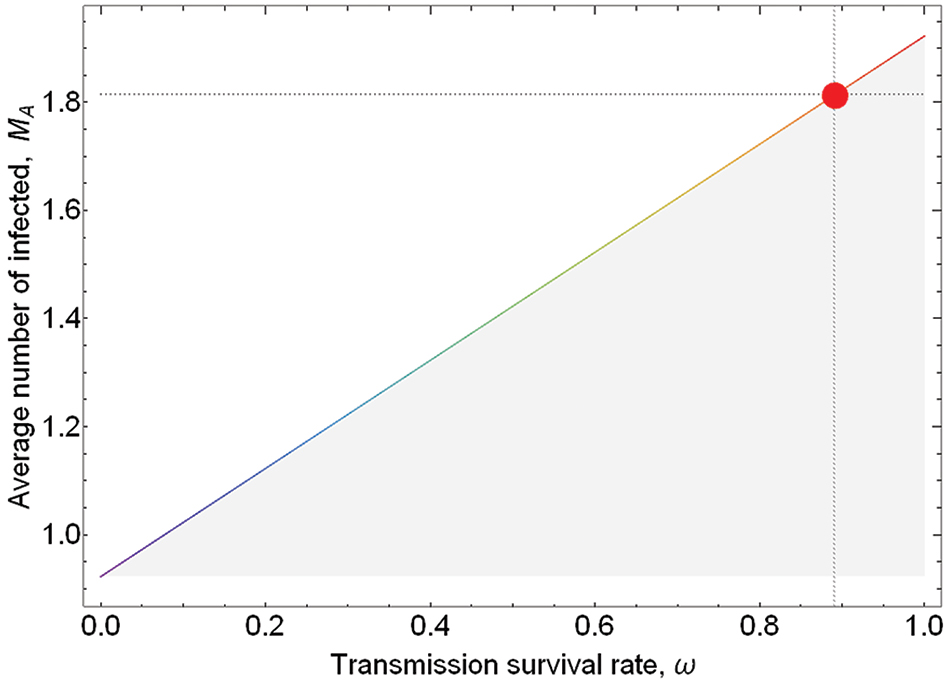
 \begin{equation*}{M_A} = \sum \limits_{i = 2}^{4}\left( 1+\omega \right){p_i}+\omega {p_5} = 1-{p_5}+\omega .\end{equation*}
This relationship is visualized in Figure 1.
Expected (average) number of infested hosts within a brood when only the adult female lice transmit ( ${M_A}$) as a function of transmission survival chance (
 $\omega$). For the maximum value of
 $\omega$, the expected number is close to 2, since both the donor and the recipient hosts are infested. The actual number is 2 minus the ratio of 5-year-old hosts, as their death eliminates the parasites residing on them. For the present model organisms (feral pigeon, slender pigeon lice), the estimated transmission survival and the corresponding infestation rate are shown with a red dot (
 $\omega = 0.89$,
 ${M_A} = 1.81$) at the end of the breeding event.

Second scenario: only the 3rd-stage nymphs transmit to nestlings
As explained above, a focal female has enough 3rd-stage nymphs to potentially infest all nestlings during the host breeding season ( $N \lt K$) while it (and its eggs, 1st- and 2nd-stage nymphs) can stay on the parent bird further on.
First, consider the case of  $j = 2,\text{}3$ and 4-year-old parent birds. Assumably, transmitting lice have no information about the infestation status (the presence or absence of their siblings) of the target nestling; therefore, all nymphs may infest either the same or different nestlings. Therefore, a stochastic urn model is applied to find (see details in Appendix A) the expected number of non-infested nestlings (denoted by X):
 \begin{equation*}\text{E}\left( X \right) = N{\left( 1-\omega \frac 1{N} \right)^K}.\end{equation*}
Thus, the expected number of infested nestlings (M):
 \begin{equation*}M = N-\text{E}\left( X \right) = N-N{\left( 1-\omega \frac 1{N} \right)^K} = N\left( 1-{\left( 1-\omega \frac 1{N} \right)^K} \right)\end{equation*}
Being 2–4 years old, the parent birds also remain infested; therefore, the expected number of birds infested by the focal lineage of lice:
 \begin{equation*}{M_L} = M+1.\end{equation*}
Second, consider the case of 5-year-old birds. The adult female louse staying on the parent bird would perish, while the expected number of birds infested by its descendant is  $M$.
By applying the principle of total probability, the phenotype of feather lice in which only the 3rd-stage nymphs transmit will on average infest the following number of birds at the end of the breeding season:
 \begin{equation*}{M_L} = \sum \limits_{i = 2}^{4}\left( M+1 \right){p_i}+M{p_5} = M+1-{p_5}\end{equation*}
Figure 2 illustrates how the probability that a nymph survives transmission (ω) and the number of 3rd-stage nymphs produced within 20 days (K) determine the expected number of infested birds (ML) at the end of the breeding event.
The expected number of infested birds ( ${M_L}$) as a function of the probability that a nymph survives transmission (
 $\omega$) and the number of 3rd-stage nymphs (
 $K$). Its maximum value is always
 $N+1-{p_5}$, which it approaches monotonically, since
 $M\rightarrow N$,
 ${M_L} = M+1-{p_5}$.

Which strategy performs better
In Columbiform birds, and the feral pigeon in particular, the number of nestlings is typically fixed at  $N = 2$. In this situation, the strategy of transmission by the 3rd-stage nymphs (
 ${M_L}$) always outperforms the strategy of transmission by adult females (
 ${M_A}$) (assuming
 $\omega = 0.89$ and
 $\omega = 0.52$). The advantage of the former strategy further increases as the number of parasite offspring increases (Figure 3).
The expected number of infested birds at the end of the breeding season for the case study of the feral pigeon/slender pigeon lice system. The values  ${M_A}$ (blue line) and
 ${M_L}$ (orange lines) represent the success of strategies when only the adult female lice (
 ${M_A}$) or when the 3rd-stage nymphs (
 ${M_L}$) transmit. (The number of host nestlings is fixed at
 $N = 2$.) For the number of lice offspring, we assume the values of
 $K = 2$ (light orange line),
 $K = 4$ (orange line) and
 $K = 8$ (brown line). The assumed survival rates of the adult lice (
 $\omega = 0.89$) and the 3rd-stage nymphs (
 $\omega = 0.52$), and the corresponding average number of infested hosts are marked by the dotted lines and coloured dots.

To generalize these results to other bird taxa, which most often produce a higher number of nestlings in a clutch, we investigate the effects of increasing the number of host offspring. The number of a focal female’s 3rd-stage nymphs emerging during the infestation time window is fixed at  $K = 5$. Again, nymphal transmission strategy (
 ${M_L}$) always outperforms adult transmission (
 ${M_A}$), and this difference further increases at high transmission survival (
 $\omega $) and large number of nestlings (
 $N$). The 2 strategies yield equal results only in the unlikely scenario when transmission survival is maximal, and the host has only 1 offspring
 $(\omega = 1$,
 $N = 1)$ (Figure 4).
The expected number of infested birds (M) in a brood at the end of the breeding season, represented on the vertical axis. The values  ${M_A}$ (bottom plane) and
 ${M_L}$ (upper plane) increase with increasing probability of transmission survival (
 $\omega$) and increasing number of host offspring (
 $N$). The number of a focal female’s 3rd-stage nymphs emerging during the infestation time window is fixed at
 $K = 5$. The values of
 ${M_L}$ exceed (or are equal to) the values of
 ${M_A}$, indicating that transmission in the 3rd nymphal stage is a more successful strategy than transmission in the adult stage. The 2 strategies yield equal results only in the unlikely scenario when transmission survival is maximal, and the host has only 1 offspring
 $(\omega = 1$,
 $N = 1)$.

Finally, Figure 5 shows that the 2 strategies yield equal results only in the unlikely scenarios when the hosts produce only 1 offspring ( $N = 1)$, and either there is only 1 3rd-stage nymph
 $\left( K = 1 \right)$ or the transmission has no mortality risk
 $(\omega = 1$). At higher clutch sizes (
 $N = 2,4,8)$, however, nymphal transmission (
 ${M_L}$) is more advantageous than adult transmission (
 ${M_A}$), except for the case when there is only one 3rd-stage nymph
 $\left( K = 1 \right)$. Otherwise, the advantage of nymphal transmission over adult transmission further increases with the increasing number of 3rd-stage (
 $K$). Note that
 ${M_L}$ is superior to
 ${M_A}$ even when the number of 3rd-stage nymphs is lower than the number of nestlings
 $(K \lt N)$.
The expected number of infested birds at the end of the breeding season, represented on the vertical axis. The values  ${M_A}$ (bottom panels) and (upper panels) increase with increasing probability of transmission survival (
 $\omega$) and increasing number of parasite offspring (
 $K$). The 4 panels show different values of host offspring (
 $N = 1,2,4,8$). For all values of
 $\omega$ when
 $K = 1$, and all values of
 $K$ when
 $\omega = 0$, the 2 strategies (
 ${M_L}$ vs
 ${M_A}$) give equal results. When
 $N = 1$ (upper left panel),
 ${M_L}$ and
 ${M_A}$ are also equal for all values of
 $K$ when
 $\omega = 1$. The situations where the number of 3rd-stage nymphs is lower than the number of nestlings
 $(K \lt N)\text{}$is shaded grey.

The availability of sexual partners on the new host
Ischnoceran lice (and almost all other Phthirapterans) reproduce sexually (Johnson and Clayton, Reference Johnson, Clayton, Price, Hellenthal, Palma, Johnson and Clayton2003; Gustafsson et al., Reference Gustafsson, Zou, Li and Sun2024), raising the question of whether potential sexual partners will be present on the newly invaded nestling. Since female lice can store sperm (Lang, Reference Lang1975; Tryjanowski et al., Reference Tryjanowski, Adamski, Dylewska, Bulkai and Rózsa2009) in the appendage of the genital organ called spermatheca (Ahmad et al., Reference Ahmad, Gupta and Saxena2013), this is not a limiting factor when the adult females invade a nestling. Conversely, a transmitting nymph may face a lack of sexual partners on the new host in the future. Appendix B details a stochastic urn model to quantify the probability that sexual partners will be available after transmission to a nestling, while the subsequent infestations from other birds, e.g. during copulations, are not considered. This is an infrapopulation-level question and given that a typical infested feral pigeon hosts 10 female lice (see above), each producing  $K$ 3rd-stage nymphs during the time window open for infestations, the probability of finding a sexual partner on the newly infested nestling is often relatively high, particularly when the number and transmission survival chances of 3rd-stage nymphs are high, and the number of nestlings in a clutch is low (Figure 6).
The probability that at least 1 male and at least 1 female nymph infest the nestling ( $Y$) with increasing probability of transmission survival (
 $\omega$) and increasing number of 3rd-stage nymphs (
 $K$). The 4 panels show different values of host offspring (
 $N = 1,2,4,8$). The lines represent the contour lines connecting similar values of
 $X$ along the plane, and the number is also written next to a few of the lines.

Let  $Y$ denote the probability that each nestling becomes infested by exactly 1 male and 1 female nymph, and let
 $L$ denote the total number of 3rd-stage nymphs emerging on the parent bird during the breeding season (i.e. offspring of all the 10 adult females hosted by a pigeon,
 $L = NK$). As explained in Appendix B,
 \begin{equation*}Y = {\left( 1-{e^{-\omega L/2N}} \right)^{2N}} = {\left( 1-\frac 1{{e^{\omega L/2N}}} \right)^{2N}}\end{equation*}
Optimal decisions of adult male lice
Throughout the above text, the optimal decisions for adult females were discussed. Note that the optimization strategy of adult males may not differ much. From the present point of view, there are only 2 differences between the sexes. First, males are slightly smaller than females (2.29 vs 2.68 mm), so the present model predicts slightly lower transmission survival for males than for females ( $\omega$ = 0.76 vs 0.89). Second, transmitting adult males need to find females on the newly infested bird to reproduce there, whereas adult females do not necessarily need a sexual partner on the new host because they may carry sperm from the former host stored in the spermatheca. Both differences indicate that transmission from parent birds to nestlings is even less beneficial for adult males than it is for adult female lice.
Discussion
How ectoparasites optimize their decision whether to stay on their current host or take the risk of transmission is a crucial question in the evolutionary ecology of parasites, pathogens and even the virulence of diseases. The frequency of transmission events is partly determined by the occurrence of opportunities to transmit, and partly by the parasites’ adaptive interest in taking advantage of such opportunities.
Most of the related studies focused on the phenotypic plasticity in Plasmodium spp., asking what cues influence malaria parasites to allocate more or less resources to gametocytogenesis, i.e. the formation of transmissible forms (see e.g. Birget et al., Reference Birget, Repton, O’donnell, Schneider and Reece2017). Contrarily, the present subject differs from the intensively studied Plasmodium systems in that it focuses on genetically fixed alternative strategies and compares optimal decisions at 2 developmental stages.
We chose the feral pigeon and slender pigeon louse as a model because their life history details (number of offspring, longevity of developmental stages, etc.) are well documented. Unfortunately, they do not necessarily represent the most characteristic, major taxa of birds and lice. For example, pigeons have only 2 nestlings in a brood, while most other birds have more. Note that a greater number of nestlings increases the adaptive benefit of nymphal transmission, thus strengthening our results. Contrarily, a shorter time window for vertical transmission may exert the opposite effect, as suspected in the case of precocial birds. Note that some lice of precocial birds were observed to widen the infestation time window by infesting the offspring as early as the egg phase (Rankin, Reference Rankin1982).
Further, an important presumption of the present model is the cost (mortality risk) of transmission. Without this mortality risk, a focal female would optimally wander across both parents and all the nestlings, depositing eggs on each of them. Admittedly, there is no experimental evidence for mortality during transmission, although it is often observed and generally accepted that Ischnoceran lice have more restricted mobility than Amblyceran lice (Johnson and Clayton, Reference Johnson, Clayton, Price, Hellenthal, Palma, Johnson and Clayton2003; Gustafsson et al., Reference Gustafsson, Zou, Li and Sun2024). Therefore, it seems reasonable to presume that vulnerability to desiccation, detachment and host grooming are major causes of transmission mortality, particularly in the Ischnocerans.
Note that we focused our interest above on the vertical transmission routes, from parents to offspring. Other transmission routes – such as sexual transmission and phoresy – may require different optimization strategies where the above results do not apply. Further, note that our model does not necessarily predict that nymphs should outnumber adults on the offspring. The prediction is that the proportion of nymphs should be relatively higher on nestlings than on parents. Thus, one cannot use those studies to verify or falsify this prediction, which describes only the nestlings’ infestations, but not the infestations of the parents.
The observation that louse nymphs transmit more readily than adults via vertical transmission routes has never been explained. The above finding that lineage-level fitness is maximized by nymphal (rather than adult) transmission can be supported by a simple verbal reasoning. Imagine a lineage with a transmitting adult female and her non-transmitting nymphs. At the end of the breeding season, only 2 birds will be infested: the parent bird infested by nymphs and eggs, and one of the nestlings infested by the focal female. Contrarily, consider another lineage with a non-transmitting focal female and her transmitting nymphs. At the end of the breeding season, the parent bird is infested by the adult female and her eggs, and most (possibly all) of her nestlings are infested by nymphal lice. The mathematical modelling presented above provides detailed support for this simple verbal reasoning. It is important to emphasize that parasite fitness was assessed by the number of infested hosts and, thus, by the number of surviving parasite lineages. If parasite fitness were assessed by the number of surviving descendants (e.g. lifetime reproductive success), the same conclusion could not be reached (Rózsa and Garay, Reference Rózsa and Garay2023).
The fate of louse lineages was tracked only until the end of the host breeding attempt. The present model does not account for the higher mortality of 1st-year birds compared to older ones, which would further reduce the benefits of vertical transmission. However, since this effect influences both 3rd-stage nymphs and adult lice equally, omitting this effect does not change the above conclusions.
As far as possible, realistic parameters close to those of the well-known pigeon/slender pigeon lice system were chosen and then attempts to generalize results to other host-parasite systems were also made. The present model was intended as a starting point to show how the kin demographic selection model (focusing on the fitness of lineages rather than individuals) can give insight into the evolution of parasites’ decisions on transmission. Hopefully, specifying more exact conditions in the future will enable future authors to make more accurate predictions for real life.
All developmental stages of parasitic lice, except for the eggs, are capable of transmission, indicating an unspecialized life cycle. From a transmission point of view, this is a generalist state that may reflect an ancient evolutionary state. Once one particular developmental stage becomes better adapted for transmission, it may or may not evolve into a specialized transmissive stage that loses all other functions related to growth and multiplication. This may result in more complex life cycles, with functionally different developmental stages, as observed in many other parasite groups.
Briefly, it can be concluded that optimal transmission strategies are life-stage dependent, and early developmental stages face fundamentally different trade-offs than mature ones.
Acknowledgements
During the preparation of this work, L.R. used Grammarly (https://app.grammarly.com/) in order to improve English style and fluency. After using this tool, all authors reviewed and edited the content as needed and take full responsibility for the content of the published article. The authors thank colleagues and reviewers for general discussions and positive feedback.
Author contributions
L.R.: conceptualization, investigation, writing, review and editing, supervision, funding acquisition. G.B.: methodology, formal analysis, visualization, writing, review and editing. V.C.: methodology, formal analysis, writing, review and editing. J.G.: conceptualization, methodology, formal analysis, investigation, writing, review and editing.
Financial support
This work was supported by the National Research, Development and Innovation Fund under the contract K143622, and by the Slovak Research and Development Agency under the contract APVV-22-0440.
Competing interests
The authors declare that there are no conflicts of interest.
Ethical standards
Not applicable.
Appendix A
Below, a stochastic urn model is described where (i) the urn represents a host nestling, (ii) the ball represents a transmissive nymph and (iii)  $\omega$ represents the probability that the nymph survives transmission to the nestling. If there are K transmissive nymphs, when will each nestling be infested by at least 1 nymph?
There are  $N$ urns and
 $K$ balls. The balls are distributed one by one among the urns. Each ball can be lost with probability
 $1-\omega$, otherwise it goes to any of the urns with equal probability. Let
 $X$ denote the number of empty urns (representing the number of non-infested nestlings). The distribution of the random variable
 $X$ can be obtained by the sieve called the Waring formula (Feller, Reference Feller1968, sect. IV.3).
Let  ${A_i}$ be the event that the
 $i$th urn is empty. Then the probability that exactly
 $n\text{}$of the events
 ${A_i}$ occur simultaneously, that is,
 $X = n$, is equal to
 \begin{equation*}\text{P}\left( X = n \right) = \sum \limits_{k = n}^{K}{\left( -1 \right)^{k-n}}\left( \begin{array}{c}
k \\
n
\end{array} \right){S_k},\end{equation*}
where
 \begin{equation*}{S_k} = \sum \limits_{\substack{H \subset \left\{ 1,\ldots ,N \right\} \\ \left| H \right| = k}}\text{P}\left( \sum \limits_{i \in H}{A_i} \right).\end{equation*}
In the present case, the probability of the intersection of each  $k$-tuple of events is equal to
 \begin{equation*}{\left( 1-\omega \frac k{N} \right)^K},\end{equation*}
hence
 \begin{equation*}\text{P}\left( X = n \right) = \sum \limits_{k = n}^{N}{\left( -1 \right)^{k-n}}\left( \begin{array}{c}
k \\
n
\end{array} \right)\left( \begin{array}{c}
N \\
k
\end{array} \right){\left( 1-\omega \frac k{N} \right)^K}.\end{equation*}
The expected number of empty urns (representing non-infested nestlings) is equal to the number of urns multiplied by the probability that a given urn is empty, that is,
 \begin{equation*}\text{E}\left( X \right) = N{\left( 1-\omega \frac 1{N} \right)^K}.\end{equation*}
Appendix B
Here again, (i) the urn represents a host nestling, (ii) the balls represent transmissive nymphs, (iii) the colour of the balls represents the sex of the nymphs and (iv) represents the probabilities that the male or female nymph survives transmission to the nestling. The number of adult female parasites infesting a parent bird equals  ${L_A}$, and each of them produces
 $K$ 3rd-stage nymphs with a sex ratio of 0.5 during the 20-day infestation period. The probability of having at least
 $m$ female and at least
 $m$ male parasite offspring on the nestlings, where
 $m$ can be 1, 2 or 3, is to be determined.
Examine the question using an urn model: if the sex ratio of lice is 0.5, and  $K$ is the number of 3rd-stage nymphs transmitting to host offspring, when will each nestling have at least 1 male and at least 1 female parasite?
Suppose now that the balls come in 2 colours, red and white, and we keep allocating them until each urn contains at least  $m$ red and at least
 $m$ white balls. How many balls are needed to achieve this? The answer is quite easy for
 $m = 1$.
For both colours and each urn, consider the event that there are no balls of the given colour in that urn after  $K$ balls have been distributed. These
 $2N$ events are interchangeable. Then the probability that the prescribed
 $k$ events hold simultaneously is equal to
 ${\left( 1-\omega \frac k{2N} \right)^K}$, and the probability that none of these events occurs is
 \begin{equation*}\sum \limits_{k = 0}^{2N}{\left( -1 \right)^k}\left( \begin{array}{c}
2N \\
k
\end{array} \right){\left( 1-\omega \frac k{2N} \right)^K},\end{equation*}
by the sieve formula. Thus, this is the probability that  $K$ balls are enough.
For higher values of  $m$, the exact formula quickly becomes too complicated. An approximate formula can be obtained as follows. Let us make the history of each urn independent. This can be done by supposing that the balls come according to a unit-intensity homogeneous Poisson process. Each ball is either red or white with probability
 $\frac{1}{2}$, and is lost with probability
 $1-\omega$, otherwise it goes to each urn with equal probability. Then balls of a fixed colour arrive in a fixed urn according to a homogeneous Poisson process with intensity
 $\frac{\omega}{2N}$; moreover, these
 $2N$ processes are independent. The goal is achieved up to time
 $t$ if the number of arriving balls, which is Poisson
 $\left( \frac{\omega t}{2N} \right)$, is not less than
 $m$ in each process. The probability of this event is
 \begin{equation}{\left( {\mathop \sum \limits_{i = m}^\infty \frac{1}{{i!}}{{\left( {\frac{{\omega t}}{{2N}}} \right)}^i}{e^{ - \omega t/2N}}} \right)^{2N}} = {\left( {1 - \mathop \sum \limits_{i = 0}^{m - 1} \frac{1}{{i!}}{{\left( {\frac{{\omega t}}{{2N}}} \right)}^i}{e^{ - \omega t/2N}}} \right)^{2N}}.{ }\end{equation}
In particular, for  $m = 1,\text{}2,\text{}3$ we have
 \begin{equation*}{\left( 1-{e^{-\omega t/2N}} \right)^{2N}},\end{equation*}
 \begin{equation*}{\begin{array}{c}
\left( 1-\left( 1+\frac{\omega t}{2N} \right){e^{-\omega t/2N}} \right)
\end{array}^{2N}},\end{equation*}
 \begin{equation*}{\left( 1-\left( 1+\frac{\omega t}{2N}+{\left( \frac{\omega t}{2N} \right)^2} \right){e^{-\omega t/2N}} \right)^{2N}},\end{equation*}
respectively.
Now, what is the connection between time and the number of balls? By the law of large numbers, the time when the  $K$th ball arrives is approximately equal to
 $K$. More precisely, its distribution is gamma
 $\left( K,1 \right)$. However, it would be wrong to integrate formula (1) in
 $t$ according to the gamma distribution, because the event of success and the arrival time of the
 $K$th ball are not stochastically independent.


 Open access

