Introduction: Guitar Heroes
Like many guitarists, during the Guitar Hero craze of 2005–2010, I often asked myself: ‘Why don't people want to play a real guitar instead?’ In retrospect, the real question I should have been asking is: ‘Why do people flock to Guitar Hero?’ In a word, it was accessible. It was fun, social, easy to learn, offered different levels of difficulty, and with a price tag of US$100 it was relatively affordable compared with other musical instruments. Further, it was ergonomically designed; producing a power chord was as easy as pushing a button. Guitar Hero offered an entry portal into the musical realm that many people had previously found difficult to access. Like all fads, Guitar Hero did not withstand the test of time and is now out of production as the lustre of guitar games seems to have faded in popular culture. I suspect that the inability of guitar games to retain cachet, or ‘stickiness’ (Gladwell, Reference GLADWELL2000), is due to their inability to offer an authentic and thereby meaningful musical experience. Guitar games are analogous to chocolate bars; a temporary fix that fails to satiate our ‘musical hunger’ (Laird, Reference LAIRD2009).
The popularity of Guitar Hero made it evident that there is a strong demand for a musical experience that is enmeshed in popular culture. Walser (Reference WALSER1993) explains: ‘popular culture is important because that is where most people get their ‘entertainment’ and information; it's where they find dominant definitions of themselves as well as alternatives, options to try on for size’ (p. xiv). It is critical to appreciate that the guitar has a high value in cultural capital and that new music learners are immersed in a culture in which the guitar is the predominant vehicle of music-making. In terms of instrument sales, the guitar outsells all other instruments considerably (NAMM Global Report, 2009). For example, in the USA, close to 3 million acoustic and electric guitars were sold in 2008; the closest rival, the portable keyboard, accounted for approximately 1.1 million units sold. The year 2008 coincides with the height of Guitar Hero pandemonium as the game ‘Guitar Hero III: Legends of Rock’ sold over 3 million units in the USA (NPD Group, 2008).
Solving the six-string: problem and research question
Given the guitar's mass popularity, it follows that the guitar-learning community is vast and diverse. As a teacher of people with intellectual and physical disabilities, I have struggled to find ways to make the guitar more accessible to my students. Based on my experiences, I have often found that they find the guitar enjoyable to strum, but especially difficult to fret. The subject of this study, Phil, is 18 and has Down syndrome. In addition to intellectual disabilities, people with Down syndrome often have some physical disabilities such as hearing loss, speech problems, poor muscle tone, loose joints and fine motor control difficulties (Alton, Reference ALTON1998). Related to the guitar is the issue of hand dexterity. Bruni (Reference BRUNI2006) explains that hypotonia (low muscle tone) ‘in the lower arm and hand make it difficult for the child to position his finger joints to hold an object such as a pencil without his joints ‘collapsing’’ (p. 20). For Phil, the major challenge presented to him by the guitar was the action of fretting. In this paper I explore ways of adapting the guitar for Phil, which may be applicable to persons with similarly limited strength and dexterity in their fretting hand. How can the guitar be adapted for a person whose abilities are limited in these regards?
Conceptual framework: the social model of disability
In the social model, disability is framed as a societal problem rather than the problem of an individual (Cameron, Reference CAMERON2009). Categorisations of who is able or disabled are social constructions (Stras, Reference STRAS2009). Rose and Meyer (Reference ROSE, MEYER, Rose, Meyer and Hitchcock2005) posit that rather than retrofitting infrastructure to accommodate people with disabilities, societies ought to create new infrastructures that are accessible to all. Applying the social model of disability, they propound that the individual is not disabled, but rather the infrastructure is disabled. In a music education context, when a barrier is encountered, rather than focusing on what is ‘wrong’ with the individual, we should be accountable for what is wrong with the situation. Removing the barriers to music education is a matter of justice (Jorgensen, Reference JORGENSEN2007).
Musical instruments often have barriers. Fostering an inclusive music education environment entails striving to enable instruments for students with intellectual and/or physical disabilities. Practitioners and researchers from various music-related disciplines have demonstrated enabling adaptations for instruments including flute (Nabb, Reference NABB2007), recorder (Dickeson, Reference DICKESON2004; Peskin, Reference PESKIN2004; Kennedy & Kua-Walker, Reference KENNEDY and KUA-WALKER2006), saxophone (Cohen, Reference COHEN1987; Nabb & Balcetis, Reference NABB and BALCETIS2010), trumpet (Snedeker, Reference SNEDEKER2005) and various percussion instruments (Crowe & Ratner, Reference CROWE and RATNER2012). Despite the disabilities of the guitar and the resulting barriers it presents to learners, our guitar-hero-worshipping culture continues to position it on a pedestal, making it an ‘instrument of desire’ (Waksman, Reference WAKSMAN1999). As both a guitarist and teacher of students with intellectual and physical disabilities, I felt compelled to increase the guitar's accessibility, and grounded in the social model of disability, I approached this study with the mentality that guitars have disabilities.
Review of related literature
Disability policy and music
In both the UK and North America, governmental structures have been in place for over 30 years to support the education of people with intellectual and physical disabilities. Hodkinson (Reference HODKINSON2010) details that the societal push towards inclusive education in Britain can be traced back to the early 1900s, which gained traction in the Civil Rights movement and eventually led to the Education Act of 1981. Similarly, the Civil Rights Movement in North America was the change agent that pressured governments to enact disability rights legislature. In 1975 the American Public Law 94–142, also known as the Disabilities Education Act, gave students with disabilities free access to a public education (Smith, Reference SMITH2001, p. 35). Shortly thereafter, the Canadian Human Rights Act of 1977 barred discrimination on the grounds of intellectual or physical ability (Hutchinson, Reference HUTCHINSON2002, p. 5). Internationally, the UNESCO ‘Salamanca Agreement’ of 1994 provided a global platform for nations to commit to inclusion as a human right (Culham & Nind, Reference CULHAM and NIND2003). Further, access to education and the arts are cited in the Universal Declaration of Human Rights, first published in 1948, declaring both the right to an education (Article 26) and the right ‘to enjoy the arts’ (Article 27). More specific to music education, Lubet (Reference LUBET2011) explains that participating in music is both a human right and a disability right, and Williams (Reference WILLIAMS2013) labels music a ‘fundamental human occupation’ (p. 39). Despite the philosophical and political backing of inclusive music education, ‘relatively little has been written on music education for children and young people with disabilities’ (Ockelford, Reference OCKELFORD2008, p. 39).
The guitar in music education
The guitar is seemingly ubiquitous in learning contexts inside and outside of classrooms, yet Silverman (Reference SILVERMAN2011) found that ‘data are not available for its use in music education settings’ (p. 284). Haley (2009) and Seifried (Reference SEIFRIED2012) reference regional successes in growing US school guitar programmes (Nevada and Virginia respectively), and both credit the Teaching Guitar Workshops advocacy group with starting over 1000 new guitar programmes across the USA and Canada. Additionally, Little Kids Rock has proliferated the guitar's existence throughout US schools since 2002 by donating rock instruments to over 300 000 ‘under-served schoolchildren’ (Little Kids Rock, n.d.). The informal learning programme Musical Futures (Green, Reference GREEN2008), which also promotes rock instruments including guitar, commenced with 1500 students in the UK and has since expanded into other parts of Europe, Southeast Asia, Australia, North America and South America. The past decade has witnessed a surge of interest in informal learning pedagogy in music education sparked by Green (Reference GREEN2002), which has focused almost solely on ‘conventional rock band practices’ (Väkevä, Reference VÄKEVÄ2010, p. 63). While teaching and learning strategies have been the focus of this movement, by association the guitar has been ushered to the forefront as the identity instrument of informal pedagogy. Before the informal pedagogy wave swept through the research community in music education, guitar pedagogy followed either the classical Segovia method (Walser, Reference WALSER1993) or the self-teaching and teacher-imitating informal method (Schwartz, Reference SCHWARTZ1993). Music education has yet to plumb the pedagogy of guitar and by comparison to the field of music therapy is in its infancy of problematising the guitar and developing varied instructional approaches for it.
The guitar in music therapy
Paralleling the post-War Paralympic movement in which sports were utilised ‘as an aid to the treatment and rehabilitation of war disabled’ (Guttman, Reference GUTTMAN1976, p. 17), the practice of music therapy gained popularity as ‘musicians and music teachers were brought into hospitals to perform and later teach music skills to the patients’ (Crowe, Reference CROWE2004, p. 10). As the occupation of music therapy has evolved in the post-War era, it has done so in a period of history in which the guitar and piano have been the primary instruments of accompaniment in popular music. Piano, voice and guitar tuition are fundamental components of a music therapist's training to acquire ‘functional skills’ required for professional certification (Gregory & Belgrave, Reference GREGORY and BELGRAVE2009). In a survey of 272 music therapists, Choi (Reference CHOI2008) found that 55% of respondents indicated that the guitar was the primary instrument used in their therapy sessions. Based on a review of music therapy literature spanning from 1966–2005, Krout (Reference KROUT2007) concluded that the guitar's use has increased through the decades and ‘dramatically during the first decade of the 21st century’ (p. 48). Strategies for assisting clients to play the guitar include varied approaches to open tunings (Barksdale, Reference BARKSDALE2003; Aigen, Reference AIGEN2005; Meyer et al., Reference MEYER, VILLERS and EBNET2010; Beer, Reference BEER2011; Oden, Reference ODEN2014) and standard tuning (Thompson, Reference THOMPSON2009; Schwantes & McKinney, Reference SCHWANTES and McKINNEY2010; Soshensky, Reference SOSHENSKY2011; Oden, Reference ODEN2014).
Guitar adaptations
Clark and Chadwick's Clinically Adapted Instruments for the Multiply Handicapped (1980) diagrams possible ways to adapt various instruments for clients in music therapy settings, including the guitar with implements such as the ‘spiral pick’ that can be coiled around any finger or toe. Oden (Reference ODEN2014) discusses several other alternative pick styles including the 4” by 4.75” ‘monster pick’, the ‘maxi pick’, which requires retrofitting of the monster pick by affixing a foam handle to make grasping it easier, the ‘orbit pick’, which incorporates a flexible tail-like extension on the pick to allow all fingers of the hand to grasp it, and the ‘rhythm pick’, which features two picks adhered to an egg shaker. For guitarists who do not have the ability to strum using their arm, Bennett and LaVerde (Reference BENNETT and LAVERDE2000) designed ‘The Guitar Strummer’ at Duke University's Biomedical Engineering Department. The mechanism simulates the strumming motion by using a foot pedal to activate a strumming device mounted above the strings and sound hole of an acoustic guitar. An electric prototype of the same design, the ‘Foot-Action Guitar Strummer,’ was later developed at Duke by a different team of designers (Lee et al., Reference LEE, LEUNG and TOPEL2006). These adaptive devices could potentially enable the guitar by making the strumming motion more accessible, which Chadwick and Clark (Reference CHADWICK and CLARK1980) describe as ‘an emotionally satisfying, tactilely pleasing, and motorically effective activity’ (p. 58).
Elliott's Guide to the Selection of Musical Instruments with Respect to Physical Ability and Disability (Reference ELLIOT1982) provides a comprehensive account of the muscle groups and joint flexes required for playing various musical instruments, highlighting the fact that most instruments require a complex set of movements to be played. As research psychologist Gary Marcus’ guitar-learning journey, Guitar Zero (Reference MARCUS2012), details, even for the individual without physical disabilities, the physical aspect of fretting is very demanding:
Forming a chord requires you to form weird left-hand shapes that span across several strings . . . the beginner has little choice but to memorise an obscure series of shapes. And even once one memorises where one's fingers go, there is the by no means trivial matter of holding them all down at the same time, each perfectly aligned. (p. 15)
Beyond the typical pains experienced by learning guitarists as they develop calluses on their fingertips, arm and wrist strength, and dexterity, medical researchers have reported that guitar players frequently experience playing-related musculoskeletal problems (Rigg et al., Reference RIGG, MARRINAN and THOMAS2003; Fjellman-Wiklund & Chesky, Reference FJELLMAN-WIKLUND and CHESKY2006; Ranelli, Straker, & Smith, Reference RANELLI, STRAKER and SMITH2011). Fretting technologies are intended to reduce the need for fine motor skills as it pertains to creating chord formations on the guitar's fretboard. Compared with an acoustic guitar, typically an electric guitar's strings are a lighter gauge and positioned closer to the fretboard, two critical factors that reduce the physical strength and dexterity needed to depress a fretting device.
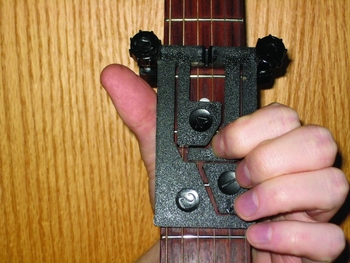
The EZ Chord (Figure 1) attaches onto a standard-tuned guitar and can be positioned on any fret. By pressing a single button, the player can produce major chords I, II, IV, V. For example, if the EZ Chord is mounted on the first fret, the device can produce D-major, E-major, G-major and A-major. An advantage of the EZ Chord is that it only requires a finger or a thumb to do the work of three fingers. Additionally if the player chooses to play the guitar on their lap with the sound hole facing up, the EZ Chord can still be utilised (Krout, Reference KROUT2007). Ultimately this device succeeds in reducing the dexterity required to play the guitar (Barksdale, Reference BARKSDALE2003; Oden, Reference ODEN2014).
The EZ Chord (“E-Z Chord”)

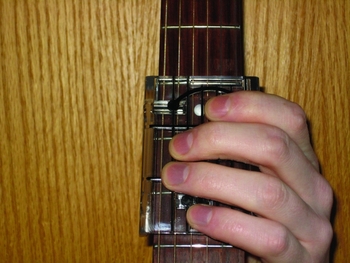
Like the EZ chord, the Davis EZ Chord (Figure 2) can be used on any guitar with standard tuning. It is a plastic mould that simulates the E-major shape and A-minor shape bar chords. The player presses the device against the fretboard and slides it to a different fret to change chords. In the ‘up’ position it produces major chords, in the ‘down’ position it produces minor chords. The pressure required to effectively use the Davis EZ Chord is similar to playing a bar chord with one's hand.
The Davis EZ Chord (“The Slide Chord”)

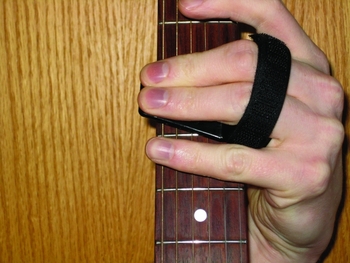
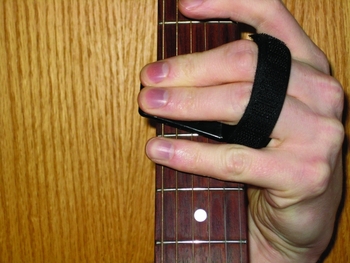
The Barre Chorder (Figure 3) straps onto two fingers of the fretting hand. With the guitar in an open tuning (e.g. DGDGBD), the player can play any major chord by moving the Barre Chorder to a different fret. Oden (Reference ODEN2014) suggests that the Barre Chorder may aid in reducing the pressure required to produce a bar chord because it allows the player to use the strength of all of their fingers instead of just one. The pressure required to produce a chord is less than that of the Davis EZ Chord and the EZ Chord. The best sonic results produced by this device are in an open major tuning.
The Barre Chorder (“Guitar Barre”)
Method
I met Phil through a community organisation that supports adolescents with intellectual disabilities. Conveniently, he lived within walking distance of my residence and we were able to coordinate afterschool guitar lessons twice a week for an hour over the course of three months. The methodological approach employed in this study subscribed to Eisner (Reference EISNER1998), using the ethnographic research tools of interviewing and observing to collect data. Given that Phil was selected because he is an adolescent with Down syndrome interested in playing the guitar, a more specific categorisation of this study is an instrumental case study because ‘a particular case is examined mainly to provide insight into an issue or to redraw a generalisation’ (Stake, Reference STAKE, Denzin and Lincoln2008, p. 445).
The primary source of data used was video, which was used in place of direct observation because I was both the teacher and participant and therefore unable to take substantive notes during the lessons. The video camera was positioned in a stationary position in the corner of the studio and framed on Phil. Video was used to capture Phil's responses to the music lessons, a strategy that has been utilised by other music researchers (Johansson, Reference JOHANSSON2004; Daniel, Reference DANIEL2006; Seddon & Biasutti, Reference SEDDON and BIASUTTI2010). Following the ‘thick description’ procedure to analyse videos (Goldman, Reference GOLDMAN, Goldman, Pea, Barron and Derry2007), I observed and described the processes, gestures, interactions, events and actions of Phil in a video log following each lesson. In addition to the video logs, I created field notes. After each lesson I recalled and recorded my ‘first impressions and personal reactions’ (Emerson et al., Reference EMERSON, FRETZ and SHAW1995, p. 18). My field notes focused on the how as opposed to the why, and described ‘the activities and the meanings associated with them’ (p. 28). Lastly, a series of questions were addressed through a semi-structured interview with Phil's mother at the conclusion of the study to provide an additional perspective to the interpretation of the data. The interview was framed as a conversation between myself and Phil's mother; in the words of Kvale (Reference KVALE2009), ‘it is an inter-view, where knowledge is constructed in the inter-action between the interviewer and the interviewee’ (p. 2). I transcribed the interview and had Phil's mother examine it for accuracy. I also attempted to interview Phil about various aspects of the study, but his responses did not enrich the dataset as they tended to be either succinct and nondescript (e.g. ‘yeah’) or tangential and unrelated to the questions posed.
Analysis of the multiple sources of data entailed thematic coding: ‘the dominant features of the situation or person, those qualities of place, person, or object that define or describe identity . . . a theme is like a pervasive quality’ (Eisner, Reference EISNER1998, p. 189). The video logs, field notes and interview transcript were examined for their pervasive qualities and used to build a narrative. I examined each data source for its contribution to the telling of the story of Phil's guitar-learning journey. Guiding questions included: What happened and was accomplished during each lesson? How did Phil's responses to the lessons impact future pedagogical considerations? What strategies worked well and why, and conversely, what strategies failed and why? The data were then triangulated, or what Eisner terms structural corroboration ‘to describe the confluence of multiple data sources of evidence or the recurrence of instances that support a conclusion’ (p. 55). To create the narrative I followed the advice of Riessman (Reference RIESSMAN2008): ‘A good narrative analysis prompts the reader to think beyond the surface of a text, and there is a move toward a broader commentary’ (p. 13). The results section is themed by the type of guitar adaptation used: open D-tuning, two-string and standard tuning.
Setting and context of the study
The lessons took place in my rehearsal room that is equipped with a well-worn PA system, electric piano, electric guitars, electric bass, amplifiers and a drum kit. Phil was interested in all of the instruments and spent time exploring each, but for the purpose of this article I have delimited the scope to his time spent learning how to play the guitar. Phil's mother disclosed to me that he had some previous experience playing the guitar, but it was short-lived and failed to sustain his interest. Two years previous to the study a man named Devon gave Phil guitar lessons, mostly focusing on how to play chords. Phil's mother reflected: ‘that was a little sad because Devon was trying really hard and Phil was less interested in the formal aspects of learning the guitar’. Bearing this anecdote in mind, my primary goal for Phil's lessons was to ensure that he enjoyed the experience of playing the guitar. The lessons needed to be adaptive to Phil's needs and therefore an emergent curricular design was utilised wherein the content of each lesson plan was contingent on the outcomes of the previous lesson. The general lesson structure was intended to be accommodating to Phil's level of interest and typically each lesson commenced with a demonstration of a skill or concept on the guitar. This was followed by a period of exploration that often included ‘jamming’ (Green, Reference GREEN2002), with Phil playing the guitar and myself accompanying him on drums.
Phil's favourite music genre is rock and at the time of the study his favourite band was Green Day. Gardstrom (Reference GARDSTROM2007) stresses the importance of instrument choice, advising to select instruments ‘that are associated with the performers whom adolescents admire’ (p. 34). Careful considerations needed to be made about what type of guitar and whether or not to adapt it. I wanted Phil's experience of playing the guitar to be authentic within the domain of rock and to be able to emulate the sounds of bands he listened to such as Green Day. I chose my Fender Stratocaster electric guitar for Phil and connected it to a Boss Dual Overdrive pedal and a Fender Blues Deluxe 40-watt tube amplifier. I reasoned that this setup would enable Phil to make that Green Day sound of loud and heavy distortion.
Results
Open-D tuning
Initially my aim was to show Phil how to play a chord using an open-tuned guitar. I tuned the guitar to an open D-major chord (DADF#AD), surmising that at the very least, if Phil could strum the guitar without fretting, he could produce a chord. Further, I reasoned if Phil could depress his index finger flat across all six strings on a single fret supported by his thumb pressing on the back of the guitar's neck, he could play other major chords. In theory this approach enabled the guitar by requiring less strength and dexterity.
I demonstrated this concept to Phil as he watched on, strumming the guitar without a fretting hand to produce the D-major chord and then barring my hand across the fifth fret to produce the A-major chord. My teaching approach was similar to what Schwartz (Reference SCHWARTZ1993) describes: modelling a concept and then asking the student to imitate what they have just observed. Phil was eager to try out the guitar, uttering short phrases of enthusiasm such as ‘ok buddy!’ that were accompanied by laughs of amusement. First, I explained to Phil that if he strummed the guitar without fretting, it would produce a chord (D-major). I also showed him how to strum down strokes and up strokes at varying tempos and he appeared to understand the basics of strumming the guitar without fretting. Second, I placed a sticker on Phil's guitar at the fifth fret and worked with him on making a bar with his hand to press the strings down in order to produce the A-major chord. With my hand guiding his fretting hand, together we practiced going from the open D-major chord to the A-major chord created at the fifth fret by alternating every four beats. I explained to Phil that he had just learned two chords and I asked him to show me where they were on the fretboard and he did so successfully by moving his hand to the sticker at the fifth fret. Next, I asked Phil to independently alternate between the D-major and A-major chords as I had demonstrated and he obliged by moving his fretting hand, but it was too difficult for him to sufficiently squeeze the guitar neck between his index finger and thumb on the fifth fret. I could see how difficult it was for him to shape his left hand to make the needed position. In my notes from that day I reflected: ‘It was difficult for Phil to make a bar with his finger because his left hand has some limited movement. He ended up pressing his finger down only on the bass strings (low D and A), which made a different sounding chord.’ I found that Phil could muster sufficient pressure between the pads of his index finger and thumb, but not between the arch of his thumb and index finger. Based on my experiences teaching other guitar learners, Phil's difficulty in depressing all of the strings simultaneously with sufficient pressure is common. Typically, this is an ability that can be developed over the course of weeks with continued and consistent practice. Following this introductory lesson, I contemplated whether or not I should continue to guide Phil down our current path and arrived at the conclusion that an alternative approach would be better for Phil for three reasons. First, Phil did not possess a guitar of his own to practice the skills learned in our lessons, so instituting a practice regimen was not a viable option. Second, considering that Phil frequently participated in Special Olympic events that require a strong grip such as bowling, I was sceptical he would be able to develop more strength for fretting than he already possessed. Third, factoring in the comment of Phil's mother, that he was less interested in the formal aspects of playing the guitar, it did not seem appropriate to forge ahead with a skill-centric agenda. Recognising a change in trajectory was needed, I instituted a new strategy to enable the guitar for Phil.
Two-string
Inspired by the ‘Guitbass’, a modified guitar that uses only three strings in an open tuning, pioneered by Dave Dederer of the rock group The Presidents of the United States of America, I prepared a two-string electric guitar using a different Fender Stratocaster for Phil in open D tuning (strings are D and A). I removed all of the strings on an electric guitar except the low E and A. Recalling that Phil was able to depress these strings on the six-string guitar, I deduced that by removing the other strings I was removing the barriers. I tuned the E string down to a D so that in an open tuning the guitar would produce a two-note D power chord, commonly notated as D5 in guitar charts and tablatures. Again, as was the case with the open-tuned six-string guitar, if Phil could make a bar with his index finger on any fret, a chord would be produced. I thought this would be ideal because Phil could still play electric guitar and produce heavy sounds, but avoid having the other strings limit his hand dexterity.
A vocal microphone was set up in the room from a previous rehearsal and Phil requested that I turn on the PA. He seemed to be more interested in the microphone than the guitar that I was so eager to see and hear him play. With the Stratocaster slung over his shoulder, he began to strum and improvise vocals into the microphone. In my field notes I made the following observations:
I interjected a few times to try to show Phil how to make a power chord and he seemed to understand, but I still think that it is physically difficult to hold his hand in the proper position required. A skinnier fret board would hold more potential to make this possible so he could wrap his hand around the guitar neck.
Although he could press both strings down with more ease, the guitar neck was still too wide for his hands to comfortably play it. Based on this observation, I realised that I had been focusing on tunings and the number of strings, when the impediment appeared to be the guitar neck. I had no alternative as my Stratocasters have the thinnest necks of the guitars I own. With no other recourse, I decided that the two-string guitar remained the best option and that the lessons should continue with it. Phil disagreed. I was surprised to hear him request to the play the Stratocaster with six strings. He did not articulate his reasoning verbally, but it was clear that he had made his choice and I sensed that there may be something about the look of the two-string guitar that he disliked such as the colour and the missing strings or alternatively that he preferred the feel and/or sound of strumming six strings. In an effort to retain Phil's interest in the study, I supported his decision to play the six-string guitar, which signalled the beginning of the next adaptation.
Standard tuning
The third adaptation, standard tuning, was not an adaptation of the guitar, but rather an adaptation of the context and conceptualisation of learning how to play the guitar. This point in the study constituted a major shift in my mentality on what it means to enable a learning environment. Previous to this third phase, I had problematised the guitar, whereas in the third phase I problematised the broader context. The use of standard tuning in the study was not planned; it was the result of my response to the immediacy of a musical moment. Unimpressed with the two-string guitar, Phil was eager to play the six-string guitar and did not want me to tune it. He wanted me to pass it over to him so that he could start playing. The tuning of the strings were of little importance to Phil, he was more interested in wearing the guitar with the strap slung over his shoulder, strumming the guitar with his right hand, and clenching the microphone with his left hand. He was content strumming the guitar in standard tuning using random fingerings and singing along. I made a conscious decision to support his music-making by serving as his accompanist playing the drum set. I played the basic beat of Michael Jackson's Billie Jean at approximately 130 bpm to follow his strumming tempo and we locked into a groove. Phil's strumming was impressively consistent and the guitar became primarily a rhythmic instrument for him in this instance. In short, we were jamming. Phil transformed in this moment and was clearly engaged in the music. His body language spoke volumes as he moved to the beat and strummed in time. He intermittently sung or shouted nonsensical phrases into the microphone like ‘rock and roll!’ Phil made it clear to me through his expressions and music-making that he derived greater joy from utilising the guitar as rhythmic support for his singing than as harmonic support. The sound produced by Phil's guitar-playing was typically loud, distorted, and feedback-laden as the timbre of his guitar was very important to him. He clearly enjoyed the percussive effect of strumming a palm-muted guitar with the overdrive pedal activated as he frequently repeated this action. This sound was often contrasted with open strums to let each string ring out and allow the guitar to create a swell of feedback. While playing and singing, he would give me directions to play louder, quieter, slower or faster on the drums. In this context, the guitar became immersed in Phil's holistic musical experience. In Phil's conceptualisation of guitar-playing, having someone to play with was more gratifying than having someone simply watch and offer verbal feedback.
For the remainder of the study when Phil played the guitar he would strum it rhythmically and forgo the fingerings I had showed him. He was not interested in learning more techniques than I had already taught him. Occasionally I tried to reintroduce the skill of how to change from one chord to another while playing in time, but I think the coordination of these actions was too demanding for him. Primarily we worked on strumming in time and Phil consistently demonstrated the ability to keep a steady meter. He was most content with strumming the guitar in standard tuning using random fingerings and playing along to a steady drumbeat.
Conclusions
Following the data collection period I questioned whether I had accomplished what I had set out to do: enable the guitar for Phil. Gradually over the course of the three-month study, any formal aspect of teaching dissipated and gave way to extended improvised jams. Considering the initial aim of the study was to make the guitar more accessible for Phil, the fact remains that he was not able to comfortably grip the guitar and perform chord changes. Phil's mother offered the following insight on this issue:
I sort of suspect he came to the end of that because of his own limitations, like getting his hands around the strings and not feeling satisfied with what he's hearing more than the actual learning of what the positions are because I think he could do that.
Multiple times over the course of the study Phil demonstrated his understanding of where to position his hand on the fretboard, therefore the barrier seemed to be solely physical. In reference to the social model of disability outlined in the conceptual framework, this is problematic because ‘a notion of ‘disabled music’ still remains predominantly rooted to the body, and in particular the body of the musician’ (Stras, Reference STRAS2009, p. 299). Perhaps a thinner guitar neck would have been the enabling agent for Phil to comfortably fret the guitar and this avenue should be explored in future inquiries. Yet, it is critical to consider that Phil had a penchant for the standard-tuned six-string guitar. Pinch and Bijsterveld (Reference PINCH and BIJSTERVELD2004) aptly state: ‘musical instruments are used within highly developed and circumscribed social and cultural environments’ (p. 639). To Phil, the guitar he played was authentic and that was more important to him than a guitar I believed to be more accessible. He did not find fault with the instrument, I did. I failed to recognise that in the eyes and ears of Phil, the two-string guitar was a lesser instrument. This was a failure on my part to ‘consider the cultural group from which clients come – their musical tastes and interests’ (Giacobbe & Graham, Reference GIACOBBE, GRAHAM and Wehman1979, p. 145). In this context, to assume that an electric guitar with two strings is comparable to an electric guitar with six strings was erroneous. Phil had never seen one of his rock idols play a two-string guitar, so why should he? In future investigations it would be worthwhile to revisit the open-tuned guitar in the jamming context that characterised the final phase of the study. In the case of Phil, I do not believe that returning to the open-tuned six-string would have made a difference to him in comparison with the standard-tuned six-string. However, other learners who are unable to fret the guitar may appreciate the affordance of producing the open chord because it creates a tonal drone of harmonic support for singing.
In addition to the importance of the authenticity of the guitar, was the amplifier because it mediates the timbre emitted. Millard (Reference MILLARD2004) writes that guitar amplifiers are ‘not just adjuncts to the instrument. They are the sound of rock’ (p. 133). For Phil, the sound quality of his electric guitar was as important, if not more, than the notes he played. He was discerning of the guitar's timbre and was not content to play a ‘clean’ sound. In line with his preferred genre of music – rock – Phil gravitated towards distortion, which Walser (Reference WALSER1993) explains adds both high and low frequency content to the signal resulting in the phenomenon of ‘presence’ and ‘weight’ respectively.
Giving Phil agency as a learner and allowing him to dictate the pace and structure of the lessons was critical in making his guitar-playing experiences successful. In jamming, a context was created in which Phil utilised the guitar percussively, repeatedly demonstrating rhythmic accuracy and consistency in his strumming. Additionally, he evinced dynamic sensitivity by alternating between palm-muted strums and open strums, which created a grunge-esque quiet-loud-quiet-loud contrast. Further, Phil exhibited a preference for situating the guitar within a rock band context by singing and shouting while he strummed his guitar and requesting that I be a part of the experience by contributing a rhythmic foundation on the drum set. I approached the study with the mindset that the disabilities associated with the guitar were physical and related to the body. While I still believe this to be true, Phil elucidated that the greater guitar-learning context itself was disabled.
Adam Patrick Bell is Assistant Professor of Music Technology and Music Education at the John J. Cali School of Music, Montclair State University. His research interests include self-led learning with digital audio workstations, home recording practices, video and screen recording ethnographic research methods for music education, and de-marginalising music education practices with music technology.